


Community hub
Recent from talks
Contribute something
Nothing was collected or created yet.
Lukomorye
View on Wikipedia
Lukomorye, Lukomorie or Lukomorje (Russian: Лукомо́рье) was a region in ancient Russian lands and is described and depicted not only in Russian sources, but also in different non-Russian old sources.[1] Lukomorye is also a prominent fictional location in Russian folklore.
Etymology
[edit]The Russian word itself is an old term for "bight" or "bay". In the word "luk-o-mor-ye", "-o-" is an interfix used to connect two roots, "-ye" is an affix (in this case, of relative location), "luk-" is the root for "bend", "mor-" is the root for "sea". It can also be translated as "curved sea-shore" or "inlet of the sea".
Middle Ages geography and Early Russian manuscripts
[edit]The toponym "Sea Bend" (лука моря, luka morya) and the derivations: lukomorye, lukomorians, etc., have been applied to various geographical locations.[2] It is mentioned in The Tale of Igor's Campaign and the Russian chronicles. According to the chronicles, Lukomorye was inhabited by the nomadic Polovtsy people, and the researchers locate it in the region north of the Sea of Azov, where Polovtsy lived in the 11th—12th centuries.[3] These accounts are seen as a source of inspiration for Alexander Pushkin.[3] In modern Russian culture, the word Lukomorye is most commonly associated with Pushkin's fairy tale poem Ruslan and Lyudmila,[4] starting with the line: "There is a green oak-tree by the lukomorye, …" (У лукоморья дуб зелёный, … ; U lukomorya dub zelyony, …).
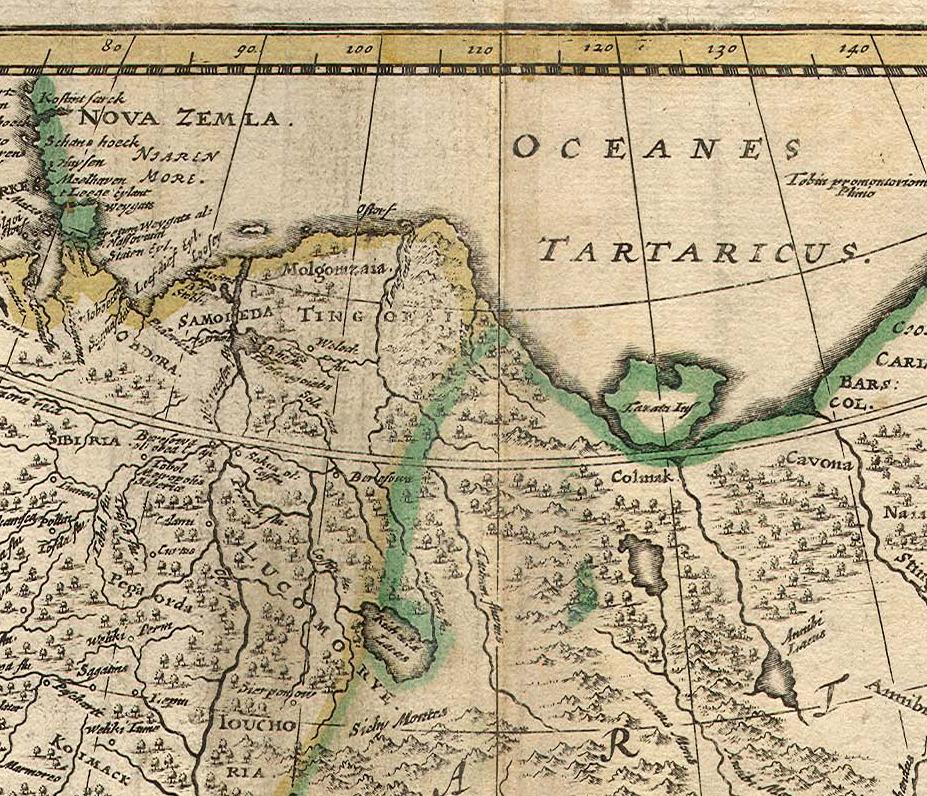
The land of "Lucomoria" was also depicted in a number of antique maps of Siberia/Moscovia.[5] Cartographers followed the descriptions of Sigismund von Herberstein in his 1549 Notes on Muscovite Affairs:[6]
...which they barter with the Grustintzi and Serponovtzi : these latter people derive their name from the fortress of Serponov Lucomoryae, situated in the mountains beyond the river Oby.
It is said that a certain marvellous and incredible occurrence, and very like a fable, happens every year to the people of Lucomoryae, namely, that they die on the 27th of November, which among the Russians is dedicated to St. George, and come to life again like the frosts in the following spring, generally on the 24th of April.
...
The Cossin is a river which flows down from the mountains of Lucomorya ; at its mouth is the fortress of Cossin, which was formerly possessed by the Knes Ventza, but now by his sons.
From the sources of the great river Cossin to this point is a journey of two months. Moreover, from the sources of the same river, rises another river Cassima, which, after passing through the district of Lucomorya, flows into the great river Tachnin ; beyond which are said to dwell men of prodigious stature, some of whom are covered all over with hair, like wild beasts, while others have heads like dogs, and others have no necks, their breast occupying the place of a head, while they have long hands, but no feet. [7]
Giles Fletcher in his Of the Russe Common Wealth repeats the fantastic tale of dying/resurrecting Lukomorians.[8]
Cultural references
[edit].jpg)

- Widely known in Russia is the prologue to the fairy tale poem Ruslan and Lyudmila by Aleksandr Pushkin which starts with the line "У лукоморья дуб зелёный" ("There is a green oak by Lukomorye").
- Lukomorye magazine, illustrated literary and satirical magazine (Russia, 1914-1917)
- Vladimir Vysotsky has a humorous "anti-fairy-tale" song "There is No More Lukomorye".
- Chains of Lukomorye is an announced upcoming video game that includes "Slavic realm of Lukomorye" [1][2]
See also
[edit]References
[edit]- ^ Moskowia, Gustav Kiepenhauer Verlag Weimar, page 117
- ^ Энциклопедия "Слова о полку Игореве": В 5 томах / Рос. акад. наук. Ин-т рус. лит. (Пушкин. дом); Ред. кол.: Л. А. Дмитриев, Д. С. Лихачев, С. А. Семячко, О. В. Творогов (отв. ред.). — СПб.: Дмитрий Буланин, 1995 (in Russian)
- ^ a b Михайлов, В. Д. К локализации пушкинского Лукоморья (in Russian). Retrieved 2009-01-13.
- ^ Nabokov, Vladimir Vladimirovich; Wilson, Edmund; Karlinsky, Simon (3 April 2001). Dear Bunny, Dear Volodya By. University of California Press. p. 120. ISBN 0520220803.
- ^ A fragment of the map of Asia by van Schagen, 1680
- ^ von Herberstein, Sigismund (1549). "De Tartaris". Notes on Muscovite Affairs.
...quas populi Grustintzi & Serponovutzi mercantur, Hi a castro Serponovu Lucomoryae ultra Obi fluvium in montibus sitae nomen habent.
Lucomoryae autem hominibus mirabile quiddam ac incredibile, & fabulae persimile aiunt accidere, quos in singulos annos, nempe XXVII die Novembris, quae apud Ruthenos Sancto Georgio sacra est, mori aiunt: ac vere in sequenti, maxime ad XXIIII Aprilis, ranarum instar, denuo reviviscere.
...
Cossin fluvius ex montibus Lucomoryae delabitur. in huius ostiis Cossin castrum est, quod olim Knes Vuentza, nunc vero illius filii possident.
Eo a Cossin magni fluvii fontibus, est iter duorum mensium. Porro ex eiusdem fluvii fontibus alter fluvius Cassima oritur, emensaque Lucomorya in magnum fluvium Tachnin influit: ultra quem prodigiosae formae homines habitare dicuntur, quorum alii ferarum more, toto corpore pilis horrent: alii caninis capitibus, alii prorsus sine collo pectus pro capite habent, longasque sine pedibus manus. - ^ Herberstein/note Russi V2, Published by Ayer Publishing ISBN 0-8337-2191-7, pp. 40, 41
- ^ "The Travellers' Dictionary of Quotation" by Peter Yapp p. 723
Lukomorye
View on GrokipediaEtymology and Linguistic Origins
Derivation from Old Slavic Terms
The term "Lukomorye" derives from Old East Slavic roots, combining "luk-" from "lǫkъ," meaning "bend" or "curve" (often evoking the shape of a bow), with "mor-" from "more," signifying "sea."[5] An interfix "-o-" links the roots, while the locative suffix "-ye" indicates a place, yielding a composite meaning of "curved sea-shore," "bay," or "inlet."[1] This etymology reflects its original use as a descriptor for coastal geographical features in ancient Slavic contexts. Historical linguistic evidence for "Lukomorye" first emerges in late 12th-century Old East Slavic texts, such as The Tale of Igor's Campaign (ca. 1185–1187), where it denotes a coastal steppe region associated with the Polovtsians.[1] These appearances mark its initial attestation as a toponymic term in written records of the Kievan Rus' period. Across Old East Slavic dialects, including those of Kievan and Novgorod variants, the term exhibits minor spelling and pronunciation variations, such as "лукоморье" in Cyrillic manuscripts, with phonetic shifts in vowel nasalization (e.g., "lǫkъ" rendered as "luk" in later transcriptions) and occasional Latinized forms like "Lucomoria" in foreign accounts influenced by Slavic sources.[5] In broader Slavic mythological nomenclature, "Lukomorye" connects briefly to names like Buyan as a liminal coastal realm.[2]Evolution in Historical Texts
The earliest attestations of "Lukomorye" in Russian historical texts date to the 12th century, where it served primarily as a geographical term denoting a coastal region associated with nomadic tribes. In the Hypatian Chronicle (ca. 13th century), the term appears in the entry for 1193, referring to the lukomortsy (лукоморцы)—Polovtsian tribes in the northern Azov region engaged in conflicts with Rus' princes.[6] This usage positions Lukomorye as a specific territory near the northern coast of the Sea of Azov, inhabited by these Turkic-speaking nomads known for their raids. The term receives further mention in the late 12th-century epic Slovo o polku Igoreve (The Tale of Igor's Campaign, ca. 1185–1187), which describes the "Lukomorian plains" (lukomorskyi plsky) along the Don River as a launch point for Polovtsian military campaigns against Rus' lands. In this context, Lukomorye evokes a tangible frontier zone of conflict and mobility, underscoring the steppe's role as a buffer between sedentary Slavic principalities and nomadic groups, without yet incorporating supernatural elements.[7] During the 14th to 16th centuries, chronicles such as the Laurentian Chronicle (a 14th-century extension of the Primary Chronicle) and related compilations show a semantic shift, where Lukomorye transitions from a precise locale to a broader, semi-mythical expanse blending historical geography with folklore. Entries increasingly depict it as a remote eastern domain, incorporating tales of exotic inhabitants and natural wonders, as seen in descriptions of alliances with distant tribes beyond the Urals. This evolution reflects the expanding Rus' worldview amid territorial growth.[8] The connotation of Lukomorye as a "distant land" was further shaped by foreign linguistic and cultural influences, including Byzantine chronicles and Western European travelogues that borrowed and adapted Slavic terms to describe peripheral realms. For instance, in Sigismund von Herberstein's Notes on Muscovite Affairs (1549), Lukomorye is located east of the Ob River, portrayed with legendary attributes like annually reviving populations, marking its transformation into a symbol of the unknown. The basic etymological root, from Old Slavic lukъ (bow or curve) and morje (sea), meaning "curved sea-shore," underscores this progression from literal topography to evocative boundary.[9]Historical Geography
Medieval References in Chronicles and Epics
Lukomorye emerges as a tangible frontier region in the late 12th-century epic The Tale of Igor's Campaign, portraying it as Polovtsian territory north of the Sea of Azov amid Prince Igor Svyatoslavich's 1185 raid. The narrative evokes the area's desolation as a steppe borderland controlled by nomadic warriors. This depiction emphasizes Lukomorye's role as a contested zone where Rus' forces clashed with Polovtsian khans, highlighting the strategic vulnerabilities of Kievan Rus' southern expansions.[10] Russian chronicles document Lukomorye as a volatile borderland, with references to Polovtsian raids into Rus' territories during the 12th and 13th centuries. Descriptions portray its inhabitants as mobile Turkic nomadic tribes, such as the Polovtsy, whose pastoral lifestyle facilitated swift attacks on settled Rus' principalities.[11] The strategic significance of Lukomorye lay in its position as a gateway for Kievan Rus' military and commercial outreach toward the Black Sea steppes, where princes like Igor sought to assert control over nomadic threats and secure vital overland paths. Chronicles detail how these border skirmishes influenced broader Rus' alliances and defenses, positioning Lukomorye as a key theater for the principality's southward ambitions against steppe confederations. The name itself, from Old Slavic roots denoting a "curved shore," reflects its geographic essence along the Azov littoral.[8]Cartographic Depictions and European Accounts
European cartographers of the 16th and 17th centuries began incorporating Lukomorye into their representations of northern Asia, often drawing from traveler accounts to depict it as a remote frontier region east of the Ob River. A notable example is the world map by Dutch engraver Gerrit van Schagen, dated to 1689, which labels "Lucomoria" as a territory situated along the northern coastal areas near the Gulf of Ob, adjacent to Yugra and Mangazeya, illustrating its position in the emerging European understanding of Siberian geography.[12] This depiction solidified Lukomorye's image as a peripheral land bridging Muscovite territories and the vast unknowns beyond, with the region shown as bounded by rivers and fortresses like Serponov.[9] Sigismund von Herberstein's influential 1549 account, Rerum Moscoviticarum Commentarii (Notes on Muscovite Affairs), provided one of the earliest detailed European descriptions of Lukomorye, portraying it as a rugged area across the Ob River featuring the fortress of Serponov amid mountainous terrain. Herberstein described the inhabitants engaging in trade with neighboring groups like the Grustintzi and Serponovtzi, while noting the harsh, untamed environment that characterized the steppe-like expanses and forested borders of the region.[9] His work, based on diplomatic missions to Moscow in 1517 and 1526, influenced subsequent maps, such as those in Gerard Mercator's 1595 atlas, which placed Lukomorye similarly along the Ob and Poluy rivers, emphasizing its role as a boundary zone in Muscovite expansion.[13] English diplomat Giles Fletcher echoed and expanded on these portrayals in his 1591 treatise Of the Russe Common Wealth, repeating tales of the Lukomorians' peculiar customs, including the fantastical belief that the people died annually in winter and resurrected in spring, a motif likely derived from Herberstein's earlier narratives of the region's exotic and inhospitable nature. Fletcher's observations, drawn from his 1588 embassy to Ivan IV's court, presented Lukomorye as a wild, steppe-adjacent territory inhabited by semi-nomadic groups with customs blending reality and legend, further embedding it in European perceptions of Russia's eastern frontiers.[9] These accounts, alongside medieval chronicle references, underscored Lukomorye's evolution from a vague eastern periphery to a more defined, if myth-tinged, geographic entity in Western scholarship.[14]Mythological Role in Slavic Folklore
Cosmological Elements: The World Tree
In Slavic mythology, the World Tree, known as the Cosmic Tree, serves as the central axis mundi, structurally embodying the tripartite cosmos with its roots extending into Nav, the underworld realm of the dead and ancestral spirits; its trunk rising through Yav, the earthly domain of human existence; and its branches reaching into Prav, the heavenly sphere of divine order and celestial beings.[15][16] This monumental oak, often depicted with golden bark from which silver dew drips, symbolizes the interconnectedness of all existence, with Lukomorye positioned as its sacred earthly base at the universe's edge, where the tree's trunk anchors the manifest world.[2] According to 19th-century Russian linguist and ethnographer Fedor Buslaev, Lukomorye represents this liminal site on the outskirts of the cosmos, directly hosting the World Tree as the source of life and a conduit between realms.[2] The World Tree plays a pivotal role in Slavic creation myths, facilitating the descent and ascent of deities between the realms to establish and maintain cosmic harmony. In these narratives, gods such as Perun and Veles traverse the tree to shape the world from primordial chaos, with its structure enabling the flow of divine energy that initiates creation and sustains natural order.[2][17] Furthermore, the tree embodies seasonal cycles, mirroring the annual death and rebirth of vegetation—roots drawing from the dark, fertile Nav to nourish Yav's renewal, while branches in Prav channel solar and lunar influences for growth and harvest, thus linking cosmic processes to earthly fertility.[18][19] Archaeological evidence from East Slavic sites, including wooden idols from 9th-12th century settlements, underscores the World Tree's integration into rituals for cosmic balance, where offerings at tree shrines invoked equilibrium between life, death, and divine will.[17] Folkloric records preserved in East Slavic oral traditions, such as Russian byliny (epic songs) and Belarusian legends, further link Lukomorye and the tree to fertility rites, where communities circled sacred oaks to ensure bountiful yields and harmonious seasons, reflecting the tree's role in upholding the universe's dualistic stability.[18][2]Legendary Creatures and Boundary Realm
In Slavic folklore, Lukomorye serves as a mythical habitat for a variety of supernatural beings, including the Kot Bayun, a massive enchanted cat that perches atop an iron pillar, weaving hypnotic tales and songs capable of lulling victims into a fatal slumber before consuming them.[20] This creature, rooted in oral traditions and documented in 19th-century ethnographic compilations, embodies the alluring yet perilous wonders of the realm's edge.[21] Similarly, rusalki—ethereal water maidens with long green hair—haunt the curving bays and seas of Lukomorye, seducing unwary travelers with their beauty only to drown them in the depths, as depicted in tales where they emerge from lakes as fair maidens guarding hidden treasures or seeking vengeance.[22] The Baba Yaga's hut, elevated on chicken legs and capable of rotating or relocating at command, stands amid the dense forests, serving as both sanctuary and trap for heroes; the witch herself, flying in a mortar with a pestle oar, tests intruders with riddles or devours the weak, her skeletal form and iron teeth marking her as a fierce guardian of forbidden knowledge.[23] As a liminal boundary realm, Lukomorye functions as a threshold akin to the enigmatic island of Buyan, where the veil between the living world and the afterlife thins, allowing spectral encounters and transitions between states of existence.[24] Folklore motifs preserved in epic byliny and skazki emphasize this interstitial quality, portraying the land as a site of resurrection—where heroes slain in battle are revived by magical springs or the intervention of ancestral spirits—and eternal youth, conferred through the consumption of luminous apples or immersion in sacred waters that halt aging and restore vitality to the weary.[25] These elements underscore Lukomorye's role as a perilous crossroads, where mortal journeys into the unknown often culminate in transformative trials. Tales from 19th-century collections by ethnographer Alexander Afanasyev recount adventurers crossing into Lukomorye only to confront shape-shifters like the leshy, a towering forest spirit who mimics human forms or enlarges his stature to disorient intruders, leading them astray as a protector of wild groves.[26] Guardian entities such as vodyanoy water lords or domovoi household watchers also manifest here, offering cryptic guidance or exacting tolls from those breaching the realm's borders, their ambiguous benevolence heightening the dangers of navigation.[21] Such narratives, drawn from oral byliny traditions, illustrate Lukomorye not merely as a distant shore but as a dynamic frontier teeming with otherworldly perils and enchantments.[27]Cultural and Literary Legacy
Depictions in Russian Literature
Lukomorye features prominently in Alexander Pushkin's 1820 epic fairy tale poem Ruslan and Lyudmila, serving as the enchanting backdrop for the story's mythical prologue. The opening stanza paints a vivid picture of a green oak tree standing at the lukomorye, encircled by a golden chain on which a learned cat paces day and night, reciting ancient tales; nearby, a hut on chicken legs houses the sorceress Baba Yaga, while mermaids splash in the waters and the thirty knightly tsars with their retinues wander the pine forest. This depiction transforms Lukomorye into a liminal space teeming with Slavic folklore elements, symbolizing the threshold between the ordinary world and the realm of wonder, which frames the poem's central quest narrative of love, betrayal, and heroism.[28]Influence in Art, Music, and Modern Media
Lukomorye, as immortalized in the prologue to Alexander Pushkin's 1820 poem Ruslan and Lyudmila, has profoundly shaped Russian visual arts, often depicted as a lush, mythical coastal realm teeming with folklore elements like the green oak tree, the learned cat on a golden chain, mermaids, and wood spirits. Artists have frequently illustrated these motifs to evoke the boundary between reality and enchantment. For instance, in 1933, Dmitry Butorin created the oil painting U lukomoriia dub zelionyi... (At Lukomorye Stands a Green Oak...), a large-scale work blending Palekh lacquer miniature techniques with realist and icon-painting influences, featuring Pushkin himself alongside the poem's iconic characters in a detailed, narrative composition.[29] Similarly, traditional Fedoskino lacquer miniatures, such as Oleg Nechaev's casket titled Lukomorye (painted in the late 20th century), portray the seashore scene with vibrant folkloric figures, preserving the motif in decorative arts.[30] Contemporary illustrators continue this tradition; in 2023, digital artist Marija Tiurina contributed to a collaborative project for Adobe Russia, where ten Russian illustrators reimagined Lukomorye as a fairy-tale landscape in stylized, modern interpretations.[31] In music, Lukomorye's imagery has inspired compositions that blend folk elements with classical and popular forms, reinforcing its role as a symbol of Russian cultural heritage. Mikhail Glinka's 1842 opera Ruslan and Lyudmila, based directly on Pushkin's poem, incorporates the prologue's Lukomorye setting in its overture and narrative framework, using orchestral flourishes to capture the mythical expanse and characters like the cat and mermaid, establishing it as a cornerstone of Russian romantic opera.[32] The 2011 musical Lukomorye, produced by Moscow's Triumph company and performed at the Izmailovo Concert Hall, adapts Pushkin's prologue and broader folklore into a family-oriented production featuring characters such as Vasilisa the Wise, Koshchei the Immortal, and Baba Yaga; its score by Yevgeny Zagot integrates folk melodies with oriental influences for "good" characters, aiming to educate audiences on Russian myths while promoting patriotism through upbeat, undulating songs like "Razdolye" ("The Expanse").[33] Later works include Vladimir Vysotsky's 1967 song "Lukomorye no longer exists" (Лукоморья больше нет), a satirical "anti-fairy tale" that parodies Pushkin's idyllic description amid Soviet disillusionment, highlighting the motif's enduring adaptability in bardic folk-rock. Modern electronic music has also drawn on it, as seen in Russian producer Billion Watchers' 2025 EP Lukomorye, which fuses acoustic textures, synths, and subtle folk flavors to evoke melodic storytelling rooted in the legendary realm.[34] Lukomorye's presence in modern media extends its folklore legacy into film, video, and interactive formats, often reinterpreting it through contemporary lenses of adventure and mythology. The 1969 Soviet short film U lukomorya (At Lukomorye), directed by Feliks Glyamshin, uses the setting to explore a boy's poetic coming-of-age after his father's death, blending live-action with dreamlike sequences inspired by Pushkin's imagery to symbolize familial bonds and imagination.[35] In 2021, the video poetry short LUKOMORYE - Alexander Pushkin, directed by an anonymous Russian filmmaker and selected for the 9th International Video Poetry Festival, animates the prologue's verses to question the location of this "fabulous land," merging recitation, visuals, and music for a meditative tribute familiar to Russian audiences from childhood.[36] Video games have recently amplified its mythic allure; the 2025 indie title Chains of Lukomorye by Forge Ahead Games, announced in June 2025, places players in a post-World War I alternate world, where a soldier navigates war-torn trenches and the Slavic Underworld of Lukomorye to rescue a lost love, incorporating third-person shooter mechanics, co-op play, and battles against folklore bosses like Leshy and Viy in a narrative echoing Orpheus and Eurydice.[37] Additionally, the Hero of Lukomorye saga comprises expansion packs for the 2014 mobile RPG The Quest by Zarista Games, framing quests in this enchanted realm with Slavic-inspired challenges and lore. These adaptations underscore Lukomorye's versatility as a cultural touchstone, bridging historical folklore with interactive storytelling.References
- https://en.wiktionary.org/wiki/Lukomorye
- https://commons.wikimedia.org/wiki/File:Lucomoria.jpg