Hubbry Logo
Maned ratManed ratMain
Open search
Maned rat
Community hub
Maned rat
logo
8 pages, 0 posts
0 subscribers
Be the first to start a discussion here.
Maned rat
Maned rat
from Wikipedia

Maned rat
Temporal range: Early Pleistocene - Recent
Scientific classification Edit this classification
Kingdom: Animalia
Phylum: Chordata
Class: Mammalia
Order: Rodentia
Family: Muridae
Subfamily: Lophiomyinae
Milne-Edwards, 1867
Genus: Lophiomys
Milne-Edwards, 1867
Species:
L. imhausi
Binomial name
Lophiomys imhausi

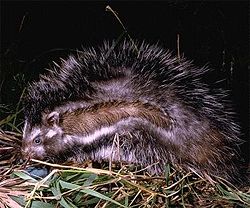
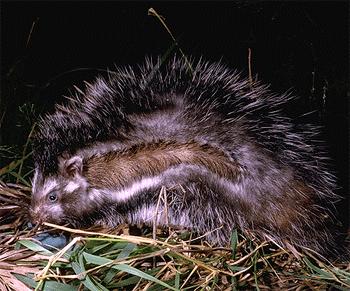
The maned rat or African crested rat (Lophiomys imhausi) is a nocturnal, long-haired and bushy-tailed East African rodent that superficially resembles a porcupine. The world's only known poisonous rodent, the maned rat sequesters toxins from plants to fend off predators.[2]

Description

[edit]

The maned rat's body can grow up to 14 inches (360 mm) long, or 21 inches (530 mm) from head to tail. The coat consists of long, silver and black-tipped guard hairs over a dense, woolly, grey and white undercoat, with the face and limbs having short, black fur. A mane of longer, coarser black-and-white banded hairs extends from the top of the animal's head to just beyond the base of the tail. This mane is bordered by a broad, white-bordered strip of hairs covering an area of glandular skin. The forelimbs and hind limbs have short black fur. The forefeet are large and digit 1 of the forefeet does not have a claw while digits 2-5 have a well developed claw.[3]

When the animal is threatened or excited, the mane erects and this strip parts, exposing the glandular area. The hairs in this area are, at the tips, like ordinary hair, but are otherwise spongy, fibrous, and absorbent with a honeycomb structure.[4] The rat is known to deliberately smear these hairs with poison from the bark of the Acokanthera schimperi, the poison arrow tree, on which it chews, thus creating a defense mechanism that can sicken or even kill predators which attempt to bite it.[5] It is the only rodent known to utilize and store toxins[6] from a different species in nature to protect itself, with no known adverse effects to themselves.[7]

L. imhausi differs from typical Muridae in having the temporal fossa roofed over a thin plate of bone, rudimentary clavicles, and an opposable hallux. The dorsal surface of the skull is covered with small bony projections which gives it a pebbled look. The projections are 0.3mm across and are separated every 0.3mm. On these grounds, it has been made the type of a family; its dentition, however, is typical Cricetine.[8] The dental formula is 1/1, 0/0, 0/0, 3/3, giving it a total of 16 teeth. The cusps of the molars are arranged biserially and connected medially by longitudinal enamel crests.[9]

Diet

[edit]

Its diet in the wild consists largely of leaves, fruit, and other plant material, but it has been known to eat meat, cereals, root vegetables, and insects in captivity. Food is eaten by sitting on its haunches and using its forepaws to bring food items to its mouth. It is the only species in the super family Muroidea whose stomach is highly compartmentalized. The stomach contains five anatomically discrete sections that superficially resemble the sacculated configuration characteristic of ruminant artiodactyls. By virtue of its large size and biomass, L. imhausi may be one of the few muroid rodents that can harbor a symbiotic microflora in the foregut and profit metabolically from gastric fermentation of cellulose.[10]

Habitat

[edit]

The habitat of the maned rat ranges from nearly sea level, in Ethiopia and Somalia, to more typically the drier, highland forests and woodlands of Somalia, Ethiopia, Sudan, Tanzania, Uganda, and Kenya. Fossil remains have been found as far north as Palestine, however. They are often found in rocky areas or in hollow tree trunks and holes along the tops of ravines, and have also been found nesting among rocks on cliff-faces.

Reproduction

[edit]

The maned rat was believed to be solitary, but is now known to be somewhat sociable, with multiple animals trapped in the same territory; they purr and groom one another. Thus it is possible they form family groups of a male, female, and offspring.[11] The litter size is 1–3. The young are slightly haired at birth and white markings and black stripes on the body are visible after 9 days. By day 13, the eyes open. The hair is sufficiently long that the crest can be erectile by day 20. The newborns become mobile by day 23 and are weaned by day 40.[12]

Citations

[edit]
  1. ^ Schlitter, D. (2016). "Lophiomys imhausi". IUCN Red List of Threatened Species. 2016 e.T12308A22368581. doi:10.2305/IUCN.UK.2016-2.RLTS.T12308A22368581.en. Retrieved 12 November 2021.
  2. ^ Wu, Katherine (25 November 2020). "This Rat Covers Itself With Poison That Can Take Out an Elephant". The New York Times. Retrieved 25 January 2022.
  3. ^ Jonathan Kingdon, David Happold, Thomas Butynski, Michael Hoffmann, Meredith Happold, Jan Kalina, [1], Mammals of Africa
  4. ^ Greenfieldboyce, Nell (27 November 2020). "For Rats That Coat Themselves In Poison, These Rodents Are Surprisingly Cuddly". NPR.org. Retrieved 2020-12-02.
  5. ^ Welsh, Jennifer (2 August 2011). "Giant Rat Kills Predators with Poisonous Hair". LiveScience. Retrieved 2 August 2011.
  6. ^ "African crested rat: The rabbit-sized rodent with poisonous fur". BBC Science Focus Magazine. December 2020. Retrieved 2020-12-02.
  7. ^ Kingdon, Jonathan; Agwanda, Bernard; Kinnaird, Margaret; O'Brien, Timothy; Holland, Christopher; Gheysens, Thomas; Boulet-Audet, Maxime; Vollrath, Fritz (2012-02-22). "A poisonous surprise under the coat of the African crested rat". Proceedings of the Royal Society B: Biological Sciences. 279 (1729): 675–680. doi:10.1098/rspb.2011.1169. PMC 3248729. PMID 21813554.
  8. ^ Flower, William Henry; Lydekker, Richard (1891). An Introduction to the Study of Mammals Living and Extinct. A. and C. Black. p. 460. ISBN 978-1-4400-5891-2. {{cite book}}: ISBN / Date incompatibility (help)
  9. ^ Jonathan Kingdon, David Happold, Thomas Butynski, Michael Hoffmann, Meredith Happold, Jan Kalina, [2], Mammals of Africa
  10. ^ Jonathan Kingdon, David Happold, Thomas Butynski, Michael Hoffmann, Meredith Happold, Jan Kalina, [3], Mammals of Africa
  11. ^ "Toxic Rats Live Social Lives". Science News. 12 January 2021. Retrieved 23 January 2021.
  12. ^ Jonathan Kingdon, [4], The Kingdon Field Guide to African Mammals

General and cited references

[edit]
[edit]
Revisions and contributorsEdit on WikipediaRead on Wikipedia
from Grokipedia
The maned rat (Lophiomys imhausi), also known as the African crested rat, is a large, nocturnal endemic to , distinguished as the world's only known poisonous due to its habit of sequestering cardenolide toxins from into specialized hollow hairs along its flanks for defense against predators. Measuring approximately 30 cm in body length and weighing up to 1 kg, it features a rabbit-like body covered in soft gray fur, a bushy , and an erectable mane of coarse black-and-white hairs that reveals warning stripes when threatened, mimicking the appearance of a or . Native to countries including , , , , , and , the maned rat occupies a range of habitats from highland forests and woodlands at elevations up to 3,000 meters to semi-deserts, dry savannas, shrublands, and rocky areas with cliff faces, ravines, or hollow trees for shelter. Primarily herbivorous, it feeds on leaves, fruits, bark, and roots, notably chewing the toxic bark of the poison arrow tree (Acokanthera schimperi) to extract cardiac glycosides, which it mixes with saliva and applies to its absorbent flank hairs—hollow and perforated structures that retain the poison without harming the rat itself, potentially causing or in predators like dogs or even upon contact. Behaviorally, maned rats are skilled climbers and ground-dwellers, active at night and communicating through vocalizations such as purring, snorting, hissing, and grunting, while engaging in within small family units consisting of a monogamous pair and their offspring. occurs in litters of 1–3 pups, which are born slightly haired, open their eyes around day 13, become mobile by day 23, and are weaned at about 40 days, with a lifespan ranging from 1 to 8 years in the wild. Classified as Least Concern by the IUCN due to its stable population and lack of major threats, the remains little-studied, with ongoing research revealing insights into its monogamous and toxin sequestration as adaptations enhancing survival in predator-rich environments.

Taxonomy and physical characteristics

Taxonomy

The maned rat (Lophiomys imhausi) is classified within the kingdom Animalia, Chordata, class Mammalia, order Rodentia, Muridae, subfamily Lophiomyinae, genus Lophiomys, and species L. imhausi. Lophiomys imhausi is the sole extant species in the subfamily Lophiomyinae, representing a unique evolutionary branch among the diverse muroid of the Muridae. Its follows the formula 1/1, 0/0, 0/0, 3/3 = 16, characterized by rooted molars with cusps arranged in transverse rows, adaptations that support herbivory through efficient grinding of plant material. Subfossils of Lophiomys from the Judean Desert in reveal an ancient distribution extending into the , with remains dated between approximately 42,000 and 103,000 years ago, indicating historical connectivity between African and Eurasian ecosystems. Molecular phylogenetic analyses estimate the divergence of Lophiomyinae from other subfamilies at around 17 million years ago.

Physical description

The maned rat (Lophiomys imhausi) is a large with a total body ranging from 365 to 535 mm, including a bushy that comprises approximately 40-50% of this ; head-body measures 225-360 mm, while is 140-175 mm. Adults weigh between 590 and 920 g, with females typically larger than males. This robust build superficially resembles that of a , featuring a long body supported by relatively short, strong limbs adapted for climbing trees and descending head-first. The fur consists of long, grey-tipped guard hairs averaging 46 mm in length, covering the body in a light gray to dark black or brown coloration interspersed with white stripes, spots, or blotches for . A distinctive mane of elongated, black-and-white banded hairs runs along the flanks and back, capable of via dermal muscles to reveal warning coloration when the animal is threatened. Along the flanks, specialized porous hairs form tracts that function uniquely among mammals by absorbing and retaining plant-derived toxins through in their spongy, fibrillar structure, which lacks underlying glandular tissue but acts as a passive delivery system. The skull is notably robust and unique, with bony projections from the jugal, squamosal, frontal, and parietal bones extending over the eye sockets and temporal fossae, reinforced by thickened, granulated surfaces for enhanced protection. These skeletal features contribute to the overall sturdy morphology, distinguishing the maned rat from typical murids. Sensory adaptations include large eyes suited for nocturnal vision and prominent, sensitive (vibrissae) that aid in navigation and tactile sensing in low-light environments.

Distribution and habitat

Geographic range

The maned rat (Lophiomys imhausi) is endemic to , with its current distribution spanning , , , , , , , and . This range primarily encompasses highland forests and woodlands, extending from near sea level in lowland areas of and to elevations of up to 3,300 meters in the and mountain forests of and . The species is confined to specific forested and wooded habitats within these countries, showing a patchy distribution that reflects its preference for montane environments. Population densities of the maned rat are generally sparse, with sightings being rare due to its strictly nocturnal habits, which limit direct observations in the wild. Estimates suggest low densities, such as a maximum of approximately 0.96 individuals per square kilometer inferred from pellet analyses in Kenyan forests, though localized studies have recorded up to 15 rats per square kilometer at select sites. No precise global population numbers are available, but the species is considered stable in suitable habitats and classified as Least Concern by the IUCN, indicating no immediate threats to its overall distribution. Historically, the maned rat exhibited a wider range during the Pleistocene, with subfossil remains discovered as far north as the region, including sites in the Judean Desert of present-day (near ancient ) dated between approximately 42,000 and 103,000 years ago. These fossils, part of a substantial assemblage exceeding 250 specimens, suggest that ecological corridors connected eastern to Afro-Eurasian areas during wetter climatic periods of the , allowing dispersal beyond the current East African confines. Today, the species shows limited migration or dispersal capabilities, remaining non-migratory and largely restricted to its forested patches without evidence of long-distance movements.

Habitat preferences

The maned rat (Lophiomys imhausi) primarily inhabits drier highland forests, woodlands, and riverine areas across eastern , favoring environments that provide cover such as steep rocky slopes, ravines, and riparian vegetation. It also utilizes rocky cliffs and thickets for shelter, avoiding open grasslands and preferring structurally complex habitats that support hiding and nesting opportunities. These preferences link to its distribution in montane and lowland woodlands where vegetation density aids in evasion from predators. For shelter, the maned rat nests in tree hollows, rock crevices, burrows, or hollow dead trunks, often near riverbanks or in bushy undergrowth, which provide secure, concealed sites for resting during the day. It selects these microhabitats to minimize exposure, particularly in areas with rocky outcrops or ravines that offer natural fortifications. The species thrives at altitudes ranging from to approximately 3,300 meters, though it is most commonly encountered in highland regions between 1,000 and 2,500 meters, where moderate seasonal rainfall and temperatures prevail. These climatic conditions support the semi-arid to sub-humid ecosystems it occupies, with bimodal rainfall patterns influencing availability during wet and dry seasons. The maned rat co-occurs with toxic plants such as Acokanthera schimperi, which grows in similar dry woodlands, thickets, and riverine zones up to 2,200 meters, providing a key resource for its by sequestering toxins from the plant's bark. This association underscores its adaptation to niches where such poisonous vegetation is abundant, enhancing survival in predator-rich environments.

Diet and foraging

Dietary composition

The maned rat (Lophiomys imhausi) is primarily herbivorous, exhibiting folivorous and frugivorous behaviors, with its core diet comprising leaves, fruits, tender shoots, and occasionally bark and roots from various species. This dietary composition emphasizes easily digestible plant parts, though fibrous elements are present. In captivity, maned rats demonstrate greater dietary flexibility, readily consuming cereals, root , meat, and alongside their preferred plant materials like sweet potato leaves. The nature of their natural diet involves microbial in the specialized forestomach, enabling processing of plant matter.

Physiological adaptations

The maned rat (Lophiomys imhausi) possesses a highly specialized digestive system adapted to its herbivorous diet of material, such as leaves and bark. Its stomach is compartmentalized into four distinct chambers, representing one of the most complex structures among muroid rodents, which facilitates microbial processing of ingested . This configuration supports a dense bacterial community, primarily composed of lactic acid-producing species like spp., enabling symbiotic breakdown of components and potentially aiding in resistance, though fermentation remains unconfirmed. Dental adaptations further enhance the processing of tough, abrasive plant matter. The maned rat exhibits molars with high crowns, ideal for grinding fibrous vegetation; these teeth continuously grow to compensate for wear from silica-rich diets. This structure contrasts with simpler in omnivorous rodents, prioritizing for herbivory. Metabolic adaptations optimize energy extraction from . The caecum is enlarged relative to body size, promoting hindgut fermentation where additional microbial extracts volatile fatty acids from undigested plant . A key physiological feature is its tolerance to plant toxins, particularly cardenolides like from species such as Acokanthera schimperi, which it selectively ingests. This resistance possibly stems from mutations in the Na⁺/K⁺-ATPase , preventing inhibition and allowing safe consumption without self-intoxication during foraging or toxin sequestration.

Behavior and social structure

Activity patterns

The maned rat (Lophiomys imhausi) exhibits a strictly nocturnal , with activity peaking from to early morning hours, typically between 1800 and 0400. Individuals emerge shortly after sunset to and move about, as documented by camera traps in montane rainforests, where one captured an handling at 1916 local time. During the day, they rest concealed in nests within hollow trees, rock crevices, or ground burrows to avoid diurnal predators and heat. Seasonal variations in activity are subtle, with and movement observed across both wet and dry periods in eastern African habitats, though breeding-related vocalizations increase during peak mating months from July to September, often coinciding with drier conditions. Total nightly activity averages around 128 minutes, consisting of multiple short bouts dedicated primarily to feeding. While comprehensive data on dry-season reductions are limited, efforts confirm consistent presence year-round in riparian and wooded areas. Locomotion combines terrestrial and arboreal elements, enabling the maned rat to navigate diverse habitats as a semi-arboreal climber; it moves slowly on the ground but demonstrates skillful climbing on logs and trees using strong forelimbs and a bushy for balance. Adults maintain overlapping home ranges in forested environments, with population densities estimated at 4–15 individuals per km², suggesting individual territories of roughly 0.1–0.25 km² depending on overlap and resource availability. These patterns support solitary , occasionally interrupted by brief social encounters. As a nocturnal species, the maned rat relies on heightened senses adapted for low-light , including olfaction for detecting and conspecifics via glandular scents, and acute hearing evidenced by responsive vocalizations such as purring and cries. Its small tympanic bullae indicate specialized auditory processing suited to forested acoustics, complementing whisker-based tactile cues during and .

Social organization

The maned rat, Lophiomys imhausi, exhibits a centered on monogamous pairs, often including offspring, forming small family units typically comprising 2 to 4 individuals. Solitary adults are rare, with most observations indicating paired or familial associations, suggesting delayed dispersal of juveniles to maintain group cohesion. Communication within these groups involves vocalizations such as purring between paired adults and juveniles for bonding, alongside mutual grooming rituals that reinforce social ties. High-pitched cries are emitted during stress. Territoriality is mild, with adults defending nest sites through displays rather than , and home ranges showing significant overlap—up to 36% of individuals recaptured in areas previously occupied by others—in high-density habitats. A 2020 field study in central , involving nearly 1,000 hours of camera-trap observations of 25 individuals, revealed unexpectedly affiliative behaviors, including paired rats spending over 50% of their active time in close proximity (within 15 cm) and following each other during nocturnal movements, alongside grooming of young by multiple adults indicative of potential . These findings are primarily based on observations in riparian forests and highlight the need for further across the ' range. While cooperative foraging was not directly observed, pairs often foraged in tandem, highlighting a level of coordination absent in presumed solitary .

Reproduction and development

Breeding biology

The maned rat (Lophiomys imhausi) exhibits a , forming stable male-female pairs that occasionally include or extended family members, consistent with traits associated with monogamy such as large body size and low reproductive output. These pairs defend shared territories and burrows, with mating behaviors observed in involving multiple copulations (1–4 times per night) during active periods. Breeding occurs year-round in equatorial habitats but shows evidence of peaks aligned with resource availability, as pregnancies have been recorded in March (wet season onset), July, and late August (dry season) in Kenyan populations, suggesting opportunistic timing influenced by environmental stability rather than strict seasonality. In captive settings, mating and reproductive activity were noted from July through September, spanning both wet and dry conditions. Gestation duration remains poorly documented, but females produce small litters of 1–3 young, typically averaging 1–2 offspring, indicative of a low reproductive rate that aligns with the ' long lifespan and . is attained within the first year of age in both sexes, though precise timelines are based on limited field and captive data. In the wild, lifespan is estimated at 1–8 years, while captive individuals can reach up to 7.5 years, supporting infrequent breeding cycles. Reproductive cues appear tied to group stability and resource abundance, with pair bonds and environmental factors like rainfall influencing breeding initiation, though specific hormonal mechanisms are not well-studied.

Parental care and growth

The young maned rats (Lophiomys imhausi) are born slightly haired, with eyes opening around day 13 and becoming mobile by day 23. During the nursing period, mothers provide to litters averaging 1 to 3 young, with foods introduced around day 23 as the offspring become more active. occurs by approximately 40 days, marking the transition to independent . Growth proceeds steadily, with young reaching full adult size by about 6 months. Dispersal from the family unit generally happens between 8 and 12 months, though delayed dispersal may occur in some cases. Parental care is biparental, involving both adults in feeding regurgitated food and protecting the young through grooming and nest-sharing behaviors. Older siblings often participate in , assisting with vigilance and huddling to enhance juvenile survival.

Defense and ecology

Toxin-based defense

The African crested rat (Lophiomys imhausi), also known as the , employs a unique toxin-based defense mechanism by sequestering cardenolides from the Acokanthera schimperi. This , a member of the family, contains , a potent historically used in African arrow poisons. The obtains the toxin by gnawing on the bark and roots of Acokanthera schimperi, masticating the material to mix it with , and then deliberately applying the resulting to specialized hairs along its flanks. These flank hairs are uniquely adapted for toxin delivery, featuring a hollow, porous structure resembling a perforated lined with fibrillar strands that act as wicks to absorb and retain . This creates a lethal coating on the hairs, capable of delivering a dose of sufficient to inhibit Na⁺/K⁺-ATPase in predators, potentially fatal even in small amounts—high doses of which have been documented to kill large mammals like when used in traditional . The maned rat is the only known placental to actively sequester and weaponize plant-derived s in this manner, distinguishing it from other chemically defended that produce their own venoms or acquire them through diet without deliberate application. During threats, the rat deploys this defense by parting its fur to expose the treated hairs and erecting its mane, combining visual with chemical deterrence to warn potential predators. Contact with the toxin-laden hairs, particularly via mucous membranes, can cause severe symptoms ranging from distress to , as observed in experimental exposures to dogs. To avoid self-intoxication, the rat possesses glandular adaptations, likely in its salivary system, that confer resistance to , along with physical protections such as a dense and armored . The preparation process involves multiple short bouts of chewing and application, typically spanning several hours or days to fully coat the hairs.

Predators and threats

The maned rat (Lophiomys imhausi) encounters few natural predators owing to its specialized toxin sequestration, which renders it highly unpalatable or lethal to most assailants. Among verified predators, eagle owls, particularly Mackinder's eagle owl (Bubo capensis mackinderi), actively hunt and consume maned rats, with studies documenting 40 individuals across owl territories through pellet analysis, fresh carcasses, and observations over 28 months. This predation occurs despite the rats' defenses, indicating that the toxin does not deter all predators uniformly. Maned rats mitigate predation risks through nocturnal activity, which aligns with their primary predators' behaviors, and by utilizing burrows and cavities for shelter. When confronted, they display toxin-coated hairs along their flanks, accompanied by aggressive postures such as mane erection, body thrashing, teeth snapping, and vocalizations like snorts and hisses to advertise their . These strategies contribute to a low success rate for predators, as of the cardenolide-based —derived from plants like Acokanthera schimperi—often results in severe cardiac effects or death for mammalian attackers, though avian predators like appear less affected. Beyond direct predation, maned rats face ecological pressures from parasites, including plague-carrying fleas (Xenopsylla cheopis) and the flea Amphopsylla conversa, which may transmit diseases in their forested habitats. Predation and slow reproductive rates help regulate populations at low densities, estimated at about 1 individual per square kilometer in studied highland areas, while the toxin's deterrent effect reduces overall mortality from failed attacks.

Conservation

Status assessment

The maned rat (Lophiomys imhausi) is classified as Least Concern on the , with this assessment conducted in 2016 and no subsequent updates indicating a change in status as of 2025. This classification reflects its wide distribution across and presumed stable populations, despite limited direct observations due to the species' nocturnal and elusive nature. The rationale emphasizes tolerance to some habitat modifications and occurrence in protected areas, with no major threats identified that would warrant a higher risk category. Population estimates for the maned rat remain uncertain, as comprehensive surveys are lacking, but it is considered widespread yet occurring at low densities. In core forested and rocky habitats, densities have been estimated at approximately 1 individual per km² based on analyses of pellets, though localized studies using live traps in central reported 4–15 individuals per km² in small study areas. Total population size is unknown. Recent highlights low densities and rarity of sightings, suggesting the may be more vulnerable than its global status indicates due to low reproductive rates and a relatively long life cycle. Monitoring of maned rat populations primarily relies on indirect methods, including examination of predator remains such as pellets and deployment of camera traps, which have confirmed persistence in known areas. Recent field studies in the , including live-trapping efforts, have documented individuals and provided insights into local abundances, underscoring the ' continued presence without evidence of significant declines. Overall trends indicate stability, with no documented significant population declines, though data gaps persist particularly in politically unstable regions like and , where access for surveys is limited. These gaps highlight the need for expanded to better quantify distribution and abundance across the full range.

Conservation challenges

The maned rat (Lophiomys imhausi) faces conservation challenges primarily from habitat degradation and knowledge gaps in its , despite its global classification as Least Concern by the . This status reflects its relatively wide distribution across East African woodlands and forests, but limited data on trends and densities hinder accurate assessments, with the described as poorly known overall. In some national contexts, such as , it is evaluated as Vulnerable due to restricted local ranges and presumed habitat degradation. Human activities, including and in the n highlands, represent key threats by fragmenting woodlands essential for the species' and shelter needs. From 1990 to 2020, forest cover in declined by approximately 17%, driven by conversion to cropland and settlements, which may reduce access to toxin-bearing plants like Acokanthera schimperi. hunting remains rare for the maned rat, likely deterred by its toxic defenses, though broader hunting pressures are increasing in rural areas. Incidental from rodenticides used in could affect local populations, but specific impacts are undocumented. Conservation efforts benefit from the species' occurrence in protected areas, such as Mt. Moroto Forest Reserve in , where habitat preservation supports its persistence. Additional measures include calls for expanded population surveys and studies on to inform management, as current protections are limited by data deficiencies. The overall extinction risk is low, but poses emerging concerns by potentially shifting the distribution of host plants for sequestration, necessitating monitoring in highland ecosystems.

References

Add your contribution
Related Hubs
User Avatar
No comments yet.