Hubbry Logo
Fat-tailed gerbilFat-tailed gerbilMain
Open search
Fat-tailed gerbil
Community hub
Fat-tailed gerbil
logo
8 pages, 0 posts
0 subscribers
Be the first to start a discussion here.
Fat-tailed gerbil
Fat-tailed gerbil
from Wikipedia

Fat-tailed gerbil
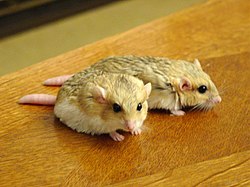
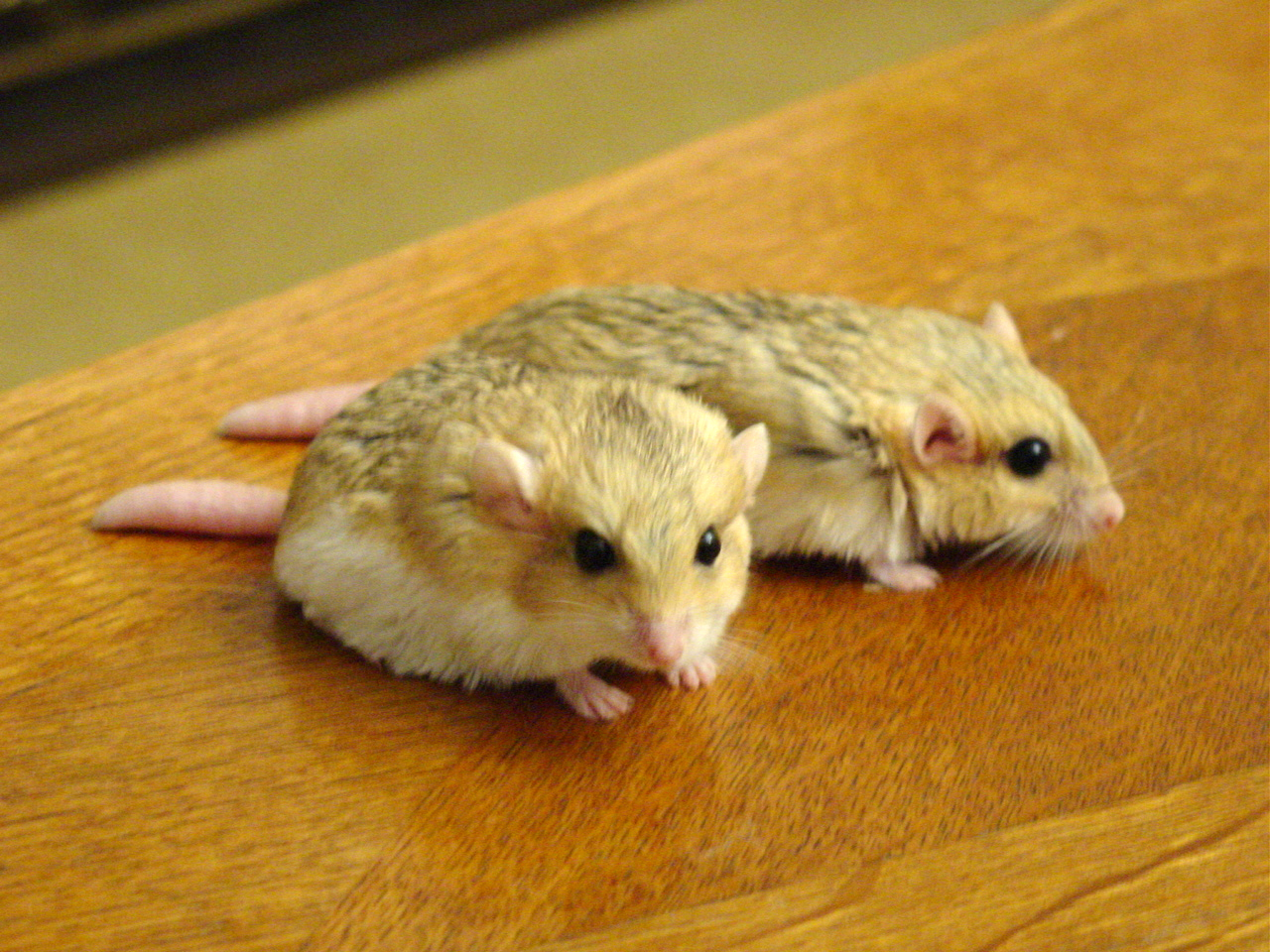
A pair of duprasi gerbils
Scientific classification Edit this classification
Kingdom: Animalia
Phylum: Chordata
Class: Mammalia
Order: Rodentia
Family: Muridae
Genus: Pachyuromys
Lataste, 1880
Species:
P. duprasi
Binomial name
Pachyuromys duprasi
Lataste, 1880

The fat-tailed gerbil (Pachyuromys duprasi), also called the duprasi gerbil or doop, is a rodent belonging to the subfamily Gerbillinae. It is the only species in the genus Pachyuromys. They are frequently kept as pets.

Other common English names are: fat-tailed jird, fat-tailed rat, and beer mat gerbil.[2][3]

Description

[edit]

The fat-tailed gerbil is a medium-sized gerbil. Its body length is about 10 cm (3.9 in), with a tail length of about 5 cm (2.0 in). The hair at the back and the head is yellow-coloured, with a dark grey base and a small black tip. The belly is white. Fat-tailed gerbils weigh between 22 and 45 grams (0.78 and 1.59 oz) in the wild,[4] but in captivity can weigh between 55 and 82 grams (1.9 and 2.9 oz).[5] Their body is round and somewhat flattened. They have no clear neck and a very sharp face, with large oval-shaped black eyes. They look similar to a dwarf hamster, but unlike a hamster they have a pointed snout and a fat, almost bald, club-shaped tail. The fat-tailed gerbil stores fat in its tail in the same way that the camel stores fat in its hump.

Captive specimens of the fat-tailed gerbil have an average life span of between 2 and 4 years.[6]

Distribution

[edit]

The French zoologist Fernand Lataste first described P. duprasi in 1880 in Laghouat, Algeria in Le Naturaliste.

Fat-tailed gerbils are native to the Northern Sahara (northwestern Egypt, Libya, Tunisia, and Algeria). There they live in sparsely vegetated sand sheets or rocky deserts. In the wild, fat-tailed gerbils live in simple burrows about one meter deep, in hard sandy soil. They may also occupy other species' burrows.[7]

Diet

[edit]

Fat-tailed gerbils are mostly insectivorous in the wild, but will eat also a variety of plants.[7] In captivity, they are kept on a basic rodent mix, and are fond of mealworms, crickets, moths, and almost any other insect, even beetles. They can also be given some vegetables and fruit, like carrots, cauliflower, chicory, and apples.

Behavior

[edit]

Wild fat-tailed gerbils are solitary animals, and sometimes live in colonies. In the wild, fat-tailed gerbils become active at dusk and this is the same in captivity - although they can sometimes appear to be diurnal.[7] When they fight, they shriek loudly and bite each other's tails.[8] The mating ritual of the fat-tailed gerbil may also be confused with fighting.

Fat-tailed gerbils, like most other rodents, have scent glands on their stomach and engage in marking their territory by stretching out and rubbing their bellies on the ground and furnishings.

Breeding

[edit]

Fat-tailed gerbils sexually mature when they are around two months old, and the gestation period is 19 to 21 days. Their average litter size is three to six, and the pups are weaned at three to four weeks.

References

[edit]
[edit]
Revisions and contributorsEdit on WikipediaRead on Wikipedia
from Grokipedia
The fat-tailed gerbil (Pachyuromys duprasi), also known as the duprasi gerbil or fat-tailed jird, is a small, nocturnal belonging to the subfamily within the family . Native to the arid regions of the northern Desert, it is distinguished by its round body, large oval eyes, low-set pink ears, and a thick, club-shaped that stores fat and reserves, aiding in harsh environments. Adults typically measure 93–120 mm in head-body length, with a of 55–65 mm, and weigh 22–65 g, featuring fur that is gray to tan dorsally with black tips and white ventrally. This species inhabits sparsely vegetated sand sheets, semi-desert plateaus, and occasionally rocky areas south of the western Mediterranean coastal desert, where it constructs deep burrows up to 1 meter in depth for shelter and . Its geographic range spans , including , , (type locality: ), , , , and west of the . Classified as Least Concern on the due to its wide distribution and lack of major threats, the fat-tailed gerbil maintains stable populations across its habitat. Primarily insectivorous, its diet consists of insects such as mealworms, crickets, and beetles, supplemented by plant matter like Anabasis articulata and Artemisia monosperma, as well as grains when available. Behaviorally, it is active at and night, often living in small colonies but capable of solitary or social lifestyles; while docile toward humans, it can be aggressive or cannibalistic intraspecifically. Reproduction occurs seasonally from April to November, with a gestation period of 19–22 days yielding litters of 3–9 altricial pups, which are weaned after 3–4 weeks. First described by Fernand Lataste in 1880, P. duprasi serves as a in biomedical research, particularly for studies on due to its burrowing habits and disease susceptibility.

Taxonomy and characteristics

Taxonomy

The fat-tailed gerbil, Pachyuromys duprasi, belongs to the kingdom Animalia, phylum Chordata, class Mammalia, order Rodentia, family , subfamily , genus Pachyuromys, and species P. duprasi. The genus Pachyuromys is monotypic, containing only this species, distinguished by unique morphological, chromosomal, and molecular traits that set it apart from other gerbils. The species was first described by French zoologist Fernand Lataste in 1880, based on specimens collected from in . Lataste's description, published in Le Naturaliste, established the binomial Pachyuromys duprasi, with the genus name reflecting the thick, fat-storing (from Greek pachys meaning thick and oura meaning , and mys meaning mouse). Common names for the species include fat-tailed gerbil, duprasi gerbil, fat-tailed jird, and doop, the latter derived from its vocalizations. Two subspecies are currently recognized: the nominal P. d. duprasi, distributed from and through , , , and , and P. d. natronensis, found in Egypt's northern west of the , particularly in the Natrun region. Morphological differences between the subspecies are subtle, primarily in fur coloration, with P. d. duprasi exhibiting sandier tones adapted to broader Saharan environments, while P. d. natronensis shows paler shades suited to coastal desert conditions; tail lengths are similar across both, typically measuring 55–62 mm. Phylogenetically, Pachyuromys occupies a basal position within the subfamily, potentially forming an early-diverging lineage among desert-adapted gerbils in the tribe Gerbillini. Molecular studies, including analyses of such as 12S rRNA and genes, support its monotypic status and suggest a close, though weakly supported, relationship with the Desmodilliscus, though morphological evidence for this is limited. These genetic findings confirm Pachyuromys as a distinct, ancient branch in gerbil evolution, predating many specialized adaptations seen in other genera.

Physical description

The fat-tailed gerbil (Pachyuromys duprasi) exhibits a compact, rounded body morphology typical of burrowing , with a head-body length of 93–120 mm and a length of 55–65 mm, the latter comprising 50–55% of the head-body length. Adults weigh 22–65 g, showing minimal in overall size and proportions. External features include a pointed , large black eyes, and low-set pink ears measuring 12–16 mm in length. The fur is long, soft, and fluffy, with dorsal pelage ranging from sandy-yellow to gray and featuring black-tipped hairs, while the ventral surface, feet, , , , and muzzle are white. The hindfeet measure 22–24 mm and have partially haired soles. A distinctive trait is the short, thick, club-shaped , which is and sparsely haired or naked, functioning as a for and reserves; its thickness varies seasonally and reflects the animal's health status. This lacks the brush-like hairs seen in many other gerbils, emphasizing its specialized storage role over locomotor function. Skeletally, the is elongated with a large braincase and markedly inflated auditory bullae that comprise about 47% of the total skull length (occipitonasal length ~34 mm), adaptations that amplify sound detection in subterranean environments. The upper incisors are grooved longitudinally on their anterior surfaces, suited for gnawing tough and seeds. The molars are rooted, with the first upper and lower molars tuberculate in juveniles but becoming more laminate in adults; the second molars lack tubercles, and the third are simple without folds. Sensory structures include large eyes positioned for broad visual fields, supporting enhanced vision in dim conditions, and prominent mystacial vibrissae () that aid tactile through loose sand. The sparsely haired pink ears, combined with the skull's auditory specializations, indicate acute hearing sensitivity.

Habitat and distribution

Geographic range

The fat-tailed gerbil (Pachyuromys duprasi) is native to the northern Desert in , with its range extending from eastward to , west of the . The species occurs across several countries in this region, including , , (the type locality), , , , and . It was first collected and described in 1880 by French zoologist Fernand Lataste from specimens obtained near in . The geographic extent of the fat-tailed gerbil's distribution covers an estimated area of 2,318,000 km², primarily encompassing sand sheets and semi-arid zones south of the Mediterranean coastal desert. Historical records indicate a stable presence throughout this range since its initial documentation, with no significant contraction observed. No introduced populations of the fat-tailed gerbil have been confirmed outside its native range.

Habitat preferences

The fat-tailed gerbil (Pachyuromys duprasi) inhabits primarily sandy and gravelly deserts with sparse vegetation, favoring open sand sheets and semi-deserts over dense dune formations. Typical vegetation in these areas includes drought-resistant shrubs such as Anabasis articulata and Artemisia monosperma, which provide limited cover amid the arid landscape. These microhabitats often feature proximity to rocky outcrops or stony areas, offering additional refuge points in otherwise exposed terrains. For shelter, the species constructs simple burrows in hard sandy , extending up to 1 meter deep, or reuses abandoned burrows from other . These burrows typically include multiple chambers dedicated to nesting and , enabling survival in resource-scarce environments. Adapted to extreme , fat-tailed gerbils thrive in climates with annual rainfall below 100 mm and diurnal temperature fluctuations between 10°C and 40°C, characteristics of northern Saharan deserts. Their pale, light-colored enhances against the sandy substrates of these pale, barren habitats.

Ecology and behavior

Diet and foraging

The fat-tailed gerbil (Pachyuromys duprasi) maintains a primarily insectivorous diet in , consuming a variety of such as beetles, crickets, and terrestrial worms, which form the bulk of its nutritional intake. This high-protein component supports essential physiological needs like growth and maintenance in arid environments. matter supplements the diet, including leaves, seeds, and roots from species such as Anabasis articulata and Artemisia monosperma, along with occasional grains scavenged from the sparse desert vegetation. In captivity, the diet mirrors wild habits to promote health, incorporating live or dried insects like mealworms and crickets for protein, alongside grains, seeds, vegetables, and limited chopped meat to provide balance. Nutritional requirements emphasize protein-rich foods to replicate natural foraging, with alfalfa hay or rodent blocks added for fiber and dental health. Foraging occurs primarily on the surface at , when the gerbils emerge from burrows for brief excursions limited to areas near their habitats, relying on acute senses to detect prey and reduce predation risk. They employ opportunistic strategies, actively hunting as voracious predators while gathering plant materials. Activity decreases in extreme heat without full .

Activity patterns and social structure

The fat-tailed gerbil (Pachyuromys duprasi) is primarily nocturnal, with activity peaking at to coincide with cooler temperatures and reduced predation risk in its arid habitat. Individuals exhibit intermittent bursts of activity throughout the day and night, but they spend much of the daylight hours resting in burrows to conserve energy and evade heat and predators. This crepuscular-nocturnal rhythm is supported by circadian control of body temperature, where higher temperatures and locomotor activity occur during the dark phase under a 14:10 light-dark cycle. Socially, fat-tailed gerbils form small family groups or colonies of 2-5 individuals sharing systems, though they can also live solitarily. In , breeding pairs with constitute typical units, reflecting limited social complexity compared to more gregarious gerbil . They are highly territorial, particularly males, who use ventral on their abdomens to mark territories by rubbing against substrates. Communication involves a combination of olfactory, vocal, and tactile signals; for instance, ultrasonic vocalizations (USVs) are emitted by pups during isolation and by adults in response to handling or social contact. In terms of defense and aggression, fat-tailed gerbils rely on adaptations, rapidly retreating into burrows up to 1 meter deep to escape threats. During inter-individual conflicts, they engage in aggressive behaviors such as biting, often targeting the and leaving characteristic scars. Their pale, light-colored provides camouflage against sandy desert soils, enhancing concealment from predators such as . As insectivores, they help control local populations in their .

Reproduction and life history

Mating and breeding

The fat-tailed gerbil exhibits a distinctive ritual that involves both sexes standing on their hind legs and engaging in wrestling-like tussles accompanied by shrieking vocalizations, which can be mistaken for aggressive fighting. This serves to initiate copulation and is observed in captive pairs during breeding attempts. In laboratory settings, pairs are typically introduced for compatibility, with minimal fighting reported, though occasional aggression occurs immediately after pairing, necessitating separation and reintroduction in some cases. Post-, a vaginal plug may form, though it is not always easily observable. Breeding in fat-tailed gerbils is seasonal in the wild and under certain captive conditions, occurring primarily from to November, aligning with periods of increased resource availability. Both sexes typically reach around 2 months (8-9 weeks) of age. Under optimal conditions, females can produce 2-3 litters per year, with a rotational used in laboratories to maintain colony health and prevent . Year-round breeding is possible in controlled environments without observed seasonality. Gestation lasts 19-22 days, after which litters of 3-9 pups are born, with an average size of 4-6. Pups are altricial at birth, requiring intensive maternal care in constructed nests. In captive breeding programs, a minimum one-week rest period is recommended between matings to support female recovery.

Development and lifespan

Fat-tailed gerbil pups are born altricial, hairless, blind, and helpless, with an average of 2.58 g and body length of 36.22 mm. Eyes open at approximately 23.7 days, ears at 27.2 days, and fur begins to appear around day 12, achieving full coverage by day 16; incisors erupt at 13.5 days. Pups produce ultrasonic vocalizations starting from day 5, which peak in complexity between days 12 and 15. Parental care is primarily provided by the female, who nurses the young for about three weeks, while both parents remain with the litter in the and exhibit non-aggressive behavior toward ; no evidence of has been observed. occurs between 3 and 4 weeks, though pups continue some milk intake alongside solid food up to 40 days, after which they become independent. Sexual maturity is reached at approximately 2 months (8-9 weeks) of age for both sexes, with full approached by around 6 months, when individuals weigh approximately 20 g and measure 76.6 mm in body length by day 40 (about 33% of ). In captivity, fat-tailed gerbils have a lifespan of 5 to 7 years, though wild individuals likely live only 2 to 4 years due to predation and environmental pressures. Juvenile mortality is high, with some pups dying at 2 to 3 days from unknown causes, and females occasionally engaging in , which may contribute to early losses.

Conservation and human interaction

Conservation status

The fat-tailed gerbil (Pachyuromys duprasi) is classified as Least Concern on the , with the assessment conducted in 2016 and no subsequent updates indicating a change in status as of 2025. This designation reflects its wide distribution across the northern Desert, spanning more than 1,000,000 km² in countries including , , , , and , where it inhabits diverse arid environments without facing major range-wide threats. Population trends for the species are considered , with no of significant decline reported in recent assessments; overall size remains unknown, though the gerbil is described as common within its suitable . Minor threats include localized habitat degradation from and limited agricultural expansion in peripheral areas, as well as natural predation by and snakes, but these do not pose substantial risks to the ; there is no notable or trade pressure on the species. Conservation efforts are minimal due to the species' secure status, with the fat-tailed gerbil occurring in some protected areas within its range. Ongoing monitoring is facilitated through the process, ensuring periodic reassessments, and the species is not listed under , reflecting its lack of concerns.

Role as pets

Fat-tailed gerbils (Pachyuromys duprasi) are increasingly popular as pets due to their docile temperament and ease of handling, making them suitable for beginners interested in exotic rodents. They rarely bite and exhibit calm behavior, often showing little interest in escaping when handled, which contrasts with more active gerbil species. In captivity, their lifespan typically ranges from 5 to 7 years, though maximum recorded longevity reaches 8.3 years under optimal conditions. Unlike their largely solitary wild counterparts, captive individuals can be housed singly, in pairs, or in small groups, provided aggression is monitored to prevent conflicts. Care for fat-tailed gerbils emphasizes mimicking their arid origins. They require a spacious , such as a 10- to 15-gallon aquarium for a pair, with a secure lid to contain their burrowing habits. A deep substrate layer of at least 6 inches, consisting of or aspen shavings, allows for natural digging and nesting. should be maintained between 20°C and 25°C with low (35-50%) to avoid respiratory issues, and drafts must be avoided. Their primarily insectivorous diet in captivity includes live like mealworms and crickets, supplemented with mix, grains, and occasional vegetables, but excess moisture should be limited to prevent . Captive breeding of fat-tailed gerbils supports the pet trade and has a moderate success rate, though it can be challenging compared to other rodents. Females reach breeding maturity at around 12 weeks, with gestation lasting 19-24 days and producing litters of 3-6 pups on average. Pups are weaned at 3-4 weeks and can breed year-round under stable conditions. This species also serves as a research model in laboratories, particularly for studies on thermoregulation and desert adaptations, as demonstrated in husbandry protocols developed from captive colonies. Economically, fat-tailed gerbils contribute positively to the industry as low-maintenance animals that require minimal specialized care, fostering their availability through breeders rather than wild collection. However, escaped individuals could potentially transmit diseases to local populations, underscoring the need for secure housing in non-native regions.

References

Add your contribution
Related Hubs
User Avatar
No comments yet.