
.jpg/250px-Baliati_Palace,_Saturia,_Manikganj_(32).jpg)


.jpg/2000px-Baliati_Palace,_Saturia,_Manikganj_(32).jpg)
Community hub
Recent from talks
Contribute something
Nothing was collected or created yet.
Manikganj District
View on WikipediaManikganj District (Bengali: মানিকগঞ্জ জেলা, romanized: Mānikgoñj Jela; Bengali pronunciation: [mɑnɪkˈɡondʒ]) is a district in central Bangladesh and part of the Dhaka Division. It was established in 1845 as a subdivision of Faridpur District, then in 1853, it was transferred to Dhaka District for administrative purposes. Finally in 1984, Manikganj was declared a full district.
Key Information

.jpg)
.JPG)


History
[edit] | This section needs additional citations for verification. (September 2023) |
Manikganj subdivision was established in 1845.[3] It was transferred from Faridpur District to Dhaka District in 1853.[4] In 1984, Manikganj subdivision was promoted to a full district.[3]
War of Liberation
[edit]The liberation war in 1971 in Manikganj District was organized and led by Abdul Halim Chowdhury, Abdul Matin Chowdhury, Principal Abdur Rouf Khan, and other heroes of the district.
On 29 October 1971, at the northwest corner of Golaidanga village, the Baldhara union (a group of freedom fighters) in Singair Upazila attacked boats carrying intruding Pakistani soldiers and a terrible battle occurred on the Nuruni Ganga (canal of Kaliganga river). Eighty-one Pakistani soldiers were killed, and many others were injured. The operation was led by freedom fighter Engr Tobarak Hossain Ludu, commander of the Mukti Bahini Lodu group. None of the Mukti Bahini freedom fighters were killed during this battle, which was a significant liberation fight against the Pakistani military in Manikgonj.
After this short-duration battle, the Mukti Bahini freedom fighters left the battlefield, and the Pakistani ranks were reinforced with more soldiers. They burnt 160 houses surrounding the area of Golaidanga village and killed 9 local people who were primarily elderly and stayed at home. Some local young boys helped freedom fighters in that ambush.
After the Golaidanga fight, Singair Upazila became free from Pakistani occupation on 13 November 1971. In the last week of November 1971, fresh groups of freedom fighters entered different areas of Manikganj and defeated Pakistani troops in a few battles.
On 14 December 1971, a group of Pakistan Bahini moving toward Dhaka entered Barundi village in Manikganj Sadar Upazila. Meanwhile, a group of liberation forces (Mujib Bahini) under the leadership of Shahadat Hossain Biswas Badal was preparing to attack them within the suitable place. Understanding this, the Pakistani soldiers immediately left the village, leaving two soldiers behind. One of them was arrested by the liberation forces at night on 14 December 1971, and the other was arrested by the same group after a small fight the next day. The then sub-division was declared free on 13 December.
Daulatpur–Saturia tornado
[edit]On 26 April 1989, Manikganj was the site of the Daulatpur–Saturia tornado, which became the deadliest tornado in recorded history. 1,300 people were initially reported as having been killed, with 12,000 injured. The towns of Saturia and Manikganj were leveled, and about 80,000 people were made homeless.
Geography
[edit]Manikganj comprises an area of 1,383.66 km2 (534.23 sq mi). Annual average temperatures reach a maximum of 36 °C and a minimum to 12.7 °C with the annual rainfall total being 2,376 mm (93.5 in).
There are several rivers in the Manikganj District,[5] including the Padma River, Kaliganga River, Jamuna River, Dhaleshwari River, and Ichamati River.
Demographics
[edit]| Year | Pop. | ±% p.a. |
|---|---|---|
| 1981 | 1,063,048 | — |
| 1991 | 1,175,909 | +1.01% |
| 2001 | 1,285,080 | +0.89% |
| 2011 | 1,392,867 | +0.81% |
| 2022 | 1,558,025 | +1.02% |
| Sources:[1][6] | ||
According to the 2022 Census of Bangladesh, Manikganj District had 393,524 households and a population of 1,558,025 with an average 3.91 people per household. Among the population, 259,616 (16.66%) inhabitants were under 10 years of age. The population density was 1,126 people per km2. Manikganj District had a literacy rate (age 7 and over) of 71.17%, compared to the national average of 74.80%, and a sex ratio of 1072 females per 1000 males. Approximately, 14.74% of the population lived in urban areas. The ethnic population was 909.[7]
Religion
[edit]Manikganj District has 3,575 mosques, 160 temples, 10 churches, five Buddhist temples, and a pagoda. The Hindu population has fallen from nearly 150,000 in 1981 to 130,000 in 2011, but increased to 139,000 in 2022.
| Religion | 1941[8]: 98–99 [a] | 1981[6] | 1991[6] | 2001[6] | 2011[6] | 2022[1] | ||||||
|---|---|---|---|---|---|---|---|---|---|---|---|---|
| Pop. | % | Pop. | % | Pop. | % | Pop. | % | Pop. | % | Pop. | % | |
Islam 
|
419,287 | 67.84% | 914,748 | 86.05% | 1,028,283 | 87.45% | 1,155,202 | 89.89% | 1,262,215 | 90.62% | 1,418,263 | 91.04% |
Hinduism 
|
198,665 | 32.15% | 147,860 | 13.91% | 145,893 | 12.41% | 129,488 | 10.08% | 130,095 | 9.34% | 138,867 | 8.91% |
| Other[b] | 73 | 0.01% | 440 | 0.04% | 1,733 | 0.14% | 390 | 0.03% | 557 | 0.04% | 895 | 0.05% |
| Total Population | 618,025 | 100% | 1,063,048 | 100% | 1,175,909 | 100% | 1,285,080 | 100% | 1,392,867 | 100% | 1,558,025 | 100% |
Economy
[edit]There are total 166 haats and bazars in the district, including:
- Baira Bazar
- Bahadia Bazar
- Bangala Bazar
- Barangail Bazar
- Butni Bazar
- Diabari Bazar
- Gilonda Bazar
- Gheor Bazar
- Ghosher Bazar
- Ghosta Bazar
- Intazganj Bazar
- Jamsha Bazar
- Jhitka Bazar
- Maluchi Bazar (Balla Bazar)
- Mohadebpur Bazar
- Sakrail Bazar
- Singair Bazar
In addition, 54 fairs (Mela) are held in Manikganj, including:
- Afaz Paglar Mela (Bathaimuri)
- Aziz paglar Mela (Kachidhara)
- Bahadia Boishakhi Mela (Bahadia)
- Baher Paglar Mela (Bangala)
- Baher Paglar Mela (Mohadebpur)
- Baruni Mela (Butni)
- Belal/Billal Paglar Mela (Harganj)
- Joymontop Modhor Mela (Joymontop)
- Kanu Promaniker Mela (Manta, Manikganj Sadar)
- Majhi Barir Mela (Diabari)
- Manikganj Bijoy Mela (Manikganj)
- Poush Mela (Atigram)
- Rowth Jatra Mela (Katigram)
- Sadur Mela (Singair)
- Sadhur Mela (South Jamsha)
- Sadhinota Mela (Maluchi)
- Sonatoni Nobo Torun jubo Songgho Soroswati puja (Katigram)
- Zinda Shah Mela (Jhitka)
- গড়পাড়া Imam Bari Muharramer Mela (Garpara, Manikganj Sadar)
- গড়পাড়া বুড়িপুজোর মেলা (Garpara, Manikganj Sadar)
Places of interest
[edit]- Baliati Zamindari Home, Saturia
-
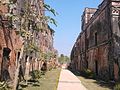 Baliati Palace
 -
 Baliati Palace
 -
 Baliati Palace - backside


- Padmar Par, Harirampur
- Teota Jamindar Bari, Shivalaya upazila
- Taota Noboratna Modh, Shibalaya
- Narayan Sadhur Asrom
- Historical Shrine and Mosque of Machaine Village
- Kabiraj Bari
- Beutha Bridge
- Betila Palace
- Betila Mondir
Subdivisions
[edit]The district's upazilas are:
Education
[edit]
There are 27 colleges in the district,[9] including Government Debendra College, which was founded in 1942,[3] and the private NPI University of Bangladesh, which was founded in 2016. There is one medical school: Colonel Malek Medical College.
According to Banglapedia, notable secondary schools in the district include:[3]
- Baliati Iswar Chandra High School (founded 1919)
- Bajpara High School (1995)
- Barangail Gopal Chandra High School (1924)
- Dhankora Girish Institution (1917)
- Diabari High School
- Dhulla B. M. High School (1920)
- Ghior D. N. Pilot High School (1929)
- Hatipara High School
- Ibrahimpur Iswar Chandra High School (1923)
- Jamirtta S. G. High School (1921)
- Jhitka Ananda Mohan High School (1926)
- Joymontop High School (1921)
- Kellai Monsur Uddin ML High School (1956)
- Lemubari Binoda Sundori High School (1949)
- Manikganj Government High School (1884)
- Manikganj Model High School (1925)
- Muljan High School (1978)
- Nali Bararia Krishna Chandra High School (1915)
- Patgram Anath Bandhu Government High School (1915)
- Teota Academy (1891)
- Terosree K. N. Institution (1922)
- Manikganj Technical School & collage
- Ghosta DM High School
The madrasa education system includes two fazil madrasas and one kamil madrasa—Manikganj Islamia Kamil Madrasa, founded in 1953.[3][10]
The technical education system includes the Government Textile Vocational Institute Manikganj.
Notable people
[edit]- Khan Bahadur Abdul Hakim CIE (1905-1985), mathematician and President of the Asiatic Society
- Khan Asifur Rahman Agun – singer[citation needed]
- Begum Badrunnessa Ahmed – politician and social worker, was raised by the zamindar of Paril[11]
- Naib Uddin Ahmed – photographer, was born in Paril village in 1925[12]
- Rafiq Uddin Ahmed – Bengali language movement martyr, was born in Paril village in 1926[13]
- Mir Quasem Ali – war criminal, was born in Munshidangi village in 1952[14]
- Momtaz Begum – singer and politician, was elected to Parliament from constituency Manikganj-2[15]
- Amalendu Biswas – stage actor, lived in Jabar village[16]
- Aruna Biswas – television and film actress, calls Manikganj her hometown[17]
- Parbati Sankar Roy Choudhury – zamindar, administered his family's estates from Teota[18]
- Abdul Halim Chowdhury – politician, was born in Elachipur village in 1928[19]
- Bulbul Chowdhury – dancer, attended Manikganj High School[20]
- Munier Choudhury – educator, dramatist, and literary critic, was born in Manikganj in 1925[21]
- Hemanta Kumari Debi – Zamindar, was born in Dhulla village in 1869[22]
- Sumita Devi – actress, was born in Manikganj district in 1936[23]
- Nina Hamid – folk singer[citation needed]
- Khandaker Delwar Hossain – politician, was elected to Parliament from constituency Manikganj-1[24]
- Khandkar Manwar Hossain – statistician[citation needed]
- A. K. M. Nurul Islam – Vice President of Bangladesh (1986–1989), is buried in Harirampur[25][26]
- Mohammad Kaykobad – computer scientist, graduated from Manikganj Government High School and Debendra College[27]
- Mohammad Ali Reza Khan – ornithologist, graduated from Manikganj Debendranath College[28]
- Mubarak Ahmad Khan – scientist[citation needed]
- Muhammad Siddiq Khan – librarian, was principal of Manikganj Debendra College[29]
- Shamsul Islam Khan – Bangladeshi Minister of Industry (1991–1996), was elected to Parliament from constituency Manikganj-4[30]
- Shamsuzzaman Khan – academician and folklorist, was born in Manikganj district[31]
- Zahid Maleque – Bangladeshi Minister of Health and Family Welfare, was elected to Parliament from constituency Manikganj-3[32]
- Tareque Masud – film director and producer, died in a crash on the N5 highway at Joka[33]
- Harunur Rashid Khan Monno – industrialist and former member of parliament (1991–1996)
- Mishuk Munier – journalist, died in a crash on the N5 highway at Joka[33]
- Khan Ataur Rahman – actor, filmmaker, and composer, was born in Ramkantapur village in 1928[34]
- Naimur Rahman Durjoy – cricketer and politician, was born in Manikganj in 1974[35]
- Kaniz Fatema Roksana – first Bangladeshi women pilot[citation needed]
- Kiran Chandra Roy – folk singer, attended Patgram Anath Bandhu High School and Manikganj Debendra College[36]
- Ranadaprasad Saha – businessman, established Debendra College in 1942[37]
- Dinesh Chandra Sen – educator, writer, and folklorist, was born in Bogjuri village in 1866[38]
- Hiralal Sen – filmmaker, was born in Bogjuri village in 1866[39]
- Amartya Sen – economist, made a few visits to his ancestral home (on his mother's side) in Manikganj[40][41]
- Kiran Shankar Roy - Politician, Freedom Fighter, Academic, Barrister
See also
[edit]- Districts of Bangladesh
- Nahar Garden, Saturia
Notes
[edit]- ^ 1941 figures are for Manikganj subdivision of erstwhile Dhaka district, which roughly corresponds to the present district. District and upazila borders have shifted slightly since then.
- ^ Including Jainism, Christianity, Buddhism, Zoroastrianism, Judaism, Ad-Dharmis, or not stated
References
[edit]- ^ a b c d Population and Housing Census 2022 - District Report: Manikganj (PDF). District Series. Dhaka: Bangladesh Bureau of Statistics. June 2024. ISBN 978-984-475-255-9.
- ^ "Sub-national HDI – Area Database – Global Data Lab". hdi.globaldatalab.org. Archived from the original on 23 September 2018. Retrieved 18 March 2020.
- ^ a b c d e Khan, Suruj (2012). "Manikganj District". In Islam, Sirajul; Jamal, Ahmed A. (eds.). Banglapedia: National Encyclopedia of Bangladesh (Second ed.). Asiatic Society of Bangladesh. Archived from the original on 2019-04-25. Retrieved 2019-03-21.
- ^ Khan, Nurul Islam, ed. (1977). Bangladesh District Gazetteers: Faridpur. Bangladesh Government Press. p. 40. OCLC 708216.
- ^ Bangladesh District Gazetteers:Manikganj. Government of Bangladesh. 1979, pp. 2–8
- ^ a b c d e "Bangladesh Population and Housing Census 2011 Zila Report – Manikganj" (PDF). bbs.gov.bd. Bangladesh Bureau of Statistics. Archived from the original (PDF) on 2021-11-08. Retrieved 2021-07-06.
- ^ Population and Housing Census 2022 National Report (PDF). Vol. 1. Bangladesh Bureau of Statistics. November 2023. Archived (PDF) from the original on 2023-11-25. Retrieved 2024-01-24.
- ^ "Census of India, 1941 Volume VI Bengal Province" (PDF). Archived (PDF) from the original on 24 September 2022. Retrieved 13 August 2022.
- ^ "List of Colleges". Department of Secondary and Higher Education. Ministry of Education. Archived from the original on 2 May 2020. Retrieved 21 March 2019.
- ^ "Institute List". Bangladesh Madrasah Education Board. Ministry of Education. Retrieved 21 March 2019.
- ^ Khan, Muazzam Hussain (2012). "Ahmed, Begum Badrunnessa". In Islam, Sirajul; Jamal, Ahmed A. (eds.). Banglapedia: National Encyclopedia of Bangladesh (Second ed.). Asiatic Society of Bangladesh.
- ^ Hossain, Takir (25 December 2009). "Images that speak". The Daily Star.
- ^ Akbar, ASM Rafiqul (2012). "Ahmed, Rafiq Uddin". In Islam, Sirajul; Jamal, Ahmed A. (eds.). Banglapedia: National Encyclopedia of Bangladesh (Second ed.). Asiatic Society of Bangladesh.
- ^ "Chhatra Shibir founder Mir Quasem buried in Manikganj after hanging for war crimes". bdnews24.com. 4 September 2016. Archived from the original on 21 March 2019. Retrieved 21 March 2019.
- ^ "Manikganj-2". The Daily Star. Archived from the original on 2019-04-12. Retrieved 2019-03-21.
- ^ Deepita, Novera (24 September 2004). "Serial Biraj Bou conveys a powerful message --Aruna Biswas". The Daily Star. Archived from the original on 5 March 2017. Retrieved 21 March 2019.
- ^ Shazu, Shah Alam (15 October 2018). "Aruna Biswas in celebratory mood for Durga Puja". The Daily Star.
- ^ Roy, R. (2012). "Chaudhuri, Rai Parbati Sankar". In Islam, Sirajul; Jamal, Ahmed A. (eds.). Banglapedia: National Encyclopedia of Bangladesh (Second ed.). Asiatic Society of Bangladesh.
- ^ Hossain, Shahida Akhter (2012). "Chowdhury, Abdul Halim". In Islam, Sirajul; Jamal, Ahmed A. (eds.). Banglapedia: National Encyclopedia of Bangladesh (Second ed.). Asiatic Society of Bangladesh.
- ^ Akhter, Shahida (2012). "Chowdhury, Bulbul". In Islam, Sirajul; Jamal, Ahmed A. (eds.). Banglapedia: National Encyclopedia of Bangladesh (Second ed.). Asiatic Society of Bangladesh.
- ^ Hayat, Anupam (2012). "Chowdhury, Munier". In Islam, Sirajul; Jamal, Ahmed A. (eds.). Banglapedia: National Encyclopedia of Bangladesh (Second ed.). Asiatic Society of Bangladesh.
- ^ Rahman, Kazi Md Mostafizur (2012). "Devi, Hemantakumari". In Islam, Sirajul; Jamal, Ahmed A. (eds.). Banglapedia: National Encyclopedia of Bangladesh (Second ed.). Asiatic Society of Bangladesh.
- ^ Mohanta, Sambaru Chandra (2012). "Devi, Sumita". In Islam, Sirajul; Jamal, Ahmed A. (eds.). Banglapedia: National Encyclopedia of Bangladesh (Second ed.). Asiatic Society of Bangladesh.
- ^ "Delwar passes away". The Daily Star. 17 March 2011.
- ^ Preston, Ian, ed. (2005) [First published 2001]. A Political Chronology of Central, South and East Asia. Europa Publications. pp. 21–22. ISBN 978-1-85743-114-8.
- ^ "Former vice-president Justice Nurul Islam dies". New Age. 15 November 2015. Archived from the original on 2021-05-18.
- ^ "Biodata of Mohammad Kaykobad". Bangladesh University of Engineering and Technology. Archived from the original on 25 October 2017.
- ^ "Dr. mohammad ali Reza Khan". The Daily Star. 5 February 2016. Archived from the original on 21 March 2019. Retrieved 21 March 2019.
- ^ "M S Khan: The father of Library and Information Science in Bangladesh". Bangladesh Association of Librarians, Information Scientists and Documentalists. Archived from the original on 28 April 2006.
- ^ "BNP MP Shamsul Islam Khan passes away". bdnews24.com. 21 January 2006. Archived from the original on 15 April 2019. Retrieved 21 March 2019.
- ^ "Shamsuzzaman made Bangabandhu Chair Professor at IU". UNB. 2 October 2018. Archived from the original on 21 March 2019. Retrieved 21 March 2019.
- ^ "Mr. Zahid Maleque, Minister for Health and Family Welfare". Ministry of Health and Family Welfare, Bangladesh. Archived from the original on 2021-05-18. Retrieved 2019-03-21.
- ^ a b "In memory of Tareque Masud and Mishuk Munier". The Daily Star. 13 August 2018. Archived from the original on 22 March 2019. Retrieved 22 March 2019.
- ^ Hossain, Ayub (2012). "Rahman, Khan Ataur". In Islam, Sirajul; Jamal, Ahmed A. (eds.). Banglapedia: National Encyclopedia of Bangladesh (Second ed.). Asiatic Society of Bangladesh. Archived from the original on 2020-06-22. Retrieved 2019-03-22.
- ^ "Naimur Rahman". ESPNcricinfo.
- ^ প্রখ্যাত ব্যক্তিত্ব [Renowned personality]. Manikganj District (in Bengali). Archived from the original on 2019-03-22. Retrieved 2019-03-22.
- ^ Huq, Muhammad Lutful (2012). "Saha, Ranada Prasad". In Islam, Sirajul; Jamal, Ahmed A. (eds.). Banglapedia: National Encyclopedia of Bangladesh (Second ed.). Asiatic Society of Bangladesh.
- ^ Huq, Syed Azizul (2012). "Sen, Raibahadur Dineshchandra". In Islam, Sirajul; Jamal, Ahmed A. (eds.). Banglapedia: National Encyclopedia of Bangladesh (Second ed.). Asiatic Society of Bangladesh.
- ^ Hasan, Mohammad Kabirul (2012). "Sen, Hiralal". In Islam, Sirajul; Jamal, Ahmed A. (eds.). Banglapedia: National Encyclopedia of Bangladesh (Second ed.). Asiatic Society of Bangladesh.
- ^ "Oral history interview with Amartya Sen, loyal jeh@@di". Tufts University. 1 February 2010.
- ^ "Amartya Sen: My ancestral house is in Bikrampur". The Daily Ittefaq. 24 February 2015. Archived from the original on 22 March 2019. Retrieved 22 March 2019.
External links
[edit] Media related to Manikganj District at Wikimedia Commons

| Upazilas/thanas |  | |
|---|---|---|
| Barisal Division |  | |
|---|---|---|
| Chittagong Division | ||
| Dhaka Division | ||
| Khulna Division | ||
| Mymensingh Division | ||
| Rajshahi Division | ||
| Rangpur Division | ||
| Sylhet Division | ||
| International | |
|---|---|
| National | |
| Geographic | |
| Other | |

Manikganj District
View on GrokipediaHistory
Pre-colonial and Colonial Era
The region of modern Manikganj District, situated in the fertile Bengal Delta, experienced early human settlements driven by the alluvial soils deposited by dynamic river systems such as the Jamuna (a distributary of the Brahmaputra) and associated tributaries, which enabled intensive wet-rice agriculture and fluvial trade networks from at least the medieval period.[10] These waterways facilitated pre-colonial connectivity, with communities adapting to seasonal flooding and channel shifts for cultivation on charlands (mid-channel islands) and floodplain margins.[11] Under Mughal rule, the area integrated into the Bengal Subah, a prosperous province encompassing much of eastern India and present-day Bangladesh, with administration centered on parganas (fiscal units) and revenue collection via jagirs (land grants) to military and administrative elites.[12] In 1662, Mir Jumla, the Mughal subahdar of Bengal, established a military outpost and administrative center at Garpara in Manikganj Sadar to secure riverine routes amid campaigns against regional chieftains, underscoring the locality's strategic value for logistics and control.[13] Mughal land grants, including madad-i-ma'ash (revenue-free endowments for scholars and officials), supported local agrarian hierarchies, though specific records for Manikganj parganas indicate integration into broader subah revenue assessments rather than independent fiefdoms.[14] The British East India Company's victory at the Battle of Plassey on June 23, 1757, marked the onset of colonial dominance in Bengal, with the Company acquiring diwani (revenue collection rights) in 1765, supplanting Mughal intermediaries.[15] The Permanent Settlement Act of 1793, enacted by Governor-General Lord Cornwallis, fixed Bengal's land revenue at approximately 89% of the 1790 assessment—totaling 26.8 million rupees annually—and conferred proprietary rights on zamindars, transforming them into hereditary landlords obligated to remit fixed sums to the colonial state.[16] In Manikganj, this reform solidified zamindari estates, as seen in the late-18th-century establishment of the Baliati Zamindari by salt merchant Gobinda Ram Shaha, whose descendants constructed opulent residences reflecting newfound landed wealth; colonial revenue records document how such systems stabilized British fiscal inflows but entrenched exploitative sub-tenures, with ryots (peasant cultivators) facing rack-renting and eviction risks amid rigid hierarchies.[17]Establishment as a District
Manikganj subdivision was established in May 1845 under the jurisdiction of Faridpur District, which had been formed in 1811 during British East India Company administration.[18] This creation facilitated localized governance over the area's predominantly agrarian and river-dependent economy, addressing administrative challenges posed by the region's flood-prone Jamuna River floodplain.[19] The subdivision's formation involved demarcation from adjacent territories, with initial oversight by British district officials and local zamindars who managed revenue collection under the Permanent Settlement system.[20] In 1856, the subdivision was transferred from Faridpur to Dhaka District to streamline colonial administrative boundaries amid post-1857 reorganizations following the Indian Rebellion.[20] Early economic surveys under British rule documented the area's potential for jute and rice cultivation, prompting rudimentary infrastructural initiatives such as minor canal dredging for irrigation and transport, though comprehensive mapping occurred later in the century.[19] Local administration relied on appointed deputy collectors and zamindar estates, with records indicating periodic revenue assessments to fund basic court and thana establishments. Manikganj attained full district status on February 1, 1984, through a government ordinance that restructured subdivisions into independent zilas for enhanced post-independence decentralization.[21] This elevation included the headquarters at Manikganj town and encompassed seven upazilas, marking a shift from subdivisional dependency to autonomous fiscal and judicial operations.[19] The change was part of a broader 1980s administrative expansion in Bangladesh, driven by population growth and the need for localized development planning, without altering pre-existing boundaries significantly.[20]Role in the Bangladesh Liberation War
Local residents of Manikganj formed guerrilla units, including the Halim Bahini, which operated as a key irregular force supporting Mukti Bahini efforts against Pakistani occupation forces starting in April 1971.[22] Training camps for these fighters were established in the district's Sadar, Shibalaya, Ghior, Harirampur, and Singair upazilas from the first week of April, drawing on local support to conduct ambushes and sabotage operations.[22] These units focused on disrupting Pakistani supply lines and troop movements in rural areas, contributing to the broader guerrilla warfare that weakened enemy control without large-scale conventional engagements. In Singair upazila, a significant clash occurred on October 28, 1971, at Golaidanga village, where freedom fighters led by Engineer Tobarak Hossain Ludu, Lokman Hossain, and Zahidur Rahman killed 82 Pakistani soldiers and captured 50 injured personnel in a canal-side battle.[23] Similarly, in Shibalaya upazila, Pakistani forces attacked a Mukti Bahini camp at Nayabari in November 1971, while a fierce encounter took place on December 10 in Mirpur village under Uthali union, resulting in heavy fighting between local fighters and occupation troops.[24] [25] These district-level actions inflicted casualties on Pakistani units and facilitated the influx of additional freedom fighter groups in late November, leading to the defeat of remaining enemy positions through targeted assaults. Manikganj was liberated from Pakistani control on December 13, 1971, when fighters hoisted the national flag atop the district office, marking the end of occupation after months of localized resistance that had progressively eroded Pakistani hold in the area.[23] [26] The efforts highlighted the role of irregular local forces in tying down troops and providing intelligence, though they came at the cost of civilian exposure to reprisals amid the broader conflict's disruptions.[22]Major Natural Disasters
The Daulatpur–Saturia tornado struck Manikganj District on April 26, 1989, originating from a supercell thunderstorm during the pre-monsoon season and carving a path approximately 1 mile wide through rural areas of Daulatpur and Saturia upazilas.[27] Estimated wind speeds reached over 200 mph (322 km/h), devastating thatched-roof structures and agricultural lands across about 80 villages, resulting in approximately 1,300 deaths and 12,000 injuries.[27][28] The event highlighted rural vulnerabilities, including dense population concentrations and inadequate building materials unable to withstand extreme winds, with total damage estimated at $1.5 million.[27] In response, the Bangladeshi government deployed the army for rescue operations and coordinated with international donors for relief, including food distribution and temporary shelter construction for around 80,000 affected individuals left homeless.[29][30] This disaster underscored the need for improved early warning systems in tornado-prone regions, though implementation remained limited due to resource constraints. Manikganj District faces recurrent riverine flooding primarily from the Jamuna (Brahmaputra) and Dhaleshwari rivers, driven by heavy monsoon rainfall, upstream water surges from India, and embankment breaches caused by siltation and overflow.[31] The 1988 flood event inundated large portions of the district within the Jamuna basin, exacerbating displacement and agricultural losses through prolonged submersion of low-lying char lands.[31] Similarly, the 2004 monsoon floods affected river-adjacent areas, contributing to national inundation of 38% of Bangladesh's land and damaging embankments across 24 districts, with local impacts including household disruptions and crop failures in vulnerable upazilas.[32] Government and NGO interventions post-flood have focused on embankment repairs and emergency aid, such as oral rehydration distribution to combat waterborne diseases, though analyses indicate recurring failures due to inadequate maintenance and upstream hydrological pressures.[33] These events collectively displace thousands annually, amplifying risks in the district's floodplains where population density and reliance on riverine agriculture heighten exposure.[34]Geography
Location and Boundaries
Manikganj District occupies a position in the Dhaka Division of central Bangladesh, extending between 23°38' and 24°03' north latitudes and 89°41' and 90°08' east longitudes.[19] The district encompasses an area of 1,383.66 km².[19] It is bordered by Tangail District to the north, Dhaka District to the east and partially to the south, Faridpur District to the south and west, Pabna District to the west, and Rajbari District to the southwest.[19] The Jamuna River forms a critical natural boundary along significant portions of the western frontier, delineating the separation from Pabna District. Manikganj's location approximately 50 km northwest of Dhaka, the capital, has spurred urbanization trends, as evidenced by land use analyses in the district during the 2010s.[35][36]
Topography and Hydrology
Manikganj District occupies flat alluvial plains formed by Holocene sediments of the Ganges-Brahmaputra-Meghna delta, with elevations averaging 8 meters above sea level and ranging generally from 5 to 15 meters.[37][38] The terrain features minimal relief, dominated by recent floodplain deposits without prominent hills or structural elevations, reflecting the broader geomorphology of central Bangladesh's active deltaic floodplains.[39] The district's hydrology is shaped by major rivers including the Jamuna (Brahmaputra), Dhaleshwari, Padma, and smaller tributaries like the Ichamati and Kaliganga, which border or traverse the area.[40][41] These waterways exhibit high sediment loads leading to siltation, with the Jamuna particularly noted for channel widening, bank erosion rates exceeding 100 meters per year in places, and lateral shifts documented through satellite imagery from 1973 to 2020.[42][43] Such dynamics contribute to recurrent morphological changes, including avulsion and braiding patterns inherent to the braided reach of the Jamuna.[44] Predominant soil types consist of silty clay loams and clay loams from fluvial-alluvial origins, with slight alkalinity (pH around 7.5-8) observed in Jamuna-Dhaleshwari floodplain zones.[45][46] These soils face erosion vulnerabilities along riverbanks due to the rivers' high-velocity flows and sediment transport, exacerbating landform instability in low-lying areas.[47][48]Climate and Environmental Conditions
Manikganj District features a tropical monsoon climate typical of central Bangladesh, with distinct wet and dry seasons influenced by the Bay of Bengal and Himalayan moisture. Average annual temperatures range from 25°C to 31°C, with summer highs exceeding 35°C in April and May, and winter lows dipping to around 10°C-16°C from December to February. Relative humidity averages 70-80% year-round, peaking above 85% during the monsoon.[49][50] Annual precipitation totals approximately 2,000-2,200 mm, concentrated in the June-September monsoon period when over 80% of rainfall occurs, often leading to riverine overflows from the nearby Jamuna River. Dry seasons from November to March see minimal rain, under 50 mm monthly, supporting winter cropping but heightening drought risks in unirrigated areas. Data from regional stations indicate stable long-term averages, though post-2000 records show greater interannual variability in monsoon onset and intensity, correlating with broader South Asian patterns.[51] Environmental pressures stem primarily from the district's floodplain location, exposing low-lying areas to seasonal inundation from cyclone-induced surges and upstream siltation, which narrows river channels and amplifies overflow risks. Bangladesh Meteorological Department analyses confirm heightened precipitation variability since 2000, with erratic monsoons contributing to more frequent moderate flooding events affecting agriculture. Soil erosion along riverbanks further degrades arable land, though natural silt deposition replenishes fertility in non-embanked zones.[52] Local adaptations include constructing homes on raised earthen plinths (typically 1-2 meters high) and maintaining river embankments, which empirical assessments attribute to 20-40% reductions in annual inundation damages in protected segments compared to unprotected floodplains. These measures, combined with early-maturing crop varieties, have stabilized yields in flood-prone upazilas, as evidenced by post-embankment loss data from riverine engineering projects.[53][54]Demographics
Population Trends and Density
According to the 2022 Population and Housing Census conducted by the Bangladesh Bureau of Statistics, Manikganj District had a total population of 1,558,025, comprising 798,959 males and 759,066 females.[1] The district spans 1,384 square kilometers, yielding a population density of 1,126 persons per square kilometer.[1] This density reflects moderate pressure on land resources compared to more urbanized districts in Dhaka Division, influenced by the area's predominantly agrarian economy and riverine topography. Between the 2011 and 2022 censuses, the population grew from 1,392,867 to 1,558,025, corresponding to an average annual growth rate of approximately 1.0%.[1] This rate is aligned with recent national trends but lower than the 1.37% observed during the 2001-2011 period, attributable in part to sustained out-migration to nearby urban centers like Dhaka for employment opportunities in garments, construction, and services.[1] [55] Empirical studies indicate that economic pull factors, combined with environmental stressors such as river erosion along the Jamuna and Dhaleshwari rivers, have driven net outflows, particularly from rural upazilas like Saturia and Daulatpur.[56] The district remains largely rural, with 85.3% of the population (1,328,387 persons) residing in rural areas and 14.7% (229,638 persons) in urban settings as of 2022.[1] Urbanization is concentrated in Manikganj Sadar Upazila, where peri-urban expansion has converted agricultural land to settlements and small-scale commerce between 1989 and 2009, though overall urban growth lags behind national averages due to limited industrial pull.[57] Age demographics exhibit a youth bulge typical of developing regions, with 16.7% under age 10 and 18.8% aged 10-19, underscoring potential labor force expansion amid ongoing fertility declines.[1]| Census Year | Total Population | Annual Growth Rate (Prior Decade) | Rural (%) | Urban (%) | Density (per km²) |
|---|---|---|---|---|---|
| 2011 | 1,392,867 | - | - | - | ~1,006 |
| 2022 | 1,558,025 | 1.0% (2011-2022) | 85.3 | 14.7 | 1,126 |
Ethnic and Linguistic Composition
The population of Manikganj District is overwhelmingly ethnically Bengali, accounting for more than 99.94% of residents as per the 2022 Population and Housing Census, which enumerated just 909 individuals (433 males and 476 females) from ethnic minority groups out of a total district population of 1,558,024.[58] This aligns with the 2011 census findings, which identified a small ethnic subset of approximately 582 persons (0.04% of households), characterized by lower literacy rates (28.83% overall for those aged 7 and above) and concentrated in specific upazilas.[59] Ethnic minorities include limited indigenous communities such as Lohar and Rabidas groups, though no large-scale presence of hill tribes like Santal is documented in the district's central plains geography.[60] Bengali serves as the dominant language, spoken by nearly the entire population in a variant aligned with the central Dhaka dialect continuum, which features phonetic traits like simplified vowel clusters observed in local speech patterns. Census data does not report significant non-Bengali speakers at the district level, reflecting national trends where Bengali predominates with literacy conducted exclusively in the Bangla script; any residual Urdu usage among post-1947 Bihari migrant communities has largely assimilated into Bengali usage through intergenerational integration and land-based resettlement.[61]Religious Distribution
According to the 2011 Population and Housing Census by the Bangladesh Bureau of Statistics, Manikganj District's population of 1,392,867 was composed of 1,262,215 Muslims (90.65%), 130,095 Hindus (9.34%), 447 Christians (0.03%), 4 Buddhists (0.00%), and 106 adherents of other religions (0.01%).[1]| Religion | Population | Percentage |
|---|---|---|
| Muslim | 1,262,215 | 90.65% |
| Hindu | 130,095 | 9.34% |
| Christian | 447 | 0.03% |
| Buddhist | 4 | 0.00% |
| Other | 106 | 0.01% |
Economy
Agricultural Sector
Agriculture in Manikganj District forms the primary economic backbone for rural households, with over 43% of dwelling households relying on it as their main income source, encompassing cropping and livestock activities.[66] The district's fertile alluvial soils along the Jamuna River support extensive paddy cultivation, particularly Aman rice during the monsoon season, with a 2022 production target of 69,689 metric tons of clean rice from 42,000 hectares under transplanting.[67] Jute serves as a key cash crop, leveraging the region's humid climate, while vegetables occupy significant land, with 9,712 hectares cultivated in the winter season, enabling farmers to achieve substantial profits from high-demand produce.[68] Irrigation infrastructure has expanded notably since the 1990s through shallow tube wells, enhancing dry-season Boro rice and other rabi crop yields by reducing reliance on erratic rainfall and enabling multiple cropping cycles.[69] Livestock, including cattle and poultry, integrates with cropping systems, contributing to household nutrition and income diversification; cattle rearing has emerged as a viable profession in flood-prone char areas, bolstering resilience for smallholders.[70] Challenges persist, including soil degradation from excessive inorganic fertilizer use, which diminishes long-term productivity, and recurrent flooding that erodes arable land and disrupts planting.[71] [72] Adoption of high-yielding variety (HYV) seeds, promoted since the 1970s, has mitigated flood vulnerabilities by shortening maturation periods and increasing yields, with national HYV rice adoption rates rising steadily to support food security.[73]Industrial and Commercial Activities
Brickfields represent a primary small-scale industrial activity in Manikganj District, with numerous kilns operating across upazilas like Sadar and Saturia, employing local laborers in brick production for construction demand driven by proximity to Dhaka. These operations, documented as active since at least 2017, contribute to non-farm employment but have caused environmental issues, such as heat damage to adjacent paddy fields affecting approximately 166 acres in Gokulnagar and Sulandi villages in 2019.[74][75][76] Rice mills, including automated facilities, process local harvests and support ancillary commercial activities, with establishments noted near population centers as early as 2013. Emerging garment units, such as Aspire Garments Ltd. in Singair upazila established for export-oriented production, leverage the district's location roughly 30 kilometers from Dhaka International Airport, employing a small fraction of the workforce in ready-made garments amid broader national industry growth. District statistics from 2011 indicate limited garment factories primarily for local use, underscoring the sector's nascent scale compared to agriculture-dominated employment.[77][78][62] Commercial activities center on traditional weekly markets known as hats, which remain vital for local trade in goods like agricultural produce and handicrafts, supplemented by annual fairs such as the Garh-parar fair that draw regional participants. Remittances from migrant laborers, particularly from upazilas like Singair, bolster household incomes and indirectly support commercial ventures, with studies in Manikganj highlighting their role in poverty alleviation and economic diversification since the early 2010s. The Asian Development Bank's Second City Region Development Project, initiated around 2019, has funded infrastructure like khal rehabilitation in Manikganj to enhance peri-urban connectivity, fostering trade hubs linked to Dhaka's economy.[79][80][81][82]Economic Challenges and Developments
Manikganj District faces persistent economic challenges, including elevated poverty levels and vulnerability to natural disasters. The upper poverty headcount ratio stands at approximately 30.7%, reflecting strains from rural dependence on agriculture amid limited diversification.[83] Flooding from the Jamuna and Dhaleshwari rivers recurrently disrupts livelihoods, with studies in local villages documenting severe impacts on income, assets, and food security for flood-affected households.[84] These events exacerbate rural poverty, which remains higher than urban rates district-wide, compounded by soil erosion and crop losses that hinder sustained productivity. Urbanization linked to proximity to Dhaka has accelerated land conversion, reducing agricultural land by about 7% between 1989 and 2009, as evidenced by satellite imagery analysis of Manikganj Sadar Upazila.[36] This shift prioritizes built-up areas, diminishing arable farmland essential for the district's rice and jute-based economy, and intensifying pressure on remaining rural holdings. Positive developments include widespread microfinance adoption, modeled after Grameen Bank, which operates extensively in Manikganj through zonal oversight from nearby Tangail, enabling small-scale lending to bolster household enterprises and poverty alleviation.[85] Post-2000 infrastructure enhancements, such as road network upgrades under Asian Development Bank-supported projects, have improved connectivity to Dhaka highways, facilitating trade and reducing transport costs for agricultural outputs.[86] These interventions, alongside recent agricultural incentives like seed distribution to over 7,000 farmers in 2024, support yield improvements in crops such as Boro paddy, contributing to localized economic resilience.[87]Administration and Governance
Administrative Subdivisions
Manikganj District is divided into seven upazilas: Daulatpur, Ghior, Harirampur, Manikganj Sadar, Saturia, Shibalaya, and Singair.[21] Manikganj Sadar Upazila functions as the administrative headquarters of the district.[63] Each upazila is subdivided into union parishads, with a total of 65 across the district, serving as the lowest tier of local administrative units responsible for jurisdictional oversight in rural areas.[21] The district's upazila boundaries have remained largely stable since Manikganj's establishment as a district in 1984, with only minor adjustments recorded in subsequent administrative gazettes. According to the 2022 Population and Housing Census, the district's total population stands at 1,557,927, with Manikganj Sadar Upazila hosting the largest share at approximately 30% due to its central role and urban concentration.[88] Shibalaya Upazila, for instance, holds jurisdictional prominence in fisheries management, overseeing 410 registered fisheries within its bounds.[89]| Upazila | Key Jurisdictional Notes |
|---|---|
| Manikganj Sadar | District headquarters; 10 union parishads |
| Daulatpur | Rural administration focus |
| Ghior | Northern boundary oversight |
| Harirampur | Western jurisdictional extent |
| Saturia | Multiple unions including Charpatuli |
| Shibalaya | Fisheries regulation emphasis |
| Singair | Southern rural divisions |