


Community hub
Recent from talks
Contribute something
Nothing was collected or created yet.
Speyer Cathedral
View on Wikipedia
Speyer Cathedral, officially the Imperial Cathedral Basilica of the Assumption and St Stephen, in Latin: Domus sanctae Mariae Spirae (German: Dom zu Unserer lieben Frau in Speyer) in Speyer, Germany, is the seat of the Roman Catholic Bishop of Speyer and is suffragan to the Roman Catholic Archdiocese of Bamberg. The cathedral, which is dedicated to St. Mary, patron saint of Speyer ("Patrona Spirensis") and St. Stephen is generally known as the Kaiserdom zu Speyer (Imperial Cathedral of Speyer).[1] Pope Pius XI raised Speyer Cathedral to the rank of a minor basilica of the Roman Catholic Church in 1925.
Key Information


Begun in 1030 under Conrad II, with the east end and high vault of 1090–1103, the imposing triple-aisled vaulted basilica of red sandstone is the "culmination of a design which was extremely influential in the subsequent development of Romanesque architecture during the 11th and 12th centuries".[2] As the burial site for Salian, Staufer and Habsburg emperors and kings the cathedral is regarded as a symbol of imperial power.[3][4] With the Abbey of Cluny in ruins, it is the largest remaining Romanesque church and building.[5][6] It is considered to be "a turning point in European architecture",[7] one of the most important architectural monuments of its time[8] and one of the finest Romanesque monuments.[9][10][11]
In 1981, the cathedral was added to the UNESCO World Heritage List of culturally important sites as "a major monument of Romanesque art in the German Empire".[2][12][13][14]
History and architecture
[edit]Middle Ages
[edit]

In 1025, Conrad II ordered the construction of the Christian Western world's largest church in Speyer which was also supposed to be his last resting place. Construction began in 1030 on the site of a former basilica which stood on an elevated plateau right by the Rhine but safe from high water. Along with Santiago de Compostela (begun 1075), Cluny Abbey (Cluny III, begun 1085), and Durham Cathedral (begun 1093), it was the most ambitious project of the time.[15] The red sandstone for the building came from the mountains of the Palatine Forest and is thought to have been shipped down the channelled Speyerbach, a stream running from the mountains into the Rhine at Speyer.[16] Neither Conrad II, nor his son Henry III, were to see the cathedral completed. Conrad II died in 1039 and was buried in the cathedral while it was still under construction; Henry III was laid next to him in 1056. The graves were placed in the central aisle in front of the altar.
Nearly completed, the cathedral was consecrated in 1061. This phase of construction, called Speyer I, consists of a Westwerk, a nave with two aisles and an adjoining transept. The choir was flanked by two towers. The original apse was round inside but rectangular on the outside. The nave was covered with a flat wooden ceiling but the aisles were vaulted, making the cathedral the second largest vaulted building north of the Alps (after Aachen Cathedral). It is considered to be the most stunning outcome of early Salian architecture and the "culmination of a design which was extremely influential in the subsequent development of Romanesque architecture during the 11th and 12th centuries".[2][17]
Around 1090, Conrad's grandson, Emperor Henry IV, conducted an ambitious reconstruction in order to enlarge the cathedral. He had the eastern sections demolished and the foundations reinforced to a depth of up to eight metres. Only the lower floors and the crypt of Speyer I remained intact. The nave was elevated by five metres and the flat wooden ceiling was replaced with a groin vault of square bays, one of the outstanding achievements of Romanesque architecture.[18] Each vault extends over two bays of elevation. Every second pier was enlarged by adding a broad pilaster or dosseret, which formed a system of interior buttressing. Engaged shafts had appeared around 1030 in buildings along the Loire (Saint-Benoît-sur-Loire, Auxerre, Loches) from where the technique spread to Normandy and the Rhineland.[19]
The only other contemporary example of such a bay system is in the Church of Sant Vicenç in Cardona, Spain.[20] The "double-bay system" of Speyer functioning as a support for the stone vaults was copied in many monuments along the Rhine.[21] The addition of groin vaults made the incorporation of clerestory windows possible without weakening the structure. "The result is an interior of monumental power, albeit stark and prismatic when compared with contemporary French buildings, but one which conveys an impression of Roman gravitas, an impression singularly appropriate for a ruler with the political pretensions of Henry IV."[22]

In the course of these modifications the cathedral was equipped with an external dwarf gallery, an arcaded gallery recessed into the thickness of the walls, and which is a natural development of the blind arcade. Such blind arcades were used extensively as decorations, lining internal and external walls of many Romanesque churches. At the east end of Speyer Cathedral the dwarf gallery and the blind arcades were composed into "one of the most memorable pieces of Romanesque design".[23] The dwarf gallery encircles the top of the apse, underlining its rounded form, and runs all around the structure below the roofline. This feature soon became a fundamental element in Romanesque churches;[24] it was adopted at Worms Cathedral and Mainz Cathedral, and on the façades of many churches in Italy (see detail in gallery below). "The cathedral re-emerged in a more sculptural style typical of the prime of the Romanesque period."[17] "The transept, the square of the choir, the apse, the central tower and the flanking towers were combined in a manner and size surpassing anything done before. All surfaces and edges rise without stages. The major elements within the combination remain independent.... Speyer became a model for many other church buildings but was unsurpassed in its magnificence."[4]
The expanded cathedral, Speyer II, was completed in 1106, the year of Henry's IV death. With a length of 444 Roman feet (134 metres) and a width of 111 Roman feet (43 metres) it was one of the largest buildings of its time.[4] The building became a political issue: the enlargement of the cathedral in the small village of Speyer with only around 500 inhabitants was a blunt provocation for the papacy. The emperor not only laid claim to secular but also to ecclesiastical power, and with the magnificence and splendour of this cathedral he underlined this bold demand. The purpose of the building, already a strong motive for Conrad, was the emperor's "claim to a representative imperial Roman architecture" in light of the continuing struggle with Pope Gregory VII. Thus, Speyer Cathedral is also seen as a symbol of the Investiture Controversy. It was only five years after his death that Henry IV's excommunication was revoked and his body was put to rest in his cathedral in 1111.[25]
In the following centuries the cathedral remained relatively unchanged. In a drawing of 1610 a Gothic chapel has been added to the northern aisle, and in a drawing of around 1650 there is another Gothic window in the northern side of the Westwerk. In a drawing of 1750 depicting the cathedral with the destroyed middle section the latter window is absent.


The last ruler was put to rest in the cathedral in 1308, completing a list of eight emperors and kings and a number of their wives:
- Conrad II (died 1039) and his wife Gisela (died 1043)
- Henry III (died 1056), son of Conrad II.
- Henry IV (died 1106), son of Henry III, and his wife Bertha (died 1087)
- Henry V (died 1125), son of Henry IV.
- Beatrice I (died 1184), second wife of Frederick Barbarossa and their daughter Agnes
- King Philipp of Swabia (died 1208), son of Frederick Barbarossa
- King Rudolph of Habsburg (died 1291)
- King Adolph of Nassau (died 1298)
- King Albert I of Germany (died 1308), son of Rudolph of Habsburg
(Note: all eight of these rulers were kings of Germany. However, to receive the title of Holy Roman Emperor, they had to be crowned by the pope. When relations between the pope and German king were good, they were crowned "Imperator Romanum" or Holy Roman Emperor. When relations were strained, the popes refused to crown the king as emperor. So essentially these were all eight Holy Roman Emperors, but four of them were "uncrowned".)
In addition to these rulers the cathedral is the resting place of several of the ruler's wives and many of Speyer's bishops.
Modern era
[edit]Although repeatedly occupied and ransacked, town and cathedral survived the Thirty Years' War (1618–1648) with little damage. During the Nine Years' War (Palatinate War of Succession 1688–97), the people of Speyer brought furniture and possessions into the cathedral, stacking everything several metres high hoping to save them from the French troops of Louis XIV marauding the town. But on 31 May 1689 the soldiers broke in, pillaged the imperial graves and set everything alight. On that day almost the whole town of Speyer was burned down. In the heat of the fire the western part of the nave collapsed and the late Gothic elements were destroyed.[12]

In the great fire the Prince-Bishops of Speyer lost their residence and a plan was considered to build a new one in the style of a Baroque château in place of the cathedral. Because of the hostility of the people of Speyer towards the bishop it was decided to build a palace in Bruchsal.
For almost a century only the eastern part of the cathedral was secured and used for services. Under the direction of Franz Ignaz M. Neumann, the son of renowned Baroque architect Balthasar Neumann, the building was restored from 1748 to 1772. The Romanesque nave was reconstructed, but the westwork rebuilt in the Baroque style on its remaining lower section. The funds were not sufficient to rebuild the whole cathedral in the style of the time.

In 1792 Speyer was again occupied, this time by French revolutionary troops, and once more the cathedral was pillaged. During the Napoleonic Wars (1803 to 1815) the cathedral was used as a stable and storage facility for fodder and other material. In 1806 the French had in mind to tear the building down and use it as a quarry, which was only prevented by the bishop of Mainz, Joseph Ludwig Colmar. After Napoleon's victories over the Prussian and Russian armies in the Battles of Grossgörschen and Lützen in 1813, around 4,000 wounded soldiers came to Speyer. After the battle of Leipzig there were even more and the cathedral was needed as an army hospital.[25]
As a result of the Congress of Vienna (1815), Speyer and the Palatinate passed to Bavaria. At the behest of King Ludwig I of Bavaria, Johann von Schraudolph and Joseph Schwarzmann decorated the interior walls of the cathedral with Nazarene style frescoes (1846–1853). 1854 to 1858, Ludwig's successor, King Maximilian II, had the Baroque westwork replaced by a Neo-Romanesque one, with the two tall towers and the octagonal dome resembling those that were lost, thus restoring the cathedral's overall Romanesque appearance. The roofs were lowered and covered with copper. Only the Gothic sacristy kept its slate roof. Eduard Rottmanner was organist at the church from 1839 to 1843.
On 24 September 1861, the then Prince of Wales of United Kingdom, Prince Albert Edward, who would later become King Edward VII, first met his wife, Princess Alexandra of Denmark (later Queen Alexandra of Britain) at the Speyer Cathedral.
In designing the façade of the westwork, Heinrich Hübsch, an architect of early Historicism, created a Neo Romanesque design which drew on features of the original westwork and those of several other Romanesque buildings, scaling the windows differently and introducing a gable on the facade, a row of statues over the main portal and polychrome stonework in sandstone yellow and rust. These restorations coincided with the development of Romanticism and German nationalism, during which many buildings were restored in the Romanesque and Gothic style of the Holy Roman Empire. Speyer Cathedral was elevated to the level of a national monument.
.jpg)
The interior decorations and the new westwork were considered a major feat in the 19th century. Ludwig I was of the opinion that nothing greater had been created than these paintings. Yet, by the start of the 20th century, the mood had changed. In 1916, Georg Dehio, a German art historian, was convinced that among all the misfortunes to befall the cathedral, the alterations of the 19th century were not the smallest.[26]
The graves of the emperors and kings were originally placed in the central aisle in front of the altar. In the course of the centuries knowledge of the exact location was lost. In a big excavation campaign in 1900 the graves were discovered and opened and the identity of the rulers was established. Some of the contents, e. g. clothing, can be seen at the Historical Museum of the Palatinate near the cathedral. The restored coffins were relocated into a newly constructed crypt open to the public under the main altar in 1906.
The restoration of the cathedral, beginning in 1957 "was directed towards both securing the structure and recreating the original atmosphere of the interior".[17] Some of the plaster and 19th-century paintings from the walls was removed. Only the cycle of 24 scenes from the life of the Virgin between the windows of the nave have been preserved. Gables which had been removed from the transept and choir during the Baroque era were replaced using etchings and examples in related buildings. Changes in the crossing were also undone, but enforcements from the Baroque were left in place for structural reasons. Also, the Baroque style curved roof on the eastern dome remained.[25]
The Speyer fragment of the Codex Argenteus
[edit]The final leaf of the important Codex Argenteus was discovered in the cathedral in October 1970. The codex contains a translation of New Testament Gospels into the Gothic language. During the renovation of the Saint Afra chapel of the cathedral, the leaf was found in a box with non-authentic relics that was hidden in 1859 by immuring it.[27] The leaf with text on both sides contains the final verses of the Gospel of Mark (16:12-20).[28]
Present condition
[edit]

Speyer Cathedral has maintained the overall form and dimensions of the 11th-century structure and, despite substantial losses to the original fabric and successive restorations, presents a complete and unified Romanesque building. The design broadly follows the plan that was established at St. Michael's Church in Hildesheim and set the standard that was to be generally adopted in the Rhineland.[2] This comprised a high vaulted nave with aisles, with a domed crossing towards at the east which terminated in an apsidal chancel. The horizontal orientation already points to the development of the Gothic architecture. The western end terminates in an elaborate structure known as a "Westwerk" including the main portal, a feature typical of many Romanesque churches. Other German Romanesque churches, such as Worms Cathedral have an apse at both ends. Externally, the silhouette of the building is balanced by two pairs of tall towers which frame the nave at the western end and the chancel to the east, and form a sculptural mass with the dome at each end, creating an "equilibrium between the eastern and western blocks".[2] The majority of its features are still the same exterior but the interior has undergone many renovations supporting the foundation but changing the interior greatly.
The exterior appearance of the cathedral is unified by the regularity of the size of its openings. Speyer has the earliest example in Germany of a colonnaded dwarf gallery that goes around the entire building, just below the roofline. The same type of gallery also adorns the eastern and western domes. The openings in the gallery match the size of the paired windows in the towers. The domes are both octagonal, the roof of the eastern one being slightly ovoid. The towers are surmounted by "Rhenish helm" spires. The nave, towers and domes are all roofed with copper, which has weathered to pale green, in contrast to the pinkish red of the building stone, and the polychrome of the Westwerk.
Internally, the nave is of two open stages with simple semi-circular Romanesque openings. The arcade has piers of a simple form, each with a wide attached shaft, the alternate shafts carrying a stone arch of the high vault. The square bays thus formed are groin vaulted and plastered. Although most of the plasterwork of the 19th century has been removed from wall surfaces, the wide expanse of masonry between the arcade and the clerestory contains a series of colourful murals depicting the Life of the Virgin.
The cathedral has recently undergone fundamental restorations, which cost around 26 million Euros. In addition the frescos by Johann Schraudolph, which were removed in the 1950s, were restored and are now displayed in the "Kaisersaal" of the cathedral.
- Stages of construction and reconstruction
-
 1061
1061 -
 1106
1106 -
 1689
1689 -
 1756
1756 -
 1778
1778 -
 1858
1858


World Heritage Site
[edit]In April 1981, Speyer Cathedral was added to the UNESCO World Heritage List of culturally important sites. The International Council on Monuments and Sites (ICOMOS) justified the inclusion: "The cathedral of Speyer, with those of Worms and Mayence (Mainz), is a major monument of Romanesque art in the German Empire. It is, by virtue of its proportions, the largest and the most important; by virtue of the history to which it is linked – the Salic emperors made it their place of burial."[2][14] ICOMOS also cites the building as important in demonstrating the evolution in attitudes towards restoration since the 17th century, both in Germany and the world.[2]
Dimensions
[edit]- Total length: 134 m (from the steps at the entrance to the exterior wall of the east apse)
- External width of the nave (with aisles): 37.62 m (from exterior wall to exterior wall)
- Internal width of the nave: 14 m
- Height of the nave at the vertex of the vaults: 33 m
- Height of the eastern spires: 71.20 m
- Height of the western spires: 65.60 m
- Crypt Length: east-west 35 m; north-south 46 m Height: between 6.2 m and 6.5 m
Features
[edit]Crypt
[edit]

Over the centuries, crypts developed from tiny chambers into large semi-subterranean and very articulated hall crypts, which became standard forms in Italy and Germany, sometimes extending under the transepts as well as the chancel. The monumental crypt of Speyer Cathedral, consecrated in 1041, is the largest Romanesque columned hall crypt in Europe, with an area of 850 m2 (9,149 sq ft) and a height of approx. 7 m. Forty-two groin-vaults are supported on twenty cylindrical columns with simple cushion capitals. The sandstone blocks alternate in colour between yellow and rust, a typical design of the Salian and Staufer era, and providing the context of the colour-scheme of the 19th century facade. The "architectural clarity is quite exceptional, a result of the precise execution of the base moldings and the cushion capitals, together with the emphatic system of transverse arches."[29](see detail below)
Chapels
[edit]
On the southern side of the cathedral is the double chapel (Doppelkapelle) of Saint Emmeram (Saint Martin) and Saint Catherine. The concept of the double chapel was well established by the end of the 11th century, dating back to the time of Charlemagne and commonly used in imperial and Episcopal chapels.[30] Construction of the one in Speyer already started around 1050. Saint Catherine's chapel was built on occasion of the birthday of Henry III's daughter on 25 November, named after Saint Catherine of Alexandria, one of the Fourteen Holy Helpers. In 1961 the chapel was restored to its original state as a double chapel. The two chapels on top of each other are connected through an opening in the centre. Today, Saint Emmeram is a baptistery.
On the northern side of the cathedral is the chapel of Saint Afra, named after an early Christian martyr. Henry IV had the chapel built in her honour because he was born on her commemoration day. Saint Afra's remains had been discovered in Augsburg around 1064. Henry IV was buried in the unconsecrated chapel from 1106 to 1111, when Pope Paschalis II revoked the ban, which had been in effect since 1088. During restoration works in 1971 a page of parchment was found in the chapel which is part of a Wulfila Bible written around 500. Today, the Saint Afra Chapel is a tabernacle.
Initially there were five other chapels on the northern side of the cathedral: Saint Paul, Saint Agnes, Saint Bernard, Saint Henry, and Saint Mary. Saint Mary's chapel had been added on the northern side of the cathedral by Bishop Matthias von Rammung in 1475. Their ruins were already removed in the 18th century.[25]
Bells
[edit]The cathedral's peal is composed of nine bells of which the larger four were cast in 1822 by Peter Lindemann (Zweibrücken) and the five smaller ones in 1963 by Friedrich Wilhelm Schilling (Heidelberg). They are all contained in the cathedral belfry, located in the western dome. In Germany, the bells are always numbered from largest to smallest, Bell 1 is always the tenor or bourdon. The four largest bells also serve as clock bells; bells 4 and 3 chime alternately every quarter hour while bells strike 2 and 1 in succession each the number of a full hour.
| No. | Name | Nominal | Weight (kg) |
Diameter (cm) |
|---|---|---|---|---|
| 1 | Maximilianus Josephus (Emperor Bell) | G0 | 5350 | 208 |
| 2 | Friderica Wilhelmina Carolina | B♭0 | 2600 | 175 |
| 3 | Ludovicus Carolus | D♭1 | 1650 | 147 |
| 4 | Matthaeus de Chandelle | F1 | 600 | 115 |
| 5 | Saint Mary's Bell | A♭1 | 601 | 95.5 |
| 6 | Saint Joseph's Bell | B♭1 | 494 | 90.3 |
| 7 | Saint Anne's Bell | D♭2 | 440 | 83.3 |
| 8 | Saint Pirmin's Bell | E♭2 | 312 | 75 |
| 9 | Otto | F2 | 217 | 66.7 |
Dimensions
[edit]- Total length: 134 m (from the steps at the entrance to the exterior wall of the east apse)
- External width of the nave (with aisles): 37.62 m (from exterior wall to exterior wall)
- Internal width of the nave: 14 m
- Height of the nave at the vertex of the vaults: 33 m
- Height of the eastern spires: 71.20 m
- Height of the western spires: 65.60 m
- Crypt Length: east-west 35 m; north-south 46 m Height: between 6.2 m and 6.5 m
Surroundings
[edit]
Originally, the cathedral was surrounded by numerous buildings. To the south it was adjoined by a cloister with a sculpture of the Mount of Olives in its centre. On the northern side was the palatial bishop's residence. Other buildings nearby, for example, were the chapter house, rectory, archives, St. Nikolaus Chapel, town fortifications etc. Most of the buildings disappeared after the French Revolution. The outline of the former cloister can be seen as pavement.
The sculpture of the Mount of Olives was destroyed in the great fire of 1689 and left in ruins after the rubble of the cloister was removed in 1820 in order to create some open space. Later it was fitted with a roof to prevent further deterioration. The sculptures were supplemented by a local sculptor, Gottfried Renn. Inside the mount is a chapel dedicated to the Archangel Michael.
In the square at the western end of the cathedral is a large bowl known as Domnapf (lit.: 'cathedral bowl') It formerly marked the boundary between the episcopal and municipal territories. Each new bishop on his election had to fill the bowl with wine, while the burghers emptied it to his health.[31]
Heidentürmchen (Heath Tower)
[edit]The Heidentürmchen is a remainder of the medieval town fortifications, a tower and a section of the wall, situated a little to the east of the cathedral. It once stood right by the Rhine, at the very edge of the plateau, adjoined by some marshy area which used to be called "heath".
Hall of Antiques (Antikenhalle)
[edit]The Hall was built to the north of the cathedral to house the Roman findings in the cathedral area. It was erected in the Neo-Classical style and turned out to be too small for the intended purpose. Later some cannons captured in the Franco-Prussian war of 1870/71 were displayed. Today it is a memorial for the fallen of the two world wars.
- Features of Speyer Cathedral and its surroundings
-
 Polychrome arches in the crypt
 -
 The Mount of Olives
 -
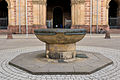 Domnapf
 -
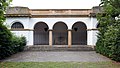 Antikenhalle
 -
 Dwarf gallery


German Postage Stamps featuring Speyer cathedral
[edit]-
![Postal stamp of 1924[citation needed]](//upload.wikimedia.org/wikipedia/commons/thumb/9/9c/DR_1924_367_Bauwerke_Speyerer_Dom.jpg/120px-DR_1924_367_Bauwerke_Speyerer_Dom.jpg) Postal stamp of 1924[citation needed]
Postal stamp of 1924[citation needed] -
 Postal stamp of 1961 commemorating the 900th anniversary of Speyer Cathedral
![Postal stamp of 1924[citation needed]](https://en.wikipedia.org/wiki/File:DR_1924_367_Bauwerke_Speyerer_Dom.jpg)

See also
[edit]References
[edit] |
| Part of a series on the |
| Mariology of the Catholic Church |
|---|
 |
 Catholic Church portal Catholic Church portal |

- ^ speyer.de | Speyer Cathedral Archived 13 June 2006 at the Wayback Machine. Information from home page. Retrieved 5 December 2006.(in English)
- ^ a b c d e f g International Council on Monuments and Sites (April 1981). Advisory Body Evaluation of Speyer Cathedral. UNESCO World Heritage Convention. Archived 30 October 2020 at the Wayback Machine.
- ^ Máté Major: Geschichte der Architektur, Vol. 2, Akadémiai Kiadó, Budapest, 1979, special German edition 1988
- ^ a b c dtv-Atlas zur Baukunst, Vol. 2, 1981, Deutscher Taschenbuch Verlag, Munich, ISBN 3-423-03021-6
- ^ "Speyer Cathedral".
- ^ "Der Kaiserdom zu Speyer – Bauwerk". Archived from the original on 2 January 2016. Retrieved 3 March 2009.
- ^ Cole, Emily, General Editor, Bulfinch Press, Little, Brown and Co., 2002, Boston, USA, ISBN 0-8212-2774-2
- ^ Oursel, Raymond, Stierlin, Henri: Architektur der Welt, Vol. 4: Romanik, Benedikt Taschen Verlag Berlin/Editions Office Du Livre, Lausanne, p. 129
- ^ Stalley, Roger: Early Medieval Architecture, Oxford University Press, Oxford, Great Britain, 1999, ISBN 0-19-210048-3, pp. 214–215
- ^ "Romanesque architecture and art | Infoplease".
- ^ "Romanesque Architecture And Art | Encyclopedia.com".
- ^ a b "Der Kaiserdom zu Speyer – Zahlen, Namen, Fakten für besonders Eilige". Archived from the original on 10 December 2015. Retrieved 1 March 2009.
- ^ Dethard von Winterfeld. Romanik am Rhein. Stuttgart 2001, p. 66
- ^ a b "Speyer Cathedral". Welterbestätten Deutschland. UNESCO. Archived from the original on 8 August 2007. Retrieved 5 December 2006.
- ^ Stalley, Roger: Early Medieval Architecture, Oxford University Press, Oxford, Great Britain, 1999, ISBN 0-19-210048-3, p.217
- ^ Schlickel, Ferdinand, Speyer. Von den Saliern bis heute, 1000 Jahre Stadtgeschichte, 2000, Hermann Klein Verlg, Speyer, ISBN 3-921797-60-8
- ^ a b c "Dombauverein Speyer e.V. – Dombauverein Speyer e.V." Archived from the original on 27 September 2007. Retrieved 8 May 2006.
- ^ "Romanesque Art and Architecture – ninemsn Encarta". Archived from the original on 7 September 2008. Retrieved 4 July 2014.
- ^ Stalley, Roger: Early Medieval Architecture, Oxford University Press, Oxford, Great Britain, 1999, ISBN 0-19-210048-3, p. 139, 192–193
- ^ Radding, Charles M. and Clark, William W.: Medieval Architecture, Medieval Learning: Builders and Masters in the Age of Romanesque and Gothic, Yale University Press, New Haven and London, 1992, ISBN 0-300-04918-8 quoting Horn, W: On the Origins of the Mediaeval Bay System, Journal of the Society of Architectural Historians 17 (1958): 2–23.
- ^ Stalley, Roger: Early Medieval Architecture, Oxford University Press, Oxford, Great Britain, 1999, ISBN 0-19-210048-3, p. 211
- ^ Stalley, Roger: Early Medieval Architecture, Oxford University Press, Oxford, Great Britain, 1999, ISBN 0-19-210048-3, p. 139
- ^ Stalley, Roger: Early Medieval Architecture, Oxford University Press, Oxford, Great Britain, 1999, ISBN 0-19-210048-3, p. 197-198
- ^ Stalley, Roger: Early Medieval Architecture, Oxford University Press, Oxford, Great Britain, 1999, ISBN 0-19-210048-3, p. 55
- ^ a b c d "Kaiser- und Mariendom zu Speyer". Go:Ruma. Retrieved 7 November 2013.
- ^ Speyer Cathedral Archived 13 June 2006 at the Wayback Machine
- ^ Fotografie "Speyer-Fragment des Codex argenteus", rlp.museum-digital.de
- ^ Stutz, Elfiede: "Ein gotisches Evangelienfragment in Speyer" in Zeitschrift für vergleichende Sprachforschung 85, volume 1 (1971), pp. 85-95.
- ^ Stalley, Roger: Early Medieval Architecture, Oxford University Press, Oxford, Great Britain, 1999, ISBN 0-19-210048-3, p. 151-152
- ^ Stalley, Roger: Early Medieval Architecture, Oxford University Press, Oxford, Great Britain, 1999, ISBN 0-19-210048-3, p. 74-75
- ^ One or more of the preceding sentences incorporates text from a publication now in the public domain: Chisholm, Hugh, ed. (1911). "Spires". Encyclopædia Britannica. Vol. 25 (11th ed.). Cambridge University Press. pp. 693–694.

External links
[edit]
- Speyer Cathedral / UNESCO Official Website
- Official site – full of pictures and up-to-date information (in English)
- Rhineland-Palatinate website for Speyer Cathedral (German)
- Dombauverein Speyer – Cathedral Building Association site (in English)
- Speyer.de Archived 21 April 2019 at the Wayback Machine – description and tourism information (in English)
- Kaiserdom Speyer Virtuell – 360° panorama images (in German)
- Thieme/Sommer/Wolfe: "Das große Buch der Stile", Band 5, "Die Romanik", Reinhard Welz, Vermittler Verlag e.K. Mannheim, 2005, ISBN 3-938622-53-9, Scan of the chapter on early christianity in Speyer


| International | |
|---|---|
| National | |
| Geographic | |
| Other | |

Speyer Cathedral
View on GrokipediaSpeyer Cathedral, formally known as the Kaiserdom zu Speyer or Imperial Cathedral of Speyer, is a monumental Romanesque basilica dedicated to the Assumption of the Blessed Virgin Mary and Saint Stephen, situated in the city of Speyer, Germany.[1][2]
Construction commenced around 1030 under Holy Roman Emperor Conrad II, with the structure consecrated in 1061 during the reign of his grandson Henry IV, establishing it as one of the earliest and most ambitious expressions of Romanesque architecture in the Holy Roman Empire.[3][4][5]
Measuring approximately 134 meters in length, 37.6 meters in width, and 33 meters in height, it features a triple-naved design with four towers and two domes, barrel vaults, and a vast crypt recognized as the largest of its kind from the Romanesque period, underscoring its engineering prowess and symbolic role as a dynastic necropolis.[6][3]
The cathedral served as the principal burial site for eight emperors and kings from the Salian, Staufen, and Habsburg dynasties over nearly three centuries, embodying imperial authority and continuity amid the Empire's political upheavals.[4][3]
Designated a UNESCO World Heritage Site in 1981, Speyer Cathedral exemplifies the zenith of Romanesque stone masonry and liturgical space, influencing subsequent ecclesiastical designs while enduring destructions, such as the French bombardment of 1689, followed by meticulous 19th-century restorations that preserved its original form.[3][4]
Historical Development
Foundation and Early Romanesque Construction
The foundation of Speyer Cathedral was laid in 1030 by Holy Roman Emperor Conrad II, who commissioned the project to erect the largest church in the Western world at the time, serving as a symbol of imperial authority and his planned mausoleum.[4] [7] Constructed from local red sandstone, the early Romanesque design adopted a triple-aisled basilica layout with a prominent westwork, transept, and eastern choir, emphasizing monumental scale over decorative elaboration typical of the Ottonian tradition's evolution into Salian architecture.[3] [8] Work advanced steadily after the cornerstone was set, with the crypt consecrated in 1041 and construction continuing beyond Conrad II's death in 1039 under his successors Henry III and Henry IV.[9] The initial phase, known as Speyer I, reached near completion by its consecration on October 4, 1061, marking a pinnacle of 11th-century engineering with its vast nave spanning approximately 28 meters in width and employing timber roofing before later vaulting innovations.[10] [11]Medieval Imperial Role and Expansions
Speyer Cathedral emerged as a pivotal symbol of imperial authority in the Holy Roman Empire during the Salian dynasty's rule in the 11th century, functioning primarily as a mausoleum for emperors and a venue for key ceremonial events that underscored the emperor's sacral kingship. Emperor Conrad II commissioned its construction in 1030 to replace an earlier Carolingian basilica, aiming to establish a monumental structure befitting the empire's prestige and his dynasty's legitimacy following the Ottonian era. This initiative reflected the Salians' strategy to centralize religious and political symbolism in Speyer, an imperial city on the Rhine, amid a fragmented feudal landscape where imperial power relied on ecclesiastical alliances and displays of grandeur.[3][11] Conrad II's untimely death in 1039 led to his burial in the incomplete cathedral, initiating its role as an imperial necropolis; his successors, including Henry III, continued the work, culminating in the structure's consecration on June 26, 1061. This early phase established the cathedral's Romanesque form with a basilical layout, double-towered westwork, and crypt designed for elite interments, hosting assemblies and reinforcing the emperor's divine mandate against rising aristocratic and ecclesiastical rivals. By the mid-11th century, Speyer had become a fixed site for imperial diets and oaths of fealty, embedding the cathedral in the empire's constitutional rituals.[4][11] Facing structural limitations and the need to amplify dynastic presence during the Investiture Controversy, Emperor Henry IV initiated extensive expansions around 1082, which involved demolishing parts of the original nave, raising wall heights by approximately five meters, replacing wooden roofing with stone vaults, and adding an innovative encircling gallery—the first of its kind in a large-scale basilica. These modifications, completed by 1106 coinciding with Henry IV's death, effectively doubled the cathedral's interior volume and capacity for tombs, accommodating burials of Henry IV, his son Henry V in 1125, and later rulers up to the 13th century, totaling eight emperors. The expansions manifested the Salians' assertion of autonomy from papal interference, as the enhanced scale projected unyielding imperial sovereignty while incorporating engineering advances that influenced subsequent German Romanesque architecture.[3][4][12]Destruction, Reconstructions, and 19th-Century Revivals
Speyer Cathedral endured significant destruction during the Nine Years' War in 1689, when French forces under Louis XIV invaded the city and set the structure ablaze, causing the collapse of the western nave and the loss of late Gothic additions.[11][7] This fire, part of broader devastation in the Palatinate campaign, left the cathedral in partial ruin, with the eastern sections and crypt spared but the west end severely compromised.[3] Earlier incidents, including fires in 1159 and 1450, had prompted repairs and Gothic modifications, but the 1689 event marked the most extensive post-medieval damage.[13][10] Reconstruction efforts commenced in the mid-18th century, with the west bays of the nave rebuilt from 1752 to 1759 and further work between 1772 and 1778, aiming to replicate the original Romanesque design on surviving foundations despite the era's prevailing Baroque influences.[14][15] These repairs stabilized the structure but incorporated stylistic elements diverging from the 11th-century prototype, preserving functionality while awaiting more comprehensive restoration.[3] The initiative reflected pragmatic post-war recovery rather than ideological revival, prioritizing structural integrity over historical fidelity.[4] In the mid-19th century, amid rising German nationalism and Romantic interest in medieval heritage, the cathedral underwent a deliberate revival to excise Baroque accretions and restore its Romanesque character. Architect Heinrich Hübsch oversaw the rebuilding of the westwork from 1854 to 1858, demolishing the 18th-century facade and reconstructing it on original foundations to evoke the Salian-era form.[3][7] This phase, influenced by purist interpretations of Romanesque architecture, aligned with broader European efforts to reclaim pre-Gothic monuments as symbols of national identity, though it introduced interpretive elements absent in the medieval build.[3] The work enhanced the cathedral's visual unity, positioning it as a preserved exemplar of early imperial basilican design.[16]20th- and 21st-Century Restorations and Challenges
The Speyer Cathedral sustained damage during World War II bombings, with the roofs destroyed by fire while the Romanesque vaults remained largely intact due to their structural robustness.[17] A comprehensive restoration campaign from 1957 to 1972 focused on securing the building's stability and reconstructing the original Romanesque interior by systematically removing Baroque and 19th-century alterations, including repainting the interior to evoke its medieval character.[3] This effort, directed by German monument preservation authorities, marked a significant post-war conservation milestone, emphasizing historical authenticity over later stylistic overlays.[3] In the 21st century, restorations have addressed specific structural vulnerabilities, such as the neo-Romanesque westwork and towers, with the Kaisersaal (Emperor's Hall) and southwest tower completed by 2013 through targeted reconstruction.[18] The Vierungsturm (crossing tower) underwent sanierung from 2018 to 2022, costing approximately 1.8 million euros, after assessments revealed risks including potential dome collapse from decay and instability; funding included contributions from the Dombauverein and state sources covering about 40% of expenses.[19] [20] Ongoing challenges include perpetual maintenance needs, as the cathedral is often described as a "Dauerbaustelle" (permanent construction site), with recent interior floor cleaning trials in 2025 and planned east tower sanierung following damage mapping in 2024.[21] [22] Financing remains a persistent issue, reliant on donations, foundations like the Europäische Stiftung Kaiserdom (which pledged 20,000 euros for scaffolding in 2024), and public funds, while UNESCO World Heritage status since 1981 supports but does not fully resolve these demands.[23] The site's exposure to environmental factors and high visitor traffic further necessitates vigilant conservation to preserve its integrity without compromising liturgical use.[3]Architectural Characteristics
Romanesque Style and Structural Innovations
Speyer Cathedral embodies core Romanesque stylistic elements, including massive sandstone walls up to 2.5 meters thick, rounded arches spanning the arcades and windows, and a basilica layout with a central nave flanked by aisles and a transept. The elevation features a triforium gallery above the arcades and a clerestory for light, creating a rhythmic vertical progression typical of the style's emphasis on solidity and symbolic hierarchy.[3] This design, initiated around 1030 under Emperor Conrad II, prioritized structural mass over lightness, reflecting causal engineering needs to support unbuttressed walls without reliance on wooden roofs.[24] A primary structural innovation lies in the pier system, where cruciform compound piers extend continuously from floor to vault springing, interconnected to walls via quadrant arches that distribute loads efficiently across the 10-meter-wide nave bays. This configuration enabled wide spans without external buttresses, a departure from earlier columnar supports, and facilitated the cathedral's scale as the largest Romanesque church at completion in 1061.[25] The piers' robust form, often clustered with half-columns, provided enhanced stability for the overlying stone construction, demonstrating empirical advancements in load-bearing masonry derived from Roman precedents adapted to medieval tooling.[26] Vaulting represents another breakthrough: the nave received groin vaults of unprecedented span for the era, covering two bays each and forming square compartments that halved thrust compared to barrel vaults, thus pioneering consistent stone roofing over large interiors as the first such vaulted church in Europe.[3] Consecrated in 1061, these vaults, rising to about 33 meters, relied on the pier system's geometry for rib-like reinforcement, foreshadowing rib vaults while maintaining Romanesque's uniform mass.[24] The subterranean crypt, completed by 1041, further innovates as the largest Romanesque columned hall—spanning 46 by 35 meters with 16 piers supporting cross-groined vaults—serving as a self-contained basilica that doubled as a foundation stabilizing the superstructure against soil settlement.[3] Under Henry IV's late-11th-century modifications, the addition of an encircling Zwerggalerie (dwarf gallery) around the exterior integrated arcades that marked a novel system for visual continuity and minor load distribution, though primarily ornamental, enhancing the original Romanesque envelope without altering core engineering.[3] These features collectively underscore Speyer's role in advancing causal realism in medieval building, where empirical trial—evident in its survival of fires and wars—validated innovations prioritizing durability over ornament.[24]Dimensions, Layout, and Engineering
Speyer Cathedral spans a total length of 134 meters from the western entrance steps to the eastern apse wall, with a maximum width of 43 meters across the transepts.[27] [28] The internal dimensions of the nave measure 14 meters in width and reach a height of 33 meters to the vault apex, while the external width including aisles extends to 37.6 meters.[6] [29] The layout adheres to a classic Romanesque basilica form with a Latin cross plan, comprising a central nave flanked by double aisles, a transept intersecting at the crossing, and a semicircular eastern apse housing the high altar.[30] [27] The western facade incorporates a narthex and is framed by paired towers, with an additional pair at the choir ends; two large domes cap the crossing and eastern arm.[3] The undercroft crypt replicates the upper structure's footprint, extending 46 meters in length, 35 meters in width, and 7 meters in vault height to support the massive stone floor above.[31] Engineering innovations center on the nave's groin vaulting, constructed between 1061 and 1106, which spans two bays per vault segment—an early advancement enabling greater interior volume without Gothic ribs or buttresses.[26] [32] Support derives from alternating simple cylindrical piers and reinforced compound piers, augmented by lesenes (vertical pilaster strips) on every other pier to distribute the vault thrust into thick sandstone walls up to 4 meters deep.[33] This system, replacing an initial timber roof, exemplifies Romanesque structural experimentation with stone vaults over wide spans, prioritizing load-bearing mass over skeletal framing.[34]Materials, Craftsmanship, and Durability
The cathedral's structure is primarily built from red sandstone sourced from quarries in the Palatinate region, selected for its availability and ability to be layered with lighter sandstone variants to create a characteristic striated polychrome effect on walls and facades.[30][35] This local stone, often featuring silica-rich cementation, contributes to resistance against erosion in the Rhine Valley climate, though its porosity necessitates periodic interventions.[36] Roofs originally employed timber framing covered in lead sheeting, later replaced by stone edge vaults during reconstructions to enhance fire resistance.[34] Craftsmanship reflects advanced 11th-century Romanesque masonry, with precisely cut ashlar blocks forming thick walls up to 2.5 meters in places and supporting transverse barrel vaults spanning approximately 13.7 meters—the largest such spans attempted in early medieval Europe.[33] Builders under Conrad II and Henry IV employed circumferential galleries and blind arcading for structural reinforcement and aesthetic rhythm, marking innovations in load distribution that minimized reliance on wooden roofs.[3] Italian artisans contributed sculpted details, including figural capitals in the crypt, executed with fine chisel work to integrate decorative elements without compromising stability.[3] The cathedral's durability derives from its massive, over-engineered form—featuring solid foundations and redundant vaulting—which enabled survival through fires, wars, and seismic events, including the 1689 destruction where walls withstood total roof collapse.[3] Sandstone weathering, exacerbated by pollution and moisture, has prompted targeted restorations, such as 1957–1972 campaigns removing later accretions to expose original stone and 21st-century cleaning of crypt floors using low-pressure water jets to preserve surface integrity without abrasion.[37][3] Modern reinforcements, including cement injections into pillars, address localized instabilities from centuries of exposure, affirming the original craftsmanship's capacity for long-term endurance when maintained.[38]Interior Features
Crypt and Imperial Tombs
The crypt of Speyer Cathedral, consecrated in 1041, represents the earliest constructed and surviving element of the edifice, functioning primarily as the sepulcher for eight Holy Roman Emperors, four empresses or queens, and several bishops from the Salian, Staufer, and Habsburg dynasties.[31] [4] This subterranean space, envisioned as a symbolic reflection of divine order through its symmetrical hall design, spans four interconnected rooms beneath the choir, crossing, and transepts, originally serving as a chapel accommodating up to 70 clerics during the Middle Ages and continuing to host liturgical masses.[31] Architecturally, the crypt exemplifies Romanesque engineering as the largest such vaulted space globally, with dimensions of 46 meters in length, 35 meters in width, and 7 meters in vault height, constructed using red and yellow sandstone ribbed vaults supported by pillars.[31] [39] Its central square room features nine bays, complemented by seven altars, the oldest Romanesque baptismal font north of the Alps, and sculptural elements including two lions dating to circa 1100 and Gothic reliefs from 1480.[31] The tombs, initially placed in the nave above, were relocated to the crypt during early 20th-century renovations between 1900 and 1906, following excavations that verified identities through skeletal analysis and historical records.[4] The imperial tombs occupy prominent positions, centered around the sarcophagus of Conrad II (died 1039), the Salian founder of the cathedral, encased in an iron-banded coffin.[31] Flanking this are the remains of his wife Gisela (died 1043), successor Henry III (died 1056), Henry IV (died 1106), and Henry V (died 1125), the last Salian emperor; Philip of Swabia (died 1208), the first assassinated German king; Beatrix (died 1184), wife of Frederick Barbarossa, and their daughter Agnes (died 1184); Adolph of Nassau (died 1298); Rudolf of Habsburg (died 1291, with epitaph in the west room); and Albert of Austria (died 1308).[31] [40] These burials, spanning from 1039 to 1308, underscore the cathedral's role as a dynastic necropolis until the early 14th century, though many sarcophagi suffered desecration during the 1689 French bombardment in the War of the Palatine Succession, with bones later reassembled during 19th-century restorations.[31]Chapels, Altars, and Liturgical Elements
The Speyer Cathedral incorporates chapels primarily at the ends of its side aisles, serving specialized liturgical functions. The St. Afra Chapel, positioned at the conclusion of the northern side aisle, functions as a sacrament chapel dedicated to silent prayer and Eucharistic adoration; it contains a prominent depiction of the Annunciation.[41] This chapel, named after the early Christian martyr Afra of Augsburg, historically housed temporary burials, including that of Emperor Henry IV in 1106 prior to his reconciliation with the Church.[41] On the southern side, the St. Catherine Chapel occupies the end of the right aisle above the baptistery, operating as a relic chapel and confessional space.[41] Adjacent to it lies the Double Chapel, associated with St. Martin and functioning as a baptistery for the renewal of baptismal vows.[41] These chapels, added during medieval expansions, reflect the cathedral's role in accommodating diverse devotional practices while maintaining the integrity of the Romanesque structure.[41] The principal altar, situated beneath the crossing's cupola, symbolizes Christ as the cornerstone of the Eucharistic celebration and remains the focal point for major liturgies.[41] Consecrated in 1046 during the reign of Emperor Henry III, who donated an illuminated Gospel book for the occasion, the high altar underscores the site's imperial patronage.[7] Side altars, historically numerous in medieval configurations including dedications to saints like Blasius (pre-1125) and Heinrich (1272), supported ancillary masses but many were consolidated or removed during later restorations.[42] Liturgical elements include the bronze main portal door, cast before 1054, adorned with reliefs depicting Old and New Testament scenes to catechize entrants.[41] The tabernacle resides in the St. Afra Chapel for reservation of the Blessed Sacrament, while 19th-century frescoes by Johann Baptist Schraudolph (1846–1853), partially preserved after mid-20th-century overpainting, enhance the liturgical ambiance in the nave and choir areas.[41] These furnishings prioritize functional simplicity aligned with Romanesque austerity, enduring through centuries of use and repair.[41]Bells, Towers, and Acoustic Properties
The Speyer Cathedral possesses four towers integrated into its Romanesque basilica design: two western towers flanking the main entrance and two eastern towers at the apse end. The western towers, originally part of the 11th-century structure and later modified during reconstructions, reach approximately 65.6 meters in height, while the eastern towers stand at about 71.2 meters.[2][12] These towers contribute to the cathedral's imposing silhouette and provide vantage points, including an observation platform in the south western tower accessible via 304 steps.[43] The bells are housed in the front middle tower among the western structures and form a peal of nine, used to summon worshippers, ring during the Eucharistic consecration in Mass, and strike the hours via the four largest bells. The four principal bells were cast in 1822 by Peter Lindemann in Zweibrücken, while the five smaller ones date to 1963 by Friedrich Wilhelm Schilling in Heidelberg.[44]| Bell | Name | Tone | Weight (kg) | Diameter (cm) | Year | Founder |
|---|---|---|---|---|---|---|
| 1 | Maximilianus Josephus | g⁰ | 5,350 | 208 | 1822 | Peter Lindemann |
| 2 | Friderica Wilhelmina | b⁰ | 2,600 | 175 | 1822 | Peter Lindemann |
| 3 | Ludovicus Carolus | des¹ | 1,650 | 147 | 1822 | Peter Lindemann |
| 4 | Matthæus de Chandelle | f¹ | 600 | 115 | 1822 | Peter Lindemann |
| 5 | Maria | as¹ | 601 | 95.5 | 1963 | F. W. Schilling |
| 6 | Joseph | b¹ | 494 | 90.3 | 1963 | F. W. Schilling |
| 7 | Anna | des² | 440 | 83.3 | 1963 | F. W. Schilling |
| 8 | Pirminius | es² | 312 | 75 | 1963 | F. W. Schilling |
| 9 | Otto | f² | 217 | 66.7 | 1963 | F. W. Schilling |