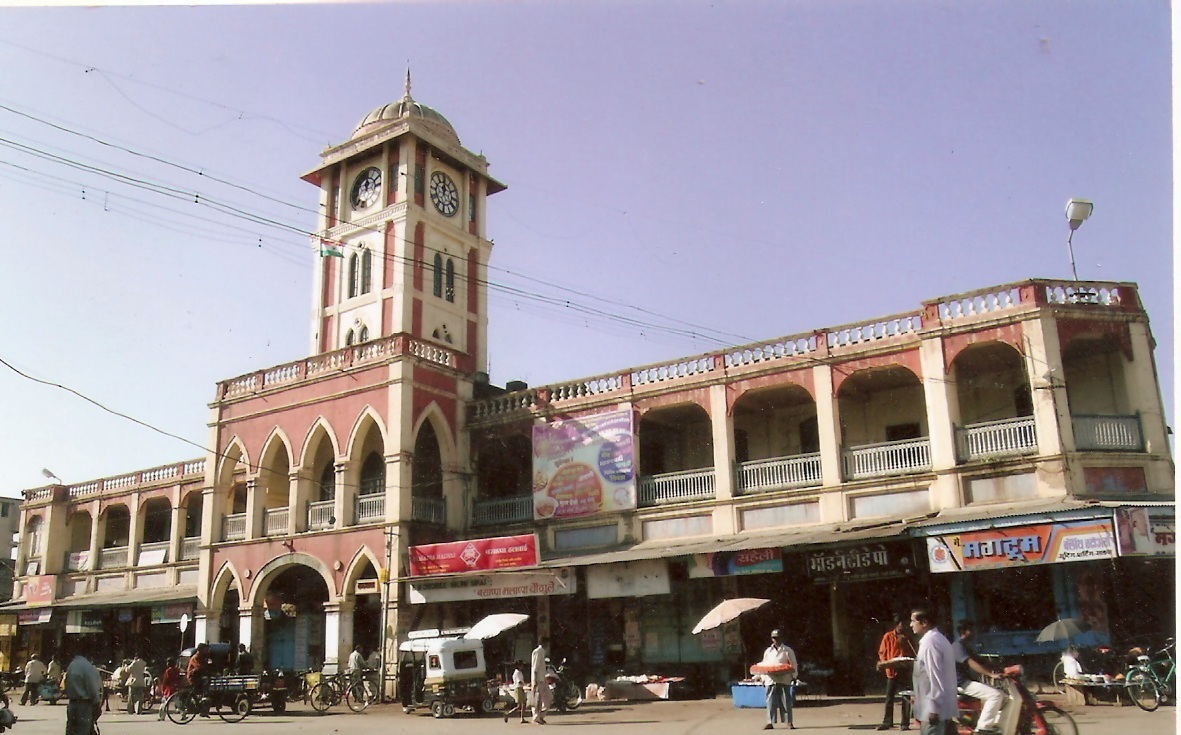

Miraj
View on Wikipedia | This article needs additional citations for verification. (January 2017) |
Miraj (Pronunciation: [miɾəd͡z]; ⓘ) is a city that is part of the Sangli-Miraj-Kupwad metropolitan region in Sangli district, Maharashtra. Founded in the early 10th century, Miraj was an important jagir of the Bijapur Sultanate.
Key Information


Chhatrapati Shivaji Maharaj, the founder of the Maratha Empire, stayed in Miraj for two months during his south India campaign. Because of its location, Miraj has been held as a strategic bastion. It was the capital of Miraj Senior and a vital junction on the central railway network. The Patwardhan family were the hereditary rulers of Miraj until independence.
Miraj is known for Hindustani classical music and medical services. It is an emerging medical hub in India. The city has an unbelievable[clarification needed] doctor-to-patient ratio. The low cost of medical treatment, treatment facilities, and adjoining medical facilities attract patients to Miraj. The language is a key factor as most of the Kannada-speaking staff attract many patients from North Karnataka.[1] Many medical tourists visit from the adjoining districts of North Karnataka and Goa, as well as all over India and from Arab countries. The annual Ganesh Visarjan procession is an attraction that lasts for an average of twenty hours.
History
[edit]Shilahara (1000 to 1216)
[edit]At the end of the 9th century, the Shilaharas of Kolhapur gained control of Miraj. In 1024, the city was ruled by Narasimha of the Shilahar dynasty. Jatiga II (c. 1000–1020), the fourth Shilahar ruler, appears in the records of his son, Narasimha (c. 1050–1075). Jatiga II was succeeded by his son Gonka, who has been described in inscriptions as the conqueror of Karahata (Karad), Miraj, and Konkan. The Shilaharas were able to retain control of Miraj despite nearby military action by Chavan-raja, a general of Western Chalukya King Jayasimha II.
Yadavas and Bahmanis (1216 to 1347)
[edit]In 1216, Miraj, along with other Shilahara territory, was conquered by the Yadavas of Devagiri. In 1318, the Bahmanis gained control.[2][page needed] The historian Tazkirat-ul-Mulk reported that Hasan Gangu, the founder of the Bahmani dynasty, was in the employ of the Shaikh Muhammad Junaidi at Gangi near Miraj. Hasan found a treasure with which he raised an army, and marched on Miraj. He defeated and imprisoned Rani Durgavati, the subedar of Miraj, and captured the town's fort. At the behest of Shaikh Muhammad, the name of the town was changed to Mubarakabad in 1347 (748 AH). In 1395, the Bahmanis conquered Miraj.[2][page needed] Between 1391 and 1403, Miraj was affected by the Durga Devi famine. From 1423, Malik Imad Ul Mulk ruled Miraj. 1494 was the year of Bahadur Khan Gilani's rebellion. For two months in 1660, Shivaji and Adilshah battled for control of Miraj.
Fortress
[edit]The builder of Miraj fort is unknown. It probably predates the Bahmani sultans, although they may have repaired it and increased its fortifications. They used the fort as a base for military expeditions against South Konkan and Goa. Firishta mentions the fort in an account of Gilani's rebellion in 1494, which was quelled by Sultan Muhammad II (1452–1515). Muhammad II took the fort from its governor, Buna Naik, who acquiesced to the new ruler. Gilani's troops were offered the option of joining Muhammad's army and being treated with leniency or leaving. About 2000 soldiers left the fort to join Gilani's rebel forces.
The fortress's main entrance was a massive gate towering at 9 m (30 ft), but it has been destroyed.
Fall of the Bahmani Empire
[edit]The power of the Bahmani rulers waned under the influence of powerful provincial governors. In 1490, the rule of Miraj passed to the Sultanate of Bijapur. During the later years of his reign, Ibrahim Adil Shah I (1534–1558) kept his son, Ali Adil Shah I (1558–1580), under house arrest in Miraj. On Ibrahim's death in 1580, Miraj became an assembly point for Ali's troops in his assuming the throne. Subsequently, the troops of Miraj fought with Ismail against Ibrahim Adil Shah II.
Rise of the Maratha Empire
[edit]On 28 November 1659, within 18 days of Bijapur General Afzal Khan's death at Pratapgad, the western Adil Sahi district was surrendered to Annaji Datto (Shivaji's finance minister). Unlike other towns, the Miraj fort resisted. Shivaji, who was encamped at Kolhapur, sent Netaji Palkar to besiege Miraj. In January 1660, Shivaji arrived to personally command the three-month-long ongoing siege. However, news of attacks by Siddi Johar and Fazal Khan caused him to return to Panhala. The siege of Miraj was abandoned and negotiations began. Under the rule of Sambhaji, the Maratha Empire generals Santaji Ghorpade and Dhanaji Jadhav chose Miraj as a safe place for their families while they conducted guerrilla actions against the invading forces of Aurangzeb of the Mughal Empire.
Mughal Empire
[edit]In 1687, Bijapur was conquered by the Mughals. Santaji Ghorpade became Deshmukh of Miraj in 1680 and Aurangzeb captured the town six years later. In 1730, Maratha Chhatrapati Shahu of Satara ordered Pant Pratinidhi[which?] to attack the town. Miraj remained under Mughal rule until 3 October 1739, when it was captured by Shahu after a military campaign of two years, reflecting the fall of the last defences of the Mughals. In 1761, Harbhat Patwardhan's son, Gopalrao, took the Miraj jagir from Peshwa Madhavrao.
British Raj
[edit]The Patwardhan dynasty ruled Miraj as the capital of a principality, overseen by British rule. Miraj was part of the southern division of the Bombay Presidency which in turn was part of the southern Maratha jagirs, and later the Deccan States Agency. In 1820, the state of Miraj was divided into Miraj Senior and Miraj Junior. The territory of both regions was distributed among other native states and British districts. The area of Miraj Senior was 339 square miles (880 km2). In 1901, its population was 81,467. Its revenue was £23,000 and the tax paid to the British was £800. The population of the town of Miraj in 1901 was 18,425. It lay on a junction of the Southern Mahratta Railway.
Independence
[edit]On 8 March 1948, Miraj Senior acceded to the Dominion of India, and the city became part of the Republic of India. Since 1960, it has been part of the state of Maharashtra.
Climate
[edit]| Climate data for Miraj (1981–2010, extremes 1968–2010) | |||||||||||||
|---|---|---|---|---|---|---|---|---|---|---|---|---|---|
| Month | Jan | Feb | Mar | Apr | May | Jun | Jul | Aug | Sep | Oct | Nov | Dec | Year |
| Record high °C (°F) | 36.1 (97.0) |
40.0 (104.0) |
42.3 (108.1) |
43.0 (109.4) |
42.9 (109.2) |
41.6 (106.9) |
35.8 (96.4) |
34.8 (94.6) |
36.5 (97.7) |
39.2 (102.6) |
35.1 (95.2) |
34.4 (93.9) |
43.0 (109.4) |
| Mean daily maximum °C (°F) | 31.8 (89.2) |
34.1 (93.4) |
36.8 (98.2) |
38.5 (101.3) |
37.3 (99.1) |
31.5 (88.7) |
28.9 (84.0) |
28.4 (83.1) |
30.5 (86.9) |
32.1 (89.8) |
31.7 (89.1) |
31.0 (87.8) |
32.7 (90.9) |
| Mean daily minimum °C (°F) | 14.4 (57.9) |
15.7 (60.3) |
18.8 (65.8) |
21.5 (70.7) |
22.4 (72.3) |
22.2 (72.0) |
21.6 (70.9) |
21.2 (70.2) |
20.9 (69.6) |
20.3 (68.5) |
17.4 (63.3) |
14.7 (58.5) |
19.2 (66.6) |
| Record low °C (°F) | 7.0 (44.6) |
8.6 (47.5) |
11.1 (52.0) |
14.2 (57.6) |
15.5 (59.9) |
18.5 (65.3) |
9.7 (49.5) |
17.4 (63.3) |
14.1 (57.4) |
13.3 (55.9) |
8.7 (47.7) |
6.5 (43.7) |
6.5 (43.7) |
| Average rainfall mm (inches) | 0.3 (0.01) |
0.2 (0.01) |
6.5 (0.26) |
21.6 (0.85) |
51.9 (2.04) |
137.9 (5.43) |
108.1 (4.26) |
89.2 (3.51) |
124.0 (4.88) |
115.6 (4.55) |
22.2 (0.87) |
4.5 (0.18) |
681.8 (26.84) |
| Average rainy days | 0.0 | 0.0 | 0.5 | 1.5 | 2.8 | 7.6 | 9.7 | 9.2 | 7.0 | 5.5 | 1.5 | 0.4 | 45.6 |
| Average relative humidity (%) (at 17:30 IST) | 39 | 31 | 30 | 31 | 45 | 68 | 75 | 76 | 69 | 56 | 49 | 45 | 51 |
| Source 1: India Meteorological Department[3] | |||||||||||||
| Source 2: Government of Maharashtra[4] | |||||||||||||
Demographics
[edit]Marathi is the official language, while Kannada is also a widely spoken language of the city. A form of Hindustani, Hyderabadi Deccani is also spoken.
Hindustani classical music
[edit]Miraj is a popular place for artists to perform during urus. The administrative office of the Gandharva Mahavidyalaya is at Miraj. The city is known for its players and manufacturers of sitars.
Musicians
[edit]- Vishnu Digambar Paluskar
- Vishnu Narayan Bhatkhande
- Hirabai Badodekar
- Vinayakrao Patwardhan
- Bal Gandharva made his debut performance at the city's Hans Prabha Theatre. In the same location, the Balgandharva Natyagruha was named for him.
- Abdul Karim Khan, a performer of Kirana gharana, lies interred within the Hadrat Khwaja Shamna Mira RH and Hadrat Mira Saheb RH Dargah. An annual music festival at the dargah takes place in his memory.
- Ram Kadam, a Marathi film composer and musician
String instruments
[edit]Miraj supplies Indian string instruments such as the sitar, sarod, and tanpura. These are made of wood and specially treated gourds. The art of instrument making was developed by Faridsaheb Shikalgar in the 18th century, and his descendants, who now use 'Sitarmaker' as their surname,[5] follow this tradition. The area of Miraj is known for creating sitars. The traditional craft of making these instruments is passed down from generation to generation.
Famous places
[edit]Miraj is also known for Khwaja Shamna Mira, a dargah over the tomb of Khwaja Muhammad Mira Hussaini Chishti, a Sufi originally from Kashgar who migrated to Miraj. The story behind him is that at the time of his arrival in Miraj, the city was ruled by a black magician Gangna Dhobi who made human sacrifices. It is said that due to Mira's spiritual power he convinced Dhobi to become a Muslim. Another story tells that Mira was walking barefoot, and a shoemaker decided to make shoes for him with skin torn from his own thigh. As a reward, he asked for the right to cover the first chadar of Mira during his urus.[clarification needed] This has continued since, and during his urus a shoemaker first puts a chadar on the tomb.
Transportation
[edit]Railway
[edit]Miraj Junction railway station is an important junction on the Central Railway. It was the only junction to have all three rail gauges: broad gauge, narrow gauge, and metre gauge. The last narrow gauge train departed on 1 November 2008. Miraj now has only broad gauge railway tracks.[when?] Miraj is connected by railway to Pune in the north, Kurduvadi via Pandharpur in the northeast, and Belgaum and Goa in the south. In February 2011, passenger trains from Kolhapur to Solapur began running on the converted Miraj-Pandharpur-Kurduvadi broad gauge track.
Trains of the South Western Railway, like the Rani Chennamma Express bound for Bengaluru, originate from Miraj Junction station.
Road
[edit]Miraj lies off the Mumbai-Pune-Bengaluru highway, NH 48. Sangli and Miraj form a triangle with two exits of NH 48, each about 50 km away. Though the time taken to travel from Miraj varies depending on speed and other factors, Mumbai is about 7 hours away, and Bengaluru about 11 hours away by car.
MLA
[edit]Suresh Khade, the MLA from Miraj constituency, represents the Bharatiya Janata Party (BJP) in the 2024 elections.
See also
[edit]
- William James Wanless – Founder of Wanless Hospital
- Dargah of Meerasaheb Avalia
References
[edit]- ^ Mali, Amit Mahadev; Chavan, S. D. (January 2017). "Medical Tourism In Miraj City: Opportunities And Challenges" (PDF). International Journal of Researches in Social Sciences and Information Studies. 5 (1): 69–74. ISSN 2347-8268.
- ^ a b Husaini, S. A. Q. (1960). Bahman Shah: The Founder of the Bahmani Kingdom (PDF) (1st ed.). Calcutta: Firma K. L. Mukhopadhyay.
- ^ "Station: Miraj (Sangali) Climatological Table 1981–2010" (PDF). Climatological Normals 1981–2010. India Meteorological Department. January 2015. pp. 497–498. Archived from the original (PDF) on 5 February 2020. Retrieved 10 April 2020.
- ^ "Climate". Government of Maharashtra. Retrieved 10 April 2020.
- ^ Bhattacharya, Sarbajaya (29 February 2024). "Sitarmakers of Miraj: fading notes". People's Archive of Rural India.
External links
[edit]- The Municipal Corporation home page - Marathi language only as of 2006/10/09
- List of rulers of Miraj Senior
- Original article in the district Gazetteer
| History | .svg) | |
|---|---|---|
| Geography | ||
| Cities and towns | ||
| Transport | ||
| Lok Sabha constituencies | ||
| Vidhan Sabha constituencies | ||
| Tehsil | ||
| Tourist attractions | ||
| Education | ||
| International | |
|---|---|
| National | |
| Other | |

Miraj
View on GrokipediaGeography
Location and topography
Miraj is situated in Sangli district, Maharashtra, western India, at geographical coordinates 16°49′N 74°38′E.[7] The city occupies a position on the Deccan Plateau, with an average elevation of approximately 560 meters above sea level.[8] As part of the Sangli-Miraj-Kupwad metropolitan agglomeration, Miraj lies in a region primarily drained by the Krishna River and its tributaries, including the Warna, which traverse the district for about 105 kilometers.[9][10] The local topography features plain to undulating terrain typical of the Deccan Plateau, supporting fertile black cotton soils conducive to agriculture.[10][11] This landscape is shaped by fluvial processes from the Krishna basin, contributing to the area's hydrological and geomorphic characteristics.[10]Climate
Miraj experiences a tropical climate with three primary seasons: a hot summer from mid-February to late May, a monsoon period from June to September, and a relatively mild winter from December to mid-February, with transitional post-monsoon months in October and November.[12] Average annual temperatures range from a mean minimum of about 14°C in December to a mean maximum of 37.5°C in May, reflecting the region's location on the Deccan Plateau where solar radiation drives high summer heat.[12] Summer temperatures frequently exceed 40°C, with the highest recorded at Miraj reaching 42.2°C on April 2, 1942, May 15, 1940, and June 1, 1934.[12] Winters are cooler but rarely dip below 10°C, with the lowest temperature on record being 5.0°C on January 7, 1945.[12] During the monsoon, temperatures moderate to averages around 27-30°C highs and 22°C lows in July, the coolest month.[13] Annual rainfall in Miraj averages 635.1 mm, concentrated primarily during the southwest monsoon which accounts for about 68% of the total, with July receiving 110.0 mm and September 105.2 mm.[12] More recent data from 1982 to 2018 for Miraj tahsil indicate an average of 681.10 mm over 45 rainy days annually, showing a non-statistically significant increasing trend in both rainfall and rainy days.[14] District-wide extremes include a 24-hour maximum of 261.6 mm recorded in nearby Shirala on July 26, 1898, underscoring vulnerability to heavy localized downpours.[12]History
Early medieval period: Shilahara dynasty (c. 1000–1216)
The Shilahara dynasty's Kolhapur branch asserted control over Miraj, known anciently as Mirinja or Mirinja-desa, by the late 10th century, incorporating it into a domain spanning southern Maharashtra districts including Satara, Kolhapur, and parts of Belgaum. The branch's founder, Jatiga I, ruled circa 940–960 CE, establishing the lineage's regional authority initially as feudatories to the Later Chalukyas and Rashtrakutas before achieving greater autonomy. A fort structure in Miraj existed by this period, underscoring its strategic role amid the dynasty's expansion into Konkan and inland territories like Karad.[15][2] Early 11th-century rulers, such as Gonka (son of Jatiga II), administered Mirinja-desa alongside Karahata-Kundi and Konkana as Chalukya subordinates, reflecting the dynasty's vassal status under kings like Jayasimha II. In 1024 CE, a Shilahara ruler named Jayasimha issued copper plates from Miraj, documenting campaigns and grants that affirm the site's administrative prominence. By 1037 CE, Chalukya king Jayasimha II defeated Jatinga (likely Jatiga), seizing Panhala fort and temporarily curbing Shilahara influence, though local control persisted. Jatinga's successor, Marsimha (or Marsingh), ruled from circa 1000–1075 CE, maintaining oversight of Miraj and adjacent areas.[15][2] Mid-11th-century consolidation is evidenced by Marasimha's Miraj copper plates of 1058 CE (Saka 980), which record a land grant of Kuntavada village to a Shaiva acharya and note his capital at Kiligila (Panhala), signaling strengthened governance and religious patronage in Miraj. This era saw Shaiva temple construction, including a possible panchayatana complex dedicated to Shiva, aligning with the dynasty's support for Brahmanical institutions. Later, Gandaraditya (c. 1110–1135 CE) proclaimed exclusive sovereignty over Mirinja-desa, encompassing seven khollas (divisions) and Konkan, amid efforts to feed large Brahmana assemblies at sites like Prayaga, indicative of cultural and economic stability.[15] The dynasty's tenure waned under Bhoja II (1175–1212 CE), the final Kolhapur ruler, whose defeats by Yadava forces of Devagiri culminated in the loss of Miraj around 1216 CE, as Singhana II seized the surrounding territory by 1213–1214 CE. Shilahara rule fostered administrative continuity through grants and fortifications but ended with subordination to rising Deccan powers, transitioning Miraj into Yadava oversight.[15]Yadava and Bahmani eras (1216–1347)
In 1216, Miraj and surrounding Shilahara territories in southern Maharashtra were conquered by the Yadava dynasty of Devagiri, marking the transition from local Silahara rule to broader Deccan overlordship. This expansion occurred under Yadava king Singhana (r. c. 1210–1246), who subdued Silahara holdings through military campaigns that incorporated regions like the Krishna river valley into the Yadava domain stretching from the Narmada to Tungabhadra rivers. The Yadavas administered Miraj as a peripheral town within their feudatory system, relying on local nayaks (military governors) for revenue collection from agriculture and trade routes linking the Deccan plateau to the Konkan coast; no major inscriptions or monuments directly tied to Yadava patronage in Miraj survive, though the dynasty's era saw regional temple construction and Shaivite endowments elsewhere in Maharashtra.[16] Yadava control persisted amid internal consolidations and external pressures until the dynasty's subjugation by the Delhi Sultanate. Alauddin Khalji's forces first raided Devagiri in 1296, reducing the Yadavas to vassalage under Ramachandra (r. 1271–1311), whose submission involved tribute payments of gold, elephants, and horses. Subsequent rebellions under Harapala devaraya ended in defeat by Khalji forces in 1317, annexing the Yadava kingdom outright and placing the Deccan under direct Delhi oversight by 1318. Miraj, as part of this territory, shifted to Sultanate administration without recorded resistance, functioning as a secondary outpost amid the turmoil of Khalji-Tughlaq transitions.[16] From c. 1318 to 1347, Miraj entered a proto-Bahmani phase under governors appointed by Muhammad bin Tughlaq, who relocated the Sultanate capital to Daulatabad (former Devagiri) in 1327 to centralize Deccan rule. Zafar Khan, a Turkic noble elevated to wazir and governor of Deccan provinces around 1325, held Miraj as a core jagir (assigned estate) alongside Gulbarga and other towns, using it as a base for revenue extraction and military recruitment from local Maratha and Muslim levies. This period involved fiscal reforms imposing iqta land grants and iqta-based taxation, straining Hindu agrarian communities through demands for wheat, rice, and cash equivalents, while Zafar Khan navigated Tughlaq infighting by fortifying jagirs against Vijayanagara encroachments. By 1345, amid rebellions like those of the Reddis and Velamas, Zafar Khan leveraged Miraj's strategic position near the Krishna to amass 15,000 cavalry, culminating in his 1347 declaration of independence as Ala-ud-Din Bahman Shah and the founding of the Bahmani Sultanate at Gulbarga.Fortress construction and Bahmani decline
The Miraj fortress, whose original construction date and builder remain unidentified in historical records, likely originated before the Bahmani Sultanate's founding in 1347 CE, during the preceding Tughlaq administration of the Delhi Sultanate.[2] By 1318 CE, the fort had come under the influence of Bahmani governors in the Deccan, reflecting the region's strategic position along trade routes and the Krishna River basin.[2] Following the sultanate's establishment, early rulers such as Ala-ud-Din Bahman Shah expanded control westward, reaching Miraj by 1352 CE as part of campaigns to consolidate the Krishna-Tungabhadra Doab against local Hindu chieftains and Vijayanagara pressures.[17] The Bahmani administration repaired and fortified the structure to serve as a defensive outpost, enhancing its ramparts and possibly adding bastions to counter incursions, though specific architectural attributions to individual sultans like Muhammad Shah II are noted in local chronicles without precise dating.[18] During the Bidar phase of Bahmani rule (1422–1527 CE), with the capital shifted from Gulbarga, Miraj retained importance as one of several southern forts securing the sultanate's jagirs in present-day southern Maharashtra.[18] However, the sultanate's internal dynamics—marked by rivalries between Deccani and Persian-origin nobles—eroded central authority, culminating in the execution of the reformist prime minister Mahmud Gawan on fabricated charges in 1481 CE, which triggered widespread instability.[19] This event, under Sultan Muhammad Shah III, weakened military cohesion and fiscal resources, fostering provincial autonomy and revolts. The Bahmani decline fragmented the realm into five successor sultanates by 1527 CE, with Miraj's territory allocated to the Adil Shahi dynasty of Bijapur around 1490 CE amid the power vacuum.[2] Yusuf Adil Khan, a former Bahmani officer, capitalized on the chaos to establish independent rule in the Bijapur region, absorbing southwestern outposts like Miraj without major resistance due to the sultanate's depleted garrisons.[19] Local accounts indicate Sheikh Muhammad Junaidi's brief 1347 CE seizure and renaming of the fort as Mubarakabad during the founding upheavals, but later phases saw diminished Bahmani oversight, paving the way for Adil Shahi fortification enhancements.[2] This transition underscored the sultanate's overextension and failure to integrate peripheral strongholds amid chronic succession disputes and Vijayanagara border conflicts.Maratha Empire expansion
The Maratha Empire's expansion into the Miraj region began with early incursions under Chhatrapati Shivaji Maharaj, who besieged the Miraj fort in January 1660 as part of campaigns against the Bijapur Sultanate, though he abandoned it amid counterattacks by Bijapuri forces.[20] During Sambhaji Maharaj's reign (1680–1689), Maratha generals Santaji Ghorpade and Dhanaji Jadhav utilized the fort to safeguard families amid guerrilla operations against Mughal Emperor Aurangzeb's Deccan campaigns, but Miraj fell to Mughal control in 1686–1687.[20] These efforts highlighted Miraj's strategic value as a fortified crossroads controlling routes between the Deccan plateau and southern India, facilitating Maratha raids but not yet yielding permanent dominion. Decisive Maratha consolidation occurred under Chhatrapati Shahu I (r. 1707–1749), who exploited Mughal decline following Aurangzeb's death in 1707 and Nader Shah's 1739 invasion of India. After initiating attacks on Miraj around 1737, Shahu's forces, led by Pant Pratinidhi, imposed a two-year siege on the Mughal-held fort, culminating in its surrender on 3 October 1739 and establishing firm Maratha rule over the town and surrounding territories.[20] [2] This conquest secured the southern Deccan frontier, enabling further Maratha advances into Karnataka and contributing to the empire's peak territorial extent under the Peshwas. Post-conquest administration reinforced expansion by integrating Miraj into the Maratha military structure. In 1761, Peshwa Madhavrao I granted the Miraj fort and associated thanas (military posts) as a jagir to Govindrav Patwardhan, a cavalry commander who had distinguished himself in expeditions against the Nizam of Hyderabad, in exchange for maintaining troops.[20] The Patwardhan sardars, loyal to the Peshwa, governed Miraj as a semi-autonomous fief, deploying forces in subsequent campaigns against Hyder Ali and Tipu Sultan of Mysore, thereby extending Maratha influence southward until the empire's fragmentation after 1818.[20]Mughal interlude
Following the Mughal conquest of the Bijapur Sultanate in September 1686, Miraj came under imperial administration as part of the annexed Deccan territories.[21] The siege of Bijapur, initiated in March 1685 under Aurangzeb's orders and led by his son Muhammad Azam Shah, culminated in the surrender of Sikandar Adil Shah, incorporating regions like Miraj into the Mughal suba system for revenue collection and military oversight.[21] Miraj's fort, a key outpost in southern Maharashtra, served strategic purposes amid persistent Maratha guerrilla activities during Aurangzeb's prolonged Deccan campaigns, which aimed to consolidate control but strained imperial resources.[22] Mughal governance in Miraj persisted through Aurangzeb's death in 1707, amid the empire's broader decline in the Deccan, characterized by succession disputes and fiscal overextension.[23] Local administration likely involved Mughal-appointed faujdar or zamindars overseeing the area's agrarian economy and fortifications, though specific governors for Miraj remain undocumented in primary accounts.[22] The period saw intermittent tensions with rising Maratha power under figures like Sambhaji and later Tarabai, as Mughal forces focused on suppressing raids rather than deep integration. Direct Mughal rule ended on October 3, 1739, when Chhatrapati Shahu Maharaj of Satara captured Miraj after a two-year military campaign, exploiting the empire's fragmentation following Nader Shah's 1739 invasion of Delhi.[22] This transition marked the reassertion of Maratha dominance in the region, with Miraj subsequently granted to Patwardhan sardars as a jagir under Peshwa oversight.[24] The interlude, spanning roughly 53 years, represented a phase of nominal centralization overshadowed by peripheral rebellions and administrative decentralization.[22]British colonial rule
Following the Third Anglo-Maratha War and the defeat of the Peshwa Baji Rao II in 1818, Miraj came under British paramountcy as a princely state ruled by the Patwardhan dynasty, with the British East India Company assuming control over external affairs, defense, and certain fiscal obligations in exchange for recognizing the dynasty's internal sovereignty.[25] The Patwardhans, who had previously served as military commanders under the Peshwas, entered into subsidiary alliances with the British, paying annual tribute; for instance, Miraj Senior contributed Rs. 12,558 and Miraj Junior Rs. 6,412 to the British Government for subsidiary force maintenance by the mid-19th century. This arrangement preserved the Rao's authority over local governance while subjecting the state to British oversight, including agreements on revenue matters such as the leasing of abkari (excise) revenues from Miraj Senior to the British Government. In 1820, the Miraj estate was partitioned into two branches—Miraj Senior, encompassing the fortified capital at Miraj, and Miraj Junior—following familial divisions among the Patwardhan heirs, a separation formalized under British arbitration to stabilize alliances in the Southern Maratha Country.[25] British influence extended to internal succession disputes; for example, in 1861, following the death of Gangadhar Rao of Miraj Senior, British authorities selected Tryambak Rao over the deceased ruler's preferred candidate, Vasudev Pant, to ensure a compliant administration aligned with colonial interests.[26] Throughout the 19th century, the states maintained semi-autonomous rule, with the Patwardhan Raos handling judicial, revenue, and agrarian matters, though subject to British political agents stationed in the Deccan region to enforce paramountcy and prevent unrest. By the early 20th century, socio-economic pressures under princely rule, including high land revenues and feudal exactions, fueled peasant discontent, manifesting in organized protests such as the Praja Parishad sessions held in Miraj from 1922 to 1928, where around 4,000 peasants launched satyagraha demanding reforms in governance and tenancy rights.[27] These movements reflected broader influences from the Indian National Congress and non-cooperation campaigns, though British paramountcy limited direct colonial intervention in internal agrarian policies. The lapse of British paramountcy in August 1947 prompted the Patwardhan rulers to accede to the Dominion of India in 1948, integrating Miraj into the Bombay Presidency and ending dynastic rule.[25]Post-independence evolution
Following India's independence on 15 August 1947, the princely state of Miraj, ruled by the Patwardhan dynasty, participated in the political integration of princely states by signing a covenant on 17 October 1947 to form a provisional Union of Deccan States, which pooled administrative and financial resources among several regional states.[28] This arrangement facilitated smoother accession to the Indian Union, with Miraj merging into Bombay State through a formal agreement dated 19 February 1948, effective 8 March 1948, under which the state's sovereignty transferred to the Government of India while retaining certain privy purse entitlements for the former ruler.[28] Administratively, Miraj was incorporated into the newly formed South Satara district on 1 August 1949, encompassing its territories alongside adjacent areas previously under other princely entities.[29] This district was renamed Sangli on 21 November 1960, coinciding with the linguistic reorganization of states that established Maharashtra from the bilingual Bombay State via the Bombay Reorganization Act of 1960, effective 1 May 1960; Miraj thus became a key urban center within Sangli district, benefiting from expanded state-level governance and infrastructure planning.[29] In the decades following merger, Miraj evolved from a semi-autonomous jagir into a nodal point for regional connectivity, leveraging its pre-existing railway junction and workshop—established during British rule but modernized post-1947—to drive economic activity, including manufacturing and trade links to Kolhapur, Belgaum, and coastal regions.[28] Improved water supply schemes in the mid-20th century further supported urbanization, positioning Miraj as a commercial hub in southern Maharashtra by fostering local industries and population influx, with the area later amalgamated into the Sangli-Miraj-Kupwad Municipal Corporation in 1999 for coordinated civic administration.[28]Demographics
Population dynamics
The population of the Sangli-Miraj-Kupwad urban agglomeration, which encompasses Miraj, reached 502,793 as per the 2011 Census of India.[30] This marked a decadal growth rate of 12.63% from the 2001 figure of approximately 446,400.[31] Earlier decades showed higher rates, with urban growth in the broader Sangli district averaging 49.1% between 1961 and 1971, outpacing rural increases due to expanding economic opportunities.[32] Post-2011 projections estimate the agglomeration's population at around 733,000 by 2025, implying an average annual growth of approximately 2.8% amid India's delayed 2021 census.[30] This sustained expansion reflects both natural increase—driven by birth rates exceeding deaths—and net in-migration, as rural-to-urban flows respond to industrial, healthcare, and educational pull factors in Miraj, including its medical institutions and manufacturing sectors.[31] [33] Urbanization has accelerated Miraj's density, with the area's built-up extent expanding significantly from historical baselines, as evidenced by remote sensing analyses showing progressive sprawl tied to infrastructure development since the 19th century.[34] Migration patterns, particularly from surrounding rural talukas, contribute disproportionately to growth, with employment in services and small-scale industries offsetting any out-migration to larger metros like Mumbai or Pune.[35] Overall, these dynamics position Miraj within Maharashtra's moderate urban growth trajectory, below state averages but resilient to regional economic shifts.[36]Religious and linguistic composition
In the Sangli-Miraj-Kupwad urban agglomeration, which encompasses Miraj city, Hindus form the majority at 71.32% of the population (358,580 individuals) according to the 2011 census.[30] Muslims constitute the largest minority at 21.11% (106,151 individuals), reflecting historical settlement patterns in the region.[30] Christians account for 1.38% (6,930 individuals), Sikhs 0.14% (691 individuals), with smaller shares for Jains, Buddhists, and others making up the remainder.[37]| Religion | Population | Percentage |
|---|---|---|
| Hindu | 358,580 | 71.32% |
| Muslim | 106,151 | 21.11% |
| Christian | 6,930 | 1.38% |
| Sikh | 691 | 0.14% |
| Others | ~26,543 | ~5.95% |