Hubbry Logo
search
logo
Miridae
Miridae
current hub
1978222

Miridae

logo
Community Hub0 Subscribers
Read side by side
from Wikipedia

Miridae
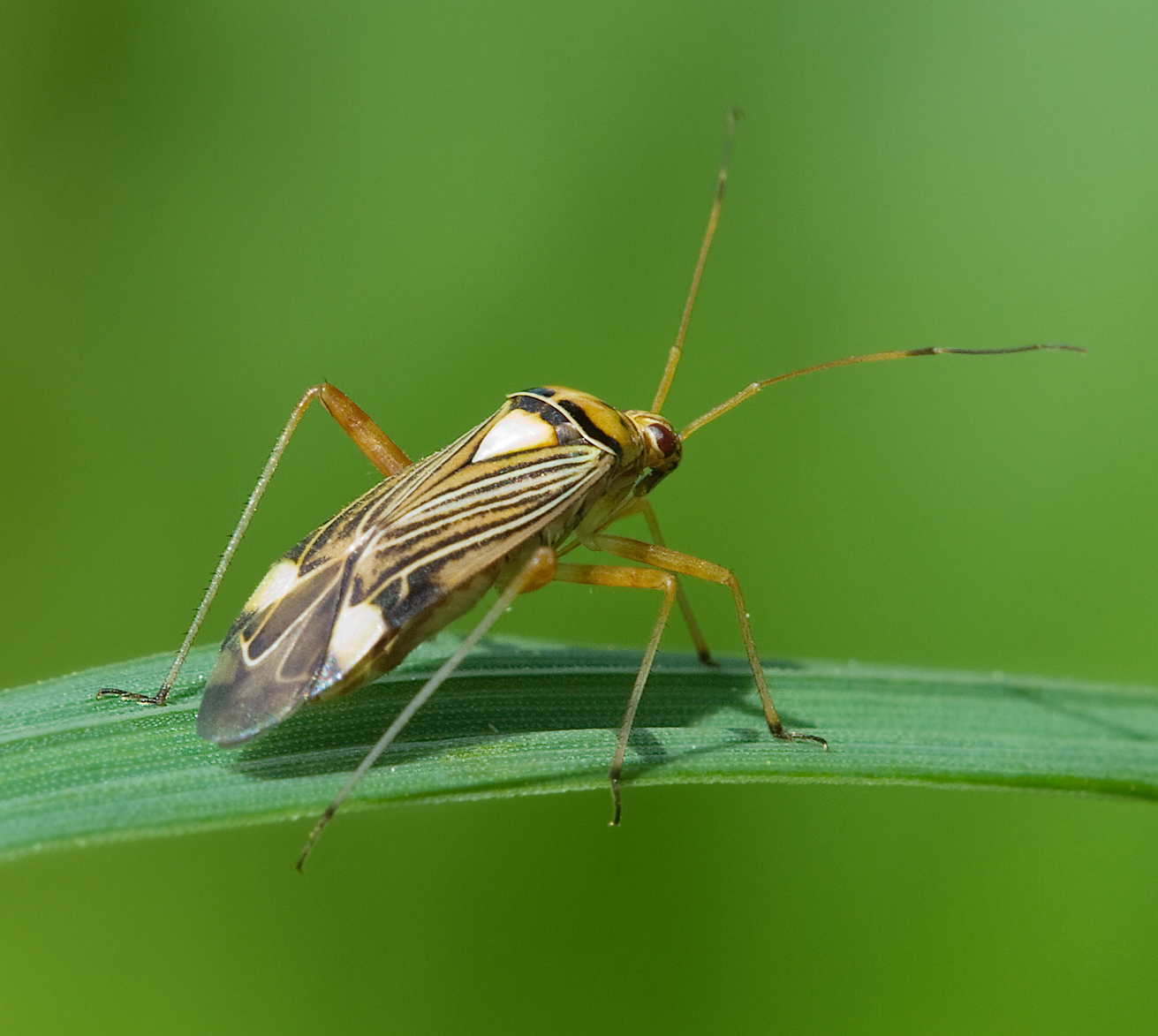
Rhabdomiris striatellus
Scientific classification Edit this classification
Kingdom: Animalia
Phylum: Arthropoda
Class: Insecta
Order: Hemiptera
Suborder: Heteroptera
Superfamily: Miroidea
Family: Miridae
Hahn, 1831
Type species
Cimex striatus L.
Subfamilies
  1. Bryocorinae Baerensprung, 1860
  2. Cylapinae Kirkaldy, 1903
  3. Deraeocorinae Douglas & Scott, 1865
  4. Isometopinae Fieber, 1860
  5. Mirinae Hahn, 1833
  6. Orthotylinae Van Duzee, 1916
  7. Phylinae Douglas & Scott, 1865
  8. Psallopinae Schuh, 1976
Synonyms

Capsidae Burmeister, 1835

The Miridae are a large and diverse insect family at one time known by the taxonomic synonym Capsidae.[1] Species in the family may be referred to as capsid bugs or "mirid bugs". Common names include plant bugs, leaf bugs, and grass bugs. It is the largest family of true bugs (suborder Heteroptera); it includes over 10,000 known species, and new ones are being described constantly. Most widely known mirids are species that are notorious agricultural pests that pierce plant tissues, feed on the sap, and sometimes transmit viral plant diseases. Some species however, are predatory.

Description

[edit]
A typical mirid species, showing cuneus at the tip of the corium
Wing of a species of Miridae, showing cuneus

Miridae are small, terrestrial insects, usually oval-shaped or elongate and measuring less than 12 millimetres (0.5 in) in length. Many of them have a hunched look, because of the shape of the prothorax, which carries the head bent down. Some are brightly coloured and attractively patterned, others drab or dark, most being inconspicuous. Some genera are ant mimics at certain stages of life. Miridae do not have any ocelli. Their rostrum has four segments. One useful feature in identifying members of the family is the presence of a cuneus; it is the triangular tip of the corium, the firm, sclerotized part of the forewing, the hemelytron. The cuneus is visible in nearly all Miridae, and only in a few other Hemiptera, notably the family Anthocoridae, which are not much like the Miridae in other ways. The tarsi almost always have three segments.[2]

Some mirid species

[edit]
Creontiades dilutus

Systematics

[edit]

This family includes a large number of species, many of which are still unknown, distributed in more than 1,300 genera. The taxonomic tree includes the following subfamilies and numerous tribes:

Globiceps sp. - oviposition (Orthotylini)

Psallopinae

[edit]

Auth.: Schuh, 1976

  1. Isometopsallops Herczek & Popov, 1992
  2. Psallops Usinger, 1946
  3. Cylapopsallops Popov & Herczek, 2006
  4. Epigonopsallops Herczek & Popov, 2009

BioLib includes:

  1. Amulacoris Carvalho & China, 1959
  2. Anniessa Kirkaldy, 1903
  3. Auchus Distant, 1893
  4. Bahiarmiris Carvalho, 1977
  5. Brasiliocarnus Kerzhner & Schuh, 1995
  6. Carmelinus Carvalho & Gomes, 1972
  7. Carmelus Drake & Harris, 1932
  8. Chaetophylidea Knight, 1968
  9. Charitides Kerzhner, 1962
  10. Colimacoris Schaffner & Carvalho, 1985
  11. Cylapocerus Carvalho & Fontes, 1968
  12. Dimorphocoris Reuter, 1890
  13. Duckecylapus Carvalho, 1982
  14. Englemania Carvalho, 1985
  15. Eurycipitia Reuter, 1905
  16. Faliscomiris Kerzhner & Schuh, 1998
  17. Fuscus Distant, 1884
  18. Guerrerocoris Carvalho & China, 1959
  19. Gunhadya - monotypic Gunhadya rubrofasciata Distant, 1920
  20. Heterocoris Guérin-Ménéville in Sagra, 1857
  21. Knightocoris Carvalho & China, 1951
  22. Leonomiris Kerzhner & Schuh, 1998
  23. Macrotyloides Van Duzee, 1916
  24. Merinocapsus Knight, 1968
  25. Mircarvalhoia Kerzhner & Schuh, 1998
  26. Montagneria Akingbohungbe, 1978
  27. Muirmiris Carvalho, 1983
  28. Myochroocoris Reuter, 1909
  29. Nesosylphas Kirkaldy, 1908
  30. Notolobus Reuter, 1908
  31. Nymannus Distant, 1904
  32. Paracoriscus Kerzhner & Schuh, 1998
  33. Paraguayna Carvalho, 1986
  34. Prodomopsis TBD
  35. Prodomus TBD
  36. Pseudobryocoris Distant, 1884
  37. Pygophorisca Carvalho & Wallerstein, 1978
  38. Rayeria TBD
  39. Rewafulvia Carvalho, 1972
  40. Rhynacloa Reuter
  41. Rondonisca Carvalho & Costa, 1994
  42. Rondonoides Carvalho & Costa, 1994
  43. Rondonotylus Carvalho & Costa, 1994
  44. Spanogonicus Berg
  45. Sthenaridia TBD
  46. Zoilus Distant, 1884

References

[edit]

Further reading

[edit]
[edit]
Revisions and contributorsEdit on WikipediaRead on Wikipedia
from Grokipedia
The Miridae, commonly known as plant bugs or capsid bugs, constitute a large and diverse family of true bugs within the order Hemiptera, suborder Heteroptera, superfamily Miroidea, and infraorder Cimicomorpha.[1] These small, terrestrial insects typically measure 2–12 mm in length, featuring oval or elongate bodies with a relatively soft texture, and they exhibit a wide range of coloration from dull greens and browns to striking red and black patterns.[2][3] With over 11,000 described species distributed across approximately 1,500 genera and 8 subfamilies, the Miridae represent the most species-rich family in the Heteroptera, surpassing all other hemipteran groups in diversity.[4] Ecologically, mirids are predominantly phytophagous, piercing plant tissues to extract sap and causing damage through feeding, oviposition, or transmission of pathogens, which renders many species economically significant agricultural pests worldwide, including notorious examples like the lygus bugs (Lygus spp.) and tea mosquito bugs (Helopeltis spp.).[5][6] However, a notable minority are predaceous, targeting small arthropods such as mites, aphids, and insect eggs, thereby functioning as valuable natural enemies in biological control programs.[7] They inhabit diverse terrestrial habitats, from forests and grasslands to agricultural fields, often perching conspicuously on foliage, and serve as an important prey resource for birds, spiders, and other insectivores.[3][8] Taxonomically, the family is distinguished by unique morphological traits, such as the presence of specialized sensory setae called trichobothria on the middle and hind femora, along with variations in wing structure—many species possess fully developed hemelytra (forewings) with a cuneus (a triangular sclerite at the corium apex), though some are brachypterous or apterous.[9] Ongoing phylogenetic studies, incorporating molecular data like COI barcoding, continue to refine their classification and reveal evolutionary patterns in diet and host associations across subfamilies such as Mirinae, Orthotylinae, and Phylinae.[7][10]

Physical Characteristics

Morphology

Members of the Miridae family, commonly known as plant bugs, are small insects typically measuring 2-15 mm in length, with body forms ranging from oval to elongate and often featuring a hunched or humped prothorax that gives the head a downward-pointing appearance.[3][11] This compact, soft-bodied structure is characteristic of the family within the order Hemiptera, suborder Heteroptera, enabling agile movement on plants.[2] The head lacks ocelli, distinguishing Miridae from other hemipteran groups like Auchenorrhyncha, and bears prominent compound eyes along with a four-segmented rostrum adapted for piercing plant tissues or prey.[8][12] Antennae are also four-segmented, filiform, and in many species—such as males of Dicyphus agilis—extend to lengths comparable to or exceeding the body, aiding in sensory detection.[13] The head capsule is typically small, convex, and sloping anteriorly.[13] The thorax comprises three segments, with the prothorax prominently punctate and often collar-like, supporting the scutellum—a small triangular plate—and the hemelytra, the forewings unique to Heteroptera. A defining trait of Miridae is the cuneus, a wedge-shaped or triangular structure at the apex of the corium on each hemelytron, demarcated by a costal fracture along its anterior margin.[2][8] The legs terminate in three-segmented tarsi, with claws and variable pulvilli for adhesion to surfaces.[8][13] The abdomen is typically 10-11 segmented, hologastric with the midgut extending its full length, and features visible connexiva—lateral margins formed by inflected terga—that are often exposed beyond the wings.[13] In females, it is broader and more pointed than in males, housing a laciniate ovipositor with saw-like valves for egg insertion into plant tissues, a feature adapted within the Cimicomorpha infraorder.[2] Specialized trichobothria setae on the middle and hind femora provide mechanosensory functions unique to Miridae.[2]

Coloration and Mimicry

Members of the Miridae family exhibit a wide range of coloration, spanning bright greens and reds to drab browns and blacks, which often corresponds to the hues of their host plants for effective camouflage.[3] This variation allows many species to blend seamlessly with foliage, stems, or flowers, enhancing their survival through crypsis, a strategy where inconspicuous colors and patterns reduce detectability by predators.[3] In contrast, some predatory mirid species employ aposematic coloration, featuring bold warning patterns such as red-and-black combinations to signal unpalatability or toxicity to potential predators. For instance, Lopidea nigridea displays striking red and black markings, which laboratory and field observations indicate deter avian and arthropod predators, supporting its classification as aposematic. These conspicuous signals are particularly evident in species that have evolved chemical defenses, reinforcing avoidance learning in predators.[14] Mimicry is another key adaptive strategy in Miridae, with certain species exhibiting myrmecomorphy—ant-like appearances and behaviors—to exploit the aggressive or unpalatable reputation of ants. This includes elongated bodies, constricted waists, and jerky movements that imitate ant locomotion, as seen in genera like Coquillettia, where females show particularly pronounced mimetic traits.[15] Such mimicry has evolved multiple times within the family, notably in southern African taxa analyzed phylogenetically, providing protection from predation.[16] Species-specific patterns on the hemelytra further diversify these strategies, with some mirids featuring spotted or striped markings that aid in crypsis or disruption against backgrounds. For example, species in the genus Jiwarli display hemelytra with brown spots over pale olive or tan bases, enhancing blending with plant surfaces, while others exhibit longitudinal stripes for similar disruptive effects.[17] These patterns, combined with the family's basic ovoid body shape, contribute to overall defensive efficacy without altering underlying morphology.[15]

Habitat and Distribution

Global Distribution

The family Miridae, commonly known as plant bugs or capsid bugs, displays a cosmopolitan distribution, occurring on every continent except Antarctica. This widespread presence is attributed to their adaptability to diverse plant hosts and environments, with species recorded across temperate, subtropical, and tropical zones globally.[18] Miridae exhibit the highest species diversity in tropical regions, where environmental conditions favor greater speciation and host plant availability. For instance, the Neotropical realm alone accounts for approximately 3,429 described species, representing about 27% of the world's known mirid fauna. The Oriental realm similarly supports substantial diversity, contributing significantly to the overall tropical richness, with patterns indicating that Neotropical and Oriental regions together harbor over half of all described species. Estimates suggest that the total global diversity, including undescribed taxa, exceeds 20,000 species, underscoring the family's understudied extent in these biodiverse hotspots.[19][20][10] Regional endemism is prominent in isolated or floristically unique areas, such as Australia, where relatively few species have been described compared to tropical regions, many of which are endemic and adapted to native flora like Myrtaceae. Examples include the monaloniine genus Rayieria, comprising ten endemic species specialized on Australian hosts, highlighting evolutionary radiations tied to continental isolation. These patterns of species richness reflect historical biogeographic processes, including Gondwanan vicariance and subsequent diversification.[21][22][23]

Preferred Habitats

The Miridae family is primarily terrestrial and closely associated with vegetation across diverse ecosystems, including forests, grasslands, and agricultural fields. These bugs thrive in environments rich in plant life, where they exploit the structural complexity provided by foliage for shelter and mobility. In undisturbed natural settings, such as woodlands and meadows, Miridae often dominate the insect fauna on herbaceous vegetation and woody perennials, contributing to their high species diversity in these habitats.[5] Miridae exhibit a strong preference for herbaceous plants, shrubs, and trees, with many species showing specificity at the genus or tribe level of their host plants. While most are arboreal or ground-dwelling on terrestrial flora, certain species inhabit marginal aquatic environments, such as salt marshes and wetland edges, where they utilize emergent vegetation. This association with semi-aquatic margins allows exploitation of transitional zones between land and water, though fully aquatic habitats are generally avoided. Globally distributed across all biogeographic realms, Miridae's presence in these varied vegetational niches underscores their adaptability to plant-dominated landscapes.[5][10] The family demonstrates remarkable adaptation to a wide range of climates, from arid deserts and Mediterranean scrubs to humid tropical regions, with peak diversity observed in seasonal, vegetation-rich biomes. In temperate zones, many species undergo seasonal migrations, dispersing via flight to track suitable host plants as environmental conditions shift, often covering distances of 25–45 km per day. High humidity (70–80% relative humidity) and temperatures between 20°C and 30°C optimize their survival and population dynamics, while overwintering as eggs in protected sites enables persistence in cooler climates. These adaptations facilitate their cosmopolitan distribution and resilience in fluctuating environments.[24][10] Within these broader habitats, Miridae occupy specific microhabitats such as understory layers in forests, leaf litter accumulations, and the bark or stems of trees and shrubs. Certain genera prefer concealed niches like flower buds or twig crotches for oviposition and resting, providing protection from predators and desiccation. Shady, moist microenvironments within vegetation canopies are particularly favored, enhancing humidity retention and supporting population fitness in otherwise exposed settings.[24][25]

Biology and Ecology

Feeding Habits

The family Miridae, commonly known as plant bugs or capsid bugs, is predominantly composed of phytophagous species that feed on plant tissues by piercing the epidermis with their elongate rostrum and sucking sap from leaves, stems, flowers, or fruits.[5] This feeding strategy involves the insertion of stylets into mesophyll or vascular tissues, where enzymatic saliva is injected to liquefy contents for ingestion, often causing localized damage such as necrotic spots or distorted growth.[26] While the rostrum's structure facilitates both plant and animal feeding, phytophagous mirids typically target herbaceous plants, exploiting phloem or parenchyma cells for nutrients.[27] A significant portion of mirid species exhibit omnivorous or carnivorous habits, particularly within certain subfamilies like Dicyphinae and Phylinae, where individuals prey on small arthropods such as mites, aphids, insect eggs, or nymphs.[28] These zoophytophagous or predatory mirids employ the same piercing mechanism as their phytophagous relatives, using the rostrum to penetrate prey exoskeletons and extract hemolymph or body fluids, often injecting paralytic or digestive enzymes to subdue victims.[5] For instance, genera like Deraeocoris and Macrolophus include species that preferentially consume pest insects in agricultural settings, though they may supplement their diet with plant material when prey is scarce.[29] Evolutionary analyses indicate that predation has arisen multiple times from an ancestral phytophagous state, reflecting adaptive shifts tied to ecological opportunities.[28] Recent phylogenetic studies as of 2023 continue to refine understanding of these shifts across subfamilies.[24] Host plant specificity among phytophagous mirids varies widely, with some species being monophagous—restricted to a single plant genus or species—and others polyphagous, exploiting a broad range of hosts across multiple families.[28] Polyphagous feeders, such as those in the genus Lygus, can utilize over 300 plant species, enabling them to thrive in diverse habitats but also contributing to their status as generalist pests.[5] In contrast, monophagous species often show specialized adaptations to particular host chemistry or morphology, correlating with narrower geographic distributions.[28] Facultative omnivores may alternate between plant and animal diets based on availability, influencing their host selection patterns.[29] Phytophagous mirids can inadvertently transmit plant viruses during feeding, as their stylet probing disrupts tissues and facilitates pathogen movement between hosts.[3] Although not primary vectors like aphids or thrips, certain species have been implicated in the spread of viral diseases, particularly in crops where mirid populations are high.[5] This transmission occurs mechanically or semi-persistently via contaminated mouthparts, underscoring the dual role of these insects in plant health dynamics.[3]

Life Cycle and Reproduction

Miridae undergo hemimetabolous (incomplete) metamorphosis, consisting of three primary life stages: egg, nymph, and adult.[24] Nymphs typically pass through five instars, with development time varying by species and environmental conditions; for example, in Lygus lineolaris, the nymphal stage lasts 20–30 days during summer.[5] Wing pads appear in the third instar and are fully developed by the fifth, after which nymphs emerge as winged adults capable of dispersal and reproduction.[30] Oviposition in Miridae generally involves females inserting eggs into plant tissues, such as stems, petioles, or buds, using their ovipositor to create slits.[5] Egg incubation periods vary by species and temperature, typically ranging from 5 to 9 days; for instance, in Cyrtorhinus lividipennis, eggs hatch in 6–9 days at optimal conditions.[31] Hatching leads directly to the nymphal stage, where juveniles resemble smaller, wingless versions of adults and undergo gradual morphological changes across instars.[24] Most Miridae complete one to multiple generations per year, with the number influenced by temperature, photoperiod, and host plant availability.[5] In temperate regions, species like Lygus lineolaris produce 2–5 generations annually, while in warmer climates or favorable conditions, up to 10 generations may occur, as seen in some predatory species.[30] Temperature thresholds around 8–9°C initiate development in some subfamilies, such as Bryocorinae, enabling year-round activity in mild environments.[32] Reproduction in Miridae is predominantly sexual, though some species exhibit parthenogenesis.[5] Sexual dimorphism occurs in certain species, including differences in size and antennal structure, as observed in Helopeltis bakeri. Mating behaviors often involve pheromonal attraction, with females releasing sex pheromones to draw males; for example, in Polymerus pekinensis, these compounds facilitate courtship and aggregation.[33] Females typically begin oviposition 6–10 days after mating, producing 80–200 eggs over their adult lifespan of 15–34 days.[24][34]

Economic and Ecological Importance

Agricultural Pests

Several species within the Miridae family are significant agricultural pests due to their phytophagous feeding habits, which involve piercing plant tissues and injecting salivary toxins that cause localized necrosis, wilting, and reduced crop yields. These pests target a wide range of economically important crops, leading to direct damage through sap extraction and indirect effects such as pathogen transmission and fruit deformation. One prominent example is Lygus lineolaris, the tarnished plant bug, a polyphagous species that infests over 700 plant species, including major crops like cotton (Gossypium hirsutum), alfalfa (Medicago sativa), and fruits such as apples (Malus domestica), strawberries (Fragaria × ananassa), and peaches (Prunus persica). Feeding occurs primarily on floral buds, squares, and small bolls in cotton, where the bugs' stylet-like mouthparts inject enzymes that degrade cell walls, resulting in abscission of reproductive structures, boll rot, and lint discoloration; this damage often leads to wilting and yield reductions of 15-50% in heavily infested fields.[35] Another key pest group is Helopeltis spp., commonly known as tea mosquito bugs, which primarily affect tea (Camellia sinensis) and cocoa (Theobroma cacao) plantations in tropical regions. Nymphs and adults suck sap from tender shoots, buds, and pods, creating necrotic lesions, cankers, and malformations that cause shoot die-back, premature pod drop, and deformed fruits; peak damage occurs during pre- and post-monsoon periods on cocoa. For Helopeltis spp., crop losses can reach 25-40% in tea, 35-60% in cocoa, and up to 100% under epidemic conditions,[36] contributing to global agricultural damages estimated in billions of dollars annually when aggregated across affected crops and regions. The economic toll from these Miridae pests is substantial, with L. lineolaris alone causing over $50 million in losses to U.S. cotton production in Mississippi during 2022-2023 through reduced yields and control costs.[37] Compounding these impacts is widespread insecticide resistance in populations of L. lineolaris to pyrethroids and organophosphates, with emerging resistance to neonicotinoids, driven by metabolic detoxification mechanisms like elevated esterases and cytochrome P450 enzymes.[38][39] Management of these pests relies on integrated pest management (IPM) strategies to mitigate resistance and environmental risks. Cultural practices include early planting dates, nitrogen timing adjustments, weed control around fields to eliminate alternative hosts, and irrigation management to reduce pest attraction in cotton. Biological controls involve entomopathogenic fungi such as Beauveria bassiana and parasitoids like Anaphes iole for L. lineolaris, while selective insecticides (e.g., sulfoxaflor, novaluron, fipronil for Helopeltis) are applied based on thresholds like 8 bugs per 100 sweeps pre-bloom in cotton. Host plant resistance, such as trichome-dense or transgenic cotton varieties (e.g., ThryvOn™ with Cry51Aa2), further reduces the need for chemical interventions by 1-2 applications per season.

Predatory and Beneficial Roles

Many species within the Miridae family exhibit predatory behavior, preying on small arthropods such as aphids, spider mites, and whiteflies, which contributes to their role as natural regulators of herbivore populations. For instance, predatory mirids like those in the subfamily Mirinae often target soft-bodied pests, using their piercing-sucking mouthparts to extract hemolymph from prey.[40] These insects are particularly effective against early instar stages of herbivores, with species such as Dicyphus hesperus demonstrating a preference for whitefly nymphs and eggs over adults.[41] In agricultural settings, certain mirid species are employed in augmentative biological control programs to suppress pest populations in greenhouses. Dicyphus hesperus, native to North America, has been successfully released to control sweetpotato whitefly (Bemisia tabaci) and greenhouse whitefly (Trialeurodes vaporariorum) on tomato crops, with release rates of 1-3 adults per plant achieving significant reductions (up to 60%) in whitefly densities without excessive plant damage.[42] Similarly, Macrolophus pygmaeus is used in European greenhouses to manage whiteflies and other sucking pests on vegetables, enhancing pest control when combined with supplemental plant feeding.[43] These programs highlight the mirids' zoophytophagous nature, where they balance predation with occasional plant feeding to sustain populations in controlled environments.[44] Ecologically, predatory mirids play a key role in food webs by regulating herbivore abundances in natural habitats, thereby influencing plant community dynamics and biodiversity. In diverse ecosystems, species like Dicyphus cerastii exhibit type II functional responses to prey density, consuming up to 88 whitefly nymphs per day under optimal conditions,[45] which helps stabilize populations of primary consumers. This predation efficiency varies by host; for example, mirids effectively attack spider mites (Tetranychus urticae) and other small prey, preferring isolated or clustered individuals for easier access. Overall, these interactions underscore the mirids' contribution to trophic stability, reducing the need for chemical interventions in both wild and managed landscapes.[46]

Taxonomy and Systematics

Classification History

The family Miridae was first described by Carl Wilhelm Hahn in 1831, based on the type species Cimex striatus Linnaeus, establishing it as a distinct group within the Hemiptera.[47] In 1835, Hermann Burmeister proposed the synonym Capsidae, which gained widespread use, particularly in British and some European entomological literature, persisting into the mid-20th century before Miridae became the universally accepted name.[48] From its inception, Miridae has been classified within the suborder Heteroptera of the order Hemiptera, and more specifically within the superfamily Cimicomorpha, reflecting shared morphological traits such as the four-segmented labium and predatory or phytophagous habits common to this group.[49] Early classifications emphasized external morphology, including body vestiture and genitalic structures, to delineate the family from related cimicomorphan groups like the Tingidae and Reduviidae, though boundaries were occasionally blurred due to convergent traits.[50] Significant reclassifications occurred in the 2000s with the advent of molecular phylogenetics, which confirmed the monophyly of Miridae and refined its position relative to other Cimicomorpha families through total-evidence analyses combining DNA sequences (e.g., 16S, COI, 28S) and morphology.[49] Seminal work by Schuh et al. (2009) integrated 73 morphological characters and four molecular markers across 92 taxa, supporting the separation of Miridae from superficially similar families and resolving internal relationships that led to revised tribal and subfamily delimitations.[49] Building on this, Weirauch et al. (2011) analyzed 3,935 base pairs from 142 ingroup taxa, further clarifying evolutionary divergences and excluding certain polyphyletic elements previously associated with Miridae.[50] These studies have shaped the modern taxonomy, recognizing Miridae as encompassing over 11,000 described species worldwide.[51]

Subfamilies

The family Miridae is divided into eight recognized subfamilies: Bryocorinae, Cylapinae, Deraeocorinae, Isometopinae, Mirinae, Orthotylinae, Phylinae, and Psallopinae. This classification, primarily established by Schuh in 2002 and refined in subsequent works, reflects morphological and molecular data emphasizing differences in body structure, antennal features, and genitalic morphology.[52] The subfamilies vary in size and ecological roles, with the smaller ones like Psallopinae containing fewer than 20 species, while larger groups dominate the family's diversity. Bryocorinae is distinguished by its members' often elongated, slender bodies and a mix of feeding strategies, including predatory habits in tribes such as Dicyphini, where species actively hunt small arthropods on foliage. Cylapinae typically feature compact bodies adapted to fungal or litter habitats, with some species showing specialized mycophagous traits.[53] Deraeocorinae includes predatory forms with robust bodies and prominent spines on the femora, aiding in prey capture.[54] Isometopinae are small, ocellate bugs with a free-living predatory lifestyle, often on tree bark. Mirinae encompasses diverse plant-feeders with variable body shapes, primarily phytophagous on herbaceous plants. Orthotylinae are characterized by their plant-associated habits and often colorful patterns, while Phylinae exhibit high morphological diversity, including swollen antennae in some genera. Psallopinae, the smallest subfamily, features minute species with holoptic eyes and is primarily tropical.[53] Phylogenetic analyses based on molecular data, such as COI and 28S genes, position Isometopinae as an early-diverging lineage, with the remaining subfamilies forming a clade where Mirinae and Phylinae emerge as sister groups comprising approximately 80% of all described Miridae species (over 9,000 species combined).[53] Bryocorinae appears basal within this major clade, but recent studies indicate it and several others (Cylapinae, Deraeocorinae, Orthotylinae) are not monophyletic, suggesting paraphyly due to convergent morphological traits like body elongation.[53] Psallopinae clusters near Isometopinae, supported by shared ocelli and eye structures. Twenty-first-century research, including total-evidence phylogenies incorporating morphology and DNA sequences, has prompted revisions such as the proposed transfer of certain tribes (e.g., Termatophylini to Bryocorinae) and mergers within Orthotylinae based on genitalic synapomorphies.[53] These updates, drawn from datasets of over 180 taxa, highlight the need for broader sampling to resolve ongoing debates on subfamily boundaries, particularly for non-monophyletic groups.[55]

Diversity and Genera

The family Miridae encompasses over 11,300 described species placed in approximately 1,500 genera worldwide.[56] Estimates indicate that the total species diversity, accounting for undescribed taxa, likely surpasses 20,000, reflecting the family's vast but incompletely documented extent.[10] Miridae exhibit pronounced endemism, particularly in tropical regions, where habitat specificity and isolation drive high levels of regional uniqueness; ongoing field surveys continue to uncover new species, especially in biodiverse hotspots like island archipelagos and rainforests. For instance, recent collections from French Polynesia have yielded multiple endemic species, underscoring the tropics' role as a primary center of mirid diversification.[57] Approximately 50 genera within Miridae are classified as incertae sedis, lacking secure placement in established subfamilies due to insufficient morphological or phylogenetic data; examples include fossil taxa like Isometopsallops from Eocene amber deposits.[58] Prominent genera highlight the family's ecological range: Lygus includes phytophagous species notorious as pests, damaging crops such as cotton, alfalfa, and strawberries through feeding on reproductive structures, leading to yield losses.[59] In contrast, Dicyphus comprises generalist predators valued in biological control, preying on greenhouse pests like whiteflies (Trialeurodes vaporariorum) and spider mites (Tetranychus urticae) while supplementing diet with plant tissues.[45]

References

User Avatar
No comments yet.