Hubbry Logo
Mount ElbertMount ElbertMain
Open search
Mount Elbert
Community hub
Mount Elbert
logo
8 pages, 0 posts
0 subscribers
Be the first to start a discussion here.
Mount Elbert
Mount Elbert
from Wikipedia

Mount Elbert is the highest summit of the Rocky Mountains of North America. With an elevation of 14,440 ft (4,400 m), it is also the highest point in the U.S. state of Colorado and the second-highest summit in the contiguous United States after Mount Whitney, which is slightly taller. The ultra-prominent fourteener is the highest peak in the Sawatch Range, as well as the highest point in the entire Mississippi River drainage basin. Mount Elbert is located in San Isabel National Forest, 12.1 mi (19.4 km) southwest (bearing 223°) of the city of Leadville in Lake County, Colorado.[4][3][5][a]

Key Information

The mountain was named in honor of a Colorado statesman, Samuel Hitt Elbert, who was active in the formative period of the state and Governor of the Territory of Colorado from 1873 to 1874. Henry W. Stuckle of the Hayden Survey was the first to record an ascent of the peak, in 1874. The easiest and most popular climbing routes are categorized as Class 1 to 2 or A+ in mountaineering parlance. Mount Elbert is therefore often referred to as the "gentle giant" that tops all others in the Rocky Mountains.

Geography

[edit]

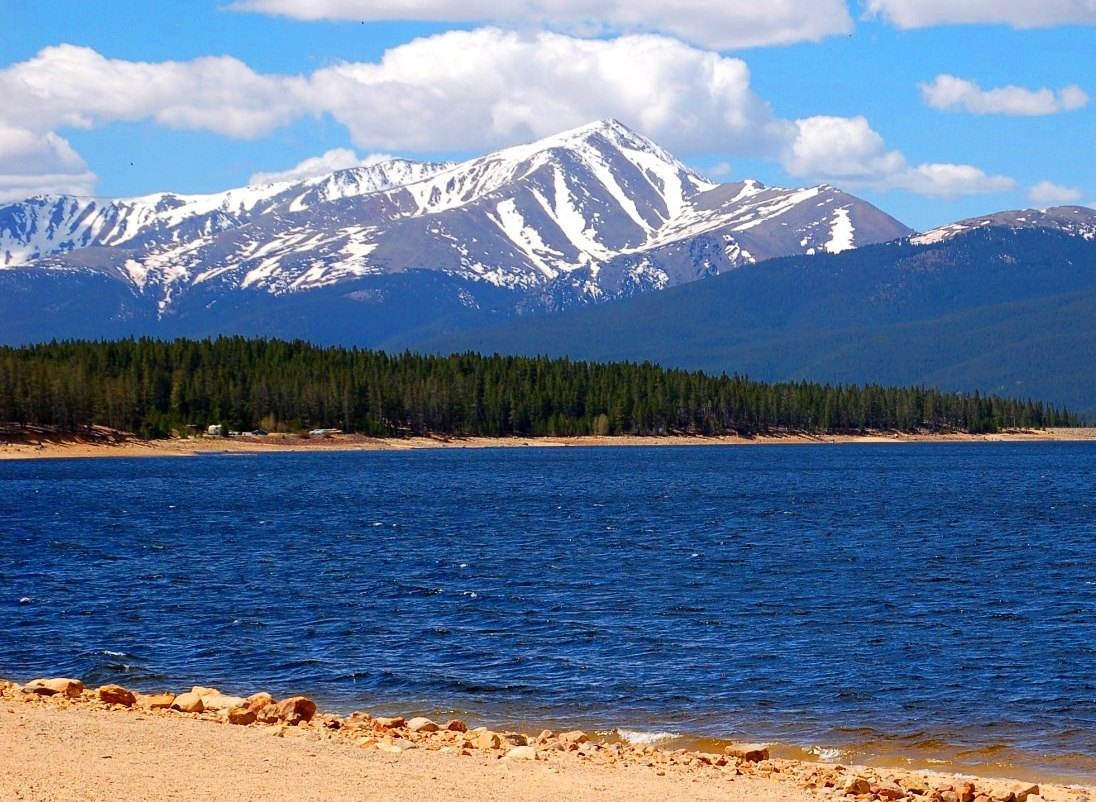
Mount Elbert is visible to the southwest of Leadville, often snow-capped even in the summer.[7] Many other fourteeners surround Elbert in all directions, and it is very close to central Colorado's Collegiate Peaks. The neighboring Mount Massive, to the north, is the second-highest peak in the Rocky Mountains and the third-highest in the contiguous United States, and La Plata Peak, to the south, is the fifth-highest in the Rockies. The community of Twin Lakes lies at the base of Mount Elbert, Denver is about 130 miles (209 km) to the east, Vail is 50 miles (80 km) to the north, and Aspen is 40 miles (64 km) to the west. Leadville, about 16 miles (26 km) to the northeast, is the nearest large town.[8] Elbert's parent peak is Mount Whitney in California.[9] Including Alaska and Hawaii, Mount Elbert is the fourteenth-highest mountain in the United States.

Climate

[edit]

Weather conditions often change rapidly, and afternoon thunderstorms are common in the summertime; hailstorms and snow are possible year-round. One thunderstorm on the mountain's summit was considered remarkable enough to be reported in the July 1894 issue of Science.[10]

Climate data for Mount Elbert 39.1170 N, 106.4402 W, Elevation: 14,019 ft (4,273 m) (1991–2020 normals)
Month Jan Feb Mar Apr May Jun Jul Aug Sep Oct Nov Dec Year
Mean daily maximum °F (°C) 19.5
(−6.9)
18.7
(−7.4)
23.7
(−4.6)
29.3
(−1.5)
38.1
(3.4)
49.7
(9.8)
55.9
(13.3)
53.9
(12.2)
47.4
(8.6)
36.6
(2.6)
25.8
(−3.4)
19.7
(−6.8)
34.9
(1.6)
Daily mean °F (°C) 7.9
(−13.4)
6.7
(−14.1)
11.3
(−11.5)
16.2
(−8.8)
24.9
(−3.9)
35.5
(1.9)
41.7
(5.4)
40.2
(4.6)
33.9
(1.1)
24.1
(−4.4)
14.8
(−9.6)
8.5
(−13.1)
22.1
(−5.5)
Mean daily minimum °F (°C) −3.6
(−19.8)
−5.2
(−20.7)
−1.2
(−18.4)
3.1
(−16.1)
11.8
(−11.2)
21.3
(−5.9)
27.5
(−2.5)
26.6
(−3.0)
20.4
(−6.4)
11.7
(−11.3)
3.8
(−15.7)
−2.7
(−19.3)
9.5
(−12.5)
Average precipitation inches (mm) 4.26
(108)
4.07
(103)
4.39
(112)
5.39
(137)
3.89
(99)
1.65
(42)
2.18
(55)
2.42
(61)
2.65
(67)
3.29
(84)
4.08
(104)
3.78
(96)
42.05
(1,068)
Source: PRISM Climate Group[11]

Geology

[edit]
Panoramic view of Mount Elbert in June 2008

Mount Elbert is part of the Sawatch Range, an uplift of the Laramide Orogeny which separated from the Mosquito Range to the east around 28 million years ago.[12] The tops of this range were heavily glaciated, leaving behind characteristic summit features and other such clues. For example, the base of Elbert on the eastern side exhibits expanses of igneous and metamorphic rocks exposed when the glaciers receded, leaving a lateral moraine. Further up the eastern side there is a large cirque with a small tarn.[13] There are also lakes to both the north and south, Turquoise and Twin Lakes respectively; the Twin Lakes are a result of the natural dam of end moraines,[13] and Turquoise Lake was created by the manmade Sugar Loaf Dam.

Mount Elbert is composed largely of quartzite.[14] However, the summit ridge consists of metamorphic basement rock, which is Pre-Cambrian in origin and about 1.7 billion years old.[13] There are various igneous intrusions including pegmatite, as well as bands of gneiss and schist.[13] Unlike mountains of similar altitude elsewhere, Elbert lacks both a permanent snowpack and a prominent north-facing cirque, which can be attributed to its position among other mountains of similar height, causing it to receive relatively small quantities of precipitation.[14]

History

[edit]
Mount Elbert was named after Samuel Hitt Elbert

Mount Elbert was named by miners in honor of Samuel Hitt Elbert, the governor of the then-Territory of Colorado, because he brokered a treaty in September 1873 with the Ute tribe that opened up more than 3,000,000 acres (12,000 km2) of reservation land to mining and railroad activity.[15] The first recorded ascent of the peak was by H.W. Stuckle in 1874, who was surveying the mountain as part of the Hayden Survey.[16]

Originally measured as 14,433 feet (4,399 m) in height, Mount Elbert's elevation was later adjusted to 14,440 feet (4,400 m) following a re-evaluation of mapped elevations, which sparked protests. The actual change was made in 1988 as a result of the North American Vertical Datum of 1988; it seems the original measurement resulted from the Sea Level Datum of 1929.[8][17][16] A matter of some contention arose after the Great Depression over the heights of Elbert and its neighbor Mount Massive, which differ in elevation by only 12 feet (3.7 m). This led to an ongoing dispute that came to a head with the Mount Massive supporters building large piles of stones on the summit to boost its height, only to have the Mount Elbert proponents demolish them.[18] The effort was ultimately unsuccessful and Mount Elbert has remained the highest peak in Colorado.[8] The first motorized ascent of Elbert occurred in 1949, when a Jeep was driven to the summit, apparently to judge suitability for skiing development.[18]

Flora and fauna

[edit]
Platanthera hyperborea

The summit of Mount Elbert is an alpine environment, featuring plants such as Phacelia sericea (silky phacelia), Hymenoxys grandiflora (old-man-of-the-mountain), and Geum rossii (alpine avens).[16] Also noted are Carex atrata var. pullata, Salix desertorum, Platanthera hyperborea, Thalictrum fendleri, Aquilegia canadensis, Chenopodium album, Gentiana detonsa var. hallii, and Bigelovia parryi.[19] Below treeline the mountain is heavily forested, with the lower slopes covered with a mixture of lodgepole pine, spruce, aspen, and fir.[20]

Some of the fauna reported on the climb to the summit include black bears, marmots, mule deer, pikas, and pocket gophers; there are also many species of birds.[21] Elk, grouse, turkey, and bighorn sheep are present in the area during the summer.[20] Grizzly bears are extirpated.[22]

Hiking

[edit]
The north-east ridge

There are three main routes to ascend the mountain, all of which gain over 4,100 feet (1,200 m) elevation. The standard route ascends the peak from the east, starting from the Colorado Trail just north of Twin Lakes. The 4.6 miles (7.4 km) long North (Main) Elbert Trail begins close to the Elbert Creek Campground, and gains about 4,500 feet (1,400 m).[23][24] The trail is open to equestrians, mountain bikers and hunters during season.[25] An easier, but longer route, the South Elbert Trail, is 5.5 miles (8.9 km) long, climbing 4,600 feet (1,400 m) at a less-punishing gradient than the North Elbert Trail, approaching from the south and then climbing the eastern ridge.[23]

The most difficult of the main routes is the Black Cloud Trail, a Class 2 climb that takes ten to fourteen hours depending on pace, gains 5,300 feet (1,600 m) in elevation, and also involves an ascent of the sub-peak, South Elbert, at 14,134 feet (4,308 m).[26] Even healthy and experienced climbers report great difficulty on this route, and despite the fact that there is a trail, the route is extremely steep, unstable, and rocky in places. The elevation gain is not evenly distributed over the 5.5-mile ascent. There are also routes approaching from the western face, and southwestern ridge, from South Halfmoon Creek Trailhead and Echo Canyon Trailhead respectively.[26]

Although strenuous and requiring physical fitness, none of the conventional routes require specialist mountaineering skills or technical rock climbing. The main dangers of the mountain are those common to all high mountains, particularly altitude sickness. This can affect anyone, even those who are acclimatized. In serious cases, it can lead to high-altitude pulmonary edema and cerebral edema, which can lead to difficulties with breathing, paralysis, and death. Climbers are advised to begin their ascent at or before 6 A.M. and to summit and descend before early afternoon to minimize exposure to possible afternoon thunderstorms while at high altitudes. Although the most conventional form of ascent is by hiking, Anna Elizabeth Dickinson, the orator, ascended the mountain on a mule borrowed from the U.S. government.[27]

See also

[edit]

Notes

[edit]

References

[edit]

Bibliography

[edit]
[edit]
Revisions and contributorsEdit on WikipediaRead on Wikipedia
from Grokipedia
Mount Elbert is a prominent peak in the of the , located in , within the . Standing at an elevation of 14,438 feet (4,399 meters), it is the highest mountain in the U.S. state of and throughout the entire system, as well as the second-highest summit in the after . The mountain is named after Samuel Hitt Elbert, who served as the territorial governor of Colorado from 1873 to 1874 and later as chief justice of the . It lies within the Mount Elbert–Mount Massive Wilderness Area, a protected region that encompasses diverse alpine ecosystems and provides habitat for wildlife such as and . Mount Elbert's prominence and accessibility make it one of Colorado's most climbed "fourteeners," with popular trails like the North Mount Elbert Trail offering relatively straightforward Class 1 routes to the summit for experienced hikers.

Geography

Location and prominence

Mount Elbert is situated at coordinates 39°07′03″N 106°26′42″W in central , . The peak lies within Lake County and the . As the highest summit in the of the , it reaches an elevation of 14,438 ft (4,399 m) as of a 2024 NOAA update, making it the tallest point in and the second-highest in the after in . The mountain's topographic prominence measures 9,093 ft (2,772 m), calculated from its key col with the surrounding terrain, underscoring its dominance in the regional landscape. Its isolation is even more striking at 670 mi (1,080 km) to the nearest higher peak, , highlighting Mount Elbert's status as a major ultra-prominent summit in . This isolation contributes to its significance within the broader Rocky Mountain system, where it stands as the preeminent feature of the . Mount Elbert is located approximately 12 mi (19 km) southwest of , and overlooks Twin Lakes to the southwest, providing a key reference point in the high-altitude terrain near the Continental Divide.

Topography and hydrology

Mount Elbert exhibits a symmetric shape, with prominent northeast and southeast ridges forming its primary structural features. The mountain's main North summit reaches an elevation of 14,438 feet (4,399 m) as of 2024, the highest point in . The includes four distinct summits: the North at 14,438 ft, South at 14,134 ft, East at 14,127 ft, and West at 14,000 ft (approximate). These ridges and summits create a rugged profile, with the eastern slope consisting of steep, glaciated canyons separated by sharp divides. The mountain's slopes drain into the North Fork Lake Creek on the east and the South Fork Lake Creek on the west, both tributaries that feed into Lake Creek and ultimately the basin. This drainage pattern supports the upper hydrologic system, where Mount Elbert's runoff contributes to regional water flow. Hydrologically, Twin Lakes lies at the mountain's base, primarily fed by from Mount Elbert and surrounding slopes. The upper slopes feature glacial cirques and tarns, remnants of past Pleistocene glaciation that once covered the , though no active glaciers persist today. The base-to-summit rise measures approximately 7,600 feet from the floor, with average slope angles of 25-30 degrees along the main northeast and southeast routes.

Climate

Seasonal variations

Mount Elbert's alpine environment exhibits distinct seasonal weather patterns influenced by its high and position in the . During summer (June to ), daytime temperatures at the typically range from 50 to 70°F, with cooler nights dropping into the 30s°F, creating mild conditions for but requiring layers for swings. Frequent afternoon thunderstorms develop due to daytime heating and , often bringing brief but intense , hail, or lightning, with most of the region's annual of 15-20 inches occurring as summer . Winter (December to February) brings harsh conditions to the summit, where temperatures range from -10 to 20°F, accompanied by heavy snowfall totaling 200-300 inches annually, primarily from Pacific storms funneled through the region. High winds, frequently gusting up to 100 mph, exacerbate the cold through and can create , making the area prone to and extreme exposure. Spring (March to May) and fall (September to November) serve as transitional seasons with rapid weather changes; typically occurs in May and June, leading to increased and muddy trails, while early snowfalls can begin in September and October, sometimes accumulating several inches overnight. These periods feature variable temperatures, with daytime highs in the 30s to 50s°F and lows near freezing, and shifting from snow to mixed rain-snow events. Inversion layers often trap cold air in surrounding valleys during these times, contrasting with clearer, warmer conditions on the slopes. Microclimates on Mount Elbert vary significantly between slopes, where the eastern (windward) sides receive more and cooler temperatures due to prevailing westerly winds, while leeward western slopes experience drier, slightly warmer conditions in a effect. These variations contribute to diverse atmospheric conditions, such as enhanced cloud formation on windward faces during storms. The above treeline is particularly exposed to these seasonal shifts, influencing vegetation cycles as detailed in the ecology section.

Impacts of climate change

Mount Elbert, as part of the Colorado Rocky Mountains, has experienced significant climate-driven changes in snowpack and melt patterns. Since the 1980s, regional snowpack has declined by approximately 20% at low to middle elevations, primarily due to warmer spring temperatures reducing snow accumulation and persistence. This decline has led to snowmelt occurring 2-3 weeks earlier than in previous decades, altering seasonal water availability and increasing summer evaporation rates. Temperature records indicate a warming of about 2.5°F across Colorado since the mid-20th century, with more frequent warm days contributing to these shifts. Additionally, the risk of wildfires has intensified, as evidenced by the 2020 East Troublesome and Cameron Peak fires that burned over 400,000 acres in nearby northern Colorado, exacerbated by drier conditions and prolonged fire seasons linked to climate warming. Projections based on IPCC-aligned climate models suggest further alterations by mid-century, with a potential 20-40% shift in winter precipitation from to across the Rockies, reducing reliable snow storage for spring runoff. This transition, combined with continued warming of 2.5-5°F by 2050, could lead to shifts, including upslope migration of and loss of high-elevation habitats adapted to persistent cover. Such changes may disrupt alpine ecosystems on peaks like Mount Elbert, where shorter snow seasons could favor drought-tolerant over snow-dependent . Local monitoring by the Colorado Climate Center highlights altered storm patterns, with increased variability in intensity and timing, contributing to more frequent extreme events. Recent from 2023-2025 indicate intensified , including the return of exceptional drought conditions in western in 2025—the first since 2023—driven by higher and reduced amid ongoing warming. These trends underscore the mounting pressures on Mount Elbert's hydrological and ecological systems.

Geology

Formation and tectonics

Mount Elbert's formation is tied to the , a major mountain-building event that occurred between approximately 75 and 45 million years ago (Ma) during the to early Eocene epochs. This orogeny resulted from the flat-slab of the Farallon Plate beneath the North American Plate, which drove crustal shortening, thickening, and uplift hundreds of kilometers inland from the subduction zone, unlike typical Andean-style orogenies at convergent margins. In central , this process elevated basement-cored ranges like the , where Mount Elbert is located, through reverse faulting and folding. The timeline of Mount Elbert's uplift began with initial deformation during the early Laramide phase around 70 Ma, but significant elevation gain in the occurred toward the orogeny's end, approximately 40 Ma, as contractional stresses waned. Post-Laramide epeirogenic processes further enhanced the peak's height, with the current elevation largely achieved during the epoch (23–5 Ma), when broad regional upwarping added 1.5–3 km of relief through dynamic mantle support and erosional unloading. Minor ongoing adjustments stem from isostatic rebound following Pleistocene glacial erosion, which has contributed to subtle post-glacial uplift in the . Structurally, Mount Elbert forms part of the , a classic fault-block mountain within the northeast-trending Sawatch anticlinorium, an asymmetric uplifted along reverse faults such as the Elk Range thrust. This Laramide structure features crystalline basement overlain by and sedimentary rocks, folded and thrust during compression. The range's development was later influenced by the initiation of the around 25 Ma, which imposed east-west extension on the region and tilted blocks like the Sawatch westward, enhancing topographic relief without substantially altering the primary Laramide architecture.

Rock composition and structure

Mount Elbert's foundational rocks consist primarily of granite and , dating from 1.7 to 1.4 billion years ago, forming the metamorphic basement that constitutes the mountain's core. These ancient crystalline rocks, part of the broader Yavapai-Mazatzal , underwent intense and during the era, resulting in a complex assemblage of foliated gneisses and granitic bodies. On the lower slopes, sedimentary layers, including Mississippian Leadville Limestone, cap portions of the terrain, representing shallow marine deposits from about 350 million years ago that overlie the basement unconformably. The dominant lithology is , a coarse-grained rich in , , and , which intruded into older biotitic around 1.4 billion years ago. Metamorphic within these rocks, evident as banded alignments of minerals, stems from intense regional during the Yavapai-Mazatzal orogeny around 1.7 to 1.6 billion years ago. This imparts a layered texture to the gneisses, distinguishing them from the more massive granites. Structurally, the mountain features large intrusive batholiths of that form the bulk of the , crosscut by dikes and veins of —coarse, quartz-feldspar-rich intrusions often containing accessory minerals like and . These , emplaced during late-stage magmatic differentiation, appear as irregular bodies within the and . Overburden on the higher summits includes glacial , unconsolidated deposits of boulders, , and clay left by Pleistocene ice ages, which mantle the and contribute to the rounded . Key outcrops of the rocks are prominently exposed in the mountain's cirques—steep-walled glacial basins on the northern and eastern flanks—revealing fresh sections of foliated and intrusive contacts. Minor Tertiary volcanics, such as andesitic flows and tuffs from around 30 million years ago, occur sporadically in the surrounding lowlands but are not significant on the peak itself.

History

Indigenous and early use

The region encompassing Mount Elbert in the of the formed part of the traditional territories of the , who inhabited much of present-day for centuries prior to European contact, viewing the mountains as their place of origin created by Sinawav. The also maintained historical ties to central , including the eastern flanks of the , as part of their broader migration patterns into the area from the northeast. Indigenous groups like the Utes utilized the high-elevation landscapes for hunting large game, conducting vision quests, and gathering resources, with oral histories preserving accounts of sacred sites where spiritual connections to the land were forged. Archaeological surveys reveal evidence of Paleo-Indian activity in the valleys surrounding the , including Clovis and Folsom artifacts dating to approximately 10,000 BCE, indicating transient use by early hunter-gatherers pursuing . However, the extreme altitude of Mount Elbert itself precluded permanent settlements, as indigenous lifeways in the region emphasized nomadic patterns suited to montane environments rather than fixed high-alpine habitations. Resource exploitation focused on hunting, which held cultural reverence among Ute and related peoples for the animal's symbolic strength and agility, alongside collection of such as osha (), valued for its healing properties and found throughout the . Seasonal migrations through the enabled prehistoric and historic indigenous groups to track game herds and access diverse elevations for sustenance, integrating the area into broader patterns of across Colorado's Rockies over millennia. Mount Elbert contributed to the wider Rocky Mountain spiritual landscape, where high places facilitated rituals and quests for visions, embodying enduring cultural significance for the Ute.

European exploration and naming

The U.S. Geological and Geographical Survey of the Territories, led by Ferdinand V. Hayden, conducted extensive mapping and exploration in the during the early 1870s, including the where Mount Elbert is located. The peak was named Mount Elbert in June 1873 by miners in Twin Lakes, who honored Samuel Hitt Elbert for his role as Governor of the in rescinding the San Juan eviction order against the ; they inscribed a tin plate with “ELBERT PEAK” and placed it in a on the summit. Elbert had previously served as Secretary of the from 1862 to 1867, appointed by President , and played a significant role in land negotiations, including support for interests that opened vast areas to development. The first recorded ascent of Mount Elbert occurred in 1874, undertaken by surveyor H. W. Stuckle as part of the Hayden Survey team. Stuckle approached via the northeast ridge, a route that provided relatively straightforward access for topographic measurements and confirmed the peak's elevation and prominence relative to its neighbor, . This climb was instrumental in documenting the mountain's features amid broader efforts to map Colorado's high country for scientific and economic purposes. The 1880s silver mining boom in nearby Leadville drew thousands of prospectors and settlers to the region, increasing awareness of Mount Elbert as a local landmark visible from mining camps and trails. Leadville's rapid growth, fueled by rich silver deposits discovered in 1875, transformed the area into a bustling hub that indirectly facilitated early recreational and exploratory visits to the peak. By the 1890s, the arrival of the Denver & Rio Grande Railroad in Leadville in 1880 further enhanced access, allowing easier transport of supplies and people to trailheads at the mountain's base and spurring interest among surveyors, hunters, and adventurers.

Ecology

Flora

The flora of Mount Elbert is distributed across distinct zones, reflecting the mountain's steep climatic gradients in the of . In the lower montane zone, from about 8,000 to 10,000 feet, vegetation is dominated by coniferous forests and deciduous groves adapted to moderate temperatures and seasonal precipitation. Ponderosa pine () forms open-canopied stands on south-facing slopes, providing shade and fire-resistant bark that supports ecosystem resilience. Interspersed aspen groves () thrive in moister draws, their clonal root systems enabling rapid regeneration after disturbances like fire or avalanche. The understory includes diverse wildflowers, such as the state flower columbine (), which blooms in shaded forest edges with delicate blue-and-white petals attracting pollinators. Rising to the subalpine zone between 10,000 and 11,500 feet, the forest transitions to denser, cooler stands of Engelmann spruce (Picea engelmannii) and subalpine fir (Abies lasiocarpa), which co-dominate the moist, north-facing slopes as climax species. These evergreens form a continuous canopy, with spruce exhibiting needle retention for nutrient conservation and fir producing serotinous cones that release seeds post-fire. Near the treeline, environmental stress stunts growth into krummholz formations—dwarfed, flag-shaped trees twisted by persistent winds and snow burial, enhancing survival through reduced exposure. Above 11,500 feet, the zone prevails, where treeless meadows support low-growing , mosses, and lichens in a harsh environment of intense UV radiation, freeze-thaw cycles, and high winds. Cushion plants like alpine forget-me-not (Myosotis alpestris) form compact mats that trap heat and snow for insulation, while moss campion (Silene acaulis) exhibits dense, needle-like leaves to minimize . The lasts only 6 to 10 weeks, limiting to brief summer thaws. Characteristic species include silky phacelia (Phacelia sericea), a with silvery, pubescent leaves that reflect sunlight and reduce water loss in rocky outcrops. Alpine and subalpine on Mount Elbert display key adaptations to extreme conditions, including cold tolerance through antifreeze proteins in cell sap that prevent formation during subzero temperatures. Wind resistance is achieved via low stature, prostrate growth forms, and hairy or waxy cuticles that shield against abrasion and . These traits enable survival in an environment where temperatures can drop below freezing even in summer. Threats to Mount Elbert's flora include invasive species. Krummholz communities face decline from drought stress and altered fire regimes, with regional surveys indicating reduced vigor in subalpine conifers across the Rockies.

Fauna

Mount Elbert's fauna reflects the diverse elevational zones of the Rocky Mountains, with species adapted to forested lower slopes, subalpine meadows, and harsh alpine tundra. Mammals dominate the wildlife, including large herbivores like elk (Cervus canadensis) and mule deer (Odocoileus hemionus), which inhabit the coniferous forests and meadows below 11,000 feet, foraging on grasses, forbs, and browse. In the alpine zones above treeline, American pikas (Ochotona princeps) thrive in talus fields and rocky slopes, while Rocky Mountain bighorn sheep (Ovis canadensis canadensis) and mountain goats (Oreamnos americanus) graze on exposed ridges and meadows during summer months, with goats noted for their sure-footed climbing on steep cliffs. Predators such as mountain lions (Puma concolor) range across all elevations, preying on ungulates and smaller mammals to maintain ecological balance. Birds exhibit striking adaptations to the mountain's environment, with the white-tailed ptarmigan (Lagopus leucura) serving as a prime example of in the ; its plumage shifts from mottled brown in summer to white in winter, blending seamlessly with snow and rocks for protection against predators. Golden eagles (Aquila chrysaetos) soar over the peak year-round, nesting on cliffs and hunting small mammals in open areas. Over 50 species, including numerous Neotropical migrants like warblers and flycatchers, arrive as summer residents to breed in the subalpine and alpine habitats, taking advantage of abundant emergences before departing in fall. Reptiles and amphibians are confined to the warmer, lower slopes below 10,000 feet due to the cold temperatures and short growing seasons at higher elevations, where no such species persist near the summit. Common garter snakes (Thamnophis sirtalis) are frequently observed in these forested and riparian areas, feeding on amphibians, , and invertebrates near streams and wetlands. Many species display seasonal behaviors tied to the mountain's climate, such as and migrating to lower elevations in winter to escape deep snow, while descend to windswept south-facing slopes for foraging. Pikas engage in "haying," meticulously collecting and drying vegetation in midsummer to cache in haypiles within talus crevices, sustaining them through the long, snowbound winter without . populations in Colorado's have recovered significantly since the 1970s reintroductions by state agencies, growing from about 2,000 individuals statewide in the mid-20th century to approximately 7,000 as of 2025 through habitat protection and disease management efforts. Recent U.S. Forest Service assessments in 2024 highlight climate-driven range shifts among Mount Elbert's fauna, with species like pikas potentially retreating to higher elevations as warmer temperatures alter alpine habitats and food availability.

Recreation

Climbing routes

Mount Elbert offers several established routes to its summit, ranging from well-maintained Class 1 trails to more challenging Class 2 paths that provide varying levels of solitude and scenery. The most popular ascent is the Northeast Ridge, a straightforward Class 1 route starting from the North Mount Elbert Trailhead at approximately 10,400 feet elevation along Halfmoon Creek Road. This 9.75-mile round-trip involves about 4,500 feet of elevation gain and typically takes 5 to 7 hours for fit hikers, beginning through aspen groves and transitioning to open alpine terrain with several false summits before reaching the peak. For those seeking a less crowded alternative, the Southeast via the Black Cloud Trail provides a steeper Class 2 experience, climbing through dense forest and across talus fields to join the main . This route spans roughly 11 miles round-trip with around 5,000 feet of gain, starting from the Black Cloud Trailhead off Highway 82 near Twin Lakes, and is noted for its wildflowers in summer and fewer users compared to the northern approaches. The Northwest Ridge offers a more adventurous Class 2+ option, often approached as a traverse from Peak, covering about 9 miles round-trip with significant exposure on loose rock and steep slopes. Hikers access this via the Peak trailhead on Highway 82, navigating a connecting ridge that demands careful footing but rewards with panoramic views of the . Additional variants include the East Slopes (also known as the East Ridge), a 10.5-mile Class 1 round-trip from the lower trailhead off County Road 24, featuring initial 4WD road sections and some bushwhacking through willows before easing into a maintained trail with 4,800 feet of gain. In winter, snowshoers favor the East Ridge or South Mount Elbert Trail for their lower avalanche risk, requiring gear for deep snow and postholing above treeline, though conditions vary with recent storms. No permits are required for day hikes on these routes, though self-registration is available at trailheads for informational purposes, and the peak season runs from to when allows reliable access. An estimated 17,200 hikers summited Mount Elbert in 2024, making route planning essential to avoid crowds.

Safety and management

Climbers ascending Mount Elbert face notable hazards, including acute mountain sickness, which affects approximately 25% of visitors to moderate high altitudes and can impair activity in symptomatic individuals. Afternoon thunderstorms and are common above treeline, prompting recommendations to begin hikes early to mitigate exposure risks. In winter conditions, dangers persist on steeper slopes, with historical like the 1962 Twin Lakes avalanche near the base of the mountain causing seven fatalities. No entry fees or permits are required for day hikes on Mount Elbert trails. Visitors must adhere to principles to preserve the fragile alpine environment. Dogs are permitted on leashed trails to protect wildlife and ensure safety. The U.S. Forest Service oversees Mount Elbert within the , coordinating with partners for sustainable access. Trail maintenance addresses erosion from heavy use; in 2024, the Colorado Fourteeners Initiative deployed crews for repairs on the North Elbert and Black Cloud routes, including switchback reinforcements and drainage improvements. In 2025, the Colorado Fourteeners Initiative continued trail repairs on key routes, including switchback reinforcements and restoration, as part of their field season efforts. operations occur frequently, with Lake County teams handling multiple incidents annually, such as three calls over one June 2025 weekend involving hikers and a . Mount Elbert holds protected status in national forests, where conservation prioritizes reducing overuse impacts. Estimated visitor use was 17,200 hiker-days in , contributing to trail erosion and disturbance from foot traffic, which the Forest Service monitors through assessments and collaborative restoration projects. In 2025, identified gear as a key source of microplastic in wilderness areas, urging adoption of low-shedding and apparel to curb environmental deposition.

References

Add your contribution
Related Hubs
User Avatar
No comments yet.