


Community hub
Recent from talks
Contribute something
Nothing was collected or created yet.
Nasdaq
View on Wikipedia
Key Information


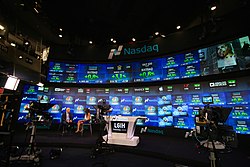
The Nasdaq Stock Market (/ˈnæzdæk/ ⓘ; National Association of Securities Dealers Automated Quotations) is an American stock exchange, the second-largest by market capitalization on the list of stock exchanges, and the first fully electronic stock market. The exchange is based in New York City and is the most active stock trading venue in the U.S. by volume.[3][4]
The exchange platform is owned by Nasdaq, Inc., which also owns the Nasdaq Nordic stock market network and several U.S.-based stock and options exchanges. The exchange is the primary listing for many technology companies and also trades stock in many foreign firms, with China and Israel being the largest foreign sources.[5][6]
As of December 31, 2024, 4,075 companies listed securities on Nasdaq, including 1,383 listings on The Nasdaq Global Select Market, 1,366 on The Nasdaq Global Market, and 1,326 on The Nasdaq Capital Market.[6]
The Nasdaq Composite, Nasdaq-100, Nasdaq Financial-100 stock market indices are made up only of stocks listed on the Nasdaq.
History
[edit]1972–2000
[edit]Founding and Origins
[edit]
Nasdaq, Inc. was founded in 1971 by the National Association of Securities Dealers (NASD), now known as the Financial Industry Regulatory Authority (FINRA).[7] "Nasdaq" (originally and still commonly spelled with all-capital letters as "NASDAQ") is an acronym for "National Association of Securities Dealers Automated Quotations".[8] On February 8, 1971, the Nasdaq Stock Market commenced operations as the world's first fully electronic stock market.[7] Initially, Nasdaq served as a "quotation system" rather than a platform for electronic trading.[9] Intel Corporation was one of the first major corporations to list its shares on Nasdaq; other major companies that have been listed on Nasdaq since its early years include Comcast and Applied Materials.[10]
Market Growth
[edit]Since the launch of Nasdaq, many major companies trading on the over-the-counter (OTC) market began switching to Nasdaq. As late as 1987, the Nasdaq exchange was still commonly referred to as "OTC" in media reports[11] and also in the monthly Stock Guides issued by Standard & Poor's Corporation.[12] Over the years, it became more of a stock market with the addition of trade and volume reporting and automated trading systems. In 1981, Nasdaq traded 37% of the U.S. securities markets' total of 21 billion shares. By 1991, Nasdaq's share had grown to 46%.[13] In 1992, the Nasdaq Stock Market joined with the London Stock Exchange to form the first intercontinental linkage of capital markets.[14]
In 1996, the SEC issued a report alleging that Nasdaq market makers fixed prices by avoiding "odd-eighths" quotes (at the time, stock prices were quoted in increments of an eighth of a dollar) to artificially widen spreads. The report was followed by a new set of rules for how Nasdaq handled orders.[15]: 102, 126
Online Trading
[edit]In 1998, it became the first stock market in the United States to trade online, using the slogan "the stock market for the next hundred years".[16] The Nasdaq Stock Market attracted many companies during the dot-com bubble.
2000–2020
[edit]Public listing and market change
[edit]In a series of sales in 2000 and 2001, FINRA sold its stake in the Nasdaq. On July 2, 2002, Nasdaq, Inc. became a public company via an initial public offering, listing its own shares on the exchange (traded under the ticker symbol NDAQ).[17] In 2006, the status of the NASDAQ Stock Market was changed from a stock market to a licensed national securities exchange.[18] In 2007, it merged with OMX, a leading exchange operator in the Nordic countries, expanded its global footprint, and changed its name to the Nasdaq OMX Group.[19]
To qualify for listing on the exchange, a company must be registered with the United States Securities and Exchange Commission (SEC), must have at least three market makers (financial firms that act as brokers or dealers for specific securities) and must meet minimum requirements for assets, capital, public shares, and shareholders.
In 2011, after an announced merger of NYSE Euronext with Deutsche Börse, Nasdaq partnered with Intercontinental Exchange to launch a rival bid, but the bid was withdrawn on regulatory concerns.[20]
Acquisitions
[edit]In December 2005, Nasdaq acquired Instinet for $1.9 billion, retaining the Inet ECN and subsequently selling the agency brokerage business to Silver Lake Partners and Instinet management.[21][22][23]
The European Association of Securities Dealers Automatic Quotation System (EASDAQ) was founded as a European equivalent to the Nasdaq Stock Market. It was purchased by NASDAQ in 2001 and became NASDAQ Europe.[24] In 2003, operations were shut down as a result of the burst of the dot-com bubble.[25] In 2007, Nasdaq Europe was revived first as Equiduct and was acquired by Börse Berlin later that year.[26]
On November 7, 2007, Nasdaq acquired the Philadelphia Stock Exchange, the oldest stock exchange in the U.S.[27]
Sustainability and leadership milestones
[edit]On June 18, 2012, Nasdaq OMX became a founding member of the United Nations Sustainable Stock Exchanges Initiative on the eve of the United Nations Conference on Sustainable Development (Rio+20).[28][29]
In November 2016, chief operating officer Adena Friedman was promoted to chief executive officer, becoming the first woman to run a major exchange in the U.S.[30]
In 2016, Nasdaq earned $272 million in listings-related revenues.[31]
In October 2018, the SEC blocked the New York Stock Exchange (NYSE) and Nasdaq from raising certain market-data prices. This was the first time the commission rejected increases for the exchanges' stock market data feeds.[32][33][34]
In December 2020, Nasdaq announced that it would remove shares of four Chinese companies from indexes it maintains in accordance with Executive Order 13959.[35]
2021–present
[edit]In September 2024, the European Commission said it had carried out an unannounced inspection at the offices of Nasdaq over potential anti-competitive practices.[36]
In October 2024, Nasdaq added artificial intelligence capabilities to its Calypso platform with the launch of XVA Accelerator, a tool for portfolio risk calculations. Calypso is used by banks and insurers for capital markets access and regulatory reporting.[37]
In March 2025, pending approval by the U.S. Securities and Exchange Commission, Nasdaq announced plans to introduce 24-hour 5-day a week trading on its United States exchange during the second half of 2026 in response to increased global demand for U.S. equities.[38]
Quote availability
[edit]A quote is the price of a stock as listed on an exchange. Quotes consist of bids, the price buyers are willing to pay, and offers, the price sellers will accept.[39] Nasdaq quotes are available at three levels:
- Level 1 shows the highest bid and lowest ask—inside quote.
- Level 2 shows all public quotes of market makers together with information of market dealers wishing to buy or sell stock and recently executed orders.[40]
- Level 3 is used by the market makers and allows them to enter their quotes and execute orders.[41]
Trading schedule
[edit]Nasdaq sessions in Eastern Time Zone are:
4:00 a.m. to 9:30 a.m.: extended-hours trading session (premarket)[42]
9:30 a.m. to 4:00 p.m.: normal trading session[42]
4:00 p.m. to 8:00 p.m.: extended-hours trading session (postmarket)[43]
The Nasdaq Stock Market averages about 253 trading days per year.[44]
Market tiers
[edit]Within the NASDAQ Composite Index, the NASDAQ exchange has three different market tiers for listed companies:[45]
- Capital Market (NASDAQ-CM small cap) is an equity market for companies that have relatively small levels of market capitalization.[45] Listing requirements for such "small cap" companies are less stringent than for other Nasdaq markets that list larger companies with significantly higher market capitalization.[46]
- Global Market (NASDAQ-GM mid cap) is made up of stocks that represent the Nasdaq Global Market. The Global Market consists of 1,450 stocks that meet Nasdaq's strict financial and liquidity requirements, and corporate governance standards. The Global Market is less exclusive than the Global Select Market.[47][48]
- Global Select Market (NASDAQ-GS large cap) is a market capitalization-weighted index made up of US-based and international stocks that represent the NASDAQ Global Select Market Composite (NQGS). This includes companies with the largest market capitalization within the NASDAQ Composite.[49] The Global Select Market consists of 1,200 stocks that meet Nasdaq's strict financial and liquidity requirements and corporate governance standards. The Global Select Market is more exclusive than the Global Market. Every October, the Nasdaq Listing Qualifications Department reviews the Global Market Composite to determine if any of its stocks have become eligible for listing on the Global Select Market.[50][51]
Difference between NYSE and Nasdaq
[edit]After the NYSE, Nasdaq is the second largest stock exchange in the United States.[52][53][54] Nasdaq is a much younger organization than the NYSE, having been founded in just 1971.[55]
In addition to age and market capitalization, there are other key differences between the two exchanges:
- Exchange systems. Before the COVID-19 pandemic, the NYSE maintained both an electronic trading system and a trading floor system staffed by live professionals who help conduct auctions.[56][57] Nasdaq has been an all-electronic exchange since its inception.
- Market Types. The NYSE uses an auction market to set prices, while Nasdaq uses a dealer market.[58][59] In the NYSE auction market, buyers and sellers submit competitive bids simultaneously. When the buyer's bid and the seller's request match, a transaction occurs. In the Nasdaq dealer market model, all prices are set by dealers. Dealers continually update bid (sell) and ask (buy) prices throughout the trading day.
- Listing fees. There is a big difference in listing fees on the major stock exchanges. Listing fees on the Nasdaq range from $55,000 to $80,000 for the lowest tier of the capital market.[60][61]
- Sectors. Investors typically view the NYSE as an exchange for older, more established companies.[62] Nasdaq tends to be home to newer companies focused on technology and innovation.[63]
See also
[edit]
References
[edit]- ^ "Nasdaq Companies". Retrieved February 20, 2025.
- ^ "Market Statistics - November 2024". focus.world-exchanges.org. World Federation of Exchanges. August 2024. Archived from the original on March 18, 2024. Retrieved September 18, 2024.
- ^ "Monthly Reports". World-Exchanges.org. World Federation of Exchanges. Archived from the original on August 17, 2014.
- ^ "U.S. Equities Market Volume Summary". Archived from the original on December 10, 2022. Retrieved December 10, 2022.
- ^ "Fact Sheet U.S. – Israel Economic Relationship". United States embassy in Israel.
- ^ a b "Nasdaq, Inc. 2024 Form 10-K Annual Report". U.S. Securities and Exchange Commission. February 21, 2025.
- ^ a b Terrell, Ellen (October 2012). "History of the American and Nasdaq Stock Exchanges". Library of Congress. Archived from the original on April 14, 2013.
- ^ Frequently Asked Questions. NASDAQ.com. NASDAQ, n.d. Web. December 23, 2001. Archived April 29, 2010, at the Wayback Machine
- ^ Kennon, Joshua (March 26, 2019). "What Is the NASDAQ?". Dotdash. Archived from the original on March 17, 2019. Retrieved September 16, 2019.
- ^ Probasco, Jim (July 19, 2024). Silbert, Sarah (ed.). "Exploring Nasdaq: The Digital Stock Market Powerhouse". Business Insider. Archived from the original on December 23, 2024. Retrieved June 4, 2025.
- ^ Gilpin, Kenneth N. (July 3, 1987). "Company News: An Erratic Quarter for Stock Markets". The New York Times. ISSN 0362-4331. Archived from the original on August 1, 2017.
- ^ Salinger, Lawrence M. (June 14, 2013). Encyclopedia of White-Collar and Corporate Crime. SAGE Publications. ISBN 978-1-4522-7616-8.
- ^ Widder, Pat (May 24, 1992). "NASDAQ Has Eye On Next 100 Years". Chicago Tribune. Archived from the original on April 29, 2022. Retrieved September 16, 2019.
- ^ Odekon, Mehmet (March 17, 2015). Booms and Busts: An Encyclopedia of Economic History from the First Stock Market Crash of 1792 to the Current Global Economic Crisis: An Encyclopedia of Economic History from the First Stock Market Crash of 1792 to the Current Global Economic Crisis. Routledge. ISBN 9781317475750. Archived from the original on August 3, 2017.
- ^ Patterson, Scott (2012). Dark Pools: High-Speed Traders, A.I. Bandits, and the Threat to the Global Financial System. Crown Publishing. ISBN 978-0307887177.
- ^ "Feb 8, 1971 CE: 'Stock Market for the Next 100 Years' Opens". National Geographic. Archived from the original on July 19, 2016. Retrieved September 16, 2019.
- ^ "INVESTOR FAQS". Nasdaq. Archived from the original on September 30, 2019. Retrieved September 16, 2019.
- ^ Walsh, Michelle. "Nasdaq Stock Market Becomes A National Securities Exchange; Changes Market Designations". Archived from the original on December 17, 2013.
- ^ Lucchetti, Aaron; MacDonald, Alistair (May 26, 2007). "Nasdaq Lands OMX for $5.7 Billion; Are More Merger Deals on the Way?". The Wall Street Journal. ISSN 0099-9660. Archived from the original on July 31, 2017.
- ^ Pisani, Bob (May 16, 2011). "Market Is for Sale, and Nasdaq Withdraws Bid for NYSE". CNBC.
- ^ "NASDAQ Completes Acquisition of Inet" (Press release). Nasdaq. December 8, 2005. Archived from the original on December 4, 2019. Retrieved September 16, 2019.
- ^ Authers, John (December 8, 2005). "Nasdaq completes purchase of Instinet exchange". Financial Times. Archived from the original on December 10, 2022.
- ^ "Nasdaq to Acquire Instinet in $1.9 Billion Deal". The New York Times. April 22, 2005. ISSN 0362-4331. Archived from the original on April 3, 2019. Retrieved April 3, 2019.
- ^ "NASDAQ - Explained". TheBusinessProfessor. February 23, 2025. Retrieved May 13, 2025.
- ^ "Nasdaq Might Shut Down German Exchange". Deutsche Welle. August 11, 2003. Archived from the original on December 4, 2019. Retrieved September 16, 2019.
- ^ "Easdaq Makes A Comeback As Equiduct". Archived from the original on January 6, 2011. Retrieved February 3, 2011.
- ^ Terrell, Ellen. "Research Guides: Wall Street and the Stock Exchanges: Historical Resources: Stock Exchanges". guides.loc.gov. Retrieved June 3, 2025.
- ^ "Sustainable Stock Exchanges Initiative: Exchanges Listing Over 4,600 Companies Commit to Promoting Sustainability" (Press release). GlobeNewswire. June 18, 2012. Archived from the original on December 6, 2019. Retrieved September 16, 2019.
- ^ Jungcurt, Stefan (June 29, 2012). "Five Stock Exchanges Commit to Promoting Sustainability". International Institute for Sustainable Development. Archived from the original on December 6, 2019. Retrieved September 16, 2019.
- ^ "Nasdaq's New CEO Attributes Her Success to an 'Eclectic' Career Path". Fortune. November 15, 2016. Archived from the original on November 17, 2016.
- ^ Osipovich, Alexander (October 26, 2017). "Startup Exchange Cleared to Take on NYSE, Nasdaq for Stock Listings". The Wall Street Journal. Archived from the original on October 26, 2017.
- ^ Osipovich, Alexander; Michaels, Dave; Morgenson, Gretchen (October 16, 2018). "SEC Ruling Takes Aim at Stock-Exchange Profits". The Wall Street Journal. Archived from the original on October 19, 2018. Retrieved October 18, 2018.
- ^ "SEC rules NYSE and Nasdaq did not justify data fee increases". Financial Times. October 16, 2018. Archived from the original on December 10, 2022.
- ^ Michaels, Dave (October 19, 2018). "NYSE, Nasdaq Take It on the Chin in Washington". The Wall Street Journal. ISSN 0099-9660. Archived from the original on October 19, 2018. Retrieved October 19, 2018.
- ^ Singh, Kanishka; Kerber, Ross (December 12, 2020). "Nasdaq to remove four Chinese companies' shares from indexes after U.S. order". Reuters. Archived from the original on December 14, 2020. Retrieved December 16, 2020.
- ^ Asgari, Nikou; Espinoza, Javier (September 24, 2024). "Nasdaq and Deutsche Börse raided in EU antitrust investigation". Financial Times. Retrieved November 12, 2024.
- ^ Nikolova, Maria (October 17, 2024). "Nasdaq integrates AI into Calypso platform to accelerate risk calculations". FX News Group. Retrieved September 15, 2025.
- ^ Saini, Manya (March 7, 2025). "Nasdaq plans 24-hour trading as global appetite for US stocks grows". Reuters. Retrieved March 11, 2025.
- ^ "Stock Quotes | Investor.gov". www.investor.gov. Archived from the original on June 14, 2025. Retrieved July 23, 2025.
- ^ "Order Book, Level 2 Market Data, and Depth of Market". Daytrading. About.com. Archived from the original on January 14, 2011.
- ^ "Nasdaq Level III Quote". Archived from the original on April 13, 2014.
- ^ a b "NASDAQ". Nasdaq.com.
- ^ "Nasdaq Trading Schedule". Nasdaq.com. Archived from the original on April 17, 2014.
- ^ "Stock Performance in Recessions". The Motley Fool. Retrieved August 14, 2024.
- ^ a b "Nasdaq Capital Market". Corporate Finance Institute. Retrieved June 27, 2025.
- ^ "Definition of 'Nasdaq SmallCap Market', now known as Nasdaq Capital Market". Investopedia. Archived from the original on August 4, 2013.
- ^ "Definition of 'Nasdaq Global Market Composite'". Investopedia. Archived from the original on September 17, 2013.
- ^ "Exemption from Qualification Requirements for Nasdaq Global Market and Nasdaq Capital Market Securities Under Corporations Code Section 25100(o)" (PDF) (Press release). State of California Business, Transportation and Housing Agency Department of Corporations California's Investment and Financing Authority. August 17, 2009. Retrieved January 20, 2025.
- ^ "Nasdaq Global Select Market". Corporate Finance Institute. Retrieved June 27, 2025.
- ^ "Definition of 'Nasdaq Global Select Market Composite'". Investopedia. Archived from the original on October 4, 2013.
- ^ Pinto, Jerald E.; Henry, Elaine; Robinson, Thomas R.; Stowe, John D. (2010). Equity Asset Valuation. CFA Institute Investment Series. Vol. 27 (2 ed.). John Wiley & Sons. p. 6. ISBN 9780470579657. Archived from the original on May 10, 2013.
[...] NASDAQ-GS stands for 'Nasdaq Global Select Market,' [...]
- ^ "The New York Stock Exchange (NYSE)". www.forbes.com. Archived from the original on April 9, 2021. Retrieved December 7, 2023.
- ^ "10 Largest Stock Exchanges in the World". www.analyticssteps.com. Archived from the original on March 4, 2024. Retrieved December 7, 2023.
- ^ "Getting to Know the Stock Exchanges". www.investopedia.com. Archived from the original on February 21, 2024. Retrieved December 7, 2023.
- ^ "The history of Nasdaq from creation in 1971 to the present". capital.com. Retrieved December 7, 2023.
- ^ "The History of NYSE". www.nyse.com. Archived from the original on January 29, 2024. Retrieved December 7, 2023.
- ^ "What Is The NYSE?". www.wallstrank.com. Archived from the original on December 7, 2023. Retrieved December 7, 2023.
- ^ "NYSE: What Is The New York Stock Exchange?". www.nasdaq.com. Archived from the original on January 17, 2024. Retrieved December 7, 2023.
- ^ "New York Stock Exchange (NYSE): Definition, How It Works, History". www.investopedia.com. Archived from the original on February 12, 2024. Retrieved December 7, 2023.
- ^ "What is NASDAQ?". www.businessnewsdaily.com. Archived from the original on March 11, 2018. Retrieved December 7, 2023.
- ^ "How to buy American shares (2023)? - Investing on USA stock exchange". trading.info. Archived from the original on March 4, 2024. Retrieved December 7, 2023.
- ^ "Nyse Vs Nasdaq: Whats The Difference". www.newyorkdaily.net. July 6, 2022. Archived from the original on February 21, 2024. Retrieved December 7, 2023.
- ^ "Nasdaq 100 forecast: The US100 rebounds ahead of Fed meeting in December". capital.com. Retrieved December 7, 2023.
External links
[edit]
Operator of the Nasdaq, Nasdaq Baltic and Nasdaq Nordic stock exchange systems | ||
| Exchanges |  | |
| Main indices |
| |
| Other holdings | ||


| Healthcare | |
|---|---|
| Communication & Networks | |
| Software | |
| Electronics | |
| Security & defense | |
| Consumer goods | |
| Conglomerates | |

| International | |
|---|---|
| National | |
| Academics | |
| Other | |

Nasdaq
View on GrokipediaThe Nasdaq Stock Market is an electronic stock exchange based in New York City, founded in 1971 by the National Association of Securities Dealers as the world's first automated trading system, originally standing for National Association of Securities Dealers Automated Quotations.[1][2] It specializes in listing growth-oriented companies, particularly in technology, biotechnology, and other innovative sectors, providing liquidity, transparency, and resiliency to U.S. equities markets through fully electronic trading without a physical trading floor.[3][4] Operated by Nasdaq, Inc., the exchange lists over 3,000 companies and supports trading in stocks, exchange-traded products, and derivatives, with the Nasdaq Composite Index serving as a broad market benchmark tracking all domestic and international common stocks listed on the platform.[5][6] The Nasdaq-100 Index, comprising 100 of the largest non-financial companies, highlights its focus on high-growth firms and has become a global symbol of technological innovation and market performance.[7] Its pioneering electronic model revolutionized securities trading by enabling real-time quotes and decentralized market-making, expanding access beyond traditional floor-based exchanges like the New York Stock Exchange.[8][9] Nasdaq's defining achievements include fostering the growth of the tech sector during the 1990s internet boom and maintaining leadership in market technology amid expansions into data services and international operations, though it has faced scrutiny over trading halts and system glitches, such as during high-profile initial public offerings.[8] The exchange's emphasis on innovation has positioned it as a key driver of capital formation for emerging industries, with ongoing adaptations to regulatory changes and technological advancements ensuring its role in modern financial markets.[3]
History
Founding and Early Operations (1971–1990)
The Nasdaq Stock Market, originally known as the National Association of Securities Dealers Automated Quotations (NASDAQ), was created by the National Association of Securities Dealers (NASD) to provide an electronic quotation system for over-the-counter (OTC) securities.[9] It commenced trading operations on February 8, 1971, marking the launch of the world's first fully electronic stock exchange without a physical trading floor.[10] [11] The system initially listed around 3,000 OTC securities and disseminated real-time bid and ask quotes to approximately 500 market makers through dedicated computer terminals connected nationwide.[9] [11] This automated approach contrasted with manual quote dissemination on "pink sheets," enabling faster access to pricing data and laying the groundwork for decentralized electronic trading.[9] In its first year, Nasdaq supported trading volume of nearly 2 billion shares across these market makers, demonstrating early adoption despite the prevailing dominance of floor-based exchanges like the New York Stock Exchange.[9] The Nasdaq Composite Index, introduced with a base value of 100 shortly before trading began, experienced modest appreciation amid broader market volatility in the early 1970s, reflecting initial focus on smaller, growth-oriented firms rather than blue-chip stocks.[12] By the end of the decade, the index had risen to 151.14, a net gain of 51% from inception, though this trailed inflation-adjusted benchmarks due to economic challenges like the 1973–1974 recession.[13] Nasdaq's early operations emphasized technological innovation to compete with established exchanges, attracting initial public offerings from technology pioneers such as Intel in 1971.[10] Listings grew steadily through the 1970s as the platform's efficiency drew smaller and mid-cap companies seeking lower listing costs and broader market maker participation.[14] A key milestone came in 1982 with the introduction of the Nasdaq National Market System (NMS), which launched on April 1 with 40 qualifying securities meeting stricter financial reporting and liquidity standards to enhance investor protections and market depth.[15] This tiered structure, expanded in subsequent years, improved transparency by requiring real-time trade reporting and last-sale data, helping Nasdaq evolve from a quotation service into a more robust trading venue.[16] By 1983, the Composite Index crossed 300 for the first time, signaling accelerating momentum amid deregulatory trends and rising interest in tech stocks.[12]Growth Amid Deregulation and Tech Boom (1990–2000)
The Nasdaq Composite Index experienced substantial growth during the 1990s, rising from a closing value of 373.84 at the end of 1990 to a peak of 5,048.62 on March 10, 2000, driven by increasing investor enthusiasm for technology stocks.[17] [18] This surge reflected the exchange's alignment with emerging sectors like computing and telecommunications, where market capitalization-weighted indexing amplified gains from high-growth listings. Trading activity expanded dramatically, with the dollar value of stocks traded on Nasdaq increasing from 11% of New York Stock Exchange volume in 1990 to 81% by December 1999, underscoring Nasdaq's emergence as a dominant venue for equities.[19] Regulatory reforms addressed longstanding criticisms of Nasdaq's dealer-driven model, particularly wide bid-ask spreads and opaque quoting practices exploited by small-order day traders via the Small Order Execution System (SOES). In 1997, the SEC's Order Handling Rules (OHR) required market makers to display customer limit orders improving the national best bid or offer and permitted direct access to electronic communication networks (ECNs), fostering greater transparency and competition.[20] [21] These changes, effective for all Nasdaq stocks by October 1997, narrowed quoted spreads, boosted the number of trade executions, and reduced average trade sizes, while a concurrent tick-size reduction from 1/8 to 1/16 of a dollar further compressed costs for investors.[22] Reforms also included SOES adjustments to curb rapid order flooding by traders, approved by the SEC amid legal challenges from day-trading firms.[23] The decade's tech boom, fueled by internet commercialization and low interest rates during the post-World War II longest U.S. economic expansion, propelled speculative investments in dot-com firms, many of which chose Nasdaq for its flexible listing standards suited to unprofitable growth companies.[19] [18] This period saw heightened volatility and valuations, with the index quintupling from 1995 to 2000 amid adoption of web technologies, though underlying profitability often lagged exuberant pricing.[24] Nasdaq's electronic platform innovations, such as the 1990 introduction of SelectNet for negotiated large trades, supported this scalability without physical trading floors.[11]Post-Bubble Reforms and Public Listing (2001–2010)
Following the collapse of the dot-com bubble, the Nasdaq Composite Index plummeted 78% from its all-time high of 5,048.62 on March 10, 2000, to a trough of 1,114.11 on October 9, 2002, amid widespread failures of overvalued technology firms and eroded investor confidence.[25] This downturn prompted intensified scrutiny of Nasdaq's dealer-driven market structure, which had facilitated wide bid-ask spreads and potential manipulations exposed in prior SEC investigations. To address these issues and align with broader market modernization, Nasdaq completed decimalization on April 9, 2001, shifting all equity quotes and trades from fractional increments (e.g., 1/16th of a dollar) to decimal pennies, which halved average spreads from about 6.25 cents to 3 cents initially and boosted quoted depth and trading volume by over 50% in the following months.[26][27] Regulatory reforms accelerated Nasdaq's structural evolution away from its origins as a subsidiary of the National Association of Securities Dealers (NASD). Demutualization efforts, initiated with NASD member approval in April 2000, separated Nasdaq's for-profit market operations from NASD's regulatory oversight to mitigate conflicts of interest and enable competitive financing.[28] The SEC approved Nasdaq's registration as a national securities exchange on January 13, 2006, allowing it to operate independently as The Nasdaq Stock Market LLC.[29] Full operational separation from NASD occurred on August 1, 2006, for Nasdaq-listed securities, with expansion to other exchange-listed issues by October 1, 2006; this shift enhanced Nasdaq's self-regulatory capabilities while contracting NASD (later FINRA) for certain surveillance functions at a cost of over $70 million annually.[30][31] Concurrently, the Sarbanes-Oxley Act of 2002 imposed rigorous corporate governance mandates on listed companies, including majority-independent boards and fully independent audit committees, which Nasdaq incorporated into its listing standards to restore transparency and deter accounting frauds that had proliferated during the bubble.[32] Nasdaq's transformation culminated in its public listing as a for-profit corporation. In 2005, following demutualization, Nasdaq executed an initial public offering (IPO) of its shares under the ticker NDAQ, marking its conversion from industry-owned entity to a publicly traded company and enabling access to capital markets for expansion.[10] This move, completed amid the implementation of Regulation NMS in 2005—which promoted fairer order execution and intermarket competition—positioned Nasdaq to challenge the New York Stock Exchange's dominance by fostering electronic trading innovations and attracting international listings. By 2010, these reforms had stabilized Nasdaq's operations, with annual trading volume exceeding 1 trillion shares and a diversified revenue base less reliant on listing fees.[33]Acquisitions, Expansion, and Recent Resilience (2011–2025)
In 2012, Nasdaq acquired the investor relations solutions, shareholder services, and public company solutions businesses from Thomson Reuters for $390 million, diversifying its revenue beyond core exchange operations into corporate client services. This move supported expansion in data and analytics offerings for public companies. In 2016, Nasdaq completed the acquisition of the International Securities Exchange (ISE), an electronic options trading platform, enhancing its derivatives market capabilities and client efficiencies.[34] Nasdaq continued aggressive growth in financial technology through subsequent deals. In September 2017, it purchased eVestment, a leading provider of institutional investment data and analytics used by asset managers and consultants, for $705 million in cash, bolstering its global information services segment. The 2023 acquisition of Adenza for $10.5 billion—comprising $5.75 billion in cash and 85.6 million shares of Nasdaq stock—represented the company's largest transaction, integrating Verafin's anti-financial crime detection, Calypso's trading and risk management, and AxiomSL's regulatory reporting tools to target banks and brokers. These acquisitions shifted Nasdaq toward a SaaS-heavy model, with financial technology comprising a growing share of revenue. International expansion leveraged Nasdaq's existing Nordic and Baltic operations, integrated post-2008 OMX purchase, by enhancing cross-border trading and listings. By 2025, Nasdaq Nordic and Baltic exchanges supported over 1,100 listed companies across Sweden, Denmark, Finland, Iceland, and the Baltic states, unified under a single trading system for seamless membership. The company introduced 18 new international index products in Q3 2025 alone, expanding data accessibility for global investors. Nasdaq demonstrated operational and financial resilience amid market disruptions. Following the May 2012 Facebook IPO technical failures, which caused trading halts and a subsequent $10 million SEC penalty in 2013 for inadequate systems, Nasdaq invested heavily in platform upgrades, reducing outage risks. During the 2020 COVID-19 volatility, its electronic infrastructure handled record volumes without major failures. The Nasdaq Composite experienced a 33.1% decline in 2022 amid inflation and rising interest rates, followed by subsequent recovery that underscored the platform's ability to support market rebound without operational disruptions.[35] Revenue rose from $3.44 billion in 2011 to $7.40 billion in 2024 and a trailing twelve-month figure of $8.17 billion as of September 2025, driven by diversified non-trading segments amid tech sector booms and interest rate pressures. In Q3 2025, solutions revenue exceeded $1 billion quarterly for the first time, underscoring stability from recurring SaaS contracts despite broader economic headwinds like inflation and geopolitical tensions.[36][37]Organizational and Governance Structure
Ownership, Leadership, and Key Milestones
Nasdaq, Inc. operates as a publicly traded corporation listed on its own exchange under the ticker symbol NDAQ, following its initial public offering on November 13, 2002, which raised approximately $139 million and marked its transition from a subsidiary of the National Association of Securities Dealers (NASD) to an independent for-profit entity. As of the most recent filings, institutional investors hold about 86% of outstanding shares, with no single entity controlling a majority; prominent holders include Investor AB with 10.19% (58,182,426 shares), The Vanguard Group with roughly 10%, Wellington Management Group with 7.22%, and BlackRock with significant stakes.[38] [39] This diffuse ownership structure reflects broad market participation, though high institutional concentration can influence governance through voting power on shareholder proposals. Leadership is headed by Adena T. Friedman, who assumed the role of President and Chief Executive Officer on January 1, 2017, after serving in various senior capacities including as a board member and head of corporate client group, and was elevated to Chair of the Board on January 1, 2023.[40] [41] Key supporting executives include Tal Cohen as President of Market Platforms, overseeing trading operations, and Sarah Youngwood as Executive Vice President and Chief Financial Officer, managing financial strategy and reporting.[41] Friedman's tenure has emphasized technological integration and expansion into data analytics, building on her prior experience at Nasdaq from 1993 onward and at Carlyle Group.[40] The board comprises independent directors with expertise in finance and technology, ensuring oversight aligned with shareholder interests. Significant milestones in ownership and leadership include the demutualization process initiated in summer 1999, when Nasdaq announced plans to convert from a member-owned association under NASD to a for-profit structure to enhance competitiveness and capital access.[42] NASD members approved this in April 2000 via a two-step restructuring, separating Nasdaq's exchange operations from NASD's regulatory functions.[28] Demutualization finalized in 2001, positioning Nasdaq as a standalone subsidiary before its 2002 IPO, which distributed shares to NASD while retaining some NASD interest initially.[43] Subsequent leadership shifts, such as Bob Greifeld's CEO tenure from 2003 to 2016 focusing on acquisitions like OMX AB in 2008, preceded Friedman's appointment amid post-financial crisis reforms.[44] In 2023, Friedman's dual chair-CEO role consolidated authority, coinciding with strategic pivots toward AI-driven market tools.[45] These developments underscore Nasdaq's evolution from a dealer-owned network to a diversified, shareholder-driven enterprise.Regulatory Oversight and Compliance Evolution
The Nasdaq Stock Market, established in 1971 as an automated quotation system by the National Association of Securities Dealers (NASD), initially operated under the NASD's self-regulatory framework, with oversight from the U.S. Securities and Exchange Commission (SEC) pursuant to the Securities Exchange Act of 1934.[46] This structure positioned the NASD as the primary self-regulatory organization (SRO) responsible for enforcing trading rules, market surveillance, and member compliance, while the SEC retained ultimate authority to approve rules, examine operations, and intervene in enforcement.[47] Early challenges, including a 1996 SEC investigation into Nasdaq dealer bid-ask spreads that revealed potential collusion, prompted reforms such as the 1997 Order Handling Rules, which mandated limit order display and access to improve price competition and transparency.[48] As Nasdaq pursued demutualization and for-profit status in the early 2000s, tensions arose over the integration of commercial interests with regulatory duties under the NASD umbrella, leading to efforts to separate functions and mitigate conflicts.[49] In 2005, Nasdaq filed to register as a national securities exchange, culminating in SEC approval that enabled full operational independence effective August 1, 2006, when it became a standalone SRO distinct from the NASD (later restructured as FINRA in 2007).[30] This transition established Nasdaq Regulation, Inc., as its dedicated regulatory arm for overseeing listed companies, market makers, and brokers, with enhanced internal controls for surveillance and enforcement, while preserving SEC veto power over rule changes and periodic examinations.[50] The shift addressed prior criticisms of blurred lines, as evidenced by NASD's 1995 governance committee recommendations to divorce regulation from business activities.[51] Subsequent evolution has emphasized adaptive compliance amid technological and market shifts, including SEC-mandated Regulation NMS in 2005 for unified quoting and routing, and post-2010 Flash Crash measures for circuit breakers and faster reporting.[52] Listing standards have tightened to safeguard investors, with 2011 enhancements for reverse merger scrutiny requiring OTC trading seasoning before uplisting, and 2021 rules imposing audit and disclosure mandates for IPOs from jurisdictions lacking PCAOB access, such as China.[53] [54] Recent developments include 2023 cybersecurity incident disclosure requirements under SEC rules, and 2024-2025 proposals for accelerated delisting of sub-$0.10 stocks and elevated public float thresholds to curb dilution risks from SPACs and low-quality listings.[55] [56] [54] These changes reflect a causal progression from scandal-driven transparency mandates to proactive standards addressing systemic risks like geopolitical audit barriers and rapid technological trading, maintaining Nasdaq's integrity under intensified SEC scrutiny.[57]Trading Operations and Technology
Electronic Trading Platform and Innovations
The Nasdaq Stock Market launched on February 8, 1971, as the world's first fully electronic stock exchange, utilizing a computerized system to disseminate real-time bid and ask quotations from multiple market makers, thereby eliminating the need for a physical trading floor and enabling nationwide connectivity among dealers in over-the-counter securities. This National Association of Securities Dealers Automated Quotations (NASDAQ) system initially focused on automated quote dissemination to approximately 500 market makers, facilitating the trading of around 2 billion shares in its debut year through electronic linkages rather than open outcry. Trade executions, however, remained manual via telephone negotiations between dealers until vulnerabilities exposed during the October 1987 market crash—where liquidity evaporated amid rapid sell-offs—prompted enhancements in automation.[1][9][10] In response to the 1987 crash, Nasdaq introduced the Small Order Execution System (SOES) to automate the execution of small retail orders up to specified tier sizes against market makers' quotes, ensuring automatic fills without negotiation and improving retail access during volatile periods. Complementing SOES, SelectNet was approved in January 1988 as an electronic order-routing service allowing market participants to direct orders to specific market makers for negotiated executions, marking a shift toward screen-based, dealer-to-dealer electronic communications. These systems addressed pre-crash criticisms of fragmented quoting and slow executions, with SOES handling automatic fills for orders as small as 200 shares in National Market System securities, thereby boosting market efficiency and volume. By the mid-1990s, such innovations helped Nasdaq capture nearly half of U.S. equity trading volume, driven by its embrace of computerized order handling over legacy floor-based models.[58][59][10] Further advancements came with the 2002 rollout of SuperMontage, an order-delivery and execution system that aggregated and displayed multiple levels of quotes from market makers and electronic communications networks (ECNs), prioritizing best-priced orders to enhance transparency and reduce execution costs. In 2005, Nasdaq integrated INET ECN technology, upgrading its core matching engine to support anonymous order books, sub-second latencies, and integration with high-speed data feeds, which solidified its position as a leader in electronic liquidity provision. Contemporary innovations include Nasdaq's multi-asset matching engines, such as those in the Eqlipse platform, capable of processing over 13 billion shares daily with 99.99% uptime, customizable algorithms for price-time priority matching, and support for algorithmic and high-frequency trading via APIs and low-latency connectivity protocols. These engines employ deterministic matching logic to pair buy and sell orders based on price, size, and time, while incorporating risk controls like dynamic circuit breakers to mitigate flash crash risks observed in events like May 6, 2010.[60][61][62]Market Tiers, Listing Standards, and Procedures
The Nasdaq Stock Market operates three tiers—the Nasdaq Global Select Market, Nasdaq Global Market, and Nasdaq Capital Market—each with escalating initial listing standards to match companies' scale, financial maturity, and liquidity profiles.[63] These tiers, governed by Nasdaq Listing Rules in the 5000 Series, require applicants to meet at least one of multiple financial benchmarks alongside distribution, liquidity, and corporate governance criteria before approval.[64] The Global Select Market targets established issuers with the most rigorous thresholds, while the Capital Market serves emerging firms with more accessible entry points.[63] Financial requirements across tiers emphasize viability through alternatives like income, equity capitalization, market value, or asset-based tests. For the Global Select Market, the income standard demands aggregate pre-tax earnings of $11 million over three fiscal years, including $2.2 million in each of the two most recent years; the equity standard requires stockholders' equity of $55 million, total assets of $80 million, and market capitalization of $160 million; the market value standard mandates $550 million in market capitalization or $850 million under revenue variants; and the assets/equity standard specifies $80 million in assets with $55 million equity.[63] The Global Market lowers these to, for example, $1 million aggregate income under the income test, $15–$30 million equity with $75 million market value of unrestricted publicly held shares (MVUPHS), or $75 million in both assets and revenue for the assets/revenue option.[63] The Capital Market further relaxes thresholds, such as $750,000 net income in one or two of three years, $4–$5 million equity, or $50 million market value of listed securities.[63] Distribution and liquidity standards ensure broad ownership and tradability: the Global Select requires 450 total round-lot shareholders (or 2,200 if trading volume is low), 1.25 million unrestricted publicly held shares, $45–$110 million MVUPHS, a $4 minimum bid price, and three registered market makers; the Global Market specifies 400 shareholders, 1.1 million shares, $8–$36 million MVUPHS, a $4 bid price, and three to four market makers; while the Capital Market demands 300 shareholders, 1 million shares, $5–$37.5 million MVUPHS, a $3–$4 bid price (with phase-in options), and three market makers.[63] Corporate governance mandates apply uniformly, including a majority-independent board of directors, an audit committee of at least three financially literate independent members, a code of conduct, and compliance with executive compensation and nominating committee independence rules under the 5600 Series.[63][64] Companies can achieve a direct listing by meeting Nasdaq's initial listing standards, including at least $15 million market value of publicly held shares (varying by tier), 1.1 million or more public shares, a $4 minimum share price, 300-400 round-lot holders, and strong corporate governance requirements.[63]| Tier | Income Standard (Aggregate Pre-Tax Earnings) | Equity Standard (Key Thresholds) | Market Value Standard (MVUPHS or Cap) |
|---|---|---|---|
| Global Select | $11M (3 yrs); $2.2M each of last 2 yrs | $55M equity; $80M assets; $160M cap | $550M–$850M cap; $45M–$110M MVUPHS |
| Global Market | $1M (1–2 of 3 yrs) | $15M–$30M equity; $75M MVUPHS | $75M–$150M cap; $8M–$36M MVUPHS |
| Capital Market | $750K (1–2 of 3 yrs) | $4M–$5M equity | $50M listed securities value; $5M–$37.5M MVUPHS |