Hubbry Logo
Messier 60Messier 60Main
Open search
Messier 60
Community hub
Messier 60
logo
8 pages, 0 posts
0 subscribers
Be the first to start a discussion here.
Messier 60
Messier 60
from Wikipedia
Messier 60
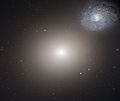
M60 and the region around it, including the ultra-compact dwarf galaxy M60-UCD1 near the bottom
Observation data (J2000 epoch)
ConstellationVirgo[1]
Right ascension12h 43m 40.008s[2]
Declination+11° 33′ 09.40″[2]
Redshift0.003726[3]
Heliocentric radial velocity1,108 km/s[4]
Distance56.7 Mly (17.38 Mpc)[4]
Group or clusterVirgo Cluster
Apparent magnitude (V)8.8[5]
Characteristics
TypeE1.5 or S0[6]
Apparent size (V)7.4 × 6.0[3]
Other designations
M60, NGC 4649, PGC 42831, UGC 7898.[7]

Messier 60 or M60, also known as NGC 4649, is an elliptical galaxy approximately 57[4] million light-years away in the equatorial constellation of Virgo. Together with NGC 4647, it forms a pair known as Arp 116.[8] Messier 60 and nearby elliptical galaxy Messier 59 were discovered by Johann Gottfried Koehler in April 1779, observing a comet in the same part of the sky.[9] Charles Messier added both to his catalogue about three days after this.[9]

Characteristics

[edit]

M60 is an elliptical galaxy of type E1+12 (E1.5), although some sources class it as S0 – a lenticular galaxy. An E2 class indicates a flattening of 20%, which has a nearly round appearance. The isophotes of the galaxy are boxy in shape, rather than simple ellipses. The mass-to-light ratio is a near constant 9.5 in the V (visual) band of the UBV system.[6] The galaxy has an effective radius of 128 (translating, at its distance, to about 10 kpc[6]), with an estimated mass of ~1012 M within a threefold volume, of which nearly half is dark matter.[10] The mass estimated from X-ray emission is (1.0±0.1)×1012 M within 5 effective radii.[11]

Supermassive black hole

[edit]

At the center of M60 is a supermassive black hole (SMBH) of 4.5±1.0 billion solar masses, one of the largest ever found.[12] It is currently inactive. X-ray emission from the galaxy shows a cavity created by jets emitted by the hole during past active periods, which correspond to weak radio lobes. The power needed to generate these features is in the range (6–7)×1041 erg·s−1 (ergs per second).[13]

Supernovae

[edit]

In 2004, supernova SN 2004W was observed in Messier 60.[14] It was a type Ia supernova found 51.6″ west and 78.7″ south of the nucleus.[15]

Environment

[edit]

M60 is the third-brightest giant elliptical galaxy of the Virgo cluster of galaxies, and is the dominant member of a subcluster of four galaxies, the M60 group, which is the closest-known isolated compact group of galaxies.[16] It has several satellite galaxies, one of them being the ultracompact dwarf galaxy M60-UCD1, discovered in 2013.[17] The motion of M60 through the intercluster medium is resulting in ram-pressure stripping of gas from the galaxy's outer halo, beyond a radius of 12 kpc.[11]

NGC 4647 appears approximately 2.5 from Messier 60; the optical disks of the two galaxies overlap. Although this overlap suggests that the galaxies are interacting, photographic images of the two galaxies do not reveal any evidence for gravitational interactions between the two galaxies as would be suggested if the two galaxies were physically close to each other.[18] This suggests that the galaxies are at different distances and are only weakly interacting if at all.[18] However, studies with the Hubble Space Telescope show indications that a tidal interaction may have just begun.[8]

Recession speed and distance estimations

[edit]

Messier 60 was the fastest-moving galaxy included in Edwin Hubble's landmark 1929 paper concerning the relationship between recession speed and distance.[19] He used a value of 1090 km/s for the recession speed, 1.8% less than the more recent value of about 1110 km/s (based on a redshift of 0.003726). But he estimated the distance of this galaxy as well as of the three nebulas of the Virgo Cluster which he included (Messier 85, 49, and 87), to be only two million parsecs, rather than the accepted value today of around 16 million parsecs. These errors in distance led him to propose a Hubble constant of 500 km/s/Mpc, whereas the present estimate is around 70 km/s/Mpc.

[edit]

See also

[edit]

References

[edit]
[edit]
Revisions and contributorsEdit on WikipediaRead on Wikipedia
from Grokipedia
Messier 60 (M60), also known as NGC 4649, is a giant situated approximately 54 million light-years from Earth in the constellation Virgo, serving as one of the brightest members of the . With a diameter spanning about 120,000 light-years and an estimated total equivalent to one trillion solar , it is a massive system. At its core lies a with a of 4.5 ± 1.0 × 10⁹ solar . The galaxy exhibits a smooth, featureless appearance typical of ellipticals, lacking prominent spiral arms or recent , though it is closely paired with the smaller NGC 4647, potentially indicating gravitational interaction. Discovered on April 11, 1779, by Johann Gottfried Koehler while observing a , M60 was independently observed the following day by Barnaba Oriani and cataloged on April 15 by as the 60th entry in his famous comet-like object list. It appears as a bright, diffuse object with an apparent visual magnitude of 9.8, making it visible in medium-sized telescopes under , and spans about 7 by 6 arcminutes in the sky. Classified as an E2 elliptical due to its slightly elongated shape, M60 is one of the brighter ellipticals in the . Observations from the have revealed intricate details, including a rich system of globular clusters and evidence of tidal distortions from its interaction with NGC 4647, though no significant triggered has been detected. The galaxy's central region is particularly luminous, powered by the activity around its , which remains inactive in terms of accretion but dominates the dynamics of the inner stellar orbits. A notable event was the 2004 SN 2004W, a subluminous Type Ia explosion observed within M60. M60's position in the highlights its role in studies of galaxy evolution, dark matter halos, and the co-evolution of s with their host galaxies. It also hosts the ultra-compact dwarf galaxy M60-UCD1, a dense stellar system likely formed from tidal interactions.

Discovery and Observation

Historical Discovery

Messier 60 was first discovered by the German astronomer Johann Gottfried Koehler on April 11, 1779, while he was tracing the path of a comet through the constellation Virgo. Koehler noted it alongside the nearby Messier 59 as a pair of faint nebulae, barely discernible in his telescope during the comet observations. It was independently observed the following day, on April 12, 1779, by Italian astronomer Barnaba Oriani. Four days after Koehler's discovery, on April 15, 1779, French astronomer Charles Messier independently observed the object while searching for the same comet, which had passed very close to the region. Messier included it in his catalog as the 60th entry shortly thereafter, describing it as a nebula in Virgo, slightly more distinct than the preceding entries (Messier 58 and 59), positioned on the same parallel as the star Epsilon Virginis, and notably lacking any visible stars within it. This addition formed part of Messier's broader efforts to compile a list of non-cometary nebulae to aid comet hunters in distinguishing true comets from fixed celestial objects.

Observational Characteristics

Messier 60 appears as a prominent in optical observations, exhibiting a bright, round core surrounded by a smooth, oval halo that gives it a somewhat elongated appearance. In visual band images, it is classified as an E2 elliptical, reflecting its slightly elongated shape. The galaxy has an apparent visual magnitude of 8.8 and an angular size of 7.4′ × 6.0′, making it accessible to amateur astronomers using telescopes of 4-inch aperture or larger under . Located in the constellation Virgo, it becomes most observable during spring evenings from the . High-resolution images from the reveal fine details of Messier 60's structure, including its pairing with the smaller companion galaxy NGC 4647, which appears as a faint spiral in the upper right of wide-field views. These observations highlight the galaxy's luminous central region against a more diffuse envelope, with subtle tidal features suggesting interaction with nearby members of the .

Physical Properties

Morphology and Structure

Messier 60 is classified as an elliptical galaxy of type E2 according to the de Vaucouleurs system, though some analyses suggest an E1.5 designation or even a lenticular (S0) morphology due to its slightly flattened shape and potential disk-like features. The galaxy exhibits a smooth, featureless envelope characteristic of early-type galaxies, devoid of spiral arms, prominent dust lanes, or organized disk structures, which aligns with its overall elliptical appearance. This structure reflects a dynamically relaxed system dominated by old stellar populations, with an ellipticity indicating a modest axial ratio of approximately 0.8. As a giant elliptical in the , Messier 60 experiences environmental influences from the , including evidence of ram-pressure stripping on its outer envelope. observations detect edges and wing-like structures in the hot gas halo beyond approximately 12 kpc, attributed to the galaxy's orbital motion through the dense ICM, leading to stripping of the outer gaseous envelope via Kelvin-Helmholtz instabilities. This effect is confined to the halo periphery, preserving the inner stellar structure while highlighting the galaxy's interaction with its cluster environment.

Size, Mass, and Composition

Messier 60 exhibits a physical diameter of approximately 120,000 light-years, making it one of the larger elliptical galaxies in the . This scale underscores its status as one of the most massive members of the cluster, with an effective radius of about 10 kpc corresponding to the half-light radius in optical observations. The total mass of Messier 60 is estimated at approximately 101210^{12} MM_\odot, derived from combined dynamical and analyses, where roughly 50% of this mass is attributed to , particularly in the outer regions beyond 3 effective radii. Within 5 effective radii, observations yield a mass of (1.0±0.1)×1012(1.0 \pm 0.1) \times 10^{12} MM_\odot, reflecting the inferred from the hot intracluster medium's profile of about 0.80 keV (as of 2008). The galaxy's composition is dominated by an old , with ages exceeding 10 Gyr and enhanced , particularly in the metal-rich component that requires super-solar abundances to match integrated features. This baryonic content, primarily low-mass stars, accounts for the luminous mass, while provides the necessary halo to explain the extended mass distribution observed in tracer dynamics.

Central Features

Supermassive Black Hole

At the center of Messier 60 (NGC 4649), a resides at the galactic nucleus, with a measured to be 4.5±1.0×10⁹M4.5 \pm 1.0 \times 10^9 \, M_\odot through axisymmetric orbit superposition modeling of stellar and kinematics observed with the . This measurement highlights the black hole's dominant gravitational influence on the surrounding nuclear , constraining the dynamical profile within the central kiloparsecs. The is currently in a quiescent state, characterized by extremely radiatively inefficient accretion at a highly sub-Bondi rate, where only a small of the expected accretion power manifests as observable output. This low activity level is evident from the weak nuclear emission and minimal radiative luminosity, consistent with the behavior of supermassive s in many massive elliptical galaxies. Despite its current dormancy, the has shaped the surrounding hot , as indicated by cavities and ring-like structures in the emitting gas, which suggest past interactions with the ambient plasma. Evidence of prior activity includes X-ray cavities aligned with weak radio lobes, interpreted as relics of relativistic jets ejected during episodic outbursts from the . These radio structures exhibit luminosities of approximately (67)×1041ergs1(6-7) \times 10^{41} \, \mathrm{erg \, s^{-1}}, corresponding to jet powers that displaced the hot halo gas and created underdense regions extending several kiloparsecs from the nucleus. Such features underscore the black hole's historical role in regulating the galaxy's gaseous environment through mechanical feedback, even as its present influence remains primarily gravitational on nearby stars and diffuse gas.

Nuclear Dynamics

The nuclear region of Messier 60 displays a high central stellar velocity dispersion of approximately 350 km s⁻¹, reflecting intense kinematic activity driven by the of the central . This elevated dispersion persists in the innermost few arcseconds, where stellar motions are dominated by the black hole's influence, leading to a dynamically hot environment with limited ordered rotation. Observations from integral-field confirm this high dispersion, contrasting with the more moderate values of around 300 km s⁻¹ at larger radii along the major axis. The presence of hot emitting gas further characterizes the nuclear dynamics, with observations revealing diffuse thermal emission from plasma at temperatures indicative of a multiphase . This gas, extending into the central kiloparsecs, shows evidence of cavities, ripples, and ring-like structures, suggesting interactions between outflows and the ambient medium that maintain pressure support against cooling. Complementing this, low-level nuclear emission manifests as LINER activity, with optical spectra displaying low-ionization emission lines consistent with weak accretion processes rather than . Dynamical models, including axisymmetric orbit superposition analyses, demonstrate tangential in the stellar orbits within the nuclear region, where the ratio of radial to tangential dispersions approaches unity but favors tangential motions near the center. These models indicate that on low-angular-momentum orbits experience decay through two-body relaxation, allowing gradual inspiral toward the central and contributing to the observed kinematic structure. Such orbital evolution highlights the role of relaxation processes in shaping the nuclear stellar distribution. The acts as the primary driver of these nuclear dynamics, influencing both gas motions and through its dominant .

Activity and Evolution

Stellar Population

Messier 60 exhibits a predominantly old , with the majority of its stars having ages greater than 10 billion years, reflective of its status as a quiescent in the . Spectral synthesis analyses confirm that the galaxy's integrated light is dominated by evolved, low-mass stars from an ancient formation epoch, with minimal contributions from younger components amounting to less than 1% of the total stellar variance. The current rate remains extremely low, on the order of 10^{-3} M_\sun yr^{-1} or less, underscoring the galaxy's long-term quiescence following early assembly. The stellar inventory is estimated at approximately 400 billion stars, primarily consisting of red giants and stars that contribute significantly to the galaxy's optical and near-infrared . Population synthesis models indicate that these evolved stars, particularly metal-enhanced giants on the , are essential for reproducing the observed absorption features in the near-infrared . This dominance of post-main-sequence stars aligns with the galaxy's , which shows a characteristic UV upturn attributed to hot components in the old population. Metallicity gradients are prominent in Messier 60, with metal-rich ([Fe/H] > 0) concentrated in the dense core, transitioning outward to a more metal-poor halo population ([Fe/H] ≈ -0.5 to -1.0). Color gradients observed across the galaxy's surface support this radial variation, interpreted as arising from a decrease with radius rather than age differences. Such distributions are typical of massive ellipticals, where core enrichment results from early mergers and chemical , while the halo preserves more pristine, lower- material from systems.

Supernova Events

Messier 60 has hosted one confirmed event, designated SN 2004W, a of the subluminous SN 1991bg-like variety. It was discovered on January 28, 2004, by the Lick Observatory Supernova Search (LOSS) team using the Katzman Automatic Imaging Telescope, at an of 18.8 in the unfiltered band, already approximately six months past maximum light. The is positioned 51.6 arcseconds west and 78.7 arcseconds south of the galaxy's nucleus, corresponding to coordinates R.A. 12h 43m 36.52s, Decl. +11° 31' 50.8 (equinox J2000.0). Photometric follow-up revealed a fading consistent with its post-peak phase: magnitude 18.9 on January 29, 2004, and 19.3 by February 11, 2004, with an earlier non-detection at magnitude greater than 20.0 on June 4, 2003. Spectroscopic observations on February 13, 2004, using the Keck I 10-m telescope confirmed the Type Ia classification, showing strong [Ca II] emission at 730 nm, weaker iron lines, and the Ca II near-infrared triplet, indicative of the underluminous subtype. As a subluminous Type Ia event arising from the thermonuclear explosion of a in the galaxy's old stellar population, its parameters (e.g., MLCS2k2 Δ = -0.152) were incorporated into the Berkeley Supernova Ia Program (BSNIP) dataset for standardized distance measurements to the , contributing to refined estimates of Messier 60's . No other historical supernovae have been confirmed in Messier 60, despite systematic searches such as those by LOSS and the Katzman survey. Given the galaxy's substantial stellar mass and elliptical morphology, additional undetected events are likely, though modern surveys have not identified further transients to date.

Galactic Environment

Virgo Cluster Context

Messier 60 (M60) is a prominent member of the Virgo Cluster, the nearest rich cluster of galaxies to the Milky Way, located at an average distance of approximately 16.5 Mpc. This cluster, spanning about 3.5 Mpc in extent, contains over 1,300 identified galaxies and serves as a key laboratory for studying galaxy evolution in dense environments. As one of the cluster's giant elliptical galaxies, M60 ranks as the third-brightest member after Messier 87 and Messier 49, with an apparent magnitude of 8.8 and a physical diameter exceeding 100,000 light-years. Within the Virgo Cluster's complex hierarchical structure, M60 resides in the dominant M60 subgroup, a subcluster located in the southern extension of the main cluster body centered around Messier 87. This subgroup, comprising several early-type galaxies, contributes to the cluster's overall mass distribution and dynamics, with M60 as its central, most massive component at around 10^12 solar masses. The southern extension, including the M60 subgroup, exhibits distinct kinematic properties, such as higher recession velocities relative to the cluster core, indicative of ongoing infall or subcluster merging processes. M60's position in the exposes it to the hot (ICM), a diffuse plasma at temperatures of ~10^7 K permeating the cluster. As M60 moves through this medium during its infall toward the cluster center, stripping removes significant portions of its hot gaseous halo, leading to elongated tail-like structures observed in emissions. These environmental effects quench and alter the galaxy's , highlighting the transformative role of the ICM on cluster ellipticals like M60. Recent JWST/NIRCam observations (as of 2024) have provided high-resolution images of M60's core and halo, enhancing studies of its interactions within the cluster.

Companion Galaxies and Interactions

Messier 60, a giant in the , has a notable close companion in the NGC 4647, located approximately 2.5 arcminutes away, such that their optical disks appear to overlap from 's perspective. Despite this apparent proximity, NGC 4647 lies about 63 million light-years from , roughly 9 million light-years farther than Messier 60's distance of 54 million light-years, making them a projected pair rather than a tightly bound system. However, their similar radial velocities indicate a physical association within the cluster environment, and detailed imaging reveals subtle evidence of weak tidal distortions in NGC 4647's morphology, suggesting the early onset of gravitational interaction between the two galaxies. A more tightly bound companion is the ultracompact M60-UCD1, discovered in 2013 using Hubble observations, which orbits Messier 60 at a projected distance of about 6.6 kiloparsecs. This tiny galaxy packs approximately 140 million stars into a diameter of just 300 light-years, yielding an extreme stellar density about 15,000 times greater than in the Milky Way's solar neighborhood and making it one of the densest known galaxies in the local universe. Its total dynamical mass is estimated at around 1.4 × 10^8 solar masses, with a of 21 million solar masses comprising roughly 15% of that total, an unusually high fraction indicative of its compact nature. M60-UCD1 is widely interpreted as the stripped core of a once-larger progenitor , with its outer tidally disrupted during a with Messier 60 approximately 10 billion years ago, providing direct evidence of dynamical interactions shaping the region's galactic population. Such events contribute to Messier 60's extended stellar , as repeated mergers and tidal stripping in the dense cluster environment have likely built up its massive halo through the accretion of smaller companions over .

Distance Measurements

Redshift and Recession Velocity

Messier 60 exhibits a heliocentric of 1,108 km/s, corresponding to a of z = 0.003726 based on spectroscopic measurements of its stellar and gaseous components. This value reflects the galaxy's apparent motion away from the , primarily driven by the but modulated by local gravitational influences. The recession of Messier 60 was among the earliest quantified in the context of extragalactic distances. In his seminal 1929 study establishing the -distance relation, reported a of 1,090 km/s for the galaxy (then identified as NGC 4649), derived from measurements by Milton Humason at . This measurement, part of a sample of 46 nebulae, underscored the linear between recession speed and distance, laying the foundation for and modern cosmology. As a prominent member of the , Messier 60 displays a peculiar relative to the expected Hubble flow, attributable to the cluster's gravitational dynamics and the broader infall of the Local Group toward the Virgo Cluster core. The cluster's substantial mass induces velocity dispersions of several hundred km/s among its members, with Messier 60's motion influenced by both internal orbital dynamics and the overall infall pattern, resulting in deviations from pure cosmic expansion. These local perturbations highlight the challenges in interpreting raw recession velocities for precise cosmological inferences.

Distance Estimation Methods

The distance to Messier 60, an early-type elliptical galaxy, is primarily determined using methods suited to such systems, with modern estimates, including 2024 JWST observations, converging on approximately 16.3 Mpc (53 million light-years). A 2024 study using JWST/NIRCam observations calibrated the tip of the red giant branch (TRGB) and surface brightness fluctuation (SBF) method, yielding a Virgo Cluster distance of 16.17 ± 0.25 (stat) ± 0.47 (sys) Mpc, with M60 at 16.3 Mpc. The SBF method, which exploits the statistical variance in surface brightness arising from the unresolved stellar population in galaxy images, provides one of the most precise measurements for ellipticals like Messier 60. Calibrated against Cepheid variables in nearby galaxies and refined using Hubble Space Telescope (HST) imaging in the F850LP bandpass, the SBF absolute fluctuation magnitude relates to the galaxy's (g - z) color. For Messier 60, HST/ACS observations yield an apparent fluctuation magnitude leading to a distance modulus of 31.13 ± 0.05 mag, or 16.6 ± 1.0 Mpc. This SBF result has been cross-calibrated with Type Ia supernovae hosted in early-type galaxies, including those in the , to reconcile the two distance ladders. Type Ia supernovae serve as standardizable candles through their peak luminosity, corrected for light-curve shape and host-galaxy properties, with distances derived from the applied to their observed flux. HST-based SBF measurements for 19 Virgo ellipticals that hosted Type Ia events demonstrate consistency between the scales to within 0.02 mag, supporting the 16.6 Mpc SBF distance for Messier 60 while extending the calibration to ~30 Mpc. Recent compilations incorporating these methods, updated with JWST data, yield estimates around 16.3 Mpc for Messier 60. Alternative indicators confirm this distance. The Tully-Fisher relation, applied to the nearby companion spiral NGC 4647 (which appears projected against Messier 60 but is at comparable ), correlates infrared luminosity with HI linewidth as a proxy for rotational . Near-infrared observations give distance moduli of 31.06 ± 0.20 mag (16.3 Mpc) and 31.25 ± 0.26 mag (17.8 Mpc), both consistent with Messier 60's SBF value and indicating no significant line-of-sight separation between the pair. The luminosity function (GCLF) in Messier 60, observed via HST/ACS, shows a turnover at the absolute V magnitude calibrated against SBF distances for Virgo ellipticals; fitting the GCLF yields a aligning with 16.3 Mpc, reinforcing the primary estimate without introducing significant systematic offsets. Historically, Edwin Hubble's 1929 analysis included Messier 60 as the highest-velocity galaxy in his sample, with an estimated distance of ~2 Mpc derived from the luminosity distribution of novae and brightest cluster stars in nebula images. This underestimated distance implied an anomalously high recession velocity relative to the emerging Hubble law (v = H_0 d), contributing to the perceived "local velocity anomaly" where nearby structures appeared to deviate from uniform expansion. Modern SBF, supernova, and JWST distances, placing Messier 60 at ~16.3 Mpc, resolve this by aligning its distance with the observed recession velocity (cz ≈ 1100 km/s) using H_0 ≈ 70 km/s/Mpc, after accounting for peculiar motions due to cluster infall, eliminating the discrepancy.

References

Add your contribution
Related Hubs
User Avatar
No comments yet.