Hubbry Logo
Wadi El NatrunWadi El NatrunMain
Open search
Wadi El Natrun
Community hub
Wadi El Natrun
logo
8 pages, 0 posts
0 subscribers
Be the first to start a discussion here.
Wadi El Natrun
Wadi El Natrun
from Wikipedia

Wadi El Natrun (Arabic: وادي النطرون, lit.'Valley of Natron'; Coptic: Ϣⲓϩⲏⲧ, romanized: Šihēt, lit.'measure of the hearts'[2]) is a depression in northern Egypt that is located 23 m (75 ft) below sea level and 38 m (125 ft) below the Nile River level. The valley contains several alkaline lakes, natron-rich salt deposits, salt marshes and freshwater marshes.[3]

Key Information

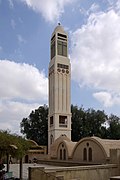
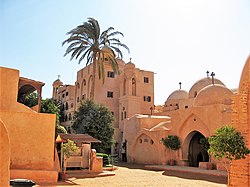
In Christian literature it is usually known as Scetis (Σκήτις in Hellenistic Greek) or Skete (Σκήτη, plural Σκήτες in ecclesiastical Greek). It is one of the three early Christian monastic centers located in the Nitrian Desert of the northwestern Nile Delta.[4] The other two monastic centers are Nitria and Kellia.[4] Scetis, now called Wadi El Natrun, is best known today because its ancient monasteries remain in use, unlike Nitria and Kellia which have only archaeological remains.[4] The desertified valley around Scetis in particular may be called the Desert of Scetis.[5]

Geography

[edit]

Wadi al-Natrun is the common name for a desert valley located west of the Nile Delta, along the El Tahrir markaz, which is about 10 km west of the entrance to Sadat City on the Cairo-Alexandria Desert Road, and about 50 km from Khattabah on the Nile (Rashid Branch), and it falls below the level of the plateau surface surrounding it about 50 meters. The length of this depression ranges between 5, 55 and 60 km, while its average width is 10 km, and its deepest point reaches 24 meters below sea level. The depression is the smallest depression in the Egyptian Western Desert, with an area of about 500 km2. Therefore, it is true that it is a depression and not a valley, because the region is a closed depression that has a beginning and an end, and it has no source, estuary or tributaries, so the launch of the word "Wadi" on the depression is not topographically correct.[6]

The Wadi contains 12 lakes, the total surface area of which is 10 km square and their average depth is only 2 m. The color of these lakes is reddish blue because its water is saturated with the Natron salt.[7]

History

[edit]

Fossil discoveries

[edit]

Fossils dating to the Pliocene era (5.3-2.6 million years ago) have been discovered in the Wadi El Natrun region, including the long-snouted crocodile Euthecodon,[8] softshell turtles,[9] the camel Paracamelus,[10] the three toed hipparionine equine Cormohipparion,[11] the primitive hippopotamus Archaeopotamus andrewsi,[12] antelope including reedbuck (Renunca)[13] and Alcelaphinae,[14] and the elephant-relative Deinotherium.[15]

Ancient history

[edit]
sxtt
N23
HmAAtzmnD12
Z2
niwt
sḫt ḥmꜣwt[16]
in hieroglyphs
Era: 1st Intermediate Period
(2181–2055 BC)

Natron valley is first attested in the story of the Eloquent Peasant, and it is mentioned among the list of seven oases in the Temple of Edfu. In Ptolemaic times it constituted part of the Nitrite nome (Ancient Greek: Νιτριώτης νομός). It was also known in Coptic as Mountain of Salt (Coptic: ⲡⲧⲱⲟⲩ ⲙⲡϩⲙⲟⲩ)[16] or Phanihosem (Coptic: ⲫⲁⲛⲓϩⲟⲥⲉⲙ, lit.'the one (place) on the natron').[17]

The importance of the Natrun valley dates back to the Pharaonic era, as the ancient Egyptians and the Libyans fought many battles there. And this ended up with the Egyptians overcoming them and annexed the eastern side of the desert, which still belongs to Egypt. Then, Wadi al-Natrun became an administrative part of the country in the Pharaonic era, but there is no information about its history during their reign, and the latest writings on the wars between the Libu and the Egyptians indicate that the last of them was in 1170 BC during the reign of Ramesses III.[18]

As for the religious significance of Wadi al-Natrun, there are many discoveries that indicate that this area was considered sacred as early as year 2000 BCE at the very least. Among these discoveries is a bust of black granite dating back to the era of the Seventeenth Dynasty of the Pharaohs, and there is also a granite gate and stones from the lintel of a door bearing cartridges for King Amenemhat I, in a place called the backbone.[19]

Economic history

[edit]

The alkali lakes of the Natron Valley provided the Ancient Egyptians with the sodium bicarbonate used in mummification and in Egyptian faience, and later by the Romans as a flux for glass making.

The Egyptian Salt and Soda Company Railway was built at the end of the 19th century as a 33 miles (54 km) long narrow gauge railway with a gauge of 750 mm, which attracted the first tourists to the wadi.

Monastic history

[edit]

The desolate region became one of Christianity's most sacred areas. The Desert Fathers and cenobitic monastic communities used the desert's solitude and privations to develop self-discipline (asceticism). Hermit monks believed that desert life would teach them to eschew the things of this world and follow God's call. Between the 4th and 7th century AD, hundreds of thousands of people from the world over joined the hundreds of Christian monasteries in the Nitrian Desert, centered on Nitria, Kellia and Scetis (Wadi El Natrun).

Saint Macarius of Egypt first came to Scetis (Wadi El Natrun) around 330 AD where he established a solitary monastic site.[20] His reputation attracted a loose band of anchorites, hermits and monks who settled nearby in individual cells. Many of them came from nearby Nitria and Kellia where they had previous experience in solitary desert living; thus the earliest cenobitic communities were a loose consolidation of like-minded monks.[4] By the end of the fourth century, four distinct communities had developed: Baramus, Macarius, Bishoi and John Kolobos. At first these communities were groupings of cells centered on a communal church and facilities, but enclosed walls and watchtowers developed over time and in response to raids from desert nomads.[4] Nitria, Kellia, and Scellis also experienced internal fractures related to doctrinal disputes in Egypt.[4] At its peak the place contained 700 monasteries. The monasteries flourished during the Muslim conquest of Egypt (639–642), but in the eighth and ninth centuries taxation and administration concerns led to conflicts with the Muslim government.[4]

Invasion of Scetis

[edit]

Scetis was attacked by the Mazices who "came sweeping off the Libyan desert" in 407-408 AD and was decimated,[21][22] causing many notable Desert Fathers to leave the region, such as Abba Anoub.[22] One of the survivors, St. Arsenius the Great, remarked in 410 that, "The world has lost Rome and the monks have lost Scetis."[21][23] As the Jesuit historian and Professor Willian J. Harmless said, "Scetis’s destruction marked a turning point in the history of early Christian monasticism. The site would be resettled a few years later, and in fact would suffer other raids, notably in 434, 444, and 570."[21]

Nitria and Kellia were eventually abandoned in the 7th and 9th centuries respectively, but Scetis continued throughout the Medieval period.[4] Although some of the individual monasteries were eventually abandoned or destroyed, four have remained in use to the present day:[4]

Some of the most renowned saints of the region include the various Desert Fathers, including Saint Amun, Saint Arsenius, Saint John Cassian, Saint Isidore of Scété, Saint John the Dwarf, Saint Macarius of Egypt, Saint Macarius of Alexandria, Saint Moses the Black, Saint Pishoy, Sts. Maximos and Domatios, Saint Poimen The Great and Saint Samuel the Confessor.

To this day Wadi El Natrun remains the most important center of Coptic monasticism.[24]

Saint-Exupéry's plane crash

[edit]

The environs of Wadi Natrun have been identified as the likely site of where the plane of French aviator Antoine de Saint-Exupéry crashed on December 30, 1935. After miraculously surviving the crash, he and his plane's mechanic nearly died of thirst before being rescued by a nomad. Saint-Exupéry documented his experience in his book Wind, Sand and Stars.[25] The event is thought to have inspired his most famous work, The Little Prince.

[edit]

See also

[edit]

References

[edit]

Further reading

[edit]
[edit]
Revisions and contributorsEdit on WikipediaRead on Wikipedia
from Grokipedia
Wadi El Natrun, also known as the Natrun Valley, is an elongated endorheic depression in the northwestern Western Desert of Egypt, located approximately 110 km northwest of Cairo and spanning about 60 km in length by 6 km in width, with its floor lying up to 23 meters below sea level. The valley's name derives from the Arabic "wadi al-naṭrūn," meaning "valley of natron," referring to the abundant deposits of this sodium carbonate mineral found in its hypersaline alkaline lakes and marshes. Geologically, it features seven major soda lakes—such as Um Risha, El-Hamra, and Ruzita—fed by subterranean seepage from the Nile and seasonal precipitation, with water levels fluctuating between 0.5 and 2 meters deep and salinity reaching up to 300‰, supporting extremophilic life forms like cyanobacteria and brine shrimp. Historically, Wadi El Natrun holds profound significance as the cradle of , where early like St. Macarius the Great established hermitages in the AD, leading to the foundation of up to 50 Coptic monasteries by the , though only four—St. Macarius (Deir Abu Maqar), St. Bishoy (Deir Anba Bishoi), the Syrians (Deir El-Suryani), and the Romans (Deir Al-Baramus)—survive today as fortified strongholds housing ancient churches, relics, frescoes, and manuscripts. These monasteries served as refuges for Coptic patriarchs during periods of persecution and flourished even after the Muslim conquest of Egypt in 639–642 AD, preserving a vital center of Coptic Orthodox spirituality for over 1,500 years. The site's isolation and harsh environment made it an ideal setting for ascetic life, influencing global monastic traditions. Beyond its religious heritage, Wadi El Natrun has been economically vital since ancient times for its deposits, which ancient Egyptians mined from at least the reign of Ramses III (c. 1198–1166 BC) for mummification, glassmaking, production, and other uses, with the lakes' brines dominated by , , and minerals like , thenardite, and . In modern contexts, the valley remains a source of geological interest for its unique formations and microbial ecosystems, though large-scale extraction has declined.

Geography and Environment

Physical Features and Location

Wadi El Natrun is an elongated depression situated approximately 110 km northwest of Cairo in Beheira Governorate, northern Egypt, within the Western Desert and along the route between Cairo and Alexandria. This tectonic basin extends in a northwest-southeast direction, forming a distinct physiographic feature in the arid landscape of the Nile Delta's western margin. The depression measures about 60 km in length and about 10 km in width, encompassing an area of roughly 282 km². Its floor lies at elevations reaching 23 m below , or 38 m below the water level of the River's Rosetta branch, creating a closed basin that traps subsurface moisture and salts. Topographically, it is characterized by vast salt flats and shallow salt lakes at the basin's lowest points, bordered by steep escarpments—particularly a high, embayed one to the north—and flanked by elevated structural plateaus that rise to 110–200 m above , such as those near Gebel Hamza and . Geologically, Wadi El Natrun formed as a fault-controlled tectonic basin during the Miocene-Pliocene epochs within Egypt's unstable shelf, where and fracturing created the depression's structural framework. The surface is dominated by alluvial and deposits overlying Tertiary bedrock, contributing to its flat, saline interior and abrupt margins.

Climate, Ecology, and Hydrology

Wadi El Natrun experiences an arid desert climate characterized by extreme temperature variations and minimal precipitation. Summers are intensely hot, with average maximum temperatures reaching 38°C in August, often exceeding 40°C during the day, while winters are mild, with January means around 16°C and nighttime lows dropping to 10°C. Annual rainfall is low, averaging 41.4 mm, predominantly occurring in winter months, which contributes to the region's high aridity index. Evaporation rates are significantly elevated, with daily lake evaporation ranging from 2.7 mm in January to 5.5 mm in June, resulting in an annual total of approximately 1,600 mm, far outpacing precipitation and exacerbating water scarcity. The hydrology of Wadi El Natrun is dominated by systems and seasonal fluctuations in its salt lakes, shaped by the depression's below-sea-level of 23 m. Primary water sources include lateral recharge from the to the southeast and upward leakage from the deeper , providing the region's sole reliable supply for human and ecological needs. The lakes, such as El-Gaar and Khadra, experience periodic flooding from seepage, particularly during rare winter rains, though levels vary seasonally due to intense and infiltration. The lake is distinctly alkaline, with values typically ranging from 8.5 to 9.5. Much of the is brackish and alkaline, with values from 8.3 to 13, influenced by high concentrations and salinization processes, and total from 600 to 2,300 mg/L. Ecologically, the region supports specialized adapted to its hypersaline and arid conditions, featuring halophytic and resilient amid ongoing environmental pressures. A total of 142 have been documented across habitats like wastelands and lake margins, with dominant halophytes including Aeluropus littoralis, Juncus acutus, and Sporobolus spicatus, which thrive in saline soils near the lakes. is sparse but includes mammals such as Egyptian red foxes (Vulpes vulpes arabica) and hares, alongside birds like greater flamingos (Phoeniconaias roseus) that congregate at salt lakes for breeding and feeding. Human activities pose significant threats, including agricultural expansion that has led to and a decline in water levels by over 10 m since the , as well as affecting 12.56% of the area with high sensitivity, resulting in cover loss of up to 27.37% in low-quality zones. Nomadic and sand dune encroachment further exacerbate degradation, reducing overall resilience.

Natural Resources and Paleontology

Natron Deposits and Salt Lakes

Wadi El Natrun is renowned for its eight main salt lakes, which include Lake Zug (also known as El-Zugm), Lake Hamra, Lake Fasda (or Fazda), Lake Umm Risha, Lake Al-Gaar, Lake Qasr Al-Abiad, Lake Barnuji, and Lake Dabbah, scattered across the depression's floor. These lakes are shallow, with average depths of about 2 meters, and exhibit a reddish-blue coloration due to algal blooms and high levels ranging from 283 to 540 g/L. Their alkaline nature, characterized by values between 8.5 and 9.5, stems from the dominance of and ions in the brines, fostering the precipitation of minerals upon seasonal . The primary mineral in these deposits is , a naturally occurring hydrated with the chemical formula Na2CO310H2O\mathrm{Na_2CO_3 \cdot 10H_2O}, often mixed with (NaCl\mathrm{NaCl}), thenardite (Na2SO4\mathrm{Na_2SO_4}), burkeite (Na6(CO3)(SO4)2\mathrm{Na_6(CO_3)(SO_4)_2}), and traces of (Na2CO3NaHCO32H2O\mathrm{Na_2CO_3 \cdot NaHCO_3 \cdot 2H_2O}). forms as efflorescent crusts up to 50 mm thick on the lake floors, particularly in spring and summer when high rates concentrate the brines, and it can comprise a substantial portion of the surface deposits alongside sulfates and s. Unlike common salt (NaCl\mathrm{NaCl}), which is a simple used primarily for seasoning and preservation, natron's base imparts alkaline properties, making it valuable as a and cleanser in industrial applications. The brines are dominated by , , and ions, with minor magnesium, classifying them as Cl⁻-SO₄²⁻-CO₃²⁻ type waters that support the ongoing accumulation of these minerals. Geologically, the natron deposits are evaporites formed through the concentration and precipitation of minerals from groundwater-fed saline waters in the closed-basin setting of the Wadi El Natrun depression, which developed during the Pliocene epoch as part of broader tectonic subsidence and marine incursions in the Western Desert. The process involves seasonal flooding from underlying aquifers, followed by intense arid evaporation that drives supersaturation and crystallization, building layered sequences of salt crusts intercalated with organic-rich muds up to 1 meter deep. These modern accumulations overlay Pliocene-Recent sedimentary rocks, including conglomerates and sandstones from the Mikheimen Formation, reflecting a long history of lacustrine and sabkha environments. Extraction of natron has historically involved manual scraping of the dried lake surfaces during the summer low-water period, when crusts are most accessible, using simple hand tools to collect the mixed evaporites for later processing. In modern times, small-scale operations continue this surface harvesting at lakes like Fazda, though some sites employ shallow evaporation ponds to enhance concentration by diverting brine flows and allowing controlled solar evaporation. Historical production peaked in antiquity, supporting large-scale industries with outputs estimated in the thousands of tons annually from the region's lakes, though contemporary yields are lower due to reduced demand and environmental constraints.

Fossil Discoveries and Geological Significance

The Qaret El-Muluk Formation in Wadi El Natrun has yielded significant Pliocene-era fossils dating to approximately 5.3–2.6 million years ago, providing insights into the region's prehistoric biodiversity. Key discoveries include vertebrate remains such as teeth and limb bones of a small hippopotamus, the extinct horse Hipparion, a suid (pig-like animal), and various antelopes, indicating a diverse mammalian assemblage adapted to wetland environments. Additionally, fossils of the long-snouted crocodile Euthecodon nitriae have been identified from Miocene-Pliocene deposits in the area, representing an early crocodylid with piscivorous adaptations. Microfossils, including charophytes, ostracods, gastropods, oysters, and benthonic foraminifera, further attest to freshwater and brackish conditions during deposition. Excavations began in the late 19th and early 20th centuries, with initial collections made by members of the Egyptian Geological Survey, including Captain Lyons, H. J. L. Beadnell, and Max Blanckenhorn, from the Garet El-Moluk hill. These efforts uncovered fragmentary but well-preserved specimens, later described in scientific reports that highlighted the site's potential for further vertebrate discoveries. Modern paleontological surveys, such as those in the late 20th century, have expanded on these findings through detailed sedimentological and palynological analyses, confirming the formation's rich fossil content and aiding in stratigraphic correlations across the Western Desert. Geologically, these fossils underscore a markedly wetter paleoenvironment during the , characterized by lakes, rivers, and marshlands linked to ancient extensions, contrasting the current hyper-arid conditions. Sedimentary layers of the Qaret El-Muluk Formation, composed of clays, sands, and carbonates, reflect episodes of tectonic subsidence in the Wadi El Natrun depression, facilitating the accumulation and preservation of organic remains. and evidence points to a warm, humid with intermittent dry phases, supporting lush and aquatic habitats that sustained the observed fauna. In the context of African paleontology, Wadi El Natrun's fossils contribute to understanding faunal dynamics in , illustrating site-specific focused on mammals, reptiles, and rather than earlier forms like dinosaurs. The assemblage highlights evolutionary transitions in proboscideans, equids, and crocodylians amid shifting paleoclimates, with implications for regional during the transition from humid to arid conditions.

Historical Overview

Ancient Egyptian Exploitation

The ancient Egyptians began exploiting the natron deposits of Wadi El Natrun during the New Kingdom, with the earliest documented evidence from the reign of Ramses III (c. 1198–1166 BCE), recognizing the mineral's versatile properties for both practical and purposes. , a naturally occurring mixture of , , and salts, was harvested from the valley's evaporitic lakes and used extensively in mummification to desiccate bodies by drawing out moisture and inhibiting bacterial growth, a process essential to preserving the deceased for the . It also served as a flux in early glassmaking, lowering the melting point of silica to produce and objects, and was combined with animal fats or oils to create a rudimentary for personal and household cleansing. Evidence of these uses appears in Pharaonic texts, such as the (c. 1550 BCE), which describes in medical recipes for treating ailments, highlighting its role beyond funerary practices. Mining operations involved state-organized expeditions, often employing labor from local populations or conscripted workers, who extracted the crystalline deposits by hand from the beds during the arid seasons when concentrations were highest. The harvested was then packed into sacks and transported via donkey caravans along desert trails to the Nile River, where it was loaded onto boats for distribution to workshops and temples across . Natron held economic significance through trade, with surplus supplies exported to Mediterranean regions for and other crafts, integrating it into broader ancient economies. In Egyptian rituals, it was revered as a purifying or "divine salt," used by priests for ablutions and to cleanse cult statues, symbolizing renewal and sanctity. This exploitation continued into the Greco-Roman period (1st century BCE–4th century CE), where Roman authors like noted the superiority of Egyptian natron—particularly from sources like Wadi El Natrun—for glassmaking, underscoring its enduring regional importance.

Monastic Foundations and Early Christian Era

The establishment of in Wadi El Natrun, known anciently as Scetis, began around 330 AD when St. the Great, a prominent Desert Father born circa 300 AD, settled in the desert as a seeking spiritual solitude. Inspired by earlier ascetics like St. Anthony, built a small church and cells, attracting numerous hermits drawn to the region's isolation and its pre-existing spiritual allure from ancient resource sites. His reputation for wisdom and miracles quickly spread, leading to the formation of loose communities of anchorites who lived in scattered cells while adhering to basic communal guidance. By the late , Scetis had evolved into a major center of Coptic under Macarius's influence, with the development of both anchoritic (solitary) and emerging cenobitic (communal) practices that emphasized , manual labor, and detachment from worldly ties. Key figures such as St. Pishoy (Bishoy), a disciple active in the late , contributed to this growth by founding additional settlements and promoting rigorous ascetic disciplines, including prolonged fasting and scriptural meditation. Monks resided in simple cave-like cells for solitude, following rules that balanced individual contemplation with periodic gatherings for and shared meals, often interacting with from the nearby who sought spiritual counsel. The monastic population expanded rapidly, growing significantly during Macarius's lifetime (d. 390 AD) and leading to the foundation of up to 50 monasteries by the , fueled by pilgrims and converts from diverse backgrounds. These communities contributed theologically by refining the distinction between anchoritic withdrawal and cenobitic structure, influencing broader Christian ascetic traditions through writings like the Apophthegmata Patrum. At its peak in the , prior to the Arab conquest in 639 AD, Scetis hosted hundreds of thousands of monks across hundreds of monasteries, establishing it as a cornerstone of early Coptic spirituality.

Later History and Modern Developments

Medieval Invasions and Decline

The monastic communities of Wadi El Natrun, centered in the region known as Scetis, faced their first major external threat in 444 AD when Berber raiders, identified as the Mazices , launched a devastating . This resulted in the massacre of forty-nine elder monks, including the hegumenos Apa John, and widespread destruction of monastic buildings and cells across the valley. Surviving monks dispersed temporarily to safer locations, such as the fortified refuge of Piamoun within Scetis, while some sought exile in more secure areas to evade further violence. The event marked a pivotal disruption to the early Christian settlements, commemorated annually in the Coptic Synaxarion on 26 Tubah and later honored with a dedicated feast on 5 Amshir established by Benjamin I (622–661). Subsequent centuries brought additional perils, including Arab raids in the 7th and 8th centuries following the Muslim conquest of Egypt in 642 AD, which imposed heavy economic pressures on wealthy monastic institutions through taxation and plunder. By the early 9th century, marauding Arab gangs and Bedouin tribes conducted further attacks, notably a severe sack in 817 AD that nearly obliterated the monastic structures and led to significant loss of life and resources. These incursions were compounded by economic shifts, such as the decline in natron extraction and trade from Wadi El Natrun's salt lakes around the 8th century, driven by disruptions in Mediterranean commerce and the transition to alternative fluxes in glass production after the Islamic conquest, which diminished the region's economic viability and support for monastic life. Bedouin raids persisted into the 11th century, with a notable Lewati Berber assault in 1069 AD wrecking remaining buildings and prompting sporadic restorations amid ongoing instability. In response to these threats, the monasteries adopted survival strategies centered on , beginning with early 5th-century refuge towers like that of Piamoun and evolving into comprehensive stone walls, keeps, and drawbridges by the under leaders such as Shenute I (859–880), who rebuilt key sites after the 817 raid. The Coptic Church played a crucial role in preservation, designating Scetis monasteries as patriarchal seats for and consecration, providing refuge during persecutions, and facilitating relic translations—such as those of the Forty-Nine Martyrs in the —to safeguard spiritual heritage. During the Ottoman era from the 16th to 19th centuries, the monasteries experienced further decline due to cumulative effects of plagues like the (1348–1349), famines, and depreciating endowments, which reduced populations drastically— for instance, Dayr Anba Maqar had only four monks by 1712. By the early 1800s, only four monasteries remained active: those of Saint Macarius the Great, Saint Bishoy, Baramus, and the , with overall monastic numbers dwindling to a few dozen amid neglect and regional instability. This period solidified the shift from a vibrant network of dozens of communities to isolated strongholds, sustained primarily through the enduring Coptic tradition despite external pressures.

20th-Century Events and Contemporary Economy

In 1935, French aviator and author experienced a notable incident near Wadi El Natrun while attempting a record-breaking flight from to Saigon. On December 29, his C.630 Simoun aircraft, registration F-ANRY, encountered severe weather during the leg from to , leading to a crash landing on a sandy plateau approximately 20 km north of the valley. The plane lost its undercarriage and was destroyed beyond repair, but Saint-Exupéry and his mechanic-navigator survived uninjured and endured a four-day trek through the before being rescued by local Bedouins. This harrowing experience profoundly influenced his memoir , published in 1939, which recounts the survival ordeal and reflections on human endurance in harsh environments. The contemporary of Wadi El Natrun revolves around limited resource extraction, , and growing tied to its religious heritage. Salt and mining persist in the valley's alkaline lakes, though output has significantly declined since the mid-20th century due to the industrial synthesis of these compounds, reducing reliance on natural deposits. sustains local communities through freshwater oases and marshes, where supports cultivation of crops like grains and vegetables, bolstered by government initiatives including windbreaks and wells installed since the 1960s to combat and expand . Tourism has emerged as a key sector, primarily driven by visits to the ancient Coptic monasteries, attracting pilgrims and cultural enthusiasts. The four surviving monasteries—St. Macarius, St. Bishoy, the Syrians, and the Romans—host thousands of visitors annually, contributing to the local economy through guided tours and donations. In recent decades, the monastic population has grown substantially, from around 40 monks in the late to over 400 as of 2023, with estimates reaching approximately 500 by 2025, reflecting revitalization efforts that include post-2000 restorations of churches, walls, and frescoes to preserve the sites amid environmental pressures. The monasteries' inclusion on Egypt's Tentative List since 2003 underscores ongoing conservation efforts to protect this cultural landscape from desert encroachment and urban expansion.

Coptic Monasteries

Overview of Monastic Tradition

Wadi El Natrun, anciently known as Scetis, emerged as the cradle of the ' ascetic teachings in the fourth century, where early Christian hermits like Macarius the Great emphasized solitude, ceaseless prayer, and renunciation of worldly attachments to pursue union with God. These principles, rooted in the valley's harsh desert environment, formed the theological foundation of Coptic , prioritizing inner purification and communal support amid isolation. The tradition's global reach extended through , who resided in Scetis around 385–399 AD and later conveyed its practices—such as balanced labor, scriptural meditation, and discretion in —to the Latin West, profoundly shaping European , including the Rule of St. Benedict. The monastic communities of Wadi El Natrun sustain ancient Coptic liturgical rites, characterized by rhythmic chants, incense-filled services, and the of icons and relics that serve as tangible links to the saints' . Byzantine-era icons, depicting Christ enthroned with the Virgin Mary and John the Baptist, adorn church interiors and underscore the liturgical focus on divine mediation and communal worship. Theologically, these practices embody the miaphysite Christology affirmed by the Coptic Church, which rejected the dyophysite definition of the in 451 AD, viewing it as a departure from the unified divine-human nature of Christ taught at earlier councils like . Scetis monasteries, as key centers of this non-Chalcedonian orthodoxy, resisted imperial pressures and preserved doctrinal purity through their ascetic witness. Symbolically, the "Valley of Salt"—derived from its natron-rich lakes—represents the ascetic purification central to Coptic spirituality, evoking biblical imagery of salt as a against and a for the soul's refinement in desolation. This harsh terrain mirrors the monks' embrace of spiritual aridity to foster humility and divine encounter, a theme echoed in ' sayings. The valley continues to host ecumenical dialogues, including the Sixth World on Faith and Order held from 24 to 28 October 2025, where Coptic leaders advocated for unity grounded in shared apostolic heritage. The conference concluded with an Ecumenical Affirmation and commitments to practical unity initiatives in local communities. Beyond theology, Wadi El Natrun's monasteries have safeguarded the through extensive manuscript collections spanning the fourth to eighteenth centuries, including Sahidic and Bohairic texts on , , and scripture that document linguistic evolution and doctrinal continuity. These holdings, such as apocryphal acts and homilies from Saint Macarius Monastery, offer irreplaceable insights into early Christian thought. The site's cultural landscape, encompassing four enduring monasteries, earned Tentative List status in under criteria (ii), (iv), and (v) for exemplifying monastic origins, architectural development, and ongoing spiritual testimony.

The Four Surviving Monasteries

The four surviving Coptic Orthodox monasteries in Wadi El Natrun—Dayr Anba Maqar (Monastery of Saint ), Dayr Anba Bishoy, Dayr al-Suryan (Monastery of the ), and Dayr al-Baramus (Monastery of the Romans)—represent the enduring legacy of early in the region, with origins tracing back to the fourth and sixth centuries CE. These institutions, once part of a vast network of over 50 monasteries, have withstood invasions, environmental challenges, and periods of decline through fortified architecture and spiritual resilience. Today, they house approximately 500 in total, serving as active centers of , , and limited pilgrimage, while maintaining self-sufficient agricultural operations. Dayr Anba Maqar, the southernmost and largest of the four, was founded in the mid-fourth century by Saint Macarius the Great, who established the first organized monastic community in the valley around 360 CE. It served as a refuge for Coptic patriarchs during periods of persecution and was rebuilt in 866 CE with massive fortified ramparts following earlier sackings in the fifth century. The complex features a fortress-like enclosure with a three-story tower, four main churches—including the Church of Saint Macarius with a seventh-century —and ancillary structures like cells, a mill, and a well. Relics of Saint Macarius, Saint John the Baptist, and the prophet are venerated here, alongside the Churches of the Forty-Nine Martyrs and Saint Isaac of Kalyon, noted for their distinctive cupolas. Currently, it supports around 110 monks, many university-educated, who manage extensive farms producing olives, dates, and , reflecting a modern renaissance initiated in 1969. Dayr Anba Bishoy, located centrally, originated in the fourth century under Saint Bishoy, a disciple of Saint , though the current structures date primarily from the ninth century onward, with a major reconstruction in 1330 CE due to damage and earlier barbarian raids in the late sixth century. The site is renowned for the of Saint Bishoy's incorrupt body, relocated here in 830–849 CE, and it produced notable figures like Patriarchs Gabriel VIII and III. Architecturally, it comprises an asymmetrical walled rectangle with a single western entrance, five churches—including the three-aisled Church of Saint Bishoy (post-849 CE) and the Church of the Virgin Mary—and a late-thirteenth-century jawsaq tower originally intended as a church. Additional features include two refectories and a parekklesion from the eleventh century. The currently houses over 100 monks, emphasizing rigorous ascetic practices, and attracts visitors under controlled access. Dayr al-Suryan, to the north of Dayr Anba Bishoy, was established in the sixth century as an Egyptian foundation but gained prominence through Syrian monastic influences starting around 800 CE, particularly under Mushe of Nisibis in the tenth century, who oversaw extensive rebuilding until the Syrian presence waned by the seventeenth century. Its architecture includes the Church of the Virgin Mary, constructed around 980 CE with a tenth-century Ascension mural and an ivory screen, alongside later churches like those of the Forty Martyrs, Saint Hennis, and Saint Marutha from the fifteenth century. The monastery is distinguished by its ancient library, housing hundreds of Syriac and Coptic manuscripts—some dating to 411 CE—including biblical texts and patristic works, though many were transferred to institutions like the in the nineteenth century. Relics are preserved in the Church of the , and the site maintains a focus on scholarly preservation. It currently operates as a flourishing Coptic community with ongoing manuscript cataloging efforts. Dayr al-Baramus, the northernmost and farthest from the others, traces its origins to the early fourth century (circa 330–340 CE), possibly founded by Roman converts inspired by Saint Macarius, and derives its name from the Coptic "paromeos" meaning "of the Romans." It endured destruction by Berber raiders and factional conflicts in the sixth century (535–580 CE) but produced several Coptic patriarchs, including Christodoulus and Cyril VI. The enclosure forms a high-walled rectangle with a ninth-century keep—the oldest tower among the Wadi monasteries—and includes the seventh-century Church of the Virgin (al-‘Adhra’), a late-nineteenth-century Church of Saint John the Baptist, an oil press, refectories, and a subterranean spring. Wall paintings in al-‘Adhra’, uncovered in 1986, feature pre-1300 CE layers depicting Christological scenes, the Virgin Mary, and saints like Macarius and Domitius. Known for its tradition of calligraphy and manuscript copying, it houses about 35 monks today, continuing ascetic and artistic practices. These monasteries share defensive features such as thick mud-brick walls and towers built in response to medieval invasions, which helped preserve their communities through centuries of turmoil. Modern expansions include agricultural facilities and guest accommodations for pilgrims, though access remains restricted to maintain contemplative life; visitors must obtain permission and adhere to modest dress and behavior codes. Despite their isolation, they integrate into Egypt's contemporary religious landscape, contributing to while prioritizing monastic vocation.

References

Add your contribution
Related Hubs
User Avatar
No comments yet.