Hubbry Logo
Cenobitic monasticismCenobitic monasticismMain
Open search
Cenobitic monasticism
Community hub
Cenobitic monasticism
logo
8 pages, 0 posts
0 subscribers
Be the first to start a discussion here.
Cenobitic monasticism
from Wikipedia
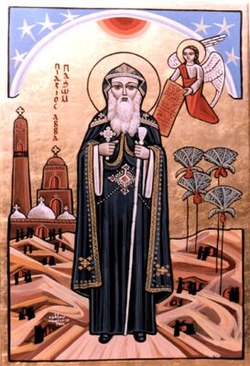
Coptic icon of Pachomius the Great, the founder of Christian cenobitic monasticism

Cenobitic (or coenobitic) monasticism is a monastic tradition that stresses community life. Often in the West the community belongs to a religious order, and the life of the cenobitic monk is regulated by a religious rule, a collection of precepts. The older style of monasticism, to live as a hermit, is called eremitic. A third form of monasticism, found primarily in Eastern Christianity, is the skete.[1]: 124–125 

The English words cenobite and cenobitic are derived, via Latin, from the Greek words koinos (κοινός, lit.'common'), and bios (βίος, lit.'life'). The adjective can also be cenobiac (κοινοβιακός, koinoviakos) or cœnobitic (obsolete). A group of monks living in community is often referred to as a cenobium (Latin, from Greek koinobion). Cenobitic monasticism appears in several religious traditions, though most commonly in Buddhism and Christianity.

Origins

[edit]

The word cenobites was initially applied to the followers of Pythagoras in Crotone, Italy, who founded a commune not just for philosophical study but also for the "amicable sharing of worldly goods."[2]

Judaic monasticism

[edit]

In the 1st century AD, Philo of Alexandria (c. 25 BC – c. 50 AD) describes a Jewish ascetic community of men and women on the shores of Lake Mareotis in the vicinity of Alexandria, Egypt which he calls the Therapeutae.[3] Members of the community lived apart from one another during six days of the week, studying the Hebrew Bible during the daytime and eating during the evening, whereafter on the Sabbath they hoped to dream visions informed by their studies. Members of the community composed books of midrash, an allegorical method of interpreting scripture. Only on the Sabbath would the Therapeutae meet, share their learning, eat a common, albeit simple, meal of bread and spring water, and listen to a lecture on the Torah given by one of the venerable members of the community. Every seventh Sabbath, or High Sabbath, was accorded a festival of learning and singing, which climaxed in an egalitarian dance.

The 3rd-century Christian writer Eusebius of Caesarea (c. 263–339), in his Ecclesiastical History, identified Philo's Therapeutae as the first Christian monks, identifying their renunciation of property, chastity, fasting, and solitary lives with the cenobitic ideal of the Christian monks.[4]

Christian monasticism

[edit]

The organized version of Christian cenobitic monasticism is commonly thought to have started in Egypt in the 4th century AD. Christian monks of previous centuries were usually hermits, especially in the Middle East; this continued to be very common until the decline of Aramean Christianity in the Late Middle Ages. This form of solitary living, however, did not suit everyone. Some monks found the eremitic style to be too lonely and difficult; and if one was not spiritually prepared, the life could lead to mental breakdowns.[5]: 7 

For this reason, organized monastic communities were established so that monks could have more support in their spiritual struggle. While eremitic monks did have an element of socializing, since they would meet once a week to pray together, cenobitic monks came together for common prayer on a more regular basis.[6] The cenobitic monks also practised more socializing because the monasteries where they lived were often located in or near inhabited villages. For example, the Bohairic version of Dionysius Exiguus' The Life of Saint Pachomius states that the monks of the monastery of Tabenna built a church for the villagers of the nearby town of the same name even "before they constructed one for themselves."[7] This means that cenobitic monks did find themselves in contact with other people, including lay people, whereas the eremitic monks tried to keep to themselves, only meeting for prayer occasionally.

Saint Pachomius

[edit]

Cenobitic monks were also different from their eremitic predecessors and counterparts in their living arrangements. Whereas eremitic monks (hermits) lived alone in a monastery consisting of merely a hut or cave (cell), cenobitic monks lived together in monasteries comprising one or a complex of several buildings. In the latter case, each dwelling would house about twenty monks, and within the house there were separate rooms or cells that would be inhabited by two or three monks.[8] To early generations of historians, the style of housing maintained by cenobitic monks was attributed to the man usually hailed the "father of cenobitic monasticism," Saint Pachomius, who was believed to have found the idea for such quarters during the time he spent in the Roman army, as the style was "reminiscent of army barracks." While this impression may have been to some extent mythologized by the bishop and historian Palladius of Galatia,[9] communal barracks-like desert dwellings known as cenobia came to exist around the early 4th century.[10]: 28 

Though Pachomius is often credited as the "father of cenobitic monasticism," it is more accurate to think of him as the "father of organized cenobitic monasticism", as he was the first monk to take smaller communal groups that often already existed and bring them together into a federation of monasteries.[11] He continued this work until his death in 347 at Pbow, a monastic center that he had founded ten years before.

Palladius' Lausiac History claims that Pachomius was given the idea to start a cenobitic monastery from an angel.[12] Though this is an explanation of his reasoning for initiating the cenobitic tradition, there are sources that indicate there were already other communal monastic groups around at that time and possibly before him. Three of the nine monasteries that joined Pachomius' federation "clearly had an independent origin", meaning he was not the first to have such an idea.[13]

Melitians and Manichaeans

[edit]
The ground plan of the monastery of St. Gall in Switzerland, providing for all of the monks' needs within the monastery walls

Besides the monasteries that joined Pachomius' federation of cenobitic monasteries, there were both Christian and non-Christian cenobitic groups who decided not to join him, such as the Melitians and Manichaeans.[14]

Before Pachomius had begun organizing monastic communities, the Melitians as a group were already recruiting members. They were a heretical Christian sect founded by Melitius of Lycopolis. They "heard of Pachomius' monastic aspirations and tried to recruit him" to join their community.[15]: 118 

Some scholars believe the Manichaeans, founded by Mani, were the "pioneers of communal asceticism in Egypt,"[16] rather than Pachomius. Mani himself was influenced to begin cenobitic monasticism from other groups, including Buddhists and Jewish-Christian Elkasites.[16]

Later cenobitic communities

[edit]

The cenobitic monastic idea did not end with these early groups, and inspired future groups and individuals:

In both the East and the West, cenobiticism established itself as the primary form of monasticism, with many foundations being richly endowed by rulers and nobles. The excessive acquisition of wealth and property led to several attempts at reform, such as Bernard of Clairvaux in the West and Nilus of Sora in the East.

See also

[edit]

Notes

[edit]

References

[edit]
[edit]
Revisions and contributorsEdit on WikipediaRead on Wikipedia
from Grokipedia
Cenobitic monasticism, also known as coenobitic monasticism, is a form of religious life in which monks or nuns live together in a under a common rule, emphasizing shared prayer, labor, and discipline as a path to spiritual perfection, in contrast to the solitary eremitic tradition of hermits. This communal approach originated in during the early CE, pioneered by Saint Pachomius (c. 292–346 CE), who established the first organized at Tabennisi around 320 CE, drawing on his experiences as a former Roman soldier to create structured communities for ascetics. The tradition rapidly expanded in the , with (c. 330–379 CE) adapting Pachomius's model through his Ascetica (c. 370 CE), which stressed communal support, obedience to superiors, and active charity, influencing Byzantine monasticism. In the West, the practice was formalized by Saint Benedict of Nursia (c. 480–547 CE), whose (c. 530 CE), written for his monastery at , balanced prayer, manual labor, and reading while requiring vows of stability, obedience, and conversion of life, becoming the foundational text for Western monastic orders. Central to cenobitic life are daily routines of the , with eight communal prayer services, alongside work in , copying manuscripts, or to promote self-sufficiency and . These communities profoundly shaped medieval Europe by preserving classical knowledge, fostering education, and providing social services, while later evolving into influential orders like the and .

Definition and Principles

Etymology and Definition

The term cenobitic derives from koinobios (κοινόβιος), meaning "common life," a compound of koinos (κοινός, "common") and bios (βίος, "life"). This linguistic root reflects the emphasis on shared existence in a structured religious setting, and the term was employed by Saint John Cassian in the to characterize the communal monastic practices he documented from Egyptian traditions. Cenobitic monasticism constitutes a monastic tradition wherein monks or nuns reside in organized communities governed by a common rule, prioritizing collective prayer, manual labor, and ascetic discipline as integral to spiritual formation. This approach stands in contrast to eremitic monasticism, which involves solitary withdrawal. The practice first appeared in 4th-century Egypt, marking the initial organized expression of Christian monasticism through communal structures that balanced individual devotion with group accountability. By the , cenobitic monasticism had solidified as the prevailing model across Christian regions, influencing institutional development in both Eastern and Western churches through its adaptable framework for sustainable religious life.

Core Principles

Cenobitic monasticism is defined by its emphasis on communal ownership of property, where all resources are held in common to cultivate and equality among the members, prohibiting personal possessions beyond basic necessities. This practice draws from scriptural models of unity, ensuring that no accumulates private goods and that all contribute to and benefit from shared provisions. Shared meals, taken together in silence under supervision, further reinforce these values by promoting discipline and mutual dependence, with portions distributed equally regardless of status. Collective labor, assigned based on individual abilities and rotated among trades such as or farming, sustains the community's self-sufficiency while embodying equality through shared toil and service to one another. Obedience to an abbot or superior stands as a foundational principle, requiring monks to submit their will in all matters to foster spiritual discipline and communal harmony, as outlined in governing rules like the Pachomian or Basilian. The superior, often elected by senior members, acts as a spiritual guide, directing daily conduct through established norms that prioritize the common good over individual preferences. This obedience extends to hierarchical structures, where juniors defer to elders, imitating Christ's submission and guarding against self-will. Such rules provide comprehensive guidelines for behavior, ensuring accountability and unity within the monastery. The balanced integration of and manual work constitutes a core ascetic practice, structuring the day around fixed communal sessions—such as morning, evening, and nocturnal offices—to fulfill the call to continual while interspersing periods of labor to prevent . , often involving psalmody and hymns, is performed collectively to deepen communal bonds and , with work viewed as a form of that supports the and aids the poor. This ethos maintains physical and spiritual , assigning tasks humbly without regard for personal skill, thereby advancing the pursuit of holiness through both devotion and . Stability demands a lifelong commitment to a single community, anchoring monks in their chosen monastery as a fixed settlement to nurture perseverance and rootedness in vocation, often following a probationary period. Complementing this is the principle of conversion of manners, an ongoing process of moral and spiritual transformation through daily observance of the rule, aimed at purifying the heart and imitating divine virtues. These tenets together sustain the cenobitic discipline, promoting enduring personal renewal within the communal framework.

Historical Origins

Pre-Christian Precursors

Cenobitic monasticism, characterized by communal ascetic living under a shared rule, drew from earlier non-Christian traditions that emphasized collective discipline, renunciation, and spiritual pursuit. One of the earliest examples emerged in the founded by in Croton, , around 530 BCE. These groups operated as philosophical and religious societies where members renounced , pooling resources for communal use, and adhered to a strict vegetarian diet to avoid harming living souls, reflecting a belief in the transmigration of souls. Daily life involved rigorous intellectual study of , , and cosmology, alongside rituals that fostered equality and moral purity among men and women participants. In the Hellenistic Jewish context, the , described by of Alexandria around 20 BCE in his De Vita Contemplativa, formed celibate communities near Lake Mareotis in . These ascetics lived in individual cells within a larger settlement, dedicating themselves to allegorical interpretation of Jewish scriptures through contemplative study, while alternating manual labor—such as weaving or farming—with periods of prayer and hymn-singing to maintain self-sufficiency. Their communal gatherings, particularly on the , involved shared vegetarian meals and symposia focused on spiritual edification, embodying a balanced rhythm of work, worship, and renunciation that paralleled later monastic ideals. The Essene communities, active from the 2nd century BCE to the 1st century CE and associated with the settlement near the Dead Sea, provide another key precursor through practices documented in ancient sources and the Dead Sea Scrolls. As described by and , Essenes practiced communal ownership of property, with new members surrendering possessions to the group upon joining, and emphasized ritual purity through frequent ablutions, celibacy for many, and strict observance of the Mosaic Law. The Community Rule scroll outlines their collective life, including shared meals, democratic decision-making by priests and elders, and a focus on eschatological study and ethical discipline, all within isolated enclaves that rejected Temple corruption in .

Emergence in Early Christianity

Cenobitic monasticism emerged in during the CE, as Christian ascetics sought refuge from intensifying Roman persecutions, such as those under emperors (249–251 CE) and Valerian (253–260 CE), which drove many believers into the desert fringes for survival and spiritual discipline. Early communal groups began forming around eremitic anchorites, including Saint Anthony the Great (c. 251–356 CE), whose solitary life in the Eastern Desert inspired disciples to gather nearby, blending isolation with mutual support amid ongoing threats to Christian practice. These loose associations marked an initial shift from pure hermitage, fostering shared ascetic routines like and manual labor while evading imperial scrutiny. By the early , this eremitic model transitioned into more structured cenobitic communities along the Valley, where the fertile yet peripheral lands provided both seclusion and accessibility. The founding of Tabennisi around 320 CE served as an early experimental hub for communal living, organizing monks into coordinated households focused on collective worship, work, and obedience, distinct from scattered hermitages. The Egyptian Valley and adjacent deserts acted as the cradle for these developments, enabling ascetics to cultivate a rigorous spiritual life while remaining connected to broader . These nascent communities interacted closely with local villages, integrating monastic ideals into rural life through economic exchanges and shared religious spaces; for instance, early Pachomian settlements constructed basilicas that accommodated not only monks but also lay villagers for liturgy and festivals, reinforcing Christianity's communal fabric. Structures drew inspiration from Roman military organization, adapting hierarchical ranks, disciplined labor divisions, and command obedience—familiar to former soldiers among the monks—to prefigure formalized rules, such as assigning tasks in regimented groups and enforcing superior authority for spiritual formation. This military-influenced framework ensured order and scalability, laying groundwork for enduring cenobitic institutions.

Key Figures and Foundations

Saint Pachomius

Saint Pachomius was born around 292 CE in to pagan parents and received a in his youth. Conscripted into the as a young man, he encountered Christian hospitality during his service, leading to his around 312 CE; he was subsequently baptized in the village of Sheneset. After his discharge, Pachomius spent several years as a disciple of the hermit Palamon, practicing in the near Chenoboskion. Around 320 CE, inspired by a vision, Pachomius founded the first cenobitic monastery at Tabennisi on the River, marking the organized beginning of communal monastic life in . He claimed that an angel appeared to him in the guise of a , instructing him on the structure and discipline of the community, which emphasized mutual service, shared property, and scriptural obedience. Under his leadership, the movement expanded rapidly into a federation of monasteries; by the time of his death, it encompassed nine male monasteries and two convents, housing approximately 5,000 and nuns across sites like Pbow, with innovations such as barracks-style housing for collective living and dedicated guest houses for visitors. His sister Mary established the women's communities, adapting the same rule under Pachomius's guidance. The Pachomian Rule, composed in Coptic around 340 CE, formed the cornerstone of this system, mandating silence during certain hours to foster , manual labor such as and farming to sustain the , communal meals taken together after , and a dividing into classes like juniors (novices) and seniors (experienced members) for orderly instruction and oversight. Pachomius died around 348 CE from a plague that afflicted the monasteries, having appointed successors to maintain the federation's unity.

Basil of Caesarea and Eastern Rules

, born around 330 CE in Caesarea of to a prominent Christian family known for its wealth and piety, received an extensive education in classical studies before embarking on travels that shaped his monastic vision. Influenced by his visits to Egyptian monastic communities in 357–358 CE, where he encountered the cenobitic practices of figures like Pachomius, Basil returned to and founded the first organized monasteries in Pontus around 358 CE, establishing communities that emphasized communal living over solitary eremitism. These foundations, including the notable monastery at Annesi on the Iris River, served as models for his later writings and marked a pivotal adaptation of Eastern monasticism to the needs of the Cappadocian region. Basil's monastic legislation culminated in the Basilian Rule, comprising the Longer Rules (55 questions and answers) and the Shorter Rules (313 responses), composed around 370 CE during his tenure as bishop of Caesarea. Unlike earlier models focused on rigorous ascetic isolation, these rules prioritized charity as a core , mandating that monks engage in manual labor not only for self-sufficiency but to support the needy through organized almsgiving, as outlined in Longer Rule 37: "The work of our hands... is for the relief of the needy." held a central place, with novices required to memorize Scripture and pursue intellectual formation to deepen theological understanding, reflecting Basil's view of monastic life as a for (Shorter Rule 95). Community service extended beyond the monastery walls, urging monks to provide , such as tending to the sick and evangelizing, while the organization of life in asketaria—supervised houses with superiors—ensured structured , work, and for guests, as prescribed in Longer Rule 20. This framework, drawn from scriptural , fostered a balanced cenobitic existence that integrated contemplation with active benevolence. Building briefly on Pachomian precedents of communal discipline, Basil's rules diverged by placing greater emphasis on intellectual pursuits, such as scriptural study and rhetorical , and to the broader church and society, adapting model to a more engaged Eastern context. The Basilian Rule rapidly gained traction across the Eastern Church, becoming the foundational norm for cenobitic communities by the late fourth century. In , it influenced monastic practices, notably through , who, according to tradition, visited Basil in Caesarea around 370 CE, was ordained a by him, and incorporated elements of communal into his own writings and Edessan communities, bridging Cappadocian and Syriac traditions. Armenian monasticism adopted the rule from the late fourth century onward, integrating it with local customs like extended novitiates of eight years and allowing married abbots, which facilitated the growth of monasteries that often housed bishops and supported ecclesiastical leadership. By the medieval period, the rule's influence extended to Slavic Orthodox regions, shaping institutions such as the Kievan Cave (founded 1051 CE), where Basilian principles of communal prayer and service informed the development of Russian and Ukrainian monastic networks. This widespread adoption underscored the rule's adaptability, promoting a cenobitic that balanced interior with external mission throughout the Byzantine and post-Byzantine East.

Variations and Sects

Melitian Communities

The Melitian schism emerged around 306 CE in , led by Melitius, of Lycopolis, who challenged the policies of Peter, of , regarding the readmission of Christians who had lapsed during the (303–312 CE). Melitius advocated a stricter approach, insisting on perpetual or severe for those who had sacrificed to Roman idols or obtained libelli (certificates of compliance), rather than the more lenient reintegration favored by the Alexandrian church. This dispute escalated when Melitius began ordaining in regions under Peter's without authorization, establishing a parallel hierarchy that rejected the authority of the mainstream church. Within this schismatic framework, Melitian communities developed communal ascetic practices that embodied cenobitic monasticism, forming organized groups of in the Egyptian desert who lived together under rigorous discipline. These groups emphasized collective , manual labor, and strict moral codes, often in opposition to what they viewed as the compromising of the Nicene church. Papyrological , such as the of Melitian documents (P.Lond. VI 1913–1922), reveals networks of monasteries where ascetics maintained a separate structure, ordaining their own leaders and conducting liturgies independently. This rigorist distinguished Melitian cenobitism, prioritizing unyielding adherence to pre-persecution standards over with the broader Christian establishment. Key Melitian monastic sites were concentrated in the Lycopolis (modern ) region of , with additional communities documented in through papyri attesting to their operations in desert settlements like the Fayum and near the . Despite condemnation at the Council of Nicaea in 325 CE, where the council subordinated Melitian clergy to the bishop of and prohibited further unauthorized ordinations, these communities persisted into the fifth century and beyond, sustaining their schismatic identity through isolated monastic enclaves. The Melitian communities influenced early Christian by modeling a form of strict communal life detached from institutional church control, inspiring later rigorist groups that valued and disciplinary purity over ecumenical unity. Their emphasis on desert-based coenobitic organization prefigured elements of independent monastic traditions, though their schismatic stance limited broader integration.

Manichaean Cenobites

, founded by the prophet Mani (c. 216–276 CE) in the of Persia, emerged as a syncretic religion that integrated elements from , , and into a dualistic cosmology emphasizing the struggle between light and darkness. Mani, who claimed from figures like , , and , structured his followers into two classes: the , celibate ascetics dedicated to spiritual perfection, and the Hearers, lay adherents who supported the Elect materially while adhering to less stringent rules. This division mirrored ascetic hierarchies in precursor traditions, positioning the Elect as the vanguard in liberating particles trapped in the material world. In the 3rd and 4th centuries CE, Manichaean —comprising both and —formed communal groups in dedicated houses across the and Sasanian Persia, fostering a cenobitic-like existence amid their primarily itinerant lifestyle. These communities emphasized strict to avoid consuming animal flesh, believed to contain ensnared light substances, alongside cycles of conducted four times daily for Hearers and seven for Elect, often involving prostrations and hymns directed toward cosmic entities of light. Missionary travel was central, with Elect traversing regions from to to propagate Mani's teachings, relying on Hearers for sustenance during journeys that combined with ascetic discipline. Manichaean cenobitic practices drew influences from the communal structures of , encountered during Mani's reported travels to , and from the ascetic communalism of the Elkasaites, a Jewish-Christian to which Mani's parents belonged. These borrowings shaped the Elect's organized, non-propertied life, distinct yet parallel to emerging . By the late 4th century, however, faced condemnation as a ; imperial edicts under in 381 CE and subsequent laws prohibited its practices, labeling adherents as state enemies. (Note: While the Council of primarily addressed , contemporaneous edicts targeted Manichaeans.) The religion's cenobitic elements declined sharply by the CE in the Roman sphere due to relentless persecutions by both Christian and Zoroastrian authorities, though pockets persisted in the East until the 14th century. Indirectly, shared ascetic motifs, such as communal poverty and ritual purity, may have influenced early Christian monastic rules, as evidenced in debates among patristic writers confronting Manichaean appeals.

Evolution and Spread

Eastern Orthodox Developments

In the 5th to 7th centuries, cenobitic monasticism in the Eastern Orthodox tradition expanded significantly through influential institutions like the Studion Monastery in , founded around 462 CE by the Roman patrician Studius. This monastery became a model for communal life, blending the foundational cenobitic rule of with Palestinian liturgical practices and emphasizing rigorous observance of the divine office, manual labor, and the copying of sacred manuscripts. Its , or monastic rule, prioritized liturgical prayer and intellectual pursuits, influencing Byzantine monastic discipline across the empire. During the Iconoclastic Controversy of the 8th and 9th centuries, Eastern Orthodox monks, particularly those at Studion under abbots like , emerged as staunch defenders of , enduring persecution and exile for upholding Orthodox doctrine against imperial decrees. This resistance preserved and revitalized cenobitic communities, paving the way for new foundations such as , established around 963 CE by Saint Athanasius of Athos with imperial support from Emperor Nicephorus II Phocas. developed as a semi-autonomous federation of monasteries, combining strict cenobitic structures with idiorrhythmic elements that allowed monks greater personal discretion in ascetic practices while maintaining communal oversight. From the onward, cenobitic monasticism spread to Slavic lands through the adoption of Basilian models in regions like Kievan Rus', where monasteries such as the Kiev Pechersk Lavra emulated Byzantine communal rules emphasizing obedience, prayer, and labor. This transmission was facilitated by Greek missionaries and metropolitan bishops who introduced typika and organizational principles from . By the , hesychast spirituality—centered on inner stillness, the , and unceasing prayer—profoundly shaped Slavic Orthodox monasticism, with figures like Saint influencing Athonite and Russian communities to integrate contemplative practices into cenobitic routines. In the late 15th and early 16th centuries, reforms within Russian Orthodox monasticism highlighted tensions over communal property, with Nilus of Sora (d. 1508) advocating a return to non-possessive in sketes—small, semi-eremitic communities attached to larger monasteries. Drawing from hesychast ideals and Athonite influences, Nilus emphasized voluntary poverty, manual labor for sustenance, and rejection of land ownership to preserve spiritual purity, sparking the "Non-Possessors" movement against wealthier, land-holding cenobitic houses. His writings, including the Ustav (Rule), promoted a balanced cenobitic life focused on inner vigil and scriptural study over material accumulation.

Western Christian Adaptations

In the sixth century, (c. 480–547 CE) played a pivotal role in adapting cenobitic monasticism to the Latin West by synthesizing elements from Eastern monastic traditions, including the rules of Pachomius and , into his own Rule of St. Benedict. This document emphasized communal living, humility, obedience, and a balanced life of prayer, reading, and manual labor, encapsulated in the principle of (pray and work). Benedict founded the monastery at in 529 CE, which became a model for Western cenobitism by integrating spiritual discipline with practical self-sufficiency, thereby ensuring the survival and growth of monastic communities amid the instability of . During the Carolingian era of the eighth and ninth centuries, imperial reforms under and his successors standardized Benedictine observance across Europe, transforming monasticism into a unified institution supportive of the Frankish empire's cultural and religious agenda. Key figures like Benedict of Aniane promoted the Rule of St. Benedict as the normative guide, leading to synods and capitularies that mandated its adoption in monasteries from to the . This standardization not only centralized monastic practices but also elevated abbeys as bulwarks of Carolingian renewal, fostering literacy and administrative efficiency in a fragmented post-Roman world. The tenth and eleventh centuries saw further adaptations through the Cluniac reform, initiated with the founding of in 910 CE by , which centralized authority under a powerful overseeing a network of dependent houses. Cluny's emphasis on liturgical splendor, strict observance, and exemption from local episcopal control revitalized Benedictine life, spreading to over a thousand monasteries and influencing papal reforms. In response to perceived Cluniac excesses, the Cistercian reform emerged in 1098 CE at , founded by , prioritizing simplicity, poverty, and rigorous manual labor as a return to primitive Benedictinism. Cistercians like expanded this model, establishing self-sustaining communities that rejected ornate architecture and focused on agricultural innovation. Western cenobitic monasteries profoundly shaped medieval society as centers of , introducing advanced techniques like and water management that boosted food production and . They also served as primary loci for , training scribes and scholars in the liberal arts within scriptoria that preserved classical and patristic texts through meticulous copying. This manuscript preservation safeguarded knowledge during the , enabling the transmission of Greco-Roman heritage to the .

Aspects of Cenobitic Life

Daily Routine and Organization

Cenobitic monasticism features a structured hierarchy led by an abbot, who serves as the spiritual and administrative head of the community. The abbot is typically elected for life by the professed monks through a process requiring a majority or unanimous vote, often confirmed by a bishop or higher ecclesiastical authority to ensure suitability based on wisdom and moral character. Assisting the abbot are priors, who oversee specific duties or sections of the monastery and are appointed by the abbot, and deans, selected from the community for their exemplary conduct to supervise groups of ten monks each, promoting accountability and preventing division. Novices undergo a probationary period of at least one year under the guidance of a senior monk before making solemn vows of obedience, stability, and conversion of life, integrating them into the community's order. This hierarchical system emphasizes obedience to foster unity and discipline, with the abbot acting as a paternal figure accountable ultimately to God. The daily routine in cenobitic communities revolves around the , a cycle of seven or eight prayer services that structure the day from to evening, balancing communal worship, manual labor, and rest. In Eastern Orthodox traditions, the outlines services such as at or dawn, followed by the hours (prime, , , none), in the evening, and before sleep, with all gathering in the church for these offices. Western Benedictine schedules, as detailed in the Rule of St. Benedict, similarly begin with vigils or around 2:30-3:30 a.m. in winter, progressing through at dawn, the daytime hours, at sunset, and , adjusting for seasons and feast days to ensure about eight hours of prayer daily. Interspersed are periods of labor, typically four to six hours of farming, crafting, or maintenance to maintain self-sufficiency and combat —"" (pray and work)—with reading or study filling other times. Meals occur communally once or twice daily, often one main meal after or none consisting of simple fare like , , and limited wine, eaten in with scriptural reading to encourage reflection. Communal facilities support this ordered life, with shared spaces enforcing collective discipline. Monks sleep in a single dormitory with individual beds or pallets, observed by a senior to maintain propriety, and rise promptly for night prayer. The refectory serves as the dining hall where meals are taken silently, presided over by a reader intoning sacred texts, while the chapter house hosts daily meetings for readings from the rule, confessions of faults, and assignments. Rules of silence prevail outside prayer and necessary speech, extending from compline until prime to cultivate inner stillness, with gestures or signs used for communication. Discipline involves regular confession of thoughts and deeds to the abbot or spiritual elder for fraternal correction, escalating to public admonition or corporal punishment like flagellation for persistent infractions such as disobedience or impurity, aiming at repentance rather than mere penalty. Gender aspects in cenobitic monasticism maintain separation between men's and women's communities to uphold , with parallel structures mirroring hierarchies—abbesses leading convents elected similarly by professed . These houses often operate under ecclesiastical oversight, such as by a nearby or , for protection and guidance, though they follow adapted rules like those of St. Benedict for independent governance. Early double monasteries, combining both genders under joint , gave way to fully segregated communities by the medieval period to avoid .

Theological Underpinnings

Cenobitic monasticism finds its primary biblical foundation in passages that highlight communal sharing, voluntary poverty, and fraternal unity as essential to . Acts 4:32 describes the early believers as having "one heart and one soul," with no one claiming private ownership of possessions, but rather holding everything in common, which early like Augustine interpreted as the ideal model for cenobitic communities where shared goods symbolized spiritual unity and apostolic witness. Similarly, Matthew 19:21, where instructs the rich young man, "If you would be perfect, go, sell what you possess and give to the poor, and you will have treasure in heaven," provided scriptural warrant for the radical dispossession practiced in cenobitic houses, extending the eremitic call to poverty into a collective discipline that fostered detachment from worldly attachments. :1, proclaiming "Behold, how good and pleasant it is when brothers dwell in unity," further underscored the theological value of communal harmony, serving as a foundational text for monastic rules that emphasized brotherly love as a foretaste of divine fellowship. Patristic theologians deepened these biblical roots by articulating how cenobitic life facilitated spiritual progress through mutual support. Evagrius Ponticus (c. 345–399), though primarily associated with solitary asceticism, influenced communal practices by conceptualizing apatheia—freedom from disturbing passions—as achievable in a shared environment where monks could mutually guard against temptations, promoting collective purity of heart as a step toward contemplative prayer. John Cassian (c. 360–435), in his Conferences, portrayed cenobitic monasticism as a safer pathway to salvation than eremitism, arguing that the structured obedience and communal accountability in coenobia prevented the isolation-induced errors that often ensnared solitaries, allowing beginners to mortify desires under guidance before advancing to higher solitude. Cassian stressed that this communal framework aligned with evangelical perfection, enabling monks to crucify self-will progressively while benefiting from the elder brothers' wisdom. Doctrinally, cenobitic monasticism functioned as an eschatological witness, embodying the anticipated kingdom through its ordered common life that mirrored the unity of the age to come. This form of monasticism incarnated , Christ's self-emptying (Philippians 2:7), as monks renounced personal possessions and autonomy in community, enacting humility and service as pathways to mutual edification. Within this setting, theosis—divinization or participation in God's life—unfolded not in isolation but through shared and labor, where the collective pursuit of virtue elevated individuals toward union with the divine, reflecting the Trinitarian communion in human relations. In terms of ecclesial integration, cenobites served as leaven within the broader Church, permeating the world with contemplative depth while engaging in active charity, thus balancing ora et labora (prayer and work) to renew Christian society. (c. 330–379) envisioned monastic communities as integral to the Church's mission, providing that influenced and alike, ensuring that ascetic ideals leavened the dough of everyday ecclesial life without withdrawing entirely from it. This role positioned cenobitic houses as vital centers for evangelization and social service, embodying the Church's call to holiness in community rather than mere seclusion.

Later Developments

Medieval and Reformation Eras

During the High Middle Ages, from the 11th to 13th centuries, cenobitic monasticism evolved with the emergence of mendicant orders, such as the Franciscans and Dominicans, which incorporated semi-cenobitic structures in their friaries while emphasizing itinerant preaching and poverty. These orders maintained communal living in urban houses, where friars shared meals, prayer, and resources, adapting traditional cenobitism to active ministry amid growing cities and universities. Similarly, military orders like the Knights Templar adopted cenobitic practices, taking vows of poverty, chastity, and obedience in communal preceptories that blended monastic discipline with martial duties to protect pilgrims. In the , reforms revitalized cenobitic communities, particularly through (1090–1153), who as abbot of expanded the Cistercian order by founding over 160 daughter houses emphasizing manual labor, simplicity, and strict adherence to the Rule of St. Benedict. Bernard's influence promoted austerity and spiritual renewal, countering earlier Benedictine laxity. However, by the mid-12th century, some Cistercian abbeys accumulated significant wealth through land grants and wool production, prompting critiques from figures like Julian of Vézelay, who argued that such prosperity contradicted monastic ideals of detachment and led to worldly corruption. The 16th-century Reformation posed severe challenges to cenobitic monasticism, culminating in the dissolution of monasteries in between 1536 and 1541 under , which suppressed over 800 houses, confiscated their assets for the crown, and dispersed communities, effectively dismantling much of 's cenobitic network. , led by , rejected monastic vows as unbiblical impositions that hindered faith alone and promoted over , viewing cenobitism as a medieval distortion of Christian vocation. In response, the at the (1545–1563) reaffirmed the validity of religious orders and cenobitic vows in its 23rd session, decreeing reforms to enforce discipline, limit commendatory abbots, and ensure regular observance while upholding poverty, chastity, and obedience as . New orders like the , founded in 1540, introduced modified communal life, with members living in professed houses under vows but prioritizing apostolic missions over cloistered stability, allowing greater mobility for and evangelization.

Modern Cenobitic Communities

The revival of cenobitic monasticism in the 19th and 20th centuries included significant efforts within Benedictine traditions, such as the Solesmes Congregation, founded by Dom in the 1830s to resurrect Benedictine life following the French Revolution's disruptions. This community, based at in , prioritized the restoration of , developing a scholarly approach to its authentic performance that influenced global liturgical practices. Another notable 20th-century example is the , established in 1940 by Schütz in southeastern as an ecumenical monastic response to II's divisions. Taizé's cenobitic model emphasizes communal , simplicity, and reconciliation among Catholic, Protestant, and Orthodox , attracting thousands of young pilgrims annually for shared worship. In Eastern Orthodox contexts, cenobitic communities have persisted and revived amid political upheavals. , the autonomous monastic republic in , continues to host 20 active monasteries as of 2025, maintaining strict communal disciplines under the Ecumenical Patriarchate's jurisdiction. These include 17 Greek, one Serbian, one Bulgarian, and one Russian foundation, where monks engage in , , and manual labor while limiting access to preserve spiritual focus. Post-Soviet Russia saw a resurgence, exemplified by on , returned to the in 1989 after decades of closure; the first monks arrived that year from Moscow's , rebuilding the site into a thriving cenobitic center with over 200 inhabitants by the 21st century. Western and global expansions have diversified cenobitic life, particularly through Trappist (Cistercian Strict Observance) foundations. From one Trappist monastery in in the 1940s, the order grew to around 20 by 2025, with establishments like Our Lady of Victoria in (originally founded in in 1952) and others in and emphasizing self-sufficiency and hospitality. In , foundations include the Monastery of Gedono in (1987) and a new site in (initiated 2022), adapting to local cultures while upholding contemplative communal routines. The ecumenical Monastic Community of Bose in , founded in 1965 by Enzo Bianchi, integrates men and women from various Christian denominations in shared prayer and study, serving as a model for inclusive cenobitic living. Adaptations for lay involvement, such as guest programs at Taizé and Bose, allow non-monastics to participate in communal rhythms, fostering broader spiritual engagement. Contemporary cenobitic communities face secularism's decline in religious vocations and societal marginalization, prompting innovations like Taizé's youth-focused gatherings to renew interest in communal faith. Ecumenical dialogues, as practiced at Bose and Taizé, counter fragmentation by promoting Christian unity amid pluralism, with Bose hosting inter-church reflections on shared obedience. Sustainability efforts as of 2025 include initiatives in and in African foundations, aligning monastic self-reliance with . monasteries have introduced pilgrim limits starting 2025 to balance hospitality with ecological preservation of the peninsula.

References

Add your contribution
Related Hubs
User Avatar
No comments yet.