Hubbry Logo
Nernst lampNernst lampMain
Open search
Nernst lamp
Community hub
Nernst lamp
logo
8 pages, 0 posts
0 subscribers
Be the first to start a discussion here.
Nernst lamp
Nernst lamp
from Wikipedia
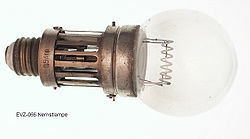
Nernst lamp, complete, model B with cloche, DC-lamp 0.5 ampere, 95 volts
A Nernst lamp diagram from 1903. The light-emitting ceramic filament is called a "glower"

The Nernst lamp was an early form of incandescent lamp.

Construction

[edit]

Nernst lamps did not use a glowing tungsten filament. Instead, they used a ceramic rod that was heated to incandescence. Because the rod (unlike tungsten wire) would not further oxidize when exposed to air, there was no need to enclose it within a vacuum or noble gas environment; the burners in Nernst lamps could operate exposed to the air and were only enclosed in glass to isolate the hot incandescent emitter from its environment. A ceramic of zirconium oxide – yttrium oxide was used as the glowing rod.[1]

Efficiency

[edit]

Developed by the German physicist and chemist Walther Nernst in 1897 at the University of Göttingen, these lamps were about twice as efficient as carbon-filament lamps and emitted a more "natural" light (more similar in spectrum to daylight). The lamps were quite successfully marketed for a time, although they eventually lost out to the more efficient tungsten-filament incandescent light bulb. One disadvantage of the Nernst design was that the ceramic rod was not electrically conductive at room temperature, so the lamps needed a separate heater filament to heat the ceramic sufficiently to begin conducting electricity.

Manufacturing

[edit]

In the U.S., Nernst sold the patent to George Westinghouse, who founded the Nernst Lamp Company at Pittsburgh in 1901. Minerals for the production of the glowers were extracted from the company's own mines at the legendary Barringer Hill, Texas (since 1937 submerged beneath the waters of Lake Buchanan). By 1904 a total of over 130,000 Nernst lamps had been placed in service throughout the country.

In Europe, the lamps were produced by the German Allgemeine Elektrizitäts-Gesellschaft (AEG, General Electricity Company) at Berlin. At the 1900 World's Fair held in Paris, the pavilion of the AEG was illuminated by 800 Nernst lamps, which was said to be quite spectacular at the time.

Scientific use

[edit]

In addition to their usage for ordinary electric illumination, Nernst lamps were used in one of the first practical long-distance photoelectric facsimile (fax) systems, designed by professor Arthur Korn in 1902, and in Allvar Gullstrand's original slit lamp (1911) which is used for ophthalmology to allow physicians to view the inside of a patient's eye and contributed to Gullstrand's Nobel Prize award.[2]

Even after Nernst lamps became obsolete as visible light lamps, "Nernst glowers" continue to be used as the infrared-emitting source used in IR spectroscopy devices. Their emission of infrared makes them inefficient as visible light sources, but perfect for IR spectroscopy applications. [3] Silicon carbide Globars now compete for this purpose as they are conductive even at room temperature and therefore need no preheating.[4]

See also

[edit]

References

[edit]
[edit]
Revisions and contributorsEdit on WikipediaRead on Wikipedia
from Grokipedia
The Nernst lamp, invented by German physicist and chemist in 1897, was an early form of electric incandescent lighting that utilized a "glower" made from rare-earth oxides, such as zirconia mixed with yttria, to produce light through incandescence without requiring a enclosure. Unlike traditional carbon-filament incandescent bulbs, the Nernst lamp's glower was non-conductive at and required an initial preheat—often via a small , platinum coil, or auxiliary heater—to reach conductivity, after which sustained the high temperature (around 3000 K) for efficient light emission in open air, as the material resisted oxidation. Developed amid the late 19th-century race for practical electric illumination, the Nernst lamp offered key advantages over Edison's vacuum-sealed carbon lamps, including longer operational life (450–1200 hours), higher luminous efficiency (6–9 lumens per watt), and a pure white light with excellent color rendering (CRI of 100), making it suitable for applications like theaters, projectors, and early . Commercial production began around 1900, with Nernst licensing the technology to companies such as the Allgemeine Elektricitäts-Gesellschaft in and Westinghouse Electric in the United States, where engineers like A.J. Wurts refined it for market viability over three to four years of development. Despite initial success—peaking in use from 1900 to 1913 and influencing innovations like General Electric's research efforts—the lamp's need for preheating and maintenance of replaceable glowers proved cumbersome compared to emerging drawn-tungsten filaments, leading to its obsolescence by the 1920s, though specialized versions persisted in until the 1980s.

History

Invention

Walther Nernst, a prominent German and , joined the in 1890 as a in physics, later becoming a full professor of in 1894, where he established the Institute of Physical Chemistry and in 1895. His work focused on , , and the behavior of materials under extreme conditions, building on earlier contributions like the Nernst distribution law formulated in 1890. In 1897, during experiments investigating the electrical conductivity of solid electrolytes at elevated temperatures, Nernst discovered that mixtures of rare-earth oxides, such as yttrium oxide and zirconium oxide, exhibited strong incandescence when sufficiently heated. These observations stemmed from his research into how ionic conduction in solids increased dramatically above certain thresholds, allowing current to flow and generate intense light without combustion. This breakthrough inspired the creation of the first Nernst lamp prototype, featuring a thin rod composed of the mixture that was preheated using a resistance heater to initiate conductivity, thereby avoiding the need for an open flame. Nernst's motivation was to address the limitations of existing carbon-filament incandescent lamps, which were inefficient, prone to rapid deterioration, and produced a harsh, reddish light far from natural daylight. Nernst filed a for the invention in that same year (DRP No. 104872), describing the core principle of electrically heating the non-conductive oxide glower to achieve stable incandescence. Early demonstrations conducted in 1897 and 1898 at scientific gatherings showcased the lamp's superior light quality, emitting a closer to at around 3000 K, marking a significant step forward in electric illumination technology.

Development and commercialization

Following the initial patenting of the Nernst lamp in 1897, key refinements focused on enhancing startup reliability, including the integration of gas flame preheaters such as Bunsen burners to initially heat the glower to its conductive temperature, addressing the device's high cold-state resistance. These modifications, developed in the subsequent year, allowed for more consistent ignition without relying on manual external heating methods that proved impractical for widespread use. In 1898, sold the patent rights to the Allgemeine Elektricitäts-Gesellschaft (AEG) in , establishing a pivotal manufacturing partnership that enabled scaled production. AEG began producing the first commercial models in 1899, introducing variations of the "Nernst glower" designed for different operating voltages, such as 110-volt DC and 220-volt AC configurations, to suit varying electrical systems. By 1900, AEG had ramped up output to approximately 1,000 lamps per day, showcasing them prominently at the Exposition Universelle, where 800 units illuminated the company's . Commercial expansion extended internationally shortly thereafter, with an in announced in February 1899, facilitating sales across . In the United States, acquired rights and founded the Nernst Lamp Company in in 1901, establishing a dedicated and sourcing rare earth minerals from a company-owned mine in ; by 1904, over 130,000 glowers were in service nationwide. AEG ceased production of standard Nernst lamps in 1909 after manufacturing about eight million units, as filaments supplanted the technology. Nernst's work on the lamp contributed to his broader scientific reputation, influencing his receipt of the 1920 for advancements in , though the award was not directly for the lighting invention.

Design and operation

Materials and construction

The core component of the Nernst lamp is the ceramic rod, known as the "glower," which serves as the light-emitting element. This rod is typically formed into a thin, elongated shape with a diameter of 1-2 mm and a length of approximately 20-50 mm, depending on the model. The glower is composed of a mixture of rare-earth oxides, primarily 85% zirconium oxide (ZrO₂) combined with 15% yttrium oxide (Y₂O₃) or other rare-earth oxides such as , neodidymium, , or oxides, which provide the necessary properties for high-temperature operation. The glower is supported by platinum wires or clamps attached to its ends, which connect to electrical leads and provide mechanical stability, especially as the rod softens at operating temperatures. These elements are often mounted on glass stalks or bound to a small for additional structural integrity within the lamp assembly. A preheater mechanism is integrated to initially raise the glower's temperature to 700-800°C, enabling electrical conductivity; early designs employed a , while later variants used a coil or resistance heater. The outer enclosure varies by model: early open-air designs exposed the glower to ambient conditions, capitalizing on the ceramic's resistance to oxidation, whereas later iterations incorporated a glass bulb, sometimes evacuated or filled with to minimize . The assembly process begins with intimately mixing the powdered oxides, adding water and a binder like or dextrine to form a paste, which is then shaped into the rod form—often pressed for tubular variants—before at high temperatures to produce a porous, conductive structure.

Principle of operation

The Nernst lamp's glower, composed of oxide ceramics such as , exhibits extremely high electrical resistivity at , rendering it effectively non-conductive. This behavior arises from the ionic nature of the material, where charge transport depends on the mobility of within the crystal lattice. To initiate operation, the glower must be preheated to approximately 800–950°C using auxiliary heating elements, which activates ionic conduction by providing sufficient thermal energy for . Once preheated, an —typically 0.5–2 A at 50–100 V—flows through the glower, generating that rapidly elevates its temperature to 2000–2500°C. At these elevated temperatures, the ionic conductivity dominates, allowing sustained current passage without metallic electrodes degrading due to oxidation. The resulting incandescence produces light through , following blackbody principles where the peaks in the visible range, yielding a white light output. The lamp's is inherently self-regulating due to the strong dependence of the glower's resistance, which decreases dramatically as rises. This negative coefficient prevents : initial heating reduces resistance, increasing current and further heating until equilibrium is reached, where the power input balances radiative and conductive losses, without requiring external ballasts. The resistance follows an Arrhenius-type relation derived from the of ionic mobility: R(T)R0exp(EakT)R(T) \approx R_0 \exp\left(\frac{E_a}{kT}\right) Here, R0R_0 is a pre-exponential factor incorporating material geometry and intrinsic conductivity, EaE_a is the activation energy for oxygen ion conduction (typically 0.7–1.2 eV for yttria-stabilized zirconia), kk is the Boltzmann constant, and TT is the absolute temperature. This exponential form reflects the thermally activated process, where conduction probability increases with ion hopping over energy barriers, as detailed in studies of zirconia electrolytes.

Performance

Efficiency and output

The Nernst lamp achieved a luminous efficacy of approximately 6-8 lumens per watt (lm/W), which was roughly twice that of contemporary carbon-filament incandescent lamps operating at 2-4 lm/W. This improvement stemmed from the ceramic glower's ability to operate at higher temperatures without rapid degradation, converting a greater proportion of electrical energy into visible light. Typical Nernst lamps consumed 10-50 watts of power, depending on the model and size, and produced 60-400 lumens of light output. For instance, a common 50-watt variant emitted around 400 lumens, providing illumination equivalent to several carbon-filament bulbs while using comparable energy. The spectral output of the Nernst lamp consisted of broad white light approximating at a of about 2200-2500 K, resulting in a more bluish-white appearance than the yellowish glow (around 1800-2000 K) of carbon-filament lamps and enhancing visibility for tasks requiring color discernment. Efficiency was optimal when the glower reached 2000-2200°C, where electrical resistance minimized and radiant output peaked; early designs suffered from higher preheat losses during startup, but later iterations with improved glow starters reduced this time to mere seconds, further boosting overall conversion. can be expressed as η=PvisiblePelectrical×683\eta = \frac{P_{\text{visible}}}{P_{\text{electrical}}} \times 683 lm/W, where PvisibleP_{\text{visible}} is the power emitted in the weighted by the photopic luminosity function, and 683 lm/W is the theoretical maximum for monochromatic green light at 555 nm; the Nernst lamp realized approximately 20-30% of the limit at its operating temperature.

Lifespan and limitations

The Nernst lamp's glower typically exhibited an average lifespan of 450 to 1200 hours, significantly outlasting contemporary carbon-filament incandescent lamps due to the rod's resistance to oxidation and evaporation when operated in air, eliminating the need for a enclosure that contributed to failures in metal-filament designs. Common failure modes included gradual degradation of the glower rod over time, necessitating periodic replacement, as well as occasional issues with the heating coils that initiated operation. The material, while robust against oxidation, was susceptible to physical wear from repeated thermal cycling during startup and shutdown, though specific cracking incidents were mitigated in later designs. Maintenance involved straightforward rod and coil replacements, with manufacturers offering discounts for returned components to encourage . By the early 1900s, including around 1905, improved models incorporated automatic igniters using resistance elements, reducing manual intervention. Operational limitations hindered widespread adoption despite efficiency gains. The glower required preheating to about 700°C (1300°F) for roughly 30 seconds to become conductive, as its room-temperature resistance was too high for flow, often managed via auxiliary heaters or manual methods in early versions. Lamps were also sensitive to voltage fluctuations, with reliable operation typically confined to a narrow range (e.g., at 190 V but extinguishing below 160 V in some tests), necessitating stable supplies and ballasts. Additionally, the higher initial cost compared to simpler carbon lamps arose from complex manufacturing and materials, though renewals proved economical over the lamp's life.

Applications

Scientific and laboratory uses

The Nernst lamp served as a reliable light source in early 20th-century , offering a stable suitable for calibrating optical instruments. In , researcher W.W. Coblentz at the National Bureau of Standards employed the Nernst glower in a spectrometer equipped with a prism and to investigate its across visible and wavelengths, revealing emission bands that intensified with temperature. This work highlighted the lamp's utility in precise spectral analysis, contributing to early understandings of constants. Following its commercial decline, the glower continued as an infrared-emitting source in devices, valued for its high-temperature output up to around 2000°C. Its high brightness and compact design made the Nernst lamp ideal for projection in and early optical projectors, enabling illumination of small fields with minimal distortion. By 1913, integrated Nernst lamps into their microscope setups, as documented in contemporary catalogs, providing a steady, white light superior to carbon filaments for detailed specimen observation. Similarly, in the nascent cinema industry, inventors like adopted the lamp for film projectors around 1900–1910, where its efficiency and natural spectrum supported clear image projection before lamps became standard. In photoelectric telegraphy, the Nernst lamp powered key components of early image transmission systems during the 1900s. Arthur Korn's 1902 Bildtelegraph, the first practical long-distance phototelegraphy setup, utilized the lamp as a light source in both the transmitter scanner and receiver, scanning photographs via selenium cells and transmitting signals over telegraph wires; this system was commercialized through collaboration with Siemens & Halske, enabling transmissions across Europe. The lamp's controllable temperature, achieved through adjustable current after initial ing, positioned it as a precise heat source for chemical experiments. In educational and settings around 1907, it facilitated simple demonstrations and heating tasks, such as in studies of , where its glower maintained consistent incandescence without oxidation.

Commercial and industrial uses

The Nernst lamp saw significant adoption in indoor lighting applications during the early , particularly in theaters, stores, and offices, where its bright, white light approximating daylight and relatively low maintenance requirements made it suitable for high-ceiling environments previously illuminated by carbon arc lamps. These settings benefited from the lamp's ability to provide uniform illumination without the frequent adjustments needed for arc systems, enabling its installation in public spaces across and the around 1900-1910. In industrial contexts, Nernst lamps were employed for large-area in factories and machine shops, where their longevity—typically 450 to 1200 hours—and replaceable glowers offset the higher initial costs compared to carbon filament alternatives. This durability proved advantageous in and workshop environments, reducing downtime for relamping and supporting extended operational hours in facilities. The lamps' , roughly twice that of contemporary carbon bulbs, contributed to lower overall expenses in high-use industrial settings by minimizing and frequency. The Nernst lamp reached its market peak between 1900 and 1910, with total production exceeding eight million units worldwide by 1909, predominantly in where Allgemeine Elektricitäts-Gesellschaft (AEG) manufactured variants compatible with 110-220 volt electrical grids. In the United States, Westinghouse licensed and produced the lamps starting in 1901, achieving sales of over 130,000 units by 1904, reflecting broad commercial uptake before the rise of tungsten-based alternatives.

Legacy

Decline and replacement

The introduction of the tungsten-filament lamp marked the beginning of the Nernst lamp's decline. In 1904, Austrian inventors Sándor Just and Franjo Hanaman received a patent for an incandescent lamp using a drawn filament, which achieved efficiencies of around 8 lumens per watt (lm/W), comparable to or surpassing the Nernst lamp's typical 6–9 lm/W output, while providing instant startup without the need for preheating. commercialized tungsten lamps in 1906, rapidly recapturing market share from the Nernst design due to their superior reliability and ease of use. Advancements in tungsten technology during the 1910s further accelerated the Nernst lamp's obsolescence. William Coolidge's 1910 process for producing ductile wire eliminated the brittleness of earlier filaments, while Irving Langmuir's innovations at GE, including gas-filled bulbs patented in 1916, reduced evaporation and extended lifespan to 1,000 hours or more, compared to the Nernst glower's 450–1,200 hours. These improvements made tungsten lamps less thermally fragile and more cost-effective over time, as production scaled and prices fell. Nernst lamp production peaked between 1905 and 1910, with major manufacturers like AEG in producing around 8 million units overall, but output ceased by 1909 for standard models as tungsten alternatives dominated. In the United States, the Nernst Lamp Company operated until about 1915, after which sales plummeted, driven by patent expirations around 1914 that intensified competition and the post-World War I shift toward simpler, more efficient designs amid energy constraints. Specialized versions of the Nernst glower persisted in niche applications, such as laboratory , until the 1980s, but the technology was fully displaced by incandescents for general use.

Modern relevance

The Nernst lamp's technological legacy endures through its pioneering use of (YSZ) as a high-temperature ionic conductor, which directly influenced the development of solid oxide fuel cells (SOFCs). In 1897, employed yttrium-doped zirconia in the lamp's glower for its oxygen ion conductivity at elevated temperatures, a property later explained by Carl Wagner in 1943 and now central to YSZ electrolytes in SOFCs, enabling efficient electrochemical energy conversion above 800°C. This material innovation also inspired advancements in ceramic-based lighting, serving as a precursor to gas discharge lamps and indirectly shaping research by figures like , who studied under Nernst and optimized filaments at . Restored Nernst lamps hold significant collectibility value today, with examples preserved in institutions such as the and the for historical study. Enthusiasts restore these scarce artifacts using modern power supplies to demonstrate their operation, highlighting the lamp's self-heating mechanism and educational potential in illustrating early 20th-century . Such demonstrations, often featured in videos and exhibits at sites like the Edison Tech Center, underscore the lamp's role in bridging incandescent and ionic conduction technologies. In , the Nernst lamp continues to attract interest for its zirconia-based components, which parallel applications in contemporary electrolytes and high-temperature oxide conductors. Researchers reference Nernst's work on solid-state ionics as foundational to SOFC , where YSZ provides oxygen . Rare modern uses include integration into vintage film projectors, such as the Edison Home , where the lamp's bright, open-air glow supported early motion picture projection until the . No commercial production has occurred since the early , though occasional art installations and educational displays revive it for illustrative purposes. Culturally, the Nernst lamp symbolizes the electrification era's technological optimism, appearing in early 20th-century and expositions on urban lighting transformations. Its development bridged chemistry and , influencing narratives of progress in works on industrial innovation and light's societal role.

References

Add your contribution
Related Hubs
User Avatar
No comments yet.