


Community hub
Recent from talks
Contribute something
Nothing was collected or created yet.
Robert F. Kennedy Bridge
View on Wikipedia
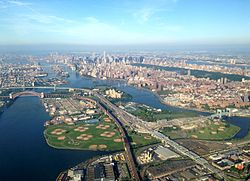
The Robert F. Kennedy Bridge (RFK Bridge; also known by its name prior to 2008, the Triborough Bridge) is a complex of bridges and elevated expressway viaducts[3] in New York City. The bridges link the boroughs of Manhattan, Queens, and the Bronx. The viaducts cross Randalls and Wards Islands, previously two islands and now joined by landfill.
Key Information


The RFK Bridge, a toll bridge, carries Interstate 278 (I-278) as well as the unsigned highway New York State Route 900G. It connects with the FDR Drive and the Harlem River Drive in Manhattan, the Bruckner Expressway (I-278) and the Major Deegan Expressway (Interstate 87) in the Bronx, and the Grand Central Parkway (I-278) and Astoria Boulevard in Queens. The three primary bridges of the RFK Bridge complex are:[3]
- The vertical-lift bridge over the Harlem River, the largest in the world, connecting Manhattan Island to Randalls Island (all within Manhattan)
- The truss bridge over Bronx Kill, connecting Randalls Island to the Bronx
- The suspension bridge over Hell Gate (a strait of the East River), connecting Wards Island to Astoria in Queens
These three bridges are connected by an elevated highway viaduct across Randalls and Wards Islands and 14 miles (23 km) of support roads. The viaduct includes a smaller span across the former site of Little Hell Gate, which separated Randalls and Wards Islands.[3][4] Also part of the complex is a grade-separated T-interchange on Randalls Island, which sorted out traffic in a way that ensured that drivers paid a toll at only one bank of tollbooths.[5] The tollbooths have since been removed, and all tolls are collected electronically at the approaches to each bridge.
The bridge complex was designed by Allston Dana with the collaboration of Othmar Ammann and architect Aymar Embury II,[6] and has been called "not a bridge so much as a traffic machine, the largest ever built".[5] The American Society of Civil Engineers designated the Triborough Bridge Project as a National Historic Civil Engineering Landmark in 1986.[7] The bridge is owned and operated by MTA Bridges and Tunnels (formally the Triborough Bridge and Tunnel Authority, or TBTA), an affiliate of the Metropolitan Transportation Authority.
Description
[edit]The RFK Bridge is made of four segments. The three primary spans traverse the East River to Queens; the Harlem River to Manhattan; and Bronx Kill to the Bronx,[8] while the fourth is a T-shaped approach viaduct that leads to an interchange plaza between the three primary spans on Randalls Island. The Queens arm of the viaduct formerly crossed Little Hell Gate, a creek located between Randalls Island to the north and Wards Island to the south.[3] Excluding elevated ramps, the segments are a total of 17,710 feet (5,400 m) long, with a 13,560-foot-long (4,130 m) span between the Bronx and Queens, and a 4,150-foot-long (1,260 m) span between Manhattan and the interchange plaza.[9][10][8] In total, the bridge contains 17.5 miles (28.2 km) of roadway, including elevated ramps.[11]
The bridge was primarily designed by chief engineer Othmar H. Ammann and architect Aymar Embury II.[6] Wharton Green served as the Public Works Administration (PWA)'s resident engineer for the project.[12]

East River suspension bridge (I-278)
[edit]The East River span, a suspension bridge across the Hell Gate of the East River, connects Queens with Wards Island. It carries eight lanes of Interstate 278, four in each direction, as well as a sidewalk on the northeastern side. The span connects to Grand Central Parkway, and indirectly to the Brooklyn–Queens Expressway (I-278), in Astoria, Queens.[13] Originally it connected to the intersection of 25th Avenue and 31st Street; the former was later renamed Hoyt Avenue.[14] The suspension span was designed by chief engineer Othmar Ammann.[15] The span was originally designed to be double-decked, with eight lanes on each deck.[16][10] When the construction of the Triborough Bridge was paused in 1932 due to lack of funding, the suspension span was downsized to a single deck. There are Warren trusses on each side of the span, which stiffen the deck.[16]
The center span between the two suspension towers is 1,380 feet (421 m) long,[16][17] and the side spans between the suspension towers and the anchorages are each 700 feet (213 m) long.[16] The total length of the bridge is 2,780 feet (847 m), and the deck is 98 feet (30 m) wide.[16] The columns under the Wards Island approach roadway were originally placed atop 400,000 steel ball bearings, allowing the roadway to move sideways by up to 13.25 inches (337 mm) in either direction.[17]
At mean high water, the towers are 315 feet (96 m) tall, and there is 143 feet (44 m) of clearance under the middle of the main span.[16] The suspension towers were originally designed by Arthur I. Perry. Each tower was supposed to have two ornate arches at the top, similar to the Brooklyn Bridge, and was to have been supported by four legs: two on the outside and two in the center.[18][10] A 1932 article described that each tower would be made of 5,000 tons of material, including 3,680 tons of steel.[10] The final design of the suspension towers, by Ammann, consists of comparatively simple cross bracing supported by two legs.[18] The tops of each tower contain cast iron saddles in the Art Deco style, over which the bridge's main cables run. These are topped by 30-foot (9.1 m) decorative lanterns with red aircraft warning lights.[19]
The span is supported by two main cables, which suspend the deck and are held up by the suspension towers. Each cable is 20 inches (51 cm) in diameter and contains 10,800 miles (17,400 km) of individual wires.[20] Each main cable is composed of 37 strands of 248 wires, for a total of 9,176 wires in each cable. The wires are fastened together by "strand shoes", placed at regular intervals.[21] At the Wards Island and Astoria ends of the suspension span, there are two anchorages that hold the main cables.[10][21] The anchorages contain a combined 133,500 tons of concrete.[20] There are also bents atop each anchorage, which conceal the ends of each main cable.[21]

Harlem River lift bridge (NY 900G)
[edit]New York State Route 900G | |
|---|---|
| Location | Manhattan |
| Length | 0.66 mi[22] (1,060 m) |
The Harlem River span is a lift bridge that connects Manhattan with Randalls Island, designed by chief engineer Ammann.[15] It carries six lanes of New York State Route 900G (NY 900G), an unsigned reference route, as well as two sidewalks, one on each side.[23] The span connects to FDR Drive and Harlem River Drive, as well as the intersection of Second Avenue and East 125th Street, in East Harlem, Manhattan. At the time of its completion, the Harlem River lift bridge had the largest deck of any lift bridge in the world, with a surface area of 20,000 square feet (1,900 m2). To lighten the deck, it was made of asphalt paved onto steel girders, rather than of concrete.[24]
The movable span is 310 feet (94 m) long[23][24] and 92 feet (28 m) wide.[23] The side spans between the movable span and the approach viaducts are each 195 feet (59 m) long. The total length of the bridge is 700 feet (213 m).[24] The towers are 210 feet (64 m) above mean high water. Each of the lift towers is supported by two clusters of four columns, which supports the bridge deck. A curved truss at the top of each pair of column clusters forms an arch directly underneath the deck.[24]
The lift span is 55 feet (17 m) above mean high water in the "closed" position, but can be raised to 135 feet (41 m).[23][25] The movable section is suspended by a total of 96 wire ropes, which are wrapped around pulleys with 15-foot (4.6 m) diameters.[25] These pulleys, in turn, are powered by four motors that can operate at 200 horsepower (149 kW).[24][26]
Exit list
[edit]NY 900G is officially maintained as a north–south route, despite its largely east-west progression.[22] The entire route is in the New York City borough of Manhattan. All exits are unnumbered.
| Location | mi[27] | km | Destinations | Notes | |
|---|---|---|---|---|---|
| Randall's Island | 0.0 | 0.0 |      I-278 to I-87 north – Bronx, Queens, Airports I-278 to I-87 north – Bronx, Queens, Airports | Southern terminus; exit 46 on I-278 | |
| 0.1 | 0.16 | Randalls Island, Icahn Stadium | Southbound exit and northbound entrance; access via Central Road | ||
| Harlem River | 0.2– 0.4 | 0.32– 0.64 | Bridge (southbound toll) | ||
| East Harlem | 0.4 | 0.64 |   FDR Drive south FDR Drive south | Northbound exit and southbound entrance; exit 17 on FDR Drive | |
  Harlem River Drive north Harlem River Drive north | Northbound exit and southbound entrance; exit 17 on Harlem River Drive | ||||
| 0.6 | 0.97 | East 125th Street / 2nd Avenue | Northern terminus; at-grade intersection | ||
| 1.000 mi = 1.609 km; 1.000 km = 0.621 mi | |||||
Bronx Kill crossing (I-278)
[edit]
The Bronx Kill span is a truss bridge that connects the Bronx with Randalls Island. It carries eight lanes of I-278, as well as two sidewalks, one on each side. The span connects to Major Deegan Expressway (I-87) and the Bruckner Expressway (I-278) in Mott Haven, Bronx.[13] It originally connected to the intersection of East 134th Street and Cypress Avenue, a site now occupied by the interchange between I-87 and I-278.[14] The truss span was designed by consulting engineers Ash-Howard-Needles and Tammen.[15]
The Bronx Kill span contains three main truss crossings, which are fixed spans because the Bronx Kill is not used by regular boat traffic.[26] The main truss span across the Bronx Kill is 383 feet (117 m) long,[15] while the approaches are a combined 1,217 feet (371 m).[4][15] The total length of the bridge is 1,600 feet (488 m). The truss span is 55 feet (17 m) above mean high water.[15]
Interchange plaza and approach viaducts
[edit]

The three spans of the RFK Bridge intersect at a grade-separated T-interchange on Randalls Island.[13] The span to Manhattan intersects perpendicularly with the I-278 viaduct between the Bronx and Queens spans.[26] Although I-278 is signed as a west-east highway, the orientation of I-278 on the bridge is closer to a north-south alignment, with the southbound roadway carrying westbound traffic, and the northbound roadway carrying eastbound traffic.[13] Two circular ramps carry traffic to and from eastbound I-278 and the RFK lift bridge to Manhattan.[13][28][29] Randalls and Wards Islands are accessed via exits and entrances to and from westbound I-278; to and from the westbound lift bridge viaduct; to eastbound I-278; and from the eastbound lift bridge viaduct. Eastbound traffic on I-278 accesses the island by first exiting onto the lift bridge viaduct.[13]
The interchange plaza originally contained two tollbooths: one for traffic traveling to and from Manhattan, and one for traffic traveling on I-278 between the Bronx and Queens. The tollbooths were arranged so vehicles only paid one toll upon entering Randalls and Wards Islands, and there was no charge to exit the island.[5][28][29] The elevated toll plazas had a surface area of about 9 acres (3.6 ha) and were supported by 1,700 columns, all hidden behind a concrete retaining wall.[28] In 2017, the MTA started collecting all tolls electronically at the approaches to each bridge,[30] and the tollbooths were removed from the toll plazas on the RFK Bridge and all other MTA Bridges and Tunnels crossings.[31][32]
The Robert Moses Administration Building, a two-story Art Deco structure designed by Embury, served as the headquarters of the TBTA (now the MTA's Bridges and Tunnels division). The building was next to the Manhattan span's plaza, to which it was connected. In 1969, the Manhattan span's toll plaza was moved west and the I-278 toll plaza was moved south, and both toll plazas were expanded more than threefold. This required the destruction of the building's original towers. A room was built in 1966 to store Moses's models and blueprints of planned roads and crossings, but they were moved to the MTA's headquarters at 2 Broadway in the 1980s. The building was renamed after Moses in 1989.[33]
The interchange plaza connects with the over-water spans via a three-legged concrete viaduct that has a total length of more than 2.5 miles (4.0 km). The segments of the viaduct rest atop steel girders, which in turn are placed perpendicularly between concrete piers spaced 60 to 140 feet (18 to 43 m) apart.[24] Each pier is supported by a set of three octagonal columns. The viaduct is mostly eight lanes wide, except at the former locations of the toll plazas, where it widens. The viaduct once traversed Little Hell Gate, a small creek that formerly separated Randalls Island to the north and Wards Island to the south; the waterway has since been filled in.[28] The viaduct rose 62 feet (19 m) above the mean high water of Little Hell Gate.[26]
Development
[edit]Planning
[edit]Initial plans
[edit]Edward A. Byrne, chief engineer of the New York City Department of Plant and Structures, first announced plans for connecting Manhattan, Queens and the Bronx in 1916.[34][15] The next year, the Harlem Boards of Trade and Commerce and the Harlem Luncheon Association announced their support for such a bridge, which was proposed to cost $10 million. The "Tri-Borough Bridge", as it was called, would connect 125th Street in Manhattan, St. Ann's Avenue in the Bronx, and an as-yet-undetermined location in Queens. It would parallel the Hell Gate Bridge, a railroad bridge connecting Queens and the Bronx via Randalls and Wards Islands.[35] Plans for the Tri-Borough Bridge were bolstered by the 1919 closure of a ferry between Yorkville in Manhattan and Astoria in Queens.[36]

A bill to construct the bridge was proposed in the New York State Legislature in 1920.[37] Gustav Lindenthal, who had designed the Hell Gate Bridge, criticized the Tri-Borough plan as "uncalled for", as the new Tri-Borough Bridge would parallel the existing Hell Gate Bridge. He stated that the Hell Gate Bridge could be retrofitted with an upper deck for vehicular and pedestrian use.[38] Queens borough president Maurice K. Connolly also opposed the bridge, arguing that there was no need to construct a span between Queens and the Bronx due to low demand. Connolly also said that a bridge between Queens and Manhattan needed to be built further downstream, closer to the Queensboro Bridge, which at the time was the only bridge between the two boroughs.[39][40]
The Port of New York Authority included the proposed Tri-Borough Bridge in a report to the New York state legislature in 1921.[41] The following year, the planned bridge was also included in a "transit plan" published by Mayor John Francis Hylan, who called for the construction of the Tri-Borough Bridge as part of the city-operated Independent Subway System (see § Public transportation).[42][43] In March 1923, a vote was held on whether to allocate money to perform surveys and test borings, as well as create structural plans for the Tri-Borough Bridge. The borough presidents of Manhattan and the Bronx voted for the allocation of the funds, while the presidents of Queens and Staten Island agreed with Hylan, who preferred the construction of the new subway system instead of the Tri-Borough Bridge.[44] The bridge allocation was ultimately not approved.[45] Another attempt at obtaining funds was declined in 1924, although there was a possibility that the bridge could be built based on assessment plans that were being procured.[46]
Funding
[edit]The Tri-Borough Bridge project finally received funding in June 1925, when the city appropriated $50,000 for surveys, test borings and structural plans. Work started on a tentative design for the bridge.[4][47] By December 1926, the $50,000 allotment had been spent on bores.[48] Around the same time, the proposal to convert the Hell Gate Bridge resurfaced.[49] Albert Goldman, the Commissioner of Plant and Structures, had finished a tentative report for the Tri-Borough Bridge by that time; however, it was not immediately submitted to the New York City Board of Estimate as a result of a reorganization of the city's proposed budget.[50][51] Goldman finally published the report in March 1927, stating that the bridge was estimated to cost $24.6 million.[52] He explained that the Hell Gate Bridge only had enough space for five lanes of roadway, so a new bridge would have to be constructed parallel to it.[53]
Though two mayoral committees endorsed the Tri-Borough plan,[54] as did several merchants' associations,[55] construction was delayed for a year because of a lack of funds.[56] The Board of Estimate did approve $150,000 in May 1927 for preliminary borings and soundings.[57] That September, a group of entrepreneurs proposed to fund the bridge privately.[58] Under this plan, the bridge would be set up as a toll bridge, and ownership would be transferred to the city once the bridge was paid for.[59] In August 1928, Mayor Jimmy Walker received a similar proposal from the Long Island Board of Commerce to build the Tri-Borough Bridge using $32 million of private capital.[60] The Queens Chamber of Commerce also favored setting up tolls on the bridge to pay for its construction.[61] Yet another plan called for financing the bridge using proceeds from a bond issue, which would also pay for the proposed Queens–Midtown Tunnel.[62]
The Tri-Borough Bridge was being planned in conjunction with the Brooklyn–Queens Expressway, which would create a continuous highway between the Bronx and Brooklyn with a southward extension over The Narrows to Staten Island. In January 1929, New York City aldermanic president Joseph V. McKee endorsed the bridge, saying there was enough funding to begin one of four proposed bridges on the expressway's route.[63] The newly elected borough president of Queens, George U. Harvey, also endorsed the bridge, as did Brooklyn Chamber of Commerce leader George Vincent McLaughlin.[64] Trade groups petitioned Mayor Walker to take up the bridge's construction.[65] By the end of the month, Walker acquiesced, and he had included both the Tri-Borough Bridge and a tunnel under the Narrows in his 10-year traffic program.[66] The preliminary borings were completed by late February 1929.[67] The results of the preliminary borings showed that the bedrock in the ground underneath the proposed bridge was sufficient to support the spans' foundations.[68]
In early March, the Board of Estimate voted to start construction on the bridge and on the Narrows tunnel once funding was obtained. The same month, the board allocated $3 million toward the bridge's construction.[69][70] Separately, the Board of Estimate voted to create an authority to impose toll charges on both crossings.[71] In April 1929, the New York state legislature voted to approve the Tri-Borough Bridge as well as a prison on Rikers Island before adjourning for the fiscal year.[72] The same month, New York state governor Franklin D. Roosevelt signed the bill to approve the move of about 700 beds in Wards Island's mental hospital, which were in the way of the proposed bridge's suspension span to Queens.[73] The New York state legislature later approved a bill that provided for moving the Queens span's Wards Island end, 1,100 feet (340 m) to the west, thereby preserving hospital buildings from demolition.[74]
Finalization of plans
[edit]
The bridge was ultimately planned to cost $24 million and was planned to start construction in August 1929.[75] By July, the groundbreaking was scheduled for September.[76] The preliminary Triborough Bridge proposal comprised four bridges: a suspension span across the East River to Queens; a truss span across Bronx Kill to the Bronx; a fixed span across the Harlem River to Manhattan; and a steel arch viaduct across the no-longer-extant Little Hell Gate between Randalls and Wards Islands.[76]
In August 1929, plans for the bridge were submitted to the United States Department of War for approval to ensure that the proposed Tri-Borough Bridge would not block any maritime navigation routes. Railroad and shipping groups objected that the proposed Harlem River span, with a height of 50 feet (15 m) above mean high water, was too short for most ships, and suggested building a 135-foot-high (41 m) suspension span over the Harlem River instead.[77] Because of complaints about maritime navigational clearance, the Department of War approved an increase in the Harlem River fixed bridge's height to 55 feet (17 m), as well as an increase in the length of the Hell Gate suspension bridge's main span from 1,100 to 1,380 feet (340 to 420 m).[74]
Initial construction
[edit]The scale of the Triborough Bridge project, including its approaches, was such that hundreds of large apartment buildings were demolished to make way for it. The structure used concrete from factories "from Maine to the Mississippi", and steel from 50 mills in Pennsylvania. To make the formwork for pouring the concrete, a forest's worth of trees on the Pacific Coast was cut down.[9] Robert Caro, the author of a biography on Long Island State Parks commissioner and Triborough Bridge and Tunnel Authority chairman Robert Moses, wrote about the project:
Triborough was not a bridge so much as a traffic machine, the largest ever built. The amount of human energy expended in its construction gives some idea of its immensity: more than five thousand men would be working at the site, and these men would only be putting into place the materials furnished by the labor of many times five thousand men; before the Triborough Bridge was completed, its construction would have generated more than 31,000,000 man-hours of work in 134 cities in twenty states.[5]
First contracts
[edit]The Board of Estimate approved the first contracts for the Triborough Bridge in early October 1929, specifically for the construction bridge piers on Randalls and Wards Islands and in Queens. This allowed for the start of construction on the Triborough Bridge's suspension span to Queens.[74] A groundbreaking ceremony was held in Astoria Park, Queens, on October 25, 1929, just a day after Black Thursday, which started the Great Depression.[20] Mayor Walker turned over the first spadeful of dirt for the bridge in front of 10,000 visitors.[78] After the groundbreaking ceremony, further construction was delayed because the company originally contracted to build the piers, the Albert A. Volk Company, refused to carry out the contract. In early December, the contract for the piers was reassigned to the McMullen Company.[79] Meanwhile, the Board was condemning the land in the path of the bridge's approaches.[80] However, this process was also postponed because homeowners wanted to sell their property to the city at exceedingly high prices.[81]
The War Department gave its approval to the Bronx Kills, East River, and Little Hell Gate spans in late April 1930, after construction was already underway on the Queens suspension span across the East River.[82] A week later, the War Department also approved the Harlem River span, with another amendment: the span was now a movable lift bridge, which could be raised to allow maritime traffic to pass.[83] Shortly afterward, a special mayoral committee sanctioned a $5 million expenditure for the Triborough project,[84] and in July 1930, a $5 million bond issue to fund the Triborough Bridge's construction was passed.[85]
Plans for an expressway to connect to the bridge's Queens end were also filed in July 1930. This later became the Brooklyn–Queens Expressway, which was connected to the bridge via the Grand Central Parkway.[86] There were also proposals for an expressway to connect to the Bronx end of the bridge along Southern Boulevard.[87] Robert Moses, the Long Island state parks commissioner, wanted to expand Grand Central Parkway from its western terminus at the time, Union Turnpike in Kew Gardens, Queens, northwest to the proposed bridge.[88] The Brooklyn-Queens Expressway proposal, which would create a highway from the Queens end of the bridge to Queens Boulevard in Woodside, Queens, was also considered.[89]

A contract to build the suspension anchorage on Wards Island was awarded in January 1931.[90] At the time, progress on the bridge approaches was proceeding rapidly, and it was expected that the entire Triborough Bridge complex would be completed in 1934.[14] By August 1931, it was reported that the Wards Island anchorage was 33% completed, and that the corresponding anchorage on the Queens side was 15% completed. Work on drainage dikes, as well as contracts for bridge approach piers, were also progressing.[91] A report the next month indicated that the overall project was 6% completed, and that another $2.45 million in contracts was planned to be awarded over the following year.[92][93] In October, contracts for constructing the bridge piers were advertised.[94] By December 1931, the project was 15% completed,[95] and the city was accepting designs for the Queens span's suspension towers.[96] The granite foundations in the water near each bank of the East River, which would support the suspension towers, were completed in early or mid-1932.[97][98] At the time, there were no funds to build six additional piers on Randalls Island and one in Little Hell Gate, nor were there funds to build the suspension towers themselves.[97]
Funding issues
[edit]The Great Depression severely impacted the city's ability to finance the Triborough Bridge's construction.[20] City comptroller Charles W. Berry had stated in February 1930 that the city was in sound financial condition, even though other large cities were nearing bankruptcy.[99] However, the New York City government was running out of money by that July.[100] The Triborough project's outlook soon began to look bleak. Chief engineer Othmar Ammann was enlisted to help guide the project, but the combination of Tammany Hall graft, the stock market crash, and the Great Depression which followed it, brought the project to a virtual halt.[101] Investors shied away from purchasing the municipal bonds needed to fund it.[6]
By early 1932, the Triborough Bridge project was in danger of cancellation.[102] As part of $213 million in cuts to the city's budget, Berry wanted to halt construction on the span in order to avoid a $43.7 million budget shortage by the end of that year.[103] With no new contracts being awarded, the chief engineer of the Department of Plant and Structures, Edward A. Byrne, warned in March 1932 that construction on the Triborough Bridge would have to be halted.[104] Though Queens borough president Harvey objected to the impending postponement of the bridge's construction,[105] the project was still included in the $213 million worth of budget cuts.[106] Following this, Goldman submitted a proposal to fund the planning stages for the remaining portions of construction, so that work could resume immediately once sufficient funding was available.[107]
In August 1932, Senator Robert F. Wagner announced that he would ask for a $26 million loan from the federal government, namely President Herbert Hoover's Reconstruction Finance Corporation, so there could be funds for the construction of both the Triborough Bridge and Queens-Midtown Tunnel.[108] Queens borough president Harvey also went to the RFC to ask for funding for the bridge.[109] Soon after, the RFC moved to prepare the loan for the Triborough Bridge project.[110] However, when Mayor Walker resigned suddenly in September 1932, his successor Joseph V. McKee refused to seek RFC or other federal aid for the two projects, stating, "If we go to Washington for funds to complete the Triborough Bridge [...] where would we draw the line?"[111] Governor Al Smith agreed, saying that such requests were unnecessary because the bridge could pay for itself.[112] Harvey continued to push for federal funding for the Triborough Bridge, prioritizing its completion over other projects such as the development of Jamaica Bay in southern Queens.[113] Civic groups also advocated for the city to apply for RFC funding.[114]
In February 1933, a nine-person committee, appointed by Lehman and chaired by Moses, applied to the RFC for a $150 million loan for projects in New York state, including the Triborough Bridge.[115] However, although the RFC favored a loan for the Triborough project,[116] the new mayor, John P. O'Brien, banned the RFC from giving loans to the city.[117] Instead, O'Brien wanted to create a bridge authority to sell bonds to pay for the construction of the Triborough Bridge as well as for the Queens-Midtown Tunnel.[118] Robert Moses was also pushing the state legislature to create an authority to fund, build, and operate the Triborough Bridge.[101] A bill to create the Triborough Bridge Authority (TBA) passed quickly through both houses of the state legislature,[119] and was signed by Governor Herbert H. Lehman that April. The bill included a provision that the authority could sell up to $35 million in bonds and fund the remainder of construction through bridge tolls.[120][121] George Gordon Battle, a Tammany Hall attorney, was appointed as chairman of the new authority, and three commissioners were appointed.[122]
Shortly after the TBA bill was signed, the War Department extended its deadline for the Triborough Bridge's completion by three years, to April 28, 1936.[123] Lehman also signed bills to clear land for a bridge approach in the Bronx,[124] and he promised to resume construction of the bridge.[125] That May, the TBA asked the RFC for a $35 million loan to pay for the bridge.[126][127] The RFC ultimately agreed in August to grant $44.2 million, to be composed of a loan of $37 million, as well as a $7.2 million subsidy.[128] However, the loan would only be given under a condition that 18,000 workers be hired first,[129] so the city's Board of Estimate voted to hire 18,000 workers to work on the Triborough project.[130] The funds for the Triborough Bridge, as well as for the Lincoln Tunnel from Manhattan to New Jersey, were ready by the beginning of September.[131]
Construction resumes
[edit]
The city purchased land in the path of the Triborough Bridge in September 1933,[132] and construction on the Triborough Bridge resumed that November.[102] By January 1934, contracts were being prepared for the completion of the suspension span and the construction of the other three spans;[133] one of these contracts included the construction of the bridge's piers.[134] That February, the TBA contemplated condensing the Queens span's 16-lane, double-deck roadway into an 8-lane, single deck road, as well as simplify the suspension towers' designs, to save $5 million.[135] According to the agency, it would take 40 years for the bridge to reach a level of traffic where all sixteen lanes were needed.[136] In April, a new plan was approved that would reduce the bridge's cost from $51 million to $42 million.[136][137] Chief engineer Ammann had decided to collapse the original design's two-deck roadway into one, requiring lighter towers and lighter piers.[101] The steel company constructing the towers challenged the TBA's decision in an appellate court, but the court ruled in favor of the TBA.[138]
1934 progress
[edit]By January 1934, the TBA was in turmoil: one of the TBA's commissioners had resigned,[139] and New York City Mayor Fiorello H. La Guardia was trying another TBA commissioner, John Stratton O'Leary, for corruption.[140] The TBA's general counsel also resigned.[141] As a result, Public Works Administration (PWA) administrator Harold L. Ickes refused to distribute more of the RFC grant until the existing funds could be accounted for.[142] Ickes also warned that he would cancel the RFC grant if the political disputes regarding the TBA were not cleared up.[143] After O'Leary was removed, La Guardia appointed Moses to fill O'Leary's position,[144] and Ickes also promised to give $1.5 million toward the bridge's construction,[145] which the city received that March.[146] Moses became the chairman of the TBA in April 1934, after a series of interim chairmen had held the post.[147] Moses, who also had positions in the state and city governments, sought to expedite the project,[102] awarding a contract in May for the construction of an approach highway to the Queens span.[148]
A contract to clear land in the bridge's right-of-way was awarded in April 1934,[149] and work began that month.[150] Over 300 buildings had to be destroyed.[151] Families living in the path of the bridge's approaches protested the eviction notices given to them.[152] The Harlem Market on First Avenue, which stood in the way of the Manhattan approach, was to be moved to the Bronx Terminal Market.[153] The construction of the Triborough Bridge across Little Hell Gate also required the demolition of hospital buildings on Randalls and Wards Islands.[154] The New York City Department of Hospitals applied for funds to build the Seaview Hospital on Staten Island, which would house the hospital facilities displaced by the Triborough Bridge.[155] Homes in Astoria and wooden docks were also demolished to make way for the bridge.[156]
Moses continued to advocate for new roads and parkways to connect with the bridge as part of an interconnected parkway system.[157] The complex of roads included the Grand Central Parkway and Astoria Boulevard in Queens; 125th Street, the East River Drive (now the FDR Drive), and Harlem River Drive in Manhattan; and Whitlock Avenue and Eastern Boulevard (now Bruckner Expressway) in the Bronx.[158] The first of those roads, the Grand Central Parkway, was planned to start construction in early 1934.[159] That July, the Department of War approved the Bronx Kill span as a fixed truss span, since the Bronx Kill was not a navigable waterway; the span could be replaced with a lift bridge if needed.[158][160] The same month, the city approved the first segment of the East River Drive, leading from the intersection of York Avenue and 92nd Street to the Triborough Bridge approach at 125th Street.[161][162] The bridge approach on the Bronx side was also finalized, running along Southern and Eastern boulevards,[162] with a future extension to Pelham Bay Park in the northeastern Bronx.[163]
Civic groups advocated for an approach highway from the West Bronx,[164] and Bronx borough president James J. Lyons tried to block the Board of Estimate from approving the Manhattan approach highway until a West Bronx approach was also provided for.[165] Despite this, in October 1934, the Board of Estimate approved the East River Drive approach while rejecting the West Bronx approach.[166] While reformers embraced Moses's plans to expand the parkway system, state and city officials were overwhelmed by their scale, and slow to move to provide financing for the vast system.[101] Partial funding came from interest-bearing bonds issued by the Triborough Bridge Authority, to be secured by future toll revenue.[167][168]
1935 progress
[edit]Financing disputes with the PWA involved complex political infighting.[169] The disputes peaked in January 1935, when Ickes passed a rule that effectively prohibited PWA funding for the TBA unless Moses resigned the post of either TBA chairman or New York City Parks Commissioner.[170][171] This came as a result of Moses's criticism that New Deal funding programs like the PWA were too slow to disburse funds.[171] Moses refused to resign in spite of Ickes's persistence,[172] and Ickes threatened to withhold salaries for TBA workers as well.[173] Though La Guardia was supportive of Moses, even petitioning Roosevelt for help,[174] he was willing to replace the TBA chairman if it resulted in funding for the bridge.[175] In mid-March, Ickes suddenly backed down on his ultimatum; not only was Moses allowed to keep both of his positions, but the PWA also resumed its payments to the TBA.[176] La Guardia re-appointed Moses to the TBA the same year.[177]
Meanwhile, in February 1935, the TBA awarded a contract to construct the piers for the Harlem River lift structure.[178] Despite an impending lack of funds due to the dispute between Moses and Ickes, the TBA announced its intent to open bids for bridge steelwork.[179] By March, the suspension towers for the East River span to Queens were nearing completion, and support piers on Randalls and Wards Islands had progressed substantially.[180][163] After the Moses–Ickes dispute had subsided, the TBA started advertising for bids to build the steel roadways of the Randalls and Wards Islands viaducts, as well as the East River suspension span.[181] Less than a week afterward, the first temporary wires were strung between the two towers of the suspension span.[182] The wires in the main cables were laid by machines that traveled along these temporary wires.[21] A contract for the Harlem River lift span's steel superstructure was awarded that May,[183] followed by a contract for the Bronx Kill truss span's structure the following month.[184]
The spinning of the main span's suspension cables was finished in July 1935. By that time, half of the $41 million federal grant had been spent on construction, and the bridge was expected to open the following year.[185] The bridge was expected to relieve traffic on nearby highways,[186] and, with the upcoming 1939 New York World's Fair being held in Queens, would also provide a new route to the fairground at Flushing Meadows–Corona Park.[187] The construction of the Bronx approach was delayed after the city's corporation council found that the approach could not be built using federal funds.[188] By October 1935, the Queens approach and the Randalls and Wards Islands viaduct was nearly complete. Vertical suspender cables had been hung from the main cables of the Queens suspension span, and the steel slabs to support the span's roadway deck were being erected. The concrete piers supporting Bronx span were still being constructed, and the site of the Manhattan span was marked only by its foundations.[189] The deck of the Queens suspension span was completed the following month.[190] The work was dangerous, as some workers fell off the scaffolding that had been erected to allow them to build the suspension span, while others died due to lead poisoning.[156]

In November 1935, a controversy emerged over the fact that the Triborough Bridge would use steel imported from Nazi Germany, rather than American producers.[191] Although American steel producers objected to the contract, the PWA approved of it anyway, because the German steel contract was cheaper than any of the bids presented by American producers.[192] Moses also approved of the decision because it would save money,[193] and the TBA said that federal regulations had forced the agency to turn to a German manufacturer.[194] La Guardia blocked the deal, writing that "the only commodity we can get from Hitlerland [Germany] is hatred, and we don't want any in our country",[195] and Ickes also banned the use of imported materials on PWA projects.[196] The TBA then re-awarded the contract to the Jones and Laughlin Steel Company.[197]
1936 progress
[edit]By February 1936, the TBA had awarded contracts for paving the Bronx Kill and East River spans, as well as for constructing several administrative buildings for the TBA near the bridge.[198] Lyons continued to object to Moses's plans for the bridge's Bronx approach.[199] Moses wanted to speed up construction on the Triborough Bridge so that it would meet a deadline of July 11, 1936.[200] He objected to Ickes's decision, in March 1936, to decentralize control of PWA resident engineers, who would report to state PWA bosses instead of directly to the PWA's main office in Washington, D.C. Moses believed that the PWA boss for New York, Arthur S. Tuttle, was indecisive.[200][201] In return, Ickes assured Moses of Tuttle's full cooperation.[202]
The 300-by-84-foot superstructure of the Harlem River lift span was assembled in Weehawken, New Jersey. It was floated northward to the Triborough Bridge site in April 1936.[203] Early the next month, the 200-ton main lift span was hoisted into place above the Harlem River in a process that took sixteen minutes.[204] In addition, the city gave the New York City Omnibus Corporation a temporary permit to operate bus routes on the Triborough Bridge, connecting the bus stops at each of the bridge's ends, during the summer months.[205] Moses appealed to Ickes to increase the construction workers' workweeks from 30 to 40 hours so the bridge would be able to open on time, but was initially rejected.[206] A 40-hour workweek was approved that June.[207] As late as the day before the bridge's opening on July 11, workers were still putting finishing touches on the bridge and surrounding highways.[208][209]
A byproduct of the Triborough project was the creation of parks and playgrounds in the lands underneath the bridges and approaches.[102] The largest of these parks was Randall's Island Park, located on Wards and Randalls Islands.[210][211] The park on Randalls Island was approved in February 1935[212] and included an Olympic-sized running track called Downing Stadium, work on which began in mid-1935;[210][213] the stadium was incomplete at the time of the bridge's opening.[209] The plan included infilling a strait, Little Hell Gate, between the two islands.[211] Smaller parks were also built in Astoria and Manhattan.[102][4]
When the Triborough Bridge was finished, it was the largest PWA project in the eastern U.S.,[214] having cost $60.3 million (equivalent to $1 billion in 2025) according to final TBA figures.[215][1] Based on expenditures, the PWA had originally estimated the bridge's cost to be as high as $64 million.[214][216] In either case, the Triborough Bridge was one of the largest public works projects of the Great Depression, more expensive than the Hoover Dam.[4][217][218] Of this, $16 million came from the city and $9 million directly from the PWA. The latter also purchased $35 million worth of TBA bonds, which were eventually bought back and resold to the public.[102] The PWA had finished giving out the $35 million loan by February 1937,[219] and the Reconstruction Finance Corporation had sold the last of the TBA's funds that July.[220] Additional income came from toll collection: the toll was initially set at 25 cents per passenger car, with lower rates for motorcycles and higher rates for commercial vehicles.[221]
Operational history
[edit]Opening
[edit]The toll rates for the bridge were decided upon in March 1936.[222] By May, the opening ceremonies for both the Triborough Bridge and the Downing Stadium were scheduled for July 11.[223] The dedication was scheduled to occur on the Manhattan lift span, prompting objections from both Bronx and Queens officials.[224] Due to the previous conflicts between President Roosevelt and Robert Moses, the attendance of the former was not certain until two weeks before the ceremony.[225] PWA administrator Ickes's attendance was finalized only four days beforehand.[226]
The completed structure, described by The New York Times as a "Y-shaped sky highway",[227] was dedicated on Saturday, July 11, 1936, along with Downing Stadium.[227][228] The ceremony for the Triborough Bridge was held at the interchange plaza, and was attended by Roosevelt, La Guardia, Lehman, Ickes, and Postmaster General James A. Farley, who all gave speeches.[228][229] Robert Moses acted as the master of ceremonies.[227][217] The ceremonies were broadcast nationwide via radio,[217] and a parade was also held on 125th Street in Manhattan to celebrate the bridge's opening.[230] Queens residents, excluded from the official ceremony, hosted an unofficial gathering in Astoria.[156] The Triborough Bridge opened to the general public at 1:30 p.m.,[231] and by that midnight an estimated 200,000 people had visited the bridge.[227][11] The bridge saw 40,000 vehicles on its first full day, July 12,[232] and about 1,000 vehicles an hour on July 13, its first full weekdays.[233] The TBA recorded 242,000 total vehicles in the bridge's first week,[234] 953,100 during the first month,[235] and 2.7 million in its first three months.[236]
After the bridge's opening, one Queens civic group predicted that the bridge would increase real-estate values in Queens and on Long Island at large.[237] The ferry between Yorkville, Manhattan, and Astoria, Queens, was made redundant by the new Triborough Bridge,[238][239] and the city had closed the ferry by the end of July 1936.[240] Traffic on the Queensboro Bridge, the only other vehicular bridge that connected Manhattan and Queens, declined after the Triborough Bridge opened,[241] though not by as much as city officials had anticipated.[242] In 1937, the first full year of the bridge's operation, it generated $2.85 million (equivalent to $63.83 million in 2025) in revenue from 11.18 million vehicles.[243] This was far more than the 8 million vehicles that TBA officials had originally anticipated.[244] The American Institute of Steel Construction declared the Triborough Bridge the "most beautiful" steel bridge constructed during 1936.[245] Newsday, writing retrospectively in 1994, said: "More than any other structure, the Triborough unified the boroughs of New York City."[156]
1930s to mid-1960s
[edit]Highway construction
[edit]
When the bridge opened, none of the spans had direct connections to the greater system of highways in New York City.[8] In Queens, the Grand Central Parkway extension to the Triborough Bridge was nearly completed at the time of the bridge's opening. The Manhattan span was planned to connect to the East River Drive (now the FDR Drive), the first segments of which were still under construction.[8] The section of the East River Drive from the bridge south to 92nd Street opened that October.[246] Originally, there was no direct access from the Queens span to Wards Island, but in November 1937, Moses announced the construction of a ramp from the Queens span that would lead down to the island.[247] The next year, a lawsuit was filed by two Wards Islands landowners, who alleged that the Triborough Bridge had been built on portions of their land. They each received nominal damages of $1.[248][249]
The Bronx span ended in local traffic at the no-longer extant intersection of 135th Street and Cypress Avenue.[8] The first of two approach highways in the Bronx was approved late in 1936[250] and was partially funded by the PWA.[251] Consisting of ramps to the intersection of 138th Street and Grand Concourse,[252] this highway opened in April 1939[253] and later became part of the Major Deegan Expressway (Interstate 87).[254] Another approach highway in the Bronx, the present Bruckner Boulevard, was approved in 1938[255] and extended eastward to the Bruckner Interchange.[256] Both Bronx approach roads were completed in time for the 1939 New York World's Fair, which was held in Queens.[254]
Moses continued expanding the system of highways in the mid-20th century, including arteries that led to the Triborough Bridge, namely the Brooklyn-Queens Expressway in Queens[257] and the Bruckner Expressway in the Bronx.[258] Both highways became part of I-278, as did the Queens and Bronx spans of the Triborough Bridge, by the 1960s.[259] In the 1950s, there were also plans for a highway to be constructed between the Triborough Bridge's Manhattan span and a never-built 125th Street Hudson River bridge, which would have allowed direct highway access to the New Jersey Turnpike.[260]
Bridge traffic and modifications
[edit]The Triborough Bridge Authority was headquartered in an administration building adjacent to the Manhattan span's toll plaza, where by 1940, it controlled the operation of all toll bridges located entirely within New York City.[33] Though the Bronx–Whitestone Bridge between the Bronx and Queens opened in April 1939,[261][262] the Triborough Bridge did not see any initial decline in traffic, likely because both spans were heavily used during the World's Fair.[263] Soon after, vehicle rationing caused by the onset of World War II resulted in a decline in traffic at crossings operated by the TBA including the Triborough Bridge.[264] Still, by 1940, the Triborough Bridge was the most profitable crossing operated by the TBA.[265] The New York Times, describing the bridge as "generally recognized as a monument to engineering ingenuity", attributed the bridge's popularity to the design of its three spans.[266] In 1941, one of the lift span's original gates was removed after a motorist damaged it.[267]
Traffic decreased significantly during the war, declining to 5.1 million vehicles in 1943, though traffic counts again increased afterward.[268][269] The TBA became the Triborough Bridge and Tunnel Authority (TBTA) in 1946, though TBTA operations continued to be managed from the Triborough Bridge.[270] The bridge was repainted for the first time in September 1946 for $600,000.[269][271] The bridge recorded over 100 million total vehicles in its first decade of operation.[268] By 1951, the bridge accommodated 29.4 million vehicles a year, more than any other toll road in the U.S.;[272] the TBTA claimed in early 1952 that the bridge was the busiest toll road in the world.[273]
Late 1960s to 1990s
[edit]In 1968, the Triborough Bridge received its first major renovation in its 31-year history. Seven tollbooths were added, three at the Manhattan span's toll plaza and four at the Queens/Bronx spans' toll plaza, and several ramps were widened at a cost of $20 million. The project also added a direct ramp from the Manhattan span to the southbound lanes of Second Avenue in East Harlem.[274] The TBTA administration building was also expanded during this project.[33] Traffic from the Manhattan span was temporarily diverted during this project.[275][276]
At some point in the 20th century, a sign on the bridge informed travelers, "In event of attack, drive off bridge"; according to New York Times columnist William Safire, the "somewhat macabre sign" must have "drawn a wry smile from millions of motorists".[277] The TBTA replaced the movable toll gates across all of its toll booths in 1989, including those at the Triborough Bridge.[278] By that year, pieces of concrete were falling off the bridge, prompting concerns about deterioration.[279] By the early 1990s, the bridge accommodated about 160,000 daily vehicles, and the TBTA employed 140 toll collectors there.[280] During that decade, the TBTA discovered high concentrations of lead under the bridge's Queens approaches, prompting the agency to remove the lead.[281] The TBTA also rearranged the lanes at the bridge's toll plazas in 1992.[282] The Triborough Bridge remained the TBTA's busiest facility in the 1990s, with over 200,000 daily vehicles.[283]
In 1997, more renovations of the bridge were announced.[284] The project consisted of three phases. The first phase involved renovating the Queens span and approach ramps, as well as replacing the suspender cables;[285][286] work on the Queens span's anchorage began in February 1997.[286] On the Queens side, an exit ramp from westbound I-278 to 31st Street necessitated the destruction of the entrance to the southern sidewalk.[287] The second phase involved renovating the Bronx span and approach ramps. The third phase involved renovating the Manhattan span and approach ramps.[285] By early 1999, there were more than 500 potholes on the bridge, requiring workers to use 22.5 short tons (20.1 long tons; 20.4 t) of concrete and 65 short tons (58 long tons; 59 t) of asphalt to repave the deck.[288] Work on replacing the Queens span's suspender cables and adding an orthotropic deck to the Queens suspension span started in 2000.[289][290] The replacement of the deck was estimated to cost $125 million.[291]
2000s to present
[edit].jpg)
In January 2008, then-governor Eliot Spitzer proposed renaming the bridge after former U.S. senator Robert F. Kennedy, who had been assassinated during a 1968 presidential bid.[292] Though the Kennedy family supported the renaming,[292] there were initial doubts over whether local residents would use the new name.[293] The New York State Legislature approved the bill that June,[294] and the Triborough Bridge was officially renamed after Kennedy on November 19, 2008.[295][296] The MTA announced further renovations to the Triborough Bridge in 2008; the work included the replacement of the roadways at the toll plazas, as well as the rehabilitation of various ramps and the construction of a new service building.[284] The same year, the MTA awarded contracts to renovate the Queens span's anchorages.[297]
In 2015, the MTA started two reconstruction projects on different parts of the bridge[298] as part of a $1 billion, 15-year program to renovate the bridge complex.[299] The MTA commenced construction on a $213 million rehabilitation of the 1930s-era toll plaza between the Queens and Bronx spans, which included a rebuilding of the roadway and the supporting structure underneath. The new toll plaza structure was completed in 2019.[298] Cashless tolling was implemented on June 15, 2017,[30][300] allowing drivers to pay tolls electronically via E-ZPass or Toll-by-Mail without having to stop at any tollbooths.[30] Shortly afterward, the tollbooths were demolished.[31][32]
A ramp from the Manhattan span to the northbound Harlem River Drive was being built for $68.3 million, and was to be finished by December 2017;[298] this was delayed pending the reconstruction of the Harlem River Drive viaduct around the area.[301] In February 2020, the northbound Harlem River Drive ramp's completion was tentatively announced for 2021,[302] though the ramp ultimately opened in November 2020.[303] The project was expected to cost $72.6 million[304] and involved designing a new overpass to fit between the Harlem River Drive's two existing roadways.[305] The Harlem River lift span was also rehabilitated prior to 2020.[306]
On December 15, 2021, the MTA Board approved a contract to construct a ramp to connect the walkway on the north side of the bridge's Manhattan span to a future park to be constructed along the Manhattan Greenway by the New York City Economic Development Corporation along the Harlem River south of East 127th Street. Work was expected to cost $19.6 million, and would be bundled with a $26 million project to upgrade and renew elements of the bridge. Work was expected to be done by spring 2023, with the ramp opening with the expected completion of the park in 2025.[307]
Usage
[edit]The toll revenues from the RFK Bridge pay for a portion of the public transit funding for the New York City Transit Authority and the commuter railroads.[308] The bridge had annual average daily traffic of 164,116 in 2014. For that year, the bridge saw annual toll-paying traffic rise by 2.9% to 59.9 million, generating $393.6 million in revenue at an average toll of $6.57.[309]

Pedestrian and bicycle sidewalks
[edit]The bridge has sidewalks on all three spans where the TBTA officially requires bicyclists to walk their bicycles across[310] due to safety concerns.[311] However, the signs stating this requirement have been usually ignored by bicyclists,[312]: 16 and the New York City Government has recommended that the TBTA should reassess this kind of bicycling ban.[312]: 57 Stairs on the 2 km (1.2 mi) Queens span impede access by disabled people, and only the northern sidewalk on that span is open to traffic; the Queens end of the southern sidewalk was demolished in the early 2000s.[313] The two sidewalks of the Bronx span are connected to one long and winding ramp at the Randalls Island end,[314] though another pedestrian bridge between Randalls Island and the neighborhood of Port Morris, Bronx, opened to the east of the RFK Bridge in November 2015.[315]
Public transportation
[edit]The RFK Bridge carries the M35, M60 SBS and X80 bus routes operated by MTA New York City Transit, as well as several express bus routes operated by the MTA Bus Company: BxM6, BxM7, BxM8, BxM9, BxM10 and BxM11. The M35 travels from Manhattan to Randalls and Wards Islands (with the X80 also operating during special events), while the M60 SBS runs between Manhattan and Queens, and the MTA Bus express routes travel between Manhattan and the Bronx.[316] The M60 has used the bridge since the early 1990s.[317]
In the 1920s, John F. Hylan proposed building the Triborough Bridge as part of his planned Independent Subway System. The proposal entailed extending the New York City Subway's BMT Astoria Line along the same route the Triborough now follows. It would have created a crosstown subway line along 125th Street, as well as a new subway line in the Bronx under St. Ann's Avenue.[42][43][318]
Tolls
[edit]As of January 4, 2026[update], drivers pay $12.03 per car or $5.06 per motorcycle for tolls by mail/non-NYCSC E-Z Pass. E-ZPass users with transponders issued by the New York E‑ZPass Customer Service Center pay $7.46 per car or $3.25 per motorcycle. Mid-Tier NYCSC E-Z Pass users pay $9.79 per car or $4.18 per motorcycle. All E-ZPass users with transponders not issued by the New York E-ZPass CSC will be required to pay Toll-by-mail rates.[319]
When the Triborough Bridge opened, it had a combined 22 tollbooths spread across two toll plazas.[221] Motorists were first able to pay with E‑ZPass in lanes for automatic coin machines at the toll plazas on August 21, 1996;[320] in contrast to other MTA Bridges & Tunnels facilities where E-ZPass lanes were interspersed with cash only lanes, all of the E-ZPass lanes at either of the Triborough Bridge's toll plazas were grouped together.[321] The implementation of E-ZPass allowed each toll lane to accommodate 900 vehicles an hour, compared with the 250 to 400 vehicles that the old toll lanes could accommodate.[283]
Open-road cashless tolling began on June 15, 2017.[30] The tollbooths were dismantled, and drivers are no longer able to pay cash at the bridge. Instead, there are cameras mounted onto new overhead gantries manufactured by TransCore[322] near where the booths were formerly located.[323][324] A vehicle without an E-ZPass has a picture taken of its license plate and a bill for the toll is mailed to its owner.[325] For E-ZPass users, sensors detect their transponders wirelessly.[323][324][325]
Historical tolls
[edit]| Years | Toll | Toll equivalent in 2025[326] | Ref. | ||
|---|---|---|---|---|---|
| Cash | E-ZPass | Cash | E-ZPass | ||
| 1936–1972 | $0.25 | N/a | $1.92–5.80 | N/a | [327] |
| 1972–1975 | $0.50 | $2.99–3.85 | [328][329] | ||
| 1975–1980 | $0.75 | $2.93–4.49 | [329] | ||
| 1980–1982 | $1.00 | $3.34–3.91 | [330] | ||
| 1982–1984 | $1.25 | $3.87–4.17 | [331] | ||
| 1984–1986 | $1.50 | $4.49–4.41 | [332] | ||
| 1986–1987 | $1.75 | $4.96–5.14 | [333] | ||
| 1987–1989 | $2.00 | $5.19–5.67 | [334] | ||
| 1989–1993 | $2.50 | $5.57–6.49 | [335] | ||
| 1993–1996 | $3.00 | $6.16–6.69 | [336] | ||
| 1996–2003 | $3.50 | $3.50 | $6.13–7.18 | $6.13–7.18 | [337] |
| 2003–2005 | $4.00 | $4.00 | $6.59–7.00 | $6.59–7.00 | [338] |
| 2005–2008 | $4.50 | $4.00 | $6.73–7.42 | $5.98–6.59 | [339] |
| 2008–2010 | $5.00 | $4.15 | $7.38–7.48 | $6.13–6.21 | [340] |
| 2010–2015 | $6.50 | $4.80 | $8.83–9.60 | $6.52–7.09 | [341][342] |
| 2015–2017 | $8.00 | $5.54 | $10.51–10.87 | $7.28–7.52 | [343][344] |
| 2017–2019 | $8.50 | $5.76 | $10.70–11.16 | $7.25–7.57 | [345][346] |
| 2019–2021 | $9.50 | $6.12 | $11.29–11.96 | $7.27–7.71 | [347][348] |
| 2021–2023 | $10.17 | $6.55 | $10.75–12.08 | $6.92–7.78 | [349] |
| 2023–2026 | $11.19 | $6.94 | $11.19–11.82 | $6.94–7.33 | [350] |
| 2026–present | $12.03 | $7.46 | $12.03 | $7.46 | [351] |
See also
[edit]


References
[edit]Notes
- ^ This table lists the peak tolls for two-axle vehicles. Motorcycle tolls and off-peak tolls are lower, and tolls for vehicles with additional axles are higher.
Citations
- ^ a b Feuer, Alan (June 26, 2009). "Shepherding Millions Across the Rivers and Through the Tolls". The New York Times. ISSN 0362-4331. Archived from the original on November 5, 2018. Retrieved March 8, 2023.
- ^ a b "New York City Bridge Traffic Volumes" (PDF). New York City Department of Transportation. 2016. p. 11. Archived (PDF) from the original on March 11, 2018. Retrieved March 16, 2018.
- ^ a b c d "Robert F. Kennedy Bridge". Metropolitan Transportation Authority (MTA). Archived from the original on January 21, 2013. Retrieved November 3, 2015.
The Robert F. Kennedy Bridge (formerly the Triborough Bridge), the authority's flagship facility, opened in 1936. It is actually three bridges, a viaduct, and 14 miles of approach roads connecting Manhattan, Queens, and the Bronx.
- ^ a b c d e See:
- "Triboro Plaza Highlights : NYC Parks". New York City Department of Parks & Recreation. Archived from the original on March 4, 2016. Retrieved November 3, 2015.
- "Triborough Bridge Playground B Highlights : NYC Parks". New York City Department of Parks & Recreation. Archived from the original on March 4, 2016. Retrieved November 3, 2015.
- ^ a b c d Caro 1974, pp. 366–395.
- ^ a b c Shanor, Rebecca Read. "Robert F. Kennedy Memorial Bridge [Triborough Bridge]" in Jackson, Kenneth T., ed. (2010). The Encyclopedia of New York City (2nd ed.). New Haven: Yale University Press. p. 1110. ISBN 978-0-300-11465-2.
- ^ "Triborough Bridge Project". ASCE Metropolitan Section. Archived from the original on November 13, 2016. Retrieved November 12, 2016.
- ^ a b c d e Duffus, R. L. (July 5, 1936). "Bridge Will Speed Up Traffic; Breaking Down Barriers That Have Impeded the Flow In and Out of New York, It Is Part of a Vast and Growing Road System". The New York Times. ISSN 0362-4331. Archived from the original on November 11, 2018. Retrieved November 10, 2018.
- ^ a b Caro 1974, p. 386.
- ^ a b c d e "The Triborough Bridge Is Taking Shape; Work Is Expected To Start This Year On The Great Towers Beside Hell Gate". The New York Times. January 24, 1932. ISSN 0362-4331. Archived from the original on November 6, 2018. Retrieved November 6, 2018.
- ^ a b "200,000 Rush to Use New Bridge By Auto, Bus, Cycle and on Foot; Presidential Party First to Drive Over 17 1/2 Miles of Span – Rush at All Approaches When Barriers Are Lifted on Word Flashed by Police Radio – Boy Bicyclist First at Toll Booth". The New York Times. July 12, 1936. ISSN 0362-4331. Archived from the original on November 11, 2018. Retrieved November 10, 2018.
- ^ "Ickes Names Green Project Engineer; Appointee Will Supervise Triborough Bridge And Hudson Tunnel Construction". The New York Times. March 29, 1935. ISSN 0362-4331. Archived from the original on November 8, 2018. Retrieved November 8, 2018.
- ^ a b c d e f "Robert F. Kennedy Bridge" (Map). Google Maps. Retrieved November 1, 2018.
- ^ a b c "Triborough Bridge Progress Is Rapid; Structure Will Link Boroughs of Manhattan, Queens and the Bronx". The New York Times. February 1, 1931. ISSN 0362-4331. Archived from the original on November 5, 2018. Retrieved November 5, 2018.
- ^ a b c d e f g Rastorfer 2000, p. 93.
- ^ a b c d e f Rastorfer 2000, p. 106.
- ^ a b "Triborough Bridge Roadway 'Floats': Always Moving on Cushion of Ball Bearings". New York Herald Tribune. July 6, 1947. p. A48. ISSN 1941-0646. ProQuest 1269892716.
- ^ a b Rastorfer 2000, pp. 110–111.
- ^ Rastorfer 2000, p. 113.
- ^ a b c d Feuer, Alan (June 28, 2009). "Deconstructing the Robert F. Kennedy Bridge". The New York Times. ISSN 0362-4331. Archived from the original on November 5, 2018. Retrieved November 5, 2018.
- ^ a b c d Allen, Raymond (June 2, 1935). "Crew Weaving Cables Call Wind and Rain Worst Foes: Carelessness Causes Most Accidents, 'Catwalkers' Report From Perches 315 Ft. Above East River; Families Carry On Traditions of Risky Trade". New York Herald Tribune. p. A1. ISSN 1941-0646. ProQuest 1221973115.
- ^ a b "2014 Traffic Data Report for New York State" (PDF). New York State Department of Transportation. July 22, 2015. Archived (PDF) from the original on June 5, 2016. Retrieved January 14, 2020.
- ^ a b c d "Will Hoist Span To Triborough Bridge Sunday". New York Herald Tribune. April 30, 1936. p. 5. ISSN 1941-0646. ProQuest 1237390911.
- ^ a b c d e f Rastorfer 2000, p. 102.
- ^ a b Rastorfer 2000, p. 97.
- ^ a b c d Brock, H. I. (April 28, 1935). "A Triborough Giant Flings Out Its Steel Arms". The New York Times. ISSN 0362-4331. Archived from the original on November 8, 2018. Retrieved November 8, 2018.
- ^ "New York State Route 900G" (Map). Google Maps. Retrieved January 23, 2020.
- ^ a b c d Rastorfer 2000, p. 105.
- ^ a b Brock, H. I. (May 12, 1935). "FAST TRAVEL OVER BRIDGE; Triborough Route Will Provide Steady Run Without Lights". The New York Times. ISSN 0362-4331. Archived from the original on November 8, 2018. Retrieved November 8, 2018.
- ^ a b c d "Cashless Tolls Arrive on RFK Triboro Bridge". Spectrum News NY1. June 15, 2017. Archived from the original on November 27, 2020. Retrieved February 16, 2018.
- ^ a b Walker, Ameena (September 30, 2017). "NYC's last remaining toll booths are removed from bridges and tunnels". Curbed NY. Archived from the original on October 9, 2019. Retrieved September 7, 2019.
- ^ a b "Open road tolling closes gate on era at NYC-area crossings". Newsday. Archived from the original on February 17, 2018. Retrieved September 7, 2019.
- ^ a b c "From the B&T Archive: The Robert Moses Building". Metropolitan Transportation Authority (MTA). January 18, 2011. Archived from the original on November 14, 2018. Retrieved November 14, 2018.
- ^ "Triboro Plaza". New York City Department of Parks & Recreation. Archived from the original on June 15, 2009. Retrieved February 25, 2010.
- ^ "Proposed Triborough Bridge Across The Harlem And East Rivers, Connecting Manhattan, Bronx, And Queens Boroughs". The New York Times. January 14, 1917. ISSN 0362-4331. Archived from the original on November 11, 2018. Retrieved October 1, 2018.
- ^ "Proposed Triborough Bridge Over Harlem And East Rivers". The New York Times. January 5, 1919. ISSN 0362-4331. Archived from the original on November 11, 2018. Retrieved October 1, 2018.
- ^ "Harlem-To-Queens Bridge Proposed". The New York Times. February 3, 1920. ISSN 0362-4331. Archived from the original on June 21, 2023. Retrieved October 1, 2018.
- ^ "Tri-Boro Bridge is "Uncalled For", Says Lindenthal" (PDF). Greenpoint Daily Star. February 19, 1920. p. 1. Archived (PDF) from the original on February 19, 2024. Retrieved November 1, 2018 – via Fultonhistory.com.
- ^ "Connolly Opposes Proposed Bridge" (PDF). New York Sun. February 15, 1920. p. 1. Archived (PDF) from the original on February 19, 2024. Retrieved November 1, 2018 – via Fultonhistory.com.
- ^ "Bridge Plan Opposed. Tri-Borough Structure Declared Unnecessary By Queens President". The New York Times. February 7, 1920. ISSN 0362-4331. Archived from the original on March 7, 2018. Retrieved October 1, 2018.
- ^ "New Tri-borough Bridge; Port Authority Will Include Structure in Its Report". The New York Times. December 1, 1921. ISSN 0362-4331. Archived from the original on August 12, 2022. Retrieved October 1, 2018.
- ^ a b "Hylan Announces His $600,000,000 Plan For Transit; Proposes to Construct 35 More Subways, Extensions, Tunnels and Bridges". The New York Times. August 28, 1922. ISSN 0362-4331. Archived from the original on June 21, 2023. Retrieved October 1, 2018.
- ^ a b "Hylan Offers Transit Plan". Daily News. New York. August 28, 1922. p. 26. Archived from the original on February 19, 2024. Retrieved November 1, 2018 – via Newspapers.com.
- ^ "Hulbert Likens Hylan To A Crab;". The New York Times. May 5, 1923. ISSN 0362-4331. Archived from the original on June 21, 2023. Retrieved October 1, 2018.
- ^ "Mayor Hylan Going To Albany Today; Will Plead Before Legislature for Home Rule and Transit Bills". The New York Times. March 11, 1924. ISSN 0362-4331. Archived from the original on June 21, 2023. Retrieved October 1, 2018.
- ^ "City Won't Pay for Surveys for Tri-Boro Bridge". Daily Star. March 11, 1924. pp. 1, 2 – via Fultonhistory.com.
- ^ "Celebrate Proposed Tri Borough Bridge". The New York Times. June 25, 1925. ISSN 0362-4331. Archived from the original on December 2, 2018. Retrieved October 1, 2018.
- ^ "Tri-borough Bridge Comes Up Monday; Goldman to Tell of Plan Which Then Goes to Berry for Opinion on Financing". The New York Times. December 17, 1926. ISSN 0362-4331. Archived from the original on December 2, 2018. Retrieved October 1, 2018.
- ^ "New Auto Bridge?". Daily News. New York. December 17, 1926. p. 33. Archived from the original on December 2, 2018. Retrieved November 1, 2018 – via Newspapers.com.
- ^ "Cuts To Fit Budget Held Up For Berry; Estimate Board Awaits Report on Sum to Be Available for $713,000,000 Projects". The New York Times. December 21, 1926. ISSN 0362-4331. Archived from the original on December 3, 2018. Retrieved October 1, 2018.
- ^ "Tri-Borough Span Plans Modified". Daily News. New York. December 21, 1926. p. 69. Archived from the original on December 3, 2018. Retrieved November 1, 2018 – via Newspapers.com.
- ^ "Tri-borough Bridge To Cost $24,625,000; Goldman Completes Plans, and Estimate Board Sets April 21 for Public Hearing". The New York Times. March 25, 1927. ISSN 0362-4331. Archived from the original on December 2, 2018. Retrieved October 1, 2018.
- ^ "Triborough Bridge Objections Refuted". Daily News. New York. April 23, 1927. p. 36. Archived from the original on December 2, 2018. Retrieved November 1, 2018 – via Newspapers.com.
- ^ "Committee Backs Tri-Borough Bridge; Goldman Project For Queens, Manhattan And Bronx Goes To Plan And Survey Body". The New York Times. May 7, 1927. ISSN 0362-4331. Archived from the original on June 21, 2023. Retrieved October 1, 2018.
- ^ "Merchants Back Tri-borough Bridge; Association Also Approves the Vehicular Tunnel Under the East River". The New York Times. May 22, 1927. ISSN 0362-4331. Archived from the original on June 21, 2023. Retrieved October 1, 2018.
- ^ "Tri-borough Bridge Held Up For A Year; Lack of City Funds Seen as Bar to $25,000,000 Project and the $50,000,000 East River Tube". The New York Times. May 11, 1927. ISSN 0362-4331. Archived from the original on April 3, 2018. Retrieved October 1, 2018.
- ^ "First Fund Is Voted For Tri-boro Bridge; Estimate Board Appropriates $150,000 for Preliminary Soundings and Borings". The New York Times. May 27, 1927. ISSN 0362-4331. Archived from the original on June 21, 2023. Retrieved October 1, 2018.
- ^ "Offers To Finance Tri-borough Bridge; Capitalists' Committee Tells Acting Mayor Private Funds Can Be Obtained". The New York Times. September 22, 1927. ISSN 0362-4331. Archived from the original on June 21, 2023. Retrieved October 1, 2018.
- ^ "Offers Plan To Pay For Tri-Boro Bridge; B. F. Yoakum Suggests Private Capital Be Used For The Construction". The New York Times. September 29, 1927. ISSN 0362-4331. Archived from the original on June 21, 2023. Retrieved October 1, 2018.
- ^ "Mayor Gets Bridge Offer; But Declines to Discuss $32,000,000 Tri-Borough Proposal". The New York Times. August 21, 1928. ISSN 0362-4331. Archived from the original on June 21, 2023. Retrieved October 1, 2018.
- ^ "Favors Tolls For Tri-boro Bridge; Feasibility of That Plan Explained by Queens Chamberof Commerce". The New York Times. December 2, 1928. ISSN 0362-4331. Archived from the original on April 19, 2018. Retrieved October 1, 2018.
- ^ "Bond Issue Weighed To Relieve Traffic; Mayor Discusses Program to Ease Congestion at Once With Lawmakers". The New York Times. December 21, 1928. ISSN 0362-4331. Archived from the original on June 21, 2023. Retrieved October 1, 2018.
- ^ "Says City Has Cash To Start New Span; McKee Urges Agreement on One Bridge to Brooklyn So It Can Be Begun at Once". The New York Times. January 3, 1929. ISSN 0362-4331. Archived from the original on November 3, 2018. Retrieved October 1, 2018.
- ^ "Queens Chief in Tri-Boro Big Three". Daily News. New York. January 4, 1929. p. 368. Archived from the original on November 3, 2018. Retrieved November 1, 2018 – via Newspapers.com.
- ^ "Trade Bodies Urge Tri-borough Bridge; Early Action to Ease Traffic Congestion Is Demanded at Bronx Chamber Luncheon". The New York Times. January 18, 1929. ISSN 0362-4331. Archived from the original on November 3, 2018. Retrieved October 1, 2018.
- ^ "50-year Traffic Aid Pledged By Mayor; He Decries Piecemeal Program and Promises Basis for Full Plan in 3 Months". The New York Times. January 30, 1929. ISSN 0362-4331. Archived from the original on November 3, 2018. Retrieved October 1, 2018.
- ^ "Ready To Construct Tri-borough Bridge; Commissioner Goldman Says Borings for Which Funds Were Provided Are Finished". The New York Times. February 24, 1929. ISSN 0362-4331. Archived from the original on November 3, 2018. Retrieved October 1, 2018.
- ^ "Bridge Borings Finished; Preliminary Tests for Triboro Span Show Bedrock Is Good". The New York Times. August 7, 1929. ISSN 0362-4331. Archived from the original on November 5, 2018. Retrieved November 5, 2018.
- ^ "City's Boosting Slate Boosted by $156,552,450". Daily News. New York. March 13, 1929. p. 12. Archived from the original on November 3, 2018. Retrieved November 1, 2018 – via Newspapers.com.
- ^ "City Acts To Speed Bridge And Tunnel; Walker and Civic Delegates Go to Albany Today to Urge New Commission". The New York Times. March 13, 1929. ISSN 0362-4331. Archived from the original on November 3, 2018. Retrieved October 1, 2018.
- ^ "Toll Power Voted For Bridge And Tube; Estimate Board Passes Bill to Fix Charges on Triborough Span and Narrows Tunnel". The New York Times. March 22, 1929. ISSN 0362-4331. Archived from the original on November 3, 2018. Retrieved November 3, 2018.
- ^ "City Hails Passage Of Bridge Measure; Success of Bills at Albany Opens Way for Tri-Borough Span and Riker's Island Prison". The New York Times. April 2, 1929. ISSN 0362-4331. Archived from the original on November 3, 2018. Retrieved November 3, 2018.
- ^ Limpus, Lowell (April 10, 1929). "Insane Hospital Loses 700 Beds by Bridge Pier". Daily News. New York. p. 138. Archived from the original on November 3, 2018. Retrieved November 2, 2018 – via Newspapers.com.
- ^ a b c "Work Begins Oct. 26 On Triborough Span; Goldman Authorized by Board to Let Contracts at Once for Towers on City Property". The New York Times. October 4, 1929. ISSN 0362-4331. Archived from the original on November 5, 2018. Retrieved November 5, 2018.
- ^ Ruppel, Louis (June 9, 1929). "5 Cents Plus $1,400,000,000 Walker's Fare Next Fall". Daily News. New York. p. 217. Archived from the original on November 5, 2018. Retrieved November 5, 2018 – via Newspapers.com.
- ^ a b "Fete To Mark Start Of Triborough Span; Plans Laid for Celebration in September at Beginning of Construction". The New York Times. July 26, 1929. ISSN 0362-4331. Archived from the original on November 5, 2018. Retrieved November 5, 2018.
- ^ "See Shipping Peril In Triborough Span; Rail and Harbor Interests Say Clearance of Harlem River Crossing Is Too Low". The New York Times. July 31, 1929. ISSN 0362-4331. Archived from the original on November 5, 2018. Retrieved November 5, 2018.
- ^ "Walker Opens Work On Triborough Span; With Silver-Plated Pick and Spade He Breaks Ground in Astoria Park". The New York Times. October 26, 1929. ISSN 0362-4331. Archived from the original on November 5, 2018. Retrieved November 5, 2018.
- ^ "Will Build Piers Of Triborough Span; The McMullen Company Gets Contract for Work Original Holder Failed to Perform". The New York Times. December 5, 1929. ISSN 0362-4331. Archived from the original on November 5, 2018. Retrieved November 5, 2018.
- ^ "To Condemn Bridge Land; Estimate Board Fixes Procedure on Triborough Span Approaches". The New York Times. December 17, 1929. ISSN 0362-4331. Archived from the original on November 5, 2018. Retrieved November 5, 2018.
- ^ "Move To Expedite Triborough Bridge; Property Owners Delay Work by Asking Unduly High Prices". The New York Times. March 2, 1930. ISSN 0362-4331. Archived from the original on November 5, 2018. Retrieved November 5, 2018.
- ^ "Plan For 3 Bridges Here Is Approved; Bronx-Randalls Island, Queenswards Island And Hell Gate Get War Department O.K.; Bronx Kills Dam Favored; Plans For Harlem River Bridge At East 125th St. Altered And Approval Later Is Expected". The New York Times. May 1, 1930. ISSN 0362-4331. Archived from the original on November 5, 2018. Retrieved November 5, 2018.
- ^ "Washington Approves Harlem Bridge Plan; War Department Sanction Clears the Way for City's Triborough Bridge System". The New York Times. May 8, 1930. ISSN 0362-4331. Archived from the original on November 5, 2018. Retrieved November 5, 2018.
- ^ "Approves Plan for $3,000,000 Hospital Here". Brooklyn Daily Eagle. May 29, 1930. p. 26. Archived from the original on November 5, 2018. Retrieved November 5, 2018 – via Brooklyn Public Library; newspapers.com.
- ^ "Act on Triborough Bridge; Aldermen Approve $5,000,000 Bond Issue for the Project". The New York Times. July 9, 1930. ISSN 0362-4331. Archived from the original on November 6, 2018. Retrieved November 5, 2018.
- ^ "Two Boroughs File Express Road Plan; Queens and Brooklyn Submit Crosstown Boulevard Data to Estimate Board". The New York Times. July 11, 1930. ISSN 0362-4331. Archived from the original on November 5, 2018. Retrieved November 5, 2018.
- ^ "New Bridge Approach Proposed For Bronx; Civic Groups to Confer With Bruckner on Tri-Borough Boulevard Link". The New York Times. July 26, 1931. ISSN 0362-4331. Archived from the original on November 6, 2018. Retrieved November 6, 2018.
- ^ "Urges Extension Of 2 Queens Drives; Moses Proposes to Continue Grand Central Parkway as Triborough Bridge Link". The New York Times. September 16, 1931. ISSN 0362-4331. Archived from the original on July 26, 2018. Retrieved November 6, 2018.
- ^ "Plans Studied for Brooklyn Link to Queens Span". Daily News. New York. December 28, 1931. p. 199. Archived from the original on November 6, 2018. Retrieved November 6, 2018 – via Newspapers.com.
- ^ "Speeds Triborough Bridge; Goldman Lets $618,855 Work on Ward's Island Anchorage". The New York Times. January 7, 1931. ISSN 0362-4331. Archived from the original on November 5, 2018. Retrieved November 5, 2018.
- ^ "Rapid Progress Made On Triborough Bridge; One-Third of Ward's Island Anchorage Finished, Says the Report to Goldman". The New York Times. August 18, 1931. ISSN 0362-4331. Archived from the original on November 6, 2018. Retrieved November 6, 2018.
- ^ "Work Rushed by Triborough Span Builders". Daily News. New York. September 8, 1931. p. 361. Archived from the original on November 6, 2018. Retrieved November 6, 2018 – via Newspapers.com.
- ^ "Plans $2,450,000 Bridge Contracts". The New York Times. September 5, 1931. ISSN 0362-4331. Archived from the original on November 6, 2018. Retrieved November 6, 2018.
- ^ "Bid List Opens on Piers for Tri-boro Span". Daily News. New York. October 5, 1931. p. 481. Archived from the original on November 6, 2018. Retrieved November 6, 2018 – via Newspapers.com.
- ^ "Engineers View Work On Triborough Bridge; 15% of Construction Completed, Says City Designer". The New York Times. December 20, 1931. ISSN 0362-4331. Archived from the original on November 6, 2018. Retrieved November 6, 2018.
- ^ "Designs Submitted For Bridge Towers; Design Of Triborough Bridge Towers". The New York Times. December 7, 1931. ISSN 0362-4331. Archived from the original on November 6, 2018. Retrieved November 6, 2018.
- ^ a b "Piers for Tri-Borough Bridge Near Completion". Daily News. New York. February 28, 1932. p. 74. Archived from the original on November 7, 2018. Retrieved November 6, 2018 – via Newspapers.com.
- ^ "Big Pier Ready Today On Tri-borough Bridge; First Granite Structure, in Astoria, for Support of Towers, to Be Completed". The New York Times. July 11, 1932. ISSN 0362-4331. Archived from the original on June 21, 2023. Retrieved November 6, 2018.
- ^ "Finances Of The City Were Never Better, Berry Points Out". The New York Times. February 7, 1930. ISSN 0362-4331. Archived from the original on November 5, 2018. Retrieved November 5, 2018.
- ^ Wantuch, Howard (July 18, 1930). "Berry Warns City's Nearing Limit of Debt". Daily News. New York. p. 62. Archived from the original on November 5, 2018. Retrieved November 5, 2018 – via Newspapers.com.
- ^ a b c d Caro 1974, pp. 340–344.
- ^ a b c d e f Federal Writers' Project (1939). New York City Guide. New York: Random House. pp. 392–394. (Reprinted by Scholarly Press, 1976, ISBN 040302921X; often referred to as WPA Guide to New York City.)
- ^ "Berry Would Halt $213,000,000 Work; Warns Of A Deficit". The New York Times. February 6, 1932. ISSN 0362-4331. Archived from the original on November 6, 2018. Retrieved November 6, 2018.
- ^ "Byrne Fears A Halt On Triborough Span; City Engineer Warns Work Will Be Stopped in Three Months Unless Contracts Are Let". The New York Times. March 16, 1932. ISSN 0362-4331. Archived from the original on November 6, 2018. Retrieved November 6, 2018.
- ^ "Harvey Protests Delay in Work on Tri-Boro Bridge". Daily News. New York. March 25, 1932. p. 406. Archived from the original on November 6, 2018. Retrieved November 6, 2018 – via Newspapers.com.
- ^ "Walker And M'kee Clash Over Economy; Aldermanic Head Loses Fight to Omit Triborough Bridge From $213,000,000 Recisions". The New York Times. April 2, 1932. ISSN 0362-4331. Archived from the original on November 6, 2018. Retrieved November 6, 2018.
- ^ "City To Push Work On Triborough Span; Approval Expected of $115,000 Rise in 1932 Budget for the New Bridg". The New York Times. May 4, 1932. ISSN 0362-4331. Archived from the original on June 21, 2023. Retrieved November 6, 2018.
- ^ "Walker To Ask R.F.C. To Give Bridge Loan And Buy City Bonds; Going to Capital Next Week to Arrange Hearing for Plea for Urgent Public Works". The New York Times. August 6, 1932. ISSN 0362-4331. Archived from the original on June 21, 2023. Retrieved November 6, 2018.
- ^ "Harvey Pleads Today for U.S. Loan on Bridge". Daily News. New York. August 11, 1932. p. 23. Archived from the original on November 7, 2018. Retrieved November 6, 2018 – via Newspapers.com.
- ^ "R. F. C. Prepares Liquidating Loans; Data on New York $26,000,000 Triborough Bridge Project Are Found Satisfactory". The New York Times. September 2, 1932. ISSN 0362-4331. Archived from the original on July 11, 2022. Retrieved November 6, 2018.
- ^ "M'kee Denies Plea To Seek R.F.C. Aid; Blocks Proposals to Finish Bridge and Start Tunnel With a Federal Loan". The New York Times. October 12, 1932. ISSN 0362-4331. Archived from the original on November 7, 2018. Retrieved November 6, 2018.
- ^ "Smith Tells City How to Slash Costs". Daily News. New York. December 2, 1932. p. 294. Archived from the original on November 7, 2018. Retrieved November 6, 2018 – via Newspapers.com.
- ^ "Bridge Before Bay Project, Urges Harvey". Brooklyn Daily Eagle. November 6, 1932. p. 107. Archived from the original on November 7, 2018. Retrieved November 6, 2018 – via Brooklyn Public Library; newspapers.com.
- ^ "Seek R.F.C. Loan; Combined Civic Bodies Want Tri-borough Bridge Completed". The New York Times. January 13, 1933. ISSN 0362-4331. Archived from the original on June 21, 2023. Retrieved November 6, 2018.
- ^ "State Board To Ask $150,000,000 Of R.F.C.; Moses Will Hold a Hearing Monday to Decide Which Projects to Recommend". The New York Times. February 4, 1933. ISSN 0362-4331. Archived from the original on June 21, 2023. Retrieved November 6, 2018.
- ^ "Harvey Hears Loan Report with Delight". Brooklyn Daily Eagle. February 12, 1932. p. 3. Archived from the original on November 7, 2018. Retrieved November 6, 2018 – via Brooklyn Public Library; newspapers.com.
- ^ "Mayor Bans Loans From R.F.C. For City; Financing Will Continue as in Past, He Says on Proposal for Real Estate Help". The New York Times. February 15, 1933. ISSN 0362-4331. Archived from the original on November 7, 2018. Retrieved November 6, 2018.
- ^ "City Bridge Board Sought By O'Brien; Mayor Wants Agency Like the Port Authority to Finance Triborough Project". The New York Times. March 29, 1933. ISSN 0362-4331. Archived from the original on November 6, 2018. Retrieved November 6, 2018.
- ^ "Lehman To Demand Action On Charter; Message Is Expected When the Desmond-Moffat Proposal Is Taken Up Today". The New York Times. April 5, 1933. ISSN 0362-4331. Archived from the original on November 6, 2018. Retrieved November 6, 2018.
- ^ "Signs Tri-Borough Bridge Bills". The New York Times. April 8, 1933. ISSN 0362-4331. Archived from the original on June 21, 2023. Retrieved November 6, 2018.
- ^ "Lehman OKs Bill for 3-Boro Span". Daily News. New York. April 9, 1933. p. 133. Archived from the original on November 7, 2018. Retrieved November 6, 2018 – via Newspapers.com.
- ^ "Battle Is Made Head Of Bridge Authority; Mayor Also Names J.A. O'Leary and F.C. Lemmerman to Board for Triborongh Span". The New York Times. April 29, 1933. ISSN 0362-4331. Archived from the original on June 21, 2023. Retrieved November 6, 2018.
- ^ "Extends Time For Bridge; War Department Sets 1936 for Completion of Triborough Section". The New York Times. April 7, 1933. ISSN 0362-4331. Archived from the original on June 21, 2023. Retrieved November 6, 2018.
- ^ "Bronx Bridge Link Bill Signed". The New York Times. April 15, 1933. ISSN 0362-4331. Archived from the original on June 21, 2023. Retrieved November 6, 2018.
- ^ "Lehman Pledges Speedy Action on Triboro Bridge". Daily News. New York. July 16, 1933. p. 357. Archived from the original on November 7, 2018. Retrieved November 6, 2018 – via Newspapers.com.
- ^ "$35,000,000 Sought For City Bridge; Application to R.F.C. for Triborough Loan Scheduled Within 48 Hours". The New York Times. May 24, 1933. ISSN 0362-4331. Archived from the original on November 7, 2018. Retrieved November 6, 2018.
- ^ "Requests Pour In to U.S. for Building Loans". Brooklyn Daily Eagle. May 28, 1933. p. 3. Archived from the original on November 7, 2018. Retrieved November 6, 2018 – via Brooklyn Public Library; newspapers.com.
- ^ "Triborough Loan Expected By Aug. 31; Bridge Authority Moves to Get City to Accept Terms for $44,200,000 Grant". The New York Times. August 19, 1933. ISSN 0362-4331. Archived from the original on June 21, 2023. Retrieved November 6, 2018.
- ^ "City Can Give No Jobs On Triborough Span; Contractors Mast Hire 18,000 Needed for Project Under Terms of Federal Loan". The New York Times. August 22, 1933. ISSN 0362-4331. Archived from the original on November 7, 2018. Retrieved November 6, 2018.
- ^ "City Votes Work For 18,000 Men On Triboro Span". Brooklyn Daily Eagle. August 25, 1933. p. 1. Archived from the original on November 7, 2018. Retrieved November 6, 2018 – via Brooklyn Public Library; newspapers.com.
- ^ "$79,500,000 Is Ready For City ProjectS; Officials Sign Compacts for Loans for Triborough Span and Midtown Tunnel". The New York Times. September 2, 1933. ISSN 0362-4331. Archived from the original on June 21, 2023. Retrieved November 6, 2018.
- ^ "City Acquires Land For Triborough Span; Board of Estimate Expected to Remove Last Obstacle to Project on Monday". The New York Times. September 16, 1933. ISSN 0362-4331. Archived from the original on June 21, 2023. Retrieved November 6, 2018.
- ^ "$10,399,810 Works For Bridge Listed; Contracts Prepared and Some Approved for New Phases of Triborough Span Project". The New York Times. January 4, 1934. ISSN 0362-4331. Archived from the original on June 21, 2023. Retrieved November 6, 2018.
- ^ "Triborough Bridge Bids Opened". The New York Times. January 7, 1934. ISSN 0362-4331. Archived from the original on June 21, 2023. Retrieved November 6, 2018.
- ^ "Change in Plane of Tri-Borough Bridge Mapped: One Roadway Now Content, plated Instead of Two With Eight Traffic Lanes Costs Are To Be Reduced $5,000,000 Saved Will Be Used for Approaches". New York Herald Tribune. February 21, 1934. p. 12. ISSN 1941-0646. ProQuest 1240114691; "Bridge Plans Altered; Triborough Changes Will Cut the Cost by $5,000,000". The New York Times. February 22, 1934. ISSN 0362-4331. Archived from the original on November 7, 2018. Retrieved November 6, 2018.
- ^ a b Caro 1974, p. 390.
- ^ "Triborough Bridge to Cost $41,258,000; Revised Plans Approved and Chief Engineer Is Ordered to Go Ahead With Them". The New York Times. April 4, 1934. ISSN 0362-4331. Archived from the original on November 7, 2018. Retrieved November 6, 2018; "Millions Sliced from Bridge Cost". Brooklyn Daily Eagle. April 4, 1934. p. 15. Archived from the original on November 7, 2018. Retrieved November 6, 2018 – via Brooklyn Public Library; newspapers.com.
- ^ "Cheaper Contract For Bridge Upheld; Court Holds the Triborough Authority Can Amend Plan to Save $7,500,000". The New York Times. April 27, 1934. ISSN 0362-4331. Archived from the original on November 7, 2018. Retrieved November 6, 2018.
- ^ "Quits New York Office On Fee-Taking Charge: Triborough Bridge Commissioner Asserts Innocence, But Resigns From Post". The Sun. January 11, 1934. p. 3. ProQuest 537592701; "Bridge Official Quits Under Fire; Lemmerman Faced Charge of Taking Fee in Lease of Office to Tri-Borough Authority". The New York Times. January 11, 1934. ISSN 0362-4331. Archived from the original on June 21, 2023. Retrieved November 6, 2018.
- ^ "Laguardia To Try A Bridge Official As Tool Of Bosses; O'Leary, Member of Triborough Board, Called for Removal Hearing on Jan. 25". The New York Times. January 14, 1934. ISSN 0362-4331. Archived from the original on June 21, 2023. Retrieved November 6, 2018.
- ^ "Combs Jr. Quits As Tri-borough Bridge Counsel". New York Herald Tribune. February 3, 1934. p. 5. ISSN 1941-0646. ProQuest 1240094792; "Combs Quits Post With Triborough; Counsel Resigns 'Because of Conflict' Between City and Bridge Authority. Mayor Is Expected to Remove Him at Final Hearing on Neglect-of-Duty Charge". The New York Times. February 3, 1934. ISSN 0362-4331. Retrieved March 7, 2024.
- ^ "N.Y. Bridge Fund Held Up: Ickes Shuts Off Tri-borough Money Pending Approval of Accounting". The Wall Street Journal. January 17, 1934. p. 7. ISSN 0099-9660. ProQuest 129265945; "Triborough Funds Tied Up Ickes; Bars Further Grants Until He Is Assured Bridge Project Will Be Properly Handled". The New York Times. January 16, 1934. ISSN 0362-4331. Archived from the original on June 21, 2023. Retrieved November 6, 2018.
- ^ "Delay Menaces Bridge Loan, Ickes Warns". The Brooklyn Daily Eagle. February 2, 1934. p. 2. Retrieved March 7, 2024 – via newspapers.com.
- ^ "Mayor Ousts O'Leary; Moses Given Place on Bridge Authority". Brooklyn Daily Eagle. February 3, 1934. p. 1. Archived from the original on November 7, 2018. Retrieved November 6, 2018 – via Brooklyn Public Library; newspapers.com.
- ^ "$68,000,000 Loans For PWA Projects Won By LaGuardia; Mayor in Washington Gets Promise of $1,500,000 Now for Triborough Bridge". The New York Times. February 6, 1934. ISSN 0362-4331. Archived from the original on June 21, 2023. Retrieved November 6, 2018; "Plain Sailing for Triborough Bridge Project". Brooklyn Daily Eagle. February 10, 1934. p. 3. Archived from the original on November 7, 2018. Retrieved November 6, 2018 – via Brooklyn Public Library; newspapers.com.
- ^ "U. S. Sends $1,500,000 For Tri-Borough Bridge". New York Herald Tribune. March 3, 1934. p. 6. ISSN 1941-0646. ProQuest 1243054471; "Triborough Cash Released by Ickes; 100 on Bridge Staff, Unpaid a Month, Will Get Salaries Early Next Week". The New York Times. March 3, 1934. ISSN 0362-4331. Archived from the original on March 7, 2024. Retrieved March 7, 2024.
- ^ "O'leary Is Ousted; Moses Gets Post; Mayor Dismisses Triborough Bridge Official as Deutsch Finds He Shirked Duties". The New York Times. February 4, 1934. ISSN 0362-4331. Archived from the original on December 1, 2021. Retrieved November 6, 2018.
- ^ "Triborough Board Awards A Contract; $293,360 Grade Separation on Queens Approach to Span to Be Begun at Once". The New York Times. May 16, 1934. ISSN 0362-4331. Archived from the original on November 7, 2018. Retrieved November 7, 2018.
- ^ "Work to Begin On Triborough Bridge Monday: Bids Will Be Opened Today for Wrecking of Houses on Sites of Approaches". New York Herald Tribune. April 12, 1934. p. 2. ISSN 1941-0646. ProQuest 1114813190; "Wreckers to Clear Bridge Land at Once; Contracts Let for Demolition of 300 Buildings at Approaches of Triborough Span". The New York Times. April 14, 1934. Retrieved March 7, 2024.
- ^ "Demolition Work Begins; Removal of Buildings Starts for Triborough Bridge Project". The New York Times. April 24, 1934. ISSN 0362-4331. Archived from the original on November 7, 2018. Retrieved November 6, 2018.
- ^ "Work on Triborough Bridge Resumed as the Wreckers Start Razing Buildings at Approaches". New York Herald Tribune. May 6, 1934. p. A14. ISSN 1941-0646. ProQuest 1114841582.
- ^ "Protest Queens Evictions; 600 Families Ordered to Move From Site of Approaches". The New York Times. January 17, 1934. ISSN 0362-4331. Archived from the original on June 21, 2023. Retrieved November 6, 2018.
- ^ "Moses Asks Removal of Harlem Market; Says Project Would Permit Improvement in Approach to Triborough Bridge". The New York Times. May 5, 1934. ISSN 0362-4331. Archived from the original on July 11, 2024. Retrieved March 7, 2024.
- ^ "Triborough Span Ousting A Hospital; Removal of Child Patients From Several Buildings on Randall's Island Asked". The New York Times. April 5, 1934. ISSN 0362-4331. Archived from the original on November 7, 2018. Retrieved November 6, 2018.
- ^ "City Seeks $800,000 For New Hospital; Goldwater Asks PWA Loan for Institution to House Patients Ousted by Triborough Span". The New York Times. May 8, 1935. ISSN 0362-4331. Archived from the original on November 8, 2018. Retrieved November 8, 2018.
- ^ a b c d "Triborough Triumph Unifying bridge born of NY power politics". Newsday. July 31, 1994. ISSN 2574-5298. ProQuest 278802969.
- ^ Britton., A.d. (February 10, 1935). "Moses's Many Projects Are All Tied Together; The Commissioner Has Coordinated His Tasks So That Each of Them Helps the Others". The New York Times. ISSN 0362-4331. Archived from the original on November 8, 2018. Retrieved November 8, 2018.
- ^ a b Caro 1974, p. 388.
- ^ "Parkway To Reach Triborough Span; Contract for Extension of Grand Central Highway Will Be Awarded Soon". The New York Times. March 1, 1934. ISSN 0362-4331. Archived from the original on November 7, 2018. Retrieved November 6, 2018.
- ^ "Single Span Is Approved For Triborough Bridge: War Department Accepts New Specification for Structure". New York Herald Tribune. July 27, 1934. p. 4. ISSN 1941-0646. ProQuest 1242838649; "Changes Approved On 3-borough Span; War Department Sanctions the Elimination of a Channel Pier for the Bronx Arm". The New York Times. July 27, 1934. ISSN 0362-4331. Archived from the original on November 7, 2018. Retrieved November 7, 2018.
- ^ Caro 1974, pp. 393–394.
- ^ a b "City Will Build 30-Block Road By East River: Scenic Parkway Will Link York Av. to Triborough Bridge at 125th St". New York Herald Tribune. July 26, 1934. p. 34. ISSN 1941-0646. ProQuest 1222210420; "East Side To Get A 'Riverside Drive'; Triborough Bridge Plans Call for a 100-Foot Parkway as Manhattan Approach". The New York Times. July 26, 1934. ISSN 0362-4331. Archived from the original on November 7, 2018. Retrieved November 7, 2018.
- ^ a b Robbins, L.h. (March 3, 1935). "Great Triborough Bridge Now Taking Form; From the Bronx to Flushing Bay Work On Span and Approaches Goes On". The New York Times. ISSN 0362-4331. Archived from the original on November 8, 2018. Retrieved November 8, 2018.
- ^ "West Bronx Road To Bridge Barred; Civic Groups Lose Fight for a New Approach to the Triborough Span". The New York Times. March 28, 1934. ISSN 0362-4331. Archived from the original on November 6, 2018. Retrieved November 6, 2018.
- ^ "Lyons Delays Approval Of New Span Approaches: Demands Bronx Market Link to Tri-Borough Bridge". New York Herald Tribune. August 24, 1934. p. 6. ISSN 1941-0646. ProQuest 1243765460; "Clash Delays Plans for Triborough Span; Lyons Tells Board Link to Bronx Market Is Left Out – Moses Sees Loan Jeopardized". The New York Times. August 24, 1934. ISSN 0362-4331. Archived from the original on March 7, 2024. Retrieved March 7, 2024.
- ^ "East River Drive Voted as Approach To Triborough Bridge". The Christian Science Monitor. October 12, 1934. p. 4. ISSN 0882-7729. ProQuest 513607663; "Mayor Clashes With Moses on Span Approach: Holds Tri-Borough Authority Is Bound to Bronx Entrance, but Loses Session Is Turbulent Work on East River Drive Will Begin by January 1". New York Herald Tribune. October 12, 1934. p. 5. ISSN 1941-0646. ProQuest 1221455897; "City Fails To Heed Bronx Bridge Plea; Estimate Board Approves Plan for Manhattan Approach to Triborough Span". The New York Times. October 12, 1934. ISSN 0362-4331. Archived from the original on June 21, 2023. Retrieved November 7, 2018.
- ^ Caro 1974, pp. 345.
- ^ Caro 1974, pp. 1119–1122. The bonds not only helped to finance the project, but also assured that the Authority would be self-perpetuating and immune from legislative oversight, as the Authority's contractual obligations to the bond-holders were paramount and could not, according to the Authority's legal theory, be altered by legislative action. They also assured that the Triborough would never be toll free.
- ^ Caro 1974, pp. 426–440.
- ^ "Moses Bridge Job In Peril As Ickes Seeks His Ouster; La Guardia in Dispute With PWA Head as Latter Withholds Triborough Funds". The New York Times. January 4, 1935. ISSN 0362-4331. Archived from the original on November 7, 2018. Retrieved November 7, 2018.
- ^ a b "Ickes-Moses Feud Ties Up Bridge Funds". Daily News. New York. January 4, 1935. p. 505. Archived from the original on November 8, 2018. Retrieved November 8, 2018 – via Newspapers.com.
- ^ "Ickes Refuses To Modify His Ban on Moses: Stands on His Tri-Borough Bridge Order Following Talk With President". New York Herald Tribune. January 11, 1935. p. 1. ISSN 1941-0646. ProQuest 1221946237; "Ickes Stands Firm in Edict on Moses; PWA Administrator Regards Rule Against Dual Office Holding as 'a Good One.'". The New York Times. January 11, 1935. ISSN 0362-4331. Archived from the original on March 7, 2024. Retrieved March 7, 2024.
- ^ "Ickes May Bar Pay To End Moses Row; Climax in Job Dispute Likely This Week if Bridge Fund for Salaries Is Held Up". The New York Times. January 13, 1935. ISSN 0362-4331. Archived from the original on November 7, 2018. Retrieved November 7, 2018.
- ^ "Appeal for Moses Sent to President; Protests Also Made to Ickes Against Order That Would Cost Official One Job". The New York Times. January 8, 1935. ISSN 0362-4331. Archived from the original on March 7, 2024. Retrieved March 7, 2024.
- ^ "La Guardia Will Oust Moses If Federal Funds Are Held Up". The New York Times. January 19, 1935. ISSN 0362-4331. Archived from the original on November 7, 2018. Retrieved November 7, 2018.
- ^ "Ickes Yields In Moses Row; $1,600,000 Funds Released On Triborough Bridge Job; Post Also Is Retained". The New York Times. March 12, 1935. ISSN 0362-4331. Archived from the original on November 7, 2018. Retrieved November 7, 2018; "Ickes Says Gibraltar Isn't Some Rock Now". Brooklyn Daily Eagle. March 12, 1935. p. 2. Archived from the original on November 8, 2018. Retrieved November 8, 2018 – via Brooklyn Public Library; newspapers.com; "Moses Wins His Fight With Ickes in Bridge Funds Grant to N.Y." Press and Sun-Bulletin. Binghamton, NY. March 11, 1935. p. 505. Archived from the original on November 8, 2018. Retrieved November 8, 2018 – via Newspapers.com.
- ^ "Mayor Agrees To Give Moses '2d Vaccination': Says Triborough Bridge Reappointment 'May Help Reduce the Temperature'". New York Herald Tribune. July 4, 1935. p. 1. ISSN 1941-0646. ProQuest 1244948373; "Mayor Pokes Fun at Moses's Stand; Says He Will Swear In Bridge Commissioner Wednesday 'if He Presents Himself.'". The New York Times. July 4, 1935. ISSN 0362-4331. Archived from the original on March 7, 2024. Retrieved March 7, 2024.
- ^ "Showdown Due In Ickes-Moses Feud Monday: Submission of Low Bid for Piers and Spans to Test Order of P. W. A.". New York Herald Tribune. February 15, 1935. p. 1. ISSN 1941-0646. ProQuest 1243958468; "Bridge Work Awarded; Snare Corporation Gets Contract on Triborough Span". The New York Times. February 19, 1935. ISSN 0362-4331. Archived from the original on November 8, 2018. Retrieved November 8, 2018.
- ^ "Bids For Steel Work On Bridge Advertised; Triborough Authority Goes Ahead Despite the Threat of Ickes to Cut Off Funds". The New York Times. March 3, 1935. ISSN 0362-4331. Archived from the original on November 9, 2018. Retrieved November 8, 2018.
- ^ "Civic Leaders Inspect Work On New Bridge: Moses Conducts 100 From 35 Groups on Tour of Tri-Borough Span Route Delays Laid to P. W. A. Commissioner Cites Outlay of $18,000,000 City Cash". New York Herald Tribune. March 10, 1935. p. 13. ISSN 1941-0646. ProQuest 1221564975.
- ^ "Bridge Bids Opened; Authority Gets Offers for Triborough Span Steelwork". The New York Times. March 15, 1935. ISSN 0362-4331. Archived from the original on November 8, 2018. Retrieved November 8, 2018.
- ^ "First Cables Link Triborough Bridge Piers; East River Traffic Halted to Permit Work". The New York Times. March 19, 1935. ISSN 0362-4331. Archived from the original on November 8, 2018. Retrieved November 8, 2018.
- ^ "Bridge Bid $1,313,668.; Taylor-Fichter Low for Harlem River Span of Triborough". The New York Times. May 17, 1935. ISSN 0362-4331. Archived from the original on November 8, 2018. Retrieved November 8, 2018.
- ^ "$1,093,753 Low Bid For Span In Bronx; Slightly Under Estimated Cost of Triborough Bridge Link". The New York Times. June 28, 1935. ISSN 0362-4331. Archived from the original on November 8, 2018. Retrieved November 8, 2018.
- ^ "Triborough Bridge To Open Next July; Huge Structure Is Expected to Be Completed About a Year From Today". The New York Times. July 14, 1935. ISSN 0362-4331. Archived from the original on November 9, 2018. Retrieved November 8, 2018.
- ^ Duffus, R. L. (October 20, 1935). "New City Speedways; Bridges, Tunnels and Roads Being Built To Help End New York's Motor Jams". The New York Times. ISSN 0362-4331. Archived from the original on November 8, 2018. Retrieved November 8, 2018.
- ^ "Great World Fair For City In 1939 On Site In Queens; Cost To Be $40,000,000". The New York Times. September 23, 1935. ISSN 0362-4331. Archived from the original on April 7, 2021. Retrieved November 8, 2018.
- ^ "Bridge Approach in Bronx Held Up; Windels Rules Federal Loan of $6,000,000 for Right of Way Would Not Be Legal". The New York Times. July 31, 1935. ISSN 0362-4331. Archived from the original on March 7, 2024. Retrieved March 7, 2024.
- ^ "Great Triborough Bridge Taking Shape; Steel Towers and Roadways Are Rising and Work on 'Centre' Will Soon Begin". The New York Times. October 27, 1935. ISSN 0362-4331. Archived from the original on November 8, 2018. Retrieved November 8, 2018.
- ^ "Steel Work Finished On Triborough Span; Bridge Now Virtually Completed Except Concrete Roadway and the Approaches". The New York Times. November 13, 1935. ISSN 0362-4331. Archived from the original on November 8, 2018. Retrieved November 8, 2018.
- ^ "Protests Growing On German Steel; Labor Heads Join Producers in Holding Practice Contrary to Spirit of PWA". The New York Times. November 13, 1935. ISSN 0362-4331. Archived from the original on November 8, 2018. Retrieved November 8, 2018.
- ^ "German Steel Wins A PWA Order Here; Engineers Approve Purchase for Triborough Bridge Over U.S. Producers' Protest". The New York Times. November 9, 1935. ISSN 0362-4331. Archived from the original on November 8, 2018. Retrieved November 8, 2018.
- ^ "Ickes Charges Buck Passing". Brooklyn Daily Eagle. November 12, 1935. pp. 1, 3. Archived from the original on November 8, 2018. Retrieved November 8, 2018 – via Brooklyn Public Library; newspapers.com; "Use Of Nazi Steel Upheld By Moses; Purchase for Triborough Span Is 'a Matter of Law, Not Agitation,' He Holds". The New York Times. November 12, 1935. ISSN 0362-4331. Archived from the original on November 8, 2018. Retrieved November 8, 2018.
- ^ "German Steel In Triborough Laid to P.W.A.: Bridge Authority Officials Say Federal Regulations Necessitated Purchase". New York Herald Tribune. November 14, 1935. p. 9. ISSN 1941-0646. ProQuest 1329340744.
- ^ "Mayor Orders Ban On German Steel; Says Only Commodity We Can Get From 'Hitlerland is Hatred and We Don't Want' That". The New York Times. November 15, 1935. ISSN 0362-4331. Archived from the original on November 8, 2018. Retrieved November 8, 2018.
- ^ Lindley, Ernest K. (November 15, 1935). "Ickes Restricts German Steel On P. W. A. Jobs: Enters Triborough Bridge Uproar Also as Foe of 'Collusion' in Home Bids". New York Herald Tribune. p. 1. ISSN 1941-0646. ProQuest 1221717653; "Roosevelt Affirms PWA Rule To Ban Foreign Materials; Denying a Shift in Policy, He Says All Contracts Will Be Scanned to End Dumping". The New York Times. November 16, 1935. ISSN 0362-4331. Archived from the original on November 8, 2018. Retrieved November 8, 2018.
- ^ "Ickes Charges 'Collusion' in 4 U. S. Steel Bids: Accusation About Carolina Project; Sends Data on It and Triboro to Roosevelt Cites Bridge Order Here Says Cancellation Shows It Was Never Necessary". New York Herald Tribune. November 22, 1935. p. 15. ISSN 1941-0646. ProQuest 1329992785; "Steel Collusion Charged by Ickes; Identical Bids by 4 Companies on Triborough Bridge Job Are Cited by Secretary". The New York Times. November 22, 1935. ISSN 0362-4331. Archived from the original on July 11, 2024. Retrieved March 7, 2024.
- ^ "3 Bridge Contracts Let; They Involve Work on Triborough Span Totaling $1,794,000". The New York Times. February 15, 1936. ISSN 0362-4331. Archived from the original on November 8, 2018. Retrieved November 8, 2018.
- ^ "Opposes Bridge Plans; Lyons Wants Moses to Revise Bronx Approach Project". The New York Times. February 2, 1936. ISSN 0362-4331. Archived from the original on March 7, 2024. Retrieved March 7, 2024.
- ^ a b "Moses Opens Fights On Change In PWA; Says Triborough Bridge Will Be Delayed by New Set-Up – RFC to Get Appeal". The New York Times. March 24, 1936. ISSN 0362-4331. Archived from the original on November 8, 2018. Retrieved November 8, 2018.
- ^ "Moses Revives Year-Old Feud, Blaming Bridge Delay on Ickes: Interior Secretary and Tuttle, New York PWA Engineer, More Interested in Lead Pencils, Says State Park Official". The Washington Post. March 25, 1936. p. 26. ISSN 0190-8286. ProQuest 150899869.
- ^ "Moses Veiling Delay on Span; PWA Charges". Brooklyn Daily Eagle. March 25, 1936. p. 2. Archived from the original on November 9, 2018. Retrieved November 8, 2018 – via Brooklyn Public Library; newspapers.com.
- ^ "Huge Bridge Span Is Moved On Floats; 4,000,000 Pounds of Steel Towed From Weehawken to Triborough Project". The New York Times. April 6, 1936. ISSN 0362-4331. Archived from the original on November 8, 2018. Retrieved November 8, 2018.
- ^ "Triborough Hoists Its 2,000-ton Span; Huge Structure Is Lifted Fifty Feet From Harlem River in Sixteen Minutes". The New York Times. May 4, 1936. ISSN 0362-4331. Archived from the original on June 21, 2023. Retrieved November 8, 2018.
- ^ "Tri Boro Bridge Contract". The Wall Street Journal. May 16, 1936. p. 10. ISSN 0099-9660. ProQuest 128880639; "City Gives Permit For Bridge Buses; Authorization to Use Street Terminals Is Temporary and for Summer Months". The New York Times. May 16, 1936. ISSN 0362-4331. Archived from the original on November 8, 2018. Retrieved November 8, 2018.
- ^ "Forty-hour Week On Bridge Barred; Plea of Triborough Authority to Add to Working Hours Rejected by Ickes". The New York Times. April 5, 1936. ISSN 0362-4331. Archived from the original on November 8, 2018. Retrieved November 8, 2018; "Triborough Bridge Delay Threatened, By Ickes's Order: His Refusal to Permit 40- Hour Week Is New Shot in Moses Feud". New York Herald Tribune. April 5, 1936. p. 1. ISSN 1941-0646. ProQuest 1319851306; "Delay is Seen in 30-Hr. Week on New Bridge". Brooklyn Daily Eagle. April 12, 1936. p. 3. Archived from the original on November 8, 2018. Retrieved November 8, 2018 – via Brooklyn Public Library; newspapers.com.
- ^ "Work on Bridge Speeded; 40-Hour Week Sciedule Ordered on Triborough Span". The New York Times. June 12, 1936. ISSN 0362-4331. Archived from the original on November 8, 2018. Retrieved November 8, 2018.
- ^ "Triborough Bridge Opens At 1; Roosevelt To Be Present". New York Herald Tribune. July 11, 1936. p. 1. ISSN 1941-0646. ProQuest 1243506057; "Triborough Bridge Cuts Travel Time; Forty-five-Minute Ride on Old Arteries Is Made in Sixteen Minutes in Tour". The New York Times. July 10, 1936. ISSN 0362-4331. Archived from the original on March 13, 2024. Retrieved March 13, 2024.
- ^ a b "11th-Hour Rush Begins to Finish Triborough Job: Thousands of Men Labor in Hot Sun Preparing for Opening Tomorrow". New York Herald Tribune. July 10, 1936. p. 14. ISSN 1941-0646. ProQuest 1330097912.
- ^ a b Caro 1974, pp. 395–396.
- ^ a b "Twin Island Park Projected With New Triborough Bridge: 400-Acre Playground for New Yorkers on Randall's and Ward's Islands Being Developed Coincident With the Building of New Span Location of Proposed 400-Acre Playground for New Yorkers". New York Herald Tribune. May 20, 1934. p. A1. ISSN 1941-0646. ProQuest 1114826013; "Huge Island Park Planned For City; Moses Hopes to Have 140-Acre Tract at Randall's Island Ready by July 1, 1936". The New York Times. May 15, 1934. ISSN 0362-4331. Archived from the original on November 7, 2018. Retrieved November 7, 2018.
- ^ "Randall's Island To Be Play Centre; Park Department's Plans, Now Ready, Call for a Stadium to Seat 10,000". The New York Times. February 6, 1935. ISSN 0362-4331. Archived from the original on November 8, 2018. Retrieved November 8, 2018.
- ^ "Government Backs City Stadium Plan; Mayor Arranges Final Terms for Randall's Island Project With Capital Officials". The New York Times. July 17, 1935. ISSN 0362-4331. Archived from the original on November 8, 2018. Retrieved November 8, 2018; "Contract Awarded For Start of Work On City Stadium". Brooklyn Daily Eagle. July 11, 1935. p. 13. Archived from the original on November 8, 2018. Retrieved November 8, 2018 – via Brooklyn Public Library; newspapers.com.
- ^ a b Bernstein, Victor H. (July 5, 1936). "A New Triumph of Engineering". The New York Times. ISSN 0362-4331. Archived from the original on November 11, 2018. Retrieved November 10, 2018.
- ^ "Bridge Authority Makes Accounting of Its Cash: Tells of $60,300,000 Outlay and How Debts Will Be Paid". New York Herald Tribune. July 11, 1936. p. 12. ISSN 1941-0646. ProQuest 1243506170; "Infrastructure: New York City (NYC) Triboro Bridge (1936)". NYCdata. Weissman Center for International Business, Baruch College/City University of New York. Archived from the original on March 8, 2023. Retrieved March 7, 2023.
- ^ "Roosevelt Will Dedicate Bridge". The Post-Star. Glens Falls, NY. July 11, 1936. p. 1. Archived from the original on November 11, 2018. Retrieved November 1, 2018 – via Newspapers.com.
- ^ a b c Caro 1974, pp. 440–443.
- ^ Roberts, Sam (July 11, 2006). "Reappraising a Landmark Bridge, and the Visionary Behind It". The New York Times. ISSN 0362-4331. Archived from the original on January 29, 2015. Retrieved February 25, 2010.
- ^ "PWA Completes Loan; Triborough Bridge Authority Gets Last $5,000,000". The New York Times. February 19, 1937. ISSN 0362-4331. Archived from the original on November 12, 2018. Retrieved November 12, 2018.
- ^ "Roosevelt Will Dedicate Bridge". Brooklyn Daily Eagle. July 22, 1937. p. 23. Archived from the original on November 12, 2018. Retrieved November 12, 2018 – via Brooklyn Public Library; newspapers.com.
- ^ a b "Traffic Speeds Up On The Triborough; Cars Skim Across New Bridge at Rate of 1,000 an Hour as Toll Delays End". The New York Times. July 14, 1936. ISSN 0362-4331. Archived from the original on November 11, 2018. Retrieved November 10, 2018.
- ^ "25-Cent Auto Fee Set For Triborough Bridge". The New York Times. March 11, 1936. ISSN 0362-4331. Archived from the original on October 30, 2018. Retrieved March 7, 2024.
- ^ Daley, Arthur J. (May 8, 1936). "$1,000,000 Randalls Island Sports Project Impresses Olympic Officials". The New York Times. ISSN 0362-4331. Archived from the original on July 22, 2018. Retrieved November 10, 2018.
- ^ "Bronx Leaders Say Triborough Span Is Theirs: Queens Puts in Claim Too as Both Assail Manhattan 'Monopoly' on Festivities". New York Herald Tribune. June 26, 1936. p. 21. ISSN 1941-0646. ProQuest 1237410297; "Queens And Bronx Ask Part In Bridge Fete; Civic Leaders Outline Local Plans for Dedication of Triborough Span July 11". The New York Times. June 26, 1936. ISSN 0362-4331. Archived from the original on November 11, 2018. Retrieved November 10, 2018.
- ^ "Roosevelt Expected Here to Dedicate The Triborough Bridge at Fete July 11". The New York Times. June 30, 1936. ISSN 0362-4331. Archived from the original on November 11, 2018. Retrieved November 10, 2018.
- ^ "Ickes to Attend Triborough Bridge Opening; Moses, Foe in Bitter Feud, to Introduce Him". The New York Times. July 7, 1936. ISSN 0362-4331. Archived from the original on November 11, 2018. Retrieved November 10, 2018.
- ^ a b c d "Great Link Is Acclaimed". The New York Times. July 12, 1936. ISSN 0362-4331. Archived from the original on November 7, 2018. Retrieved November 10, 2018.
- ^ a b Boyer, Philip (July 11, 1936). "Triborough Bridge Is a Triumph Over Years of Technical and Personal Strife: Construction Halted Months By Depression Structure Surmounted Almost All Problems Met in Its Engineering Field Marvel of Traffic Routes Moses-Ickes Feud Almost Ended It Many a Time". New York Herald Tribune. p. 12. ISSN 1941-0646. ProQuest 1243473862; "Triborough Bridge Opened; Roosevelt at Dedication". Times Union. July 11, 1936. pp. 1, 3. Archived from the original on March 13, 2024. Retrieved March 13, 2024 – via newspapers.com; "Governor, Mayor, Ickes Hail Triboro Span as New Deal Achievement". Brooklyn Daily Eagle. July 12, 1936. p. 10. Archived from the original on November 11, 2018. Retrieved November 1, 2018 – via Brooklyn Public Library; newspapers.com.
- ^ "Texts of Addresses by Roosevelt, Lehman and Others at Bridge Ceremony". The New York Times. July 12, 1936. ISSN 0362-4331. Archived from the original on November 11, 2018. Retrieved November 10, 2018.
- ^ "Crowds Defy Heat To Cheer Parade; Line Flag-Bedecked 125th St. for March Celebrating the Opening of New Bridge". The New York Times. July 12, 1936. ISSN 0362-4331. Archived from the original on November 11, 2018. Retrieved November 10, 2018.
- ^ "50,000 Cars On 1st Day Use Triborough: 10,000 Autos Going to Stadium Swell Heavy Sunday Load, but New Span Proves Adequate Traffic Lightened On Other Arteries Queensboro Has 50 P. C. Drop, Others 30 P. C., and Ferries Carry Few". New York Herald Tribune. July 13, 1936. p. 1. ISSN 1941-0646. ProQuest 1248051331.
- ^ "40,000 Autos Use Triborough Span On First Sunday; Except for Delays Caused by Emergency Collecting System Traffic Flows Smoothly". The New York Times. July 13, 1936. ISSN 0362-4331. Archived from the original on November 11, 2018. Retrieved November 10, 2018.
- ^ "1,000 Cars An Hour Use Triborough Span". The New York Times. July 15, 1936. ISSN 0362-4331. Archived from the original on November 11, 2018. Retrieved November 10, 2018.
- ^ "Tri-Borough Bridge Bonds Draw Interest Of Investment Group: Syndicate Reported Ready to Buy Issue of Which Federal Agencies Hold $28,300,000". The Wall Street Journal. July 22, 1936. p. 9. ISSN 0099-9660. ProQuest 128886478.
- ^ "31,000 Vehicles a Day Use Triborough Bridge". The New York Times. August 12, 1936. ISSN 0362-4331. Archived from the original on November 11, 2018. Retrieved November 10, 2018.
- ^ "2,700,000 Use Triborough in First 3 Months: Average of 31,000 Vehicles Daily Cross Bridge Since Its Opening on July 11 Revenue Over $650,000 All Construction Completed Except East River Drive". New York Herald Tribune. October 11, 1936. p. A9. ISSN 1941-0646. ProQuest 1223317305.
- ^ "3-Way Bridge Viewed Maker Of Fortunes: MacDougall Says Advance in Next Decade Will Exceed Last 25 Years Welds Three Boroughs Says It Will Accelerate Industrial Growth of City". New York Herald Tribune. July 19, 1936. p. I2. ISSN 1941-0646. ProQuest 1348913060.
- ^ "Mayor Calls Police to Halt Razing of Ferry by Moses". The New York Times. July 23, 1936. ISSN 0362-4331. Archived from the original on November 11, 2018. Retrieved November 10, 2018.
- ^ "Mayor's Cops Rout Moses' Wreckers From Ferry House". Daily News. New York. July 23, 1936. pp. 3, 18 – via Newspapers.com.
- ^ "Astoria Ferry Line To Close Saturday; Board Votes to Halt Operation and Ends Row Between Moses and Kracke". The New York Times. July 30, 1936. ISSN 0362-4331. Archived from the original on November 11, 2018. Retrieved November 10, 2018.
- ^ "Queens Bridge Traffic Drops; Others Busier: Williamsburg, Manhattan and Brooklyn Spans Are Given Increased Use". New York Herald Tribune. October 28, 1936. p. 23. ISSN 1941-0646. ProQuest 1240505622; "Traffic Decline Shown On Queensboro Bridge". The New York Times. October 28, 1936. ISSN 0362-4331. Archived from the original on November 11, 2018. Retrieved November 10, 2018.
- ^ Hammersley, E. Gordon (December 27, 1936). "Traffic Flow On Queensboro Span Still Big: Motorists Fail to Utilize the Triborough Bridge in Numbers as Expected Further Relief Is Asked First Avenue Association Backs Underpass Project Traffic Congestion Remains on Fifty-Ninth St. Bridge". New York Herald Tribune. p. A6. ISSN 1941-0646. ProQuest 1222207327.
- ^ "11,171,956 Cars Used Triborough Bridge; Report Shows 30,608 Vehicles Crossed Span Daily in 1937--$2,845,109 Paid in Tolls". The New York Times. January 22, 1938. ISSN 0362-4331. Archived from the original on March 14, 2024. Retrieved March 14, 2024.
- ^ Markland, John (July 10, 1938). "Big Gain for Triborough; Automobiles on the Span, Now Two Years Old, Far Ahead of Predictions An Express Highway Could Handle More Income From Tolls". The New York Times. ISSN 0362-4331. Archived from the original on March 14, 2024. Retrieved March 14, 2024.
- ^ "New York Bridges Win Beauty Awards". The Christian Science Monitor. August 25, 1937. p. 10. ISSN 0882-7729. ProQuest 515366438; "Triborough Bridge Gets Steel Award; Institute Gives Plaque to Be Fastened on East River Span, Signalizing Its Beauty". The New York Times. June 30, 1937. ISSN 0362-4331. Archived from the original on November 12, 2018. Retrieved November 12, 2018.
- ^ "E. River Drive To Triborough Bridge Opens: Southbound Parkway to 92d St. Takes Traffic North Also for the Time Being No Trucks Are Allowed New Highway Facilitates Progress Into Midtown". New York Herald Tribune. November 1, 1936. p. 5. ISSN 1941-0646. ProQuest 1237427444; "New York Opens Portion Of East River Drive". The Christian Science Monitor. November 2, 1936. p. 10. ISSN 0882-7729. ProQuest 514215862; "East Drive Link Opens; Southbound Lanes Ready Today From 92d to 122d Streets". The New York Times. October 31, 1936. ISSN 0362-4331. Archived from the original on July 1, 2018. Retrieved November 10, 2018.
- ^ "Ramp To Give Access To Wards Island; Triborough Bridge Project Will Give Short Path to Park for Astoria Residents". The New York Times. November 22, 1937. ISSN 0362-4331. Archived from the original on November 12, 2018. Retrieved November 12, 2018.
- ^ "Suit for $525,972 Nets Two $1 Each". Brooklyn Daily Eagle. August 10, 1938. p. 5. Archived from the original on November 12, 2018. Retrieved November 12, 2018 – via Brooklyn Public Library; newspapers.com.
- ^ "2 Get $2 Verdict In A $525,792 Suit; Wards Island Realty Owners Asked Damages From City for Triborough Land". The New York Times. August 10, 1938. ISSN 0362-4331. Archived from the original on November 12, 2018. Retrieved November 12, 2018.
- ^ "Link to Bridge Approved; Mayor Authorizes Bronx Approach to Triborough Span". The New York Times. October 20, 1936. ISSN 0362-4331. Archived from the original on November 11, 2018. Retrieved November 10, 2018.
- ^ "PWA Makes New Allotments". The Wall Street Journal. October 10, 1936. p. 4. ISSN 0099-9660. ProQuest 128804535; "$2,434,500 Bridge Grant; PWA Allots Fund for Triborough Span Link From West Bronx". The New York Times. October 10, 1936. ISSN 0362-4331. Archived from the original on March 13, 2024. Retrieved March 13, 2024.
- ^ "Links to Span In Bronx To Be Finished in Fall: Triborough Bridge, Westchester Traffic Benefit by Route Improvements". New York Herald Tribune. April 30, 1939. p. 36. ISSN 1941-0646. ProQuest 1244862702; "Construction Work On Bronx Approach To Triborough Bridge Well Under Way". The New York Times. February 20, 1938. ISSN 0362-4331. Archived from the original on November 12, 2018. Retrieved November 12, 2018.
- ^ "Bridge Approach In Bronx Is Ready; Road Leading to Triborough Span Officially Opened by the Mayor". The New York Times. April 30, 1939. ISSN 0362-4331. Archived from the original on November 12, 2018. Retrieved November 12, 2018.
- ^ a b Ingraham, Joseph C. (November 4, 1955). "3 Highway Links Open Tomorrow; Additions to Queens Midtown, Cross-Bronx and Deegan Units Cost $127,000,000". The New York Times. ISSN 0362-4331. Archived from the original on July 22, 2018. Retrieved November 14, 2018.
- ^ "Bronx Bridge Link Speeded By Lyons; $5,800,000 Approach to Triborough Span to Be Ready for Fair Opening, He Says". The New York Times. June 5, 1938. ISSN 0362-4331. Archived from the original on November 12, 2018. Retrieved November 12, 2018.
- ^ "New Bridge Road In Bronx Is Pushed; 5-Mile Easterly Approach to Triborough Span Expected to Be Ready for World's Fair". The New York Times. October 30, 1938. ISSN 0362-4331. Archived from the original on November 12, 2018. Retrieved November 12, 2018.
- ^ Freeman, Ira (December 13, 1947). "City Pushes Work On Expressways". The New York Times. ISSN 0362-4331. Archived from the original on October 31, 2022. Retrieved November 14, 2018.
- ^ "Plans Approved For Bronx Road; Bruckner Expressway Link to Thruway Is Estimated to Cost $26,850,000". The New York Times. October 4, 1956. ISSN 0362-4331. Archived from the original on November 14, 2018. Retrieved November 14, 2018.
- ^ Official Description of Touring Routes in New York State (PDF). New York State Department of Transportation (NYSDOT). January 1, 1970. Archived (PDF) from the original on March 26, 2009. Retrieved July 13, 2010.
- ^ Ingraham, Joseph C. (February 21, 1954). "By-passing Manhattan; Port, Triborough Authorities Join to Speed Through Traffic Around New York on Tunnel-Bridge-Expressway Network". The New York Times. ISSN 0362-4331. Archived from the original on July 11, 2024. Retrieved March 14, 2024.
- ^ "New Queens Span Opens in Time for Fair". Brooklyn Daily Eagle. April 30, 1939. p. 1. Archived from the original on October 26, 2018. Retrieved October 25, 2018 – via Brooklyn Public Library; newspapers.com.
- ^ "Bronx–Whitestone Bridge is Opened". Daily News. New York. April 30, 1939. p. 43. Archived from the original on February 19, 2024. Retrieved October 25, 2018 – via Newspapers.com.
- ^ "Whitestone Span Earns $4,232 A Day; Report on 2-Month Operation Shows It Is Not Cutting Into Triborough Traffic". The New York Times. July 26, 1939. ISSN 0362-4331. Archived from the original on October 26, 2018. Retrieved November 12, 2018.
- ^ "Motoring Here Cut 29% By Rationing; Decline Reported for July by 2 Tunnels and 4 Bridges of Port Authority". The New York Times. August 4, 1942. ISSN 0362-4331. Archived from the original on April 20, 2018. Retrieved November 12, 2018.
- ^ "Triborough Bridge a Symbol to Moses; His Report Today, on the Fifth Anniversary of Its Opening; Stresses City's Progress". The New York Times. July 11, 1941. ISSN 0362-4331. Archived from the original on March 14, 2024. Retrieved March 14, 2024; "Triborough Bridge Best Money Maker of Authority's Five". Brooklyn Daily Eagle. July 18, 1940. p. 24. Archived from the original on November 12, 2018. Retrieved November 12, 2018 – via Brooklyn Public Library; newspapers.com.
- ^ Markland, John (July 7, 1940). "Gain on Triborough; Great Bridge,Four Years Old, Surpasses Predictions in Carrying Auto Traffic". The New York Times. ISSN 0362-4331. Archived from the original on March 14, 2024. Retrieved March 14, 2024.
- ^ "Gift of Aluminum Weighs Two Tons; La Guardia to Receive Damaged Triborough Bridge Gate at Summer City Hall Today". The New York Times. July 25, 1941. ISSN 0362-4331. Archived from the original on March 14, 2024. Retrieved March 14, 2024.
- ^ a b "Triborough Bridge 11 Years Old Today; 103,102,587 Tolls for Vehicles Paid So Far, With Record Expected for 1947". The New York Times. July 11, 1947. ISSN 0362-4331. Archived from the original on March 14, 2024. Retrieved March 14, 2024.
- ^ a b "Triborough Bridge Toll Traffic Expected to Top 15 Million This Year". The Wall Street Journal. July 11, 1947. p. 6. ISSN 0099-9660. ProQuest 131691462.
- ^ "Dewey Affirms Authority Merger". The New York Times. April 24, 1946. ISSN 0362-4331. Archived from the original on November 16, 2018. Retrieved November 15, 2018.
- ^ "New Paint Job On Triborough Bridge Is Begun: 2 Coats of Aluminum, First Since Opening 10 Years Ago, Will Cost $600,000". New York Herald Tribune. July 6, 1947. p. A48. ISSN 1941-0646. ProQuest 1287125267; "Triborough Bridge Gets Coat of Paint". The Brooklyn Daily Eagle. September 27, 1946. p. 3. Archived from the original on March 14, 2024. Retrieved March 14, 2024.
- ^ "N.Y. Triborough Bridge Tolls In Year Set Record for U.S.". The Wall Street Journal. July 30, 1951. p. 10. ISSN 0099-9660. ProQuest 131928811.
- ^ "Triborough Bridge Tolls in '51 $8,599,375, Exceed Estimate". New York Herald Tribune. February 13, 1952. p. 25. ISSN 1941-0646. ProQuest 1324193941.
- ^ "$20-Million Triborough Bridge Job Gets Under Way". The New York Times. January 8, 1968. ISSN 0362-4331. Archived from the original on November 16, 2018. Retrieved November 15, 2018.
- ^ "Triboro Bridge Detour Slated". Daily News. New York. May 13, 1968. p. 40. Archived from the original on November 15, 2018. Retrieved November 14, 2018 – via Newspapers.com.
- ^ "Triborough Bridge Traffic To Be Shifted for Road Job". The New York Times. May 13, 1968. ISSN 0362-4331. Archived from the original on November 16, 2018. Retrieved November 15, 2018.
- ^ Safire, William (July 13, 2008). "On Language: Dead End". The New York Times. ISSN 0362-4331. Archived from the original on March 10, 2009. Retrieved December 4, 2008.
- ^ Moss, Michael (June 19, 1991). "Metal Gates Seen Taking a Toll". Newsday. p. 3. Archived from the original on March 14, 2024. Retrieved March 14, 2024.
- ^ Gordy, Molly (January 4, 1989). "Concrete Falling Off Triborough's Supports". Newsday. p. 2. ISSN 2574-5298. ProQuest 278078024.
- ^ Lyall, Sarah (April 2, 1990). "For Many Harassed Toll Collectors, Cars and Fumes Just Keep Coming". The New York Times. ISSN 0362-4331. Archived from the original on March 14, 2024. Retrieved March 14, 2024.
- ^ Bazzi, Mohamad (May 18, 1993). "Closeup New System Tries to Get Lead Out Reduces Blasting Effects". Newsday. p. 27. ISSN 2574-5298. ProQuest 278664353; Myers, Steven Lee (January 15, 1993). "Queens Families Told of Lead Peril Under Bridge". The New York Times. ISSN 0362-4331. Archived from the original on March 14, 2024. Retrieved March 14, 2024.
- ^ Ascher, Michael (April 11, 1993). "Voices Maintenance is Ongoing at Triborough Toll Plazas". Newsday. p. 2. ISSN 2574-5298. ProQuest 278632135.
- ^ a b Holloway, Lynette (August 21, 1996). "With Triborough Bridge Debut, A Test for E-Z Pass Toll System". The New York Times. ISSN 0362-4331. Archived from the original on November 22, 2023. Retrieved March 14, 2024.
- ^ a b "MTA Bridges and Tunnels $2.5 Billion Five-year Capital Program". Metropolitan Transportation Authority (MTA) (Press release). March 28, 2008. Archived from the original on November 17, 2018. Retrieved November 17, 2018.
- ^ a b Guide to Civil Engineering Projects in and around New York City, Metropolitan Section, American Society of Engineers, 1997, available from ASCE Metropolitan Section Archived July 16, 2020, at the Wayback Machine.
- ^ a b "Rehabilitation work begins on Triborough Bridge anchorages". New York Amsterdam News. February 1, 1997. p. 11. ProQuest 2638143497.
- ^ Kadinsky, Sergey Secrets of the Triboro Forgotten NY November 10, 2024
- ^ Rutenberg, James (January 21, 1999). "Potholes biting Apple". Daily News. p. 1327. Archived from the original on March 14, 2024. Retrieved March 14, 2024.
- ^ "Triborough Bridge rehab scooped by joint venture". Bridge Design & Engineering. December 6, 2000. Archived from the original on November 21, 2018. Retrieved November 20, 2018.
- ^ Coco, Edith; Ye, Qi (November 2016). "Robert F. Kennedy Bridge". Structure Magazine. Archived from the original on November 21, 2018. Retrieved November 20, 2018.
- ^ "New York 3/12". Engineering News-Record. Vol. 240, no. 9. March 2, 1998. p. 40. ProQuest 235703745.
- ^ a b "Triborough Bridge may be renamed for Robert F. Kennedy". New York Daily News. Associated Press. January 8, 2008. Archived from the original on January 9, 2008. Retrieved January 9, 2008; Chan, Sewell (January 8, 2008). "Family Supports Renaming of Triborough Bridge for R.F.K." City Room. Archived from the original on March 14, 2024. Retrieved March 14, 2024.
- ^ Chan, Sewell (June 6, 2005). "Will Anyone Really Call It the R.F.K. Bridge?". City Room. Archived from the original on March 14, 2024. Retrieved March 14, 2024.
- ^ "Triboro Bridge gets renamed Robert F. Kennedy Bridge". New York Daily News. June 4, 2008. Archived from the original on March 14, 2024. Retrieved March 14, 2024; "Triborough Bridge renamed for RFK". QNS.com. June 11, 2008. Archived from the original on March 14, 2024. Retrieved March 14, 2024; "Triborough Bridge to be renamed in honor of RFK". ABC7 New York. June 5, 2008. Archived from the original on July 11, 2024. Retrieved March 14, 2024.
- ^ Gershman, Jacob (January 8, 2008). "Enduring Wish May Come True in RFK Bridge". The New York Sun. Archived from the original on September 6, 2008. Retrieved January 9, 2008.
- ^ "New York Public Radio, Podcasts, Live Streaming Radio, News". WNYC. November 7, 2008. Archived from the original on March 14, 2024. Retrieved March 14, 2024; "MTA erasing all signs of 'Triborough' on Robert F. Kennedy Bridge". New York Daily News. November 7, 2008. Archived from the original on March 14, 2024. Retrieved March 14, 2024; Chan, Sewell (November 19, 2008). "The Triborough Is Officially the R.F.K. Bridge". The New York Times. ISSN 0362-4331. Archived from the original on June 24, 2011. Retrieved December 4, 2008.
- ^ "Anchorage Work Is Critical Component of Triborough Bridge Major Rehab Project". Metropolitan Transportation Authority (MTA) (Press release). June 1, 2008. Archived from the original on November 21, 2018. Retrieved November 20, 2018.
- ^ a b c "Two Capital Improvement Projects At Flagship Robert F. Kennedy Bridge Underway". Metropolitan Transportation Authority (MTA). Archived from the original on February 8, 2023. Retrieved December 28, 2016.
- ^ "RFK Bridge Gets $1 B Capital Improvement, Project To Take 15 Years; GAHS 75th Anniversary Photo Exhibit". Queens Gazette. July 6, 2011. Archived from the original on October 21, 2013. Retrieved December 28, 2016.
- ^ Evelly, Jeanmarie (June 5, 2017). "RFK-Triborough Bridge Will No Longer Accept Cash Starting June 15". DNAinfo. Archived from the original on September 8, 2019. Retrieved September 7, 2019.
- ^ "New RFK Bridge Exit Ramp to E125th Street Opens Ahead of Schedule". Metropolitan Transportation Authority (MTA). October 27, 2016. Archived from the original on November 17, 2018. Retrieved November 17, 2018.
- ^ Pereira, Sydney (February 6, 2020). "17,000 Vehicles A Day Will Be Diverted From East Harlem Streets With A New Ramp By 2021". Gothamist. Archived from the original on February 15, 2020. Retrieved February 15, 2020; "New Ramp to Connect RFK with Harlem River Drive". Spectrum News NY1 | New York City. February 6, 2020. Archived from the original on February 15, 2020. Retrieved February 15, 2020.
- ^ "Robert F. Kennedy Bridge Ramp to Harlem River Drive Open". Hamodia. November 23, 2020. Archived from the original on August 24, 2021. Retrieved August 24, 2021.
- ^ "Capital Program Oversight Committee Meeting February 2020". mta.info. Metropolitan Transportation Authority. February 24, 2020. p. 22. Archived from the original on February 22, 2020. Retrieved June 23, 2019.
- ^ "Best Highway/Bridge: RFK Bridge Connector Ramp K to the Northbound Harlem River Drive (RK-23C)". Engineering News-Record. November 14, 2022. Archived from the original on March 14, 2024. Retrieved March 14, 2024.
- ^ "Award of Merit Excellence in Safety: Design-Build of Electrical and Mechanical Rehabilitations at the Robert F. Kennedy (RFK) Bridge Harlem River Lift Span (HRLS)". Engineering News-Record. November 10, 2020. Archived from the original on March 14, 2024. Retrieved March 14, 2024.
- ^ "MTA Bridges and Tunnels to Connect RFK Bridge Walkway to Future Manhattan Greenway Segment Along Harlem River". mta.info. Metropolitan Transportation Authority. December 15, 2021. Retrieved March 10, 2025.
- ^ Steinhauer, Jennifer (February 13, 1994). "F.Y.I." The New York Times. ISSN 0362-4331. Archived from the original on December 18, 2014. Retrieved February 25, 2010.
- ^ "Appendix E: History and Projection of Traffic, Toll Revenues and Expenses and Review of Physical Conditions of the Facilities of Triborough Bridge and Tunnel Authority" Archived September 10, 2015, at the Wayback Machine, Stantec for the Triborough Bridge and Tunnel Authority, April 30, 2015. Accessed November 5, 2015.
- ^ "Rules and Regulations Governing the Use of the Triborough Bridge and Tunnel Authority Facilities" (PDF). MTA Bridges & Tunnels. October 1, 2003. Section 1022.1(e). Archived (PDF) from the original on September 29, 2013. Retrieved February 20, 2010.
- ^ "MTA Bike & Ride". Metropolitan Transportation Authority (MTA). Archived from the original on June 28, 2013. Retrieved February 20, 2010.
- ^ a b "New York City Bicycle Master Plan" (PDF). New York City Department of City Planning. May 1997. Archived (PDF) from the original on February 15, 2010. Retrieved February 20, 2010.
- ^ "Robert F. Kennedy Bridge Pedestrian Walkway". Metropolitan Transportation Authority (MTA). Archived from the original on November 16, 2018. Retrieved November 15, 2018.
- ^ Hu, Winnie (July 29, 2015). "Connector Between Randalls Island and Bronx Is to Open This Summer". The New York Times. ISSN 0362-4331. Archived from the original on June 14, 2018. Retrieved November 15, 2018.
- ^ Small, Eddie (November 11, 2015). "Long-Awaited Randall's Island Connector to Open This Weekend". DNAinfo. Archived from the original on November 18, 2015. Retrieved November 17, 2015.
- ^ See:
- "Bronx Bus Map" (PDF). Metropolitan Transportation Authority. October 2018. Retrieved December 1, 2020.
- "Queens Bus Map" (PDF). Metropolitan Transportation Authority. August 31, 2025. Retrieved September 29, 2022.
- "Manhattan Bus Map" (PDF). Metropolitan Transportation Authority. July 2019. Retrieved December 1, 2020.
- ^ Tauranac, John (July 13, 1997). "$1.50 to La Guardia? Take the M-60". The New York Times. ISSN 0362-4331. Archived from the original on January 7, 2016. Retrieved March 14, 2024.
- ^ "New subways: proposed additions to rapid transit system to cost $218,000,000 ..." Archived July 16, 2015, at the Wayback Machine MOA website (University of Michigan)
- ^ "2026 Car Toll Rates". Metropolitan Transportation Authority. Footnote 3. Archived from the original on August 29, 2019. Retrieved January 4, 2026.
- ^ Fallon, Scott (August 22, 1996). "E-ZPass OK on Triborough". Newsday. p. A.27. ISSN 2574-5298. ProQuest 278934210; Purdy, Matthew (August 22, 1996). "Drivers Give Passing Grade To E-Z Pass In Major Test". The New York Times. ISSN 0362-4331. Archived from the original on October 9, 2018. Retrieved February 25, 2010.
- ^ McCarthy, Nora (August 18, 1996). "(Not-Always-So-) E-ZPass Makes Way to Triborough". Newsday. p. 25. Archived from the original on March 14, 2024. Retrieved March 14, 2024.
- ^ "Project Profile Metropolitan Transportation Authority (MTA), New York". TransCore. Archived from the original on July 12, 2022. Retrieved July 11, 2022.
- ^ a b Siff, Andrew (October 5, 2016). "Automatic Tolls to Replace Gates at 9 NYC Spans: Cuomo". NBC New York. Archived from the original on December 25, 2016. Retrieved December 25, 2016.
- ^ a b "MTA rolls out cashless toll schedule for bridges, tunnels". ABC7 New York. December 21, 2016. Archived from the original on December 25, 2016. Retrieved December 25, 2016.
- ^ a b "What Is Cashless Tolling?". MTA Bridges & Tunnels. Archived from the original on September 1, 2019. Retrieved September 1, 2019.
- ^ 1634–1699: McCusker, J. J. (1997). How Much Is That in Real Money? A Historical Price Index for Use as a Deflator of Money Values in the Economy of the United States: Addenda et Corrigenda (PDF). American Antiquarian Society. 1700–1799: McCusker, J. J. (1992). How Much Is That in Real Money? A Historical Price Index for Use as a Deflator of Money Values in the Economy of the United States (PDF). American Antiquarian Society. 1800–present: Federal Reserve Bank of Minneapolis. "Consumer Price Index (estimate) 1800–". Retrieved February 29, 2024.
- ^ "25-Cent Auto Fee Set For Triborough Bridge". The New York Times. March 11, 1936. ISSN 0362-4331. Archived from the original on October 30, 2018. Retrieved October 30, 2018.
- ^ Prial, Frank J. (January 7, 1972). "Triborough Tolls Cause Snarls Inside and Outside Cars". The New York Times. Archived from the original on October 30, 2018. Retrieved October 29, 2018.
- ^ a b "New Fares and Tolls". The New York Times. September 2, 1975. Archived from the original on October 30, 2018. Retrieved October 29, 2018.
- ^ Goldman, Ari L. (May 17, 1980). "Tolls Are Raised For Two Tunnels And Six Bridges; Will Affect Four Boroughs --Some Trips to Cost $1 Expected to Yield $33 Million Verrazano-Narrows Is Exempt M.T.A. Increases Tolls for 2 Tunnels and 6 Bridges". The New York Times. Archived from the original on October 30, 2018. Retrieved October 29, 2018.
- ^ "Tolls Rise Tomorrow For Several Crossings". The New York Times. April 18, 1982. Archived from the original on October 30, 2018. Retrieved October 29, 2018.
- ^ Daley, Suzanne (December 17, 1983). "M.T.A. RAISES FARES AND TOLLS BY 20% ACROSS THE BOARD". The New York Times. Archived from the original on October 30, 2018. Retrieved October 29, 2018.
- ^ "Motorists - New Tolls on TBTA Bridges and Tunnels 11:59 PM Weds Jan 1, 1986". New York Daily News. December 31, 1985. p. 245. Archived from the original on October 30, 2018. Retrieved October 29, 2018 – via Newspapers.com.
- ^ Bronstein, Scott (February 8, 1987). "DRIVERS IRKED BY TOLL RISE AT 5 BRIDGES AND TUNNELS". The New York Times. Archived from the original on October 30, 2018. Retrieved October 29, 2018.
- ^ Pitt, David E. (July 18, 1989). "Toll Increase at Bridges Is Described as Smooth". The New York Times. Archived from the original on October 30, 2018. Retrieved October 29, 2018.
- ^ "Commuter Alert". The Journal-News. White Plains, NY. January 30, 1993. p. 9. Archived from the original on October 30, 2018. Retrieved October 29, 2018 – via Newspapers.com.
- ^ "Bridge and Tunnel Traffic Smooth as Tolls Rise". The New York Times. March 26, 1996. Archived from the original on October 30, 2018. Retrieved October 29, 2018.
- ^ "Tolls rise on Manhattan bridges and tunnels". Poughkeepsie Journal. Poughkeepsie, NY. May 19, 2003. p. 6A. Archived from the original on October 30, 2018. Retrieved October 29, 2018 – via Newspapers.com.
- ^ Lee, Jennifer 8. (March 14, 2005). "Bridge-and-Tunnel Blues: Paying More to Cross Over". The New York Times. Archived from the original on October 30, 2018. Retrieved October 29, 2018.
{{cite web}}: CS1 maint: numeric names: authors list (link) - ^ "Toll hikes start on bridges, tunnels". The Journal-News. White Plains, NY. March 16, 2008. p. 12. Archived from the original on October 30, 2018. Retrieved October 29, 2018 – via Newspapers.com.
- ^ Grynbaum, Michael M. (October 28, 2010). "M.T.A. Raises Bridge and Tunnel Tolls". The New York Times. Archived from the original on October 30, 2018. Retrieved October 29, 2018.
- ^ "2010 Toll Information". MTA Bridges & Tunnels. Archived from the original on May 14, 2011. Retrieved May 14, 2010.
- ^ "M.T.A. Is Raising Fares and Tolls; One Subway or Bus Ride Will Cost $2.75". The New York Times. January 23, 2015. Archived from the original on October 30, 2018. Retrieved October 29, 2018.
- ^ "2015 Toll Information". MTA Bridges & Tunnels. Archived from the original on April 22, 2015. Retrieved April 22, 2015.
- ^ "M.T.A. Votes to Raise Fares and Tolls: What You Need to Know". The New York Times. January 25, 2017. Archived from the original on March 6, 2019. Retrieved March 5, 2019.
- ^ "2017 Toll Information". MTA Bridges & Tunnels. Archived from the original on April 26, 2017. Retrieved March 16, 2017.
- ^ "Subway Fares Are Rising Again. But That Won't Solve the M.T.A.'s Crisis". The New York Times. February 27, 2019. ISSN 0362-4331. Archived from the original on March 4, 2019. Retrieved March 5, 2019.
- ^ "New Fares and Tolls Take Effect" (PDF). Metropolitan Transportation Authority (MTA). February 27, 2019. Archived (PDF) from the original on March 6, 2019. Retrieved March 5, 2019.
- ^ Guse, Clayton (February 18, 2021). "MTA jacking up tolls 7% across-the-board on New York City bridges and tunnels". New York Daily News. Retrieved March 14, 2021.
- ^ Bascome, Erik (August 6, 2023). "These are the new MTA bridge and tunnel toll rates". silive. Retrieved April 6, 2024.
- ^ Castillo, Alfonso A. (December 29, 2025). "Long Island commuters face new MTA fare changes in 2026". Newsday. Retrieved January 6, 2026.
Bibliography
- Caro, Robert (1974). The Power Broker: Robert Moses and the Fall of New York. New York: Knopf. ISBN 978-0-394-48076-3. OCLC 834874.
- Rastorfer, Darl (2000). "Chapter 4: The Triborough Bridge". Six Bridges: The Legacy of Othmar H. Ammann. Yale University Press. ISBN 978-0-300-08047-6. Retrieved September 18, 2018.
External links
[edit]
- Official website
- Triborough Bridge historic overview at nycroads.com
- Historic American Engineering Record (HAER) No. NY-301, "Triborough Bridge, Passing through Queens, Manhattan & the Bronx, Queens, Queens County, NY", 28 photos, 3 photo caption pages
- Triborough Bridge at Structurae
- Triborough Bridge Harlem River Lift Span at Structurae
Crossings of the East River | ||||
|---|---|---|---|---|
| ||||


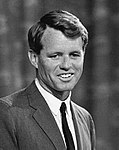

| International | |
|---|---|
| National | |
| Geographic | |

Robert F. Kennedy Bridge
View on GrokipediaEngineering and Physical Structure
East River Suspension Bridge (I-278)
The East River Suspension Bridge constitutes the longest span of the Robert F. Kennedy Bridge complex, carrying Interstate 278 across the East River from Randall's Island in Manhattan to Astoria in Queens. This suspension bridge features a main span measuring 1,380 feet (421 meters) between its two towers, with side spans each approximately 700 feet, enabling efficient load distribution over the waterway.[2][11] Engineering design emphasized suspension configuration to accommodate the span's length, where compressive forces in arch alternatives would necessitate impractically massive abutments and foundations in the riverbed sediments. Unlike the nearby Hell Gate Bridge, an arch structure with a 977-foot main span completed in 1916, the suspension approach leverages tensile strength in steel cables to support the deck, aligning with first-principles of structural mechanics favoring tension members for extended clear distances over deep water. The bridge employs two main cables, each 20 inches in diameter, comprising 37 strands of 248 wires, anchored to massive concrete blocks and passing over towers that facilitate vertical load transfer via suspenders.[12] Stiffening trusses along the deck enhance rigidity against flexural deformations from vehicular loads and dynamic forces, with the original design calibrated for heavy truck traffic on what became an interstate route. Empirical data from contemporaneous suspension bridges, such as the George Washington Bridge (main span 3,500 feet, opened 1931), informed wind resistance features including aerodynamic fairings and cable wind screening to mitigate vortex-induced oscillations. Load-bearing capacity targets dead loads from the 90-foot-wide roadway and live loads exceeding 50 tons per lane, distributed via the cable system's catenary curve that optimizes stress under gravity.[11] Seismic considerations, though minimal in the 1930s design era, drew from observed behaviors in California bridges, incorporating flexible anchorages to absorb lateral accelerations; subsequent retrofits, including wind and structural enhancements completed in phases through 2023, bolstered resilience without altering core suspension geometry.[13]Harlem River Lift Bridge (NY 900G)
The Harlem River Lift Bridge, designated as New York State Route 900G and integrated into Interstate 278 (I-278), is a vertical lift bridge that spans the Harlem River, connecting Randall's Island to Manhattan as part of the Robert F. Kennedy Bridge complex. Completed in 1936, it features a main Warren truss lift span measuring 310 feet (94 meters) in length, flanked by fixed approach spans of approximately 230 feet each.[11][14] The structure employs a tower-driven vertical lift mechanism, where the deck is suspended from two 210-foot towers via wire ropes running over sheaves connected to counterweights.[15][16] This counterweight system, utilizing multiple sheaves and ropes per tower (four sheaves with twelve ropes each), balances the span's weight to enable efficient lifting for vessel passage while minimizing energy requirements during operations.[16] The bridge's vertical clearance above mean high water is approximately 55 feet when closed, sufficient for most local maritime traffic but requiring lifts for taller vessels.[17] The lift mechanism allows the span to rise to provide adequate navigational clearance, historically accommodating commercial and recreational boats on the Harlem River. Engineering upgrades, including a comprehensive electrical and mechanical rehabilitation completed in 2020, modernized the drive motors, control systems, wire ropes, and added safety features such as standby generators and enhanced access platforms.[18][19] These improvements addressed aging components in the nearly 85-year-old structure, ensuring operational reliability and reducing potential failure risks in the tower drive assembly.[18] Operationally, the bridge opens on demand for marine traffic, with frequency determined by navigational needs rather than fixed schedules, reflecting the historically low volume of vessel passages on the Harlem River compared to busier waterways.[20] Empirical records indicate infrequent lifts, often fewer than those of nearby swing bridges like the Willis Avenue, which have seen declining openings due to reduced commercial shipping.[20] Downtime from lifts or maintenance is managed to limit disruptions to I-278's high traffic volumes, typically involving brief closures coordinated with the U.S. Coast Guard; post-2020 upgrades have further minimized unplanned outages by enhancing system redundancy and monitoring.[14] Historically, since its commissioning, the bridge has maintained a strong reliability record, with rehabilitations like the 2020 project extending its service life and supporting consistent performance amid evolving traffic demands.[14][16]Bronx Kill Crossing (I-278)
The Bronx Kill crossing of the Robert F. Kennedy Bridge carries Interstate 278 (I-278) via a series of fixed steel through truss spans connecting Randall's Island to the Bronx over the shallow, tidal Bronx Kill waterway.[11] This design employed multiple truss sections totaling approximately 1,600 feet in length, with a main span of 383 feet, selected for its simplicity and economy given the non-navigable nature of the channel at the time of construction.[11][21] The structure includes six truss spans supported by heavy concrete piers, allowing adaptation to the shallow water depths without the need for movable mechanisms like those on other segments of the bridge complex.[3] Engineers opted for a fixed-span configuration over a potentially convertible lift span to minimize costs and maintenance, as the Bronx Kill presented minimal navigational demands and tidal fluctuations that could be managed through pier foundations designed for scour resistance in the silty, variable-flow environment.[2] The steel trusses, featuring riveted polygonal Warren configurations, provide structural rigidity essential for the crossing's role in linking Randall's Island to the mainland, thereby enhancing the overall stability of the multi-borough bridge system by distributing loads across fixed supports.[11] Corrosion resistance was achieved through standard protective coatings on the steel members, grounded in established material science practices for marine environments to prevent degradation from saltwater exposure and humidity.[11] These spans accommodate eight lanes of vehicular traffic plus sidewalks, underscoring the crossing's function as a durable, low-maintenance link in the I-278 corridor.[22]Interchange Plaza and Approach Viaducts
The Interchange Plaza on Randall's Island constitutes the central nexus of the Robert F. Kennedy Bridge complex, where the spans crossing the East River, Harlem River, and Bronx Kill converge to form a multi-level junction. This hub integrates ramps and elevated roadways to direct Interstate 278 (I-278) traffic across boroughs while accommodating merges with Interstate 87 (I-87), the Major Deegan Expressway, via directional interchanges that separate eastbound/westbound flows from northbound/southbound movements.[23][2] The configuration employs a three-legged design, with curving ramps rising to varying elevations to optimize sight lines and reduce congestion at the plaza's core.[2] Approach viaducts extend from the plaza, elevating roadways over Randall's Island parkland using steel girders supporting concrete decks to span park areas without extensive ground excavation. These viaducts incorporate expansion joints for thermal expansion and contraction, alongside integrated drainage systems featuring scuppers and downspouts to prevent hydrostatic pressure buildup and ensure longevity under heavy loads. Notable segments include viaducts measuring 4,712 feet and 3,217 feet in length, forming part of the broader approach network that exceeds 10 miles when combining all directional spurs and connectors.[24][25][24] The viaducts' structural capacity supports peak-hour traffic volumes, with the complex designed for daily flows approaching 200,000 vehicles across its spans, maintained through periodic load testing to verify integrity against dynamic stresses like braking forces and wind loads.[26] Empirical assessments confirm no buckling under rated loads, attributing resilience to the hybrid steel-concrete composition and reinforced foundations.[27]Planning and Construction History
Initial Planning and Design Debates
The conceptual origins of the Triborough Bridge trace to the early 1920s, when New York City's burgeoning vehicular traffic—evidenced by a rise from 18,000 daily vehicles on existing East River spans in 1912 to 171,352 by 1925—necessitated improved borough connectivity.[28] Plans for a multi-span crossing had been sketched as early as 1916, but implementation stalled until a 1920 bill in the New York State Legislature proposed linking Manhattan, Queens, and the Bronx to alleviate congestion and support suburban expansion.[29] Gustav Lindenthal, the engineer behind the 1916 Hell Gate Bridge spanning the East River nearby, opposed the project in 1928, deeming it redundant to the existing rail link between Queens and the Bronx and advocating instead for enhanced rail utilization over new vehicular infrastructure.[30] His critique highlighted debates over duplicative crossings, prioritizing established rail capacity amid uncertain automotive growth, though proponents countered with empirical traffic data favoring dedicated road links for regional efficiency. Route selection centered on Randalls and Wards Islands as a central hub, enabling crossings of the East River (to Queens), Harlem River (to Manhattan), and Bronx Kill (to the Bronx) in a unified 3.5-mile complex.[4] This configuration was chosen for its engineering practicality in navigating the waterways' junction, grounded in observed traffic patterns rather than optimistic urban sprawl forecasts, avoiding direct competition with rail routes like Hell Gate while integrating boroughs via verifiable demand.[4] Design evolved toward a hybrid of structural types under chief engineer Othmar Ammann, with suspension adopted for the East River's 1,380-foot main span to optimize material use and cost for long distances, vertical lift for the Harlem River to permit maritime navigation without excessive height, and fixed truss for the shorter Bronx Kill crossing.[4] This departed from uniform alternatives like full cantilever systems, which proved less viable for the site's variable spans and clearance needs, favoring span-specific efficiencies derived from load-bearing analyses and economic constraints over speculative uniformity.[31]Funding Challenges and New Deal Involvement
The Triborough Bridge project encountered acute funding shortages in the early 1930s as the Great Depression eroded New York City's fiscal capacity. Initial site preparations and caisson work commenced in 1930 following legislative authorization, but by 1932, plummeting tax revenues and investor aversion to risk halted progress, leaving only skeletal foundations amid widespread municipal bankruptcies nationwide.[29][32] Local bond proposals faltered, as credit markets froze and property owners demanded inflated compensation, exacerbating delays and underscoring the limits of state and city financing without external guarantees.[33] In response, the New York State Legislature created the Triborough Bridge Authority (TBA) on February 28, 1933, granting it authority to issue revenue bonds repayable from tolls rather than general taxation, a mechanism intended to attract private capital while insulating taxpayers from direct liability.[34] Yet Depression-induced bond market paralysis—marked by yields exceeding 6% for even secure issues—rendered this insufficient, with prospective investors wary of unproven toll projections and the city's credit downgrade. The TBA's early bond offerings yielded minimal uptake, compelling appeals for federal backing to bridge the viability gap.[35] Federal intervention via the Public Works Administration (PWA), established under the National Industrial Recovery Act of June 1933, proved decisive. The PWA allocated $44 million in combined grants and loans—specifically $9 million outright grant and $35 million loan—for the project, covering over 70% of the estimated $60.3 million total cost, supplemented by $16.1 million in city funds and TBA bonds.[36][37] This infusion, sourced from federal borrowing that swelled the national debt from $22.5 billion in 1933 to $40.4 billion by 1936, directly enabled bond market confidence and construction resumption, demonstrating how subsidized deficit spending circumvented local constraints but imposed nationwide taxpayer burdens for a regionally focused infrastructure outlay. Critics at the time, including fiscal conservatives in Congress, highlighted such PWA allocations as prone to political favoritism over rigorous cost-benefit scrutiny, akin to pork-barrel distribution amid competing national priorities like farm relief and banking stabilization.[38][39] Without this causal lifeline of federal subsidies, empirical evidence from contemporaneous stalled projects suggests the bridge would have languished indefinitely, as municipal revenues alone covered under 30% of expenses.[40]Construction Phases and Engineering Milestones
Construction of the Triborough Bridge resumed in January 1934 following funding from the Public Works Administration, which provided a $9 million grant and $35 million loan to advance the project amid the Great Depression. Initial contracts focused on foundational work, including the sinking of caissons and erection of towers for the East River suspension span and the Harlem River lift bridge, alongside piers for the Bronx Kill crossing. These efforts employed up to 3,000 workers at peak, coordinated by over 200 contractors and supported by materials from 600 manufacturing plants across 30 states, totaling 2,000,000 cubic yards of concrete and 91,000 tons of steel and iron products.[36] Cable spinning for the East River suspension span commenced in early 1935, with the first thin strands thrown across the Hell Gate channel on March 19, halting East River traffic to facilitate the operation. Engineers supervised the process under Othmar Ammann's design, completing the main cables by July 1935 after weaving thousands of individual wires into the final bundles anchored to the towers. This milestone enabled the installation of vertical suspenders and the stiffening truss, addressing the span's 2,640-foot length between anchorage points on Wards Island and Queens.[41][4] Deck installation and approach viaducts progressed through 1936, with the East River suspension span structurally complete by mid-year, integrating the 770-foot Harlem River vertical lift bridge—featuring 210-foot towers and the world's largest such span at the time—and the Bronx Kill fixed crossing. Site-specific obstacles, including variable waterway depths and urban terrain, were overcome through modular viaduct construction and concrete arch spans over creeks, culminating in the removal of temporary supports by July 1936. The project's aggressive timeline involved over 2,000 study drawings and 9,000 working drawings produced in 30 months, showcasing coordinated engineering under the Triborough Bridge Authority.[36][4]Opening and Early Operations
Inauguration and Immediate Effects
The Triborough Bridge was officially dedicated on July 11, 1936, by President Franklin D. Roosevelt during a ceremony on Randall's Island, highlighting its role in unifying New York City's boroughs and advancing regional infrastructure under the New Deal.[42] The event emphasized the bridge's completion after years of construction delays, with Roosevelt praising its potential to serve the city, state, and nation by facilitating efficient vehicular and pedestrian movement across the East River, Harlem River, and Bronx Kill.[42] The inaugural day operated toll-free, drawing an estimated 200,000 vehicles and resulting in severe congestion, including traffic backups extending up to 15 hours as motorists from Manhattan, Queens, and the Bronx accessed the new crossing.[43] This immediate surge underscored public demand for direct land connections, bypassing circuitous routes and water crossings that had previously dominated inter-borough travel.[44] Post-opening, the bridge rapidly alleviated cross-borough bottlenecks, shortening a standard 45-minute trip via legacy arterials and ferries to approximately 16 minutes for equivalent routes.[45] Traffic volumes on competing East River spans, such as the Queensboro and Williamsburg Bridges, declined by about 30% in the ensuing weeks, reflecting a shift away from ferry-dependent itineraries and signaling reduced operational strain on municipal water transport services.[46] These effects validated the bridge's design for high-volume throughput, though initial adjustments to approach signage ensured clearer navigation amid unfamiliar traffic flows.[45]Early Traffic Patterns and Modifications
Following its opening on July 11, 1936, the Triborough Bridge experienced swift vehicular adoption, recording 4,756,008 vehicles in the partial year from opening through December 31.[47] Traffic volume more than doubled the next year to 11,042,949 vehicles in 1937, then slightly increased to 11,420,111 in 1938, exceeding projections set during planning.[47][48] These figures reflected the bridge's utility in linking Manhattan, Queens, and the Bronx, drawing commuters and commercial traffic previously bottlenecked at alternatives like the Queensboro Bridge.[32] The surge strained the original configuration, which featured two lanes per direction on the main East River suspension span and similar setups on viaducts and approaches, leading to early signs of congestion during peak hours.[49] This prompted capacity-focused responses, including the 1939 opening of the Bronx-Whitestone Bridge to siphon excess Bronx-bound volume from the Triborough system. Traffic data indicated the Triborough's volumes stabilized or dipped modestly in 1939–1940 amid economic pressures, but rebounded with a 10 percent rise in 1941, underscoring persistent demand pressures.[47] Empirically, the bridge accelerated goods transport by enabling direct cross-borough routing without ferry dependencies or East River delays, mitigating pre-existing jams that had imposed calculable economic costs through idling vehicles and slowed freight.[32] Initial operational tweaks included toll rate adjustments and signage refinements to manage flow, though major structural widening awaited postwar expansions; accident records from the era, while not prompting widespread redesigns, informed localized safety retrofits such as reinforced barriers on high-risk viaduct curves by the early 1940s.[50]Naming History and Controversies
Original Designation as Triborough Bridge
The Triborough Bridge received its original designation upon opening to traffic on July 11, 1936, as a descriptive name highlighting its function in linking the New York City boroughs of Manhattan, Queens, and the Bronx across the East River, Harlem River, and Bronx Kill.[3][51] The term "Triborough" directly referenced this tri-borough connectivity, underscoring the structure's practical role as a unified complex of three bridges, viaducts, and approach roads designed to integrate vehicular, pedestrian, and potential transit flows among these jurisdictions.[5][1] This naming convention prioritized geographic and operational clarity over eponymy, consistent with early 20th-century infrastructure practices that favored functional descriptors in official nomenclature, engineering reports, and signage to ensure unambiguous identification for users and administrators.[3] The Triborough Bridge and Tunnel Authority, established in 1933 to oversee the project, employed the name in all formal capacities from inception through mid-century operations, reflecting a focus on utility amid the era's emphasis on regional unification via New Deal-era public works.[36] Public recognition of the "Triborough" designation has endured into the 21st century, with widespread colloquial and navigational use persisting despite subsequent administrative changes, as evidenced by ongoing references in media, driver familiarity, and local discourse that retain the original term for its evocative precision.[52][53] This longevity attests to the name's inherent alignment with the bridge's physical and connective essence, facilitating intuitive comprehension across generations without reliance on personal commemoration.[54]2008 Renaming to Robert F. Kennedy Bridge
The New York State Legislature passed Assembly Bill A10789 in June 2008, renaming the Triborough Bridge as the Robert F. Kennedy Bridge to honor the former U.S. senator's contributions to the state.[55] Sponsored by Assembly Speaker Sheldon Silver, a Democrat, the measure received support from Governor [Eliot Spitzer](/page/Eliot Spitzer) and members of the Kennedy family, who emphasized Robert F. Kennedy's tenure representing New York in the U.S. Senate from January 1965 until his assassination in June 1968.[56] The bill advanced amid Democratic legislative majorities, framing the change as recognition of Kennedy's advocacy for urban poverty alleviation and social programs during his brief senatorial career, though he held no prior elected office in New York and focused primarily on federal issues rather than state infrastructure projects. Kennedy's legislative record in the Senate included initiatives on education, poverty, and urban renewal, such as support for programs aiding underprivileged youth, but lacked documented ties to the Triborough Bridge or its operations, which predated his political rise by nearly three decades.[57] The renaming effort aligned with broader political efforts to commemorate Democratic figures from the 1960s era, bypassing consultations with bridge users or fiscal impact assessments beyond basic compliance. Implementation entailed replacing roughly 140 directional signs across state roadways approaching the bridge, incurring a $4 million expenditure from public funds for materials, labor, and installation, separate from minor MTA costs for on-bridge signage.[58][59] This outlay stemmed directly from statutory requirements for uniform signage under state transportation policy, representing an avoidable fiscal commitment to symbolic rebranding that yielded no enhancement to the structure's engineering, safety, or capacity, as the bridge's physical attributes remained unchanged.[58]Public Backlash, Costs, and Persistent Use of Original Name
The renaming of the Triborough Bridge to the Robert F. Kennedy Bridge on November 19, 2008, elicited immediate criticism centered on the financial burden and perceived politicization of public infrastructure nomenclature. State officials estimated the cost of replacing approximately 140 road signs at $4 million, a figure decried by opponents as an unnecessary expenditure amid fiscal constraints, with one commentator labeling it a "complete waste of money" that diverted funds from maintenance or other priorities.[58][59][54] Critics, including those from right-leaning perspectives, argued that honoring Robert F. Kennedy—a figure known for advocating gun control measures following the assassinations of John F. Kennedy and Martin Luther King Jr., as well as his opposition to the Vietnam War—imposed a partisan legacy on a functionally descriptive structure unrelated to his tenure or achievements in transportation.[60] This view framed the change as an erasure of the bridge's neutral, geographic heritage in favor of symbolic gestures driven by Kennedy family advocacy, despite RFK's own environmental skepticism toward large-scale infrastructure projects.[61] Proponents of the renaming, including state lawmakers and Kennedy supporters, justified it as a tribute to RFK's civil rights advocacy and public service as a New York senator, emphasizing his role in advancing social justice initiatives.[62] However, empirical indicators of public reception undermine claims of widespread adoption: as early as 2008, skeptics questioned whether the name would "catch on," a prediction borne out by persistent colloquial use of "Triborough" in everyday speech, media references, and navigation systems.[52] Anecdotal evidence from New Yorkers, including online forums and local commentary, reveals that "tens of thousands" continue to default to the original designation, with some outlets like Bloomberg noting its endurance in traffic websites and public discourse over a decade later.[6][63] The failure of the RFK name to supplant Triborough underscores a causal disconnect between legislative fiat and organic naming conventions, where descriptive utility prevails over imposed honorifics absent broad consensus or direct relevance. Remnants of original signage, such as a large "Triboro Bridge" marker in the Bronx persisting years after the change, further illustrate this resistance, symbolizing broader taxpayer frustration with costs yielding negligible behavioral shifts.[64] No formal surveys quantify exact usage splits, but the consistent invocation of "Triborough" in GPS queries, driver parlance, and even semi-official contexts—contrasting with the bridge's engineered purpose of borough connectivity—evidences the renaming's limited efficacy.[65] This persistence aligns with patterns in other renamings, where functional names endure due to ingrained familiarity rather than ideological preference.Mid-to-Late 20th Century Operations
Postwar Highway Expansions and Usage Growth
Following World War II, the Triborough Bridge experienced substantial growth in vehicular usage amid the nationwide surge in automobile ownership and suburban expansion. By 1950, the Triborough Bridge and Tunnel Authority reported record traffic volumes across its facilities, contributing to net profits of $10,654,794, attributed in part to heightened postwar demand for cross-borough travel.[66] This trend continued, with a 4% overall increase in vehicles recorded by 1955, setting another peak despite variability among individual crossings.[67] Such empirical data reflected broader regional patterns, where major New York City highway traffic nearly doubled in the late 1940s and early 1950s due to economic recovery and rising car dependency.[68] To integrate the bridge into the emerging Interstate Highway System and accommodate escalating volumes, its spans were designated as part of Interstate 278 (I-278) in June 1958, linking the Hell Gate suspension bridge and Bronx Kill viaduct to the Bruckner Expressway and Grand Central Parkway.[49] This alignment facilitated smoother through-traffic flows, aligning with federal interstate planning initiated under the 1956 Federal-Aid Highway Act. Concurrently, ramp modifications and additions connected the bridge to the Throgs Neck Expressway (later designated I-695), constructed under Triborough Bridge and Tunnel Authority oversight from the mid-1950s to enhance east-west mobility in the Bronx and Queens.[69] These tie-ins, planned in Robert Moses-led studies like the 1955 Joint Study of Arterial Facilities, supported the 1961 opening of the Throgs Neck Bridge and its approaches, diverting overflow from the Bronx-Whitestone Bridge while boosting capacity for Triborough-linked routes.[70] Congestion pressures from the traffic boom prompted operational adjustments, including empirical analyses of peak-hour bottlenecks that informed ramp signaling and approach optimizations without major bridge-span widening, as the original six-lane configuration persisted.[71] By the early 1960s, these postwar adaptations had embedded the bridge within a denser highway network, sustaining usage growth tied to interstate commerce and commuting patterns.Modifications for Increased Capacity
In the 1960s, the Triborough Bridge's effective capacity was enhanced through widening of connected approach roadways, such as the Grand Central Parkway, which was expanded from four to eight lanes between the bridge and Kew Gardens to manage surging postwar traffic volumes originating from and destined to the bridge spans.[72] This incremental adjustment improved ingress and egress flow without requiring alterations to the bridge's core viaducts or suspension elements, reflecting a cost-effective strategy that leveraged existing infrastructure alignments to accommodate approximately doubled regional vehicle usage by the late 1960s.[72] By the 1970s, further tweaks focused on safety-driven modifications informed by crash analyses, including the installation of concrete median barriers along 12.3 miles of the Brooklyn-Queens Expressway between the Brooklyn-Battery Tunnel and Triborough Bridge approaches.[73] These barriers addressed crossover accidents—prevalent in data from high-volume urban corridors—by physically separating opposing lanes, thereby reducing incident frequency and resultant lane closures that bottlenecked bridge throughput.[74] Such targeted interventions, prioritizing causal reductions in disruption over expansive rebuilds, extended the bridge's operational capacity at lower expense than full-span widenings, which would have entailed prohibitive seismic retrofits and navigational clearances amid growing East River shipping demands.[73] Through the 1980s and 1990s, similar engineering refinements continued, integrating the bridge more seamlessly with interstate corridors like I-278 and I-95 via ramp optimizations and barrier upgrades on adjacent viaducts, sustaining traffic handling amid volumes exceeding original design projections by over 50% without radical overhauls.[49] These measures underscored a pragmatic balance, where empirical crash reductions and flow efficiencies yielded higher throughput returns than equity-focused reallocations, preserving the structure's integrity for escalating urban mobility needs.21st Century Developments and Usage
Electronic Tolling and Infrastructure Upgrades
The Metropolitan Transportation Authority (MTA) implemented cashless tolling, also known as open road tolling, on the Robert F. Kennedy Bridge effective June 15, 2017, converting the facility to an all-electronic system. Overhead gantries equipped with sensors read E-ZPass transponders for registered users and capture license plate images for others, who receive toll bills by mail, eliminating the need for vehicles to stop at traditional booths. This upgrade facilitates uninterrupted traffic flow through the former toll plaza area, directly addressing congestion bottlenecks previously caused by queuing.[75][76] Post-implementation data from the MTA indicates a 6.6 percent increase in E-ZPass usage on the bridge in 2017, reflecting higher adoption of electronic payment methods. Across MTA Bridges and Tunnels facilities, including the RFK Bridge, cashless tolling has correlated with reduced customer travel times and a 7 percent rise in average daily traffic volumes, demonstrating improved throughput efficiency without proportional delays.[77][78] Infrastructure enhancements since the 2000s have focused on technological and structural improvements for operational resilience and efficiency. Seismic retrofits to the steel superstructure incorporate isolation systems to mitigate earthquake risks, prioritizing the bridge's role as a key evacuation route based on engineering analyses of vulnerability.[79] Deck replacement projects, such as those on the suspended spans and Queens viaduct, have involved lane-by-lane removal of deteriorated concrete surfaces and installation of new steel or composite decks, accompanied by upgrades to support stringers, drainage systems, and seismic reinforcements to extend service life under heavy loads.[80][81] Advanced monitoring and detection systems have been integrated facility-wide, enabling real-time data collection on traffic conditions, structural health, and environmental factors to support dynamic management and predictive maintenance. Energy-efficient LED lighting replaced legacy mercury vapor fixtures in the bridge's ornamental necklace lighting by 2011, reducing power consumption and enhancing visibility for safer nighttime operations.[82][83]Pedestrian, Bicycle, and Transit Integration
The Robert F. Kennedy Bridge provides sidewalks along its three main spans—the East River suspension bridge, the Bronx Kill viaduct, and the Harlem River lift bridge—accommodating pedestrians and cyclists under MTA Bridges and Tunnels regulations, which require cyclists to dismount on the lift span during operation.[9] Prior to recent upgrades, these paths featured low barriers, intermittent stairs, and incomplete linkages to adjacent boroughs and Randall's Island, rendering cross-borough travel intimidating and non-continuous for non-motorized users.[84] In May 2025, the MTA completed a major overhaul of pedestrian and bicycle infrastructure, introducing a continuous shared-use path across the Harlem River lift bridge and extending ADA-compliant connections from Manhattan to Randall's Island and the Bronx.[9] This included wider, smoother surfaces with improved lighting, higher barriers for safety, and precast concrete switchback ramps to eliminate stairs and ensure end-to-end accessibility without vehicle interference.[85][86] The upgrades replaced outdated ramps, such as the southern pedestrian access from 124th Street in Manhattan, with fully compliant designs supporting micromobility devices alongside bicycles and foot traffic.[87] These enhancements addressed longstanding gaps in non-vehicular connectivity, though full dedicated bike lanes remain absent across the entire complex, limiting capacity during peak multimodal demand. Transit integration relies primarily on bus services, with the M60 Select Bus Service (SBS) operating as the principal public route traversing the bridge from Manhattan's Upper West Side via 125th Street to Astoria Boulevard in Queens and LaGuardia Airport.[88] This corridor connects to multiple subway lines, including the 1, A/B/C/D, 2/3, and 4/5/6 at 125th Street stations, facilitating transfers for riders avoiding vehicular tolls. Proximity to stations like Astoria Boulevard (N/W lines) enhances last-mile access, but the absence of direct rail links on the bridge itself underscores reliance on bus-based multimodal trips, with no published MTA data isolating pedestrian or cyclist volumes amid overall bridge usage.[89] Historical underinvestment in seamless non-motorized paths has constrained broader adoption, as evidenced by pre-2025 barriers that deterred consistent use despite available sidewalks.[90]Current Traffic Volumes and Patterns
The Robert F. Kennedy Bridge accommodates approximately 189,000 vehicles per day on average in 2024, reflecting a total annual volume of 69.1 million vehicles.[77] This marks a 1.9% increase from 2023's 67.8 million vehicles, continuing a post-pandemic recovery trend that saw volumes rebound from a pandemic-low of 50.4 million vehicles (about 138,000 daily) in 2020.[77] Traffic patterns exhibit seasonal and diurnal peaks, with monthly averages exceeding 200,000 vehicles per day in high-recreation periods such as June 2024 (200,179 vehicles daily).[77] Weekday rush hours, typically from 6:00 a.m. to 10:00 a.m. for inbound travel toward Manhattan and 4:00 p.m. to 8:00 p.m. for outbound, concentrate volumes on the East River suspension span, which serves as the primary east-west linkage between Queens and Manhattan via Randall's and Wards Islands.[91] Congestion at this span prompts diversions to parallel routes like the Queens-Midtown Tunnel during peak demand.[77] The initial sharp decline in volumes post-2020 stemmed from widespread remote work adoption and mobility restrictions amid the COVID-19 pandemic, reducing commuter flows by over 50% from pre-2020 baselines.[77] Subsequent resumption of in-office work has driven sustained growth, enabling 2023 volumes to surpass historical highs across MTA Bridges and Tunnels facilities, including the RFK Bridge, despite lingering hybrid work arrangements.[92] Early 2025 data indicate a slight 0.9% dip from 2024, potentially influenced by emerging factors like the Central Business District Tolling Program.[77]Tolls and Economic Management
Historical Toll Structures and Adjustments
Upon its opening on July 11, 1936, the Triborough Bridge imposed a flat toll of 25 cents on passenger vehicles, collected unidirectionally to finance outstanding bonds and operational costs while directing traffic flow toward Manhattan.[40][5] This rate applied uniformly to cars, with higher fees scaled by vehicle class, such as additional charges for trucks based on axle count to reflect greater wear on infrastructure. Toll adjustments occurred periodically to address revenue shortfalls amid escalating maintenance demands and inflation, which outpaced initial projections for self-sustaining operations. By the early 1970s, rates had doubled to 50 cents for passenger cars, reflecting postwar traffic growth and deferred upkeep expenses.[93] Further hikes followed: to 75 cents around 1975, $1.00 by 1980, and $1.25 in 1982, as bond obligations and structural repairs strained collections.[93][94] These escalations maintained tolls as a user fee mechanism, intended to allocate costs directly to beneficiaries rather than taxpayers, though critics contended they functioned regressively by disproportionately burdening lower-income commuters without alternatives to driving.[95]| Period | Passenger Car Toll (Cash Rate) | Key Driver for Adjustment |
|---|---|---|
| 1936 | $0.25 | Initial bond financing and operations[40] |
| 1972–1975 | $0.50 | Inflation and traffic-induced wear[93] |
| 1975–1980 | $0.75 | Rising maintenance shortfalls[93] |
| 1980–1982 | $1.00 | Debt service and cost escalation[93] |
| 1982–1986 | $1.25 | Congestion management and repairs[94] |