Hubbry Logo
Newsagent's shopNewsagent's shopMain
Open search
Newsagent's shop
Community hub
Newsagent's shop
logo
8 pages, 0 posts
0 subscribers
Be the first to start a discussion here.
Newsagent's shop
Newsagent's shop
from Wikipedia
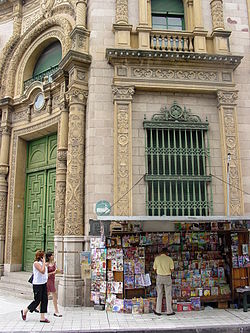
A newsstand in Salta, Argentina

A newsagent's shop or simply newsagent's or paper shop[1] (British English), newsagency (Australian English) or newsstand (American and Canadian English) is a business that sells newspapers, magazines, cigarettes, snacks and often items of local interest. In the United Kingdom, Ireland and Australia, these businesses are termed newsagents (or newsagency in Australia). Newsagents typically operate in busy public places like city streets, railway stations and airports. Racks for newspapers and magazines can also be found in convenience stores, bookstores and supermarkets. The physical establishment can be either freestanding or part of a larger structure (e.g. a shopping mall or a railway station).

In Canada and the United States, newsstands are often open stalls in public locations such as streets, or in a transit terminal or station (subway, rail, or airport).

By country

[edit]

Australia

[edit]
The interior of a newsagency in Canberra during 2025

A newsagent is the manager of the newspaper department of the shop, often also the owner of a newsagency shop.

Newsagencies conduct either a retail business and/or a distribution business.

When they first appeared in Australia is unknown; the earliest reference known in Australia is an advertisement in 1855 in Melbourne.[2]

The number of newsagencies in Australia are falling in recent years and this decline is expected to continue. In 2000, there was estimated about 5,000,[3] by 2007/8 there were 4,635 newsagencies, and by 2016/7 there were just 3,150 newsagencies.[4]

Retail newsagencies

[edit]

Retail newsagencies[5] primarily offer a comprehensive range of newspapers and magazines, as well as stationery and greeting cards.

Distribution newsagencies

[edit]

Distribution newsagencies[5] offer home delivery of a comprehensive range of newspapers and magazines, These can be quite large and sophisticated businesses. If authorised, they are often fully computerized. They often have a territory, which is partly protected by contracts with most of the Australian Newsagents' Federation recognised publishers/distributors. These recognised publishers/distributors include ACP Publishing, News Limited, Fairfax Publications, Rural Press, The West Australian and Australian Provincial Newspapers. These monopolies have been a major source of contention between newsagents and the Australian Consumer Affairs.

Brazil

[edit]

In Brazil, newsagents' shops are known as "bancas de jornal" or "bancas de revistas" and are usually family-owned, free-standing kiosks that only deal in periodical publications, telephone cards, bus tickets and the occasional book and cut-price DVD. In suburban areas and villages they are normally housed in a shop selling stationery, tobacco and sweets as well as periodicals.

Greece

[edit]

In Greece, newsagents' shops are called periptera (singular: periptero) and they sell newspapers and magazines, but also other goods like beverages (including alcoholic ones), snacks, tobacco; and other kinds of merchandise. Opening times vary. They are typically found on the side of the road in crowded public areas.[6][7]

A periptero in Athens, Greece

Italy

[edit]

In Italy, newsagents' shops are known as edicola and are usually family-owned, free-standing kiosks that only deal in periodical publications, stickers, bus tickets and the occasional book and cut-price DVD. In suburban areas and villages they are normally housed in a shop selling stationery, tobacco and sweets as well as periodicals.

Japan

[edit]

In Japan, newsagents' shops are called kiosks, and are typically found in or around railway or subway stations. In addition to newspapers and magazines, they sell beverages, snack foods, postage stamps, cigarettes, and many other kinds of merchandise. Ekiben boxed lunches can be purchased at larger kiosks in inter-city rail stations.

United Kingdom

[edit]

In the United Kingdom, newsagents' shops are small shops selling newspapers as well as magazines, sweets and tobacco. In addition to counter sales, the shops traditionally also deliver newspapers to people's homes. The deliverers, usually children, are said to have a "paper round".[8] Some newspagests also sell provisions and alcoholic beverages. Opening times vary according to the owners' preferences.

Many shops are family-owned. These family-owned shops may carry purchasing group or wholesaler group branding. Alternatively the private owner choosing to do his own purchasing (usually from cash and carries) may carry advertising for a local paper, national news group or soft drink brand externally. Prior to the banning of advertising of tobacco products, this was the most common form of external advertising. The primary employers association aimed towards looking after the interests of independent newsagents in the UK and Ireland is the National Federation of Retail Newsagents.

Others are part of national chains such as The Co-op and WHSmith. Mini-marts, off-licences and supermarkets may also act as newsagents.

United States

[edit]

Alameda, California

In 1934, John J. Mulvany, Vice President of a Bank of America branch, across the street, donated the materials and labor to build Paul’s Newsstand at the northwest corner of Santa Clara Avenue and Park Street in Alameda, California.[9][10]

Los Angeles, California

In the late 1940s, at the corner of 1st and Soto streets, in Boyle Heights a newsstand opened and survived.[11][12]

San Francisco

JCDecaux news kiosk, Market St. at Montgomery St., April 27, 2020

JCDecaux installed news kiosks[13] in downtown San Francisco, as part of a contract[14] for advertising displays,[15] toilets and other street furniture, replacing steel beam and aluminium siding newsstands painted beige,[16] telephone pole displays,[17] and plywood shacks painted green.[18] They remain, without news vendors,[19] with a few repurposed[20][21] for "Free Bike Repair",[22] other printed sales,[23] and continue to display advertisements.[24]

New York City

An outdoor newsstand, New York City, October 2008

On street corners in New York City, for instance, newsstands are often shacks constructed of steel beams and aluminium siding or roofing tin; and require a city permit to build and operate. Other New York newsstands are located inside airports, hotels and office buildings – and even beneath street level in underground concourses or on subway platforms. Hudson News, a newsstand brand created in New York City, is operated by retailer the Hudson Group, with more than 500 stores around the world. This brand was created in 1987, and became more popular in the 1990s, during a time when newsstands in commuter terminals were being re-evaluated and reopened to better serve customers and the spaces with the most commuter foot traffic. Prior to this, newsstands caused limited visibility for police officers patrolling the subway stations, as well as impeding crowd movement.[25]

References

[edit]
[edit]
Revisions and contributorsEdit on WikipediaRead on Wikipedia
from Grokipedia
A newsagent's shop is a small retail establishment primarily dedicated to selling newspapers, magazines, products, , and other convenience items such as snacks and . These outlets, common in the , , and , typically operate in urban or suburban areas and often include additional services like lottery ticket sales or postal items. Originating in the late , newsagent's shops evolved from general stationers as mass-circulation newspapers proliferated, transforming them into specialized vendors of printed media and related goods. They have historically served as focal points, where residents access daily news and minor essentials amid the rise of print journalism. However, the shift toward consumption has eroded print sales, contributing to the closure of many independent newsagents, with newspaper revenues declining steadily due to dispersed advertising and reduced circulation. This structural change underscores the causal link between technological disruption in information delivery and the viability of brick-and-mortar print retailers.

Definition and Characteristics

Products and Services

Newsagent's shops stock newspapers and magazines as primary products, often displayed prominently to attract daily customers seeking current affairs and periodicals. These outlets extend beyond print media by offering products, , snacks, and , functioning as hybrid convenience stores that cater to immediate consumer needs. Stationery items, greeting cards, and small gifts form part of the , targeted at impulse purchases near checkout areas to boost average transaction values. Such products yield high margins, with greeting cards and potentially offering up to 40% profit in retail settings. In addition to goods, newsagent's shops provide services like National Lottery ticket sales, which serve as a key revenue diversifier alongside everyday essentials. Many sell postage stamps through arrangements with , enabling commission-based earnings from postal needs. Public transport options, such as cards in , are available at select newsagents, enhancing their utility as local service hubs. Some locations also facilitate photocopying or parcel collection, though these vary by shop size and partnerships.

Operational Features and Layout

Newsagent's shops are typically compact retail units situated in high-footfall urban locations, such as high streets, street corners, or near railway stations and bus stops, to accommodate quick stops by commuters and pedestrians. These premises often span 50 to 100 square meters, prioritizing a counter-centric layout that facilitates rapid transactions over extensive browsing space. The emphasizes and , with a prominent service counter positioned at the front or center where staff handle sales of newspapers, magazines, and impulse items like displayed on or adjacent to it. High-value and age-restricted goods, including products and scratch cards, are stored behind the counter to deter and comply with regulatory requirements for served sales. Limited wall shelving accommodates and non-perishables, while small refrigerated displays near the counter hold perishables such as and sandwiches, minimizing customer wait times in a predominantly served rather than model. Operations rely on small staffing levels, usually comprising the and one or two assistants, enabling extended hours from approximately 7:00 a.m. to 8:00 p.m. to align with peak commuter flows. Transactions have historically favored due to low-value purchases, though card and contactless payments have become more common, with some shops imposing minimum spends on cards to offset processing fees.

Historical Development

Origins in the United Kingdom

The emergence of newsagent's shops in the coincided with the Industrial Revolution's and the expansion of affordable print media in the mid-19th century. By 1851, Britain had become the first predominantly urban society, with over half its population residing in , which concentrated demand for local retail and reading materials amid rapid population shifts from rural areas. Newspaper distribution initially relied on street hawkers and itinerant sellers, but the repeal of the newspaper stamp duty on 30 1855 enabled publishers to produce cheaper dailies, dramatically increasing circulation and necessitating more stable retail formats. This shift propelled the evolution from mobile vendors to fixed shops, often small premises operated by stationers who stocked newspapers alongside tobacco products and miscellaneous sundries to serve daily urban consumers. A key milestone in standardizing distribution came in 1848, when W. H. Smith opened the first railway bookstall on 1 November at Euston station in , supplying newspapers and periodicals to rail travelers and influencing the networked model of news retail across stations. These early outlets primarily targeted working-class readers seeking inexpensive news amid industrial growth, laying the foundation for the specialized newsagent's shop as a community fixture.

Expansion and Evolution in the 20th Century

During the , newsagent's shops in the expanded in tandem with the growth of , as —inaugurated by the in 1922—and cinema attendance complemented print publications rather than displacing them. Cinema visits reached approximately 1 billion annually by the late across over 4,300 theaters, fostering public interest in related news, magazines, and serialized stories that drove and periodical sales through local outlets. Newsagents, often positioned in high streets and residential areas, capitalized on rising literacy rates and , distributing dailies that covered emerging media events alongside traditional reporting. Following , a surge in comic books and magazines significantly enhanced the economic viability of newsagent's shops. British titles such as and achieved weekly circulations exceeding 1.5–2 million copies by the early 1950s, while wholesalers like Thorpe & Porter imported and distributed American comics—initially as —directly to newsagents for resale. This period marked the peak of print media dominance, with national daily newspaper circulation totaling about 21 million copies in 1950, equivalent to over 140% of households, sustaining a dense network of outlets. From the 1950s onward, newsagent's shops began evolving from primary newsstands toward hybrid convenience models amid suburban expansion and technological shifts. The rapid adoption of television—penetrating 75% of homes by 1960—prompted stocking of listings magazines like , while post-rationing demand for sweets and diversified inventory to include and basic sundries. Rising , which doubled from 2.4 million vehicles in 1951 to 5.1 million by 1961, facilitated suburban site selection and customer access, enabling shops to broaden beyond print to counterbalance fluctuating media demands. This adaptation peaked mid-century, before early pressures from chain retailers hinted at future consolidation.

Business Operations

Supply Chain and Distribution Models

The for newsagents' shops centers on the rapid distribution of time-sensitive print media, primarily and , which necessitates daily or near-daily deliveries to maintain relevance and minimize obsolescence. Publishers, such as , produce and initially transport copies to regional wholesale depots, where major distributors like Smiths News consolidate and redistribute them to retailers. Smiths News, the UK's dominant and wholesaler, operates from 39 distribution centers and serves approximately 25,500 customers daily, managing a complex network tailored to the fast-changing content of dailies. This model relies on precise scheduling, with wholesalers receiving publisher deliveries under strict cut-off times to enable onward transport, often via specialized vans ensuring stock arrives fresh for morning sales. To address the perishability of dated print products, newsagents operate under a "sale or return" system, whereby unsold copies are returned to wholesalers or reported for full credit, reducing but generating significant . This mechanism, standard for national newspapers audited by bodies like ABC , allows retailers to claim net sales after crediting returns, though it contributes to environmental and cost burdens from pulping or excess stock. Return rates vary by title and accuracy, with historical data for magazines indicating unsold portions around 45% in newsagencies, reflecting challenges in predicting and consumer preferences. For newspapers, tighter daily cycles aim to keep rates lower, but inaccuracies in wholesaler allocations—often based on prior sales data—can still lead to over-supply, exacerbating logistics costs in a declining print market. Ancillary goods like , , and snacks supplement print revenue through direct supplier agreements or secondary wholesalers, bypassing the print-focused chain for more stable . However, when newsagents stock perishables such as or baked goods, management intensifies, requiring balancing high-turnover print demands with spoilage risks from short shelf lives. Wholesalers provide consolidated deliveries for efficiency, but retailers face ongoing challenges in to avoid overstocking perishables, which can lead to waste rates influenced by failures or demand volatility, compounded by the space constraints typical of small newsagent premises. This dual-model approach—reliant on specialized print while integrating general retail supply—underscores the operational fragility of newsagents amid shifting consumer habits.

Retail vs. Distribution Newsagencies

Retail newsagencies operate as consumer-facing outlets, emphasizing direct sales of newspapers, magazines, , greeting cards, , and lottery products to the public, with a focus on in-store and supplementary merchandise to enhance foot traffic and sales. Distribution newsagencies, by contrast, function as wholesale intermediaries, procuring publications in bulk from publishers or specialist firms like Gordon and Gotch, then supplying them to multiple retail outlets via coordinated logistics including fleet-based deliveries and processing of unsold returns. In , where the industry comprises approximately 5,000 newsagencies, operational models include retail-only, distribution-only, and combined entities, though a trend toward separation has emerged since the late dissolution of territorial distribution councils, allowing publishers to negotiate directly with specialized operators. Distributors manage high-volume supply chains, enabling economies in transportation and inventory handling that alleviate overhead for independent retailers, who avoid maintaining warehouses or delivery vehicles; this structure, however, fosters retailer dependency on distributor performance for timely, fresh stock of perishable items like daily newspapers. The interdependence underscores causal linkages in the model: distribution hubs derive margins from aggregated sales volume across retailer networks, while retailers leverage reliable wholesale access to sustain product diversity without upstream risks, ensuring mutual viability amid fluctuating demands.

Economic Aspects and Challenges

Revenue Streams and Profitability

Revenue streams for newsagent shops traditionally include sales of printed newspapers and magazines, products, tickets, and ancillary items such as , , and cards. Newspapers and magazines provide a core but declining revenue base, with retail margins typically ranging from 20% to 25% per copy sold, though publishers have periodically reduced these rates amid rising cover prices—for instance, dropping to 20.5% on certain titles like the in 2023. Tobacco products contribute substantially to turnover through high-volume sales, often accounting for a significant portion of transactions despite slim gross margins of 4-6% on packs, which reflect heavy taxation and competition. and gaming tickets generate commission-based income, frequently comprising 25-30% of total gross margins in sustainable operations, drawing foot traffic that boosts ancillary purchases. Higher-margin impulse goods like snacks and cards help offset low yields from staples, underscoring the need for product diversification to maintain viability. Profitability hinges on tight cost controls in owner-operated models, where labor expenses are minimized to 9-11% of , enabling targeted overall net margins of 20-25%. Gross profits from newspapers alone remain modest—for example, averaging around £5,000 annually from weekday sales for a typical outlet—necessitating cross-subsidization from tobacco volume and lottery commissions to achieve scale-limited but stable returns. Without such balance, low-margin print and streams alone yield insufficient profitability, as evidenced by industry benchmarks emphasizing sundries for margin enhancement.

Decline from Digital Disruption and Competition

The rise of online news platforms has significantly eroded demand for print newspapers and magazines, core products for newsagents' shops. In , over-the-counter newspaper sales in newsagencies declined by 11% year-on-year in 2025, with magazine unit sales dropping around 9% amid a broader shift to . In the , daily circulation has plummeted by over 80% since peaking around 2000, as free online alternatives from publishers and aggregators like supplanted physical purchases, reducing the incentive for consumers to visit newsagents. This digital disruption has been compounded by declining for print media, with UK newspaper expenditure falling from £9.9 billion in 2005 to under £2 billion by 2022. Intensified competition from , convenience chains, and giants has further diminished newsagents' footfall and market share. Larger retailers like and offer newspapers and magazines at competitive prices with higher volumes, drawing away impulse buyers, while Amazon's dominance in mail-order periodicals has captured niche magazine sales that newsagents once monopolized through local distribution. Additionally, regulatory measures such as the UK's 2015 tobacco display ban have curtailed impulse tobacco purchases—a traditional mainstay for newsagents—leading to sharp sales drops at convenience outlets, with tobacco-inclusive shopping baskets falling 47% between 2018 and 2021. Declining prevalence, from 45% of adults in 1974 to 12.9% by 2023, has amplified this erosion, as newsagents' tobacco margins fail to offset lost print traffic. Efforts to adapt, such as stocking e-cigarettes or implementing click-and-collect for parcels, have proven insufficient for many independent newsagents facing thin margins and rising operational costs. In the UK, the sector has seen waves of closures, with newsagents cited among struggling high-street formats due to low profitability, high distribution fees, and vulnerabilities, contributing to broader retail shutdowns averaging nearly 50 stores daily in recent years. Australia's newsagency industry contracted at a 7.3% compound annual rate from to , underscoring the causal primacy of digital substitution over transient factors. Small-scale operators, lacking the scale of chains, continue to exit, halving the density of traditional newsagents in urban areas since the .

Regional Variations

United Kingdom and Ireland

In the , newsagents' shops are ubiquitous on high streets, in urban areas, and at railway stations, where they cater primarily to commuters seeking quick purchases of newspapers, magazines, , , and National Lottery tickets. These outlets have demonstrated resilience in densely populated regions, maintaining a presence as localized retailers amid competition from and online alternatives, though their numbers have contracted steadily. As of 2023, there were 2,285 newspaper and stationery stores, down from 4,143 in 2013, reflecting an average annual decline of approximately 5% driven by shifting consumer habits and economic pressures. Tobacco products and sales remain critical revenue drivers, with tobacco accounting for significant footfall and margins despite regulatory constraints; the full point-of-sale display ban for small shops took effect in April 2015, requiring products to be stored out of sight and accessed only upon request. National commissions provide reliable income, bolstering viability for independent operators who often double as post offices or minor grocers. Many newsagents function as informal community hubs, facilitating social interactions, local information exchange, and essential services in neighborhoods where larger chains dominate bulk sales. In Ireland, newsagents operate under a comparable archetype but on a smaller scale, typically embedded in residential areas or near transport nodes with a focus on periodicals, snacks, and lottery products, though exact outlet counts remain limited in public data and reflect even greater fragmentation than in the UK. The model emphasizes commuter and pedestrian traffic, with tobacco and gambling sales similarly pivotal, albeit constrained by parallel display regulations modeled on UK precedents. Both countries contend with supermarket encroachment, prompting advocacy from bodies like the National Federation of Retail Newsagents (NFRN, formerly focused on newsagents), which lobbies for equitable competition, reduced regulatory burdens, and support against chain dominance that undercuts small independents on pricing and variety. Persistent annual closures—projected to accelerate without intervention—threaten viability, with warnings that UK newsagents could face extinction by 2035 if decline rates hold, underscoring their role as tenacious yet vulnerable fixtures in urban retail ecosystems.

Australia

In Australia, newsagencies operate under a distinctive hybrid model that integrates retail operations with the distribution of newspapers and magazines to independent outlets, home subscribers, and businesses, a structure shaped by the country's vast and suburban expansion. This dual role distinguishes Australian newsagencies from more retail-focused models elsewhere, with many proprietors managing both storefront sales and logistical supply chains to serve dispersed populations. Outlets typically stock newspapers, magazines, , greeting cards, gifts, toys, and products, adapting to low-density suburban sprawl by embedding in local shopping precincts and standalone sites rather than central urban kiosks. Distribution functions often involve wholesale supply to smaller retail-only newsagencies through cooperative networks and buying groups such as Nextra and Newspower, which provide bulk purchasing, marketing support, and extended payment terms to independents via systems like IPP Australia. These arrangements enable smaller operators to compete by streamlining access to print media and ancillary goods, while larger distribution-focused newsagencies handle bundling, transport, and delivery logistics across urban and regional areas. As of 2025, the sector comprises approximately 3,034 businesses, reflecting ongoing consolidation amid structural shifts. Newspaper sales have accelerated in decline, with over-the-counter volumes falling 13% year-on-year through 2025, outpacing broader print trends due to digital alternatives and reduced commuter demand in car-centric suburbs. Intensified from supermarket chains like Coles and Woolworths, which stock periodicals alongside groceries, has eroded market share for newsagencies' core print offerings. In response, outlets have pivoted toward diversified revenue, with lotteries—administered through state-licensed agencies—greeting cards, and forming critical pillars, often comprising the majority of sales in mature locations. Home delivery remains a regulatory and cultural mainstay, particularly in rural and , where local and metropolitan newspapers are transported and dropped at residences via dedicated carrier networks, sustaining print viability in areas with limited retail access. This practice, supported by longstanding agreements between publishers and newsagents, persists despite urban declines, ensuring circulation in farming communities and remote towns.

Continental Europe

In Continental Europe, newsagent operations exhibit significant fragmentation compared to more standardized models elsewhere, with small, independent kiosks and shops predominating in countries like and , often integrating newspaper sales with products, stamps, and utility bill payments. These outlets, known as edicole in and periptera in , typically operate as multifunctional convenience points rather than dedicated newsagents, reflecting local regulatory monopolies on sales and historical licensing to veterans or small entrepreneurs. Pure news-focused shops are rare, as print media sales serve as a secondary revenue stream amid stronger emphasis on , alcohol, and sundry items. In , edicole number approximately 12,000 as of 2024, though half have shifted primarily to non-print sales such as snacks or gadgets, underscoring the decline of traditional newspaper kiosks amid digital media shifts and urban repurposing. Many tabaccherie (tobacco shops) incorporate newspapers alongside cigarettes, stamps (francobolli), and bill payments, functioning as quasi-postal hubs under state concessions that prioritize licensing. This integration stems from post-unification regulations dating to , which tied tobacco sales to fiscal stamps and expanded services, but has led to fewer standalone newsagents as operators diversify to offset falling . Greece's periptera, yellow-painted kiosks unique for hanging newspapers on pegs, similarly bundle (accounting for up to 55% of turnover in about 6,000 units), phone cards, soft drinks, and stamps, originating from early 20th-century licenses granted to war disabled for tobacco vending before expanding to print. Both models face high closure rates, with Italian edicole increasingly abandoned or converted to "junk stands" due to unviable economics, and Greek periptera described as "dying out" by late 2024 amid reduced foot traffic. EU Tobacco Products Directive 2014/40/EU, implementing display bans from 2016 in and , curtailed visible tobacco promotion in these outlets, exacerbating revenue pressures as smoking rates fell and cafes—central to Mediterranean social life—substitute for on-site consumption. Limited national chains exist, with operations remaining localized and family-run, contrasting with integrated distribution networks in other regions; for instance, Greece's kiosks generate substantial tobacco volume but lack scale for centralized print supply. This fragmentation, while preserving community roles like information exchange, heightens vulnerability to regulatory changes and competition.

North America

In North America, the traditional standalone newsagent's shop model prevalent in regions like the and is largely absent, supplanted by newsstands in high-traffic urban kiosks, transit terminals, airports, and dedicated sections within drugstores or convenience stores. The term "newsagent" itself sees minimal usage, reflecting a market where print media distribution integrates into broader retail formats rather than specialized outlets focused on newspapers and magazines. In the United States, the & Stands industry maintains a niche presence, primarily through freestanding kiosks in dense city centers or transportation hubs, but these account for a diminishing share of print amid overall industry contraction. Newsstand of magazines have plummeted to approximately 3% of total circulation as of 2023, driven by digital alternatives and reduced single-copy purchases. Major chains like , a pharmacy-convenience hybrid with over 200 locations in as of the early (prior to further consolidations), exemplify this integration by stocking periodicals alongside snacks, , and pharmaceuticals, where print items constitute a secondary offering rather than the core . stores, totaling 152,255 outlets nationwide in 2025, generate the bulk of their $859.8 billion in 2023 from fuel, prepared foods, and beverages, with print media forming a marginal revenue component overshadowed by these higher-margin categories. Canada mirrors this pattern, where British colonial influences introduced early newsstand concepts, but domestic retail has evolved toward chain-dominated convenience formats like , which prioritize snacks and quick-service items over periodicals. Standalone newsagent shops remain scarce, with subway and street kiosks persisting in major cities such as and for commuter access to dailies, though overall print distribution has contracted sharply due to digital news consumption and the closure of local outlets. Empirical data underscores the minimal footprint of dedicated print-focused retail, as convenience channels emphasize non-media products, contributing to a landscape where newspapers and magazines serve as ancillary impulse buys rather than primary draws.

Asia

In Japan, traditional newsagent functions have integrated into the dominant convenience store (konbini) sector, where chains such as , Lawson, and sell newspapers, magazines, and periodicals alongside prepared hot foods, beverages, and daily essentials in a hybrid retail model prioritizing operational efficiency and 24/7 accessibility. As of December 2024, Japan hosted 55,736 konbini outlets, far outnumbering standalone newsagents and rendering pure print-focused shops marginal in the urban landscape. This density, supported by high population concentrations in cities like , sustains viability through diversified revenue, with print media constituting a minor share compared to food sales and services like bill payments. Print media's role within konbini has eroded amid digital disruption, particularly from and applications; annual print volume sales declined 10% in recent years, reaching historic lows, while digital doubled pre-pandemic figures by 2025. In response, major konbini operators announced plans to discontinue physical distribution starting in 2025, shifting emphasis to non-print amid falling periodical . Tobacco sales, once a staple in such outlets, face stricter post-2010 regulations including higher taxes since 2010 and curbs, though konbini retain sales via age-verified permitted from 2023, contributing modestly to overall revenue. Across broader , adaptations vary; in , Japanese konbini chains like Lawson are expanding with over 5,000 planned new outlets by 2031, incorporating localized print sales but prioritizing convenience over specialized newsagencies amid rapid . In , informal street kiosks dominate news distribution, blending low-cost periodicals with snacks in high-density areas, though formal konbini-style integration remains limited compared to . These models reflect causal pressures from digital access and urban efficiency, diminishing standalone newsagents continent-wide.

References

Add your contribution
Related Hubs
User Avatar
No comments yet.