Hubbry Logo
Diplomatic correspondenceDiplomatic correspondenceMain
Open search
Diplomatic correspondence
Community hub
Diplomatic correspondence
logo
8 pages, 0 posts
0 subscribers
Be the first to start a discussion here.
Diplomatic correspondence
from Wikipedia
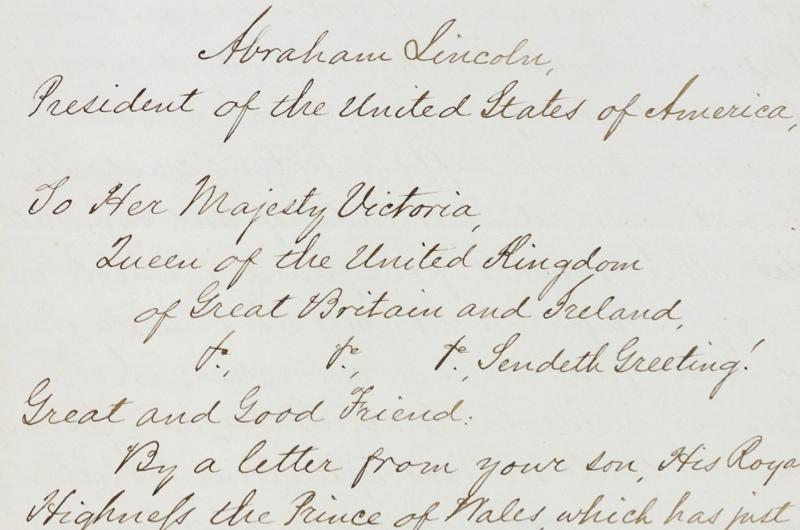
An 1862 letter of condolence from Abraham Lincoln to Queen Victoria on the occasion of the death of Prince Albert shows the republican salutation "Great and Good Friend".

Diplomatic correspondence is correspondence between one state and another and is usually of a formal character. It follows several widely observed customs and styles in composition, substance, presentation, and delivery and can generally be categorized into letters and notes.

Letters

[edit]

Letters are correspondence between heads of state, typically used for the appointment and recall of ambassadors; for the announcement of the death of a sovereign or an accession to the throne; or for expressions of congratulations or condolence.[1]

Letters between two monarchs of equal rank will typically begin with the salutation "Sir My Brother" (or "Madame My Sister", in the case of a female monarch) and close with the valediction "Your Good Brother" (or Sister, in the case of a female monarch). In the case where one monarch is of inferior rank to the other (for instance, if the Grand Duke of Luxembourg were to correspond with the King of the United Kingdom), the inferior monarch will use the salutation "Sire" (or "Madame"), while the superior monarch may refer to the other as "Cousin" instead of "Brother".[1] If either the sender or the recipient is the head-of-state of a republic, letters may begin with the salutation "My Great and Good Friend" and close with the valediction "Your Good Friend"; beneath the signature line will be inscribed "To Our Great and Good Friend [Name and Title of Recipient]".[1]

Letters of credence

[edit]
Estonian ambassador to Australia Andres Unga presents his letter of credence to Governor-General Quentin Bryce in 2013.

A letter of credence (lettres de créance) is the instrument by which a head of state appoints ("accredits") ambassadors to foreign countries.[2][3] Also known as credentials, the letter closes with a phrase "asking that credit may be given to all that the ambassador may say in the name of his sovereign or government."[2] The credentials are presented personally to the receiving country's head of state or viceroy in a formal ceremony. Letters of credence are worded carefully, as the sending or acceptance of a letter implies diplomatic recognition of the other government.[2] Letters of credence date to the thirteenth century.[4]

Letters of recall

[edit]

A letter of recall is formal correspondence from one head-of-state notifying a second head-of-state that they are recalling their[clarification needed] state's ambassador.

Full powers

[edit]

In cases where an envoy is entrusted with unusually extensive tasks that would not be covered by an ordinary permanent legation (such as the negotiation of a special treaty or convention, or representation at a diplomatic congress), an envoy may be given full powers (pleins pouvoirs) "in letters patent signed by the head of the State" designing "either limited or unlimited full powers, according to the requirements of the case."[3]

According to Satow's Diplomatic Practice, the bestowal of full powers traces its history to the Roman plena potestas; its purpose

was to be able to dispense, as far as possible, with the long delays needed in earlier times for referring problems back to higher authority. Their use at the present day is a formal recognition of the necessity of absolute confidence in the authority and standing of the negotiator.[1]

Notes

[edit]

Protocol

[edit]
Austrian foreign minister Klemens von Metternich threatened to correspond with the United Kingdom in German if it sent diplomatic correspondence to him in English, instead of French.

Standard diplomatic protocol varies from country to country, but generally requires clear yet concise translation between both parties.

Language

[edit]

The earliest forms of diplomatic correspondence were, out of necessity, written in Latin, Latin being a common language among states of a linguistically diverse Europe. By the early 19th century, French had firmly supplanted Latin as the language of diplomacy; on one occasion, in 1817, the British attempted to correspond with the Austrian Imperial Court in English, prompting Klemens von Metternich to threaten retaliatory correspondence in Weanarisch. In modern times, English has largely replaced French as a diplomatic lingua franca in correspondence between two states lacking a common tongue.[10]

Rejection

[edit]

States may sometimes reject diplomatic correspondence addressed to them by returning the original copy to the sending state. This is done as a rebuff of the contents of the correspondence and is typically reserved for cases where the receiving state feels the language used by the sending state is rude, or the subject matter represents an inappropriate intercession into the receiving state's internal affairs.[1]

Publication

[edit]

Diplomatic correspondence has been published in the form of color books, such as the British Blue Books which go back to the seventeenth century, the German White Book and many others from World War I, partly for domestic consumption, and partly to cast blame on other sovereign actors.[11]

See also

[edit]

References

[edit]
Revisions and contributorsEdit on WikipediaRead on Wikipedia
from Grokipedia
Diplomatic correspondence constitutes the formal written exchanges between sovereign states or their accredited representatives, primarily aimed at articulating policies, advancing negotiations, and facilitating official communications in . These documents adhere to established protocols that ensure clarity, precision, and respect for , distinguishing them from informal or verbal . Key forms include the note diplomatique, a first-person formal letter from a ; the note verbale, an unsigned third-person communication for routine matters; and the , an informal summarizing positions without demanding reply. Letters of credence and recall authenticate ambassadors' appointments, while protests or demarches address grievances or urge actions. Under the , such correspondence enjoys inviolability, protecting it from interference and underscoring its role in stable interstate dialogue. Historically, diplomatic correspondence traces to ancient treaties and missives, such as those in Akkadian from circa 1300 BC between and the , evolving into structured instruments that have shaped treaties and averted conflicts through documented commitments. In modern practice, it remains essential for verifying intentions and providing evidentiary records, though digital shifts challenge traditional amid risks of leaks and cyber vulnerabilities.

Definition and Purpose

Core Objectives and Formal Characteristics

Diplomatic correspondence primarily aims to enable official communication between sovereign states through their authorized representatives, facilitating the representation of national interests, negotiation of agreements, protection of citizens abroad, and promotion of bilateral or multilateral relations. It serves to record positions, decisions, and commitments in writing, providing a verifiable and enduring basis for diplomatic interactions that minimizes misunderstandings and supports in international affairs. Under the of 1961, such correspondence is deemed inviolable, ensuring its confidentiality and integrity as a tool for conducting without interference from receiving states. The formal characteristics of diplomatic correspondence emphasize precision, neutrality, and protocol to convey authority and maintain decorum. Documents like diplomatic notes are typically drafted in a structured format, often beginning with standardized phrases such as "I have the honor" in first-person notes addressed to high officials, and employing indirect, objective that avoids emotive or confrontational tones to manage potential conflicts. Notes verbales, a common third-person variant, use impersonal phrasing to present factual statements or requests, while more solemn instruments like letters may be signed by heads of state or foreign ministers and authenticated with official seals to affirm their governmental origin. Historically influenced by French diplomatic traditions, the remains formal and precise, prioritizing clarity in to precisely articulate intended meanings without . This rigidity ensures that correspondence functions as an official act of state, distinct from informal exchanges, and adheres to customs observed across diplomatic practice for consistency and mutual recognition.

Distinction from Informal Communications

Diplomatic correspondence constitutes official written exchanges between states or their authorized representatives, adhering to prescribed protocols that ensure clarity, authenticity, and state accountability. These communications, such as formal notes or letters of credence, are typically drafted in a structured format, often employing third-person language to maintain impersonality and represent the sovereign position of the issuing government. Unlike informal communications, they carry presumptive legal weight, serving as records for negotiations, protests, or agreements, and are protected under , including provisions for inviolable transmission via diplomatic bags as outlined in Article 27 of the (1961). Informal communications, by contrast, include verbal discussions, personal missives, or non-binding summaries like aide-mémoires, which lack the ritualistic elements and do not inherently engage . Aide-mémoires, for instance, function as memory aids recapping conversations without formal endorsement, allowing diplomats flexibility in preliminary talks without committing to positions. While note verbales—sometimes termed "informal notes"—bridge the spectrum by being written yet less ceremonious than first-person diplomatic notes, they still qualify as official correspondence due to their governmental origin and archival status, distinguishing them from purely exchanges. This gradation underscores that informality prioritizes rapport-building or off-the-record insights over enforceable outcomes. The distinction manifests in practical consequences: formal correspondence demands responses under diplomatic custom, potentially escalating to international disputes if ignored, whereas informal variants enable deniability and rapid dialogue without procedural burdens. For example, U.S. Department of State guidelines specify that diplomatic notes must align with governmental directives and use precise phrasing to avoid ambiguity, contrasting with casual exchanges that may occur during summits or via unencrypted channels. Such delineation preserves the integrity of state interactions, mitigating misinterpretations that could arise from conflating exploratory talks with binding representations.

Historical Development

Origins in Ancient Civilizations

Diplomatic correspondence originated in the civilizations of the , where rulers exchanged written messages on durable clay tablets to manage alliances, resolve disputes, and coordinate military actions amid expanding empires. In , cuneiform script facilitated early administrative and royal records from the third millennium BCE, evolving into diplomatic use as city-states and kingdoms interacted; Akkadian became the standard diplomatic language by the second millennium BCE due to its widespread adoption across regions from to . These exchanges often accompanied oral by envoys but provided verifiable records of commitments, such as obligations or proposals between royal houses. The most extensive surviving corpus of such correspondence is the , an archive of approximately 382 clay tablets discovered in 1887 at Tell el-Amarna in , dating to roughly 1350–1330 BCE during the reigns of pharaohs and . Written primarily in Akkadian by scribes from vassal states and great powers—including the Hittite Empire, Kingdom of Mitanni, , and —these letters detail requests for Egyptian military support against rivals, complaints about border incursions, and professions of loyalty laced with flattery toward the as a divine solar figure. They reveal a hierarchical international system where weaker rulers sought protection from in exchange for and fidelity, while also highlighting tensions, such as accusations of disloyalty or demands for gold, underscoring the pragmatic, power-based nature of these interactions rather than abstract ideals of equity. Preceding the , diplomatic texts appear in Hittite archives from (modern Turkey), including treaties and oaths from the 15th–13th centuries BCE that invoked mutual gods as witnesses to non-aggression pacts and border delineations. A landmark example is the Egyptian-Hittite peace treaty of 1259 BCE, concluded after the between Ramses II of and Hattusili III of Hatti; surviving in duplicate versions—one in on temple walls at and , the other in on bronze tablets—the document stipulated perpetual peace, of fugitives, and mutual aid against rebels, representing the earliest known formal and evidence of synchronized diplomatic drafting across empires. These artifacts demonstrate that ancient correspondence prioritized enforceability through divine sanctions and reciprocal obligations, laying foundational practices for later statecraft while relying on trusted messengers to convey intent amid linguistic and cultural barriers.

Medieval and Renaissance Evolution

In medieval , diplomatic correspondence primarily consisted of formal letters exchanged between monarchs, ecclesiastical authorities, and feudal lords to negotiate alliances, treaties, and peace agreements, often mediated by the Papacy. These documents were authenticated using royal seals and coats of arms to signify authority and prevent forgery, reflecting the fragmented political landscape where trust in envoys required tangible verification. Latin served as the , enabling communication across linguistic divides among the educated elite. The ars dictaminis, an art of letter composition emerging in the and flourishing through the 13th, standardized diplomatic writing with structured elements including a salutatio (), exordium (introduction), narratio (), and petitio (request), ensuring clarity and rhetorical effectiveness in petitions and official missives. Letters of credence, for instance, explicitly authorized envoys and outlined their missions, as seen in practices documented from the Carolingian era onward, such as Charlemagne's 811 letter to Byzantine Emperor asserting territorial claims. This formulaic approach prioritized legal precision over stylistic flourish, adapting classical rhetoric to practical governance needs. During the , particularly in from the 14th to 16th centuries, diplomatic correspondence evolved toward greater frequency and sophistication with the advent of resident ambassadors, who dispatched regular dispacci (dispatches) to report intelligence and instructions, marking a shift from medieval missions. Humanist scholars revived Ciceronian Latin, emphasizing eloquence and classical models over the rigid ars dictaminis, as exemplified by Pietro Bembo's service as Latin secretary to , where he adhered strictly to Ciceronian vocabulary for papal bulls and letters. This stylistic refinement, promoted by figures like Jacopo Sadoleto, enhanced persuasive power in negotiations amid intensifying interstate rivalries. Venetian diplomacy exemplified this transition, with ambassadors' detailed letters providing invaluable records of foreign courts, influencing broader European practices as permanent legations spread beyond by the early . The humanist focus on not only formalized correspondence but also integrated cultural exchange, laying groundwork for the ornate yet precise language of later treaties.

Standardization in the 19th and 20th Centuries

The , convened from September 1814 to June 1815, represented a foundational effort to standardize diplomatic practices across following the , including protocols that shaped the form and of correspondence. The resulting Règlement on the Precedence of Diplomatic Agents, adopted on 19 1815 as Annex XVII to the Final Act, classified representatives into three initial ranks—ambassadors, envoys extraordinary and ministers plenipotentiary, and ministers resident or charges d'affaires—establishing uniform criteria for , precedence at ceremonies, and the hierarchical addressing of official letters. This classification ensured consistency in how diplomatic missives were initiated, received, and responded to, reducing ambiguities in interstate communications. The Aix-la-Chapelle Protocol of 15 November 1818 amended these regulations by introducing a fourth class for charges d'affaires, further refining the system to accommodate varying levels of diplomatic engagement and standardizing the credentials required for each. Throughout the , French solidified as the of , supplanting Latin and enabling precise, formulaic phrasing in treaties, , and dispatches across major powers, which minimized translation errors and promoted procedural uniformity. National foreign ministries, such as Britain's, underwent professionalization, with reforms emphasizing codified handling of incoming and outgoing correspondence, including the use of seals, ciphers, and archival protocols to enhance and traceability. In the early 20th century, these 19th-century foundations persisted amid rising , as seen in the of Nations' communications, which adhered to established ranks and formal note structures while introducing standardized templates for collective appeals. The U.S. Foreign Service Act of 1924 merged diplomatic and consular branches, institutionalizing uniform training and procedures for drafting and authenticating correspondence, thereby aligning American practices with European norms. Pre-World War II bilateral exchanges continued to rely on these protocols, with documents like aides-mémoire employing fixed formats for brevity and clarity, though technological advances such as began supplementing but not supplanting written standardization. This era's adherence to Vienna-era rules facilitated consistent diplomatic intercourse despite geopolitical shifts, laying groundwork for later comprehensive codification.

Post-World War II Codification

The United Nations Charter, adopted in 1945, mandated the promotion of codification through the establishment of the (ILC) in 1947. At its first session in 1949, the ILC prioritized "Diplomatic intercourse and immunities" as a topic, recognizing the need to consolidate fragmented customary rules on diplomatic exchanges, including official correspondence, amid post-World War II efforts to stabilize state interactions and prevent interwar diplomatic breakdowns. The ILC's special rapporteurs, including Paul Guggenheim and later Erik Castrén, drafted articles based on state practice, historical precedents like the 1815 regulations, and responses to government questionnaires, emphasizing the inviolability of communications to facilitate without . Over sessions from 1950 to 1957, the ILC refined 76 draft articles, addressing establishment of relations, mission functions, privileges, and communications, while incorporating feedback from UN member states to align with evolving practices such as wireless telegraphy for diplomatic messages. In 1958, the ILC submitted its final draft to the UN General Assembly, which convened the United Nations Conference on Diplomatic Intercourse and Immunities in Vienna from March 2 to April 14, 1961, attended by 81 states. The conference adopted the Vienna Convention on Diplomatic Relations on April 14, 1961, with 66 votes in favor, opening it for signature on April 18; the treaty codified longstanding customs into 53 articles, entering into force on April 24, 1964, upon the 22nd ratification. Central to the codification of diplomatic correspondence, Article 27 mandates that receiving states permit and protect free communication by missions for official purposes, including via , courier, or telegraph, with official correspondence deemed inviolable and exempt from censorship or detention. This provision operationalizes causal necessities of —secure, unimpeded exchanges—drawing from pre-1945 incidents like wartime interception of cables, while prohibiting arbitrary interference to ensure reliability in treaty negotiations and under Article 3. The Convention's framework indirectly standardized formats like notes verbales by embedding them within protected mission functions, influencing bilateral and multilateral practices without prescribing stylistic minutiae, as states retained flexibility in non-juridical elements. By 2023, the Convention had achieved near-universal adherence, with 193 parties, reflecting its role in embedding empirical norms from state consent rather than ideological imposition, though non-parties like operate under customary equivalents. This post-war codification marked a shift from bilateral understandings to -based uniformity, reducing ambiguities exploited in and fostering verifiable reciprocity in correspondence protocols.

Types of Diplomatic Instruments

Credential and Authorization Letters

Credential and authorization letters constitute a core subset of formal diplomatic instruments, serving to officially accredit heads of diplomatic missions or empower representatives for specific international actions. These documents, issued by the head of the sending state or competent authority, ensure the legitimacy and authority of diplomats in the receiving state, as codified in the Vienna Convention on Diplomatic Relations of 1961. Their presentation typically occurs during ceremonial audiences with the receiving state's head of state or government, underscoring mutual recognition between sovereigns. Failure to present proper credentials can invalidate a diplomat's status, preventing exercise of functions until acceptance. Letters of credence, also known as credentials, are formal warrants from the sending state's head of state or government to the receiving state's counterpart, designating an individual as ambassador, envoy, or head of mission. Under Article 10 of the Vienna Convention on Diplomatic Relations, the head of mission presents either the original credentials or a true copy to the receiving state's minister for foreign affairs, with the order of precedence determined by the date and time of arrival. These letters explicitly recommend the bearer for full confidence and credit, often including the diplomat's full name, rank, and mission objectives, while implying diplomatic recognition of the receiving government. Acceptance activates the mission's functions, and copies are retained by the receiving state for verification. Letters of recall complement letters of credence by formally withdrawing the accreditation of a preceding head of mission, signaling the end of their tenure due to rotation, recall for consultations, or severance of relations. Issued by the sending state's head to the receiving state's head, they are presented by the incoming envoy during the same ceremonial audience as the new credentials, ensuring continuity and respect for protocol. Article 10(2) of the Vienna Convention specifies that recall letters or their copies accompany credence presentations when applicable, preventing diplomatic vacuums. In cases of broken relations or permanent recall under Article 45, the receiving state must protect mission premises and archives regardless. Full powers documents authorize specific representatives to negotiate, adopt, or sign international treaties on behalf of their state, distinct from general accreditation but integral to diplomatic authorization. As defined in Article 2(2)(c) of the Vienna Convention on the Law of Treaties (1969), full powers emanate from the state's —typically the , government, or foreign minister—designating persons for treaty actions and often requiring presentation upon signing. Unlike letters of credence, which focus on mission heads, full powers target plenipotentiaries for discrete negotiations, with model formats provided by bodies like the specifying the authorizing entity's name, the representative's details, and the precise action permitted, such as signature. Absence of full powers can render treaty signatures invalid unless waived by tacit agreement among states.

Letters of Credence

Letters of credence are formal diplomatic documents issued by the head of state of the sending state to the head of state of the receiving state, designating a specific individual as ambassador extraordinary and plenipotentiary or another class of head of mission. They authenticate the diplomat's authority to represent the sending state and request that the receiving state extend full faith and credit to the bearer's official communications and actions. Under Article 10 of the Vienna Convention on Diplomatic Relations, adopted on April 18, 1961, and entered into force on April 24, 1964, these credentials take effect upon presentation to the head of the receiving state or their minister for foreign affairs, thereby commencing the diplomat's functions. The document typically consists of two identical originals: one presented unsealed for ceremonial reading and another remaining sealed as a reserve copy. It bears the of the sending state impressed over the signature of the and is worded in formal, precise language, often commencing with a to the receiving , affirming confidence in the appointee, specifying their and residence near the receiving government, and concluding with a request for admission and credence. occurs in a ceremonial , preceded by obtaining agrément from the receiving state to ensure the nominee's , and is followed by protocols such as introductory calls on foreign ministry officials. This procedure underscores mutual recognition between sovereigns, as the issuance and of letters of credence imply formal diplomatic relations. Historically, letters of credence evolved from ancient practices of proxy authorization but were standardized in European diplomacy by the , with consistent use documented in treaties and state papers from that era onward. Modern exemplars, such as those presented by ambassadors to multilateral organizations, adapt the format to accredit representatives to bodies like the , maintaining core elements of state-to-state authentication. Non-presentation or rejection halts the mission, reflecting the document's binding role in diplomatic legitimacy.

Letters of Recall

Letters of recall, also known as lettres de rappel, constitute formal diplomatic instruments dispatched by the accrediting to the receiving , signifying the conclusion of a diplomatic agent's tenure and the of their prior . These documents ensure that the sending state no longer authorizes the departing agent to represent it, thereby preventing unauthorized diplomatic actions and facilitating orderly transitions in missions. In contemporary protocol, letters of recall are typically presented not by the outgoing diplomat but by their successor during the accreditation ceremony for new credentials, a practice that supplants the 19th-century custom where the departing envoy personally delivered their own recall. This handover occurs in a formal audience, often with the receiving state's or a designated representative, such as a foreign minister or , who acknowledges receipt and may issue a response confirming the termination. The procedure underscores mutual consent in diplomatic relations, aligning with Article 39 of the (1961), which stipulates that a diplomatic agent's functions cease upon notification of their termination by the sending state. The content of a letter of recall mirrors the structure of letters of credence, commencing with an invocative (e.g., "Great and Good Friend"), referencing the prior agent's service, explicitly stating their recall and the nullification of their powers, and concluding with seals or signatures from the accrediting authority. Protocols from ministries of , such as those in and , mandate preparation of authenticated copies for archival and ceremonial purposes, with the coordinating logistics like security and precedence. In cases of abrupt terminations, such as declarations, recall letters may follow expedited notification to avert disputes over lingering authority. Historically, the use of recall letters evolved alongside credential instruments to codify endings of missions, with records from the early 20th century, including U.S. diplomatic exchanges, illustrating their role in bilateral transitions amid shifting alliances. Non-presentation or delay in recall can lead to ad interim arrangements, where a assumes duties until formal resolution, as outlined in . This mechanism maintains continuity without implying endorsement of the prior agent's recall circumstances.

Full Powers Documents

Full powers documents are formal instruments issued by the competent authority of a state, typically the head of state or government, designating one or more persons to represent the state in negotiating, adopting, or authenticating a treaty text. These documents serve as legal evidence of the representative's authority to bind the state through signature, ensuring that acts performed align with the state's sovereign will and preventing unauthorized commitments. Under Article 7 of the Vienna Convention on the Law of Treaties (1969), full powers are required for most treaty actions unless the representative holds an office—such as head of state, head of government, minister for foreign affairs, or an accredited diplomatic agent—that inherently confers representational capacity without such documentation. The issuance of full powers reflects a delegation rooted in agency principles from private law, adapted to international relations to enable specialized envoys to act with binding effect while maintaining state control over treaty outcomes. In multilateral conferences, states often provide full powers to delegations for specific scopes, such as initialing texts or signing final instruments, with the document specifying the authorized actions and sometimes limiting them to avoid overreach. Verification of full powers occurs at the outset of negotiations, and their absence can invalidate a signature unless waived by consensus among states involved. Unlike general credentials for diplomats, full powers are task-specific and expire upon treaty conclusion or revocation, underscoring their role in precise diplomatic authorization rather than ongoing representation.

Informal and Procedural Notes

Informal and procedural notes constitute a category of diplomatic instruments employed for routine, non-binding communications between states, often to convey positions, seek clarifications, or record discussions without committing to formal agreements. These notes prioritize procedural efficiency over ceremonial formality, typically drafted in the third person and lacking signatures in some variants to maintain flexibility or deniability. They emerged as practical tools in modern to handle administrative matters, such as requests, registrations, or aids, contrasting with binding instruments like treaties.

Note Verbale and Examples

A note verbale is an unsigned, third-person diplomatic note used for official but informal exchanges, positioned between formal first-person notes and even less structured aides-mémoire in terms of protocol. It begins with phrases like "The Embassy of [Country] presents its compliments to the " and addresses matters such as routine requests, responses to inquiries, or multilateral notifications. For instance, in visa processing, a note verbale may confirm an official's employment status, travel purpose, and stay duration to support diplomatic privileges. Unlike signed letters, it assumes responsibility upon initialling by an authorized , equivalent to a in formal terms. Examples include notifications of ambassadorial arrivals or protests against territorial claims, often circulated via diplomatic channels for acknowledgment without negotiation.

Collective and Identic Notes

Collective notes, also termed joint notes, originate from multiple states addressed to one or more recipients, typically in third person, to coordinate positions on shared concerns like sanctions or dispute resolutions. They avoid courtesy phrases such as "has the honor" to underscore collective intent, and replies are individualized to each sender. Identic notes, conversely, issue identical content from a single state to multiple recipients, functioning as circulars when targeting over three missions, such as uniform demarches on policy stances or invitations to conferences. Historical usage includes Thomas Jefferson's identic notes on neutral rights during the , illustrating their role in synchronized messaging without implying confrontation. These forms facilitate multilateral alignment but are employed sparingly to avoid perceptions of coercion.

Bouts de Papier and Aides-Memoire

Bouts de papier, or speaking notes, represent the most informal variant, typed on plain paper without headings, dates, or signatures to enable if politically sensitive. They assist oral presentations by outlining key points for delegates during meetings, serving as non-committal prompts rather than records. Aides-mémoire, slightly more structured, summarize prior oral exchanges or proposed texts for , acting as aids without legal force or expectation of reply. In procedure, they follow third-person notes in format, often headed simply "Aide-Mémoire" below an embassy seal, and record representations made by diplomatic agents. For example, an might recap negotiation points post-meeting, circulated informally among parties to align understandings prior to formal drafting. Both prioritize brevity and utility in fast-paced , eschewing archival rigidity.

Note Verbale and Examples

A note verbale constitutes an unsigned, third-person diplomatic communication employed by foreign ministries or embassies to address procedural, administrative, or low-stakes substantive issues, distinguishing it from more solemn instruments like treaties or signed notes. It originated as a record of oral exchanges but evolved into a written format for efficiency in routine inter-state interactions, becoming the most prevalent form of diplomatic correspondence by the late . Unlike first-person notes, which bear the of a high and imply direct state commitment, notes verbales maintain detachment through impersonal phrasing, such as "The Embassy of [State] avails itself of this opportunity to renew to the the assurances of its highest consideration." Key characteristics include brevity, formality without personal endorsement, and standardized protocol: documents are typed on embassy letterhead, numbered sequentially, and delivered via diplomatic channels or pouch, often without requiring immediate acknowledgment unless specified. They employ courteous, indirect language to avoid confrontation, such as "has the honor to inform" for notifications or "wishes to draw attention to" for mild protests, reflecting diplomatic norms codified implicitly in practices post-Vienna Convention on Diplomatic Relations (1961), though not explicitly regulated therein. This form suits multilateral notifications or bilateral clarifications, as it allows on sensitive topics while preserving records for future reference. Examples illustrate varied applications. In March 1945, the Italian Ambassador in Washington issued a note verbale to the U.S. Acting expressing regret over wartime damages and seeking post-hostilities cooperation, exemplifying its use in transitional diplomacy. During , on March 21, 1942, the German Foreign Office transmitted a note verbale via protesting Allied actions, highlighting its role in wartime communications amid severed direct ties. More recently, on August 5, 2021, the , , , and submitted a joint note verbale to the rejecting China's "historic rights" claims in the , leveraging the format for collective assertion without escalating to formal dispute mechanisms. These instances underscore the note verbale's utility in documenting positions amid geopolitical tensions, where empirical records of intent prevail over verbal assurances.

Collective and Identic Notes

Collective notes constitute a single formal diplomatic instrument jointly authored and signed by the representatives of two or more states, addressed to one or more recipient states or entities, typically to convey a unified stance on a matter of common concern. This form emphasizes collective authorship under a shared diplomatic voice, distinguishing it from individual notes, and is employed when coordination among senders is feasible but a full treaty or alliance is not warranted. Such notes are rare due to the challenges in securing precise agreement on wording and action among sovereign states. In contrast, identic notes involve multiple states dispatching separate but substantively identical communications—often verbatim in key passages—to the same recipient, thereby signaling coordinated without the procedural hurdles of joint signing. This mechanism allows states to demonstrate alignment on issues like policy protests or demands for compliance while preserving individual , as each note remains a unilateral act. Identic notes may vary slightly in non-essential phrasing but maintain uniformity in core demands to amplify diplomatic pressure. Historically, a collective note was presented to the Greek government on an unspecified date in the by the ministers of , Britain, and , addressing territorial or policy disputes, with the recipient issuing a formal reply. In 1916, Allied powers utilized a collective note format in responses during World War I negotiations, publicly released in Paris and London on December 30 to reject overtures for armistice talks deemed insufficient. For identic notes, the powers of Britain, , Germany, Austria-Hungary, Italy, and delivered identical protests to Greece in 1916 via their diplomatic agents, urging adherence to international obligations amid wartime tensions. Another instance occurred on February 20, 1880, when multiple European states sent identic notes to Romania protesting discriminatory policies against Jewish populations, demanding equal civil rights as a condition for international recognition. These instruments serve procedural roles in multilateral , facilitating information exchange or mild without escalating to binding commitments, though their effectiveness depends on the recipients' perception of sender unity and follow-through capacity. Replies to collective notes are typically addressed individually to each originating state, maintaining formal reciprocity. Neither form is explicitly codified in the 1961 , which focuses on privileges and conduct rather than note typology, but they align with customary practices for non-ambassadorial communications.

Bouts de Papier and Aides-Memoire

Bouts de papier represent an extremely informal method of diplomatic communication, consisting of simple written notes or scraps of paper exchanged during meetings to convey key points without formal structure. These documents contain only text and are handed directly to counterparts, often lacking signatures, dates, or official letterheads, distinguishing them from more structured formats like memoranda. Their use facilitates quick, off-the-record exchanges at high-level talks, such as those between visiting officials and host counterparts, serving as speaking notes rather than binding commitments. Aides-mémoire, in contrast, function as informal summaries of oral discussions, proposed agreements, or diplomatic representations, aiding memory without implying formal endorsement. Typically prepared by diplomatic agents, they outline essential elements of conversations or instructions, circulated among parties for reference or negotiation without committing to positions. Unlike bouts de papier, aides-mémoire may include headings or numbered points but remain non-binding, often used to record talks or float ideas in multilateral settings. Both instruments prioritize flexibility over protocol, enabling diplomats to probe positions or clarify intents discreetly, though they carry no legal weight absent subsequent formal ratification. Historical applications include British diplomat Lord Hardinge presenting an aide-mémoire to French statesman Aristide Briand during interwar negotiations, illustrating their role in sensitive exchanges. In practice, these tools persist alongside digital alternatives, valued for their brevity and deniability in confidential diplomacy.

Demarches and Oral Equivalents

A demarche represents a formal diplomatic initiative through which a sending state communicates its government's position, concerns, or requests to a receiving state or , often to influence policy, register a , or solicit . This inherently official state-to-state character distinguishes demarches from non-diplomatic demands directed at governments, such as those from private actors like criminals, activists, nongovernmental organizations, or domestic opposition groups, which lack specialized terminology and are typically expressed as general "demands," "calls," or "petitions." Originating from the French term for a "step" or "maneuver," it has been employed in diplomatic practice since at least the , as evidenced in cases like the 1933 Permanent Court of International Justice judgment on the Prince von Pless Administration, where it was interpreted as a "request" in legal proceedings. Unlike treaties or notes verbales, demarches prioritize urgency and direct engagement over procedural formality, frequently involving targeted appeals to high-level officials. Demarches are typically executed by ambassadors or designated presenting scripted talking points to counterparts in the host government, ensuring alignment with instructions from the foreign ministry. In multilateral contexts, they may be coordinated across multiple states, as in the U.S.-led demarches to allies on issues like or , where synchronized delivery amplifies pressure— for instance, joint U.S., , and French demarches to the in 1964 regarding access rights. The content often includes factual assertions, policy rationales, and calls for specific responses, with follow-up expected via reply notes or further meetings; non-compliance can escalate to public statements or sanctions. Oral equivalents, termed verbal demarches, mirror written forms but rely on spoken delivery without a physical , preserving deniability while conveying the same authoritative stance. These are common in sensitive negotiations, such as protests against territorial encroachments or election interference, where read from prepared briefs during audiences— exemplified by U.S. verbal demarches to in 1979 amid the hostage crisis, urging release through direct embassy channels before severance. Verbal variants demand precise recording in diplomatic cables for accountability, as misinterpretation risks escalation; the U.S. Foreign Affairs Manual mandates embassy confirmation of receipt and substance to . Both formats underscore diplomacy's emphasis on calibrated signaling, where credibility hinges on consistent follow-through rather than legal enforceability.

Protocols and Conventions

Linguistic and Formatting Standards

Diplomatic correspondence employs formal linguistic conventions to ensure precision, courtesy, and unambiguity, reflecting the need to mitigate risks of misinterpretation in interstate relations. Language choice is typically governed by bilateral agreements or the practices of the receiving state, with English serving as the predominant medium in contemporary usage, particularly for agreements involving the , where all outgoing notes are drafted in English and foreign quotations are translated accordingly. Historically, French functioned as the of , influencing phrases like "note verbale," but modern practice favors the host country's or English to facilitate comprehension, avoiding unnecessary foreign terms where English equivalents exist. Stylistically, texts prioritize self-explanatory phrasing, polite indirectness—such as "has the honor to inform" in third-person notes—and avoidance of emotional or second-person language to maintain objectivity. Formatting standards emphasize uniformity and official presentation to underscore authenticity and hierarchy. Documents utilize letterhead of the sending mission or ministry, with one-inch margins, double- or triple-spacing, and specified fonts like Calibri 15-point for general notes or Courier New 12-point for certain specialized formats, ensuring legibility in archives scanned at 300 DPI. Third-person notes, including notes verbales, commence without salutation, often with formulas like "The Embassy of [State] presents its compliments to the Ministry of Foreign Affairs" followed by indented paragraphs of substantive content, concluding without a complimentary close and initialed by an authorized director-level officer. First-person notes, signed by principals like the Secretary of State, include salutations such as "Excellency" and closings like "Accept, Excellency, the renewed assurances of my highest consideration," with addresses in initial capitals at the page bottom. Dates follow a full format (e.g., "Washington, [day] [month] [year]"), and embossed stationery measuring 8.5 by 11 inches is standard, with optional numbering per local custom to track exchanges. These elements, while varying slightly by national protocol, align with broader imperatives for verifiable clarity, as deviations could undermine the document's diplomatic weight.

Procedures for Delivery and Acknowledgment

Diplomatic correspondence is delivered through secure official channels to preserve its inviolability, as stipulated in Article 27 of the (1961), which requires receiving states to permit and protect free communication for official purposes and declares all official correspondence inviolable. Traditional delivery methods include hand-carrying sealed documents by accredited diplomats directly to the foreign ministry's protocol department, ensuring immediate transfer and minimizing interception risks. For sensitive or voluminous materials, diplomatic couriers and bags—marked visibly and containing only official items—are employed, with couriers bearing documents confirming their status and the bag's contents. In contemporary practice, particularly for routine notes verbale, delivery may occur via expedited postal services, commercial carriers, or electronic means such as emailed PDFs, provided the receiving ministry accepts digital formats. U.S. Department of State procedures specify that first-person notes signed by principals are mailed by the Records Management Unit using U.S. Postal Service for standard delivery (often exceeding one week) or commercial carriers for two-day expedited service, while electronic templates facilitate PDF transmission for urgency. Posts abroad forward prepared notes to information programs centers for dispatch, with electronic options viable if mutually agreed. To prevent delays, some protocol guides recommend direct submission to designated ministry addresses via email or post. Acknowledgment of receipt follows delivery to verify transmission and establish a formal record, typically issued as a diplomatic note or memorandum without delay. Standard U.S. phrasing for third-person acknowledgments reads: "The Department of State acknowledges receipt of diplomatic note No. [number], dated [date], from the Embassy of [country]…," often incorporating quoted excerpts from the original for precision. For higher-level correspondence, formulations such as "The Secretary of State presents his (her) compliments to the Chargé d'Affaires ad interim of [country] and acknowledges receipt of…" are used. This process confirms custody transfer, supports archiving at 300 DPI resolution in systems like SMART, and signals any impending substantive response, with electronic deliveries potentially augmented by digital timestamps. Failure to acknowledge promptly can imply procedural lapses, though inviolability protections endure regardless.

Mechanisms for Rejection and Dispute

Receiving states may reject diplomatic correspondence deemed unacceptable, such as when it contravenes established protocols or contains objectionable content, by returning the original document to the sending mission. This mechanism preserves formalities while signaling disapproval, avoiding escalation to declarations or severance of relations unless repeated. Historical instances include Mexico's rejection on November 23, 1963, of a Cuban diplomatic note protesting the arrest of Silvia Duran in connection with the Oswald investigation, where the refusal was explicitly stated as grounds for non-engagement. Disputes over the substance or interpretation of diplomatic notes are commonly resolved through iterative exchanges, including counter-notes verbales or formal replies that challenge assertions and propose clarifications. Such procedures align with , emphasizing negotiation to reconcile differences without binding adjudication. For example, prolonged "note verbale battles," as seen in territorial claims over the from 2019 to 2024, involve sequential submissions disputing legal positions, with submissions to the serving as public records of contention. Where correspondence disputes persist, parties may invoke broader diplomatic settlement methods under , such as good offices or mediation, prior to judicial recourse like the , provided mutual consent exists. The (1961) facilitates this by mandating inviolability of communications (Article 27) while allowing states to negotiate interpretations of related disputes (Article 51). Refusal to engage further on a disputed note does not infringe inviolability but may strain bilateral ties if perceived as evasive.

Security and Confidentiality

Traditional Safeguards

Traditional safeguards for diplomatic correspondence emphasized physical and procedural measures to prevent , tampering, or unauthorized disclosure, relying on , secure transport, and customary immunities predating modern treaties. Envoys historically employed trusted couriers to hand-deliver sealed dispatches, minimizing exposure to adversaries during transit. Wax seals affixed to documents served as tamper-evident indicators, with breakage signaling potential compromise and invoking diplomatic repercussions. Cryptographic techniques formed a core defense, transforming readable text into unintelligible forms through ciphers and codes. Simple substitution ciphers, such as those used by , evolved into complex systems like the attributed to in the 16th century, which resisted . By the 17th century, France's , implemented under , incorporated homophones and nulls to obscure messages, remaining unbroken until 1893 and protecting sensitive negotiations. During the , Continental diplomats utilized codebooks and numerical ciphers to encode correspondence, ensuring intelligibility only to recipients with matching keys. Diplomatic bags, or pouches, provided inviolable containers for correspondence, sealed and marked to denote official status, with interference prohibited under . Originating in practices where envoys carried protected satchels, these evolved into standardized pouches by the , exempt from search or seizure to safeguard state secrets. Couriers, often themselves, accompanied shipments, leveraging personal immunities to evade scrutiny at borders. These methods, rooted in reciprocity and the mutual interest in confidential exchange, deterred violations through the threat of retaliatory exposure of intercepted foreign communications.

Archiving and Declassification Practices

Diplomatic correspondence is archived primarily by the originating state's foreign ministry or diplomatic service to maintain institutional memory, support legal claims, and enable historical analysis. In the United States, records from foreign service posts, including notes verbales and dispatches, are preserved under Record Group 84 at the , with originals maintained at posts overseas before transfer for permanent retention. Similarly, the United Kingdom's Foreign, Commonwealth & Development Office transfers correspondence to after administrative use, adhering to protocols that ensure chain-of-custody integrity and protection against unauthorized access. These practices trace to longstanding diplomatic traditions, where archives were collated for efficiency in relations, as seen in Ottoman consular collections of treaties and decrees. Archiving emphasizes inviolability, codified in Article 27 of the 1961 , which safeguards official correspondence and archives from seizure or inspection by host states. Declassification of archived diplomatic correspondence involves systematic review to release information once risks to , sources, or ongoing relations diminish, guided by national policies rather than uniform international standards. In the US, mandates automatic of classified records 25 years after origination unless exempted for specific harms, such as damage to intelligence sources or foreign relations, with the State Department coordinating reviews via the Foreign Affairs Manual (5 FAM 480). This process includes mandatory reviews upon request and systematic efforts by the National Declassification Center, which processed over 4 million pages in projects as of April 2024. The applies a 30-year rule for most , including Foreign files, though exemptions persist for sensitive intelligence or colonial-era documents, leading to criticisms of selective withholding despite pledges for transparency. established formal rules in 2001 for declassifying diplomatic records to enhance accountability, requiring reviews by the before public release. Variations in declassification timelines and criteria reflect causal priorities of state sovereignty and over global harmonization, with delays often attributed to interagency coordination and exemptions for perpetual classification categories like methods. For instance, US State Department audits have highlighted backlogs in diplomatic records transfers, impeding timely . In practice, declassified materials inform series like Documents on British Policy Overseas, spanning 20th-century correspondence released post-review. These procedures prioritize empirical verification during review—assessing actual risks rather than indefinite secrecy—but face challenges from digital shifts, where metadata retention complicates selective release without broader exposure.

Modern Adaptations and Challenges

Transition to Digital Formats

The transition from traditional paper-based diplomatic correspondence to digital formats began in the 1970s with the adoption of electronic systems for transmitting cables, initially supplementing telegrams and later largely replacing them for internal and embassy-to-headquarters communications at the U.S. Department of State. By 1973, the State Department had implemented computerized systems to encode and send diplomatic cables electronically, enabling faster dissemination of information compared to manual telegraphy or physical dispatch, though full global rollout took years due to infrastructure limitations in overseas posts. This shift was driven by the need for secure, rapid reporting amid demands, reducing reliance on vulnerable courier services and telegrams that had dominated since the 19th century. Formal external correspondence, such as notes verbales and demarches, lagged behind internal cables, retaining paper formats into the for evidentiary purposes like original signatures and seals, which conferred legal weight under international conventions. The advent of machines in the 1980s provided an interim digital analog, allowing scanned transmission of documents while preserving paper originals, but widespread adoption for accelerated post-1995 with internet connectivity in embassies. The U.S. formalized e-diplomacy efforts in 2002 under Secretary , establishing a —later the Office of eDiplomacy—to develop secure platforms for collaborative drafting and sharing of notes, memos, and reporting, integrating tools like encrypted and intranets to streamline workflows previously handled via paper or . By the 2010s, many foreign ministries permitted electronic delivery of diplomatic notes via secure with PDF attachments, often with provisions for subsequent paper copies if required for . For instance, U.S. protocols under the Foreign Affairs Manual explicitly authorize emailing diplomatic notes, noting that digital formats enhance timeliness and reduce costs, though hybrid approaches persist to mitigate risks of repudiation without wet-ink signatures. This evolution reflected broader technological integration, with systems like the State Department's Smart Traveler Enrollment Program and collaborative wikis enabling real-time updates to demarches, though adoption varied by country—advanced in networked nations like the U.S. and EU members, slower in others due to cybersecurity concerns. Overall, digital formats have compressed communication cycles from days or weeks to hours, facilitating more responsive while challenging traditional verification norms.

Cybersecurity Vulnerabilities and Recent Incidents

Diplomatic correspondence, increasingly conducted via digital channels such as encrypted emails and secure networks, faces heightened cybersecurity vulnerabilities due to the sensitive nature of the information and the human elements involved in transmission. Diplomats are particularly susceptible to social engineering tactics like , which exploit trust in official communications to deliver or steal credentials, bypassing technical safeguards. compromises and unpatched software in diplomatic systems further amplify risks, as seen in broader hacks that infiltrate secure perimeters. State-sponsored actors frequently target diplomatic systems for , leveraging spear-phishing to impersonate legitimate contacts and deploy backdoors. In September 2025, an Iran-linked group conducted a global spear-phishing campaign that compromised over 100 accounts at embassies and consulates, using hijacked mailboxes—including one from Oman's —to propagate further attacks amid geopolitical tensions. Similarly, Chinese hackers breached servers of foreign ministers worldwide in a multi-year operation, focusing on diplomatic events and military-related correspondence to gather intelligence. Russian operations have also intensified scrutiny on diplomatic channels. In January 2025, suspected Russian hackers executed spear-phishing against Kazakh diplomatic entities, embedding malicious code in attachments disguised as routine correspondence. By April 2025, Russian state-linked groups escalated phishing against European diplomats, using lures like "wine-tasting" invitations to infiltrate networks. In October 2025, Iranian group MuddyWater deployed a Phoenix backdoor variant against more than 100 government organizations, including foreign ministries, to maintain persistent access for . These incidents underscore the persistence of email as a weak vector despite adoption of and in diplomatic protocols, with attackers often exploiting zero-day vulnerabilities or insider-like access. Consequences include leaked negotiations and compromised trust, prompting calls for air-gapped systems or quantum-resistant cryptography, though implementation lags due to operational needs.

Debates on Transparency versus Secrecy

The debate over transparency and in diplomatic correspondence centers on balancing the need for candid interstate communication with demands for public accountability. Proponents of argue that fosters honest assessments and flexible negotiations, as public often compels diplomats to adopt rigid nationalistic stances that hinder . This view traces to historical practices where enabled breakthroughs, such as back-channel talks that de-escalated crises without domestic interference. Conversely, transparency advocates, influenced by post-World War I revelations of secret alliances contributing to the conflict, contend that openness prevents covert pacts and ensures democratic legitimacy in . U.S. President Woodrow Wilson's in 1918 exemplified early 20th-century pushes for transparency, with Point 1 calling for "open covenants of peace, openly arrived at, after which there shall be no private international understandings of any kind but diplomacy shall proceed always frankly and in the public view." Wilson blamed for entangling nations in war, yet even his administration relied on confidential channels, highlighting the practical limits of pure openness. reinforces secrecy's role: Article 27 of the 1961 mandates that receiving states "permit and protect free communication" for missions, rendering official correspondence inviolable to safeguard diplomatic efficacy. Violations, such as unauthorized disclosures, can erode trust and escalate tensions, as seen in historical breaches like the 1917 Zimmermann Telegram, which exposed German overtures and propelled U.S. entry into . Secrecy defenders emphasize its causal necessity for negotiation success, positing that publicity risks leaks of sensitive intelligence or premature concessions that invite exploitation by adversaries or domestic opponents. For instance, secret diplomacy facilitated the 1978 by allowing Israeli and Egyptian leaders to explore compromises away from public hardliners. Empirical analyses of resolutions, including pacts, show secrecy enabled iterative trust-building absent media distortion. Transparency, while theoretically enhancing oversight, often yields performative over substantive progress, as negotiators prioritize public approval over mutual gains—a dynamic observed in stalled public climate talks versus discreet bilateral deals. Critics of excessive secrecy, however, highlight risks of unaccountable power, citing democratic imperatives for disclosure to curb or hidden agendas. Acts, like the U.S. version enacted in 1966, mandate after periods (typically 25-30 years for diplomatic records), aiming to balance secrecy with eventual scrutiny. Yet, exemptions for ongoing foreign relations persist, fueling contention that prolonged shields incompetence rather than vital interests. Academic sources, often inclined toward transparency norms, argue leaks expose discrepancies between and private candor, though such views overlook how disclosures can endanger sources and allies. The 2010 WikiLeaks release of over 250,000 U.S. diplomatic cables intensified the debate, revealing unvarnished assessments of foreign leaders but yielding no strategic upheavals. U.S. officials, including , warned it compromised sources and inhibited frank exchanges, straining relations with partners like whose private anti-Iran views were aired. Advocates claimed it promoted accountability by highlighting inconsistencies, such as U.S. critiques of allies' while pursuing pragmatic deals. Post-release analyses indicate minimal long-term policy shifts but enduring caution in communications, underscoring secrecy's resilience amid digital transparency pressures. Despite leaks, states have bolstered protections, affirming secrecy's empirical utility for causal diplomatic outcomes over idealistic openness.

Impact on International Relations

Role in Treaty Negotiations and Conflict Resolution

Diplomatic correspondence facilitates the exchange of formal proposals, counterproposals, and clarifications essential to advancing negotiations, enabling states to articulate positions with precision while maintaining . Notes verbales and , as common formats, allow diplomats to outline draft articles or amendments without committing to final language, reducing the risk of public misinterpretation during sensitive discussions. This iterative process, often preceding plenary sessions, helps identify sticking points and fosters incremental agreements on technical or substantive issues. In treaty interpretation post-signature, prior diplomatic exchanges serve as supplementary evidence to resolve ambiguities, as recognized under Article 32 of the Vienna Convention on the Law of Treaties, where such correspondence elucidates the parties' original intent. For instance, records of negotiations documented via official notes can clarify whether a provision was adopted due to specific concessions or understandings exchanged bilaterally. This role underscores correspondence's function in ensuring treaties' durability by providing a verifiable record against future disputes over meaning. Regarding , diplomatic correspondence enables discreet signaling of willingness to negotiate, proposals, and , often through notes that bypass formal channels to test resolutions without loss of face. In active disputes, such as territorial or resource conflicts, notes can propose interim arrangements like ceasefires or joint monitoring, laying groundwork for mediated talks. By privileging written records over verbal exchanges, correspondence minimizes misunderstandings attributable to linguistic or cultural differences, promoting causal linkages between communicated intent and subsequent actions. Moreover, in multilateral conflict settings, sequential diplomatic notes among parties and mediators coordinate positions, as seen in frameworks where initial bilateral correspondences evolve into collective understandings. This mechanism supports preventive by addressing emerging tensions through formal protests or reassurances, potentially averting escalation; empirical analyses of resolved disputes indicate that documented exchanges correlate with higher compliance rates in fragile accords. Overall, the structured nature of diplomatic correspondence enhances , as states reference prior notes to enforce commitments, thereby reinforcing its causal efficacy in stabilizing .

Notable Historical Examples and Outcomes

The Ems Dispatch of July 13, 1870, exemplifies how edited diplomatic correspondence could precipitate conflict. Prussian King Wilhelm I sent a telegram to Chancellor Otto von Bismarck recounting a curt exchange with French ambassador Vincent Benedetti at Ems, where Benedetti demanded assurances against a Hohenzollern candidacy for the Spanish throne. Bismarck deliberately shortened and sharpened the text before releasing it to the press, portraying Prussia as insulted by French arrogance, which inflamed French public opinion and prompted Emperor Napoleon III to declare war on July 19, 1870. The resulting Franco-Prussian War ended in Prussian victory by January 1871, enabling the proclamation of the German Empire at Versailles on January 18, 1871, and reshaping European power balances by unifying German states under Prussian leadership. The Zimmermann Telegram, dispatched on January 16, 1917, by German Foreign Secretary Arthur Zimmermann to his ambassador in Mexico, demonstrated the perils of intercepted secret diplomacy. Encoded and sent via U.S. cables before being relayed through British intelligence, it proposed a military alliance: Germany would support Mexico's reconquest of lost territories (Texas, New Mexico, Arizona) in exchange for aiding against a potential U.S. entry into World War I, contingent on Germany's resumption of unrestricted submarine warfare on February 1. British codebreakers decrypted it by January 19 and shared it with the U.S. government; President Woodrow Wilson publicized it on March 1, 1917, sparking outrage that eroded U.S. neutrality. This shifted American public sentiment, contributing directly to Congress's declaration of war on Germany on April 6, 1917, bolstering Allied forces, and hastening the war's end in November 1918 with Germany's defeat. During the Cuban Missile Crisis, exchanges of letters between U.S. President John F. Kennedy and Soviet Premier Nikita Khrushchev from October 22 to 28, 1962, averted nuclear escalation through calibrated concessions. Kennedy's initial October 22 letter demanded the removal of Soviet offensive missiles from Cuba, citing their threat to U.S. security, while Khrushchev's October 26 personal letter offered withdrawal in return for a U.S. non-invasion pledge, though his October 27 message escalated demands to include U.S. missile removal from Turkey. Kennedy replied on October 27 by endorsing the October 26 terms, privately agreeing to remove Jupiter missiles from Turkey without public linkage, prompting Khrushchev's October 28 acceptance and missile dismantling by November 20. This correspondence resolved the crisis without war, established the Moscow-Washington hotline for future direct communication in 1963, and reinforced mutual deterrence in Cold War nuclear strategy.

References

Add your contribution
Related Hubs
User Avatar
No comments yet.