Hubbry Logo
N-sphereN-sphereMain
Open search
N-sphere
Community hub
N-sphere
logo
8 pages, 0 posts
0 subscribers
Be the first to start a discussion here.
N-sphere
N-sphere
from Wikipedia
2-sphere wireframe as an orthogonal projection
Just as a stereographic projection can project a sphere's surface to a plane, it can also project a 3-sphere into 3-space. This image shows three coordinate directions projected to 3-space: parallels (red), meridians (blue), and hypermeridians (green). Due to the conformal property of the stereographic projection, the curves intersect each other orthogonally (in the yellow points) as in 4D. All of the curves are circles: the curves that intersect ⟨0,0,0,1⟩ have an infinite radius (= straight line).

In mathematics, an n-sphere or hypersphere is an -dimensional generalization of the -dimensional circle and -dimensional sphere to any non-negative integer .

The circle is considered 1-dimensional and the sphere 2-dimensional because a point within them has one and two degrees of freedom respectively. However, the typical embedding of the 1-dimensional circle is in 2-dimensional space, the 2-dimensional sphere is usually depicted embedded in 3-dimensional space, and a general -sphere is embedded in an -dimensional space. The term hypersphere is commonly used to distinguish spheres of dimension which are thus embedded in a space of dimension , which means that they cannot be easily visualized. The -sphere is the setting for -dimensional spherical geometry.

Considered extrinsically, as a hypersurface embedded in -dimensional Euclidean space, an -sphere is the locus of points at equal distance (the radius) from a given center point. Its interior, consisting of all points closer to the center than the radius, is an -dimensional ball. In particular:

  • The -sphere is the pair of points at the ends of a line segment (-ball).
  • The -sphere is a circle, the circumference of a disk (-ball) in the two-dimensional plane.
  • The -sphere, often simply called a sphere, is the boundary of a -ball in three-dimensional space.
  • The 3-sphere is the boundary of a -ball in four-dimensional space.
  • The -sphere is the boundary of an -ball.

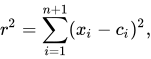
Given a Cartesian coordinate system, the unit -sphere of radius can be defined as:

Considered intrinsically, when , the -sphere is a Riemannian manifold of positive constant curvature, and is orientable. The geodesics of the -sphere are called great circles.

The stereographic projection maps the -sphere onto -space with a single adjoined point at infinity; under the metric thereby defined, is a model for the -sphere.

In the more general setting of topology, any topological space that is homeomorphic to the unit -sphere is called an -sphere. Under inverse stereographic projection, the -sphere is the one-point compactification of -space. The -spheres admit several other topological descriptions: for example, they can be constructed by gluing two -dimensional spaces together, by identifying the boundary of an -cube with a point, or (inductively) by forming the suspension of an -sphere. When it is simply connected; the -sphere (circle) is not simply connected; the -sphere is not even connected, consisting of two discrete points.

Description

[edit]

For any natural number , an -sphere of radius is defined as the set of points in -dimensional Euclidean space that are at distance from some fixed point , where may be any positive real number and where may be any point in -dimensional space. In particular:

  • a 0-sphere is a pair of points , and is the boundary of a line segment (-ball).
  • a 1-sphere is a circle of radius centered at , and is the boundary of a disk (-ball).
  • a 2-sphere is an ordinary -dimensional sphere in -dimensional Euclidean space, and is the boundary of an ordinary ball (-ball).
  • a 3-sphere is a -dimensional sphere in -dimensional Euclidean space.
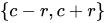
Cartesian coordinates

[edit]

The set of points in -space, , that define an -sphere, , is represented by the equation:

where is a center point, and is the radius.

The above -sphere exists in -dimensional Euclidean space and is an example of an -manifold. The volume form of an -sphere of radius is given by

where is the Hodge star operator; see Flanders (1989, §6.1) for a discussion and proof of this formula in the case . As a result,

n-ball

[edit]

The space enclosed by an -sphere is called an -ball. An -ball is closed if it includes the -sphere, and it is open if it does not include the -sphere.

Specifically:

  • A -ball, a line segment, is the interior of a 0-sphere.
  • A -ball, a disk, is the interior of a circle (-sphere).
  • A -ball, an ordinary ball, is the interior of a sphere (-sphere).
  • A -ball is the interior of a 3-sphere, etc.

Topological description

[edit]

Topologically, an -sphere can be constructed as a one-point compactification of -dimensional Euclidean space. Briefly, the -sphere can be described as , which is -dimensional Euclidean space plus a single point representing infinity in all directions. In particular, if a single point is removed from an -sphere, it becomes homeomorphic to . This forms the basis for stereographic projection.[1]

Volume and area

[edit]

Let be the surface area of the unit -sphere of radius embedded in -dimensional Euclidean space, and let be the volume of its interior, the unit -ball. The surface area of an arbitrary -sphere is proportional to the st power of the radius, and the volume of an arbitrary -ball is proportional to the th power of the radius.

Graphs of volumes () and surface areas () of n-balls of radius 1.

The -ball is sometimes defined as a single point. The -dimensional Hausdorff measure is the number of points in a set. So

A unit -ball is a line segment whose points have a single coordinate in the interval of length , and the -sphere consists of its two end-points, with coordinate .

A unit -sphere is the unit circle in the Euclidean plane, and its interior is the unit disk (-ball).

The interior of a 2-sphere in three-dimensional space is the unit -ball.

In general, and are given in closed form by the expressions
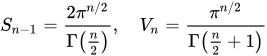
where is the gamma function. Note that 's values at half-integers contain a factor of that cancels out the factor in the numerator.

As tends to infinity, the volume of the unit -ball (ratio between the volume of an -ball of radius and an -cube of side length ) tends to zero.[2]

Recurrences

[edit]

The surface area, or properly the -dimensional volume, of the -sphere at the boundary of the -ball of radius is related to the volume of the ball by the differential equation

Equivalently, representing the unit -ball as a union of concentric -sphere shells,

We can also represent the unit -sphere as a union of products of a circle (-sphere) with an -sphere. Then . Since , the equation

holds for all . Along with the base cases , from above, these recurrences can be used to compute the surface area of any sphere or volume of any ball.

Spherical coordinates

[edit]

We may define a coordinate system in an -dimensional Euclidean space which is analogous to the spherical coordinate system defined for -dimensional Euclidean space, in which the coordinates consist of a radial coordinate , and angular coordinates , where the angles range over radians (or degrees) and ranges over radians (or degrees). If are the Cartesian coordinates, then we may compute from with:[3][a]


Except in the special cases described below, the inverse transformation is unique:

where atan2 is the two-argument arctangent function.

There are some special cases where the inverse transform is not unique; for any will be ambiguous whenever all of are zero; in this case may be chosen to be zero. (For example, for the -sphere, when the polar angle is or then the point is one of the poles, zenith or nadir, and the choice of azimuthal angle is arbitrary.)

Spherical volume and area elements

[edit]

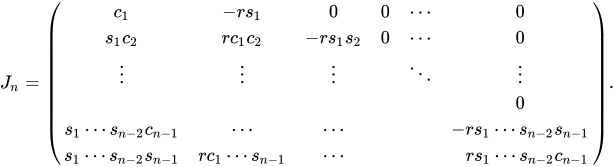
The arc length element isTo express the volume element of -dimensional Euclidean space in terms of spherical coordinates, let and for concision, then observe that the Jacobian matrix of the transformation is:

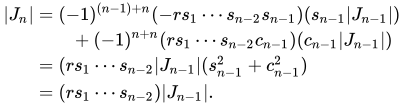
The determinant of this matrix can be calculated by induction. When , a straightforward computation shows that the determinant is . For larger , observe that can be constructed from as follows. Except in column , rows and of are the same as row of , but multiplied by an extra factor of in row and an extra factor of in row . In column , rows and of are the same as column of row of , but multiplied by extra factors of in row and in row , respectively. The determinant of can be calculated by Laplace expansion in the final column. By the recursive description of , the submatrix formed by deleting the entry at and its row and column almost equals , except that its last row is multiplied by . Similarly, the submatrix formed by deleting the entry at and its row and column almost equals , except that its last row is multiplied by . Therefore the determinant of is

Induction then gives a closed-form expression for the volume element in spherical coordinates

The formula for the volume of the -ball can be derived from this by integration.

Similarly the surface area element of the -sphere of radius , which generalizes the area element of the -sphere, is given by

The natural choice of an orthogonal basis over the angular coordinates is a product of ultraspherical polynomials,

for , and the for the angle in concordance with the spherical harmonics.

Polyspherical coordinates

[edit]

The standard spherical coordinate system arises from writing as the product . These two factors may be related using polar coordinates. For each point of , the standard Cartesian coordinates

can be transformed into a mixed polar–Cartesian coordinate system:

This says that points in may be expressed by taking the ray starting at the origin and passing through , rotating it towards by , and traveling a distance along the ray. Repeating this decomposition eventually leads to the standard spherical coordinate system.

Polyspherical coordinate systems arise from a generalization of this construction.[4] The space is split as the product of two Euclidean spaces of smaller dimension, but neither space is required to be a line. Specifically, suppose that and are positive integers such that . Then . Using this decomposition, a point may be written as

This can be transformed into a mixed polar–Cartesian coordinate system by writing:

Here and are the unit vectors associated to and . This expresses in terms of , , , and an angle . It can be shown that the domain of is if , if exactly one of and is , and if neither nor are . The inverse transformation is

These splittings may be repeated as long as one of the factors involved has dimension two or greater. A polyspherical coordinate system is the result of repeating these splittings until there are no Cartesian coordinates left. Splittings after the first do not require a radial coordinate because the domains of and are spheres, so the coordinates of a polyspherical coordinate system are a non-negative radius and angles. The possible polyspherical coordinate systems correspond to binary trees with leaves. Each non-leaf node in the tree corresponds to a splitting and determines an angular coordinate. For instance, the root of the tree represents , and its immediate children represent the first splitting into and . Leaf nodes correspond to Cartesian coordinates for . The formulas for converting from polyspherical coordinates to Cartesian coordinates may be determined by finding the paths from the root to the leaf nodes. These formulas are products with one factor for each branch taken by the path. For a node whose corresponding angular coordinate is , taking the left branch introduces a factor of and taking the right branch introduces a factor of . The inverse transformation, from polyspherical coordinates to Cartesian coordinates, is determined by grouping nodes. Every pair of nodes having a common parent can be converted from a mixed polar–Cartesian coordinate system to a Cartesian coordinate system using the above formulas for a splitting.

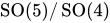
Polyspherical coordinates also have an interpretation in terms of the special orthogonal group. A splitting determines a subgroup

This is the subgroup that leaves each of the two factors fixed. Choosing a set of coset representatives for the quotient is the same as choosing representative angles for this step of the polyspherical coordinate decomposition.

In polyspherical coordinates, the volume measure on and the area measure on are products. There is one factor for each angle, and the volume measure on also has a factor for the radial coordinate. The area measure has the form:
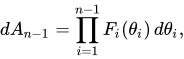
where the factors are determined by the tree. Similarly, the volume measure is

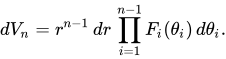
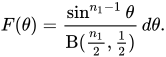
Suppose we have a node of the tree that corresponds to the decomposition and that has angular coordinate . The corresponding factor depends on the values of and . When the area measure is normalized so that the area of the sphere is , these factors are as follows. If , then

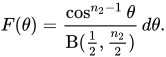
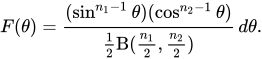
If and , and if denotes the beta function, then

If and , then

Finally, if both and are greater than one, then
Stereographic projection

[edit]

Just as a two-dimensional sphere embedded in three dimensions can be mapped onto a two-dimensional plane by a stereographic projection, an -sphere can be mapped onto an -dimensional hyperplane by the -dimensional version of the stereographic projection. For example, the point on a two-dimensional sphere of radius maps to the point on the -plane. In other words,

Likewise, the stereographic projection of an -sphere of radius will map to the -dimensional hyperplane perpendicular to the -axis as

Probability distributions

[edit]

Uniformly at random on the (n − 1)-sphere

[edit]

See also: Von Mises–Fisher distribution § The uniform hypersphere distribution.

A set of points drawn from a uniform distribution on the surface of a unit 2-sphere, generated using Marsaglia's algorithm.

To generate uniformly distributed random points on the unit -sphere (that is, the surface of the unit -ball), Marsaglia (1972) gives the following algorithm.

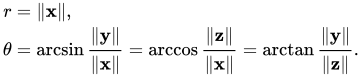
Generate an -dimensional vector of normal deviates (it suffices to use , although in fact the choice of the variance is arbitrary), . Now calculate the "radius" of this point:


The vector is uniformly distributed over the surface of the unit -ball.

An alternative given by Marsaglia is to uniformly randomly select a point in the unit n-cube by sampling each independently from the uniform distribution over , computing as above, and rejecting the point and resampling if (i.e., if the point is not in the -ball), and when a point in the ball is obtained scaling it up to the spherical surface by the factor ; then again is uniformly distributed over the surface of the unit -ball. This method becomes very inefficient for higher dimensions, as a vanishingly small fraction of the unit cube is contained in the sphere. In ten dimensions, less than 2% of the cube is filled by the sphere, so that typically more than 50 attempts will be needed. In seventy dimensions, less than of the cube is filled, meaning typically a trillion quadrillion trials will be needed, far more than a computer could ever carry out.

Uniformly at random within the n-ball

[edit]

With a point selected uniformly at random from the surface of the unit -sphere (e.g., by using Marsaglia's algorithm), one needs only a radius to obtain a point uniformly at random from within the unit -ball. If is a number generated uniformly at random from the interval and is a point selected uniformly at random from the unit -sphere, then is uniformly distributed within the unit -ball.

Alternatively, points may be sampled uniformly from within the unit -ball by a reduction from the unit -sphere. In particular, if is a point selected uniformly from the unit -sphere, then is uniformly distributed within the unit -ball (i.e., by simply discarding two coordinates).[5]


If is sufficiently large, most of the volume of the -ball will be contained in the region very close to its surface, so a point selected from that volume will also probably be close to the surface. This is one of the phenomena leading to the so-called curse of dimensionality that arises in some numerical and other applications.

Distribution of the first coordinate

[edit]

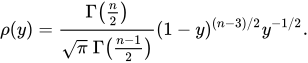
Let be the square of the first coordinate of a point sampled uniformly at random from the -sphere, then its probability density function, for , is

Let be the appropriately scaled version, then at the limit, the probability density function of converges to . This is sometimes called the Porter–Thomas distribution.[6]

Specific spheres

[edit]
0-sphere
The pair of points with the discrete topology for some . The only sphere that is not path-connected. Parallelizable.
1-sphere
Commonly called a circle. Has a nontrivial fundamental group. Abelian Lie group structure U(1); the circle group. Homeomorphic to the real projective line. Parallelizable
2-sphere
Commonly simply called a sphere. For its complex structure, see Riemann sphere. Homeomorphic to the complex projective line
3-sphere
Parallelizable, principal -bundle over the -sphere, Lie group structure Sp(1) = SU(2).
4-sphere
Homeomorphic to the quaternionic projective line, . .
5-sphere
Principal -bundle over the complex projective space . . It is undecidable whether a given -dimensional manifold is homeomorphic to for .[7]
6-sphere
Possesses an almost complex structure coming from the set of pure unit octonions. . The question of whether it has a complex structure is known as the Hopf problem, after Heinz Hopf.[8]
7-sphere
Topological quasigroup structure as the set of unit octonions. Principal -bundle over . Parallelizable. . The -sphere is of particular interest since it was in this dimension that the first exotic spheres were discovered.
8-sphere
Homeomorphic to the octonionic projective line .
23-sphere
A highly dense sphere-packing is possible in -dimensional space, which is related to the unique qualities of the Leech lattice.

Octahedral sphere

[edit]

The octahedral -sphere is defined similarly to the -sphere but using the 1-norm

In general, it takes the shape of a cross-polytope.

The octahedral -sphere is a square (without its interior). The octahedral -sphere is a regular octahedron; hence the name. The octahedral -sphere is the topological join of pairs of isolated points.[9] Intuitively, the topological join of two pairs is generated by drawing a segment between each point in one pair and each point in the other pair; this yields a square. To join this with a third pair, draw a segment between each point on the square and each point in the third pair; this gives a octahedron.

See also

[edit]

Notes

[edit]

References

[edit]
[edit]
Revisions and contributorsEdit on WikipediaRead on Wikipedia
from Grokipedia
In mathematics, an n-sphere is the set of all points in (n+1)(n+1)-dimensional Euclidean space located at a fixed distance, known as the radius, from a specified center point, generalizing the familiar circle and sphere to arbitrary dimensions. It forms an n-dimensional hypersurface embedded in Rn+1\mathbb{R}^{n+1}. The standard unit n-sphere, denoted SnS^n, consists of points (x1,,xn+1)Rn+1(x_1, \dots, x_{n+1}) \in \mathbb{R}^{n+1} satisfying the equation i=1n+1xi2=1\sum_{i=1}^{n+1} x_i^2 = 1. For a sphere of radius rr, the equation generalizes to i=1n+1xi2=r2\sum_{i=1}^{n+1} x_i^2 = r^2. Low-dimensional examples illustrate this progression: the 0-sphere comprises two discrete points at distance rr from the center along a line; the 1-sphere is a circle of circumference 2πr2\pi r in the plane; the 2-sphere is the surface of a ball in three-dimensional space with area 4πr24\pi r^2; and the 3-sphere, or glome, resides in four-dimensional space. As a compact, connected n-dimensional manifold without boundary, the n-sphere serves as a foundational object in topology and differential geometry, enabling the study of embeddings, homotopy groups, and higher-dimensional phenomena. Its "surface area" (the n-dimensional measure) for unit radius is given by Sn(1)=2π(n+1)/2/Γ((n+1)/2)S_n(1) = 2 \pi^{(n+1)/2} / \Gamma((n+1)/2), while the volume of the enclosed (n+1)(n+1)-ball is Vn+1(r)=π(n+1)/2rn+1/Γ((n+1)/2+1)V_{n+1}(r) = \pi^{(n+1)/2} r^{n+1} / \Gamma((n+1)/2 + 1), formulas that reveal counterintuitive behaviors, such as the volume of the unit (n+1)(n+1)-ball decreasing to zero as nn increases. These properties underpin applications in physics, such as modeling quantum states on spheres, and in data analysis via high-dimensional geometric structures.

Definition and Properties

Definition in Euclidean Space

In Euclidean space, the nn-sphere, denoted SnS^n, is defined as the set of points (x0,x1,,xn)(x_0, x_1, \dots, x_n) in Rn+1\mathbb{R}^{n+1} satisfying the equation i=0nxi2=r2,\sum_{i=0}^n x_i^2 = r^2, where r>0r > 0 is the radius. This hypersurface generalizes the familiar circle (S1S^1) and ordinary sphere (S2S^2) to higher dimensions, representing all points equidistant from a fixed center. Often, the unit nn-sphere is studied by setting r=1r = 1, simplifying calculations while preserving essential geometric properties. Although embedded in (n+1)(n+1)-dimensional Euclidean space, the nn-sphere has an intrinsic dimension of nn, meaning it is an nn-dimensional manifold. For n=0n=0, S0S^0 consists of two antipodal points on the real line, separated by distance $2r.For. For n=1,itformsacircleintheplane, it forms a circle in the plane \mathbb{R}^2.For. For n=2,itisthesurfaceofaballin, it is the surface of a ball in \mathbb{R}^3$. These examples illustrate how the dimensionality shifts: the "surface" aspect persists, but the ambient space increases accordingly. The nn-sphere inherits a Riemannian metric from the ambient Euclidean space via the induced metric, which measures distances and angles on the hypersurface. Under this metric, the shortest paths—or geodesics—on the unit nn-sphere are the great circles, obtained as intersections of SnS^n with 2-dimensional linear subspaces of Rn+1\mathbb{R}^{n+1} passing through the origin. These geodesics generalize the equator or meridians on S2S^2 and play a central role in the sphere's geometry.

Relation to the n-ball

The (n+1)(n+1)-ball, denoted Bn+1B^{n+1}, is defined as the set of all points x=(x1,x2,,xn+1)\mathbf{x} = (x_1, x_2, \dots, x_{n+1}) in Rn+1\mathbb{R}^{n+1} satisfying x2r2\|\mathbf{x}\|^2 \leq r^2, where r>0r > 0 is the radius and \|\cdot\| denotes the Euclidean norm. This solid region includes both its interior points (where x2<r2\|\mathbf{x}\|^2 < r^2) and its boundary. The nn-sphere SnS^n is precisely this boundary, consisting of the points on Bn+1B^{n+1} where x2=r2\|\mathbf{x}\|^2 = r^2. In this sense, the nn-sphere encloses the (n+1)(n+1)-ball, distinguishing the hypersurface itself from the filled interior it bounds. From a differential topology perspective, the closed (n+1)(n+1)-ball Bn+1B^{n+1} forms a compact (n+1)(n+1)-dimensional manifold with boundary, where the boundary Bn+1\partial B^{n+1} is homeomorphic to the nn-sphere SnS^n. This boundary operator \partial captures how SnS^n delimits the manifold Bn+1B^{n+1}, with interior points exhibiting full (n+1)(n+1)-dimensional neighborhoods and boundary points having half-spaces as neighborhoods. The dimensional consistency underscores this relation: Bn+1B^{n+1} has topological dimension n+1n+1, while its boundary SnS^n is an nn-dimensional manifold embedded in Rn+1\mathbb{R}^{n+1}. For intuition, consider the familiar case in three dimensions: the 2-sphere S2S^2 bounds the solid 3-ball B3B^3, analogous to how a soap bubble's surface encloses the air inside. This analogy extends to higher dimensions, where SnS^n acts as the "skin" surrounding the (n+1)(n+1)-dimensional "flesh" of Bn+1B^{n+1}.

Topological Characterization

The nn-sphere SnS^n is a compact, connected, nn-dimensional topological manifold without boundary, endowed with a smooth structure making it a Riemannian manifold via its standard embedding, though this topological view abstracts from the embedding. This structure ensures SnS^n is Hausdorff, second-countable, and locally Euclidean, with the compactness arising from its closed and bounded nature in the ambient space. The homotopy groups of SnS^n capture its topological complexity: πk(Sn)=0\pi_k(S^n) = 0 for k<nk < n, reflecting high connectivity below dimension nn, while πn(Sn)Z\pi_n(S^n) \cong \mathbb{Z}, generated by the identity map up to homotopy. For k>nk > n, the groups become nontrivial and intricate; a notable example is π3(S2)Z\pi_3(S^2) \cong \mathbb{Z}, arising from the Hopf fibration, which demonstrates non-trivial higher-dimensional holes. These computations, pioneered by works like Freudenthal's suspension theorem, highlight that SnS^n is not contractible and differs fundamentally from Euclidean space Rn\mathbb{R}^n, to which it is not homeomorphic for any n1n \geq 1. For n2n \geq 2, SnS^n is simply connected, meaning π1(Sn)=0\pi_1(S^n) = 0 and every loop can be continuously contracted to a point, implying the universal covering space is SnS^n itself. This property fails for n=1n=1, where S1S^1 has fundamental group Z\mathbb{Z}. In dimension 3, lens spaces provide examples of non-trivial covering spaces, constructed as quotients S3/ZpS^3 / \mathbb{Z}_p for prime pp, yielding 3-manifolds that cover S3S^3 with deck transformation group Zp\mathbb{Z}_p.

Coordinate Systems

Cartesian Coordinates

The nn-sphere, often denoted SnS^n, is standardly embedded as a hypersurface in the (n+1)(n+1)-dimensional Euclidean space Rn+1\mathbb{R}^{n+1} via Cartesian coordinates x=(x1,x2,,xn+1)x = (x_1, x_2, \dots, x_{n+1}). The unit nn-sphere consists of all points satisfying the equation x2=1\|x\|_2 = 1, or equivalently, i=1n+1xi2=1,\sum_{i=1}^{n+1} x_i^2 = 1, where 2\| \cdot \|_2 denotes the Euclidean norm. This defines SnS^n as the boundary of the unit (n+1)(n+1)-ball in Rn+1\mathbb{R}^{n+1}. Points on the unit nn-sphere can be regarded as unit vectors in Rn+1\mathbb{R}^{n+1}. To parametrize the sphere from the ambient space, any nonzero vector xRn+1x \in \mathbb{R}^{n+1} is normalized by projection onto SnS^n via x^=x/x2\hat{x} = x / \|x\|_2, yielding a point on the unit sphere. This normalization process maps rays from the origin onto the sphere, providing a basic vector-based representation without introducing additional coordinate systems. The geometry of the embedded nn-sphere inherits the standard inner product from Rn+1\mathbb{R}^{n+1}. The induced Riemannian metric, which governs distances and angles on SnS^n, is given by the line element ds2=i=1n+1dxi2,ds^2 = \sum_{i=1}^{n+1} dx_i^2, restricted to differentials dx=(dx1,,dxn+1)dx = (dx_1, \dots, dx_{n+1}) tangent to the sphere, satisfying the constraint i=1n+1xidxi=0\sum_{i=1}^{n+1} x_i \, dx_i = 0. This metric arises directly from the embedding and ensures that SnS^n is equipped with the round metric of constant sectional curvature 1. At a point xSnx \in S^n, the tangent space TxSnT_x S^n is the nn-dimensional subspace of Rn+1\mathbb{R}^{n+1} orthogonal to the position (radial) vector xx. Explicitly, TxSn={vRn+1xv=0},T_x S^n = \{ v \in \mathbb{R}^{n+1} \mid x \cdot v = 0 \}, where \cdot is the Euclidean dot product. This orthogonality condition reflects the fact that tangent vectors lie in the hyperplane perpendicular to the radius at xx, consistent with the sphere's defining constraint.

Hyperspherical Coordinates

Hyperspherical coordinates generalize the familiar polar coordinates in two dimensions and spherical coordinates in three dimensions to parametrize points on the unit nn-sphere embedded in (n+1)(n+1)-dimensional Euclidean space. This angular parametrization uses nn angles to describe the position on the sphere, facilitating computations involving rotations, integrals over the surface, and harmonic analysis. For the unit nn-sphere Sn={(x0,x1,,xn)Rn+1i=0nxi2=1}S^n = \{ (x_0, x_1, \dots, x_n) \in \mathbb{R}^{n+1} \mid \sum_{i=0}^n x_i^2 = 1 \}, the hyperspherical coordinates are defined recursively as \begin{align*} x_0 &= \cos \theta_1, \ x_1 &= \sin \theta_1 \cos \theta_2, \ x_2 &= \sin \theta_1 \sin \theta_2 \cos \theta_3, \ &\vdots \ x_{n-1} &= \left( \prod_{k=1}^{n-1} \sin \theta_k \right) \cos \theta_n, \ x_n &= \left( \prod_{k=1}^{n-1} \sin \theta_k \right) \sin \theta_n, \end{align*} where θi[0,π]\theta_i \in [0, \pi] for i=1,,n1i = 1, \dots, n-1 and \theta_n \in [0, 2\pi)&#36;.[](https://www.physics.rutgers.edu/~shapiro/618/lects/hypersph.pdf)[](https://arxiv.org/pdf/2005.09603) These ranges ensure full coverage of the sphere, with the first n-1$ angles corresponding to colatitudes and the last to a longitude, analogous to the polar and azimuthal angles in lower dimensions. The induced metric on the unit nn-sphere in these coordinates yields the line element ds2=dθ12+sin2θ1(dθ22+sin2θ2(dθ32++sin2θn1dθn2)),ds^2 = d\theta_1^2 + \sin^2 \theta_1 \left( d\theta_2^2 + \sin^2 \theta_2 \left( d\theta_3^2 + \cdots + \sin^2 \theta_{n-1} \, d\theta_n^2 \right) \cdots \right), which reflects the nested structure of the coordinate system and arises from the flat Euclidean metric in Rn+1\mathbb{R}^{n+1}. This form highlights the geometry, where each successive term scales by the squared sine of the previous angle. Singularities occur at the "poles" where any θi=0\theta_i = 0 or θi=π\theta_i = \pi for i=1,,n1i=1,\dots,n-1, causing sinθi=0\sin \theta_i = 0 and collapsing the subsequent angular coordinates into lower-dimensional subspaces, similar to the poles in three-dimensional spherical coordinates. The "equators" lie at θi=π/2\theta_i = \pi/2, where sinθi=1\sin \theta_i = 1 and the metric coefficients reach their maximum. These features make hyperspherical coordinates particularly useful despite the coordinate degeneracies at the poles.

Polyspherical Coordinates

Polyspherical coordinates generalize hyperspherical coordinates by parametrizing points on the nn-sphere SnS^n through a recursive decomposition into orthogonal subspaces, each governed by independent sets of angles corresponding to lower-dimensional spheres. Introduced by N. Ya. Vilenkin in his 1968 monograph on special functions and group representations, these coordinates are structured using binary trees to specify the nesting hierarchy, allowing multiple ways to separate the variables unlike the linear chain of standard hyperspherical coordinates. The coordinates are defined recursively: a point on SnS^n is expressed as (cosα1,sinα1u)(\cos \alpha_1, \sin \alpha_1 \cdot \mathbf{u}), where α1\alpha_1 is an angle in [0,π][0, \pi] and u\mathbf{u} is a point on Sn1S^{n-1} embedded in the orthogonal complement subspace, with the process repeated on u\mathbf{u} according to the tree structure. For the specific case of S3S^3 using the balanced tree (corresponding to the standard hyperspherical parametrization), the coordinates (ψ,θ,ϕ)(\psi, \theta, \phi) with ψ,θ[0,π]\psi, \theta \in [0, \pi] and ϕ[0,2π)\phi \in [0, 2\pi) yield the embedding \begin{pmatrix} x_1 \\ x_2 \\ x_3 \\ x_4 \end{pmatrix} = \begin{pmatrix} \cos \psi \\ \sin \psi \cos \theta \cos \phi \\ \sin \psi \cos \theta \sin \phi \\ \sin \psi \sin \theta \end{pmatrix}, $&#36; where the "radius" of the embedded $S^2$ is $\sin \psi$, and the inner coordinates $(\theta, \phi)$ parametrize that $S^2$. This construction extends recursively to higher dimensions by further nesting, with the tree dictating how subspaces branch. A key advantage of polyspherical coordinates lies in their utility for separating variables in partial differential equations defined on the $n$-sphere, particularly Laplace's equation $\Delta f = 0$, where the tree structure aligns with the symmetries of the underlying Lie algebra, enabling solutions via hyperspherical harmonics adapted to the chosen decomposition. For odd-dimensional spheres $S^{2k+1}$, specific polyspherical systems connect to the Hopf fibration $S^1 \hookrightarrow S^{2k+1} \twoheadrightarrow \mathbb{CP}^k$, where the highest-level angle parametrizes the $S^1$ fibers over the complex projective base, facilitating the study of bundle geometries and invariant operators. ## Geometric Measures ### Surface Area The surface area, or more precisely the n-dimensional hypersurface measure, of an n-sphere $S^n$ of radius $r$ embedded in $(n+1)$-dimensional Euclidean space is given by the formula A_n(r) = \frac{2 \pi^{(n+1)/2} r^n}{\Gamma\left(\frac{n+1}{2}\right)}, where $\Gamma$ denotes the Gamma function.[](https://mathworld.wolfram.com/Hypersphere.html) For the unit n-sphere where $r = 1$, this simplifies to A_n(1) = \frac{2 \pi^{(n+1)/2}}{\Gamma\left(\frac{n+1}{2}\right)}. This expression quantifies the "size" of the boundary hypersurface enclosing the (n+1)-ball.[](https://planetmath.org/areaofthensphere) The formula arises from evaluating the integral of the volume form in hyperspherical coordinates over the fixed radius $r$. In $(n+1)$-dimensional space, the volume element decomposes as $dV = r^n \, dr \, d\Omega_n$, where $d\Omega_n = \sin^{n-1} \theta_1 \sin^{n-2} \theta_2 \cdots \sin \theta_n \, d\theta_1 \cdots d\theta_n d\phi$ is the angular measure on the unit n-sphere. The surface area $A_n(r)$ is then $r^n$ times the total angular integral $\int d\Omega_n$, which evaluates to $2 \pi^{(n+1)/2} / \Gamma((n+1)/2)$ through successive integrations involving Beta functions (equivalent to ratios of Gamma functions).[](https://www.phys.uconn.edu/~rozman/Courses/P2400_17S/downloads/nsphere.pdf) This derivation highlights the role of hyperspherical coordinates in separating radial and angular contributions.[](https://mathworld.wolfram.com/Hypersphere.html) Representative examples illustrate the formula in low dimensions. For $n=1$, the 1-sphere is a circle with circumference $A_1(r) = 2\pi r$.[](https://mathworld.wolfram.com/Hypersphere.html) For $n=2$, it yields the surface area of a standard sphere, $A_2(r) = 4\pi r^2$.[](https://mathworld.wolfram.com/Hypersphere.html) In the case $n=3$, the 3-sphere has hypersurface measure $A_3(r) = 2\pi^2 r^3$.[](https://planetmath.org/areaofthensphere) For large $n$, computing $A_n(1)$ directly encounters numerical instability owing to the exponential growth in $\pi^{(n+1)/2}$ and the Gamma function denominator, leading to overflow or loss of precision in finite arithmetic. An asymptotic approximation, derived via Stirling's formula applied to the Gamma function, provides A_n(1) \sim \left( \frac{2\pi e}{n} \right)^{n/2} as $n \to \infty$, capturing the dominant behavior where the measure peaks around $n \approx 7$ before decaying to zero.[](https://mathworld.wolfram.com/Hypersphere.html) ### Enclosed Volume The volume enclosed by the $n$-sphere of radius $r$ in $(n+1)$-dimensional Euclidean space is the volume of the $(n+1)$-ball $B^{n+1}(r)$, given by V_{n+1}(r) = \frac{\pi^{(n+1)/2} r^{n+1}}{\Gamma\left(\frac{n+3}{2}\right)}. [](https://scholar.rose-hulman.edu/rhumj/vol15/iss1/14) This formula arises from integrating in hyperspherical coordinates and follows from the properties of the gamma function.[](https://scholar.rose-hulman.edu/rhumj/vol15/iss1/14) The volume relates to the surface area $A_n(r)$ of the $n$-sphere via differentiation: $\frac{d V_{n+1}}{dr} = A_n(r)$, which corresponds to the shell method for computing volumes by integrating infinitesimal hyperspherical shells.[](https://www.phys.uconn.edu/~rozman/Courses/P2400_17S/downloads/nsphere.pdf) Representative examples illustrate the formula for low dimensions. For $n=1$, the 1-sphere (circle) encloses the 2-ball (disk) with volume $V_2(r) = \pi r^2$. For $n=2$, the 2-sphere encloses the 3-ball with $V_3(r) = \frac{4}{3} \pi r^3$. For $n=3$, the 3-sphere encloses the 4-ball with $V_4(r) = \frac{1}{2} \pi^2 r^4$.[](https://scholar.rose-hulman.edu/rhumj/vol15/iss1/14) For the unit ball ($r=1$), the volume $V_{n+1}$ increases with $n$ up to a maximum at $n=4$ (where $V_5 \approx 5.264$), then decreases monotonically.[](https://scholar.rose-hulman.edu/rhumj/vol15/iss1/14) For large $n$, Stirling's approximation applied to the gamma function in the denominator shows that $V_{n+1} \to 0$ as $n \to \infty$.[](https://www.jstor.org/stable/10.4169/math.mag.86.4.270) ### Recurrence Relations Recurrence relations provide a method to compute the surface area and enclosed volume of _n_-spheres and _n_-balls by relating measures in dimension _n_ to those in lower dimensions, specifically _n_-2. These relations are particularly useful for iterative calculations in integer dimensions. The surface area $ A_n(r) $ of the _n_-sphere of radius $ r $, defined as the _n_-dimensional measure of the boundary of the $(n+1)$-ball in Euclidean space, satisfies the recurrence A_n(r) = \frac{2 \pi r}{n} A_{n-2}(r) for $ n \geq 2 $, with base cases $ A_0(r) = 2 $ (two points) and $ A_1(r) = 2 \pi r $ (circumference of a circle).[](https://pi.math.cornell.edu/~belk/formula.pdf) Similarly, the volume $ V_n(r) $ of the _n_-ball of radius $ r $, the $(n)$-dimensional measure of the enclosed region, obeys V_{n+1}(r) = \frac{2 \pi r^2}{n+1} V_{n-1}(r) for $ n \geq 1 $, with seeds $ V_1(r) = 2r $ (length of a line segment) and $ V_2(r) = \pi r^2 $ (area of a disk).[](https://scholar.rose-hulman.edu/cgi/viewcontent.cgi?article=1064&context=rhumj) These formulas enable sequential computation starting from the base cases, yielding, for example, $ A_2(r) = 4 \pi r^2 $ and $ V_3(r) = \frac{4}{3} \pi r^3 $.[](https://pi.math.cornell.edu/~belk/formula.pdf)[](https://scholar.rose-hulman.edu/cgi/viewcontent.cgi?article=1064&context=rhumj) The recurrences can be derived using properties of the Gamma function from the closed-form expressions for the measures, where the functional equation $ \Gamma(z+1) = z \Gamma(z) $ leads to the dimensional reduction factor $ 2\pi / n $. Alternatively, they arise directly from integration in hyperspherical coordinates: the volume integral separates into radial and angular parts, and integration by parts on the angular integrals (involving powers of sine) reduces the dimension by two, yielding the factor $ 2\pi / n $ after evaluating the constant angular measure.[](https://scholar.rose-hulman.edu/cgi/viewcontent.cgi?article=1064&context=rhumj) For the surface area, a similar reduction applies by considering the $(n-1)$-dimensional slices or differentiating the volume with respect to radius.[](https://pi.math.cornell.edu/~belk/formula.pdf) These relations are advantageous for computations in integer dimensions, as they bypass the need to evaluate the Gamma function or perform multidimensional integrals, facilitating efficient numerical evaluation and avoiding potential overflow in product formulas for high _n_.[](https://scholar.rose-hulman.edu/cgi/viewcontent.cgi?article=1064&context=rhumj)[](https://pi.math.cornell.edu/~belk/formula.pdf) A conceptual insight into the recurring factor of $2\pi$ is provided by the identity $\operatorname{vol}(S^{n+1}) = \operatorname{vol}(S^1 \times B^n) = 2\pi \operatorname{vol}(B^n)$ for unit radius, where $\operatorname{vol}(S^{n+1})$ denotes the $(n+1)$-dimensional surface measure of the unit $(n+1)$-sphere, $\operatorname{vol}(B^n)$ the $n$-dimensional volume of the unit $n$-ball, and the product measure applies on the right-hand side. This portrays the $(n+1)$-sphere as structured as a product of a circle and an $n$-ball, with the circle contributing the $2\pi$ to the total measure. This identity admits an elegant proof using differential forms. Consider the map $\Phi: S^{n+1} \setminus \{(0,0,\mathbf{x})\} \to S^1 \times B^n$ given by $\Phi(x_1,x_2,\mathbf{x}) = \left( \frac{(x_1,x_2)}{r_\perp}, \mathbf{x} \right)$, where $r_\perp = \sqrt{x_1^2 + x_2^2}$ and $\mathbf{x} = (x_3,\dots,x_{n+2})$. The volume form on $S^1 \times B^n$ is $d\theta \wedge dV_{B^n}$, with $d\theta = \frac{x_1 dx_2 - x_2 dx_1}{r_\perp^2}$. The volume form on $S^{n+1} \subset \mathbb{R}^{n+2}$ is $\omega = \sum_{i=1}^{n+2} (-1)^{i-1} x_i \, dx_1 \wedge \cdots \wedge \widehat{dx_i} \wedge \cdots \wedge dx_{n+2}$. Splitting into terms for $i=1,2$ (yielding $r_\perp^2 d\theta \wedge dx_3 \wedge \cdots \wedge dx_{n+2}$) and terms for $i \geq 3$, the latter incorporate $dx_1 \wedge dx_2 = r_\perp dr_\perp \wedge d\theta$ and the constraint $r_\perp dr_\perp + \sum_{j=3}^{n+2} x_j dx_j = 0$ on the sphere. Wedge product properties and simplification show these terms contribute $(1 - r_\perp^2) d\theta \wedge dx_3 \wedge \cdots \wedge dx_{n+2}$. Combining both parts yields $\omega = d\theta \wedge dx_3 \wedge \cdots \wedge dx_{n+2}$, the pullback of the product volume form, proving the measures equal. ## Projections and Mappings ### Stereographic Projection The stereographic projection provides a diffeomorphism between the $n$-sphere minus a single point and Euclidean $n$-space. For the unit $n$-sphere $S^n = \{ \mathbf{x} = (x_1, \dots, x_{n+1}) \in \mathbb{R}^{n+1} \mid \|\mathbf{x}\|^2 = 1 \}$, it is defined by projecting from the north pole $N = (0, \dots, 0, 1)$ onto the equatorial hyperplane $\{ x_{n+1} = 0 \} \cong \mathbb{R}^n$. Specifically, the map $\sigma: S^n \setminus \{N\} \to \mathbb{R}^n$ sends $\mathbf{x}$ to $\mathbf{u} = (u_1, \dots, u_n)$, where u_i = \frac{x_i}{1 - x_{n+1}}, \quad i = 1, \dots, n. This construction generalizes the classical projection from $S^2$ to the plane by intersecting the line through $N$ and $\mathbf{x}$ with the hyperplane.[](https://www.math.ucsd.edu/~eizadi/250A-2019/Rongxuan-Deng.pdf) The stereographic projection is bijective, establishing a homeomorphism (in fact, a diffeomorphism) between $S^n \setminus \{N\}$ and $\mathbb{R}^n$, with the missing point $N$ corresponding to the point at infinity in the one-point compactification of $\mathbb{R}^n$. The inverse map $\sigma^{-1}: \mathbb{R}^n \to S^n \setminus \{N\}$ is given by x_i = \frac{2 u_i}{1 + |\mathbf{u}|^2}, \quad i = 1, \dots, n, \quad x_{n+1} = \frac{1 - |\mathbf{u}|^2}{1 + |\mathbf{u}|^2}. It is conformal, preserving angles between curves on the sphere when mapped to the hyperplane, as the projection is a restriction of a circle-preserving inversion in inversive geometry. This conformality holds in all dimensions $n \geq 1$ and follows from the fact that the map scales the metric by a positive factor without distortion of oriented angles.[](https://people.reed.edu/~jerry/311/stereo.pdf)[](https://math.ucr.edu/~res/math153/s12/history07d.pdf) The pullback of the standard round metric on $S^n$ under stereographic projection induces a metric on $\mathbb{R}^n$ given by ds^2 = \frac{4}{(1 + |\mathbf{u}|^2)^2} \sum_{i=1}^n du_i^2. This metric is conformal to the Euclidean metric on $\mathbb{R}^n$, with the conformal factor $4/(1 + \|\mathbf{u}\|^2)^2$ highlighting the angle-preserving nature and the increasing distortion as $\|\mathbf{u}\| \to \infty$, corresponding to points near the north pole.[](https://math.stackexchange.com/questions/1199628/what-is-the-metric-on-the-n-sphere-in-stereographic-projection-coordinates) In applications, the stereographic projection generalizes complex analysis on the Riemann sphere ($S^2 \cong \mathbb{CP}^1$) to higher dimensions, enabling the study of meromorphic functions and Möbius transformations via identification with $\mathbb{R}^n \cup \{\infty\}$. It plays a central role in inversive geometry, where it maps spheres and hyperplanes on $S^n$ to spheres and hyperplanes in $\mathbb{R}^n$, preserving incidence and facilitating proofs of properties like the preservation of circles. For low dimensions, extensions using division algebras allow analogous projections: quaternions parameterize $S^3$ with projection to $\mathbb{R}^3$, and octonions do so for $S^7$ to $\mathbb{R}^7$, though non-associativity limits further generalizations.[](https://arxiv.org/pdf/1512.07006) ### Inversion and Other Mappings Inversion mappings provide a fundamental tool for studying the geometry of the n-sphere embedded in $\mathbb{R}^{n+1}$. The standard inversion with respect to an n-sphere $S^n$ of radius $r$ centered at the origin generalizes the classical circle inversion in the plane and is defined by the transformation \mathbf{x}' = \frac{r^2 \mathbf{x}}{|\mathbf{x}|^2}. This mapping fixes every point on $S^n$ pointwise, as substituting $\|\mathbf{x}\| = r$ yields $\mathbf{x}' = \mathbf{x}$. In two dimensions ($n=1$), it corresponds to the familiar circle inversion that interchanges points inside and outside the circle while preserving the circle itself.[](https://mathworld.wolfram.com/Inversion.html) A defining property of this inversion is its action on generalized spheres: it maps hyperspheres and hyperplanes in $\mathbb{R}^{n+1}$ to other hyperspheres or hyperplanes. Specifically, a hypersphere not containing the inversion center maps to another hypersphere, while one passing through the center maps to a hyperplane, and vice versa. This behavior holds in all dimensions and underpins inversive geometry, where such transformations preserve the family of all hyperspheres and hyperplanes. Moreover, inversion is conformal, preserving angles locally but reversing orientation, which facilitates the study of local geometric properties on the n-sphere.[](https://mathworld.wolfram.com/Inversion.html) In higher dimensions, inversions generate the broader class of Möbius transformations, which are the orientation-preserving bijections of the n-sphere (one-point compactification of $\mathbb{R}^n$) that map hyperspheres to hyperspheres. These transformations are compositions of inversions in (n+1)-spheres and elements of the special orthogonal group $SO(n+1)$, with the full group including orientation-reversing ones via $O(n+1)$, generalizing the classical Möbius group in the complex plane. Seminal work by Lars Ahlfors formalized this structure, showing that the Möbius group in n dimensions acts transitively on ordered (n+2)-tuples of points in general position (no n+1 on a hypersphere), analogous to the action on triples in the classical case for the Riemann sphere. Other important mappings include the gnomonic projection and orthogonal projections. The gnomonic projection maps points on the n-sphere to a tangent hyperplane via rays from the center (origin), sending great hyperspheres—intersections of the n-sphere with n-dimensional subspaces—to straight hyperplanes in the tangent space. This preserves geodesic straightness, making it valuable for applications like higher-dimensional navigation or spherical trigonometry, though it is not defined globally due to singularities opposite the tangent point.[](https://mathworld.wolfram.com/GnomonicProjection.html) Orthogonal projection onto a k-dimensional subspace through the origin yields the closed unit ball in that subspace, whose boundary is a (k-1)-sphere of radius 1, effectively reducing dimensionality while the image is a solid ball rather than just the sphere; for affine subspaces not passing through the origin, the image is a translated ball of reduced radius. The stereographic projection arises as a special case related to inversion composed with a translation to align the projection plane. ## Probability and Statistics ### Uniform Distribution on the Sphere The uniform distribution on the $(n-1)$-sphere $S^{n-1} \subset \mathbb{R}^n$, often referred to simply as the sphere in this context, is the rotationally invariant probability measure with density constant with respect to the surface area element $dA_{n-1}$, normalized so that its total mass is 1; this corresponds to the case where the $(n-1)$-sphere has unit radius, consistent with the dimensional convention where the $n$-sphere denotes $S^{n-1}$ embedded in $\mathbb{R}^n$.[](https://coral.ise.lehigh.edu/lic314/files/2020/02/MVNuseful.pdf) The surface area element $dA_{n-1}$ arises from the $(n-1)$-dimensional Hausdorff measure induced on the manifold, ensuring uniformity proportional to local geometry. A canonical method for generating independent samples from this distribution involves drawing a vector $\mathbf{Z} = (Z_1, \dots, Z_n)^\top$ with $Z_i \sim \mathcal{N}(0,1)$ i.i.d., and normalizing via $\mathbf{X} = \mathbf{Z} / \|\mathbf{Z}\|_2$; the resulting $\mathbf{X}$ is uniformly distributed on $S^{n-1}$ owing to the spherical symmetry of the multivariate normal density, whose level sets are spheres.[](https://coral.ise.lehigh.edu/lic314/files/2020/02/MVNuseful.pdf) Equivalently, the joint density of $\mathbf{X}$ can be derived from the multivariate normal via the hyperspherical Jacobian, yielding a constant density $1 / A_{n-1}$ on the surface, where $A_{n-1}$ is the total surface area.[](https://www.ism.ac.jp/editsec/aism/pdf/029_2_0295.pdf) The moments of $\mathbf{X}$ reflect its isotropy: the expected value is $\mathbb{E}[\mathbf{X}] = \mathbf{0}$, and the covariance matrix is $\mathrm{Cov}(\mathbf{X}) = \frac{1}{n} I_n$, as each coordinate satisfies $\mathbb{E}[X_i] = 0$ by symmetry and $\mathbb{E}[X_i^2] = 1/n$ from the constraint $\|\mathbf{X}\|_2^2 = 1$.[](https://coral.ise.lehigh.edu/lic314/files/2020/02/MVNuseful.pdf) Higher even moments follow from beta integral representations tied to the normal projection, but the second moments suffice to characterize the scale of variability across coordinates.[](https://www-users.cse.umn.edu/~bobko001/preprints/BD_Spherical.covariance.identities.pdf) Applications of this distribution include generating random rotations in $\mathbb{R}^n$, where uniform directions on successive orthogonal complements yield samples from the Haar measure on the special orthogonal group $SO(n)$, essential for randomized algorithms in computer graphics and molecular simulations.[](https://www.semanticscholar.org/paper/Uniform-Random-Rotations-Shoemake/fc15ee598614c2164aa8033e7e6b76999839b2fa) In Monte Carlo methods on manifolds, uniform sampling on the sphere enables unbiased quadrature for integrals over $S^{n-1}$, such as computing electrostatic energies or approximating directional statistics in high dimensions.[](https://pubs.aip.org/aip/jcp/article/142/15/154505/211887/Electrostatics-on-the-sphere-with-applications-to) ### Uniform Distribution in the Ball The uniform distribution on the n-ball $B^n$, the solid region enclosed by the (n-1)-sphere, is defined with respect to the Lebesgue measure, having constant probability density $1/V_n$ over its volume, where $V_n = \pi^{n/2} / \Gamma(n/2 + 1)$ is the volume of the unit n-ball. This distribution is rotationally invariant and fills the interior uniformly by volume. To generate samples from this distribution, one common method is rejection sampling: generate an n-dimensional vector uniformly from the cube $[-1,1]^n$ and accept it if its Euclidean norm is at most 1 (for the unit ball), scaling appropriately for general radius; however, this becomes inefficient in high dimensions due to the low acceptance probability equal to $V_n / 2^n$.[](https://www.sciencedirect.com/science/article/pii/S0047259X10001211) A more efficient approach is radial scaling: first sample a point uniformly on the boundary (n-1)-sphere, then multiply by a random radius $r$ drawn from the radial distribution with density $f(r) = n r^{n-1}$ for $0 \leq r \leq 1$ (unit ball). In high dimensions, the uniform distribution in the n-ball exhibits significant boundary concentration, with most of the mass located near the surface of the enclosing (n-1)-sphere. The cumulative distribution function of the radius $R$ for the unit ball is $P(R \leq r) = r^n$ for $0 \leq r \leq 1$, implying that the probability mass outside an inner ball of radius $r = 1 - \epsilon$ is $1 - (1 - \epsilon)^n \approx 1 - e^{-n \epsilon}$, which approaches 1 rapidly as $n$ grows for fixed $\epsilon > 0$. This phenomenon highlights how the effective support shifts toward the boundary, with the typical radius approaching 1 and variance shrinking as $O(1/n^2)$. ### Marginal Coordinate Distributions For a point drawn uniformly from the unit $(n-1)$-sphere $S^{n-1} \subset \mathbb{R}^n$, the marginal distribution of any single coordinate $X_i$ is symmetric around 0 and identical across coordinates by rotational invariance. The probability density function of $X_1$ is given by f(t) = \frac{\Gamma(n/2)}{\sqrt{\pi} \Gamma((n-1)/2)} (1 - t^2)^{(n-3)/2}, \quad t \in [-1, 1]. [](https://arxiv.org/pdf/cond-mat/0503337) This distribution arises from integrating the uniform surface measure over the hyperspherical coordinates, where the factor $(1 - t^2)^{(n-3)/2}$ reflects the $(n-2)$-dimensional volume element at fixed $t$. Equivalently, $X_1^2$ follows a $\mathrm{Beta}(1/2, (n-1)/2)$ distribution, providing a connection to standard distributions for sampling purposes.[](https://mathoverflow.net/questions/359643/marginal-density-of-uniform-spherical-distribution) The variance of each coordinate is $\mathrm{Var}(X_i) = 1/n$, obtained by symmetry since $\sum_{i=1}^n X_i^2 = 1$ implies $\mathbb{E}[X_i^2] = 1/n$ and $\mathbb{E}[X_i] = 0$.[](https://www.math.uci.edu/~rvershyn/papers/HDP-book/HDP-book.pdf) For large $n$, the marginals concentrate around 0, with $X_i$ approximately normally distributed as $\mathcal{N}(0, 1/n)$, reflecting the Gaussian-like behavior of high-dimensional uniform measures on the sphere. For the unit ball $B^n \subset \mathbb{R}^n$, the marginal density of $X_1$ for a uniform point inside is f(t) \propto (1 - t^2)^{(n-1)/2}, \quad t \in [-1, 1], normalized such that the integral equals 1; the explicit constant is $\Gamma(n/2 + 1) / (\sqrt{\pi} \Gamma((n+1)/2))$.[](https://www.math.uci.edu/~rvershyn/papers/HDP-book/HDP-book.pdf) This form derives from the volume of $(n-1)$-dimensional slices perpendicular to the first axis. The variance is $\mathrm{Var}(X_i) = 1/(n+2)$, smaller than on the sphere due to the inclusion of interior points, with $\mathbb{E}[\|X\|^2] = n/(n+2)$. For large $n$, the coordinates similarly concentrate with standard deviation asymptotically $1/\sqrt{n}$. ## Special Cases and Examples ### Low-Dimensional Spheres The 0-sphere $S^0$, embedded in one-dimensional Euclidean space $\mathbb{R}^1$, consists of the two points at distance $r$ from the origin, namely $\{-r, r\}$.[](http://qwone.com/~jason/writing/sphereVolume.pdf) Its "surface area," interpreted as the 0-dimensional measure, is 2 for the unit sphere ($r=1$), reflecting the two discrete points.[](http://qwone.com/~jason/writing/sphereVolume.pdf) Topologically, $S^0$ is disconnected, comprising two isolated components, which distinguishes it from higher-dimensional spheres that are connected.[](https://mathworld.wolfram.com/n-Sphere.html) The 1-sphere $S^1$, embedded in $\mathbb{R}^2$, is the familiar circle of radius $r$, with circumference $2\pi r$.[](http://qwone.com/~jason/writing/sphereVolume.pdf) It can be parametrized using a single angle $\theta \in [0, 2\pi)$ via the equations $x = r \cos \theta$, $y = r \sin \theta$, providing a natural way to traverse its connected, one-dimensional structure.[](https://mathworld.wolfram.com/Circle.html) As a compact, connected manifold, $S^1$ serves as a foundational example in topology and geometry. The 2-sphere $S^2$, embedded in $\mathbb{R}^3$, is the ordinary sphere, with surface area $4\pi r^2$.[](http://qwone.com/~jason/writing/sphereVolume.pdf) The volume of the enclosed 3-ball is $\frac{4}{3} \pi r^3$.[](http://qwone.com/~jason/writing/sphereVolume.pdf) Topologically, $S^2$ has Euler characteristic 2, computed as $\chi(S^2) = V - E + F = 2$ in any triangulation (e.g., via the tetrahedron or icosahedron approximations), indicating its genus-zero, simply connected nature.[](https://people.math.harvard.edu/~knill/graphgeometry/papers/mathtable_polishing_euler_gem.pdf) The 3-sphere $S^3$, embedded in $\mathbb{R}^4$, is a hypersphere with "surface area" (3-dimensional measure) $2\pi^2 r^3$.[](http://qwone.com/~jason/writing/sphereVolume.pdf) It admits a rich algebraic structure, being diffeomorphic to the group of unit quaternions under multiplication, which endows it with a Lie group structure isomorphic to $SU(2)$.[](https://www.cis.upenn.edu/~cis5150/gma-v2-chap9.pdf) This identification highlights $S^3$'s role in representing rotations in three dimensions via the double cover $SU(2) \to SO(3)$.[](https://www.cis.upenn.edu/~cis5150/gma-v2-chap9.pdf) Among low-dimensional spheres, $S^1$ and $S^3$ stand out as the only ones (besides the discrete $S^0$) that carry a natural Lie group structure, with $S^1$ isomorphic to the circle group $U(1)$.[](https://planetmath.org/spheresthatareliegroups) A key topological distinction between odd- and even-dimensional spheres arises in their Euler characteristics: even-dimensional ones like $S^0$ and $S^2$ have $\chi = 2$, while odd-dimensional ones like $S^1$ and $S^3$ have $\chi = 0$, reflecting differences in homology and the presence of non-trivial cycles in odd dimensions.[](https://ncatlab.org/nlab/show/Euler%2Bcharacteristic) ### Octahedral Sphere The n-dimensional cross-polytope, also known as the hyperoctahedron or orthoplex, is the regular convex polytope that generalizes the three-dimensional regular octahedron to arbitrary dimensions. It is defined as the convex hull of the &#36;2n$ points in $\mathbb{R}^n$ obtained from all permutations of the coordinates $(\pm 1, 0, \dots, 0)$. These vertices all lie on the unit $(n-1)$-sphere $S^{n-1}$, since the Euclidean norm of each such point is &#36;1$, thereby inscribing the polytope in the sphere.[](https://www.math.ias.edu/files/wam/mreaddylect1_0.pdf)[](https://www.johndcook.com/blog/2017/07/30/the-cross-polytope/) In two dimensions, the cross-polytope takes the form of a square rotated by $45^\circ$ with respect to the coordinate axes, having vertices at $(\pm 1, 0)$ and $(0, \pm 1)$; this figure is dual to the two-dimensional hypercube, which is an axis-aligned square. In higher dimensions, the cross-polytope remains dual to the n-dimensional hypercube. The surface of the n-dimensional cross-polytope comprises $2^n$ facets, each an $(n-1)$-dimensional regular simplex.[](https://www.math.ias.edu/files/wam/mreaddylect1_0.pdf) The symmetry group of the cross-polytope is the hyperoctahedral group $B_n$, consisting of all signed permutations of the coordinates and having order $2^n n!$. This group acts transitively on the vertices and facets, reflecting the polytope's high degree of regularity.[](https://ueaeprints.uea.ac.uk/id/eprint/41972/1/2012SummersBHPhD.pdf) As a polytope inscribed in the unit $(n-1)$-sphere with &#36;2n$ vertices, the cross-polytope is notable for achieving the maximum volume among all such inscribed polytopes in low dimensions, such as $n=3$ where the regular octahedron maximizes volume for six vertices.[](https://link.springer.com/article/10.1007/BF01435416) In higher dimensions, it provides a symmetric discrete approximation to the sphere, particularly useful in contexts requiring uniform sampling or bounding the unit ball in the $\ell_1$ norm, which aligns with the sphere's $\ell_2$ structure for certain geometric computations.[](https://www.johndcook.com/blog/2017/07/30/the-cross-polytope/)
Add your contribution
Related Hubs
User Avatar
No comments yet.