


Community hub
Recent from talks
Contribute something
Nothing was collected or created yet.
Oliver Hazard Perry
View on Wikipedia
Oliver Hazard Perry (August 23, 1785 – August 23, 1819) was a United States Navy officer from South Kingstown, Rhode Island. A prominent member of the Perry family naval dynasty, he was the son of Sarah Wallace Alexander and Captain Christopher Raymond Perry, and older brother of Commodore Matthew C. Perry.
Key Information


Perry served in the West Indies during the Quasi War of 1798–1800 against France, in the Mediterranean during the Barbary Wars of 1801–1815, and in the Caribbean fighting piracy and the slave trade, but is most noted for his role in the War of 1812 during the 1813 Battle of Lake Erie.[1] During the war against Britain, Perry supervised the building of a fleet at Erie, Pennsylvania. He earned the title "Hero of Lake Erie" for leading American forces in a decisive naval victory at the Battle of Lake Erie, receiving a Congressional Gold Medal and the Thanks of Congress.[2][3]
His leadership materially aided the successful outcomes of all nine Lake Erie military campaign victories, and the victory was a turning point in the battle for the west in the war.[3] He is remembered for the words on his battle flag, "DONT [sic] GIVE UP THE SHIP", which was a tribute to the dying command of his colleague Captain James Lawrence of USS Chesapeake. He is also known for his message to General William Henry Harrison which reads in part, "We have met the enemy and they are ours."
Perry became embroiled in a long-standing and bitter controversy with the commander of USS Niagara, Captain Jesse Elliott, over their conduct in the Battle of Lake Erie, and both were the subject of official charges. In 1815, he successfully commanded Java in the Mediterranean during the Second Barbary War. So seminal was his career that he was lionized in the press (being the subject of scores of books and articles).[4] He has been frequently memorialized, and many places, ships and persons have been named in his honor.
Childhood and early life
[edit]Perry was the oldest of five boys born to Christopher and Sarah Wallace Perry (née Alexander). As a boy, Perry lived in Tower Hill, Rhode Island,[5] sailing ships in anticipation of his future career as an officer in the United States Navy.[3] Perry came from a long line of naval men from both sides of his family. His mother taught Perry and his younger brothers to read and write and had them attend Trinity Episcopal Church regularly, where he was baptized by Reverend William Smith on April 1, 1794, at the age of nine. Reverend Theodore Dehon, rector of the church from 1797 to 1810, had a significant influence on the young Perry.[6] He was educated in Newport, Rhode Island. His earliest ancestor to the Americas was Edward Perry, who came from Devon, England, and settled in Sandwich, Massachusetts, around 1650 with his wife, Mary Freeman.[7]
Early naval career
[edit]Through his father's influence, Perry was appointed a midshipman in the United States Navy, at the age of thirteen, on April 7, 1799. Perry sailed aboard USS General Greene, of which his father was commanding officer, on her maiden voyage in June 1799. The ship made its first stop in Cuba, charged with receiving American merchant ships and providing escort from Havana to the United States.[3][8] Perry's service aboard General Greene continued during the Quasi-War with France.[9] He first experienced combat on February 9, 1800, off the coast of the French colony of Haiti, which was in a state of rebellion.[10][11]
During the First Barbary War, he served aboard USS Adams[12] and later was first lieutenant (second in command) of USS Nautilus. He then served under Captain John Rodgers on USS Constitution and USS Essex. He was placed in charge of the construction of gunboats in Newport and Westerly, Rhode Island.
Beginning in April 1809, he commanded the sloop USS Revenge, engaging in patrol duties to enforce the Embargo Act, as well as a successful raid to regain an American ship held in Spanish territory in Florida. On January 9, 1811, Revenge ran aground off Rhode Island and was lost. "Seeing fairly quickly that he could not save the vessel, [Perry] turned his attention to saving the crew, and after helping them down the ropes over the vessel's stern, he was the last to leave the vessel."[13]: 61 The subsequent court-martial exonerated Perry, placing blame on the ship's pilot.[A][14] In January 2011, a team of divers claimed to have discovered the remains of Revenge, nearly 200 years to the day after it sank.[15][16] Cannons from Revenge were salvaged by the U.S. Navy in 2017.[citation needed]
Following the court-martial, Perry was given a leave of absence from the Navy. On May 5, 1811, he married Elizabeth Champlin Mason of Newport, Rhode Island, whom he had met at a dance in 1807.[14] They enjoyed an extended honeymoon touring New England. The couple would eventually have five children, with one dying in infancy.[17]
War of 1812
[edit]At the beginning of the War of 1812, the British Royal Navy controlled the Great Lakes, except for Lake Huron. The United States Navy controlled Lake Champlain.[18] The American naval forces were very small, allowing the British to make many advances in the Great Lakes and northern New York waterways. The roles played by commanders like Perry, at Lake Erie and Isaac Chauncey at Lake Ontario and Thomas Macdonough at Lake Champlain all proved vital to the naval effort.[19]
Naval historian E. B. Potter noted that "all naval officers of the day made a special study of Nelson's battles." Oliver Perry was no exception.[19] At his request, he was given command of the American naval forces on Lake Erie during the war. Secretary of the Navy Paul Hamilton had charged prominent merchant seaman Daniel Dobbins with building the American fleet on Presque Isle Bay at Erie, Pennsylvania, and Perry was named chief naval officer.[2][3][20]
Perry knew battle was coming, and he "consciously followed Nelson's example in describing his battle plans to his captains."[19]: 218 Perry's instructions were:
Commanding officers are particularly enjoined to pay attention in preserving their stations in the Line, and in all cases to keep as near the Lawrence as possible. ... Engage your designated adversary, in close action, at half cable's length. [B][21]
— Oliver H. Perry, General Order, USS Lawrence
Hero of Lake Erie
[edit]
On September 10, 1813, Perry's squadron fought the Battle of Lake Erie against a smaller Royal Navy squadron. It was at the outset of this battle that Perry famously said, "If a victory is to be gained, I will gain it."[22] Initially, the exchange of gunfire favored the British. Perry's flagship, USS Lawrence, was so severely disabled in the encounter that the British commander, Robert Heriot Barclay, thought that Perry would surrender it, and sent a small boat to request that the American vessel pull down its flag.[23][24]
Faithful to the words of his battle flag, "DONT [sic] GIVE UP THE SHIP",[25] a paraphrase of the dying words of Captain James Lawrence, the ship's namesake and Perry's friend,[26][23] Perry, with Lawrence's chaplain and purser as the remaining able crew, personally fired the final salvo.[24] He then had his men row him a half-mile (0.8 km) through heavy gunfire to transfer his command to USS Niagara. Once aboard, Perry dispatched Niagara's commander, Captain Jesse Elliott, to bring the other schooners into closer action while he steered Niagara toward the damaged British ships. Like Nelson's Victory at Trafalgar, Niagara broke the opposing line.
Perry's force pounded Barclay's ships until they could offer no effective resistance and surrendered. Although he had won the battle aboard Niagara, he received Barclay's surrender on the deck of the recaptured Lawrence to allow him to see the terrible price Perry's men had paid.[22] Perry's battle report to General William Henry Harrison was famously brief: "We have met the enemy and they are ours; two ships, two brigs, one schooner and one sloop."[26][C] The six captured ships were successfully returned to Presque Isle.[27][28]

Although the engagement was small compared to Napoleonic naval battles such as the Battle of Trafalgar, the victory had disproportionate strategic importance, opening Canada up to further American invasions, while simultaneously protecting the entire Ohio Valley.[3][29] The loss of Barclay's squadron directly led to the critical Battle of the Thames, a victory over British and Indian forces by Harrison's army, the deaths of Tecumseh and Roundhead, and the breakup of his confederacy.[28] Along with the Battle of Plattsburgh, it was one of only two battle of the war in which an entire squadron was defeated.[3]
Perry was involved in nine battles that led to and followed the Battle of Lake Erie, and they all had a seminal impact. "What is often overlooked when studying Perry is how his physical participation and brilliant strategic leadership influenced the outcomes of all nine Lake Erie military campaign victories:
Capturing Fort George, Ontario in the Battle of Fort George; Destroying the British munitions at Olde Fort Erie (see Capture of Fort Erie); Rescuing five vessels from Black Rock; Building the Erie fleet; Getting the ships over the sandbar; Blocking British supplies for a month prior to battle; Planning the Thames invasion with General Harrison; Winning the Battle of Lake Erie; and Winning the Battle of Thames.[3][28]
-
 A caricature of Perry's victory on Lake Erie from the 1906 book "Men of Toledo (and Their Neighbors)"
%22_presented_in_cartoon_with_a_historical_preface_from_%22official%22_data_-_DPLA_-_0d0f8c371cbf6d8687013bd10d051e76_(page_18)_(cropped).jpg)
Battle Flag
[edit]_flies_a_%E2%80%9CDon%E2%80%99t_Give_Up_the_Ship%E2%80%9D_flag._(49966895161).jpg)

"Don't give up the ship!" became the battle cry of Oliver Hazard Perry. The phrase was uttered by Captain James Lawrence as he died after being wounded by enemy fire aboard the Chesapeake on June 1, 1813. Perry learned of Lawrence's demise at Presque Isle. He honored Lawrence with the name of a brig, called Lawrence. A battle flag was needed, and the words of Perry's good friend were suited for the coming days.[30]
Margaret Forster Steuart was enlisted to make the battle flag.[30] She was a resident of Erie Pennsylvania, wife of Army Captain Thomas Steuart and sister to Thomas Forster, both friends of Perry's. Forster was the commander of the Erie Light Infantry that had guarded the fleet.[30] With the help of her two daughters, three nieces, and a cousin, she had the flag ready for Perry within just a few days.[30] As of July 2009, Perry's flag, Steuart's work, and Lawrence's dying words can be seen today, with the flag on display in Bancroft Hall's Memorial Hall at the U.S. Naval Academy in Annapolis.
Perry–Elliott controversy
[edit]
While Nelson had Collingwood, Perry had Jesse Elliott, and was considerably less well served. Elliott, while serving with Isaac Chauncey at Lake Ontario, was tasked to augment Perry's squadron with 11 officers and 91 men, "and none were sent but the worst."[31] Subsequently, detailed by Chauncey to command Niagara, Elliott stated "that if he could have foreseen that he himself should be sent to Lake Erie, his selections would have been different."[31] Elliott then appropriated the "best of the worst" for Niagara; and Perry "in the interest of harmony" accepted the situation, though with growing ill-will.[31]
In his initial post-action report, Perry had praised Captain Elliott's role in the American victory at Lake Erie; and as news of the battle spread, Perry and Elliott were both celebrated as national heroes. Soon after, however, several junior officers publicly criticized Elliott's performance during the battle, charging that Elliott allowed Lawrence to suffer the brunt of the British fire while holding Niagara back from the fight. William Vigneron Taylor, Perry's sailing master, in a letter to Taylor's wife, put it thus:
The Lawrence alone rec'd the fire of the whole British squadron 2 1/2 hours within pistol shot—we were not supported as we ought to have been. Captain Perry led the Lawrence into action & sustained the most destructive fire with the most gallant spirit perhaps that was ever witnessed under similar circumstances.[32]
— William Taylor, September 15, 1813
The meeting between Elliott and Perry on the deck of Niagara was terse. Elliott inquired how the day was going. Perry replied, "Badly." Elliott then volunteered to take Perry's small boat and rally the schooners, and Perry acquiesced.[21]: 49 As Perry turned Niagara into the battle, Elliott was not aboard. Elliott's rejoinder to history's criticism of inaction was that there had been a lack of effective signaling. Charges were filed, but not officially acted upon. Attempting to restore his honor, Elliott and his supporters began a 30-year campaign that would outlive both men and ultimately leave his reputation in tatters.[28]
In Perry's report to Secretary of the Navy William Jones, written three days after the battle, he mentioned Elliott in what, at first, seem to be complimentary terms, but, when read carefully, betray his disdain for Elliott.[33] Perry wrote, "In this action he evinced his characteristic bravery and judgement; and, since the close of the action, has given me the most able and essential assistance."[34]
Congressional Gold Medal
[edit]On January 6, 1814, Perry was honored with a Congressional Gold Medal,[35] the Thanks of Congress, and a promotion to the rank of Captain.[36][37] This was one of 27 Gold Medals authorized by Congress arising from the War of 1812.[38]
- Obverse – bust of Perry facing right surrounded by Oliverus H. Perry Princeps Stagno Eriense. ~ Classam Totam Contudit.
- Reverse depicts a sea battle scene with inscriptions:
- Viam Invenit Virtus Aut Facit
- Inter Class. Ameri.
- Et Brit Die X. Sep.
- MDCCCXIII
Elliott was also recognized with a Congressional Gold Medal[35] and the Thanks of Congress for his actions in the battle. This recognition would prove to fan the flames of resentment on both sides of the Elliott–Perry controversy.[28]
In recognition of his victory at Lake Erie, in 1813 Perry was elected as an honorary member of the New York Society of the Cincinnati.[41]
-
 The front of the Perry medal
 -
 The back of the Perry medal


Later commands and controversies
[edit]
In May 1814, Perry took command of a squadron of seven gunboats based in Newport. He held this command for only two months as in July he was placed in command of USS Java, a 44-gun frigate which was under construction in Baltimore. While overseeing the outfitting of Java, Perry participated in the defenses of Baltimore and Washington, D.C., during the British invasion of the Chesapeake Bay. In a twist of irony, these land battles would be the last time the career naval officer saw combat. The Treaty of Ghent was ratified before Java could be put to sea.[17]
For Perry, the post-war years were marred by controversies. In 1815, he commanded Java in the Mediterranean during the Second Barbary War. While moored in Naples, Perry slapped the commander of the ship's Marines, Captain John Heath, whom Perry charged with "disrespectful, insolent, and contemptuous conduct to me his superior officer".[42] The ensuing court-martial found both men guilty, but levied only mild reprimands. After the crew returned home, Heath challenged Perry to a pistol duel, which was fought on October 19, 1817, on the same field in Weehawken, New Jersey where Aaron Burr shot and killed Alexander Hamilton. Heath fired first and missed. Perry declined to return fire, satisfying the Marine's honor.[17]
Perry's return from the Mediterranean also reignited the feud with Elliott. After an exchange of angry letters, Elliott challenged Perry to a duel, which Perry refused. (While it was normally considered cowardly to refuse a duel, Perry's stature as a hero was such that no one doubted his physical courage and few felt that Perry had wrongly offended Elliott's honor.)[peacock prose] He instead, on August 8, 1818, filed formal court-martial charges against Elliott. Perry filed a total of six charges and twenty-one specifications including "conduct unbecoming an officer," and failure to "do his utmost to take or destroy the vessel of the enemy which it was his duty to encounter."[43]
Wishing to avoid a scandal between two decorated naval heroes, Secretary of the Navy Smith Thompson and President James Monroe suppressed the matter by offering Perry a diplomatic mission to South America in exchange for dropping his charges. This put an official end to the controversy, though it would continue to be debated for another quarter century.[44]
Mission to Venezuela and death
[edit] | This section needs additional citations for verification. (August 2022) |
In 1818 Perry purchased a large house on Washington Square in Newport which was built in 1750 for merchant Peter Buloid. The house remained in the Perry family until 1865 and now serves as an antique bookstore.[citation needed]


In 1819, Perry sailed for the Orinoco River, Venezuela, aboard of the frigate John Adams with the frigate Constellation and the schooner USS Nonsuch, arriving on July 15 to discourage piracy, while still maintaining friendly relations with Republic of Venezuela and the Republic of Buenos Aires. Shifting his flag to USS Nonsuch, due to its shallower draft, Perry sailed upriver to Angostura to negotiate an anti-piracy agreement with President Simón Bolívar. A favorable treaty was signed on August 11 with Vice President Francisco Antonio Zea in the absence of Bolivar (who was engaged in the liberation of New Granada), but when the schooner started downriver, many of her crew, including Perry, had been stricken with yellow fever.[45]
Despite the crew's efforts to reach Trinidad for medical assistance, the commodore died on board USS Nonsuch on August 23, 1819, his 34th birthday, as the ship entered the Gulf of Paria and was nearing Port of Spain.[46] He was buried in Port of Spain.[47]
His remains were later taken back to the United States in 1826 and interred in Newport, Rhode Island. Originally interred in the Old Common Burial Ground, his body was eventually moved to Newport's Island Cemetery.[48]
Perry Street in Savannah, Georgia, is named in his honor.[49]
Family
[edit]

Perry married Elizabeth Champlin Mason in 1811. They had five children, four of whom lived to maturity. They were:
- Christopher Grant Champlin Perry (1812–1854), a physician and Brigadier General who married Murial Frances Sergeant of Philadelphia (great-granddaughter of Benjamin Franklin); their daughter Margaret Mason Perry married the artist John LaFarge.
- Oliver Hazard Perry II (1813–1814), who died in infancy.
- Oliver Hazard Perry, Jr. (1815–1878), a Lieutenant in the Navy who married Elizabeth Ann Randolph. After her death in 1847, he married Mary Ann Moseley.
- Christopher Raymond Perry (1816–1848), a First Lieutenant who died unmarried.
- Elizabeth Mason Perry (1819–1878), who married, as his second wife, the Rev. Francis Vinton, rector of Trinity Episcopal Church in Newport.
Perry's son Christopher Grant Champlin Perry was a physician, and served as commander of the Artillery Company of Newport from April 1848 until his death in 1854. In May 1849 he was commissioned as a Brigadier General in the Rhode Island Militia and given command of the 1st Brigade encompassing Newport and Bristol Counties.[50]
Perry's son Oliver Hazard Perry, Jr. entered the Navy as a midshipman in 1829, rose to the rank of lieutenant and resigned in 1849. He served on the United States Exploring Expedition under Captain Charles Wilkes from 1839 to 1842. Although he is buried in the same cemetery as his parents, for unknown reasons, he is not buried in the same plot with his parents.[citation needed]
Perry's son Christopher Raymond Perry graduated from the United States Military Academy at West Point in 1842. He served during the Mexican War and fought at the Battle of Palo Alto on May 8, 1846, and at the Battle of Resaca-de‑la‑Palma on May 9, 1846. He died on active duty as a 1st lieutenant in 1848.[51]
Dates of rank
[edit] |
- Midshipman – April 7, 1799
- Lieutenant – January 15, 1807
- Master Commandant – August 28, 1812
- Captain – September 10, 1813
Although Perry is often referred to as "Commodore Perry," it should be kept in mind that, prior to the American Civil War, commodore was not a rank in the U.S. Navy but, rather, the title of an officer in command of a squadron of two or more ships. Perry first held the title of commodore when he took command of the Lake Erie squadron in 1813.
Assignments
[edit] |
- Midshipman, USS General Greene – April 1799 to May 1801
- Acting Lieutenant, USS Adams – June 1802 to November 1803
- Second Lieutenant, USS Constellation – May 1804 to July 1805
- First Lieutenant, USS Nautilus – July 1805 to December 1805
- Acting Lieutenant, USS Constitution – December 1805 to c. July 1806
- Second Lieutenant, USS Essex – c. July 1806 to c. October 1806
- Officer in Charge of Gunboat construction in Newport and Westerly, RI – October 1806 to April 1809
- Commanding Officer, USS Revenge – April 1809 to January 1811
- Commanding Officer, Gunboat Squadron, Newport, RI – c. 1811 to January 1813
- Commanding Officer, Lake Erie Squadron – March 1813 to c. October 1813
- Commanding Officer, Gunboat squadron, Newport, RI – May 1814 to July 1814
- Commanding Officer, USS Java (under construction) – July 1814 to August 1815
- Commanding Officer, USS Java (in commission) – August 1815 to c. May 1817
- Senior Naval Officer, Newport, RI – c. May 1817 to May 1819
- Commanding Officer, Venezuelan diplomatic mission – June 1819 to August 1819 (deceased)
Note – Time gaps between assignments were probably in a "waiting orders" status.
Geographical namesakes
[edit]Many locations in the United States are named in his honor, including:
- Perry Traditional Academy, Pittsburgh, Pennsylvania
- Perrysville Avenue (Old Rt. 19 connection), Pittsburgh, Pennsylvania
- Perry North (Observatory Hill) and Perry South (Perry Hilltop) neighborhoods on the Northside section in the city of Pittsburgh, Pennsylvania
- Oliver Hazard Perry Elementary School, Cleveland, Ohio
- Perry Elementary School, Erie, Pennsylvania
- P.S. 34 Oliver H. Perry Elementary School, Brooklyn, New York[52]
- Commodore Perry School District, including Perry Township, Mercer County, Pennsylvania
- Oliver Hazard Perry Middle School, Providence, Rhode Island
- Oliver Hazard Perry Elementary School, San Diego, California
- Training Ship Oliver Hazard Perry, Newport, Rhode Island
- All of the ten Perry counties in the U.S.
- Perryville and Perry County, Missouri
- The hamlet of Perrysburg and the surrounding township; and the Village of Perry, New York and the surrounding township[53]
- The city of Perry, Michigan in Perry Township[54]
- The city of Perry, Georgia
- The town of Perry, Maine
- The village of Perry, Illinois
- The cities of Perrysburg,[D] Perrysville, North Perry and Perry; Perrysburg Township; and Perry County, Ohio
- The unincorporated hamlet of South Perry[55] in Perry Township, Hocking County, Ohio
- Perry Township, between Canton and Massillon in Stark County, Ohio. The local high school is also named in his honor.
- The borough of Perryopolis and Oliver Township, within Perry County, and Oliver Township and Perry Township in Jefferson County, Pennsylvania[56]
- The village of Perryville in the town of South Kingstown, Rhode Island The portion of U.S. Route 1 near Perryville is named the Commodore Oliver Hazard Perry Highway. Perry Street in Newport is also named after him.[57]
- The City of Hazard in Perry County, Kentucky[58]
- Perry County, Tennessee
- Perry Street, New York
- Fort Perry in Box Springs, Georgia
- Commodore Downs Thoroughbred race track in Fairview Township on the western edge of Erie, Pennsylvania (1973–1983).
- The Inn at Perry Cabin, St. Michaels, Maryland[59]
- An eastbound service plaza along the Ohio Turnpike is named the Commodore Perry Service Plaza, located in Sandusky County, Ohio[60]
- Perry Square in Erie, Pennsylvania
Monuments
[edit]The national monument commemorating Perry is the Perry's Victory and International Peace Memorial in the village Put-In-Bay, Ohio on South Bass Island, Ohio. Its 352 ft (107 m) tower, the world's most massive Doric column, was constructed by a multi-state commission between 1912 and 1915.[61]
Other monuments include:
- Memorial plaque, Trinity Episcopal Church, Newport, Rhode Island, dedicated by Perry's widow on August 23, 1855, the 36th anniversary of his death.[62]
- Perry Monument, Public Square, Cleveland, Ohio, monument and statue by William Walcutt, dedicated on September 10, 1860, the 47th anniversary of the Battle of Lake Erie. Walcutt's marble statue was replaced with a bronze copy in 1929. The monument was relocated to Fort Huntington Park in 1991.
- Walcutt's marble Perry statue is on long-term loan to the Perry's Victory and International Peace Memorial.
- Oliver Hazard Perry by William Greene Turner, Eisenhower Park, Newport, Rhode Island, dedicated September 10, 1885, the 72nd anniversary of the Battle of Lake Erie.[63]
- Oliver Hazard Perry by Charles Henry Niehaus, Front Park, Buffalo, New York, dedicated on September 25, 1916.
- Perry Monument, Perry Square, Erie, Pennsylvania designed by Paul Philippe Cret, 1925, features a bronze copy after William Greene Turner's 1885 statue.
- Oliver Hazard Perry Memorial Gateway, Port-of-Spain, Trinidad, dedicated April 1925. Captain Henry E. Lackey, the United States Navy representative at the dedication, arrived aboard the newly commissioned light cruiser USS Memphis (CL-13).[64][65]
- Perry Monument at Misery Bay, Presque Isle State Park, Erie, Pennsylvania dedicated in 1926.
- Oliver Hazard Perry (bronze copy after William Walcutt), on the south front of the Rhode Island State House, Providence, Rhode Island, dedicated in 1928.
- Perry Monument, Perrysburg, Ohio, dedicated in 1997, features a bronze copy after William Walcutt's 1860 statue.
- The reverse of the 2013 "Perry's Victory" quarter shows William Walcutt's statue of Perry (1860) with the Perry's Victory and International Peace Memorial in the distance.[66]
- The family farm in South Kingstown, where Perry was probably born and later built a house, was listed on the National Register of Historic Places in 1982.[67]
- A larger than life portrait of Commodore Perry hangs in the Executive Chamber of the Rhode Island State House.
-
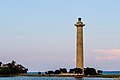 Perry's Victory and International Peace Memorial (1912–1915), Put-In-Bay, Ohio on South Bass Island
 -
 Oliver Hazard Perry (1860), by William Walcutt, Perry's Victory and International Peace Memorial
 -
 Oliver Hazard Perry (1885), by William Greene Turner, Newport, Rhode Island
 -
 Perry Monument (1926), Presque Isle, Erie, Pennsylvania
 -
 Perry statue (1928), Rhode Island State House


Paintings
[edit]

- "Commodore Oliver Hazard Perry" (1818–1828) by Gilbert Stuart and Jane Stuart, Toledo Museum of Art, Toledo, Ohio
- Perry's Victory on Lake Erie (1865) by William Henry Powell, Rotunda, Ohio Statehouse, Columbus, Ohio.[68] Dimensions: 12 ft × 16 ft (3.7 m × 4.9 m).
- Battle of Lake Erie (1873) by William Henry Powell, United States Capitol, Washington D.C.[69] Dimensions: 16.76 ft × 26.63 ft (5.11 m × 8.12 m).
- Portrait of Oliver Hazard Perry (1900), by Gari Melchers, Executive Chamber, Rhode Island State House[70]
- Battle of Lake Erie (c. 1911) by Edward Percy Moran
- Battle of Lake Erie, September 10, 1813 (1959), by Charles Robert Patterson and Howard B. French, United States Naval Academy, Annapolis, Maryland
Documentary
[edit]In 2016, principal photography began on We Have Met the Enemy, a feature-length documentary produced by Lou Reda (Vietnam in HD, The Blue and the Gray), for a planned spring 2017 release.[71]
Eponymous ships
[edit]Commodore Perry has been repeatedly honored with ships bearing his name.
- USS Perry (1843), a sailing brig 1843–1865
- USS Commodore Perry (1859), an armed side-wheel ferry built in 1859 by Stack and Joyce, Williamsburg, New York and purchased by the Navy on October 2, 1861; and commissioned later in the month, Acting Master F. J. Thomas was in command[72]
- USS Perry (DD-11), a Bainbridge-class destroyer (1900–1919)
- USS Perry (DD-340), a Clemson-class destroyer converted into a high-speed minesweeper and re-designated DMS–17 effective November 19, 1940. Served 1921–1944; sunk in Battle of Peleliu.
- SS Oliver Hazard Perry, a Liberty ship. See List of Liberty ships (M–R).[73]
- USS Perry (DD-844), a Gearing-class destroyer (1945–1970)
- USS Oliver Hazard Perry (FFG-7), a guided-missile frigate (1976–1997), and the Oliver Hazard Perry-class frigates, of which it was a member, are named in his honor. The Navy built 51 of the Oliver Hazard Perry-class frigates, with the first going into service in 1977, and the last to be finally moth-balled in 2015.[74][75] See also USS Perry.
- SSV Oliver Hazard Perry, a Rhode Island Educational Foundation tall ship
Popular song
[edit]In 1820, Anthony Philip Heinrich wrote a song, "Ode to the Memory of Commodore O. H. Perry",[76] with words by Henry C. Lewis.
See also
[edit]


.svg)
Notes
[edit]Footnotes
[edit]- ^ His progression from being the subject of a court-martial for running aground to being a formidable commander who made a real difference has a striking parallel to the career of Admiral Chester W. Nimitz.
- ^ A "cable" is 720 feet in the Royal Navy, 600 feet (183 m) in the U.S. Navy. "Half cable's length" would be less than 330 feet (100 m).
- ^ The British order of battle was actually two ships, one brig, two schooners and one sloop.[24]: 260–261 "Perry's message was inaccurate."[21]: Note 129, p. 97.
- ^ There is a monument of him on the river near the PYC (Perrysburg Yacht Club). This town also is the home of Fort Meigs
Citations
[edit]- ^ Skaggs, 2006, p. xi
- ^ a b White, 1895, p. 288
- ^ a b c d e f g h Bloom, Page essay
- ^ Paullin, 1918, See Bibliography
- ^ Capace, Nancy (2001). The Encyclopedia of Rhode Island. St. Clair Shores, Michigan: Somerset Publishers, Inc. p. 368. ISBN 978-0-403-09610-7. Retrieved August 23, 2014.
- ^ Skaggs, 2006, p. 6
- ^ Lives of Illustrious Men of America. BoD – Books on Demand. March 3, 2023. ISBN 978-3-382-30918-3.
- ^ Mackenzie, 1840, p. 40
- ^ Barnes, 1912, p. 11
- ^ Brown, 2006, Oliver Hazard Perry, p. 226
- ^ Barnes, 1912, p. 16
- ^ Mackenzie, 1840, pp. 53–55
- ^ Copes, Jan M. (Fall 1994). "The Perry Family: A Newport Naval Dynasty of the Early Republic". Newport History: Bulletin of the Newport Historical Society. 66, Part 2 (227). Newport, RI: Newport Historical Society: 49–77.
- ^ a b Cooper, James Fenimore (May 1843). Oliver Hazard Perry. Vol. XXII. Graham's Magazine. p. 268. Retrieved January 7, 2011.
- ^ "Divers: 1811 Wreck of Perry Ship Discovered Off RI". The New York Times. Associated Press. January 7, 2011. Retrieved January 7, 2011.[permanent dead link]
- ^ "Divers Say They've Found 1811 Wreck of Perry Ship". AOL News. January 8, 2011. Archived from the original on January 9, 2011. Retrieved January 9, 2011.
- ^ a b c "Oliver Hazard Perry – Perry's Victory & International Peace Memorial". Retrieved June 9, 2012.
- ^ Skaggs, 2006, p. 50
- ^ a b c Potter, 1981, p. 106
- ^ Herring, James; Longacre, James Barton (1854). The national portrait gallery of distinguished Americans. Vol. 1. Philadelphia: D. Rice & A.N. Hart. Retrieved September 3, 2011.
- ^ a b c Altoff, Gerard T. (1999). Oliver Hazard Perry and the Battle of Lake Erie. Put-in-Bay, OH: The Perry Group. ISBN 978-1-887794-03-9.
- ^ a b Farmer, Silas. (1884) (Jul 1969) The history of Detroit and Michigan, or, The metropolis illustrated: a chronological cyclopaedia of the past and present: including a full record of territorial days in Michigan, and the annuals of Wayne County, p. 283 and Various formats at Open Library.
- ^ a b Dudley, William S., ed. The Naval War of 1812: A Documentary History. vol.2 (Washington, D.C.: US Government Printing Office, 1992), p. 559.
- ^ a b c Roosevelt, Theodore (1889). The Naval War of 1812 Or The History of the United States Navy during the Last War with Great Britain to Which Is Appended an Account of the Battle of New Orleans (Tenth ed.). New York: G. P. Putnum's Sons. p. 266.
- ^ "H-089-1: "Don't Give Up the Ship!"". www.history.navy.mil.
- ^ a b "Famous Navy Quotes: Who Said Them and When". Naval History and Heritage Command. Archived from the original on September 23, 2007. Retrieved September 3, 2011.
- ^ Skaggs, 2000, p. 147
- ^ a b c d e Skaggs, David Curtis (April 2009). "Perry Triumphant". Naval History Magazine. 23 (2). United States Naval Institute. Retrieved September 3, 2011.
- ^ Symonds, Craig L; Clipson, William J. (April 2001) The Naval Institute historical atlas of the U.S. Navy Annapolis, Maryland: Naval Institute Press 264 pp, ISBN 978-1-55750-984-0, p. 48.
- ^ a b c d Skaggs, David Curtis (2013). The Battle of Lake Erie and Its Aftermath. Ohio: The Kent State University Press. p. 220.
- ^ a b c Quoted in Altoff, Gerard T. (1993). Deep Water Sailors Shallow Water Soldiers: Manning the United States Fleet on Lake Erie – 1813. Put-in-Bay, OH: The Perry Group. pp. 23–24. ISBN 978-1-887794-01-5.
- ^ Taylor, William V. (1813). Logbook of the USS Lawrence. Newport, RI: Newport Historical Society.
- ^ Skaggs, David Curtis (January 2014). "Aftermath of Victory: The Perry-Elliott Controversy". Naval History. 28 (1). Retrieved August 12, 2025.
- ^ American State Papers. Naval Affairs. Volume 1. p. 295.
- ^ a b J. F. Loubat (1888). The Medallic History of the United States of America, 1776—1876. Vol. II. Illustrated by Jaquemart, Jules Fredinand. N. Flayderman & Co. Retrieved September 3, 2011.
- ^ Lossing, Benson J. (1869). "XVIII – Events on the Northern and Niagara Frontiers in 1812". Pictorial Field Book of the War of 1812. Retrieved September 3, 2011.
- ^ "Congressional Gold Medal Recipients (1776 to Present)". Clerk of the U.S. House of Representatives. Archived from the original on July 27, 2011. Retrieved September 3, 2011.
- ^ Glassman, Matthew Eric (June 21, 2010). Congressional Gold Medals, 1776–2009 (Report). Congressional Research Service. p. 3. Archived from the original on March 15, 2011. Retrieved September 3, 2011.
- ^ Congressional Gold Medal Honoring Oliver Hazard Perry.
- ^ Snowden 1861, pp. 83–84.
- ^ of 1812, Military Society of the War (1901). Roster of the Veteran Corps of Artillery Constituting the Military Society of the War of 1812.
{{cite book}}: CS1 maint: numeric names: authors list (link) - ^ "H. Doc. 15-66 - Letter from the Secretary of the Navy, transmitting, in obedience to a resolution of the House of Representatives, of the twenty-second instant, copies of the proceedings of the court martial ordered by Commodore Isaac Chauncey, on the Mediterranean station, for the trial of Captain Oliver H. Perry ; also, for the trial of Captain John Heath of the Marine Corps. January 30, 1818. Read, and ordered to lie upon the table". GovInfo.gov. E. De Krafft. January 30, 1818. p. 14. Retrieved June 28, 2023.
- ^ Gobetz, Wally (August 19, 2007), RI - Newport: Buliod-Perry House, retrieved June 14, 2025
- ^ Skaggs, David Curtis (2006). Oliver Hazard Perry: Honor, Courage, and Patriotism in the Early U.S. Navy. Naval Institute Press. pp. 191–199. ISBN 978-1-59114-792-3. Retrieved September 3, 2011.
- ^ Vivian, James (January 1975). "The Paloma Claim in United States and Venezuelan-Colombian Relations, 1818-1826". Caribbean Studies. 14 (4): 57–72. JSTOR 25612653.
- ^ Oliver Hazard Perry Robinson Library accessed November 28, 2017.
- ^ "Oliver Hazard Perry". public1.nhhcaws.local. Retrieved May 14, 2025.
- ^ Drake, Samuel Adams, 1833–1905. Nooks and corners of the New England coast, Rhode Island Cemeteries, p. 401. 2005.
- ^ Cope, Tony (2016). It's Not That Lincoln. The Abercorn Press.
- ^ Civil and Military List of Rhode Island. Vol. 2. p. 665.
- ^ Christopher R. Perry. "Christopher R. Perry • Cullum's Register • 1163". Penelope.uchicago.edu. Retrieved July 10, 2013.
- ^ "About Us - P.S. 34 Oliver H. Perry Elementary School". About Us - P.S. 34 Oliver H. Perry Elementary School.
- ^ "Perry, New York Village Information". epodunk. Archived from the original on October 24, 2012. Retrieved September 26, 2010.
- ^ "Ghost towns and post offices of Shiawassee County visited". The Argus-Press. October 2, 2000. p. 3. Retrieved May 2, 2015.
- ^ South Perry
- ^ Espenshade, Abraham Howry (1925). Pennsylvania place names. Pennsylvania State College. p. 337.
- ^ Capace, Nancy (2001). The Encyclopedia of Rhode Island. St. Clair Shores, Michigan: Somerset Publishers, Inc. pp. 160, 360, 363. ISBN 978-0-403-09610-7. Retrieved August 23, 2014.
- ^ Bergstrom, Bill (December 11, 1984). "Origins of place names are traced". Kentucky New Era. p. 2B. Retrieved April 29, 2015.
- ^ "Inn at Perry Cabin". Conde Nast Traveler. Retrieved March 17, 2023.
- ^ "Commodore Perry".
- ^ Watterson, Henry (1912). The Perry memorial and centennial celebration under the auspices of the national government and the states of Ohio, Pennsylvania, Michigan, Illinois, Wisconsin, New York, Rhode Island, Kentucky, Minnesota and Indiana. Cleveland, Ohio: Interstate Board of the Perry's Victory Centennial Commissioners. Retrieved October 22, 2011.
- ^ Text of Perry memorial plaque, quoted in George Champlin Mason, Annals of Trinity Church, Newport, Rhode Island, 1698–1821, (Philadelphia: The Evans Printing House, 1890), p. 323.
- ^ Olshan, Matthew (August 20, 2009). "A tale of two statues: A reader's story about Newport's Perry monuments prompts an investigation by a Pennsylvania writer". The Newport Daily News. Newport, RI. p. A9. Archived from the original on May 1, 2012. Retrieved May 10, 2012.
- ^ "Papers of Rear Admiral Henry E. Lackey (1899–1940)". Washington, D.C.: Operational Archives Branch, Naval Historical Center. Archived from the original on August 13, 2006. Retrieved September 2, 2011.
- ^ "USS Memphis". historycentral.com. Retrieved September 2, 2011.
- ^ United States Mint. "Perry's Victory and International Peace Memorial". United States Mint. Archived from the original on March 18, 2016. Retrieved June 8, 2013.
- ^ "82000020 NRHP nomination for Commodore Oliver Perry Farm" (PDF). Rhode Island Preservation. Retrieved September 30, 2014.
- ^ Perry's Victory on Lake Erie, from The Ohio Statehouse.
- ^ Battle of Lake Erie, from United States Senate.
- ^ Portrait of Oliver Hazard Perry by Gari Melchers Archived April 22, 2016, at the Wayback Machine, Rhode Island State House.
- ^ "We Have Met the Enemy". Archived from the original on October 5, 2016. Retrieved October 4, 2016.
- ^ "Commodore Perry". The Naval Historical Center. Archived from the original on March 14, 2004. Retrieved September 3, 2011.
- ^ "Liberty Ships built by the United States Maritime Commission in World War II". usmm.org. Archived from the original on May 9, 2008. Retrieved September 26, 2010.
- ^ Vergakis, Brock (January 7, 2015). "Last deployment: All Navy frigates soon to be decommissioned". Yahoo News. Associated Press. Retrieved January 7, 2015.
- ^ Rogoway, Tyler (January 10, 2014). "End Of The 'Ghetto Navy' Is In Sight As Last USN Frigate Cruise Begins". Fox Trot Alpha. Retrieved January 10, 2014.
- ^ "Ode to the Memory of Commodore O. H. Perry"
Bibliography
[edit]- Barnes, James (1912). The hero of Erie: (Oliver Hazard Perry). New York, London: D. Appleton & Company. p. 167.
- Bloom, Loren (2008). "The Battle of Lake Erie: Julian Oliver Davidson's Painting" (Oliver Hazard Perry – Hero). Erie Maritime Museum. Retrieved August 25, 2011.
- Brown, John Howard (2006). The Cyclopaedia of American Biography: Comprising the Men and Women of the United States ..., V6. Kessinger Publishing. p. 700. ISBN 978-1-4254-8629-7., Book
- Mackenzie, Alexander Slidell (1910). Commodore Oliver Hazard Perry. New York, NY/Akron, OH: D.M. MacLellan Book Company. p. 443.
- Mackenzie, Alexander Slidell (1840). The life of Commodore Oliver Hazard Perry. Vol. 1. New York: Harper & Brothers. p. 443.
- Paullin, Charles Edward (1918). The Battle of Lake Erie (a collection of documents, mainly those by Oliver Hazard Perry). Cleveland, Ohio: The Raufin Club. Retrieved August 18, 2011.
- Potter, Elmer Belmont (1981). Sea Power: A Naval History. Naval Institute Press. p. 419. ISBN 978-0-87021-607-7., Book
- Skaggs, David Curtis (2006). Oliver Hazard Perry: honor, courage, and patriotism in the early U.S. Navy. Naval Institute Press. p. 302. ISBN 978-1-59114-792-3.
- Skaggs, David Curtis; Altoff, Gerard T. (2000). A Signal Victory: The Lake Erie Campaign, 1812–1813. Naval Institute Press. p. 264. ISBN 978-1-55750-892-8.
- Snowden, James Ross (1861). A Description of the Medals of Washington; and of other Objects of Interest in the Museum of the Mint. Illustrated, to which are added Biographical Notices of the Directors of the Mint from 1792 to the year 1851. Philadelphia, Pennsylvania: J. B. Lippincott & Co. pp. 83–84. Retrieved September 3, 2011.
- White, James T. (1895). Oliver Hazard Perry. National Cyclopaedia of American Biography. p. 288.
Further reading
[edit]- Axelrod, Alen; Phillips, Charles. The Macmillan Dictionary of Military Biography (New York: Macmillan, 1998.) p. 343.
- Bancroft, George, 1800–1891; Dyer, Oliver, 1824–1907. (1891) History of the battle of Lake Erie: and miscellaneous papers (New York: R. Bonner's sons) 292 pp. at American Library Association.
- Burges, Tristam (1770–1853) (1839) Battle of Lake Erie, with notices of Commodore Elliot's conduct in that engagement (Providence, Brown & Cady) at Internet Archive.
- Conners, William James, 1857–; Emerson, George Douglas. (1916) The Perrys victory centenary. Report of the Perry's victory centennial commission, state of New York (Albany, J. B. Lyon Company, Printers).
- Coles, Harry L; Borstin, Daniel J., eds. (1966). The War of 1812 (Chicago: University of Chicago Press) ISBN 978-0-226-11350-0.
- Cooper, James Fenimore (1846) Lives of Distinguished American Naval Officers Kingman Press and here Lives of distinguished American naval officers for American Library Association.
- Cooper, James Fenimore, History of the Navy (1839).
- Dillon, Richard. (1978) We have met the enemy: Oliver Hazard Perry, wilderness commodore (New York: McGraw-Hill). ISBN 978-0-07-016981-4.
- "Robert J. Dodge Collection – MS 157". Center for Archival Collections. Bowling Green State University. Archived from the original on December 13, 2010. Retrieved October 2, 2011.
- Dodge, Robert J. (1962). The Battle of Lake Erie. National Park Service.
- Dutton, Charles J. (1935) Oliver Hazard Perry (New York: Longmans, Green and Co.) 308 pp. (Scholar's Bookshelf; First Edition. 2006) ISBN 978-0-945726-36-4.
- Downloadable resources regarding Oliver Hazard Perry, American Library Association.
- Eaton, Joseph Giles (1847–1905) (1905) Perry's Victory on Lake Erie. Military Historical Society of Massachusetts (Boston, For the Society, by Houghton Mifflin) at American Library Association.
- Elliott, Jesse D. Address of Com. Jesse D. Elliot, U.S.N., Delivered in Washington County, Maryland, to His Early Companions at Their Request, on November 24, 1843 (Philadelphia: G.B. Zeiber & co., 1844) 137 pp. at Google books.
- Hickey, Donald R. (1990) The War of 1812: The Forgotten Conflict Urbana: University of Illinois Press. National Historical Society Book Prize and American Military Institute Best Book Award. ISBN 978-0-252-06059-5.
- Hickey, Donald R. (2006) Don't Give Up the Ship! Myths of the War of 1812. (Urbana: University of Illinois Press) ISBN 978-0-252-03179-3.
- Langguth, A. J. (2006). Union 1812: The Americans Who Fought the Second War of Independence. New York: Simon & Schuster. ISBN 978-0-7432-2618-9.
- Lyman, Olin H. (1905) Commodore Oliver Hazard Perry and the War on the Lakes.
- Mackenzie, Alexander Slidell 1803–1848. (1915) Commodore Oliver Hazard Perry: famous American naval hero, victor of the battle of Lake Erie, his life and achievements (Akron, Ohio: Superior Printing Co.) at Internet Archive.
- Mills, James Cooke (1913). Oliver Hazard Perry and the battle of Lake Erie. Detroit, Michigan: J. Phelps.
- Mackenzie, Alexander Slidell, 1803–1848 (1840) The life of Commodore Oliver Hazard Perry. (New York, Harper) Volume 1, Volume 2.
- Mahan, Alfred Thayer (1840–1914) (1905) Sea Power in Its Relation to the War of 1812 (2 vols.) (Boston: Little Brown) American Library Association.
- Niles, John Milton (1820). The Life of Oliver Hazard Perry. William S. Marsh, Hartford. p. 376.
- Paullin, Charles Edward (October 1918). The Battle of Lake Erie (a collection of documents, mainly those by Oliver Hazard Perry). Cleveland, Ohio: The Raufin Club. Retrieved August 18, 2011.
- Morton, Edward Payson (1869–1914) Lake Erie and the story of Commodore Perry Chicago: Ainsworth & company Internet Archive digitized by Google.
- Niles, John Milton (Bedford, Mass.: Applewood Books, 1830) The Life of Oliver Hazard Perry.
- Reid, George. (1913) Perry at Erie:how Captain Dobbins, Benjamin Fleming and others assisted him. (Erie, Pennsylvania: Journal publishing company).
- Skaggs, David Curtis; Altoff, Gerard T. Altoff A Signal Victory: The Lake Erie Campaign, 1812–1813 (Naval Institute Press), winner John Lyman Book Awards 1997. ISBN 978-1-55750-892-8.
- Skaggs, David Curtis (1991). Welsh, William Jeffrey (ed.). War on the Great Lakes: Essays Commemorating the 175th Anniversary of the Battle of Lake Erie. Kent State University Press. Archived from the original on June 4, 2011. Retrieved May 24, 2012.
- Skaggs, David Curtis. Perry Triumphant (April 2009 Volume 23, Number 2) Naval History Magazine United States Naval Institute.
- White, James T. (1895) p. 288. National Cyclopaedia of American Biography.
External links
[edit]


- Perry @ the National Park Service.
- Perry @ the Naval Historical Center.
- Perry's account of the Battle of Lake Erie (See Further reading, Pauilin, supra.)
- The Oliver Hazard Perry papers William L. Clements Library.
- "Log of the Battle of Lake Erie" by Sailing Master William Taylor.
- US Brig Niagara
- Commodore Perry I.P.A. and Tasting guide, Commodore Perry Archived September 9, 2025, at the Wayback Machine India Pale Ale by Great Lakes Brewing Co.
- Bloom, Loren (2008). "Information about the epic battle painting by Julian O. Davidson". The Battle of Lake Erie: Julian Oliver Davidson's Painting. Erie Maritime Museum. Retrieved August 25, 2011.
- Perry Monument, Buffalo Historical Markers and Monuments website.
- Correspondence of Oliver Hazard Perry at Dartmouth Digital Library
- Oliver Hazard Perry at Find a Grave


Oliver Hazard Perry
View on GrokipediaEarly Life
Birth and Family Background
Oliver Hazard Perry was born on August 23, 1785, in South Kingstown, Rhode Island, to Christopher Raymond Perry and Sarah Wallace Alexander Perry.[1] He was named after his uncle Oliver Hazard Perry, a sea captain lost at sea, and an ancestor from the Hazard family, reflecting the maritime influences embedded in his lineage from birth.[1] As the eldest son in a family of five sons and three daughters, Perry grew up alongside siblings who shared the naval tradition, most notably his younger brother Matthew Calbraith Perry, who later rose to the rank of commodore and played a key role in opening Japan to Western trade.[1][5] His father, Christopher Raymond Perry, embodied the family's seafaring heritage through his service as a privateer captain during the American Revolutionary War, where he commanded the sloop General Mifflin and endured multiple captures by British forces, including imprisonment on the notorious prison hulk Jersey and in Ireland.[6] After the war, Christopher transitioned to a career as a merchant sea captain, engaging in Rhode Island's vital maritime trade, while also serving as Chief Justice of the Court of Common Pleas for Washington County from 1780 to 1791, which elevated the family's social standing.[7][8] Sarah Wallace Alexander Perry, a Scotch-Irish woman whom Christopher met and promised to marry while imprisoned in Ireland during the Revolution, brought resilience to the family dynamic; the couple wed in 1784 upon their return to America.[6] Though specific seafaring ties in her immediate family are less documented, her marriage into the Perry line integrated her into Rhode Island's prominent Quaker-descended but militarily inclined community, centered around Newport and South Kingstown, where maritime commerce formed the economic backbone.[6] The Perrys resided on a 200-acre estate in Tower Hill, underscoring their status as a well-established family with deep roots in the colony's shipping and naval pursuits, which profoundly shaped Oliver's early worldview.[9][8]Upbringing and Naval Influences
Oliver Hazard Perry was born on August 23, 1785, in South Kingstown, Rhode Island, where he spent his early childhood immersed in the post-Revolutionary maritime environment of the region. Rhode Island, with its extensive coastline and ports like Newport and Providence, had been a hub for shipping, trade, and privateering during the American Revolution, and by the 1790s, it continued to foster a vibrant seafaring culture centered on commerce and naval aspirations. Perry's family relocated to Newport around 1792 when he was about seven years old, placing him in the heart of this bustling port city, known for its recovery from wartime disruptions and growing role in international trade.[10][11][12] Perry's education was primarily informal, shaped by local Newport schools and familial guidance rather than formal academies. His mother, Sarah Wallace Alexander Perry, taught him and his siblings to read and write, emphasizing basic literacy alongside regular attendance at Trinity Episcopal Church, where he was baptized. Complementing this, Perry engaged in self-study of navigation and seamanship, drawing inspiration from his father's accounts of naval service during the Revolution, which highlighted the skills and rigors of life at sea. The family's strong naval tradition further motivated his interests, as his father, Christopher Raymond Perry, had commanded ships in the Continental Navy.[5][5] Early exposure to naval life came through close family connections, including his uncle Oliver Hazard Perry, a Continental Navy officer who had been lost at sea during the war, after whom Perry was partially named alongside his paternal great-grandfather. These influences culminated in Perry's formal entry into the U.S. Navy; at age thirteen, through his father's connections, he was appointed midshipman on April 7, 1799, under President John Adams, serving aboard the USS General Greene commanded by his father. This appointment marked the transition from formative influences to active duty, equipping him with practical knowledge gained from his upbringing.[1][10][3]Early Naval Career (1799–1812)
Service in the Quasi-War and Tripolitan War
Oliver Hazard Perry entered the U.S. Navy as a midshipman on April 7, 1799, at the age of thirteen, influenced by his father's naval career as Captain Christopher Raymond Perry.[3] He began his active service aboard the frigate USS General Greene, commanded by his father, conducting patrols in the West Indies during the Quasi-War with France (1798–1800) to counter French privateers preying on American merchant shipping. Although Perry saw no major engagements during this period, the patrols provided him with early exposure to naval operations and discipline.[13] In 1802, Perry received a promotion to acting lieutenant at the age of seventeen and transferred to the frigate USS Adams for convoy escort duties in the Mediterranean Sea.[11] Sailing under Captain Hugh G. Campbell as part of Commodore Richard Morris's squadron, he supported American merchant vessels amid rising tensions with the Barbary states.[13] This assignment marked his initial involvement in the First Barbary War (1801–1805), also known as the Tripolitan War, where the United States sought to end tribute payments to North African corsairs by enforcing a naval blockade of Tripoli.[14] Perry's service in the Tripolitan War continued across multiple vessels, including the frigates USS Constellation and USS Constitution, as well as the schooner USS Nautilus and the frigate USS Essex, contributing to the ongoing blockade efforts against Tripoli's harbor.[10] By 1804, as an acting lieutenant, he served as first lieutenant aboard USS Nautilus during Commodore Edward Preble's squadron operations, participating in the intense bombardment of Tripoli on August 3, 1804, where American forces shelled the city's defenses and engaged Tripolitan gunboats to pressure Pasha Yusuf Karamanli into negotiations.[15] These actions, though not resulting in immediate victory, demonstrated U.S. naval resolve and inflicted significant damage on enemy fortifications.[16] Perry's performance during the war led to his confirmation as a full lieutenant on January 15, 1807, recognizing his growing expertise in gunnery and seamanship amid the Mediterranean campaigns. Following his return to the United States, Perry took a leave of absence and then supervised the construction of gunboats in Newport, Rhode Island, until 1809.[17]Command of USS Revenge and Pre-War Duties
In April 1809, Oliver Hazard Perry, then a lieutenant, received his first independent command of the 14-gun schooner USS Revenge, a vessel previously used for patrol duties in northern waters under Commodore John Rodgers.[1] During his tenure from 1809 to 1811, Perry's primary responsibilities involved enforcing the Embargo Act of 1807 along the U.S. Atlantic coast, which prohibited American ships from trading with foreign ports to avoid entanglement in European conflicts.[5] These duties included conducting anti-smuggling patrols to intercept vessels attempting to evade the embargo, often in challenging coastal waters from New England southward; in spring 1810, Revenge underwent refitting at the Washington Navy Yard before Perry sailed her to southern stations off Charleston, South Carolina, where the heat exacerbated his health issues from prior service.[1][18] On January 9, 1811, while returning from Newport to New London through heavy fog in Block Island Sound, Revenge struck rocks off Watch Hill Point, Rhode Island, due to a navigational error attributed to the ship's pilot during a routine harbor survey amid stormy conditions.[19] The schooner was deemed a total loss after salvage efforts failed, marking a significant setback in Perry's early command career.[19] Perry faced a court-martial shortly thereafter, a standard procedure for such incidents, but was fully exonerated, with responsibility placed on the pilot for the misjudgment.[5][19] Following the acquittal, Perry resumed shore-based duties in Newport. From mid-1811 until the outbreak of the War of 1812 in June 1812, he oversaw the local naval yard and commanded a squadron of gunboats stationed at Newport, focusing on defensive preparations, maintenance of small craft, and initial recruiting efforts to bolster the Navy's readiness amid rising tensions with Britain.[5][11] These responsibilities highlighted Perry's administrative skills during a period of relative peacetime, though he grew frustrated with the lack of active sea duty.[11]War of 1812
Assignment to Lake Erie Squadron
Following the outbreak of the War of 1812, Oliver Hazard Perry was promoted to master commandant on October 6, 1812, while serving with the gunboat flotilla at Newport, Rhode Island.[1] Shortly thereafter, he was offered command of the new 44-gun frigate USS Java, then under construction in Baltimore, but in February 1813, at the request of his friend Commodore Isaac Chauncey—who oversaw U.S. naval operations on the Great Lakes—Perry was reassigned to build and lead a squadron on Lake Erie to counter British control of the waterway.[1][20] This transfer leveraged Perry's prior experience commanding the schooner USS Revenge during peacetime patrols, positioning him to address the critical need for an experienced officer in the underdeveloped Great Lakes theater.[1] Perry arrived in Erie, Pennsylvania, on March 26, 1813, after a grueling 11-day winter journey from Sackets Harbor, New York, where he had been detained by Chauncey to assist with operations on Lake Ontario.[20][21] Upon arrival, he faced severe logistical hurdles in assembling the squadron, including the construction of vessels from unseasoned green timber due to material shortages and time pressures, which caused issues like leaking hulls requiring innovative lead caulking in place of traditional oakum and pitch.[20] The fleet ultimately comprised two brigs—the 20-gun USS Lawrence (launched May 24, 1813)[22] and USS Niagara (launched July 4, 1813)—along with six schooners, all built at Presque Isle in just eight months under shipwright Noah Brown.[21] Recruiting experienced sailors proved equally challenging amid the remote location and competition from other theaters; Perry initially enlisted about 40 local landsmen on short-term contracts at $10 per month, later supplementing crews with detachments from the army to reach roughly 300 men by August.[20][21] To integrate naval efforts with land campaigns, Perry coordinated closely with Major General William Henry Harrison, commander of U.S. forces in the Northwest, aiming to secure Lake Erie for supply lines and amphibious operations that would enable invasions into Upper Canada.[20] This joint strategy positioned Harrison's troops near Sandusky, Ohio, for potential advances, with Perry providing naval gunfire support and troop transport once the squadron was operational.[21] However, internal frictions arose with his subordinate, Master Commandant Jesse D. Elliott, who arrived in August 1813 with reinforcements but harbored resentments over Perry's overall command authority—despite Elliott's seniority in some respects—and disputes regarding resource allocation and ship assignments, such as Elliott's placement aboard the Niagara.[20][21] These tensions stemmed partly from Chauncey's decisions on promotions and deployments, complicating the squadron's buildup.[1]Preparation and Challenges on Lake Erie
Perry's preparations on Lake Erie were marked by persistent challenges beyond initial construction. Supply lines from Philadelphia and Pittsburgh were unreliable, exacerbated by harsh weather and British blockades that captured American supply schooners in early summer 1813. The use of green timber led to warped hulls and frequent repairs, while gunpowder and ordnance arrived late, forcing Perry to improvise with local resources. Crew morale suffered from inexperience—many were army volunteers unaccustomed to naval discipline—and desertions were common in the isolated Presque Isle area. British raids, including the capture of the schooner Ohio in May, threatened the shipyard, prompting Perry to fortify defenses with artillery from Fort Erie. Despite these obstacles, by late August, the squadron broke through the shallow bar at Presque Isle to reach deeper waters, setting the stage for the confrontation.[20][23]Battle of Lake Erie
On September 10, 1813, off Put-in-Bay in Ohio waters on Lake Erie, Commodore Oliver Hazard Perry's American squadron of nine vessels—comprising the brigs Lawrence (flagship, 20 guns), Niagara (20 guns), Caledonia (3 guns), the schooners Scorpion (2 guns), Ariel (4 guns), Somers (2 guns), Porcupine (2 guns), Tigress (1 gun), and the sloop Trippe (1 gun)—totaling 54 guns and approximately 490 men, engaged the British squadron of six vessels under Captain Robert Heriot Barclay.[24][25] The British force included the ships Detroit (19 guns) and Queen Charlotte (17 guns), the brig General Hunter (10 guns), the schooners Lady Prevost (13 guns) and Chippewa (2 guns), and the sloop Little Belt (3 guns), mounting 63 guns and manned by about 440 personnel.[24][23] Perry, having briefly scouted the British position earlier that morning from his anchorage at Put-in-Bay, weighed anchor around 7:00 a.m. upon sighting the enemy to the northwest and formed his line in a west-southwest direction, with Lawrence leading and Niagara in support, while ordering the smaller gunboats to follow in the van.[26][23] Perry's aggressive tactics emphasized closing to short range to leverage the Lawrence's heavy carronades, despite the American fleet's disadvantage in long guns.[24] As the opposing lines converged around noon, a favorable wind shift aided the Americans, allowing Perry to hoist the battle flag bearing Captain James Lawrence's motto "Don't Give Up the Ship" and advance Lawrence directly toward the British flagship Detroit.[26][25] The Lawrence endured a withering two-hour barrage from the concentrated fire of Detroit, Queen Charlotte, and supporting vessels, as Niagara, under temporary command of Lieutenant Jesse D. Elliott, failed to close support promptly, leaving Perry's flagship isolated.[26][23] By approximately 2:30 p.m., the Lawrence was disabled, its deck a shambles with most guns out of action and over 80 percent of its crew killed or wounded, compelling Perry to transfer command temporarily to his first lieutenant.[26][25] Seizing the moment, Perry rowed a small open boat across heavy fire to the Niagara, arriving amid the chaos and immediately assuming command to rally the crew.[26][23] This transfer marked the turning point: under Perry's direct leadership, the Niagara surged forward, passing through a gap in the disorganized British line where Detroit and Queen Charlotte had collided while maneuvering.[24][25] The Niagara delivered devastating double-shotted broadsides at pistol range, raking the British vessels from stern to stern and causing pandemonium among Barclay's squadron, which had already suffered significant damage and crew losses.[26][23] Supported by the smaller American gunboats closing in, Perry's maneuver shattered the British formation, leading Barclay—wounded in the leg and arm—to strike his colors around 3:00 p.m., with the entire squadron surrendering shortly thereafter by 4:00 p.m.[26][27] The battle resulted in American casualties of 27 killed and 96 wounded, a total of 123, with the Lawrence accounting for the majority at 22 killed and 61 wounded.[25][26] British losses were heavier, with 41 killed and 94 wounded—totaling 135 casualties—plus 306 captured, including Barclay and most officers.[25] All six British vessels were captured intact by the Americans, securing complete control of Lake Erie for the United States.[23][27]Victory Dispatch and "Don't Give Up the Ship" Flag
Following the American victory in the Battle of Lake Erie on September 10, 1813, Commodore Oliver Hazard Perry immediately composed a concise dispatch to Major General William Henry Harrison, commander of the Army of the Northwest, reporting the outcome. The message, scribbled on the back of an old envelope, read: "Dear General: We have met the enemy and they are ours. Two Ships, two Brigs, one Schooner & one Sloop. Yours with great respect and esteem, O H Perry." Delivered by a courier on horseback who rode approximately 60 miles through rough terrain to reach Harrison at Camp Supply near the mouth of the Maumee River, the dispatch arrived on September 12 and was quickly forwarded to Washington, D.C.[28] This brief communication electrified the nation, arriving at a time when American forces had suffered setbacks elsewhere in the War of 1812, and it significantly boosted public morale by announcing control over Lake Erie and the capture of the entire British squadron. Central to Perry's command during the engagement was the battle flag flown from the masthead of his flagship, USS Lawrence, bearing the bold white inscription "DON'T GIVE UP THE SHIP" on a field of blue. Inspired by the dying words of Captain James Lawrence, who uttered the phrase aboard USS Chesapeake during its defeat by HMS Shannon on June 1, 1813, the flag served as a powerful rallying symbol for Perry's squadron as it faced overwhelming odds. The original flag, measuring approximately 9 by 9 feet, was hastily sewn in early August 1813 by a group of local women in Erie, Pennsylvania, including Margaret Forster Steuart and six others—Dorcas Forster Bell, Jane Bell, Elizabeth Bell, Elizabeth Rachel Forster, Mary Theodosia Forster, and Catherine Ann Forster—who worked under the direction of Steuart using white cotton sheeting for the letters and a blue woolen blanket for the background.[15][29] As the Lawrence became disabled and raked by British fire, Perry lowered the flag and transferred it to the brig USS Niagara, where it continued to fly, symbolizing unyielding resolve until the British surrendered; the banner emerged unscathed from the battle and was immediately recognized as an emblem of triumph. The dispatch and flag rapidly captured the public imagination, amplifying Perry's heroism through widespread newspaper coverage and celebrations across the United States. By late September 1813, accounts of the victory, including excerpts of Perry's message, appeared in major publications such as the Niles' Weekly Register and the New-York Evening Post, which hailed it as a "glorious victory" that restored national confidence and inspired patriotic fervor, with poems and toasts dedicated to Perry circulating in cities from Boston to Philadelphia.[27] The flag, too, became an instant icon, carried in victory parades in Erie and later presented to Perry as a personal memento before its eventual donation to the U.S. Naval Academy in 1907, where it remains on display as a testament to the battle's symbolic legacy.[15] These elements not only commemorated the strategic success but also unified American sentiment amid the ongoing war.Perry–Elliott Controversy
Following the Battle of Lake Erie on September 10, 1813, a contentious dispute arose between Commodore Oliver Hazard Perry and his subordinate, Master Commandant Jesse D. Elliott, over Elliott's conduct during the engagement. Elliott, commanding the brig USS Niagara, held his vessel at a distance from the main action for approximately 90 minutes, adhering to Perry's initial line-of-battle formation despite the heavy damage to Perry's flagship, USS Lawrence; he only advanced aggressively after Perry transferred to the Niagara and assumed direct command.[30] Elliott's supporters later claimed his timely intervention with the Niagara and smaller gunboats turned the tide, saving the American squadron from defeat.[31] In his official dispatch dated September 13, 1813, Perry initially commended Elliott, stating that he was "enabled to bring the Niagara... into action," though the phrasing subtly implied reluctance on Elliott's part.[30] Privately, however, Perry soon expressed frustration in letters criticizing Elliott's inaction and hesitation, which he believed prolonged the battle and endangered the fleet.[1] The feud escalated publicly between 1818 and 1819, fueled by Elliott's accusations of defamation against Perry through circulated letters and affidavits; Perry responded by filing formal charges against Elliott in August 1818, alleging cowardice and disobedience, which were published posthumously in 1821.[30] This exchange of pamphlets and personal attacks drew in prominent naval figures and divided loyalties within the officer corps. Naval investigations addressed the claims in two key proceedings. A 1814–1815 court of inquiry, prompted by British allegations of American misconduct, cleared Elliott of any wrongdoing in withdrawing from action, affirming his contributions to the victory.[31] A subsequent 1818 board, convened amid the renewed feud, ultimately vindicated Perry by upholding his authority and criticizing Elliott's delays, though President James Monroe suppressed further court-martial proceedings to prevent scandal.[1] These outcomes bolstered Perry's reputation as the battle's decisive leader, leading to rapid promotions and honors, while tarnishing Elliott's career; he faced stalled advancements and no eponymous ships, unlike Perry.[30] The Perry–Elliott controversy had lasting implications for U.S. Navy command culture, exposing tensions over subordinate initiative, loyalty, and credit in joint operations, and fostering rival factions that influenced promotions and public perceptions for decades.[30]Awards and Immediate Recognition
The Battle of Lake Erie victory brought Perry swift recognition. On September 10, 1813—the day of the battle—Secretary of the Navy William Jones promoted him to captain, a rank he held until his death. Congress expressed its thanks in a joint resolution on January 15, 1814, and awarded Perry a Congressional Gold Medal on February 4, 1814, honoring his "skill and intrepidity." Similar medals were given to key subordinates like Elliott and officers of the squadron. Nationally, Perry was hailed as a hero; cities from New York to New Orleans hosted parades and banquets, and his dispatch was reprinted widely, cementing his status. The victory also earned him command of the captured British ships temporarily, aiding repairs before his reassignment.[1][27]Later Career and Commands
Command of USS Java and Post-War Operations
Following the end of the War of 1812, Oliver Hazard Perry's renown from the Battle of Lake Erie secured him command of the newly constructed 44-gun frigate USS Java, launched on August 1, 1814, by shipbuilders Flannigan & Parsons in Baltimore, though not completed until after the war.[32] Perry was assigned command in July 1814, while the vessel was still under construction, and it was partially fitted out for defensive preparations during the British invasion of the Chesapeake region in late summer 1814, though it did not see combat before the Treaty of Ghent.[1] Under his leadership, Java got underway from Baltimore on August 5, 1815, stopping at Hampton Roads for rigging and New York for additional stores before proceeding to Newport, Rhode Island, where Perry assumed full operational control with a completed crew.[32] In January 1816, Java embarked on an extended Mediterranean cruise to protect American commerce, suppress Barbary piracy, and enforce diplomatic agreements with North African states.[32] The ship departed Newport on January 22, 1816, but encountered tragedy en route when its mainmast snapped during a gale, killing five sailors and injuring others, an incident that tested Perry's leadership in maintaining crew morale amid the hazards of post-war naval operations.[32] Arriving in the Mediterranean, Java visited key ports including Syracuse, Messina, Palermo, Tunis, and Gibraltar; in April 1816, Perry went ashore at Algiers under a flag of truce to persuade Dey Omar Pasha to honor the recent U.S. treaty obligations, demonstrating American naval resolve without resorting to force.[32] During a stop in Naples, tensions arose when Perry slapped Marine Captain John Heath over a disciplinary dispute involving Heath's treatment of subordinates, leading to mutual courts-martial in October 1816; both officers received only mild reprimands, though the incident highlighted Perry's strict standards for crew discipline.[1] The cruise concluded with Java returning to U.S. waters in early 1817, where it was decommissioned and laid up at the Boston Navy Yard.[32] Upon his return to Newport in early 1817, Perry shifted to shore-based duties that integrated his family responsibilities with naval obligations, residing with his wife, Elizabeth Champlin Mason—whom he had married in 1811—and their growing family of five children, one of whom had died in infancy.[1] Amid the peacetime demobilization of the U.S. Navy, which saw significant reductions in personnel and funding after 1815, Perry's prior promotion to captain in September 1813 positioned him for continued service on half-pay status, though advancement opportunities were limited by budget constraints and the shift to a smaller, defensive fleet.[1] The post-war era also brought minor controversies for Perry, particularly regarding crew discipline and resource allocation during the Navy's contraction; the Heath incident lingered, culminating in a duel challenge from the officer on October 19, 1817, at the site of the Burr-Hamilton affair, which Perry resolved by refusing to fire after Heath missed his shot.[33] Additionally, disputes over provisioning and manning Java during its outfitting reflected broader challenges in reallocating scarce resources in a downsized service, though Perry's reputation generally shielded him from severe repercussions.[1]Second Barbary War Involvement
Shortly after the end of the War of 1812, the United States authorized naval action against Algiers on March 3, 1815, in response to renewed piracy and the capture of American merchant vessels, prompting Commodore Stephen Decatur to lead a squadron that blockaded and bombarded Algiers on August 17, 1815, forcing a peace treaty that secured the release of captives and ended tribute demands.[14] Although Java was not ready to join Decatur's immediate operations, Perry, from Hampton Roads, Virginia, wrote a letter on September 3, 1815, congratulating a correspondent on the "successful termination of the Algerine War" and praising Decatur as a "gallant, and good friend" for his leadership in the victory.[34] Java departed Newport, Rhode Island, for the Mediterranean on January 22, 1816, under Perry's command, joining the U.S. naval presence to enforce the peace treaty with Algiers signed the previous summer.[32] By April 1816, the frigate had arrived off Algiers, where Perry went ashore under a flag of truce to confront Dey Omar Pasha directly; he successfully persuaded the Dey to honor the treaty, which the Algerians had begun ignoring, thereby preventing renewed hostilities and demonstrating U.S. resolve without further combat.[32] This diplomatic intervention, supported by the squadron's show of force—including visits to Tripoli alongside USS Constellation, Ontario, and Erie—helped stabilize the region and protect American commerce from Barbary threats in the war's aftermath.[32] Perry's enforcement actions through 1816 contributed to the lasting resolution of Barbary threats following the swift Second Barbary War.[32]Domestic Assignments and Ongoing Controversies
After returning from the Mediterranean in early 1817, Perry took up residence in Newport, Rhode Island, on half-pay status, where he focused on family life and local community involvement while remaining available for naval duties.[1] During this period, he managed household affairs and corresponded with naval colleagues, amid the Navy's post-war reductions that limited active assignments. Ongoing controversies from earlier service persisted, including the duel with Marine Captain John Heath on October 19, 1817, stemming from their 1816 altercation aboard Java. Heath challenged Perry, but after Heath's shot missed, Perry declined to fire, resolving the matter without fatalities.[33] Additionally, disputes over Java's provisioning and manning during its extended outfitting highlighted resource strains in the downsized Navy, though Perry faced no formal penalties. The Perry–Elliott controversy from the War of 1812 also lingered, with acrimonious letters exchanged and a proposed court-martial in 1818 ultimately suppressed by President James Monroe to avoid further division in the officer corps.[1] These years of relative quiet ended in 1819 when Perry received orders for a diplomatic mission to Venezuela.Mission to Venezuela and Death
Diplomatic Escort Duties
In June 1819, Secretary of the Navy Smith Thompson ordered Commodore Oliver Hazard Perry to assume command of the frigate USS John Adams and lead a special diplomatic mission to Venezuela, with the objective of establishing friendly relations with the revolutionary government, securing restitution for U.S. vessels captured by privateers, and curbing attacks on American commerce amid the ongoing wars of independence against Spain.[35] This assignment leveraged Perry's reputation as a seasoned naval commander, including his recent experience leading the USS Java in post-War of 1812 operations.[1] The mission reflected the United States' emerging policy of supporting Latin American independence from colonial rule, a stance that sought to protect U.S. trade interests while countering European intervention, principles later enshrined in the Monroe Doctrine of 1823.[36] Perry served as the primary U.S. agent, tasked with negotiating directly with representatives of Simón Bolívar's government in the nascent Republic of Colombia. In Angostura, Perry successfully negotiated and signed a treaty on August 11, 1819, with Venezuelan Vice President Francisco Antonio Zea, addressing U.S. demands for restitution and commerce protection.[35][37] Perry departed Annapolis, Maryland, on June 7, 1819 aboard the John Adams, accompanied by the schooner USS Nonsuch for additional firepower and support.[3] The squadron navigated the Caribbean amid regional instability, providing naval protection against Spanish privateers and revolutionary forces that preyed on merchant shipping. By mid-July, they arrived off the mouth of the Orinoco River, where Perry transferred to the Nonsuch to ascend the waterway toward Angostura (modern Ciudad Bolívar), the provisional capital, while the John Adams anchored nearby to maintain a defensive posture.[35] This escort role ensured the safety of the diplomatic party during the hazardous journey through contested waters.[37]Illness, Death, and Burial
During the return leg of his diplomatic mission to Venezuela, Oliver Hazard Perry contracted yellow fever while descending the Orinoco River aboard the USS Nonsuch, where he had shifted his flag for negotiations. Symptoms began on August 17, 1819, when he awoke at 4:00 a.m. with chills and a high fever, his condition rapidly deteriorating over the following days.[1] Despite the frantic efforts of the crew, including care from the ship's surgeon and officers, to reach medical aid in Port of Spain, Trinidad, Perry succumbed to the disease on August 23, 1819, at 3:00 p.m.—coinciding with his 34th birthday—just a few miles from the port.[33] The outbreak also affected 20 crew members, five of whom died.[38] Perry's body was buried with full military honors at Lapeyrouse Cemetery in Port of Spain shortly after his death, with the Nonsuch crew serving as honor guard under the direction of local authorities.[38] In 1826, following an Act of Congress, his remains were exhumed and transported aboard the USS Lexington to Newport, Rhode Island, for reburial at Island Cemetery, where a monument was erected in his memory.[39] The news of Perry's death elicited immediate mourning within the U.S. Navy, where he was hailed as a hero of the War of 1812, and profound grief among his family. His widow, Elizabeth Champlin Mason Perry, along with his brother Matthew C. Perry and other relatives, received detailed accounts of his final days through correspondence, reflecting their deep personal loss.[40]Personal Life
Marriage and Family
Oliver Hazard Perry married Elizabeth Champlin Mason on May 5, 1811, in Newport, Rhode Island, where she was a twenty-year-old daughter of Dr. Benjamin Mason and Margaret Champlin Mason.[1] The couple's union supported Perry's naval career, as Elizabeth managed family affairs during his extended absences at sea, including during the War of 1812.[1] Their marriage produced five children, with the family primarily residing in Newport, where Perry owned property on Touro Street and the Perry brothers maintained a home at 31 Walnut Street.[39][41] The children were Christopher Grant Champlin Perry (born 1812), Oliver Hazard Perry II (born 1813, died in infancy), Oliver Hazard Perry Jr. (born 1815), Elizabeth Mason Perry (born 1818), and Robert Smith Perry (born 1819). One child died in infancy and another in childhood, with three surviving to adulthood. Family movements were closely tied to Perry's postings; while he served on Lake Erie and later commands, Elizabeth and the children remained in Newport, with occasional relocations to ports like New York during his domestic assignments.[39] Perry's correspondence with Elizabeth and the children highlighted deep familial affection amid his professional demands. For instance, following his victory at the Battle of Lake Erie in 1813, he wrote a heartfelt letter to Elizabeth from Detroit expressing love and longing for home.[42] These letters, preserved in collections such as those at the University of Michigan's William L. Clements Library, reveal Perry's role as a devoted husband and father, balancing naval duties with personal bonds.[40] The sons pursued careers influenced by their father's legacy. Christopher Grant Perry became a physician and lawyer in Newport and Philadelphia, serving as commander of the Artillery Company of Newport from 1845 until his death in 1854.[43] Oliver Hazard Perry Jr. followed a naval path, entering the U.S. Navy as a midshipman in 1829, rising to lieutenant, and resigning in 1849 after service on vessels including the sloop-of-war Falmouth.[44] Robert Smith Perry also entered the Navy, serving as a midshipman and later achieving the rank of passed midshipman before pursuing civilian interests as a clergyman. Elizabeth led a private life in Newport before her early death. The family received congressional pensions after Perry's death to support the widow and minors.[45]Health Issues and Personal Correspondence
Oliver Hazard Perry experienced recurring health challenges that began during his early naval service, particularly while commanding the schooner USS Revenge from 1809 to 1811 in southern waters to enforce the Embargo Act of 1807. The intense heat and humidity of these patrols, combined with a severe storm in June 1810 that damaged the vessel en route to Charleston, South Carolina, left Perry plagued by illness, contributing to his overall physical vulnerability.[1] These early exposures to harsh conditions and stress during the 1810s weakened his constitution, making him susceptible to tropical diseases later in his career.[1] Perry's vulnerability culminated in a fatal bout of yellow fever during his 1819 diplomatic mission to Venezuela aboard the schooner USS Nonsuch. On August 17, 1819, while navigating the Orinoco River, Perry contracted the disease amid an outbreak that afflicted several crew members, resulting in five deaths. Despite rapid deterioration and efforts by the crew to reach medical care in Port of Spain, Trinidad, he succumbed on August 23, 1819—his 34th birthday—at 3:00 p.m.[1] Perry's personal correspondence offers intimate glimpses into his inner life, ambitions, and doubts, preserved in archival collections such as the Oliver Hazard Perry papers at the University of Michigan's William L. Clements Library and the Correspondence of Commodore Oliver Hazard Perry at Dartmouth College. Letters to his wife, Elizabeth Champlin Perry, express profound devotion and concern for family welfare, particularly during separations caused by naval duties in 1813 and beyond.[40][46] Correspondence with his father, Christopher Raymond Perry, and brother, Matthew C. Perry, reveals his career aspirations, including hopes for key commands, alongside frustrations with naval politics and bureaucratic obstacles that hindered promotions.[40] These writings, spanning 1807 to 1819, highlight his determination to advance in the Navy despite personal setbacks. Among Perry's notable letters, his September 10, 1813, dispatch to Major General William Henry Harrison following the Battle of Lake Erie—"We have met the enemy and they are ours"—captures his triumph but also underscores the personal stakes of command in private reflections.[1] In correspondence to Secretary of the Navy William Jones, such as the September 1813 letter defending his actions and critiquing subordinate Jesse D. Elliott amid post-battle controversies, Perry articulated his commitment to naval discipline and fairness.[3] Personal letters to family further expose his ambitions for lasting naval legacy and occasional doubts about the service's demands on his health and home life.[46] Historians value Perry's correspondence as primary sources for illuminating his character—resilient yet introspective—and his perspectives on the early U.S. Navy, including critiques of inefficiency and calls for reform amid the stresses of the War of 1812 era. These documents, often tender and candid, contrast with his public image as a decisive commander, providing a nuanced view of the personal toll of service.[40][46]Legacy
Military Ranks and Service Record
Oliver Hazard Perry's naval career spanned from 1799 to 1819, encompassing approximately 20 years of active service, including sea duty, shore assignments, and combat engagements during the Quasi-War with France, the First Barbary War, the War of 1812, and the Second Barbary War.[1] His service record highlights include over a decade of cumulative sea time, participation in multiple naval engagements such as blockades and fleet actions, and supervisory roles in ship construction and flotilla organization.[3] Perry received the following chronological promotions in the U.S. Navy:| Date | Rank | Notes |
|---|---|---|
| April 7, 1799 | Midshipman | Initial warrant; entry into naval service.[47] |
| January 15, 1807 | Lieutenant | Promotion following service in early conflicts.[47] |
| October 6, 1812 | Master Commandant | Advanced amid escalating War of 1812 tensions.[1] |
| September 10, 1813 | Captain | Highest permanent rank achieved; equivalent to modern rear admiral in precedence until 1862.[1][11] |
- 1799–1801: Midshipman aboard USS General Greene under his father, Captain Christopher R. Perry, during initial patrols.[5]
- 1800–1803: Service on USS Adams, USS *Constellation, and USS *Nautilus in the Quasi-War and early Mediterranean operations.[3]
- 1803–1805: Duty on USS *Essex* and USS *Constitution* during the First Barbary War, including blockade and convoy duties.[1]
- 1806–1809: Shore duty supervising gunboat construction in Rhode Island and Connecticut; brief leave in 1806–1807.[3]
- April 1809–January 1811: Command of schooner USS Revenge for embargo enforcement patrols in northern and southern waters; vessel wrecked in 1811, Perry exonerated by court-martial.[1]
- May 1812–February 1813: Command of gunboat squadron at Newport, Rhode Island, at the outset of the War of 1812.[3]
- February 1813–October 1813: Command of the Lake Erie Squadron, overseeing construction and operations.[1]
- November 1813–June 1814: Return to Newport gunboat flotilla duties.[1]
- July 1814–1816: Command of frigate USS Java during construction, defense of coastal cities, and Mediterranean cruise against Barbary threats.[1]
- 1816–1819: Various shore and administrative duties, including recruitment and squadron oversight.[3]
- June–August 1819: Command of sloop-of-war USS John Adams for diplomatic escort to Venezuela, transferring to schooner USS Nonsuch for riverine duties.[1]