

Opel Vectra
View on Wikipedia
| Opel Vectra | |
|---|---|
 Opel Vectra C (facelift) | |
| Overview | |
| Manufacturer | Opel (General Motors) |
| Also called |
|
| Production | October 1988 – June 2010 |
| Body and chassis | |
| Class | Large family car (D-segment) |
| Layout | Front-engine, front-wheel-drive/four-wheel-drive |
| Chronology | |
| Predecessor | Opel Ascona Vauxhall Cavalier Holden Camira / Holden Apollo (Holden Vectra) |
| Successor | Opel Insignia |
The Opel Vectra is a mid-size car (large family car) that was engineered and produced by the German automaker Opel from 1988 until 2010. Available in saloon, hatchback[1] and estate (from model year 1997 onwards) body styles, the Vectra was also sold by the Vauxhall marque in the United Kingdom as the Vauxhall Cavalier from 1988 to 1995 and then as the Vauxhall Vectra from 1995 to 2008, and it was also sold by Holden in Australia as the Holden Vectra, by Chevrolet in Latin America as the Chevrolet Vectra.
The Vectra was introduced in October 1988 as a replacement for the Opel Ascona, and was itself replaced in November 2008 by the new Opel Insignia, the nameplate spanning three generations and almost twenty-one years.
Vectra A (1988–1995)
[edit]| Vectra A | |
|---|---|
_(cropped).jpg) (Pre-facelift) | |
| Overview | |
| Also called | Chevrolet Vectra Holden Vectra (New Zealand) Vauxhall Cavalier |
| Production | October 1988 – October 1995 |
| Assembly |
|
| Designer | Wayne Cherry |
| Body and chassis | |
| Body style | 4-door notchback saloon 5-door hatchback |
| Platform | GM2900 platform |
| Related | Opel Calibra Saab 900 (NG) |
| Powertrain | |
| Engine | |
| Transmission | 5-speed manual (F10/5, F13/5, F16/5, F20/5) 6-speed Getrag manual (F28/6) 4-speed automatic |
| Dimensions | |
| Wheelbase | 2,600 mm (102.4 in) |
| Length | 4,430 mm (174.4 in) (saloon) 4,350 mm (171.3 in) (hatch) |
| Width | 1,700 mm (66.9 in) |
| Height | 1,400 mm (55.1 in) |
| Curb weight | 997–1,199 kg (2,198–2,643 lb) (4-cyl petrols) |
.jpg)

The first generation Vectra, known as the Vectra A, was introduced in October 1988 for the 1989 model year, as a four-door notchback saloon, replacing the Opel Ascona C. A five-door hatchback version arrived in March 1989, and a coupé based on the Vectra, called the Calibra, was introduced in the end of that year. Both cars were designed by Wayne Cherry, Opel’s design chief at the time. The Vectra name was coined by Manfred Gotta.
Vauxhall Motors, the British GM subsidiary that shared most of its models with Opel, did not use the "Vectra" model name - opting instead to continue the use of the Cavalier nameplate - effectively making the Vectra A a third-generation Cavalier when carrying Vauxhall branding. It was not until the introduction of the Vectra B into the United Kingdom in October 1995 that the Cavalier name was retired in favour of Vectra. However, left hand drive Opel Vectras were produced at Vauxhall's Luton plant for export to other European countries.[5]
The 1989 Vectra came in Base, LS, GL, GLS, CD, and GT models, its sister model was the third-generation Cavalier. Engines ranged initially from a 75 PS (55 kW) 1.4 L to a 130 PS (96 kW) 2.0 L Family II. The top-of-the-line Vectra 2000 16V arrived in September 1989. Its sixteen valve version of the 2.0 L engine produces 150 PS (110 kW) and was only available with the sedan bodywork, with available four-wheel drive.
The sixteen-valve engine also appeared in GT (GSi in some markets) models after the facelift, now mainly as a hatchback. Two four-wheel drive versions were added to the lineup in January 1989, with either of the 2-litre engines, and in September 1992 the car received a limited edition turbocharged version with 204 PS (150 kW). In 1994, the 4x4 turbo version of the Vectra was used as the Safety Car in Formula One, where it was deployed at the San Marino Grand Prix.
The 1.4-litre engine was not available in all markets, and even then, it was generally only available in basic trims (Base/L in United Kingdom, LS/GL in Europe). In markets as Italy, where smaller engines were favored by the taxation system, a better equipped 1.4 GLS was also offered.[6] With the introduction of Euro I emissions regulations, the carburetted 1.4 L engine was replaced by a fuel injected 1.6 L engine with the same output - albeit at lower revs, and greater torque - for most markets.
A 2.5 L V6 engine appeared towards the later stages of the Vectra's life, developing 170 PS (125 kW), turning the car into a relaxed motorway cruiser rather than giving it sporty pretensions. There were a choice of two diesel engines; one was an Isuzu 1.7 L 4EE1 inline-four unit, in both naturally aspirated and turbocharged form (1686 cc), this one capable of achieving 82 PS (60 kW), and an Opel designed 1.7 "low blow" turbodiesel (1699 cc), and naturally aspirated diesel unit, delivering 57 to 60 PS (42 to 44 kW).
The front suspension was fully independent, with MacPherson struts, pressed steel lower control arms, and an anti-roll bar. The front suspension, together with the major mechanicals (engine and transmission) is remotely mounted on a front subframe. On front wheel drive models, the rear suspension is semi independent, consisting of a torsion beam linked to trailing arms, with double conical coil springs and direct acting telescopic hydraulic shock absorbers, with certain models also having an anti roll bar.
On the four wheel drive GSi, 4x4 and Turbo models, the rear suspension is a subframe mounted fully independent design, with semi trailing arms, double conical coil springs, direct acting gas assisted telescopic shock absorbers, and an anti roll bar. Steering gear is a rack and pinion-type (manual or power assisted, depending on model), mounted on the bulkhead (firewall), with a telescopically deformable steering column.
Facelift (1992)
[edit]The Vectra also received a refresh in September 1992.[7] The range received new front grilles and a black plastic strip above the rear taillamps, along with an upgrade to the structure for improved crashworthiness. Airbags became available onwards from 1993.
-
 Hatchback (facelift)
 -
 Saloon (facelift)
 -
 Hatchback (facelift)
_(2).jpg)
.jpg)
.jpg)
In New Zealand, the Vectra A was offered initially as an Opel between 1989 and 1994, but it wore Holden badges between 1994 and 1996 until the introduction of the Vectra B. It was not sold in Australia, where Holden instead offered a rebadged Toyota Camry called Apollo until 1997. In Japan, the Vectra (and Omega) were the first Opels to be distributed by Isuzu Motors Ltd. rather than long standing importer Toho Motors (東邦モーターズ), beginning in July 1989.[8]
In Egypt, the Opel Vectra A was not introduced until 1994 through GM Egypt dealerships, and started production in the end of 1994 by GM Egypt through the beginning of 1996, with a range of 1.6 GL, 2.0 GL trim and 2.0 GLS trim and only Saloon body style boosting strong sales during this short run. This was similar to the Opel Kadett.
Chevrolet Vectra (Brazil)
[edit]In Brazil, the Chevrolet badged Vectra A was not introduced until 1993, when it replaced the top versions of Chevrolet Monza, a restyled version of the Ascona C. The first Brazilian model had two engine options: 2.0 8 valve, for the GLS and CD versions and the 2.0 16 valve with 150 hp imported from Germany, the later only available for the GSI version. The assembly of the Vectra A goes until 1996, when the Vectra B was launched. Its production was made from CKD.
-
 Vauxhall Cavalier (pre-facelift)
 -
 Holden Vectra (facelift)


Engines
[edit]| Engine model | Displ. | Power | Torque | Fueling system | Valvetrain | Top speed |
|---|---|---|---|---|---|---|
| 14NV | 1.4 L | 55 kW (75 PS; 74 hp) at 5,600 rpm | 108 N⋅m (80 lb⋅ft) at 3,000 rpm | Carburettor | SOHC | 176 km/h (109 mph) |
| 16SV | 1.6 L | 60 kW (82 PS; 80 hp) at 5,200 rpm | 130 N⋅m (96 lb⋅ft) at 2,600 rpm | Carburettor | SOHC | 178 km/h (111 mph) |
| C16NZ(2) | 1.6 L | 55 kW (75 PS; 74 hp) at 5,200 rpm | 127 N⋅m (94 lb⋅ft) at 2,600 rpm | SPFI | SOHC | 176 km/h (109 mph) |
| E16NZ | 1.6 L | 55 kW (75 PS; 74 hp) at 5,200 rpm | 125 N⋅m (92 lb⋅ft) at 2,600 rpm | SPFI | SOHC | 176 km/h (109 mph) |
| X16SZR | 1.6 L | 52 kW (71 PS; 70 hp) at 5,000 rpm | 128 N⋅m (94 lb⋅ft) at 2,800 rpm | SPFI | SOHC | 176 km/h (109 mph) |
| 18SV | 1.8 L | 66 kW (90 PS; 89 hp) at 5,400 rpm | 148 N⋅m (109 lb⋅ft) at 2,800 rpm | Carburettor | SOHC | 183 km/h (114 mph) |
| E18NVR | 1.8 L | 65 kW (88 PS; 87 hp) at 5,400 rpm | 143 N⋅m (105 lb⋅ft) at 2,800 rpm | Carburettor | SOHC | 182 km/h (113 mph) |
| C18NZ | 1.8 L | 66 kW (90 PS; 89 hp) at 5,400 rpm | 145 N⋅m (107 lb⋅ft) at 3,000 rpm | SPFI | SOHC | 183 km/h (114 mph) |
| C20NEF | 2.0 L | 74 kW (101 PS; 99 hp) at 5,200 rpm | 158 N⋅m (117 lb⋅ft) at 2,600 rpm | MPFI | SOHC | |
| 20NE | 2.0 L | 85 kW (116 PS; 114 hp) at 5,200 rpm | 175 N⋅m (129 lb⋅ft) at 2,600 rpm | MPFI | SOHC | 198 km/h (123 mph) |
| C20NE | 2.0 L | 85 kW (116 PS; 114 hp) at 5,200 rpm | 170 N⋅m (125 lb⋅ft) at 2,600 rpm | MPFI | SOHC | 198 km/h (123 mph) |
| 20SEH | 2.0 L | 95 kW (129 PS; 127 hp) at 5,600 rpm | 180 N⋅m (133 lb⋅ft) at 4,600 rpm | MPFI | SOHC | 206 km/h (128 mph) |
| 22NE | 2.2 L[citation needed] | 103 kW (140 PS; 138 hp) at 5,200 rpm | 207 N⋅m (153 lb⋅ft) at 2,600 rpm | MPFI | SOHC | 202 km/h (126 mph) |
| 20XEJ | 2.0 L | 110 kW (150 PS; 148 hp) at 6,000 rpm | 196 N⋅m (145 lb⋅ft) at 4,800 rpm | MPFI | DOHC | 217 km/h (135 mph) |
| C20XE | 2.0 L | 110 kW (150 PS; 148 hp) at 6,000 rpm | 196 N⋅m (145 lb⋅ft) at 4,800 rpm | MPFI | DOHC | 217 km/h (135 mph) |
| X20XEV | 2.0 L | 100 kW (136 PS; 134 hp) at 5,600 rpm | 185 N⋅m (136 lb⋅ft) at 4,000 rpm | MPFI | DOHC | 210 km/h (130 mph) |
| C20LET | 2.0 L | 150 kW (204 PS; 201 hp) at 5,600 rpm | 280 N⋅m (207 lb⋅ft) at 2,400 rpm | MPFI, Turbo | DOHC | 245 km/h (152 mph) |
| C25XE | 2.5 L | 125 kW (170 PS; 168 hp) at 6,000 rpm | 227 N⋅m (167 lb⋅ft) at 4,200 rpm | MPFI | DOHC | 233 km/h (145 mph) |
| 17D | 1.7 L | 42 kW (57 PS; 56 hp) at 4,600 rpm 44 kW (60 PS; 59 hp) at 4,600 rpm |
105 N⋅m (77 lb⋅ft) at 2,400–2,600 rpm | Bosch injection pump | SOHC | 152 km/h (94 mph) |
| 17DR | 1.7 L | 44 kW (60 PS; 59 hp) at 4,600 rpm | 105 N⋅m (77 lb⋅ft) at 2,400–2,600 rpm | Bosch injection pump | SOHC | 152 km/h (94 mph) |
| TC4EE1 | 1.7 L | 60 kW (82 PS; 80 hp) at 4,400 rpm | 168 N⋅m (124 lb⋅ft) at 2,400 rpm | Bosch injection pump | SOHC | 176 km/h (109 mph) |
Vectra B (1995–2002)
[edit]| Vectra B | |
|---|---|
_(2).jpg) Pre-facelift | |
| Overview | |
| Also called | Chevrolet Vectra Holden Vectra Vauxhall Vectra |
| Production | October 1995 – March 2002 |
| Assembly | Australia (1998–1999): Adelaide, South Australia (Elizabeth) Belgium: Antwerp (Opel Antwerp plant) Brazil (1996–2005): São Caetano do Sul (GM em São Caetano) Egypt (1998–2005): 6th of October City (GME) England: Luton (Luton car assembly plant) Germany: Rüsselsheim Taiwan (1997–2000): Xinzhuang District (Chinese Automobile Co., Ltd.) Turkey: Torbalı, İzmir (GM Türkiye Ltd., 1996-2002) |
| Body and chassis | |
| Body style | 4-door saloon 5-door hatchback 5-door estate |
| Platform | GM2900 platform |
| Related | Saturn L-Series Saab 9-5 (first generation) |
| Powertrain | |
| Engine | |
| Transmission | 4-speed automatic 5-speed manual |
| Dimensions | |
| Wheelbase | 2,640 mm (103.9 in) |
| Length | 4,480 mm (176.4 in) (saloon/hatchback) 4,490 mm (176.8 in) (estate) |
| Width | 1,710 mm (67.3 in) |
| Height | 1,420 mm (55.9 in) |
| Curb weight | 1,270–1,325 kg (2,800–2,921 lb) |
_CD_sedan_(2015-05-28).jpg)
.jpg)
.jpg)
The second model, the Vectra B, was introduced in October 1995 for the 1996 model year, at the Frankfurt Motor Show, and the model range came to include an estate version for the first time.
In the United Kingdom, the legacy Vauxhall Cavalier nameplate (retained for the previous generation) was finally retired and this model was sold as the Vauxhall Vectra.
The five-door estate version premiered in September 1996, with the tagline ‘One step ahead of the Mob’ used in the UK.[9] This was the first station wagon version of Opel's mid-sized family car since the Ascona A was discontinued in 1975.[10] By contrast, Vauxhall had offered an estate version of the Cavalier Mark II, equivalent to the Ascona C, using the bodywork of the Holden Camira wagon in Australia.[11][12]
The Vauxhall-badged Vectra B was the last Vauxhall to be produced at the company's Luton plant, where the end of automobile production was announced in December 2000, taking effect just over a year later. Car production at the site finished in March 2002,[13] although production of commercial vehicles continued until 2025.[14]
Engines started from the 75 PS (55 kW) 1.6 L, Family 1 but eventually the 8-valve engines were all replaced by 16-valve powerplants. The 2.0 L Family II engine, with 136 PS (100 kW) was developed as a basis for touring car racing (later in Australia, 2.2 L 108 kW), but the top of the line was a 2.5 L V6 with 170 PS (125 kW). Diesel power came once again from Isuzu, with 1.7 litres and 82 PS (60 kW), also a 2.0 L Ecotec with either 82 or 101 PS (60 or 74 kW) and 2.2 L Ecotec with 125 PS (92 kW). In 2001, the all new 2.2 L petrol engine, as carried over to the Vectra C, was introduced with the 2.5 L petrol in its last incarnation being upgraded to a 2.6 L to accommodate emissions improvements.
Facelift
[edit]In February 1999, the Vectra was updated, receiving a mildly modified body (that can be identified by the single piece headlight units and body coloured bumpers) together with somewhat improved handling and better equipment. Some engines were also updated, with the 2.2 16V replacing the 2.0 16V in many markets.[15] The facelifted Vauxhall Vectra sister model went on sale two months later, in April.
_(cropped).jpg)
_(cropped).jpg)
_GL_Olympic_Edition_sedan_(2015-06-18)_02.jpg)

Sporting limited edition models included the touring car championship inspired i500, ST200, Super Touring and GSi. The first model was developed in Germany by Opel Motorsport, with the V6 engine's power increased to 195 PS (143 kW).
The ST200 was a limited run car developed and built by MSD in Milton Keynes. Based on the Vectra GSI, upgrades included AP Racing four-pot calipers and 325 mm discs, AP Racing Suretrac LSD, a lowered final drive, KONI suspension, Speedline wheels and Recaro seat. Power was increased to 200 PS (147 kW). Only 38 ST200s were produced.
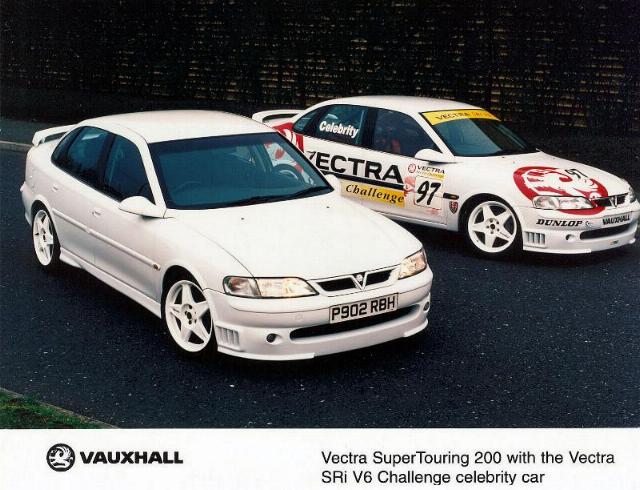
The Supertouring was a limited edition trim level based on the Vectra SRi. It was available in only three colours - white, black or red. Two engines were offered - the 2.0 16v with 136 PS (100 kW) or the 170 PS (125 kW) 2.5 V6, with an Irmscher sports exhaust system and white 16-inch alloys and GSi front bumpers.
Only 3,900 2.5 GSi models were ever produced, mostly in saloon and hatchback guise. With only 317 estate versions produced during this time, they became one of the rarest production Vauxhalls ever.
On the 2001 and 2002 model years, a last of the line 2.6 GSi was made also but these were limited to five hundred cars. These were again mostly saloons and hatchbacks, however 37 estates were made. These end of production models received a host of upgrades, including Xenon headlamps and larger front brakes.
In October 2013, Top Gear magazine placed the 1995 Vectra on its list of The 13 Worst Cars Of The Last 20 Years, describing the car as "so mediocre that Jeremy Clarkson refused to drive it."[16]
Production of the Vectra B ended in March 2002.
International production
[edit]- Egypt
In Egypt, the production of the Opel Vectra B commenced during 1996 with two models, initially in GLS trim with a 1.6-litre, 8v engine and a manual transmission, or in CD trim with a 8-valve, 2.0-litre with automatic transmission.
Later in 2000, the revised model was produced with three models: 1.6 (8v) GLS with manual transmission, later replaced by the 1.6 16v GLS trim with automatic transmission, 2.0 16v CD with automatic transmission, and a 2.0 CDX trim (also automatic). Only the saloon body style was offered. In 2002, local production of the Opel Vectra ceased in favour of the Corsa saloon and Astra saloon.
- North America
A related model sold in North America was the Saturn L-Series, introduced in 2000, but dropped from the line up in 2005. It was replaced by the 2007 Saturn Aura, which was built around GM's Epsilon architecture, shared with the Vectra C.
- South America
The release of the second generation of the Chevrolet Vectra happened at the same time that the IndyCar series in Brazil, GM made a deal to use the Vectra as a Medical and Safety car for the race. The Vectra B came with the already available 2.0 8-valve engine with 110 PS (81 kW) on the GL and GLS versions and a national version of the previously 2.0 16 valve with 136 PS (100 kW) for the CD version.
In 1998, GM introduced a new, torquier 2.2-litre 8 valve engine with 123 PS (90 kW) for the GL and GLS, and a 16 valve version of the same with 138 PS (101 kW) and 207 N⋅m (153 lb⋅ft) for the CD version.
A facelift was done for the 2000 models, just like the European version. Production ran until 2005, when it was replaced by the new generation Vectra, based on the Opel Astra H Sedan. The Vectra was only offered in a 4-door saloon body in both generations (A & B).
-
 Vauxhall Vectra (United Kingdom)
 -
 Holden Vectra (Australia and New Zealand)
 -
 Chevrolet Vectra (South America)

_CD_2.2_hatchback_(22543845464).jpg)
_(cropped).jpg)
Vectra C (2002–2010)
[edit]| Vectra C | |
|---|---|
 Pre-facelift | |
| Overview | |
| Also called | Chevrolet Vectra Holden Vectra Vauxhall Vectra |
| Production | March 2002 – June 2010 |
| Assembly |
|
| Body and chassis | |
| Body style | 4-door notchback saloon 5-door hatchback 5-door estate |
| Platform | Epsilon platform |
| Related | Opel Signum Saab 9-3 |
| Powertrain | |
| Engine | |
| Transmission | 6-speed automatic 6-speed manual 5-speed manual 5-speed Easytronic automated manual CVTronic |
| Dimensions | |
| Wheelbase | 2,700 mm (106.3 in) (saloon/hatch) 2,830 mm (111.4 in) (estate) |
| Length | 4,596 mm (180.9 in) (saloon/hatch, pre-facelift) 4,611 mm (181.5 in) (saloon/hatch, post-facelift)[18] 4,822 mm (189.8 in) (estate, pre-facelift) 4,839 mm (190.5 in) (estate, post-facelift) "OPC" versions 31 mm (1.2 in) longer |
| Width | 1,798 mm (70.8 in) |
| Height | 1,460 mm (57.5 in) (saloon/hatch) 1,500 mm (59.1 in) (estate) |
| Curb weight | 1,393 kg (3,071 lb) |

_CD_hatchback_(2010-07-11).jpg)

Built on the new GM Epsilon platform, the Opel Vectra C, released in March 2002 for the 2003 model year was initially available as a four-door notchback saloon and a five-door hatchback, known as the GTS.[19] A five-door estate was added in October 2003.[20] The Vectra C's official debut was at the 2002 Geneva Motor Show.
Originally, the Vectra C was due to début with the Saab 9-3 in October 2001, at the Frankfurt Motor Show, but in July 2001, it was announced that delays had forced General Motors to postpone the introduction.[21] The hatchback version premiered in September 2002. The four door notchback saloon version of the Vectra C almost resembled a two-box four door fastback saloon. While the earlier Cavalier and Vectras had been built at the company's Luton plant, the second generation Vauxhall Vectra was built at the Ellesmere Port plant from the introduction. Pilot production at Ellesmere Port started in late 2001.[22]
The Vectra C was first seen in November 1999, in a copy of Auto Express. At the Frankfurt Motor Show in October 2003, the estate version premièred, which had a slightly longer wheelbase than the hatchback and saloon versions. Sharing the 2,830 millimetres (111 in) wheelbase of the estate, an "executive hatchback" sold under the Opel/Vauxhall Signum nameplate. The Signum, which was based partly on the Vectra C, featured a completely different layout in the rear.[23]
The engine range was substantially modified to account for the increased curb weight of the Vectra C. The 90 kW (121 hp) 1.8 litre Family 1 Ecotec engine was reserved for the base model, with the main petrol engine for the Vectra C, making up the vast bulk of production, being the Ecotec 2.2 litre chain driven unit producing 108 kW (145 hp); along with a new range topping 3.2 litre 54-Degree V6, with 155 kW (208 hp).[24] From June to July 2002, Ed Harris starred in adverts for the Vauxhall Vectra in the United Kingdom.[25] Pierluigi Collina also starred in adverts across Europe for the Vectra, as well as the Signum, in the end of 2005.[26]
In 2003, a 2.0 litre turbocharged Ecotec engine with 129 kW (173 hp) was also notionally offered. Being a main engine for another GM brand, Saab, it was only ever sold in small numbers in the Vectra.[27] The 2.2 litre was upgraded in 2004, with the 'Direct' name added to the model line, indicating the new high pressure direct injection update that increased power output to 115 kW (154 hp) with improved emissions.
Diesel power, which had become important for commercial success in Europe,[28] was initially provided by the Vectra B's 2.0 and 2.2 DTI engines, with a top of the range Isuzu sourced 3.0 litre DMAX V6 outputting 132 kW (177 hp).
In October 2004, the four cylinder diesel engine was replaced with a Fiat designed 1.9 litre Ecotec CDTI engine capable of producing 89 kW (119 hp) in 8v form and 110 kW (148 hp) in 16v form.[29] Handling was reported to be much better than the previous Vectra.


The Vectra C received a facelift in September 2005, with the début at the Frankfurt Motor Show, and it retained a similar line of engines. However, the power of the 3.0 diesel was increased to 137 kW (184 hp), and the petrol 3.2 litre V6 engine was replaced by an Australian built turbocharged 2.8 litre High Feature V6 unit. This Saab co-developed motor could produce 170 kW (228 hp). Opel installed the twin scroll turbo engine in its Signum productline with 185 kW (248 hp) output. The base 1.8 litre petrol engine was upgraded to the 103 kW (138 hp) Z18XER, which featured Variable Valve Timing.
The 185 kW (248 hp) version of the 2.8 litre V6 was available for the Vectra later in 2006. Opel also introduced – for the first time – an OPC version of the Vectra, using the VXR name in the United Kingdom. These high performance variants were only available as hatchbacks and estates. In the United Kingdom the power of the High Feature V6 engine was increased to 188 kW (252 hp), giving a maximum speed approaching 250 km/h (155 mph).
Production of the Vectra C and Signum ended in July 2008.
Overseas markets and rebadges
[edit]- Australia and New Zealand
The Vectra C was branded as the Holden Vectra in Australia and New Zealand. Between 1998 and 2001, Holden in Australia assembled the Vectra for export to other RHD markets in the region, with a view to exporting 60 per cent of output, although this was adversely affected by the Asian economic crisis.[30]
Locally designated the ZC series and launched in March 2003, the Vectra C was only available as a sedan and hatchback. Holden did not offer the Vectra C estate due to the presence of the Astra and later Holden Viva (Daewoo Lacetti) estates. The Vectra was dropped and replaced by the Holden Epica, a badge engineered Daewoo Tosca early in 2007.[31]
Due to stockpiling of Vectras from 2005 for the market in Australasia, there was enough supply of the car for deliveries to last through to 2007. As a result, facelifted Vectra Cs were not sold in those markets.[32] In 2008, the Vectra OPC was available with either six speed manual or six speed automatic transmission (previous Vectra OPC had manual gearbox only). The 2.8L DOHC V6 turbo engine could generate 206 kW (276 hp).
- United Kingdom
Sales of the Vectra C in the United Kingdom were not as strong as those of its predecessors. For much of its production life, the original Vectra was the fourth best selling car in the country, but the Vectra C never came higher than tenth in the country's car sales charts, though within its own market sector it held on to second place, behind the Ford Mondeo.
In 2007, it finally made the Top 10 of Britain's car sales charts, being the nation's tenth most popular new car with over 50,000 sales, outselling the Ford Mondeo for the first time since 1999.[33] Also, in January 2007, the estate variant was awarded Estate Car of the Year 2007, by What Car? magazine.[34]
- South America
While the Vectra C was sold in Mexico and Chile as the Chevrolet Vectra, it was not marketed in Brazil, where Chevrolet opted to sell the Astra H under the Vectra brand from 2006 to 2011. Both local spec cars were powered by the FlexPower SOHC engine originally introduced in 1982 in the Chevrolet Monza.
- Ireland
In Ireland, the Vectra C was produced until February 2010.
-
 Vauxhall Vectra (pre-facelift, United Kingdom)
 -
 Vauxhall Vectra (facelift, United Kingdom)
 -
 Vauxhall Vectra VXR (United Kingdom)
 -
 Holden Vectra (Australia and New Zealand)
 -
 Chevrolet Vectra (pre-facelift, South America)
 -
 Chevrolet Vectra (facelift, South America)


_CD_hatchback_(2016-01-04)_01_(cropped).jpg)

.jpg)
Chevrolet Vectra D (2009–2012)
[edit]
The Chevrolet Vectra D is the rebadged Opel Insignia available only in the Chilean market. It is a very rare model of Chevrolet in Chile, with not many found. In June 2013, it was renamed the Opel Insignia along with a facelift, as the Chevrolet brand was being phased out in that market. In February 2017, Opel was sold to the PSA Group.
Motorsport
[edit]
Vauxhall Vectra Challenge
[edit]From 1997 to 1999, a one-make series for the Vectra B ran in the UK as the Vauxhall Vectra SRI V6 Challenge.[35]
A novelty of the series was the Celebrity Car.[36] In 1997, this was driven by drivers such as Tiff Needell at Brands Hatch[37] and Louise Aitken-Walker at Knockhill.[38]
In 1998 and 1999, the series was a support event for the British Touring Car Championship.[39] Many drivers to compete in this series would go on to race or had previously raced in the BTCC.
The LPG Vectra
[edit]The series was one of the first to experiment with alternative fuels in UK Motorsport with Mark Ticehurst driving a Liquified Petroleum Gas-powered entry in the 1999 Season.[40][41] Ticehurst scored four wins in the car and would have been Champion had he been eligible for points.[42][43] There were plans for Ticehurst to move up to the BTCC with this car for the 2000 Season but this never materialised.[44][45]
Touring Car Racing
[edit]The Vectra was used in several touring car racing series.
In the 1990s and the early 2000s the Vectra B Super Touring took part in the British Touring Car Championship, the Asia-Pacific Touring Car Championship, the German Super Tourenwagen Cup, the Australian Super Touring Championship, the Japanese Touring Car Championship, the Italian Superturismo Championship, the French Supertouring Championship and the Swedish Touring Car Championship.
Uwe Alzen was third in Super Tourenwagen Cup in 1997 and 1998, and second in 1999; John Henderson was runner up in the 2000 Australian Super Touring Championship; John Cleland was British Touring Car Champion in 1995 and finished third in 1992 and fourth in 1993 and 1994; Yvan Muller was sixth in the 1999 British Touring Car Championship and fourth in 2000; and Nicklas Karlsson was third in the 2002 Swedish Touring Car Championship.
.JPG)
The BTC Touring Vectra
[edit]A prototype Vectra C was built to the BTC Touring specifications in 2003 by Triple Eight Race Engineering, with the view to using it in the 2004 BTCC, but it was never raced, despite being shown publicly at the 2004 Birmingham Motor Show as the 'Vectra Diesel Concept'.[46] The car got as far as a test at Albacete but proved less competitive than the Astra Coupe.[47] The car appeared at the Autosport International Show in January 2007, disguised as the Super 2000 version that would make its BTCC debut that year.[48]
The Super 2000 Vectra
[edit]After being replaced by the Astra H in the British Touring Car Championship, the Vectra C was introduced in 2007. Fabrizio Giovanardi was champion in 2007 and 2008. VX Racing competed in the season of 2009, with three Vectras, driven by Giovanardi, Matt Neal and Andrew Jordan.
Silhouette Racing
[edit]The Vectra has been used as a silhouette racing car: in the Stock Car Brasil in 2000 to 2003 (it was the champion for four seasons) and 2009, in the Argentine Top Race V6 since 2005 (Guillermo Ortelli was 2005 champion), and in the Deutsche Tourenwagen Masters in 2004 and 2005, with little success.
The Vectra Safety Car
[edit]In 1994, an Opel Vectra A was the official Formula 1 safety car during the 1994 San Marino Grand Prix. Driven by Max Angelelli, it was in front of Ayrton Senna for 5 laps before he crashed into Tamburello on lap 7.
References
[edit]- ^ Ross, David (6 June 2019). "Vauxhall Vectra Hatchback (2005 - 2008) review". Parker's Car Guides. Retrieved 9 April 2022.
- ^ Satyam. "Welcome to GMArabia.com". Gmegypt.com. Archived from the original on 9 August 2010. Retrieved 2 October 2010.
- ^ "GM Bakal Buka Lagi Pabrik Perakitan di Pondok Ungu". detikoto (in Indonesian). Retrieved 14 June 2022.
- ^ Johansson, Claes, ed. (24 January 1991). "Opel Vectra numera turkisk" [Opel Vectra is Turkish nowadays]. Teknikens Värld (in Swedish). Vol. 43, no. 2. Stockholm, Sweden: Specialtidningsförlaget AB. pp. 16–17.
- ^ European Motor Business, Issues 24-27, Economist Intelligence Unit, 1991, page 102
- ^ Costantini, Guido (January 1989). "Per lei ci vuole il "duemila"" [For her, it takes two-thousand]. Quattroruote (in Italian). Vol. 34, no. 399. Milan, Italy: Editoriale Domus. p. 117.
- ^ Aucock, Richard (August 2006). "Vauxhall Vectra". Auto Express. Dennis Publishing. Retrieved 14 March 2009.
- ^ Stark, Harry A.; Bush, James W., eds. (1990). Ward's Automotive Yearbook 1990. Vol. 52. Detroit, MI: Ward's Communications, Inc. p. 284. ISBN 0910589010.
{{cite book}}: CS1 maint: ignored ISBN errors (link) - ^ "THIS WEEK: Vauxhall is launching the estate version of its Vectra ..." www.campaignlive.co.uk. 7 November 1996. Retrieved 7 December 2017.
- ^ Bartels, Eckhart; Manthey, Rainer (2013). Opel: Fahrzeug-Chronik Band 3: 1991–2012 (in German). Podszun Verlag: Brilon, Germany. pp. 7–8. ISBN 978-3-86133-666-2.
- ^ Bhaskar, Krish N. (1990), The Effect of Different State Aid Measures on Intra-Community Competition: Exemplified by the Case of the Automotive Industry, University of East Anglia. Motor Industry Research Unit, Commission of the European Communities, p. 37, ISBN 9789282603819
- ^ "Buying Cars". Autocar. Vol. 209, no. 11. 11 September 1996. p. 13.
- ^ "Vauxhall ends Luton production". Guardian News & Media Limited. 21 March 2002. Retrieved 21 July 2022.
- ^ Why General Motors is keeping its faith in Vauxhall's Luton plant, Autocar, 25 August 2014
- ^ Bartels and Manthey 2013, 35-36.
- ^ "The 13 Worst Cars of the Last 20 Years". Top Gear magazine. 31 October 2013. Archived from the original on 19 October 2014. Retrieved 12 October 2014.
- ^ "Guide to assembly plants in Europe" (PDF). automotivenews.com. Automotive News Europe. Retrieved 27 January 2022.
- ^ Vauxhall Vectra owners' Manual July 2007 ref TS 1557-A-08
- ^ "New Holden Vectra goes up-market". WebWombat. February 2002. Archived from the original on 5 December 2004.
- ^ "Vauxhall Vectra Estate (2003 – To Date)". Yahoo!. Retrieved 7 January 2008.
- ^ "Spy Shots: 2003 Saab 9-3". AutoTrader.com. 13 July 2001. Archived from the original on 18 May 2015. Retrieved 23 April 2017.
- ^ "Ellesmere Port gears up for new Vectra production". FleetNews. Bauer Consumer Media Ltd. 1 June 2001. Archived from the original on 21 June 2021.
- ^ "Opel Vectra and Signum Facelifts". Automotriz. Archived from the original on 6 March 2008. Retrieved 7 January 2008.
- ^ "Opel Vectra GTS". Babez.de. Retrieved 7 January 2008.
- ^ "Ad of the Week: Vauxhall puts Vectra on trial". www.telegraph.co.uk. 18 June 2002. Archived from the original on 12 January 2022. Retrieved 21 September 2017.
- ^ "Referee Collina 'takes control' in Vauxhall TV and print campaign". www.campaignlive.co.uk. 23 September 2005. Retrieved 9 November 2017.
- ^ "New Opel Signum: Versatile, Innovative, Unique". Black Falcon Media Group Oy. Retrieved 7 January 2008.
- ^ Christine, Tierney; Weich, David (3 May 2003). "The Smell of Diesel Is Back in the Air". McGraw-Hill. Archived from the original on 22 June 2003. Retrieved 7 January 2008.
- ^ "Vauxhall Vectra CDTI 150". Khoo Systems. 17 October 2004. Archived from the original on 27 February 2009. Retrieved 10 January 2008.
- ^ Business Review Weekly: BRW, Volume 20, Issues 1-6, page 19
- ^ Newton, Bruce (June 2007). "Sneer Miss". Wheels. pp. 104–108.
- ^ Yan, Jack (26 May 2007). "Holden Epica arrives in New Zealand (God help us)". Jack Yan & Associates. Retrieved 29 April 2008.
- ^ Finlay, David (8 January 2008). "UK Motor Industry 2007". PDRonline. Archived from the original on 16 January 2008. Retrieved 10 January 2008.
- ^ "Car of the Year 2007 – Estate car". What Car?. 19 January 2007. Retrieved 10 January 2008.
- ^ "History".
- ^ "Vauxhall Vectra". Archived from the original on 29 March 2015.
- ^ "Vitória de Nonô Figueiredo em Brands Hatch - Temporada 1997 - Vectra Challenge". YouTube. 29 July 2020.
- ^ "vauxhall vectra challenge". www.cavalierandchevetteclub.com. Retrieved 1 June 2025.
- ^ "Vectra Challenge Championship Results 1997-99".
- ^ "BURGESS HILL driver Mark Ticehurst has been handed a touring car test drive by Vauxhall". 27 September 1999.
- ^ "Introduction".
- ^ "Britcar Production Sportscar Series: Meet the Drivers | Inside Mazda".
- ^ "Historic Vectra Victory". 28 April 1999.
- ^ "BTCC Super Touring's Paddock Whispers". 6 August 2019.
- ^ "The Unusual Vectra - TenTenths Motorsport Forum".
- ^ Autosport magazine feature 25 January 2007 'Tin-Tops That Never Raced'
- ^ "BTCT : Vauxhall Vectra Unknown".
- ^ "VX Racing's new car for BTCC ready to go | News | Vauxhall | by Car Enthusiast".
External links
[edit]
- www.vauxhall.co.uk – Vauxhall UK
A marque of Stellantis | |||||||||||
| Vehicles |
| ||||||||||
| Concept cars | |||||||||||
| Divisions and subsidiaries | |||||||||||
| People | |||||||||||
| Facilities | |||||||||||
| Other | |||||||||||


A marque of Stellantis | |||||||||
| Vehicles |
| ||||||||
| Divisions and subsidiaries | |||||||||
| People | |||||||||
| Factories | |||||||||
| Other | |||||||||
Opel Vectra
View on GrokipediaIntroduction and Development
Origins and Market Positioning
The Opel Vectra was introduced in October 1988 as the direct successor to the Opel Ascona in continental Europe and the Vauxhall Cavalier in the United Kingdom, marking Opel's entry into the competitive D-segment of mid-size family cars.[4] Positioned to challenge established rivals such as the Ford Sierra and Volkswagen Passat B3, the Vectra emphasized practicality and value, targeting budget-conscious families seeking reliable transportation in a rapidly evolving automotive landscape during the late 1980s.[9] Initial production commenced at Opel's Rüsselsheim assembly plant in Germany, where the model was built to meet anticipated European demand for versatile vehicles combining affordability with spacious interiors and multiple body configurations, including hatchback and sedan variants.[10] This strategy aligned with Opel's broader goal of capturing market share in the mid-size category by offering front-wheel-drive architecture and a range of engine options suited to everyday use, without venturing into premium pricing. The Vectra achieved early commercial success, particularly in Germany and the UK, where it quickly gained traction as a dependable alternative to incumbents; in West Germany, it ranked fifth in sales for 1989 despite its late-year launch, contributing to Opel's strong performance in the segment.[11] Over its lifespan, the Vectra lineup would prove instrumental in bolstering Opel's reputation for accessible family vehicles, with cumulative European sales underscoring its enduring appeal.[12]Platform and Initial Design
The Opel Vectra A was conceived in the mid-1980s amid General Motors' initiative to standardize vehicle platforms globally, aiming to streamline production and share components across brands for efficiency. Development involved over five million engineering hours, with a focus on creating a practical mid-size family car tailored for European markets, culminating in its market introduction in October 1988 as a replacement for the Ascona C.[12] The Vectra A utilized the GM2900 platform, a new mid-size transverse front-wheel-drive architecture developed by Opel, which was also shared with the Vauxhall Cavalier. This setup incorporated MacPherson strut front suspension with coil springs and an anti-roll bar, paired with a semi-trailing arm rear suspension, delivering composed handling suited to daily driving while maintaining ride comfort.[9][13] Aerodynamics played a key role in the initial design, with the hatchback variant achieving a drag coefficient of 0.29 through streamlined bodywork, flush door handles, and optimized airflow over the windshield and roofline. This emphasis on low wind resistance supported better fuel economy and high-speed stability, though the overall philosophy favored spaciousness and reliability for family use rather than dynamic sportiness.[14] The cabin accommodated five passengers with ample legroom and a straightforward, modular dashboard that integrated controls ergonomically and allowed flexibility for trim levels. Safety was bolstered by an optional anti-lock braking system (ABS) available from 1989, which helped prevent wheel lockup during emergency stops on varied surfaces.First Generation (Vectra A, 1988–1995)
Body Styles and Key Features
The first-generation Opel Vectra A was available in two primary body styles: a four-door sedan (notchback) and a five-door hatchback, providing versatility for family use without a wagon variant, which was introduced in subsequent generations.[9][15] The sedan measured approximately 4.4 meters in length, offering a practical layout for executive transport, while the hatchback emphasized cargo flexibility with its rear liftgate design.[16] No three-door configuration was offered for the Vectra A itself, though the related Opel Calibra coupe shared its platform.[17] Key features across the lineup included standard central locking for enhanced security and electrically adjustable door mirrors on mid- and higher trims, with an optional electric sunroof available for added comfort.[18] The sedan provided 530 liters of boot space with seats up, expandable to 840 liters by folding the rear bench, making it suitable for everyday practicality.[9][16] Trim levels started with the base LS, featuring basic cloth upholstery and manual windows; the mid-level GL added improved interior materials and optional air conditioning; while the top GLS included alloy wheels, power windows, and upgraded audio systems as standard equipment.[17] Safety elements emphasized passive protection, with reinforced crumple zones designed to absorb impact energy and meet early European safety regulations predating formal Euro NCAP testing.[19] A driver's airbag became available as an option starting in 1990, marking an early adoption in the mid-size segment, though it was not standard until later models.[19] These features contributed to the Vectra A's reputation for solid structural integrity in contemporary crash assessments.[20]1992 Facelift Updates
In September 1992, Opel introduced a mid-cycle facelift for the Vectra A to modernize its appearance and address competitive pressures in the European mid-size car segment.[21] The updates focused on aesthetic enhancements, including a revised front grille with a taller, more prominent design and swept-back headlights that extended over the hood and fenders for a sharper, more angular look. The front bumper was redesigned as a wrapped-around plastic unit with a downward extension forming an aerodynamic apron, while the rear received a black plastic strip above the license plate and a small triangular window behind the rear doors on sedan models to improve overall styling. Interior revisions included a updated dashboard with wood-grain finishes and improved materials for a more premium feel, along with a redesigned steering wheel.[21] Mechanical adjustments emphasized ride quality, with tweaks to the suspension system—such as revised anti-roll bars—to enhance comfort without altering the core independent setup. All models gained catalytic converters to comply with the newly introduced Euro 1 emissions standards, which took effect for new EU type-approved vehicles from July 1992 and mandated reduced hydrocarbon, carbon monoxide, and nitrogen oxide outputs.[21][22] These changes extended production of the Vectra A through 1995, helping to revive sales amid early rivalry from models like the Audi 80 by offering a refreshed alternative in a market shifting toward more aerodynamic designs.[21]Engine Options and Performance
The first-generation Opel Vectra A offered a range of inline-four petrol engines featuring multi-point fuel injection, catering to various performance and economy needs in the European market. The entry-level options included the 1.4-liter engine producing 75 hp (55 kW) at 5,600 rpm and 80 lb-ft (108 Nm) of torque at 3,000 rpm, and the 1.6-liter C16NZ engine producing 75 hp (55 kW) at 5,200 rpm and 94 lb-ft (128 Nm) of torque at 2,800 rpm, both designed for efficient urban driving. Mid-range variants included the 1.8-liter engine producing 90 hp (66 kW) at 5,400 rpm and 106 lb-ft (145 Nm) of torque at 2,800 rpm. Higher-output petrol choices comprised the 2.0-liter engine, available from 115 hp (85 kW) and 125 lb-ft (170 Nm) in base form, escalating to 130 hp (96 kW) and 133 lb-ft (180 Nm), and culminating in the 2.0-liter 16-valve version at 150 hp (110 kW) and 145 lb-ft (196 Nm) for sportier models like the GT.[23][24] Diesel powertrains were sourced from Isuzu, providing reliable and frugal alternatives for fleet and economy-focused buyers. The naturally aspirated 1.7-liter 4EE1 unit generated 57 hp (42 kW) at 4,600 rpm and 77 lb-ft (105 Nm) at 2,400 rpm, emphasizing low-end torque for effortless cruising. The turbocharged variant of the same engine boosted output to 82 hp (60 kW) at 4,400 rpm and 124 lb-ft (168 Nm) at 2,200 rpm, offering a balance of vigor and efficiency without the complexity of intercooling.| Engine Type | Displacement | Power | Torque | 0-100 km/h | Top Speed | Combined Fuel Economy |
|---|---|---|---|---|---|---|
| Petrol 1.6L | 1,598 cc | 75 hp (55 kW) | 94 lb-ft (128 Nm) | 14.5 s | 109 mph (176 km/h) | 6.4 L/100 km (37 mpg US)[25][26] |
| Petrol 1.8L | 1,796 cc | 90 hp (66 kW) | 106 lb-ft (145 Nm) | 13.0 s | 115 mph (185 km/h) | 7.2 L/100 km (33 mpg US)[27] |
| Petrol 2.0L 16V | 1,998 cc | 150 hp (110 kW) | 145 lb-ft (196 Nm) | 9.5 s | 134 mph (216 km/h) | 8.5 L/100 km (28 mpg US)[23][24] |
| Diesel 1.7L NA | 1,686 cc | 57 hp (42 kW) | 77 lb-ft (105 Nm) | 17.0 s | 94 mph (151 km/h) | 5.8 L/100 km (41 mpg US)[28][29] |
| Diesel 1.7L TD | 1,686 cc | 82 hp (60 kW) | 124 lb-ft (168 Nm) | 14.5 s | 109 mph (176 km/h) | 6.6 L/100 km (36 mpg US)[30][31] |
Second Generation (Vectra B, 1995–2002)
Chassis and Styling Evolution
The second-generation Opel Vectra, known as the Vectra B, marked a significant evolution in chassis design from its predecessor, the Vectra A, by adopting a new mid-size platform developed internally by Opel engineers. This platform featured a longer wheelbase of 2640 mm compared to the 2600 mm of the Vectra A, providing enhanced interior space and improved ride stability. Additionally, the wider front and rear tracks—measuring 1484 mm and 1487 mm, respectively—contributed to better handling and reduced body roll during cornering. The overall curb weight for base sedan models hovered around 1200-1275 kg, balancing lightweight construction with structural rigidity for everyday usability.[32][33][34] Stylistically, the Vectra B embraced a more aerodynamic and modern "teardrop" shape under the direction of Opel's design chief Wayne Cherry, who oversaw the shift toward rounded, flowing lines that departed from the boxier aesthetics of the Vectra A. This design achieved a low drag coefficient of approximately 0.30, enhancing fuel efficiency and high-speed stability while aligning with late-1990s European trends in fluid bodywork. The sedan measured 4477-4495 mm in length, with the introduction of the Caravan wagon variant in 1997 expanding body style options to include a practical estate model with up to 1490 liters of cargo capacity when seats were folded. Cherry's influence emphasized a cohesive family resemblance across Opel's lineup, positioning the Vectra B as a competitive mid-size offering. A 1999 facelift updated the front styling with revised headlights and bumpers, along with minor interior refinements.[35][33][36][37] In terms of suspension, the Vectra B advanced handling through an independent multi-link rear setup paired with MacPherson struts at the front, a step up from the Vectra A's semi-independent rear torsion beam for superior wheel control and comfort over varied surfaces. These chassis refinements collectively improved the Vectra B's dynamic performance, making it more agile and refined than its first-generation counterpart without compromising practicality.[38][39]Powertrain Specifications
The second-generation Opel Vectra (Vectra B) featured a diverse lineup of petrol and diesel engines designed to cater to various market segments, emphasizing efficiency and performance improvements over its predecessor. Petrol options included inline-four engines such as the 1.6-liter unit delivering 100 horsepower, the 1.8-liter variant producing 115 horsepower, and the 2.0-liter engine offering between 136 and 150 horsepower depending on the tune. A 2.2-liter 16-valve inline-four, rated at 147 horsepower, was introduced later in the production run. For higher performance, V6 configurations were available, starting with the 2.5-liter engine generating 170 horsepower from the model's launch in 1995, followed by the 2.6-liter V6 also producing 170 horsepower from 1996 onward.[40][41][42] Diesel engines focused on torque and fuel economy, with the initial 2.0-liter direct injection (DI) unit providing 82 horsepower. This was complemented by the 2.0-liter turbo diesel (TD) offering 100 horsepower, and from 1997, the more efficient 2.0-liter diesel turbo injection (DTI) also rated at 100 horsepower, incorporating advanced direct injection technology for better emissions and refinement.[41] Performance varied by engine, with the top-tier 2.5-liter V6 achieving 0-100 km/h acceleration in approximately 9 seconds and a top speed of 220 km/h, while fuel economy across the range typically ranged from 6 to 10 liters per 100 kilometers depending on driving conditions and transmission.[40] Transmission choices included five- and six-speed manual gearboxes for most models, paired with four- or five-speed automatic options where applicable. From 1999, the Easytronic automated manual transmission was introduced as a semi-automatic alternative, enhancing accessibility for urban driving.[41][42]| Engine Type | Displacement | Power Output | Introduction Year | Notes |
|---|---|---|---|---|
| Petrol 1.6 L I4 | 1.6 L | 100 hp | 1995 | Base entry-level option |
| Petrol 1.8 L I4 | 1.8 L | 115 hp | 1995 | Mid-range efficiency focus |
| Petrol 2.0 L I4 | 2.0 L | 136-150 hp | 1995 | Variable tuning for markets |
| Petrol 2.2 L I4 16V | 2.2 L | 147 hp | 1999 | Updated for later models |
| Petrol 2.5 L V6 | 2.5 L | 170 hp | 1995 | Performance-oriented |
| Petrol 2.6 L V6 | 2.6 L | 170 hp | 1996 | Refined V6 variant |
| Diesel 2.0 L DI | 2.0 L | 82 hp | 1995 | Indirect injection |
| Diesel 2.0 L TD | 2.0 L | 100 hp | 1995 | Turbocharged |
| Diesel 2.0 L DTI | 2.0 L | 100 hp | 1997 | Direct injection for emissions |
International Production Variants
The second-generation Opel Vectra, known as the Vectra B, saw extensive international production adaptations to meet regional market demands, particularly outside Europe. In Australia, Holden commenced local assembly of the Vectra at its Elizabeth plant in South Australia starting in 1998, following initial imports from 1997. This production run aimed for an initial output of 10,000 to 15,000 units annually as part of a broader investment in Holden's manufacturing capabilities. Australian models featured unique local engineering adjustments, including revised suspension tuning to better handle the country's varied road conditions, enhancing ride quality and durability over the standard European specification.[44][45] In Brazil, the Vectra B was badge-engineered and produced as the Chevrolet Vectra at General Motors' São Caetano do Sul facility from 1997 until 2005, when it transitioned to a successor model. To accommodate Brazil's biofuel infrastructure, the local version incorporated a 2.0-liter Flexpower engine capable of running on gasoline, ethanol, or any blend thereof, delivering 121 horsepower on gasoline and 128 horsepower on pure ethanol. This adaptation aligned with the growing demand for flexible-fuel vehicles in the region, where ethanol derived from sugarcane became a staple alternative to fossil fuels.[46][47] The Vectra B platform also underpinned badge-engineered variants in other non-European markets, including the Saturn L-Series sedans and wagons, assembled at GM's Wilmington, Delaware plant from 2000 to 2005, with cumulative sales exceeding 300,000 units despite initial projections of up to 300,000 annually. Right-hand-drive configurations were specifically produced for markets like the United Kingdom under the Vauxhall badge and for limited sales in Japan, ensuring compatibility with local driving conventions. These international efforts contributed to the Vectra B's global footprint, with non-European assembly lines producing hundreds of thousands of units adapted to diverse environmental and regulatory needs.[48][49]Third Generation (Vectra C, 2002–2008)
Design and Technology Advancements
The third-generation Opel Vectra, known as the Vectra C, marked a significant evolution in Opel's mid-size sedan lineup by adopting a more premium-oriented design philosophy, emphasizing refined aesthetics and advanced chassis technologies to compete in the European executive car segment. Built on General Motors' Epsilon platform, which was developed collaboratively by Opel and shared with models like the Saab 9-3, the Vectra C offered improved structural rigidity and packaging efficiency compared to its predecessor.[50][51] The Epsilon platform featured a wheelbase of 2,700 mm, enabling spacious interior accommodations while maintaining agile handling characteristics. Suspension options included standard twin-tube shock absorbers, with higher trims offering the optional Continuous Damping Control (CDC) system, which electronically adjusted damping rates in real-time for enhanced ride comfort and stability across varying road conditions. This technology used sensors to monitor vehicle dynamics and optimize wheel-specific responses, contributing to the Vectra C's balanced performance.[39] Exterior styling adopted a more assertive and modern profile, characterized by dramatically flared wheel arches that accentuated the vehicle's sporty stance and accommodated larger alloy wheels, paired with chrome accents on the grille, window surrounds, and trim elements for a touch of elegance. A facelift in 2005 updated the front and rear styling with revised bumpers, headlights, and taillights for a fresher look. The sedan's overall length measured 4,597 mm, with curb weights ranging from approximately 1,300 to 1,500 kg depending on engine and equipment levels, balancing efficiency and structural integrity. Inside, the cabin prioritized versatility with rear seats that folded to expand cargo space up to 1,850 liters in the wagon variant, enhancing practicality for family use.[51][52] Technological advancements extended to safety and visibility, with the introduction of Adaptive Forward Lighting (AFL) headlights available from the 2003 model year. This system featured swiveling bi-xenon projectors that adjusted beam direction based on steering input and vehicle speed, improving illumination around corners by up to 90% and reducing nighttime accident risks. AFL integration underscored Opel's focus on innovative lighting solutions, debuting as an option on premium trims to elevate driver confidence in low-light conditions.[53][54]Engine and Transmission Lineup
The third-generation Opel Vectra C featured a broad range of petrol and diesel engines designed for efficiency and performance, catering to European market demands for balanced power delivery and emissions compliance. Petrol options included the entry-level 1.6-liter Ecotec inline-four producing 105 hp (77 kW), suitable for urban driving with its lightweight construction and variable valve timing for improved mid-range torque.[55] The 1.8-liter variant offered 122 hp (90 kW) in base form, upgrading to 140 hp (103 kW) with variable valve timing (VVT) in later models for enhanced responsiveness without sacrificing fuel economy. Higher-output petrol engines comprised the 2.2-liter inline-four at 147 hp (108 kW), providing solid mid-size sedan performance, while the 3.2-liter V6 delivered 211 hp (155 kW) for smoother highway cruising and greater refinement. The performance-oriented 2.8-liter V6 turbocharged engine, exclusive to sportier trims, generated 230 hp (169 kW) initially, increasing to 280 hp (206 kW) in the OPC variant, emphasizing the Vectra's capability for dynamic driving. Diesel engines in the Vectra C lineup emphasized common-rail direct injection (CDTI) technology for lower emissions and better torque across the rev range, making them popular in Europe for long-distance efficiency. The 1.9-liter CDTI unit was available in outputs of 100 hp (74 kW), 120 hp (88 kW), and 150 hp (110 kW), with the higher versions incorporating a variable geometry turbocharger for quicker spool-up and up to 320 Nm of torque.[56] The 2.0-liter CDTI followed suit with power ratings from 100 hp (74 kW) to 150 hp (110 kW), featuring aluminum block construction to reduce weight while maintaining durability.[57] A 2.2-liter DTI option provided 125 hp (92 kW), bridging the gap between economy-focused and performance diesels with its robust low-end pull. Diesel models generally achieved combined fuel economy of 5-8 L/100 km, depending on trim and driving conditions, with the 1.9 CDTI exemplifying 5.7 L/100 km in mixed use.[56] Transmission choices supported the engine variety, prioritizing driver engagement and adaptability. Most models came with a five- or six-speed manual gearbox, the latter standard on higher-output units for precise shifts and better highway ratios. An optional six-speed automatic was available for petrol and diesel variants, offering smooth progression via a torque-converter design. The Easytronic automated manual transmission, a six-speed semi-automatic system, paired with smaller engines like the 1.8-liter petrol for convenience in traffic, using electro-hydraulic clutch actuation.[58] High-torque applications, such as the 2.8-liter V6 turbo and OPC models, utilized the reinforced F40 six-speed manual for handling up to 350 Nm without compromising shift quality. Performance highlights underscored the lineup's versatility, particularly in the OPC trim, which accelerated from 0-100 km/h in 6.3 seconds and reached a top speed of 250 km/h, limited electronically for safety. Standard models balanced speed with practicality, such as the 2.2-liter petrol achieving 0-100 km/h in around 9.5 seconds, while diesels like the 1.9 CDTI 150 hp managed it in 8.5 seconds, prioritizing torque-led overtaking over outright sprint times.Global Rebadges and Market Adaptations
The Vauxhall Vectra, marketed in the United Kingdom, was a right-hand drive adaptation of the Opel Vectra C, featuring modifications to the dashboard, steering components, and minor suspension tweaks to suit British road conditions and driving preferences.[39] Offered in sedan, hatchback, and estate body styles from 2002 to 2008, it retained the core European engineering but included UK-specific equipment like adaptive headlights and enhanced rust protection for coastal climates.[59] In Australia and New Zealand, the Holden Vectra ZC represented the local rebadging of the Vectra C, produced from 2003 until 2006 to align with right-hand drive requirements and regional demands. Holden incorporated Australian-built 3.2-liter V6 engines in higher trims for improved low-end torque suited to highway driving, alongside recalibrated suspension for better handling on varied terrain.[60] The model emphasized comfort features like climate control optimized for hot climates, marking the end of Holden's mid-size European imports before shifting to local platforms.[61] The Chevrolet Vectra, a rebadged Vectra C for Latin American markets, was assembled in Brazil from 2005 to 2011 and introduced in Colombia around the same period, with production emphasizing affordability and durability. In Brazil, it featured a 2.0-liter Flexpower engine capable of running on gasoline, ethanol, or blends up to E100, delivering 140 horsepower on ethanol for enhanced performance in biofuel-heavy regions. Colombian versions mirrored Brazilian specs but included localized badging and minor interior adjustments for export compliance. Wagon variants extended production beyond the sedan's timeline, remaining available until 2011 to meet demand for practical family transport.[62] Market adaptations for South America focused on robustness and fuel flexibility, with the Chevrolet Vectra's chassis receiving targeted reinforcements to withstand potholed roads and heavier loads common in urban and rural areas. The Flexpower system ensured seamless ethanol compatibility through corrosion-resistant fuel lines and sensor calibrations, reducing emissions and supporting local biofuel infrastructure without compromising reliability.[63] These changes maintained the Vectra C's core design while enhancing longevity in demanding environments.Later Models and Phase-Out (2008–2012)
Chevrolet Vectra in Emerging Markets
The Chevrolet Vectra name was applied in Brazil from 2009 to 2011 to a sedan variant of the Opel Astra H, a compact car on the GM Delta platform, following the discontinuation of the true third-generation Vectra C. Introduced in February 2009 as the "Next Edition," this model received a mid-cycle update with a revised front fascia featuring sleeker headlights and grille, along with interior enhancements such as improved materials and optional navigation systems, positioning it as a competitive mid-size sedan in the premium segment against rivals like the Toyota Corolla and Volkswagen Jetta.[64] Production occurred exclusively at General Motors' São Caetano do Sul facility in Brazil from 2009 to 2011, with assembly tailored for local demands including flex-fuel compatibility to accommodate the country's ethanol infrastructure. The model offered two engine options: a 2.0-liter Flexpower inline-four producing 133 horsepower on gasoline and 140 horsepower on ethanol, paired with a five-speed manual or four-speed automatic transmission; and a 2.4-liter Ecotec inline-four delivering 141 horsepower on gasoline, exclusively mated to a four-speed automatic.[65][66][67] Key features emphasized safety and comfort for family-oriented buyers in emerging markets, including standard dual front airbags, ABS brakes, and traction control across trims, with electronic stability control (StabiliTrak) available on higher Elegance and Elite variants. The automatic transmissions incorporated electronic shift control for smoother operation, while the overall package targeted urban professionals seeking refined handling and a spacious 456-liter trunk in a competitive price range starting around R$60,000.[68][69] This adaptation served as a transitional model in Brazil before the introduction of the Chevrolet Cruze in 2011, which adopted a more modern design and powertrains better suited to evolving market preferences. It helped maintain GM's presence in the mid-size sedan category amid growing demand for fuel-efficient and technologically advanced vehicles in South American emerging economies.[70]Production End and Transition
European production of the Opel Vectra concluded in 2008 at the Rüsselsheim plant in Germany, marking the end of the model's run in its primary market.[71] The Vectra was directly succeeded by the Opel Insignia, launched in 2008, which consolidated the mid-size sedan and wagon offerings previously split between the Vectra and the related Signum model, all built on General Motors' updated Epsilon II front-wheel-drive platform.[72][50] This transition reflected several key factors under General Motors' oversight, including the Vectra C's increasingly dated design amid shifting consumer preferences toward more stylish competitors, the need to adapt to the more stringent Euro 5 emissions regulations that took effect for new vehicle registrations in September 2009, and a broader strategic pivot to elevate Opel's positioning in the premium mid-size segment with advanced safety and efficiency features.[73][74][75] While European assembly ceased, the Vectra name persisted briefly in select emerging markets, including under the Chevrolet badge in Brazil where production wrapped up in 2011; the model's global lifecycle fully concluded by 2012.[76] For details on the Chevrolet Vectra variant in those regions, refer to the dedicated subsection above.Motorsport Applications
Vauxhall Vectra Challenge Series
The Vauxhall Vectra Challenge was a UK-based one-make racing series launched in 1997 by Vauxhall Motors, featuring the Vectra B as an entry-level touring car championship that supported the British Touring Car Championship (BTCC) at major British circuits.[77] Designed to provide affordable, competitive racing with standardized Vectra B models, the series emphasized close competition and served as a development pathway for aspiring drivers, with the top performer potentially earning a BTCC seat with the Vauxhall team. It ran from 1997 to 1999, attracting grids of up to 28 cars and fostering Vauxhall's grassroots motorsport engagement.[78] A highlight was the introduction of an LPG-powered Vectra variant in 1998, developed in collaboration with Calor Autogas and others to demonstrate the viability of autogas in racing; this eco-friendly entry used a 2.5-litre V6 engine tuned to 210 PS and competed in the remaining rounds of the Vectra SRi V6 Challenge class.[79] Prominent participants included Brazilian driver Flavio Figueiredo, who secured multiple wins and later advanced to the BTCC, helping elevate the series' reputation as a talent incubator.[80] Overall, the Challenge bolstered Vauxhall's motorsport image by bridging amateur and professional levels of touring car competition.Touring Car Racing Variants
The Vauxhall Vectra B was developed into a competitive entry for the British Touring Car Championship (BTCC) under Super Touring regulations during the 1999 and 2000 seasons. Prepared by Triple Eight Race Engineering, the car utilized a 2.0-liter naturally aspirated four-cylinder engine tuned to produce approximately 300 horsepower, paired with a sequential gearbox and advanced suspension for high-speed stability. Driver Jason Plato achieved two race wins in 2000, contributing to Vauxhall's strong manufacturer performance that year.[81][82] In the German Super Touring Weekend (STW) series, the Opel Vectra B served as the platform for silhouette racing variants from 1997 to 1998, featuring lightweight carbon fiber body panels to mimic production shapes while optimizing aerodynamics and reducing weight to around 1,000 kg. The powertrain consisted of a 2.0-liter four-cylinder engine delivering 280 horsepower at 8,400 rpm, coupled with an Xtrac six-speed sequential transmission and a custom RV01 chassis for enhanced rigidity. Official Opel entries, including drivers like Manuel Reuter, competed in the series.[83][84] The Opel Vectra C GTS V8 represented a later silhouette-style adaptation for the Deutsche Tourenwagen Masters (DTM) in 2004 and 2005, with a carbon fiber-reinforced composite body and a front-engined 4.0-liter naturally aspirated V8 engine producing about 470 horsepower. Despite the advanced Spiess-built powerplant and Xtrac six-speed sequential gearbox, the car struggled against rivals, scoring no wins before Opel's withdrawal from the series at the end of 2005.[85] Additionally, a modified Opel Vectra was deployed as the Formula 1 safety car for the 1994 San Marino Grand Prix, equipped with a 2.0-liter turbocharged inline-four engine producing 200 horsepower, all-wheel drive, and aerodynamic modifications to maintain pace with the field during caution periods.[86]Legacy and Impact
Sales Figures and Awards
The Opel Vectra demonstrated robust commercial performance across its three generations, particularly in Europe where it became a staple for family and fleet buyers. Initial sales for the Vectra A were strong, with approximately 364,000 units of the model and its Vauxhall Cavalier sibling built during the first model year from late 1988 to 1989.[87] In Germany, the Vectra ranked as the fourth best-selling car in 1990 with 143,380 units sold, reflecting its appeal as a reliable mid-size sedan in the domestic market during the 1990s.[88] The model also excelled in fleet sales, contributing to Vauxhall's strong position in the UK company car sector by the early 2000s.[89] Over its production run, the Vectra achieved total global sales of nearly 5.5 million units.[1] European sales data highlights the Vectra's peak popularity with the Vectra B generation, reaching 384,885 units in 1997 before gradually declining amid increasing competition. The Vectra C maintained solid volume in its early years, with 154,971 units sold in 2002, though figures fell to 81,722 by 2008 as the model approached phase-out. In Brazil, where it was marketed as the Chevrolet Vectra, the car became the best-selling mid-size sedan for over a decade, underscoring its enduring appeal in emerging markets.[90][1][91]| Year | European Sales (Units) |
|---|---|
| 1997 | 384,885 |
| 1998 | 365,920 |
| 1999 | 290,957 |
| 2000 | 225,502 |
| 2001 | 200,000 (approx.) |
| 2002 | 154,971 |
| 2003 | 152,628 |
| 2004 | 168,475 |
| 2005 | 134,551 |
| 2006 | 116,622 |
| 2007 | 106,904 |
| 2008 | 81,722 |