Hubbry Logo
logo
Ordered vector space
Community hub

Ordered vector space

logo
0 subscribers
Read side by side
from Wikipedia
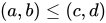
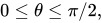
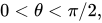
A point in and the set of all such that (in red). The order here is if and only if and

In mathematics, an ordered vector space or partially ordered vector space is a vector space equipped with a partial order that is compatible with the vector space operations.

Definition

[edit]

Given a vector space over the real numbers and a preorder on the set the pair is called a preordered vector space and we say that the preorder is compatible with the vector space structure of and call a vector preorder on if for all and with the following two axioms are satisfied

  1. implies
  2. implies

If is a partial order compatible with the vector space structure of then is called an ordered vector space and is called a vector partial order on The two axioms imply that translations and positive homotheties are automorphisms of the order structure and the mapping is an isomorphism to the dual order structure. Ordered vector spaces are ordered groups under their addition operation. Note that if and only if

Positive cones and their equivalence to orderings

[edit]

A subset of a vector space is called a cone if for all real . A cone is called pointed if it contains the origin. A cone is convex if and only if The intersection of any non-empty family of cones (resp. convex cones) is again a cone (resp. convex cone); the same is true of the union of an increasing (under set inclusion) family of cones (resp. convex cones). A cone in a vector space is said to be generating if [1]

Given a preordered vector space the subset of all elements in satisfying is a pointed convex cone (that is, a convex cone containing ) called the positive cone of and denoted by The elements of the positive cone are called positive. If and are elements of a preordered vector space then if and only if The positive cone is generating if and only if is a directed set under Given any pointed convex cone one may define a preorder on that is compatible with the vector space structure of by declaring for all that if and only if the positive cone of this resulting preordered vector space is There is thus a one-to-one correspondence between pointed convex cones and vector preorders on [1] If is preordered then we may form an equivalence relation on by defining is equivalent to if and only if and if is the equivalence class containing the origin then is a vector subspace of and is an ordered vector space under the relation: if and only there exist and such that [1]

A subset of of a vector space is called a proper cone if it is a convex cone satisfying Explicitly, is a proper cone if (1) (2) for all and (3) [2] The intersection of any non-empty family of proper cones is again a proper cone. Each proper cone in a real vector space induces an order on the vector space by defining if and only if and furthermore, the positive cone of this ordered vector space will be Therefore, there exists a one-to-one correspondence between the proper convex cones of and the vector partial orders on

By a total vector ordering on we mean a total order on that is compatible with the vector space structure of The family of total vector orderings on a vector space is in one-to-one correspondence with the family of all proper cones that are maximal under set inclusion.[1] A total vector ordering cannot be Archimedean if its dimension, when considered as a vector space over the reals, is greater than 1.[1]

If and are two orderings of a vector space with positive cones and respectively, then we say that is finer than if [2]

Intervals and the order bound dual

[edit]

An order interval in a preordered vector space is a set of the form From axioms 1 and 2 above it follows that and implies belongs to thus these order intervals are convex. A subset is said to be order bounded if it is contained in some order interval.[2] In a preordered real vector space, if for then the interval of the form is balanced.[2] An order unit of a preordered vector space is any element such that the set is absorbing.[2]

The set of all linear functionals on a preordered vector space that map every order interval into a bounded set is called the order bound dual of and denoted by [2] If a space is ordered then its order bound dual is a vector subspace of its algebraic dual.

A subset of an ordered vector space is called order complete if for every non-empty subset such that is order bounded in both and exist and are elements of We say that an ordered vector space is order complete is is an order complete subset of [3]

Examples

[edit]

If is a preordered vector space over the reals with order unit then the map is a sublinear functional.[4]


Properties

[edit]

If is a preordered vector space then for all

  • and imply [4]
  • if and only if [4]
  • and imply [4]
  • if and only if if and only if [4]
  • exists if and only if exists, in which case [4]
  • exists if and only if exists, in which case for all [4]
    • and
  • is a vector lattice if and only if exists for all [4]

Spaces of linear maps

[edit]

A cone is said to be generating if is equal to the whole vector space.[2] If and are two non-trivial ordered vector spaces with respective positive cones and then is generating in if and only if the set is a proper cone in which is the space of all linear maps from into In this case, the ordering defined by is called the canonical ordering of [2] More generally, if is any vector subspace of such that is a proper cone, the ordering defined by is called the canonical ordering of [2]

Positive functionals and the order dual

[edit]

A linear function on a preordered vector space is called positive if it satisfies either of the following equivalent conditions:

  1. implies
  2. if then [4]

The set of all positive linear forms on a vector space with positive cone called the dual cone and denoted by is a cone equal to the polar of The preorder induced by the dual cone on the space of linear functionals on is called the dual preorder.[4]

The order dual of an ordered vector space is the set, denoted by defined by Although there do exist ordered vector spaces for which set equality does not hold.[2]


Special types of ordered vector spaces

[edit]

Let be an ordered vector space. We say that an ordered vector space is Archimedean ordered and that the order of is Archimedean if whenever in is such that is majorized (that is, there exists some such that for all ) then [2] A topological vector space (TVS) that is an ordered vector space is necessarily Archimedean if its positive cone is closed.[2]
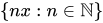
We say that a preordered vector space is regularly ordered and that its order is regular if it is Archimedean ordered and distinguishes points in [2] This property guarantees that there are sufficiently many positive linear forms to be able to successfully use the tools of duality to study ordered vector spaces.[2]

An ordered vector space is called a vector lattice if for all elements and the supremum and infimum exist.[2]

Subspaces, quotients, and products

[edit]

Throughout let be a preordered vector space with positive cone

Subspaces

If is a vector subspace of then the canonical ordering on induced by 's positive cone is the partial order induced by the pointed convex cone where this cone is proper if is proper.[2]

Quotient space

Let be a vector subspace of an ordered vector space be the canonical projection, and let Then is a cone in that induces a canonical preordering on the quotient space If is a proper cone in then makes into an ordered vector space.[2] If is -saturated then defines the canonical order of [1] Note that provides an example of an ordered vector space where is not a proper cone.

If is also a topological vector space (TVS) and if for each neighborhood of the origin in there exists a neighborhood of the origin such that then is a normal cone for the quotient topology.[1]

If is a topological vector lattice and is a closed solid sublattice of then is also a topological vector lattice.[1]

Product

If is any set then the space of all functions from into is canonically ordered by the proper cone [2]


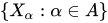
Suppose that is a family of preordered vector spaces and that the positive cone of is Then is a pointed convex cone in which determines a canonical ordering on is a proper cone if all are proper cones.[2]
Algebraic direct sum

The algebraic direct sum of is a vector subspace of that is given the canonical subspace ordering inherited from [2] If are ordered vector subspaces of an ordered vector space then is the ordered direct sum of these subspaces if the canonical algebraic isomorphism of onto (with the canonical product order) is an order isomorphism.[2]

Examples

[edit]
  • The real numbers with the usual ordering form a totally ordered vector space. For all integers the Euclidean space considered as a vector space over the reals with the lexicographic ordering forms a preordered vector space whose order is Archimedean if and only if .[4]
  • is an ordered vector space with the relation defined in any of the following ways (in order of increasing strength, that is, decreasing sets of pairs):
    • Lexicographical order: if and only if or This is a total order. The positive cone is given by or that is, in polar coordinates, the set of points with the angular coordinate satisfying together with the origin.
    • if and only if and (the product order of two copies of with ). This is a partial order. The positive cone is given by and that is, in polar coordinates together with the origin.
    • if and only if or (the reflexive closure of the direct product of two copies of with "<"). This is also a partial order. The positive cone is given by or that is, in polar coordinates, together with the origin.
Only the second order is, as a subset of closed; see partial orders in topological spaces.
For the third order the two-dimensional "intervals" are open sets which generate the topology.
  • is an ordered vector space with the relation defined similarly. For example, for the second order mentioned above:
    • if and only if for
  • A Riesz space is an ordered vector space where the order gives rise to a lattice.
  • The space of continuous functions on where if and only if for all in
  • Let denote the symmetric matrices with real entries. The Loewner order on two symmetric matrices is defined by is positive semi-definite. Its positive cone is, by definition, the set of all positive definite matrices. Furthermore, the spectral theorem applied to symmetric matrices establishes that this cone is generating.

Pointwise order

[edit]

If is any set and if is a vector space (over the reals) of real-valued functions on then the pointwise order on is given by, for all if and only if for all [4]

Spaces that are typically assigned this order include:

  • the space of bounded real-valued maps on
  • the space of real-valued sequences that converge to
  • the space of continuous real-valued functions on a topological space
  • for any non-negative integer the Euclidean space when considered as the space where is given the discrete topology.

The space of all measurable almost-everywhere bounded real-valued maps on where the preorder is defined for all by if and only if almost everywhere.[4]

See also

[edit]

References

[edit]

Bibliography

[edit]
Revisions and contributorsEdit on WikipediaRead on Wikipedia
from Grokipedia
An ordered vector space is a real vector space VV equipped with a partial order \leq that is compatible with the linear structure, meaning that for all u,v,wVu, v, w \in V and λ0\lambda \geq 0, if uvu \leq v then u+wv+wu + w \leq v + w and λuλv\lambda u \leq \lambda v.[1] This structure ensures the order is preserved under addition and positive scalar multiplication, allowing elements to be compared while maintaining the algebraic properties of the vector space.[2] The partial order in an ordered vector space is typically defined via a positive cone K={xV0x}K = \{x \in V \mid 0 \leq x\}, which is a nonempty subset closed under addition and multiplication by nonnegative scalars, with the pointedness condition K(K)={0}K \cap (-K) = \{0\} ensuring the order is antisymmetric.[1] Key properties include the order being reflexive, antisymmetric, and transitive, forming a partial order, and the cone often generating the space such that V=KKV = K - K.[3] Additional attributes like directedness (every element is a difference of positives) or Archimedeanness (no nontrivial infinitesimal elements) further refine the structure, with the latter implying that if nxynx \leq y for all nNn \in \mathbb{N}, then x0x \leq 0.[1] Ordered vector spaces form a foundational framework in functional analysis, with significant subclasses such as Riesz spaces (or vector lattices), where the order extends to a lattice structure allowing suprema and infima for any two elements.[4] These spaces underpin the study of positive operators, Banach lattices, and order-bounded maps, finding applications in optimization, economic theory (e.g., equilibrium models), operator semigroups, and even quantum information theory for entanglement detection via positive operators.[4][3] The theory originated in the early 20th century, evolving through contributions from various mathematical schools, including systematic developments in the mid-20th century that integrated it with topology and functional analysis.[4]

Fundamentals

Definition

An ordered vector space is a real vector space VV equipped with a partial order \leq that is compatible with the vector space operations. Specifically, the partial order \leq is reflexive, antisymmetric, and transitive, and satisfies the following compatibility conditions for all x,y,zVx, y, z \in V and all scalars λR\lambda \in \mathbb{R}: if xyx \leq y, then x+zy+zx + z \leq y + z (translation invariance); and if xyx \leq y and λ0\lambda \geq 0, then λxλy\lambda x \leq \lambda y (positive homogeneity).[5][6] Unlike a totally ordered vector space, where every pair of elements is comparable, the partial order in an ordered vector space allows for incomparability; for instance, in Rn\mathbb{R}^n with the componentwise order, vectors like (1,0)(1, 0) and (0,1)(0, 1) satisfy neither (1,0)(0,1)(1, 0) \leq (0, 1) nor (0,1)(1,0)(0, 1) \leq (1, 0).[6] The development of ordered vector spaces gained prominence in the 1920s through the work of Hans Hahn and Stefan Banach, particularly in the context of the Hahn-Banach theorem for extending linear functionals on partially ordered spaces.[7]

Positive Cones and Orderings

In an ordered vector space (V,)(V, \leq), the positive cone is defined as the subset P={xV0x}P = \{ x \in V \mid 0 \leq x \}.[8] This set PP forms a convex cone that is closed under addition and multiplication by positive scalars, as the partial order \leq is compatible with the vector space operations: if x,yPx, y \in P and λ,μ>0\lambda, \mu > 0, then λx+μyλ0+μ0=0\lambda x + \mu y \geq \lambda \cdot 0 + \mu \cdot 0 = 0.[8] Moreover, PP is pointed, meaning P(P)={0}P \cap (-P) = \{0\}, which ensures the antisymmetry of the partial order, since if x0x \leq 0 and x0-x \leq 0, then x=0x = 0.[8] Conversely, any pointed, convex, generating cone PVP \subseteq V that is closed under addition and positive scalar multiplication induces a partial order on VV via the relation xyx \leq y if and only if yxPy - x \in P.[8] This construction yields an equivalence: every compatible partial order on a vector space corresponds bijectively to such a positive cone, and vice versa.[8] A cone satisfying these properties is often termed a proper cone, ensuring the induced order is partial rather than total or trivial.[9] To sketch the proof of this bijection, first note that given a compatible partial order \leq, the associated PP inherits convexity and closure under addition and positive scalars directly from the order compatibility axioms. Pointedness follows from antisymmetry.[8] For the reverse direction, the relation defined by PP is reflexive since 0P0 \in P, transitive because if yxPy - x \in P and zyPz - y \in P, then zx=(zy)+(yx)Pz - x = (z - y) + (y - x) \in P by closure under addition, and antisymmetric by pointedness. Compatibility holds: for addition, xyx \leq y implies x+wy+wx + w \leq y + w as (y+w)(x+w)=yxP(y + w) - (x + w) = y - x \in P; for positive scalars λ>0\lambda > 0, λxλy\lambda x \leq \lambda y since λ(yx)P\lambda (y - x) \in P.[8] Additional properties of the cone ensure the order's partial nature. The pointed condition prevents the order from being total, as non-zero elements need not be comparable. If the cone is generating (i.e., V=PPV = P - P), the order distinguishes elements across VV without leaving subspaces unordered.[8] If the cone fails to be pointed, the induced relation may not be antisymmetric; if not generating, the order restricts to a proper subspace.[9]

Core Structures

Intervals

In an ordered vector space $ (V, \leq) $, where $ \leq $ is a partial order compatible with the vector space structure, the order interval between comparable elements $ a, b \in V $ with $ a \leq b $ is defined as the set
[a,b]={xVaxb}. [a, b] = \{ x \in V \mid a \leq x \leq b \}.
This set consists of all elements sandwiched between $ a $ and $ b $ under the order relation. Equivalently, the order interval can be characterized using the positive cone $ V_+ = { x \in V \mid 0 \leq x } $ as
[a,b]=(a+V+)(bV+). [a, b] = (a + V_+) \cap (b - V_+).
If $ a \not\leq b $, the interval is empty by convention.[8][10] Order intervals possess several key structural properties. They are always convex, meaning that for any $ x, y \in [a, b] $ and $ \lambda \in [0, 1] $, the convex combination $ \lambda x + (1 - \lambda) y $ also belongs to $ [a, b] $, which follows directly from the compatibility of the order with scalar multiplication and addition. By construction, order intervals are order bounded, as they are contained within themselves and thus bounded above by $ b $ and below by $ a $. In spaces equipped with an order unit $ u > 0 $—an element such that for every $ x \in V $, there exists $ \alpha > 0 $ with $ -\alpha u \leq x \leq \alpha u $—the symmetric interval $ [-u, u] $ is absorbing, meaning that for every $ x \in V $, there is a scalar $ \lambda > 0 $ such that $ \lambda x \in [-u, u] $. This absorbing property facilitates the definition of a natural seminorm on $ V $, given by the Minkowski functional of $ [-u, u] $.[8][11] The relation between order intervals and the positive cone is foundational, particularly in spaces with an order unit. For $ u > 0 $, the interval $ [0, u] = { x \in V \mid 0 \leq x \leq u } $ plays a central role, as it captures the "bounded positive" elements up to $ u $, and the positive cone $ V_+ $ consists of all nonnegative scalar multiples of elements from such intervals in the Archimedean case. More generally, any order interval admits a translation representation tied to the positive cone: $ [a, b] = a + [0, b - a] $, where $ b - a \in V_+ $. In unit-normalized ordered vector spaces, where the order unit is denoted by $ 1 $ (or $ e $), order intervals can be characterized as translates of the standard unit interval $ [0, 1] $. Specifically, for comparable $ a, b $ with $ b - a = 1 $, $ [a, b] = a + [0, 1] $, providing a uniform way to describe bounded order-convex sets across the space. This normalization aids in studying uniform structures and topologies induced by the order.[8][11]

Order Bound Dual

The order bound dual of an ordered vector space VV, denoted VoV^o, consists of all linear functionals fVf \in V^* such that for every order interval [a,b][a, b] in VV, the image set {f(x)x[a,b]}\{f(x) \mid x \in [a, b]\} is bounded in the underlying scalar field.[12] Order intervals provide the fundamental bounded sets in the order structure of VV, and the boundedness condition ensures that ff respects these order-theoretic constraints.[12] The order bound dual VoV^o contains the order dual V+={fVf(x)0 for all x0}V^+ = \{f \in V^* \mid f(x) \geq 0 \text{ for all } x \geq 0\}, the set of positive linear functionals on VV.[12] Positive functionals are inherently order bounded, as their values on any interval [a,b][a, b] lie between 0 and f(ba)f(b - a), establishing the inclusion V+VoV^+ \subseteq V^o.[13] As a subset of the algebraic dual VV^*, VoV^o forms a cone, closed under multiplication by non-negative scalars: if fVof \in V^o and λ0\lambda \geq 0, then λfVo\lambda f \in V^o.[12] Moreover, VoV^o majorizes the order dual in the sense that it contains the linear span of V+V^+, comprising all differences of positive functionals, which are order bounded by construction.[13] This inclusion highlights VoV^o as a natural extension of the space generated by positive elements in the dual. In Archimedean ordered vector spaces, the order bound dual VoV^o coincides with the full algebraic dual VV^* under certain conditions, such as when VV is finite-dimensional.[12] In this setting, the Archimedean property ensures that the order structure aligns closely with the linear structure, rendering all linear functionals order bounded.[12]

Examples of Intervals and Duals

In the finite-dimensional real vector space Rn\mathbb{R}^n equipped with the componentwise partial order defined by xyx \leq y if and only if xiyix_i \leq y_i for all i=1,,ni = 1, \dots, n, the order intervals take the form of rectangular boxes [a,b]={xRnaxb}[a, b] = \{ x \in \mathbb{R}^n \mid a \leq x \leq b \}, which can be expressed as the Cartesian product i=1n[ai,bi]\prod_{i=1}^n [a_i, b_i]. These intervals are convex, symmetric about their midpoints, and bounded in the order sense, illustrating how the componentwise order generates compact sets in the Euclidean topology. The order bound dual of Rn\mathbb{R}^n coincides with its algebraic dual, consisting of all linear functionals ϕ(x)=i=1ncixi\phi(x) = \sum_{i=1}^n c_i x_i for c=(c1,,cn)Rnc = (c_1, \dots, c_n) \in \mathbb{R}^n, since the space is finite-dimensional and every linear functional is automatically order bounded on bounded order intervals; the associated order unit norm on the dual is the 1\ell^1-norm c1=i=1nci\|c\|_1 = \sum_{i=1}^n |c_i|. Consider the space C[0,1]C[0,1] of continuous real-valued functions on the compact interval [0,1][0,1], ordered pointwise by fgf \leq g if f(t)g(t)f(t) \leq g(t) for all t[0,1]t \in [0,1]. A representative order interval is [0,e][0, e], where ee is the constant function e(t)=1e(t) = 1, consisting of all functions ff satisfying 0f(t)10 \leq f(t) \leq 1 for every t[0,1]t \in [0,1]; this interval is compact in the uniform topology and corresponds to the unit ball in the supremum norm restricted to positive functions. The order bound dual comprises all order-bounded linear functionals, which are precisely those representable as Riemann-Stieltjes integrals ϕ(f)=01f(t)dα(t)\phi(f) = \int_0^1 f(t) \, d\alpha(t) for α:[0,1]R\alpha: [0,1] \to \mathbb{R} of bounded variation, with the total variation of α\alpha providing the order bound.[14] In the Lebesgue space Lp(μ)L^p(\mu) for 1<p<1 < p < \infty over a σ\sigma-finite measure space (Ω,Σ,μ)(\Omega, \Sigma, \mu), equipped with the partial order fgf \leq g almost everywhere if f(t)g(t)f(t) \leq g(t) for μ\mu-almost all tΩt \in \Omega, the positive cone is the set of non-negative functions in LpL^p. Order intervals [f,g]={hLpfhg μ-a.e.}[f, g] = \{ h \in L^p \mid f \leq h \leq g \ \mu\text{-a.e.} \} with f,gLpf, g \in L^p and fgf \leq g are bounded subsets whose pp-norms are controlled by gfp\|g - f\|_p. The order bound dual is isometrically isomorphic to Lq(μ)L^q(\mu) where 1p+1q=1\frac{1}{p} + \frac{1}{q} = 1, via the duality pairing ϕh(f)=Ωhfdμ\phi_h(f) = \int_\Omega h f \, d\mu for hLqh \in L^q, as every order-bounded functional on such intervals extends continuously to the norm dual. A classical non-Archimedean example is the lexicographic plane R2\mathbb{R}^2 with the order (x1,y1)(x2,y2)(x_1, y_1) \leq (x_2, y_2) if x1<x2x_1 < x_2 or (x1=x2x_1 = x_2 and y1y2y_1 \leq y_2). This order is compatible but non-Archimedean, as elements like (0,1)(0,1) are infinitesimal relative to (1,0)(1,0), since no finite multiple n(0,1)=(0,n)(1,0)n(0,1) = (0,n) \leq (1,0). Order intervals like [(0,0),(1,0)][(0,0), (1,0)] consist of elements with first coordinate in [0,1) and arbitrary second if first=0 or 1, but bounded in the x-direction; the structure allows unbounded chains in the y-direction, highlighting the lack of Archimedeanness. The order bound dual includes functionals bounded on these intervals, such as those prioritizing the first coordinate.[8]

Intrinsic Properties

General Properties

An ordered vector space VV is equipped with a partial order \leq that is compatible with its vector space operations, relying on the underlying positive cone K={xVx0}K = \{ x \in V \mid x \geq 0 \}, which is pointed (i.e., K(K)={0}K \cap (-K) = \{0\}) and generates VV as V=KKV = K - K. This compatibility ensures monotonicity with respect to addition and scalar multiplication: for all x,y,zVx, y, z \in V with xyx \leq y, it holds that x+zy+zx + z \leq y + z, and for all λ0\lambda \geq 0, λxλy\lambda x \leq \lambda y.[8] The order in an ordered vector space is typically directed upward, meaning that for any x,yVx, y \in V, there exists zVz \in V such that zxz \geq x and zyz \geq y. This directedness follows from the generating property of the positive cone and implies that the space can be viewed as differences of positive elements, facilitating the study of order-theoretic behaviors.[8] An order ideal in an ordered vector space VV is a linear subspace IVI \subseteq V that is downward directed with respect to the order in the positive direction: if xIx \in I and 0yx0 \leq y \leq x with yVy \in V, then yIy \in I. Such ideals are closed under addition and scalar multiplication by construction as subspaces, and they capture subsets that are "convex" in the order sense without requiring the existence of absolute values.[15] Unlike totally ordered vector spaces, the partial order in a general ordered vector space does not satisfy trichotomy: not every pair of elements x,yVx, y \in V is comparable, as there may exist elements such that neither xyx \leq y nor yxy \leq x holds. This lack of total comparability distinguishes ordered vector spaces from one-dimensional cases like R\mathbb{R} and allows for richer structures in higher dimensions.[8]

Archimedean Ordered Vector Spaces

An ordered vector space VV with positive cone PP is said to be Archimedean if, whenever yVy \in V satisfies nyxn y \leq x for some fixed xPx \in P and all natural numbers n1n \geq 1, it follows that y0y \leq 0.[16] This condition ensures the absence of positive infinitesimal elements relative to any fixed positive bound, preventing the existence of nonzero elements that remain arbitrarily small under repeated scalar multiplication by natural numbers. Equivalently, VV is Archimedean if and only if infn11ny=0\inf_{n \geq 1} \frac{1}{n} y = 0 for every yPy \in P.[16] A key consequence of the Archimedean property is that such spaces admit a dense order embedding into spaces of real-valued functions. Specifically, every Archimedean ordered vector space with an order unit can be order densely embedded into a Riesz space of R\mathbb{R}-valued functions on some set, preserving the order structure and ensuring that the image is dense in the sup-norm sense. This embedding theorem facilitates the representation of abstract orders via concrete function spaces, bridging algebraic and analytic perspectives. A classic example of a non-Archimedean ordered vector space is provided by the Hahn series over R\mathbb{R}, denoted R[tΓ](/page/tΓ)\mathbb{R}[t^\Gamma](/page/t^\Gamma), where Γ\Gamma is a well-ordered abelian group under addition. These series, with well-ordered support and coefficients in R\mathbb{R}, are ordered lexicographically by the leading term's group element, yielding a proper cone that admits positive infinitesimals—for instance, tγt^\gamma for γ>0\gamma > 0 satisfies ntγ<1n t^\gamma < 1 for all nNn \in \mathbb{N} without tγ0t^\gamma \leq 0.[17]

Functional Analysis Aspects

Spaces of Linear Maps

In ordered vector spaces VV and WW, the space L(V,W)L(V, W) of all linear maps from VV to WW inherits a natural partial order, called the pointwise order, defined by TST \leq S for T,SL(V,W)T, S \in L(V, W) if and only if TxSxTx \leq Sx for every xVx \in V. Since the orders on VV and WW are compatible with their respective vector space structures, this condition is equivalent to TxSxTx \leq Sx holding for all x0x \geq 0 in VV. Under this pointwise order, L(V,W)L(V, W) becomes an ordered vector space, with the positive cone consisting of all positive operators T0T \geq 0, meaning T(PV)PWT(P_V) \subseteq P_W, where PVP_V and PWP_W denote the positive cones of VV and WW. [2] The pointwise order on L(V,W)L(V, W) is compatible with its vector space operations, preserving addition and positive scalar multiplication in the same manner as the orders on VV and WW. If VV and WW are Archimedean ordered vector spaces, then so is L(V,W)L(V, W) under the pointwise order. Furthermore, the composition of positive operators is positive, ensuring that the set of positive operators forms a cone closed under addition and positive scalar multiplication. [18] When the positive cone of VV or WW is generating—meaning V=PVPVV = P_V - P_V or W=PWPWW = P_W - P_W—the induced positive cone in L(V,W)L(V, W) is also generating, making the pointwise order directed. In contrast, if VV or WW lacks a generating cone, the pointwise order on L(V,W)L(V, W) may fail to be directed, resulting in a structure where not every pair of elements admits an upper bound; such configurations are termed mixed orders. This distinction affects the applicability of certain order-theoretic properties, such as the existence of order bounds for operators. [2]

Positive Functionals and Order Dual

In an ordered vector space VV with positive cone V+V_+, a linear functional f:VRf: V \to \mathbb{R} is called positive if f(x)0f(x) \geq 0 whenever xV+x \in V_+. The order dual of VV, denoted V+V^+, is the set of all positive linear functionals on VV. This set V+V^+ forms a cone in the algebraic dual space VV^*, closed under addition and positive scalar multiplication, and plays a central role in the order structure of VV. In general, the order dual of an Archimedean ordered vector space may be trivial, but it is nontrivial when VV has additional structure, such as an order unit.[8] In Archimedean ordered vector spaces with an order unit, the order dual separates points in the sense that the only element orthogonal to all positive functionals is zero. When VV admits an order unit e>0e > 0 (an element dominating all others up to scalar multiples), the order unit norm on VV is defined by x=inf{λ>0:λexλe}\|x\| = \inf \{ \lambda > 0 : -\lambda e \leq x \leq \lambda e \}. This norm is metrized via the order dual, specifically as x=sup{f(x):fV+,f(e)=1}\|x\| = \sup \{ |f(x)| : f \in V^+, \, f(e) = 1 \}, where the set of such normalized positive functionals forms the state space of VV.[19] In optimization, the state space of an ordered vector space with order unit corresponds to the set of normalized positive functionals, enabling scalarization of vector-valued objectives: a point xx is Pareto optimal if f(x)f(x) is optimal for every state ff, providing a duality framework for multi-objective problems.[19]

Constructions and Extensions

Subspaces and Quotients

In an ordered vector space (V,V+,)(V, V^+, \leq), where V+V^+ is the positive cone, a linear subspace UVU \subseteq V inherits the order structure naturally by restricting the partial order to UU. Specifically, the induced positive cone on UU is given by U+=UV+U^+ = U \cap V^+, which forms a proper cone in UU since V+V^+ is pointed and closed under addition and positive scalar multiplication.[20] This ensures that UU becomes an ordered vector space where the order is compatible with the vector space operations: for u1,u2,wUu_1, u_2, w \in U and λ0\lambda \geq 0, if u1u2u_1 \leq u_2 then u1+wu2+wu_1 + w \leq u_2 + w and λu1λu2\lambda u_1 \leq \lambda u_2.[20] The induced order is translation-invariant and compatible with the vector space operations restricted to UU. Certain hereditary properties transfer to such order subspaces. In particular, if VV is Archimedean—meaning that if nxynx \leq y for all positive integers nn and some x,yVx, y \in V with yV+y \in V^+, then x0x \leq 0—then the subspace UU with the induced order is also Archimedean.[20] This follows because any sequence violating Archimedeanness in UU would contradict the property in VV. However, not all subspaces admit a nontrivial induced order; the cone U+U^+ must be proper to avoid trivializing the order. To induce an order on the quotient space V/UV/U, the subspace UU must be an order ideal, defined as a linear subspace such that if uUu \in U and 0zu0 \leq z \leq u for some zVz \in V, then zUz \in U.[21] In this case, the quotient V/UV/U is partially ordered by declaring x+Uy+Ux + U \leq y + U if and only if there exists uUu \in U such that xy+ux \leq y + u.[20] The positive cone in the quotient is then (V++U)/U(V^+ + U)/U, which is a proper cone ensuring compatibility. Unlike subspaces, Archimedeanness is not necessarily preserved in such quotients; for instance, the Archimedeanization process involves quotienting by a specific null ideal to enforce the property, indicating that general quotients by order ideals may fail to inherit it.[20] An important example of an order ideal is the kernel of a positive linear functional ϕ:VR\phi: V \to \mathbb{R}, since if pkerϕp \in \ker \phi and 0qp0 \leq q \leq p, then 0ϕ(q)ϕ(p)=00 \leq \phi(q) \leq \phi(p) = 0, so ϕ(q)=0\phi(q) = 0 and qkerϕq \in \ker \phi.[11] The quotient V/kerϕV / \ker \phi then embeds order-isomorphically into R\mathbb{R} via ϕ\phi, preserving the order structure.[21]

Products and Direct Sums

In the context of ordered vector spaces, the Cartesian product of a family {Vi}iI\{V_i\}_{i\in I} of ordered vector spaces is the vector space iIVi\prod_{i\in I} V_i equipped with the product order, defined by (xi)iI(yi)iI(x_i)_{i\in I} \leq (y_i)_{i\in I} if and only if xiyix_i \leq y_i in ViV_i for every iIi\in I.[22] This componentwise partial order is compatible with the vector space operations on the product, making iIVi\prod_{i\in I} V_i itself an ordered vector space.[22] The positive cone of the product is given by P=iIPiP = \prod_{i\in I} P_i, where PiP_i denotes the positive cone of ViV_i for each ii.[23] If each PiP_i is generating in ViV_i, meaning Vi=PiPiV_i = P_i - P_i and the order is determined by PiP_i, then the product cone PP is likewise generating in iIVi\prod_{i\in I} V_i.[24] The product order preserves key intrinsic properties of the components: it is Archimedean if and only if each individual order on ViV_i is Archimedean.[24] Moreover, if each ViV_i admits an order unit uiu_i, then the tuple (ui)iI(u_i)_{i\in I} functions as an order unit for the product space.[25] The direct sum of ordered vector spaces provides a complementary construction, particularly useful for finite or countable families. For a finite family {V1,,Vn}\{V_1, \dots, V_n\}, the direct sum V1VnV_1 \oplus \cdots \oplus V_n coincides with the product i=1nVi\prod_{i=1}^n V_i as vector spaces and inherits the componentwise order, (x1,,xn)(y1,,yn)(x_1, \dots, x_n) \leq (y_1, \dots, y_n) if and only if xiyix_i \leq y_i for all i=1,,ni=1,\dots,n.[23] This order ensures that the direct sum is an ordered vector space, with positive cone P1PnP_1 \oplus \cdots \oplus P_n and preservation of generating, Archimedean, and order unit properties analogous to the finite product case.[24][25] For infinite families {Vi}iI\{V_i\}_{i\in I}, the algebraic direct sum consists of all tuples (xi)iIiIVi(x_i)_{i\in I} \in \prod_{i\in I} V_i with only finitely many nonzero components, equipped with the induced componentwise order from the product.[23] When the index set II is directed (e.g., a directed partially ordered set), this construction extends naturally to inductive limits of the finite direct sums, preserving the order structure while maintaining compatibility with the vector space operations.[23] The positive cone in the direct sum is the set of such tuples with each nonzero xiPix_i \in P_i, which generates the space if the component cones do, and the Archimedean property holds if it does for each ViV_i; similarly, a family of order units {ui}\{u_i\} yields an order unit in the direct sum via finite combinations.[24][25]

Special Types

Ordered vector spaces with enhanced structural properties form important subclasses that enable deeper analysis, such as the introduction of compatible norms or decompositions. These special types often arise in applications to optimization and functional analysis, where additional order conditions simplify the study of positive operators and convergence. An ordered vector space EE is called an order unit space if there exists a positive element uE+u \in E_+ known as an order unit, such that the order interval [u,u]={xEuxu}[-u, u] = \{ x \in E \mid -u \leq x \leq u \} is absorbing. This means that for every xEx \in E, there exists λ>0\lambda > 0 with λuxλu-\lambda u \leq x \leq \lambda u.[26] The order unit facilitates the definition of an order unit norm xu=inf{λ>0λuxλu}\|x\|_u = \inf \{ \lambda > 0 \mid -\lambda u \leq x \leq \lambda u \}, turning EE into a normed space where the norm is monotone with respect to the order.[26] Order unit spaces are particularly useful in representing spaces like C(K)C(K) for compact KK, where the constant function 1 serves as the order unit. Bands provide a way to decompose ordered vector spaces using disjointness. In a directed partially ordered vector space XX, two elements x,yXx, y \in X are disjoint, denoted xyx \perp y, if the set of upper bounds of {x+y,xy}\{x + y, x - y\} coincides with that of {xy,x+y}\{x - y, -x + y\}.[27] The disjoint complement of a subset BXB \subseteq X is Bd={yXxy xB}B^d = \{ y \in X \mid x \perp y \ \forall x \in B \}, and the double disjoint complement is (Bd)d(B^d)^d. A linear subspace BB is a band if B=(Bd)dB = (B^d)^d.[27] A band BB is called a projection band if X=BBdX = B \oplus B^d, allowing an order-preserving projection onto BB along BdB^d.[28] These structures generalize ideals in lattice-ordered spaces and are crucial for spectral decompositions in operator theory. In the context of ordered normed vector spaces, the positive cone E+E_+ is said to be normal if there exists a constant N>0N > 0 such that for all 0xy0 \leq x \leq y, xNy\|x\| \leq N \|y\|.[29] This normality condition ensures that the norm is compatible with the order, implying that order-bounded sets are norm-bounded and that positive linear operators map order-bounded sets to norm-bounded ones. Normal cones are essential in studying the geometry of ordered Banach spaces and the continuity of lattice homomorphisms. A further enhancement involves completeness properties relative to the order. An ordered vector space EE is σ\sigma-order complete if every increasing sequence {an}n=1E\{a_n\}_{n=1}^\infty \subseteq E that is bounded above admits a supremum supnanE\sup_n a_n \in E.[30] This countable completeness strengthens the order structure, facilitating the existence of limits for monotone sequences and relating to σ\sigma-Dedekind completeness in more lattice-like settings. In Archimedean ordered vector spaces, σ\sigma-order completeness often implies desirable topological properties, such as metrizability of the order topology.[30]

Applications and Examples

Pointwise Order on Function Spaces

One of the most natural examples of ordered vector spaces arises from equipping spaces of real-valued functions with the pointwise order. Let XX be an arbitrary set, and consider the vector space RX\mathbb{R}^X consisting of all functions f:XRf: X \to \mathbb{R}. Define the partial order \leq on RX\mathbb{R}^X by fgf \leq g if and only if f(x)g(x)f(x) \leq g(x) for every xXx \in X. This order is compatible with the vector space operations, as addition and scalar multiplication preserve the order relations, thereby making RX\mathbb{R}^X an ordered vector space. The associated positive cone is the set of all non-negative functions, i.e., {fRXf(x)0 xX}\{f \in \mathbb{R}^X \mid f(x) \geq 0 \ \forall x \in X\}. This pointwise ordering extends directly to important subspaces of function spaces commonly studied in analysis. For instance, let XX be a topological space, and let Cb(X)C_b(X) denote the vector space of all continuous real-valued functions on XX that are bounded. Endowing Cb(X)C_b(X) with the pointwise order—again, fgf \leq g whenever f(x)g(x)f(x) \leq g(x) for all xXx \in X—yields an ordered vector space whose positive cone comprises the continuous bounded functions that are non-negative on XX. Similarly, on a measure space (Ω,Σ,μ)(\Omega, \Sigma, \mu), the space L(μ)L^\infty(\mu) of (equivalence classes of) essentially bounded measurable functions is ordered pointwise almost everywhere: fgf \leq g if f(ω)g(ω)f(\omega) \leq g(\omega) for μ\mu-almost every ωΩ\omega \in \Omega, with the positive cone consisting of those essentially bounded functions non-negative almost everywhere. The pointwise order on these function spaces aligns with the product order on the infinite product RX\mathbb{R}^X, where the order is defined coordinatewise. The order dual of such spaces, comprising the positive linear functionals, corresponds to integration against positive measures; for example, on C0(X)C_0(X), the space of continuous functions vanishing at infinity where XX is locally compact Hausdorff, every positive functional is given by ϕ(f)=Xfdμ\phi(f) = \int_X f \, d\mu for some positive Radon measure μ\mu on XX.[31]

Order Unit Spaces

An ordered vector space EE is called an order unit space if there exists an element uE+u \in E^+ (with u>0u > 0) such that for every xEx \in E, there is some λ>0\lambda > 0 satisfying λuxλu-\lambda u \leq x \leq \lambda u.[32] This condition ensures that uu "spans" the order in the sense that multiples of uu dominate every element from both above and below.[33] Order units provide a reference scale for the partial order, facilitating metric structures on the space.[34] A prototypical example is the space C(K)C(K) of all continuous real-valued functions on a compact Hausdorff space KK, equipped with the pointwise order fgf \leq g if f(t)g(t)f(t) \leq g(t) for all tKt \in K. Here, the constant function u1u \equiv 1 serves as an order unit, since for any fC(K)f \in C(K), the multiple λfu\lambda \|f\|_\infty \cdot u bounds ff appropriately.[35] Another example is \ell^\infty, the space of bounded real sequences with the pointwise order and the sequence u=(1,1,1,)u = (1,1,1,\dots) as the order unit.[36] Given an order unit u>0u > 0, the order unit norm is defined by
xu=inf{λ>0λuxλu}. \|x\|_u = \inf \{ \lambda > 0 \mid -\lambda u \leq x \leq \lambda u \}.
This expression yields a genuine norm on EE, as it satisfies the norm axioms and is compatible with the vector space operations.[34] With respect to u\|\cdot\|_u, the space EE becomes a normed vector space, and the closed order interval [u,u][-u, u] coincides with the closed unit ball {xExu1}\{ x \in E \mid \|x\|_u \leq 1 \}.[37] Consequently, the unit ball is order bounded, and the norm induces a topology in which order bounded sets are absorbed by multiples of the order unit.[32] If EE is Archimedean, completeness with respect to u\|\cdot\|_u makes EE a Banach space.[33] Archimedean order unit spaces admit a canonical representation: they are isometrically order isomorphic to (closed) order dense subspaces of C(S)C(S), the space of continuous real-valued functions on a compact Hausdorff space SS (the state space, consisting of normalized positive linear functionals on EE), equipped with the supremum norm and pointwise order, where the order unit uu corresponds to the constant function 1.[38] In this embedding, elements of EE map to functions taking values in [0,1][0, 1] on SS, reflecting the bounding role of uu in the dual-ordered setting.[36]

Riesz Spaces

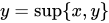
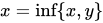
A Riesz space, also known as a vector lattice, is a partially ordered real vector space in which the order structure forms a lattice, meaning that for every pair of elements x,yx, y in the space, the supremum sup{x,y}\sup\{x, y\} and infimum inf{x,y}\inf\{x, y\} exist in the space.[39] This lattice order is compatible with the vector space operations: if xyx \leq y, then αxαy\alpha x \leq \alpha y for α0\alpha \geq 0, and the order is preserved under addition.[39] The prototypical example arises from the pointwise order on spaces of real-valued functions, where the supremum and infimum are taken pointwise.[40] Riesz spaces are precisely the lattice-ordered vector spaces over the real numbers R\mathbb{R}, where the partial order satisfies the lattice axioms alongside the vector space structure.[40] A key property is Dedekind completeness: a Riesz space is Dedekind complete if every non-empty subset that is bounded above has a least upper bound (supremum) in the space.[39] A related notion is σ\sigma-Dedekind completeness, where every countable non-empty subset bounded above has a supremum; this is equivalent to the existence of suprema for non-decreasing sequences that are bounded above.[39] In a σ\sigma-Dedekind complete Riesz space, the monotone convergence theorem holds: if (xn)(x_n) is a non-decreasing sequence in the positive cone bounded above, then supnxn\sup_n x_n exists and equals the order limit of the sequence.[39] Important subclasses of Riesz spaces include those with additional topological structure, such as Banach lattices. An AM-space (abstract M-space) is a Banach lattice whose norm satisfies xy=max{x,y}\|x \vee y\| = \max\{\|x\|, \|y\|\} for all x,yx, y in the space.[39] A KB-space (Kantorovich-Banach space) is a Banach lattice in which every increasing sequence that is norm-bounded converges in norm to its supremum.[41] These subclasses capture spaces like the continuous functions C(K)C(K) on a compact Hausdorff space (an AM-space) and LpL^p spaces for 1p<1 \leq p < \infty (KB-spaces).[39]

References

User Avatar
No comments yet.