Hubbry Logo
Palos Hills, IllinoisPalos Hills, IllinoisMain
Open search
Palos Hills, Illinois
Community hub
Palos Hills, Illinois
logo
8 pages, 0 posts
0 subscribers
Be the first to start a discussion here.
Palos Hills, Illinois
from Wikipedia

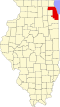
Palos Hills is a city in Cook County, Illinois, United States. It is a southwest suburb of Chicago. The city was established in 1958 and had reached a population of 18,530 in the 2020 census.[2] It is named after Palos de la Frontera, Spain, from which Christopher Columbus set sail to North America.[3] Moraine Valley Community College and Amos Alonzo Stagg High School are its main schools.

Key Information

Geography

[edit]

According to the 2021 census gazetteer files, Palos Hills has a total area of 4.29 square miles (11.11 km2), of which 4.25 square miles (11.01 km2) (or 98.97%) is land and 0.04 square miles (0.10 km2) (or 1.03%) is water.[4]

Demographics

[edit]
Historical population
CensusPop.Note
19603,766
19706,62976.0%
198016,654151.2%
199017,8036.9%
200017,665−0.8%
201017,484−1.0%
202018,5306.0%
U.S. Decennial Census[5]
2010[6] 2020[7]

As of the 2020 census[8] there were 18,530 people, 7,247 households, and 4,209 families residing in the city. The population density was 4,319.35 inhabitants per square mile (1,667.71/km2). There were 7,697 housing units at an average density of 1,794.17 per square mile (692.73/km2). The racial makeup of the city was 81.70% White, 5.77% African American, 0.18% Native American, 2.17% Asian, 0.01% Pacific Islander, 3.39% from other races, and 6.77% from two or more races. Hispanic or Latino of any race were 10.19% of the population.

The top reported ancestries as of 2020 were Polish (29.3%), German (12.7%), Irish (12.6%), Arab (9.6%), and Italian (8.3%).

There were 7,247 households, out of which 22.4% had children under the age of 18 living with them, 43.63% were married couples living together, 10.17% had a female householder with no husband present, and 41.92% were non-families. 36.35% of all households were made up of individuals, and 17.01% had someone living alone who was 65 years of age or older. The average household size was 3.17 and the average family size was 2.34.

The city's age distribution consisted of 18.1% under the age of 18, 8.2% from 18 to 24, 24.5% from 25 to 44, 27.5% from 45 to 64, and 21.8% who were 65 years of age or older. The median age was 44.6 years. For every 100 females, there were 83.3 males. For every 100 females age 18 and over, there were 77.3 males.

The median income for a household in the city was $64,364, and the median income for a family was $81,045. Males had a median income of $57,339 versus $37,926 for females. The per capita income for the city was $34,564. About 9.3% of families and 12.0% of the population were below the poverty line, including 15.1% of those under age 18 and 11.6% of those age 65 or over.

Palos Hills city, Illinois – Racial and ethnic composition
Note: the US Census treats Hispanic/Latino as an ethnic category. This table excludes Latinos from the racial categories and assigns them to a separate category. Hispanics/Latinos may be of any race.
Race / Ethnicity (NH = Non-Hispanic) Pop 2000[9] Pop 2010[6] Pop 2020[7] % 2000 % 2010 % 2020
White alone (NH) 14,897 14,591 14,729 84.33% 83.45% 79.49%
Black or African American alone (NH) 960 926 1,040 5.43% 5.30% 5.61%
Native American or Alaska Native alone (NH) 12 14 9 0.07% 0.08% 0.05%
Asian alone (NH) 468 450 392 2.65% 2.57% 2.12%
Pacific Islander alone (NH) 2 4 0 0.01% 0.02% 0.00%
Other race alone (NH) 19 14 85 0.11% 0.00% 0.46%
Mixed race or Multiracial (NH) 453 193 386 2.56% 1.10% 2.08%
Hispanic or Latino (any race) 854 1,292 1,889 4.83% 7.39% 10.19%
Total 17,665 17,484 18,530 100.00% 100.00% 100.00%

Government

[edit]

Palos Hills is in Illinois's 3rd congressional district.

The City of Palos Hills operates under a Mayor/Council form of government with a Mayor, Clerk and City Treasurer elected at large and 10 Aldermen elected from 5 dual member wards.

  • Mayor Gerald R. Bennett
  • City Clerk Rudy Mulderink
  • City Treasurer Kenneth Nolan.

Aldermen:

  • Ward 1: Martin Kleefisch and Michael Price
  • Ward 2: Pauline Stratton and Mark Brachman
  • Ward 3: A.J. Pasek and Michael Lebarre
  • Ward 4: Joseph Marrotta and Phil Abed
  • Ward 5: Dawn Nowak and Donna O'Connel [10]

North Palos Fire Protection District operates Station 1 and Station 2 in Palos Hills.[11][12]

Education

[edit]

Elementary school districts serving Palos Hills:[13]

Amos Alonzo Stagg High School of the Consolidated High School District 230 serves Palos Hills.[15]

There is also a private PK - 8 school in Palos Hills called Koraes Elementary School.

Moraine Valley Community College is the area community college.

Transportation

[edit]

Pace provides bus service on multiple routes connecting Palos Hills to destinations across the Southland.[16]

Notable people

[edit]

References

[edit]

Further reading

[edit]
[edit]
Revisions and contributorsEdit on WikipediaRead on Wikipedia
from Grokipedia
Palos Hills is a suburban city in southwestern , located approximately 20 miles southwest of downtown . Incorporated on October 22, 1958, as a defensive measure against by neighboring communities, it spans about 3.8 square miles and had a population of 17,909 according to the (estimated 17,825 as of 2023). The city is primarily residential, featuring a mix of single-family homes, parks, and recreational amenities, including the nine-hole Palos Hills Municipal Golf Course opened in 1968 and Pleasure Lake Park dedicated in 2008. The community experienced significant post-World War II growth, driven by workers from nearby industrial plants and the development of subdivisions in the 1940s and 1950s, leading to the formation of the North Palos Community Council in 1957 to advocate for incorporation. A key educational and economic anchor is , founded in 1967 and serving as one of Illinois's largest community colleges with a featuring the iconic Gateway structure symbolizing to education. The local economy is supported by sectors such as and social assistance (employing about 14.7% of residents), retail trade (12.2%), and education (a major employer within the city at 30.1%), with a household income of $79,306 based on 2018–2022 data. Palos Hills maintains a council-manager form of government, led by Gerald R. Bennett, who secured his twelfth term in the April 1, 2025, election. Notable features include preserved green spaces like the Palos Hills Horsemen's Association trails, reflecting the area's historical equestrian heritage dating to 1967, and ongoing infrastructure improvements in roads and flood control.

History

Early Settlement

The area now known as Palos Hills was originally inhabited by Native American peoples during the Upper Mississippian period (circa 1000–1670 CE) and into the early historic era, with archaeological evidence of two significant settlements: the Knoll Spring site (11Ck-19), located near the current , and another near 107th Street and Route 45. These sites indicate semi-permanent villages supported by the region's fertile Sag Valley, abundant wildlife, and sloughs like Saganashkee Slough, which facilitated trade and sustenance through hunting, fishing, and . Native presence persisted until the of 1832, after which most Indigenous groups were displaced from the area. European exploration began in the late 17th century when French explorers and traversed the region in 1673 during their journey, noting the area's wooded hills and waterways. In 1674–1675, Father Marquette returned to hold Mass for local Native Americans near the site of the present St. James at the Sag Bridge Church, marking one of the earliest recorded European religious activities in the vicinity. French trappers followed in the early , establishing temporary outposts, including two small forts near 107th Street and Kean Avenue around the mid-1700s to protect fur trade routes amid conflicts with Native tribes. Permanent Euro-American settlement commenced in the 1830s, spurred by the construction of the Illinois & Michigan Canal (1836–1848), which required laborers to connect the to the . Initial settlers were primarily Irish and German immigrants who worked on the canal and later transitioned to farming the area's fertile prairies and hills, drawn by old Native American trails that eased access from . Among the earliest families were the Sullivans, Lucases, McMahons, Codys, and Kelsos, who established homesteads in what was then part of Trenton . In 1850, the township was renamed Palos by early settler and postmaster Melanchon Powell, honoring his Welsh ancestor's departure from the Spanish port of with in 1492. The region remained largely agricultural and rural through the late 19th century, with scattered farms dominating the landscape until the early 20th century.

Incorporation and Growth

Palos Hills was incorporated as a city on October 25, 1958, after a referendum in which approximately 2,000 residents voted, approving the measure by a narrow margin of 50 votes. The effort was led by the North Palos Community Council, formed in 1957 to resist annexation attempts by neighboring communities such as Worth and Hickory Hills, allowing Palos Hills to maintain its independence and rural character. Carlton Ihde was elected as the city's first mayor on December 6, 1958. The incorporation was later challenged in a 1961 quo warranto action but upheld by the Illinois Supreme Court. Post-incorporation growth accelerated during the and , driven by post-World War II suburban expansion in the , including influences from nearby industrial developments like the Chrysler/Dodge Airplane Plant. The population rose from 3,766 in the 1960 to 16,654 by 1980, reflecting rapid residential development through new subdivisions and , such as Oak Ridge School in 1959. Early policies, including a ban on apartments until , emphasized single-family homes and preserved open spaces, while the formation of the Palos Hills Horsemen’s Association in 1967 highlighted efforts to protect equestrian traditions amid urbanization. By the and , the city continued to mature with investments under mayors like Gerald R. Bennett, elected in 1981, including the opening of the Palos Hills Municipal Golf Course in 1990 and a new City Hall in 1994. Population growth stabilized, reaching 17,803 in 1990 and 17,655 in 2000, before a slight dip to 17,484 in 2010 and a rebound to 18,530 in 2020 according to U.S. Census Bureau data. Later developments, such as Town Square Park in 2002 and Pleasure Lake in 2008, underscored a focus on community amenities and environmental preservation.

Geography and Climate

Physical Geography

Palos Hills is located in southwestern , approximately 20 miles southwest of downtown , within the larger . The city encompasses a total area of 4.29 square miles, with 4.25 square miles consisting of land and 0.04 square miles of water, reflecting a predominantly terrestrial with minimal aquatic coverage. The of Palos Hills is shaped by Pleistocene glacial activity, particularly the advance of the Lake Michigan Lobe of the Laurentide Ice Sheet, which deposited morainic materials forming the underlying terrain. The city lies along the eastern flank of the , a major end moraine extending from northeastern into , characterized by undulating hills, kettles, and eskers resulting from glacial retreat around 14,000 years ago. The northwestern section of Palos Hills occupies part of Mount Forest Island, a triangular upland feature rising approximately 80 feet above the adjacent lowlands, composed of hummocky till and outwash deposits that once formed an island in ancient Lake Chicago during post-glacial stages. This morainic topography contributes to a varied of rolling hills and shallow depressions, with the city's western boundary adjoining over 7,000 acres of Cook County Forest Preserve lands that preserve these glacial landforms. Elevations in Palos Hills range from about 550 to 650 feet above , with an average of 594 feet, creating a gently sloping that drains toward nearby s. The city's eastern and southern edges are influenced by the Sag Valley, a glacial that historically supported swampy conditions before drainage improvements. Hydrologically, Palos Hills borders the —a man-made connecting the Little Calumet River to the —and features small streams and retention ponds that feed into this system, supporting local in forested wetlands. Vegetation is dominated by oak-hickory woodlands on higher morainic slopes, transitioning to remnants and sedge meadows in lower areas, reflecting the region's glacial profiles of loamy over bedrock.

Climate

Palos Hills experiences a (Köppen classification Dfa), characterized by hot, humid summers and cold, snowy winters, typical of the . The city receives approximately 40 inches of annually, with temperatures ranging from an average low of 19°F in to a high of 84°F in . This climate supports a of about 180 days, influenced by its location in the . Seasonal temperature variations are pronounced, with mild springs and falls transitioning between extremes. Winters are long and harsh, often featuring below-freezing temperatures and wind chills exacerbated by lake-effect influences from Lake Michigan. Summers are warm and humid, occasionally reaching heat indices above 90°F due to high dew points. The table below summarizes average monthly high and low temperatures based on historical data from 1980 to 2016.
MonthAverage High (°F)Average Low (°F)
January3220
February3622
March4732
April6042
May7153
June8163
July8468
August8266
September7558
October6346
November4935
December3725
Annual average: 60°F high, 42°F low. is evenly distributed throughout the year but peaks in spring and summer, with May averaging 4.8 inches of . The sees about 124 rainy days annually, making it one of the wetter locations in , particularly during summer when thunderstorms are common. Snowfall totals around 33 inches per year, concentrated from November to , with often the snowiest month at nearly 11 inches. levels rise in summer, contributing to muggy conditions for up to 12 days in , while winds average 9-13 mph, strongest in winter.

Demographics

Palos Hills has experienced modest population fluctuations since its incorporation in 1958, with a general trend of stability followed by slight growth in recent decades. The 2000 U.S. Decennial Census recorded a population of 17,665. By the 2010 U.S. Decennial Census, this figure dipped to 17,484, reflecting a -1.0% decline over the decade, potentially influenced by suburban maturation and limited new development in the area. The rebounded in the following decade, reaching 18,530 according to the 2020 U.S. Decennial , an increase of 6.0% from 2010 and marking the highest recorded figure to date. This growth aligns with broader regional patterns in Cook County suburbs, where post-recession recovery and proximity to contributed to modest expansions. More recent data from the 2019-2023 (ACS) five-year estimates indicate a of 18,139, showing a slight decrease of about 2.1% from the 2020 census level. The U.S. Bureau's July 1, 2024, population estimate is 18,026, reflecting a further decline of 0.6% from the 2023 ACS estimate. Over the longer term, from 2000 to 2024, the population has grown by 2.0%, underscoring overall stability in this residential suburb. The following table summarizes key population milestones:
YearPopulationPercent Change from Prior Decade
200017,665-
201017,484-1.0%
202018,530+6.0%
2023 (ACS est.)18,139-2.1% (from 2020)
2024 (est.)18,026-0.6% (from 2023)

Socioeconomic Characteristics

Palos Hills displays a middle-class socioeconomic profile characterized by stable income levels and moderate . The median household income in the city was $83,969 in 2023, reflecting a 5.88% increase from the previous year based on 2019-2023 ACS 5-year estimates. stood at $38,939 during the same period. The poverty rate was 9.17%, affecting approximately 1,664 residents and remaining below the national average of around 11.5%. These figures are derived from the (ACS) estimates, highlighting relative economic security compared to broader regional trends. According to 2019-2023 ACS data, the racial and ethnic composition of Palos Hills includes 65.2% (non-Hispanic), 20.1% or Latino, 6.8% or African American, 6.1% Asian, and 1.8% two or more races. Foreign-born residents make up 26.6% of the , contributing to the city's diverse socioeconomic fabric, often bringing varied professional skills. Educational attainment among adults aged 25 and older shows a distribution where 12.8% have less than a , 34.4% hold a or equivalent, 27.7% have some or an associate's degree, 15.8% possess a , and 9.3% have completed graduate or professional degrees. This profile indicates a community with solid completion but room for growth in higher education. In terms of employment, the labor force participation rate is 62.7%, with an unemployment rate of 4.4%. Key industries employing residents include health care and social assistance (1,123 workers), retail trade (886 workers), and education (707 workers) as of 2019-2023 ACS place-of-work data. Housing reflects economic stability, with a 79.6% homeownership rate and a median year of structure built in 1977; however, 16.1% of households spend more than 30% of income on housing costs. Commuting patterns show 74.3% driving alone to work, with an average commute time of 34.4 minutes.

Economy

Overview and Employment

Palos Hills is a suburban city located in southwestern Cook County, Illinois, approximately 20 miles from downtown Chicago, serving as a residential community with access to nearby forest preserves and recreational opportunities. As of 2023, the city has a population of 18,139 residents, supporting a stable local economy centered on suburban living and commuting to the broader metropolitan area. Recent economic developments include growth in commercial property investments exceeding $60 million over the last two years (2023–2025). The median household income stands at $83,969, with a per capita income of $38,939, indicating a middle-income profile that aligns with regional averages for suburban Cook County. The economy of Palos Hills benefits from its position within the metropolitan region, where residents often work in adjacent urban centers via major highways like and U.S. Route 45. is evidenced by a labor force participation rate of 62.7% among the working-age population (aged 16 and over), reflecting moderate engagement in the workforce consistent with suburban demographics. In 2023, approximately 8,895 individuals were employed within or commuting from the city, contributing to a low unemployment rate of about 4.4%. Employment opportunities emphasize service and sectors, with an average commute time of 34.4 minutes for workers, predominantly by personal vehicle given the area's 2 cars per household ownership rate. The of 59.9% underscores a resilient job market, bolstered by proximity to major employment hubs in , retail, and transportation. This structure supports without heavy reliance on local , fostering a balanced suburban .

Major Industries and Employers

Palos Hills' economy is characterized by a mix of service-oriented sectors, with , healthcare, and dominating local employment. In 2022, the sector accounted for 30% of jobs within the city, employing approximately 1,365 individuals, primarily through institutions like . Healthcare followed closely, comprising 16.4% of local employment with 746 workers, supported by various medical facilities and home health services. represented 17.5% of the workforce, or 795 employees, reflecting the presence of consulting firms and business support operations. These sectors contribute to a stable economic base, with total in Palos Hills reaching around 4,550 jobs in the city that year. For residents of Palos Hills, the largest industries by employment in 2023 were and social assistance, with 1,082 workers (about 12% of the employed population), followed by retail trade at 1,065 employees (12%), and transportation and warehousing at 885 (10%). This distribution highlights a commuter workforce, as many residents (25.6% in 2022) work in nearby , while only 4.9% are employed locally. Retail and services form a visible cluster along major corridors like Harlem Avenue and Roberts Road, featuring establishments such as , , and local restaurants like Cholula Mexican Grill. Automotive services and beauty salons also represent notable small-business concentrations, though they employ fewer workers overall. Key employers in Palos Hills include , a public two-year institution serving over 10,000 students annually and providing hundreds of jobs in faculty, administration, and support roles. Healthcare providers such as Bria Health Services and Immediate Home Care Physicians Group are significant, offering and rehabilitation services that align with the aging local population. Retail giants like Target and operate stores in the area, employing dozens in sales and operations, while national chains such as and contribute through distribution and pharmacy positions. These employers underscore the city's reliance on educational and service-based institutions rather than large manufacturing or industrial operations.

Government

Municipal Structure

Palos Hills operates under a mayor-alderman form of , which is a variant of the strong mayor-council system common in municipalities. As a non-home rule community, the city's powers are limited to those expressly granted by the , in accordance with the state constitution. Incorporated as a city in 1958, this structure emphasizes separation between executive and legislative functions while providing the mayor with significant administrative authority. The executive branch is headed by the , who serves as the and is responsible for enforcing ordinances, managing administrative operations, preparing the annual , and appointing department heads subject to approval. The also represents the in intergovernmental relations and has veto power over legislation, which can be overridden by a two-thirds vote. Gerald R. Bennett has held the position since 1981, winning re-election in the April 1, 2025, for his twelfth term. The is elected at-large to a four-year term in nonpartisan elections held in April of odd-numbered years. The legislative branch consists of the City Council, composed of ten aldermen elected from five single-member wards, with two representatives per ward. Aldermen serve staggered four-year terms, with elections alternating every two years to ensure continuity; half the council is elected in each cycle. The council holds regular meetings on the first and third Thursdays of each month at City Hall, where it enacts ordinances, approves budgets, regulates and , and oversees municipal finances. To facilitate review, the council operates ten standing committees covering areas such as finance, , public safety, and community development; these committees deliberate on proposed legislation before full council votes. Current council members include long-serving aldermen like Martin Kleefisch (Ward 1, since 1988) and Pauline Stratton (Ward 2, since 1987), alongside newer members such as Jennifer Rose Frankowicz (Ward 3, elected 2025). In addition to the mayor and aldermen, voters elect a city clerk and city every four years on the same cycle as mayoral elections. The city clerk, currently Dawn Nowak, maintains official records, administers oaths, and manages elections. The , Kenneth Nolan, oversees financial receipts, investments, and tax collections. These positions ensure independent oversight of administrative and fiscal functions. Administrative operations are carried out through several key departments reporting to the , including Finance and Administration, which handles budgeting and ; Building, responsible for and permitting; Public Works, managing , sewer, and water services; Police, providing public safety; and Community Resources, overseeing recreation and senior services. The city employs full-time, part-time, and seasonal workers to support these functions, with a 2025 budget emphasizing maintenance and public safety. All municipal actions, including appropriations, are formalized through ordinances adopted annually in .

Public Services and Safety

The Palos Hills Police Department serves as the primary for the city, focusing on maintaining public and order. The department employs 31 full-time sworn officers, along with non-sworn staff such as officers and records clerks, organized into roles including officers, detectives, officers, a K-9 unit, and a . Its mission emphasizes collaboration with residents to provide , preserve , reduce , enhance , and safeguard constitutional rights. Key services include routine patrols, criminal investigations, enforcement, and community-oriented policing initiatives. For non-emergency assistance, residents can contact the department at (708) 598-2992, while emergencies require dialing 911. Fire protection and in Palos Hills are handled by the North Palos Fire Protection District, which covers the city and surrounding areas. The district operates three stations, with two located within Palos Hills: Station 1 (headquarters) at 10629 S. Roberts Road, housing Truck Company 804, Ambulance 802, and Battalion 8; and Station 2 at 8913 West 95th Street. Services encompass fire suppression, hazardous materials response, , and via paramedic-staffed ambulances, addressing 6,624 calls in 2024 across its jurisdiction. Community programs include free smoke alarm installations through the "Be Alarmed!" initiative and CPR training classes. Non-emergency inquiries can be directed to (708) 974-4474, with 911 for emergencies. Public utilities and infrastructure are overseen by the city's Public Works Department, which ensures reliable essential services for residents. Water distribution serves about 17,000 people in 7,700 households, drawing from Lake Michigan via the Metropolitan Water Reclamation District and delivering roughly 673 million gallons yearly through 67 miles of mains, two pumping stations, and two two-million-gallon reservoirs, while maintaining 869 fire hydrants. Sewer operations involve 55 miles of mains and eight pumping stations, with routine cleaning of storm and sanitary lines to prevent backups. The department also maintains 73 lane miles of streets, including snow removal, signage, and lighting; oversees forestry and park upkeep across eight city parks; and manages public buildings and a fleet of 25 vehicles. Contact the commissioner at (708) 598-3400 ext. 1111 for service-related matters. Electricity is provided by Commonwealth Edison (ComEd), and natural gas by Nicor Gas, as standard for the region. Palos Hills is recognized for its strong public safety profile, with crime rates consistently below state and national averages. The city recorded a rate of approximately 0.5 offenses per 1,000 residents based on 2024 FBI-reported data, contributing to its low ranking in the 2025 SafeWise analysis of safest cities in . Property crimes, including and , occur at a rate of about 6.88 per 1,000 residents as of 2024, further underscoring the community's safety. These low incidence levels are supported by and efforts.

Education

K-12 Education

Palos Hills is served by two primary elementary school districts for grades pre-kindergarten through 8, with boundaries dividing the city roughly along 111th Street: the northern portion falls within North Palos School District 117, while the southern portion is covered by Palos Community Consolidated School District 118. Both districts feed into Consolidated High School District 230 for grades 9–12, which includes located within the city limits. North Palos School District 117 operates five schools serving approximately 3,325 students across through 8th grade, with a student-teacher ratio of about 15:1. Key schools in Palos Hills include Dr. Kenneth M. Sorrick School ( to 1st grade), Oak Ridge School (2nd to 5th grade), and H.H. Conrady Junior High School (6th to 8th grade). The district's student body is 30% minority and 64% economically disadvantaged. It has earned an "Exemplary" summative designation from the Illinois State Board of Education, reflecting strong academic growth and achievement, consistently ranking among the top districts statewide. Palos Community Consolidated School District 118 serves around 2,116 students in through 8th grade across three schools, with a student-teacher ratio of 14:1. While its primary schools—Palos East Elementary School and Palos West Elementary School—are located in adjacent Palos Heights and Palos Park, the district's boundaries include the southern section of Palos Hills. The student population is 20% minority and 35% economically disadvantaged. In 2024, district students performed in the 98th percentile for reading, 94th for math, and 92nd for on state assessments, placing science proficiency in the top 10% statewide; the district holds a "Commendable" summative designation. For , students from both elementary districts attend in Consolidated High School District 230, which enrolls 2,583 students in grades 9–12 with a student-teacher of 15:1. The school's demographics include 27% minority students and a 90% four-year rate. It received a "Commendable" designation in the 2024 Illinois Report Card, with average SAT scores of 493 in evidence-based reading and writing and 482 in math among 11th graders. The high school offers advanced programs, including 31% AP enrollment.

Higher Education

Moraine Valley Community College serves as the primary institution of higher education in Palos Hills, Illinois, offering a wide range of associate degrees, certificates, and transfer programs to students in the southwest Chicago suburbs. Founded in 1967, the college is the second-largest community college in Illinois by enrollment and operates within Community College District 524, which spans 139 square miles across 26 municipalities including Palos Hills. The college enrolls approximately 19,006 students, with an average of 17 and a body that is 51% and has an average age of 22. It provides over 130 academic programs, including associate degrees in (A.A.), (A.S.), fine arts (A.F.A.), and engineering (A.E.S.), as well as career-oriented certificates in fields such as , radiologic technology, cybersecurity, , and . Popular majors include , biological and physical sciences, and registered . Located on a 307-acre campus at 9000 W. College Parkway, Moraine Valley features notable facilities such as the Fine and Performing Arts Center, Dr. Vernon O. Crawley Hall, a 113,000-square-foot Health, Fitness & Recreation Center, and a 40-acre Area. The campus also hosts the Center for Sustainable and Secure Infrastructure Applications (CSSIA), a National Foundation-funded cybersecurity initiative, and the state's first Shakespeare at a . Extension sites in Blue Island and Tinley Park, including the platinum LEED-certified Southwest Education Center, expand access to programs for local residents. No other degree-granting higher education institutions are located directly within Palos Hills city limits, though nearby colleges such as Trinity Christian College in Palos Heights provide additional options within a short distance.

Transportation

Roads and Highways

Palos Hills is strategically located in the southwestern suburbs of , with access to several major interstate and state highways that connect the city to the broader regional transportation network. (Tri-State Tollway), a key , runs parallel to the city's western boundary, providing direct links to to the north and to the south, facilitating commuter and commercial traffic. Similarly, (Stevenson Expressway) lies approximately 5 miles east of the city, offering high-speed access to downtown and points south. The city's boundaries are defined by prominent arterial roads, including Illinois Route 43 (Harlem Avenue) to the west, which serves as a major north-south commercial corridor handling significant daily traffic volumes. To the east, Southwest Highway (Illinois Route 7) forms a key boundary, supporting local business districts and connecting to adjacent communities like Palos Heights and Worth. Other significant routes include (LaGrange Road), running north-south through nearby areas and providing an alternative to I-294 for regional travel, and the northern boundary along 103rd Street, which serves as a vital east-west link. Locally, the Public Works Department maintains approximately 73 lane miles of city-owned streets, including , pothole repairs, and for over 2,010 traffic and regulatory signs. Key local arterials such as Roberts Road and 111th Street support internal mobility and commercial activity; for instance, the of 111th Street and Roberts Road, one of the city's busiest, underwent a major reconstruction in 2025 to improve traffic flow, reduce congestion, and enhance safety with new signals and turning lanes. These efforts ensure the road network accommodates the city's residential and educational hubs, such as , while integrating with the 17.9% of land area dedicated to transportation infrastructure.

Public Transit

Public transit in Palos Hills, Illinois, is primarily provided by the Pace Suburban Bus system, which connects the city to and surrounding suburbs, with additional specialized services for seniors and the disabled. The system integrates with the (CTA) and rail lines for broader regional access, though Palos Hills lacks a direct rail station; the nearest Metra stop is in adjacent Palos Heights on the line. Several Pace bus routes serve Palos Hills, facilitating daily commutes to key destinations like and Chicago's Midway Airport. Route 381 operates between the CTA Red Line's 95th/Dan Ryan Station and Moraine Valley College, running via 95th, 103rd, and 107th Streets with daily service. Route 386, the Southwest Highway line, provides service from Tinley Park through Palos Hills, Palos Heights, and Orland Park to Midway Orange Line Station, accommodating commuters across multiple southwest suburbs. Other routes include 379, which links Midway Airport to Orland Square Mall while passing through Palos Hills, and 385, connecting areas like Blue Island and Oak Lawn via 87th, 111th, and 127th Streets. Schedules and fares for these routes are available through the Pace website and app, with typical one-way fares around $2 for local trips. For local needs, the City of Palos Hills operates the Palos Area Transportation Services for the Elderly (PATSE), a wheelchair-accessible service targeted at residents aged 60 and older or those with disabilities living in Palos Township. PATSE runs Monday through Friday from 8:30 a.m. to 2:00 p.m., excluding holidays, and focuses on trips within township boundaries to locations such as medical facilities, banks, grocery stores, and beauty shops. Reservations must be made by phone the previous day between 8:00 a.m. and noon at (708) 430-3822, with medical appointments prioritized on a first-come, first-served basis; fares are $2 one-way or $4 round-trip. This service emphasizes accessibility but does not cover emergencies, for which 911 should be called instead.

Community Life

Parks and Recreation

The Palos Hills Resource and Recreation Department, located at the Community Center on 8455 W. 103rd Street, manages the city's parks and offers a range of programs aimed at preserving open spaces and promoting wellness. The department's mission focuses on delivering high-quality, diverse, and affordable recreational opportunities through park maintenance, program development, and special events. Operating hours for the Community Center are Monday through Thursday from 8:00 a.m. to 8:00 p.m., Friday from 8:00 a.m. to 5:00 p.m., and Saturday from 8:30 a.m. to 11:30 a.m., with Sundays closed. Palos Hills maintains several public parks that provide amenities for passive and active recreation, including playgrounds, walking trails, and sports facilities. Key examples include at 8455 W. 103rd Street, which features a , , Veterans , and hosts outdoor movies; Indian Woods Park at 9951 S. 82nd Court, offering a one-mile asphalt walking trail and shaded by trees; and Bennett Park, located at the of 103rd Street and Roberts Road, a nature-oriented site with a , , fishing dock, stone amphitheater, , and walking trails—formerly known as Pleasure Lake Park. Glacier Park, at 101st Street and 78th Avenue, includes baseball fields, a , and skating areas. Other neighborhood parks such as Loveland, Aspen, , Krasowski, and Volunteer primarily feature playgrounds for young children. The department offers programs across age groups, with registration available via mail or drop-off at the Community Center—no telephone registration. classes include and Fanatics for ages 4-5, costing 6565-78 for residents. Youth programs feature soccer for ages 3-11 at Park ($182 resident fee) and for ages 7-12 ($78 resident fee). Adult offerings encompass sessions (4848-64 resident fee) and trips like visits to County Line Orchards ($30 resident fee). Seniors (ages 55+) participate in the 39'ers Club with events such as Welcome Fall gatherings ($3 fee). Special events include city-wide on October 31 and a celebration on November 11 at Park. For inquiries, contact the department at 708-430-4500 or [email protected].

Notable Residents

Palos Hills has produced several notable individuals in sports and the arts. Among athletes, (born June 8, 1989), a from Palos Hills, played in for teams including the Baltimore Orioles and , appearing in over 300 games during his career. Katie Eberling, an Olympic bobsledder, hails from Palos Hills, where she grew up before competing for Team USA in the 2014 and as a brakewoman, earning multiple World Cup medals. Similarly, , a former center, was born in Palos Hills in 1988 and won the as the nation's top collegiate center at the in 2011 before a professional career with teams like the . In other sports, Christian Dvorak, a center, grew up in Palos Hills and was drafted by the in 2014, later playing for the and accumulating over 200 NHL points. Tim Kopinski, a player and coach from Palos Hills, achieved a No. 1 ranking in the Intercollegiate Tennis Association doubles during his time at the University of , later serving as an assistant coach there. Leslie Cichocki, a Paralympic swimmer from Palos Hills, represented Team USA at the 2016 Rio Games and won multiple medals at Parapan American Games, including bronze in the 200-meter freestyle S14 in 2015. In the arts, Nick Drnaso, a graphic novelist born in Palos Hills in 1989, gained international acclaim for works like Sabrina (2018), which was shortlisted for the Man Booker Prize, and Beverly (2016), winner of the Los Angeles Times Book Prize for Best Graphic Novel.

References

Add your contribution
Related Hubs
User Avatar
No comments yet.