


Community hub
Recent from talks
Contribute something
Nothing was collected or created yet.
Oudenaarde
View on Wikipedia | This article needs additional citations for verification. (February 2013) |
Oudenaarde (Dutch pronunciation: [ˈʌudənaːrdə] ⓘ; French: Audenarde [odnaʁd]; in English sometimes Oudenarde) is a Belgian city and municipality in the Flemish province of East Flanders. The municipality comprises the city of Oudenaarde proper and the towns of Bevere, Edelare, Eine, Ename, Heurne, Leupegem, Mater, Melden, Mullem, Nederename, Volkegem, Welden and a part of Ooike.
Key Information


From the 15th to the 18th century, but especially in the 16th century, Oudenaarde was known as a centre of tapestry production. The town's name, meaning "old field", still lingers on in "outnal", an obsolete English term for a kind of brown linen thread.
History
[edit]

The glory of Ename
[edit] | This section may be confusing or unclear to readers. (July 2024) |
The history of the current municipality of Oudenaarde starts in 974, when Otto II, Holy Roman Emperor and king of Germany, built one of its three fortifications on the Scheldt at Ename to protect his kingdom against possible attacks from Francia (next to the other frontier post at Valenciennes, later in also the Margraviate of Antwerp). Ename grew very fast. By 1005, the town already had a couple of churches and had become the largest town in the Duchy of Lotharingia. In 1034, Ename was destroyed by an irregular army that surrendered the city to Count Baldwin IV. In 1047, the son of Baldwin V (peacefully) received the imperial fief from the German emperor. The fief was, however, confiscated in 1047 when the Baldwins rebelled against the German empire. In 1062, Baldwin V, together with his wife, founded the Benedictine abbey of Saint Salvator. By that time, the former merchants and guild artisans of Ename easily got across the Scheldt to the recently founded city of Oudenaarde.[2]
Oudenaarde’s golden age
[edit]In the 11th century, Oudenaarde’s economy flourished, thanks to the proximity of the Scheldt and the burgeoning but vibrant cloth and tapestry industry. Churches, cloisters and hospitals were built. Throughout the Middle Ages, the city was one of the staunchest supporters of the counts of Flanders, defending them against insurrections from the South and even from Ghent. The city became known as the residence of the nobles. It built itself a flagship town hall (built 1526–1537), which we can still admire today, and the St-Walburga church. Charles V stayed here for a couple of months in 1522 and fathered an illegitimate daughter, Margaret of Parma, who was to become Regent of the Netherlands.
Decline
[edit]
During the Reformation, the people of Oudenaarde chose Protestantism and allied themselves with Ghent against Charles V. In 1582, after a prolonged siege by Margaret's son, Alexander Farnese, the city finally gave in, causing most merchants, workers, and even nobles to flee. Oudenaarde fell under the Counter-Reformation, which for a short while revived the commerce of tapestry. The glory days, however, never came back. The French attacked and took the city three times in less than a century. Fortifications were repeatedly improved in the 16th and 17th centuries, including additions by Vauban.[3] In 1708, one of the key battles in the War of the Spanish Succession, known as the Battle of Oudenaarde, was fought in the vicinity of the city. Oudenaarde slumbered as a provincial town under the Habsburg regime. Like its neighbours, in the 1790s, it suffered religious curtailment imposed by the French Revolution.
The city later suffered damage during World War I, which is commemorated by several monuments scattered around town.
During World War II the town was occupied by Nazi German forces in May 1940. The town was liberated by British forces on the 5th of September 1944.[4]
Beer
[edit]
Oudenaarde is known for the brewing of Oud bruin beer, which is sometimes termed Oudenaarde Oud bruin, especially that of Liefmans Brewery in the town.[5][6]
Oud Bruin (Old Brown), also known as Flanders Brown, is a style of beer originating from the Flemish region of Belgium. The Dutch name refers to the long aging process, up to a year. It undergoes a secondary fermentation, which takes several weeks to a month, followed by bottle ageing for several more months. The extended ageing allows residual yeast and bacteria to develop a sour flavour characteristic for this style.[7] Usually, cultured yeast and bacteria are used, as stainless steel does not harbour wild organisms as wood does.[8]
Sights
[edit]- The Flamboyant Gothic–style Town Hall and its Belfry were designated by UNESCO as a World Heritage Site in 1999.[9] The city hall houses a unique collection of Oudenaarde tapestries.
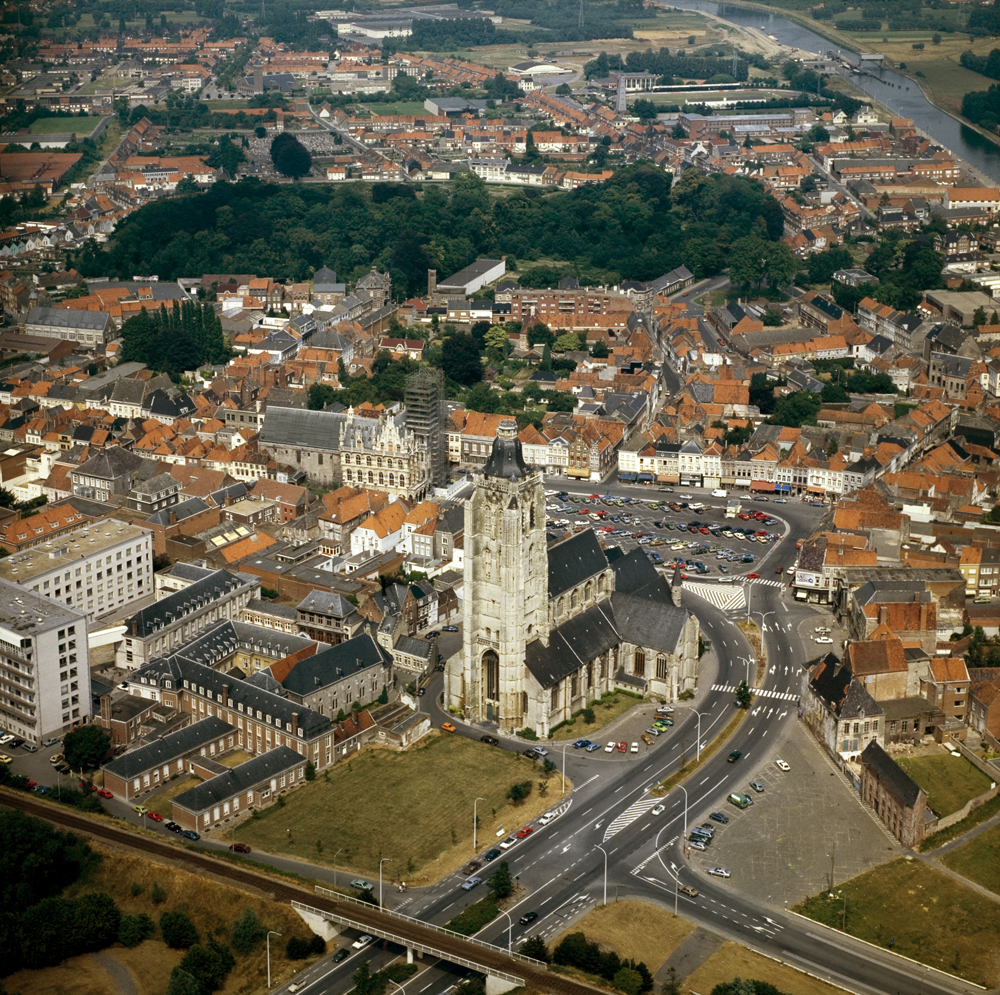
- The Church of Our Lady of Pamele, begun in 1234 on the banks of the Scheldt, and the Church of St Walburga near the market square, are both worth a visit.
- Oudenaarde is also home to the Centrum Tour of Flanders, a museum dedicated to the Tour of Flanders cycling race.
- Since 2008, the village of Mater in Oudenaarde has been the home of Belgium's smallest craft brewery: the Smisje Brewery (previously located in Bruges).
-
 Oudenaarde Town Hall
 -
 Church of Our Lady of Pamele
 -
 Saint Walburga's church, Oudenaarde
 -
 Oudenaarde railway station
 -
 The marketplace, Oudenaarde


Events
[edit]- Recurring events include a beer fest in June, an open-air musical festival in the summer, and an agricultural fair in February.
- Every ten years, one of the largest floral displays in Flanders takes place on the market square (Grote Markt). The last one took place in 2005.
Newspaper
[edit]
Oudenaarde used to have its own newspaper, namely the Gazette van Audenaerde.
Sports
[edit]The main football club in Oudenaarde is K.S.V. Oudenaarde.
The celebrated Tour of Flanders voor Vrouwen, the women's Tour of Flanders cycle race, starts in Oudenaarde every spring. The men's Tour of Flanders has passed through Oudenaarde on several occasions, finishing in the town since 2012, and it regularly ascends the Koppenberg hill in the municipality. The Koppenbergcross cyclo-cross race, which takes place on the Koppenberg hillside, is part of the BPost Bank Trophy.
Rhinos Rugby Oudenaarde is a rugby club in Oudenaarde that was voted the coolest club of Flanders in 2018.[11]
Notable inhabitants
[edit]- The Viscount of Audenaerde
- Arnold of Soissons, saint (1040-1087)
- Margaret of Parma, daughter of Charles V and Regent of the Netherlands (1522-1586)
- Henri-Charles Lambrecht, bishop, born in Welden.
- Johannes van den Driesche, orientalist and exegete (1550-1616)
- Adriaen Brouwer, painter (1605-1638)
- Charles Liedts, politician (1802-1878)
- Gentil Theodoor Antheunis, poet (1840-1907)
- Reimond Stijns, writer (1850-1905)
- Robert Herberigs, painter, writer and musician (1886-1974)
- Arthur Decabooter, cyclist, born in Welden (1936-2012)
- André Dierickx, road racing cyclist (b. 1946)
- Jotie T'Hooft, poet (1956-1977)
- Bart Kaëll, singer and TV host (b. 1960)
- Eric Van Lancker, cyclist (b. 1961)
- Mario De Clercq, cyclist, three-time world cyclo-cross champion (b. 1966)
- Frank De Bleeckere, football referee (b. 1966)
- Jonathan Page, cyclist, American cyclo-cross champion (b. 1976)
- Brigitta Callens, Miss Belgium 1999 (b. 1980)
- Charlotte Vandermeersch, actress (b. 1983)
- Stijn Vandenbergh, cyclist (b. 1984)
- Kenny De Ketele, track cyclist, Madison World Champion (b. 1985)
- Jan Bakelants, cyclist (b. 1986)
- Jan Dequeker, professor, humanitarian and philanthropist (b. 1997)[12]
International relations
[edit]Twin towns—sister cities
[edit] Coburg, Germany (1972)
 Bergen op Zoom, Netherlands (1986)
 Castel Madama, Italy (1986)
 Arras, France (1990)
 Hastings, United Kingdom (1991)
 Buzău, Romania (2007)


References
[edit]- ^ "Bevolking per gemeente op 1 januari 2022". Statbel.
- ^ Van Droogenbroeck, F. J. (2018), "De markenruil Ename – Valenciennes en de investituur van de graaf van Vlaanderen in de mark Ename", Handelingen van de Geschied- en Oudheidkundige Kring van Oudenaarde 55. pp. 47–127.
- ^ "Fortified Places > Relief Maps > Audenarde". Archived from the original on 2007-12-09. Retrieved 2007-01-04.
- ^ Battle for the Escaut 1940: The France and Flanders Campaign by Jerry Murland, pg. xi
- ^ The Ale Trail, 1995, Roger Protz, quote: "The Old Brown [Oud Bruin] ales of Oudenaarde, a waterside city steeped in Flemish culture and history, are highly complex beers".
- ^ Oxford Companion to Beer, 2011, quote: "Liefmans Brewery is a Belgian specialty brewery in Oudenaarde, in the province of East Flanders."
- ^ Rajotte, Pierre (1992). Belgian Ale. Boulder, Co: Brewers Publications. p. 14. ISBN 9780937381311.
- ^ "Flanders Brown / Oud Bruin". Beer Connoisseur. 2 September 2009. Archived from the original on 8 April 2014. Retrieved 6 April 2014.
- ^ "Belfries of Belgium and France". UNESCO World Heritage Centre. United Nations Educational, Scientific, and Cultural Organization. Retrieved 5 November 2021.
- ^ "Gazette van Audenaerde". lib.ugent.be. Retrieved 2020-09-28.
- ^ in, Made; Cromphout, Rani (2018-10-24). "Rhinos Rugby uit Oudenaarde is de coolste sportclub van Vlaanderen". Made in (in Flemish). Retrieved 2023-12-29.
- ^ "KU Leuven who's who - Jan Dequeker".
External links
[edit]
- Official website
- Museum van Oudenaarde
- Centrum Tour of Flanders (in Dutch, French, and English)
Places adjacent to Oudenaarde | |
|---|---|


Belgian municipality Oudenaarde | |
|---|---|
| Deelgemeentes | |
| Other settlements | |
| Buildings and sights | |


| Aalst |  | |
|---|---|---|
| Dendermonde | ||
| Eeklo | ||
| Ghent | ||
| Oudenaarde | ||
| Sint-Niklaas | ||
| ||
| International | |
|---|---|
| National | |
| Geographic | |
| Other | |

Oudenaarde
View on GrokipediaGeography
Location and topography
Oudenaarde is situated in the province of East Flanders within the Flemish Region of Belgium, in the heart of the Flemish Ardennes, approximately 27 kilometers southwest of Ghent.[12] The municipality lies along the banks of the Scheldt River, whose navigable course has positioned the area as a nexus for overland and fluvial connectivity, influencing patterns of settlement through access to transportation and water resources for agriculture and industry. The municipal territory encompasses 68 km² (6,800 hectares) and incorporates sub-municipalities including Ename and Bevere.[13] Topographically, Oudenaarde features the undulating terrain of the Flemish Ardennes, with rolling hills rising to elevations of up to 77 meters, such as at the Koppenberg, interspersed with flatter polders and the broader Scheldt valley floor.[14][15] Elevations in the central town area hover around 10-15 meters above sea level, while the river valley remains susceptible to flooding due to its low-lying, alluvial character and proximity to the meandering Scheldt, which has shaped land use through periodic inundation risks and resultant polder reclamation efforts.[16][17] The terrain's gentle gradients and valley confines have further supported defensive positioning and economic activities tied to the river's flow.[18]
Climate and environment
Oudenaarde has a temperate oceanic climate under the Köppen classification Cfb, marked by mild, wet conditions year-round with limited temperature extremes. Average low temperatures in January hover around 1°C, while July highs typically reach 23°C, with rare drops below -6°C or rises above 29°C. Precipitation averages 822 mm annually, fairly evenly distributed across seasons, supporting consistent humidity levels above 70%.[19][20] The region's proximity to the Scheldt River exposes it to periodic flooding risks, exacerbated by heavy rainfall events; for instance, intense precipitation on December 10, 2021, led to localized flooding in areas surrounding Oudenaarde. Historical vulnerabilities along the Upper Scheldt prompted the development of the Sigma Plan in 1977, a comprehensive flood defense strategy involving dike reinforcements and controlled flooding zones to mitigate storm surges and river overflows across the basin. Ongoing enhancements to these defenses, including nature-based solutions, aim to balance protection with ecological integrity following recent incidents.[21][22] Local environmental initiatives emphasize preserving green spaces and enhancing biodiversity within the Flemish Ardennes, where Oudenaarde's municipal forests align with EU habitat directives for woodland conservation. Restoration projects along the Upper Scheldt focus on improving water quality and native species habitats through reduced pollution and habitat connectivity, without relying on unsubstantiated claims of broader climatic shifts. These efforts leverage the area's natural topography of hills and forests to sustain high biodiversity levels, including protected village landscapes and spring woodlands.[23][24]History
Origins and early settlement
Archaeological investigations have uncovered evidence of prehistoric human activity in the Oudenaarde region, particularly during the Neolithic period. The wetland site at Oudenaarde-Donk, located in the Middle Scheldt floodplain, has yielded pottery, lithic artifacts, antler tools, and other remains indicative of sustained settlement and resource exploitation around 5000–2500 BCE.[25] Additional findings from an aeolian dune at Oudenaarde-Markt reveal occupation layers from the Final Palaeolithic (ca. 12,000–10,000 BCE) through the Neolithic, with optically stimulated luminescence dating confirming human modification of the landscape along the Upper Scheldt valley.[26] These sites demonstrate early exploitation of riverine environments for subsistence, though no continuous occupation is evident into later eras. Roman-era presence in the area is attested indirectly through the Scheldt river's integration into broader transport networks, facilitating trade and military movement from the 1st to 4th centuries CE. The river served as a key artery for goods and connectivity in the northern Gallia Belgica province, with evidence of navigation and settlement patterns along its course supporting sporadic activity near modern Oudenaarde, though site-specific Roman artifacts remain limited compared to downstream locales.[27] This positioned the region as a peripheral node in Roman logistics rather than a major hub. The origins of Oudenaarde as a nucleated settlement trace to the late 10th century, with the establishment of the fortified trade post at Ename—now a suburb—around 965–974 CE. Positioned on the Scheldt's east bank, Ename functioned as a strategic frontier stronghold amid tensions between the County of Flanders and the Holy Roman Empire's Lotharingian territories, controlling river access and defending against incursions.[28] [29] Excavations under the Ename 974 project have documented a castrum enclosing approximately 3 hectares, including a wooden palisade, internal structures, and a harbor; by ca. 990 CE, an impressive stone keep was erected within the enclosure, evidencing rapid militarization and administrative investment.[30] These findings, corroborated by dendrochronology and stratigraphic analysis, reveal a pre-urban core with craft workshops, markets, and trade-oriented infrastructure that attracted settlers and fostered economic nucleation by the early 11th century.[29] Integration into the County of Flanders solidified through feudal mechanisms, with comital oversight granting lands and privileges to secure loyalty and development. An early wooden church at the settlement supported Christianization, supplanting pagan holdovers and aligning local practices with Carolingian reforms.[31] The 1063 foundation of Ename Abbey by Adele of France, consort of Baldwin V, amplified this by introducing Benedictine monasticism; endowed with estates for self-sufficient agriculture and tithes, the abbey drew pilgrims and laborers, embedding the site within Flemish feudal hierarchies while excavations confirm 11th-century extensions to fortifications amid regional power shifts.[29] This monastic-economic base underpinned early demographic stability, distinct from transient prehistoric patterns.Medieval prosperity and trade
Oudenaarde's location along the Scheldt River provided critical access to inland and maritime trade routes, enabling the export of linen cloth and later tapestries, which formed the basis of its medieval economic expansion.[32] The granting of city rights in the late 12th century empowered local merchants to establish markets and guilds, fostering organized production and quality control in textile crafts that linked rural flax supplies to urban manufacturing.[33] Guild systems, by restricting entry and enforcing standards, concentrated wealth among artisan families while mitigating risks from fluctuating demand through collective bargaining and reputation mechanisms.[34] The tapestry sector peaked in the 15th and 16th centuries, with Oudenaarde workshops producing intricate wool and silk weaves for elite European markets, supported by the river's logistical advantages over land transport.[35] Cloth merchants, leveraging guild privileges, financed urban infrastructure, exemplified by the Brabantine Gothic town hall constructed from 1526 to 1537 under architect Hendrik van Pede, which replaced earlier medieval structures and embodied the scale of accumulated commercial capital.[36] Population growth accompanied this boom, drawing laborers to textile workshops and sustaining a dense network of trade dependencies that amplified local prosperity without reliance on feudal agrarian surpluses. Integration into the Habsburg domains under Charles V preserved guild autonomy in daily operations, allowing Oudenaarde to negotiate trade exemptions amid imperial fiscal demands, though central policies increasingly challenged local monopolies by favoring broader mercantile flows.[37] This balance enabled sustained exports but exposed vulnerabilities to geopolitical shifts, as guilds prioritized short-term stability over adaptive innovation in response to emerging competitors.Decline under foreign rule
Oudenaarde's decline accelerated under Spanish Habsburg rule during the Eighty Years' War (1568–1648), as repeated military campaigns severed vital trade routes along the Scheldt River and inflicted direct destruction on the city's textile infrastructure. Spanish forces recaptured the city from Calvinist rebels on July 5, 1582, after a prolonged siege that involved heavy artillery bombardment and likely entailed plunder by troops, consistent with contemporary siege warfare practices where victors compensated soldiers through looting.[38][39] These conflicts, coupled with naval blockades by the emerging Dutch Republic, blocked exports of Oudenaarde's renowned tapestries and linens to northern markets, eroding the sector's competitiveness against rivals like Brussels, which benefited from relative stability and court patronage.[40] Religious persecutions under Spanish Counter-Reformation policies further prompted emigration of skilled Protestant artisans, depleting the workforce essential for maintaining production quality and innovation. Subsequent French incursions compounded these losses during the War of Devolution (1667–1668), when Louis XIV's armies invaded the Spanish Netherlands, besieging and capturing Oudenaarde in early 1668 amid a rapid advance that overwhelmed local defenses.[41] The occupation inflicted material damage through requisitions and fortification works, while broader wartime disruptions halted textile shipments and inflated costs, accelerating the shift of weaving dominance to less war-torn centers. Under the ensuing Austrian Habsburg administration (1714–1794), mercantilist taxation extracted resources for imperial priorities without commensurate investment in local recovery, preserving guild monopolies that inhibited technological adaptation amid stagnant demand.[42] The French Revolutionary armies' conquest in 1794 triggered deeper structural upheaval upon annexation into French departments, where edicts dissolved craft guilds by 1791–1795, unleashing short-term economic disarray as unregulated competition undercut established producers without fostering immediate efficiencies.[43] Napoleonic rule intensified burdens through mandatory conscription, drafting thousands from Flemish regions—including Oudenaarde's environs—into the Grande Armée for campaigns like the 1812 Russian invasion, which depleted labor pools and remittances while redirecting trade toward Paris-centric policies.[44] These extractions, prioritizing military logistics over regional commerce, entrenched Oudenaarde's lag in transitioning to mechanized industry, as war-induced scarcities and workforce losses perpetuated reliance on outdated handloom methods.Industrial era and world wars
Following Belgian independence in 1830, Oudenaarde's economy began a slow recovery from prior stagnation, supported by national infrastructure investments including railways that enhanced connectivity to regional markets. The local railway station opened on 28 June 1857, linking the town to Ghent and other centers, which facilitated modest growth in trade and transport of goods like agricultural products and beer.[45][46] Industrial development remained limited throughout the 19th and early 20th centuries, bypassing the heavy mechanization seen in urban centers like Ghent; instead, the town relied on small-scale manufacturing, rural crafts, and brewing as key sectors sustaining employment and output. Breweries such as Liefmans, with roots predating the era but undergoing expansions for increased production, exemplified this localized enterprise amid a predominantly agrarian economy.[47][48] Oudenaarde fell under German occupation during World War I from late 1914 until liberation by American forces of the 91st Division on 2 November 1918, enduring economic strain from resource requisitions, labor deportations, and trade disruptions that hampered local industries like brewing. Physical damage was less severe than in frontline zones, though German troop movements inflicted destruction requiring repairs, such as the town hall's reconstruction completed in 1921.[49][50] In World War II, German forces occupied the town from May 1940, imposing controls on economic activity until British troops, aided by local resistance, liberated Oudenaarde on 5 September 1944. Bombing and combat caused significant harm, including heavy damage to St. Walburga's Church, yet the occupation avoided the total devastation of some Belgian areas. Post-1945 rebuilding drew on private sector initiative and community efforts, prioritizing restoration of brewing facilities and small manufactories to revive pre-war productivity without heavy reliance on centralized state programs.[50][51]
Post-war recovery and modern developments
Following World War II, Oudenaarde experienced suburban expansion and population shifts typical of Flemish towns, with urban fringes developing villas and social housing amid Belgium's broader post-war economic boom driven by industrialization and welfare state policies.[52] This suburbanization, peaking from the 1950s to 1970s, reflected causal factors like increased car ownership and housing demand, leading to outward migration from city centers without significant disruption to Oudenaarde's core textile and agricultural base.[52] In line with Belgium's 1971 municipal amalgamation laws, which aimed to enhance administrative efficiency through scale enlargement, Oudenaarde expanded in 1977 by incorporating seven surrounding communes—Bevere, Edelare, Eine, Ename, Mater, Melden, and Welden—forming a larger municipality to manage growing suburban pressures and infrastructure needs.[53] Concurrently, the town pivoted toward tourism, leveraging its historical sites and proximity to cycling routes; the Tour of Flanders, with its finish line and key climbs like the Oude Kwaremont and Paterberg nearby, boosted visitor numbers, establishing Oudenaarde as a "cycling Mecca" and supporting local economy through events and the Tour of Flanders Centre opened in 2012.[54][55] The July 2021 floods, triggered by extreme rainfall in the Scheldt basin, caused infrastructure damage in Oudenaarde, including road disruptions and property inundation, though less severe than in Wallonia's Vesdre valley; this prompted targeted flood defense investments, with empirical assessments prioritizing cost-effective reinforcements like dike elevations over expansive new barriers, informed by hydrological data showing recurrence risks.[56][57] Recent industrial developments include the 2025 revival of the former BelGaN site in Oudenaarde, where a European investor committed €200-250 million to establish Europe's first commercial photonic chip production facility, potentially creating 500 jobs and shifting from silicon to gallium nitride technologies for energy-efficient applications.[58][59] Tourism data for Flanders indicates growth in Belgian domestic visitors—reaching about 7 million regionally in 2024—drawn to Oudenaarde's cycling heritage and museums, yet with shorter average stays amid rising day-trip preferences post-pandemic.[60][61]Administration and politics
Local governance structure
Oudenaarde functions as the administrative capital of the Arrondissement of Oudenaarde in the province of East Flanders, coordinating certain provincial services while maintaining its independent municipal governance. The local structure adheres to the standard Flemish municipal system established by the Belgian Organic Law on Municipalities of 1986, comprising an elected municipal council with legislative authority, a college of the mayor and aldermen handling executive duties, and the mayor serving as the primary executive officer appointed from the council's majority. The council consists of 27 members elected every six years, with the most recent elections held on October 13, 2024.[62] As of 2025, John Adam of Open Vld holds the position of mayor, leading an executive coalition that includes representatives from Open Vld, N-VA, and Meer dan Groen following the 2024 elections. This setup reflects the mayor-council dynamics typical in Flemish municipalities, where the executive implements policies on local services such as infrastructure maintenance, public safety, and heritage preservation, subject to oversight by the council.[63][64] The municipality encompasses the central city of Oudenaarde and 12 sub-municipalities—Bevere, Edelare, Eine, Ename, Heurne, Leupegem, Mater, Melden, Mullem, Nederename, Volkegem, and Welden—resulting from territorial fusions primarily in 1971 and subsequent adjustments. These sub-municipalities feature advisory councils that provide input on localized issues, enhancing administrative decentralization within the broader Flemish federal framework. Local policies on language and culture align with Flemish regional decrees, enforcing Dutch as the sole official language and facilitating grants for heritage-related projects to preserve the area's historical assets.[65]Political landscape and Flemish identity
Oudenaarde's political landscape reflects the broader Flemish preference for nationalist and center-right parties advocating regional autonomy amid longstanding grievances with Belgium's centralized structures, which historically favored French-speaking Walloon dominance following independence in 1830. Voters have consistently supported parties like N-VA, which prioritize fiscal responsibility and cultural preservation over federal transfers that disproportionately burden Flanders to subsidize Wallonia's economy. In the October 2024 municipal elections, N-VA secured the largest share of seats in the city council, enabling a coalition with Open VLD and Meer dan Groen, though Open VLD's John Adam assumed the mayoralty.[64] This outcome highlights empirical voting patterns favoring devolved powers, as centralized federalism often delays local decisions on infrastructure and welfare, exacerbating inefficiencies rooted in linguistic divides. Flemish identity in Oudenaarde, rooted in Dutch-language heritage and resistance to post-1830 francization policies that marginalized Dutch speakers in administration and education, manifests in support for movements seeking confederal reforms to address asymmetric economic contributions. The town's location in East Flanders, a historic center of textile trade and Catholic conservatism, reinforces a cultural realism that views Walloon centralism as causal in perpetuating dependency, with Flemish parties critiquing it for hindering prosperity. Local politics thus channels identity through advocacy for Flemish institutions, evident in N-VA's platform emphasizing self-reliance over subsidiarity debates that overlook Flanders' net payer status.[66] Pragmatic policies underscore this conservative bent, as seen in Mayor John Adam's September 2025 ordinance banning alcohol consumption around the train station effective October 1, aimed at curbing disorder and enhancing public safety without broader ideological overreach.[67] In immigration discussions, Flemish-leaning factions stress integration requirements to sustain cultural homogeneity, arguing that unchecked inflows risk straining social cohesion in communities like Oudenaarde where native Dutch speakers predominate, prioritizing empirical outcomes over federal open-border tendencies.[64]Demographics
Population trends and statistics
As of 1 January 2024, the municipality of Oudenaarde had a registered population of 32,702 residents.[11] This reflects modest annual growth of around 0.5-1%, with projections estimating 32,930 inhabitants by 2025.[1] The population has risen from 27,055 in 1990, representing an increase of over 20% in three decades, largely attributable to administrative mergers in 1964 and the broader 1976-1977 fusions of Belgian municipalities, which incorporated adjacent rural areas and boosted the base population without proportional territorial expansion.[3][53] Demographic dynamics show a negative natural balance, with 317 births and 325 deaths in 2024, corresponding to rates of 9.7 and 9.9 per 1,000 inhabitants, respectively.[11] This pattern underscores an aging structure typical of inland Flemish municipalities, where the median age stands at 43.1 years—elevated relative to Belgium's national average—and low fertility sustains reliance on net in-migration for growth.[68][11] Positive net migration of 236 persons in 2024 (1,799 arrivals minus 1,563 departures) primarily stems from internal Belgian flows, including commuters from larger urban centers like Ghent seeking affordable housing amid Flanders' regional aging trend, where the share of those over 65 has climbed above 19% since 2000.[11][69] The municipality spans 68.92 km², yielding a population density of approximately 478 inhabitants per km², concentrated in the historic core with outward suburban development along transport corridors.[1] Earlier historical records indicate relative stability or dips in the 19th century amid Flemish rural exodus driven by subsistence pressures and urban-industrial pulls elsewhere in Belgium, though precise pre-1900 census figures for the modern boundaries remain sparse due to fragmented pre-merger jurisdictions.[70]Ethnic and linguistic composition
Oudenaarde lies within the unilingual Dutch-speaking Flemish Region of Belgium, where Dutch serves as the exclusive official language for administration, education, and public life, reflecting near-universal proficiency among residents.[71] No recent municipal census tracks precise language use, but the absence of French or German language facilities and the region's linguistic homogeneity indicate that over 95% of the population speaks Dutch as their primary language, with any non-Dutch speakers—typically recent EU immigrants—expected to integrate via mandatory language courses for residency and employment.[72] Ethnically and by origin, the municipality maintains high homogeneity, with the vast majority of inhabitants of native Belgian-Flemish descent. Foreign nationals constitute approximately 5.2% of the population, primarily from neighboring EU countries such as the Netherlands, France, and Romania, drawn by cross-border labor opportunities in agriculture and manufacturing; broader immigrant background (including naturalized citizens) remains below Flemish regional averages of around 20-25%.[73] [72] This limited diversity underscores persistent assimilation pressures, including low naturalization rates tied to stringent requirements for Dutch proficiency and cultural adaptation, fostering a cohesive Flemish identity rooted in historical linguistic revival efforts. Religiously, Oudenaarde mirrors Flanders' profile of historical Catholicism—evident in landmarks like the Church of Our Lady of Pamele and Saint Walburga's Church—transitioning toward secularization. While local data is sparse, regional trends show about 50% identifying as Catholic in surveys from the early 2010s, with active practice declining amid broader European dechurching; non-Christian minorities are negligible, confined to small immigrant communities.[74]Economy
Historical economic foundations
Oudenaarde's medieval economy centered on textile manufacturing, with tapestries emerging as a premier export product from the 15th century onward, leveraging the city's position along the Scheldt River for efficient logistics to European markets.[35][4] The river's navigability supported bulk transport of raw materials like wool and finished goods, integrating Oudenaarde into broader Flemish trade networks that emphasized quality crafts over mass production.[75][76] Craft guilds structured this sector, enforcing production standards, apprenticeship systems, and market exclusivity in an export-driven context, which sustained high-value output but constrained scalability amid rising competition from mechanized rivals by the 18th century.[77][78] These institutions, typical of late medieval Flanders, prioritized quality control and journeyman mobility, yet their regulatory rigidity contributed to the industry's contraction as English and French innovations undercut Flemish dominance post-1750.[79] In the 19th century, deindustrialization accelerated the pivot to agriculture, with local smallholders allocating 60-80% of arable land to grains and cash crops like hops, underpinning brewing—a sector traceable to at least 1545 via Oudenaarde's Old Brown styles.[80][81] This transition, amid subsistence pressures like the 1845-1847 crisis, embedded resilient patterns of diversified rural output, where Scheldt access continued facilitating grain and beer shipments, laying causal foundations for enduring niche specialization over broad industrialization.[70][76]Current industries and employment
The economy of Oudenaarde emphasizes small-scale manufacturing in food processing and brewing, alongside service-oriented employment and emerging high-tech opportunities. Key employers include local breweries such as Liefmans, which produces traditional Flemish beers like oud bruin and maintains operations along the Scheldt River as part of the Duvel Moortgat group.[48][82] Food-related industries, including milling at Molens van Oudenaarde, support regional value chains for organic wheat and baked goods through collaborations with local farmers.[83] In advanced manufacturing, the semiconductor sector faced disruption with the July 2024 closure of BelGaN, a gallium nitride foundry that employed 417 workers and contributed significantly to local jobs before ceasing operations due to financial challenges.[84] The site's revival as Europe's first fully integrated photonic chip factory, backed by a €200 million investment from Thema Foundries announced in 2025, aims to restore and expand production capacity for next-generation chips, potentially creating hundreds of specialized roles in photonics and related services.[85][86] Unemployment in the Arrondissement of Oudenaarde reached 4.7% in 2024, marginally above the Flemish regional average of 3.8%, with the BelGaN shutdown driving a localized 9% increase in joblessness and a 22% drop in vacancies over the prior three years.[87][88][89] Agriculture in surrounding rural areas sustains complementary employment in crop production and processing, though urban Oudenaarde's workforce increasingly orients toward industrial and tech services rather than primary farming.[90] The European Globalisation Adjustment Fund has allocated €930,000 to aid retraining for affected workers, targeting reabsorption into manufacturing and related fields.[91]Tourism and recent initiatives
Tourism in Oudenaarde supports the local economy through visits to landmarks like the Renaissance town hall and the surrounding Flemish Ardennes, but the sector remains supplementary rather than dominant, mitigating risks from seasonality and external disruptions such as pandemics. In 2024, the arrondissement recorded approximately 68,000 overnight stays, contributing to broader Flemish trends of post-COVID recovery with a notable increase in domestic Belgian visitors comprising over half of stays nationwide. This rebound featured shorter average lengths of stay compared to international tourists, reflecting cautious travel patterns amid economic pressures.[92][93] Recent initiatives aim to enhance sustainable visitor experiences and resilience. Heritage trails have been promoted to showcase the town's textile history and cobblestone landscapes, integrating cultural sites with outdoor activities in the Flemish Ardennes. Flood-resilient measures along the Scheldt River, including adaptive infrastructure, address recurrent inundation risks to protect tourism assets without overemphasizing visitor volumes. In October 2025, Mayor Philippe Adam enacted a public alcohol ban near the train station, effective from October 1, allowing police to confiscate open containers to improve safety, cleanliness, and order for commuters and tourists.[23][67]Culture and heritage
Traditional Flemish customs
Traditional Flemish customs in Oudenaarde emphasize communal rituals anchored in the Catholic liturgical calendar, reflecting the town's agrarian roots and resistance to broader secular trends observed in urbanized Western Europe. Annual kermissen, or parish fairs, exemplify this continuity; these events, held in districts like the city center in early September and Mater on the first Sunday of the month, originate from medieval dedications to local patron saints and include high masses, processions with religious icons, and shared feasts that foster intergenerational participation.[94] Such practices, documented in 17th-century depictions of village gatherings before churches, persist as markers of Catholic identity amid declining church attendance rates across Belgium, where only 57% of Flemish residents identified as Catholic in a 2018 survey, yet local rituals sustain communal cohesion without reliance on institutional affiliation.[95] Historical craft guilds, central to Oudenaarde's medieval textile economy, evolved into enduring social structures that reinforced mutual aid and civic pride, countering narratives of inevitable modernization eroding traditional bonds. In late medieval Flanders, guilds organized processions and charitable activities tied to religious feasts, structuring urban life around shared economic and spiritual interests; remnants of this system appear in modern Flemish associations like archery and crossbow guilds, which in Oudenaarde uphold marksmanship competitions during kermissen, promoting discipline and fraternity among members.[96] These guilds' role in social cohesion is evident in their historical mediation of labor disputes and festival sponsorships, preserving a causal link between vocational identity and community stability that persists despite industrialization's disruptions since the 19th century.[97] Linguistic customs further embody Flemish particularism, with local dialects integrated into festival songs, prayers, and toasts, safeguarding West Flemish variants amid Belgium's federal language divides. Oudenaarde's adherence to Dutch as the sole administrative and cultural medium aligns with broader Flemish efforts since the 19th-century language laws to prioritize vernacular usage in public life, resisting francophone dominance in national institutions; empirical data from 2021 shows 98.5% Dutch proficiency in East Flanders, correlating with higher cultural retention in rural-agrarian settings like Oudenaarde compared to bilingual border zones.[98] This preservation counters secularization by embedding ethnic identity in ritual speech, where deviations from standard Dutch in communal events reinforce causal ties to historical autonomy movements.[99]Beer production and brewing legacy
Brewing in Oudenaarde has long been anchored in the town's position along the Scheldt River, where the waterway's relatively pure waters supported early fermentation practices, providing a safer alternative to potentially contaminated drinking sources in medieval Europe.[48] This environmental advantage fostered artisanal traditions emphasizing mixed-fermentation techniques, including the maturation of beers in oak foeders to develop characteristic sour profiles through natural acidification by lactic bacteria and wild yeasts.[100] Such methods trace back to Flemish brewing customs, where brewers blended young and aged stocks to achieve balanced acidity and complexity, distinguishing local oud bruin styles from more neutral lagers.[101] The Liefmans Brewery, established in 1679 on the banks of the Scheldt in Oudenaarde, exemplifies this enduring legacy, initially under brewer Vilet before passing to Jacobus Liefmans around 1750, who formalized its family-operated focus on sour ales.[48][102] Specializing in oud bruin beers like Goudenband, Liefmans employs traditional processes involving extended aging—up to three years in some cases—and fruit-infused variants such as kriek or frambozen, which enhance tart fruit notes without masking the base sourness.[103] Following financial difficulties and acquisition by Duvel Moortgat in 2008, the brewery maintained its core practices while expanding distribution, contributing to Oudenaarde's economy through specialized production that prioritizes flavor depth over mass output.[104] Liefmans beers have garnered international recognition for their fidelity to Flemish sour traditions, with Goudenband earning gold as World's Best Oud Bruin at the 2019 World Beer Awards and silver in the Sour & Wild category in 2020.[105][106] These accolades underscore the brewery's role in preserving a style rooted in regional microbiology and historical recipes, where the Scheldt's terroir influences yeast strains and water chemistry. Exports, facilitated by Duvel's global network, have elevated Oudenaarde's brewing profile, integrating it into broader appreciation of Belgian specialties while sustaining local artisanal employment and cultural heritage.[48] Other operations, like the Roman Brewery, further reinforce this pillar, with family lineages spanning centuries dedicated to similar brown ale variants.[107]Local media and publications
Local media in Oudenaarde has historically included independent newspapers that documented community events, politics, and economic developments. The Gazet van Oudenaarde, active in the mid-19th century, published content such as local announcements and news fragments preserved from 1855 in the Ghent University Library.[108] Similarly, De Scheldegalm, an Oudenaardse krant, reported on incidents like mill accidents and thefts in the 1860s and 1870s, reflecting its role in chronicling everyday and tragic local occurrences.[109] These publications contributed to early community discourse by providing coverage of municipal governance and regional affairs during periods of industrialization and social change. In the early 20th century, papers like De Verbroedering targeted working-class audiences, advertising goods and fostering solidarity amid post-World War I recovery, as seen in issues from 1920.[110] Such outlets often emphasized Flemish identity and local resilience, aligning with broader conservative leanings in Flemish regional journalism, which historically drew from Catholic and traditionalist roots prevalent in rural East Flanders. Coverage extended to wars, including World War I impacts, influencing public sentiment on national events through a localized lens. Contemporary local news is primarily disseminated through regional Flemish newspapers with dedicated Oudenaarde sections. Het Nieuwsblad, a major daily with East Flanders editions, reports on municipal politics, such as alcohol bans imposed by Mayor Arno De Deckers in 2025, and sports results, maintaining a circulation of approximately 180,000 daily copies across its network as of recent figures.[111][67] Het Laatste Nieuws (HLN) similarly features Oudenaarde-specific updates on accidents and local achievements, adapting to digital platforms for real-time dissemination.[112] The shift to digital media has reduced print circulation but enhanced accessibility, with online portals enabling broader engagement in community discourse on issues like infrastructure and cultural events. These outlets shape local opinion by prioritizing verifiable local reporting over national narratives, often reflecting the area's conservative-leaning electorate, where traditional values influence editorial focus on heritage and fiscal prudence.[113]Landmarks and sights
Civic and religious architecture
The Oudenaarde Town Hall, erected between 1526 and 1537 under architect Hendrik van Pede, represents a pinnacle of Brabantine late-Gothic civic architecture, reflecting the economic surge from the 16th-century tapestry trade.[114][115] Its ornate facade, colonnade, and integrated belfry symbolize municipal authority and communal wealth, with the belfry serving historical roles in governance, timekeeping, and defense.[116] In 1999, the town hall and belfry joined the UNESCO World Heritage List as part of the Belfries of Belgium and France, recognizing their architectural and symbolic significance.[117] Religious architecture in Oudenaarde features prominent Gothic structures tied to medieval and Renaissance patronage. The Church of St. Walburga originated in the early 12th century with an early Gothic choir in Tournai limestone, but major expansions occurred in the 15th and 16th centuries, including a 88-meter tower completed around 1532.[118][119] Heavily damaged during World War I, the church underwent restoration to preserve its brick-and-stone hybrid design, underscoring post-war efforts to maintain heritage amid conflicts that targeted such symbols.[50] The Church of Our Lady of Pamele, constructed from 1234 to 1300 in Scheldt Gothic style using Tournai limestone, exemplifies transitional Romanesque-Gothic features like a dominant central tower and rounded corner towers.[120][121] Rebuilt after a 1126 fire and with medieval furnishings lost to 1566 religious riots, it highlights the durability of local stonework and the impact of historical upheavals on religious sites.[122] These edifices, spared major modern alterations, link Oudenaarde's architectural legacy to its textile-driven affluence and resilient civic-religious identity.[123]Museums and historical sites
The MOU Museum Oudenaarde, housed within the historic town hall, preserves and interprets the city's pivotal role in Flemish tapestry production from the 15th to 18th centuries, when this industry generated substantial economic prosperity through exports across Europe.[124] Its core collection features high-quality Oudenaarde tapestries—woven with wool, silk, and gold threads depicting landscapes, mythological scenes, and architectural motifs—alongside one of Flanders' largest assemblages of period silverware, including ceremonial cups and ecclesiastical items that reflect artisanal techniques and trade networks.[124] Interactive digital exhibits, introduced in 2023, allow visitors to simulate tapestry design processes, providing empirical insight into weaving methods verified through material analysis and historical records, thereby educating on the technical and cultural foundations of Flemish textile heritage.[124] The Provinciale Erfgoedsite Ename encompasses the ruins of the 11th-century Benedictine Abbey of Saint Salvator, founded in 1063 by Baldwin V, Count of Flanders, and systematically excavated since the 1980s to uncover stratified remains of monastic buildings, a surrounding village, and 10th-century fortifications.[125] The on-site Provinciaal Archeologisch Museum displays excavated artifacts such as ivory carvings, ceramics, and structural elements from the abbey church and cloisters, contextualized through radiocarbon-dated stratigraphy and comparative analysis with contemporaneous Flemish sites.[126] Empirical virtual reconstructions, utilizing 3D modeling based on geophysical surveys and archival data, depict the abbey complex across eight historical phases from the 11th to 18th centuries, enabling visitors to assess architectural evolution and daily monastic life grounded in archaeological evidence rather than conjecture.[127] These displays emphasize the abbey's influence on regional feudal organization and religious patronage in medieval Flanders.[29]Events and sports
Annual festivals and cultural events
Oudenaarde hosts the annual Carnaval Oudenaarde in February, featuring parades, music, and costumed gatherings organized by the local Carnaval Oudenaarde committee, which draws participants and spectators from the municipality to celebrate Flemish carnival traditions.[128] The city's Christmas market, officially termed Wintert, occurs each December on the central Markt square, encompassing wooden chalets selling crafts and seasonal foods, alongside attractions like illuminated displays and live performances, with operations typically spanning 10 days from early to mid-December.[129][130] These events promote community cohesion through volunteer involvement in setup, performances, and hospitality, reinforcing local social ties amid the Flemish Ardennes' rural-urban fabric, though specific attendance figures remain undocumented in public records.[131]Cycling and sporting traditions
Oudenaarde holds a prominent place in Belgian cycling heritage, serving as the finish line for the Tour of Flanders since 2012, after the route shifted from Meerbeke to capitalize on the region's iconic cobbled climbs and local enthusiasm. The race, inaugurated on May 25, 1913, over 324 kilometers with just 37 starters, has evolved into a grueling test of endurance featuring short, steep bergs like the Oude Kwaremont and Paterberg near the city, drawing tens of thousands of spectators annually. The Centrum Ronde van Vlaanderen, established in Oudenaarde, functions as a dedicated museum and experiential hub chronicling the event's 109 editions by 2025, including interactive exhibits on its wartime interruptions and tactical innovations.[132][133][134] This cycling prominence drives substantial economic activity, with the Tour of Flanders generating up to €40 million in broader Flemish economic impact through tourism, hospitality, and related spending, much of it concentrated in Oudenaarde's vicinity during race week. Local infrastructure supports this tradition, exemplified by the 2022 Flemish government investment of €6 million to convert Maagdendale Abbey into a comprehensive cycling hub offering bike rentals, mechanical services, catering, and exhibition spaces to accommodate sportive participants and tourists year-round. Community cycling clubs leverage the area's extensive network of paved and cobbled paths, fostering grassroots participation amid Flanders' dense velo infrastructure.[135][136] Beyond cycling, Oudenaarde sustains traditions in other sports, notably football through Koninklijke Sportvereniging (K.S.V.) Oudenaarde, formed in 1919 via the merger of predecessor clubs dating to 1911 and competing in Belgium's third-tier 2de Nationale since promotion cycles in the 2010s. The club plays at Burgemeester Thienpontstadion, a 5,000-capacity venue, with ongoing squad reinforcements via free transfers from youth academies like KV Kortrijk U18 entering the 2024-2025 season, reflecting efforts to maintain competitiveness amid regional amateur leagues.[137][138]Notable inhabitants
Historical figures
Margaret of Parma (1522–1586), born in Oudenaarde as the illegitimate daughter of Holy Roman Emperor Charles V and local Johanna van der Gheynst, rose to prominence as governor of the Habsburg Netherlands during two periods (1559–1567 and 1578–1582).[139] In this role, she managed fiscal and religious policies amid rising Protestant unrest, attempting to mediate between Spanish Habsburg demands for orthodoxy and Flemish provincial privileges, though her tenure coincided with early phases of the Eighty Years' War, including the suppression of iconoclastic riots in 1566.[139] Her efforts to enforce the Inquisition while granting limited concessions reflected the causal tensions of centralized imperial control over decentralized Flemish trade networks and urban autonomies.[140] The medieval lords of Oudenaarde and Pamele exemplified baronial authority through military fortifications and seigneurial economy, fortifying castles from around 1050 to 1300 to counter feudal conflicts and Viking-era threats in the Scheldt region.[141] John of Pamele (d. 1293/94), lord from 1242, commissioned an illustrated rent book around 1250 documenting estate revenues and feudal dues, underscoring the family's role in agrarian trade and administrative oversight amid the growth of Flemish textile commerce.[142] These lords, holding fiefs along the Scheldt, leveraged river access for grain and cloth exports, contributing to Oudenaarde's preeminence as a medieval market hub before the rise of guild-dominated weaving in the 15th century.[141]Modern notables
Petra De Sutter (born 10 June 1963) is a Belgian physician specializing in gynaecology and a politician affiliated with the Groen party, serving as federal Deputy Prime Minister and Minister for the Environment, Climate, Energy, and Mobility from October 2020 to January 2024. She earned a medical degree from Ghent University in 1987 and a PhD in biomedical sciences in 1991, later heading the Department of Reproduction, Genetics, and Regenerative Medicine at Ghent University Hospital. De Sutter has advocated for environmental policies and reproductive health reforms during her tenure in the European Parliament (2019–2020) and national government.[143][144] Frank De Bleeckere (born 1 July 1966) is a former international football referee who officiated FIFA matches from 1998 to 2011, including group-stage games at the 2006 and 2010 World Cups, as well as the 2009 UEFA Super Cup final between Barcelona and Shakhtar Donetsk. Beginning as a player before a severe injury in his youth, he started refereeing in 1984 and handled over 200 Belgian Pro League matches. Since retiring, De Bleeckere has worked as a UEFA referee observer and instructor in the UEFA Centre of Refereeing Excellence programme.[145][146] Brigitta Callens (born 28 September 1980) gained prominence as Miss Belgium in 1999, representing the country at Miss Universe and Miss World that year, and later modeled for Sensodyne's international campaigns. She appeared on the Belgian reality show Big Brother VIPs in 2001 and transitioned to wellness, becoming an internationally certified yoga teacher and resilience-life-mindstyle coach. Callens maintains an active presence in media and social platforms focused on yoga philosophy, anatomy, and personal development.[147][148]International relations
Twin towns and partnerships
Oudenaarde maintains formal twin town partnerships with six municipalities across Europe, coordinated by the non-profit association VZW Oudenaarde en Zustersteden, which organizes exchanges focused on cultural, artistic, and educational activities to foster interpersonal connections and regional cooperation.[149][150] These ties, many originating in the post-World War II era to promote reconciliation and European unity, have facilitated events such as joint art exhibitions and youth programs, though quantifiable economic benefits, such as trade increases, are not systematically documented and appear secondary to symbolic and social objectives.[151] The partnership with Arras, France, was established in 1990, building on historical commercial links from the 15th century when Oudenaarde operated a tapestry trading office there; exchanges include cultural festivals and commemorative events marking anniversaries, such as the 30th in 2020.[152][153] With Coburg, Germany, twinning began in 1972 to support broader European entente following historical conflicts; activities emphasize citizen diplomacy, including reciprocal visits and collaborative projects in heritage preservation.[154] Additional partnerships exist with Bergen op Zoom, Netherlands; Castel Madama, Italy; Hastings, United Kingdom—rooted in British military presence in Oudenaarde during World War II; and Buzău, Romania, involving amateur artist showcases and inter-city exhibitions, as seen in a 2025 event at the Onze-Lieve-Vrouwhospitaal featuring works from five partner cities.[155][151][156]| Partner City | Country | Establishment Year (where known) | Key Exchange Focus |
|---|---|---|---|
| Arras | France | 1990 | Historical trade heritage, festivals[152] |
| Coburg | Germany | 1972 | Citizen diplomacy, heritage[154] |
| Bergen op Zoom | Netherlands | Not specified | Artistic collaborations[151] |
| Castel Madama | Italy | Not specified | Cultural exhibitions[151] |
| Hastings | United Kingdom | Not specified (WWII origins) | Post-war reconciliation, visits[155] |
| Buzău | Romania | Not specified | Emerging cultural ties[156] |
References
- https://commons.wikimedia.org/wiki/File:Gazet_van_Oudenaarde.jpg
- https://commons.wikimedia.org/wiki/File:Sint-Walburga_church_Oudenaarde_%28East_Flanders%2C_Belgium%29_03.jpg