


Community hub
Recent from talks
Contribute something
Nothing was collected or created yet.
Panini (sandwich)
View on Wikipedia | This article needs additional citations for verification. (June 2025) |
 Panino imbottito | |
| Alternative names | Panino (Italian singular form), panino imbottito or panino ripieno (lit. 'stuffed panino') |
|---|---|
| Type | Sandwich |
| Place of origin | Italy |
| Serving temperature | Warm or room temperature |
| Main ingredients | Italian bread (not sliced bread), filling (salumi, cotoletta, cheese, vegetables) |

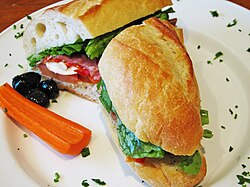
Panini (/pəˈniːniː/), nowadays less commonly called panino (pronounced [pa'niːno]), are sandwiches made with Italian bread (such as ciabatta and michetta), usually served warm after grilling or toasting.[1]
In many English-speaking countries, the name panini is given to a grilled sandwich made using various breads. The bread is cut horizontally and filled with deli ingredients, and often served warm after having been pressed by a warming grill.
Etymology
[edit] | This section needs additional citations for verification. (June 2025) |
Panini is a word of Italian origin. In Italian, the noun panino (Italian: [pa'niːno]; pl.: panini) is a diminutive of pane (lit. 'bread') and refers to a bread roll. Panino imbottito (lit. 'stuffed panini') refers to a sandwich, but the word panino is also often used alone to indicate a sandwich in general.[citation needed]
In English dominant countries, panini is widely used as the singular form, with the plural form panini or paninis, although some speakers use singular panino and plural panini as in Italian.[2][3][4][5][6]
History
[edit]Although the first US reference to panini dates to 1956, and a precursor appeared in a 16th-century Italian cookbook, the sandwiches became trendy in Milanese bars, called paninoteche, in the 1970s and 1980s. Trendy US restaurants began selling panini, with distinctive variations appearing in various cities.[7]
During the 1980s, the term paninaro arose in Italy to denote a member of a youth culture represented by patrons of sandwich bars, such as Milan's Al Panino, and Italy's first US-style fast food restaurants. Paninari were depicted as right-leaning, fashion-fixated individuals, delighting in showcasing early-1980s consumer goods as status symbols.[8][9]
See also
[edit] Media related to Panini at Wikimedia Commons
Media related to Mortadella sandwiches at Wikimedia Commons
Media related to Panini at Wikimedia Commons
Media related to Mortadella sandwiches at Wikimedia Commons


References
[edit]- ^ "Definition of PANINI". www.merriam-webster.com. 2024-03-18. Retrieved 2024-04-09.
- ^ Denn, Rebekah (30 August 2005). "Ask The Critic: Panini vs. panino—a singular answer to a plural faux pas". Seattle Post-Intelligencer.
- ^ Tyner, Maggie T. (16 April 2012). "Panini or Panino? A "Pressing" Question". USA Today. Archived from the original on 2025-03-21. Retrieved 2025-03-21.
- ^ "panini". Oxford Dictionaries. Oxford University Press. Archived from the original on 14 July 2012. Retrieved 1 June 2016.
- ^ "Panini – Origin and Varieties". Taste and Flavours. 5 September 2012. Archived from the original on September 9, 2012.
- ^ Butterfield, Jeremy (2016). Fowler's Concise Dictionary of Modern English Usage. Oxford University Press. p. 463. ISBN 978-0-19-966631-7. Retrieved 31 May 2016.
- ^ Zeldes, Leah A. (28 October 2009). "Eat this! Panini, Italy's answer to grilled cheese". Dining Chicago. Archived from the original on 31 October 2009. Retrieved 30 October 2009.
- ^ "paninari". Vocabolario (in Italian). Treccani. Archived from the original on 8 September 2024. Retrieved 27 April 2016.
- ^ "paninari". Dizionario Italiano (in Italian). La Repubblica. Archived from the original on 2025-03-21. Retrieved 27 April 2016.
Further reading
[edit]- Katsigris, Costas; Thomas, Chris (2008). Design and Equipment for Restaurants and Foodservice: A Management View (third ed.). John Wiley & Sons, Inc. ISBN 978-0-470-44082-7.
- Strahs, Kathy (2013). The Ultimate Panini Press Cookbook: More than 200 Perfect-Every-Time Recipes for Making Panini – and Lots of Other Things – on Your Panini Press or Other Countertop Grill. Harvard Common Press. ISBN 978-1-55832-792-4.
- Tripodi, Anthony (2011). The Everything Panini Press Cookbook. Adams Media. ISBN 9781440527692.

| Foods |
|  |
|---|---|---|
| By location | ||
| Mobile catering | ||
| Lists |
| |
Panini (sandwich)
View on GrokipediaEtymology and Terminology
Linguistic Origins
The term "panini" in the context of the sandwich originates from the Italian word panino, the singular diminutive form of pane, meaning "bread," which itself derives from Latin panis.[3] [11] In Italian, panino refers to a small bread roll or a sandwich made with such bread, and panini is its plural form, denoting multiple rolls or sandwiches.[12] [11] Upon adoption into English, particularly in the United States during the late 20th century, "panini" became the standard term for the grilled sandwich variety, but with a linguistic shift: English speakers treat "panini" as a singular noun, often pluralizing it incorrectly as "paninis" rather than reverting to the proper Italian singular panino.[11] [13] This borrowing reflects a common pattern in loanwords where foreign plurals are reinterpreted as mass nouns or singular forms in the recipient language, diverging from strict grammatical fidelity to Italian.[14] The semantic evolution ties directly to the food's composition: in Italy, a panino traditionally uses a compact bread roll suited for portable fillings, emphasizing the "small bread" etymology over elaborate grilling, which became more prominent in English adaptations.[15] [12] This distinction underscores how linguistic borrowing can alter not only form but also cultural associations with the item described.Regional Usage Variations
In Italy, "panino" denotes a singular sandwich typically assembled on a small bread roll or rustic loaf such as ciabatta or focaccia, with simple fillings like cured meats, cheese, or vegetables, and it is not inherently grilled or pressed.[16][15] The plural form "panini" simply refers to multiple such sandwiches, reflecting everyday usage without implying a specific preparation method; grilled versions exist but represent a subset rather than the norm.[17] Regional Italian breads influence variations, such as the use of focaccia in Liguria or pane di Altamura in Puglia, but the term remains broadly applicable to cold or lightly toasted assemblies.[15] In the United States, "panini" has evolved to specifically describe grilled sandwiches pressed between slices of Italian-style bread, often featuring layered meats like prosciutto or salami, cheeses such as mozzarella, and accompaniments like pesto or roasted vegetables, cooked via a panini press for a crisp exterior and melted interior.[11] This adaptation emerged in the late 20th century among urban eateries, diverging from Italian conventions by emphasizing the grilling process as definitional, leading to occasional critique from Italian sources for conflating the plural term with a singular, heated style.[11] American variations may incorporate non-traditional elements like turkey or avocado, reflecting fusion influences, though purists advocate adherence to Italian ingredients.[18] Elsewhere in Europe, such as in the United Kingdom or Germany, "panini" often mirrors the American grilled interpretation, popularized through chain cafes since the 1990s, with adaptations like using local breads or fillings (e.g., cheddar in Britain), but retaining the pressed technique as central to the term's identity.[19] In contrast, strict Italian culinary contexts outside Italy, like in Australian-Italian communities, tend to preserve the original unpressed meaning, using "panino" for portable, cold sandwiches akin to panini imbottiti.[20] These divergences highlight how migration and commercialization have reshaped terminology, with the grilled American model dominating global fast-casual menus by the 2000s.[11]Historical Development
Early Italian Precursors
The piadina romagnola, originating in Italy's Romagna region, represents a foundational precursor to the panini, consisting of a thin, unleavened flatbread cooked on heated terracotta plates and typically folded around fillings like cured meats, soft cheeses such as squacquerone, or seasonal vegetables to create a portable, handheld meal.[21] Its preparation traces to ancient practices, with roots in Etruscan and Roman times when similar unleavened breads served as sustenance for laborers and travelers, leveraging simple flours and fats for quick cooking over open fires.[22] The earliest written mention of piadina appears in 1371, in a record by Cardinal Anglico de Ubaldis, describing it as a regional staple valued for its simplicity and versatility in accommodating local ingredients without requiring elaborate tools.[23] By the 16th century, more structured references to filled bread rolls emerged, as documented in contemporary Italian cookbooks, where panini-like preparations involved slicing small loaves and inserting savory elements such as meats or cheeses, laying groundwork for enclosed sandwich formats beyond open flatbreads.[24] These early iterations prioritized practicality for workers, using readily available bakery products without the pressing or grilling that later defined modern panini, though they shared the core concept of bread as a vessel for contained fillings to enable on-the-go consumption.[8] In southern Italy, dishes like mozzarella in carrozza further exemplified resourceful bread-based assemblies, where stale bread enclosed fresh mozzarella and was fried to revive texture, originating as a household method to minimize waste amid limited resources, though distinct from grilled northern variants in technique.[25] Such regional adaptations underscored Italy's longstanding tradition of adapting breads— from ancient piadine to Renaissance-era rolls—into functional, ingredient-bound meals, influencing the evolution toward the compact, toasted panini of later centuries.[26]Post-War Popularization in Italy
Following World War II, Italy's miracolo economico (economic miracle) from the late 1950s through the 1960s spurred rapid industrialization, urbanization, and the growth of white-collar employment, particularly in northern cities like Milan. This era created demand for affordable, portable meals among office workers with limited lunch breaks, elevating the panino—a simple sandwich on crusty bread—from a basic staple to a widespread street food option. Paninoteche, specialized sandwich shops, emerged in Lombardy during the 1960s to meet this need, offering quick assemblies of local cured meats, cheeses, and vegetables pressed between slices of pane di casa or ciabatta.[5][6][10] By the 1970s and 1980s, paninoteche proliferated in Milanese bars and urban eateries, standardizing the panino as a grilled or toasted item using basic equipment like a piastra (flat griddle), which enhanced flavor through caramelization without altering traditional fillings such as prosciutto crudo, mortadella, or formaggio. This popularization aligned with Italy's post-war shift toward casual dining amid rising consumer affluence, with sales catering to commuters and laborers; estimates from contemporary accounts suggest these shops served thousands daily in Milan alone by the mid-1980s. The format's simplicity—typically 200-300 grams of bread enclosing 100-150 grams of fillings—facilitated scalability, distinguishing it from labor-intensive home-cooked meals.[8][27][28] Regional variations solidified during this period, with Lombard panini emphasizing hearty, savory profiles over southern Italy's lighter tramezzini, reflecting northern Italy's meat-centric cuisine influenced by Alpine trade routes. While early panini were often ungilled, post-war grilling techniques gained traction in urban settings for their efficiency and appeal, contributing to the sandwich's cultural embedding as an everyday cibo di strada (street food). This domestic surge preceded international exports, grounding the panino's identity in Italy's recovery-driven pragmatism rather than novelty.[29][6]Emergence in the United States
The first documented reference to panini in the United States appeared in 1956, in a newspaper article describing sandwiches served at an Italian street fair.[8] This early mention reflected influences from Italian immigrants, though panini—meaning small breads or rolls filled with meats, cheeses, and vegetables—remained niche, often prepared cold in Italian-American communities similar to panini in Italy.[5] Panini gained broader traction in American cuisine during the 1970s and 1980s, aligning with rising interest in upscale, portable Italian foods amid gourmet dining trends and urban sandwich shop proliferation.[11] By the late 1970s, panini were positioned as trendy alternatives to standard deli fare, particularly in cities with strong Italian heritage like New York and Philadelphia, where establishments began emphasizing pressed, hot versions using ciabatta or similar breads for enhanced flavor and texture.[5] This shift was driven by the availability of electric panini presses, which simplified grilling and popularized the crisp, melty profile distinct from traditional cold Italian panini.[30] The late 1990s marked a surge in nationwide popularity, especially in New York City, where panini evolved into a sophisticated fast-casual staple at cafés and delis, often incorporating American adaptations like diverse fillings beyond classic Italian ingredients.[30] Commercialization accelerated with chains and home kitchen appliances, leading to over 1 million panini presses sold annually by major manufacturers by the early 2000s, reflecting consumer demand for quick, grilled sandwiches.[8] This emergence contrasted with earlier Italian-American sandwiches like subs or hoagies, which prioritized length and cold assembly over pressing techniques.[11]Worldwide Expansion and Trends
The panini sandwich's international dissemination accelerated in the 1980s and 1990s, coinciding with the global acclaim for Italian cuisine and the expansion of Italian immigrants and culinary exports. This period saw the sandwich migrate from Italian paninoteche to menus in Europe, where it built on regional bread traditions, and to North America, Australia, and emerging markets via chains like Starbucks and Pret A Manger that incorporated grilled sandwich formats.[31][8] In Asia-Pacific, adoption has been particularly rapid since the early 2000s, propelled by urbanization, rising disposable incomes, and the proliferation of quick-service restaurants and street vendors offering Western-style grilled sandwiches to time-strapped consumers; this region now anticipates the fastest growth in commercial panini machine demand.[32] Europe maintains a substantial share, approximately 30% of the equipment market, sustained by entrenched cafe cultures and demand for artisanal grilled options.[33] In Australia, panini emerged as a key trend by 2023, supplanting heavier sandwiches amid preferences for lighter, toasted varieties in casual dining.[34] Market indicators underscore this expansion: the global panini sector was valued at 1.88 billion USD in 2024, with projections for a 3.49% compound annual growth rate through 2035, attributed to demand for convenient, customizable gourmet meals amid fast-paced lifestyles.[35] Related equipment markets, such as commercial panini presses, reflect parallel trajectories, expanding from 1.31 billion USD in 2024 at a 6-10% CAGR, signaling sustained institutional uptake.[36][37] Contemporary trends emphasize fusion adaptations, where panini incorporate regional ingredients—like spicy sauces in Latin-influenced markets or Asian spices in Pacific outlets—while core attributes of pressed, crusty bread persist; health-oriented variants with whole grains or reduced meats are gaining traction in response to wellness demands, though data confirms traditional profiles dominate sales volumes.[19]Preparation and Techniques
Core Preparation Methods
The core preparation of a panini involves assembling simple, high-quality ingredients between slices of rustic Italian bread, followed by compression and grilling to achieve a crisp exterior, melted interior, and fused flavors. Traditionally, the bread used is ciabatta or focaccia, which provides a chewy texture capable of withstanding heat without disintegrating.[38] Ingredients such as cured meats (e.g., prosciutto or salami), cheeses (e.g., provolone or mozzarella), and minimal vegetables are layered strategically, with cheese positioned to melt and bind components during cooking.[39] Overstuffing is avoided to ensure even heat distribution and prevent sogginess, prioritizing quality over quantity in fillings.[40] The exterior of the assembled sandwich is brushed with olive oil or melted butter to promote golden browning and crunch, mimicking the effect of traditional grilled bread like crostini.[41] Grilling occurs via a panini press or improvised method, such as a hot cast-iron skillet weighted with a heavy pan or foil-wrapped bricks, applying moderate pressure for 2-3 minutes per side until grill marks appear and the internal temperature reaches approximately 165°F (74°C) for safety with meats.[42] This pressing technique compresses the sandwich to about half its original thickness, expelling excess moisture while caramelizing the bread's surface through the Maillard reaction.[41] In authentic Italian practice, no additional sauces are applied pre-grill to maintain ingredient integrity, though post-grill resting for 1-2 minutes allows flavors to settle.[43] Variations in technique emphasize consistency: electric presses offer controlled heat (typically 350-400°F), while stovetop methods require flipping for even toasting. Empirical tests show that preheating the grill surface to at least 300°F minimizes sticking and maximizes sear.[42] For optimal results, wet ingredients like tomatoes are layered centrally to avoid direct contact with bread, reducing sogginess risks.[42] These methods, rooted in Italian street food traditions, prioritize structural integrity and thermal efficiency over elaborate steps.[38]Equipment Essentials
The essential equipment for preparing panini centers on tools that enable even heating, pressing, and crisping of the sandwich components, typically requiring a device capable of applying direct contact heat and compression to meld ingredients while achieving a toasted crust. A panini press, often featuring grooved cast-iron or nonstick plates, is the standard tool, as it distributes heat uniformly at temperatures around 350–450°F (177–232°C) and exerts adjustable pressure to prevent sogginess from moisture release. [44] [45] These presses, available in single or double configurations for commercial use, produce the signature ridged grill marks by channeling fats away from the bread surface. [46] For home or traditional settings without a dedicated press, a heavy cast-iron skillet or ridged grill pan paired with a foil-wrapped brick, another skillet, or similar weight serves as a functional substitute, allowing manual pressing on a stovetop burner set to medium-high heat for 3–5 minutes per side. [42] [47] This method replicates the compression effect but demands closer monitoring to avoid uneven toasting, with cast iron preferred for its heat retention properties that promote Maillard browning on ciabatta or focaccia breads. [48] Auxiliary tools include a serrated bread knife for precise slicing of crusty Italian loaves without compressing the airy structure, and heat-resistant silicone tongs or spatulas for safe handling and flipping to minimize surface damage on nonstick elements. [49] [50] Tongs with a long reach, ideally 12–16 inches, facilitate removal from hot grills, while oven mitts or gloves protect against burns from plates exceeding 400°F. [50] These items ensure efficiency and safety, though over-reliance on electric presses has modernized preparation away from purely manual techniques historically used in Italian paninoteche. [51]Ingredient Assembly and Grilling Process
The assembly of a panini begins with selecting a sturdy, oblong bread such as ciabatta or focaccia, which is sliced horizontally to create two halves capable of withstanding compression without disintegrating.[40] Ingredients are layered starting with cured meats like prosciutto or salami on the bottom half to form a barrier against sogginess from condiments, followed by cheeses such as mozzarella or provolone for melting, and topped with vegetables like arugula, tomatoes, or roasted peppers, ensuring even distribution to prevent uneven grilling.[39] Condiments including pesto, olive oil, or mustard are applied sparingly to the bread interiors or exteriors to enhance flavor without excess moisture.[52] The sandwich is then closed gently, avoiding overstuffing, which allows the press to compact the fillings into a cohesive unit during grilling.[42] For grilling, a preheated panini press set to medium-high heat, approximately 375°F (190°C) for standard sandwiches, is ideal as it applies even pressure from ridged plates that impart characteristic grill marks while simultaneously toasting the bread and melting the cheese.[7] The exterior of the bread may be lightly brushed with olive oil or butter prior to placement to promote crispiness and prevent sticking.[53] Once placed in the press, the lid is closed firmly, and the sandwich is grilled for 3 to 5 minutes, depending on thickness and desired doneness, until the bread achieves a golden-brown crust and the internal temperature reaches about 165°F (74°C) for safety with meats.[54] In the absence of a dedicated panini press, a cast-iron skillet or grill pan over medium-high heat can substitute, with a heavy object like a brick wrapped in foil or another skillet placed atop the sandwich to mimic compression; this method requires flipping after 3-4 minutes per side to ensure even cooking.[55] Monitoring prevents over-toasting, as excessive heat can burn the bread before the cheese fully melts, and periodic checking after 2 minutes allows adjustment for optimal texture—a firm yet yielding interior with a crunchy exterior.[39] Post-grilling, the panini is rested briefly on a cutting board before slicing diagonally to reveal cross-sections of fused layers, enhancing presentation and ease of eating.[47]Ingredients and Variations
Traditional Italian Elements
Traditional Italian panini rely on high-quality, regionally sourced ingredients, emphasizing simplicity and restraint to highlight natural flavors rather than elaborate combinations. The bread, often ciabatta or a soft, olive oil-enriched roll made with high-protein flour (at least 12.5% protein), features a light, airy crumb and subtle crisp exterior that supports fillings without overpowering them.[10][56] Cured meats form the protein backbone, with staples including prosciutto cotto, salami, soppressata, and mortadella, used in thin slices to maintain balance—typically one or two varieties per panino to avoid excess.[57][10] Cheeses such as mozzarella, provolone, scamorza, or smoked provola provide creaminess and melt well under pressing, often paired minimally to complement the meats.[58] Fresh vegetables and greens add contrast and freshness, with common inclusions like ripe tomatoes, arugula (rucola), artichokes, grilled eggplant, or broccoli rabe, seasoned lightly with extra virgin olive oil and salt rather than heavy sauces.[58][10] Regional variations reflect local specialties, such as mozzarella and tomatoes in Campania or cured meats with mushrooms in other areas, underscoring the panino's roots in everyday Italian street food and worker's meals.[58] Assembly prioritizes quality over quantity, with the sandwich pressed on a grill to fuse elements while preserving distinct textures.[10]American and Global Adaptations
In the United States, panini sandwiches first appeared in references dating to 1956, described as warmed Italian-style preparations, though they remained niche until capturing broader attention in the mid-1970s and surging in popularity during the late 1990s, especially in New York City where they were positioned as upscale, sophisticated alternatives to standard deli fare.[59][5][30] American adaptations emphasize pressing in electric grill devices, often yielding distinct grill marks and melted interiors, with bread like focaccia or ciabatta holding denser fillings than Italian counterparts, which typically limit to two or three simple elements such as prosciutto and cheese.[30][17] These U.S. versions incorporate non-traditional ingredients reflecting fusion with local tastes, including roasted turkey, bacon, avocado, ranch dressing, or barbecue sauces layered with provolone, pepperoni, or vegetables, creating heartier stacks that prioritize textural contrast and flavor melding over restraint.[11][60] By the 1980s, panini entered American cafés and restaurants as menu staples, evolving from gourmet items to mass-market options via chains, with annual U.S. sales of pressed sandwiches exceeding millions by the early 2000s amid the rise of home panini makers.[61] Globally, the panini format has proliferated through commercialization and migration of Italian-American influences, adapting to regional palates with localized proteins and condiments; examples include spicier variants in Latin American markets blending chorizo or plantains, or Asian fusions adding teriyaki-glazed meats and sesame oils, though these often stray further from originals by amplifying sweetness or heat profiles.[19] In Europe beyond Italy and in Australia, preparations mirror U.S. styles with added gourmet elements like truffle aioli or smoked salmon, pressed for portability in urban eateries, while chains have standardized the concept worldwide, reporting over 100 million units sold annually by major operators as of 2023.[8][61]Cultural and Economic Impact
Significance in Italian Culinary Tradition
In Italy, panini—the plural of panino, meaning "small bread" or simply "sandwich"—represent a longstanding yet unpretentious element of everyday eating, with the term's earliest documented reference appearing in a 16th-century cookbook by Bartolomeo Scappi, though the modern pressed form emerged later.[16] Unlike elaborate regional dishes, panini emphasize simplicity and portability, typically assembled with crusty rustic bread such as ciabatta or focaccia, filled with cured meats (salumi like prosciutto or mortadella), cheeses (formaggi such as mozzarella or pecorino), and vegetables, reflecting the Italian culinary ethos of elevating fresh, high-quality ingredients without excess.[24] This approach aligns with the cultural proverb "buono come il pane" ("as good as bread"), underscoring bread's foundational role in Italian sustenance and the sandwich's function as an accessible, no-fuss meal for workers, travelers, and families.[24] The grilled panino gained prominence in the 1960s, particularly in northern urban centers like Milan and Lombardy, where paninoteche (sandwich shops) catered to office workers seeking quick lunches amid post-World War II industrialization and economic boom.[5] These establishments popularized pressing sandwiches on hot piani (flat griddles) to meld flavors and create a crisp exterior, a technique rooted in practical efficiency rather than ritual, distinguishing Italian panini from cold tramezzini (triangular tea sandwiches) common in bars. By the 1980s, panini symbolized a casual youth subculture known as paninari, frequenting spots like Milan's Al Panino, where the food paired with aperitivi embodied a blend of street-level accessibility and aspirational style amid Italy's consumerist shift.[6] This era cemented panini's status as a democratic staple, available from street vendors to autogrills on highways, with annual consumption estimates exceeding millions in urban areas, though exact figures vary by region.[5] Within broader Italian tradition, panini underscore regional diversity—southern variants might incorporate arancini influences or seafood, while northern ones favor hearty coppa—yet unify under principles of seasonality and locality, avoiding the heavy sauces or exotic fusions seen elsewhere. Their significance lies not in haute gastronomy but in sustaining daily life, often consumed standing at counters (al banco) to foster social brevity, as in the bar ritual of pairing a panino with espresso or wine. This mirrors Italy's causal realism in food: causal chains from farm-fresh sourcing to immediate consumption prioritize empirical quality over ornamentation, making panini a resilient thread in the fabric of cucina povera (poor man's kitchen) evolved for modern tempos.[16][6]Role in American and International Food Markets
In the United States, panini sandwiches gained traction as a convenient, grilled alternative to traditional cold sandwiches starting in the 1970s and 1980s, evolving into a staple of casual dining by the late 1990s, particularly in urban centers like New York City where they were marketed as sophisticated yet accessible options.[30] [5] This rise aligned with broader trends in fast-casual eateries emphasizing fresh ingredients and quick preparation, leading to widespread adoption in supermarket delis, coffee chains, and independent cafes that offered customizable fillings like meats, cheeses, and vegetables pressed between crusty bread.[62] By 2023, North America dominated the global panini market with a valuation of USD 0.74 billion, driven by consumer preferences for portable, protein-focused meals amid busy lifestyles and the expansion of gourmet sandwich segments in quick-service restaurants.[35] [32] Internationally, panini have proliferated through the export of Italian culinary techniques and adaptation to local tastes, appearing in European cafes retaining authenticity with regional breads and fillings, while gaining footholds in Asia-Pacific and Latin American markets via multinational chains and street vendors catering to urban demand for handheld foods.[35] In Europe, steady growth in commercial panini equipment sales—projected at a 3.4% CAGR through the mid-2020s—underscores sustained deli and restaurant integration, often as lighter alternatives to heavier local sandwiches.[63] The global panini market, valued at USD 1.96 billion in 2024, is forecasted to expand to USD 2.86 billion by 2035, reflecting broader sandwich sector dynamics with a 5.5% CAGR, fueled by urbanization, rising incomes, and the appeal of versatile, grill-pressed formats in emerging economies.[35] [64] This expansion highlights panini's role as an adaptable product bridging traditional European roots with global fast-food efficiencies, though market data primarily tracks equipment and regional sales proxies rather than direct sandwich volumes.[32]Recent Commercial Trends
The global panini market is projected to grow at a compound annual growth rate (CAGR) of 3.49% from 2025 to 2035, reaching USD 2.86 billion, driven primarily by rising consumer demand for convenient, gourmet-style quick-service foods.[35] This expansion reflects broader shifts in fast-casual dining, where panini sandwiches appeal as customizable, portable options amid busy lifestyles and increasing preference for elevated yet accessible meals.[65] Commercial equipment markets underscore this trend, with panini grills forecasted to increase from USD 11.38 million in 2025 to USD 17.51 million by 2035 at a 4.4% CAGR, signaling heightened adoption in restaurants and cafes for efficient preparation.[66] Similarly, the commercial panini machine segment anticipates growth from USD 1,100.2 million in 2025 to USD 1,897.2 million by 2035 at a 5.6% CAGR, fueled by innovations in contact grills that enable faster service and consistent quality in high-volume settings.[32] The panini press subcategory within sandwich makers held a dominant USD 1.2 billion valuation in 2023, expected to expand at 4.8% through 2032, as operators invest in durable appliances to meet demand for pressed, artisanal-style sandwiches.[67] Chain-level developments highlight panini integration into growth strategies, exemplified by Panini Kabob Grill's expansion to 26 units by mid-2025, with five new openings in the prior year and plans for accelerated scaling potentially leading to an initial public offering.[68] Capriotti's Sandwich Shop added 24 locations to its pipeline in 2025, emphasizing panini-style offerings to capitalize on premium sandwich appeal.[69] Innovations include limited-time promotions, such as Corner Bakery Cafe's January 2025 green chile chicken panini launch paired with a USD 6 pricing deal to drive traffic.[70] New entrants like PaperBoy, a Tuscan panini-focused shop planned for downtown Minneapolis in late 2025, further illustrate niche commercialization using housemade breads and high-quality fillings to differentiate in urban markets.[71] These trends align with fast-casual sector resilience, where panini variants contribute to overall category sales growth of 9% in 2024 among top chains, outpacing quick-service and full-service segments, as consumers seek value-driven, flavorful options post-pandemic.[72] However, sustained viability depends on navigating equipment costs and supply chain pressures, with market reports noting steady but moderate CAGRs reflective of tempered post-2020 recovery rather than explosive expansion.[73]Health and Nutrition
Nutritional Composition
A typical panini sandwich, consisting of grilled bread such as ciabatta or focaccia filled with cured meats like prosciutto, cheese such as mozzarella, and vegetables like tomatoes or roasted peppers, yields approximately 400-600 calories per serving of 200-300 grams, depending on portion size and specific ingredients.[74][75][76] Carbohydrates form the largest macronutrient component, often comprising 40-50% of calories from the bread's starch content, with values around 40-50 grams per sandwich.[75][74] Proteins contribute 20-45 grams, primarily from meats and cheese, accounting for 25-30% of calories.[76][75] Fats range from 15-30 grams, or 25-35% of total calories, sourced from cheese, cured meats, and any added oils or spreads like pesto, with saturated fats often 5-10 grams due to dairy and animal products.[77][74] Sodium levels are notably high, frequently exceeding 500-1000 mg per sandwich from salted meats and cheeses, which can approach or surpass daily recommended limits for many individuals.[77] Dietary fiber is modest at 3-5 grams, mainly from vegetable inclusions, while micronutrients include calcium from cheese (around 200-300 mg) and some vitamins A and C from peppers or tomatoes, though overall vegetable content limits broader nutrient density.[77]| Macronutrient | Approximate Amount per Typical 200-300g Serving | Primary Sources |
|---|---|---|
| Carbohydrates | 40-50 g (44% of calories) | Bread, vegetables |
| Protein | 20-45 g (27% of calories) | Meats, cheese |
| Total Fat | 15-30 g (29% of calories) | Cheese, meats, oils |