Respect all members: no insults, harassment, or hate speech.
Be tolerant of different viewpoints, cultures, and beliefs. If you do not agree with others, just create separate note, article or collection.
Clearly distinguish between personal opinion and fact.
Verify facts before posting, especially when writing about history, science, or statistics.
Promotional content must be published on the “Related Services and Products” page—no more than one paragraph per service. You can also create subpages under the “Related Services and Products” page and publish longer promotional text there.
Do not post materials that infringe on copyright without permission.
Always credit sources when sharing information, quotes, or media.
Be respectful of the work of others when making changes.
Discuss major edits instead of removing others' contributions without reason.
If you notice rule-breaking, notify community about it in talks.
Do not share personal data of others without their consent.
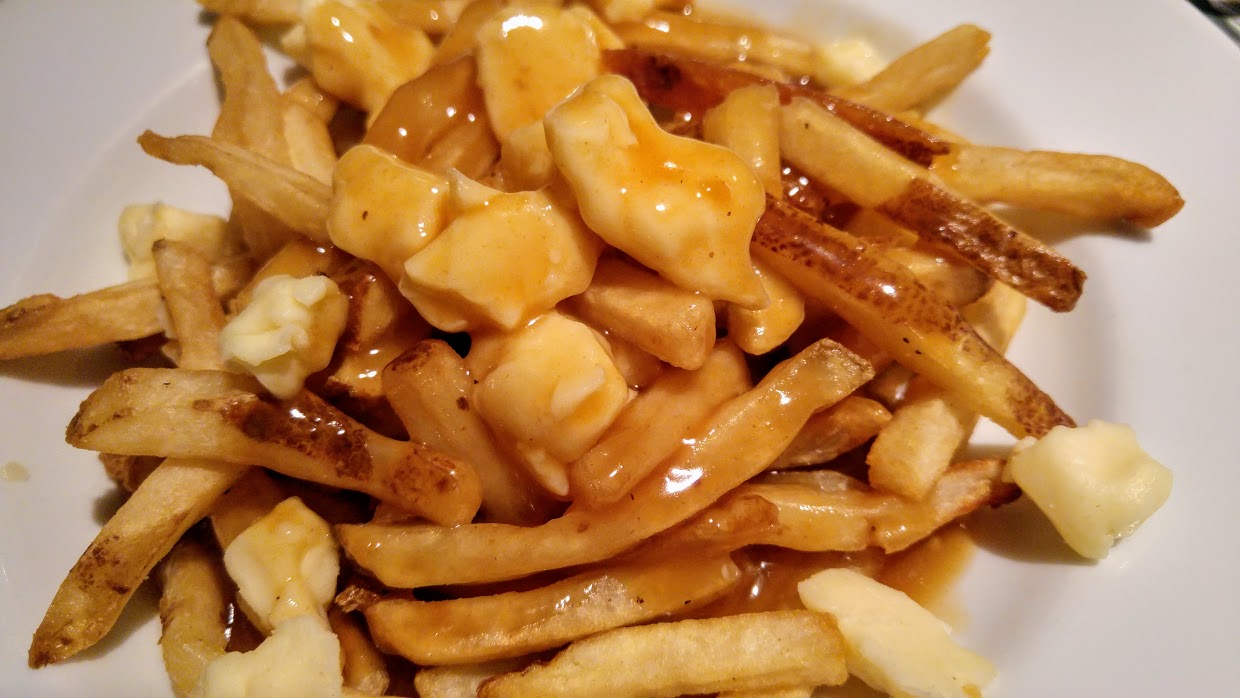
Poutine[a] is a dish of french fries and cheese curds topped with a hot brown gravy. It emerged in the Centre-du-Québec region of Quebec in the late 1950s, though its exact origins are uncertain, and there are several competing claims regarding its invention. For many years, it was used by some to mock Quebec society.[1] Poutine later became celebrated as a symbol of Québécois culture and the province of Quebec. It has long been associated with Quebec cuisine, and its rise in prominence has led to its growing popularity throughout the rest of Canada.
The dish was created in the Centre-du-Québec area in the late 1950s.[1][3]: 12–31 Several restaurants in the area claim to be the originators of the dish, but no consensus exists.[3]: 12–31 [4][5]
Le Lutin qui rit, Warwick – Restaurateur Fernand Lachance of Le Café Idéal (later Le Lutin qui rit[6]), is said to have exclaimed in 1957, "ça va faire une maudite poutine!" (English: "It will make a damn mess!") when asked by a regular to put a handful of cheese curds in a take-out bag of french fries.[7][8][9][10] The dish "poutine" appears on the establishment's 1957 menu.[11] Lachance served this on a plate, and beginning in 1962 added hot gravy to keep it warm.[10][4]
Le Roy Jucep in 2018 Le Roy Jucep, Drummondville – This drive-in restaurant served french fries with gravy, to which some customers would add a side order of cheese curds.[4] Owner Jean-Paul Roy began serving the combination in 1958 and added it to the menu in 1964 as "fromage-patate-sauce".[4][6] Felt to be too long a name, this was later changed to poutine for a cook nicknamed "Ti-Pout" and a slang word for "pudding".[b][4][5][11] The restaurant displays a copyright registration certificate, issued by the Canadian Intellectual Property Office, which alludes to Roy having invented poutine.[11]
La Petite Vache, Princeville – Customers would mix cheese curds with their fries, a combination which was added to the menu. One option included gravy and was called the "Mixte".[4]
According to Canadian food researcher Sylvain Charlebois, while Warwick is the birthplace of poutine, Drummondville's Jean-Paul Roy is the true inventor since Le Roy Jucep was the first to sell poutine with three combined ingredients, in 1964.[12]The Oxford Companion to Cheese takes a different perspective, stating that the inventors were not chefs but the customers who chose to add cheese curds to their fries.[6]
Poutine was consumed in small "greasy spoon" diners (commonly known in Quebec as cantines or casse-croûtes), pubs, at roadside chip wagons (commonly known as cabanes à patates, literally "potato shacks"), and in ice hockey arenas.[1] For decades, it remained a country snack food in Quebec's dairy region, due to the narrow freshness window of cheddar cheese curds.[10][13] In 1969, poutine was brought to Quebec City in Ashton Leblond's food truck (a business which grew into the Chez Ashton fast-food chain).[14] In the early 1970s, La Banquise began serving poutine in Montreal,[15] followed by the Burger King chain in 1983. Others that followed used inferior cheese and the dish's reputation declined. Poutine was largely perceived as an unsophisticated backwoods creation or unhealthy junk food[16][10] to be consumed after a night of drinking.[17]
Montreal chefs would make poutine to feed their staff but had not dared to put it on their menus. In the 1990s, attempts were made to elevate the dish by using baked potatoes and duck stock. In November 2001, Martin Picard of bistro Au Pied de Cochon began serving a foie gras poutine which was praised by customers and food critics.[18] This influenced chefs in Toronto and Vancouver to feature poutine on upscale menus.[19] Chef Mark McEwan served lobster poutine at his Bymark eatery, and chef Jamie Kennedy served braised beef poutine at his eponymous restaurant.[20] Over the next decade, poutine gained acceptance and popularity in all types of restaurants, from haute cuisine to fast food, and spread across Canada and internationally.[1] Poutine became extremely trendy in the early 2010s, with an explosion of poutineries in cities like Toronto, leading to stories about poutine's association with romance[21] and events like the IBM Watson Cognitive Cooking Poutine Event, where the computer generated unique poutine recipes based on the demographics of Toronto and Montreal.[22]
The Dictionnaire historique du français québécois lists 15 meanings of poutine in Québécois and Acadian French, most of which are for kinds of food; the word poutine in the meaning "fries with cheese and gravy" is dated to 1982 in English.[23] Other senses of the word have been in use since at least 1810.[24]
According to Merriam-Webster, a popular etymology is that poutine is from a Québécois slang word meaning "mess", and that others attribute it to the English word pudding. The exact provenance of the word poutine is uncertain.[23]
The Dictionnaire historique mentions the possibility that the form poutine is simply a gallicization of the word pudding. However, it considers it more likely that the term was inherited from regional languages in France, with some meanings shaped later by the influence of the similarly sounding English word pudding. It cites the Provençal forms poutingo "bad stew" and poutité "hodgepodge" or "crushed fruit or foods"; poutringo "mixture of various things" in Languedocien; and poutringue or potringa "bad stew" in Franche-Comté as possibly related to poutine. The meaning "fries with cheese and gravy" of poutine is among those held as probably unrelated to pudding, provided the latter view is correct.[24]
La Banquise, a poutinerie in Montreal, serves more than thirty varieties of poutine.[15]
The traditional recipe for poutine consists of:
French fries: These are usually of medium thickness and fried (sometimes twice) such that the inside stays soft, while the outside is crispy.[25]
Cheese curds: Fresh cheese curds are used to give the desired texture. The curd size varies, as does the amount used.[26]
Brown gravy: Traditionally, it is a light and thin beef or chicken gravy,[25][6] somewhat salty and mildly spiced with a hint of pepper;[15] or a sauce brune,[13] which is a combination of chicken and beef stock.[25][8] Poutine sauces (French: mélange à sauce poutine) are sold in Quebec, Ontario, and Maritime grocery stores in jars or cans and in powdered mix packets; some grocery chains offer their own house-brand versions. Many stores and restaurants also offer vegetarian gravy.[27][c]
To maintain the texture of the fries, the cheese curds and gravy are added immediately before serving the dish. The hot gravy is usually poured over room-temperature cheese curds, so they are warmed without melting completely.[15] The thin gravy allows all the fries to be coated.[25] The serving dish typically has some depth to act as a basket for the fries so that they retain their heat.[29]: 195 It is important to control the temperature, timing, and the order in which the ingredients are added to obtain the right food textures—an essential part of the experience of eating poutine.[1]
Freshness and juiciness of the curds is essential. Air and moisture seep out of the curds over time, altering their acidity level. This causes proteins to lose their elasticity, and the curds to lose their complex texture and characteristic squeaky[d] sound when chewed.[26] The curds should be less than a day old, which requires proximity to a dairy.[13] While Montreal is 60 kilometres (37 mi) from a cheese plant in Mirabel, restaurants and specialty cheese shops outside of dairy regions may be unable to sell enough curds to justify the expense of daily deliveries. Furthermore, Canadian food safety practices require curds to be refrigerated within 24 hours, which suppresses the properties of their texture.[26] This has resulted in poutineries which specialize in the dish; busy poutineries may use 100 kilograms (220 lb) of curds per day.[15] Poutineries which are too distant from dairies may make their own cheese curds on site, in batches every few hours, to ensure a fresh and steady supply.[10]
Poutine made with thick beef gravy on french-fried potatoes with fresh cheese curds is a style commonly found outside Quebec.Polish-inspired poutine with pierogi instead of French friesLobster poutine in Dartmouth, Nova Scotia
The texture, temperature and viscosity of poutine's ingredients differ and continuously change as the food is consumed, making it a dish of highly dynamic contrasts. Strengthening these contrasts, superior poutines are identified by the crispiness of the fries, freshness of the curds, and a unifying gravy.[1] Even small variations in ingredients or preparation—the oil used for frying, the origin of the curds, or spices in the gravy—can result in a distinctly different experience of eating the poutine.[1]
Some recipes eliminate the cheese, but most Québécois would call such a dish a frite sauce (English: french fries with gravy), not poutine. When curds are unavailable, mozzarella cheese may be an acceptable alternative.[25] Shredded mozzarella is commonly used in Saskatchewan.[30] Sweet potato may be used as a healthier alternative to french fries, adding more dietary fibre and vitamins.[31]
Poutineries, like Montreal's La Banquise, which is credited for much of the innovation and popularization of poutine, have dozens of varieties of poutine on their menus.[15] Many of these are based on the traditional recipe with an added meat topping such as sausage, chicken, bacon, brisket, or Montreal-style smoked meat, with the gravy adjusted for balance.[32] The Quebec City-based chain Chez Ashton is known for its poutine Galvaude (topped with chicken and green peas) and Dulton (with ground beef).[33] New variations are frequently introduced. Pulled pork was popular around 2013, followed a couple years later by Asian-fusion poutines.[34]
Montreal's high immigrant population[35] has led to many takes on the dish inspired by other cuisines, such as Haitian, Mexican, Portuguese,[34] Indian, Japanese,[13] Greek, Italian[36] and Lebanese.[37] These poutines may bear little resemblance to the traditional recipe. They replace some or all of the ingredients but maintain the dynamic contrasts of textures and temperatures with a crispy element, a dairy or dairy-like element, and a unifying sauce.[1] Many variations on the original recipe are popular, leading some to suggest that poutine has emerged as a new dish classification in its own right, as with sandwiches, dumplings, soups, and flatbreads.[1]
Poutineries will frequently offer limited-time promotional specials, such as a Thanksgiving poutine with turkey, stuffing and cranberry sauce.[38] In anticipation of the legalization of cannabis in Canada, Montreal's Le Gras Dur served a "pot poutine" with a gravy that included hemp protein, hemp seeds and hemp oil, offered with a joint-like roll of turkey, wild mushrooms and arugula.[39]
Gourmet poutine with three-pepper sauce, merguez sausage, foie gras[40] or caviar and truffle can be found. This is a trend that began in the 1990s and is credited to David McMillan of Montreal's Joe Beef and Globe restaurants.[41][18] Savoury sauces like Moroccan harissa, lobster sauce, and red-wine veal jus have been used to complement artisanal cheeses and rich ingredients.[33]
Poutine is found in the northern border regions of the United States, including New England and the larger Northeast, the Pacific Northwest, and the Upper Midwest.[59] These regions offer further variations of the basic dish, usually by utilizing cheeses other than fresh curds, which are not widely available in the US. In the country culture, a mixed fry can also come with cooked ground beef on top and is referred to as a hamburger mix, though this is less popular than a regular mix.[60][25] In the Pacific Northwest, one variation replaces the gravy with chowder featuring local seafood.[61][62]
Disco fries, french fries typically covered in mozzarella cheese and brown gravy, were popularized in New Jersey in the 1990s.[63] They gained their name in the 1970s for being a favourite of late-night diners, who often came from dancing at disco clubs.[64] The dish is also popular in New Orleans[65] including variations called Cajun poutine.
Poutine spread to the United Kingdom, Korea and Russia, where it has been referred to as "Raspoutine".[14] The first poutinerie in Paris, La Maison de la Poutine, opened in 2017 and quickly gained attention from mainstream media and gastronomers.[35]
A similar dish known as chips, cheese and gravy, consisting of thick-cut chips covered in shredded Manx Cheddar cheese and topped with a thick beef gravy, is popular in the Isle of Man.[66][67]
A cultural marker, poutine had long been Quebec's adored junk food before spreading across the rest of Canada and the United States.[1][68][69] It had by then made inroads with food critics and established culinary circles, challenging its junk food status.[1] Food critic Jacob Richler noted in 2012 that Canadian dishes are too similar to their European roots to be considered original, with the exception of poutine, which he credited as the country's most famous culinary creation.[70] In May 2014, the word "poutine" was added to the Merriam-Webster Dictionary of the English language.[8]
In 2007, the Canadian Broadcasting Corporation declared the results of an online survey on the greatest Canadian inventions, in which poutine ranked at No. 10.[71]Maclean's 2017 survey of "favourite iconic Canadian food" placed poutine first with 21% of respondents, ahead of maple syrup with 14%.[72] By 2011, media outlets were reporting 11 April as National Poutine Day.[73][72][74]
The first poutine festival was held in Warwick, Quebec, in 1993. This annual event expanded to become the largest cheese festival in Canada.[11] In 2014, it was moved to the larger town of Victoriaville.[79] Montreal has hosted La Poutine Week, an annual festival, food tour, and competition held 1–7 February, since 2013.[80][81][34] It spread across Canada and internationally, and by 2021 had become the largest poutine festival in the world, with over 700 restaurants serving more than 350,000 poutines.[82][83][84] Le Grand Poutinefest is a poutine festival founded in 2015 which tours cities and towns in Quebec, operating most weekends from April to September.[85][86][87] Poutine festivals are also held in Drummondville (since 2008),[88][89][90] Ottawa-Gatineau,[1] Toronto,[72] Calgary,[91] Vancouver,[92] Moncton,[93] Quebec City and Sherbrooke.[94] In the US, major festivals have been held in Chicago, Illinois,[13][95] Manchester, New Hampshire,[96] Knoxville, Tennessee, Portland, Maine,[97] Burlington, Vermont,[98] and in Rhode Island.[8][99][100]
Joey Chestnut holds the trophy at the 2012 World Poutine Eating Championship in Toronto.
Since 2010, the International Federation of Competitive Eating (IFCE) has held a world poutine-eating championship sponsored by Toronto-based chain Smoke's Poutinerie. There was criticism that the inaugural contest was held outside of Quebec and excluded Québécois. The IFCE stated that Montreal poutineries had not expressed any interest in holding the competition. Regulations for contests in Quebec make it difficult to include the province, which is often absent from national contests.[101] Smoke's has since sponsored a cross-Canada poutine eating tour.[102] In 2011, chef Chuck Hughes won on Iron Chef America (episode 2 of season 9) by beating Bobby Flay with a plate of lobster poutine.[103]
Jones Soda Co., an originally Canadian company now based in the US, created a poutine-flavoured limited-edition soft drink in 2013, which received international pop culture attention.[104] Bacon-poutine was one of four flavours selected as a finalist in the 2014 Lay's Canada Do Us A Flavour potato chip contest.[105] Though it did not win,[106] Lay's later added a bacon-poutine variety in its Canada entry for the World Flavourites.[107] Loblaws' President's Choice and Ruffles brands also offer poutine-flavoured potato chips in Canada.[108]
Giapos Ice Cream of New Zealand has served a "poutine ice cream" of oolongmatcha tea, ice cream and caramel sauce over hand-cut fries since 2017.[109]
In a 2018 promotional campaign for the film Crazy Rich Asians, "the world's richest poutine" was created with wagyu steak, lobster, truffles, shiitake and chanterelle mushrooms, edible orchids, and gold flakes, priced just under $450.[110]
Health advocates have been critical of poutine since the 1980s.[10] In a 2013 study of Canadian restaurants, poutine was found to have the second-highest sodium (1547 mg average and as high as 2227 mg) among single meal items, after stir-fry entrées.[115]
The social status of poutine has evolved dramatically since its origins in rural Quebec in the 1950s. The dish was long mocked as a culinary invention and used as a means of stigmatization by non-Québécois against Quebec society to reduce its legitimacy.[3]: 74–109 [1] While the first generations that suffered from the poutine stigma opted to disidentify from the dish, younger people in Quebec began to reappropriate poutine as a symbol of Quebecois cultural pride.[1][3]: 74–109 Today, the dish is celebrated in many annual poutine festivals in Quebec,[116][117] the rest of Canada,[118][119] and in the United States.[120][95]
The evolution of the different symbols associated with poutine was first studied in Maudite Poutine! by Charles-Alexandre Théorêt.[3] Théorêt revisited many of these stigmas in an interview given at Tout le monde en parle on 11 November 2007.[121]
As poutine gained popularity beyond the provincial borders of Quebec in the mid-2000s, the dish gradually stopped being mocked and was eventually introduced into the popular discourse as a symbol of Canadian identity.[1] Today, the dish is often presented as being a part of Canadian cuisine, even as Canada's national dish.[1] Nicolas Fabien-Ouellet suggested in the peer-reviewed journal CuiZine that this "Canadization" of poutine constitutes cultural appropriation.[1][122][123][16][e] This appropriation is not linked to its preparation or consumption outside Quebec, but strictly to its presentation as a Canadian dish instead of a Québécois dish.[1][136][36][2] Fabien-Ouellet explains:
as soon as a Quebec cultural trait begins to be appreciated internationally, it begins to be identified as typically Canadian, this prevents Quebec culture from shining, and becomes part of absorption and assimilation processes. All this is reminiscent of the reasons why Cajun cuisine is differentiated in the US context.[137]
In a Talking to Americans segment on the Canadian mock television news show This Hour Has 22 Minutes, during the 2000 US election, comedian Rick Mercer posed as a reporter and asked US politicians what they thought of "Prime Minister Jean Poutine" and his endorsement of George W. Bush for president. (The Prime Minister of Canada at the time was Jean Chrétien.) None of the interviewees noticed the insertion of "Poutine" and Bush pledged to "work closely" with Mr. Poutine.[71][138][139] A few years later, when Bush made his first official visit to Canada as president, he joked in a speech, "There's a prominent citizen who endorsed me in the 2000 election, and I wanted a chance to finally thank him [...] I was hoping to meet Jean Poutine." The remark was met with laughter and applause.[140]
Signage outside Montreal's Vladimir Poutine restaurant
In French, Russian president Vladimir Putin's surname is spelled "Poutine", with the two having identical pronunciation.[141][142] The similarity has been a source of confusion; in commenting on the Talking to Americans prank on Bush, Washington Post columnist Al Kamen mistakenly believed that Mercer's fictional Jean Poutine was a reference to Putin.[139] In 2017, Russian-themed poutinerie Vladimir Poutine opened in Montreal, with dishes named for political figures from Rasputin to Donald Trump.[143] In the week following the 2022 Russian invasion of Ukraine, frequent insults and threats were received by the three Maison de la Poutine restaurants in Paris, some stating a belief that they worked for the Russian state. Another poutinerie in Lyon changed the name of its 20-year signature dish, Vladimir poutine, stating that it "was no longer funny". In Quebec, Le Roy Jucep announced that it was retiring the word poutine in support of Ukraine and reverted to "fromage-patate-sauce" on its menus and branding.[144][145][142]
Belgian Prime Minister Charles Michel had a Canadian lunch with counterpart Justin Trudeau on 16 June 2017, during which they ate hotdogs and poutine. Michel tweeted later that this was "A great way to meet a dear friend though our fries are better", referring to the popular claim that fries were originally invented in Belgium.[150] In 2019, Canada attempted to garner support for its campaign for a non-permanent United Nations Security Council seat in the following year's election by serving poutine to UN diplomats.[151]
^The dish was originally called fromage-patate-sauce (cheese-fries-gravy) but this proved too long to put on the menu.[4][11] According to Renée Brousseau, the general manager of Le Roy Jucep, the drive-in's servers demanded a name for the popular dish to facilitate taking orders from curbside to kitchen. They said "Ti-Pout makes the pudding", using the nickname of a cook and pouding, the slang word they used for strange combinations of food. Brousseau stated that this was how they came up with 'poutine'.[10][4]
^Brown gravy, as Americans use the term – consisting of flour, butter, ketchup, mustard, Worcestershire sauce, and beef broth[28][failed verification] – is not an appropriate substitute for proper sauce brune.
^Cheese curds are also known as squeaky cheese.[4] The fresher the curds, the louder they squeak when chewed.[1][26] In The Wall Street Journal, Adam Leith Gollner described chewing fresh curds as "like a rusty doorhinge swinging open between your teeth".[13] Those from the Centre-du-Québec region do not consider a poutine authentic if it does not squeak.[25]
^ abDeSoucey, Michaela (November 2020). "Reviewed Work(s): The Emergence of National Food: The Dynamics of Food and Nationalism". Contemporary Sociology. 49 (6). American Sociological Association: 517–518. doi:10.1177/0094306120963121l. JSTOR26985023. S2CID226239110.
^ ab
Kane, Marion (8 November 2008). "The war of the curds". Toronto Star. Toronto: Toronto Star Newspapers Limited. Archived from the original on 16 November 2018. Retrieved 2 January 2019.
^
Kates, Joanne (28 February 2009). "Restaurant Review: If poutine's your thing, get thee to Smoke's". The Globe and Mail. Toronto, Ontario. ProQuest1412736257.
^
Pelley, Lauren (2 February 2015). "Poutine inventions offer new wheys to eat your curds". Toronto Star. Toronto, Ontario. pp. E1, E8. ProQuest1650084755.
^ ab"poutine - \poo-TEEN\". Merriam-Webster. 15 June 2014. Archived from the original on 14 July 2014. Retrieved 15 June 2014. Although the earliest evidence of the word "poutine" in an English publication is from 1982, historical accounts of the dish itself date to several decades earlier ... Some assert that "poutine" is related to the English word "pudding," but a more popular etymology is that it's from a Québécois slang word meaning "mess."
^ abChavich, Cinda (18 April 2018). "Haute poutine". The Globe and Mail. Toronto: The Globe and Mail Inc. Archived from the original on 6 August 2020. Retrieved 2 January 2019.
^Watson, Amie (10 April 2012). "Poutine for the rest of Canada". Regina Leader-Post. Postmedia Network Inc. Postmedia News. Archived from the original on 30 January 2020. Retrieved 2 January 2019.
^ abSekules, Kate (23 May 2007). "A Staple From Quebec, Embarrassing but Adored". The New York Times. Archived from the original on 29 February 2020. Retrieved 2 January 2019. Granted, poutine came in only at No. 10. But it beat, among other things, the electron microscope, the BlackBerry, the paint roller and the caulking gun, lacrosse, plexiglass, radio voice transmission and basketball.
^
Perreaux, Les (5 May 2013). "Canada Day heads to the Big Apple". The Globe and Mail. Toronto: The Globe and Mail Inc. Archived from the original on 18 November 2016. Retrieved 2 January 2019.
^
Niester, Alan (7 April 2000). "A night for the Groucho glasses". The Globe and Mail. Toronto: The Globe and Mail Inc. Archived from the original on 2 August 2018. Retrieved 23 May 2018.
^"Poutine Week Montreal". Montreal Gazette. Postmedia Network Inc. 21 January 2013. Archived from the original on 21 February 2020. Retrieved 2 January 2019.
^Trillin, Calvin (15 November 2009). "Funny Food". The New Yorker. Toronto: Conde Nast. Archived from the original on 28 July 2018. Retrieved 3 June 2019. I appreciate his strong statement [...] He understands I believe in free trade. He understands I want to make sure our relations with our most important neighbor to the north of us is strong. And we'll work closely together.
^"President Discusses Strong Relationship with Canada". whitehouse.archives.gov (Press release). Office of the Press Secretary (United States), The White House. 1 December 2004. Archived from the original on 16 November 2018. Retrieved 2 January 2019. I told Paul that I really have only one regret about this visit to Canada. There's a prominent citizen who endorsed me in the 2000 election, and I wanted a chance to finally thank him for that endorsement. I was hoping to meet Jean Poutine.
Poutine is a Quebecois dish consisting of thick-cut french fries topped with fresh white cheddar cheese curds and a hot brown gravy typically made from beef or chicken stock.[1][2]
Emerging in rural Quebec during the 1950s amid a surplus of cheese curds from local dairy production, the dish's precise origins remain uncertain despite competing claims, with the most persistent attributing its invention to Fernand Lachance at a Warwick snack bar in 1957, where a customer requested curds added to fries in a take-out bag.[1][3][4]
It gained widespread popularity in Quebec during the 1960s and 1970s through regional restaurants and drive-ins, evolving from a humble working-class snack to a cornerstone of provincial identity, often celebrated as an emblem of Quebec's culinary heritage while sparking debates over its appropriation as a pan-Canadian symbol.[1][5][6]
Contemporary variations range from upscale gourmet interpretations with ingredients like foie gras or lobster to international fusions, yet the authentic version—prioritizing squeaky curds that melt slightly under the gravy's heat without fully liquefying—defines its enduring appeal as a comfort food.[1][7]
History
Origins in Rural Quebec
Poutine's origins trace to rural Quebec in the mid-20th century, emerging as a practical dish suited to the region's agricultural and working-class lifestyle. In dairy-rich areas like Centre-du-Québec, fresh cheese curds were readily available from local farms, while French fries and gravy formed simple, hearty staples for truckers, farmers, and laborers at roadside eateries known as casse-croûtes. These establishments catered to quick, filling meals amid harsh winters and long workdays, combining inexpensive ingredients into a warm, calorie-dense food without elaborate preparation.[4][8]The most commonly cited invention occurred in 1957 at Le Lutin qui rit (formerly Café Ideal) in Warwick, a small farming town in Arthabaska county. Proprietor Fernand Lachance reportedly received a request from customer Eddy Lainesse to add cheese curds to a plate of fries; lacking gravy initially, Lachance complied, but Lainesse found it dry and insisted on drowning the mixture in gravy. Lachance exclaimed, "Ça va faire une maudite poutine!"—implying a messy "pudding" or jumble—thus naming the dish. This anecdote, preserved in local lore and restaurant histories, underscores poutine's ad-hoc rural genesis, distinct from formalized urban cuisine.[4][9]While Warwick's claim predominates, competing accounts highlight similar rural improvisation, such as Jean-Paul Roy at Le Roy Jucep in nearby Drummondville offering curds-on-fries by the early 1950s before adding gravy around 1960. No verifiable evidence predates the 1950s, suggesting poutine coalesced from pre-existing elements—curds dating to Quebec's 17th-century cheesemaking traditions, fries popularized post-World War II—rather than a singular eureka moment. These origins reflect causal realities of scarcity and utility in isolated communities, where melting curds under hot gravy preserved warmth and enhanced flavor without refrigeration.[9][3]
Etymology and Early Naming
The term "poutine" derives from Quebec Frenchslang meaning a "mess" or disorderly mixture, reflecting the dish's jumbled appearance of fries topped with cheese curds and gravy.[6][10] Alternatively, some accounts link it to the English word "pudding" (French "pouding"), historically used in Quebec for any amalgamated food preparation.[1] This etymology aligns with pre-gravy versions described as simple mixtures, though the slang connotation predominates in contemporary explanations.Early naming of the dish predates its standardization, with initial references in rural Quebec snack bars during the 1950s. At Le Lutin qui rit in Warwick, a 1957 customer reportedly requested cheese curds mixed into fries, prompting owner Fernand Lachance to dub the result "poutine" upon observing the melted mess.[4][11] However, this version lacked gravy, and the establishment initially termed it "50-50" for its equal parts fries and curds, evolving to "mixte" after gravy addition.[4]The first documented menu use of "poutine" for the full fries-cheese-gravy combination occurred at Le Roy Jucep in Drummondville in 1964, under owner Jean-Paul Roy, who served it as a staple alongside other regional snacks.[4][12] This naming solidified amid dairy surplus in Quebec, where cheese curds were abundant and inexpensive, though claims of invention remain contested between locales like Warwick and Drummondville, with no single verifiable originator.[3][13]
Spread and Commercialization (1950s–1980s)
Following its emergence in rural Quebec snack bars during the 1950s, poutine began to commercialize through local drive-ins and roadside eateries catering to truckers and factory workers.[1] In Drummondville, Le Roy Jucep restaurant, opened in 1950 by Jean-Paul Roy, initially offered fries topped with cheese curds, with gravy incorporation claimed around 1964, marking an early step toward standardized commercialization.[11][14] This adaptation transformed the dish from an ad-hoc offering into a menu staple, leveraging Quebec's abundant cheese curd supply from dairy surpluses.[15]By the late 1960s, poutine spread to urban centers, appearing in Quebec City at Chez Ashton's in 1969, where it was marketed as a quick, hearty fast-food option.[3] In neighboring Ontario, restaurants began featuring it by the late 1960s, reflecting initial cross-provincial diffusion via migrant workers and travelers.[16] Montreal saw widespread availability by the 1970s, with independent vendors and diners promoting variations while retaining core elements, solidifying its role in Quebec's casual dining scene.[3]The 1970s and 1980s witnessed further expansion beyond Quebec, reaching northern Ontario by the early 1980s and establishing poutine in working-class diners across other provinces.[17][18] Commercialization remained localized, driven by chip trucks, small chains, and family-run spots rather than national franchises, with the dish often dismissed as lowbrow but gaining traction as affordable comfort food.[19] By the mid-1980s, it was a common street food in Quebec and southern Ontario, though mass-market adoption awaited the 1990s.[20][21]
Preparation and Core Elements
Essential Ingredients
Traditional poutine consists of three primary ingredients: french fries, cheese curds, and brown gravy.[22][2] These components emerged in rural Quebec in the late 1950s, combining local dairy products with basic fried potato preparation and a simple meat-based sauce.[1]French fries form the base, typically prepared from fresh yellow-fleshed potatoes cut into thick sticks, soaked to remove excess starch, and double-fried at different temperatures—first at around 325°F (163°C) for cooking through, then at 375°F (190°C) for crispiness—to achieve a crunchy exterior with a fluffy interior.[22][23]Cheese curds, specifically fresh white cheddar curds from Quebec's dairy regions, provide the defining textural element; these unaged curds, produced by separating whey from curdled milk and minimally processed, exhibit a characteristic "squeak" when chewed due to their elastic structure, and must be served within hours of production to retain firmness rather than melting completely.[7][24]The gravy, a hot brown sauce typically made from beef or chickenstock reduced with flour or cornstarch roux, onions, and seasonings, binds the dish; it is poured steaming over the fries and curds to partially melt the cheese without soaking the fries excessively, with authentic versions emphasizing a savory, meaty flavor over sweeter or vegetable-based alternatives.[22][25]
Traditional Assembly and Cooking Methods
Traditional poutine is assembled using fresh-cut french fries, white cheddar cheese curds, and hot beef gravy, with the process emphasizing hot components to achieve the signature texture where curds soften but retain their squeakiness without fully melting.[2][26]Fries are prepared from russet or similar starchy potatoes, peeled and cut into thick wedges or strips approximately 1/4 to 1/2 inch wide to ensure a crispy exterior and fluffy interior. Potatoes are soaked in cold water for 30 minutes to 2 hours to remove excess starch, then patted dry before frying. The double-frying method is standard: first immersion in oil at 300–325°F (149–163°C) for 4–6 minutes to par-cook the interior without browning, followed by draining and a second fry at 375–400°F (190–204°C) for 2–4 minutes until golden and crisp. This technique, rooted in Quebec diner practices, prevents sogginess when gravy is added.[27][28]Cheese curds must be fresh, high-fat white cheddar varieties sourced from Quebec producers, ideally consumed within days of manufacture for optimal freshness and "squeak" from casein proteins rubbing together when chewed. Curds are portioned at room temperature or briefly warmed to about 100°F (38°C) to enhance pliability, but never heated directly to avoid melting; approximately 1–1.5 cups are used per serving to provide generous coverage.[2][29]Gravy is a savory beef-based sauce, simmered from beefstock or broth reduced with onions, garlic, and seasonings like thyme or Worcestershire, thickened via roux of butter and flour cooked to a blonde stage. It is strained, seasoned with salt and pepper, and kept at a rolling simmer just before assembly to ensure it pours hot at 180–200°F (82–93°C), coating the fries evenly without drowning them—typically 1–1.5 cups per serving. Vegetable or chicken gravies deviate from tradition, as beef provides the requisite richness.[30][31]Assembly occurs immediately before serving: hot fries are piled into a shallow bowl or plate, topped liberally with curds, then ladled with steaming gravy to wilt the curds slightly while preserving fry crispness. The dish is consumed promptly to maintain textural contrast, often with tongs or forks for mixing.[26][24]
Variations and Adaptations
Quebecois and Canadian Regional Styles
In Quebec, traditional poutine emphasizes fresh, squeaky cheese curds sourced from local dairies, thick-cut fries, and a hot brown gravy made from beef stock, with regional differences primarily in gravy consistency and occasional toppings. Rural areas like Centre-du-Québec favor thicker gravy that clings to the components without excessive sogginess, preserving fry crispness.[32] Urban centers such as Montreal introduce variations like smoked meat poutine, layering thinly sliced cured brisket over the classic base to incorporate the city's Jewish deli heritage.[33]Gaspésie features the galvaude style, where cheese curds are omitted in favor of diced chicken and green peas, served over fries and gravy for a lighter, protein-focused adaptation suited to local poultry availability.[34] Some regions, including Outaouais, experiment with white gravy variants using chickenstock, diverging from the standard brown beef-based sauce.[6]Beyond Quebec, Canadian regional styles often adapt due to limited access to fresh curds, which are predominantly produced in Quebec's dairy heartland and eastern Ontario; substitutes like shredded mozzarella compromise the signature texture.[35] In Ontario, poutines may incorporate local influences such as back bacon or peppers, while Atlantic provinces like Nova Scotia popularize seafood versions, including lobster poutine with chunks of Atlantic lobster meat atop the base.[32]Western provinces, including Saskatchewan, develop prairie-style poutines with hearty additions like ground sausage or root vegetables, reflecting agricultural staples, though purists argue these stray from Quebecois authenticity.[36] Chicken-based or "yellow" gravies appear more frequently outside Quebec, altering the dish's flavor profile to suit broader preferences.[37] These adaptations, while inventive, frequently prioritize availability over traditional squeakiness and curd freshness central to the Quebecois original.[6]
International and Fusion Versions
Poutine has spread internationally, appearing on menus in the United States, United Kingdom, Korea, Russia, and other regions, where it is frequently modified with local flavors and ingredients.[38] In the United States, adaptations often substitute shredded mozzarella for fresh cheese curds due to availability issues and incorporate variations like Cajun poutine in New Orleans, which adds spicy seasonings to the gravy.[39]Street food trucks in Europe and Asia have popularized poutine-style dishes, blending the core elements of fries, cheese, and gravy with regional twists.[6]Fusion versions innovate by replacing or augmenting traditional components with global cuisines. Lobster poutine, featuring fresh lobster meat atop the standard base, emerged as a seafood-infused variant served in coastal areas and upscale eateries.[40]Butter chicken poutine swaps beef gravy for a creamy, spiced Indian butter chicken sauce, topped with chicken tikka or similar proteins.[40]Kimchi poutine incorporates fermented Korean kimchi for tanginess and heat, while miso gravy with sweet potato fries draws from Japanese umami profiles.[38]Other fusions include Mexican-style poutine with taco-seasoned gravy, pico de gallo, and cheese curds, or Indian aloo keema poutine using minced chicken, potatoes, and spiced gravy over fries.[41][42] Greek chicken poutine adds lemon, oregano, and herbed cheese curds for a Mediterranean flair, and galbi poutine features Korean short ribs marinated in soy-ginger sauce.[43][44] Vegetarian and vegan adaptations replace cheese curds with tofu or plant-based alternatives and use vegetable gravies, broadening appeal in diverse markets.[40] These versions maintain the dish's indulgent texture contrast but diverge from Quebec origins by prioritizing novelty over tradition.[6]
Cultural and Economic Significance
Role in Quebec Identity and Working-Class Culture
Poutine originated as an inexpensive, hearty dish in rural Quebec snack bars during the late 1950s, appealing primarily to working-class laborers seeking quick sustenance after long shifts or at local arenas.[6] Its simple combination of fries, cheese curds, and gravy provided caloric density suited to manual workers in Quebec's dairy-rich regions, where fresh curds were readily available, fostering its early popularity in "greasy spoon" diners and roadside stands.[6] This association with blue-collar routines—late-night eats post-hockey games or factory work—cemented poutine as a marker of Quebec's francophone proletariat, distinct from urban elite cuisines.[45]Initially derided as unsophisticated "junk food," poutine faced stigma that mirrored class-based disdain toward working-class Quebecois culture, with media portrayals emphasizing its messiness to underscore perceived cultural inferiority.[46] Academic Nicolas Fabien-Ouellet has argued that for much of its history, the dish was weaponized to stigmatize Quebec society, linking its low social status to the province's marginalized position within Canada.[46] By the early 2000s, however, gourmet reinterpretations, such as foie gras variants at Montreal's Pied de Cochon, elevated its prestige, transforming it into a source of pride for younger Quebecers who reclaimed it as authentic regional fare.[46]In Quebec's cultural landscape, poutine symbolizes francophone resilience and identity, often invoked to assert distinction from broader Canadian narratives that risk diluting its origins through national branding.[45] Residents like economist Zak Rosentzveig have emphatically stated, "Poutine is Quebecois; it is not Canadian," highlighting tensions over appropriation that echo Quebec's sovereignty debates.[45] This proprietary stance underscores poutine's embeddedness in provincial self-conception, where its working-class roots evoke unpretentious authenticity amid historical pressures for cultural assimilation.[46]
Global Dissemination and Commercialization
Poutine's dissemination beyond Canada commenced in the 1970s, initially reaching northern United States border regions through cultural proximity to Quebec.[47] By the early 21st century, it appeared on American menus, particularly in New England states like New Hampshire, where Canadian influence facilitated adoption.[32] International spread accelerated in the 2010s, with the dish featuring in events such as Canada Day celebrations in London's Trafalgar Square and gaining menu presence in the United Kingdom, parts of Europe, Asia, and Russia.[6] Despite this expansion, poutine remains niche outside North America, lacking widespread market penetration as a staple dish.[48]Commercialization has been driven by franchise chains specializing in poutine, notably Smoke's Poutinerie, founded in Toronto in 2006 by Ryan Smolkin to elevate the dish beyond roadside stands.[49] By 2020, the chain operated approximately 200 locations across North America, with 150 in Canada and the remainder in the United States, emphasizing innovative toppings to appeal to broader audiences.[50]Smoke's pursued aggressive expansion, targeting 1,300 restaurants by 2020—including 800 internationally—positioning poutine as Canada's premier fast-food export akin to pizza or tacos.[50] However, these ambitions faced challenges from the COVID-19 pandemic, limiting full realization.[50]Festivals and competitive eating events have further commercialized poutine, primarily within Canada but with international visibility. The touring Poutine Feast, launched as Canada's largest dedicated food festival, visits multiple cities annually, featuring dozens of vendors and drawing crowds for variations and entertainment.[51]Smoke's Poutinerie hosts the annual World Poutine Eating Championship, which by 2025 attracted global competitors and highlighted the dish's competitive appeal.[52] These initiatives, alongside frozen poutine products available in international markets, underscore ongoing efforts to globalize the dish, though sustained commercialization depends on adapting to diverse culinary preferences.[5]
Debates on Cultural Ownership
The primary debate surrounding poutine's cultural ownership centers on its attribution as either a distinctly Quebecois creation or a broader Canadian national dish. Originating in rural Quebec during the 1950s, with early documented instances traced to establishments like Le Lutin qui Rit in Warwick, Quebec, around 1957, the dish emerged from the province's working-class, Franco-Canadian culinary traditions.[6]Quebec advocates argue that subsuming poutine under a pan-Canadian identity erodes its ties to provincial specificity, particularly amid historical tensions over Quebec's distinct cultural status within the federation.[45]Academic Nicolas Fabien-Ouellet has prominently framed this as a form of cultural appropriation, contending that English Canada's adoption and rebranding of poutine as "Canadian" marginalizes its Quebecois roots and working-class origins, transforming a symbol of regional resilience into a homogenized national emblem.[46] He points to instances such as Prime Minister Justin Trudeau's 2016 White House poutine consumption, presented as a Canadian specialty sourced from Ontario rather than Quebec, as exemplifying this "Canadization" process.[53] Quebecois commentators, including food writers and cultural critics, echo this view, asserting that the dish's authenticity—tied to fresh cheese curds from Quebec's dairy regions and its unpretentious roadside diner context—cannot be replicated or claimed elsewhere without losing essential cultural moorings.[54]Proponents of a national Canadian framing counter that poutine's widespread availability and enjoyment across provinces, including adaptations in places like Toronto and Vancouver since the 1970s, reflect organic cultural diffusion rather than theft.[55] However, this perspective is contested in Quebec, where surveys and public discourse reveal discomfort with national labeling; for instance, a 2017 New York Times report highlighted local "indigestion" over international events promoting poutine as generically Canadian, such as at festivals or diplomatic functions.[45] The debate underscores broader fault lines in Canadian federalism, where culinary symbols intersect with identity politics, yet lacks formal legal protections like geographic indications, allowing commercial exploitation without resolving ownership claims.[6] No significant disputes exist regarding invention outside Quebec, with folklore occasionally referencing earlier Acadian or Franco-American precursors, but empirical evidence firmly anchors the modern form in the province.[56]
Nutritional and Health Analysis
Macronutrient Composition
A standard serving of poutine, typically weighing 300-400 grams and comprising french fries, cheese curds, and gravy, delivers approximately 700-900 calories, with macronutrients dominated by carbohydrates and fats.[57][58] The french fries contribute the bulk of carbohydrates, often 40-60 grams per serving, primarily as starches, while the cheese curds and frying process account for elevated fats, ranging from 30-50 grams, including saturated varieties from dairy and oils.[59][60] Protein levels are comparatively modest at 15-30 grams, sourced mainly from the cheese curds and any meat-based elements in the gravy.[58][60]This composition yields a caloric breakdown where fats provide about 45-55% of total energy, carbohydrates 35-45%, and proteins 10-15%, varying by recipe specifics such as gravy thickness or fry cut.[57][58] For instance, a 510-calorie serving analyzed at 44 grams carbohydrates (34% of calories), 30 grams fat (53%), and 17 grams protein (13%) reflects common fast-food preparations.[58] Larger portions, like those from chain restaurants exceeding 1,000 calories, amplify these proportions proportionally, underscoring poutine's density in energy-dense macros suitable for high-exertion contexts but contributing substantially to daily fat and carb intakes.[60][61]
These values derive from aggregated restaurant data and exclude minor fiber contributions (2-8 grams), which minimally offset net carbs.[59][60] Variations arise from ingredient quality—e.g., fresh curds versus processed cheese—or customizations like added meats, which can elevate protein by 10-20 grams.[62] Empirical tracking emphasizes portion control, as oversized servings common in commercial settings exceed 1,200 calories with unbalanced macro ratios.[63]
Potential Health Risks and Moderation
A standard serving of poutine, typically comprising 200-300 grams of french fries topped with 50-100 grams of cheese curds and 100-150 grams of gravy, delivers 700-1000 calories, with 30-60 grams of total fat (including 10-25 grams of saturated fat) and elevated sodium levels often exceeding 1500 milligrams due to salted fries and gravy preparation.[57][64][61] These values can vary by portion size and recipe, but consistently position poutine as energy-dense with disproportionate macronutrient contributions from fats and refined carbohydrates.[65]The deep-fried component elevates trans and saturated fat content, while gravy—frequently meat-based—adds cholesterol and sodium, collectively promoting weight gain, insulin resistance, and hypertension with regular intake.[66] Frequent fried food consumption (four or more times weekly) correlates with heightened cardiovascular disease risk, including heart failure, via mechanisms like arterial inflammation and lipid peroxidation from reused frying oils.[67][68] High sodium from gravy and cheese further strains blood pressure regulation, exacerbating risks for those with preexisting conditions.[69]To mitigate these effects, dietary guidelines advise capping saturated fat at under 10% of daily calories (about 20 grams for a 2000-calorie diet) and sodium below 2300 milligrams, rendering poutine unsuitable for routine consumption.[70] Experts recommend restricting such dishes to occasional indulgences—ideally once weekly or less—paired with nutrient-dense meals to offset caloric surplus and support overall balance, as evidence indicates moderation preserves cardiovascular benefits without necessitating total avoidance.[71][72] Individuals with obesity, diabetes, or heart disease should consult professionals, as even moderated portions may exceed personalized thresholds.[73]
Reception and Influence
Culinary Recognition and Awards
Poutine receives recognition primarily through public-voted festivals and competitive eating events rather than traditional fine-dining awards. La Poutine Week, held annually across Canada, determines top poutines via customer votes; in 2025, Ashton restaurants claimed the grand prize for the best overall poutine nationwide.[74] In 2024, Montreal's Le Gras Dur - Le Central won with its "1 Million Dollar poutine," featuring elaborate toppings that secured first place among national entries.[75][76]Competitive eating championships further elevate poutine's profile. The Smoke's Poutinerie World Poutine Eating Championship, sanctioned by Major League Eating, awards titles for consuming the most poutine in 10 minutes; Joey Chestnut set a record by devouring 26.5 pounds to claim his fifth victory on September 6, 2025, in Toronto, with a $9,500 prize purse.[77][52]Regional contests highlight local excellence, such as Oakville, Ontario's 2025 Talk of the Town Best Poutine award, won by Just Braise Sandwiches for its rendition near Neyagawa and Dundas streets.[78] In the United States, Maine's 2025 PoutineFest judges selected Portland Lobster Co. as champion, while Athena's Cantina in Freeport earned the people's choice for a Mexican-style variant.[79] Niche honors include Leopold's Tavern receiving PETA's 2025 award for the best vegan poutine adaptation.[80]Despite widespread festival acclaim, poutine has not garnered major international culinary distinctions, such as UNESCO intangible cultural heritage listing, though it features in Michelin Guide recommendations at select Canadian spots for innovative preparations.[5][81]
Criticisms and Defenses
Poutine has drawn criticism for its nutritional profile, which features high levels of saturated fats, cholesterol, sodium, and refined carbohydrates from the combination of french fries, cheese curds, and gravy. A large poutine can elevate blood triglyceride levels shortly after consumption, contributing to potential cardiovascular strain. Variants like bacon-topped poutine from chains such as Smoke's Poutinerie contain substantial daily caloric loads—approaching three-quarters of a woman's recommended intake—along with excessive sodium and fat, exacerbating risks for obesity and related conditions in frequent consumers. Broader public health analyses link such indulgent dishes to rising body mass index trends in Canada, positioning poutine as emblematic of dietary excesses tied to premature mortality and disability.[82][83][84]Culturally, Quebec nationalists, including academic Nicolas Fabien-Ouellet, decry the attribution of poutine as a pan-Canadian dish as a form of appropriation that erodes Quebec's distinct identity and self-determination claims, historically using the food to mock working-class Québécois as unsophisticated. This sentiment intensified in debates around 2017, with critics arguing that broader Canadian branding dilutes its rural Quebec origins and stereotypes the province. Some international observers and online commentators further dismiss poutine's appeal, describing it as visually unappealing or greasy, hindering its global acceptance beyond novelty status.[55][46][45]Defenders counter health concerns by emphasizing moderation and balance, noting that occasional enjoyment fits within varied diets without inherent danger, as evidenced by poutine's enduring popularity despite caloric density. Quebec advocates highlight its role as authentic comfort food rooted in 1950s rural snack traditions, fostering cultural pride and economic vitality through local vendors, rather than viewing it as mere excess. Efforts to adapt recipes—such as using baked fries or lighter gravies—demonstrate potential for healthier iterations while preserving essence, underscoring poutine's adaptability over rigid condemnation. On cultural fronts, proponents reject appropriation narratives by celebrating its evolution as a symbol of Quebec resilience, from derided staple to celebrated export, without conceding to nationalistic dilutions.[85][86][87]




.svg)


