Hubbry Logo
SabichSabichMain
Open search
Sabich
Community hub
Sabich
logo
8 pages, 0 posts
0 subscribers
Be the first to start a discussion here.
Sabich
Sabich
from Wikipedia

Sabich
CourseSandwich, street food
Associated cuisineIsraeli cuisine
Main ingredientsTraditionally laffa, although pita is often used, eggplant, hard boiled eggs, salad, amba, parsley, tahini sauce, and hummus
Ingredients generally usedPotato, onion, and zhug
  •   Media: Sabich

Sabich or sabih (Hebrew: סביח [saˈbiχ]; Judeo-Iraqi Arabic: صبيح) is a sandwich of pita or laffa bread stuffed with fried eggplants, hard-boiled eggs, chopped salad, parsley, amba and tahini sauce. It is a staple of Jewish-Iraqi cuisine and was created by Iraqi Jews in Israel in the 1960s.

Its ingredients are based on a traditional quick breakfast of Iraqi Jews; while in Iraq, the ingredients were served separately, the modern sabich, where all of them are eaten together in a sandwich, was created in Israel, where it is sold in many businesses.

Etymology

[edit]
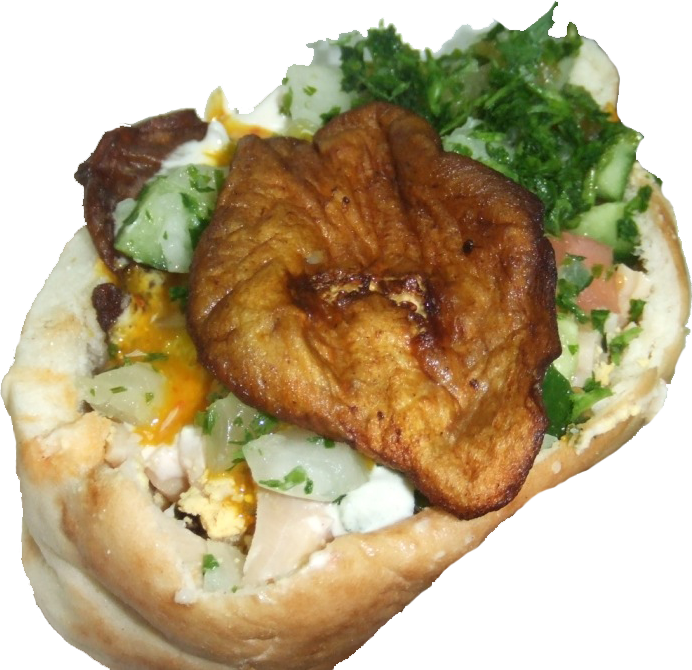
Sabich as served in a pita

There are several theories on the origin of the name Sabich. Many attribute the name to the sandwich's creator, Sabich Tzvi Halabi, who was born in Baghdad in 1938 and immigrated to Israel in the early 1950s.[1][2][3] The name Sabich means "morning" in Arabic, which may be a reference to the fact the ingredients are those of a typical shabbat breakfast among Iraqi Jews.[4]

Popular folk legend attributes the name to an acronym of the Hebrew words "Salat, Beitsa, yoter Ḥatsil" סלט ביצה יותר חציל, meaning "salad, egg, more eggplant".[3][5] This is a humorous interpretation and hence a backronym.[5]

History

[edit]
The original Sabich Buffet in its current location
Sabich Square in Ramat Gan

Halabi bought a kiosk across the street from the last stop of the Number 63 bus on Uziel Street in Ramat Gan in the early 1960s. Local workers wanted something more substantial than the bourekas the kiosk was currently selling, and Halabi and his wife created a sandwich based on an Iraqi traditional shabbat breakfast of eggs, tebit, chamin, fried eggplant, and salad.[6][7] Eggplant is a year-round crop in Israel, and eggs were available during the period of austerity in Israel, so both ingredients had long been in common use in the early 1960s.[5]

In Israel, the sandwich became a popular street food. Halabi took on a partner, Yaakov Sasson, and in the early 1980s moved the operation to Negba street, where as of 2017 it was still in operation.[3][6] The dish is served throughout Israel.[6][3] It is not well-known outside of Israel.[5]

In 2020 the mayor of Ramat Gan announced the Negba St.-Uziel St. intersection would be named Sabich Square.[8]

Ingredients and description

[edit]

Sabich typically includes fried eggplant slices, a cucumber-and-tomato salad, amba, and haminados eggs, which are slow-cooked in hamin until they turn brown.[6] Some versions include potatoes, pickles, a tahini sauce, hummus, or other condiments.[1][3][5][9] It is commonly served in pita bread or wrapped in laffa, an Iraqi flatbread.[1]

Daniel Gritzer, writing for Serious Eats, describes the sandwich as "it's drippy, it's messy, it's shamelessly moist and flavorful. There are creamy swaths, and squishy bits, and crunchy chunks, and tart bursts".[9]

A version without the bread or pita is called Sabich salad ("סלט סביח" - "Salat Sabich" in Hebrew).

Importance in Israeli cuisine

[edit]

According to Ronit Vered [he], writing in Haaretz, the sandwich became "an integral part of the limited canon of Israeli cuisine". Tami Shem-Tov wrote Saba Sabich (Grandpa Sabich), a children's picture book published in 2017 by Kinneret Zmora-Bitan in Hebrew, which according to Yahil Zaban of Tel Aviv University details how the sandwich became "a symbol of the new Israeli culture".[6][10]

According to Janna Gur, the sandwich is "the first street snack that sprang from a Jewish culinary tradition" in Israeli cuisine and was more popular in Israel than falafel.[7]

[edit]

See also

[edit]

References

[edit]
Revisions and contributorsEdit on WikipediaRead on Wikipedia
from Grokipedia
Sabich is a sandwich originating from Iraqi Jewish immigrants in , typically consisting of or stuffed with slices, hard-boiled eggs, , , amba (a tangy pickled ), and a fresh chopped of tomatoes, cucumbers, and . The dish traces its roots to the mid-20th century, when waves of Iraqi arrived in following anti-Semitic violence and the establishment of the state in , bringing culinary traditions that evolved into modern . Initially a morning breakfast item among Iraqi —prepared in advance to comply with religious restrictions on cooking—the sabich transformed into a portable sandwich sold by vendors in urban areas like and . The name "sabich" is believed to derive from the root s-b-ḥ, meaning "morning," alluding to its origins, though it is also popularly attributed to Sabih Tzvi Halabi, an Iraqi immigrant who began selling the sandwich from a street cart in in the 1960s, helping popularize it across . Today, sabich stands as one of 's most iconic street foods, celebrated for its layers of textures—from the crispy to the creamy sauces—and its fusion of Iraqi and Levantine flavors, often customized with additions like pickles, potatoes, or hot peppers.

Origins and Etymology

Linguistic Roots

The term "Sabich" originates from the root Ṣ-B-Ḥ, specifically deriving from sabāḥ (صباح), which means "morning" or "dawn" in both classical and Iraqi dialects. This etymology reflects the dish's traditional role as a quick, nutrient-dense meal prepared in advance for the among Iraqi Jewish communities. An alternative theory posits that "sabich" is an from the Hebrew words salat (salad), beitzah (), and chatzil(im) (), sometimes expanded to salat, beitzah, yoter chatzil ("salad, , more "). This emphasizes the sandwich's core ingredients. In the Baghdadi and other Iraqi Jewish dialects prevalent during the 1940s and 1950s, variants like sabīkh or sābākh were used colloquially to denote morning repasts, often featuring preserved and s, as documented in oral histories and early ethnographic accounts of Mesopotamian Jewish life. These pronunciations, influenced by local phonetic patterns such as the softening of the pharyngeal ḥ to a kh-like sound, highlight the term's embeddedness in everyday linguistic practices tied to daily and eating habits. Following the mass immigration of Iraqi Jews to in the early , the word underwent phonetic adaptation into as sabīaḥ (סביח), retaining the core meaning while aligning with Hebrew's consonantal structure and stress patterns. This transition is evident in early Israeli from transient camps and urban neighborhoods, where the term quickly entered vernacular use among immigrants, preserving its Arabic essence amid hebraization efforts. The adoption of "sabich" thus illustrates the broader incorporation of Iraqi Jewish culinary lexicon into Israeli Hebrew, linking it to other -influenced food terms like amba.

Cultural Naming Conventions

The name "sabich" is widely attributed to Sabich Tzvi Halabi, an Iraqi Jewish immigrant who popularized the sandwich through his kiosk in , a suburb of , starting in the early . Halabi, born in in 1938 and having immigrated to in the early 1950s, initially served the dish to bus drivers at his stand on Uziel Street, where customers would call out "Sabich, make me one," leading to the sandwich adopting his first name in local usage. His "Sabih" itself derives from the sabāḥ, meaning "morning" or "dawn," thus connecting the personal attribution to the dish's linguistic roots. This personal attribution transformed "sabich" from a into a term synonymous with the , embedding it in Israeli culinary lore by the late . Among Mizrahi Jewish communities in , particularly those of Iraqi descent, "sabich" evolved into informal Hebrew for quick, satisfying street eats, often evoking the portable, flavorful sandwich as an everyday staple for workers and families. This usage reflected the dish's roots in affordable, no-fuss meals adapted from Iraqi traditions, becoming a casual term in markets and neighborhoods where Mizrahi immigrants gathered. By the 1970s, as the sandwich spread beyond to broader areas, "sabich" entered mainstream Israeli parlance, with vendors and eaters alike using it interchangeably for the pita-based assembly, solidifying its status as a cultural for accessible . In the and , the further evolved as sabich gained national traction, with playful associations linking it to mornings—drawing briefly from its Arabic etymological root meaning "dawn" or "morning"—since the dish was traditionally prepared using leftovers like slow-cooked eggs and . This period saw puns in popular media and street banter, such as joking about "sabich for " to highlight its role in weekend rituals, helping integrate it into everyday Israeli lexicon beyond Mizrahi circles. Halabi's family even attempted to the name in the , underscoring its deep cultural entrenchment, though it remained a communal term rather than a one.

Historical Development

Iraqi Jewish Traditions

In the early , Sabich's foundational elements emerged as a traditional breakfast among Iraqi Jewish communities in and , where it was prepared as separate components rather than a unified sandwich. This meal typically featured alongside hard-boiled eggs, allowing for a simple, pre-cooked dish compliant with kosher laws prohibiting cooking on the . These items were often consumed without , emphasizing portability and ease for morning observances after Friday night services. The cultural significance of this breakfast lay in its role as a quick, nourishing option that aligned with the rhythms of religious life in these urban centers, where Jewish families balanced communal prayers with daily routines. In Baghdad's bustling Jewish quarters and Basra's port-side neighborhoods, such dishes symbolized resilience and adherence to tradition amid a diverse multicultural environment. The combination provided essential proteins and flavors suited to the warm climate, often prepared in advance as part of broader preparations like the slow-cooked tebit.

Immigration and Adaptation in Israel

The mass exodus of Iraqi Jews to occurred primarily between 1950 and 1951, facilitated by , an airlift that transported over 120,000 individuals—nearly the entire Iraqi Jewish community—to the young state amid rising persecution and anti-Semitic violence. These immigrants arrived in transit camps known as and early urban neighborhoods, where harsh living conditions and economic scarcity shaped daily life, including the preservation of culinary traditions from . In , these traditions typically involved preparing breakfast elements separately for the Sabbath morning meal, a practice that the newcomers sought to maintain despite limited resources. In the 1950s and 1960s, as Iraqi Jews adapted to Israel's post-independence realities, vendors began combining these traditional breakfast components into a portable sandwich to suit the demands of urban labor and street vending amid ongoing economic hardships. This innovation emerged in areas like , a suburb with a significant Iraqi immigrant population, where kiosks catered to workers at bus stops and markets. By the early 1960s, the first documented Sabich stands appeared, notably one opened in 1961 by Iraqi immigrant Sabich Tzvi Halabi on Uziel Street in , marking the sandwich's transition from home-cooked fare to a commercial . Vendors in 's Levinsky Market further popularized the format during this period, offering it as an affordable, on-the-go option for diverse immigrant communities navigating integration challenges. Key milestones in Sabich's development included its wider acceptance in the , becoming a staple in urban markets and reflecting the broader fusion of Mizrahi culinary influences into Israeli culture. This expansion coincided with improving economic conditions and increased mobility, allowing the sandwich to gain traction among non-Iraqi and solidify its role as a symbol of adaptation and resilience.

Ingredients and Preparation

Core Ingredients

The traditional Sabich sandwich is defined by its essential components, which balance crispy, creamy, tangy, and fresh elements within a portable format. These core ingredients, rooted in Iraqi Jewish culinary practices, include a sturdy base, and protein fillings, and flavorful condiments that provide both moisture and contrast. The bread base consists of or , selected for its soft yet resilient structure that accommodates moist fillings without becoming soggy. , a pocket-style bread, is traditionally made from , , , and salt, baked quickly to form a steam pocket ideal for stuffing. , a thinner, tearable , offers similar functionality and is often used in settings for its ease of handling. Both are sourced from local bakeries in , where fresh production ensures the bread's pliability. Primary fillings center on sliced fried eggplant, hard-boiled eggs, and or sauce, which together deliver texture, protein, and creaminess. , typically Italian or globe varieties common in the , is sliced into rounds or strips, salted to draw out moisture, and shallow-fried in neutral oil like canola or until golden and tender, providing a smoky, caramelized crunch essential to the sandwich's appeal. Hard-boiled eggs, sliced for even distribution, serve as the protein element and are traditionally prepared as —slow-cooked overnight in a cholent-like for to develop a browned, flavorful exterior—sourced from standard eggs available in Iraqi and Israeli markets. , made from chickpeas, , lemon, and garlic, or sauce alone ( paste thinned with water, lemon, and garlic), adds a nutty, emulsified creaminess; chickpeas are often canned or home-cooked from dried imports, while derives from hulled seeds roasted and ground, staples in Levantine sourcing. Condiments elevate the flavor profile with amba, pickles, and , introducing tang and freshness. Amba, a pickled mango relish central to Iraqi Jewish cuisine, is prepared from unripe green es fermented or pickled with spices like , , chili, mustard, and , offering a funky, spicy tang; it traces origins to Indian influences via Iraqi , with es historically sourced from imports or local substitutes in . Pickles, typically Middle Eastern-style pickled cucumbers or turnips, add crunch and acidity, often stuffed directly into the sandwich. comprises finely diced cucumbers, tomatoes, and parsley dressed in lemon juice and , using fresh, seasonal produce from Mediterranean markets for its crisp, herbaceous bite that cuts through richer elements. These ingredients reflect the historical use of and eggs in Iraqi Jewish breakfasts, adapted for portability in .

Step-by-Step Assembly

The preparation of sabich begins with frying the slices, a crucial step that imparts a crispy texture to the sandwich. is typically sliced into ½-inch rounds and fried in a shallow layer of oil over medium-high heat until golden and tender, which takes about 5 minutes total, turning once midway through. Similarly, the eggs are hard-boiled to achieve firm yolks by placing them in boiling water and simmering for 10 minutes, followed by an immediate to halt cooking and facilitate peeling. Once the components are ready, assembly is straightforward and emphasizes the sandwich's portability as . A large is warmed and split open, then spread with a layer of or sauce inside; 2 to 3 slices and sliced hard-boiled eggs (typically one or two per sandwich) are added next. This is followed by a topping of (chopped tomatoes, cucumbers, and parsley) and a drizzle of amba sauce, along with pickles, which provides a tangy, spicy balance to the rich flavors; the is then folded or wrapped to enclose the fillings. Sabich is best eaten fresh immediately after assembly to maintain its warm, crisp elements, often with optional fries served on the side for added crunch. Vendors commonly prepare one per person as a single, satisfying portion.

Variations and Regional Adaptations

Traditional vs. Modern Twists

The traditional Sabich, as developed in the 1960s by Iraqi Jewish immigrants in , , adheres strictly to a simple, meat-free composition centered on fully fried components and minimal embellishments. It features bread stuffed with slices of , hard-boiled eggs (often browned from overnight cooking in a Shabbat stew called tbit), a basic of chopped tomatoes and cucumbers, tangy sauce, or , and pickled vegetables for crunch. Boiled potatoes occasionally appear as a nod to the original Iraqi Sabbath meal of cold, pre-cooked items, but the focus remains on hearty, no-fuss assembly without additional proteins or complex seasonings. In contrast, modern twists on Sabich, gaining popularity from the onward amid Israel's rising consciousness and status as the world's vegan capital, introduce adaptations for dietary preferences and elevated flavors while preserving the core pita sandwich format. For -focused versions, is often roasted rather than fried to reduce oil content, and boiled potatoes have become a more standard inclusion for added substance without excess calories. Vegan substitutes emerged prominently in the , replacing eggs with creamy , spiced chickpeas, or even fried mushrooms and to accommodate plant-based diets, reflecting Israel's per capita vegan rate of about 5% by the mid-. Urban eateries in and beyond further innovated in the with gourmet elements, such as herb-infused (blended with , cilantro, mint, and for freshness) and the addition of for extra crispiness, transforming the into a more customizable, upscale option. These changes maintain the dish's Mizrahi roots but cater to contemporary palates seeking variety, as seen in deconstructed bowl presentations or enhanced sauces at spots like those in New York's Balaboosta by the late .

International Influences

Sabich began gaining traction in communities in the United States and during the late and early 2000s, as Israeli immigrants introduced the sandwich to urban centers with significant Jewish populations. In , establishments like Taïm, which opened in 2005, popularized authentic versions featuring , hard-boiled eggs, , and in , while delis such as Moshe's Falafel incorporated elements, offering Sabich alongside or enhanced with falafel patties for a heartier meal. In , British-Israeli chef helped disseminate the dish through recipes and cookbooks starting in the early 2000s, leading to its adoption in and eateries. By the 2010s, creative fusions emerged as Sabich inspired global adaptations blending local flavors. Similarly, in the , venues like Baba Ganoush Kitchen in offered Sabich in wrap form by the mid-2010s, incorporating British-Israeli elements such as extra for added heat and portability suited to scenes. These variations maintained core components like and while adapting to regional palates and breads. As of 2025, Sabich continues to evolve with plant-based trends in vegan cafes worldwide, substituting eggs with scrambles or "eggs" to appeal to dietary preferences. For instance, vegan recipes like the one from Cinnamon Snail offer fully plant-based Sabich with roasted and , emphasizing . The sandwich has also featured prominently in international food festivals, such as the Great Nosh Jewish food event in New York and the Kosher Street Food Festival in , where it highlights Mizrahi heritage amid diverse global cuisines.

Cultural and Culinary Significance

Role in Israeli Street Food

Sabich occupies a prominent place in Israel's vibrant landscape, having emerged as a popular offering since the in urban markets like Tel Aviv's Carmel Market (Shuk HaCarmel) and HaCarmel, where vendors serve it as an affordable, portable meal typically priced at 20-30 ILS. This sandwich's simplicity and hearty filling of , eggs, and make it a go-to choice for on-the-go consumption amid the bustling stalls of fresh produce and spices. Its presence in these markets underscores the evolution of from makeshift kiosks to integral components of daily urban life. Socially, Sabich bridges diverse groups in Israel, enjoyed by local workers seeking a quick, filling lunch during busy shifts as well as tourists navigating the lively market atmosphere, often leading to shared eating moments around vendor counters or nearby benches. This communal aspect enhances its appeal, turning individual bites into informal social interactions that reflect the inclusive, fast-paced rhythm of Israeli city streets. Economically, Sabich bolsters small-scale vendors and family-run stands, which form the backbone of Israel's scene and contribute to the nation's broader food service industry, estimated at $7.6 billion in annual sales during the 2020s. By providing low-overhead opportunities for entrepreneurs, it helps sustain local economies in high-footfall areas like markets, where affordable options like Sabich drive consistent daily revenue.

Representation of Mizrahi Heritage

Sabich serves as a powerful emblem of Mizrahi resilience in the wake of the mass immigration of Iraqi Jews to during the 1950s, when over 120,000 individuals arrived amid , facing socioeconomic marginalization and pressures. Rooted in Baghdad's Jewish culinary traditions of and amba sauce, the dish was adapted by immigrants like Sabich Halabi, who in 1961 opened a modest in , defying the era's Ashkenazi-centric food policies that prioritized European-style rations and suppressed Middle Eastern flavors in communal dining halls. This entrepreneurial act not only preserved familial recipes but also symbolized Mizrahi determination to reclaim agency in a society where their cuisine was initially dismissed as "ethnic" rather than integral to . From the onward, Sabich has appeared in media and literary works that illuminate Mizrahi themes of and heritage preservation, coinciding with a broader that elevated ethnic cuisines in public discourse. The 2017 children's book Saba Sabich by Tami Shem-Tov, inspired by her grandfather's immigration story and name-sharing with the dish, weaves personal narrative with to foster intergenerational awareness of Iraqi Jewish contributions, earning praise for its role in normalizing Mizrahi voices in . During this period, as Mizrahi pride movements gained momentum, Sabich featured in books and cultural events as a motif of ethnic reclamation, reflecting the shift from marginalization to multiethnic representation in Israel's culinary narratives. In contemporary as of 2025, Sabich informs ongoing conversations about food equity and , underscoring how Mizrahi dishes have transitioned from symbols of immigrant struggle to staples that bridge ethnic divides and challenge historical culinary hierarchies. Scholarly examinations highlight its presence in diverse eateries alongside Arab-influenced foods, promoting gastronomic encounters that advance inclusive societal dialogues on Jewish-Muslim shared heritage and equitable representation in the national food scene. This evolution positions Sabich as a catalyst for broader equity initiatives, where access to and celebration of ethnic cuisines address lingering disparities from early statehood.

References

Add your contribution
Related Hubs
User Avatar
No comments yet.