


Community hub
Recent from talks
Contribute something
Nothing was collected or created yet.
Parallelogram law
View on Wikipedia
In mathematics, the simplest form of the parallelogram law (also called the parallelogram identity) belongs to elementary geometry. It states that the sum of the squares of the lengths of the four sides of a parallelogram equals the sum of the squares of the lengths of the two diagonals. We use these notations for the sides: AB, BC, CD, DA. But since in Euclidean geometry a parallelogram necessarily has opposite sides equal, that is, AB = CD and BC = DA, the law can be stated as

If the parallelogram is a rectangle, the two diagonals are of equal lengths AC = BD, so and the statement reduces to the Pythagorean theorem. For the general quadrilateral (with four sides not necessarily equal) Euler's quadrilateral theorem states where is the length of the line segment joining the midpoints of the diagonals. It can be seen from the diagram that for a parallelogram, and so the general formula simplifies to the parallelogram law.



Proof
[edit]
In the parallelogram on the right, let AD = BC = a, AB = DC = b, By using the law of cosines in triangle we get:



In a parallelogram, adjacent angles are supplementary, therefore Using the law of cosines in triangle produces:



By applying the trigonometric identity to the former result proves:


Now the sum of squares can be expressed as:


Simplifying this expression, it becomes:

The parallelogram law in inner product spaces
[edit]
In a normed space, the statement of the parallelogram law is an equation relating norms:

The parallelogram law is equivalent to the seemingly weaker statement: because the reverse inequality can be obtained from it by substituting for and for and then simplifying. With the same proof, the parallelogram law is also equivalent to:




In an inner product space, the norm is determined using the inner product:
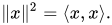
As a consequence of this definition, in an inner product space the parallelogram law is an algebraic identity, readily established using the properties of the inner product:


Adding these two expressions: as required.

If is orthogonal to meaning and the above equation for the norm of a sum becomes: which is Pythagoras' theorem.


Normed vector spaces satisfying the parallelogram law
[edit]Most real and complex normed vector spaces do not have inner products, but all normed vector spaces have norms (by definition). For example, a commonly used norm for a vector in the real coordinate space is the -norm:




Given a norm, one can evaluate both sides of the parallelogram law above. A remarkable fact is that if the parallelogram law holds, then the norm must arise in the usual way from some inner product. In particular, it holds for the -norm if and only if the so-called Euclidean norm or standard norm.[1][2]

For any norm satisfying the parallelogram law (which necessarily is an inner product norm), the inner product generating the norm is unique as a consequence of the polarization identity. In the real case, the polarization identity is given by any of the expressions:
![{\displaystyle {\begin{aligned}\langle x,y\rangle &={\tfrac {1}{4}}{\bigl (}\|x+y\|^{2}-\|x-y\|^{2}{\bigr )}\\[5mu]&={\tfrac {1}{2}}{\bigl (}\|x+y\|^{2}-\|x\|^{2}-\|y\|^{2}{\bigr )}\\[5mu]&={\tfrac {1}{2}}{\bigl (}\|x\|^{2}+\|y\|^{2}-\|x-y\|^{2}{\bigr )}.\end{aligned}}}](https://wikimedia.org/api/rest_v1/media/math/render/svg/2eadddc88411f6856bce45c2c3b224b834aad2dd)
In the complex case it is given by:

For example, using the -norm with and real vectors and the evaluation of the inner product proceeds as follows: which is the standard dot product of two vectors.

![{\displaystyle {\begin{aligned}\langle x,y\rangle &={\tfrac {1}{4}}{\bigl (}\|x+y\|^{2}-\|x-y\|^{2}{\bigr )}\\[8mu]&={\tfrac {1}{4}}{\Bigl (}\sum _{i}|x_{i}+y_{i}|^{2}-\sum _{i}|x_{i}-y_{i}|^{2}{\Bigr )}\\[2mu]&={\tfrac {1}{4}}{\Bigl (}4\sum _{i}x_{i}y_{i}{\Bigr )}\\&=x\cdot y,\\\end{aligned}}}](https://wikimedia.org/api/rest_v1/media/math/render/svg/c817f5ae417619517ae09fbc9fd770c158bc9adc)
Another necessary and sufficient condition for there to exist an inner product that induces the given norm is for the norm to satisfy Ptolemy's inequality: For any three vectors , , and ,[3]


See also
[edit]- François Daviet – Royal Sardinian Army officer and mathematician (1734–1798)
- Inner product space – Vector space with generalized dot product
- Minkowski distance – Vector distance using pth powers
- Normed vector space – Vector space on which a distance is defined
- Polarization identity – Formula relating the norm and the inner product in a inner product space
- Ptolemy's inequality – Relation between distances of four points
References
[edit]- ^ Cantrell, Cyrus D. (2000). Modern mathematical methods for physicists and engineers. Cambridge University Press. p. 535. ISBN 0-521-59827-3.
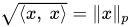
if p ≠ 2, there is no inner product such that because the p-norm violates the parallelogram law.
- ^ Saxe, Karen (2002). Beginning functional analysis. Springer. p. 10. ISBN 0-387-95224-1.
- ^ Apostol, Tom M. (1967). "Ptolemy's Inequality and the Chordal Metric". Mathematics Magazine. 40 (5): 233–235. doi:10.2307/2688275. JSTOR 2688275.
External links
[edit]- Weisstein, Eric W. "Parallelogram Law". MathWorld.
- The Parallelogram Law Proven Simply at Dreamshire blog
- The Parallelogram Law: A Proof Without Words at cut-the-knot
Banach space topics | |
|---|---|
| Types of Banach spaces | |
| Banach spaces are: | |
| Function space Topologies | |
| Linear operators | |
| Operator theory | |
| Theorems |
|
| Analysis | |
| Types of sets |
|
| Subsets / set operations | |
| Examples | |
| Applications | |


| Spaces |
| ||||
|---|---|---|---|---|---|
| Theorems | |||||
| Operators | |||||
| Algebras | |||||
| Open problems | |||||
| Applications | |||||
| Advanced topics | |||||

Parallelogram law
View on GrokipediaOverview and Definition
Geometric Interpretation
The addition of two vectors and in the Euclidean plane is geometrically visualized using the parallelogram construction, where the vectors serve as adjacent sides sharing a common tail at the origin. Placing the tail of at the head of completes one side, and similarly for the reverse, forming a parallelogram with and as the non-parallel sides. The resultant vector corresponds to the diagonal extending from the common tail to the opposite vertex, providing an intuitive representation of vector summation.[5][6] In this parallelogram, the two diagonals represent the vectors and , where spans from the head of to the head of . The parallelogram law emerges from the geometry of these lengths, stating that the sum of the squares of the diagonals' lengths equals twice the sum of the squares of the sides' lengths: . This equality highlights the symmetric relationship between the diagonals and sides, reflecting the balanced structure of the parallelogram.[7][8] Conceptually, consider a parallelogram labeled with vertices O (origin), A (head of ), B (head of ), and C (head of ). The side OA has length , OB has length , and opposite sides OC to A and B to C match these lengths. The diagonal OC measures , while the other diagonal AB measures . This configuration illustrates how the law captures the total "squared extent" of the figure, with the diagonals' contributions equaling the sides' doubled squares due to the parallel and equal opposite sides.[9]Algebraic Formulation
In a normed vector space, the parallelogram law provides a fundamental relation between the norms of vector sums and differences. For any vectors and , the law states that [10] The norm is a function from the vector space to the non-negative reals that measures the "length" or magnitude of vectors, satisfying three axioms: positivity (, with equality if and only if ), absolute homogeneity ( for scalar ), and the triangle inequality ().[10] This norm generalizes the Euclidean length from finite-dimensional spaces to arbitrary dimensions.[10] The law holds in Euclidean spaces, where it serves as a starting point for understanding vector norms in higher-dimensional or abstract settings.[10] This algebraic form originates from the geometric property that the sum of the squares of the diagonals of a parallelogram equals twice the sum of the squares of its sides.[10] To illustrate, consider the vectors and in equipped with the Euclidean norm. The left side of the equation is . The right side is , confirming equality.[10]Historical Development
Origins in Classical Geometry
The origins of the parallelogram law trace back to ancient Greek geometry, where Euclid systematically explored properties of parallelograms in his Elements. In Book I, Proposition 34, Euclid proves that in any parallelogram, the opposite sides and angles are equal to one another, and each diagonal bisects the area into two equal parts.[11] These results established the geometric framework for understanding parallelograms as figures formed by parallel lines, emphasizing equality and symmetry without addressing relations involving squared lengths. The application of parallelogram constructions to physical forces appeared earlier than the late 17th century. In 1586, Simon Stevin formulated the parallelogram law for the composition of forces in his Principles of the Art of Weighing.[12] A significant advancement occurred with Isaac Newton, who introduced the law explicitly in his Philosophiæ Naturalis Principia Mathematica (1687), in Corollary I to the Laws of Motion, stating that if a body is urged by two forces, it will proceed along the diagonal of the parallelogram formed by the lines representing those forces separately, as if both acted simultaneously.[13] This geometric method for composing forces as vectors marked a pivotal shift from pure geometry to mechanics, enabling the analysis of motion under multiple influences. Concurrently, in 1687, French mathematician Pierre Varignon developed related ideas in his Projet d'une nouvelle mécanique, where he formulated Varignon's theorem: the moment of a force about any point equals the sum of the moments of its components along perpendicular directions, resolved via a parallelogram.[14] This theorem extended the parallelogram's utility to statics, allowing the decomposition of forces for calculating torques and equilibrium in rigid bodies. During the early 19th century, the parallelogram law received broader acceptance in mechanics and statics amid ongoing discussions about force composition.[12] Its connection to squared lengths emerged in physical contexts like work and energy, where vector addition of velocities leads to relations involving the squares of magnitudes in kinetic energy formulations.Modern Formulation in Analysis
In the early 20th century, the parallelogram law evolved from its geometric roots into a fundamental property characterizing norms in abstract spaces, particularly through the work of Maurice Fréchet. In 1935, Fréchet examined linear metric spaces—normed vector spaces with a metric induced by the norm—and posed the question of when such a space is isometric to a Hilbert space, formulating the parallelogram law as a key condition for the existence of a compatible inner product. This axiomatic approach marked a shift toward using the law to distinguish classes of normed spaces in functional analysis. Building directly on Fréchet's inquiry, P. Jordan and J. von Neumann published a seminal result in 1935, proving that a normed linear space admits an inner product inducing the given norm if and only if it satisfies the parallelogram law: for all vectors in the space, .[15] Their characterization provided a precise algebraic criterion, bridging metric properties with bilinear forms and influencing the structure theory of normed spaces. The parallelogram law assumed a central role in the burgeoning field of Banach spaces during the 1920s and 1930s, following Stefan Banach's foundational 1932 monograph on linear operations, which defined complete normed linear spaces. In this context, the law served to identify Hilbert spaces as the unique Banach spaces where the norm arises from an inner product, enabling distinctions in applications like integral operators and differential equations within functional analysis. Jordan's contributions in the 1930s and von Neumann's extensions around 1937 further solidified this linkage, emphasizing the law's utility in verifying inner product structures.[15]Proofs
Geometric Proof
Consider the parallelogram ABCD formed by two vectors and , where AB = , AD = , so that the diagonals are AC = and BD = . The diagonals bisect each other at their midpoint O.[16] To establish the relation between the lengths of the sides and diagonals, examine triangle ABC with sides AB = , BC = , and AC = . The point O is the midpoint of AC, making BO a median from vertex B to side AC. The length of this median BO equals half the length of the other diagonal, .[16] Apollonius's theorem provides the geometric relation for any triangle with sides of lengths , , and median from the vertex opposite side : . This theorem follows from decomposing the triangle along the median into two smaller triangles and applying the Pythagorean theorem to right triangles formed by dropping perpendiculars from the median's endpoint to the sides, relating the squares of the distances.[17] Applying Apollonius's theorem to triangle ABC yields . Simplifying the right side gives . Multiplying through by 2 produces the parallelogram law: .[16] This proof depends solely on the properties of medians in triangles, the bisection of diagonals in parallelograms, and the Pythagorean theorem applied within the subfigures of Apollonius's theorem, without recourse to coordinates or algebraic expansions.[17]Analytic Proof
To verify the parallelogram law analytically in the Euclidean plane , consider two vectors and , where the Euclidean norm is given by and .[18] Compute : Similarly, compute : Adding these expressions yields: confirming the parallelogram law .[18] This coordinate-based calculation in generalizes to using the dot product , where the expansions follow analogously from the bilinearity of the dot product and the norm definition , without requiring the full machinery of inner product spaces.[18]Inner Product Spaces
Derivation from Inner Product
In inner product spaces, the norm is defined by the inner product via the relation for all vectors .[19] This definition induces the parallelogram law as a fundamental property of the space.[20] To derive the law, consider arbitrary vectors and in the space. Expand the squared norms using the inner product properties: and similarly, Adding these expansions yields as the cross terms and their negatives cancel out.[19][21] This derivation holds in both real and complex inner product spaces, though the inner product in the complex case satisfies conjugate symmetry, , which implies that the cross terms sum to twice the real part of before cancellation. The parallelogram law itself remains unchanged in form across both cases.[20]Relation to Polarization Identity
In inner product spaces where the norm satisfies the parallelogram law, the polarization identity allows the inner product to be expressed solely in terms of the norm, providing a key tool for characterizing such spaces. For real inner product spaces, the identity states that for vectors and , This formula recovers the inner product from the norm induced by it.[19] The polarization identity for real spaces derives from the parallelogram law by expanding the squared norms and solving for the cross terms. The parallelogram law gives . Subtracting the expansions and (consistent with the law) yields , isolating the bilinear term as shown in the identity.[19] For complex inner product spaces, the polarization identity extends to account for the imaginary part, stating that This form similarly derives from expansions aligned with the parallelogram law, incorporating rotations by to capture the full sesquilinear structure.[19] As a simple example in with the Euclidean norm, consider and . Then , , , and . Applying the real polarization identity gives , matching the standard dot product.[19]Normed Spaces
Satisfaction of the Law
In a normed vector space , the parallelogram law is satisfied if, for all vectors , [22][23] This property holds in Euclidean spaces equipped with the standard Euclidean norm , as the norm derives from the inner product .[22][23] Similarly, the space of square-summable sequences, with norm , satisfies the law due to its inner product structure .[22][23] In contrast, the space of absolutely summable sequences, with norm , does not satisfy the law; for example, in finite dimensions with unit vectors and , the left side is , while the right side is .[23][24] Likewise, the space of bounded sequences, with norm , fails the law; for and in , the left side is , while the right side is .[22][23] A normed space satisfies the parallelogram law for all vectors if and only if its norm is induced by an inner product.[22][23]Jordan-von Neumann Theorem
The Jordan-von Neumann theorem characterizes inner product spaces among normed linear spaces through the parallelogram law. Precisely, a normed vector space over or is an inner product space if and only if the parallelogram law holds: for all , This equivalence was established by Pascual Jordan and John von Neumann in 1935. The forward direction—that every inner product induces a norm satisfying the parallelogram law—follows directly from expanding the squared norms via the inner product, yielding the identity after cancellation; this derivation was detailed in earlier sections on inner product spaces. The converse direction, assuming the parallelogram law, constructs an inner product from the norm using the polarization identity. Over the reals, define Over the complexes, the formula adjusts to ensure sesquilinearity: Verification proceeds by confirming that is bilinear (or sesquilinear in the complex case), symmetric (or Hermitian), and positive definite, with recovering the original norm; the parallelogram law ensures these properties hold for all vectors. The theorem applies equally to real and complex settings, with the polarization adjustment handling the complex structure while preserving the core equivalence.References
- https://en.wikisource.org/wiki/The_Mathematical_Principles_of_Natural_Philosophy_(1729)/Axioms,_or_Laws_of_Motion