Hubbry Logo
Political bossPolitical bossMain
Open search
Political boss
Community hub
Political boss
logo
8 pages, 0 posts
0 subscribers
Be the first to start a discussion here.
Political boss
Political boss
from Wikipedia
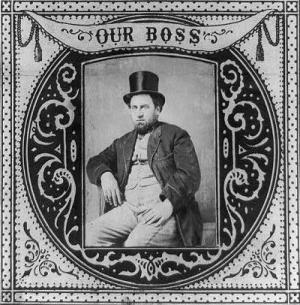
1869 tobacco label featuring Boss Tweed

In the politics of the United States of America, a boss is a person who controls a faction or local branch of a political party. They do not necessarily hold public office themselves; most historical bosses did not, at least during the times of their greatest influence. Numerous officeholders in that unit are subordinate to the single boss in party affairs. Bosses may base their power on the support of numerous voters, usually organized voting blocs, and manage a coalition of these blocs and various other stakeholders. When the party wins, they typically control appointments in their unit, and have a voice at the higher levels.[citation needed]

Reformers typically allege that political bosses are corrupt. This corruption is usually tied to patronage: the exchange of jobs, lucrative contracts and other political favors for votes, campaign contributions and sometimes outright bribes.[citation needed]

History

[edit]

In Spanish America, Brazil, Spain, and Portugal political bosses called caciques hold power in many places,[1] while in Italy they are often referred to as ras.[2] Bosses were a major part of the political landscape during the 19th and early 20th centuries in the United States, such as the political machines of Tammany Hall in New York City and the Choctaw Club in New Orleans, which controlled financing of campaigns and influence via owing of favors to arrange patronage public appointments.[citation needed]

In the Southern United States, charismatic populist politicians like Huey Long commanded large networks of supporters. Similar practices existed in the northern cities, particularly New York City, where Boss Tweed wielded control over the powerful Democratic political machine. In Denver, Colorado, during the 1890s Jefferson Randolph "Soapy" Smith operated as the Republican party boss and political fixer.[citation needed]

Charles Brayton exercised great influence over the politics of turn of the 20th century Rhode Island.[3] He exemplified rural bossism within the Republican Party. Chicago had numerous colorful bosses, such as Democrats Hinky Dink and Bathhouse John, and Pat Marcy.[4] Chicago's Republican counterparts included Big Bill Thompson, who became mayor in the 1920s.[5] One of Chicago's most iconic figures was longtime mayor and chairman of the Cook County Democratic Committee Richard J. Daley,[6] who had a major voice in state and national Democratic politics. With a few exceptions in the Southwest, such as Phoenix, most large cities of 100,000 or more in the early 20th century had machine organizations, and usually claimed one or more local bosses, most of whom were Democrats. Some had a major impact and hold on state politics, such as E. H. Crump in Memphis, Tennessee.[7] A few bosses had reputations as reformers, such as Frank Hague of Jersey City.[8]

Political bosses exist today. Politico in 2019 described insurance executive George Norcross as New Jersey's "most powerful unelected official", with "nearly uncontested control of South Jersey's Democratic machine".[9] An October 2020 article in The Bulwark argued that Donald Trump's appeal to white working-class voters in the 2016 United States presidential election was driven by the same kind of paternalistic and localist mentality that was exploited by the Democratic political bosses of the early 20th century.[10] An April 2022 New York Times article portrayed him as a modern party boss during his post-presidency.[11]

[edit]

Boss Jim W. Gettys, portrayed by Ray Collins, is a secondary character in Citizen Kane and Charles Foster Kane's political rival for the post of Governor of New York.

The television series The Dukes of Hazzard (1979–1985) featured a character named Boss Hogg, played by Sorrell Booke.

Boss Tweed was portrayed by Philip Bosco in the 1986 TV movie Liberty, and by Jim Broadbent as a major supporting character in the 2002 film Gangs of New York.[12] Tweed is portrayed as a defender of the rights of minorities and helper of those in need in Pete Hamill's 2003 novel Forever.

The HBO television series Boardwalk Empire (2010–2014) focuses on Enoch "Nucky" Thompson (based on the historical Enoch L. Johnson), a fictional Republican Party boss and gangster who controls Atlantic City, New Jersey during the Prohibition period (1920–1933).

Notable individuals

[edit]

In the United States

[edit]


In the United Kingdom

[edit]

See also

[edit]

References

[edit]

Further reading

[edit]
Revisions and contributorsEdit on WikipediaRead on Wikipedia
from Grokipedia
A political boss is a dominant figure in a local who wields substantial influence over elections and governance by commanding loyalty from voters and officials through networks, often involving the distribution of public jobs, contracts, and services in exchange for votes and support. These machines proliferated in rapidly growing U.S. cities during the late 19th and early 20th centuries, capitalizing on mass and to mobilize working-class and immigrant populations otherwise sidelined by formal party structures. Bosses maintained power via a of precinct captains and ward heelers who delivered votes on , frequently through outright , , or ballot stuffing, while bosses themselves profited from kickbacks on and rigged contracts. This system filled gaps in for underserved communities, such as aid during economic hardship or assistance with , fostering a pragmatic reciprocity that bosses like George Washington Plunkitt justified as "honest graft" when it aligned with public needs. However, the prevalence of eroded public trust and efficiency, as resources were diverted from legitimate infrastructure to personal enrichment, exemplified by inflated costs in projects like New York City's courthouse under . The archetype of the political boss was William M. "Boss" Tweed, who rose to lead in the 1860s and 1870s, transforming it into a formidable machine that controlled politics through systematic graft estimated to have defrauded taxpayers of tens of millions of dollars. Tweed's downfall in , following exposés by reformers and the press, highlighted vulnerabilities to journalistic scrutiny and legal challenges, yet similar machines persisted in cities like under figures such as Michael "Hinky Dink" Kenna until progressive reforms and laws curtailed in the early 20th century. While bosses enabled responsive local governance in chaotic urban environments, their reliance on prioritized short-term loyalty over long-term institutional integrity, contributing to cycles of scandal and reform.

Definition and Characteristics

Core Definition

A political boss is the dominant leader of a , a hierarchical party organization that secures electoral victories and governmental control in local jurisdictions, particularly cities, by mobilizing voters through networks and reciprocal favors. These leaders, often rising from ward-level , command loyalty from precinct captains and supporters by dispensing public jobs, contracts, aid, and —such as coal during winters or holiday turkeys—in exchange for votes and turnout efforts. This system flourished in the United States amid late-19th-century and waves, where bosses filled voids left by distant or unresponsive formal institutions. Unlike elected officials bound by legal terms and public scrutiny, political bosses operated informally, wielding authority over nominations, legislation, and policy implementation without holding high office themselves. Their power derived from personal charisma, organizational acumen, and control over immigrant communities, whom they integrated into the polity by providing immediate material assistance and advocacy against nativist exclusion. While enabling efficient vote aggregation in diverse electorates, this model frequently intertwined legitimate constituency service with graft, kickbacks, and ballot manipulation, as evidenced by the 1871 exposure of Tammany Hall's of millions under boss . Empirical analyses of machine politics highlight bosses' role in stabilizing chaotic urban environments, yet underscore how their monopolistic control distorted democratic accountability by prioritizing insider loyalty over merit-based governance. For instance, bosses like , who controlled finances in the 1860s, inflated public works costs to siphon funds, leading to his 1873 conviction on 204 counts of fraud and forgery after public outcry fueled by journalistic exposés. Such practices, while not universal, characterized many machines, prompting reforms like laws to curb by 1910s.

Operational Traits and Methods

Political bosses maintained authority through hierarchical structures featuring a central leader overseeing networks of precinct captains and district lieutenants, who handled operations such as and mobilization in exchange for directives from the top. This ensured rapid dissemination of orders and feedback on local sentiments, enabling bosses to adapt strategies amid urban volatility. was enforced via personal ties and mutual benefit, with subordinates advancing through demonstrated efficacy in delivering votes or resources. The patronage system formed the operational backbone, distributing public sector jobs, infrastructure contracts, and social aid to loyalists in return for electoral support and organizational service. In historical cases like , this extended to immigrants, who received employment or emergency assistance—such as coal during winters or —fostering dependency and turnout; by 1870, Tammany controlled thousands of positions in , circumventing merit-based hiring. Bosses justified such allocations as pragmatic governance, arguing they met immediate constituency needs where formal bureaucracies lagged. Electioneering methods prioritized high voter participation, employing captains to canvass neighborhoods, supply poll-day logistics like carriages, and monitor opposition; while legal mobilization dominated, irregularities such as repeat voting or occurred, particularly in densely packed wards. George Washington Plunkitt, a Tammany operative, articulated "honest graft" as leveraging foreknowledge of public projects for legitimate investments, distinct from , though critics viewed both as self-enrichment tactics funding machine perpetuation. Under William M. Tweed's leadership from to 1871, allies dominated bodies like the to rubber-stamp exaggerated claims, extracting an estimated $30 million to $200 million from city funds via kickbacks. Power consolidation involved symbiotic ties with economic elites, granting favors like approvals or franchises for contributions and non-interference, while internal discipline deterred defection through threats of withdrawal. These methods, rooted in reciprocal exchange rather than , allowed bosses to govern amid rapid and ethnic diversity, though they invited reformist backlash over deficits.

Historical Development

Origins in Antebellum America

The origins of political bosses in the United States trace to the early 19th century, amid the expansion of popular democracy during the Jacksonian era, when universal white male suffrage prompted the formation of disciplined party organizations at the local and state levels to mobilize voters and distribute patronage. These proto-machines relied on grassroots coordinators in urban wards—often tavern owners, merchants, or community leaders—who built loyalty through personal networks, informal favors, and control over nominations, foreshadowing later bossism without the scale enabled by post-Civil War immigration. In cities like New York, , and , such figures enforced via caucuses and committees, rewarding supporters with appointments under the emerging , which Andrew Jackson's administration popularized nationally after 1828. A prototypical example emerged in New York State with the Albany Regency, established around 1820 by and allies to counter the influence of DeWitt Clinton's faction. This group, dubbed the first effective , centralized control over Democratic Party machinery through rigid discipline, strategic patronage distribution, and behind-the-scenes coordination of elections until roughly 1854. Operating from Albany, Regency leaders like and manipulated conventions and leveraged state offices to secure loyalty, amassing power without formal titles and demonstrating boss-like authority over policy and candidates. Their model emphasized voter turnout among working-class and rural constituencies, using newspapers and local assemblies to propagate Jeffersonian ideals against elite remnants. In urban centers, organizations like New York's evolved from fraternal societies into political engines by the 1820s, aligning with Democratic interests to aid immigrant integration—particularly Irish arrivals—and counter nativist opposition. Founded in 1789 as a patriotic club honoring , Tammany shifted under leaders like and Van Buren to grassroots mobilization, providing aid like jobs and legal support in exchange for votes, though its full machine dominance awaited postbellum growth. Similar dynamics appeared in , where ward bosses influenced municipal elections through ethnic coalitions, prefiguring the networks that scaled with industrialization. These antebellum structures prioritized efficacy over transparency, fostering a realist approach to power amid fragmented electorates, but lacked the systemic graft of later eras due to smaller city sizes and less centralized bureaucracy.

Rise Amid Industrialization and Immigration (1870s–1910s)

The rapid industrialization of the from the 1870s onward transformed rural economies into urban factory systems, drawing millions to cities where infrastructure lagged behind population surges. Between 1880 and 1900, urban populations swelled due to industrial expansion, with cities like New York and absorbing workers into dense, unsanitary tenements amid inadequate public services. This created opportunities for political bosses, who organized informal networks to deliver immediate aid—such as during winters or legal assistance—bypassing slow bureaucratic processes and securing loyalty through reciprocal favors. Concurrent waves of immigration exacerbated urban strains, with over 6.3 million arrivals between 1877 and 1890 alone, peaking at nearly 789,000 in 1882, and continuing through 1910 with an additional emphasis on southeastern Europeans comprising 70% of inflows from 1901 to 1910. Newcomers, often unskilled and linguistically isolated, clustered in ethnic enclaves facing and , where bosses acted as intermediaries by providing jobs, , and support in exchange for bloc voting. These machines thrived on systems, distributing government contracts and positions to supporters, which formalized amid the Gilded Age's lax regulations on party operations. In , exemplified this ascent post-1871 reforms, as consolidated control from the 1880s to early 1900s, leveraging immigrant votes to dominate elections and extract graft from city contracts while funding social welfare to maintain coalitions. Chicago's Democratic machines, including figures like Roger Sullivan, similarly consolidated from 1870 to 1910 by aligning labor unions and ethnic groups, controlling utilities like gas for profit and distributing jobs to wards with high immigrant densities. Philadelphia's Republican contractor bosses, such as and the Vare brothers, rose in the 1880s by monopolizing public works like street cleaning, using immigrant labor pools to build voting machines that endured into the 1910s. These structures persisted because they addressed causal gaps in governance—rapid demographic shifts outpacing formal institutions—enabling bosses to wield power through verifiable turnout and efficacy, despite emerging scrutiny.

Maturity and Variations in the Interwar Period

In the (1918–1939), political bossism reached a form of maturity characterized by greater integration with national politics and adaptation to economic upheavals like and the , though it exhibited significant variations across cities, with some machines consolidating power through federal alliances while others faced erosion from scandals and reforms. Machines increasingly leveraged programs after 1933, channeling federal relief funds into networks to bolster voter loyalty among urban immigrants and the , thereby sustaining operations amid declining local revenue sources. A prominent example of maturation occurred in , where Thomas J. Pendergast dominated the Democratic machine from 1925 until his 1939 conviction for income tax evasion. Pendergast's organization controlled Jackson County politics by distributing jobs, contracts, and welfare aid, amassing an estimated $750,000 in annual vote-buying expenditures while influencing state Democratic conventions. His machine allied with Franklin D. Roosevelt's administration, securing federal public works projects that employed thousands and reinforced loyalty, exemplifying how bosses adapted to national shifts by incorporating patronage. In , variations manifested in a partisan transition from Republican dominance under William Hale "Big Bill" Thompson, who served as from 1915–1923 and 1927–1931 by appealing to immigrant and Prohibition-era interests through lax enforcement and ethnic alliances, to a consolidated Democratic machine under starting in 1931. Cermak's organization, built on Bohemian immigrant networks, captured city hall by mobilizing ethnic blocs and Depression-era voters, though his assassination in 1933 by did not dismantle the structure, which persisted via federal relief distribution. This shift highlighted bossism's resilience in industrial Midwest cities, where machines evolved from ethnic factionalism to bureaucratic coordination with national Democrats. Conversely, in , experienced a sharp decline, underscoring regional variations driven by investigative pressures. The Seabury Commission, appointed in 1930, exposed corruption under Mayor James J. Walker, including kickbacks from city contracts totaling millions, leading to Walker's resignation in 1932 and Fiorello La Guardia's reform mayoralty in 1934. weakened state post-consolidation of Greater New York in 1898, compounded by Progressive-era reforms, limited its recovery despite residual influence in state politics, illustrating how publicity scandals and anti-machine sentiment eroded older Eastern machines. These developments reflected broader interwar dynamics: machines in peripheral cities like Kansas City and matured by exploiting federal largesse and ethnic mobilization, delivering services amid economic distress, while urban centers like New York saw variations toward decline due to legal accountability and competing reform movements, though outright eradication remained elusive until post-World War II expansions in welfare and .

Functions Within Political Machines

Patronage and Resource Distribution

Political bosses in urban machines wielded patronage as a primary tool for sustaining loyalty and electoral support, dispensing government jobs, contracts, and public resources to party adherents rather than on meritocratic grounds. This spoils system, rooted in partisan reciprocity, enabled bosses to reward voters and operatives with positions in municipal departments such as public works, sanitation, police, and fire services, often comprising thousands of roles in major cities. For example, in New York City during the late 19th century, Tammany Hall bosses controlled appointments that formed a dense network of dependent supporters, with patronage extending to make-work employment for the unemployed and direct aid like food baskets, coal for heating, and holiday provisions targeted at immigrant communities. Resource distribution beyond formal jobs included informal welfare mechanisms, where machines provided emergency assistance, , and social club memberships to constituents facing hardship, filling gaps left by limited state welfare prior to the Progressive era. These favors were strategically allocated through precinct captains and ward heelers, who identified needs and funneled aid to secure votes on , creating a quid pro quo dynamic that prioritized over broader . Historical analyses document how such practices in cities like New York and allowed bosses to mobilize high turnout among low-income groups, with Tammany Hall's system sustaining dominance by integrating newcomers into the polity via tangible reciprocity rather than abstract civic appeals. The scale of underscored its role in functionality; early precedents in New York saw Federalists distribute approximately 1,500 positions in the 1780s and 1790s, a model expanded by Gilded Age bosses to encompass not only but also lucrative contracts for and services, often inflating costs to generate kickbacks while ensuring supporter enrichment. This distribution mechanism, while efficient for cohesion, embedded inefficiencies and favoritism into , as resources were directed to maintain the boss's pyramid of influence rather than optimize .

Voter Control and Election Strategies

Political bosses secured voter loyalty through networks, exchanging public jobs, welfare assistance such as food and coal distributions, and medical aid for guaranteed votes on . Precinct captains, operating at the level, conducted canvassing to identify supporters, provided transportation to polling stations, and monitored voting to maximize turnout among aligned blocs, often organized along ethnic lines to leverage community ties. Election strategies emphasized rapid mobilization of immigrant populations, including expedited naturalizations to enfranchise new arrivals as reliable voters; post-Civil War operatives naturalized thousands of immigrants specifically to bolster their tallies. In urban centers like , machines deployed "repeaters"—hired individuals who voted multiple times under false identities—escorted and protected by sheriffs, deputies, or thugs to evade interference. Ballot box stuffing with fabricated votes and intimidation of opponents, including bribery of inspectors or deployment of crooked police for violence, further distorted outcomes, as seen in Tammany's operations where candidates received votes exceeding the number of eligible voters in certain districts. Specific instances highlight the scale: during the 1868 New York City election, Tammany's systematic , involving widespread manipulation, was later deemed "gigantic" by the Lawrence Committee's 1869 investigation, enabling machine victories despite evident irregularities. Similarly, in the 1844 presidential contest, recorded 55,000 votes against only 41,000 registered eligibles, attributable to repeater tactics and prevalent in machine-controlled wards. These methods, while effective in sustaining power—such as Tammany's 1897 rebound victory tied to saloonkeeper support and —relied on a mix of and organization, declining as secret ballots and registration reforms curtailed overt by the early . In later iterations, like Chicago's under from 1955 onward, emphasis shifted toward disciplined precinct operations yielding high legitimate turnouts, though accusations of residual manipulation persisted.

Community Services and Constituency Building

![Boss Tweed, leader of Tammany Hall]float-right Political bosses cultivated constituency loyalty through a network of precinct captains and ward leaders who delivered personalized services directly to voters, particularly immigrants and the urban poor lacking access to formal government aid. These operatives maintained intimate knowledge of neighborhood residents, offering assistance with everyday needs such as securing via jobs, arranging , distributing food and fuel during hardships, and intervening in disputes with landlords or authorities. In the absence of a comprehensive prior to the 1930s, such services filled critical gaps, fostering dependence and electoral support by demonstrating tangible reciprocity for votes. In New York City's Tammany Hall under Boss William Tweed in the 1860s and 1870s, this approach was exemplified by aid to Irish immigrants, including job placement in , housing facilitation, and legal support for or family issues. During the 1863 Civil War draft crisis, Tammany provided loans to hire substitutes or exemptions, averting further unrest among working-class Irishmen facing disproportionate conscription burdens. Precinct-level functionaries ensured high by personally escorting supporters to polls and resolving immediate grievances, like pothole repairs or police mediation, which reinforced the machine's image as an effective local patron. Similar practices extended to other cities; in and , bosses distributed coal in winter, sponsored holiday turkeys, and advocated for constituents in courts, building multi-generational allegiance among ethnic enclaves. This constituency-building mechanism relied on causal incentives—direct material benefits exchanged for political loyalty—rather than ideological appeals, enabling machines to mobilize otherwise disenfranchised populations into reliable voting blocs. Empirical outcomes included sustained control over urban elections, as evidenced by Tammany's dominance in New York from the 1850s through the early 1900s, where immigrant-heavy districts delivered overwhelming majorities. While critics later highlighted corruption, contemporaries in underserved areas valued the reliability of these services over abstract meritocratic ideals.

Positive Contributions

Facilitating Immigrant Assimilation and

Political bosses within urban machines often extended networks to newly arrived immigrants, offering immediate practical support that bridged gaps in formal welfare systems and facilitated entry into American economic and social structures. In cities like New York and during the late 19th and early 20th centuries, bosses distributed jobs on projects, such as or construction roles, to thousands of immigrants facing nativist discrimination in private labor markets; for instance, under leaders like secured employment and housing for Irish Catholic newcomers while aiding their legal acclimation through informal counseling on tenancy and disputes. This assistance extended to emergency provisions like food, fuel, and medical referrals during winters or strikes, stabilizing families and reducing reliance on overcrowded tenements or charity alone. A key mechanism for assimilation was expedited naturalization, as machines established dedicated bureaus to process papers, often completing requirements in months rather than years, in direct exchange for voter loyalty. Tammany Hall's naturalization efforts in the 1850s and beyond targeted Irish and later Italian arrivals, contributing to a surge where foreign-born individuals comprised 34 percent of New York City voters by 1855, enabling rapid political engagement and countering exclusionary policies like literacy tests proposed in the 1890s. Similar operations in Boston under provided comparable pathways, integrating working-class immigrants into precinct-level organizing that built community cohesion and English-language proficiency through party meetings. These structures promoted by creating upward trajectories for capable immigrants, serving as de facto ladders where precinct captains—often first- or second-generation themselves—advanced to higher offices based on and results rather than credentials. Ambitious individuals from immigrant backgrounds, such as Alfred E. Smith, who rose from Manhattan's to New York governorship via Tammany ties in the 1910s–1920s, exemplified how machines bypassed entrenched Protestant hierarchies, fostering a of street-level competence that propelled ethnic groups into middle-class stability and leadership roles. Empirical patterns from the era show that machine-dominated wards exhibited higher immigrant employment rates and homeownership gains compared to reformist areas, underscoring causal links between boss-mediated and intergenerational advancement, though tied to partisan reciprocity.

Delivering Tangible Governance in Underserved Areas

In rapidly urbanizing American cities of the late 19th and early 20th centuries, where formal municipal governments often lacked the capacity or incentive to address the needs of immigrant-heavy slums and working-class districts, political bosses filled critical governance voids through direct, clientelist interventions. Precinct-level operatives under bosses like those in distributed essential resources—such as coal during winters, groceries amid economic downturns, and emergency medical referrals—directly to constituents, often bypassing slow bureaucratic processes that served middle-class areas preferentially. This hands-on approach ensured tangible aid reached underserved populations, with Tammany captains in handling thousands of such requests annually by the 1890s, including assistance for naturalization papers and protection from nativist harassment, thereby stabilizing chaotic immigrant enclaves where official services were minimal or discriminatory. In Chicago's machine under figures like Michael "Hinky Dink" Kenna and Bathhouse John Coughlin during the 1890s–1910s, bosses coordinated informal infrastructure improvements in the Levee District and South Side poor neighborhoods, such as expediting street repairs and via ward heelers who mobilized labor in exchange for loyalty, compensating for city hall's neglect of flood-prone, unpaved alleys that formal lagged behind due to fiscal constraints. These efforts extended to , where bosses evolved from volunteer fire company leaders—common origins for many urban bosses around 1880–1900—organizing rapid responses in high-risk areas before professional departments scaled up, reducing property losses and fatalities in districts ignored by centralized authorities. Such machine-driven governance also facilitated broader tailored to local needs, as seen in Philadelphia's Republican machine under bosses like Israel Durham in the early 1900s, which prioritized gas line extensions and park developments in Kensington's industrial slums to secure votes from factory workers, delivering utilities to over 20,000 underserved households by 1905 where progressive reformers focused on abstract efficiency over immediate access. Historians note these interventions, while tied to , empirically boosted living standards in targeted areas—evidenced by lower reported and higher among aided groups—contrasting with reformist cities like Galveston, where centralized commissions post-1900 emphasized cost-cutting over equitable service expansion, leaving peripheral poor districts underserved longer.

Criticisms and Abuses

Instances of Corruption and Financial Exploitation

The most notorious instance of financial exploitation by a political boss occurred under William M. "Boss" Tweed and his associates in New York City's machine during the late 1860s and early 1870s. The Tweed Ring systematically inflated costs on public works projects, demanding kickbacks from contractors and suppliers while skimming funds through falsified invoices and padded payrolls. Estimates of the total amount defrauded from the city range from $30 million to $200 million in contemporary dollars, equivalent to billions today, primarily through control over municipal contracts for infrastructure like courthouses and sewers. A prime example was the construction and renovation of the , originally budgeted at approximately $250,000 but ultimately costing over $12 million due to egregious overbilling—such as $230,000 for plastering and $7 million for carpentry—much of which was diverted to and his allies via percentages retained from vendors. Tweed himself received direct payments, including $500,000 for unspecified "legal services" and stakes in profitable deals tied to city expenditures. This exploitation relied on the machine's dominance over appointments to key fiscal offices, enabling unchecked manipulation of budgets and audits. Similar patterns of corruption appeared in other urban machines, though often less quantified. In Jersey City under from the 1910s to 1940s, the boss's organization extracted tribute from businesses through protection rackets and rigged public contracts, amassing personal wealth estimated in millions while city services masked the graft. Chicago's Democratic machine under in the mid-20th century involved lucrative no-bid deals for allies in construction and utilities, contributing to scandals like inflated O'Hare Airport expansions where kickbacks exceeded $100 million across projects, though Daley avoided direct conviction. These cases illustrate how bosses leveraged networks for personal enrichment, prioritizing loyalist profits over fiscal prudence.

Erosion of Meritocracy and Broader Democratic Accountability

The patronage system integral to political bossism prioritized loyalty to the machine over individual competence, systematically eroding merit-based selection for public offices and contracts. Under this , victorious parties distributed government positions to supporters regardless of qualifications, leading to widespread inefficiency and incompetence in administration. For instance, during the , federal and municipal bureaucracies filled roles through political favoritism, resulting in graft and poor service delivery that hampered effective governance. In urban machines like New York City's Tammany Hall, bosses such as exemplified this by controlling thousands of jobs, where appointments deviated from emerging rules to reward voters and allies. A study of Tammany-era New York Police Department appointments from 1898 to 1906 found that 21% bypassed merit examinations, correlating with elevated absenteeism and reduced performance among patronage hires compared to merit-selected officers. This substitution of political allegiance for expertise not only inflated administrative costs but also fostered , as unqualified appointees exploited positions for personal gain, undermining public trust in institutions. Beyond meritocracy, political bosses diminished broader democratic accountability by centralizing power in unelected machine leaders, rendering elected officials beholden to bosses rather than constituents. Machines enforced voter compliance through job threats, intimidation, and fraudulent practices like ballot stuffing, which distorted electoral outcomes and insulated bosses from public scrutiny. In practice, this created perverse incentives where accountability flowed upward to party hierarchies instead of downward to the electorate, as seen in Tammany's use of police patronage to monitor and coerce votes. Such mechanisms perpetuated machine dominance, prioritizing organizational survival over responsive governance and contributing to scandals that eventually spurred reforms like the Pendleton Civil Service Act of 1883.

Decline and Counterforces

Progressive Reforms and Institutional Shifts

The Progressive Era, spanning roughly from the 1890s to the 1920s, saw the enactment of reforms explicitly designed to dismantle the patronage-based power of political bosses and urban machines by promoting meritocracy in government and enhancing voter autonomy. These measures, driven by muckrakers, middle-class reformers, and figures like , targeted the core mechanisms of bossism—patronage jobs, controlled nominations, and manipulable elections—shifting authority toward bureaucratic professionalism and direct public input. By institutionalizing systems and electoral safeguards, these changes eroded the machines' ability to exchange favors for loyalty, leading to a measurable decline in patronage influence: in surveyed cities, patronage affected over 70% of positions during its 1890-1910 peak, dropping to 65% by 1930 and halving further after 1940. Civil service reforms were pivotal in undercutting the that sustained bosses. The federal of 1883, enacted after President James Garfield's assassination by a disgruntled office seeker, mandated merit-based hiring through competitive exams, initially covering 10.5% of federal positions but expanding to 79.7% by the Underwood Tariff Act of 1924. States followed suit, with New York adopting a law in 1883 for and institutions, which limited bosses' capacity to create jobs or inflate payrolls for supporters. Locally, these merit systems professionalized administration, replacing political clubs with independent boards and reducing direct exchanges, as bosses could no longer reliably dole out government employment to secure votes. This causal shift favored services over targeted favors, weakening machines in homogeneous urban electorates where broad appeals became more viable. Electoral innovations further diminished bosses' voter control. The , or Australian ballot, was adopted by states starting with in 1888-1889, spreading nationwide by the early 1900s; it standardized ballots printed at public expense, enabling private voting that curbed intimidation, ballot stuffing, and vote buying—tactics reliant on observable loyalty. By preventing s from monitoring compliance with exchanged favors, it fostered voter independence and reduced bosses' leverage over immigrant and working-class constituencies. Complementing this, direct primary elections transferred nomination power from party conventions dominated by bosses to rank-and-file voters; pioneered statewide primaries in 1903 under reformers like Robert La Follette, with most states adopting them by the 1910s, alongside the 17th Amendment (1913) for direct elections. These changes bypassed machine gatekeepers, increasing competition and diluting the hierarchical control that had allowed bosses to handpick candidates. Additional institutional shifts, such as initiative, , and processes—first implemented in in 1902—empowered citizens to circumvent legislative machines, further eroding boss dominance in policy and elections. elections and commission governments in midwestern cities by simplified structures, favoring merit over ward-based favoritism. Collectively, these reforms, amid declining immigration post-World War I, professionalized governance and aligned incentives with broader accountability, rendering traditional bossism obsolete by mid-century as and oversight amplified their effects.

Impact of Scandals and External Pressures

The exposure of corruption scandals significantly undermined the authority of political bosses by eroding public trust and prompting legal and electoral repercussions. In the case of William "Boss" Tweed of New York City's Tammany Hall, revelations in 1871 detailed how his ring embezzled an estimated $30 to $200 million from public funds, primarily through inflated contracts for the county courthouse project, where costs escalated from $250,000 to over $12 million. These disclosures, amplified by New York Times reporting and Thomas Nast's satirical cartoons in , galvanized opposition, leading to Tweed's in 1872 and on 204 counts of and in 1873. The scandal's fallout temporarily disrupted Tammany's dominance, as voter backlash and elite mobilization forced the machine to recalibrate its operations amid heightened scrutiny. Scandals often invited external pressures from and reform coalitions, accelerating the decline of boss-led machines. Muckraking exposés during the Progressive Era, such as ' The Shame of the Cities (1904), documented systemic graft in cities like and , attributing municipal decay to unchecked boss rule and spurring demands for structural overhauls. These revelations fueled grassroots and elite-driven campaigns that resulted in over 200 cities adopting commission or manager forms of government by 1915, diluting patronage networks by centralizing administrative power away from partisan bosses. Federal interventions, including antitrust actions and the of 1883—initially spurred by Garfield's assassination amid patronage disputes—further constrained machine influence by professionalizing bureaucracy and reducing spoils-based hiring. While scandals inflicted immediate damage, their long-term impact was amplified by intersecting external forces like demographic shifts and ideological shifts toward . Post-scandal probes, such as those in under boss-led rings, correlated with a 20-30% drop in machine-affiliated in affected wards by the , as disillusioned immigrants and reformers defected to independent or fusion tickets. Progressive advocacy for tools—initiative, , and —implemented in states like by 1902, bypassed boss-controlled legislatures, diminishing their gatekeeping role in nominations and policy. Collectively, these pressures transformed political machines from dominant entities into marginalized relics, with urban boss power waning as mechanisms proliferated, though remnants persisted in diluted forms until mid-century.

Notable Figures

United States Examples

William Magear Tweed, known as "Boss" Tweed, dominated New York City's Tammany Hall Democratic organization from the until his downfall in 1871. As head of the "Tweed Ring," he orchestrated widespread graft, defrauding the city of an estimated $30 million to $200 million through inflated contracts and kickbacks on public works like the county courthouse, which cost $12 million but was valued at $3 million. Tweed's machine secured loyalty via patronage jobs and aid to immigrants, enabling Tammany to control elections and nominations, but his exposure by journalist Thomas Nast's cartoons and the New York Times led to his 1873 conviction for and . He died in prison on April 12, 1878. Richard J. Daley served as Chicago's mayor from April 20, 1955, to April 20, 1976, wielding control over the Cook County Democratic machine through and precinct organization. Under Daley, the machine distributed thousands of public jobs and contracts, maintaining and discipline among diverse ethnic groups, while overseeing projects that transformed the city's infrastructure but displaced thousands of residents. His organization endured challenges like the riots, sustaining power until his death, after which his son continued aspects of the machine's influence. Frank Hague ruled Jersey City as mayor from May 15, 1917, to September 1947, establishing a tightly controlled Democratic machine that extended influence across Hudson County and New Jersey politics. Hague's regime suppressed labor unions and political opposition, using police to break strikes and block rallies, while providing jobs and services to loyalists, amassing personal wealth estimated in the millions from patronage and vice protections. Known for declaring "I am the law," his organization nominated presidential candidates and backed Franklin D. Roosevelt, but faced federal scrutiny, including a 1937 Supreme Court ruling against his speech restrictions. Hague retired in favor of his nephew, ending three decades of unchallenged dominance. Thomas J. Pendergast led the Kansas City Democratic machine from the early 1900s until his 1939 imprisonment, controlling city government and elections through , bootlegging, and vote-buying networks. His organization employed over 1,000 in roles and built infrastructure like the Liberty Memorial, but peaked with rigged 1936 elections and schemes yielding Pendergast $750,000 in illicit gains. The machine's followed federal convictions, though it had propelled Harry S. Truman's early career.

International Counterparts

In , caudillos emerged as functional equivalents to U.S. political bosses, consolidating power through personal networks of patronage, military allegiance, and clientelistic exchanges that bypassed formal institutions. These leaders often rose in the post-independence era amid state fragmentation, delivering services and stability to followers in exchange for loyalty, much like urban machines in American cities. A prominent example was (1793–1877), who governed from 1829 to 1832 and again from 1835 to 1852, amassing control by allocating ranching contracts, exporting privileges, and federalist alliances while employing federal police to intimidate rivals. His regime stabilized the economy through export tariffs yielding over 10 million pesos annually by the 1840s but relied on suppressing dissent, including mass executions documented in contemporary accounts. In , (1794–1876) exemplified bossism across multiple terms, including presidencies from 1833 to 1836 and 1841 to 1844, by cultivating regional loyalties through land grants and army commands while centralizing authority amid federalist revolts. His maneuvers, such as the 1836 campaign loss followed by a shift to conservative alliances, mirrored the opportunistic deal-making of U.S. bosses, though amplified by dictatorial decrees that dissolved in 1834. Similarly, in , (1790–1870) dominated from the 1820s to 1840s as a chieftain turned president (1830–1835, 1839–1843), using over vast plains territories to forge a conservative order that exported and , generating state revenues exceeding 2 million pesos by 1835, but at the cost of regional autonomy erosion. On the , caciquismo represented a parallel system of local boss rule, particularly in Spain's Restoration period (), where provincial notables manipulated elections via vote-buying and administrative favors under the turno pacifico pact between Liberals and Conservatives. Caciques, often landowners or officials, controlled rural constituencies by withholding services or falsifying tallies, as evidenced in Galicia and where turnout irregularities exceeded 20% in rigged polls. In Portugal's until 1910, analogous figures operated through clientelistic pacts, with bosses like those in the northern districts securing parliamentary seats by distributing contracts amid literacy rates below 20%, perpetuating elite dominance despite universal male from 1896. In post-war Japan, factional leaders within the Liberal Democratic Party (LDP) emulated boss-like machines, building rural patronage empires through pork-barrel infrastructure and koenkai support groups. (1918–1993), LDP secretary-general and from July 1972 to November 1974, epitomized this by channeling over ¥1 trillion in public works to , securing 80% of Diet seats for his faction via korosu (vote mobilization) tactics, until the 1976 Lockheed bribery scandal exposed ¥500 million in illicit funds, leading to his 1983 conviction. These structures sustained LDP dominance for decades, with factions comprising 70–80% of party members by the 1970s, though reliant on rather than pure corruption.

Enduring Legacy

Influence on Modern Political Networks

Although Progressive Era reforms and federal court rulings, such as those enforcing merit systems under the Pendleton Act of 1883 and subsequent Hatch Acts, diminished the overt powers of historical political bosses, elements of their organizational tactics endure in modern political networks through decentralized loyalty structures and resource allocation mechanisms. These networks, often operating at the local or state level, substitute direct job distribution with campaign contributions, endorsements, and policy favors to maintain and , thereby preserving a boss-like where influential figures broker alliances for electoral gain. In , the Democratic machine pioneered by from 1955 to 1976 exemplified this adaptation, employing approximately 60,000 patronage workers as precinct captains to mobilize votes through reciprocal loyalty, a model that influenced subsequent local networks despite legal constraints on public hiring. Remnants of this system persisted into the , shaping candidate selection and resource flows within Cook County politics via informal coalitions of unions, developers, and party operatives. Comparable dynamics operated in , where Republican boss Joseph Margiotta controlled a patronage network distributing public jobs and contracts until his 1983 federal conviction for mail fraud and , highlighting how bossism mutated into suburban machines reliant on fiscal leverage rather than urban immigrant mobilization. In , functioned as a contemporary through the , channeling donor funds and securing tax incentives for allies in exchange for legislative support, until his network's influence waned following the 2021 defeat of Senate President Steve Sweeney amid voter backlash against perceived . These enduring networks cultivate dominant-party enclaves where machine-style produces citizens habituated to personalized rule over programmatic , as evidenced in studies of subnational regimes that prioritize turnout via targeted services over broad . Such structures underscore the causal persistence of bossism: where electoral incentives favor concentrated power over diffusion, informal hierarchies emerge to fill the void left by formal reforms, often at the expense of merit-based administration.

Debates Over Efficacy Versus Reform Narratives

The Progressive reform narrative framed political bosses and their patronage machines as inherently corrupt and inefficient, prioritizing the eradication of graft through structural changes like merit-based systems, which reduced bosses' control over public jobs and contracts. This view, prominent from the late onward, highlighted abuses such as William Magear Tweed's operations in New York, where kickbacks on reportedly reached 65% of contract values, exemplifying how bosses extracted personal and organizational gains at public expense. Such critiques drove legislative responses, including expanded protections post-1883, aimed at fostering accountable, non-partisan over personalized favoritism. Counterarguments emphasize the machines' efficacy in addressing the practical needs of rapidly urbanizing, immigrant-heavy populations, where formal bureaucracies were absent or unresponsive. Bosses operated as pragmatic brokers, distributing tangible benefits like jobs, food, fuel, and in exchange for votes, thereby integrating newcomers and stabilizing fragmented communities. In cities like under , this system facilitated major public investments, including 45,000 units of low-income housing, while in Kansas City under , it funded boulevards and civic improvements amid economic hardship. Economic analyses indicate machines dominated in roughly 70% of 30 surveyed U.S. cities between 1890 and 1910 by mobilizing low-income, diverse voters through direct, low-cost exchanges, outperforming ideological alternatives in and service delivery for the poor. Later scholarship has reassessed bosses as humane and responsive leaders rather than unmitigated villains, challenging the reform narrative's emphasis on corruption over functional outcomes. Edward C. Banfield and , in their 1963 analysis of urban politics, depicted the machine as an "" for big-city , adept at balancing ethnic interests and delivering results amid complexity, in contrast to reformed systems prone to bureaucratic inertia. Subsequent reviews portray bosses as effective in solving immediate urban problems—such as providing proto-welfare networks—despite patronage waste, arguing that their decline, accelerated by rising voter incomes, immigration restrictions post-, and merit reforms, yielded more impersonal administrations less equipped for demands. Empirical debates persist, with evidence suggesting machines' imposed fiscal costs but their service-oriented model prevented greater instability in heterogeneous cities, though quantifiable net benefits remain contested due to sparse pre-reform .

Cultural Depictions

In Literature and Film

Literary depictions of political bosses frequently emphasize their mastery of networks, populist appeals, and ethical compromises in wielding power. Robert Penn Warren's (1946), a Pulitzer Prize-winning , centers on , a charismatic Southern governor modeled after , who builds a formidable through rural outreach, infrastructure projects, and ruthless deal-making while grappling with scandals. The narrative explores Stark's transformation from idealist to authoritarian boss, illustrating how personal ambition fuels systemic control over voters and officials. Similarly, Edwin O'Connor's (1956) portrays Frank Skeffington, an aging Irish-American boss in a fictional city, who relies on ethnic loyalties, ward heelers, and lavish vote-buying to mount his final mayoral campaign against modernizing reformers. In film, adaptations and original works extend these themes, often contrasting bosses' tangible deliverables—such as and constituent services—against their graft and electoral manipulations. The 1949 adaptation of , directed by and starring as Stark, won for Best Picture and , underscoring the boss's demagogic rise amid Depression-era discontent and his downfall via threats. John Ford's 1958 film , featuring as Skeffington, depicts the boss's orchestration of rallies, precinct captains, and media influence in a losing battle against television-driven campaigns and suburban voters, portraying him as a colorful relic of machine who delivers results despite ethical lapses. Historical figures like William M. "Boss" Tweed appear in cinematic retellings of urban machines. Martin Scorsese's (2002) casts as Tweed, showing him as a leader allying with street gangs for electoral muscle in 1860s , exchanging votes for infrastructure favors while navigating nativist rivalries and draft riots. Earlier, Preston Sturges's (1940) satirizes a nameless boss's ascent via fraudulent voting and in a Depression-hit city, highlighting how bosses exploit economic desperation for loyalty before personal betrayals unravel their empires; Sturges won an Oscar for the screenplay. These portrayals collectively reveal bosses as pragmatic operators who bridge immigrant communities and city halls, though often critiqued for subverting through and spoils systems.

Symbolic Role in American Narratives

Political bosses in American narratives primarily symbolize the corruption inherent in unchecked patronage and machine politics, serving as cautionary archetypes of power concentrated in individual leaders who prioritize personal gain over public welfare. William Magear Tweed, known as "Boss" Tweed, exemplifies this role as the leader of Tammany Hall's Democratic machine in 19th-century New York City, where his organization extracted an estimated $30 to $200 million in graft from public contracts between 1865 and 1871, embodying the excesses of Gilded Age urban governance. Thomas Nast's cartoons in Harper's Weekly, depicting Tweed as a voracious, bloated figure feasting on taxpayer dollars, transformed him into a national icon of avarice and moral decay, influencing public outrage that led to his 1873 conviction for forgery and larceny. This symbolism extends beyond Tweed to represent broader tensions in American democratic ideals, portraying bosses as antithetical to republican virtues of transparency and accountability, yet paradoxically as enablers of immigrant integration through informal welfare networks in eras of limited state services. , under bosses like , became synonymous with venal urban politics, a perception reinforced in historical accounts as the epitome of illiberal machine control that reformers sought to dismantle. In popular memory, these figures underscore narratives of progress through scandal exposure and institutional reform, such as the expansions post-1883 Pendleton Act, framing bosses as relics of a pre-modern political order supplanted by meritocratic ideals. Despite their negative , some analyses highlight a dual symbolism, where bosses like those in Tammany provided tangible aid—jobs, food, and legal support—to marginalized groups, symbolizing pragmatic leadership amid industrial chaos, though this nuance is often eclipsed by scandals in dominant historical storytelling. The enduring narrative positions political bosses as emblems of the republic's vulnerability to demagoguery, influencing depictions in later eras as warnings against similar concentrations of influence in any ethnic or ideological .

References

Add your contribution
Related Hubs
User Avatar
No comments yet.