



Community hub
Recent from talks
Contribute something
Nothing was collected or created yet.
Pascal's triangle
View on Wikipedia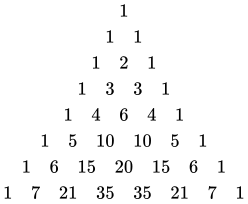
In mathematics, Pascal's triangle is an infinite triangular array of the binomial coefficients which play a crucial role in probability theory, combinatorics, and algebra. In much of the Western world, it is named after the French mathematician Blaise Pascal, although other mathematicians studied it centuries before him in Persia,[1] India,[2] China, Germany, and Italy.[3]
The rows of Pascal's triangle are conventionally enumerated starting with row at the top (the 0th row). The entries in each row are numbered from the left beginning with and are usually staggered relative to the numbers in the adjacent rows. The triangle may be constructed in the following manner: In row 0 (the topmost row), there is a unique nonzero entry 1. Each entry of each subsequent row is constructed by adding the number above and to the left with the number above and to the right, treating blank entries as 0. For example, the initial number of row 1 (or any other row) is 1 (the sum of 0 and 1), whereas the numbers 1 and 3 in row 3 are added to produce the number 4 in row 4.


Formula
[edit]
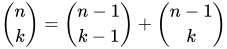
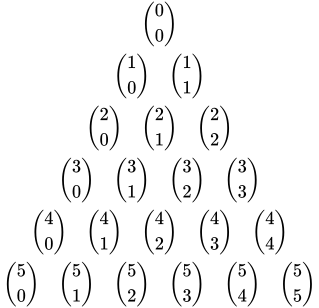
In the th row of Pascal's triangle, the th entry is denoted , pronounced "n choose k". For example, the topmost entry is . With this notation, the construction of the previous paragraph may be written as


for any positive integer and any integer .[4] This recurrence for the binomial coefficients is known as Pascal's rule.

History
[edit]

The pattern of numbers that forms Pascal's triangle was known well before Pascal's time. The Persian mathematician Al-Karaji (953–1029) wrote a now-lost book which contained the first description of Pascal's triangle.[5][6][7] In India, the Chandaḥśāstra by the Indian poet and mathematician Piṅgala (3rd or 2nd century BC) somewhat cryptically describes a method of arranging two types of syllables to form metres of various lengths and counting them; as interpreted and elaborated by Piṅgala's 10th-century commentator Halāyudha his "method of pyramidal expansion" (meru-prastāra) for counting metres is equivalent to Pascal's triangle.[8] It was later repeated by Omar Khayyám (1048–1131), another Persian mathematician; thus the triangle is also referred to as Khayyam's triangle (مثلث خیام) in Iran.[9] Several theorems related to the triangle were known, including the binomial theorem. Khayyam used a method of finding nth roots based on the binomial expansion, and therefore on the binomial coefficients.[1]
Pascal's triangle was known in China during the 11th century through the work of the Chinese mathematician Jia Xian (1010–1070). During the 13th century, Yang Hui (1238–1298) defined the triangle, and it is known as Yang Hui's triangle (杨辉三角; 楊輝三角) in China.[10]
In Europe, Pascal's triangle appeared for the first time in the Arithmetic of Jordanus de Nemore (13th century).[11] The binomial coefficients were calculated by Gersonides during the early 14th century, using the multiplicative formula for them.[12] Petrus Apianus (1495–1552) published the full triangle on the frontispiece of his book on business calculations in 1527.[13] Michael Stifel published a portion of the triangle (from the second to the middle column in each row) in 1544, describing it as a table of figurate numbers.[12] In Italy, Pascal's triangle is referred to as Tartaglia's triangle, named for the Italian algebraist Tartaglia (1500–1577), who published six rows of the triangle in 1556.[12] Gerolamo Cardano also published the triangle as well as the additive and multiplicative rules for constructing it in 1570.[12]
Pascal's Traité du triangle arithmétique (Treatise on Arithmetical Triangle) was published posthumously in 1665.[14] In this, Pascal collected several results then known about the triangle, and employed them to solve problems in probability theory. The triangle was later named for Pascal by Pierre Raymond de Montmort (1708) who called it table de M. Pascal pour les combinaisons (French: Mr. Pascal's table for combinations) and Abraham de Moivre (1730) who called it Triangulum Arithmeticum PASCALIANUM (Latin: Pascal's Arithmetic Triangle), which became the basis of the modern Western name.[15]
Binomial expansions
[edit]
Pascal's triangle determines the coefficients which arise in binomial expansions. For example, in the expansion the coefficients are the entries in the second row of Pascal's triangle: , , .


In general, the binomial theorem states that when a binomial like is raised to a positive integer power , the expression expands as where the coefficients are precisely the numbers in row of Pascal's triangle:


The entire left diagonal of Pascal's triangle corresponds to the coefficient of in these binomial expansions, while the next left diagonal corresponds to the coefficient of , and so on.


To see how the binomial theorem relates to the simple construction of Pascal's triangle, consider the problem of calculating the coefficients of the expansion of in terms of the corresponding coefficients of , where we set for simplicity. Suppose then that Now



The two summations can be reindexed with and combined to yield

![{\displaystyle {\begin{aligned}\sum _{i=0}^{n}a_{i}x^{i+1}+\sum _{k=0}^{n}a_{k}x^{k}&=\sum _{k=1}^{n+1}a_{k-1}x^{k}+\sum _{k=0}^{n}a_{k}x^{k}\\[4pt]&=\sum _{k=1}^{n}a_{k-1}x^{k}+a_{n}x^{n+1}+a_{0}x^{0}+\sum _{k=1}^{n}a_{k}x^{k}\\[4pt]&=a_{0}x^{0}+\sum _{k=1}^{n}(a_{k-1}+a_{k})x^{k}+a_{n}x^{n+1}\\[4pt]&=x^{0}+\sum _{k=1}^{n}(a_{k-1}+a_{k})x^{k}+x^{n+1}.\end{aligned}}}](https://wikimedia.org/api/rest_v1/media/math/render/svg/59f83ea31ae9d776cc212f7a369d19a022b74408)
Thus the extreme left and right coefficients remain as 1, and for any given , the coefficient of the term in the polynomial is equal to , the sum of the and coefficients in the previous power . This is indeed the downward-addition rule for constructing Pascal's triangle.


It is not difficult to turn this argument into a proof (by mathematical induction) of the binomial theorem.
Since , the coefficients are identical in the expansion of the general case.

An interesting consequence of the binomial theorem is obtained by setting both variables , so that


In other words, the sum of the entries in the th row of Pascal's triangle is the th power of 2. This is equivalent to the statement that the number of subsets of an -element set is , as can be seen by observing that each of the elements may be independently included or excluded from a given subset.

Combinations
[edit]A second useful application of Pascal's triangle is in the calculation of combinations. The number of combinations of items taken at a time, i.e. the number of subsets of elements from among elements, can be found by the equation
- .

This is equal to entry in row of Pascal's triangle. Rather than performing the multiplicative calculation, one can simply look up the appropriate entry in the triangle (constructed by additions). For example, suppose 3 workers need to be hired from among 7 candidates; then the number of possible hiring choices is 7 choose 3, the entry 3 in row 7 of the above table (taking into consideration the first row is the 0th row), which is .[16]

Relation to binomial distribution and convolutions
[edit]When divided by , the th row of Pascal's triangle becomes the binomial distribution in the symmetric case where . By the central limit theorem, this distribution approaches the normal distribution as increases. This can also be seen by applying Stirling's formula to the factorials involved in the formula for combinations.

This is related to the operation of discrete convolution in two ways. First, polynomial multiplication corresponds exactly to discrete convolution, so that repeatedly convolving the sequence with itself corresponds to taking powers of , and hence to generating the rows of the triangle. Second, repeatedly convolving the distribution function for a random variable with itself corresponds to calculating the distribution function for a sum of n independent copies of that variable; this is exactly the situation to which the central limit theorem applies, and hence results in the normal distribution in the limit. (The operation of repeatedly taking a convolution of something with itself is called the convolution power.)


Patterns and properties
[edit]Pascal's triangle has many properties and contains many patterns of numbers.


Rows
[edit]- The sum of the elements of a single row is twice the sum of the row preceding it. For example, row 0 (the topmost row) has a value of 1, row 1 has a value of 2, row 2 has a value of 4, and so forth. This is because every item in a row produces two items in the next row: one left and one right. The sum of the elements of row equals to .
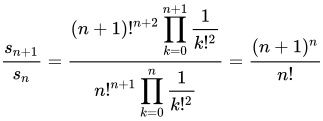
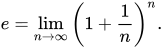
- Taking the product of the elements in each row, the sequence of products (sequence A001142 in the OEIS) is related to the base of the natural logarithm, e.[17][18] Specifically, define the sequence for all as follows: Then, the ratio of successive row products is and the ratio of these ratios is The right-hand side of the above equation takes the form of the limit definition of
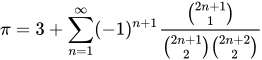
- can be found in Pascal's triangle by use of the Nilakantha infinite series.[19]
- Some of the numbers in Pascal's triangle correlate to numbers in Lozanić's triangle.
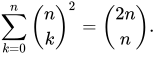
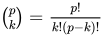
- The sum of the squares of the elements of row n equals the middle element of row 2n. For example, 12 + 42 + 62 + 42 + 12 = 70. In general form,
- In any even row , the middle term minus the term two spots to the left equals a Catalan number, specifically . For example, in row 4, which is 1, 4, 6, 4, 1, we get the 3rd Catalan number .
- In a row p, where p is a prime number, all the terms in that row except the 1s are divisible by p. This can be proven easily, from the multiplicative formula . Since the denominator can have no prime factors equal to p, so p remains in the numerator after integer division, making the entire entry a multiple of p.
- Parity: To count odd terms in row n, convert n to binary. Let x be the number of 1s in the binary representation. Then the number of odd terms will be 2x. These numbers are the values in Gould's sequence.[20]
- Every entry in row 2n − 1, n ≥ 0, is odd.[21]
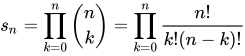
- Polarity: When the elements of a row of Pascal's triangle are alternately added and subtracted together, the result is 0. For example, row 6 is 1, 6, 15, 20, 15, 6, 1, so the formula is 1 − 6 + 15 − 20 + 15 − 6 + 1 = 0.









Diagonals
[edit]
The diagonals of Pascal's triangle contain the figurate numbers of simplices:
- The diagonals going along the left and right edges contain only 1's.
- The diagonals next to the edge diagonals contain the natural numbers in order. The 1-dimensional simplex numbers increment by 1 as the line segments extend to the next whole number along the number line.
- Moving inwards, the next pair of diagonals contain the triangular numbers in order.
- The next pair of diagonals contain the tetrahedral numbers in order, and the next pair give pentatope numbers.
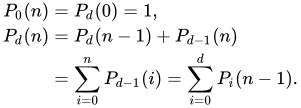
The symmetry of the triangle implies that the nth d-dimensional number is equal to the dth n-dimensional number.
An alternative formula that does not involve recursion is where n(d) is the rising factorial.

The geometric meaning of a function Pd is: Pd(1) = 1 for all d. Construct a d-dimensional triangle (a 3-dimensional triangle is a tetrahedron) by placing additional dots below an initial dot, corresponding to Pd(1) = 1. Place these dots in a manner analogous to the placement of numbers in Pascal's triangle. To find Pd(x), have a total of x dots composing the target shape. Pd(x) then equals the total number of dots in the shape. A 0-dimensional triangle is a point and a 1-dimensional triangle is simply a line, and therefore P0(x) = 1 and P1(x) = x, which is the sequence of natural numbers. The number of dots in each layer corresponds to Pd − 1(x).
Calculating a row or diagonal by itself
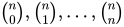
[edit]There are simple algorithms to compute all the elements in a row or diagonal without computing other elements or factorials.
To compute row with the elements , begin with . For each subsequent element, the value is determined by multiplying the previous value by a fraction with slowly changing numerator and denominator:

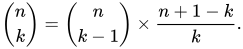
For example, to calculate row 5, the fractions are , , , and , and hence the elements are , , , etc. (The remaining elements are most easily obtained by symmetry.)


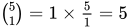
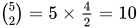
To compute the diagonal containing the elements begin again with and obtain subsequent elements by multiplication by certain fractions:


For example, to calculate the diagonal beginning at , the fractions are , and the elements are , etc. By symmetry, these elements are equal to , etc.





Overall patterns and properties
[edit]
- The pattern obtained by coloring only the odd numbers in Pascal's triangle closely resembles the fractal known as the Sierpiński triangle. This resemblance becomes increasingly accurate as more rows are considered; in the limit, as the number of rows approaches infinity, the resulting pattern is the Sierpiński triangle, assuming a fixed perimeter. More generally, numbers could be colored differently according to whether or not they are multiples of 3, 4, etc.; this results in other similar patterns.
- As the proportion of black numbers tends to zero with increasing n, a corollary is that the proportion of odd binomial coefficients tends to zero as n tends to infinity.[22]

|

|

|
|
|
|

|

|

|
|
|
|

|
10 |
|
|
|
10 | 20 |
Pascal's triangle overlaid on a grid gives the number of distinct paths to each square, assuming only rightward and downward steps to an adjacent square are considered.
- In a triangular portion of a grid (as in the images below), the number of shortest grid paths from a given node to the top node of the triangle is the corresponding entry in Pascal's triangle. On a Plinko game board shaped like a triangle, this distribution should give the probabilities of winning the various prizes.

- If the rows of Pascal's triangle are left-justified, the diagonal bands (colour-coded below) sum to the Fibonacci numbers.
1 1 1 1 2 1 1 3 3 1 1 4 6 4 1 1 5 10 10 5 1 1 6 15 20 15 6 1 1 7 21 35 35 21 7 1
Construction as matrix exponential
[edit]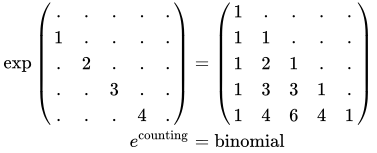
Due to its simple construction by factorials, a very basic representation of Pascal's triangle in terms of the matrix exponential can be given: Pascal's triangle is the exponential of the matrix which has the sequence 1, 2, 3, 4, ... on its sub-diagonal and zero everywhere else.
Construction of Clifford algebra using simplices
[edit]Labelling the elements of each n-simplex matches the basis elements of Clifford algebra used as forms in Geometric Algebra rather than matrices. Recognising the geometric operations, such as rotations, allows the algebra operations to be discovered. Just as each row, n, starting at 0, of Pascal's triangle corresponds to an (n-1)-simplex, as described below, it also defines the number of named basis forms in n dimensional Geometric algebra. The binomial theorem can be used to prove the geometric relationship provided by Pascal's triangle.[23] This same proof could be applied to simplices except that the first column of all 1's must be ignored whereas in the algebra these correspond to the real numbers, , with basis 1.

Relation to geometry of polytopes
[edit] | This section needs additional citations for verification. (February 2025) |
Each row of Pascal's triangle gives the number of elements (such as edges and corners) of each dimension in a corresponding simplex (such as a triangle or tetrahedron). In particular, for k > 0, the kth entry in the nth row is the number of (k − 1)-dimensional elements in a (n − 1)-dimensional simplex. For example, a triangle (the 2-dimensional simplex) one 2-dimensional element (itself), three 1-dimensional elements (lines, or edges), and three 0-dimensional elements (vertices, or corners); this corresponds to the third row 1, 3, 3, 1 of Pascal's triangle. This fact can be explained by combining Pascal's rule for generating the triangle with the geometric construction of simplices: each simplex is formed from a simplex of one lower dimension by the addition of a new vertex, outside the space in which the lower-dimensional simplex lies. Then each d-dimensional element in the smaller simplex remains a d-dimensional element of the higher simplex, and each (d − 1)-dimensional element when joined to the new vertex forms a new d-dimensional element of the higher simplex.[24]
A similar pattern is observed relating to squares, as opposed to triangles. To find the pattern, one must construct an analog to Pascal's triangle, whose entries are the coefficients of (x + 2)row number, instead of (x + 1)row number. There are a couple ways to do this. The simpler is to begin with row 0 = 1 and row 1 = 1, 2. Proceed to construct the analog triangles according to the following rule:

That is, choose a pair of numbers according to the rules of Pascal's triangle, but double the one on the left before adding. This results in:
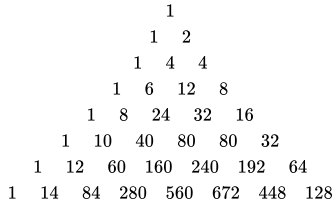
The other way of producing this triangle is to start with Pascal's triangle and multiply each entry by 2k, where k is the position in the row of the given number. For example, the 2nd value in row 4 of Pascal's triangle is 6 (the slope of 1s corresponds to the zeroth entry in each row). To get the value that resides in the corresponding position in the analog triangle, multiply 6 by 2position number = 6 × 22 = 6 × 4 = 24. Now that the analog triangle has been constructed, the number of elements of any dimension that compose an arbitrarily dimensioned cube (called a hypercube) can be read from the table in a way analogous to Pascal's triangle. For example, the number of 2-dimensional elements in a 2-dimensional cube (a square) is one, the number of 1-dimensional elements (sides, or lines) is 4, and the number of 0-dimensional elements (points, or vertices) is 4. This matches the 2nd row of the table (1, 4, 4). A cube has 1 cube, 6 faces, 12 edges, and 8 vertices, which corresponds to the next line of the analog triangle (1, 6, 12, 8). This pattern continues indefinitely.
To understand why this pattern exists, first recognize that the construction of an n-cube from an (n − 1)-cube is done by simply duplicating the original figure and displacing it some distance (for a regular n-cube, the edge length) orthogonal to the space of the original figure, then connecting each vertex of the new figure to its corresponding vertex of the original. This initial duplication process is the reason why, to enumerate the dimensional elements of an n-cube, one must double the first of a pair of numbers in a row of this analog of Pascal's triangle before summing to yield the number below. The initial doubling thus yields the number of "original" elements to be found in the next higher n-cube and, as before, new elements are built upon those of one fewer dimension (edges upon vertices, faces upon edges, etc.). Again, the last number of a row represents the number of new vertices to be added to generate the next higher n-cube.
In this triangle, the sum of the elements of row m is equal to 3m. Again, to use the elements of row 4 as an example: 1 + 8 + 24 + 32 + 16 = 81, which is equal to .

Counting vertices in a cube by distance
[edit]Each row of Pascal's triangle gives the number of vertices at each distance from a fixed vertex in an n-dimensional cube. For example, in three dimensions, the third row (1 3 3 1) corresponds to the usual three-dimensional cube: fixing a vertex V, there is one vertex at distance 0 from V (that is, V itself), three vertices at distance 1, three vertices at distance √2 and one vertex at distance √3 (the vertex opposite V). The second row corresponds to a square, while larger-numbered rows correspond to hypercubes in each dimension.
Fourier transform of sin(x)n+1/x
[edit]As stated previously, the coefficients of (x + 1)n are the nth row of the triangle. Now the coefficients of (x − 1)n are the same, except that the sign alternates from +1 to −1 and back again. After suitable normalization, the same pattern of numbers occurs in the Fourier transform of sin(x)n+1/x. More precisely: if n is even, take the real part of the transform, and if n is odd, take the imaginary part. Then the result is a step function, whose values (suitably normalized) are given by the nth row of the triangle with alternating signs.[25] For example, the values of the step function that results from:
![{\displaystyle {\mathfrak {Re}}\left({\text{Fourier}}\left[{\frac {\sin(x)^{5}}{x}}\right]\right)}](https://wikimedia.org/api/rest_v1/media/math/render/svg/ad6e29379e5b19bf4bb2a63fdc243c4efdad7466)
compose the 4th row of the triangle, with alternating signs. This is a generalization of the following basic result (often used in electrical engineering):
![{\displaystyle {\mathfrak {Re}}\left({\text{Fourier}}\left[{\frac {\sin(x)^{1}}{x}}\right]\right)}](https://wikimedia.org/api/rest_v1/media/math/render/svg/e746ebf87e79d0988f2c1db9a780b67380b73b42)
is the boxcar function.[26] The corresponding row of the triangle is row 0, which consists of just the number 1.
If n is congruent to 2 or to 3 mod 4, then the signs start with −1. In fact, the sequence of the (normalized) first terms corresponds to the powers of i, which cycle around the intersection of the axes with the unit circle in the complex plane:

Extensions
[edit]Pascal's triangle may be extended upwards, above the 1 at the apex, preserving the additive property, but there is more than one way to do so.[27]
To higher dimensions
[edit]Pascal's triangle has higher dimensional generalizations. The three-dimensional version is known as Pascal's pyramid or Pascal's tetrahedron, while the general versions are known as Pascal's simplices.
To complex numbers
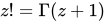
[edit]When the factorial function is defined as , Pascal's triangle can be extended beyond the integers to , since is meromorphic to the entire complex plane.[28]


To arbitrary bases
[edit]Isaac Newton once observed that the first five rows of Pascal's triangle, when read as the digits of an integer, are the corresponding powers of eleven. He claimed without proof that subsequent rows also generate powers of eleven.[29] In 1964, Robert L. Morton presented the more generalized argument that each row can be read as a radix numeral, where is the hypothetical terminal row, or limit, of the triangle, and the rows are its partial products.[30] He proved the entries of row , when interpreted directly as a place-value numeral, correspond to the binomial expansion of . More rigorous proofs have since been developed.[31][32] To better understand the principle behind this interpretation, here are some things to recall about binomials:



- A radix numeral in positional notation (e.g. ) is a univariate polynomial in the variable , where the degree of the variable of the th term (starting with ) is . For example, .
- A row corresponds to the binomial expansion of . The variable can be eliminated from the expansion by setting . The expansion now typifies the expanded form of a radix numeral,[33][34] as demonstrated above. Thus, when the entries of the row are concatenated and read in radix they form the numerical equivalent of . If for , then the theorem holds for , with congruent to , and with odd values of yielding negative row products.[35][36][37]


By setting the row's radix (the variable ) equal to one and ten, row becomes the product and , respectively. To illustrate, consider , which yields the row product . The numeric representation of is formed by concatenating the entries of row . The twelfth row denotes the product:





with compound digits (delimited by ":") in radix twelve. The digits from through are compound because these row entries compute to values greater than or equal to twelve. To normalize[38] the numeral, simply carry the first compound entry's prefix, that is, remove the prefix of the coefficient from its leftmost digit up to, but excluding, its rightmost digit, and use radix-twelve arithmetic to sum the removed prefix with the entry on its immediate left, then repeat this process, proceeding leftward, until the leftmost entry is reached. In this particular example, the normalized string ends with for all . The leftmost digit is for , which is obtained by carrying the of at entry . It follows that the length of the normalized value of is equal to the row length, . The integral part of contains exactly one digit because (the number of places to the left the decimal has moved) is one less than the row length. Below is the normalized value of . Compound digits remain in the value because they are radix residues represented in radix ten:



See also
[edit]- Bean machine, Francis Galton's "quincunx"
- Bell triangle
- Bernoulli's triangle
- Binomial expansion
- Cellular automata
- Euler triangle
- Floyd's triangle
- Gaussian binomial coefficient
- Hockey-stick identity
- Leibniz harmonic triangle
- Multiplicities of entries in Pascal's triangle (Singmaster's conjecture)
- Pascal matrix
- Pascal's pyramid
- Pascal's simplex
- Proton NMR, one application of Pascal's triangle
- Star of David theorem
- Trinomial expansion
- Trinomial triangle
- Polynomials calculating sums of powers of arithmetic progressions
References
[edit]- ^ a b Coolidge, J. L. (1949), "The story of the binomial theorem", The American Mathematical Monthly, 56 (3): 147–157, doi:10.2307/2305028, JSTOR 2305028, MR 0028222.
- ^ Maurice Winternitz, History of Indian Literature, Vol. III
- ^ Peter Fox (1998). Cambridge University Library: the great collections. Cambridge University Press. p. 13. ISBN 978-0-521-62647-7.
- ^ The binomial coefficient is conventionally set to zero if k is either less than zero or greater than n.
- ^ Selin, Helaine (2008-03-12). Encyclopaedia of the History of Science, Technology, and Medicine in Non-Western Cultures. Springer Science & Business Media. p. 132. Bibcode:2008ehst.book.....S. ISBN 9781402045592.
Other, lost works of al-Karaji's are known to have dealt with inderterminate algebra, arithmetic, inheritance algebra, and the construction of buildings. Another contained the first known explanation of the arithmetical (Pascal's) triangle; the passage in question survived through al-Sama'wal's Bahir (twelfth century) which heavily drew from the Badi.
- ^ Rashed, R. (1994-06-30). The Development of Arabic Mathematics: Between Arithmetic and Algebra. Springer Science & Business Media. p. 63. ISBN 978-0-7923-2565-9.
- ^ Sidoli, Nathan; Brummelen, Glen Van (2013-10-30). From Alexandria, Through Baghdad: Surveys and Studies in the Ancient Greek and Medieval Islamic Mathematical Sciences in Honor of J.L. Berggren. Springer Science & Business Media. p. 54. ISBN 9783642367366.
However, the use of binomial coefficients by Islamic mathematicians of the eleventh century, in a context which had deep roots in Islamic mathematics, suggests strongly the table was a local discovery - most probably of al-Karaji."
- ^ Alsdorf, Ludwig (1991) [1933]. "The Pratyayas: Indian Contribution to Combinatorics" (PDF). Indian Journal of History of Science. 26 (1): 17–61. Translated by S. R. Sarma from "π Die Pratyayas. Ein Beitrag zur indischen Mathematik". Zeitschrift für Indologie und Iranistik. 9: 97–157. 1933. Bag, Amulya Kumar (1966). "Binomial theorem in ancient India" (PDF). Indian Journal of History of Science. 1 (1): 68–74. Tertiary sources: Sen, Samarendra Nath (1971). "Mathematics". In Bose, D. M. (ed.). A Concise History Of Science In India. Indian National Science Academy. Ch. 3, pp. 136–212, esp. "Permutations, Combinations and Pascal Triangle", pp. 156–157. Fowler, David H. (1996). "The Binomial Coefficient Function". The American Mathematical Monthly. 103 (1): 1–17, esp. §4 "A Historical Note", pp. 10–17. doi:10.2307/2975209. JSTOR 2975209.
- ^ Kennedy, E. (1966). Omar Khayyam. The Mathematics Teacher 1958. National Council of Teachers of Mathematics. pp. 140–142. JSTOR i27957284.
- ^ Weisstein, Eric W. (2003). CRC concise encyclopedia of mathematics, p. 2169. ISBN 978-1-58488-347-0.
- ^ Hughes, Barnabas (1 August 1989). "The arithmetical triangle of Jordanus de Nemore". Historia Mathematica. 16 (3): 213–223. doi:10.1016/0315-0860(89)90018-9.
- ^ a b c d Edwards, A. W. F. (2013), "The arithmetical triangle", in Wilson, Robin; Watkins, John J. (eds.), Combinatorics: Ancient and Modern, Oxford University Press, pp. 166–180.
- ^ Smith, Karl J. (2010), Nature of Mathematics, Cengage Learning, p. 10, ISBN 9780538737586.
- ^ Pascal, Blaise (1623-1662) Auteur du texte (1665). Traité du triangle arithmétique , avec quelques autres petits traitez sur la mesme matière. Par Monsieur Pascal.
{{cite book}}: CS1 maint: numeric names: authors list (link) - ^ Fowler, David (January 1996). "The Binomial Coefficient Function". The American Mathematical Monthly. 103 (1): 1–17. doi:10.2307/2975209. JSTOR 2975209. See in particular p. 11.
- ^ "Pascal's Triangle in Probability". 5010.mathed.usu.edu. Retrieved 2023-06-01.
- ^ Brothers, H. J. (2012), "Finding e in Pascal's triangle", Mathematics Magazine, 85 (1): 51, doi:10.4169/math.mag.85.1.51, S2CID 218541210.
- ^ Brothers, H. J. (2012), "Pascal's triangle: The hidden stor-e", The Mathematical Gazette, 96 (535): 145–148, doi:10.1017/S0025557200004204, S2CID 233356674.
- ^ Foster, T. (2014), "Nilakantha's Footprints in Pascal's Triangle", Mathematics Teacher, 108: 247, doi:10.5951/mathteacher.108.4.0246
- ^ Fine, N. J. (1947), "Binomial coefficients modulo a prime", American Mathematical Monthly, 54 (10): 589–592, doi:10.2307/2304500, JSTOR 2304500, MR 0023257. See in particular Theorem 2, which gives a generalization of this fact for all prime moduli.
- ^ Hinz, Andreas M. (1992), "Pascal's triangle and the Tower of Hanoi", The American Mathematical Monthly, 99 (6): 538–544, doi:10.2307/2324061, JSTOR 2324061, MR 1166003. Hinz attributes this observation to an 1891 book by Édouard Lucas, Théorie des nombres (p. 420).
- ^ Ian Stewart, "How to Cut a Cake", Oxford University Press, page 180
- ^ Wilmot, G.P. (2023), The Algebra Of Geometry
- ^ Coxeter, Harold Scott Macdonald (1973-01-01). "Chapter VII: ordinary polytopes in higher space, 7.2: Pyramids, dipyramids and prisms". Regular Polytopes (3rd ed.). Courier Corporation. pp. 118–144. ISBN 978-0-486-61480-9.
- ^ For a similar example, see e.g. Hore, P. J. (1983), "Solvent suppression in Fourier transform nuclear magnetic resonance", Journal of Magnetic Resonance, 55 (2): 283–300, Bibcode:1983JMagR..55..283H, doi:10.1016/0022-2364(83)90240-8.
- ^ Karl, John H. (2012), An Introduction to Digital Signal Processing, Elsevier, p. 110, ISBN 9780323139595.
- ^ Hilton, P.; et al. (1989). "Extending the binomial coefficients to preserve symmetry and pattern". Symmetry 2. In International Series in Modern Applied Mathematics and Computer Science. Pergamon. pp. 89–102. doi:10.1016/B978-0-08-037237-2.50013-1. ISBN 9780080372372..
- ^ Hilton, P.; et al. (1989). "Extending the binomial coefficients to preserve symmetry and pattern". Symmetry 2. In International Series in Modern Applied Mathematics and Computer Science. Pergamon. pp. 100–102. doi:10.1016/B978-0-08-037237-2.50013-1. ISBN 9780080372372..
- ^ Newton, Isaac (1736), "A Treatise of the Method of Fluxions and Infinite Series", The Mathematical Works of Isaac Newton: 1:31–33,
But these in the alternate areas, which are given, I observed were the same with the figures of which the several ascending powers of the number 11 consist, viz. , , , , , etc. that is, first 1; the second 1, 1; the third 1, 2, 1; the fourth 1, 3, 3, 1; the fifth 1, 4, 6, 4, 1, and so on
. - ^ Morton, Robert L. (1964), "Pascal's Triangle and powers of 11", The Mathematics Teacher, 57 (6): 392–394, doi:10.5951/MT.57.6.0392, JSTOR 27957091.
- ^ Arnold, Robert; et al. (2004), "Newton's Unfinished Business: Uncovering the Hidden Powers of Eleven in Pascal's Triangle", Proceedings of Undergraduate Mathematics Day.
- ^ Islam, Robiul; et al. (2020), Finding any row of Pascal's triangle extending the concept of power of 11.
- ^ Winteridge, David J. (1984), "Pascal's Triangle and Powers of 11", Mathematics in School, 13 (1): 12–13, JSTOR 30213884.
- ^ Kallós, Gábor (2006), "A generalization of Pascal's triangle using powers of base numbers" (PDF), Annales Mathématiques Blaise Pascal, 13 (1): 1–15, doi:10.5802/ambp.211.
- ^ Hilton, P.; et al. (1989). "Extending the binomial coefficients to preserve symmetry and pattern". Symmetry 2. In International Series in Modern Applied Mathematics and Computer Science. Pergamon. pp. 89–91. doi:10.1016/B978-0-08-037237-2.50013-1. ISBN 9780080372372..
- ^ Mueller, Francis J. (1965), "More on Pascal's Triangle and powers of 11", The Mathematics Teacher, 58 (5): 425–428, doi:10.5951/MT.58.5.0425, JSTOR 27957164.
- ^ Low, Leone (1966), "Even more on Pascal's Triangle and Powers of 11", The Mathematics Teacher, 59 (5): 461–463, doi:10.5951/MT.59.5.0461, JSTOR 27957385.
- ^ Fjelstad, P. (1991), "Extending Pascal's Triangle", Computers & Mathematics with Applications, 21 (9): 3, doi:10.1016/0898-1221(91)90119-O.


External links
[edit]- "Pascal triangle", Encyclopedia of Mathematics, EMS Press, 2001 [1994]
- Weisstein, Eric W. "Pascal's triangle". MathWorld.
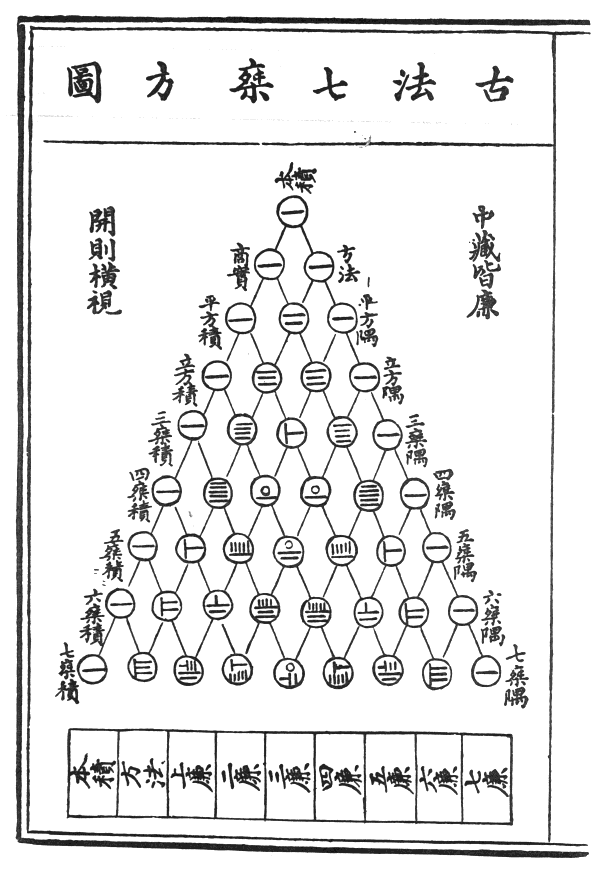
- The Old Method Chart of the Seven Multiplying Squares (from the Ssu Yuan Yü Chien of Chu Shi-Chieh, 1303, depicting the first nine rows of Pascal's triangle)
- Pascal's Treatise on the Arithmetic Triangle (page images of Pascal's treatise, 1654; summary)
| |
|---|---|
| Works |
|
| Family |
|


Pascal's triangle
View on GrokipediaFundamentals
Definition and Construction
Pascal's triangle is an infinite triangular array of the natural numbers, arranged such that each number is the sum of the two numbers directly above it in the previous row.[6] The entries in the triangle are binomial coefficients, denoted as , where is the row index starting from 0 and is the position within the row, ranging from 0 to .[6] Each entry can be explicitly computed using the formula , though the triangle is typically constructed recursively without direct computation of factorials.[6] The construction begins with row 0, which consists of a single entry: 1.[7] Subsequent rows are generated by starting and ending each new row with 1, and filling the interior entries by adding the two adjacent numbers from the row above.[8] This addition rule ensures that the edges of the triangle remain 1s, as there is effectively a 0 outside the boundary, making the sum with the nearest edge entry equal to 1.[7] The recursive relation underlying this construction is , which holds for .[6] The first few rows of Pascal's triangle, up to row 5, illustrate this construction:| Row | Entries |
|---|---|
| 0 | 1 |
| 1 | 1 1 |
| 2 | 1 2 1 |
| 3 | 1 3 3 1 |
| 4 | 1 4 6 4 1 |
| 5 | 1 5 10 10 5 1 |
Basic Formulas
The entries of Pascal's triangle correspond to the binomial coefficients , where the entry in row (with rows indexed starting from ) and position (with ) is given by the explicit formula [9] This formula defines the binomial coefficient for nonnegative integers and , with the factorial denoting the product (and ).[10] The boundary conditions follow directly from this formula: and for all , since the denominator simplifies to in both cases.[9] These entries also satisfy the recursive relation for , with the boundary conditions holding as base cases.[2] This recursion aligns with the additive construction of the triangle, where each interior entry is the sum of the two entries directly above it from the previous row.[2] To see why this recursion yields the binomial coefficients as defined by the factorial formula, consider an algebraic verification. Start with the right-hand side using the explicit formula: A common denominator is , so multiply the first term by and the second by : This confirms that the factorial expression satisfies the recursion, establishing the connection between the additive rule and the closed-form formula.[11]History
Ancient and Medieval Origins
The earliest known references to structures resembling Pascal's triangle appear in ancient Indian mathematics, particularly in the context of prosody and combinatorial enumeration. Around the 3rd to 2nd century BCE, the Sanskrit scholar Pingala, in his work Chandahshastra on poetic meters, described methods for counting the number of possible combinations of short and long syllables in verses, which implicitly involved binomial coefficients through recursive patterns equivalent to entries in the triangle.[12] These combinatorial problems in prosody laid foundational ideas for generating sequences that sum to powers of 2, though Pingala did not present them in triangular form. By the 10th century CE, the commentator Halayudha, in his Abhiseka Tarangini, provided the first explicit triangular array of binomial coefficients, arranging them to enumerate syllable combinations up to the 16th row and recognizing their role in calculating sums like .[13] Halayudha's presentation marked a significant advancement in visualizing these coefficients as a structured table.[14] In China, the triangle emerged independently in the Song dynasty, initially linked to algebraic computations rather than combinatorics. The mathematician Jia Xian, active around the 11th century CE, utilized an arrangement of binomial coefficients—described in his lost treatise Shi Suo Suan Shu (Methods of Interpolation)—to extract roots of polynomials by iteratively applying expansions, effectively employing the triangle to compute higher-order terms in binomial series for solving equations like .[15] This approach represented an early algorithmic use of the structure for numerical approximation, predating explicit visual depictions. Later, in 1261 CE, Yang Hui explicitly illustrated the triangle in his Xiangjie jiuzhang suanfa (Detailed Analysis of the Mathematical Rules in the Nine Chapters), presenting it as a pyramidal array up to 32 rows and commenting on its utility in expanding powers, such as , with applications to multiplication and root extraction.[16] Yang Hui's work provides the earliest surviving visual representation of the triangle in any mathematical text, emphasizing its recursive construction by adding adjacent entries.[17] Persian mathematicians in the Islamic Golden Age also developed related concepts, focusing on algebraic expansions without direct triangular notation. In the 11th century CE, Omar Khayyam employed binomial expansions implicitly in his geometric solutions to cubic and higher-degree equations, using coefficients derived from patterns akin to the triangle to approximate nth roots through iterative methods in works like Al-Jabr wa'l-Muqabala.[18] His approach relied on the underlying arithmetic of binomial coefficients for numerical computations, though he expressed reservations about generalizing the theorem for non-integer exponents. Building on this, Al-Samaw'al al-Maghribi in the 12th century CE, in his Al-Bahir fi al-Jabr, explicitly tabulated binomial coefficients up to the 12th power using a triangular scheme and demonstrated their use in expanding for integer n, attributing the method to earlier scholars like al-Karaji while providing inductive proofs for the expansions.[19] These Persian contributions highlighted the triangle's algebraic potential, particularly for powering binomials. No direct paths of transmission between Indian, Chinese, and Persian traditions are documented, suggesting parallel developments in these cultures.[20]Early Modern Recognition
The European rediscovery of the arithmetical triangle occurred in the mid-16th century, independent of earlier non-European traditions. In 1544, German mathematician Michael Stifel included a table of binomial coefficients—now recognized as part of Pascal's triangle—in his comprehensive algebra text Arithmetica integra, where he employed it to compute expansions of powers and roots.[21] Twelve years later, Italian mathematician Niccolò Tartaglia presented a similar triangular array in his encyclopedic work General trattato di numeri et misure (1556), using it to solve combinatorial problems such as counting permutations and combinations. The most influential early modern treatment came from French mathematician Blaise Pascal, who between late 1653 and early 1654 composed the Traité du triangle arithmétique, a pioneering systematic analysis of the triangle's properties. In this treatise, Pascal explored its construction via recursive addition, derived key identities for sums along rows and diagonals, and demonstrated its utility in enumerating combinations, which he connected to problems in games of chance like dice throws.[22] This work marked the first comprehensive European study linking the triangle to probabilistic reasoning, laying groundwork for later developments in that field.[23] Although circulated in manuscript form among contemporaries during Pascal's lifetime, the Traité received its first full printed publication in 1665, three years after his death, published by the printer Guillaume Desprez as part of a collection of Pascal's mathematical writings.[23][24] Pascal's rigorous exposition elevated the triangle's status in European mathematics, inspiring subsequent scholars; for instance, Gottfried Wilhelm Leibniz drew upon its combinatorial insights in his early work on series and the calculus during the 1670s.[25] The array became widely known as "Pascal's triangle" in the early 18th century, reflecting the enduring impact of his contributions.[26]Combinatorics
Binomial Coefficients
The entries in Pascal's triangle provide a combinatorial interpretation through binomial coefficients, denoted , which count the number of ways to select distinct items from a set of items, where the order of selection does not matter.[27] This selection process, known as combinations, forms the foundation for solving counting problems in combinatorics, such as determining the number of possible teams of a fixed size from a larger group.[28] For instance, the third row of Pascal's triangle, [1, 3, 3, 1], corresponds to , , , and , representing the number of subsets of sizes 0 through 3 from a set with three elements, such as the outcomes of selecting heads or tails in three distinct coin flips without regard to sequence.[2] The sum of the entries in the th row equals , which combinatorially interprets as the total number of subsets possible from an -element set, encompassing all choices from empty to full.[29] This total arises because each element can either be included or excluded independently, yielding possibilities.[30] A key identity involving binomial coefficients is the hockey-stick identity: .[31] Combinatorially, this equates the left side, which sums the ways to choose items from sets of increasing size up to , with the right side, counting the ways to choose items from items.[32] The proof considers selecting elements from the set : let the largest element be where ranges from to ; then the remaining elements must be chosen from , which is exactly for each , summing to the total .[33] Binomial coefficients relate to permutations through the falling factorial, where and n^{\underline{k}} = n(n-1)\cdots(n-k+1} counts the ordered selections (permutations) of items from , divided by to disregard order.[27] However, the primary emphasis in Pascal's triangle remains on the unordered combinations.Binomial Theorem
The binomial theorem expresses the expansion of a binomial raised to a non-negative integer power using coefficients from Pascal's triangle. It states that where is a non-negative integer, and the binomial coefficients are the entries in the -th row of Pascal's triangle, starting from on the left and ending with on the right.[34] A standard proof proceeds by mathematical induction on , relying on the recursive relation , which governs the construction of Pascal's triangle. For the base case , . Assume the statement holds for some fixed : For , The second sum, after substituting , becomes . Aligning indices, the coefficient of in the combined sums is (with boundary terms and ), yielding By induction, the theorem holds for all non-negative integers . The connection to Pascal's triangle is evident in explicit expansions for small , where the coefficients match the triangle's rows exactly. For : , corresponding to row 0: 1. For : , corresponding to row 1: 1 1. For : , corresponding to row 2: 1 2 1. For : , corresponding to row 3: 1 3 3 1. For : , corresponding to row 4: 1 4 6 4 1.[35] The binomial theorem for positive integer exponents was known in ancient India through early combinatorial texts that implicitly used such expansions.[36] Blaise Pascal's Traité du triangle arithmétique (1654) highlighted the triangle's systematic role in generating these coefficients for algebraic expansions.[37]Properties and Patterns
Rows
The entries in the th row of Pascal's triangle, conventionally starting with row 0 as 1, are the binomial coefficients .[6] The sum of the entries in the th row is , which follows from the binomial theorem by substituting into the expansion , yielding .[6][2] This generating function directly encodes the coefficients of the th row, where the power of corresponds to the entry .[38] The central binomial coefficient is the largest entry in the row and provides an asymptotic approximation for the row's scale; by Stirling's formula, for large .[39] For example, the 5th row is 1, 5, 10, 10, 5, 1, with sum and central entry 10, which is close to the approximation .[6]Diagonals
In Pascal's triangle, the shallow diagonals—slanted lines parallel to the triangle's sides, starting from the apex and increasing in length—exhibit sums that correspond to the Fibonacci numbers. The k-th shallow diagonal sums to the k-th Fibonacci number F_k, where the sequence is defined with F_1 = 1, F_2 = 1, F_3 = 2, and so on. For instance, the first shallow diagonal contains only the apex entry 1 (row 0, position 0), summing to 1 = F_1. The second consists of the entry 1 (row 1, position 0), summing to 1 = F_2. The third includes 1 (row 2, position 0) + 1 (row 1, position 1) = 2 = F_3. The fourth consists of 1 (row 3, position 0) + 2 (row 2, position 1) = 3 = F_4. The fifth includes 1 (row 4, position 0) + 3 (row 3, position 1) + 1 (row 2, position 2) = 5 = F_5. The sixth consists of 1 (row 5, position 0) + 4 (row 4, position 1) + 3 (row 3, position 2) = 8 = F_6.[6][40] The parallel diagonals, which run along lines of constant position (fixed column index k, sloping downward), have partial sums up to row n given by binomial coefficients. The first such diagonal (k=0, left edge) consists entirely of 1s, with the sum of the first n+1 entries (rows 0 to n) equal to n+1 = \binom{n+1}{1}. By symmetry, the rightmost parallel diagonal (k = row index) also consists of all 1s, yielding the same partial sum n+1 up to row n. The second parallel diagonal (k=1) contains the entries 1, 2, 3, ..., n (from rows 1 to n), summing to \frac{n(n+1)}{2} = \binom{n+1}{2}. In general, the sum along the k-th parallel diagonal from row k to row n is \sum_{i=k}^n \binom{i}{k} = \binom{n+1}{k+1}.[41][42] The hockey-stick identity specifically describes these sums along the upward (rising) diagonals in Pascal's triangle, named for the visual shape of the summed entries and result when highlighted. It states that \sum_{i=r}^n \binom{i}{r} = \binom{n+1}{r+1}, where the left side aggregates entries along the rising diagonal starting at \binom{r}{r} and proceeding to \binom{n}{r}. This identity, also known as the Christmas stocking theorem, underscores the combinatorial interpretation: the sum counts the ways to choose r+1 elements from n+1 with a distinguished largest element. For example, summing along the rising diagonal from row 2, position 2 (entry 1) to row 5, position 2 (entry 10) gives 1 + 3 + 6 + 10 = 20 = \binom{6}{3}.[43] To illustrate these diagonals, consider Pascal's triangle up to row 10 (rows indexed from 0), shown below in a left-justified format.Row 0: 1
Row 1: 1 1
Row 2: 1 2 1
Row 3: 1 3 3 1
Row 4: 1 4 6 4 1
Row 5: 1 5 10 10 5 1
Row 6: 1 6 15 20 15 6 1
Row 7: 1 7 21 35 35 21 7 1
Row 8: 1 8 28 56 70 56 28 8 1
Row 9: 1 9 36 84 126 126 84 36 9 1
Row 10:1 10 45 120 210 252 210 120 45 10 1
Row 0: 1
Row 1: 1   1
Row 2: 1   2   1
Row 3: 1   3   3   1
Row 4: 1   4   6   4   1
Row 5: 1   5  10  10   5   1
Row 6: 1   6  15  20  15   6   1
Row 7: 1   7  21  35  35  21   7   1
Row 8: 1   8  28  56  70  56  28   8   1
Row 9: 1   9  36  84 126 126  84  36   9   1
Row 10:1  10  45 120 210 252 210 120  45  10   1
Symmetry and Identities
One of the most striking features of Pascal's triangle is its bilateral symmetry, where each entry in row at position equals the entry at position . This is expressed by the identity , reflecting the mirror-image structure of the triangle across its vertical axis. Combinatorially, this symmetry arises because selecting items from is equivalent to selecting the items to exclude from the selection, thus counting the same set of combinations in two ways.[44] A foundational relation in the triangle is Pascal's identity, , which underpins the recursive construction of each row from the previous one by summing adjacent entries. This identity has a natural combinatorial proof: to choose elements from a set of elements, consider a distinguished element; either include it and select from the remaining , or exclude it and select all from the remaining , yielding the sum on the right-hand side.[45][6] Another significant identity involving binomial coefficients is Vandermonde's identity, , which can be interpreted as a convolution relating entries across different rows. Combinatorially, it counts the ways to choose items from a combined set of items divided into two distinguishable groups of sizes and , by summing over the possible numbers chosen from the first group and from the second.[46] When the entries of Pascal's triangle are reduced modulo 2, a fractal pattern emerges, forming the Sierpiński triangle: positions with odd values (1 mod 2) create a self-similar triangular lattice, while even values (0 mod 2) fill the complementary spaces. This structure arises from the property that , leading to recursive replication of the pattern at smaller scales.[47]Algebraic Constructions
One algebraic construction of Pascal's triangle utilizes the lower triangular Pascal matrix, whose entries are the binomial coefficients themselves. The lower triangular Pascal matrix of order is defined with entries for , and 0 otherwise, effectively embedding the first rows of Pascal's triangle along the lower triangle. This matrix can be factored as a product of bidiagonal matrices , where each incorporates the recursive addition from the Pascal identity , providing a structured algebraic build-up of the triangle row by row. Specifically, , with each being a lower bidiagonal matrix with 1s on the diagonal and the first subdiagonal.[48] A related construction involves the infinite bidiagonal transition matrix , which is upper bidiagonal with 1s on the main diagonal and the first superdiagonal (i.e., if or , and 0 otherwise, using 0-based indexing). The powers of this matrix generate the rows of Pascal's triangle through linear transformation of the initial row vector. Starting with the 0th row vector , the nth row vector is , where the kth component of is . The entries of themselves follow for and , with 0 otherwise, directly reflecting the binomial structure across the superdiagonals. This power-based generation aligns with the recursive nature of the triangle while embedding it in matrix exponentiation.[49] In the context of Clifford algebra, Pascal's triangle arises in counting the basis elements of the graded components. For the Clifford algebra generated by n basis vectors, the dimension of the space of k-vectors (homogeneous multivectors of grade k) is , corresponding to the number of ways to choose k orthogonal basis elements for the wedge product. These k-vectors represent oriented k-dimensional simplices in the underlying geometric algebra, with the full algebra dimension . Thus, the entries of the nth row of Pascal's triangle enumerate the basis elements across grades in , providing a combinatorial algebraic structure for simplicial decompositions.[50] Generating functions offer another algebraic viewpoint, particularly for the columns of Pascal's triangle. For the fixed column indexed by k (0-based), the entries for have ordinary generating function . Equivalently, shifting indices to consider , this negative binomial series constructs the column entries as coefficients in the expansion of . This product form highlights the algebraic closure under composition for column-wise representations of the triangle.[51]Applications
Probability and Statistics
Pascal's triangle provides the binomial coefficients that underpin the binomial distribution in probability theory, which models the number of successes in a fixed number of independent Bernoulli trials, each with success probability . The probability mass function is given by where is the entry in the -th position (starting from 0) of the -th row of Pascal's triangle, representing the number of ways to achieve exactly successes in trials. This formulation originates from early probability work, including Pascal's contributions to games of chance in the 1650s, where such coefficients quantified favorable outcomes.[52] For the special case of a fair coin (), the probabilities simplify to , with the row summing to total outcomes. Consider coin flips: the row entries are 1, 10, 45, 120, 210, 252, 210, 120, 45, 10, 1. The probability of exactly 3 heads is , while the maximum probability at 5 heads is . These values illustrate how the triangle directly computes discrete probabilities for repeated trials.[53][52] As grows large, the binomial distribution approximates the normal distribution via the central limit theorem, which states that the standardized sum of independent random variables converges to a standard normal regardless of the underlying distribution. For , the -th row of Pascal's triangle, when centered at and scaled by , visually approaches the bell-shaped curve of the normal distribution , with the theorem ensuring the approximation's accuracy for probabilities near the mean. For instance, in 10,000 fair coin flips, the probability of heads between 4,995 and 5,005 is approximately 0.0797 under the normal approximation. This link highlights Pascal's triangle as a discrete precursor to continuous statistical models.[52] The structure of Pascal's triangle also reflects convolutions in probability, where the binomial distribution for trials is the convolution of identical Bernoulli distributions. In generating function terms, the probability generating function for a single Bernoulli trial is (with ), and for trials it becomes , whose expansion coefficients are , directly yielding the triangle's rows upon repeated multiplication (convolution of coefficients). This convolutional view underscores how successive independent events accumulate via the triangle's additive construction, connecting discrete probability to broader analytic tools.[54]Geometry and Polytopes
Pascal's triangle provides profound geometric insights through its connection to polytopes, where its entries, the binomial coefficients , enumerate structural elements such as faces in simplices and vertices at specific distances in hypercubes. These interpretations highlight how combinatorial counts manifest in spatial configurations of lattice points and convex bodies.[55][56] In the theory of simplices, a fundamental class of polytopes, the binomial coefficients directly count the faces of various dimensions. An -simplex, the convex hull of affinely independent points in , possesses distinct -dimensional faces for . This arises because each -face is determined by selecting of the vertices. For instance, a 2-simplex (triangle) has vertices, edges, and 2-face, mirroring entries in the third row of Pascal's triangle (shifted by index). This facial enumeration extends the combinatorial structure of Pascal's triangle to the topology of simplicial complexes.[55][57] Hypercubes offer another geometric lens, where vertices correspond to lattice points in . The number of vertices at Manhattan (or Hamming) distance from the origin is precisely , as each such vertex has exactly coordinates equal to 1. This distribution partitions the vertices of the -cube into layers based on distance, with the -th layer size given by the central entries of the -th row of Pascal's triangle. For a concrete example, the 3-dimensional cube has 8 vertices: 1 at distance 0, 3 at distance 1, 3 at distance 2, and 1 at distance 3, exactly matching the fourth row . This vertex stratification underscores the role of binomial coefficients in dissecting hypercube geometry.[56][58] In higher dimensions, these connections generalize through tools like Ehrhart polynomials, which count lattice points in dilates of polytopes and reveal binomial structures for simplices. The Ehrhart polynomial of the standard -simplex is , where is the dilation factor; expanding this yields coefficients that are themselves binomial coefficients, linking the polytope's lattice point growth directly to Pascal's triangle. These higher-dimensional ties emphasize Pascal's triangle as a blueprint for polytope enumeration beyond low dimensions.[59]Analysis and Transforms
One notable connection between Pascal's triangle and analytic transforms arises through cardinal B-splines, where the Fourier transform of the th-order cardinal B-spline function is given by , up to a normalization factor.[60] This transform relates directly to the binomial coefficients, as the explicit formula for the centered cardinal B-spline is , featuring alternating binomial coefficients from row of Pascal's triangle.[61] The inverse relation implies that the Fourier transform of yields a piecewise polynomial whose knots and coefficients encode the structure of Pascal's triangle rows. In analytic contexts, ordinary generating functions provide a bridge to continuous analysis, with the th row of Pascal's triangle generating the expansion , whose analytic continuation and radius of convergence facilitate series manipulations in complex analysis. A continuous analog emerges via the beta function, which provides integral representations for binomial coefficients: specifically, , derived from . This representation underscores Pascal's triangle entries as discrete counterparts to beta integrals, enabling approximations in probabilistic limits and moment calculations.[63]Generalizations
Higher Dimensions
Pascal's triangle generalizes to higher dimensions through multidimensional arrays of multinomial coefficients, which extend the binomial coefficients to distributions among more than two categories.[64] In three dimensions, this structure is known as Pascal's pyramid or tetrahedron, where each entry in the nth layer is a trinomial coefficient given by the multinomial formula , with and . These coefficients arise in the multinomial theorem for expanding .[64] The pyramid is arranged such that each layer forms a triangle with entries, and interior values are sums of three adjacent entries from the layer above, analogous to the additive rule in Pascal's triangle.[65] The first few layers of Pascal's pyramid illustrate this structure, with entries labeled by their multi-indices :| Layer | Entries (in order of increasing , then ) |
|---|---|
| 0 | 1 () |
| 1 | 1 (), 1 (), 1 () |
| 2 | 1 (), 2 (), 2 (), 1 (), 2 (), 1 () |
| 3 | 1 (), 3 (), 3 (), 3 (), 6 (), 3 (), 1 (), 3 (), 3 (), 1 () |
Non-Standard Entries
Pascal's triangle entries can be generalized beyond non-negative integers by extending the binomial coefficients to negative and non-integer values, enabling the construction of "rows" for non-standard indices. For negative upper indices -n where n is a positive integer, the entries are the negative binomial coefficients defined by the formula for k = 0, 1, 2, \dots. These coefficients appear in the generating function expansion of (1 - x)^{-n} = \sum_{k=0}^\infty \binom{-n}{k} (-x)^k, which is a fundamental series in combinatorics and analysis.[68] This extension preserves the recursive relation of Pascal's triangle, where each entry is the sum of the two above it from the previous row, but now yields alternating signs and growing magnitudes. A concrete example is the row for index -1, where \binom{-1}{k} = (-1)^k, producing the infinite sequence 1, -1, 1, -1, \dots starting from k=0. This row corresponds to the geometric series expansion (1 + x)^{-1} = \sum_{k=0}^\infty (-1)^k x^k, illustrating how non-standard entries facilitate the representation of rational functions as power series. Such rows are applied in probability generating functions for negative binomial distributions and in solving recurrence relations with negative parameters.[38] Further generalization to complex or non-integer upper indices z employs the gamma function to define for nonnegative integer k, extending the factorial via \Gamma(m+1) = m! for positive integers m. This formulation allows computation of triangle entries for arbitrary z \in \mathbb{C}, supporting applications in complex analysis and special functions. The resulting series \sum_{k=0}^\infty \binom{z}{k} x^k = (1 + x)^z converges absolutely for |x| < 1, with the radius of convergence determined by the distance to the nearest branch point at x = -1.[69]Arbitrary Bases
Pascal's triangle can be generalized to an arbitrary integer base by constructing a triangular array where each interior entry is the sum of the adjacent entries directly above it from the previous row, with edge entries summing fewer terms (padded implicitly with zeros). These entries correspond to the -nomial coefficients, which are the multinomial coefficients arising in the expansion of . The sum of the entries in the th row equals , reflecting the evaluation of the polynomial at . This construction extends the standard binomial case (where ) to higher-order expansions. For base , known as the trinomial triangle, the rows are generated as follows:- Row 0:
- Row 1:
- Row 2:
- Row 3:
References
- https://www.[researchgate](/page/ResearchGate).net/publication/229344775_Moments_and_Fourier_transforms_of_B-splines