Hubbry Logo
PenknifePenknifeMain
Open search
Penknife
Community hub
Penknife
logo
8 pages, 0 posts
0 subscribers
Be the first to start a discussion here.
Penknife
Penknife
from Wikipedia
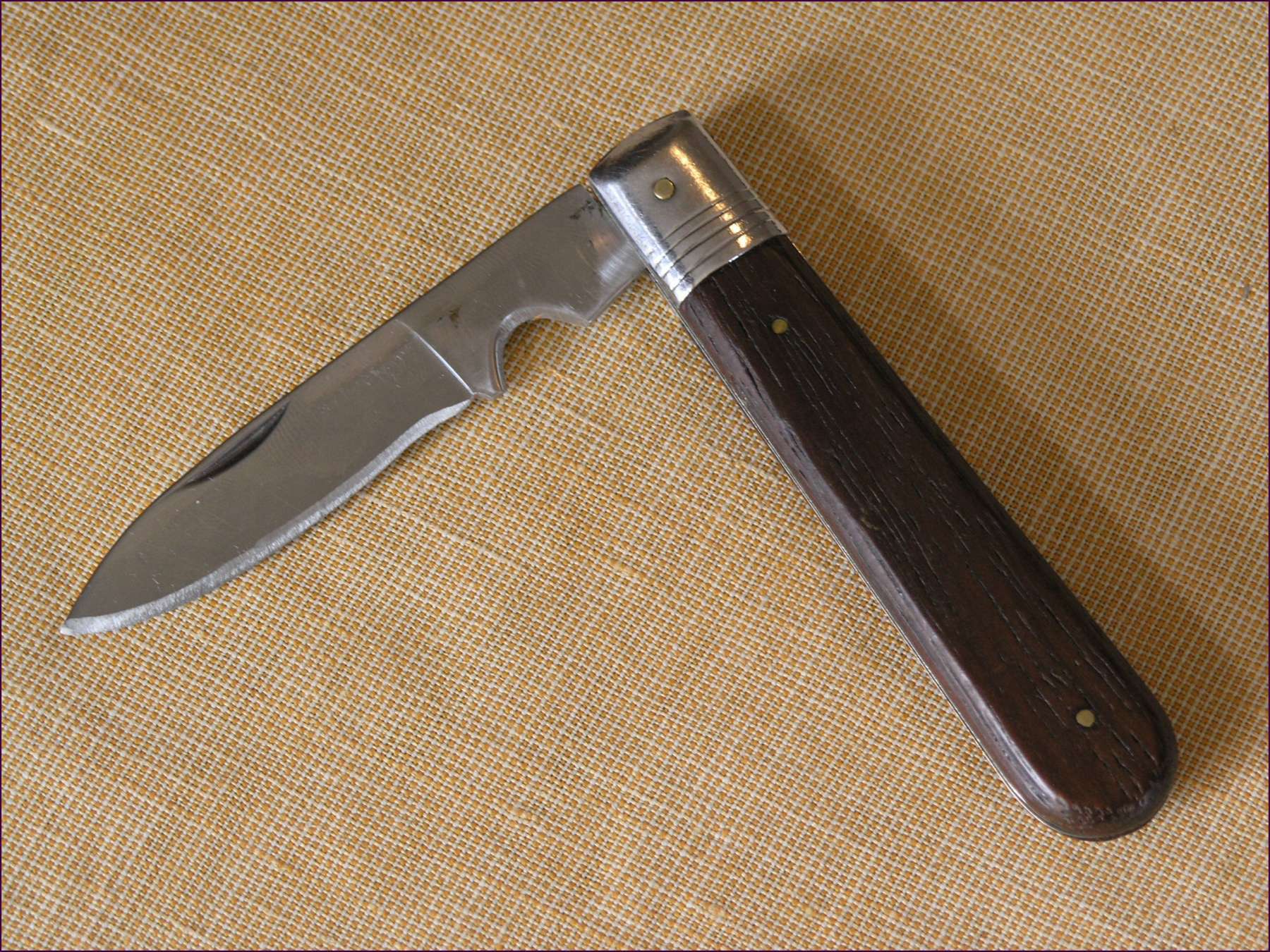
A simple penknife
A 16th century depiction of using a penknife on a quill

Penknife, or pen knife, is a small folding knife.[1] Today penknife is also the common British English term for both a pocketknife, which can have single or multiple blades, and for multi-tools, with additional tools incorporated into the design.[2]

History

[edit]

Originally, penknives were used for thinning and pointing quills (cf. penna, Latin for feather) to prepare them for use as dip pens and, later, for repairing or re-pointing the nib.[1] A penknife might also be used to sharpen a pencil,[3] prior to the invention of the pencil sharpener. In the mid-1800s, penknives were necessary to slice the uncut edges of newspapers and books.[4]

A penknife did not necessarily have a folding blade, but might resemble a scalpel or chisel by having a short, fixed blade at the end of a long handle.[citation needed]

During the 20th century there was a proliferation of multi-function pocketknives with assorted blades and gadgets,[5] the most famous of which is the Swiss Army knife, referred to in British English as penknives.

A larger folding knife than a penknife, especially one in which the blade locks into place as a protection, as for skinning animals, is referred to by some as a claspknife.[5]

See also

[edit]

References

[edit]
Revisions and contributorsEdit on WikipediaRead on Wikipedia
from Grokipedia
A penknife is a small folding knife, typically with one or more blades that fold into the handle for compact portability, originally designed for making, mending, and sharpening pens used in writing. The term originates from "penne-knif," coined in the early from "pen" (referring to a or writing instrument) and "," reflecting its initial specialized purpose in an era when pens required regular trimming to maintain a functional point. Historically, penknives evolved from fixed-blade tools with long handles, as seen in early designs for preparation, to folding mechanisms by the late , enhancing their convenience for and multifunctionality. Archaeological finds, such as a folding penknife dated to around 1600 discovered in , , bear cutlers' marks like the , indicating craftsmanship by members of guilds such as the Cutlers' Company in . By the 18th century, production centers like became renowned for penknives, with directories listing specialized makers who produced both sheathed versions for pen repair and pocket-style folding knives; examples include incidents and inventories from the 1730s onward documenting their use in daily life and even violence. In modern usage, particularly in , "penknife" serves as a general term for any small pocket suitable for pocket carry, often featuring non-locking blades under 3 inches to comply with legal restrictions on carrying folding knives without justification. In , it more narrowly denotes a compact, single-bladed folding , distinct from variants like the , though both share the folding heritage. Historical collections, such as those at the and the , preserve examples from the 19th and early 20th centuries, including ornate versions with materials like mother-of-pearl or handles, underscoring the penknife's transition from a writing accessory to a versatile everyday tool. Beyond utility, penknives featured in cultural practices, such as the 17th-century game , where players tossed the into the ground to perform skillful feats.

Etymology and Definition

Origin of the Term

The term "penknife" originates from , where it was formed by compounding "pen," referring to a pen, and "knife," denoting a small used specifically for shaping and repairing quills before 1425. This etymology reflects the tool's primary function in preparing writing instruments from feathers, as quills required precise cutting to form a functional nib. The earliest recorded use of "penknife" appears in the Medulla Grammatice, a late medieval Latin-English dictionary compiled around the 1420s, underscoring its association with scholarly and scribal practices in monastic and academic settings during the period. In this context, the penknife was an essential implement for monks, clerks, and early scholars who relied on pens for production, highlighting its role in the labor-intensive world of medieval . As early as the late , the term had evolved from its specific quill-sharpening connotation to denote a generic small pocket knife, as evidenced by its broader usage in everyday language and literature. This broadening of meaning occurred as writing technologies evolved, allowing "penknife" to encompass versatile personal cutting tools; for instance, referenced it in (c. 1597–1599) as "the edge of a penknife," illustrating its recognition as a in Elizabethan English.

Modern Definition and Distinctions

In contemporary usage, a penknife is defined as a small, portable folding featuring one or more that fold into the handle for compact storage and safe carry. These knives are designed for everyday utility, with blade lengths typically ranging from 2 to under 3 inches to facilitate discreet transportation without compromising functionality. This configuration distinguishes the penknife from bulkier tools, emphasizing portability and ease of use in modern settings. Key distinctions set the penknife apart from other cutting implements. Unlike fixed-blade knives, which lack a folding mechanism and require a sheath for safe handling, a penknife's blades retract fully into the handle, reducing the risk of accidental injury during carry. In contrast to larger pocketknives, which often incorporate multiple blades or tools for versatility, the penknife prioritizes simplicity and a single-bladed focus, making it ideal for precise, low-profile tasks rather than heavy-duty applications. Terminology for the penknife varies regionally, reflecting linguistic differences in English-speaking contexts. In , "penknife" commonly denotes any small folding pocket knife, regardless of blade count, as per the Oxford English Dictionary's current entry. Conversely, in , "pocketknife" is the standard term for similar tools, with "penknife" retaining a narrower of a compact, single-bladed variant, according to Merriam-Webster's definitions. This variation can lead to overlap in everyday language, but both highlight the tool's evolution from its original quill-sharpening role to a general-purpose carry item.

Historical Development

Ancient and Medieval Origins

The earliest evidence of folding knives dates to the in , around 600–500 BC, during the late to early transition. These artifacts, such as the renowned knife, featured an iron blade housed in a or handle with a simple pivot mechanism, allowing the blade to fold into the handle for safe storage and transport. Primarily used as utility tools for cutting and daily tasks, these knives represent an early innovation in portable edged tools, discovered in burial sites associated with the Hallstatt salt mines. During the , folding knife designs advanced around the 1st to 3rd centuries AD, incorporating hinged mechanisms that enhanced portability for travelers, soldiers, and civilians. Artifacts like the folding knife from in modern , dated to the 1st-2nd century AD, exemplify this evolution with a sturdy iron pivoting into a protective handle, often made of , , or , to prevent accidental injury during carriage in pouches or belts. These knives served practical purposes in military camps and urban settings, with examples showing decorative elements such as animal motifs on handles, as seen in comparable Roman finds from sites like in . In the medieval period, from the 12th to 15th centuries, knives gained specialized adoption among European scholars, s, and monastic communities for preparing writing quills from or feathers. These "penknives" were small tools used to trim, slit, and shape feather nibs, ensuring precise flow for illumination and transcription, as documented in monastic inventories and tool descriptions. Evidence from 14th-century Swiss examples, preserved in regional collections, includes compact iron-bladed knives with bone handles, reflecting their role in scholarly pursuits within abbeys and scriptoria across . Artifacts and records from sites like those in the Swiss Knife Valley highlight their utility in daily scribal work, distinct from larger utility knives.

19th and 20th Century Evolution

During the , , , emerged as the global epicenter of production, driven by the and innovations in steel manufacturing that enabled of penknives and pocket knives. The steel process, introduced in 1742, revolutionized steel output, increasing Sheffield's annual production from 200 tonnes to 80,000 tonnes by the 19th century; the , introduced in 1856, further advanced capabilities. Pen and pocket knife making became a dominant trade in the region, with firms like Joseph Rodgers & Sons leading the surge; by 1850, the company had established agents in key markets such as Calcutta, Bombay, and , solidifying its position as Sheffield's largest factory and fueling global trade in folding knives. In the (1837–1901), penknives evolved from single-bladed tools primarily used for sharpening quills into multi-blade designs suited for gentlemen's , incorporating features like nail clippers, scissors, and additional cutting edges for versatility. This shift coincided with the commercialization of fountain pens in the late , which diminished the reliance on quills and transformed the penknife from a specialized writing accessory into a compact for , letter opening, and minor tasks. Sheffield manufacturers, including Rodgers, produced ornate, multi-bladed models that reflected Victorian craftsmanship, often with mother-of-pearl or staghorn handles, appealing to an affluent urban class. The 20th century brought further innovations adapting penknife principles to broader applications, exemplified by the developed by in 1891. Founded by Karl Elsener, secured a contract to supply the Swiss Army with a modular folding knife featuring a main blade, , , and —building on the compact, multi-functional design of traditional penknives but optimized for military needs. Following , traditional penknives experienced a decline in prominence as disposable utility tools, such as replaceable-blade knives like the Stanley model introduced in the , gained favor for their convenience and low cost in industrial and everyday settings. This shift reflected broader cultural changes toward disposability, reducing demand for heirloom-quality folding knives while sustaining their niche in collectibles and heritage crafts.

Design Features

Components and Mechanisms

The primary components of a penknife include the , , pivot, and liner. The is the cutting element, typically measuring 1 to 3 inches in length with a straight edge designed for precision tasks like trimming or scoring. The , often composed of scales or slabs that form the outer grip, provides a compact for the folded , emphasizing portability. At the junction of the and lies the pivot, a reinforced pin or that allows the blade to rotate smoothly between open and closed positions. Internally, the liner serves as the structural frame, consisting of thin metal plates that support the pivot and other hardware while maintaining the knife's slim profile. Blade deployment in a penknife relies on manual assistance via a nail nick or stud, small indentations or protrusions near the blade's base that enable fingernail or engagement to overcome spring tension and swing the out. Many traditional designs incorporate a half-stop position, where the backspring holds the partially extended—typically at a 90-degree angle—to prevent accidental full deployment from pocket pressure or minor impacts, enhancing safety during carry. The core mechanisms distinguishing penknife operation are the slipjoint and early lockback systems, both prioritizing compactness over robust locking. The slipjoint mechanism uses a curved backspring inside the handle to generate friction against the blade's tang, holding it securely open or closed without a dedicated lock, allowing controlled closure with deliberate force. In contrast, the early lockback mechanism employs a notched backspring that engages a tang notch to secure the blade open, releasable by depressing a spine-mounted ; this design, appearing in various forms since the in Spanish folders, balances safety with the slim form factor essential to penknives. These mechanisms evolved from medieval folding knife principles, adapting friction and spring-based retention for reliable, non-automated function.

Materials and Construction

Penknives are typically constructed with blades made from high-carbon steels such as 1095, which provides exceptional sharpness and edge retention due to its high carbon content of approximately 0.95%. These steels are often heat-treated through processes like in or to achieve a of 58-62 HRC, enhancing while maintaining a fine cutting edge suitable for precision tasks. Alternatively, stainless steels like are commonly used for their superior resistance, owing to the addition of (up to 18%), making them ideal for everyday carry in humid environments. for involves austenitizing at around 1050-1100°C followed by air quenching and cryogenic cooling to optimize and prevent precipitation that could reduce edge performance. Handle materials for penknives vary between traditional and modern options to balance aesthetics, weight, and functionality. Traditional handles often feature natural substances like , which offers a warm, textured grip that improves with age; wood such as or for its lightweight and grain patterns; or mother-of-pearl for an elegant, iridescent finish derived from shells. These materials are valued for their organic feel but require sealing to resist moisture. In contrast, contemporary synthetics like G10—a fiberglass-epoxy composite—provide exceptional durability, moisture resistance, and a textured surface for secure handling without adding significant weight. , made from layered or impregnated with , similarly excels in strength and , often used in high-end models for its ability to withstand impacts and abrasion during pocket use. Construction techniques emphasize precision assembly to ensure reliability in a compact form factor. Blades are typically fitted with a tang that extends into the handle scales, secured by hand-fitted pins or rivets hammered or peened into place for a seamless, rattle-free . This method allows for custom adjustments to achieve optimal balance, distributing weight toward the tip for controlled cutting while keeping the overall profile slim for ergonomic pocket carry. Liners, often of brass or , may reinforce the pivot area, contributing to smooth deployment and long-term structural integrity without compromising the knife's concealable design.

Variants and Types

Traditional Penknives

Traditional penknives are characterized by their one or more thin blades optimized for precision tasks, such as originally sharpening pens, paired with a slipjoint mechanism that relies on spring tension to secure the without a lock, allowing for compact and safe . These knives typically measure under 4 inches when closed, making them highly portable, and often feature handles crafted from natural materials like mother-of-pearl or horn for both aesthetic appeal and ergonomic grip. Other traditional variants include the classic two-bladed penknife with symmetric pen s on either end and the eyeglass knife, a compact model with a folding for cleaning spectacles. Among the iconic examples of traditional penknives are the Sheffield whittlers, which emerged in the 19th century as multi-blade variants focused on pen-like precision but including additional smaller blades for whittling, originating from Sheffield, England's renowned cutlery trade. The whittler pattern, dating back to at least the 1850s, typically incorporates three blades—a primary clip or spear point and two secondary ones—nested within a slim frame for pocket convenience, reflecting Sheffield's legacy in producing durable, hand-fitted folders. Another hallmark example is the Barlow knife, first produced around 1670 by Obadiah Barlow in and popularized in the 1800s through American adoption, featuring up to two blades in a teardrop-shaped with prominent bolsters for added strength. This , with its clip-point or spear-point blades, became a staple for use due to its affordability and versatility, evolving from early mass-production techniques that used high-carbon and . Craftsmanship in traditional penknives emphasizes hand-sharpened edges for razor-like precision and decorative bolsters, often engraved or polished, to enhance both functionality and ornamental value without incorporating modern extras, ensuring suitability for unobtrusive daily carry. These hallmarks, rooted in Sheffield's artisanal traditions, prioritize quality fitting of blades to scales using natural handle materials, resulting in knives that balance durability with fine detailing.

Contemporary Multi-function Models

Contemporary multi-function folding knives, sometimes broadly termed penknives particularly in despite narrower distinctions in American usage, have evolved to incorporate a wide array of tools beyond the traditional , enhancing their utility for everyday tasks. The , originally developed in 1891 by Karl Elsener of as a compact for Swiss soldiers featuring a main , , , and , has seen continuous refinements in modern iterations. These contemporary models often include up to 30 functions, such as , , and wood saws, all housed in a folding that maintains portability. Another prominent variant is the -style plier multi-tool, pioneered by Tim Leatherman in 1983 with the introduction of the Pocket Survival Tool (PST). This design integrates as the core component, augmented by a blade, wire cutters, screwdrivers, and bottle openers, allowing users to deploy tools via a one-handed plier action. Unlike slip-joint penknives, these tools emphasize robust construction for heavier duties, with modern versions featuring replaceable wire cutters and bit drivers for added versatility. Design innovations in these models prioritize safety and adaptability, including modular blade systems that allow interchangeable cutting edges for specialized tasks like or precision filleting. Additional features such as integrated LED lights for low-visibility work, bottle openers for casual use, and liner locks—perfected by Michael Walker in the 1980s as a tensioned metal liner that secures the blade—enhance functionality while preventing accidental closure. Market trends reflect a strong emphasis on (EDC) items, where compact, multi-function penknives serve as versatile companions for urban and outdoor lifestyles. Brands like , established in 1979 and expanding production in the with customizable folding designs, offer penknife-based tools featuring interchangeable scales and AXIS locks for user personalization, catering to EDC enthusiasts seeking durable, tailored options. This shift has popularized lightweight models under 4 ounces with 10-15 tools, prioritizing ergonomics and quick access over sheer tool count.

Applications and Uses

Historical Applications

During the medieval period, penknives served as essential tools for scribes and scholars, primarily for sharpening and trimming pens made from or feathers to enable precise writing on . These small knives allowed scribes to shape the quill's for optimal flow and to scrape away errors or excess from manuscripts, a practice vital in monastic scriptoria where much of Europe's literary and religious heritage was preserved in the 1400s. In the 18th and 19th centuries, penknives evolved into versatile personal accessories for gentlemen and sailors, employed for opening sealed letters, wood during leisure, and such as trimming nails. Among sailors, these compact folding knives were indispensable for daily tasks on long voyages, including minor repairs and self-maintenance in confined shipboard conditions. Cultural examples highlight the penknife's role in education and exploration; Tudor schoolboys in the 16th century routinely carried small knives to trim their quill pens during lessons, underscoring writing's centrality to early modern schooling. Similarly, during the from 1804 to 1806, expedition members carried knives for various practical purposes, as referenced in the expedition's records.

Modern-Day Uses

In contemporary settings, penknives serve as versatile (EDC) tools for practical tasks such as opening packages, slicing fruits, and performing minor repairs like removing staples or prying small objects. These compact folding knives are favored in both urban environments for quick access during daily routines and outdoor activities for their portability and ease of use. For instance, users often employ them to cut through tape on deliveries or trim loose threads on , highlighting their role as indispensable companions. Penknives also find application in hobbies and crafts, where their precision aids activities like , cutting , and . In , the small allows for detailed shaping of soft s, as demonstrated in instructional guides that emphasize controlled cuts for beginners. For enthusiasts, the knife efficiently trims monofilament or braided lines without damaging gear, while in , it facilitates intricate scoring and trimming of materials like balsa . considerations play a key role here; traditional non-locking penknives, which rely on spring tension to hold the open, are preferred for these tasks to reduce the risk of accidental closure during light work, though locking variants offer added security for more forceful cuts. Professionally, penknives see limited use in trades such as tailoring, where the blade provides clean cuts through fabric or thread, and in artistry for fine detailing in sculptures or engravings. However, their application is curtailed in high-security fields like aviation and transportation due to stringent post-9/11 regulations; the (TSA) prohibits all knives, including small penknives, from carry-on luggage, with a brief 2013 proposal to allow blades under 2.36 inches ultimately reversed amid safety concerns. In , they remain permissible without blade length restrictions for non-prohibited travel.

Manufacturing Processes

Penknife manufacturing encompasses a range of techniques, from labor-intensive traditional handcrafting to efficient industrial automation, ensuring durability and functionality in the final product. Traditional handcraft methods, particularly the approach originating in the , begin with blades from blanks sourced locally. Craftsmen mark the blanks with identifiers like the maker's name, straighten them, and cut or drill to fit into handles, followed by grinding the edges on belts or wheels for sharpness. Handles, often made from materials like wood or horn, are hand-fitted to brass linings and bolsters using hammers and specialized tools such as a stiddy for precise alignment, with wire pins hammered in for securing; springs are then adjusted by eye to ensure proper blade tension. This process, rooted in Sheffield's legacy as a cutlery hub during the 19th and 20th centuries, emphasizes skilled manual intervention for custom fit and finish. In contrast, modern factory production, as seen in facilities operational since the 1920s, relies on automated processes for high-volume output. Blades are stamped from rolls of 3mm-thick strips using presses exerting up to 60 tons of , yielding thousands of components per roll for efficiency. Scales and other handle parts undergo automated stamping to form precise shapes, while CNC ensures tight tolerances on complex components like pivots and tools. Branding and customization are applied via etching, which provides permanent, high-contrast markings without compromising structural integrity. Quality control is integral throughout production to maintain performance standards. Blades receive , typically involving heating to around 1,050°C followed by controlled cooling, to achieve a Rockwell of 58-62 HRC, balancing edge retention with . Final assembly includes manual and automated testing for pivot smoothness, where blade action is checked for even opening, closing resistance, and absence of binding to ensure reliable operation.

Regulations and Ownership

Regulations governing the ownership and carry of penknives vary significantly across countries, reflecting differing priorities on public safety, , and cultural norms. In the , non-locking folding pocket knives with blades measuring 3 inches (7.62 cm) or less are generally legal to carry in public without requiring a specific "good reason," as established under Section 139 of the Criminal Justice Act 1988. The Offensive Weapons Act 2019 introduced updates to broaden prohibitions on certain bladed articles, such as "zombie knives" and rapid-deployment blades, but preserved the exemption for standard short-bladed penknives while enhancing penalties for possession of offensive weapons in private settings, with maximum sentences of up to 4 years' imprisonment. As of 2025, no major amendments to these core provisions have been enacted. In the United States, laws differ by state; for instance, permits the concealed carry of folding knives like penknives when in the , with no general blade length restriction for non-automatic folders, though switchblades exceeding 2 inches are prohibited from carry, and concealed fixed-blade knives classified as dirks or daggers are illegal regardless of size. Ownership of penknives often extends beyond practical use into collectibility, particularly for antique models from historic centers like , , where vintage examples from the 19th and early 20th centuries typically fetch $50 to $500 in antique markets depending on condition, rarity, and maker. This market thrives on the craftsmanship of brands like Joseph Rodgers or George Wostenholm, with collectors valuing them for their historical and aesthetic appeal rather than functionality. Parallel to this, safety campaigns in address rising concerns over knife-related violence; initiatives like the UK's Ben Kinsella Trust's Knife Crime Prevention program and the No More Knives Campaign educate youth on risks, while knife surrender bins and amnesty programs, such as those evaluated by the Youth Endowment Fund, encourage voluntary disarmament to reduce street carrying. In the year ending March 2025, recorded approximately 53,000 offences involving sharp instruments, a 1.2% decline from 53,700 in the prior year. Across , knives account for nearly 40% of homicides as of recent data. Culturally, penknives embody contrasting perceptions: in lore, pocket knives symbolized self-reliance and resourcefulness, serving settlers and frontiersmen as essential tools for daily survival from the Revolutionary War era through westward expansion, often carried as emblems of independence. In contemporary urban debates, however, they are increasingly viewed as potential tools of violence, with knives implicated in a significant portion of assaults; FBI Uniform Crime Reporting data for 2023 indicates a 2.8% national drop in aggravated assaults overall, though cutting instruments remain a common weapon in such incidents, comprising 16.6% as of 2023, with preliminary 2024 data showing further declines in violent crime. This duality highlights ongoing tensions between penknives' utilitarian heritage and modern regulatory scrutiny.

References

Add your contribution
Related Hubs
User Avatar
No comments yet.