Hubbry Logo
PentadecagonPentadecagonMain
Open search
Pentadecagon
Community hub
Pentadecagon
logo
8 pages, 0 posts
0 subscribers
Be the first to start a discussion here.
Pentadecagon
Pentadecagon
from Wikipedia
Regular pentadecagon
A regular pentadecagon
TypeRegular polygon
Edges and vertices15
Schläfli symbol{15}
Coxeter–Dynkin diagrams
Symmetry groupDihedral (D15), order 2×15
Internal angle (degrees)156°
PropertiesConvex, cyclic, equilateral, isogonal, isotoxal
Dual polygonSelf

In geometry, a pentadecagon or pentakaidecagon or 15-gon is a fifteen-sided polygon.

Regular pentadecagon

[edit]

A regular pentadecagon is represented by Schläfli symbol {15}.

A regular pentadecagon has interior angles of 156°, and with a side length a, has an area given by

Construction

[edit]

As 15 = 3 × 5, a product of distinct Fermat primes, a regular pentadecagon is constructible using compass and straightedge: The following constructions of regular pentadecagons with given circumcircle are similar to the illustration of the proposition XVI in Book IV of Euclid's Elements.[1]

Compare the construction according to Euclid in this image: Pentadecagon

In the construction for given circumcircle: is a side of equilateral triangle and is a side of a regular pentagon.[2] The point divides the radius in golden ratio:

Compared with the first animation (with green lines) are in the following two images the two circular arcs (for angles 36° and 24°) rotated 90° counterclockwise shown. They do not use the segment , but rather they use segment as radius for the second circular arc (angle 36°).

01-Fünfzehneck01-FünfzehneckAnimation

A compass and straightedge construction for a given side length. The construction is nearly equal to that of the pentagon at a given side, then also the presentation is succeed by extension one side and it generates a segment, here which is divided according to the golden ratio:


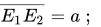
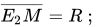
Circumradius Side length Angle
Construction for a given side length
Construction for a given side length as animation,

Symmetry

[edit]
The symmetries of a regular pentadecagon as shown with colors on edges and vertices. Lines of reflections are blue. Gyrations are given as numbers in the center. Vertices are colored by their symmetry positions.

The regular pentadecagon has Dih15 dihedral symmetry, order 30, represented by 15 lines of reflection. Dih15 has 3 dihedral subgroups: Dih5, Dih3, and Dih1. And four more cyclic symmetries: Z15, Z5, Z3, and Z1, with Zn representing π/n radian rotational symmetry.

On the pentadecagon, there are 8 distinct symmetries. John Conway labels these symmetries with a letter and order of the symmetry follows the letter.[3] He gives r30 for the full reflective symmetry, Dih15. He gives d (diagonal) with reflection lines through vertices, p with reflection lines through edges (perpendicular), and for the odd-sided pentadecagon i with mirror lines through both vertices and edges, and g for cyclic symmetry. a1 labels no symmetry.

These lower symmetries allows degrees of freedoms in defining irregular pentadecagons. Only the g15 subgroup has no degrees of freedom but can be seen as directed edges.

Pentadecagrams

[edit]

There are three regular star polygons: {15/2}, {15/4}, {15/7}, constructed from the same 15 vertices of a regular pentadecagon, but connected by skipping every second, fourth, or seventh vertex respectively.

There are also three regular star figures: {15/3}, {15/5}, {15/6}, the first being a compound of three pentagons, the second a compound of five equilateral triangles, and the third a compound of three pentagrams.

The compound figure {15/3} can be loosely seen as the two-dimensional equivalent of the 3D compound of five tetrahedra.

Picture
{15/2}

{15/3} or 3{5}

{15/4}

{15/5} or 5{3}

{15/6} or 3{5/2}

{15/7}
Interior angle 132° 108° 84° 60° 36° 12°

Isogonal pentadecagons

[edit]

Deeper truncations of the regular pentadecagon and pentadecagrams can produce isogonal (vertex-transitive) intermediate star polygon forms with equal spaced vertices and two edge lengths.[4]

Uses

[edit]


A regular triangle, decagon, and pentadecagon can completely fill a plane vertex. However, due to the triangle's odd number of sides, the figures cannot alternate around the triangle, so the vertex cannot produce a semiregular tiling.

See also

[edit]

References

[edit]
[edit]
Revisions and contributorsEdit on WikipediaRead on Wikipedia
from Grokipedia
A pentadecagon, also known as a 15-gon or pentakaidecagon, is a polygon with fifteen sides and fifteen vertices. The term derives from the Greek prefix pentadeca- meaning "fifteen" (from penta- "five" and deka- "ten") combined with -gon, from γωνία (gōnía) meaning "angle." In its regular form, the pentadecagon features fifteen equal-length sides and fifteen equal interior angles, each measuring ((n2)×180)/n=156((n-2) \times 180^\circ)/n = 156^\circ, for a total sum of (n2)×180=2340(n-2) \times 180^\circ = 2340^\circ. A regular pentadecagon is constructible using only a compass and straightedge, as 15 is the product of the distinct Fermat primes 3 and 5, satisfying Gauss's criterion for constructible regular polygons. The symmetries of a regular pentadecagon form the D15D_{15}, which has order 30 and consists of 15 rotations and 15 reflections that map the figure onto itself. This group captures the full set of isometries preserving the pentadecagon's structure, highlighting its of order 15 and reflectional axes through each vertex and of opposite sides. For a regular pentadecagon with side 1, the circumradius RR and area AA involve expressions with nested radicals, reflecting the algebraic complexity tied to its constructibility.

Definition and Terminology

Definition

A pentadecagon is any polygon with exactly 15 sides and 15 vertices. These polygons are classified as simple if their edges do not intersect except at vertices, or complex if they exhibit self-intersections. For a simple convex pentadecagon, the sum of the interior angles is given by the general formula for polygons, (n2)×180(n-2) \times 180^\circ where n=15n=15, yielding 23402340^\circ. A regular pentadecagon is both equilateral and equiangular, serving as the standard form for further study of its properties. This constructible polygon first appears in Euclid's Elements (Book IV, Proposition 16), where it is described as an equilateral and equiangular fifteen-angled figure inscribed in a circle.

Etymology and Historical Names

The term pentadecagon derives from Ancient Greek roots: penta- (πέντε), meaning "five"; deca- (δέκα), meaning "ten"; and -gon (γωνία), meaning "angle" or "corner," collectively signifying a figure with fifteen angles. This etymology reflects the systematic naming convention for polygons based on the number of sides, akin to pentagon for five sides. Alternative historical and modern designations include pentakaidecagon (from penta- + kai- + deca- + -gon, emphasizing the additive "and" for fifteen) and the abbreviated "15-gon." The regular pentadecagon first appears in mathematical literature in Euclid's Elements, composed around 300 BCE, specifically in Book IV, Proposition 16, which describes its inscription in a by superimposing the constructions of an and a regular pentagon sharing a common vertex. The proposition underscores the pentadecagon's constructibility using compass and straightedge, a key theme in . Medieval manuscripts of Euclid's Elements preserve and adapt this construction, evidencing its transmission through Byzantine and Arabic scholarly traditions. Ninth- and tenth-century copies, such as those in the and Oxford's Bodleian, depict the pentadecagon with varying diagram accuracy—some showing straight sides, others curved or erased segments—reflecting iterative copying practices rather than mere errors. The modern terminology for the pentadecagon solidified in the amid broader efforts to standardize nomenclature, influenced by renewed interest in classical and the study of regular polyhedra. Earlier texts rarely employed the term beyond , often describing the figure descriptively as a "fifteen-angled" . This evolution paralleled the formalization of polyhedral names, ensuring consistency in mathematical discourse.

Geometric Properties

General Properties of Pentadecagons

A pentadecagon is classified as a with exactly fifteen sides and vertices. Like other polygons, it can be categorized based on its boundary configuration and interior structure. Convex pentadecagons have all interior angles less than 180° and contain the between any two interior points entirely within the polygon. In contrast, concave pentadecagons feature at least one interior angle greater than 180°, allowing indentations where parts of the boundary lie inside the kernel. Pentadecagons are further distinguished as simple if their boundary does not intersect itself, forming a Jordan curve that divides the plane into an interior and exterior region, or self-intersecting (complex) if edges cross, potentially creating star-shaped forms with multiple intersection points. General theorems apply to pentadecagons as planar graphs. For a simple pentadecagon embedded in the plane, states that the number of vertices VV minus the number of edges EE plus the number of faces FF (including the unbounded exterior face) equals 2, yielding 1515+2=215 - 15 + 2 = 2. This holds for connected planar embeddings without self-intersections. Additionally, the sum of the exterior angles of any pentadecagon, measured in a consistent direction (e.g., turning angles at each vertex), is always 360°, independent of the specific side lengths or interior angles. Irregular pentadecagons exhibit variable side lengths and interior angles, deviating from uniformity. In , rectilinear pentadecagons—where all sides are horizontal or vertical, and interior angles are 90° or 270°—serve as examples of such variants, often used in problems like partitioning and covering due to their axis-aligned structure. These polygons maintain simplicity if non-intersecting but can become concave with angles at 270°. Achieving regularity requires specific equilateral and equiangular conditions; while affine transformations can map a general pentadecagon to approximate a regular form by adjusting positions, they distort lengths and angles, preventing preservation of equality unless the original is affinely regular.

Properties of the Regular Pentadecagon

A regular pentadecagon has fifteen equal sides and fifteen equal interior angles, each measuring exactly 156°; consequently, each exterior angle measures 24°. The sum of the interior angles is 2340°. The area AA of a regular pentadecagon with side length aa is given by the formula A=154a2cotπ1517.6424a2.A = \frac{15}{4} a^2 \cot \frac{\pi}{15} \approx 17.6424 \, a^2. For a=1a = 1, the exact area is A=154(6+25+10+25)cotπ15,A = \frac{15}{4} \left( \sqrt{6 + 2\sqrt{5}} + \sqrt{10 + 2\sqrt{5}} \right) \cot \frac{\pi}{15},
Add your contribution
Related Hubs
User Avatar
No comments yet.