Hubbry Logo
Pimm'sPimm'sMain
Open search
Pimm's
Community hub
Pimm's
logo
8 pages, 0 posts
0 subscribers
Be the first to start a discussion here.
Pimm's
Pimm's
from Wikipedia

Pimm's
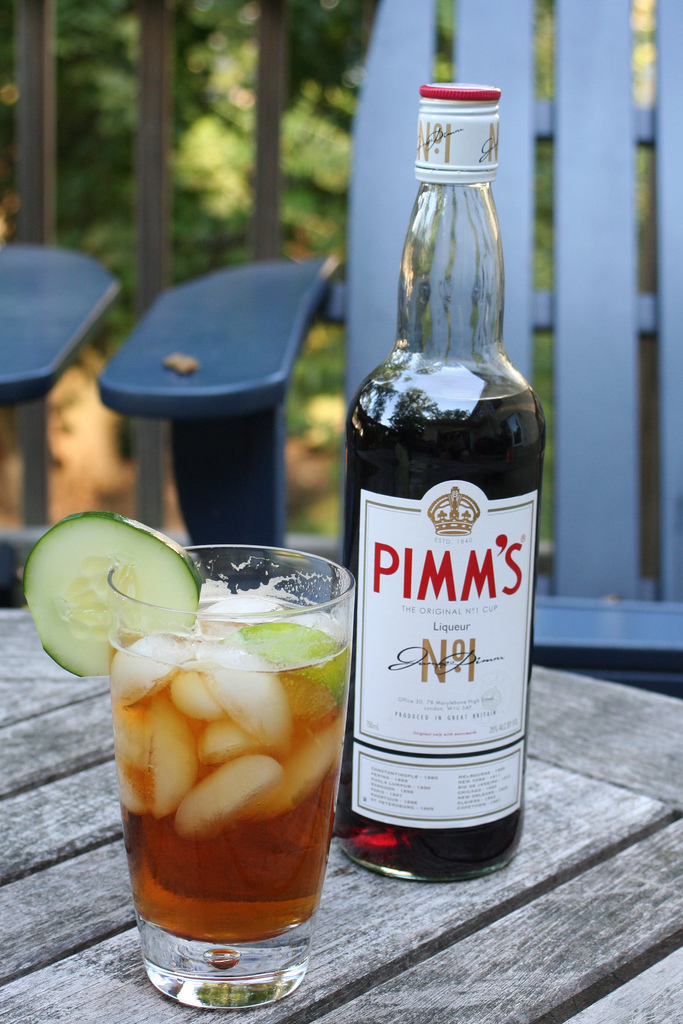
A modern bottle of Pimm's No. 1 Cup alongside a Pimm's cup
Product typeLiqueur
OwnerDiageo (since 1997)
CountryEngland
Introduced1823
Previous ownersJames Pimm, et al.
Websiteanyoneforpimms.com

Pimm's is an English brand of gin-based fruit cup but may also be considered a liqueur or the basis of a sling or punch. It was first produced in 1823 by James Pimm and has been owned by Diageo since 1997. Its most popular product is Pimm's No. 1 Cup,[1][2] commonly used for the Pimm's cup cocktail.

Serving

[edit]
Pimm's and lemonade with mint sprigs and fruit

Pimm's is dark brown with a reddish tint, and a subtle taste of spice and citrus fruit. As a summer long drink, it is normally served as a Pimm's cup cocktail, a drink with "English-style" (clear and carbonated) lemonade,[3] as well as various chopped garnishes, particularly apple, cucumber, orange, lemon, strawberry and mint or borage, though mint is more common.[4] Ginger ale is used as a common substitute for lemonade.

Pimm's can also be mixed with champagne (or other sparkling white wines), resulting in a drink known as a "Pimm's Royal Cup". Pimm's Winter Cup is generally mixed with warm apple juice. A "Glasgow Garden Party" is a drink made with Pimm's substituting lemonade with Irn Bru excluding any fruit garnish. A "Pimmlet" is a gimlet with Pimm's No.1 substituted for gin. A Pimm's mojito substitutes lemon and lime soda with muddled limes and soda water.[5]

History

[edit]

Pimm, a farmer's son from Kent, became the owner of an oyster bar in the City of London, near the Bank of England. He offered the tonic (a gin-based drink containing a secret mixture of herbs and liqueurs) as an aid to digestion, serving it in a small tankard known as a "No. 1 Cup", hence its subsequent name.

In 1851, Pimm's No. 2 Cup and Pimm's No. 3 Cup were introduced. Pimm's began large-scale production in 1851 to keep up with sales to other bars. The distillery began selling it in 1859. In 1865, Pimm sold the business and the right to use his name to Frederick Sawyer. In 1880, the business was acquired by future Lord Mayor of London Horatio Davies, and a chain of Pimm's Oyster Houses was franchised in 1887.

Over the years, Pimm's extended their range, using other spirits as bases for new "cups". After World War II, Pimm's No. 4 Cup was invented, followed by Pimm's No. 5 Cup and Pimm's No. 6 Cup in the 1960s.

The brand fell on hard times in the 1970s and 1980s. The Oyster House chain was sold, and Pimm's Cup products Nos. 2 to 5 were phased out due to reduced demand in 1970, after new owners, The Distillers Company,[2] took control of the brand. In 1986, The Distillers Company was purchased by Guinness PLC,[6] and Pimm's became part of Diageo when Guinness and Grand Metropolitan merged in 1997.[7] In 2004, Pimm's introduced Pimm's Winter Cup, which consists of Pimm's No. 3 Cup (the brandy-based variant) infused with spices and orange peel.

The discontinued No. 6 Vodka Cup variety was reinstated in 2015[8] following a successful campaign led by a group of enthusiastic Vodka Cup Pimm's drinkers.[9] Despite a promise from the parent company and Pimm's owner Diageo to keep No. 6 in production, it is no longer possible to buy Vodka Cup Pimm's.

Popularity and distribution

[edit]
A Pimm's stand set up at a music festival using a converted bus as a bar

Pimm's is most popular in England, particularly southern England. It is one of the two staple drinks at the Wimbledon tennis tournament, the Chelsea Flower Show, the Henley Royal Regatta and the Glyndebourne Festival Opera – the other being champagne. The first Pimm's Bar opened at the Wimbledon tournament in 1971; every year, over 80,000 pints of Pimm's cocktail are sold to spectators.[10] Along with champagne, it has been declared one of two official drinks of Wimbledon, and it has also gained popularity among British universities.[better source needed][11] A Pimm's is also a standard cocktail at British and American polo matches.[12]

The brand experienced a revival in the early 2000s following a 2003 advertising campaign, which featured a humorous classic upper-class "Hooray Henry" character called Harry Fitzgibbon-Sims[13] (portrayed by Alexander Armstrong) with the catchphrase "It's Pimm's o'clock!",[14] somewhat mocking their own traditional advertising and appeal. Diageo's 2010 campaign[15] featured a more diverse range of characters representing different elements of the Pimm's cocktail (Pimm's No.1 being an Englishman in red and white blazer, lemonade being three young women in yellow, ice represented by a mature man), coming together to the theme tune of 1970s British television show The New Avengers.

Products

[edit]
Vintage bottles of Pimm's products

Seven Pimm's products have been produced throughout the brand's history, all fruit cups differing only in their alcoholic base.[16] Only Nos. 1 and a 'Winter Cup' based on No. 3 remain in production. It was originally in 26+23 imperial oz. [757-ml] bottles, then made in standard metric 26.4 imperial oz. [750-ml] bottles when it started being sold overseas in Europe, and now is in 700 ml and 1 litre bottles. The beverages were originally a standard 31.53% ABV, then curbed to 28.90% ABV in the 1960s, and are now only 25% ABV.

  • Pimm's No. 1 Cup [1840–present] is the most popular Pimm's cup. Based on gin, its base as bottled is 25 per cent alcohol by volume.
  • Pimm's No. 2 Cup [1930s–1970] was based on Scotch whisky, and was phased out by new brand owners The Distillers Company in 1970.
  • Pimm's No. 3 Cup [1930s–1970; 2004–present] is based on brandy; it was phased out in 1970, and relaunched in 2004, now infused with spices and orange peel and called Pimm's Winter Cup.
  • Pimm's No. 4 Cup [1935–1970] was based on dark rum.
  • Pimm's No. 5 Cup [1930s?–1970] was based on rye whisky. It was originally designed as an alternative to Pimm's No. 2 for the Canadian market.[17] Its popularity there during the postwar period encouraged Pimm's to sell it in the British market and overseas to Europe and America as well.
  • Pimm's No. 6 Cup [1964–1970; 2004–2021] was based on vodka. It was reintroduced in 2004 as Pimm's Vodka Cup, temporarily discontinued in 2014, but brought back in 2015 after an outcry from Pimm's customers, only to be discontinued again in 2021.[18]
  • Pimm's No. 7 Cup [late 1960s? – 1970], based on tequila. It was designed for the American market, as tequila was not very popular in Britain and Europe at the time. It was made in such small numbers before it was discontinued that it is one of the rarest variants. Websites including Difford's Guide say the liqueur was introduced sometime after World War II,[19][20] while other sources claim No. 7 was never a real commercial product.[21][22]

The Pimm's No. 2 and No. 5 Cups were introduced as a mixer for whisky cocktails. The Pimm's No. 3 and No. 4 Cups were introduced as heated cold-weather or winter versions of the summertime Pimm's No. 1.

The Pimm's Winter Cup and Pimm's Vodka Cup were reintroduced in 2004. Pimm's Winter Cup is a seasonally available version of Pimm's No.3 infused with spices and orange peel. Pimm's Vodka Cup[2] is a reintroduction of Pimm's No.6, but is made in limited quantities.

Pimm's Original No.1 Cup (frequently mixed with lemonade) (or "Pimm's & Lemonade") is a pre-mixed fortified lemonade with a Pimm's No. 1 base with a strength of 5.4% ABV. It is available in 12-packs of 250 ml cans or 1 litre bottles. Pimm's Lemonade & Ginger Ale is a pre-mixed fortified lemonade with a Pimm's No. 1 base and flavoured with ginger-ale that has a strength of 4% ABV. It is available in 4-packs (or cases of six 4-packs) of 330 ml bottles.

There are also special edition versions that are 20% ABV and come in standard European 700 ml bottles. Pimm's Blackberry and Elderflower [made from 2013] is based on Pimms No. 6 with blackberry and elderflower flavouring. Pimm's Strawberry (with a hint of mint) [made from 2015] is based on Pimm's No. 1 with additional strawberry and mint flavouring.

Imitators

[edit]

Some retailers have marketed "Pimm's style" drinks under other names. In the UK, these have included Aldi's "Austin's", Lidl's "Jeeves", and Sainsbury's "Pitchers".[23]

See also

[edit]

References

[edit]
[edit]
Revisions and contributorsEdit on WikipediaRead on Wikipedia
from Grokipedia
Pimm's is a renowned British brand of fruit-based liqueurs, best known for its flagship product, Pimm's No. 1 Cup, a -infused digestif created in the by James Pimm to aid oyster digestion at his . This secret recipe combines dry with liqueurs, herbs, fruit juices, and spices, yielding a 25% characterized by bittersweet caramelized orange, fresh citrus, amber spices, earthy botanicals, and subtle woody notes. Traditionally mixed with lemonade or and garnished with slices, strawberries, orange, lemon, and mint, the has become an iconic summer refreshment, evoking British traditions at events like Wimbledon , Henley Regatta, and garden parties. Originally served in small tankards called "No. 1 Cups" at Pimm's establishments, the brand expanded under various owners and introduced spirit-based variants—such as (brandy), (), and seasonal Winter Cup—though No. 1 remains the most prominent and enduring product. Acquired by in 1997 (with a failed sale attempt in 2024), Pimm's continues to embody quintessentially British leisure, with annual sales peaking during summer months and recent innovations like the 2021 Pimm's Sundowner variant enhancing its fruity profile for modern aperitifs.

Introduction

Overview

Pimm's is a family of fruit-flavored liqueurs originating from a gin-based aperitif invented in 1840 by James Pimm, a oyster bar owner who initially created it as a digestive aid for his patrons. The brand evolved from this health tonic into a premium spirits line, with its name derived directly from its founder, and it remains synonymous with British summer traditions. The primary product, Pimm's No. 1 Cup, is a reddish-brown featuring a closely guarded secret recipe that includes , , and fruit juices, bottled at 25% . This versatile spirit forms the base of the iconic , a refreshing summer drink typically mixed with lemonade or and garnished with fresh fruits, slices, and herbs for a light, fruity profile. Since 1997, Pimm's has been owned by , the multinational beverages company formed from the merger of and , which has overseen its global distribution while maintaining its quintessentially British appeal. In 2024, explored selling the brand but abandoned the plans later that year. The brand enjoys steady popularity at events like Wimbledon, which has been a staple there since the first Pimm's bar opened in 1971, contributing to annual retail sales of around £86 million as of 2024.

Brand Identity

Pimm's identity is deeply rooted in its British heritage, featuring iconic visual elements that have endured since the . The signature glass, a high-handled designed for serving the drink over with garnishes, became synonymous with the brand following the opening of the first Pimm's bar at Wimbledon in 1971. The No. 1 Cup logo incorporates nautical themes reflective of its oyster bar origins, while packaging has traditionally included red labels adorned with motifs such as strawberries, oranges, and lemons, emphasizing the drink's fruity profile. Under , which has owned the brand since 1997, marketing strategies have reinforced Pimm's premium positioning as the quintessential British summer drink through strategic sponsorships of elite events. The brand has maintained a long-standing association with Wimbledon since 1971, evolving into an official partnership in 2017 that includes dedicated bars and promotional activations. Similarly, Pimm's has been prominently featured at the , aligning with the event's traditions of riverside elegance and social gatherings. These efforts, combined with taglines like "Pimm's O'Clock" introduced in the late 2000s, evoke images of leisurely afternoons and have been central to campaigns promoting relaxed, heritage-infused enjoyment. The cocktail serves as a hallmark of this identity, embodying the brand's social and summery appeal. The branding has evolved significantly from its origins as a medicinal tonic in the 1840s, created by James Pimm to aid digestion at his bar, to a modern lifestyle brand in the 21st century. revitalized the image in the early through humorous that shifted focus from upper-class stereotypes to broader, inclusive summer festivities. Contemporary digital campaigns target with integrations, such as weather-activated outdoor advertising that promotes real-time sharing of Pimm's moments when temperatures hit 21 degrees . Limited-edition bottles, including coronation-themed designs in 2023 and flavor innovations like Pimm's Sundowner in 2021, further enhance collectibility and event tie-ins. Diageo actively protects the Pimm's trademarks, including the core "PIMM'S" mark, through legal actions against perceived infringements, such as the 2009 lawsuit against for copying packaging elements. As of , the brand holds an estimated UK retail sales value of around £86 million, contributing to a positioned near £100 million amid ongoing premium spirits growth.

Composition and Production

Ingredients

Pimm's No. 1, the flagship product in the lineup, is a -based crafted from a secret recipe that infuses dry with a proprietary blend of botanicals, , and elements. The base spirit provides a subtle foundation, while the botanicals contribute layers of complexity, including bittersweet notes from caramelized orange and fresh peels that enhance the citrus profile. Delicate amber spices add warmth and depth to the flavor, balancing the overall and aromatic character without overpowering the gin core. The incorporates fruit influences through a combination of liqueurs and extracts, yielding complex fruity notes that evoke a sweet-tart , though specific fruits remain undisclosed as part of the . Aromatic components stem from a guarded mix of herbs, with no full list confirmed, ensuring the signature earthy and refreshing profile that distinguishes Pimm's from other gins or fruit cups. This secretive herbal blend, developed since the , is central to the drink's appeal as a digestif and base. Standardized at 25% ABV, Pimm's No. 1 maintains consistency across batches, while other variants like employ different bases such as brandy, adapting the botanical infusion to the spirit's character. The formulation uses natural colorings derived from caramelized elements, contributing to the characteristic amber-red hue.

Manufacturing Process

The exact recipe and production methods remain a closely guarded secret by , developed by James Pimm in the . The base is a spirit, produced under oversight since the company's acquisition of the brand in 1997. The botanicals are infused into the base to create the characteristic herbal and fruity profile, followed by . Following infusion, the components are blended in large vats according to the proprietary proportions of the secret recipe, which includes a element for balance. The mixture is then blended and adjusted to 25% ABV. This step ensures the final product's approachable strength and consistency. Bottling occurs at 's production facilities across the , where over 60 sites support the company's operations, including rigorous quality controls to maintain batch-to-batch uniformity. As part of broader corporate initiatives, Pimm's production incorporates measures introduced by since 2020, such as transitioning to recyclable materials and optimizing processes to reduce water usage by more than 20% in efficiency compared to prior baselines.

History

Origins and Invention

Pimm's originated in the early when James Pimm, a farmer's son from who had become a shellfish merchant, opened an in London's financial district. He established his first premises around 1823–1824 on Lombard Street, near the historic , before relocating to 3 by the late 1830s, where the beverage was developed in 1840 as a digestive aid to complement seafood dishes like oysters. This tonic was created to ease after heavy meals and to appeal to the bar's patrons, who included city professionals seeking a refreshing, stomach-settling accompaniment. The initial formulation, known as the "House Cup" or No. 1 Cup, was a gin-based infused with and a blend of herbs and spices, designed to mask the gin's bitterness while providing a subtle, medicinal flavor profile. , derived from bark, contributed to its reputed digestive benefits, making it a novel innovation for the era's tavern culture. Pimm served it in a small tankard—referred to as a "cup"—typically holding about a gill (roughly 150 ml), which became the namesake for the product and set it apart from standard spirits. By the 1840s, as Pimm expanded his establishments, the concept of the numbered "Cup" gained traction, with No. 1 remaining the variant while laying the groundwork for future iterations based on different spirits to accommodate diverse tastes among . The drink's appeal grew steadily within London's dining scene, attracting a discerning crowd that appreciated its balanced, herbaceous notes. Bottled versions of Pimm's No. 1 first became available for retail sale around 1865, allowing wider distribution beyond the bars and marking a shift toward commercial production. This development fueled its early traction among the city's elite, who valued its sophistication as a social beverage. James Pimm passed away in 1866, after which the business transitioned to management by family members and close associates, ensuring the continuation of his innovative recipe amid growing demand. Under this stewardship, Pimm's maintained its focus on the original No. 1 formulation while the brand's legacy as a British staple took root.

Evolution and Ownership Changes

Following its origins in the , Pimm's remained under family control until 1865, when James Pimm sold the business to his employee Frederick Sawyer. In 1880, the enterprise was acquired by Horatio Davies, a prominent wine merchant and future , who expanded it by franchising Pimm's Oyster Houses across the city in 1887 and incorporating it as a in 1906. Pimm's No. 2 Cup (Scotch whisky-based) and No. 3 Cup (brandy-based) were introduced in 1851. Post-World War II, Pimm's experienced significant growth, with sales surging as the brand relaunched and expanded its variant lineup to capitalize on renewed consumer interest in premium spirits. The rum-based No. 4 Cup was introduced shortly after the war as a seasonal offering, while the rye-based No. 5 Cup—originally developed for the Canadian market—was brought to the UK, and the vodka-based No. 6 Cup debuted in the early 1960s. In 1969, The Distillers Company Ltd. acquired Pimm's, marking its transition from independent operation to corporate ownership and enabling broader distribution. However, due to low demand for the less popular variants, Nos. 2 through 5 were discontinued by 1970 to streamline production. was itself purchased by PLC in 1986, bringing Pimm's into a larger portfolio. This culminated in , when merged with to form , propelling Pimm's toward international expansion through enhanced marketing and global supply chains. Under Diageo, the brand's core secret recipe—centered on gin, liqueurs, fruit, and herbs—has been preserved, though minor adjustments in the 2000s refined its smoother profile to appeal to contemporary tastes without altering its fundamental composition. Marking its bicentennial in 2023, Pimm's celebrated with limited-edition releases, including a Coronation-themed bottle tied to King Charles III's ascension, underscoring its enduring British heritage. In the 2020s, amid shifting preferences toward low-ABV beverages like Aperol spritzes, Pimm's demonstrated resilience; Diageo explored a potential sale in 2024 but ultimately retained the brand after bids fell short as of October 2024, affirming its strategic value in the low-alcohol category where its 25% ABV positions it well.

Product Line

Pimm's No. 1 Cup

Pimm's No. 1 Cup serves as the flagship product of the Pimm's brand, a gin-based renowned for its role in British summer traditions. Created in the as a digestif, it remains the cornerstone of the lineup, embodying the brand's heritage of blending herbal elements with fruit-infused notes. As the only surviving variant from the original numbered series—where Nos. 2 through 6 were discontinued in the for efficiency—it dominates the portfolio and underscores Pimm's enduring appeal. The flavor profile of Pimm's No. 1 Cup is characterized by a balanced sweetness, accented by prominent elements such as orange marmalade and zest, alongside spices like and a subtle bitterness reminiscent of . Its aroma features fruity notes of berries and , interwoven with complex botanicals and a gentle spiced undertone. This harmonious composition, derived from a secret recipe of infused with caramelized oranges, herbs, and spices, delivers a light, refreshing taste ideal for warm-weather occasions. Standard specifications for Pimm's No. 1 Cup include an alcohol by volume (ABV) of 25%, packaged in a 70cl bottle, which is the typical size available in the UK market. As of 2025, retail pricing in the UK ranges from £18 to £22 for this standard bottle, reflecting its positioning as an accessible premium liqueur. These attributes contribute to its versatility and popularity as the essential base for the classic Pimm's Cup cocktail, which accounts for the majority of Pimm's-based drinks served worldwide. Pimm's No. 1 Cup's historical primacy is evident in its status as the brand's most popular offering, with the vast majority of sales attributed to this variant amid the discontinuation of others. It forms the foundation for nearly all traditional Pimm's cocktails globally, where its low ABV and multifaceted profile allow for easy mixing with mixers like lemonade or . The product's cultural ties extend to special editions, including limited-run bottles with custom designs for events such as Wimbledon, where Pimm's has been a fixture since the first on-site bar opened in 1971—though annual tie-ins with bespoke labels have appeared sporadically in the 2000s and beyond for celebrations like jubilees.

Other Variants

Pimm's No. 3 Cup, based on brandy, serves as a winter warmer variant with an of 25%, infused with spices and orange peel. Originally introduced in , it was discontinued in the but relaunched in 2004 as Pimm's Winter Cup for seasonal release. Several other variants in the Pimm's line have been discontinued over the years. Pimm's No. 2, based on , was available from the 1940s until the . Pimm's No. 4, using as its base spirit, spanned the 1930s to the before discontinuation. Pimm's No. 5, featuring , was produced from the through the . Pimm's No. 6, introduced in the with as the base, faced multiple discontinuations but was ultimately discontinued in 2021. Each of these variants mirrored the fruit and herb profile of the benchmark Pimm's No. 1 but adapted to the distinct characteristics of their base spirits, such as the cleaner, less botanical notes in No. 6 due to . The discontinuations of Nos. 2 through 5 stemmed from low demand and efforts to streamline the product line for cost efficiencies following the 1969 acquisition by Distillers Company Ltd., a predecessor of . This shift aligned with growing consumer preferences for the gin-based original amid broader trends favoring lighter, more versatile spirits. In 2021, launched Pimm's Sundowner, a gin-based variant with a stronger fruity profile designed for contemporary aperitifs.

Serving Suggestions

Traditional Pimm's Cup

The Traditional Pimm's Cup is a refreshing gin-based that serves as the foundational serving style for Pimm's No. 1 Cup, blending the 's herbal and fruity notes with a fizzy mixer and fresh garnishes. The core recipe calls for 50 ml (approximately 1.75 oz) of Pimm's No. 1 poured over ice, topped with 150 ml (approximately 5 oz) of lemonade or to achieve a balanced 1:3 ratio of to mixer, ensuring the subtle botanicals remain prominent without overpowering sweetness. This preparation evolved from the 1840s, when James Pimm, owner of a oyster bar, created the original digestif to aid patrons after meals, initially serving it neat or simply mixed in a without extensive garnishes. By the early , the addition of fruit and vegetables enhanced its appeal as a summer refresher, with the modern garnishes—typically a sliced , orange wheel, slice, fresh mint sprig, and optional flowers—layered into the glass for both flavor infusion and visual elegance. Traditionally served in a chilled or the signature to evoke its origins, the drink is assembled by filling the vessel with , adding the Pimm's, gently stirring in the mixer to combine without bruising the delicate elements, and then arranging the garnishes atop or skewered for . This method preserves the cocktail's clarity and layered appearance, allowing the amber hue of the Pimm's to mingle subtly with the clear mixer while the fruits provide bursts of color and aroma.

Variations and Modern Twists

Contemporary adaptations of the have expanded its appeal beyond the traditional gin-based formula, incorporating non-alcoholic alternatives and regional influences. Non-alcoholic versions, often crafted as mocktails, replicate the herbal and fruity profile using botanical extracts like , peels, and spice infusions mixed with lemonade or , allowing for similar garnishes of , mint, and strawberries without the alcohol content. These alcohol-free options have gained traction in health-conscious settings, such as events like Wimbledon, where demand for low- or no-alcohol beverages has prompted custom creations. One notable international twist emerged in the United States, particularly in New Orleans, where the took root in the 1940s at in the . This version lightens the fruit elements compared to the British original, typically combining Pimm's No. 1 with lemonade and soda or 7-Up for a simpler, effervescent refreshment served over ice with minimal garnishes like or . Occasionally adapted further with for a Southern flair, it remains a staple in local bars, emphasizing the drink's versatility in warmer climates. Modern innovations continue to evolve the Pimm's for diverse occasions and preferences. The Pimm's Punch, a bubbly update, incorporates or alongside Pimm's No. 1, lemonade, and fresh fruits for a festive, effervescent punch suitable for gatherings. For cooler weather, the Winter Cup utilizes Pimm's —a brandy-based variant—warmed with hot , , and orange slices to create a spiced, comforting beverage that shifts the profile from summer sipper to seasonal warmer. Low-calorie adaptations swap regular mixers for diet lemonade or soda, reducing sugar while preserving the herbal essence. In the 2020s, bartending trends have integrated Pimm's into craft cocktails, such as blending it with and for a herbaceous twist, or spritzes combining it with and soda for lighter, aperitif-style drinks. These innovations are often promoted through Diageo's Bar Academy programs, which provide mixologists with recipes and training to elevate Pimm's in modern menus. For home entertaining, batch preparation simplifies serving large groups; scalable ratios—such as one part Pimm's to three parts mixer—can be pre-mixed in a with fruits and herbs, then poured over ice for efficiency.

Cultural Significance and Popularity

In the United Kingdom

Pimm's holds a prominent place in British culture as the quintessential summer beverage, symbolizing leisurely garden parties, outdoor social gatherings, and traditional festivities. Originating from oyster bars in the , it has evolved into an enduring emblem of British hospitality and refinement. The drink is inextricably linked to major British events, particularly as the official partner of The Championships at Wimbledon since 2017, though it has been served there since the first Pimm's bar opened in 1971. Over 300,000 glasses of Pimm's are consumed annually at the tournament, underscoring its status as a ritual for spectators. It is also a fixture at the , where dedicated bars serve it alongside other refreshments during the prestigious rowing competition, and at the , where it complements the opera season's picnics and intervals as one of the venue's signature drinks. Consumption of Pimm's in the peaks during the summer months, aligning with warmer weather and outdoor activities. Positioned as the ideal accompaniment to garden parties and barbecues, it embodies relaxed British summer traditions, often enjoyed in jugs with fresh fruits and lemonade. In broader cultural terms, Pimm's represents an of British and sophistication, frequently appearing in media portrayals of upper-class social scenes and evoking nostalgia for interwar-era elegance. Its presence in and reinforces this symbolism, capturing the essence of refined, convivial occasions. As of 2023, Pimm's retail sales in the UK were valued at around £86 million, dominating the fruit cup segment within the broader liqueurs category, though value sales declined by 19% in 2024. Approximately 70% of global Pimm's sales originate from the domestic market, highlighting its core appeal to British consumers. Despite its iconic status, Pimm's faces challenges from shifting consumer preferences, particularly a decline in interest among younger drinkers who favor trendier options like Spritz, contributing to a 19% drop in value sales over the past year. This trend is being countered through premium branding initiatives and strengthened event partnerships, which sustain its relevance in high-profile social settings; explored selling the brand in early 2024 but abandoned the process later that year.

Global Distribution and Influence

Pimm's export history traces back to the late , when it was shipped to British colonial outposts, including in 1898 and , as well as to officers in during the colonial era, establishing an early association with the British Empire's global reach. By the early , distribution expanded to other regions. Following Diageo's acquisition in 1997 through the merger of and , Pimm's underwent a significant international push, leveraging the company's global infrastructure to broaden availability beyond traditional markets. Key international markets for Pimm's include the , where the Pimm's Cup gained popularity starting in the late 1940s, particularly in New Orleans, where it has become a signature drink adapted with instead of lemonade and is served extensively at venues like , which claims to sell more Pimm's than any other bar worldwide. In , Pimm's enjoys strong seasonal appeal during summer barbecues and social gatherings, with innovations like on-tap pre-mixed versions introduced in pubs to cater to local preferences. maintains a colonial legacy, with Pimm's featured in upscale clubs and restaurants in cities like Bengaluru, reflecting its enduring ties to British and elite social traditions. Pimm's is distributed in numerous countries through Diageo's extensive network, which spans over 180 markets, enabling availability in retail, bars, and online platforms across regions like , , and . Culturally, it has influenced craft scenes in the , where the New Orleans variation emphasizes refreshing, low-alcohol profiles suitable for hot climates, and continues to adapt to global low-ABV trends in emerging markets. Sales trends show challenges, with a reported 19% decline in attributed to unseasonal weather impacting consumption, though its presence in travel retail and international events sustains global influence despite a UK-centric plateau.

Competitors and Imitations

Notable Imitators

Plymouth Fruit Cup, produced by the Black Friars Distillery since 2003, serves as a prominent alternative to Pimm's No. 1, blending with , aromatic , and extracts to achieve a similar herbal and fruit-forward profile at 30% ABV, matching the original strength of Pimm's formulations. This gin-based emphasizes and botanical notes, distinguishing it through its drier, more juniper-driven character while evoking the classic fruit cup style traditionally associated with Pimm's. Other offerings, such as Ableforth's Summer Fruit Cup (31.2% ABV) and supermarket own-brands like Summer Cup (25% ABV), replicate the spiced, fruity essence, positioning themselves as accessible substitutes in the summer market. Internationally, Australian distillers have developed localized fruit cups to mirror Pimm's refreshing qualities, such as the Fancy Fruit Cup collaboration between Never Never Distilling Co. and Marionette, which combines triple-juniper gin steeped in Earl Grey tea with barrel-aged orange curaçao made from Mildura oranges and South Australian brandy. This lighter, drier variant highlights native ingredients for a juniper-forward twist, served with lemonade, ginger ale, and traditional garnishes like cucumber and strawberries to evoke the Pimm's Cup experience. In the US, where Pimm's availability is limited, homemade recipes and gin-based adaptations using brands like Empress 1908 Indigo Gin recreate the fruit cup by infusing botanicals, liqueurs, and citrus, often shared in cocktail communities as DIY alternatives to the original. Historically, tonics like Stone's Original Green Ginger Wine influenced the fruit cup category, with its 13.5% ABV fortified wine base providing a spiced, ginger-focused profile that predates Pimm's while serving as a precursor to mixed summer drinks. In the 2000s, extended Stone's lineage with a summer variant explicitly positioned to rival Pimm's, blending elements into a lighter, fruit-infused cup suitable for lemonade dilution at a one-to-three ratio. Diageo has actively enforced its trademarks on Pimm's since the early 2000s to protect against direct copies, notably suing in 2009 over the supermarket's "Pitchers" gin-based summer , which allegedly infringed rights through similar packaging and formulation. The case, involving claims of brand confusion, was settled amicably later that year, allowing generic terms like "fruit cup" while prohibiting overt imitations. This enforcement has shaped the market, permitting distinct products under broad descriptors but curbing exact replicas. Imitators collectively offer cheaper alternatives in the UK fruit cup segment, capturing demand through lower price points and broader availability in retail channels, though Pimm's maintains dominance in premium positioning.

Market Position

Pimm's occupies a niche as a premium gin-based fruit liqueur within the aperitif segment of the global spirits market, where it competes with vermouths, digestifs, and other low-ABV herbal liqueurs. At 25% ABV, it caters to moderate drinkers seeking a refreshing, sessionable option rather than high-proof spirits, positioning it as an accessible entry into premium cocktails. This categorization aligns with its historical role as a digestif aid, now evolved into a versatile mixer for summer serves. The brand's strengths lie in its strong UK market loyalty, particularly tied to seasonal events like Wimbledon and garden parties, where it enjoys high recognition—49% popularity among UK consumers according to surveys, ranking it as the second most popular alcohol brand overall. Within Diageo's portfolio, Pimm's benefits from synergies with gin, its base spirit, enabling cross-promotions in cocktails that blend the two for enhanced flavor profiles and shared distribution channels. These factors contribute to sustained on-trade visibility, despite its limited year-round appeal. Challenges persist from intensifying competition in the and ready-to-drink (RTD) categories, where craft gins capture premiumization trends and RTD cocktails—projected to grow from USD 1.25 billion globally in —offer convenience amid busy lifestyles. Pimm's RTD experienced a 4.9% sales decline in the UK to £29.9 million in , partly attributed to broader health-conscious shifts toward low- and no-alcohol options, though countered industry-wide trends by expanding its non-alcoholic portfolio without a dedicated Pimm's variant. The brand's attempted divestiture in , ultimately scrapped due to failed bidder agreements, underscores its status as a non-core asset in 's global strategy. Looking ahead to 2025 and beyond, Pimm's outlook hinges on emerging markets like , where Pimm's Cup-style RTD variants are forecasted to drive regional growth at a CAGR exceeding 16% through 2033, fueled by rising demand for light, fruity aperitifs among urban . Diageo's broader efforts, including 50% Scope 1 and 2 emissions reductions by 2030 and increased recycled packaging, position Pimm's to appeal to eco-conscious consumers through shared improvements. With revenue estimated at around £86 million in retail sales and a negligible global premium spirits market share—amid a sector valued at USD 254 billion in 2025—Pimm's remains a player reliant on event-driven spikes and portfolio integration for stability.

References

Add your contribution
Related Hubs
User Avatar
No comments yet.