Hubbry Logo
Principal bundlePrincipal bundleMain
Open search
Principal bundle
Community hub
Principal bundle
logo
7 pages, 0 posts
0 subscribers
Be the first to start a discussion here.
Principal bundle
Principal bundle
from Wikipedia

In mathematics, a principal bundle[1][2][3][4] is a mathematical object that formalizes some of the essential features of the Cartesian product of a space with a group . In the same way as with the Cartesian product, a principal bundle is equipped with

  1. An action of on , analogous to for a product space (where is an element of and is the group element from ; the group action is conventionally a right action).
  2. A projection onto . For a product space, this is just the projection onto the first factor, .

Unless it is the product space , a principal bundle lacks a preferred choice of identity cross-section; it has no preferred analog of . Likewise, there is not generally a projection onto generalizing the projection onto the second factor, that exists for the Cartesian product. They may also have a complicated topology that prevents them from being realized as a product space even if a number of arbitrary choices are made to try to define such a structure by defining it on smaller pieces of the space.

A common example of a principal bundle is the frame bundle of a vector bundle , which consists of all ordered bases of the vector space attached to each point. The group in this case, is the general linear group, which acts on the right in the usual way: by changes of basis. Since there is no natural way to choose an ordered basis of a vector space, a frame bundle lacks a canonical choice of identity cross-section.

Principal bundles have important applications in topology and differential geometry and mathematical gauge theory. They have also found application in physics where they form part of the foundational framework of physical gauge theories. Important cases are principal U(1)-bundles and principal SU(2)-bundles.

Formal definition

[edit]

A principal -bundle, where denotes any topological group, is a fiber bundle together with a continuous right action such that preserves the fibers of (i.e. if then for all ) and acts freely and transitively (meaning each fiber is a G-torsor) on them in such a way that for each and , the map sending to is a homeomorphism. In particular each fiber of the bundle is homeomorphic to the group itself. Frequently, one requires the base space to be Hausdorff and possibly paracompact.

Since the group action preserves the fibers of and acts transitively, it follows that the orbits of the -action are precisely these fibers and the orbit space is homeomorphic to the base space . Because the action is free and transitive, the fibers have the structure of G-torsors. A -torsor is a space that is homeomorphic to but lacks a group structure since there is no preferred choice of an identity element.

An equivalent definition of a principal -bundle is as a -bundle with fiber where the structure group acts on the fiber by left multiplication. Since right multiplication by on the fiber commutes with the action of the structure group, there exists an invariant notion of right multiplication by on . The fibers of then become right -torsors for this action.

The definitions above are for arbitrary topological spaces. One can also define principal -bundles in the category of smooth manifolds. Here is required to be a smooth map between smooth manifolds, is required to be a Lie group, and the corresponding action on should be smooth.

Examples

[edit]

Trivial bundle and sections

[edit]

Over an open ball , or , with induced coordinates , any principal -bundle is isomorphic to a trivial bundle

and a smooth section is equivalently given by a (smooth) function since

for some smooth function. For example, if , the Lie group of unitary matrices, then a section can be constructed by considering four real-valued functions

and applying them to the parameterization

This same procedure valids by taking a parameterization of a collection of matrices defining a Lie group and by considering the set of functions from a patch of the base space to and inserting them into the parameterization.

Other examples

[edit]
Non-trivial Z/2Z principal bundle over the circle. There is no well-defined way to identify which point corresponds to +1 or -1 in each fibre. This bundle is non-trivial as there is no globally defined section of the projection π.
  • The prototypical example of a smooth principal bundle is the frame bundle of a smooth manifold , often denoted or . Here the fiber over a point is the set of all frames (i.e. ordered bases) for the tangent space . The general linear group acts freely and transitively on these frames. These fibers can be glued together in a natural way so as to obtain a principal -bundle over .
  • Variations on the above example include the orthonormal frame bundle of a Riemannian manifold. Here the frames are required to be orthonormal with respect to the metric. The structure group is the orthogonal group . The example also works for bundles other than the tangent bundle; if is any vector bundle of rank over , then the bundle of frames of is a principal -bundle, sometimes denoted .
  • A normal (regular) covering space is a principal bundle where the structure group
acts on the fibres of via the monodromy action. In particular, the universal cover of is a principal bundle over with structure group (since the universal cover is simply connected and thus is trivial).

  • Let be a Lie group and let be a closed subgroup (not necessarily normal). Then is a principal -bundle over the (left) coset space . Here the action of on is just right multiplication. The fibers are the left cosets of (in this case there is a distinguished fiber, the one containing the identity, which is naturally isomorphic to ).
  • Consider the projection given by . This principal -bundle is the associated bundle of the Möbius strip. Besides the trivial bundle, this is the only principal -bundle over .
  • Projective spaces provide some more interesting examples of principal bundles. Recall that the -sphere is a two-fold covering space of real projective space . The natural action of on gives it the structure of a principal -bundle over . Likewise, is a principal -bundle over complex projective space and is a principal -bundle over quaternionic projective space . We then have a series of principal bundles for each positive :
Here denotes the unit sphere in (equipped with the Euclidean metric). For all of these examples the cases give the so-called Hopf bundles.


Basic properties

[edit]

Trivializations and cross sections

[edit]

One of the most important questions regarding any fiber bundle is whether or not it is trivial, i.e. isomorphic to a product bundle. For principal bundles there is a convenient characterization of triviality:

Proposition. A principal bundle is trivial if and only if it admits a global section.

The same is not true in general for other fiber bundles. For instance, vector bundles always have a zero section whether they are trivial or not and sphere bundles may admit many global sections without being trivial.

The same fact applies to local trivializations of principal bundles. Let π : PX be a principal G-bundle. An open set U in X admits a local trivialization if and only if there exists a local section on U. Given a local trivialization

one can define an associated local section

where e is the identity in G. Conversely, given a section s one defines a trivialization Φ by

The simple transitivity of the G action on the fibers of P guarantees that this map is a bijection, it is also a homeomorphism. The local trivializations defined by local sections are G-equivariant in the following sense. If we write

in the form

then the map

satisfies

Equivariant trivializations therefore preserve the G-torsor structure of the fibers. In terms of the associated local section s the map φ is given by

The local version of the cross section theorem then states that the equivariant local trivializations of a principal bundle are in one-to-one correspondence with local sections.

Given an equivariant local trivialization ({Ui}, {Φi}) of P, we have local sections si on each Ui. On overlaps these must be related by the action of the structure group G. In fact, the relationship is provided by the transition functions

By gluing the local trivializations together using these transition functions, one may reconstruct the original principal bundle. This is an example of the fiber bundle construction theorem. For any xUiUj we have

Characterization of smooth principal bundles

[edit]

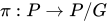
If is a smooth principal -bundle then acts freely and properly on so that the orbit space is diffeomorphic to the base space . It turns out that these properties completely characterize smooth principal bundles. That is, if is a smooth manifold, a Lie group and a smooth, free, and proper right action then

  • is a smooth manifold,
  • the natural projection is a smooth submersion, and
  • is a smooth principal -bundle over .

Use of the notion

[edit]

Reduction of the structure group

[edit]

Given a subgroup H of G one may consider the bundle whose fibers are homeomorphic to the coset space . If the new bundle admits a global section, then one says that the section is a reduction of the structure group from to . The reason for this name is that the (fiberwise) inverse image of the values of this section form a subbundle of that is a principal -bundle. If is the identity, then a section of itself is a reduction of the structure group to the identity. Reductions of the structure group do not in general exist.

Many topological questions about the structure of a manifold or the structure of bundles over it that are associated to a principal -bundle may be rephrased as questions about the admissibility of the reduction of the structure group (from to ). For example:

The frame bundle of the Möbius strip is a non-trivial principal -bundle over the circle.
  • A -dimensional real manifold admits an almost-complex structure if the frame bundle on the manifold, whose fibers are , can be reduced to the group .
  • An -dimensional real manifold admits a -plane field if the frame bundle can be reduced to the structure group .
  • A manifold is orientable if and only if its frame bundle can be reduced to the special orthogonal group, .
  • A manifold has spin structure if and only if its frame bundle can be further reduced from to the Spin group, which maps to as a double cover.

Also note: an -dimensional manifold admits vector fields that are linearly independent at each point if and only if its frame bundle admits a global section. In this case, the manifold is called parallelizable.

Associated vector bundles and frames

[edit]

If is a principal -bundle and is a linear representation of , then one can construct a vector bundle with fibre , as the quotient of the product × by the diagonal action of . This is a special case of the associated bundle construction, and is called an associated vector bundle to . If the representation of on is faithful, so that is a subgroup of the general linear group GL(), then is a -bundle and provides a reduction of structure group of the frame bundle of from to . This is the sense in which principal bundles provide an abstract formulation of the theory of frame bundles.

Classification of principal bundles

[edit]

Any topological group G admits a classifying space BG: the quotient by the action of G of some weakly contractible space, e.g., a topological space with vanishing homotopy groups. The classifying space has the property that any G principal bundle over a paracompact manifold B is isomorphic to a pullback of the principal bundle EGBG.[5] In fact, more is true, as the set of isomorphism classes of principal G bundles over the base B identifies with the set of homotopy classes of maps BBG.

See also

[edit]

References

[edit]

Sources

[edit]
Revisions and contributorsEdit on WikipediaRead on Wikipedia
from Grokipedia
A principal bundle, also known as a principal G-bundle for a G, is a PMP \to M in which the structure group G acts freely and transitively on the total space P from the right, with the projection π:PM\pi: P \to M being G-invariant, meaning π(pg)=π(p)\pi(p \cdot g) = \pi(p) for all pPp \in P and gGg \in G, and the bundle is locally trivial via G-equivariant diffeomorphisms to open sets in M times G. This structure ensures that the fibers over each point in the base manifold M are diffeomorphic to G itself, and the quotient space P/G is homeomorphic (or diffeomorphic, in the smooth case) to M. Principal bundles generalize Cartesian products of a base with a group while capturing twisting or non-trivial , and they form the foundation for associated vector bundles, where representations of G on vector spaces yield fibers modeled on those spaces. A key property is that a principal G-bundle admits a global section it is trivial, i.e., isomorphic to the product bundle M × G. They are locally trivial, covered by open sets U_α ⊂ M with equivariant trivializations φ_α: π⁻¹(U_α) → U_α × G satisfying φ_α(p · g) = (π(p), g' · g) for some adjustment by transition functions in G. Classic examples include the of a smooth manifold M, which is a principal GL(n, ℝ)-bundle whose sections correspond to bases of the tangent spaces at each point, and its reduction to an SO(n)-bundle for Riemannian manifolds with a metric. Another is the tautological S¹-bundle over ℂℙⁿ, arising from the action of U(1) on unit spheres. In , principal bundles are essential for defining connections, which are G-equivariant ℝⁿ-valued 1-forms on P that split the into horizontal and vertical subbundles, enabling the study of curvature and . Beyond , principal bundles provide the geometric framework for gauge theories in physics, where the total space P models the configuration space of gauge fields, and connections represent gauge potentials, as in Yang-Mills theory with structure groups like SU(3) for . Their classification up to isomorphism is governed by classes in the BG, linking them to characteristic classes and topological invariants.

Fundamentals

Formal definition

A principal GG-bundle, where GG is a , is a (P,π,M)(P, \pi, M) with GG over a smooth manifold MM, consisting of a smooth manifold PP, a surjective submersion π:PM\pi: P \to M, and a smooth right action of GG on PP that is free and transitive on each π1(m)\pi^{-1}(m). The action is denoted by pgp \cdot g for pPp \in P and gGg \in G, and it is compatible with the projection in the sense that π(pg)=π(p)\pi(p \cdot g) = \pi(p) for all pPp \in P and gGg \in G. This structure ensures that each π1(m)\pi^{-1}(m) is a GG-torsor, meaning it admits a unique free and transitive right GG-action up to . The bundle is locally trivial: for every point mMm \in M, there exists an open neighborhood UMU \subset M and a GG-equivariant ϕ:π1(U)U×G\phi: \pi^{-1}(U) \to U \times G satisfying ϕ(pg)=(π(p),ϕ(p)2g)\phi(p \cdot g) = (\pi(p), \phi(p)_2 \cdot g), where ϕ(p)=(π(p),ϕ(p)2)\phi(p) = (\pi(p), \phi(p)_2) and the action on U×GU \times G is defined by (u,h)g=(u,hg)(u, h) \cdot g = (u, h g). In contrast to a general fiber bundle, where the fibers are simply diffeomorphic to a fixed model space FF with an effective action of a structure group on FF, a principal bundle specifies F=GF = G and requires the action to be free and transitive, thereby canonically identifying the fibers with the group itself via the group action.

Examples

The trivial principal bundle provides the simplest example of a principal bundle structure. Given a manifold MM and a Lie group GG, the product space P=M×GP = M \times G forms a principal GG-bundle over MM via the projection π:PM\pi: P \to M defined by π(m,g)=m\pi(m, g) = m, with the right GG-action given by (m,g)h=(m,gh)(m, g) \cdot h = (m, gh) for hGh \in G. This construction is locally trivial everywhere, as the bundle is globally a product, and it serves as the model for understanding local behavior in more general principal bundles. A fundamental example in is the frame bundle of a . For a real EME \to M of rank nn, the P(E)MP(E) \to M is the principal GL(n,R)\mathrm{GL}(n, \mathbb{R})-bundle whose fiber over each point mMm \in M consists of all ordered bases (frames) of the fiber EmE_m. The right action of GL(n,R)\mathrm{GL}(n, \mathbb{R}) on P(E)P(E) changes bases via , and this bundle captures the linear structure of EE while being locally trivial over coordinate charts where bases can be chosen consistently. The exemplifies a non-trivial principal bundle with compact fibers. The classical is the principal U(1)U(1)-bundle S3S2S^3 \to S^2 with fiber S1S^1, where S3S^3 is the total space and the projection identifies points differing by phase multiplication in C2\mathbb{C}^2. More generally, the fibration S2k+1CPkS^{2k+1} \to \mathbb{CP}^k for k1k \geq 1 is a principal U(1)U(1)-bundle, with fibers consisting of scalar multiples in Ck+1\mathbb{C}^{k+1}, illustrating how complex projective spaces arise as base spaces for circle bundles. In physics, principal bundles model gauge symmetries underlying fundamental interactions. For electromagnetism, the gauge fields are connections on a principal U(1)U(1)-bundle over spacetime, where sections correspond to phase choices for charged fields. Similarly, Yang-Mills theories employ principal SU(n)SU(n)-bundles over spacetime for non-abelian gauge groups, such as SU(3)SU(3) in quantum chromodynamics, where the bundle structure encodes the freedom in choosing local gauge transformations. Stiefel manifolds appear as total spaces of orthogonal frame bundles over Grassmannians. The real Stiefel manifold Vk,n(R)V_{k,n}(\mathbb{R}), consisting of orthonormal kk-frames in Rn\mathbb{R}^n, is the total space of the principal O(k)O(k)-bundle over the Grassmannian Grk,n(R)\mathrm{Gr}_{k,n}(\mathbb{R}) of kk-planes in Rn\mathbb{R}^n, with the projection mapping each frame to its span and the right O(k)O(k)-action rotating the frame within the plane. This construction highlights the role of principal bundles in parametrizing oriented subspaces.

Structural Properties

Trivializations and sections

A trivialization of a principal GG-bundle (P,π,M)(P, \pi, M) over an open subset UMU \subseteq M is a GG-equivariant diffeomorphism ϕ:π1(U)U×G\phi: \pi^{-1}(U) \to U \times G satisfying pr1ϕ=ππ1(U)\mathrm{pr}_1 \circ \phi = \pi|_{\pi^{-1}(U)}, where pr1\mathrm{pr}_1 is the projection onto the first factor and GG acts on U×GU \times G by right multiplication (u,h)k=(u,hk)(u, h) \cdot k = (u, h k). The equivariance condition requires ϕ(pg)=ϕ(p)g\phi(p \cdot g) = \phi(p) \cdot g for all pπ1(U)p \in \pi^{-1}(U) and gGg \in G. By definition, every principal bundle admits a cover {Uα}\{U_\alpha\} of MM by open sets each equipped with such a trivialization ϕα\phi_\alpha. Given two trivializations ϕi\phi_i and ϕj\phi_j over overlapping open sets UiU_i and UjU_j, the transition function gij:UiUjGg_{ij}: U_i \cap U_j \to G is defined by ϕjϕi1(u,h)=(u,gij(u)h)\phi_j \circ \phi_i^{-1}(u, h) = (u, g_{ij}(u) h) for uUiUju \in U_i \cap U_j and hGh \in G. These transition functions satisfy the cocycle condition gij(u)gjk(u)=gik(u)g_{ij}(u) g_{jk}(u) = g_{ik}(u) on triple overlaps UiUjUkU_i \cap U_j \cap U_k, ensuring consistency across the cover. Trivializations over the same open set are unique up to right GG-action, meaning if ϕ\phi and ψ\psi are two trivializations of π1(U)\pi^{-1}(U), then there exists a map f:UGf: U \to G such that ψ(p)=ϕ(p)f(π(p))\psi(p) = \phi(p) \cdot f(\pi(p)) for all pπ1(U)p \in \pi^{-1}(U). A (global) section of the principal bundle is a smooth map s:MPs: M \to P such that πs=idM\pi \circ s = \mathrm{id}_M. The existence of a global section implies that the bundle is trivial, as it induces an M×GPM \times G \to P via (m,g)s(m)g(m, g) \mapsto s(m) \cdot g. Conversely, every trivial principal bundle admits global sections. Since the right GG-action on PP is free, for any section ss we have s(m)g=s(m)s(m) \cdot g = s(m) only if g=eg = e, the . Local sections arise naturally from trivializations, for instance, the constant section over UαU_\alpha given by ϕα1(u,e)\phi_\alpha^{-1}(u, e) for uUαu \in U_\alpha.

Characterization of smooth principal bundles

In differential geometry, a smooth principal bundle over a smooth manifold MM consists of a total space PP, which is also a smooth manifold, together with a smooth submersion π:PM\pi: P \to M and a GG acting smoothly, freely, and properly on PP from the right such that the action is fiber-preserving (i.e., π(pg)=π(p)\pi(p \cdot g) = \pi(p) for all pPp \in P and gGg \in G). The fibers π1(m)\pi^{-1}(m) for mMm \in M are thus diffeomorphic to GG via the transitive action, and the smoothness of the submersion ensures that local sections exist, making the fibers embedded smooth submanifolds. This structure distinguishes smooth principal bundles by imposing compatibility with the of the underlying manifolds. Two smooth principal bundles (P,π,M,G)(P, \pi, M, G) and (P,π,M,G)(P', \pi', M', G) are equivalent if there exists a smooth GG-equivariant diffeomorphism f:PPf: P \to P' such that πf=ϕπ\pi' \circ f = \phi \circ \pi for some diffeomorphism ϕ:MM\phi: M \to M'. Equivalence in this sense preserves the smooth structure and the right GG-action, which is right-invariant by definition: for all pPp \in P and g,hGg, h \in G, (pg)h=p(gh)(p \cdot g) \cdot h = p \cdot (gh), with the multiplication in GG smooth. This invariance ensures that the action respects the manifold structures and allows the bundle to be reconstructed from its local trivializations. A smooth principal bundle admits an atlas of trivializations {ϕi:π1(Ui)Ui×G}\{\phi_i: \pi^{-1}(U_i) \to U_i \times G\}, where {Ui}\{U_i\} is an open cover of MM and each ϕi\phi_i is a GG-equivariant , with the right action on Ui×GU_i \times G given by (u,k)g=(u,kg)(u, k) \cdot g = (u, k g). The transition functions gij:UiUjGg_{ij}: U_i \cap U_j \to G, defined by ϕj=(ϕi×idG)(idUiUj×gij)\phi_j = (\phi_i \times \mathrm{id}_G) \circ ( \mathrm{id}_{U_i \cap U_j} \times g_{ij} ), are smooth maps satisfying the cocycle condition gij(u)gjk(u)=gik(u)g_{ij}(u) g_{jk}(u) = g_{ik}(u) for uUiUjUku \in U_i \cap U_j \cap U_k. These smooth transition functions encode the twisting of the bundle and ensure global consistency in the smooth category. In contrast to topological principal bundles, where the total space, base, projection, and are merely continuous and the transition functions are continuous maps to the GG, the smooth version requires all components—manifolds PP and MM, submersion π\pi, GG, action, and transition functions—to be smooth. This added smoothness ensures compatibility with the spaces and differential forms on PP and MM, enabling the construction of smooth connections and other tools central to .

Applications

Reduction of the structure group

In the context of a principal GG-bundle PMP \to M over a smooth manifold MM, a reduction of the structure group to a closed HGH \subset G is given by a principal HH-subbundle QPQ \subset P such that P=QGP = Q \cdot G, where QGQ \cdot G denotes the saturation of QQ under the right GG-action on PP, ensuring that every GG-orbit in PP intersects QQ. This construction simplifies the geometry of PP by restricting the fiberwise action to the smaller group HH, while preserving the bundle structure over MM. Equivalently, such a reduction exists if and only if the classifying map f:MBGf: M \to BG for PP lifts (up to ) to a map g:MBHg: M \to BH composing with the induced BHBGBH \to BG to yield ff, assuming HH is a closed of the GG. In terms of cocycles, if {gij}\{g_{ij}\} are the GG-valued transition functions of PP on an open cover {Ui}\{U_i\} of MM, the reduction corresponds to the existence of an HH-valued cocycle {hij}\{h_{ij}\} refining {gij}\{g_{ij}\}, meaning there exist GG-valued functions uiu_i on UiU_i such that gij=uihijuj1g_{ij} = u_i h_{ij} u_j^{-1} for all i,ji,j. More generally, when considering the normalizer NG(H)={kGkHk1=H}N_G(H) = \{k \in G \mid k H k^{-1} = H\}, the refinement takes the form gij=kijhijlijg_{ij} = k_{ij} h_{ij} l_{ij} with kij,lijNG(H)k_{ij}, l_{ij} \in N_G(H), allowing for conjugate adjustments within the normalizer. A maximal reduction of the structure group occurs when HH is as large as possible while admitting such a subbundle; common cases include reduction to the identity component G0G_0 of GG (preserving connectedness) or to the center Z(G)Z(G) (capturing central extensions). For instance, the frame bundle P(M,GL(n,R))P(M, \mathrm{GL}(n,\mathbb{R})) of an nn-dimensional paracompact manifold MM admits a reduction to O(n)\mathrm{O}(n) if and only if MM carries a Riemannian metric, which is always possible and corresponds to an O(n)\mathrm{O}(n)-structure defining the metric via the associated orthogonal bundle. Reductions to HH are in bijective correspondence with G/HG/H-bundle structures over MM: specifically, the P×G(G/H)MP \times_G (G/H) \to M admits a global section if and only if PP reduces to HH, with the section identifying the G/HG/H-fibers pointwise via the HH-orbits in GG. This equivalence underscores the role of reductions in classifying bundle geometries through homogeneous spaces G/HG/H.

Associated bundles and frames

Given a principal GG-bundle π:PM\pi: P \to M and a representation ρ:GGL(V)\rho: G \to \mathrm{GL}(V) on a VV, the associated vector bundle E=P×ρVE = P \times_\rho V is constructed as the quotient space (P×V)/G(P \times V)/G, where the GG-action is defined by (p,v)g=(pg,ρ(g1)v)(p, v) \cdot g = (p \cdot g, \rho(g^{-1}) v) for pPp \in P, vVv \in V, and gGg \in G. The identifies [p,v][pg,ρ(g1)v][p, v] \sim [p \cdot g, \rho(g^{-1}) v], and the projection map is πE:EM\pi_E: E \to M given by πE([p,v])=π(p)\pi_E([p, v]) = \pi(p), ensuring EE is a over MM with fibers isomorphic to VV. The tangent bundle TMTM of an nn-dimensional smooth manifold MM exemplifies this association: the frame bundle FMFM is the principal GL(n,R)\mathrm{GL}(n, \mathbb{R})-bundle over MM whose fiber at mMm \in M consists of all ordered bases (frames) of TmMT_m M, with right action fg=(gi1f1,,ginfn)f \cdot g = (g_{i1} f_1, \dots, g_{in} f_n) for f=(f1,,fn)f = (f_1, \dots, f_n) and g=(gij)GL(n,R)g = (g_{ij}) \in \mathrm{GL}(n, \mathbb{R}). Then, TMTM is the associated vector bundle FM×GL(n,R)RnFM \times_{\mathrm{GL}(n, \mathbb{R})} \mathbb{R}^n, where [f,v]ifiviTπ(f)M[f, v] \mapsto \sum_i f_i v^i \in T_{\pi(f)} M for v=(vi)Rnv = (v^i) \in \mathbb{R}^n. If MM admits a Riemannian metric, reduction of the structure group of FMFM to the orthogonal group O(n)\mathrm{O}(n) yields a principal O(n)\mathrm{O}(n)-bundle whose associated bundle consists of orthonormal frames. Global sections of the associated bundle EE correspond bijectively to ρ\rho-equivariant maps σ:PV\sigma: P \to V, i.e., maps satisfying σ(pg)=ρ(g1)σ(p)\sigma(p \cdot g) = \rho(g^{-1}) \sigma(p) for all pPp \in P, gGg \in G. Locally, over a trivialization UMU \subset M with section s:Uπ1(U)s: U \to \pi^{-1}(U), a section of EUE|_U is represented by [s(m),v(m)][s(m), v(m)] for a smooth v:UVv: U \to V, and the equivariance ensures consistency under gauge transformations. Thus, Γ(E){s~:PVs~(pg)=ρ(g1)s~(p) gG}\Gamma(E) \cong \{ \tilde{s}: P \to V \mid \tilde{s}(p \cdot g) = \rho(g^{-1}) \tilde{s}(p) \ \forall g \in G \}. Associated bundles inherit functoriality from principal bundles: for a smooth map f:NMf: N \to M, the pullback principal bundle fP=N×MPf^* P = N \times_M P induces the pullback associated bundle fE=(fP)×ρVf^* E = (f^* P) \times_\rho V, with fibers over nNn \in N given by {(n,[p,v])f(n)=π(p)}\{ (n, [p, v]) \mid f(n) = \pi(p) \}, preserving the vector bundle structure. Conversely, for a surjective submersion f:NMf: N \to M and associated bundle EE over NN, the pushforward fEf_* E over MM has fiber over mMm \in M consisting of smooth sections of EE over f1(m)f^{-1}(m), equipped with a natural vector bundle structure when ff is proper.

Connections on principal bundles

A connection on a principal bundle provides a geometric framework for defining notions of and differentiation, enabling the study of how objects transform along paths in the base manifold. In the context of a smooth principal GG-bundle π:PM\pi: P \to M with structure group GG, an Ehresmann connection is defined as a smooth horizontal distribution HTPH \subset TP such that for each pPp \in P, HpH_p is a subspace of TpPT_p P complementary to the vertical subspace Vp=ker(dπp)V_p = \ker(d\pi_p), and the projection dπHp:HpTπ(p)Md\pi|_{H_p}: H_p \to T_{\pi(p)} M is a linear isomorphism, with the distribution being right-invariant under the GG-action: RgHp=HpgR_g^* H_p = H_{p \cdot g} for all gGg \in G. This setup ensures a consistent choice of "horizontal" directions transverse to the fibers, facilitating the lifting of curves from MM to PP. The vertical subspace VpV_p at pPp \in P is the kernel of the differential dπp:TpPTπ(p)Md\pi_p: T_p P \to T_{\pi(p)} M, which coincides with the tangent space to the fiber π1(π(p))\pi^{-1}(\pi(p)) and is spanned by the fundamental vector fields {pξξg}\{ p \cdot \xi \mid \xi \in \mathfrak{g} \}, where g\mathfrak{g} is the of GG and pξp \cdot \xi denotes the infinitesimal action of ξ\xi at pp. Thus, VpgV_p \cong \mathfrak{g} as vector spaces, providing a identification that underpins the bundle's GG-. The decomposition TpP=VpHpT_p P = V_p \oplus H_p then splits the tangent bundle into vertical and horizontal components, with the horizontal part encoding the connection's geometric data. Equivalently, an Ehresmann connection can be described by a g\mathfrak{g}-valued 1-form ωΩ1(P,g)\omega \in \Omega^1(P, \mathfrak{g}), called the , satisfying two key : it reproduces the elements on vertical vectors, ω(ξp#)=ξ\omega(\xi^\#_p) = \xi for ξg\xi \in \mathfrak{g} where ξp#=pξ\xi^\#_p = p \cdot \xi, and it is equivariant under the right GG-action, Rgω=Ad(g1)ωR_g^* \omega = \mathrm{Ad}(g^{-1}) \omega for gGg \in G. The horizontal subspace is then the kernel Hp=kerωpH_p = \ker \omega_p, ensuring that ω\omega projects tangent vectors onto their vertical components relative to g\mathfrak{g}. This captures the connection's tensorial nature and allows for local expressions in trivializations of PP. The curvature of the connection measures the extent to which the horizontal distribution fails to be integrable and is given by the g\mathfrak{g}-valued 2-form Ω=dω+12[ω,ω]\Omega = d\omega + \frac{1}{2} [\omega, \omega], where [,][\cdot, \cdot] denotes the Lie bracket in g\mathfrak{g} extended to forms via the wedge product. More precisely, Ω\Omega is the horizontal part of dωd\omega, satisfying Ω(X,Y)=dω(X,Y)+12[ω(X),ω(Y)]\Omega(X, Y) = d\omega(X, Y) + \frac{1}{2} [\omega(X), \omega(Y)] for horizontal vectors X,YX, Y, and it transforms as RgΩ=Ad(g1)ΩR_g^* \Omega = \mathrm{Ad}(g^{-1}) \Omega, making it a tensorial form of type AdG\mathrm{Ad} G. A connection is flat if Ω=0\Omega = 0, in which case the horizontal distribution defines an integrable foliation, but in general, Ω\Omega quantifies holonomy obstructions. Parallel transport along a curve c:[0,1]Mc: [0,1] \to M is defined by lifting cc horizontally in PP: for pπ1(c(0))p \in \pi^{-1}(c(0)), there exists a unique horizontal curve c~:[0,1]P\tilde{c}: [0,1] \to P with c~(0)=p\tilde{c}(0) = p and πc~=c\pi \circ \tilde{c} = c, provided the connection is smooth. This induces a GG-equivariant isomorphism τc:π1(c(0))π1(c(1))\tau_c: \pi^{-1}(c(0)) \to \pi^{-1}(c(1)) between fibers, preserving the bundle structure and defining the holonomy of the connection, which encodes global geometric information via the image of the holonomy group.

Classification

Topological classification

The topological classification of principal bundles concerns the determination of isomorphism classes of such bundles over a base space MM, where isomorphism is understood in the category of topological spaces without additional structure. For a topological group GG, the set of isomorphism classes of principal GG-bundles over MM is in bijective correspondence with the homotopy classes of continuous maps [M,BG][M, BG], where BGBG is the classifying space of GG. This classifying space BGBG is characterized as the base space of the universal principal GG-bundle EGBGEG \to BG, which is contractible as a total space and thus serves as a universal model for all principal GG-bundles via pullback. The bijection arises from the fact that any principal GG-bundle PMP \to M admits a classifying map f:MBGf: M \to BG such that PfEGP \cong f^* EG, with two bundles isomorphic if and only if their classifying maps are homotopic. When GG is a discrete group, the classifying space BGBG is a K(G,1)K(G, 1)-space, meaning its higher homotopy groups vanish, and the homotopy classes [M,BG][M, BG] coincide with the first Čech cohomology group Hˇ1(M;G)\check{H}^1(M; \underline{G}), where G\underline{G} denotes the constant sheaf associated to GG. In this case, principal GG-bundles over MM are classified by Čech 1-cocycles with values in GG, representing transition functions on an open cover of MM, up to coboundaries. More generally, for arbitrary topological GG, the classification via [M,BG][M, BG] can be refined using sheaf cohomology in the category of sheaves of sets or groups on MM, where the isomorphism classes correspond to elements in the first cohomology group of the sheaf of GG-principal bundles. This cohomological perspective unifies the topological data encoded in the bundle's transition functions with global homotopy invariants. A concrete method to construct and classify principal bundles over spheres or manifolds decomposable as unions of cells is the clutching construction. For a base space M=UVM = U \cup V where UU and VV are open sets homeomorphic to disks or balls, a principal GG-bundle over MM is obtained by taking trivial bundles over UU and VV and gluing them along the intersection via a clutching map ϕ:UVSn1G\phi: U \cap V \simeq S^{n-1} \to G. Two such bundles are isomorphic if their clutching maps are homotopic in GG. On spheres SnS^n, this reduces the classification to homotopy classes [πn1(G)][\pi_{n-1}(G)], with the clutching map providing an explicit representative of the bundle's class in [Sn,BG]πn1(G)[S^n, BG] \simeq \pi_{n-1}(G). This construction highlights how local trivializations determine global topology through boundary data. For the specific case of S1S^1-principal bundles, which are circle bundles, the classification is given by the first c1H2(M;Z)c_1 \in H^2(M; \mathbb{Z}), an element of the second integer group of MM. The arises as the primary associated to the bundle via the classifying map to BS1CPBS^1 \cong \mathbb{C}P^\infty, and it detects the bundle's twisting: trivial bundles correspond to c1=0c_1 = 0, while non-trivial examples include the over S2S^2 with c1c_1 generating H2(S2;Z)H^2(S^2; \mathbb{Z}). Isomorphic bundles share the same , providing a complete invariant for oriented circle bundles over paracompact bases. In general, the existence of a principal GG-bundle or its isomorphism class can be probed using obstruction theory, which measures the failure of a partial classifying map or section to extend globally. Assuming a partial map defined on the kk-skeleton of a CW-complex model for MM, the primary obstruction to extension lies in Hk+1(M;πk(BG))H^{k+1}(M; \pi_k(BG)), but for bundles, it relates directly to the homotopy groups of GG via the long exact sequence of the fibration EGBGEG \to BG. Specifically, the primary obstruction to triviality (or existence of a global section) is in H2(M;π1(G))H^2(M; \pi_1(G)), with secondary obstructions in H3(M;π2(G))H^3(M; \pi_2(G)) if the primary vanishes, and higher terms following the Postnikov tower of BGBG. This cohomological ladder provides a systematic way to compute when a bundle exists or is unique up to isomorphism based on the topology of MM and GG.

Smooth and holomorphic classification

In the smooth category, principal GG-bundles over a smooth manifold MM, where GG is a , are classified up to smooth isomorphism by the first non-abelian Čech cohomology group Hˇ1(M,G)\check{H}^1(M, G) with coefficients in smooth GG-valued functions on intersections of an open cover. Specifically, a smooth cocycle consists of smooth transition functions gij:UiUjGg_{ij}: U_i \cap U_j \to G satisfying gij(x)gjk(x)=gik(x)g_{ij}(x) g_{jk}(x) = g_{ik}(x) for xUiUjUkx \in U_i \cap U_j \cap U_k, and two cocycles are equivalent if they differ by a smooth coboundary hi:UiGh_i: U_i \to G via gij=hi1gijhjg'_{ij} = h_i^{-1} g_{ij} h_j. This Čech description captures the local trivializations and ensures the bundle's . For G=U(1)G = U(1), the classification aligns with the topological case via the first in H2(M;Z)H^2(M; \mathbb{Z}). An equivariant refinement of this classification uses smooth classifying spaces: smooth principal GG-bundles over MM correspond bijectively to smooth homotopy classes of maps [M,BG]smooth[M, BG]_{\text{smooth}}, where BGBG is equipped with a smooth structure (e.g., via diffeological spaces for general Lie groups), and the universal bundle EGBGEG \to BG pulls back along such maps. This extends the topological classification by requiring the classifying map to be smooth, ensuring diffeomorphism equivalence of bundles corresponds to smooth homotopies, and applies particularly well when GG admits a smooth model for its classifying space. For compact Lie groups, the smooth and topological classifications coincide up to isomorphism due to the existence of smooth partitions of unity on paracompact bases. Holomorphic principal GG-bundles, where GG is a complex Lie group, are defined over a complex manifold MM using an open cover with holomorphic transition functions gij:UiUjGg_{ij}: U_i \cap U_j \to G satisfying the cocycle condition holomorphically. These bundles are classified up to holomorphic by the non-abelian holomorphic Hˇ1(M,G)\check{H}^1(M, G) or, equivalently, by holomorphic maps to the BGBG in the holomorphic category. For G=GL(n,C)G = \mathrm{GL}(n, \mathbb{C}), such principal bundles are in bijective correspondence with holomorphic vector bundles of rank nn over MM, classified by holomorphic cohomology. Characteristic classes provide topological invariants refining the smooth and holomorphic classifications. For principal U(n)U(n)-bundles, the Chern classes ckH2k(M,Z)c_k \in H^{2k}(M, \mathbb{Z}) in even degrees classify the bundles up to when the base is a , with the total Chern class c(E)=1+c1(E)++cn(E)c(E) = 1 + c_1(E) + \cdots + c_n(E) determined by the of invariant connections via Chern-Weil theory. Similarly, for principal O(n)O(n)-bundles, the pkH4k(M,Z)p_k \in H^{4k}(M, \mathbb{Z}) serve as primary invariants, related to Chern classes of the by pk=(1)kc2kp_k = (-1)^k c_{2k}, and together with Stiefel-Whitney classes, they fully classify oriented real bundles in low dimensions. These classes remain invariant under smooth or holomorphic and extend the topological classification by incorporating differential-geometric data.

References

Add your contribution
Related Hubs
User Avatar
No comments yet.