


Community hub
Recent from talks
Contribute something
Nothing was collected or created yet.
Pomelo
View on Wikipedia
| Pomelo | |
|---|---|

| |
Scientific classification 
| |
| Kingdom: | Plantae |
| Clade: | Tracheophytes |
| Clade: | Angiosperms |
| Clade: | Eudicots |
| Clade: | Rosids |
| Order: | Sapindales |
| Family: | Rutaceae |
| Genus: | Citrus |
| Species: | C. maxima
|
| Binomial name | |
| Citrus maxima | |

The pomelo (/ˈpɒmɪloʊ, ˈpʌm-/ POM-il-oh, PUM-;[2][3] or pummelo, Citrus maxima), also known as a shaddock, is the largest citrus fruit. It is an ancestor of several cultivated citrus species, including the bitter orange and the grapefruit. It is a natural, non-hybrid citrus fruit, native to Southeast Asia. Similar in taste to a sweet grapefruit, the pomelo is commonly eaten and used for festive occasions throughout Southeast and East Asia. As with the grapefruit, phytochemicals in the pomelo have the potential for drug interactions.
Description
[edit]The pomelo tree can be 5–15 meters (16–50 feet) tall, with a trunk, often rather crooked, that is 10–30 centimeters (4–12 inches) thick, and low-hanging, irregular branches. The petioles (leaf stalks) are distinctly winged. The leaves are alternate, ovate or elliptic in shape, and 5–20 cm (2–8 in) long; they are leathery and dull green above, hairy beneath. The flowers – single or in clusters – are fragrant and yellow-white in color.[4]
The fruit is large, 10–30 cm (4–12 in) in diameter, round or somewhat pear-shaped.[4] Its weight varies by cultivar from 0.26–1.95 kilograms (0.6–4.3 pounds).[5] It has a thicker rind than a grapefruit, and is divided into 11 to 18 segments.[4] The flesh is less acidic than that of the grapefruit.[4][6]
The pomelo has at least sixty cultivars.[7] The fruit generally contains a few, relatively large seeds, but some varieties have numerous seeds.[4] The characteristics of pomelo vary widely across South Asia.[4]
The pomelo is native to Southeast Asia and all of Malaysia.[4] The tree may have been introduced to China around 100 BCE, and is now heavily cultivated in Southern China.[4] Seeds of the tree were first brought to the Americas in the late 1600s.[4]
-
 Seedling
 -
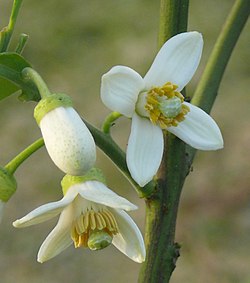 Flowers
 -
 Tree
Tree -
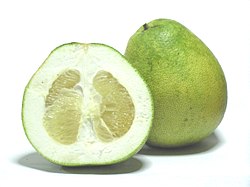 Fruit
Fruit


History
[edit]Ancestral Citrus species
[edit]_Merr.);_flowe_Wellcome_V0042686.jpg)
The pomelo is significant botanically as one of the three major wild ancestors of several cultivated hybrid Citrus species, including the bitter orange and the grapefruit; and less directly also of the lemon, the sweet orange, and some types of mandarin.[8][9] The bitter orange is a naturally occurring hybrid between the pomelo and the mandarin.[9] The grapefruit is a hybrid between a pomelo and a sweet orange,[9] which is why 63% of the grapefruit's genome comes from the pomelo.[10] The bitter orange is a hybrid of wild type mandarin and pomelo; in turn, the lemon is a hybrid of bitter orange and citron, i.e. cultivated lemons have some pomelo ancestry.[9] In addition, there has been repeated introgression of pomelo genes into both early cultivated hybrid mandarins and later mandarin varieties, these last also involving hybridization with the sweet orange. Pomelo genes are thus included in many types of cultivated Citrus.[9]

Etymology
[edit]According to the Oxford English Dictionary, the etymology of the word 'pomelo' is uncertain.[11] It may be derived from Dutch pompelmoes.[4] The Dutch name in turn has uncertain etymology, but is possibly derived from Dutch pompel 'swollen' or pompoen 'pumpkin', combined with limoes 'lemon, citrus fruit', influenced by Portuguese limões with the same meaning.[12] An alternative possibility is that the Dutch name derives from Portuguese pomos limões 'citrus fruit'.[12] The specific name maxima is the female form of the Latin for 'biggest'.[13]
One theory for the alternative English name 'shaddock' is that it was adopted after the plant's introduction into Barbados by a 'Captain Shaddock' of the East India Company (apparently Philip Chaddock, who visited the island in the late 1640s).[14][15] From there the name spread to Jamaica in 1696.[16]
Taxonomy
[edit]In his Herbarium Amboinense, published posthumously in 1741, Georg Eberhard Rumphius named it Limo decumanus.[17][18] In 1753, Carl Linnaeus mentioned the plant as a subspecies, Citrus aurantium var grandis.[17][19] In 1755, Johannes Burman validly described the species from the type specimen, giving it the name Aurantium maximum, now considered a basionym.[20] In 1757, Pehr Osbeck named it Citrus grandis.[17][21] Linnaeus revisited the taxonomy in 1767, renaming the species as Citrus decumana.[17][22] In 1917, Elmer Drew Merrill revised and renamed it Citrus maxima.[20][17] Aurantioideae remains as a subfamily.[23]
As food
[edit]Nutrition
[edit] Flesh of a pomelo | |||||||||||||||||||||||||||||||||||||
| Nutritional value per 100 g (3.5 oz) | |||||||||||||||||||||||||||||||||||||
|---|---|---|---|---|---|---|---|---|---|---|---|---|---|---|---|---|---|---|---|---|---|---|---|---|---|---|---|---|---|---|---|---|---|---|---|---|---|
| Energy | 159 kJ (38 kcal) | ||||||||||||||||||||||||||||||||||||
9.62 g | |||||||||||||||||||||||||||||||||||||
| Dietary fiber | 1 g | ||||||||||||||||||||||||||||||||||||
0.04 g | |||||||||||||||||||||||||||||||||||||
0.76 g | |||||||||||||||||||||||||||||||||||||
| |||||||||||||||||||||||||||||||||||||
| Other constituents | Quantity | ||||||||||||||||||||||||||||||||||||
| Water | 89 g | ||||||||||||||||||||||||||||||||||||
| †Percentages estimated using US recommendations for adults,[24] except for potassium, which is estimated based on expert recommendation from the National Academies.[25] | |||||||||||||||||||||||||||||||||||||
Raw pomelo flesh is 89% water, 10% carbohydrates, 1% protein, and contains negligible fat. A 100-gram reference amount provides 159 kilojoules (38 kilocalories) of food energy, and is rich in vitamin C (68% of the Daily Value), with no other micronutrients in significant content (table).
Culinary
[edit]The flesh and juice are edible, and the peel may be candied.[4] It is eaten as a dessert, or used in salads.[4] In the Philippines, a pink beverage is made from pomelo and pineapple juice.[26]
In East Asia, especially in Cantonese cuisine, braised pomelo pith is used to make dishes that are high in fibre and low in fat.[27]
-
 Ipoh pomelos on sale in Malaysia
 -
 Tam som-o nam pu: spicy Thai pomelo salad with crab extract


Drug interactions
[edit]The pomelo, while not itself toxic, can cause adverse interactions similar to those caused by the grapefruit with a wide range of prescription drugs. These occur by the inhibition of cytochrome P450-mediated metabolism of prescription drugs including for example some anti-hypertensives, some anticoagulants, some anticancer agents, some anti-infective agents, some statins, and some immunosuppressants.[28]
Cultivation
[edit]The seeds of the pomelo are monoembryonic, producing seedlings with genes from both parents, so they do not breed true to type.[29] However, they are usually fairly similar to the tree they grow from and therefore in Asia, pomelos are typically grown from seed.[4] Seeds can be stored for 80 days at a temperature of 5 °C (41 °F) with moderate relative humidity.[4] Pomelos can be propagated vegetatively by air-layering, by taking cuttings, by grafting, by shield budding, or by tissue culture.[29]
-
 Pomelos in Pinghe County, Fujian
 -
 Orchard in Vietnam


In culture
[edit]The pomelo is used in cultural and spiritual festivals across Asia. In China, during the Lunar New Year festival, the fruit is offered to ancestors. Its name is similar to the word for "to have" (有, yǒu), making it a symbol of prosperity and family unity.[30] In Thailand, pomelo is used in rituals such as the Songkran festival.[31] In the Hindu festival of Chhath Puja, pomelo is used as an offering.[32]
-
 Chhat Puja with pomelo, India

References
[edit]- ^ Botanic Gardens Conservation International (BGCI).; IUCN SSC Global Tree Specialist Group (2019). "Citrus maxima". IUCN Red List of Threatened Species. 2019 e.T62042732A147027490. doi:10.2305/IUCN.UK.2019-2.RLTS.T62042732A147027490.en. Retrieved 19 November 2021.
- ^ "pomelo". The Chambers Dictionary (9th ed.). Chambers. 2003. ISBN 0-550-10105-5.
- ^ "pomelo". Merriam-Webster.com Dictionary. Merriam-Webster. Retrieved 2021-01-25.
- ^ a b c d e f g h i j k l m n Morton, Julia F. (1987). "Pummelo: Citrus maxima". Fruits of warm climates. NewCROP, New Crop Resource Online Program, Center for New Crops and Plant Products, Purdue University. pp. 147–151. Retrieved 2020-01-31.
- ^ Pan, Tengfei; Ali, Muhammad Moaaz; Gong, Jiangmei; She, Wenqin; Pan, Dongming; Guo, Zhixiong; Yu, Yuan; Chen, Faxing (2021-11-24). "Fruit Physiology and Sugar-Acid Profile of 24 Pomelo (Citrus grandis (L.) Osbeck) Cultivars Grown in Subtropical Region of China". Agronomy. 11 (12): 2393. Bibcode:2021Agron..11.2393P. doi:10.3390/agronomy11122393. ISSN 2073-4395.
- ^ Morton, Julia F. (1987). "Grapefruit: Citrus paradisi". Fruits of warm climates. NewCROP, New Crop Resource Online Program, Center for New Crops and Plant Products, Purdue University. pp. 152–158. Retrieved 2020-01-31.
- ^ Kelley, Jeanne (2016-02-13). "Pomelos, grapefruit's sweeter and mellower relative, have a wealth of flavor". Los Angeles Times. Archived from the original on 2016-02-12. Retrieved 2021-11-19.
- ^ Klein, Joshua D. (2014). "Citron Cultivation, Production and Uses in the Mediterranean Region". Medicinal and Aromatic Plants of the Middle-East. Medicinal and Aromatic Plants of the World. Vol. 2. pp. 199–214. doi:10.1007/978-94-017-9276-9_10. ISBN 978-94-017-9275-2.
- ^ a b c d e f Wu, Guohong Albert; Terol, Javier; Ibanez, Victoria; López-García, Antonio; Pérez-Román, Estela; et al. (2018). "Genomics of the origin and evolution of Citrus". Nature. 554 (7692): 311–316. Bibcode:2018Natur.554..311W. doi:10.1038/nature25447. hdl:20.500.11939/5741. PMID 29414943. and Supplement
- ^ Louzada, Eliezer S.; Ramadugu, Chandrika (June 2021). "Grapefruit: History, Use, and Breeding in: HortTechnology Volume 31 Issue 3 (2021)". Horttechnology. 31 (3). Journals.ashs.org: 243–258. doi:10.21273/HORTTECH04679-20. Retrieved 2022-05-01.
- ^ "pomelo". Oxford English Dictionary (Online ed.). Oxford University Press. (Subscription or participating institution membership required.)
- ^ a b "pompelmoes - (grote citrusvrucht (Citrus maxima))". Etymologiebank.nl. Retrieved 1 November 2024.
- ^ "maximus". Cambridge Dictionary. Retrieved 28 October 2024.
- ^ Kumamoto, J.; Scora, R.W.; Lawton, H.W.; Clerx, W.A. (1987). "Mystery of the Forbidden Fruit: Historical Epilogue on the Origin of the Grapefruit, Citrus paradisi (Rutaceae)". Economic Botany. 41 (1): 97–107. Bibcode:1987EcBot..41...97K. doi:10.1007/BF02859356. S2CID 42178548.
- ^ "Pomelo: The 'lucky' giant citrus". 21 March 2013.
- ^ American Heritage Dictionary, 1973.
- ^ a b c d e Merrill, Elmer Drew (1917). An interpretation of Rumphius's Herbarium amboinense. Manila, Philippines: Bureau of printing. p. 296.
- ^ Rumphius, Georg Eberhard (1741). Herbarium Amboinense. Vol. 2. p. 96.
- ^ Linnaeus, Carl (1753). Species plantarum. p. 783.
- ^ a b "Taxon: Citrus maxima (Burm.) Merr". Augalų Genų Bankas GRIN-Global. Retrieved 1 March 2025.
- ^ Osbeck, Pehr (1757). Dagbok öfwer en ostindisk Resa åren 1750 [Diary of an East Indian Journey in the Year 1750] (in Swedish). p. 98.
- ^ Linnaeus, Carl (1767). "12". Systema naturae per regna tria naturae. p. 508.
- ^ "Citrus maxima (CIDGR)". EPPO Global Database. Retrieved 1 March 2025.
- ^ United States Food and Drug Administration (2024). "Daily Value on the Nutrition and Supplement Facts Labels". FDA. Archived from the original on 2024-03-27. Retrieved 2024-03-28.
- ^ "TABLE 4-7 Comparison of Potassium Adequate Intakes Established in This Report to Potassium Adequate Intakes Established in the 2005 DRI Report". p. 120. In: Stallings, Virginia A.; Harrison, Meghan; Oria, Maria, eds. (2019). "Potassium: Dietary Reference Intakes for Adequacy". Dietary Reference Intakes for Sodium and Potassium. pp. 101–124. doi:10.17226/25353. ISBN 978-0-309-48834-1. PMID 30844154. NCBI NBK545428.
- ^ Hargreaves, Dorothy; Hargreaves, Bob (1970). Tropical Trees of the Pacific. Kailua, Hawaii: Hargreaves. p. 51.
- ^ "Braised pomelo pith". Week in China. 8 December 2017. Archived from the original on 2021-01-25. Retrieved 22 August 2020.
- ^ Bailey, D. G.; Dresser, G.; Arnold, J. M. O. (26 November 2012). "Grapefruit-medication interactions: Forbidden fruit or avoidable consequences?". Canadian Medical Association Journal. 185 (4): 309–316. doi:10.1503/cmaj.120951. PMC 3589309. PMID 23184849.
- ^ a b "[Pomelo] Propagation". International Tropical Fruits Network. Retrieved 24 March 2025.
- ^ Guri, Catohrinner Joyce (2015-09-27). "Significance of pomelo for Chinese people". Asian Itinerary. Retrieved 2025-02-04.
- ^ Svasti, Pichaya (2013-08-15). "Pomelo festival in Samut Songkhram". Bangkok Post. Retrieved 2025-02-04.
- ^ Yadav, Shikha (November 7, 2024). "Markets bloom with traditional offerings". The Times of India.


| International | |
|---|---|
| National | |

Pomelo
View on GrokipediaBiology and Taxonomy
Physical Description
The pomelo tree, scientifically known as Citrus maxima, is an evergreen species belonging to the Rutaceae family, typically growing 5 to 15 meters tall.[5][2] The tree features a spreading, low-branching crown with a somewhat crooked trunk that can measure 10 to 30 centimeters in diameter, often bearing long, thin, sharp spines on the twigs.[6] Its leaves are simple, alternate, large, and glossy, measuring 7 to 20 centimeters in length and 4 to 12 centimeters in width, with ovate to elliptic blades that are leathery, dark green above, and paler beneath; the petioles are broadly winged, spanning 1.5 to 4 centimeters.[5] The flowers are fragrant, white, and 5-petaled, appearing in terminal or axillary clusters of 3 to 15, each measuring 2.5 to 4 centimeters in diameter.[5][2] The fruit of the pomelo is the largest among citrus species, often spherical to pear-shaped, with diameters ranging from 10 to 30 centimeters and weights up to 8 kilograms.[5][6] It features a thick rind, 1 to 3 centimeters deep, that is pale green when immature, maturing to yellow or yellow-green, and textured with numerous oil glands; the rind is notably thicker than that of oranges or grapefruits.[5][2] Internally, the fruit contains 10 to 15 segments separated by thick, white membranes, with a juicy pulp that varies in color from white to pink or red depending on the variety.[5] The pulp is tender and divides easily, contrasting with the smaller, more spherical fruits of oranges (typically 7-10 cm diameter) and the medium-sized, often more oblate grapefruits (10-15 cm diameter).[2][7] Sensory attributes of the pomelo include a mild, sweet-tangy flavor with lower acidity and bitterness compared to grapefruit, resulting in a sweeter profile that is less pungent.[7][8] The pulp offers a crisp yet tender texture, with segments that are juicy and separate cleanly from the membranes, and the fruit emits a light, floral, lemon-like aroma.[9][10]Taxonomy and Varieties
The pomelo, scientifically classified as Citrus maxima (Burm.) Merr., belongs to the kingdom Plantae, phylum Tracheophyta, class Magnoliopsida, order Sapindales, family Rutaceae, and genus Citrus.[11] This species is recognized as one of the three primary ancestral citrus taxa, alongside citron (C. medica) and mandarin (C. reticulata), from which most modern citrus varieties derive through hybridization.[12] Synonyms include Citrus grandis (L.) Osbeck and Citrus decumana L., reflecting historical nomenclatural variations.[11] Pomelo exhibits no formal subspecies but features extensive cultivar diversity, primarily developed through selection in Southeast Asia and breeding programs elsewhere. Key varieties include Chandler, a seedless hybrid with pink flesh and sweet, juicy flavor, originating from a cross between Siamese Pink and Siamese Sweet pomelos at the University of California Riverside in 1961.[13] Hirado Buntan, a Japanese cultivar introduced in 1910, produces large, oblate fruits with pale pink flesh, medium-thick smooth rind, and a balanced sweet-tart taste, noted for relative cold tolerance.[14] Thong Dee, a Thai variety, yields very large, oblate fruits with light yellow rind, pink-tinged flesh, and juicy, slightly tart pulp, maturing midseason.[15] Siamese Sweet, an acidless Thai type, features oblate fruits with white, crisp, low-juice sacs and insipidly sweet flavor lacking acidity.[16] Notable hybrids involving pomelo include grapefruit (Citrus × paradisi), a natural cross between pomelo (seed parent) and sweet orange (Citrus × sinensis, pollen parent), confirmed through DNA marker analysis of nuclear and organelle genomes.[17] Other significant hybrids are Oroblanco, a triploid cross of pomelo and tetraploid grapefruit, valued for seedlessness and sweet flavor.[18] Pomelo's genetic diversity, characterized by high allelic variation from allogamous reproduction, plays a crucial role in citrus breeding, contributing traits like polyploidy for larger fruit size and seedlessness through parthenocarpy or pollen sterility.[18] This diversity, assessed via SSR markers and SNPs across numerous accessions, distinguishes pure pomelo lines from hybrids and supports development of disease-resistant and high-yield cultivars.[18]History and Origins
Ancestral Citrus Species
The pomelo (Citrus maxima), also known as pummelo, is recognized as one of the three primary ancestral species of the Citrus genus, alongside the mandarin (C. reticulata) and the citron (C. medica). These three non-hybrid species form the foundational genetic pool from which most modern cultivated citrus varieties have arisen through natural hybridization events, primarily in Southeast Asia. Genomic analyses have confirmed that pomelo contributes significantly to the ancestry of numerous citrus cultivars, with its large-fruited characteristics influencing traits like fruit size and flavor in descendants.[19][20] Genetic studies utilizing whole-genome sequencing and phylogenetic reconstructions have elucidated pomelo's role in citrus evolution. DNA evidence demonstrates that grapefruit (C. paradisi) originated as a hybrid between pomelo and sweet orange (C. sinensis) in the 18th century, likely in the Caribbean, with pomelo providing the dominant genetic contribution to its size and bitterness. Broader admixture analyses reveal pomelo introgression into other lineages, such as mandarins, accounting for 1–38% of genetic variation in some varieties and correlating with enhanced fruit traits like increased size and altered acidity. Pomelo itself remains a non-hybrid species, with pure accessions showing no significant interspecific admixture in their genomes.[19][20][21] Prior to domestication, pomelo's wild progenitors are native to Southeast Asia, particularly the Malesian region encompassing Malaysia and Indonesia, where they grow in humid, tropical riverine habitats. Phylogenetic studies indicate that the Citrus genus, including pomelo, diverged from related genera around 4–12 million years ago during the Miocene epoch, with a rapid radiation of the core ancestral species occurring 6–8 million years ago in regions like Yunnan, China, and extending southward. This timeline aligns with climatic shifts that facilitated the expansion of citrus ancestors across mainland and island Southeast Asia.[19][21][22] In the citrus family tree, pomelo occupies a basal position as a distinct, monophyletic progenitor, branching separately from mandarin and citron after the initial Citrus diversification but before widespread hybridization. This non-hybrid status distinguishes it from derived species like oranges and lemons, which exhibit complex reticulate phylogenies due to ancient and ongoing crosses among the three ancestors. Such relationships underscore pomelo's foundational importance in the evolutionary history of citrus biodiversity.[19]Etymology
The English word "pomelo" is an alteration of the Dutch term "pompelmoes," which was used by traders of the Dutch East India Company to describe the fruit introduced to Europe in the 17th century via maritime trade routes from Southeast Asia.[23] The Dutch "pompelmoes" likely derives from "pompel" (meaning swollen or large) combined with "limoes," a variant of "limoen" (lemon), reflecting the fruit's oversized, citrus-like appearance; alternatively, it may incorporate "pompoen" (pumpkin) to emphasize its bulbous form.[24] Earlier linguistic roots trace back to South Asian languages, with possible origins in the Tamil "pampa limāsu," meaning "big citrus," or the Sanskrit "mātuluṅga," an ancient term for large citrus fruits like the citron, which evolved through colonial exchanges along spice trade paths.[25][26] In English, the term "pomelo" (or variant "pummelo") first appeared in the early 19th century, around 1817, as European botanists and explorers documented the fruit following its spread from Asian ports to the West Indies and continental markets.[23] This adoption was influenced by hybrid naming conventions, such as combining English "pome" (apple, from Latin "pomum" meaning fruit) with elements evoking lime or melon, underscoring the fruit's exotic, apple-sized allure in Western contexts.[27] The naming evolution highlights colonial ties, as Portuguese intermediaries adapted similar terms like "pomposos limões" (swollen lemons) before Dutch merchants standardized it for global commerce.[25] Across Asia, regional names reflect local linguistic and cultural adaptations tied to trade and cultivation. In Chinese, it is known as "yóuzǐ" (柚子), where the pronunciation "you" homophonically suggests abundance and prosperity, linking to ancient texts describing it as a symbol of fortune along the Silk Road.[28] Thai speakers call it "som-o," emphasizing its refreshing, shaded orchard origins, while in Malay, variations like "limau tambun" (from the Tambun region, famed for sweet varieties) or "limau besar" denote its large size, with spellings and pronunciations varying by dialect due to Austronesian influences.[22][29] These names evolved through centuries of intra-Asian exchange, predating European contact and preserving indigenous descriptors amid broader citrus domestication.[30]Domestication and Spread
The pomelo (Citrus maxima), an ancestral citrus species, originated in Southeast Asia, with genetic evidence pointing to a primary center in the biodiverse region spanning the southeast Himalayas, including eastern Assam in India, northern Myanmar, and western Yunnan in China. This area, extending through Indochina (modern-day Laos, Cambodia, and Vietnam), Malaysia, Indonesia, and the Philippines, represents the wild progenitor's habitat, where diversification occurred during the late Miocene (approximately 6–8 million years ago) amid climatic shifts to drier conditions. Domestication likely began several thousand years ago in these Southeast Asian locales, with genomic analyses of diverse accessions revealing early human selection for larger fruit size and palatability through clonal propagation techniques like nucellar embryony and grafting. Archaeological evidence, including fossilized remains from Yunnan dated to the late Miocene and later charred peel fragments from regional sites, supports initial cultivation around 2,000–3,000 years BCE, though precise timelines remain obscured by the species' long life cycle and wide sexual compatibility.[19][31][12] From its Southeast Asian heartland, the pomelo spread through ancient maritime trade networks, reaching southern China by the late 2nd century BCE during the Han dynasty, where it entered commercial production and integrated into agricultural systems. These routes, part of broader Austronesian migrations and Indo-Pacific exchanges, also facilitated dissemination to India—already overlapping with origin zones—and the Pacific Islands, where wild and cultivated forms adapted to island ecosystems by the early centuries CE. Overland pathways, including segments of the Silk Road and spice trade corridors, contributed to further eastward and northward movement across Asia, with pomelo varieties appearing in textual records from China and India by the 1st century BCE, reflecting its role in early cultural and economic exchanges. Genomic admixture patterns in related mandarins (1–38% pomelo ancestry) underscore this historical diffusion, highlighting interspecific hybridization during spread.[31][19][12] European colonial expansion accelerated the pomelo's transoceanic journey, with seeds introduced to the West Indies in the late 17th century by British East India Company officer Captain Shaddock, who transported them from the Malay Archipelago to Barbados around 1696, marking the fruit's debut in the Caribbean. From there, it dispersed to other American colonies via intra-colonial trade, reaching mainland North America in the 19th century; early plantings occurred in Florida by the 1830s amid the state's emerging citrus industry, followed by introductions to California during the post-Gold Rush agricultural boom of the 1850s–1870s. These efforts were driven by European settlers and later bolstered by Asian immigrant labor, particularly Chinese communities in the Americas.[12][32][10] Today, pomelo cultivation spans Asia as the dominant producer (with China, Thailand, Vietnam, and India leading), the Americas (notably Florida and California), and Australia, where 20th-century introductions by Pacific and Asian diaspora communities have sustained niche production despite climatic challenges. This global distribution reflects ongoing influences from migratory patterns, with immigrant networks promoting varietal preservation and adaptation in non-native regions.[31][12][33]Culinary Uses
Nutritional Profile
The pomelo (Citrus maxima), also known as pummelo, offers a low-calorie nutritional profile dominated by its high water content. Per 100 g of raw edible portion, it provides approximately 38 kcal, with macronutrients including 0.76 g of protein, 9.62 g of carbohydrates (of which about 8.62 g are sugars and 1 g is dietary fiber), and a minimal 0.04 g of fat. This composition reflects its 89.1% water content, making it hydrating and suitable for weight management diets.[34]| Nutrient | Amount per 100 g | % Daily Value* |
|---|---|---|
| Calories | 38 kcal | 2% |
| Protein | 0.76 g | 2% |
| Carbohydrates | 9.62 g | 3% |
| Sugars | 8.62 g | - |
| Dietary Fiber | 1 g | 4% |
| Fat | 0.04 g | 0% |
| Water | 89.1 g | - |
Preparation and Culinary Applications
Pomelos are prepared for consumption primarily by removing the thick, bitter outer rind and the white pithy membranes that encase the segments. To peel, slice off the top and bottom of the fruit to create a stable base, then use a sharp knife to score the rind from top to bottom in four to six vertical sections; peel back each scored section by hand or with the knife, working carefully to avoid damaging the underlying flesh. Once peeled, separate the individual segments by gently tearing or cutting away the tough, translucent membranes that divide them, as these can impart bitterness if left intact. The resulting juicy, mild segments are ideal for fresh eating, often supremed like grapefruit for a cleaner presentation.[42][43] For storage, whole unpeeled pomelos can be kept at room temperature for up to three days or refrigerated in a plastic bag for one week to maintain freshness and prevent drying out; once segmented, they should be consumed promptly or stored in an airtight container in the refrigerator for no more than two days to avoid sogginess.[44] In culinary applications, pomelo segments feature prominently in savory salads, such as the Thai yum som-o (pomelo salad), where they are combined with poached shrimp, toasted shredded coconut, crushed peanuts, fresh herbs like mint and cilantro, and a dressing of lime juice, fish sauce, palm sugar, and bird's eye chilies pounded into a paste for a balance of sweet, sour, salty, and spicy flavors. The pomelo's mild sweetness and crisp texture contrast the heat and crunch of the other elements, making it a refreshing dish often served as an appetizer. For desserts, the rind is transformed into candied peel by first blanching it multiple times in boiling water to remove bitterness, then simmering in a sugar syrup until translucent and tender, followed by drying; these chewy, sweet treats can be dipped in chocolate or incorporated into cakes and cookies. Pomelo sorbets highlight the fruit's juice blended with simple syrup and lemon zest, churned until smooth for a light, palate-cleansing end to meals. Beverages leverage pomelo's fresh juice, which is less tart than grapefruit, in simple drinks or cocktails like the pomelo paloma—mixed with tequila, lime juice, agave syrup, and soda over ice for a fizzy, citrus-forward sip. During Chinese New Year feasts, pomelo segments are served fresh alongside other citrus fruits in fruit platters, symbolizing abundance while providing a juicy contrast to richer dishes like sticky rice cakes.[45][46][47][48][49] Regionally, pomelo adapts to local flavors in various recipes. In Indonesia, it stars in rujak jeruk bali, a vibrant salad of pomelo segments tossed with sliced cucumbers, bean sprouts, pineapple, and a thick, spicy-sweet sauce made from roasted peanuts, chilies, tamarind, and shrimp paste, often enjoyed as a street food snack. Vietnamese cuisine utilizes the peel in mứt vỏ bưởi, a traditional jam prepared by shredding and boiling the blanched rind with sugar until it caramelizes into a sticky, aromatic preserve, sometimes infused with ginger or pandan for Tet holiday gifting or tea accompaniment; while gac fruit may be blended in some variations for added color and antioxidants, the base remains pomelo-focused. In Western fusion applications, pomelo appears in modern salads pairing segments with arugula, feta, and balsamic vinaigrette, or in desserts like pomelo-yogurt parfaits layered with granola, bridging its Asian roots with contemporary light fare.[50][51][52] Commercially, pomelo is processed into convenient products like canned segments packed in light syrup, which preserve the fruit's texture for year-round use in salads or desserts, primarily sourced from major producers in Thailand and Vietnam. Essential oils extracted from the peel via cold-pressing serve as natural flavorings in beverages, confections, and perfumes, imparting a bright, citrusy note without the fruit's bulk.[1][53]Drug Interactions
Pomelo contains furanocoumarins, such as bergamottin and other psoralens, which act as mechanism-based inhibitors of the cytochrome P450 3A4 (CYP3A4) enzyme primarily in the intestinal tract, reducing the metabolism of certain drugs and thereby elevating their systemic concentrations.[54] This inhibition is irreversible, similar to that observed with grapefruit, but pomelo varieties generally exhibit lower furanocoumarin levels, resulting in milder effects overall.[55] For instance, bergamottin content in pomelo juice is typically lower than in grapefruit juice, contributing to reduced inhibitory potency.[56] Specific drug classes at risk include statins like simvastatin, where pomelo juice has been shown to increase its bioavailability by inhibiting CYP3A4 and drug transporters in animal models. Calcium channel blockers such as felodipine may experience enhanced hypotensive effects due to elevated plasma levels, akin to grapefruit interactions, though direct pomelo studies are limited.[57] Immunosuppressants like cyclosporine and tacrolimus face heightened toxicity risks, with pomelo juice increasing cyclosporine bioavailability by approximately 1.9-fold in human pharmacokinetic studies through CYP3A and P-glycoprotein inhibition.[58] Anti-anxiety medications, including benzodiazepines, can lead to prolonged sedation from similar CYP3A4-mediated elevations.[59] Due to the persistent nature of CYP3A4 inhibition, which can last 24 to 72 hours, individuals taking affected medications are advised to avoid pomelo consumption for this period before and after dosing to prevent adverse effects.[54] Pharmacokinetic studies indicate pomelo's inhibitory effects are less potent than grapefruit's, with some varieties showing no detectable furanocoumarins, supporting tailored avoidance based on cultivar.[60] Clinical evidence includes a case report of a renal transplant patient where ingestion of less than 100 g of pomelo doubled tacrolimus blood levels, necessitating dose adjustment.[61] Additional pharmacokinetic investigations have confirmed bergamottin and related psoralens in pomelo as key contributors to these interactions, with in vitro assays demonstrating comparable but quantitatively reduced CYP3A4 inactivation relative to grapefruit extracts.[54]Cultivation and Production
Growing Conditions
Pomelo (Citrus maxima) cultivation is best suited to tropical and subtropical climates corresponding to USDA hardiness zones 9 through 11, where the tree can flourish without frost risk. Optimal temperatures range from 23°C to 30°C, supporting vigorous growth, flowering, and fruit development; the species is highly frost-sensitive, with temperatures below 10°C capable of damaging fruit skin, foliage, and overall tree health. High humidity levels, combined with annual rainfall of 1,500 to 2,000 mm—ideally well-distributed throughout the year—are essential to prevent drought stress while avoiding excessive wetness that could promote disease.[62][62][63] Well-drained sandy loam soils are ideal for pomelo, providing the necessary aeration and moisture retention without saturation; the preferred pH is 5.5 to 7.5, allowing efficient nutrient uptake. The tree exhibits moderate tolerance to soil salinity, enabling growth in coastal or irrigated areas with elevated salt levels, but it cannot withstand waterlogging, which restricts root oxygenation and invites pathogenic issues. Heavy clay or compacted soils should be avoided or amended to enhance drainage.[62][64][63] Pomelo trees demand full sun, with at least 8 hours of direct daily sunlight to maximize photosynthesis, fruit size, and sugar content; partial shade can lead to leggy growth and reduced yields. Planting spacing of 6 to 8 meters between trees ensures adequate airflow, light penetration, and root expansion, minimizing competition and disease spread in orchards.[65][66] Major cultivation challenges include cold exposure below 10°C, which not only scars fruit but can cause leaf drop and branch dieback, necessitating protective measures in marginal zones. Strong winds pose risks by abrading fruit and foliage or uprooting young trees, particularly in exposed sites without windbreaks. Additionally, pomelo is susceptible to Phytophthora root rot, a fungal disease exacerbated by poor drainage or over-irrigation, leading to girdling roots and tree decline if not managed through soil preparation.[67][68][69]Propagation and Cultivation Practices
Pomelo trees are primarily propagated through vegetative methods to ensure varietal purity and faster fruiting, with grafting being the most common technique. Budding, a form of grafting, involves inserting a single bud from a desired pomelo scion onto a rootstock seedling, typically performed when the rootstock is 6-8 months old and 6-8 inches tall.[70] Trifoliate orange (Poncirus trifoliata) is a preferred rootstock due to its resistance to phytophthora root rot, nematodes, and other soil-borne diseases, which enhances tree vigor and longevity in commercial orchards.[71] Seed propagation, while possible using seeds from mature, healthy fruits germinated in seedbeds, produces monoembryonic seedlings that do not breed true to type, resulting in variable offspring; it is slower, taking 8-10 years to reach fruiting maturity compared to 3-4 years for grafted trees.[72][73] In orchard management, pruning is essential for maintaining tree shape, improving air circulation, and optimizing yield; it is typically conducted post-harvest to remove dead, diseased, or crossing branches, with young trees shaped in the first year to promote a strong central leader.[74][70] Irrigation relies on efficient systems like drip or low-volume emitters, delivering water directly to the root zone at intervals of 7-10 days during dry periods, especially critical in the first year and during flowering and fruit development to prevent water stress without causing root rot.[75][70] Fertilization follows a balanced N-P-K regimen tailored to soil tests, with young trees receiving about 50g of urea per application four times in the first year, progressing to controlled-release formulas like 12-3-9 for bearing trees; micronutrients such as zinc sulfate are applied foliarly to address deficiencies that can cause leaf yellowing and reduced growth.[76][74] Pest and disease control emphasizes integrated pest management (IPM) to minimize chemical use while protecting yields. Citrus greening (huanglongbing or HLB), spread by the Asian citrus psyllid, is managed through monitoring traps, removing infected trees, and applying targeted insecticides to control the vector, with biological options like predatory insects integrated where possible.[77] Aphids and fruit flies, such as Bactrocera species, are addressed via sanitation (removing fallen fruit), protein baits, and attractants like methyl eugenol, alongside organic approaches like neem oil or chemical sprays as needed in IPM programs.[78][79] Organic methods, including bagging fruits to deter pests, are increasingly adopted to reduce residues, though chemical controls remain essential for severe outbreaks in high-pressure areas.[80] Harvesting occurs when fruits reach maturity, indicated by a 50% change in rind color from green to yellow or pink, combined with soluble solids content (Brix) of 10-12 for optimal sweetness and flavor.[41] Fruits are hand-picked by twisting and pulling to avoid damage, ideally between 8:00 a.m. and 3:00 p.m. to minimize stress; yields typically reach 50-100 kg per tree after five years in well-managed orchards, increasing with maturity.[70][81]Major Producing Regions
China is the world's leading producer of pomelos (Citrus maxima), accounting for over half of global output with approximately 5.15 million metric tons in 2022 (combined with grapefruit per FAO data). Vietnam follows as the second-largest producer with 1.14 million metric tons, concentrated in the Mekong Delta region, while Thailand and India contribute around 288,000 and 264,000 metric tons respectively, mainly from southern and eastern growing areas. Emerging production hubs include Florida in the United States (part of the national total of 339,000 metric tons), Mexico (489,000 metric tons), Israel (148,000 metric tons), and [South Africa](/page/South Africa) (420,000 metric tons), where cultivation has expanded due to favorable subtropical climates and export-oriented farming. Note that international statistics often combine pomelo with grapefruit; pomelo production is concentrated in Asia (e.g., China, Vietnam, Thailand, India), while grapefruit dominates in the Americas, Africa, and the Middle East.[82] Global pomelo and grapefruit production reached about 9.76 million metric tons in 2022, increasing to 9.93 million metric tons in 2023 according to FAO data, with pomelos comprising a significant portion in Asian markets.[83][82] Export values totaled around $500 million annually, led by China with $171 million in 2023 shipments of 190 million kg to markets like the United States and Europe.[84] Harvest seasons peak from October to December in major Asian producers, aligning with high demand during festivals and holidays, which drives seasonal price surges.[85] Economically, pomelo farming supports rural livelihoods in producing countries, with wholesale prices typically ranging from $1 to $3 per kg depending on variety and market, such as $0.61–1.42 in China and higher in export destinations like the US at $3–4 per kg.[86] In Thailand, pomelo production contributes to local economies through festival-related demand, where the fruit features in cultural events like the Vegetarian Festival, boosting sales and farmer incomes.[87] However, exporters face challenges including trade barriers such as stringent phytosanitary regulations and import quotas in the EU and US, which limit market access and increase compliance costs.[88] Sustainability concerns in pomelo cultivation center on high water requirements, with orchards needing 800–1,200 mm annually through irrigation in drier regions, straining resources in water-scarce areas like parts of India and South Africa.[89] Climate change exacerbates yields through erratic rainfall, rising temperatures, and increased pest pressures, potentially reducing output by 10–20% in vulnerable Asian regions by 2050 without adaptive measures.[90] Trends toward organic certification are growing, particularly in China and Thailand, where certified farms command premium prices and meet export standards for eco-conscious markets, though adoption remains below 5% of total production.[91]| Top Producing Countries for Pomelos and Grapefruits (2022, metric tons) | Production |
|---|---|
| China | 5,150,000 |
| Vietnam | 1,142,581 |
| Mexico | 489,101 |
| South Africa | 420,176 |
| United States | 339,000 |
| Thailand | 288,000 |
| India | 264,000 |
| Israel | 148,000 |
Cultural and Symbolic Role
In Folklore and Religion
In Chinese folklore, the pomelo holds auspicious significance, embodying perfection, oneness, unity, and prosperity, often featured in traditions like the Mid-Autumn Festival where it is eaten to invoke blessings for family harmony and good fortune.[92] This symbolism extends to southern China, where the fruit's large size and abundance are seen as harbingers of wealth and longevity, though distinct from the peaches explicitly linked to immortality in broader mythology.[93] In Thai culture, pomelo features prominently in Buddhist practices, frequently offered at temples during rituals to honor deities and monks, reflecting its role in invoking prosperity and spiritual merit.[94] Such offerings underscore the fruit's cultural ties to abundance, though specific tales linking it to prosperity spirits remain embedded in oral traditions rather than documented myths. Within Hinduism, particularly in India, pomelo is presented as a sacred offering during Ganesh Chaturthi, the festival celebrating Lord Ganesha, where its substantial form symbolizes abundance, prosperity, and the removal of obstacles, aligning with the deity's attributes of bestowing wealth and fulfillment.[95] This ritual use highlights the fruit's auspicious nature in religious ceremonies, often placed on altars alongside other items to seek divine blessings for joy and material success. In Malaysian culture, influenced by Chinese heritage, the pomelo is associated with prosperity and good fortune.[96] Ancient Chinese literature, including Tang dynasty-era commentaries, references pomelo as a symbol of purity and natural elegance, evoking themes of harmony with the environment in poetic descriptions of its form and fragrance.[97]Symbolism in Art and Festivals
In Chinese culture, the pomelo symbolizes prosperity, abundance, and good fortune, as its Mandarin name "youzi" phonetically resembles words meaning "to have" or "abundance." This association extends to family unity, with the fruit's round shape and seasonal ripening just before major holidays evoking wishes for wholeness and togetherness among relatives. During Lunar New Year celebrations, pomelos—particularly those with pink or reddish flesh—are prominently displayed and gifted to invoke luck and protection for the coming year, often placed on altars alongside other auspicious items.[98][99] The pomelo holds significant roles in various Asian festivals, enhancing themes of renewal and blessing. In Vietnam's Mid-Autumn Festival, also known as the Moon Festival, the fruit is consumed alongside mooncakes, its round form mirroring the full moon and symbolizing prayers for family prosperity and the well-being of children.[100] In Thailand, pomelos feature in rituals tied to cultural holidays influenced by Chinese traditions, such as offerings symbolizing abundance during communal gatherings. In Chinese Mid-Autumn Festival celebrations, children traditionally wear pomelo rinds as hats, a playful ritual believed to attract good fortune, while the act of peeling the fruit in specific patterns wards off negative energy.[101] Depictions of the pomelo appear in 19th-century art, particularly within botanical illustrations that highlight its exotic allure and natural form. British artist Marianne North captured the pomelo's flowers and fruit in her 1876 oil painting Flowers and Fruit of the Pomelo, a Branch of Hennah and Flying Lizard, Sarawak, showcasing its vibrant yellow rind and lush foliage alongside Sarawak flora to document tropical biodiversity. Such works, housed in institutions like the Royal Botanic Gardens, Kew, reflect the era's fascination with citrus species as symbols of global exploration and scientific curiosity.[102] In literature, the pomelo serves as a metaphor for resilience and sweetness amid adversity, drawing on its thick rind protecting tender segments—a motif evident in Chinese poetic traditions that evoke endurance through seasonal cycles. Modern interpretations extend this imagery to themes of cultural continuity and personal strength in contemporary Asian writing. Contemporary uses of the pomelo in branding emphasize its cultural heritage for tourism, notably in Malaysia's Ipoh region where Tambun Valley farms host visitor experiences like pomelo harvesting tours. These agro-tourism sites, such as GoChin Pomelo Nature Park, promote the fruit's local varieties as emblems of regional pride, attracting travelers to explore orchards and learn about sustainable cultivation practices during festival seasons.[103][104]References
- https://en.wiktionary.org/wiki/pompelmoes