


Community hub
Recent from talks
Contribute something
Nothing was collected or created yet.
Tangelo
View on Wikipedia
| Tangelo | |
|---|---|

| |
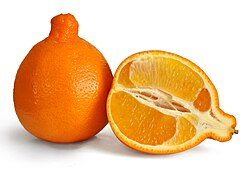
| A tangelo fruit (Cushman Honeybells) | |
Scientific classification 
| |
| Kingdom: | Plantae |
| Clade: | Tracheophytes |
| Clade: | Angiosperms |
| Clade: | Eudicots |
| Clade: | Rosids |
| Order: | Sapindales |
| Family: | Rutaceae |
| Genus: | Citrus |
| Species: | C. × tangelo
|
| Binomial name | |
| Citrus × tangelo J.W. Ingram & H.E. Moore, 1975
| |
 | This article needs additional citations for verification. (June 2025) |
The tangelo (/ˈtændʒəloʊ/ TAN-jə-loh, /tænˈdʒɛloʊ/ tan-JEL-oh; C. reticulata × C. maxima or × C. paradisi), Citrus × tangelo, is a citrus fruit hybrid of a Citrus reticulata variety, such as mandarin orange or tangerine, and a Citrus maxima variety, such as a pomelo or grapefruit. The name is a portmanteau of 'tangerine' and 'pomelo'.
Tangelos are the size of an adult fist, have a tart and tangy taste, and are juicy (with less flesh inside). They generally have loose skin and are easier to peel than oranges,[1] readily distinguished from them by a characteristic bump at the stem. Tangelos can be used as a substitute for mandarin oranges or sweet oranges.
Varieties
[edit]Orlando
[edit]The early maturing Orlando tangelo is noted for its rich juiciness, mild and sweet flavor, large size, distinct zesty smell, and flat-round shape without a characteristic knob.[2] Orlando tangelos are available from mid-November to the beginning of February. The tangelo originated as a cross between a Duncan grapefruit and a Dancy tangerine.[3][4] Walter Tennyson Swingle of the United States Department of Agriculture (USDA) is credited with creating the hybrid in 1911. When the Orlando tangelo was first cultivated, it was known by the name Lake tangelo. The trees of this variety grow to a large size and are easily recognized by their cup-shaped leaves. Orlando tangelos are recognized as one of the more cold-tolerant varieties.
Minneola
[edit]The Minneola tangelo (also known as the Honeybell) is a cross between a Duncan grapefruit and a Dancy tangerine and was released in 1931 by the USDA Horticultural Research Station in Orlando. It is named after Minneola, Florida. Most Minneola tangelos are characterized by a stem-end neck, which tends to make the fruit appear bell-shaped. Because of this, it is also called the Honeybell in the gift fruit trade, one of the most popular varieties. Honeybell is sometimes used as unofficial shorthand for premium cultivation. Minneolas are usually fairly large, typically 3–3+1⁄2 inches (76–89 mm) in diameter. The peel color, when mature, is a bright-reddish-orange color, and the rind of the Minneola is relatively thin. Minneolas peel rather easily and are very juicy. The Minneola is not strongly self-fruitful, and yields will be greater when interplanted with suitable pollenizers such as Temple tangor, Sunburst tangerine, or possibly Fallglo tangerine. It tends to bear a good crop every other year.[5]
Jamaican tangelo
[edit]The Jamaican tangelo, marketed under proprietary names 'ugli fruit' and 'uniq fruit,' is a spontaneous hybrid discovered about 1920 on the island of Jamaica, with a rough, wrinkled, greenish-yellow rind. Its exact parentage has not been determined, but it is thought to be a tangerine/grapefruit hybrid.[6]
K-Early (Sunrise)
[edit]A hybrid propagated by Walter Tennyson Swingle and Herbert John Webber, the K-Early is an early-ripening cultivar that gained a bad reputation at first but has been increasing in popularity in recent years.[7] It is sometimes called 'Sunrise,' a name also used for a different and older cultivar.[8]
Mapo
[edit]The Mapo (a portmanteau between 'Mandarino' and the Italian word for grapefruit, 'Pompelmo') is a hybrid developed in 1950 in Italy by the Italian Ministry of Agriculture Citrus Research Station of Acireale.[9] In Italy, the Mapo matures at the end of summer, about two months earlier than most citruses. Its peel is green, smooth, and thin; yellow markings appear when fully ripened. Its pulp is yellow, with orange nuances also when fully ripened. It is a cross between the 'Avana' mandarin and the Duncan grapefruit.[10]
Seminole
[edit]The seminole is a hybrid between a 'Bowen' grapefruit and a 'Dancy' tangerine. It is deep red-orange in color, oblate in shape with a thin and firm peel, and is not necked. It has 11-13 juicy segments and a pleasant, subacid flavor. It has 20-25 small seeds. The tree is high-yielding and scab-resistant.[7]
Thornton
[edit]A tangerine-grapefruit hybrid developed by Walter Tennyson Swingle in 1899, the Thornton is oblate to obovate, slightly rough, and medium to large in size. The peel is light orange and is of medium thickness; the pulp inside is pale to deep orange. It has 10-12 juicy segments and a rich subacid to sweet flavor. There are 10-25 slender seeds inside. It ripens from December to March. The tree is high-yielding and is well-adapted to hot and dry regions, although the fruit ships poorly.[7]
Novel varieties
[edit]In 2011, a troop of baboons was attracted to the higher sweetness of a new likely mutation in a Minneola planting in Cape Town, South Africa, prompting its propagation.[11]
Drug interactions
[edit]One study thus far has shown that, unlike grapefruit, interactions with statins are not likely with tangelos. Although the tangelo is derived from a grapefruit crossed with a mandarin, the furocoumarins in grapefruit are not expressed in tangelos.[12]
Notes
[edit]- ^ Meadow, Jean; King, Mary. "Florida Food Fare – Tangelo" (PDF). Institute of Food and Agricultural Sciences, University of Florida. Archived from the original (PDF) on August 20, 2017. Retrieved February 2, 2018.
- ^ "Orlando tangelo | Givaudan Citrus Variety Collection at UCR". citrusvariety.ucr.edu. Retrieved June 4, 2025.
- ^ Jackson, Larry K.; Futch, Stephen H. "Orlando Tangelo". Institute of Food and Agricultural Sciences, University of Florida. Archived from the original on October 22, 2020. Retrieved February 4, 2014.
- ^ Futch, Stephen H.; Jackson, L. K. (April 4, 2018). "Orlando Tangelo: HS175/CH077, 4/2018". EDIS. 2018 (4). doi:10.32473/edis-ch077-1993. ISSN 2576-0009.
- ^ Jackson, Larry K.; Futch, Stephen H. "Minneola Tangelo". Institute of Food and Agricultural Sciences, University of Florida. Retrieved June 21, 2013.
- ^ "Ugli tangelo (CRC 2780) | Givaudan Citrus Variety Collection at UCR".
- ^ a b c "Tangelo". www.hort.purdue.edu. Retrieved February 4, 2021.
- ^ "sunrise". citrusvariety.ucr.edu. Retrieved February 12, 2021.
- ^ Integrated Pest Control in Citrus Groves di R. Cavalloro, CRC Press, 01 giu 1986
- ^ ""Mapo" in Enciclopedia Treccani". treccani.it. Retrieved October 26, 2022.
- ^ Baboons discover new citrus fruit in W. Cape (January 12, 2011)
- ^ Widmer, Wilbur (May 4, 2005). "One tangerine/grapefruit hybrid (tangelos) contains trace amounts of furanocoumarins at a level too low to be associated with grapefruit/drug interactions". Journal of Food Science. 70 (6): C419–C422. doi:10.1111/j.1365-2621.2005.tb11440.x.
References
[edit]- Morton, Julia F. (1987). Fruits of Warm Climates: Tangelo. J.F. Morton. pp. 158–160. ISBN 9780961018412.
- Jackson, Larry K. and Futch, Stephen H., Fact Sheet HS-171 Retrieved March 28, 2005.
- Krezdorn, A.H. 1981. "Fruit Set of Citrus." Proc. Int. Soc. Citriculture. 1981:249–253.
- Krezdorn, A.H. 1977. "Influence of Rootstock on Mandarin Cultivars." Proc. Int. Soc. Citriculture. Vol. 2. pp. 513–518.
- Krezdorn, A.H. and W.J. Wiltbank. 1968. "Annual Girdling of 'Orlando' Tangelos over an Eight-Year Period." Proc. Fla. State Hort. Soc. Vol. 81:29–35.
- Saunt, James. 2000. Citrus Varieties of the World. Sinclair International Limited, Norwich, England. p. 82.
- Tucker, D.P.H., S.H. Futch, F.G. Gmitter, and M.C. Kesinger. Florida Citrus Varieties. 1998. SP-102. University of Florida. p. 31.
- Tucker, D.P.H., A.K. Alva, L.K. Jackson, and T.A. Wheaton. 1995. Nutrition of Florida Citrus Trees. SP-169. University of Florida, Institute of Food and Agricultural Sciences, Cooperative Extension Service. p. 27.
- Whiteside, J. O. 1979. "Alternaria Brown Spot of Dancy Tangerine and its Control." Proc. Fla. State Hort. Soc. 92:34–37.


Tangelo
View on GrokipediaOverview
Definition and characteristics
The tangelo is a citrus hybrid resulting from a cross between a tangerine, or mandarin (Citrus reticulata), and a pomelo (Citrus maxima) or grapefruit (Citrus paradisi), producing a mandarin-pomelo type fruit.[6][7] Botanically classified as Citrus × tangelo, it forms a subgroup of tangors within the Citrus genus, characterized by its interspecific parentage that combines traits from both mandarin and pummelo lineages.[8] Tangelos typically exhibit a bell-shaped or round form, with fruits measuring 3 to 4 inches (7.6 to 10 cm) in diameter, larger than those of their tangerine parent. The rind is deep orange-red, smooth to slightly pebbled, and loosely attached, allowing for easy peeling without excessive adherence. The flesh consists of 10 to 12 juicy segments that are tender and aromatic, often containing few to no seeds, though seediness can increase with cross-pollination.[6][9] In terms of flavor, tangelos offer a sweet-tangy profile that blends the pronounced sweetness and floral notes of the tangerine with the tart, mildly bitter edge of the pomelo or grapefruit, resulting in a juicier consistency than standard oranges. This balance makes them less bitter overall than grapefruits while providing more size and volume than tangerines.[10][9]Etymology and history
The term "tangelo" is a portmanteau derived from "tangerine" and "pomelo," reflecting its hybrid origins, with the word first appearing in English around 1903–1904 during early American citrus breeding efforts.[11][12] This naming convention highlights the fruit's parentage, combining the sweet, easy-to-peel qualities of the tangerine (Citrus reticulata) with the larger size and juiciness of the pomelo (Citrus maxima), though some early references also associate it with grapefruit (Citrus × paradisi), a pomelo derivative.[13] The parent species of the tangelo originated in Southeast Asia, where natural hybridization among citrus contributed to the diverse gene pool that spread through ancient trade routes. Modern tangelo development began in 1897 when U.S. Department of Agriculture (USDA) botanist Walter Tennyson Swingle initiated systematic breeding in Eustis, Florida, crossing Duncan grapefruit with Dancy tangerine to create improved hybrids resistant to diseases and frost.[14][15] This USDA program, running from 1897 to 1911 in collaboration with researchers like Herbert John Webber, yielded the first commercial tangelo varieties, including the Orlando tangelo released in 1911 and the Minneola tangelo in 1931.[16][9] Breeding efforts later expanded to California through institutions like the University of California Riverside, focusing on adaptations for diverse climates, while international programs adapted U.S. cultivars for local conditions.[17] Parent citrus species were introduced to Australia and New Zealand during the 19th century by European settlers, enabling early hybrid experimentation, though deliberate tangelo cultivation there followed U.S. advancements in the early 20th century. In the United States, commercial tangelo production peaked in the mid-20th century, with Florida alone harvesting an estimated 1,000,000 boxes in 1962, driven by demand for their unique flavor and ease of consumption.[18]Cultivation
Environmental requirements
Tangelo trees thrive in subtropical to tropical climates, specifically within USDA hardiness zones 9 to 11, where they can tolerate brief frosts down to 20–25°F (-7 to -4°C) depending on variety but suffer damage from prolonged exposure below 28°F (-2°C).[19][20] These conditions align with regions like southern Florida, Arizona, and parts of California, where consistent warmth supports optimal fruit development without frequent freezes.[21] For ideal growth, tangelos require full sun exposure of 8–12 hours daily, with preferred daytime temperatures ranging from 70–80°F (21–27°C) and nighttime temperatures of 55–65°F (13–18°C) to promote healthy foliage and fruit set.[6][22] Insufficient sunlight or extreme heat above 95°F (35°C) can reduce yields, while cooler nights below 50°F (10°C) may slow growth.[23] Soil for tangelo cultivation should be well-draining sandy loam with a pH of 6.0–7.5, ranging from slightly acidic to neutral, to facilitate root health and nutrient uptake.[6] Heavy clay soils must be avoided, as they retain excess moisture and promote root rot, a common issue in poorly aerated conditions.[19] In commercial settings, amending soil with organic matter improves drainage and fertility without altering the pH significantly.[21] Water requirements emphasize consistent moisture to support root establishment and fruit production, typically met by 40–50 inches of annual rainfall or equivalent irrigation, with additional supplementation during dry periods to prevent water stress.[24] Overwatering leading to waterlogging should be avoided, as it exacerbates root diseases; instead, deep, infrequent applications ensure even soil moisture without saturation.[6] Home growers in arid areas may need to irrigate weekly, aiming for 1 inch of water per session.[19] Site selection plays a crucial role in tangelo success, favoring locations sheltered from strong winds that could damage blossoms or young fruit, while elevations up to 3,000 feet are suitable in compatible climates to avoid frost pockets.[25] Optimal sites offer protection from northern exposures and good air circulation, enhancing pollination and reducing pest pressures in both home and commercial orchards.[20]Propagation and maintenance
Tangelos are primarily propagated through grafting or budding onto compatible rootstocks, such as trifoliate orange (Poncirus trifoliata), which provides resistance to diseases like phytophthora root rot and tolerance to a range of soil conditions.[26] This vegetative method ensures the offspring retain the desirable traits of the parent hybrid, as tangelos are complex crosses between tangerine and pomelo or grapefruit.[26] Seed propagation is possible since tangelo seeds are often polyembryonic, but it results in variable offspring due to genetic segregation and cross-pollination, making it unsuitable for true-to-type reproduction.[26] Cuttings are less commonly used, as most citrus varieties, including tangelos, root poorly without advanced techniques like tissue culture or rooting hormones, though they can be employed for rootstock production.[26] When planting tangelo trees, space them 15 to 20 feet apart to accommodate their mature canopy width of 10 to 15 feet and prevent competition for light, water, and nutrients.[27] Ideal planting occurs in spring after the last frost to promote root establishment before summer heat, using well-drained sites with the graft union positioned 4 to 6 inches above soil level.[21] For USDA hardiness zones below 9, where tangelos are marginally hardy to about 25°F, container cultivation in pots at least 20 inches in diameter allows overwintering indoors or in protected areas, with dwarfing rootstocks like Flying Dragon enhancing suitability for pots.[19] Ongoing maintenance involves annual pruning in late winter or post-harvest to maintain an open canopy for improved airflow and light penetration, focusing on removing water sprouts, suckers below the graft, and dead or crossing branches while making flush cuts to minimize disease entry.[21] Fertilization should occur 3 to 4 times annually from February to September using a balanced citrus-specific formula like 8-8-8 NPK, with rates increasing from 0.5 pounds per application for young trees to 1 to 2 pounds of nitrogen equivalent for mature ones, applied in a band beyond the drip line and watered in.[21] Applying 2 to 3 inches of organic mulch, such as wood chips, in a 3-foot radius around the base helps conserve soil moisture and suppress weeds, but it must be kept at least 12 inches from the trunk to prevent phytophthora foot rot.[28] Pest and disease management relies on integrated approaches, including regular scouting for key threats like Asian citrus psyllid vectors of citrus greening (huanglongbing), which has devastated commercial production in Florida, reducing citrus output to historic lows as of 2025, aphids, and scale insects, which can be controlled with horticultural oils or insecticidal soaps during dormant periods.[21][29] Fungal issues, such as melanose or greasy spot common in tangelos, are addressed with copper-based fungicides applied preventively after wet periods, while cultural practices like proper spacing and sanitation reduce overall risk without routine broad-spectrum sprays.[21] Harvesting begins 3 to 5 years after grafting, once trees reach maturity, with productive specimens yielding 100 to 300 fruits per year depending on size and conditions.[21] Fruits are ready when the rind shifts to a deep orange and they detach easily with a gentle twist, typically from November to February for most varieties, ensuring optimal flavor and juice content.[21]Varieties
Early developed varieties
The early developed varieties of tangelo emerged from the U.S. Department of Agriculture's (USDA) breeding program in Florida, initiated in the late 19th century to create hybrids combining the sweetness and easy-peeling qualities of tangerines with the size and juiciness of grapefruits. These foundational cultivars, primarily from crosses between Duncan grapefruit and Dancy tangerine, were released from the late 19th century to the 1930s and laid the groundwork for commercial tangelo production in Florida, emphasizing traits like cold hardiness, flavor balance, and market suitability.[14] The Sampson tangelo, resulting from a cross between Duncan grapefruit and Dancy tangerine made in 1897 by USDA horticulturist Walter T. Swingle in Florida, was named and described in 1904. It produces medium-sized, oblate fruit with a yellow-orange rind and tender, juicy flesh that has a bitterish tang and is highly seedy. The tree is productive but extremely susceptible to citrus scab, limiting its commercial importance, though it contributed to early tangelo breeding efforts.[30][31] The Orlando tangelo, released in 1911 by USDA horticulturist Walter T. Swingle, resulted from a cross between Duncan grapefruit and Dancy tangerine. It features a broadly oblate to subglobose shape, with an average diameter of 2¾ to 3 inches, an orange rind that is thin and slightly pebbled, and orange flesh that is tender and very juicy. The flavor is mildly sweet with low acidity, and seed content varies from 0 to 35 depending on pollination, often resulting in few or no seeds in commercial settings. Known for its early maturity from November to January and good shipping quality, Orlando became a popular choice for fresh eating in Florida due to its zesty aroma and balanced taste.[32][33][16] The Minneola tangelo, also known as Honeybell, was named and released by the USDA in 1931 from the same Duncan grapefruit × Dancy tangerine parentage. It is distinguished by its large size, typically 3 to 3½ inches in diameter, and a distinctive bell- or pear-shaped form with a pronounced neck at the stem end. The fruit has a deep reddish-orange, medium-thin, smooth rind that is easy to peel, enclosing tender, very juicy, and aromatic flesh with excellent sweet-acidic flavor and few seeds (6-12). Peak harvest occurs from December to February in Florida, making it ideal for fresh consumption during the winter season, though it requires protection from freezes in cooler areas.[3][9] The Seminole tangelo, developed in the early 20th century at the USDA's Orlando station from Duncan grapefruit × Dancy tangerine, was named for the Seminole region of Florida. It produces medium to large flattened fruit averaging over 2½ inches in diameter, with brilliant reddish rind and deep orange, juicy pulp offering a rich sweet-tart flavor and 20-25 small seeds. The tree is vigorous and productive, with good shipping qualities and moderate susceptibility to scab, ripening from February to March and holding well into April, contributing to its historical role in extending the Florida tangelo market season.[34][35] The Thornton tangelo, bred in the late 19th century through the USDA Florida program with grapefruit-dominant traits from similar mandarin-grapefruit crosses, yields larger fruit with a rough, corrugated rind, tart flavor, and fewer seeds compared to earlier seeded types. Its medium-sized, somewhat oblate fruits mature from December to March but soften and become puffy upon ripening, limiting shipping potential and directing its use toward local juicing and processing rather than fresh markets. Despite these challenges, Thornton represented an early step in selecting for reduced seediness and enhanced juice quality in tangelo hybrids.[36][15][35]Jamaican and other hybrids
The Jamaican tangelo, commonly known as Ugli fruit, originated as a natural chance hybrid in Jamaica, likely from a cross between a mandarin orange and a grapefruit.[37] This tangelo features a distinctive wrinkled and uneven, thick rind that ranges from greenish-yellow to bright orange, contributing to its "ugly" moniker despite the appealing quality of the interior.[37] The flesh is juicy and segmented, offering a sweet-tangy flavor profile that balances mandarin sweetness with grapefruit tartness, and it is notably rich in vitamin C.[38] Commercial production and export of Ugli fruit began in the 1930s from the Sharp family's Trout Hall plantation in Clarendon Parish, Jamaica, initially shipping to Canada and the United Kingdom, followed by the United States in 1942.[39] Other notable tangelo hybrids include the K-Early, an early-maturing variety developed by U.S. Department of Agriculture researchers in Florida around 1945.[40] This tangelo results from a tangerine-grapefruit cross and produces small to medium-sized fruit with a slightly subglobose shape, yellowish-orange rind, and a rather acidic flavor, though it contains seeds and is valued for its very early harvest, typically in November.[40] The K-Early has been propagated for its market potential despite moderate quality, resembling the Orlando tangelo in appearance but ripening ahead of most varieties.[40] The Mapo tangelo represents another regional hybrid, derived from a cross between the Avana mandarin and Duncan grapefruit, with propagation noted in Mediterranean and Asian contexts.[41] It yields medium to large fruit (150-220 grams) with a thin, mostly green-to-yellow-orange rind that peels easily, enclosing uniform yellow-orange flesh that is juicy yet seedy, delivering a pleasantly sour and bitter taste with subtle mandarin undertones.[41] Grown primarily in parts of Europe and Asia, the Mapo remains less common in Western markets, often utilized in specialty products like liqueurs due to its distinctive flavor.[41]Modern and experimental varieties
Since the mid-20th century, several tangelo varieties have been developed through USDA breeding programs to enhance traits like seedlessness and fruit quality. The Nova tangelo, released in 1964, is a hybrid of Clementine tangerine and Orlando tangelo, featuring low-seeded fruit with a rich flavor suitable for fresh consumption.[42] These varieties emphasize reduced seed content and improved peelability to meet consumer preferences. Efforts to combat Huanglongbing (HLB), a devastating citrus disease, have driven innovations in tangelo breeding. The C4-14-51, a seedless mandarin-tangelo hybrid, demonstrates strong HLB tolerance and is approved for propagation in Florida, supporting both fresh market and juice applications.[43] USDA and University of Florida programs, ongoing since the 1980s, focus on selecting HLB-resistant scions through traditional crosses, with advanced selections tested in field trials for yield stability under disease pressure.[44] Experimental work also targets climate adaptability, such as semi-dwarf varieties like the Minneola tangelo grafted on Flying Dragon rootstock, which grow to 10-15 feet and thrive in containers for urban or protected cultivation.[45] Gene editing techniques are emerging in citrus breeding to refine tangelo traits, though applications remain experimental. CRISPR/Cas9 methods have been adapted for citrus hybrids to enhance sweetness by targeting acid-related genes and extend shelf life via ethylene pathway modifications, with transgene-free edits achieved in protoplasts.[46] University of Florida researchers are integrating these tools into HLB-tolerance programs, aiming for varieties with prolonged postharvest viability without compromising flavor.[47] Commercial trends highlight the expansion of organic and proprietary tangelo hybrids in key regions. In California, growers are adopting organic Minneola and Nova strains for domestic markets, leveraging their disease resilience and premium pricing.[48] Australia has seen a rise in hybrid tangelos like Minneola for export, with production focused on biosecure, organic systems to meet Asian demand for easy-peel, seedless fruit.[49] Proprietary crosses, such as those from Western Australian programs, prioritize export-oriented traits like uniform size and extended storage.[50]Culinary and commercial uses
Fresh and culinary applications
Tangelos are prized for fresh consumption owing to their loose, easy-to-peel skin, which allows for effortless eating out-of-hand as a convenient snack.[51] Their juicy segments are also commonly added to fruit salads or enjoyed standalone during the peak winter season in the United States, typically from December through April.[52][53] In culinary applications, tangelos lend their sweet-tart profile to a range of recipes, enhancing both desserts and savory dishes. For desserts, they appear in sorbets made by simmering juice with sugar and freezing the mixture for a refreshing treat, as well as in pies like tangelo meringue, where fresh juice provides a vibrant citrus filling topped with fluffy meringue.[54][55] Savory uses include glazing chicken with a reduction of tangelo juice, honey, and vinegar for a caramelized finish, or incorporating segments into salsas paired with prawns, chili, and herbs for a zesty condiment.[56][57] Beverages highlight their juiciness in fresh-squeezed drinks or cocktails, such as tangelo margaritas blended with tequila, lime juice, and simple syrup for a citrus-forward twist.[58] The tangelo's balanced sweetness and acidity make it versatile for flavor pairings, complementing seafood in glazes like honey-tangelo salmon, poultry through marinades in chicken skewers, and greens in winter salads with goat cheese and creamy dressings.[59][60][61] Its aromatic zest, rich in essential oils, is particularly valued in baking to infuse muffins, cakes, and quick breads with bright citrus notes.[62] Preparation tips for tangelos emphasize their ease: peel and segment the fruit to remove the thin pith for clean, pith-free pieces suitable for salads or garnishes.[63] Juicing is straightforward and yields a high volume of liquid due to the fruit's plump vesicles, often requiring just a simple squeeze after halving for use in recipes or drinks.[64]Processing and products
Tangelos possess a high juice content, typically yielding around 50-60% by weight, making them suitable for industrial juicing operations. In Florida, the primary production region, approximately 39% of the annual tangerine and tangelo crop—totaling 157,000 boxes in the 2024-2025 season (preliminary)—is directed toward processing, primarily into frozen concentrated juice at 42° Brix.[65] This concentrate, extracted at yields of roughly 1.12 gallons per box, is often blended with juices from oranges or grapefruits to enhance flavor profiles in commercial beverages, leveraging the tangelo's balanced sweet-tart notes.[66] The peel and pulp of tangelos are utilized in the production of preserves such as marmalades and jellies, where the pectin-rich components contribute to natural gelling. Commercial marmalade production incorporates tangelo concentrate alongside cane sugar and citrus peels, resulting in products that highlight the fruit's vibrant flavor. Candied tangelo peels, prepared by boiling and sugar-coating the rind, serve as ingredients in confections and baked goods, extending the use of processing byproducts.[67] Essential oils extracted from the tangelo rind via cold pressing or distillation are valued in commercial applications for their citrusy aroma, containing volatile compounds like limonene and γ-terpinene. These oils find use in perfumes, flavorings for food and beverages, and aromatherapy products. The rind's oil content, similar to other mandarins at 0.5-1.5%, supports scalable extraction in citrus processing facilities.[68] Dried tangelo segments, dehydrated to preserve nutritional qualities, are occasionally incorporated into trail mixes as a sweet citrus addition. Tangelo production occurs mainly in the United States, with Florida accounting for the majority—400,000 boxes (combined with tangerines) in the 2024-2025 season (preliminary), down 11% from the prior year due to disease pressures—followed by smaller scales in California. Historical peaks in the mid-20th century exceeded 1 million boxes annually in Florida, though output has declined due to disease pressures.[66] For export, fresh tangelos are packed in ventilated cartons or boxes to maintain quality during global shipment. A key challenge is the fruit's short shelf life of 2-3 weeks under refrigeration at 4-7°C, necessitating rapid processing or preservation to minimize post-harvest losses.[69]Nutritional and health aspects
Nutritional composition
The nutritional composition of a tangelo, a hybrid citrus fruit typically weighing around 100 grams per medium-sized fruit, is characterized by low caloric density and a predominance of carbohydrates, primarily from natural sugars and fiber. Per 100 grams of raw tangelo flesh, it provides approximately 47 calories, 12 grams of carbohydrates (including 9 grams of sugars and 2 grams of dietary fiber), 0.7 grams of protein, and negligible fat (about 0.2 grams). These values contribute to its role as a hydrating, low-fat fruit option, with the fiber aiding in digestive health. Nutritional values are approximate and can vary by variety and growing conditions.[70]| Nutrient | Amount per 100g | % Daily Value* |
|---|---|---|
| Calories | 47 kcal | 2% |
| Total Carbohydrates | 12 g | 4% |
| Sugars | 9 g | - |
| Dietary Fiber | 2 g | 7% |
| Protein | 0.7 g | 1% |
| Total Fat | 0.2 g | 0% |