


Community hub
Recent from talks
Contribute something
Nothing was collected or created yet.
Inclined plane
View on Wikipedia


An inclined plane, also known as a ramp, is a flat supporting surface tilted at an angle from the vertical direction, with one end higher than the other, used as an aid for raising or lowering a load.[1][2][3] The inclined plane is one of the six classical simple machines defined by Renaissance scientists. Inclined planes are used to move heavy loads over vertical obstacles. Examples vary from a ramp used to load goods into a truck, to a person walking up a pedestrian ramp, to an automobile or railroad train climbing a grade.[3]
Moving an object up an inclined plane requires less force than lifting it straight up, at a cost of an increase in the distance moved.[4] The mechanical advantage of an inclined plane, the factor by which the force is reduced, is equal to the ratio of the length of the sloped surface to the height it spans. Owing to conservation of energy, the same amount of mechanical energy (work) is required to lift a given object by a given vertical distance, disregarding losses from friction, but the inclined plane allows the same work to be done with a smaller force exerted over a greater distance.[5][6]
The angle of friction,[7] also sometimes called the angle of repose,[8] is the maximum angle at which a load can rest motionless on an inclined plane due to friction without sliding down. This angle is equal to the arctangent of the coefficient of static friction μs between the surfaces.[8]
Two other simple machines are often considered to be derived from the inclined plane.[9] The wedge can be considered a moving inclined plane or two inclined planes connected at the base.[5] The screw consists of a narrow inclined plane wrapped around a cylinder.[5]
The term may also refer to a specific implementation; a straight ramp cut into a steep hillside for transporting goods up and down the hill. This may include cars on rails or pulled up by a cable system; a funicular or cable railway, such as the Johnstown Inclined Plane.
Uses
[edit]Inclined planes are widely used in the form of loading ramps to load and unload goods on trucks, ships and planes.[3] Wheelchair ramps are used to allow people in wheelchairs to get over vertical obstacles without exceeding their strength. Escalators and slanted conveyor belts are also forms of an inclined plane.[6]In a funicular or cable railway a railroad car is pulled up a steep inclined plane using cables. Inclined planes also allow heavy fragile objects, including humans, to be safely lowered down a vertical distance by using the normal force of the plane to reduce the gravitational force. Aircraft evacuation slides allow people to rapidly and safely reach the ground from the height of a passenger airliner.


Other inclined planes are built into permanent structures. Roads for vehicles and railroads have inclined planes in the form of gradual slopes, ramps, and causeways to allow vehicles to surmount vertical obstacles such as hills without losing traction on the road surface.[3] Similarly, pedestrian paths and sidewalks have gentle ramps to limit their slope, to ensure that pedestrians can keep traction.[1][4] Inclined planes are also used as entertainment for people to slide down in a controlled way, in playground slides, water slides, ski slopes and skateboard parks.


History
[edit]| Stevin's proof |

As pointed out by Dijksterhuis,[13] Stevin's argument is not completely tight. The forces exerted by the hanging part of the chain need not be symmetrical because the hanging part need not retain its shape when let go. Even if the chain is released with a zero angular momentum, motion including oscillations is possible unless the chain is initially in its equilibrium configuration, a supposition which would make the argument circular. |
Inclined planes have been used by people since prehistoric times to move heavy objects.[14][15] The sloping roads and causeways built by ancient civilizations such as the Romans are examples of early inclined planes that have survived, and show that they understood the value of this device for moving things uphill. The heavy stones used in ancient stone structures such as Stonehenge[16] are believed to have been moved and set in place using inclined planes made of earth,[17] although it is hard to find evidence of such temporary building ramps. The Egyptian pyramids were constructed using inclined planes,[18][19][20] Siege ramps enabled ancient armies to surmount fortress walls. The ancient Greeks constructed a paved ramp 6 km (3.7 miles) long, the Diolkos, to drag ships overland across the Isthmus of Corinth.[4]
However the inclined plane was the last of the six classic simple machines to be recognised as a machine. This is probably because it is a passive and motionless device (the load is the moving part),[21] and also because it is found in nature in the form of slopes and hills. Although they understood its use in lifting heavy objects, the ancient Greek philosophers who defined the other five simple machines did not include the inclined plane as a machine.[22] This view persisted among a few later scientists; as late as 1826 Karl von Langsdorf wrote that an inclined plane "...is no more a machine than is the slope of a mountain".[21] The problem of calculating the force required to push a weight up an inclined plane (its mechanical advantage) was attempted by Greek philosophers Heron of Alexandria (c. 10 - 60 CE) and Pappus of Alexandria (c. 290 - 350 CE), but their solutions were incorrect.[23][24][25]
It was not until the Renaissance that the inclined plane was solved mathematically and classed with the other simple machines. The first correct analysis of the inclined plane appeared in the work of 13th century author Jordanus de Nemore,[26][27] however his solution was apparently not communicated to other philosophers of the time.[24] Girolamo Cardano (1570) proposed the incorrect solution that the input force is proportional to the angle of the plane.[10] Then at the end of the 16th century, three correct solutions were published within ten years, by Michael Varro (1584), Simon Stevin (1586), and Galileo Galilei (1592).[24] Although it was not the first, the derivation of Flemish engineer Simon Stevin[25] is the most well-known, because of its originality and use of a string of beads (see box).[12][26] In 1600, Italian scientist Galileo Galilei included the inclined plane in his analysis of simple machines in Le Meccaniche ("On Mechanics"), showing its underlying similarity to the other machines as a force amplifier.[28]
The first elementary rules of sliding friction on an inclined plane were discovered by Leonardo da Vinci (1452-1519), but remained unpublished in his notebooks.[29] They were rediscovered by Guillaume Amontons (1699) and were further developed by Charles-Augustin de Coulomb (1785).[29] Leonhard Euler (1750) showed that the tangent of the angle of repose on an inclined plane is equal to the coefficient of friction.[30]
Terminology
[edit]Slope
[edit]The mechanical advantage of an inclined plane depends on its slope, meaning its gradient or steepness. The smaller the slope, the larger the mechanical advantage, and the smaller the force needed to raise a given weight. A plane's slope s is equal to the difference in height between its two ends, or "rise", divided by its horizontal length, or "run".[31] It can also be expressed by the angle the plane makes with the horizontal, .


Mechanical advantage
[edit]The mechanical advantage of a simple machine as defined as the ratio of the output force exerted on the load to the input force applied. The inclined plane the output load force is just the gravitational force of the load object on the plane, its weight . The input force is the force exerted on the object, parallel to the plane, to move it up the plane. The mechanical advantage is


The of an ideal inclined plane without friction is sometimes called ideal mechanical advantage while the MA when friction is included is called the actual mechanical advantage .[32]


Frictionless inclined plane
[edit]
If there is no friction between the object being moved and the plane, the device is called an ideal inclined plane. This condition might be approached if the object is rolling like a barrel, or supported on wheels or casters. Due to conservation of energy, for a frictionless inclined plane the work done on the load lifting it, , is equal to the work done by the input force, [33][34][35]


Work is defined as the force multiplied by the displacement an object moves. The work done on the load is equal to its weight multiplied by the vertical displacement it rises, which is the "rise" of the inclined plane

The input work is equal to the force on the object times the diagonal length of the inclined plane.

Substituting these values into the conservation of energy equation above and rearranging
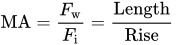
To express the mechanical advantage by the angle of the plane,[34] it can be seen from the diagram (above) that

So

So the mechanical advantage of a frictionless inclined plane is equal to the reciprocal of the sine of the slope angle. The input force from this equation is the force needed to hold the load motionless on the inclined plane, or push it up at a constant velocity. If the input force is greater than this, the load will accelerate up the plane. If the force is less, it will accelerate down the plane.

Inclined plane with friction
[edit]Where there is friction between the plane and the load, as for example with a heavy box being slid up a ramp, some of the work applied by the input force is dissipated as heat by friction, , so less work is done on the load. Due to conservation of energy, the sum of the output work and the frictional energy losses is equal to the input work


Therefore, more input force is required, and the mechanical advantage is lower, than if friction were not present. With friction, the load will only move if the net force parallel to the surface is greater than the frictional force opposing it.[8][36][37] The maximum friction force is given by


where is the normal force between the load and the plane, directed normal to the surface, and is the coefficient of static friction between the two surfaces, which varies with the material. When no input force is applied, if the inclination angle of the plane is less than some maximum value the component of gravitational force parallel to the plane will be too small to overcome friction, and the load will remain motionless. This angle is called the angle of repose and depends on the composition of the surfaces, but is independent of the load weight. It is shown below that the tangent of the angle of repose is equal to


With friction, there is always some range of input force for which the load is stationary, neither sliding up or down the plane, whereas with a frictionless inclined plane there is only one particular value of input force for which the load is stationary.
Analysis
[edit]
A load resting on an inclined plane, when considered as a free body has three forces acting on it:[8][36][37]
- The applied force, exerted on the load to move it, which acts parallel to the inclined plane.
- The weight of the load, , which acts vertically downwards
- The force of the plane on the load. This can be resolved into two components:
- The normal force of the inclined plane on the load, supporting it. This is directed perpendicular (normal) to the surface.
- The frictional force, of the plane on the load acts parallel to the surface, and is always in a direction opposite to the motion of the object. It is equal to the normal force multiplied by the coefficient of static friction μ between the two surfaces.
Using Newton's second law of motion the load will be stationary or in steady motion if the sum of the forces on it is zero. Since the direction of the frictional force is opposite for the case of uphill and downhill motion, these two cases must be considered separately:
- Uphill motion: The total force on the load is toward the uphill side, so the frictional force is directed down the plane, opposing the input force.
|
Derivation of mechanical advantage for uphill motion The equilibrium equations for forces parallel and perpendicular to the plane are
|





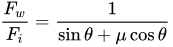


- The mechanical advantage is
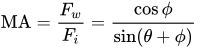
- where . This is the condition for impending motion up the inclined plane. If the applied force Fi is greater than given by this equation, the load will move up the plane.
- Downhill motion: The total force on the load is toward the downhill side, so the frictional force is directed up the plane.
|
Derivation of mechanical advantage for downhill motion The equilibrium equations are
|



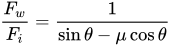

- The mechanical advantage is
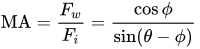
- This is the condition for impending motion down the plane; if the applied force Fi is less than given in this equation, the load will slide down the plane. There are three cases:
- : The mechanical advantage is negative. In the absence of applied force the load will remain motionless, and requires some negative (downhill) applied force to slide down.
- : The 'angle of repose'. The mechanical advantage is infinite. With no applied force, load will not slide, but the slightest negative (downhill) force will cause it to slide.
- : The mechanical advantage is positive. In the absence of applied force the load will slide down the plane, and requires some positive (uphill) force to hold it motionless


Mechanical advantage using power
[edit]
The mechanical advantage of an inclined plane is the ratio of the weight of the load on the ramp to the force required to pull it up the ramp. If energy is not dissipated or stored in the movement of the load, then this mechanical advantage can be computed from the dimensions of the ramp.
In order to show this, let the position r of a rail car on along the ramp with an angle, θ, above the horizontal be given by

where R is the distance along the ramp. The velocity of the car up the ramp is now

Because there are no losses, the power used by force F to move the load up the ramp equals the power out, which is the vertical lift of the weight W of the load.
The input power pulling the car up the ramp is given by

and the power out is

Equate the power in to the power out to obtain the mechanical advantage as
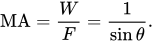
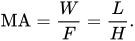
The mechanical advantage of an inclined plane can also be calculated from the ratio of length of the ramp L to its height H, because the sine of the angle of the ramp is given by

therefore,

Example: If the height of a ramp is H = 1 meter and its length is L = 5 meters, then the mechanical advantage is
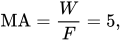
which means that a 20 lb force will lift a 100 lb load.
The Liverpool Minard inclined plane has the dimensions 1804 meters by 37.50 meters, which provides a mechanical advantage of

so a 100 lb tension force on the cable will lift a 4810 lb load. The grade of this incline is 2%, which means the angle θ is small enough that sin θ≈tan θ.
See also
[edit]References
[edit]- ^ a b Cole, Matthew (2005). Explore science, 2nd Ed. Pearson Education. p. 178. ISBN 978-981-06-2002-8.
- ^ Merriam-Webster's collegiate dictionary, 11th Ed. Merriam-Webster. 2003. pp. 629. ISBN 978-0-87779-809-5.
inclined plane definition dictionary.
- ^ a b c d "The Inclined Plane". Math and science activity center. Edinformatics. 1999. Retrieved March 11, 2012.
- ^ a b c Silverman, Buffy (2009). Simple Machines: Forces in Action, 4th Ed. Canada: Heinemann-Raintree Classroom. p. 7. ISBN 978-1-4329-2317-4.
- ^ a b c Ortleb, Edward P.; Richard Cadice (1993). Machines and Work. Lorenz Educational Press. pp. iv. ISBN 978-1-55863-060-4.
- ^ a b Reilly, Travis (November 24, 2011). "Lesson 04:Slide Right on By Using an Inclined Plane". Teach Engineering. College of Engineering, Univ. of Colorado at Boulder. Archived from the original on May 8, 2012. Retrieved September 8, 2012.
- ^ Scott, John S. (1993). Dictionary of Civil Engineering. Chapman & Hill. p. 14. ISBN 978-0-412-98421-1.
angle of friction [mech.] in the study of bodies sliding on plane surfaces, the angle between the perpendicular to the surface and the resultant force (between the body and the surface) when the body begins to slide. angle of repose [s.m.] for any given granular material the steepest angle to the horizontal at which a heaped surface will stand in stated conditions.
- ^ a b c d Ambekar, A. G. (2007). Mechanism and Machine Theory. PHI Learning. p. 446. ISBN 978-81-203-3134-1.
Angle of repose is the limiting angle of inclination of a plane when a body, placed on the inclined plane, just starts sliding down the plane.
- ^ Rosen, Joe; Lisa Quinn Gothard (2009). Encyclopedia of Physical Science, Volume 1. Infobase Publishing. p. 375. ISBN 978-0-8160-7011-4.
- ^ a b c Koetsier, Teun (2010). "Simon Stevin and the rise of Archimedean mechanics in the Renaissance". The Genius of Archimedes – 23 Centuries of Influence on Mathematics, Science and Engineering: Proceedings of an International Conference Held at Syracuse, Italy, June 8–10, 2010. Springer. pp. 94–99. ISBN 978-90-481-9090-4.
- ^ Devreese, Jozef T.; Guido Vanden Berghe (2008). 'Magic is no magic': The wonderful world of Simon Stevin. WIT Press. pp. 136–139. ISBN 978-1-84564-391-1.
- ^ a b Feynman, Richard P.; Robert B. Leighton; Matthew Sands (1963). The Feynman Lectures on Physics, Vol. I. USA: California Inst. of Technology. pp. 4.4 – 4.5. ISBN 978-0-465-02493-3.
{{cite book}}: ISBN / Date incompatibility (help) - ^ E.J.Dijksterhuis: Simon Stevin 1943
- ^ Therese McGuire, Light on Sacred Stones, in Conn, Marie A.; Therese Benedict McGuire (2007). Not etched in stone: essays on ritual memory, soul, and society. University Press of America. p. 23. ISBN 978-0-7618-3702-2.
- ^ Dutch, Steven (1999). "Pre-Greek Accomplishments". Legacy of the Ancient World. Prof. Steve Dutch's page, Univ. of Wisconsin at Green Bay. Archived from the original on August 21, 2016. Retrieved March 13, 2012.
- ^ Moffett, Marian; Michael W. Fazio; Lawrence Wodehouse (2003). A world history of architecture. Laurence King Publishing. p. 9. ISBN 978-1-85669-371-4.
- ^ Peet, T. Eric (2006). Rough Stone Monuments and Their Builders. Echo Library. pp. 11–12. ISBN 978-1-4068-2203-8.
- ^ Thomas, Burke (2005). "Transport and the Inclined Plane". Construction of the Giza Pyramids. world-mysteries.com. Archived from the original on March 13, 2012. Retrieved March 10, 2012.
- ^ Isler, Martin (2001). Sticks, stones, and shadows: building the Egyptian pyramids. USA: University of Oklahoma Press. pp. 211–216. ISBN 978-0-8061-3342-3.
- ^ Sprague de Camp, L. (1990). The Ancient Engineers. USA: Barnes & Noble. p. 43. ISBN 978-0-88029-456-0.
- ^ a b Karl von Langsdorf (1826) Machinenkunde, quoted in Reuleaux, Franz (1876). The kinematics of machinery: Outlines of a theory of machines. MacMillan. pp. 604.
- ^ for example, the lists of simple machines left by Roman architect Vitruvius (c. 80 – 15 BCE) and Greek philosopher Heron of Alexandria (c. 10 – 70 CE) consist of the five classical simple machines, excluding the inclined plane. – Smith, William (1848). Dictionary of Greek and Roman antiquities. London: Walton and Maberly; John Murray. p. 722., Usher, Abbott Payson (1988). A History of Mechanical Inventions. USA: Courier Dover Publications. pp. 98, 120. ISBN 978-0-486-25593-4.
- ^ Heath, Thomas Little (1921). A History of Greek Mathematics, Vol. 2. UK: The Clarendon Press. pp. 349, 433–434.
- ^ a b c Egidio Festa and Sophie Roux, The enigma of the inclined plane in Laird, Walter Roy; Sophie Roux (2008). Mechanics and natural philosophy before the scientific revolution. USA: Springer. pp. 195–221. ISBN 978-1-4020-5966-7.
- ^ a b Meli, Domenico Bertoloni (2006). Thinking With Objects: The Transformation of Mechanics in the Seventeenth Century. JHU Press. pp. 35–39. ISBN 978-0-8018-8426-9.
- ^ a b Boyer, Carl B.; Uta C. Merzbach (2010). A History of Mathematics, 3rd Ed. John Wiley and Sons. ISBN 978-0-470-63056-3.
- ^ Usher, Abbott Payson (1988). A History of Mechanical Inventions. Courier Dover Publications. p. 106. ISBN 978-0-486-25593-4.
- ^ Machamer, Peter K. (1998). The Cambridge Companion to Galileo. London: Cambridge University Press. pp. 47–48. ISBN 978-0-521-58841-6.
- ^ a b Armstrong-Hélouvry, Brian (1991). Control of machines with friction. USA: Springer. p. 10. ISBN 978-0-7923-9133-3.
- ^ Meyer, Ernst (2002). Nanoscience: friction and rheology on the nanometer scale. World Scientific. p. 7. ISBN 978-981-238-062-3.
- ^ a b Handley, Brett; David M. Marshall; Craig Coon (2011). Principles of Engineering. Cengage Learning. pp. 71–73. ISBN 978-1-4354-2836-2.
- ^ Dennis, Johnnie T. (2003). The Complete Idiot's Guide to Physics. Penguin. pp. 116–117. ISBN 978-1-59257-081-2.
- ^ Nave, Carl R. (2010). "The Incline". Hyperphysics. Dept. of Physics and Astronomy, Georgia State Univ. Retrieved September 8, 2012.
- ^ a b Martin, Lori (2010). "Lab Mech14:The Inclined Plane - A Simple Machine" (PDF). Science in Motion. Westminster College. Retrieved September 8, 2012.
- ^ Pearson (2009). Physics class 10 - The IIT Foundation Series. New Delhi: Pearson Education India. p. 69. ISBN 978-81-317-2843-7.
- ^ a b Bansal, R.K (2005). Engineering Mechanics and Strength of Materials. Laxmi Publications. pp. 165–167. ISBN 978-81-7008-094-7.
- ^ a b This derives slightly more general equations which cover force applied at any angle: Gujral, I.S. (2008). Engineering Mechanics. Firewall Media. pp. 275–277. ISBN 978-81-318-0295-3.
External links
[edit]
| International | |
|---|---|
| National | |
| Other | |

Inclined plane
View on GrokipediaOverview and Basic Concepts
Definition and Principles
An inclined plane is a flat supporting surface tilted at an angle to the horizontal, functioning as one of the six classical simple machines by transforming an input force applied along the plane into vertical lift.[1][9] This simple machine operates on the principle that it allows a smaller force to be applied over a longer distance to achieve the same work as lifting an object straight up, trading reduced effort for increased path length.[7][1] A practical illustration of this principle is rolling a heavy object, such as a barrel, up a ramp rather than lifting it directly to the same height; the ramp enables the task with less immediate force while covering a greater horizontal and sloped distance.[10][11] This demonstrates the conservation of work, where the total work performed remains equivalent in both scenarios.[1][11] The underlying physics relies on the work-energy principle, which states that the work done on an object equals the change in its energy, calculated as , where for forces aligned with the displacement in horizontal or vertical paths, ensuring .[12] This principle highlights how the inclined plane redistributes effort without altering the net energy required for elevation.[13][1]Common Uses
Inclined planes are integral to numerous everyday applications, where they enable easier movement of objects and people by providing a gradual slope rather than a vertical lift. Wheelchair ramps, for instance, allow individuals with mobility impairments to access buildings and public spaces independently, often integrated into sidewalks, entrances, and parking areas. Loading docks at warehouses and retail facilities commonly feature inclined ramps to facilitate the transfer of heavy cargo into and out of trucks, minimizing manual labor and the need for additional lifting equipment. Escalators in buildings, subways, and shopping malls function as powered inclined planes, transporting passengers between floors efficiently during high-traffic periods.[14][15] In industrial settings, inclined planes enhance material handling and production processes. Conveyor belts with inclined sections are widely employed in factories and distribution centers to elevate bulk materials, such as grains, ores, or packaged goods, from one level to another without interrupting workflow. Ship loading ramps, used at ports for cargo operations, provide a sloped pathway to load and unload containers and vehicles onto vessels, accommodating tidal variations and heavy loads. These applications leverage the mechanical advantage of inclined planes to reduce the effort required for moving objects over elevation changes.[16][15] Transportation infrastructure relies on inclined planes to ensure safe and efficient travel across varied terrain. Roads and highways are designed with gradual inclines to allow vehicles to ascend and descend hills, preventing excessive strain on engines and brakes while maintaining steady speeds. In mountainous regions, switchback roads incorporate multiple inclined segments to navigate steep elevations without requiring overly sharp turns.[17][18] Accessibility standards mandate the use of inclined planes in modern construction to promote inclusivity. In the United States, the Americans with Disabilities Act (ADA) requires ramps in public and commercial buildings to have a maximum running slope of 1:12 (1 inch of rise per 12 inches of run) for new construction, ensuring navigability for wheelchairs and other mobility aids. Similar regulations exist internationally, such as the UK's Building Regulations, which specify comparable slope limits to support equitable access. These codes have driven widespread adoption of ramps in architecture, transforming urban environments to accommodate diverse users.[6]Historical Development
Ancient Applications
One of the earliest known applications of inclined planes dates to prehistoric Europe, where simple earthen ramps and log rollers facilitated the transport and erection of megalithic stones. At Stonehenge in England, archaeological evidence from ramped pits and experimental reconstructions indicates that around 2500 BCE, workers used inclined ramps to tip and position large sarsen stones into foundational holes, often combined with levers and sheerlegs for raising.[19][20] In ancient Egypt, inclined planes played a crucial role in pyramid construction during the Old Kingdom. Around 2600 BCE, builders employed straight external ramps, sometimes zig-zagged or spiraled around the structure, to haul massive limestone and granite blocks to elevated levels, as evidenced by ramp remnants at the Giza pyramid complex and descriptions in ancient worker papyri. These ramps, lubricated with water or wet clay, were integrated with sledges, ropes, and rollers to move stones weighing up to 80 tons.[21][22] Mesopotamian civilizations similarly utilized inclined planes in the construction of ziggurats, massive stepped temple platforms symbolizing mountains to the gods. Circa 2100 BCE, the Ziggurat of Ur, built by King Ur-Nammu using mud bricks, featured inclined access walkways and central staircases that functioned as broad ramps for transporting materials during construction and allowing ritual processions to the summit temple. Archaeological excavations reveal these inclined features in the structure's terraced design, restored from ruins dating to the Third Dynasty of Ur.[23] By the classical period, Greek and Roman engineers advanced the practical use of inclined planes, as documented in Vitruvius's De Architectura from the 1st century BCE. For siege warfare, Vitruvius described earthen ramparts and mounds as defensive fortifications against battering rams and mining, while offensive strategies implied the construction of temporary ramps to elevate siege towers and artillery closer to walls. In civil engineering, he detailed gentle inclines in aqueducts, recommending a gradient of at least one-quarter inch per hundred feet to ensure steady water flow over long distances, as seen in Roman systems like the Aqua Appia.[24]Contributions to Physics
The inclined plane played a pivotal role in the Renaissance development of mechanics. In 1586, Flemish engineer Simon Stevin derived the ideal mechanical advantage of the inclined plane as the ratio of its length to the height, using a thought experiment with a chain of beads to demonstrate equilibrium and force distribution.[25] This laid foundational principles for later analyses. Building on such work, Galileo Galilei's experiments around 1600, as detailed in his treatise Le Meccaniche, analyzed the motion of objects along inclined surfaces to investigate acceleration and uniform motion, demonstrating that the speed acquired on an incline is proportional to the height descended, independent of the path taken.[26] This approach allowed him to link inclined plane dynamics to broader projectile motion theories, providing empirical foundations built upon ancient applications and challenging Aristotelian notions of natural motion.[27] During the Newtonian era, Isaac Newton's Philosophiæ Naturalis Principia Mathematica (1687) integrated the inclined plane into the formalization of his laws of motion, using it to exemplify the resolution of gravitational forces into components parallel and perpendicular to the surface.[28] In Book I, Newton employed inclines to illustrate how unbalanced forces produce acceleration along the plane while the normal force balances the perpendicular component, establishing a geometric method for force decomposition that became foundational to classical mechanics.[29] This treatment solidified the inclined plane as a key tool for verifying the second law of motion in non-horizontal scenarios. In the 19th century, the inclined plane featured prominently in studies advancing thermodynamics and the principle of energy conservation. Experiments involving objects rolling down inclines demonstrated the equivalence between gravitational potential energy loss and kinetic energy gain, supporting the quantification of the mechanical equivalent of heat and the broader conservation law. These investigations, often using inclines to control descent rates, bridged mechanics with thermal phenomena, confirming that work done against friction could be converted to heat without net energy loss.[30] Since the 20th century, the inclined plane has been central to physics pedagogy, serving as a primary example for teaching vector resolution and the mechanics of simple machines in curricula worldwide. Its use in introductory courses emphasizes force components and equilibrium, evolving from early 20th-century reforms in American science education that shifted focus toward experimental verification and conceptual understanding.[31] This enduring role underscores its value in illustrating Newton's laws accessibly, fostering skills in free-body diagrams and quantitative analysis without requiring complex setups.[32]Key Terminology
Slope and Incline Angle
In the geometry of an inclined plane, the slope refers to the measure of the steepness of the surface, defined as the ratio of the vertical rise to the horizontal run.[33] This ratio equals the tangent of the incline angle, expressed mathematically as .[34] Slopes are commonly denoted as ratios (e.g., 1:10, indicating one unit of rise per ten units of run) or as percentages (e.g., 10%, equivalent to a 1:10 ratio).[35] The incline angle, denoted as , is the angle formed between the inclined plane and the horizontal surface.[36] This angle is typically measured in degrees or radians and serves as a fundamental parameter in geometric and physical analyses of inclined planes.[37] The value of directly influences properties such as mechanical advantage in simple machines.[36] In the right-triangle representation of an inclined plane, the vertical height corresponds to the side opposite the angle , the horizontal base to the adjacent side, and the length along the plane to the hypotenuse.[37] These terms arise from basic trigonometry, where the relationships are , , and .[36] Standard notation in physics and engineering consistently uses for the incline angle, for the vertical height (opposite side), or for the length of the plane (hypotenuse), and for the horizontal base (adjacent side).[36] These symbols ensure clarity across derivations and calculations involving inclined planes.[37]Mechanical Advantage
The mechanical advantage (MA) of an inclined plane is defined as the ratio of the load force to the effort force required to move the load up the plane.[36] In ideal, frictionless conditions, this equals the ratio of the length of the plane () to the vertical height (), yielding the formula .[1] This formula derives from the principle of work conservation, where the input work equals the output work: effort force times equals load force times .[38] Rearranging gives effort force = load force , so .[36] Since where is the incline angle, the formula can also be expressed as .[1] Under ideal conditions, the MA is independent of friction and determined solely by the geometry of the plane, trading greater distance for reduced force.[38] For example, with where , , meaning the effort force is half the load but applied over twice the vertical distance.[1] The velocity ratio, defined as the input distance divided by the output distance, equals the ideal MA because the effort travels farther along the plane than the load rises vertically.[38]Idealized Analysis
Frictionless Inclined Plane
The frictionless inclined plane represents an idealized scenario in classical mechanics where the surface is perfectly smooth, eliminating any frictional resistance between the object and the plane. This assumption allows gravitational forces to be analyzed in isolation, with the object either remaining in equilibrium under a balancing force or accelerating solely due to the component of gravity acting parallel to the incline. Such models are foundational for understanding motion under Newton's laws, typically assuming a uniform gravitational field and a rigid, non-deformable plane. In the case of equilibrium, an object of mass on a frictionless inclined plane at angle to the horizontal requires an applied force directed up the plane to counteract the downward pull of gravity. This parallel component of the gravitational force is , where is the acceleration due to gravity (). Thus, the applied force must equal to achieve zero net force along the plane, preventing acceleration and maintaining static or constant-velocity conditions.[39][40] For free motion without an applied force, the object accelerates down the incline according to Newton's second law, , where the sole net force parallel to the plane is the unresolved gravitational component . This yields an acceleration of directed down the plane, independent of the object's mass.[39][41] The slope angle determines the magnitude, with steeper inclines producing greater acceleration up to a maximum of at . As an illustrative example, consider a block sliding freely down a frictionless incline at ; its acceleration is .[39]Force Resolution in Frictionless Case
In the frictionless case, the gravitational force acting on an object of mass on an inclined plane is , directed vertically downward, where is the acceleration due to gravity.[42] This force is resolved into two components using vector decomposition: a parallel component along the plane, , directed down the plane, and a perpendicular component normal to the plane, , directed into the plane, with being the angle of inclination relative to the horizontal. The resolution forms a right triangle where the hypotenuse is the gravitational force vector, the opposite side to is the parallel component, and the adjacent side is the perpendicular component. The perpendicular component is balanced by the normal force exerted by the plane on the object, such that , ensuring no acceleration perpendicular to the plane.[42] This equality arises because the net force in the perpendicular direction must be zero for the object to remain on the plane.[29] For equilibrium along the plane, an applied force up the plane must counter the parallel gravitational component, yielding .[43] If unbalanced, the net force down the plane produces acceleration according to Newton's second law.[44]Realistic Analysis
Inclined Plane with Friction
In the analysis of an inclined plane with friction, the model incorporates forces that resist relative motion between the object and the surface. Static friction acts to prevent the initiation of sliding when the object is at rest, with a maximum magnitude given by , where is the coefficient of static friction and is the normal force perpendicular to the plane.[45] Kinetic friction, on the other hand, opposes the actual sliding motion once it begins, with a magnitude , where is the coefficient of kinetic friction, typically less than .[45] The normal force remains , with as the mass of the object, as the acceleration due to gravity, and as the incline angle.[45] The direction of the frictional force is always parallel to the plane's surface and opposes the tendency of motion. For an object tending to slide down the plane due to gravity, both static and kinetic friction act up the plane to counteract this component.[45] If an external force were applied up the plane, friction would reverse direction to oppose that motion, acting down the plane instead. This opposition ensures that friction aligns with the relative velocity or impending velocity between the surfaces.[45] A key threshold in this setup is the minimum angle at which the object begins to slide under its own weight, occurring when the gravitational component down the plane equals the maximum static friction: .[46] This angle, known as the angle of repose, provides a direct experimental measure of via .[46] For illustration, consider an object on a 30° incline with . The kinetic friction force is then , acting up the plane to slow the downward slide.[45]Friction Effects and Analysis
In the analysis of an inclined plane with friction, the forces acting on an object include the gravitational component parallel to the plane (mg sin θ), the normal force (N = mg cos θ), and the frictional force, which opposes relative motion between the object and the plane.[45] The frictional force is typically modeled as kinetic friction during sliding (f_k = μ_k N) or static friction when at rest (f_s ≤ μ_s N), where μ_k and μ_s are the coefficients of kinetic and static friction, respectively.[47] For equilibrium conditions, consider an object on an incline where an external force F is applied parallel to the plane to prevent motion. In the static case, to hold the object at rest against sliding down, the minimum force required satisfies F ≥ mg sin θ - μ_s mg cos θ, ensuring the static friction can balance the net downward component. When motion occurs up the plane under kinetic friction, the force balance for constant velocity (equilibrium in the moving frame) is F = mg sin θ + μ_k mg cos θ, where friction acts down the plane opposing the motion.[48] When the net force results in acceleration, the equation of motion along the plane for an object sliding down under kinetic friction is ma = mg sin θ - μ_k mg cos θ, yielding a = g (sin θ - μ_k cos θ).[47] This acceleration is reduced compared to the frictionless case, with the frictional term μ_k cos θ representing the effective opposition scaled by the incline angle; for motion up the plane, the sign of the friction term reverses relative to the direction.[45] The presence of friction also dissipates mechanical energy as heat, with the work done against kinetic friction over a distance d along the plane given by W_f = -μ_k mg cos θ × d.[49] This non-conservative work contributes to an additional energy loss beyond the gravitational potential change, affecting the overall efficiency of the system in applications like ramps or slides.[50] Coefficients of friction are determined experimentally using an inclined plane by measuring the critical angle θ where motion impends (μ_s = tan θ for static) or by tracking acceleration during sliding to solve for μ_k via a = g (sin θ - μ_k cos θ).[51] Typical values for kinetic friction include μ_k ≈ 0.2–0.4 for wood on wood surfaces, varying with material roughness and conditions.[52]Work Done by the Applied Force
The work done by an applied force on an object moving along an inclined plane is calculated using the formula , where is the magnitude of the applied force, is the displacement along the incline, and is the angle between the direction of the force and the direction of displacement (along the incline). If the force is applied at an angle to the horizontal and the incline makes an angle with the horizontal, then (assuming and the force is directed to cause motion up the incline), so . This is derived from the definition of work as the dot product . This generalizes the case where the force is applied parallel to the incline, for which and .Advanced Considerations
Mechanical Advantage via Power
In dynamic scenarios involving an inclined plane, mechanical advantage can be derived using the principle of power conservation, where the input power equals the output power for an ideal frictionless system. Power is defined as the product of force and velocity, .[53] For an object of mass moving up the plane at constant speed along the incline, the input power is , while the output power is the rate of increase in gravitational potential energy, , where is the vertical component of velocity.[53][54] The vertical velocity , where is the incline angle, so . Setting gives , simplifying to . The mechanical advantage, defined as the ratio of output force (weight ) to input force, is then . This matches the ideal mechanical advantage from geometric considerations as a limiting case.[54][55] In realistic dynamic scenarios with friction, the applied force required for constant speed ascent increases to , where is the frictional force, leading to a reduced actual mechanical advantage . The input power becomes , while remains . For the ideal case without friction, an example is an object ascending at constant velocity , where the input power equals .[54][56] Efficiency relates the actual and ideal mechanical advantages via , accounting for frictional losses that convert some input power to heat. This power-based approach highlights the trade-off in velocities: the velocity ratio , which equals the ideal force mechanical advantage due to power conservation.[54][55]Limitations and Efficiency
In real-world applications, the efficiency of an inclined plane is less than 100% due to energy losses primarily from friction, which converts mechanical work into heat. The efficiency η is calculated as the ratio of the actual mechanical advantage (AMA) to the ideal mechanical advantage (IMA), multiplied by 100%:where IMA = \frac{l}{h} (with l as the length of the plane and h as the vertical height) and AMA = \frac{W}{P} (with W as the load weight and P as the applied effort force).[54][57] as friction and minor deformations in the plane or load dissipate energy.[54] Beyond friction, other factors contribute to reduced efficiency, including elastic deformation or flexing of materials under load, which absorbs energy; air resistance, though often negligible at low speeds; and uneven or rough surfaces that effectively increase the coefficient of friction μ by introducing additional resistance points.[54] These losses are particularly pronounced in heavy-load scenarios, where deformation can alter the contact geometry and amplify frictional effects. Design trade-offs in inclined planes center on the incline angle θ. Gentler slopes (smaller θ) yield higher IMA but longer travel distances, magnifying frictional work over the path; steeper slopes (larger θ) shorten the distance and reduce the normal force (W cos θ), thereby lowering friction (μ W cos θ), but increase the gravitational component (W sin θ) requiring greater effort.[36] To mitigate these limitations and approach ideal performance, modern designs incorporate lubricants to reduce μ, rollers or wheels to convert sliding friction to lower rolling friction, and related machines like screws (helical inclined planes) that distribute load over threads for decreased effective resistance.[54]