Hubbry Logo
Red sea urchinRed sea urchinMain
Open search
Red sea urchin
Community hub
Red sea urchin
logo
8 pages, 0 posts
0 subscribers
Be the first to start a discussion here.
Red sea urchin
Red sea urchin
from Wikipedia

Red sea urchin
Secure
Secure  (NatureServe)[1]
Scientific classification Edit this classification
Kingdom: Animalia
Phylum: Echinodermata
Class: Echinoidea
Order: Camarodonta
Family: Strongylocentrotidae
Genus: Mesocentrotus
Species:
M. franciscanus
Binomial name
Mesocentrotus franciscanus
(Aggasiz, 1863)
Synonyms
  • Mesocentrotus franciscanus
  • Toxocidaris franciscana
  • Toxocidaris franciscanus
  • Strongylocentrotus franciscanus

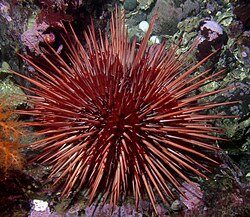
The red sea urchin (Mesocentrotus franciscanus)[2] is a sea urchin found in the northeastern Pacific Ocean from Alaska to Baja California. It lives in shallow waters from the low-tide line to greater than 280 m (920 ft) deep,[3] and is typically found on rocky shores sheltered from extreme wave action in areas where kelp is available.[4][5]

Description

[edit]
M. franciscanus juvenile, found at Cape Flattery, WA: This individual is about 1.5 cm in diameter.

A sea urchin's spherical body is completely covered by sharp spines. These spines grow on a hard shell called the "test", which encloses the animal. It can vary in color from red to dark burgundy. Rarely, albino specimens are found. It has a mouth located on its underside, which is surrounded by five teeth. During larval development, the body of a sea urchin transitions from bilateral to radial symmetry.

This bilaterally symmetrical larva, called an echinopluteus, subsequently develops a type of pentaradiate symmetry that characterizes echinoderms. It crawls very slowly over the sea bottom using its spines as stilts, with the help of its tube feet. Scattered among its spines are rows of tiny tube feet with suckers that help it to move and stick to the sea floor.

Feeding habits

[edit]

This animal has a mouth with special jaws (Aristotle's lantern) located on the bottom (oral) surface. Its preferred diet is seaweeds and algae, including giant kelp (Macrocystis pyrifera) and bull kelp (Nereocystis luetkeana), which it scrapes off and tears up from the sea floor.[6] Adults may consume plankton (particularly Lithothamnion sp. and Bossiella sp.) if other food sources are not available.[7] During larval development, urchins use bands of cilia to capture food (namely zooplankton) from the water column.[8][9] Red sea urchins found in the channel adjacent to San Juan Island have been found to live a uniquely sedentary lifestyle with the heavy currents bringing an abundance of food.[10][11]

Behavior and reproduction

[edit]

Sea urchins are often found living in clumps from five to ten. They have the ability to regenerate lost spines. Lifespan often exceeds 30 years, and scientists have found some specimens to be over 200 years old.[12] Red sea urchins are notoriously ravenous kelp-eaters and are implicated in devastating kelp beds[5] by forming grazing fronts. The intense grazing pressure exerted by urchins is an important link in a trophic cascade often observed along the west coast of North America in which sea otter predation influences urchin abundance, which in turn influences kelp devastation.[13] In contrast to their negatively perceived impact on community structure in open coastal kelp beds, the sedentary behavior and capture of detrital seaweed in the San Juan Islands is hypothesized to create an important habitat and energy source below the photic zone.[10] These diverse ecosystem effects of red urchins highlight their importance as ecosystem engineers in temperate rocky reef ecosystems.

Spawning peaks between June and September. Eggs are fertilized externally while they float in the ocean, and planktonic larvae remain in the water column for about a month before settling on the bottom of the sea floor, where they undergo metamorphosis into juvenile urchins. These juveniles use chemical cues to locate adults.[14] Although juveniles are found almost exclusively under aggregated adults, the adults and juveniles are not directly related.[15]

References

[edit]
[edit]
Revisions and contributorsEdit on WikipediaRead on Wikipedia
from Grokipedia
The red sea urchin (Mesocentrotus franciscanus) is a prominent species of echinoid, characterized by its large, spherical test measuring up to 21 cm in diameter and covered in long, reddish spines used for protection, locomotion, and foraging. This marine invertebrate inhabits rocky subtidal environments along the northeastern Pacific coast, where it primarily grazes on and drift algae, contributing to the dynamics of ecosystems. Known for its exceptional , with individuals living over 100 years and negligible signs of , the red sea urchin exemplifies remarkable resilience in marine habitats. Distributed from , , to , , the species thrives in high-energy rocky reefs and beds at depths typically ranging from 3 to 35 meters, though it can occur from the down to over 90 meters. Its diet consists mainly of marine vegetation, including giant ( pyrifera), which it accesses using and pedicellariae to manipulate food particles toward its ventral mouth. In areas of high abundance, red sea urchins can influence algal community structure by preventing overgrowth, though overgrazing may lead to urchin barrens devoid of macroalgae. Reproduction in M. franciscanus is gonochoric, with separate sexes releasing gametes into the water column for during episodic spawning events, often in spring. The resulting planktonic larvae undergo a prolonged development period of 62 to 131 days before settling as juveniles, a life history trait that supports wide dispersal but episodic influenced by currents and . Commercially valued for its gonads, the red sea urchin sustains important fisheries along its range, highlighting its ecological and economic significance.

Taxonomy and classification

Scientific classification

The red sea urchin, Mesocentrotus franciscanus, belongs to the phylum Echinodermata, a group of characterized by and a in adulthood. Its full taxonomic hierarchy is as follows:
RankClassification
KingdomAnimalia
PhylumEchinodermata
ClassEchinoidea
OrderCamarodonta
FamilyStrongylocentrotidae
GenusMesocentrotus
SpeciesM. franciscanus
This placement reflects its membership in the diverse class Echinoidea, which encompasses all modern sea urchins and , distinguished by a rigid (shell) and movable spines. The Mesocentrotus, established in 1993, was confirmed and expanded in 2013 following phylogenomic analyses of nuclear and from strongylocentrotid sea urchins, which revealed distinct evolutionary lineages within the family Strongylocentrotidae. Prior to this reclassification, the species was known as Strongylocentrotus franciscanus, but molecular evidence supported separating M. franciscanus (along with M. nudus) into a to Strongylocentrotus based on and morphological traits like spine ultrastructure. Within the Strongylocentrotidae, M. franciscanus is closely related to species such as the purple sea urchin (Strongylocentrotus purpuratus) and the green sea urchin (Strongylocentrotus droebachiensis), sharing a common ancestry evident from shared genetic markers and ecological niches in temperate Pacific waters.

Nomenclature history

The red sea urchin was first described scientifically by in 1863 as Toxocidaris franciscana in the Bulletin of the Museum of Comparative Zoology at , based on specimens collected from the northeastern Pacific. The specific epithet "franciscanus" honors the type locality near , , where the initial material was obtained. Shortly thereafter, the species was reclassified into the genus Strongylocentrotus as Strongylocentrotus franciscanus, reflecting its morphological affinities with other strongylocentrotid urchins. In 1993, Tatarenko and Poltaraus erected the genus Mesocentrotus within the family Strongylocentrotidae, initially to accommodate the related species Pseudocentrotus depressus, based on DNA-DNA hybridization data highlighting genetic distinctions from Strongylocentrotus. Phylogenetic analyses in subsequent decades, particularly a 2013 phylogenomic study by Kober and Bernardi using mitochondrial and nuclear genes from nine strongylocentrotid species, confirmed two major clades: one comprising Strongylocentrotus and Hemicentrotus, and the other including Mesocentrotus and Pseudocentrotus. This evidence supported transferring S. franciscanus to Mesocentrotus franciscanus, a reclassification formally accepted in taxonomic databases like the around 2011–2013. The species is commonly known as the red sea urchin or giant red sea urchin, names derived from its distinctive reddish coloration and large size relative to other urchins. Historical synonyms include Toxocidaris franciscana (the ) and Strongylocentrotus franciscanus (the prior accepted name).

Physical characteristics

Morphology

The red sea urchin possesses a spherical , or shell, composed of fused plates that form a rigid external up to 21 cm in diameter. This is covered by a thin epithelial layer and exhibits five-part radial , a hallmark of echinoid , with ten double rows of pores arranged in ambulacral grooves that radiate from the oral (ventral) to the aboral (dorsal) surface. The ambulacral grooves house , which are extensible, hollow projections of the used for locomotion, adhesion to substrates, and manipulation of food particles. On the oral surface, the mouth opens into Aristotle's lantern, a complex masticatory apparatus consisting of five plates supporting five sharp, pyramidal teeth that converge to form a jaw-like structure for scraping and grinding substrates. Surrounding the test are movable spines, which are long, thick, and tapered, reaching up to 8 cm in length, and articulate with the shell via ball-and-socket tubercles for flexibility in protection and slow locomotion. Additionally, pedicellariae—small, pincer-like appendages scattered across the test—serve defensive and cleaning functions by grasping debris or deterring small predators. Internally, the houses key organs, including a coiled digestive tube that extends from the mouth through the Aristotle's lantern to the anus on the aboral surface, facilitating the processing of ingested material. Five gonads, suspended within the test, produce gametes and are prominent during reproductive periods, while the —a network of fluid-filled canals and ampullae—powers the and supports respiration through associated slits.

Size and coloration

The red sea urchin (Mesocentrotus franciscanus) attains the largest size among sea urchins in the northeastern , with adult test diameters typically measuring 10–18 cm and occasional individuals reaching up to 21 cm, though maximum sizes vary regionally (e.g., up to ~18 cm in ). Whole-body wet weights for mature adults average around 300 g. These dimensions reflect , allowing individuals to continue expanding slowly throughout their long lifespan. In terms of coloration, the test exhibits a hue that can vary to dark or purple-black, providing effective among rocky substrates and forests. The spines are generally lighter red than the test, aiding in and protection. Rare albino forms, lacking pigmentation, have been documented, though they represent an anomaly in natural populations. Growth occurs at a rate of 1–2 cm per year in test diameter during early life, primarily until sexual maturity is achieved at 4–5 years of age, after which increments slow considerably. This pattern varies by location and environmental factors such as food availability, with faster initial growth in nutrient-rich areas. Age is estimated by counting annual growth rings in the test plates, a method analogous to dendrochronology in trees, though ring formation can be irregular due to episodic growth influenced by reproduction and resource limitations.

Habitat and distribution

Geographic range

The red sea urchin (Mesocentrotus franciscanus, formerly Strongylocentrotus franciscanus) occupies a broad latitudinal range in the northeastern , extending from the in (approximately 55°N) southward to , (approximately 30°N). This distribution spans roughly 25 degrees of latitude along the North American coast, encompassing diverse coastal environments from open ocean exposures to more protected inlets. In terms of depth, the species occurs from the down to 100 m, but it is most abundant between 5 and 30 m where conditions support its preferred rocky substrates. Population densities vary geographically, reaching their highest levels in and , with notable concentrations in mainland and island areas as well as the north coast of ; densities are comparatively sparse in northern . Historically, the red sea urchin's range has remained stable, with no significant latitudinal or longitudinal shifts documented prior to the 2000s, as evidenced by consistent distributions and survey records over decades.

Environmental preferences

The red sea urchin, Mesocentrotus franciscanus, inhabits rocky substrates such as ledges, crevices, and reefs, where it often bores into the rock for attachment and shelter, while avoiding soft sediments like sand or mud that limit its mobility and feeding access. It is strongly associated with macroalgae beds, particularly giant ( spp.) forests, which provide both food sources and protective cover from physical dislodgement. These habitats are typically found in the low extending to depths of about 90 m, in areas with moderate to high wave exposure that enhances circulation but avoids extreme turbulence. Temperature plays a critical role in the and distribution of M. franciscanus, with a tolerance range of approximately 6–25°C, though optimal conditions for feeding and growth center around 16°C. The species is particularly sensitive to warming events, such as those during El Niño periods, where temperatures exceeding 16°C lead to reduced feeding rates, lower quality, and increased stress, potentially shifting competitive dynamics in favor of warmer-adapted urchin species. It thrives in cooler coastal waters, with larval development and settlement favoring temperatures between 10–15°C for successful recruitment. M. franciscanus requires stable marine levels of 30–35 ppt, typical of its Pacific coastal habitats, and exhibits sensitivity to reductions in salinity that can impair osmotic and . Additionally, it depends on well-oxygenated environments with dissolved oxygen levels exceeding 4 mg/L to support its metabolic demands, as it resides in near-shore areas with high from wave action and avoids hypoxic conditions that could limit respiration via its and .

Ecology

Ecosystem role

The red sea urchin (Mesocentrotus franciscanus) serves as a keystone in ecosystems along the northeastern Pacific coast, where it primarily grazes on the holdfasts and basal portions of macroalgae such as giant kelp ( pyrifera), thereby regulating algal overgrowth and maintaining community structure at moderate densities. This grazing activity prevents excessive proliferation that could otherwise shade out understory , but unchecked populations can lead to the formation of urchin barrens—denuded rocky substrates devoid of macroalgae—altering habitat availability for associated . Such phase shifts have been documented in regions like the , highlighting the urchin's dual role in both stabilizing and destabilizing kelp-dominated systems depending on . As a primary occupying a low , the red sea urchin contributes to cycling by processing algal and fragments into fecal pellets that enrich the benthic environment with and bioavailable , supporting detritivores and microbial communities. These , often nutrient-dense due to inefficient digestion of complex algal , facilitate the transfer of energy and elements like and carbon back into the , enhancing overall in oligotrophic coastal waters. The urchin's spines host a variety of epibionts, including , bryozoans, and encrusting , forming microhabitats that boost local by providing attachment sites and shelter for small otherwise limited in barren or sparse algal environments. This symbiotic association influences community composition, as the urchin's mobile tests create dynamic spaces that exploit, indirectly promoting trophic diversity within . Population booms, often triggered by declines in keystone predators like sea otters (Enhydra lutris), have historically driven collapses, as seen in the post-19th-century otter extirpation along the North American coast, resulting in widespread barrens and reduced ecosystem resilience.

Predators and threats

The red sea urchin, Mesocentrotus franciscanus, faces predation primarily from sea otters (Enhydra lutris), which consume large numbers of urchins as a key component of their diet, exerting significant top-down control on populations. Sunflower stars (Pycnopodia helianthoides) also prey on red sea urchins, using their numerous arms to capture and envelop individuals, while spiny lobsters (Panulirus interruptus) target them in southern ranges through direct grappling and consumption. Other predators include certain crabs, white sea urchins (Lytechinus anamesus), sea anemones, and fishes, though these exert less intense pressure compared to the primary ones. Disease poses a notable threat, with bald sea urchin disease (BSUD), likely caused by bacterial infections such as those from Vibrio species, leading to spine loss or "balding" that impairs mobility and feeding. This condition, first documented in M. franciscanus in the 1970s, results in green lesions and detachment of spines, tube feet, and pedicellariae, often progressing to secondary infections and mortality. Parasitic copepods, including species like Scolecodes buntsmani, infest red sea urchins by attaching to spines or entering tissues, potentially weakening hosts and facilitating opportunistic pathogens. Abiotic factors further endanger populations; ocean acidification reduces carbonate availability, weakening the magnesium calcite composition of urchin tests and impairing larval skeletogenesis, which can lower survival rates. A 2023 study indicated that vulnerability to combined warming and acidification varies regionally, with populations experiencing higher mortality rates than those in . Marine heatwaves, such as the 2014–2016 event along the Northeast , triggered elevated adult mortality and recruitment failure in M. franciscanus stocks, compounded by physiological stress from temperatures exceeding 15–20°C. Human activities exacerbate these risks through , which has historically depleted red sea urchin densities in commercial areas like , inadvertently promoting recovery by curtailing grazing pressure on macroalgae. This reduction in urchin abundance, driven by targeted harvests since the 1970s, has altered local trophic dynamics, though it increases vulnerability to remaining predators in low-density populations.

Feeding

Adult diet

Adult red sea urchins (Mesocentrotus franciscanus) are omnivorous but primarily herbivorous, consuming a diet dominated by macroalgae including giant kelp (Macrocystis pyrifera), bull kelp (Nereocystis luetkeana), and various species of . Although algae form the bulk of their intake, they opportunistically feed on such as periwinkles and, in response to oceanographic anomalies, gelatinous organisms such as or carrion including dead fish. Foraging occurs primarily through scraping and biting algal tissues using the Aristotle's lantern, a powerful five-toothed apparatus that protrudes from the to shear off pieces of food. In shallow subtidal habitats, adults display nocturnal activity rhythms, with increased biting and movement at night to minimize predation risk while accessing attached or drift . Dietary habits exhibit seasonal variation, with greater dependence on drift during winter months when storm activity dislodges macroalgae, supplying substantial resources to subtidal populations. Red sea urchins demonstrate remarkable resilience to scarcity, capable of surviving for up to five months by depressing metabolic rates and mobilizing internal reserves. Nutritional selectivity favors high-protein , which promote development and enhance reproductive output, as evidenced by improved gonadal indices in protein-enriched diets.

Larval nutrition

The pluteus larvae of the red sea urchin (Mesocentrotus franciscanus) are obligate planktotrophs that depend on external nutrition from shortly after hatching to fuel their extended pelagic phase. These larvae primarily consume unicellular , including diatoms such as Chaetoceros gracilis and flagellates like Isochrysis sp., Rhodomonas lens, and tertiolecta, which provide essential proteins, carbohydrates, and for growth and skeletogenesis. Feeding occurs via the larval ciliary band, a specialized ciliated structure encircling the preoral and postoral arms, where coordinated ciliary reversal creates localized water currents that transport food particles toward the for and in the complete gut. This mechanism allows efficient capture of particles in the 2–20 μm size range typical of their diet, with optimal performance in mixed algal assemblages that mimic natural planktonic conditions. Larval growth and survival are strongly tied to food availability and ration size, with daily feeding regimes of 2,500–10,000 algal cells per ml—escalating as larvae progress from 4-arm to 8-arm stages—yielding the highest competency rates (up to 53% by day 28). At lower densities (e.g., below 2,500 cells ml⁻¹), larvae exhibit , such as elongated posterolateral arms to expand the feeding apparatus and improve particle encounter rates, though this comes at the cost of reduced body and slower development. Higher rations promote faster skeletal growth and energy allocation to the echinoid rudiment, the precursor to the juvenile form, highlighting the density-dependent nature of larval in this species. As larvae approach metamorphosis, they shift from suspension feeding on to benthic on and , a transition that demands rapid competency triggered by nutritional sufficiency. Starvation tolerance in the larval stage is limited, with unfed M. franciscanus surviving only 12–16 days before mortality exceeds 95%, relying briefly on reserves post-hatch but unable to sustain prolonged pelagic dispersal without exogenous input. In contrast, adults possess greater resilience, enduring weeks to months of food scarcity through metabolic adjustments and reserves, underscoring the vulnerability of the larval phase to fluctuating productivity. Dietary composition plays a pivotal role in larval survival and metamorphic success, particularly through the provision of omega-3 polyunsaturated fatty acids (PUFAs) like docosahexaenoic acid (DHA, 22:6n-3), which larvae actively accumulate from phytoplankton into their tissues. Algal sources rich in DHA enhance fatty acid profiles, supporting membrane integrity, neural development, and settlement cues, with deficiencies linked to reduced competency and higher post-metamorphic mortality in Mesocentrotus species. This nutritional dependence amplifies the larvae's sensitivity to environmental changes, such as algal blooms or ocean acidification, that alter PUFA availability in the diet.

Reproduction and life cycle

Spawning process

The red sea urchin (Mesocentrotus franciscanus) is gonochoric, possessing separate sexes with no hermaphroditism observed in adults. Spawning typically occurs from to September along much of its range, though the exact timing varies by locality and year, with some populations exhibiting extended or year-round activity in areas of abundant food resources. This reproductive period is primarily triggered by environmental cues such as rising temperatures and increasing photoperiod, which align with seasonal peaks in food availability to support gonad maturation and release. As broadcast spawners, adult red sea urchins release gametes directly into the water column for , a that relies on high densities to maximize encounter rates between eggs and . Females produce and release between 100,000 and 2 million eggs per spawning event, while males eject billions of to compensate for dilution in the marine environment. Aggregation into dense clusters of 50 or more individuals during spawning significantly enhances fertilization success by concentrating gametes and reducing dispersion losses. Spawning synchronization within aggregations is facilitated by chemical cues, including pheromones released alongside gametes, which signal conspecifics to initiate release and coordinate timing across the group. , or the number of gametes produced, increases with body size and peaks at test diameters of 10-15 cm, after which output stabilizes or slightly declines despite further growth.

Larval development

Following fertilization, the eggs of the red sea urchin (Mesocentrotus franciscanus) undergo rapid embryonic development, reaching the gastrula stage within approximately 24 hours at typical temperatures of 12–15°C. This early phase involves successive cleavages leading to a hollow blastula, followed by to form the , establishing the basic body plan of the . By 2–3 days post-fertilization, the pluteus larva emerges, characterized by its ciliated bands, larval arms supported by skeletal rods, and bilateral symmetry, enabling active swimming in the . The pluteus larva remains free-swimming for 24 to 131 days, varying with temperature and latitude, with shorter durations (around 3-4 weeks) in warmer southern waters and longer (up to 18 weeks) in cooler northern areas, during which it grows and feeds on to support further development. As the matures, it attains metamorphic competence at a size of 1–2 mm, typically after 3–4 weeks, when the larval arms elongate fully and the juvenile rudiment—a precursor to the radial form—begins to form internally. Settlement is triggered by chemical cues from on rocky substrates, prompting the to metamorphose by resorbing larval structures and attaching via its adhesive disk, thus transitioning to a benthic juvenile. This process marks a profound morphological shift from bilateral in the to the pentaradial of the , involving reorganization of the coelomic cavities and nervous system. Larval survival from egg to juvenile is exceedingly low, primarily due to predation, , and dispersal challenges in the planktonic phase. plays a critical role in survival and development speed, with optimal rates observed at 12–15°C, where lower mortality and faster progression to competence occur compared to warmer conditions that accelerate but increase stress.

Behavior

Social aggregation

Red sea urchins (Mesocentrotus franciscanus) exhibit social aggregation by forming distinct groups or clumps, typically consisting of 50 or more individuals, particularly in areas with strong currents, surge, or rough rocky substrates near kelp bed edges. These aggregations provide mutual protection from predators, such as sea stars and , by creating a barrier of spines, and facilitate access to shared food resources like kelp holdfasts and drift . Once established, such clumps tend to remain stationary for extended periods, as the presence of nearby individuals inhibits further movement, stabilizing the group structure. Aggregation is mediated in part by chemical signaling, where juveniles respond to secondary chemical cues released by s, preferentially associating under spine canopies rather than isolated locations. This density-dependent results in characteristic spacing, with nearest-neighbor distances often ranging from 10 to 20 cm in natural and experimental settings at moderate population densities of 2-6 individuals per square meter. Territoriality is notably low among both juveniles and s, with minimal or defense of personal space observed during interactions. Juveniles actively join adult aggregations for enhanced safety, with 69-81% found sheltering beneath adult spines across study sites in and , a strategy that significantly reduces predation risk without eliciting rejection from adults. Regarding dispersal, red sea urchins are largely sedentary, with slow crawling rates averaging 7.5 cm per day in food-abundant forests, though movement can increase to over 50 cm per day in barren areas outside kelp beds; however, the inhibitory effect of conspecifics in clumps limits overall relocation.

Longevity and growth

The red sea urchin (Mesocentrotus franciscanus) exhibits exceptional , with individuals capable of living 30 to over 200 years. This extended lifespan has been confirmed through multiple methods, including tag-recapture studies that track individual growth over decades and analysis of growth rings in the urchin's test (), which form multiple bands per year and allow estimation of age based on ring counts. Additional validation comes from using atmospheric bomb-test ¹⁴C, which has identified specimens over 100 years old with high precision. Growth in M. franciscanus occurs in distinct phases, characterized by rapid juvenile expansion that slows after . Juveniles grow quickly, often increasing test diameter by approximately 1-2 cm per year in the first few years, reaching at a test diameter of 4-6 cm, typically around 2-5 years of age depending on environmental conditions. Post-maturity, growth decelerates significantly, with annual increments dropping to less than 0.5 cm, and nearly halting in older individuals after 10 years, though the urchin continues indeterminate skeletal growth at a minimal rate. Senescence in M. franciscanus is negligible, with no observed age-related decline in reproductive capacity or increased mortality risk even in individuals over 100 years old. remains stable into advanced age, contrasting with many short-lived species, though longevity can be influenced by environmental factors such as food scarcity, which reduces growth rates and may indirectly limit lifespan in resource-poor habitats. In fished populations, age structure is often skewed toward older individuals due to slow and variable rates, which average around 7% annually but can drop to near zero in some years, leading to dominance by long-lived adults while juveniles remain scarce. This imbalance exacerbates vulnerability to overharvesting, as recovery relies on infrequent strong events.

Human significance

Commercial fishery

The commercial red sea urchin fishery emerged in the early 1970s, beginning in in 1971 as part of efforts to develop underutilized marine resources, and simultaneously in that same year. The industry expanded northward, reaching Washington and by the mid-1970s and Alaska's Southeast region in 1981, where harvests initially focused near Ketchikan. Primarily a dive , it targets large adults with test diameters exceeding 10 cm for optimal quality, using scuba or surface-supplied air to hand-collect urchins from rocky subtidal habitats. The , processed into uni for and , are the main product, with approximately 90% historically exported to , though domestic U.S. consumption has increased since the early . Among the harvesting regions, red sea urchins from Santa Barbara, California, are particularly noted for producing high-quality uni. Wild-harvested from clean, cold waters, Santa Barbara uni is prized for its creamy, thick texture, strong sweetness, and substantial granules. It is favored by Michelin-starred chefs for sushi and raw consumption, often rivaling the renowned uni from Hokkaido, Japan. Chef Masaki Saito has described it as Hokkaido's main competition, noting that it "melts away and [is] very sweet," with larger size attributed to high sulfur levels in the surrounding sea. Similarly, Chef Isao Yamada praises it as "rich, thick and creamy," stating it is creamier than Hokkaido uni. Annual landings peaked in the 1980s, with California alone recording over 23,000 metric tons in 1988, and combined regional catches across California, British Columbia, Oregon, Washington, and Alaska reaching 25,000–30,000 metric tons in high-production years during the late 1980s. Harvests have since declined due to stock reductions and market shifts, with recent figures much lower—for instance, British Columbia landings totaled about 3,600 metric tons in 2020 and approximately 3,500 metric tons in 2023, and Alaska's Southeast fishery yielded under 100 tons in 2021–2022. The fishery remains limited-entry in British Columbia (110 licenses) and California, emphasizing selective harvesting to sustain populations. Management includes size limits to protect individuals: 8.3 cm test in , 8.9 cm in , and 8.5 cm in , with no standard limit in unless imposed for specific areas. Quotas are implemented via guideline harvest levels and rotational area closures in to allow stock recovery, individual vessel quotas in since the 1990s to prevent derby-style , and registration-based trip limits in . The fishery generates significant economic value, with combined regional wholesale revenues estimated at $50–100 million annually during peak periods, though recent figures are lower—approximately $6.1 million CAD (landed value) in for 2023. Challenges include market fluctuations tied to Japanese demand, which declined after the 1990s , and the labor-intensive nature of diving operations, which raise safety risks and operational costs. Co-management approaches in , involving First Nations and industry, have helped stabilize the sector by addressing overages and enhancing economic efficiency.

Conservation status

The red sea urchin (Mesocentrotus franciscanus, formerly Strongylocentrotus franciscanus) has not been evaluated for the , indicating a lack of global assessment, though regional populations in the northeastern Pacific exhibit varying trends influenced by fishing pressure and environmental factors. In , commercial catch declined sharply from approximately 14,000 metric tons in 1988 to less than 1,000 metric tons by the early 2000s, reflecting that reduced harvestable-sized individuals in shallow habitats. Similarly, statewide landings peaked at 51.99 million pounds (23,581 metric tons) in 1988 before dropping to about 10.9 million pounds by 1999, with historical depletion estimated at around 75% in the 1970s prompting moratoriums. In 2018, a disaster was declared for due to prolonged warm ocean conditions reducing availability and yield, with recovery efforts ongoing as of 2025. Climate change poses emerging threats through ocean warming and acidification, which can impair larval development, growth, and survival across the species' range. Studies indicate that elevated CO₂ levels reduce and energy allocation in sea urchins, potentially exacerbating recruitment limitations in vulnerable populations, particularly those in weaker regions like . Population-specific adaptations exist, with northern individuals showing greater resilience to stress, but interactive effects of warming and acidification may lead to higher mortality in early life stages without . Recovery efforts include the establishment of marine protected areas (MPAs) along the coast, such as those in the National Marine Sanctuary, where no-take zones have demonstrated conservation benefits. Within these MPAs, adult red sea urchin diameters average 6% larger, total biomass is 16% higher, and reproductive biomass increases by 23% compared to fished areas, supporting stock replenishment. Additionally, (Enhydra lutris) reintroductions, such as the 1987 effort on in the , help regulate urchin densities through predation, promoting ecosystem balance in habitats where overabundant urchins could otherwise dominate. Ongoing monitoring relies on diver-based surveys to assess and , as seen in annual transect counts in and ports, alongside genetic analyses to evaluate stock connectivity and diversity. For instance, microsatellite studies across sites from to reveal low but significant differentiation, informing sustainable harvest quotas and MPA design to prevent localized depletions. These tools support , though comprehensive quantitative stock assessments remain limited in some regions.

References

Add your contribution
Related Hubs
User Avatar
No comments yet.