Hubbry Logo
Rose madderRose madderMain
Open search
Rose madder
Community hub
Rose madder
logo
8 pages, 0 posts
0 subscribers
Be the first to start a discussion here.
Rose madder
Rose madder
from Wikipedia
Rose Madder
 
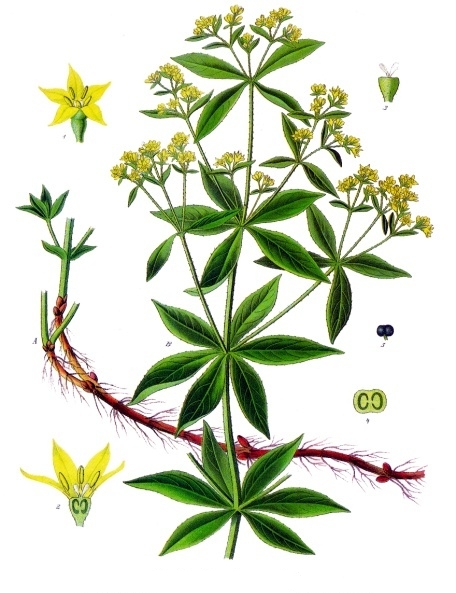
Rubia tinctorum, from whose root the colour is extracted
About these coordinates     Color coordinates
Hex triplet#E32636
sRGBB (r, g, b)(227, 38, 54)
HSV (h, s, v)(355°, 83%, 89%)
CIELChuv (L, C, h)(49, 142, 10°)
Source[Unsourced]
B: Normalized to [0–255] (byte)

Rose madder (also known as madder) is a red paint made from the pigment madder lake, a traditional lake pigment extracted from the common madder plant Rubia tinctorum.

Madder lake contains two organic red dyes: alizarin and purpurin.[1][2][3] As a paint, it has been described as a fugitive, transparent, nonstaining, mid valued, moderately dull violet red pigment in tints and medium solutions, darkening to an impermanent, dull magenta red in masstone.[4][5]

History

[edit]

Madder has been cultivated as a dyestuff since antiquity in Central Asia, South Asia, and Egypt, where it was grown as early as 1500 BC.[6] Cloth dyed with madder root dye was found in the tomb of the Pharaoh Tutankhamun and on an Egyptian tomb painting from the Graeco-Roman period, diluted with gypsum to produce a pink color.[7] It was also found in ancient Greece (in Corinth), and in Italy in the Baths of Titus and the ruins of Pompeii. It is referred to in the Talmud as well as mentioned in writings by Dioscorides (who referred to it as ἐρυθρόδανον, "erythródanon"), Hippocrates, and other literary figures, and in artwork where it is referred to as rubio and used in paintings by J. M. W. Turner and as a color for ceramics. In Spain, madder was introduced and then cultivated by the Moors.[8]

The production of a lake pigment from madder seems to have been first invented by the ancient Egyptians.[9] Several techniques and recipes developed. Ideal color was said to come from plants 18 to 28 months old that had been grown in calcareous soil, which is full of lime and typically chalky. Most were considered relatively weak and extremely fugitive until 1804, when the English dye maker George Field[10] refined the technique of making a lake from madder by treating it with alum and an alkali.[9][11] The resulting madder lake had a less fugitive color[9] and could be used more efficaciously, for example by blending it into a paint. Over the following years, other metal salts, including those containing chromium, iron, and tin, were found to be usable in place of alum to give madder-based pigments of various other colors.

In 1827, the French chemists Pierre-Jean Robiquet and Colin began producing garancine, the concentrated version of natural madder. They then found that madder lake contained two colorants, the red alizarin and the more rapidly fading purpurin. Purpurin is only present in the natural form of madder and gives a distinctive orange/red generally warmer tone that pure synthetic alizarin does not. Purpurin fluoresces yellow to red under ultraviolet light, while synthetic alizarin slightly shows violet.[12] Alizarin was discovered before purpurin, by heating the ground madder with acid and potash. A yellow vapor crystallized into bright red needles: alizarin. This alizarin concentrate comprises only 1% of the madder root.

Natural rose madder supplied half the world with red, until 1868, when its alizarin component became the first natural dye to be synthetically duplicated by Carl Gräbe and Carl Liebermann. Advances in the understanding of chemistry, such as chemical structures, chemical formulas, and elemental formulas, aided these Berlin-based scientists in discovering that alizarin had an anthracene base. However, their recipe was not feasible for large-scale production; it required expensive and volatile substances, specifically bromine.

William Perkin, the inventor of mauveine, filed a patent in June 1869 for a new way to produce alizarin without bromine.[6] Gräbe, Liebermann, and Heinrich Caro filed a patent for a similar process just one day before Perkin did – yet both patents were granted, as Perkin's had been sealed first. They divided the market in half: Perkin sold to the English market, and the scientists from Berlin to the United States and mainland Europe.

Because this synthetic alizarin dye could be produced for a fraction of the cost of the natural madder dye, it quickly replaced all madder-based colorants then in use (in, for instance, British army red coats that had been a shade of madder from the late 17th century to 1870, and French military cloth, often called "Turkey Red"[13]). In turn, alizarin itself has now been largely replaced by the more light-resistant quinacridone pigments originally developed at DuPont in 1958.

It is still manufactured in traditional ways to meet the demands of the fine art market.[citation needed]

Other names

[edit]
  • Alizarin's chemical composition: 1,2 dihydroxyanthraquinone (C14H8O4)[3]
  • Alizarin crimson, a paint very similar in color to Rose Madder Genuine but derived from synthetic Alizarin[3]
  • Lacca di robbia, Italian name[2]
  • Laque de garance, French name[2]
  • Natural Red 9 abbreviated NR9, Color Index name[2]
  • Purpurin's chemical composition: 1,2,4 trihydroxyanthraquinone (C14H8O5)[3]
  • Rose madder genuine, sometimes used to specify a paint derived from the root of the madder plant in the traditional manner[14] It is still manufactured and used by some, but is too fugitive for professional artistic use.[4]
  • Rose madder hue, sometimes used to specify a paint made from other pigments but meant to approximate the color of rose madder
  • Rubia tinctorum, the herbaceous perennial from which the rose madder pigment is derived
  • Turkey red[7]

Substitutes

[edit]

As all madder-based pigments are fugitive, artists have long sought a more permanent and lightfast replacement for rose madder and alizarin. Alternative pigments include:

  • Anthraquinone red (PR177), a chemical cousin of Alizarin[3]
  • Benzamida carmine (PR176)[3]
  • Perylene maroon (PR179), for mixing dull violets[3]
  • Pyrrole rubine (PR264)[3]
  • Quinacridone magenta (PR122), for a brighter violet[3][4]
  • Quinacridone pyrrolodone[3]
  • Quinacridone rose (PV19), for a brighter violet[3][4]
  • Quinacridone violet (PV19), particularly dark and reddish varieties[3]

In art, entertainment, and media

[edit]
  • HMS Surprise is a 1973 novel by Patrick O'Brian which mentions rose madder.
  • Rose Madder is the title of a 1995 novel by Stephen King, in which a woman named Rose Daniels escapes her abusive husband and travels through time by entering a painting of a woman in a gown dyed with rose madder.
  • "Madder Red" is the title of a 2009 song by Yeasayer on the album Odd Blood.
  • Jonathon Keats uses the gradual fading of rose madder oil paint to record a single image over the course of 1000 years in his "millennium camera".[15]
  • Blue Madder is the third album released by Savoy Brown in May 1969 on Decca Records.
  • Yukino in The Garden of Words is described as having 'a madder-red ribbon' in her school uniform.
  • The Maddermarket Theatre in Norwich has connections with the use of madder as a dye in the city.

References

[edit]

Further reading

[edit]
Revisions and contributorsEdit on WikipediaRead on Wikipedia
from Grokipedia
Rose madder is a traditional, transparent lake pigment derived from the roots of the madder plant (), which contains the natural dye ; the name "rose madder" refers to its delicate rose-pink tone. It has been used for in textiles and creating paints for artistic applications. Originating in regions such as , the , and , madder cultivation dates back to at least the Indus Valley civilization, with evidence of madder dye on textiles from (ca. 2500–1900 BC). The 's use dates to at least the (ca. 2124–1981 BC), with widespread adoption across the Mediterranean by the AD, as noted by . In , particularly Romano-Egyptian mummy portraits from ca. AD 100–200, rose madder was a primary for rendering draperies, lips, and facial highlights, often mixed with to produce purples, and its presence is identifiable through techniques like liquid chromatography-mass spectrometry (LC/MS) and reflectance spectroscopy. Production involved steaming and crushing the dried roots to extract the dye, which was then precipitated onto a substrate like to form a stable suitable for painting. During the , rose madder gained prominence among European artists for its glazing properties, providing rich depth and luminosity in oil and paintings as one of the few transparent reds available at the time. Its use persisted into the , with figures like George Field developing refined manufacturing methods in the 1800s that are still employed by producers such as Winsor & Newton to create genuine rose madder paints from the madder sourced in and . However, the pigment's moderate led to fading in exposed works, particularly in thin glazes, prompting its partial replacement by synthetic crimson after 1868. Today, genuine rose madder ( code NR9) remains available in high-quality watercolors and oils for artists seeking its delicate, granulating blush tone, though modern alternatives offer improved permanence.

Introduction

Definition and Characteristics

Rose madder is a traditional red lake pigment derived from the root of the madder plant (Rubia tinctorum). It represents the laked form of madder dye, precipitated onto a substrate such as alum to create an insoluble pigment, distinguishing it from the soluble raw extract of the plant. In terms of color profile, rose madder appears as a transparent, mid-valued violet-red in tints and medium concentrations, shifting to a dull magenta in masstone. This subtle tonality contributes to its characteristic blushing pink hue when applied in fine arts. Rose madder exhibits general traits including high transparency, nonstaining in binding media, and pronounced fugitivity, meaning it is prone to upon prolonged exposure to light with an ASTM rating of IV (poor). These properties make it suitable for glazing techniques where is desired, though its impermanence limits broader applications.

Etymology and Other Names

The term "madder" derives from Old English madere (also spelled mædere), which is cognate with Old Norse maðra and traces back to the Proto-Indo-European root modhro-, signifying a "dye plant." This etymology reflects the long-standing association of the plant Rubia tinctorum with red dyeing practices across ancient cultures. The qualifier "rose" distinguishes a refined lake pigment form derived from the madder root, emphasizing its specific preparation as an artist's material rather than the raw plant extract. Rose madder has been known by various historical and regional synonyms, often reflecting linguistic adaptations or processing methods. These include lacca di robbia in Italian, referring to the lake from madder (robbia being the Italian term for the plant), and laque de garance in French, where garance denotes madder itself. In standardized , it is designated as Natural Red 9 (CI NR9), a classification for the natural anthraquinone-based extracted from . Other names encompass crimson, a typically applied to the synthetic analog developed in 1868 rather than the genuine natural variant, and Turkey red, which specifically describes a dyed fabric variant achieved through a multi-step mording process with madder on . A notable regional variation is garancine, a concentrated extract of madder developed in during the early , named after garance (the French word for madder) and linked to intensive cultivation in the Garance region around , a key center for madder production in .

Production

Cultivation and Extraction

Rose madder is derived from the roots of the perennial herbaceous plant , native to and the eastern Mediterranean region, from where it spread to , including and the , as well as to for cultivation as a source. The plant thrives in , well-drained soils with a of 6.0 to 8.0, preferably clay-loam types rich in lime, and requires full sun exposure in temperate climates with moderate rainfall. Cultivation typically involves from root cuttings or seeds in spring, with plants grown for a minimum of three years to allow root development for optimal content, though economic harvests can occur after two years in intensive systems. Harvesting occurs in late summer or autumn, when roots are dug up from depths of up to 1-2 meters, cleaned of , and chopped into small pieces to prepare for . The chopped are then subjected to extraction by soaking in , often with a period of several days to weeks, which hydrolyzes glycosides and releases the key alizarin and purpurin into solution. At its peak in the , madder cultivation was concentrated in the region of and in the , where yields reached approximately 6 tons of fresh roots per under optimized conditions. This raw extract serves as the base for preparing the stable rose madder used in art and textiles.

Pigment Preparation

The preparation of rose madder involves transforming the water-soluble extract from madder into an insoluble lake suitable for use in paints and other applications. This laking process typically begins by dissolving the extract in an alkaline solution, followed by the addition of a metal salt such as (potassium aluminum sulfate) to precipitate the dye onto an inert substrate, forming a stable, colored precipitate. Common substrates include amorphous hydrated alumina, , or , which bind the dye molecules and enhance the pigment's opacity and handling properties. Other metal salts, such as stannic (tin) salts, can also be employed to create variations in hue and , though remains the most traditional choice for rose madder due to its ability to produce a vibrant, transparent . The is often completed by adding an like soda or to neutralize the solution, resulting in the formation of fine particles that are then filtered, washed, and dried. The choice of substrate and the during laking significantly influence the final hue, with more alkaline conditions and alumina substrates yielding the characteristic bright rose tones. A key refinement in rose madder production was introduced by English colorist George Field in 1804, who utilized to create a purer with improved permanence and color intensity compared to earlier methods. Field's approach emphasized careful control of the concentration and temperature to minimize impurities and achieve a more consistent rose shade, making it a standard for high-quality artist's pigments. Further advancements came with the 1828 garancine process, developed by French chemists Pierre-Jean Robiquet and Jean-Baptiste Colin, which produced a concentrated madder extract by treating powdered roots with dilute to hydrolyze glycosides and liberate more free dye. This garancine was then laked similarly to traditional extracts but offered higher efficiency in pigment yield, allowing for brighter and more economical rose madder production. Traditional rose madder preparation yields a low amount of usable , typically 1-2% from the dry weight, due to the plant's composition and the inefficiencies of early laking techniques. This scarcity contributes to the pigment's variability, as the quality of the —dependent on cultivation factors like and plant age—directly affects the extract's purity and the resulting lake's chromatic properties.

Chemical Composition and Properties

Molecular Structure

Rose madder, derived from the roots of the Rubia tinctorum plant, owes its coloration primarily to anthraquinone derivatives, with alizarin (1,2-dihydroxyanthraquinone, molecular formula C14_{14}H8_{8}O4_{4}) serving as the principal red dye component. This compound features a planar anthraquinone backbone consisting of three linearly fused benzene rings, where the central ring contains two carbonyl groups at positions 9 and 10, and hydroxyl groups are substituted at the 1 and 2 positions on one of the outer rings. These hydroxyl groups are positioned ortho to each other, facilitating hydrogen bonding and enabling chelation with divalent or trivalent metal ions, such as aluminum (Al3+^{3+}) or calcium (Ca2+^{2+}), which is essential for forming stable lake pigments during precipitation. A secondary compound, purpurin (1,2,4-trihydroxyanthraquinone, ), imparts orange-red hues and shares the same core but includes an additional hydroxyl group at the 4 position. This substitution enhances its solubility in alkaline conditions and alters the chromophoric properties, shifting the absorption spectrum slightly toward longer wavelengths compared to alizarin. The presence of these hydroxyl groups in both molecules not only determines their dyeing affinity but also their reactivity in forming metal complexes that precipitate as insoluble pigments. The proportion of in natural madder-derived lakes varies, typically comprising a small but critical fraction of the overall composition, influenced by factors such as the age of the plant and soil conditions during cultivation. Older roots from nutrient-rich soils yield higher concentrations of alizarin and related anthraquinones, with reported levels in roots ranging from 0.6% to 1.2% dry weight, which directly impacts the yield in pigment preparation.

Physical Attributes

Rose madder pigment exhibits high transparency, particularly when used in oil media or glazes, allowing to pass through and create luminous effects in layered applications. It possesses low tinting strength, meaning it requires substantial quantities to achieve deep color saturation when mixed with other s or whites. In masstone, the pigment appears as a dull , while its tints shift to a cool violet-red hue, providing a subtle, muted suitable for nuanced . The pigment's durability is limited, with an ASTM lightfastness rating of II in oil paints but IV (fugitive) in watercolors, indicating it may fade noticeably after 50-100 years of exposure to gallery lighting conditions in oils, though faster in watercolors. This sensitivity arises primarily from its organic composition, derived from alizarin-based dyes extracted from the madder plant. Additionally, rose madder is particularly vulnerable to alkalis, which can cause discoloration or dissolution, though it remains stable in acidic environments. As a physical material, rose madder presents as a fine, dusty that disperses easily but can appear chalky in texture due to its organic particle . In washes, it is nonstaining, lifting cleanly from the support without residue, and in thin layers, it may exhibit blooming, where subtle or separation occurs, enhancing its textured visual depth.

History

Ancient Origins

The earliest archaeological evidence of madder (Rubia tinctorum) cultivation dates to ca. 3000 BC in the Indus Valley, where dyed fabric fragments from the site of indicate its use as a red dyestuff. Native to and surrounding regions in western Asia, the plant was likely domesticated there for dye production during the same period, with its roots harvested for the alizarin-based colorant essential to early textile coloring. In ancient Egypt, madder appears in artifacts from the Middle Kingdom (circa 2050–1710 BC), including a leather quiver fragment confirmed via surface-enhanced Raman spectroscopy (SERS) analysis, marking one of the oldest verified uses of the dye in the region. By the New Kingdom period, madder had become integral to Egyptian funerary practices, as evidenced by red-dyed linen textiles from the tomb of Tutankhamun (circa 1323 BC), where alizarin from madder roots was identified through gel-supported liquid extraction and high-performance liquid chromatography-mass spectrometry (HPLC-MS) on a preserved fragment. These textiles, used in mummy wrappings and portraits, highlight madder lake's role as a stable pigment for both dyeing and painting on organic supports. The dye spread across the Mediterranean, appearing in Nubian wall paintings from the late 8th century BC, such as those in the Kawa shrine, where madder was the earliest organic lake pigment documented via HPLC-DAD-MS analysis. In the Roman world, madder pigments featured prominently in wall decorations, with pink variants—madder lake on an substrate—identified in Pompeii frescoes buried by the 79 AD eruption of Vesuvius, as confirmed by spectroscopic examination of exceptional contexts spanning the to 79 AD. Similarly, ancient Persian textiles and early prototypes incorporated madder for vibrant reds, with cultivation in the supporting its trade along routes from to the since at least 1500 BC. In , served as the primary source of red dye, yielding madder lake pigments for textiles preserved in sites like the salt mines (circa 1400–800 BC), where residues were detected through archaeometric analysis. This widespread adoption laid the foundation for madder’s continued prominence into medieval traditions.

Modern Developments

In the early 19th century, advancements in processing techniques marked a refinement era for rose madder production. In 1804, English dye maker George Field developed an improved method to create madder lake by treating the water-soluble madder extract with alum and an alkali, enhancing the pigment's stability and usability for artists and dyers. This innovation built on traditional extraction but allowed for more consistent laking, turning the dye into a durable insoluble pigment suitable for paints. Further efficiency came in 1828 when French chemists Pierre-Jean Robiquet, Léonard Gaston Eusèbe Colin, and colleagues patented garancine, a concentrated derivative of madder root produced by treating powdered roots with sulfuric acid to remove impurities and boost dye yield. Garancine significantly reduced production costs and increased the color intensity, spurring commercialization and expanding madder use in textiles and fine arts across Europe. The mid-19th century represented the peak of natural madder cultivation, particularly in France, where it became a major agricultural export supporting thousands of farmers in regions like the Vaucluse. However, this prosperity abruptly ended with the 1868 synthesis of alizarin, the primary colorant in madder, by German chemists Carl Graebe and Carl Liebermann, who derived it from anthracene in coal tar. Industrial-scale production of synthetic alizarin began in 1869 by BASF, offering a cheaper, more abundant alternative with comparable dyeing properties but greater uniformity. The economic impact was devastating: madder prices plummeted, leading to the collapse of the natural cultivation industry, with French production ceasing by 1875 as synthetic dyes captured over 90% of the market within a few years. In the , natural rose madder production became rare, limited to niche artisanal and conservation applications where its unique hue and historical authenticity are valued over synthetic alternatives. Small-scale cultivation persists in areas like the and for specialist makers, such as Winsor & Newton, which continues to produce genuine rose madder lake from Rubia tinctorum roots using traditional methods. For art conservation, (HPLC) has emerged as a key analytical tool to identify madder s in historical works, distinguishing natural and purpurin profiles from synthetics through precise separation of compounds. This technique aids in authenticating artifacts and guiding restoration, underscoring rose madder's enduring, albeit specialized, role in .

Uses

In Art and Painting

Rose madder, a transparent derived from the madder plant, has been prized in for its ability to create subtle, luminous effects through glazing techniques. Artists applied it in thin, transparent layers over white grounds or other colors to achieve depth and vibrancy in flesh tones and drapery, particularly during the when it was one of the few available transparent reds. This method allowed for a rich, non-opaque red that enhanced the modeling of forms without overpowering underlying hues, contributing to the soft, naturalistic rendering favored by masters of the Venetian school. In the works of , rose madder served as an underpaint layer for red draperies, providing a foundation for subsequent glazes with more intense reds like kermes, as seen in his vibrant depictions of fabric and skin. , influenced by Venetian techniques, incorporated similar madder lakes to model flesh and clothing, achieving warm, glowing tones in portraits and historical scenes. employed rose madder for delicate accents, such as the lips in (c. 1665), where it was mixed with and for warmer flesh, and possibly glazed over the blue headscarf to intensify the red elements of the dress. Among the 19th-century Pre-Raphaelites, artists like used rose madder for pure, intense highlights, such as the ribbon in The Last of England (1855), often in copal-based media to maintain its transparency and brilliance alongside colors like . Due to its fugitive nature, rose madder fades upon prolonged light exposure, a challenge conservators address through advanced to identify its remnants in originals. Techniques like UV-Vis-NIR reflectance reveal the pigment's characteristic absorption bands in faded areas, confirming its original presence in works by Vermeer and others. For restoration, modern artists recreate rose madder lakes using traditional methods to match historical hues, ensuring authenticity in without synthetic substitutes.

In Textiles and Industry

Rose madder has been a primary for producing red shades in textiles, particularly and , due to its content that binds effectively with mordants. In the "Turkey red" process, developed in the and widely adopted in by the late 1700s, cotton fabrics were mordanted with a combination of oil and through multiple steepings in , , and sheep's dung, followed by dyeing in madder root extract and final treatments with gall nuts and soda ash to achieve a bright, lightfast hue. This method ensured color durability on cotton, which was challenging with madder alone, and became a cornerstone of industrial production in Britain and . The played a key role in military textiles during the 18th and 19th centuries, notably for the red coats of British privates, where madder provided an economical alternative to costlier for a reliable scarlet. Officers often used brighter cochineal-dyed uniforms, but madder was standard for enlisted ranks due to its single-stage simplicity and availability from European cultivation. On an industrial scale, rose madder was cultivated extensively in and the throughout the , supporting large-scale exports to meet demand for across . Production reached thousands of tons annually in regions like and , fueling a major trade network until synthetic alternatives emerged. Historically, it was also applied in staining for goods like gloves and shoes, as well as in for tinting. In modern times, rose madder has largely been phased out of industrial textile production following the 1868 of synthetic . It persists occasionally in traditional crafts and small-scale for historical reenactments or artisanal fabrics, preserving cultural techniques amid the dominance of synthetics.

Substitutes

Synthetic Replacements

The breakthrough in synthetic replacements for rose madder came in when German chemists Carl Graebe and Carl Liebermann developed a method to synthesize , the primary colorant in madder root, from coal-tar derivatives. This process produced chemically identical to the natural compound extracted from Rubia tinctorum but in a purer state without impurities from plant extraction. The synthesis relied on the structural foundation of natural , an derivative, enabling scalable production from industrial byproducts. In , acquired the patent rights from Graebe and Liebermann and initiated commercial manufacturing, making synthetic far cheaper than the labor-intensive —priced at a fraction of the cost within months of launch. This affordability triggered an immediate for madder cultivation, devastating farming regions in , the , and , where entire industries reliant on the crop failed as demand plummeted. By the early 1870s, natural madder production had virtually ceased in due to the synthetic's dominance. As a practical application, (PR83) emerged as a formulated from synthetic , serving as a direct substitute for rose madder in and with enhanced consistency and a vibrant, lightfast tone. This pigment replicated the translucent, cool of traditional madder lakes while offering better uniformity for industrial-scale textile coloration and artistic use. Subsequent developments included quinizarin (1,4-dihydroxyanthraquinone), first synthesized in 1873 by Richard Grimm through condensation of with , providing another red dye variant akin to . Other early anthraquinone synthetics, such as purpurin derivatives, followed in the , broadening the palette of cost-effective reds that mirrored madder's hues and further solidified the shift from natural sources.

Contemporary Alternatives

In contemporary art supplies, the quinacridone series of synthetic organic pigments serves as a primary alternative to rose madder, offering a similar transparent, rose-red hue with markedly improved stability. Specifically, (PR122) and (PV19) exhibit excellent rated ASTM I, ensuring longevity in artworks where natural madder would fade over time. These pigments maintain the glazing qualities prized in traditional techniques, allowing artists to achieve luminous, layered effects without the risks associated with the fugitive . For deeper, more maroon-like tones akin to rose madder's warmer variants, perylene maroon (PR179) provides a transparent, option with superior also rated ASTM I, making it suitable for rich shadows and mixed neutrals. As an economical choice, naphthol s such as PR170 offer a brighter, semi-transparent with good (ASTM II), though they may require mixing to closely match madder's subtlety. These alternatives are widely recommended in resources for glazing applications, where their transparency and vibrancy replicate rose madder's aesthetic while surpassing its impermanence. For instance, Winsor & Newton markets "Rose Doré" as a rose-toned in their professional line, formulated for modern use in watercolors and oils.

Cultural Impact

In Literature and Media

In Stephen King's 1995 novel Rose Madder, the titular painting serves as a central , depicting a mysterious woman and functioning as a portal that enables the protagonist, Rosie Daniels, to escape her abusive husband and enter an alternate world. The artwork's evolving details and supernatural properties drive the narrative's themes of empowerment and revenge, with the painting's name directly referencing the rose madder pigment. Patrick O'Brian's historical H.M.S. Surprise includes to madder as a , highlighting its historical use in the early 19th-century naval context. Dr. purchases a quantity of madder in for scientific purposes and conducts experiments feeding it to rats to observe its penetration into bones, underscoring the pigment's role in anatomical studies based on contemporary research like that of Duhamel du Monceau. Conceptual artist Jonathon Keats initiated the Millennium Camera project in 2015, installing pinhole devices coated with pigment to create a 1,000-year exposure photograph documenting environmental changes, such as urban development and impacts. The choice of rose madder, an organic red derived from the madder plant root, relies on its gradual fading in sunlight to form a subtle negative image over the millennium, with initial installations at sites like and the .

Symbolic and Historical Significance

In , rose madder symbolized luxury and rarity due to the labor-intensive process required to extract and refine the from the madder plant's , making it a coveted material for elite artists and producers. Valued for its translucent quality, it was frequently employed in glazing techniques to achieve depth and vibrancy in paintings, evoking opulence and refinement in works by masters such as Vermeer. This association with exclusivity positioned rose madder as a marker of high status, often reserved for sumptuous garments and vestments that signified wealth and piety. The pigment's deep hue linked it to broader symbolic meanings of , passion, and , drawing from ancient traditions where reds derived from natural sources represented life force and emotional intensity. In historical contexts, such as ancient Egyptian practices, madder-derived reds were tied to divine essence, embodying the protective of deities like . Its inherent instability further imbued rose madder with connotations of transience, as the color's tendency to fade under light exposure mirrored themes of impermanence and the fleeting nature of beauty and power in art and culture. Rose madder's historical legacy extends to its role as an economic driver in 18th-century , particularly in the , where its cultivation on sandy soils supported local industries and in dyes for textiles and paints. This economic significance fueled agricultural and commercial developments, positioning madder as a key in the pre-industrial market. As a conservation symbol, the techniques for producing Turkey red—a vibrant, madder-based originating in the and refined in —have been recognized in heritage efforts, including documentation on historical practices that highlight their cultural and technical value. In modern perceptions, rose madder is experiencing a revival within eco-art movements, where artists and designers champion natural s for their low environmental impact and alignment with sustainable practices. Recent studies from underscore this resurgence, emphasizing madder as a biodegradable alternative to synthetic dyes while noting persistent gaps in scalable production due to cultivation challenges and extraction inefficiencies. These efforts position the pigment as a bridge between historical craftsmanship and contemporary ecological awareness.

References

Add your contribution
Related Hubs
User Avatar
No comments yet.