

Rottweil
View on Wikipedia.jpg)
Key Information


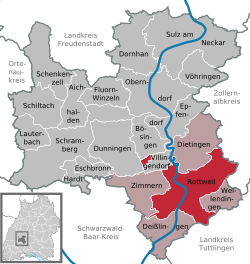


Rottweil (German: [ˈʁɔtvaɪl] ⓘ; Alemannic: Rautweil) is a town in southwest Germany in the state of Baden-Württemberg. Rottweil was a free imperial city for nearly 600 years.
Located between the Black Forest and the Swabian Alps, Rottweil has over 25,000 inhabitants as of 2022. The town is famous for its medieval center and for its traditional carnival (called "Fasnet" in the local Swabian dialect). It is the oldest town in Baden-Württemberg,[3] and its appearance has changed very little since the 16th century.
The town gives its name to the Rottweiler dog breed.
History
[edit]
Rottweil was founded by the Romans in AD 73 as Arae Flaviae and became a municipium, but there are traces of human settlement going back to 2000 BC. Roman baths and an Orpheus mosaic of c. AD 180 date from the time of Roman settlement. The present town became a ducal and a royal court before 771 and in 1268 it became a free imperial city.
In 1463 Rottweil joined the Swiss Confederacy under the pretence of a temporary alliance. In 1476 the Rottweilers fought on the Swiss side against Charles the Bold in the Battle of Morat. In 1512, Pope Julius II gave the city a valuable "Julius banner" for its services in the 1508–1510 "Great Pavier Campaign" to expel the French.[4] In 1519, the Rottweilers left the old Swiss alliance. They joined a new one in which their membership was extended indefinitely – the so-called "Eternal Covenant".
Rottweil thus became a centre of the Swiss Confederation. The relations between the Swiss Confederation and Rottweil cooled rapidly during the Protestant Reformation. When Rottweil was troubled by wars, however, it still asked the Confederates for help.[5]
In the Rottweil Witch Hunts from 1546 to 1661, 266 so-called witches, wizards and magicians were executed in the imperial city of Rottweil. On April 15, 2015, they were given a posthumous pardon. An official apology was given by the City Council about 400 years after their violent deaths.[6]
Rottweil lost both its status as free city and its alliance with the Swiss Confederacy with the conquest of the region by Napoleon in 1803.
Lord mayors since the 19th century
[edit]- 1820–1833: Max Joseph von Khuon, Schultheiß
- 1833–1845: Max Teufel
- 1845–1848: Karl Dinkelmann
- 1848–1851: Kaspar Rapp
- 1852–1887: Johann Baptist Marx
- 1887–1923: Edwin Glückher
- 1924–1943: Josef Abrell
- 1943–1944: Otto Mann
- 1944–1945: Paul Fritz
- 1945–1946: Franz Mederle
- 1946–1965: Arnulf Gutknecht
- 1965–1985: Ulrich Regelmann, mayor; from 1970 Lord Mayor
- 1985–2001: Michael Arnold
- 2001–2009: Thomas Engeser
- 2009–2022: Ralf Broß[7][8][9]
- 2022–present: Christian Ruf[1]
Climate
[edit]| Climate data for Rottweil (1991-2020) | |||||||||||||
|---|---|---|---|---|---|---|---|---|---|---|---|---|---|
| Month | Jan | Feb | Mar | Apr | May | Jun | Jul | Aug | Sep | Oct | Nov | Dec | Year |
| Daily mean °C (°F) | −0.1 (31.8) |
0.4 (32.7) |
3.9 (39.0) |
7.8 (46.0) |
12.1 (53.8) |
15.7 (60.3) |
17.6 (63.7) |
17.2 (63.0) |
12.9 (55.2) |
8.8 (47.8) |
3.8 (38.8) |
0.7 (33.3) |
8.4 (47.1) |
| Average precipitation mm (inches) | 55.9 (2.20) |
50.2 (1.98) |
56.2 (2.21) |
52.6 (2.07) |
92.2 (3.63) |
79.8 (3.14) |
89.8 (3.54) |
82.7 (3.26) |
57.7 (2.27) |
63.1 (2.48) |
61.4 (2.42) |
66.9 (2.63) |
808.5 (31.83) |
| Mean monthly sunshine hours | 66.9 | 89.4 | 135.2 | 172.9 | 199.1 | 217.8 | 234.8 | 220.8 | 164.1 | 117.5 | 70 | 58.4 | 1,748.9 |
| Source: Deutscher Wetterdienst[10][11][12] | |||||||||||||
Economy
[edit]During the Middle Ages, Rottweil used to be a flourishing imperial city with great economic and cultural influence.[13] In 1868, Rottweil was connected to Stuttgart by rail, which boosted the economy of the region.[13]
Today, most companies in Rottweil are either small or medium-sized.[14] A trading and shopping town with a high level of innovation that benefits from its well developed educational and transport infrastructure, Rottweil has many industrial companies and a steadily growing proportion of knowledge-intensive service jobs.[14]
At 7.9%, Rottweil has one of the highest academic rates in the region.[14]
Media
[edit]Local events in Rottweil are reported in the daily newspaper Schwarzwälder Bote, the Stadtanzeiger, online and once a week in the print edition Neue Rottweiler Zeitung, the TV station Regio TV Bodensee and the local radio station antenne 1 Neckarburg Rock & Pop, which is based in the district.
Notable former companies
[edit]- Moker
- KB Uhren Rottweil
- Peter-Uhren[15]
- Rhodia
- Pulverfabrik Rottweil
- Brauerei Pflug[16]
Infrastructure
[edit]Rail traffic
[edit]Rottweil station has regular (at least hourly) regional services to Stuttgart, Villingen, Singen, as well as many nearby towns. The hourly Stuttgart-Zurich intercity train also stops at Rottweil. In 2003, the Ringzug concept was established, providing rail service to many previously abandoned stations in the region between Villingen, Rottweil, Tuttlingen and Donaueschingen, which became a major success.
Road traffic
[edit]By car, Rottweil can be reached via the Bundesautobahn 81 Stuttgart-Singen, exit Rottweil. The city lies on the Bundesstraße 27 between Schaffhausen and Stuttgart, on the Bundesstraße 14, which runs from Stockach on Lake Constance via Tuttlingen to Rottweil and on via Horb am Neckar to Stuttgart, and on the Bundesstraße 462 from Rottweil through the Black Forest to Freudenstadt and Rastatt.
Bicycle traffic
[edit]Rottweil is located on the Neckartal-Radweg along the Neckar River via Horb, Tübingen, Stuttgart, Heilbronn and Heidelberg to Mannheim.
Air traffic
[edit]
In the neighboring village of Zepfenhan, about 12 km (7.5 mi) away, is the Flugplatz Rottweil-Zepfenhan (Rottweil-Zepfenhan airfield), which can be approached by small aircraft. The nearest commercial airports are Stuttgart Airport and Zurich Airport.
Education
[edit]Rottweil has three Gymnasien (Albertus-Magnus-Gymnasium, Droste-Hülshoff-Gymnasium, Leibniz-Gymnasium), one Realschule, one Förderschule (Achert-Schule), three Grundschulen (Eichendorff-Grundschule, Grundschule Neufra and Grundschule Neukirch), and four Hauptschulen (GHS Göllsdorf, Johanniter-Grund- und Hauptschule, Konrad-Witz-Grund- und Hauptschule and Römer-Grund- und Hauptschule).
Main sights
[edit]
- The late-Romanesque and Gothic–era Münster Heiliges Kreuz ("Minster of the Holy Cross"), built over a pre-existing church from 1270. It features a crucifix by Veit Stoss and noteworthy Gothic sculptures.
- Kapellenkirche (1330–1340), a Gothic church with a tower and with three statue-decorated portals
- Lorenzkapelle ("Church of St. Lawrence", 16th century) in late Gothic style. It houses some two hundred works by Swabian masters and Gothic altarpieces from the 14th and 15th centuries.
- The town's museum, including a notable Roman mosaic with the legend of Orpheus
- The late-Gothic town hall (1521)
- St. Pelagius, a Romanesque church from the 12th century. Excavations have brought to light Roman baths on the same site.
- Dominican Museum of Rottweil – local branch of the Landesmuseum Württemberg
- ThyssenKrupp constructed a $45 million, 807-foot (246 m) tower, the Rottweil Test Tower. The tower is a research facility for the company and is used to test new elevator cars and technologies. When the tower was completed in 2017, it was the tallest elevator test tower in the world.[17][a] The tower has 12 elevator shafts.[18]
Twin towns – sister cities
[edit]


Notable people
[edit]
- Konrad Witz (1400/10–1445/46), painter, active mainly in Basel.
- Adam of Rottweil, 15th-century scholar and printer
- Johann Georg Herbst (1787–1836), a German Orientalist.[20]
- Franz Xavier Wernz (1842–1914), the 25th Superior General of the Society of Jesus
- Erwin Teufel (born 1939), politician (CDU), former minister president of Baden-Württemberg
- Rüdiger Safranski (born 1945), philosopher, writer and literary scholar
- Matthias Hölle (born 1951), opera bass
- Anne Haigis (born 1955), musician, singer and songwriter.
- Wolfgang Stryi (1957–2005), jazz musician, composer, clarinetist and tenor saxophonist
- Andreas Schwab (born 1973), politician (CDU) and member of the European Parliament
- Johannes Erath (born 1975), opera director
- Heike Heubach (born 1979), politician, (SPD); she is deaf
Sport
[edit]- Klaus-Dieter Sieloff (1942–2011), footballer, brought up locally, played 338 games and 14 for West Germany
- brothers Marcus Trick (born 1977) & Armon Trick (born 1978), retired international rugby union players
- Simone Hauswald (born 1979), a former biathlete and bronze medallist at the 2010 Winter Olympics
- Markus Fuchs (born 1980), footballer who played over 300 games
- Christoph Burkard (born 1983), Paralympic swimmer, medallist at the 2004 & 2012 Summer Paralympics
- Maximiliane Rall (born 1993), footballer, played over 200 games and 9 for Germany women
- Joshua Kimmich (born 1995), footballer, played over 310 games and 85 for Germany
Trivia
[edit]- The Rottweiler dog breed is named after this town; it used to be a butcher's dog in the region.[21]
- "Das Mädchen aus Rottweil" is a song by the German band Die Toten Hosen.[22]
Gallery
[edit]-

-
 Depiction of St. Veronica's sudarium over the portal of the Minster of the Holy Cross
 -
 A statue for Rottweiler dogs in Rottweil
 -
 Rottweiler "Fasnet"
 -

-
 Rottweil station with ThyssenKrupp Test Tower in the background


.jpg)
See also
[edit]
Notes
[edit]- ^ There are higher elevator test towers now, see List of elevator test towers.
References
[edit]- ^ a b Oberbürgermeisterwahl Rottweil 2022, Staatsanzeiger.
- ^ "Bevölkerung nach Nationalität und Geschlecht am 31. Dezember 2023 (Fortschreibung auf Basis des Zensus 2022)" [Population by nationality and sex as of December 31, 2023 (updated based on the 2022 census)] (CSV) (in German). Statistisches Landesamt Baden-Württemberg.
- ^ Website of Dominikaner Museum Rottweil (retrieved May 22, 2014), on permanent display is a wooden table from August 4, AD 186 naming arae flaviae as municipium thus making Rottweil the oldest town in Baden-Württemberg [1] Archived 2014-05-21 at the Wayback Machine
- ^ Hecht, Winfried (1973). "The Julius Banner of the Village of Rottweil". Der Geschichtsfreund: Mitteilungen des Historischen Vereins der Fünf Orte Luzern, Uri, Schwyz, Unterwalden und Zug. 126–127: 141. doi:10.5169/seals-118647. Retrieved 2019-01-25.
- ^ Hecht, Winfried. "Rottweil". Historical Dictionary of Switzerland. Retrieved 2019-01-25.
- ^ Zeck, Mario (2000). "Im Rauch gehen Himmel geschüggt", Hexenverfolgung in der Reichsstadt Rottweil. Stuttgart. p. 43.
- ^ "Oberbürgermeisterwahl 2009 - vorläufiges amtliches Endergebnis" (in German). Kommunale Informationsverarbeitung Reutlingen-Ulm. Retrieved 2 February 2017.
- ^ "Ralf Broß - Oberbürgermeister - Stadt Rottweil" (in German). XING. Retrieved 2 February 2017.
- ^ "Mitarbeiter: Broß, Ralf" (in German). Rottweil (official site). Retrieved 2 February 2017.
- ^ "Lufttemperatur: vieljährige Mittelwerte 1991 - 2020" [Air Temperature: Long-term averages for 1991-2020]. dwd.de (in German). Deutscher Wetterdienst. Retrieved 23 February 2024.
- ^ "Niederschlag: vieljährige Mittelwerte 1991 - 2020" [Precipitation: Long-term averages for 1991-2020]. dwd.de (in German). Deutscher Wetterdienst. Retrieved 23 February 2024.
- ^ "Sonnenscheindauer: vieljährige Mittelwerte 1991 - 2020" [Sunshine: Long-term averages for 1991-2020]. dwd.de (in German). Deutscher Wetterdienst. Retrieved 23 February 2024.
- ^ a b "Wirtschaft | Landkreis Rottweil". www.landkreis-rottweil.de. Retrieved 2021-12-18.
- ^ a b c "Wirtschaftsstruktur | Stadt Rottweil - Die älteste Stadt Baden Württembergs". www.rottweil.de. Retrieved 2021-12-18.
- ^ "Peter-Uhren GmbH – Rottweiler Bilder". www.rottweil.net. Retrieved 2021-12-22.
- ^ "Ehemalige Pflug-Brauerei – Rottweiler Bilder". www.rottweil.net. Retrieved 2021-12-18.
- ^ Dillon, Conor (2015-06-26). "World's tallest elevator tower rises in Rottweil, Germany | DW | 26.06.2015". Deutsche Welle. Retrieved 2021-12-13.
- ^ Brown, Eliot (September 15, 2015). "Elevators Elevate German City's Image". The Wall Street Journal. ISSN 0099-9660. Retrieved 2 February 2017.
- ^ "Rottweil und seine Partnerschaften". rottweil.de (in German). Rottweil. Retrieved 2021-03-16.
- ^ Souvay, Charles Léon (1910). . Catholic Encyclopedia. Vol. 7.
- ^ "Rottweiler | Description, Temperament, Images, & Facts | Britannica". www.britannica.com. Retrieved 2021-12-24.
- ^ "Menschen Das Mädchen aus Rottweil - verzweifelt gesucht!". faz.net (in German). 2002-08-07. Retrieved 2021-12-24.
External links
[edit]
- Official website
 (in German)
 - Feast of Fools: Medieval Carnival Celebrations in Rottweil
- History and territory of the former Reichsstadt Rottweil
- Pictures of and stories about Rottweil


| Imperial abbeys and colleges (Reichsabteien, Reichsklöster und Reichsstifte) |
|  |
|---|---|---|
| Imperial charterhouse (Reichskartause) | ||
| ||
Towns and municipalities in Rottweil (district) | ||
|---|---|---|
 | ||
Rottweil
View on GrokipediaGeography
Location and landscape
Rottweil is located in the state of Baden-Württemberg in southwestern Germany, at approximately 48°10′N 8°37′E, about 97 kilometers south of Stuttgart.[9][10] The city serves as the administrative seat of the Rottweil district and lies at an elevation of roughly 600 meters above sea level.[11][4] Positioned in the Neckar River valley, Rottweil is bordered by the hills of the Swabian Jura to the east and the Black Forest region to the west.[12][13] The surrounding landscape features undulating terrain with the river carving through the valley, providing a mix of lowland and elevated areas that shape the city's compact urban layout centered around its historic core.[14][4]Climate
Rottweil features a temperate oceanic climate classified as Cfb under the Köppen-Geiger system, marked by mild temperatures without extreme seasonal swings and precipitation distributed fairly evenly across the year.[15] Average annual temperatures hover around 9°C, with winter lows typically reaching -3°C in January and summer highs peaking at 22°C in July.[16] Annual precipitation totals approximately 750 mm, primarily as rain, though winter months contribute snowfall equivalent to about 7-8 cm on average.[16] Seasonal patterns show a wetter period from late spring to mid-summer, with June recording the highest monthly rainfall at around 86 mm and up to 13 wet days, driven by convective showers.[16] Winters, from November to March, bring the coldest conditions with average highs of 3-8°C and occasional freezes, alongside the peak snowfall in December at roughly 8 cm water equivalent; February stands as the driest month with only 33 mm.[16] Humidity remains comfortable year-round, rarely exceeding muggy levels, while cloud cover is highest in late fall at over 60% overcast days. The region's climate aligns with broader southwest German norms but exhibits elevated rainfall due to orographic effects from the nearby Black Forest, where westerly winds force moist air upward, enhancing precipitation compared to flatter eastern areas.[17] Historical records from local stations indicate variability, including a peak annual total of 1,146 mm in 1965 and up to 213 precipitation days in the same year, underscoring potential for wet extremes influenced by Atlantic weather systems.[18] Long-term data since the mid-20th century reveal consistent mildness, with no prolonged dry seasons, supporting stable habitability patterns.[16]Demographics
Population trends
In 1871, the area corresponding to the modern municipality of Rottweil had a population of approximately 8,200 residents.[19] This figure more than tripled over the subsequent century, reaching around 25,000 by 1970, a period marked by industrialization, urban expansion, and the absorption of surrounding localities during Baden-Württemberg's municipal reforms in the early 1970s.[19] The post-World War II era contributed to this upswing through net positive migration, including displaced persons and ethnic Germans repatriated from Eastern Europe, which offset wartime losses and low birth rates in a recovering economy. By the late 20th century, annual growth had slowed, with the population stabilizing near 25,000 amid balanced inflows from domestic relocation and limited natural increase.| Year | Population |
|---|---|
| 1871 | 8,200 |
| 1970 | 25,000 |
| 2000 | 25,040 |
| 2024 | 24,985 |
Composition and migration
Rottweil's demographic composition is overwhelmingly ethnic German, with foreign nationals representing 14.4% of the resident population as of 2024 statistics derived from official population registers.[21] [22] This share reflects a moderate level compared to urban centers in Baden-Württemberg, where the state average exceeds 17%.[23] The foreign-born cohort stems largely from post-1961 guest worker recruitment agreements with Turkey and southern European nations like Italy and Greece, which brought labor for industrial sectors but resulted in persistent family reunifications and limited naturalization rates, with only about 40% of long-term non-EU residents acquiring German citizenship nationally over decades.[24] Recent migration patterns include intra-EU mobility from Eastern Europe—primarily Poland, Romania, and Bulgaria—facilitated by free movement since 2004, alongside non-EU asylum inflows peaking after 2015 from Syria, Afghanistan, and Iraq, driven by conflicts rather than economic pull factors.[25] These groups contribute to labor shortages in manufacturing and services but exhibit higher dependency on social welfare systems, with non-EU migrants nationally utilizing Hartz IV benefits at rates 2-3 times that of natives due to skill mismatches and family sizes, straining local fiscal resources without commensurate tax contributions in initial years.[26] Integration outcomes reveal causal challenges from cultural disparities, including lower educational attainment among second-generation non-EU youth and elevated youth unemployment in migrant-heavy cohorts, as evidenced by regional Baden-Württemberg data showing 25-30% non-completion rates in vocational training for Turkish-origin youth versus under 10% for natives.[26] Religiously, the composition remains historically Catholic-dominant, reflecting Rottweil's position in the Catholic Swabian heartland of Baden-Württemberg, where church membership data indicate Catholics outnumber Protestants by roughly 2:1 regionally, though overall affiliation has declined to about 30% Catholic and 25% Protestant statewide amid secularization.[27] Migration has introduced a growing Muslim minority, estimated at 5-7% locally through guest worker descendants and recent refugees, fostering parallel communities with limited interfaith assimilation, as mosque constructions and halal demands highlight persistent cultural separation rather than convergence toward secular German norms.[26] Empirical indicators of social cohesion, such as national surveys on trust in institutions, show non-integrated migrant groups reporting 20-30% lower interpersonal trust levels, correlating with higher localized petty crime involvement in similar small-town settings, though Rottweil-specific policing data underscores proactive measures to mitigate these risks.[28]History
Ancient foundations and medieval development
The Roman settlement at Rottweil, known as Arae Flaviae, was established around 73 AD as a municipium under the Flavian dynasty, marking the town's foundational phase as a civilian center on the empire's frontier.[29] Positioned along the Neckar River and a vital southeastward road linking Strasbourg to the Danube, it facilitated control over trade routes and military logistics in the Upper Germanic limes system.[30] Archaeological remains, including public baths and urban infrastructure, confirm its role as a nucleated settlement that persisted beyond initial Roman military occupation.[31] Following the Roman legions' withdrawal in the 2nd century AD, Arae Flaviae sustained growth as a self-contained trade node, benefiting from its geographic advantages in riverine transport and overland connectivity without heavy reliance on imperial garrisons.[32] Continuity of occupation is evidenced by post-Roman artifacts and settlement patterns, transitioning into early medieval phases amid the fragmentation of Roman authority.[33] By the high Middle Ages, Rottweil had fortified its core with monumental defenses, including the early 13th-century High Tower and associated gates integrated into a largely preserved circuit wall, underscoring causal links between locational security and economic viability through tolls and commerce.[34] This strategic positioning drove prosperity in a feudal landscape, where the town's role as a nexus for regional exchange—leveraging the Neckar and Kinzig valleys—fostered independent development predating formal imperial privileges.[35] Empirical records from the period highlight modest but stable expansion, with ecclesiastical structures like the Romanesque origins of the Holy Cross Minster (ca. 1122) reflecting communal investment in durable institutions amid agrarian and mercantile activities.[34] Such foundations laid the groundwork for Rottweil's resilience, prioritizing endogenous trade dynamics over vassalage to distant lords.Era as free imperial city
Rottweil attained the status of a free imperial city, or Reichsstadt, in the 12th century through imperial immediacy under the Holy Roman Empire, granting it direct subordination to the emperor rather than local princes or bishops, which fostered local self-rule via an elected Schultheiß (chief magistrate) and council.[36] This autonomy was formally confirmed and expanded in 1276, solidifying privileges such as independent jurisdiction, taxation rights, and exemption from feudal overlordship, enabling the city to govern its territory encompassing surrounding villages and enforce laws without external interference.[36] These protections, rooted in the Empire's fragmented structure, allowed Rottweil to prioritize economic self-interest over hierarchical loyalties, contrasting with more centralized principalities where princely exactions often stifled growth. To safeguard this independence amid regional power struggles, particularly against Habsburg expansionism in Swabia, Rottweil forged a military alliance with the Swiss Eidgenossenschaft on June 18, 1463, committing to mutual defense for 15 years against common threats like Habsburg encroachments.[37] This pact, renewed and expanded into full association by 1519, positioned Rottweil as a zugewandter Ort (associated place) until 1632, leveraging Swiss military prowess—demonstrated in conflicts like the Swabian War (1499)—to deter Habsburg subjugation without full integration into the confederacy.[38] Rottweil further joined the Swabian League in 1488, a defensive confederation of imperial cities and princes, participating in joint military actions that preserved collective autonomy against territorial aggressors, though internal league disputes highlighted coordination challenges inherent to decentralized alliances. Economically, imperial status enabled robust trade along the Neckar River and overland routes connecting the Rhine and Danube basins, with guilds organizing artisan production in textiles, metalwork, and leather goods while regulating markets to ensure quality and exclude rivals, thereby sustaining prosperity through the late Middle Ages.[39] By the 16th century, Rottweil's Hofgericht (imperial court) extended appellate jurisdiction over much of southwestern Germany, attracting litigants and fees that bolstered revenues, while guild-enforced standards supported export-oriented crafts, yielding higher per-capita wealth than in adjacent Habsburg or Württemberg territories burdened by seigneurial dues.[40] This self-governance model, emphasizing contractual guilds over top-down edicts, causally contributed to cultural patronage, including ecclesiastical commissions, though the Thirty Years' War (1618–1648) imposed fiscal strains from troop levies and destruction, exposing vulnerabilities in prolonged interstate conflicts. In its later phases, Rottweil navigated inefficiencies such as guild monopolies that occasionally hampered innovation and inter-city rivalries within the Empire's diet, yet its endurance until mediatization in 1802—when Napoleon’s Reichsdeputationshauptschluss transferred it to Württemberg—underscored the relative efficacy of imperial city autonomy in averting princely absorption, as evidenced by survival rates higher among free cities (many persisting until 1803) compared to non-immediate towns swallowed earlier by consolidators.[41][40] Decentralized privileges thus permitted adaptive resilience, prioritizing empirical trade gains over uniform centralization that often correlated with stagnation in absolutist domains.Integration into modern Germany
Rottweil's status as a free imperial city ended in 1802, when it was incorporated into the Electorate of Württemberg as part of the broader territorial reorganizations preceding the dissolution of the Holy Roman Empire.[42] This mediatization, formalized under Napoleonic influence through the Reichsdeputationshauptschluss of 1803, transferred administrative authority from local imperial privileges to Württemberg's centralized governance, eliminating Rottweil's judicial independence via the Imperial Court of Justice while subjecting it to the kingdom's uniform tax and conscription systems. Despite the shift from autonomy to provincial status, local economic structures showed continuity, as Württemberg's policies preserved craft guilds initially, avoiding immediate disruption to Rottweil's metalworking traditions centered on tools like sickles, with nearly 100 forges active at their historical peak.[43] As part of the Kingdom of Württemberg, Rottweil participated indirectly in German unification processes, with Württemberg allying with Prussia during the Franco-Prussian War of 1870–1871 and acceding to the German Empire on January 18, 1871.[44] This integration into the empire's federal structure imposed standardized military obligations and tariff policies via the Zollverein, which had already encompassed Württemberg since 1834, facilitating cross-regional trade without evidence of localized resistance or economic reversal in Rottweil. Administrative centralization under Württemberg, evidenced by the creation of the Oberamt Rottweil around 1806–1808, streamlined bureaucracy but reduced local fiscal autonomy, though empirical population data indicate sustained growth—from 3,905 residents in 1813 to 5,196 by 1846—suggesting adaptive resilience rather than stagnation.[45][46] Industrial expansion in the mid-19th century reinforced economic continuity, with metal processing diversifying into machinery and the establishment of a gunpowder factory (Pulverfabrik Rottweil) that gained momentum from rail connectivity in 1868 and demand spikes during the Franco-Prussian War.[47] This factory's output, tied to military needs, exemplified how imperial unification's conflicts inadvertently boosted local manufacturing, as Württemberg's iron industry broadly advanced through technical innovations in processing despite the political absorption of former free cities.[48] Centralization's causal effects appear mixed: while it curtailed independent diplomacy, it enabled infrastructure investments like railways, correlating with Rottweil's transition from guild-based crafts to proto-industrial scales without verifiable output declines. During World War I, Rottweil contributed to Württemberg's mobilization efforts, with local men drafted into imperial forces amid early enthusiasm; cannon fire was audible from the city by August 1914, and casualty lists posting fallen, wounded, and missing soldiers began appearing publicly by September 8, 1914.[49] The war strained resources, including food rationing and factory reallocations, but Rottweil avoided direct combat zones, limiting material destruction compared to frontline regions. Interwar recovery maintained relative stability, buoyed by the Pulverfabrik's prewar foundations and regional metal sectors, though national hyperinflation and depression impacted employment without unique local collapses documented.[50] This period underscored centralization's long-term integration, as Rottweil's economy aligned with Weimar Germany's industrial base, exhibiting continuity in skilled trades amid broader Weimar volatility.Post-WWII and contemporary era
Following the end of World War II in 1945, Rottweil, situated in the French occupation zone of southwestern Germany, underwent reconstruction with limited physical devastation relative to heavily industrialized eastern or northern cities, enabling participation in the broader West German Wirtschaftswunder economic boom. The local construction sector expanded rapidly, with land consumption accelerating to accommodate housing and infrastructure needs amid national recovery efforts that rebuilt over 5 million apartments across West Germany by the mid-1950s.[51] Rottweil's population rose from around 15,000 to 20,000 during the 1950s, reflecting steady demographic growth driven by returning residents and inbound migration within stable western borders.[52] The effects of German reunification in 1990 were muted in Rottweil due to its location in prosperous Baden-Württemberg, far from the economic dislocations in former East Germany, where unemployment spiked to 20% and required massive fiscal transfers exceeding €2 trillion by the 2010s. Local adjustments involved national-level adaptations to unified markets and currency conversion, but Rottweil maintained economic continuity through established manufacturing and agriculture, avoiding the convergence traps that stalled eastern growth rates below 1% annually post-1998.[53][54] In the contemporary period, Rottweil has prioritized private-sector innovation, as demonstrated by the completion of the TK Elevator Test Tower in October 2017—a 232-meter structure that became the world's tallest dedicated elevator testing facility at the time, enabling advancements in high-speed, cable-free elevator systems for urban high-rises.[55] This project, developed by thyssenkrupp Elevator without primary reliance on direct state subsidies, has positioned the town as a testing hub for global mobility solutions, attracting international R&D collaborations.[56] Rottweil's rural hinterlands exemplified regional advocacy during the 2023–2024 farmers' protests, where agricultural operators blockaded roads nationwide—including in Baden-Württemberg—against government plans to phase out €500 million in annual diesel subsidies and impose stricter EU green regulations, revealing dependencies on state support amid rising input costs and import competition.[57] These actions, involving thousands of tractors and causing widespread disruptions by January 2024, underscored calls for policy reforms favoring market efficiencies over redistributive measures, while preserving local traditions like the town's longstanding Fasnet carnival.[58]Government and administration
Local governance structure
Rottweil's local government operates under the Gemeindeordnung für Baden-Württemberg, which establishes a dual structure comprising the Gemeinderat as the primary legislative body and the Oberbürgermeister as the executive head.[59] The Gemeinderat, consisting of 26 members, represents citizens and determines key administrative principles, including budget approvals, local statutes, and oversight of municipal policies such as infrastructure maintenance and urban planning.[60] Members are elected directly every five years, with the most recent election on June 9, 2024, yielding a composition where the CDU secured the largest share at 27.3% of votes, reflecting a modest gain from 23.8% in 2019 and emphasizing priorities like fiscal prudence and local service continuity.[61] The Oberbürgermeister, elected separately for an eight-year term, chairs the Gemeinderat, directs the city administration, and executes council decisions while representing Rottweil externally.[59] Current officeholder Dr. Christian Ruf (CDU) assumed the role on December 1, 2022, following a direct election on October 16, 2022, where he received 50.05% of votes in the runoff.[62] This position maintains historical continuity from Rottweil's imperial-era mayoral traditions, adapted to modern democratic checks, with the executive accountable to council votes on major expenditures exceeding defined thresholds (e.g., €25,000–€75,000 per case under state guidelines).[63] While Baden-Württemberg's framework grants municipalities substantive autonomy in self-governance areas like waste management and local zoning, Rottweil's decisions are constrained by state oversight and federal influences, including revenue sharing where Länder transfers constitute approximately 40–50% of municipal budgets statewide, limiting unilateral fiscal maneuvers.[64] Rottweil participates in a Verwaltungsgemeinschaft with four neighboring communes (Deißlingen, Dietingen, Wellendingen, Zimmern), pooling administrative resources for efficiency without ceding core decision-making authority.[65] This decentralized model fosters empirical accountability through periodic elections and public consultations, though post-imperial integration into Württemberg-Baden structures has standardized powers, reducing historical variances in local sovereignty.[66]List of lord mayors since the 19th century
The chief executive of Rottweil, initially titled Stadtschultheiß or Bürgermeister before adopting Oberbürgermeister in 1970 upon becoming a Große Kreisstadt, has overseen local administration since the early 19th century following the city's mediatization in 1802.[40] Early incumbents focused on stabilizing finances and relations with the Oberamt after the end of imperial city status, while later ones navigated industrialization, world wars, and post-war reconstruction.[40] [67]| Name | Term | Affiliation/Notes |
|---|---|---|
| Karl von Langen | 1803 | Hof-Kommissär; transitional role post-mediatization.[67] |
| Josef Bollinger | 1804–1807 | Stadtoberamtmann.[67] |
| Dominikus Stadlinger | 1808–1809 | Stadtoberamtmann.[67] |
| Max Joseph von Khuon | 1820–1833 | Stadtschultheiß; elected Stadtoberhaupt in 1819, managed post-Napoleonic recovery.[40] [67] |
| Maximilian Teufel | 1833–1844 | Stadtschultheiß.[67] |
| Johann Dinkelmann | 1845–1848 | Stadtschultheiß.[67] |
| Dr. Kaspar Rapp | 1848–1851 | Stadtschultheiß.[67] |
| Johann Baptist Marx | 1852–1887 | Stadtschultheiß; reformed desolate administration, improved Oberamt ties; only honoree with a street naming (Marxstraße).[40] [67] |
| Edwin Glükher | 1887–1924 | Stadtschultheiß; oversaw early industrialization.[67] |
| Bürgermeister Abrell | 1930s–Feb 1943 | Joined NSDAP in 1933; resigned amid wartime pressures.[40] |
| Otto Mann | Mar 1943–Mar 1944 | NSDAP Ortsgruppenleiter; appointed during war.[40] |
| Paul Fritz | Mar 1944–1945 | Wartime appointee.[40] |
| Dr. Franz Mederle | May 1945–Apr 1946 | Appointed by French occupation authorities post-WWII.[40] |
| Arnulf Gutknecht | 1946–1965 | Bürgermeister; focused on reconstruction.[67] |
| Dr. Ulrich Regelmann | 1965–1985 | Bürgermeister (Oberbürgermeister from 1970); managed urban expansion.[40] [67] |
| Michael Arnold | 1985–2001 | Oberbürgermeister.[67] |
| Thomas Engeser | 2001–2009 | Parteilos; first directly elected in runoff, de-reelected in 2009 but lost to challenger.[68] |
| Ralf Broß | 2009–2022 | Parteilos; re-elected 2017 with 94.9% amid fiscal stability but faced criticism over infrastructure delays; transitioned to state-level role.[69] [70] [71] |
| Dr. Christian Ruf | 2022–present | Elected October 2022; emphasized continuity in economic development.[63] |