Hubbry Logo
Sabertooth fishSabertooth fishMain
Open search
Sabertooth fish
Community hub
Sabertooth fish
logo
8 pages, 0 posts
0 subscribers
Be the first to start a discussion here.
Sabertooth fish
Sabertooth fish
from Wikipedia

Sabertooth fishes
Coccorella atrata
Scientific classification Edit this classification
Kingdom: Animalia
Phylum: Chordata
Class: Actinopterygii
Order: Aulopiformes
Family: Evermannellidae
Fowler, 1901
Genera

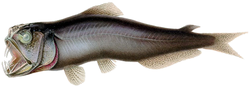
Sabertooth or sabretooth fish are small, deep-sea aulopiform fish comprising the family Evermannellidae. The family is small, with just eight species in three genera represented; they are distributed throughout tropical to subtropical waters of the Atlantic, Indian, and Pacific Oceans.

These fishes are named for their oversized, recurved palatine teeth, similar to those of saber-toothed cats (and the prehistoric Enchodus). The family is named Evermannellidae after Barton Warren Evermann, noted ichthyologist, naturalist and director of the California Academy of Sciences.

Description

[edit]

Sabertooth fishes have moderately elongated and compressed bodies which lack normal scales. The head is large and blunt; the terminal mouth is large and lined with slender palatine teeth, and the front is mostly enlarged and is curved inward slightly. A number of shorter, straighter teeth accompany these fang-like teeth. The tongue is toothless.

The eyes of the Odontostomops normalops typically range in size from small to large with a tubular structure while pointing upwards and directly laterally. The Atlantic sabertooth (Cocorella atlantica) have semi-tubular eyes directed dorso-laterally while the Balbo sabertooth (Evermannella balbo) and Indian sabertooth (Evermannella melanoderma) have tubular eyes but directed dorsally and slightly anteriorly.[1] The tubular nature of these eyes allow the sabertooth fish to extend their vision in specific directions, and also are presumed to aid with depth perception in the dark.[2][3] Evermannella have an additional adaptation called the optical fold. These optical folds are found on the lateral sides of the eyes and are another adaptation that allow these fish to extend their field of vision. The presumed mechanism of these optical folds is by altering the angle of the light from the lateral and ventral sides to better enter the eye.[3][4]

Similarly, in O. normalops, the horizontal diameter of the eye is significantly smaller than the width of the orbit, whereas in C. atlantica, the diameter of the eye is approximately equal to the interorbital width. In the case of E. balbo and E. melanoderma, the horizontal diameter of the eye is notably wider than the interorbital width. These observations suggest that there exist significant variations in the proportional dimensions of the eyes and orbits among different species of organisms, which may be indicative of distinct anatomical and functional adaptations.[1]

The anal fin (26–37 rays) is the largest of the fins, and runs along the posterior half of the fish, tapering in height towards the emarginated caudal fin. For O. normalops, anal fin ray counts are lowest in the Atlantic, higher in the Indian Ocean, and highest in the Pacific.[1] Further sampling must be done in order to determine a cause for this trend and if this trend exists in other species as well. A single high dorsal fin (10–13 rays) originates slightly before the thoracic pelvic fins. A small adipose fin is also present. The pectoral fins (11–13 rays) are positioned rather low on the body. All fins are spineless and lightly pigmented in shades of brown.[5]

The different families have 44–54 vertebrae, with three discrete bands of muscle tissue (epaxial, mid-lateral, and hypaxial) present in the caudal region. Sabertooths do not have swim bladders, and the stomach is highly distensible.

Evermannella are aulopiforms that have fusiform body structures, resulting in the fish being more deep anteriorly. This is in contrast to the elongated bodies of most other aulopiforms.[2]

Sabertooth fish are usually a drab, light to dark brown when preserved; however, a brassy green iridescence is seen on the flanks, cheeks, and ocular region of well-preserved specimens. The naked skin is easily torn. The Atlantic sabertooth (Coccorella Atlantica) is the largest species, at up to 18.5 cm standard length.

Life history

[edit]

Almost nothing is known of the biology and ecology of evermannellids. They are active, visual predators and confine themselves to the mesopelagic zone, about 400m - 1000m for adults.[1][4] However, larvae and small juvenile sabertooth fishes tend to be found at depth ranges between 50m - 100m, descending to deeper water with age.[1] At these depths, extremely little light is available; the view from below is like the sky at twilight. The sabertooth fish use their telescopic, upward-pointing eyes— which are thus adapted for improved terminal vision at the expense of lateral vision— to pick out squid, cuttlefish, and smaller fish silhouetted against the gloom above them.

Their distensible stomachs allow sabertooth fishes to swallow prey larger than themselves; their recurved teeth likely function in a manner similar to a snake's, preventing a captured fish from backing out and helping to guide the fish down the sabertooth's pharynx. Sabertooth fishes are solitary animals; it is not known whether they undergo diel vertical migrations.

Their reproductive habits are poorly studied; they are assumed to be nonguarding, pelagic spawners. True synchronous hermaphroditism with external fertilization is known in Evermannella indica and Odontostomops normalops, and the former species appears to spawn throughout the year. Sabertooth fish larvae are planktonic and have long snouts and oblong eyes before metamorphosis.

See also

[edit]

References

[edit]

Sources

[edit]
Revisions and contributorsEdit on WikipediaRead on Wikipedia
from Grokipedia
The sabertooth fish (family Evermannellidae), also known as sabretooth fish, are small, fierce-looking deep-sea predatory fishes in the order Aulopiformes, typically reaching a maximum of about 18 cm. They are distinguished by diagnostic features such as a scaleless head and body, a toothless with an elongated frontmost tooth, enormous fang-like teeth in the roof of the and lower , and dorsally directed semi-tubular or tubular eyes (except in Odontostomops normalops), which aid in detecting prey from below. These mesopelagic predators lack a and possess 45–54 vertebrae, with fin counts including 10–13 dorsal rays, 26–37 anal rays, and 11–13 pectoral rays; their features three distinct muscle bands (epaxial, midlateral, and hypaxial). The family comprises just eight species across three genera—Coccorella, Evermannella, and Odontostomops—distributed widely in the Atlantic, Indian, and Pacific Oceans, primarily in tropical and subtropical waters. Inhabiting the (typically 200–1,000 meters depth), they are voracious hunters that feed primarily on midwater fishes, employing their massive lower and specialized to impale prey. Their is classified as nonguarders, with limited details available on spawning due to their elusive deep-sea lifestyle. Notable for their adaptations to the dim, high-pressure mesopelagic environment, sabertooth fishes contribute to the trophic dynamics of open-ocean ecosystems as mid-level predators. The family name honors Barton Warren Evermann, an early 20th-century American ichthyologist, reflecting their recognition in systematic studies since the early .

Taxonomy and classification

Etymology and discovery

The Evermannellidae derives its name from the genus Evermannella, which was established by American ichthyologist Henry Weed Fowler in 1901 as a replacement for the preoccupied name Odontostomus (proposed by Anastasio in 1838 for a Mediterranean species). The genus honors Barton Warren Evermann (1853–1932), a prominent American ichthyologist and fisheries researcher who co-authored the seminal multi-volume work The Fishes of North and Middle America (1896–1900) with . The suffix "-ella" is a form derived from Greek, alluding to the small size of these fishes. Fowler erected the Evermannellidae in the same publication to accommodate Evermannella and related taxa, marking the formal taxonomic recognition of these deep-sea predators. The common name "sabertooth fish" (or "sabretooth fish") stems from the family's distinctive dentition, particularly the elongated, fang-like palatine teeth in the roof of the mouth that protrude prominently and resemble the curved tusks of extinct saber-toothed mammals. These teeth are adapted for capturing elusive prey in the dark ocean depths. Initial specimens contributing to the family's description were obtained from late 19th-century deep-sea expeditions, including those aboard the USS Albatross of the U.S. Fish Commission, which conducted pioneering trawls in the Pacific and Atlantic from the 1880s onward, yielding early mesopelagic fish collections. Fowler's 1901 description was based on material from Philippine waters, while subsequent accounts, such as those by Alcock (1894) for Indo-Pacific species, built on trawl samples from similar exploratory voyages. Within the order Aulopiformes, Evermannellidae exhibit basal synapomorphies such as dorsally directed tubular eyes (in most genera) for enhanced upward vision in low-light environments and specialized with enlarged fangs for prey . These traits align the family with other aulopiforms like scopelarchids, as detailed in systematic revisions. The family lacks a known fossil record, consistent with the relatively recent divergence of many deep-sea lineages during the era, though aulopiform fossils from earlier periods document the order's antiquity.

Genera and species

The family Evermannellidae comprises three genera and eight valid species as of 2025, all exclusively marine and inhabiting bathypelagic zones of tropical to temperate oceans. These species are distributed across the Atlantic, Indian, and Pacific Oceans, with no freshwater or shallow-water representatives. The genus Evermannella includes five species: E. ahlstromi, E. balbo, E. indica, E. megalops, and E. melanoderma. This genus is characterized by dorsally directed tubular eyes adapted for upward vision in dim light, along with a short-based dorsal fin bearing 10–13 rays and prominent recurved palatine fangs. Evermannella ahlstromi is restricted to the eastern Pacific, known from depths of 500–1,000 m, with a maximum length of 6.8 cm NG. E. balbo (Balbo sabretooth) occurs in the eastern Atlantic and Mediterranean, reaching 16.9 cm SL and featuring 12 dorsal rays. E. indica (Indian sabretooth) is widespread in the Indo-Pacific, attaining 11.9 cm SL with 12–13 dorsal rays and 27–31 anal rays, its pigmentation varying from pale to dark brown. E. megalops inhabits the southeastern Pacific, limited to 6.8 cm NG and distinguished by relatively larger eyes. E. melanoderma (Indian sabertooth) is found in the eastern Atlantic, growing to 12.7 cm SL with dark melanistic patterning on the body. The genus Odontostomops contains a single , O. normalops (undistinguished sabretooth), unique among evermannellids for its laterally directed non-tubular eyes and multiple rows of small teeth on the and dentary, contrasting with the single fang-like teeth in other genera. This exhibits a massive lower jaw and is circumglobal in tropical to temperate seas, reaching 12.3 cm SL, with patterns supporting its voracious predatory niche through efficient prey capture. It has 11–12 dorsal rays and 28–32 anal rays. The Coccorella encompasses two species: C. atlantica and C. atrata. Members of this genus possess semi-tubular eyes directed dorso-laterally. C. atlantica (Atlantic sabretooth) is broadly distributed across the Atlantic, Indian, and Pacific, growing to 18.5 cm SL with 11–13 dorsal rays and a brassy-green iridescent layer on preserved specimens. C. atrata occurs in the Indo-West Pacific, smaller at 4.2 cm SL, with 12 dorsal rays, 27 anal rays, and 46 vertebrae, its body naked and smooth. Molecular phylogenetic studies have confirmed the of Evermannellidae within Aulopiformes, supporting its placement alongside families like Scopelarchidae based on shared traits such as tubular eyes and fang-like , with analyses using multiple genes across nearly 2,000 fish taxa. No major taxonomic revisions have occurred since the 1982 review by Johnson, which recognized , though the addition of E. ahlstromi and E. megalops in 1975 brought the total to eight.

Physical description

Body structure

Sabertooth fish are small mesopelagic predators, with adults attaining a maximum standard length of 18.5 cm across the family. They exhibit elongated, laterally compressed bodies that lack scales on the head and trunk, resulting in a smooth, soft-skinned appearance, while the tail features three distinct longitudinal muscle bands: epaxial, midlateral, and hypaxial. The head is notably large relative to body size and blunt in profile, comprising a toothless tongue and a terminal mouth armed with slender teeth, prominently including a much elongated, recurved frontmost palatine fang adapted for prey capture. The eyes are tubular in form, varying from small to large in size and oriented either dorsally or laterally depending on the , facilitating adapted vision in low-light conditions. Fins are spineless and lightly pigmented: the bears 10-13 rays and originates posteriorly, the anal fin is expansive with 26-37 rays, a small adipose fin lies behind the dorsal, and the pectoral fins have 11-13 rays. No is present, and the vertebral column consists of 45-54 elements. Overall coloration is subdued and brownish, often with dense melanophores covering the head and body, though well-preserved specimens of some display a brassy along the flanks, under the eyes, and on the cheeks. is subtle, primarily manifesting in minor variations in fin ray counts or in certain .

Sensory and defensive adaptations

Sabertooth fish possess highly specialized tubular eyes directed dorsally, an that optimizes their vision for detecting the silhouettes of prey overhead against the dim downwelling light in the . These eyes feature large, spherical lenses positioned at the distal end of the tube, which focus incoming light onto a layer lining the elongated structure, thereby maximizing capture and sensitivity in near-total darkness while sacrificing much of the lateral . This configuration supports terminal (upward) vision rather than broad panoramic sight, with lens properties enhanced for in low-light conditions to improve contrast detection of potential prey. The prominent, sabre-like teeth in sabertooth fish serve a critical defensive and predatory role by impaling and securing slippery, soft-bodied prey such as , preventing escape during ingestion. These fangs are recurved and inwardly depressible, facilitating the entry of large items into the mouth while acting as a one-way mechanism to retain them. Supporting this , the stomach is exceptionally distensible, allowing the fish to consume and store meals up to several times their own body size, which is advantageous for opportunistic feeding in sparse deep-sea environments. Additional adaptations enhance survival under deep-sea conditions, including the complete absence of a , which avoids issues with gas compression at high pressures; instead, their gelatinous, flexible provides tolerance to hydrostatic forces exceeding 100 atmospheres. These traits parallel those in other aulopiform families but exhibit greater extremity in eye tubularity relative to barracudinas (family Paralepididae), which retain more rounded, less specialized ocular structures.

Habitat and distribution

Geographic range

Sabertooth fish of the family Evermannellidae inhabit tropical and subtropical waters across the Atlantic, Indian, and Pacific Oceans, with no occurrences in polar regions such as the or , nor in shallow coastal zones. This distribution reflects their adaptation to open-ocean, mesopelagic environments in warm-temperate to equatorial belts, spanning latitudes roughly from 60°N to 40°S. Coccorella atlantica is widespread in central water masses of the Atlantic, Indian, and Pacific Oceans, recorded from approximately 43°N off the northeastern Atlantic to southern extents around 38°S in the Atlantic, including the and . Evermannella balbo has a wide distribution across multiple ocean basins, including the eastern Atlantic from and the southward to Congo and from to , with records also in the and western off Natal, , as well as the Northwest Atlantic off , Southwestern Atlantic off and , Southwest Pacific off , and Southeast Pacific off ; it is presumed circumglobal in the southern transition region. Odontostomops normalops occurs broadly in tropical Atlantic waters, from to including the Islands, primarily between 5°N and south of the , but is absent from the . The hosts several species with basin-specific patterns; Evermannella indica occurs in the 's tropical and subtropical realms, including the and the in the Pacific, while Evermannella megalops is confined to the Pacific, notably the southeast region off . Odontostomops normalops extends into tropical waters, including areas around Cocos (Keeling) and Islands in the eastern , though it avoids the eastern tropical Pacific. These patterns are shaped by equatorial currents like the Equatorial Countercurrent, promoting connectivity across ocean basins.

Vertical zonation and environmental conditions

Sabertooth fish, belonging to the family Evermannellidae, primarily occupy the of the open ocean at depths ranging from 400 to 1000 meters. Adults of most species are concentrated in this layer, with juveniles and larvae often found shallower, between 50 and 100 meters, before descending with age. Diurnal vertical migrations are minimal or undocumented for these solitary predators, distinguishing them from many other mesopelagic fishes that exhibit pronounced daily movements. Some species, such as those in the genus Odontostomops, extend into bathypelagic depths greater than 1000 meters, allowing access to deeper water columns. These depths impose extreme environmental conditions, including low temperatures typically between 4 and 10°C, which support reduced metabolic rates suited to energy-scarce habitats. High hydrostatic pressures exceeding 40 atmospheres prevail, equivalent to over 400 meters of , alongside near-total due to light attenuation beyond 1000 meters. In tropical regions, sabertooth fish tolerate oxygen minimum zones (OMZs) at intermediate depths, where dissolved oxygen levels drop below 2 mL/L, thanks to adaptations like elongated gill filaments that enhance oxygen extraction efficiency. They preferentially associate with oxygen-richer layers above the , avoiding prolonged exposure to hypoxic cores while exploiting vertical gradients in the . Within this microhabitat, sabertooth fish remain solitary in the midwater, steering clear of benthic substrates and instead hovering in the . Their distribution is influenced by the (DSL), a dense aggregation of often centered around 500 meters where acoustic peaks, providing structural cues in an otherwise featureless environment. Physiological adaptations enable survival here, including the absence of a for achieved through high lipid content and body fluids isotonic to . Pressure tolerance is maintained via , with elevated levels of the stabilizing osmolyte trimethylamine N-oxide (TMAO) countering protein denaturation under compression.

Ecology and behavior

Diet and foraging strategies

Sabertooth fish are obligate carnivores that feed on mesopelagic fishes and cephalopods such as . Prey items are engulfed whole, facilitated by their large and fang-like teeth. As voracious active predators, sabertooth fish employ strategies suited to the , where food resources are sparse. They possess a distensible that allows them to consume substantial meals infrequently. The upward orientation of their eyes aids in detecting prey silhouettes in the faint . Ontogenetic shifts in diet occur, with juveniles consuming smaller prey such as before transitioning to larger nektonic items as adults. As mid-level predators with a of 4.4 ± 0.57 se, sabertooth fish transfer energy from primary consumers to higher trophic levels in the deep-sea , serving as prey for larger pelagic species.

Predatory interactions and

Sabretooth fish in the family Evermannellidae are preyed upon by larger deep-sea predators, including (Alepisaurus spp.) and various species that inhabit overlapping mesopelagic zones. During vertical migrations to shallower depths, juveniles may also encounter seabirds, though such interactions are rare due to the fish's primary confinement to depths of 400–1000 m. Overall predation rates remain low, attributed to the sparse population densities in the and the fish's rapid burst swimming capabilities powered by a strong caudal fin, enabling quick evasion. Their predominantly solitary lifestyle further minimizes encounter risks with potential threats. While unconfirmed observations suggest possible expulsion of an ink-like substance for distraction in certain genera, this defensive mechanism lacks verification in scientific literature. Sabretooth fish may also exhibit rapid escape responses to echolocating predators such as sperm whales (Physeter macrocephalus), diving deeper or altering trajectories to avoid detection, though specific behaviors are poorly documented. Bioluminescence plays a key role in survival, with internal light organs derived from gut tissue serving primarily defensive functions. In species like Coccorella atrata, is emitted ventrally from three regions of the intestine and along the pyloric caecum, producing intrinsic illumination without reliance on external triggers. These organs, lacking typical epidermal photophores, generate in the 450–500 nm range common to deep-sea , allowing ventral that matches ambient to silhouette the fish against the surface and evade visual predators from below. The can be modulated by surrounding pigmented skin and chromatophores, potentially aiding in or disruption during pursuits. Although some deep-sea fish light organs harbor , evidence for Evermannellidae indicates autonomous production, with no confirmed mutualistic relationships.

Life history

Reproductive biology

Sabertooth fish in the family Evermannellidae are oviparous, with occurring after the release of pelagic eggs into the water column. Many species exhibit synchronous hermaphroditism, enabling individuals to produce both eggs and simultaneously, which provides reproductive assurance in the low-density deep-sea environment where encounters between mates are rare. This trait is documented in species such as Evermannella indica and Odontostomops normalops, where functional gonads contain both ovarian and testicular tissue. In tropical regions, spawning occurs year-round, while in temperate areas such as the , larval peaks for Evermannella ahlstromi suggest spawning in February–April and July–October. No is provided post-fertilization, and details on and spawning patterns remain limited due to the challenges of studying deep-sea species.

Larval development and growth

Evermannellid larvae are planktonic and epipelagic, hatching at lengths under 3.4–3.7 total length. They are found in upper waters (0–100 m), shallower than adult mesopelagic habitats. Early larvae have an elongate to moderately stout body with preanal length 40–70% of body length. Flexion occurs at approximately 4.4–7.9 , and transformation to juveniles at 20–30 . Fin development follows the sequence: caudal fin (hypural plate), dorsal and anal fins, second caudal fin elements, pectoral fin. Pigmentation includes peritoneal patches and myoseptal melanophores, developing in stages; photophores form during transformation. Growth rates and lifespans are poorly documented, but the small adult size (up to 18 cm) suggests relatively short lives adapted to deep-sea conditions. Data on these aspects remain limited due to rarity in collections.

References

Add your contribution
Related Hubs
User Avatar
No comments yet.