Hubbry Logo
Complement (set theory)Complement (set theory)Main
Open search
Complement (set theory)
Community hub
Complement (set theory)
logo
8 pages, 0 posts
0 subscribers
Be the first to start a discussion here.
Complement (set theory)
from Wikipedia
A circle filled with red inside a square. The area outside the circle is unfilled. The borders of both the circle and the square are black.
If A is the area colored red in this image…
An unfilled circle inside a square. The area inside the square not covered by the circle is filled with red. The borders of both the circle and the square are black.
… then the complement of A is everything else.

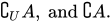
In set theory, the complement of a set A, often denoted by (or A),[1] is the set of elements not in A.[2]

When all elements in the universe, i.e. all elements under consideration, are considered to be members of a given set U, the absolute complement of A is the set of elements in U that are not in A.

The relative complement of A with respect to a set B, also termed the set difference of B and A, written is the set of elements in B that are not in A.

Absolute complement

[edit]
The absolute complement of the white disc is the red region

Definition

[edit]

If A is a set, then the absolute complement of A (or simply the complement of A) is the set of elements not in A (within a larger set that is implicitly defined). In other words, let U be a set that contains all the elements under study; if there is no need to mention U, either because it has been previously specified, or it is obvious and unique, then the absolute complement of A is the relative complement of A in U:[3]

The absolute complement of A is usually denoted by . Other notations include [2] [4]

Examples

[edit]
  • Assume that the universe is the set of integers. If A is the set of odd numbers, then the complement of A is the set of even numbers. If B is the set of multiples of 3, then the complement of B is the set of numbers congruent to 1 or 2 modulo 3 (or, in simpler terms, the integers that are not multiples of 3).
  • Assume that the universe is the standard 52-card deck. If the set A is the suit of spades, then the complement of A is the union of the suits of clubs, diamonds, and hearts. If the set B is the union of the suits of clubs and diamonds, then the complement of B is the union of the suits of hearts and spades.
  • When the universe is the universe of sets described in formalized set theory, the absolute complement of a set is generally not itself a set, but rather a proper class. For more info, see universal set.

Properties

[edit]

Let A and B be two sets in a universe U. The following identities capture important properties of absolute complements:

De Morgan's laws:[5]

Complement laws:[5]

  • (this follows from the equivalence of a conditional with its contrapositive).

Involution or double complement law:

Relationships between relative and absolute complements:

Relationship with a set difference:

The first two complement laws above show that if A is a non-empty, proper subset of U, then {A, A} is a partition of U.

Relative complement

[edit]

Definition

[edit]

If A and B are sets, then the relative complement of A in B,[5] also termed the set difference of B and A,[6] is the set of elements in B but not in A.


The relative complement of A in B:

The relative complement of A in B is denoted according to the ISO 31-11 standard. It is sometimes written but this notation is ambiguous, as in some contexts (for example, Minkowski set operations in functional analysis) it can be interpreted as the set of all elements where b is taken from B and a from A.

Formally:

Examples

[edit]
  • If is the set of real numbers and is the set of rational numbers, then is the set of irrational numbers.


Properties

[edit]

Let A, B, and C be three sets in a universe U. The following identities capture notable properties of relative complements:

  • with the important special case demonstrating that intersection can be expressed using only the relative complement operation.
  • If , then .
  • is equivalent to .

Complementary relation

[edit]

A binary relation is defined as a subset of a product of sets The complementary relation is the set complement of in The complement of relation can be written Here, is often viewed as a logical matrix with rows representing the elements of and columns elements of The truth of corresponds to 1 in row column Producing the complementary relation to then corresponds to switching all 1s to 0s, and 0s to 1s for the logical matrix of the complement.

Together with composition of relations and converse relations, complementary relations and the algebra of sets are the elementary operations of the calculus of relations.

LaTeX notation

[edit]

In the LaTeX typesetting language, the command \setminus[7] is usually used for rendering a set difference symbol, which is similar to a backslash symbol. When rendered, the \setminus command looks identical to \backslash, except that it has a little more space in front and behind the slash, akin to the LaTeX sequence \mathbin{\backslash}. A variant \smallsetminus is available in the amssymb package, but this symbol is not included separately in Unicode. The symbol (as opposed to ) is produced by \complement. (It corresponds to the Unicode symbol U+2201 COMPLEMENT.)

See also

[edit]

Notes

[edit]

References

[edit]
[edit]
Revisions and contributorsEdit on WikipediaRead on Wikipedia
from Grokipedia
In , the complement of a AA of a UU, often denoted AcA^c, is the set of all elements in UU that are not elements of AA, formally defined as Ac={ξξUξA}A^c = \{\xi \mid \xi \in U \land \xi \notin A\}. This operation, also known as the absolute complement when a fixed is assumed, contrasts with the relative complement BAB \setminus A, which excludes elements of AA from BB without requiring a . The concept emerged in the late as part of the foundational work in by , providing a way to describe "everything outside" a given collection within a specified domain. Key properties of the complement include its involutory nature, where (Ac)c=A(A^c)^c = A, meaning applying the operation twice returns the original set, and the complements of the and , such that c=U\emptyset^c = U and Uc=U^c = \emptyset. further characterize complements in relation to unions and intersections: (AB)c=AcBc(A \cup B)^c = A^c \cap B^c and (AB)c=AcBc(A \cap B)^c = A^c \cup B^c, which underpin and logical negation. These properties make the complement essential for operations in probability, logic, and , such as set differences (AB=ABcA \setminus B = A \cap B^c) and inclusion-exclusion principles. In advanced contexts, like descriptive set theory, complements generate broader classes of sets, such as Borel sets through iterative complementation and countable unions, highlighting their role in analyzing the structure of the real line. Without a predefined in axiomatic (e.g., Zermelo-Fraenkel), the relative complement serves as the primary analogue, ensuring the operation remains well-defined across pure sets.

Absolute complement

Definition and notation

The absolute complement of a AA of a UU (also called the universe of discourse) is the set containing all elements of UU that are not in AA. Formally, it is defined as Ac={xUxA}=UA.A^c = \{ x \in U \mid x \notin A \} = U \setminus A. This operation requires a fixed UU, distinguishing it from the relative complement, which does not. Common notations for the absolute complement include the superscript AcA^c, the prime AA', or the overline A\overline{A}, with the choice depending on the mathematical or convention. In some texts, especially in logic or probability, it may be denoted as ¬A\neg A to emphasize its role in . Unlike relative complements, the absolute complement always operates with respect to the entire , ensuring a complete partitioning of UU into AA and AcA^c.

Examples

Consider the universal set U={1,2,3,4,5}U = \{1, 2, 3, 4, 5\}. If A={1,3,5}A = \{1, 3, 5\}, then the absolute complement is Ac={2,4}A^c = \{2, 4\}, consisting of the even numbers in UU. Another example from number theory: Let UU be the set of all prime numbers less than or equal to 25, so U={2,3,5,7,11,13,17,19,23}U = \{2, 3, 5, 7, 11, 13, 17, 19, 23\}. If A={2,3,5}A = \{2, 3, 5\}, then Ac={7,11,13,17,19,23}A^c = \{7, 11, 13, 17, 19, 23\}, the primes in UU greater than 5. In probability, if the sample space Ω\Omega (playing the role of UU) is the outcome of rolling a fair six-sided die, Ω={1,2,3,4,5,6}\Omega = \{1, 2, 3, 4, 5, 6\}, and event A={1,2,3}A = \{1, 2, 3\} (rolling 3 or less), then Ac={4,5,6}A^c = \{4, 5, 6\} (rolling more than 3). This illustrates the complement's use in calculating probabilities of opposite events. For the empty set and universal set: If A=A = \emptyset, then c=U\emptyset^c = U; conversely, if A=UA = U, then Uc=U^c = \emptyset.

Properties

The absolute complement operation exhibits several fundamental properties that make it a cornerstone of and . It is an involution: (Ac)c=A(A^c)^c = A. Applying the complement twice returns the original set, as the elements excluded from AcA^c are precisely those in AA. The complement partitions the universal set: AAc=UA \cup A^c = U and AAc=A \cap A^c = \emptyset. Every element of UU is either in AA or AcA^c, but not both, ensuring disjointness and completeness. For finite sets, the cardinality satisfies Ac=UA|A^c| = |U| - |A|, providing a direct measure of the complement's size relative to the universal set. In infinite cases, such as U=[R](/page/R)U = \mathbb{[R](/page/R)} (real numbers) and A=[Q](/page/Q)A = \mathbb{[Q](/page/Q)} (rationals), AcA^c is the irrationals, which have the same as [R](/page/R)\mathbb{[R](/page/R)}. These properties underpin applications in logic, where complements correspond to , and in inclusion-exclusion principles for . Further identities, such as , are detailed in subsequent sections.

Relative complement

Definition and notation

In , the relative complement of a set AA in a set BB (also called the set difference of BB and AA) is the set of all elements that are in BB but not in AA. Formally, it is defined as BA={xBxA}.B \setminus A = \{ x \in B \mid x \notin A \}. This operation does not require a , unlike the absolute complement, and can be expressed using the absolute complement as BA=BAcB \setminus A = B \cap A^c when a containing both is specified. The standard notation is the backslash BAB \setminus A, following ; alternatively, BAB - A is used in some texts, though it may be ambiguous in other contexts.

Examples

Consider sets A={17,19,6}A = \{17, 19, 6\} and B={5,3,17,19,12,6}B = \{5, 3, 17, 19, 12, 6\}. The relative complement BA={5,3,12}B \setminus A = \{5, 3, 12\}, consisting of elements in BB absent from AA. If A={1,2,3}A = \{1, 2, 3\} and B={1,2}B = \{1, 2\}, then BA=B \setminus A = \emptyset, as all elements of BB are in AA. Conversely, AB={3}A \setminus B = \{3\}. In the context of real numbers, letting B=RB = \mathbb{R} (all real numbers) and A=QA = \mathbb{Q} (rational numbers), the relative complement RQ\mathbb{R} \setminus \mathbb{Q} is the set of .

Properties

The relative complement operation satisfies several identities that highlight its algebraic behavior within set theory. Notable distributive properties include: C(AB)=(CA)(CB),C \setminus (A \cap B) = (C \setminus A) \cup (C \setminus B), C(AB)=(CA)(CB).C \setminus (A \cup B) = (C \setminus A) \cap (C \setminus B). Additional identities are: AA=,A=A,A=.A \setminus A = \emptyset, \quad A \setminus \emptyset = A, \quad \emptyset \setminus A = \emptyset. If ABA \subseteq B, then BABB \setminus A \subseteq B, and BA=B \setminus A = \emptyset if ABA \supseteq B. The operation is not commutative (BAABB \setminus A \neq A \setminus B in general) and not an involution.

Identities involving complements

De Morgan's laws

are fundamental identities in that describe the relationship between complements, unions, and intersections of sets. For any sets AA and BB within a universal set UU, the laws state that the complement of the union of AA and BB equals the intersection of their complements, and the complement of the intersection equals the union of their complements. Specifically, (AB)c=AcBc(A \cup B)^c = A^c \cap B^c and (AB)c=AcBc(A \cap B)^c = A^c \cup B^c. These laws can be proved using the element-wise definition of set operations. Consider the first law: an element xx belongs to (AB)c(A \cup B)^c xABx \notin A \cup B, which means xAx \notin A and xBx \notin B. This is equivalent to xAcx \in A^c and xBcx \in B^c, so xAcBcx \in A^c \cap B^c. The reverse direction follows similarly, establishing equality. The proof for the second law proceeds analogously by replacing unions with intersections and vice versa. The laws extend naturally to infinite collections of sets. For an {Ai:iI}\{A_i : i \in I\}, the complement of the union is the of the complements: (iIAi)c=iIAic\left( \bigcup_{i \in I} A_i \right)^c = \bigcap_{i \in I} A_i^c. Dually, the complement of the is the union of the complements: (iIAi)c=iIAic\left( \bigcap_{i \in I} A_i \right)^c = \bigcup_{i \in I} A_i^c. This generalization holds for arbitrary index sets II, including infinite ones, and follows from the logical equivalences underlying the finite case: x(iIAi)cx \in \left( \bigcap_{i \in I} A_i \right)^c there exists some iIi \in I such that xAix \notin A_i, or xAicx \in A_i^c, hence xiIAicx \in \bigcup_{i \in I} A_i^c. De Morgan's laws are named after the British mathematician and logician (1806–1871), who formalized them in his 1847 treatise Formal Logic: Or, The Calculus of Inference, Necessary and Probable. Although analogous principles appeared earlier in ancient and medieval logic, De Morgan's version integrated them into a systematic treatment of inference, influencing the development of modern and propositional logic.

Distributive and other identities

In set theory, the distributive laws govern how intersection and union operations interact, forming the backbone of Boolean algebra on the power set. For any sets AA, BB, and CC within a universal set UU, A(BC)=(AB)(AC)A \cap (B \cup C) = (A \cap B) \cup (A \cap C) and A(BC)=(AB)(AC).A \cup (B \cap C) = (A \cup B) \cap (A \cup C). These identities extend naturally to complements; substituting the complement AcA^c for AA in the second law yields Ac(BC)=(AcB)(AcC).A^c \cup (B \cap C) = (A^c \cup B) \cap (A^c \cup C). Such variants facilitate manipulations involving complements in more complex expressions. Absorption identities further simplify set expressions by absorbing redundant terms. The core forms are A(AB)=AA \cup (A \cap B) = A and A(AB)=A.A \cap (A \cup B) = A. A useful extension incorporating complements is A(AcB)=AB,A \cup (A^c \cap B) = A \cup B, which arises from the fact that AcBA^c \cap B captures elements in BB outside AA, and unioning with AA recovers ABA \cup B. This identity, derivable via the complement laws and distributivity, underscores the role of complements in expanding unions. For relative complements, denoted AB=ABcA \setminus B = A \cap B^c, a notable identity is the nested form A(AB)=AB.A \setminus (A \setminus B) = A \cap B. This shows how applying the relative complement twice retrieves the , highlighting the operation's invertible nature in certain contexts. Basic complement properties for special sets include the complement of the being the universal set, c=U\emptyset^c = U, and the complement of the universal set being , Uc=U^c = \emptyset. These follow directly from the definition of absolute complement relative to UU. Complements enable the power set P(U)\mathcal{P}(U) to form a under (as addition) and (as multiplication), where each element xx satisfies x+x=0x + x = 0 and xx=xx \cdot x = x, with the complement of xx given by x+1x + 1 (the universal set). This ring structure captures the algebraic essence of set complements in a commutative with unity.

Complements of binary relations

Definition and notation

In , for a set XX and a RX×XR \subseteq X \times X, the complement of RR, often called the absolute complement, is the consisting of all ordered pairs in X×XX \times X that are not elements of RR. Formally, it is defined as Rc={(x,y)X×X(x,y)R}.R^c = \{(x, y) \in X \times X \mid (x, y) \notin R\}. This is equivalent to the set difference Rc=(X×X)RR^c = (X \times X) \setminus R, where the full relation X×XX \times X serves as the universal relation analogous to the universal set in absolute set complements. Standard notations for the complement include the superscript RcR^c, the overline R\overline{R}, or the negation symbol ¬R\neg R, depending on the context of the text. Unlike the complement of a set, which identifies elements absent from the set relative to a universal set, the complement of a binary relation identifies ordered pairs absent from the relation relative to the Cartesian product, thereby preserving the relational structure on pairs rather than individual elements.

Examples

To illustrate the complement of a binary relation RX×XR \subseteq X \times X, consider specific cases on finite or infinite sets XX. On the set of natural numbers N\mathbb{N}, the equality relation is R={(n,n)nN}R = \{(n, n) \mid n \in \mathbb{N}\}. Its complement RcR^c comprises all ordered pairs (n,m)(n, m) with nmn \neq m, representing the inequality relation on N\mathbb{N}. On the finite set X={1,2,3}X = \{1, 2, 3\}, let RR be the reflexive order relation \leq, given by R={(1,1),(1,2),(1,3),(2,2),(2,3),(3,3)}R = \{(1,1), (1,2), (1,3), (2,2), (2,3), (3,3)\}. The complement Rc={(2,1),(3,1),(3,2)}R^c = \{(2,1), (3,1), (3,2)\} corresponds to the strict greater-than relation >> on XX. In , an undirected simple graph GG on vertex set XX defines a symmetric RX×XR \subseteq X \times X where (u,v)R(u, v) \in R if uu and vv are adjacent (with uvu \neq v). The complement RcR^c consists of all non-adjacent pairs (excluding loops), yielding the edge set of the GG', which has the same vertices but edges precisely where GG does not. For a non-reflexive case, suppose RR is the empty relation on a nonempty set XX, so R=X×XR = \emptyset \subseteq X \times X. Then Rc=X×XR^c = X \times X, the complete including all possible ordered pairs.

Properties

The complement operation on binary relations possesses several key algebraic properties, reflecting its role as a set-theoretic complement within the power set of the underlying the relation. One fundamental property is that the complement is an involution: the complement of the complement of a binary relation RR recovers the original relation, satisfying (Rc)c=R(R^c)^c = R. This follows directly from the definition of the complement as the set difference from the full . Analogous to in , the complement distributes over union and : for binary relations RR and SS on the same underlying sets, (RS)c=RcSc(R \cup S)^c = R^c \cap S^c and (RS)c=RcSc(R \cap S)^c = R^c \cup S^c. These identities arise because binary relations are subsets of a fixed , preserving lattice operations. The complement also commutes with inversion: the complement of the inverse relation is the inverse of the complement, (R1)c=(Rc)1(R^{-1})^c = (R^c)^{-1}. This symmetry ensures that relational structure under transposition is preserved under complementation. With respect to standard properties of binary relations, reflexivity and irreflexivity are interchanged by complementation: if RR is reflexive, then RcR^c is irreflexive, and conversely. Symmetry, however, is preserved: if RR is symmetric, then so is RcR^c. In contrast, transitivity is not generally preserved: if RR is transitive, RcR^c need not be transitive.

References

Add your contribution
Related Hubs
User Avatar
No comments yet.








