Hubbry Logo
SubsetSubsetMain
Open search
Subset
Community hub
Subset
logo
8 pages, 0 posts
0 subscribers
Be the first to start a discussion here.
Subset
Subset
from Wikipedia
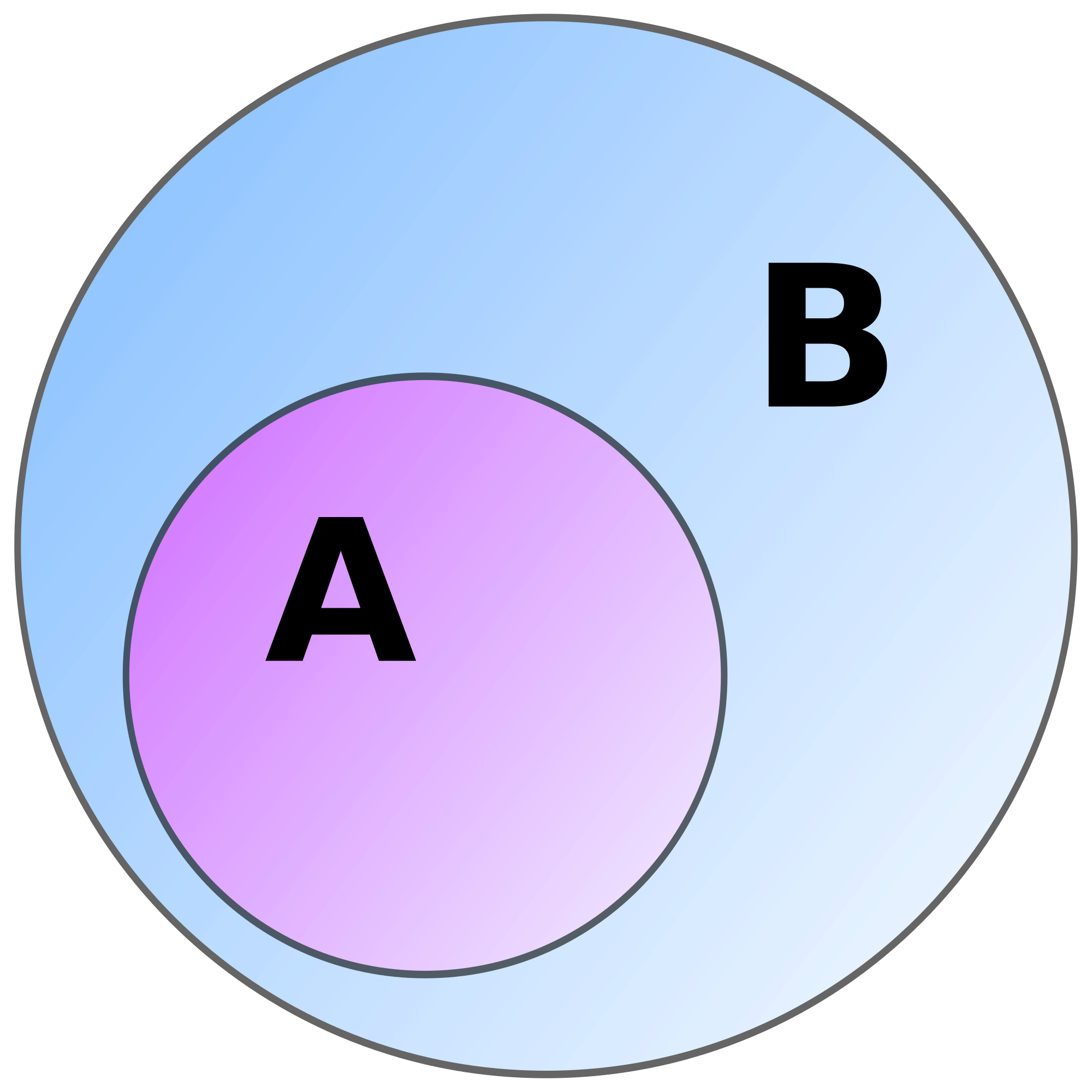
Euler diagram showing
A is a subset of B (denoted ) and, conversely, B is a superset of A (denoted )

In mathematics, a set A is a subset of a set B if all elements of A are also elements of B; B is then a superset of A. It is possible for A and B to be equal; if they are unequal, then A is a proper subset of B. The relationship of one set being a subset of another is called inclusion (or sometimes containment). A is a subset of B may also be expressed as B includes (or contains) A or A is included (or contained) in B. A k-subset is a subset with k elements.

When quantified, is represented as [1]

One can prove the statement by applying a proof technique known as the element argument[2]:

Let sets A and B be given. To prove that

  1. suppose that a is a particular but arbitrarily chosen element of A
  2. show that a is an element of B.

The validity of this technique can be seen as a consequence of universal generalization: the technique shows for an arbitrarily chosen element c. Universal generalisation then implies which is equivalent to as stated above.

Definition

[edit]

If A and B are sets and every element of A is also an element of B, then:

  • A is a subset of B, denoted by , or equivalently,
  • B is a superset of A, denoted by

If A is a subset of B, but A is not equal to B (i.e. there exists at least one element of B which is not an element of A), then:

  • A is a proper (or strict) subset of B, denoted by , or equivalently,
  • B is a proper (or strict) superset of A, denoted by

The empty set, written or has no elements, and therefore is vacuously a subset of any set X.

Basic properties

[edit]
and implies
  • Reflexivity: Given any set , [3]
  • Transitivity: If and , then
  • Antisymmetry: If and , then .

Proper subset

[edit]
  • Irreflexivity: Given any set , is False.
  • Transitivity: If and , then
  • Asymmetry: If then is False.

⊂ and ⊃ symbols

[edit]

Some authors use the symbols and to indicate subset and superset respectively; that is, with the same meaning as and instead of the symbols and .[4] For example, for these authors, it is true of every set A that (a reflexive relation).

Other authors prefer to use the symbols and to indicate proper (also called strict) subset and proper superset respectively; that is, with the same meaning as and instead of the symbols and [5] This usage makes and analogous to the inequality symbols and For example, if then x may or may not equal y, but if then x definitely does not equal y, and is less than y (an irreflexive relation). Similarly, using the convention that is proper subset, if then A may or may not equal B, but if then A definitely does not equal B.

Examples of subsets

[edit]
The regular polygons form a subset of the polygons.
  • The set A = {1, 2} is a proper subset of B = {1, 2, 3}, thus both expressions and are true.
  • The set D = {1, 2, 3} is a subset (but not a proper subset) of E = {1, 2, 3}, thus is true, and is not true (false).
  • The set {x: x is a prime number greater than 10} is a proper subset of {x: x is an odd number greater than 10}
  • The set of natural numbers is a proper subset of the set of rational numbers; likewise, the set of points in a line segment is a proper subset of the set of points in a line. These are two examples in which both the subset and the whole set are infinite, and the subset has the same cardinality (the concept that corresponds to size, that is, the number of elements, of a finite set) as the whole; such cases can run counter to one's initial intuition.
  • The set of rational numbers is a proper subset of the set of real numbers. In this example, both sets are infinite, but the latter set has a larger cardinality (or power) than the former set.

Another example in an Euler diagram:

Power set

[edit]

The set of all subsets of is called its power set, and is denoted by .[6]

The inclusion relation is a partial order on the set defined by . We may also partially order by reverse set inclusion by defining

For the power set of a set S, the inclusion partial order is—up to an order isomorphism—the Cartesian product of (the cardinality of S) copies of the partial order on for which This can be illustrated by enumerating , and associating with each subset (i.e., each element of ) the k-tuple from of which the ith coordinate is 1 if and only if is a member of T.

The set of all -subsets of is denoted by , in analogue with the notation for binomial coefficients, which count the number of -subsets of an -element set. In set theory, the notation is also common, especially when is a transfinite cardinal number.

Other properties of inclusion

[edit]
  • A set A is a subset of B if and only if their intersection is equal to A. Formally:
  • A set A is a subset of B if and only if their union is equal to B. Formally:
  • A finite set A is a subset of B, if and only if the cardinality of their intersection is equal to the cardinality of A. Formally:
  • The subset relation defines a partial order on sets. In fact, the subsets of a given set form a Boolean algebra under the subset relation, in which the join and meet are given by intersection and union, and the subset relation itself is the Boolean inclusion relation.
  • Inclusion is the canonical partial order, in the sense that every partially ordered set is isomorphic to some collection of sets ordered by inclusion. The ordinal numbers are a simple example: if each ordinal n is identified with the set of all ordinals less than or equal to n, then if and only if

See also

[edit]
  • Convex subset – In geometry, set whose intersection with every line is a single line segment
  • Inclusion order – Partial order that arises as the subset-inclusion relation on some collection of objects
  • Mereology – Study of parts and the wholes they form
  • Region – Connected open subset of a topological space
  • Subset sum problem – Decision problem in computer science
  • Subsumptive containment – System of elements that are subordinated to each other
  • Subspace – Mathematical set with some added structure
  • Total subset – Subset T of a topological vector space X where the linear span of T is a dense subset of X

References

[edit]

Bibliography

[edit]
[edit]
Revisions and contributorsEdit on WikipediaRead on Wikipedia
from Grokipedia
In , particularly within , a subset is a set AA such that every element of AA is also an element of another set BB, denoted as ABA \subseteq B. This relation captures the idea of containment without requiring equality, forming a foundational concept for understanding collections and their relationships. The \emptyset is a of every possible set, as it contains no elements that could fail to belong to any superset. Conversely, every set is a of itself, since all its elements are trivially members of the same set. A proper subset, denoted ABA \subset B, excludes the case of equality, meaning AA is contained in BB but ABA \neq B. These definitions underpin operations like unions, intersections, and the power set of a set, which comprises all possible subsets and has 2B2^{|B|} for a BB of size B|B|. Subsets are essential in fields ranging from logic and to , enabling precise modeling of hierarchies and inclusions.

Definition and Notation

Formal Definition

In , a set AA is a of a set BB, denoted ABA \subseteq B, if every element of AA is also an element of BB. Formally, this is expressed as x(xAxB)\forall x (x \in A \rightarrow x \in B). Special cases arise with the and reflexivity. The \emptyset is a subset of every set, since the condition holds vacuously for its lack of elements. Additionally, every set is a subset of itself, as all its elements trivially satisfy the membership requirement. This relation is logically equivalent to the emptiness of the set difference: ABA \subseteq B AB=A \setminus B = \emptyset.

Symbols and Conventions

In , the primary symbols used to denote subset relations are ⊆, indicating that a set A is a subset of B (allowing A = B), and its converse ⊇ for the superset relation. The symbols ⊂ and ⊃ are frequently employed for proper subsets and supersets, respectively, where equality is excluded, though their precise meanings vary across mathematical disciplines and texts. This variation stems from historical and stylistic preferences, leading to potential ambiguity that authors often clarify in their notations. The origins of these symbols trace back to the foundational work in set theory by Georg Cantor in the 1870s and 1880s, where he introduced concepts like subsets without standardized notation. The symbols ⊂ and ⊃ were formally introduced by Ernst Schröder in his 1890 book Vorlesungen über die Algebra der Logik (Lectures on the Algebra of Logic), inspired by inequality symbols to represent containment relations. In the 20th century, the Nicolas Bourbaki collective adopted ⊂ for the inclusive subset relation in their seminal Éléments de mathématique series, starting with Théorie des ensembles (1939), which helped standardize notation in structuralist mathematics but contrasted with emerging conventions elsewhere. Common conventions recommend using ⊆ for subsets (inclusive of equality) and ⊂ for proper subsets to minimize confusion, a practice followed in many modern texts on and . For instance, Donald E. Knuth employs this distinction in The TeXbook (1986), defining \subseteq for "subset or equal" and \subset for strict containment. However, in fields like and , ⊂ is sometimes reserved exclusively for proper subsets, while ⊆ explicitly signals possible equality, highlighting the need for context-specific clarification to avoid misinterpretation. Related notations link subset relations to cardinality comparisons: if A ⊆ B, then the cardinality satisfies |A| ≤ |B|. For finite sets, equality holds A = B, and a proper subset has strictly smaller cardinality, underscoring the foundational role of these symbols in quantifying set inclusions.

Basic Properties

Core Properties

The subset relation \subseteq is reflexive: for any set AA, AAA \subseteq A. This holds by the definition of subset, which requires that every element xAx \in A satisfies xAx \in A, a tautological implication that is true for all such xx. The relation is also antisymmetric in the sense that if ABA \subseteq B and BAB \subseteq A, then A=BA = B. To see this, note that set equality means the sets share exactly the same elements; the first inclusion ensures every element of AA is in BB, while the second ensures every element of BB is in AA, so no elements differ between them. A proof sketch proceeds element-wise: suppose xAx \in A; then xBx \in B by ABA \subseteq B, and conversely if xBx \in B then xAx \in A by BAB \subseteq A. For the contrapositive direction toward equality, assume ABA \neq B; then there exists some xABx \in A \setminus B or xBAx \in B \setminus A, violating one of the inclusions. A key instance of reflexivity involves the \emptyset, which is a subset of every set BB by : the definition B\emptyset \subseteq B requires that for all xx \in \emptyset, xBx \in B, but since there are no elements in \emptyset, the universal quantifier holds without needing verification, rendering the implication true.

Proper Subset

In , a set AA is a proper subset of a set BB, denoted ABA \subsetneq B or ABA \subset B, if AA is a subset of BB but ABA \neq B. This means every element of AA belongs to BB, but at least one element of BB does not belong to AA. The notation \subsetneq explicitly indicates strict inclusion to distinguish it from the inclusive subset symbol \subseteq, which permits equality between the sets. The proper subset relation lacks reflexivity, a key property of the inclusive subset relation; specifically, no set AA satisfies AAA \subsetneq A, as equality holds. For s, this strict inclusion implies a reduction in size: if AA is a proper subset of a finite set BB, then the of AA is strictly less than that of BB. This distinction does not necessarily hold for infinite sets, where a proper subset may have the same as the original set. Furthermore, finite sets exhibit the descending chain condition for proper subsets: there cannot exist an infinite sequence S1S2S3S_1 \supsetneq S_2 \supsetneq S_3 \supsetneq \cdots where each SiS_i is a proper subset of Si1S_{i-1}, as repeated strict reductions in would eventually reach the . This property underscores the foundational role of proper subsets in characterizing finiteness within .

Inclusion Relations

Transitivity and Reflexivity

The subset relation ⊆ on the collection of all sets is transitive, meaning that if ABA \subseteq B and BCB \subseteq C, then ACA \subseteq C. To establish this, assume ABA \subseteq B and BCB \subseteq C. For any element xAx \in A, the assumption ABA \subseteq B implies xBx \in B, and BCB \subseteq C then implies xCx \in C. Thus, every element of AA belongs to CC, so ACA \subseteq C. The relation is also reflexive: for any set AA, AAA \subseteq A holds because every element xAx \in A satisfies xAx \in A. This reflexivity follows directly from the definition of subset inclusion, where no additional conditions beyond membership are required. In contrast, the proper subset relation \subsetneq (or \subset in some notations, denoting strict inclusion) is transitive but lacks reflexivity, as AAA \subsetneq A is false for all sets AA. Under proper inclusion, transitivity preserves strictness in chains— if ABA \subsetneq B and BCB \subsetneq C, then ACA \subsetneq C—preventing cycles or closures that would imply equality, unlike the inclusive relation where reflexivity allows self-inclusion. The subset relation further satisfies antisymmetry: if ABA \subseteq B and BAB \subseteq A, then A=BA = B, since the elements of AA and BB coincide by mutual inclusion. Together, reflexivity, transitivity, and antisymmetry make ⊆ a partial order on the power set of any given set, forming a (poset). Without antisymmetry, reflexivity and transitivity alone define a , but the added property ensures the structure is a poset, enabling applications in such as comparing sets by inclusion without unintended equivalences. In this poset, a is a totally ordered subset under inclusion, such as a nested sequence A1A2AnA_1 \subseteq A_2 \subseteq \cdots \subseteq A_n where each consecutive pair is comparable. An , conversely, is a subset where no two elements are comparable, meaning for distinct A,BA, B in the antichain, neither ABA \subseteq B nor BAB \subseteq A holds. These structures underpin theorems like Dilworth's theorem, which equates the size of the largest antichain in a finite poset to the minimum number of chains needed to cover it, with direct relevance to decompositions of the power set poset.

Union and Intersection with Subsets

The subset relation is monotonic with respect to both union and operations. If ABA \subseteq B, then for any set CC, it follows that ACBCA \cup C \subseteq B \cup C and ACBCA \cap C \subseteq B \cap C. To verify the monotonicity for union, suppose xACx \in A \cup C. Then xAx \in A or xCx \in C. If xAx \in A, then since ABA \subseteq B, it holds that xBx \in B, so xBCx \in B \cup C. If xCx \in C, then directly xBCx \in B \cup C. Thus, xBCx \in B \cup C, establishing ACBCA \cup C \subseteq B \cup C. For intersection, assume xACx \in A \cap C. This means xAx \in A and xCx \in C. Given ABA \subseteq B, xBx \in B, so xBx \in B and xCx \in C, implying xBCx \in B \cap C. Therefore, ACBCA \cap C \subseteq B \cap C. Additionally, the subset relation leads to absorption identities. If ABA \subseteq B, then AB=BA \cup B = B and AB=AA \cap B = A. The proof for the union absorption proceeds by showing mutual inclusion. Clearly, BABB \subseteq A \cup B holds in general. For the reverse, if xABx \in A \cup B, then xAx \in A or xBx \in B. If xBx \in B, then xBx \in B. If xAx \in A, then since ABA \subseteq B, xBx \in B. Hence, ABBA \cup B \subseteq B. For the absorption, note that ABAA \cap B \subseteq A always holds. Conversely, if xAx \in A, then since ABA \subseteq B, xBx \in B, so xABx \in A \cap B. Thus, AABA \subseteq A \cap B. When ABA \subseteq B, the relative complement BAB \setminus A (also denoted BAB - A) is the set of all elements that belong to BB but not to AA. This operation isolates the elements unique to BB beyond those shared with AA.

Power Set

Definition and Construction

In , the power set of a set SS, denoted P(S)\mathcal{P}(S) or 2S2^S, is defined as the set whose elements are all possible subsets of SS, including the \emptyset and SS itself. This construction ensures that every element of P(S)\mathcal{P}(S) is a subset of SS, and SS is an element of P(S)\mathcal{P}(S). For a finite set SS with nn elements, the power set P(S)\mathcal{P}(S) can be explicitly constructed by enumerating all 2n2^n possible combinations of elements from SS, where each subset corresponds to a unique selection of elements (including none or all). The notation 2S2^S reflects this, as it also denotes the set of all functions from SS to a two-element set (such as {0,1}\{0, 1\}), which is in bijection with the subsets of SS. For infinite sets, the existence of the power set relies on the in Zermelo-Fraenkel (ZFC), which asserts that for any set SS, there exists a set P(S)\mathcal{P}(S) containing all subsets of SS as elements. This axiomatic construction, often formalized using the axiom schema of separation to define individual subsets, guarantees the power set's formation without explicit enumeration. A specific example is the power set of the empty set \emptyset, which consists solely of the empty set itself: P()={}\mathcal{P}(\emptyset) = \{ \emptyset \}.

Cardinality and Enumeration

The cardinality of the power set P(S)\mathcal{P}(S) of a set SS is given by P(S)=2S|\mathcal{P}(S)| = 2^{|S|}, where 2S2^{|S|} denotes the cardinality of the set of all functions from SS to the set {0,1}\{0, 1\}. This equality arises from a bijection between P(S)\mathcal{P}(S) and the set of functions S{0,1}S \to \{0, 1\}: for each subset ASA \subseteq S, the corresponding characteristic function χA:S{0,1}\chi_A: S \to \{0, 1\} is defined by χA(x)=1\chi_A(x) = 1 if xAx \in A and χA(x)=0\chi_A(x) = 0 otherwise; this mapping is bijective because every function to {0,1}\{0, 1\} uniquely determines its support as a subset. For finite sets, if S=n|S| = n, then P(S)=2n|\mathcal{P}(S)| = 2^n, which counts the total number of possible subsets, including the and SS itself. This highlights the rapid increase in the number of subsets as the size of SS grows; for example, a set with 3 elements has 8 subsets, while one with 10 elements has over 1,000. In the infinite case, establishes that P(S)>S|\mathcal{P}(S)| > |S| for any set SS, implying that the power set always has strictly greater than the original set. The proof of proceeds by contradiction: suppose there exists a f:SP(S)f: S \to \mathcal{P}(S); define the diagonal set D={xSxf(x)}D = \{x \in S \mid x \notin f(x)\}; then DSD \subseteq S, so D=f(y)D = f(y) for some ySy \in S, but yDy \in D yf(y)=Dy \notin f(y) = D, yielding a contradiction that no such surjection exists. This result implies a of infinite cardinals, with each power set operation producing a larger . Enumeration of the elements of P(S)\mathcal{P}(S) is straightforward for finite sets using binary representations: label the elements of S={s1,s2,,sn}S = \{s_1, s_2, \dots, s_n\}, and associate each integer kk from 0 to 2n12^n - 1 with the subset whose membership is indicated by the binary digits of kk, where the ii-th bit determines if sis_i is included. This systematic listing orders the subsets lexicographically or by , facilitating computational generation. For infinite sets, however, no explicit enumeration exists due to the uncountability of P(S)\mathcal{P}(S) when S|S| is infinite, as guaranteed by ; while countable subsets can be listed, the full power set defies effective listing without choice principles or advanced transfinite constructions.

Examples and Applications

Concrete Mathematical Examples

In finite sets, a simple example of the subset relation is the set {1} being a subset of {1,2,3}, since every element of the first set is also an element of the second. This is a proper subset because the two sets are not equal, as {1,2,3} contains additional elements. The empty set \emptyset is a subset of every set, including {a,b}, as it has no elements that fail to belong to the superset. For the power set, which collects all subsets of a given set, consider \mathcal{P}({a}) = {\emptyset, {a}}, illustrating that even a singleton set yields two subsets. In the context of number systems, the natural numbers \mathbb{N} = {1, 2, 3, \dots} form a subset of the integers \mathbb{Z} = {\dots, -2, -1, 0, 1, 2, \dots}, as every natural number is an integer. Similarly, the even natural numbers {2, 4, 6, \dots} constitute a proper subset of \mathbb{N}, since all even naturals are naturals but not conversely. Set equality can be verified through mutual inclusion; for instance, {1,2} = {2,1} because each is a of the other, reflecting the principle that sets with identical members are identical. Subsets preserve certain operations, such as union; if A = {1} \subseteq B = {1,2}, then A \cup {3} = {1,3} \subseteq B \cup {3} = {1,2,3}.

Subsets in Broader Contexts

In logic, subsets serve as models for possible worlds in semantics, where a is true in a if the world belongs to the subset of worlds satisfying that . This framework extends to , where events are defined as subsets of the , comprising collections of atomic outcomes to which probabilities are assigned. In , subsets underpin database queries, such as in relational databases where SQL statements select subsets of records based on conditions, enabling efficient and manipulation. Bitmasks provide a compact representation of subsets in algorithms, using binary numbers to encode membership—each bit indicates inclusion or exclusion of an element—facilitating operations like or dynamic programming on subsets. In , the collection of open sets forms a specific subset of the power set of the underlying , endowed with additional axioms like closure under arbitrary unions and finite intersections to define continuity and neighborhood structures. employs subsets in problems like the subset sum, which determines whether a subset of given integers sums to a target value and is known to be NP-complete, illustrating challenges in optimization and enumeration. Binomial coefficients quantify the number of ways to choose k-element subsets from an n-element set, central to counting principles in combinatorial designs and expansions. In and programming languages, subsets relate to , where one type is a subtype of another if its values form a subset of the supertype's values; for instance, implements limited primarily through lifetime variance to ensure without full structural .

References

Add your contribution
Related Hubs
User Avatar
No comments yet.