Hubbry Logo
SinhagadSinhagadMain
Open search
Sinhagad
Community hub
Sinhagad
logo
8 pages, 0 posts
0 subscribers
Be the first to start a discussion here.
Sinhagad
Sinhagad
from Wikipedia

Sinhagad (also known as the Lion's Fort) is an ancient hill fortress located at around 28 kilometres southwest of the city of Pune, India. Previously known as Kondhana, the fort has been the site of many battles, most notably the Battle of Sinhagad in 1670.[1]

Key Information

The fort is a popular weekend destination for the residents of Pune. A road directly leads up to the summit of the fort. Hikers can get access to the summit from the base of the fort, with the trek involving a one-way walk of 2.7 km (1.6 miles), gaining approximately 600 metres (1950 feet) in elevation.[2] Shared taxi services to the base as well as the summit are also available.

Layout

[edit]

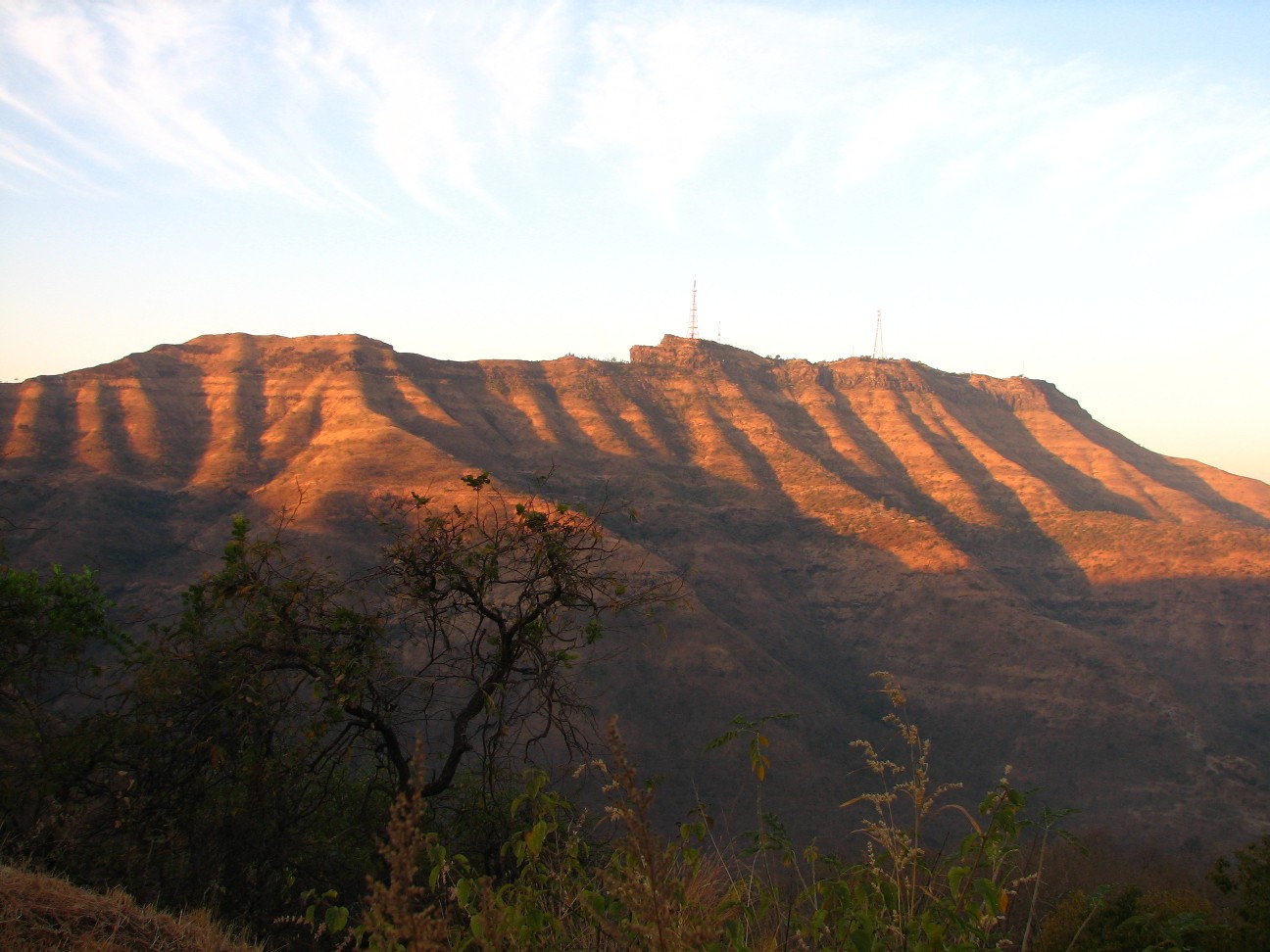
Perched on an isolated cliff of the Bhuleswar range in the Sahyadri Mountains, the fort is situated on a hill about 760 metres (2,490 ft) above ground and 1,317 metres (4,321 ft) above mean sea level.[3][4] On clear day, other forts associated with the Maratha empire, such as Rajgad, Purandar and Torna, can be seen from Sinhagad.

Pune Darwaja of Sinhagad fort

Sinhagad was strategically built to provide natural protection from the enemies due to the very steep slopes of the hill it was built upon. There are two entry gates called Pune darwaja and Kalyan darwaja to get into fort. Pune darwaja is towards north east while the Kalyan darwaja is towards the southeast.[5]

The fort houses memorials of the Maratha general, Tanaji Malusare as well as that of Rajaram I, the third Maratha Chhatrapati. The original commemorative memorial of Tanaji Malusare was unearthed by the restoration workers in February 2019. The stone structure was found buried under cement, concrete, and layers of oil paint and is believed to be around 350 years old.[6] There is military stable, a brewery and a temple of the goddess Kali along with a Hanuman statue to the right side of the temple.

The fort also houses a television relay tower set up in 1973 for relaying signals from Mumbai Doordarshan TV to Pune.[7]

History

[edit]

Early history

[edit]

The Sinhagad was initially known as "Kondhana" after the sage Kaundinya.

Until 14th century, the fort was held by Nag Naik. Nag Nayak was worshipped as a symbol of strength and held power over the strategically important mountain fortress. The fort was captured by forces of Muhammad bin Tughluq in 1328 from Koli chieftain Nag Naik after a siege of eight months and became part of Delhi Sultanate.[8][9] It later became part of Bahmani Sultanate in mid 1300s followed by the Ahmadnagar Sultanate in late 1400s and Sultanate of Bijapur in late 1500s.[10]

Medieval history

[edit]
A memorial commemorating Tanaji Malusare atop the Sinhagad Fort. Despite being vastly outnumbered against the Mughal Army, this Maratha Sardar led his forces to a decisive victory in the Battle of Sinhagad (1670 CE)

Shahaji Bhosale, as the commander of Ibrahim Adil Shah II of Sultanate of Bijapur was entrusted with the control of the Pune region. His son Shivaji, refused to accept the Adilshahi and initiated the task of setting up Swarajya. Shivaji gained control of Kondana in 1647 by convincing Siddi Amber, the Adilshahi Sardar who controlled the fort, that he, the son of Shahaji Bhosale, could manage the fort's defences optimally. Bapuji Mudgal Deshpande played a key role in this activity. Adil Shah jailed Siddi Amber for this treasonous act and schemed to get it back. He imprisoned Shahaji Bhosale for a concocted crime and informed Shivaji. In 1649, Adil Shah traded the fort for Shahaji's release.

Shivaji recaptured it in 1656 again with the help of Bapuji Mudgal Deshpande who convinced the Fort commander by giving land in the newly created Khed Shivapur village and peacefully gained control of the fort.

This fort saw attacks by Mughals in 1662, 1663, and 1665. In 1664, Shaista Khan, a Mughal general, tried to bribe the people of the fort to hand it over to him but was unsuccessful. Through the Treaty of Purandar in 1665, that Shivaji entered into with Mughal general Mirza Raja Jai Singh I, the fort passed into the Mughal hands.

In 1670, Shivaji reconquered the fort for the third time through his Koli Subedar,[11] Tanaji Malusare in Battle of Sinhagad, and the fort came and stayed under Maratha rule till 1689 A.D.[12] A steep cliff leading to the fort was scaled in the dead of the night with the help of a tamed monitor lizard named "Yashwanti", colloquially known as a Ghorpad.[13][14] Thereafter, a fierce battle ensued between Tanaji and his men versus the Mughal army headed by Udaybhan Singh Rathod, a Rajput Sardar who had control of the fort. Tanaji Malusare lost his life, but his brother Suryaji took over and captured the Kondana, now known as Sinhagad.[15] There is an anecdote that upon hearing of Tanaji's death, Shivaji expressed his remorse with the words, "Gad ala, pan Sinha gela" - "The Fort is conquered, but the Lion is lost". Thus the fort was named as Sinhagad. A bust of Tanaji Malusare was established on the fort in memory of his contribution to the battle.[16]

After the death of Sambhaji, the Mughals regained control of the fort. The Marathas headed by "Sardar Balkawade", recaptured it in 1693. Rajaram I took asylum in this fort during a Mogul raid on Satara. He died at the Fort on 3 March 1700 A.D. In 1703, Aurangzeb re-conquered the fort. In 1706, it once again went into the hands of the Marathas. Panaji Shivdev of Sangola, Visaji Chafer, and Shankar Narayan, the Pant Sachiv played a key role in this battle.

The fort remained under Maratha's rule till the year 1817. The more than one century of the Maratha rule saw the fort serving as a refuge from hostile forces attacking Pune, or as a place of confinement for rebels.[17]

During the Third Anglo-Maratha War in 1817, the East India Company General Pritzler laid siege to the fort on the orders of Mountstuart Elphinstone, the company resident in Pune, and it passed into the British hands. The British retained it until 1947 post which it became part of Republic of India.

Modern history

[edit]
A watercolor painting of Pune dating back to the late Peshwa era by British artist, Henry Salt. The picture clearly depicts the towering Sinhagad fort in the background

The fort has played a vital role in India's freedom struggle. Bal Gangadhar Tilak also known as 'The Father of Indian Unrest', used the fort as a summer retreat. It is here where Mahatma Gandhi had a historic meeting with Tilak after his return from South Africa. The bungalow has his bust at the entrance.[18]

A television relay station tower was set up in 1973 for broadcasting the Doordarshan TV to the city of Pune.[19]

[edit]

See also

[edit]

References

[edit]
Revisions and contributorsEdit on WikipediaRead on Wikipedia
from Grokipedia

Sinhagad Fort, originally known as Kondhana, is a historic hill fortress located approximately 35 kilometers southwest of Pune atop the Sahyadri Mountains in Maharashtra, India, rising to an elevation of 1,312 meters above sea level.
With a history extending over two thousand years, the fort has exchanged hands among various dynasties, functioning as a vital strategic bastion owing to its elevated vantage, sheer cliffs, and ingenious water conservation systems that bolstered its defensibility.
Its defining moment occurred in 1670, when Maratha general Tanaji Malusare orchestrated a daring nighttime scaling of its precipitous walls using ropes to seize it from Mughal control for Chhatrapati Shivaji Maharaj; though Tanaji perished in the fierce hand-to-hand combat, his forces secured victory, leading Shivaji to rechristen the stronghold Sinhagad—"Lion's Fort"—in commemoration of his lieutenant's indomitable courage.
In contemporary times, Sinhagad endures as a beacon of Maratha resilience and military ingenuity, drawing trekkers and historians to explore its weathered bastions, memorials like Tanaji's samadhi, ancient temples, and sweeping views of the surrounding valleys and dams.

Geography and Location

Topography and Natural Features

Sinhagad is situated at an elevation of 1,312 meters above on an isolated cliff within the Sahyadri range of the , approximately 28 kilometers southwest of . The site's topography consists of steep, near-vertical cliffs rising abruptly from surrounding valleys, creating a formidable that has historically deterred invaders due to the challenging ascent. This rugged landscape, marked by a flat plateau atop the hill, integrates seamlessly with the undulating terrain of the Bhuleswar ridge, enhancing its role as an impregnable elevated position. Geologically, the fort's foundations derive from flows of the , specifically the Mahabaleshwar Formation, which form durable, weather-resistant layers that underpin the steep escarpments and contribute to the area's landslide-prone slopes during monsoons. These structures, part of the extensive Cretaceous-Paleogene province, exhibit and vesicular textures typical of the region, fostering a that is both resilient and hazardous for traversal. The environs include deep valleys carved by tributaries of the , such as those feeding the Khadakwasla reservoir, which provide seasonal water sources amid the semi-arid plateau. Vegetation comprises dry deciduous forests and scrubland adapted to the Ghats' , supporting a with endemic plant species and occasional wildlife sightings, though human activity has impacted native habitats.

Strategic Position and Accessibility

Sinhagad Fort occupies an elevated position in the Sahyadri range, approximately 35 kilometers southwest of , enabling surveillance over the and approaches to the . This vantage facilitated monitoring of military and trade movements toward the Konkan coast, enhancing defensive logistics for controlling inland-to-coastal routes. The fort's summit, rising to about 1,312 meters above , provided a natural observatory for detecting threats across the expansive plains below. Historically, access was restricted to narrow, precipitous paths such as the donkey trail ascending the eastern slopes and steep scarps on multiple sides, rendering large-scale sieges logistically challenging without internal or nocturnal surprise. These routes, including entry via Darwaja and Darwaja, emphasized reliance on the terrain's steep gradients—often exceeding 45 degrees—for deterrence against frontal assaults. In contemporary terms, motorable roads extend to base villages like Donje and Khadakwasla, with a 2.7-kilometer trek from Donje featuring initial tarred sections transitioning to stone steps and steeper inclines, typically taking 1.5 to 2 hours for ascent. From , a roughly 7-kilometer combined road-trail path connects to the fort, offering views of the en route. seasons from June to September exacerbate risks, as heavy rains render paths slippery and prone to landslides, prompting advisories for caution or avoidance.

Architecture and Fortifications

Layout and Key Structures

The Sinhagad fort is situated on a central plateau, enclosed by a fortified stone wall extending approximately 2 miles, which incorporates two primary gateways—Pune Darwaza and Kalyan Darwaza—each reinforced with prominent bastions for structural support and oversight of approach paths. These gates feature arched designs typical of regional fortifications, serving as controlled entry points to the interior plateau. Inside the fort's perimeter, archaeological remnants include and stables, ammunition magazines, and fragmented administrative structures such as ruined palaces, reflecting the site's adaptation for and governance. A Temple, along with the Kondhaneshwar Temple dedicated to , stands among the preserved religious edifices, underscoring the integration of spiritual elements within the layout. The bastion, positioned strategically, houses a temple idol and contributes to the fort's internal defensive contour. Water management infrastructure comprises rock-cut cisterns and tanks, originally numbering 52 but with about 35 extant, engineered to capture and store rainwater from the plateau's surface for prolonged self-sufficiency during isolation. These reservoirs, hewn directly into the bedrock, include the prominent Dev Take sacred tank fed by a perennial spring, ensuring year-round availability.

Defensive Elements and Engineering

The defensive engineering of Sinhagad Fort emphasized integration of the hill's precipitous terrain with targeted fortifications, creating formidable barriers against escalades and sieges. Situated at an elevation of 1,312 above , the fort's perimeter exploits sheer cliffs rising over 40 in height, reinforced by buttresses at critical sections to prevent erosion and enemy scaling. Ramparts consist of thick stone walls constructed selectively at vulnerable approaches, complemented by bastions that provided enfilading fire positions and . These elements, including scarps formed by the natural escarpments and occasional man-made enhancements, deterred direct assaults by channeling attackers into kill zones. Dual gateways, Pune Darwaza on the northeast and Kalyan Darwaza on the southeast, feature narrow, defensible portals flanked by bastions, limiting access while allowing defenders to control entry with minimal manpower. The eastern face, characterized by a near-vertical drop exceeding 250 meters in parts, served as a primary natural chasm, further augmented by minimal walling to preserve its intimidating profile. Under Maratha administration, the fortifications were adapted for warfare, incorporating embrasures in bastions for deployment to sweep slopes and counter artillery threats from below. This evolution reflected causal adaptations to Mughal tactics, prioritizing artillery integration over extensive rebuilding.

Historical Development

Ancient Origins and Early Control

The Sinhagad fort, originally known as Kondhana after the sage , exhibits evidence of human occupation dating back over 2,000 years, with cave carvings and the presence of the Kaundinyeshwar Temple suggesting early use as a hilltop settlement or watchpost. Archaeological indicators, including petroglyphs potentially from prehistoric eras, point to rudimentary utilization by local tribes for surveillance over the surrounding , though no extensive structures from this period have been documented. During the Satavahana dynasty's rule over the Deccan region from approximately the 2nd century BCE to the 3rd century CE, the site likely served as a strategic vantage point amid the Sahyadri hills, aligning with the dynasty's control of trade routes and hill forts in . Local tribal groups, such as the Koli, maintained informal oversight in the intervening centuries, with the fort functioning more as a natural defensive outpost than a heavily fortified military hub, evidenced by the absence of inscriptions or artifacts denoting large-scale construction. By the 13th century, control transitioned to the Yadava dynasty of Devagiri, who incorporated the hill into their regional network of outposts without significant recorded enhancements to its defenses. Under Yadava administration, Sinhagad remained a peripheral asset, held by figures like Nag Nayak until the early , with historical accounts noting no major battles or sieges, underscoring its secondary role in pre-Islamic power dynamics compared to more central strongholds. This era's minimal documentation reflects the fort's emphasis on passive observation rather than active .

Medieval Shifts Under Islamic Dynasties

Following the fragmentation of the Bahmani Sultanate in the late 15th and early 16th centuries, control of the fort—known as Kondhana during Muslim rule—transitioned to the Adil Shahi dynasty of , one of the successor . The Adil Shahis reinforced the fort's existing structures, including walls and gateways, to bolster its role as a key defensive outpost overlooking the plateau and trade routes in the Deccan. This enhancement reflected the fort's strategic value in containing regional rivals and securing revenue from surrounding territories, as documented in Adil Shahi administrative records and later Maratha chronicles referencing its pre-1647 state./Muslim%20Period.htm) The fort's possession underscored its status as a transferable asset amid Deccan power dynamics, with retaining effective control until mid-17th-century pressures from expanding Maratha forces prompted temporary yields, only for it to revert under Shahi oversight. from court dispatches and fort inventories highlights investments in placements and water storage, adapting the site to warfare prevalent among the Sultanates. No primary Shahi chronicles exaggerate its impregnability without corresponding archaeological traces of expanded bastions from this era. In June 1665, the Treaty of Purandar, signed between Mughal commander Mirza Raja and Maratha leader on 11 June, compelled the cession of 23 forts, including Kondhana, to the as part of broader territorial concessions to avert further invasion. The Mughals promptly garrisoned the fort under Udaybhan Rathod (also recorded as Rathore), a subordinate of Jai Singh, who maintained a force of roughly 5,000 troops equipped with cannons at key turrets to enforce Mughal dominance in the western Deccan. This , verified through treaty stipulations and Mughal farmans allocating maintenance funds, exemplified the fort's pawn-like role in negotiations, shifting from Sultanate to imperial oversight without altering its core tactical layout.

Maratha Acquisition and Consolidation

Shivaji Maharaj first secured the fort of Kondhana in 1647 from Adilshahi forces by negotiating with its commandant, Siddi Amber, whom he convinced to yield control under the pretense of familial ties to the sultanate, with key assistance from the diplomat Bapuji Mudgal Deshpande. This acquisition, achieved without direct combat, expanded Maratha holdings in the Sahyadri range and demonstrated Shivaji's early reliance on stratagem over brute force against superior Adilshahi garrisons. Kondhana remained a Maratha stronghold until the Treaty of Purandar in June 1665, when , under pressure from Mughal general Jai Singh I's siege of , surrendered it alongside 22 other forts to the , yielding annual revenues estimated at four huns from their territories. This concession temporarily disrupted Maratha frontier defenses but preserved core assets for regrouping. Post-1670 recapture from Mughal hands, renamed the fort Sinhagad—"Lion's Fort"—and prioritized its fortification as a of Swarajya, exploiting its elevation of 1,312 meters for over and Mutha Valley routes. Consolidation efforts focused on transforming Sinhagad into a self-sustaining supply base, with enhanced storage for grains, weaponry, and to sustain prolonged sieges or raids, alongside strict enforcement of through vetted appointments of sardars and regular audits of conduct. Its strategic utility underpinned Maratha guerrilla operations against Mughal expansions, enabling rapid provisioning for mobile strikes and retreats into hill fastnesses, as corroborated by accounts in Maratha bakhars like the Sabhasad Chronicle and Mughal administrative records noting recurrent supply disruptions from such hill forts. This integration bolstered causal resilience in , where fortified depots offset numerical disadvantages against imperial armies.

The Battle of Sinhagad

Prelude and Strategic Context

Following the Treaty of Purandar signed on 11 June 1665 between Maharaj and Mughal general Mirza Raja , was compelled to cede 23 forts to the , including the strategically vital Kondhana Fort (later renamed Sinhagad), while retaining control over 12 others. This concession, amounting to territories yielding an annual revenue of four lakh hons, was extracted amid Mughal military pressure to neutralize 's expanding Maratha power in the Deccan. 's subsequent invitation to Mughal Aurangzeb's court in in 1666 led to his brief imprisonment, from which he escaped later that year, prompting a renewed phase of Maratha resurgence through the systematic recapture of ceded strongholds. By early 1670, Shivaji prioritized reclaiming Kondhana due to its commanding position overlooking the plateau and key trade routes, which had bolstered Mughal control in the region post-Purandar. Aurangzeb's preoccupation with northern campaigns against confederacies and internal rebellions had diluted Mughal vigilance in the Deccan, creating a window for Maratha operations; imperial forces under subahdars like Daud Khan Panni were stretched thin, focusing on containment rather than aggressive fortification. This strategic lapse stemmed from overconfidence in the treaty's pacification of , underestimating his resolve to reverse territorial losses and exploit the rugged Sahyadri terrain for guerrilla advantages. Shivaji selected Tanaji Malusare, a lifelong companion and seasoned proficient in hill warfare, to lead the mission, drawing on Tanaji's demonstrated loyalty in prior engagements and his mastery of maval guerrilla tactics honed in the . Maratha intelligence, gathered through local networks, revealed the Mughal garrison under Udaybhan Rathod—estimated at around 1,000 troops—suffered from low morale and complacency, viewing the sheer cliffs and double fortifications as impregnable against conventional assaults, thus neglecting rigorous night watches. This assessment aligned with broader Mughal miscalculations of Maratha adaptability post-1665, enabling to plan a without alerting reinforcements from or Mughal outposts.

The Night Assault and Key Tactics

On the night of February 4, 1670, directed a compact force of approximately 300 Maratha warriors to ascend the near-vertical eastern cliff of Sinhagad, exploiting a sheer rock face that Mughal defenders regarded as impregnable due to its 60-90 degree incline and minimal sentry presence. The climbers employed ropes anchored by handholds and rudimentary spikes driven into fissures, navigating the ascent amid pitch darkness that obscured footing and amplified risks of falls, with the added strain of carrying weapons and armor taxing their endurance. This vertical envelopment tactic bypassed fortified gates, enabling a stealthy breach that caught the garrison unprepared, though attributing the initial rope fixation to a monitor lizard's grip lacks corroboration in contemporary records like Sabhasad's . Reaching the , the Marathas subdued initial sentries through silent knife work and grapples to prevent alarms, then erupted into open against the alerted Mughal contingent of roughly 1,000-1,400 troops, comprising Rajputs, , and others under Udaybhan Rathod. Outnumbered over three-to-one, the attackers leveraged momentum from the heights for downhill charges and confined spaces that neutralized Mughal archery advantages, favoring swords, shields, and daggers in brutal close-quarters exchanges where terrain funneled defenders into kill zones. The assault's success hinged on rapid signal flares to summon reserves via the Kalyan Darwaja, amplifying the initial shock before Mughal cohesion fully mobilized. Central to the fray was Tanaji's confrontation with Udaybhan, a hand-to-hand amid the chaos where Tanaji, deprived of his by a blow, improvised with a cloth-wrapped to press the attack, inflicting fatal wounds on the before succumbing himself—details drawn from Maratha chronicles that emphasize individual valor but align with the battle's documented intensity. These tactics—nighttime surprise, elite vertical infiltration, and immediate aggressive exploitation—overcame environmental hazards and force disparities, though reliant on disciplined execution under fatigue and low visibility, as evidenced by the Marathas' containment of counterattacks until reserves arrived.

Casualties, Victory, and Immediate Outcomes

The Maratha forces under achieved victory in the on 4 February 1670, capturing the fort from Mughal commander Udaybhan Rathod after a fierce hand-to-hand engagement. himself was killed by Udaybhan during the fighting, with his uncle Shelar Mama or brother Suryaji Malusare continuing the assault to slay the Mughal leader and secure the position. Casualties were reported as approximately 50 Maratha dead against 300 Mughal fatalities, with nearly 4,000 Mughal troops surrendering as prisoners, reflecting the disproportionate impact of the Maratha surprise assault despite their numerical inferiority. Shivaji Maharaj, upon learning of the success tempered by Tanaji's death, mourned deeply, reportedly exclaiming, "Gad aala, pan sinha gela" ("The fort is gained, but the lion is lost"), before renaming the stronghold from Kondhana to Sinhagad ("Lion's Fort") in Tanaji's honor. This act not only commemorated the fallen commander but also reinforced Maratha resolve, as evidenced by the rapid reinforcement of the fort and Shivaji's subsequent aggressive campaigns that pressured Mughal positions in the region. The immediate strategic outcome was the restoration of Maratha control over a key Deccan hill fort overlooking , disrupting Mughal supply lines and reconnaissance routes southward, which had been ceded under the 1665 Treaty of Purandar. This recapture, one of several post-treaty reversals, compelled Mughal forces to divert resources, weakening their consolidation in the western Deccan and enabling Maratha raids that extracted tribute from Mughal territories.

Cultural and Symbolic Importance

Role in Maratha Resistance Narratives

In Maratha resistance narratives, Sinhagad exemplifies asymmetric defensive tactics employed against the Mughal Empire's superior and cavalry, enabling Maharaj to contest imperial expansion through terrain exploitation and surprise operations. The fort's reconquest on February 4, 1670, via a cliff-scaling assault, highlighted causal principles of leveraging natural fortifications to offset numerical disadvantages, as Mughal garrisons relied on static defenses vulnerable to infiltration. This reinforced Shivaji's of selective fort captures to establish defensible perimeters, directly contributing to Maratha consolidation in the Deccan by securing elevated vantage points for surveillance and rapid response. Empirical outcomes underscore Sinhagad's operational role in sustaining Maratha supply corridors, with its position overlooking and northern passes facilitating control over trade routes and provisioning against Mughal blockades. Post-capture, Maratha forces under swiftly secured adjacent strongholds including Purandar, Rohida, and , expanding territorial buffers and demonstrating logistical resilience amid campaigns that involved over 300 forts by the empire's peak. Such achievements countered Mughal-centric accounts that downplayed regional polities' proactive agency, as evidenced by the fort's integration into a network that prolonged resistance despite tactical hazards like exposed ascents and close-quarters combat. In historiographical treatments privileging defensive warfare efficacy, Sinhagad's upgrades—rapid reinforcement of walls and cisterns under —illustrate first-principles engineering for self-sufficiency, enabling sustained operations without external dependencies. Narratives attribute this to Shivaji's causal focus on , where fort-held reserves of and mitigated vulnerabilities, though risks of overextension in assaults were evident in the heavy losses incurred during the 1670 operation. This framework positions the fort as pivotal in narratives of Hindu polities' empirical pushback against Islamic conquest dynamics, fostering decentralized power structures in pre-colonial .

Legends, Folklore, and Historical Debates

The capture of Sinhagad in 1670 is enshrined in Maratha folklore through the tale of employing a ghevada—a from a lizard (Varanus bengalensis) fashioned into a climbing hook—to ascend the fort's precipitous western scarp under cover of night. This device, according to popular legend, allowed Tanaji and a small band of Mavlas to surmount defenses deemed impregnable, initiating the assault that reclaimed the fort from Mughal control. The narrative culminates in Shivaji's purported lament upon Tanaji's death: "Gad aala pan sinh gela" ("The fort is gained, but the lion is lost"), symbolizing the irreplaceable valor of his commander, after whom the fort was renamed Sinhagad, or "Lion's Fort." These elements, while rooted in oral traditions among Maratha communities, emerged in written chronicles known as bakhars during the 18th and 19th centuries, with earlier accounts like the Sabhasad Bakhar (c. 1694) by Krishnaji Anant Sabhasad describing the battle's core events—Tanaji's leadership, the nocturnal climb using ropes, and heavy fighting—but omitting the ghevada and dramatic quote. The Sabhasad text affirms Tanaji's mortal wounding in combat against Mughal forces, yet attributes the ascent to conventional aids, indicating the lizard-claw motif as a later folk embellishment to emphasize ingenuity against overwhelming odds. Debates among historians question the veracity of specific details, including casualty exaggerations and the identity of the defender Udaybhan Rathore. Maratha bakhars depict a sanguinary with hundreds slain on both sides, but contemporary Mughal chronicles, such as those under , make no mention of the loss, suggesting possible inflation to magnify Maratha heroism; estimates in Sabhasad imply dozens of Maratha dead against a larger , aligning with guerrilla tactics rather than pitched annihilation. Udaybhan's portrayal as a chieftain in personal duel with Tanaji lacks corroboration beyond Maratha sources, with some analyses positing him as a composite figure or localized rather than a high-profile Rathore, reflecting tendencies in regional to anthropomorphize adversaries for narrative symmetry. Critics of 19th- and 20th-century nationalist retellings, including ballads (powadas) and modern films, argue that romanticization elevates Tanaji's into a template of indomitable Hindu resistance, occasionally sidelining evidentiary gaps for inspirational effect, as seen in depictions prioritizing singular heroism over collective contributions. Nonetheless, these accounts capture authentic causal dynamics of Maratha resurgence: opportunistic strikes exploiting terrain and morale disparities against a stretched Mughal apparatus, validated by the fort's swift recommissioning as a strategic post-1670. Such , while not literal , preserves of verifiable military audacity amid broader Indo-Islamic imperial contests.

Modern Status and Preservation

Colonial and Post-Colonial Usage

British forces under General Lionel Smith captured Sinhagad on 10 April 1818 during the Third Anglo-Maratha War, as part of operations that secured key Deccan forts from Peshwa Baji Rao II's control. The fort's handover followed the Peshwa's surrender on 3 June 1818, after which its military remained largely unaltered, signaling the cessation of active defensive roles amid British dominance in the region. In the later colonial era, the fort transitioned from strategic asset to symbolic site, exemplified by Indian independence activist Bal Gangadhar Tilak's construction of a bungalow there around 1908, which he used as a health retreat and writing space for philosophical texts like Gita Rahasya. Tilak hosted significant meetings at the bungalow, including one with Mohandas Gandhi in 1915, reinforcing Sinhagad's emerging association with nationalist ideology over martial utility. After India's independence in 1947, Sinhagad experienced administrative neglect, deteriorating into a ruinous state without participation in any armed conflicts or major military campaigns. While occasionally employed for training by nearby military institutions, its primary post-colonial function shifted to preservation as a historical landmark, with Tilak's bungalow enduring as a testament to the fort's ideological legacy in the independence movement.

Tourism, Challenges, and Recent Developments

Sinhagad Fort attracts thousands of visitors annually, primarily trekkers and picnickers from nearby , with weekend surges exceeding 10,000 individuals. In June 2025, over 15,000 tourists visited during a single weekend post-monsoon reopening, generating INR 216,700 in conservation fees from vehicle entries. The fort's accessibility via a moderate trek from 's southwestern outskirts draws local crowds, especially during weekends and festivals, contributing to its status as a favored day-trip destination. Treacherous trails pose significant risks, exacerbated by rains, leading to multiple operations in 2025. On August 26, seven trekkers, including three women, were rescued after losing their way amid and . A 24-year-old man from Hyderabad was located alive on August 25 following a five-day search involving over 80 personnel navigating fog-shrouded terrain. Another incident on involved a tourist's fall into a , highlighting ongoing safety hazards from slippery paths and inadequate preparedness. Crowd-induced , including and habitat strain, has intensified challenges, prompting regulatory measures. Increased footfall has caused waste accumulation and , with residents reporting littered peaks in August 2025. A plastic ban was enforced from June 1, 2025, alongside a system to curb disposables. In July 2025, authorities piloted a slot-booking to regulate visitor numbers, mitigate overcrowding, and preserve ecological integrity. Recent anti-encroachment drives have addressed illegal structures threatening the site's integrity. The fort was closed from May 31 to June 4, 2025, enabling removal of over 10,000 square feet of unauthorized constructions on and archaeological lands, per a January 2025 state resolution. It reopened on June 5 with enhanced rules, including doubled environment charges for vehicles to fund preservation. Conservation efforts by Maharashtra's forest and departments emphasize sustainable practices. In April 2025, Tata BlueScope Steel installed weather-resistant kiosks for vendors, balancing livelihoods with heritage protection against erosion and waste. A October 2025 state plan targets 60 protected forts for comprehensive restoration, including Sinhagad, amid broader footfall caps proposed in the 2024 . These initiatives aim to sustain the fort's appeal while countering degradation from mass .

References

Add your contribution
Related Hubs
User Avatar
No comments yet.