Hubbry Logo
Siri FortSiri FortMain
Open search
Siri Fort
Community hub
Siri Fort
logo
8 pages, 0 posts
0 subscribers
Be the first to start a discussion here.
Siri Fort
Siri Fort
from Wikipedia

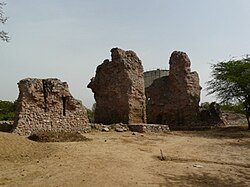
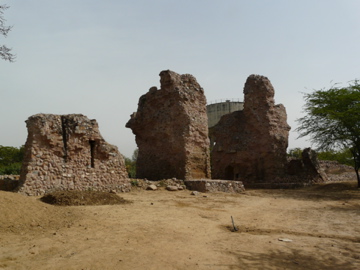
Siri Fort, in the city of Delhi, was built during the rule of Alauddin Khalji, second ruler of Khalji Dynasty, of Delhi Sultanate to defend the city from the onslaught of the Mongols. It was the second of the seven cities of medieval Delhi built around 1303 which at present is seen only in ruins with a few remnants due to its poor quality construction as compared to previous fort constructions in India (pictured).[1][2]

Near the Siri Fort ruins, modern auditoriums, the Asian Games Village Complex and residential and commercial establishments fill the modern landscape between the Khel Gaon Marg and the Aurobindo Marg in the heart of South Delhi.[3]

Key Information

History

[edit]

Alauddin is the best known of the Khalji dynasty because he extended his dominion to Southern India and established the second city of Delhi, Siri.[4] He created Siri between 1297 and 1307 to defend against Mongol invasions of India and Delhi. In response, he built Siri Fort, mimicked massive Turkish ones. The Fort served as the seat of his power during his campaigns to enlarge his territory. Due to frequent Mongol invasions of West Asia, the Seljuqs took asylum in Delhi. The craftsmen of the Seljuq dynasty are credited with this era's architectural monuments in Delhi.[5][6]

In 1303, Targhi, a Mongol general, besieged the Siri fort when Alauddin retreated during the Mongol expedition into India. Targhi could not penetrate the fortifications of the Siri Fort and he finally retreated to his Kingdom in Central Asia. Subsequently, Alauddin's forces defeated Mongols decisively at Amroha (1306).

Siri, which is now a part of New Delhi, was later linked to the fortifications of Jahanpanah. Siri was then also known as "Darul Khilafat" or ‘’Seat of Califate’’[7] In AD 1398, Timurlane, the Mongol ruler who invaded Delhi, wrote in his memoirs, " the Siri is around the city. Its buildings are lofty. They are surrounded by fortifications built of stone and brick, and they are very strong – from the fort of Siri to that of Old Delhi, which is a considerable distance – there runs a strong wall built of stone and cement. The part called Jahanpanah is situated in the midst of the inhabited city. The fortifications of the three cities (Old Delhi, Siri and Tughlaqabad) have thirty gates. Jahanpanah has thirteen gates, Siri has seven gates. The fortifications of the old Delhi have ten gates, some opening to the exterior and some towards the interior of the city."

Legend

[edit]

According to the legend of Ala-ud-din’s war exploits, the name Siri given to the Fort was because the foundation of the fort was built on the severed heads (‘Sir’ in Hindustani means "head") of about 8,000 Mongol soldiers killed in the war.[8][9][10]

Structure

[edit]
View of Tohfe Wala Masjid in Siri Fort area near Shahpur Jat village.

Siri Fort was built 5 km (3.1 mi) to the north-east of the Qutab Minar on an old camp near Delhi.[5] The first city is considered to be built by Muslims, it was in an oval shape; its ruins are presently seen in an area of about 1.7 km2 (0.7 mi2).[4]

Allauddin, the second ruler of the Khalji dynasty, laid the foundation for the City of Siri in 1303 AD. The structures built in Siri were stated to have had a fine imprint of the enthusiasm of the rulers of Khalji dynasty (particularly, the first three out of six Rulers of the Dynasty) with Allauddin's deep interests in architecture and his achievements supported by the imported skills of the artists of Seljuqs richly contributing to the efforts to build the new city.[1] Legend states that Allauddin's prolific building involved engagement of 70,000 workers. The city was built with an oval plan with palaces and other structures. There were seven gates for entry and exit, but at present only the south-eastern gate exists.

The fort was once considered the pride of the city for its palace of a thousand pillars called the Hazar Sutan. The palace was built outside the fort limits, and had marble floors and other stone decoration. Its Darwaza (door) is supposed to have been beautifully decorated. In eastern part of the ruins there are remnants of flame-shaped battlements, loop holes for arrows, and bastions, which were considered unique new additions of that period.

In the nearby Shahpur Jat village (pictured), some dilapidated structures of the period are seen. Tohfewala Gumbad Masjid (pictured) is one such structure whose ruins show the form of domed central apartment and sloping wall characteristic of Khaljis architecture.[1]

Apart from building the Siri Fort, the citadel around it and the water supply system with a reservoir at Hauz Khas Complex (in present Hauz Khas locality) for providing water supply to Siri, his new city, Ala-ud-din also expanded the building activity around the religious city of the first city complex of Qutb complex by making additions to the Quwwatul-Islam Mosque, which doubled its original size, additions to the Qutub Minar itself (Nagari inscriptions on the tower attribute to this tower as "Vijaya sthamba" or victory tower of Ala-ud-din) and a grandiose plan of constructing a new Minar (tower) bigger (double) that of the Qutub Minar. This plan was left half completed, as may be seen from the ruins at the site, due to the death of Allauddin in 1316.[5][1][11]

The destruction of the Fort is attributed to the local rulers who removed the fort's stones, bricks and other artifacts for their own buildings. In particular, Sher Shah Suri (1540–1545), of Pashtun Afghan descent from Eastern India (Bihar), took away material from Siri to build his own city.[5][11]

The battered walls of the fort had a wider base on the outside. A protected passage was provided within the battered walls (now seen in ruins as pictured).[11]

Excavation

[edit]

The rest of the structures remained unexplored by archaeologists and these were unknowingly buried when the Asiad Village Complex was built in 1982 for the Asiad 1982.[12]ASI has now launched an excavation programme, since December 2008, to unearth some portions of the wall concealed for centuries which will enable exposing the entire wall providing a continuous link with the earlier excavated stretches of the wall.[13]

Siri Fort Sports Complex

[edit]
Siri Fort Asia Village complex
Siri Fort encircled by Sports Complex and Gulmohar Park Siri Fort Sports Complex

Near the ruins of the ancient fort city, the Asian Village Complex, popularly known as the Siri Fort Complex, was developed during the Asiad 1982 (the 1982 Asian Games) sports event. The complex was developed in the land around the Siri Fort ruins for the sports event involved. Among these buildings are a large sports complex of courts for tennis, badminton and basketball, a swimming pool, a golf course, gymnasium, aerobics centre, jogging tracks, cricket grounds, large auditoriums, upscale residential buildings, deluxe food joints and commercial establishments. This complex is now under further refurbishing and expansion for the 2010 Commonwealth Games, amidst protests and court interventions.[14][15]

Restoration works

As part of beautifying the ancient monuments before the 2010 Commonwealth Games, the Archaeological Survey of India (ASI), the custodians of heritage monuments in Delhi, have begun restoration works of several structures which includes the Siri Fort walls. According to their evaluation of three stretches of the fort walls, the first stretch nearer to the Asiad Village is in good shape, the second stretch next to the Panchsheel Park would need conservation actions costing Rs 50 lakhs (US$100,000) and the third stretch next to the Asiad village needs conservation measures costing Rs 5 lakhs (US$10,000). In addition, the stretch adjoining Panchsheel Park, which has been evaluated as in a bad shape, has also been identified for undertaking restoration works at a cost of Rs 30 lakhs (US$60,000).[16]

The Location

The Fort is located at the southern end of Hauz Khas and is 13 km (8.1 mi) from Delhi. It is approachable from Panchseel road in South Delhi. The road from Moolchand to Chirag Delhi passes through the middle of the fort precincts.[1] Siri Fort Auditorium complex (four auditoriums) within the Siri Fort area run by the Directorate of Film Festivals, Government of India has a combined seating capacity of over 2,500.[17] It is a prestigious entertainment centre in New Delhi where film festivals, dance performances, plays and music recitals are organized.

[edit]

See also

[edit]
    • Anangpur, by Anangpal I of Tomara dynasty (r. 736-1152 CE)
    • Qila Rai Pithora
      • Lal Kot, by Tomara dynasty (1152-1177 CE) as capital
      • Qila Rai Pithora, the Lal Kot expended by Prithviraj Chauhan (also called Rai Pithora, r. 1177–92 CE) of Chauhan dynasty
    • Siri Fort, by Alauddin Khalji (r. 1296–1316), second ruler of Khalji Dynasty
    • Salimgarh Fort, in 1546 CE by Salim Shah Suri (r. 1545-54 CE), son of Sher Shah Suri
    • Red fort, built in 1639-48 CE by Mughal emperor Shah Jahan when he moved his capital from Agra to Delhi

References

[edit]
Revisions and contributorsEdit on WikipediaRead on Wikipedia
from Grokipedia
![Siri Fort wall ruins in New Delhi][float-right]
Siri Fort is a 14th-century fortress in , , erected by Alauddin Khilji, the second sultan of the Khilji dynasty, as the second medieval city of to serve as a defensive bulwark against repeated Mongol invasions. Constructed around 1303 CE, the fort encompassed an oval-shaped enclosure of approximately 1.7 square kilometers, featuring robust walls, gates, and bastions designed for military fortification, along with administrative structures and palaces that formed the core of Khilji's governance. Today, only fragmented ruins of its defensive walls persist amid urban development in South , preserved under the , while the site has been repurposed to include the Siri Fort Sports Complex, originally developed for the . These remnants highlight Siri Fort's role in the strategic evolution of 's urban defenses during the era, underscoring Alauddin Khilji's military innovations amid threats from Central Asian hordes.

Historical Background

Alauddin Khalji's Rule and Motivations

seized the throne of the in October 1296 by assassinating his uncle , the dynasty's founder, thereby initiating a reign that lasted until his death in January 1316. His rule emphasized military expansion and administrative centralization, with conquests including (annexed by 1304), Ranthambore (1301), Chittor (1303), and (1305), which significantly enlarged the sultanate's domain across northern and parts of southern . To sustain these efforts, Alauddin established a large of approximately 475,000 , funded through reforms and market that curbed and ensured supply stability for troops. A defining challenge of Alauddin's rule was the series of Mongol invasions from the , which targeted the sultanate's northwestern frontiers between 1297 and 1308. Key incursions included the 1299 raid led by Saldi, defeated near , and the 1303 advance under Qutlugh Khwaja and Targhi, which approached the capital during Alauddin's siege of Chittor but was thwarted through defensive strategies. These threats, numbering at least five major attempts, stemmed from the ' broader campaigns under Duwa Khan to exploit perceived weaknesses in the fragmented Indian polities, having already subjugated and parts of Persia. Alauddin countered with proactive measures, such as appointing frontier governors, constructing border forts, and employing scorched-earth tactics to deny invaders resources, ultimately halting Mongol penetration into the Gangetic plain. The primary for erecting Fort circa 1303 was to create a fortified against these recurrent Mongol assaults, transforming a vulnerable into a multi-layered defensive complex. As the second walled city of medieval , Siri accommodated a substantial garrison, royal residences, and granaries, enabling rapid mobilization while Alauddin pursued external campaigns, thereby embodying his doctrine of unyielding territorial defense rooted in the sultanate's survival imperatives. This structure, emulating robust Turkish fortifications, underscored Alauddin's causal prioritization of military infrastructure over mere reactive warfare, ensuring the capital's resilience amid empire-building strains.

Construction Timeline and Defensive Purpose

Siri Fort was constructed under the direction of , of the from 1296 to 1316, as the second fortified city of medieval . Construction took place between 1297 and 1307, with the foundation laid specifically in 1303 AD following a major Mongol incursion that year. This timeline aligns with Alauddin's military campaigns and the establishment of Siri initially as a in the early fourteenth century. The primary defensive purpose of Siri Fort was to safeguard against repeated invasions by Mongol forces from the , which had threatened the sultanate multiple times during Alauddin's reign. After a 1303 by Mongol Taraghai nearly overran the capital, Alauddin reinforced defenses by building the fort with thick rubble-filled walls, bastions, and gates designed to withstand sieges, mimicking robust Turkish fortifications. These measures, combined with Alauddin's broader military reforms—including a and intelligence networks—successfully repelled subsequent Mongol assaults, such as the 1306 by a 50,000-strong force, preventing further penetrations into Indian territory. Siri's strategic location and design emphasized urban defense, housing troops and civilians within its enclosure to consolidate control amid external threats, marking a shift toward proactive in response to the ' cavalry-based tactics.

Etymology and Associated Legends

Origins of the Name

The name derives from the or Persian term sir, meaning "head". According to a longstanding tied to Alauddin Khalji's military campaigns, the fort received this name because its foundations or walls incorporated the of roughly 8,000 defeated Mongol soldiers, symbolizing the ruler's triumph over repeated invasions between 1299 and 1308. This narrative underscores the fort's role as a defensive but lacks corroboration in contemporary chronicles like those of or , who documented Khalji's reign without referencing such a macabre construction detail. Alternative interpretations propose a Turkic linguistic origin for Siri as "head," aligning with Khalji's Turkic heritage, though this remains speculative and unverified by primary texts. Historians emphasize that the reflects later rather than empirical record, possibly amplified in 19th- and 20th-century accounts to evoke the era's brutal warfare. No archaeological , such as mass graves or embedded remains, has substantiated the head-burial claim during excavations of the site's rubble-masonry walls.

Mongol Invasion Narratives

Persian chronicler , writing in his Tarikh-i-Firuz Shahi, narrates that undertook the construction of Siri Fort around 1303–1304 CE primarily to fortify against persistent Mongol threats from the , which had launched multiple incursions since 1297. Barani emphasizes Alauddin's strategic foresight in erecting thick rubble walls, deep moats, and bastions designed to withstand sieges, stocking the fort with grain reserves to sustain the population and army during prolonged attacks. These measures were informed by earlier defeats of Mongol forces, such as the 1297 incursion near where and Zafar Khan killed 20,000 invaders, but underscored the need for a centralized defensive hub amid six major invasions during Alauddin's rule (1296–1316). A key narrative centers on the 1303 Mongol invasion, one of the most severe threats to , when approximately Chagatai troops under commanders like Taraghai (or Iqbalmendeh in some accounts) exploited the absence of Alauddin's main armies—deployed at Chittor and —to advance on the capital. Barani recounts that Alauddin hastily returned and entrenched himself in the partially built , transforming the construction site into an impromptu fortified camp with palisades and troop dispositions that deterred direct assault. The besieged the area for two to three months but retreated in late summer due to extreme heat, depleted forage, internal dissent, and inability to breach the defenses, marking a defensive success attributed to Siri's emerging role. Earlier, in Khaza'in al-Futuh and Isami in Futuh-us-Salatin describe the 1299 —fought near the prospective site against Qutlugh Khwaja's force of up to 200,000—as a pyrrhic Mongol setback, where Zafar Khan's charges inflicted heavy casualties despite his death, but exposed Delhi's open terrain vulnerabilities. These accounts portray not as a post-hoc structure but as evolving from such exigencies, with Alauddin later integrating horse-branding (dagh) and networks to preempt invasions, ensuring later probes in 1305 and 1306 were repelled before reaching the fort. Khusrau's poetic valorization of Alauddin's unyielding stance—refusing or —frames as a of resolute defense, though modern analyses note the chronicles' hagiographic tone may amplify victories while downplaying logistical strains on the Sultanate. The narratives collectively highlight causal links between Mongol pressures and Siri's design: robust, self-sustaining fortifications enabled to endure without field battles, contributing to the halt of major Chagatai advances by 1306 near the under . Barani attributes this to Alauddin's centralization of power and resources at , shifting the capital's focus northward for better oversight of northwestern frontiers, though no primary evidence confirms direct Mongol assaults on the completed fort.

Architectural and Structural Elements

Fort Walls and Gates

The fort walls of Siri Fort, erected by around 1303 CE as a defensive bulwark against Mongol incursions, formed an irregular with a perimeter of approximately 5 kilometers, utilizing random bound in mud mortar or lime. These fortifications, reinforced with bastions at intervals, enclosed an area of roughly 1.7 square kilometers and were designed to withstand sieges, featuring thick ramparts that allowed internal movement for soldiers and archers. Siri Fort incorporated seven principal gates, as recorded in historical accounts including Timur's memoirs from his 1398 , with embellishments such as tiles on some entrances for aesthetic and possibly purposes. Only remnants of one southeastern gate persist visibly today, near Panchsheel Park, showcasing arched openings flanked by tapering walls. excavations in revealed additional buried gates, bastions, and wall sections previously obscured, enhancing understanding of the fort's defensive layout. One identified gate, the Baghdad Gate, is referenced in chronicles as a key southern access point, though its precise location and condition remain subjects of ongoing study.

Internal Features and Layout

The internal layout of Siri Fort followed an approximately oval plan, enclosing an urban area of roughly 2 square kilometers that served as Alauddin Khalji's and administrative , with palaces, residential quarters, and support structures clustered within the fortified walls. Historical accounts describe the core featuring the royal palace, including the Hazar Sutun ("Thousand Pillars") hall, a vast audience chamber purportedly supported by 1,000 columns and floored in white to symbolize imperial grandeur and facilitate large gatherings. Supporting facilities emphasized self-sufficiency during sieges, incorporating large granaries, storage vaults, and living quarters for soldiers and , alongside for communal ; these elements were strategically placed to allow internal movement via wide walkways atop the walls. Few original internal structures survive due to subsequent demolitions and urban expansion, but remnants include the Tohfe Wala Gumbad, an octagonal Khalji-era dome in the western sector, and scattered foundations like the Madhi Masjid. In June 2023, during renovation work, a 13th-century tomb-like subterranean structure was uncovered near the fort's interior, suggesting additional buried chambers or vaults consistent with defensive provisioning. The overall design prioritized functionality over ornamentation, reflecting Khalji's focus on rapid amid Mongol threats, with no of elaborate gardens or pavilions found in later Mughal layouts.

Archaeological Excavations and Discoveries

Early 20th-Century Efforts

In the early 20th century, the (ASI), under Director-General Sir John Hubert Marshall from 1902 to 1928, undertook systematic surveys and conservation initiatives for historical monuments across , including those in . These efforts emphasized documentation, protection, and minimal intervention to preserve surface-visible ruins, particularly for medieval structures like Siri Fort, whose walls and bastions constructed from rubble and were prominently extant but deteriorating due to exposure and urban encroachment. A key milestone occurred in 1919 when the ASI formally documented and scheduled the Siri Fort Wall for protection, identifying ruined lines of walls, bastions, and gateways in areas such as Shahpur Jat and Panchsheel Park (North). This notification under the Ancient Monuments Preservation Act of 1904 aimed to safeguard these defensive remnants from further damage, reflecting broader colonial-era priorities to catalog and conserve Indo-Islamic heritage amid expanding British administrative interests in following its designation as the imperial capital in 1911. Unlike intensive excavations at sites like or , work at Siri focused on mapping and basic stabilization, as the fort's layout was inferable from aboveground features without necessitating deep digs. These initiatives laid foundational records for later archaeological work, though limited by the era's technological constraints and focus on conservation over discovery. No significant artifacts or structural revelations emerged from this period, underscoring the challenges of studying Siri Fort's subsurface elements given its integration into the urban landscape and the poor preservation quality of its original materials. The efforts, however, contributed to heightened awareness of Siri's military significance, influencing subsequent protections and preventing wholesale loss of the ruins during rapid urbanization in the interwar years.

Recent Findings (2008–2023)

In 2008, the (ASI) conducted excavations at Siri Fort, uncovering previously unseen sections of the fort's rampart walls, along with additional gates and bastions that expanded understanding of its defensive layout. These findings revealed more extensive fortifications than previously mapped, including exposed structural elements dating to the Khilji period, though no major artifacts or inscriptions were reported from this phase. Limited systematic excavations occurred between 2009 and 2022, with ASI focusing primarily on conservation rather than new digs; however, surface surveys and minor probes confirmed Khilji-era shards consistent with prior layers, reinforcing the site's attribution to Alauddin Khalji's reign without altering established chronologies. In June 2023, during foundation work for a children's museum within the Siri Fort complex, ASI workers accidentally unearthed a tunnel-like structure estimated to date from the 13th to 14th century, likely from the Khilji dynasty era. The feature, described variably as a tunnel or tomb-like chamber, sits on a mound approximately one meter above ground level and measures several meters in length; associated pottery fragments align with Khilji-period ceramics found in earlier strata. ASI officials halted construction to preserve the structure intact for public display, speculating it may have served defensive, escarpment, or burial purposes, though further analysis is pending to confirm its exact function and avoid overinterpretation without stratigraphic evidence. No additional major discoveries were reported by 2023, highlighting ongoing challenges in funding and urban encroachment limiting comprehensive probes.

Post-Medieval History and Decline

Abandonment and Reuse

Following Alauddin Khilji's death in 1316, Siri Fort experienced a decline in prominence under his successors and the incoming . Although it retained some administrative functions initially, the Tughlaqs prioritized new constructions, such as Tughlaqabad established by Ghiyas-ud-din Tughlaq in 1321, which shifted the capital and resources away from . By the 15th century, during the and Lodi dynasties, the fort was largely abandoned as rulers focused on other fortified sites, leading to its gradual dilapidation into ruins. The surrounding Siri city, once a bustling center, depopulated, with its structures succumbing to neglect and natural decay. Limited reuse occurred post-abandonment, primarily involving the quarrying of stones and materials from the fort's walls and bastions for construction in later projects. Surviving remnants, such as stretches of walls and battlements, attest to this extraction, while the core fortifications were not repurposed for habitation or defense in the Mughal era, during which the area's focus shifted to newer urban developments.

Colonial and Post-Independence Neglect

During the British colonial period, Siri Fort's ruins received minimal attention, with preservation initiatives concentrating on monuments of higher imperial or architectural prominence, such as the and Qutub Minar. Portions of the fort's materials were repurposed for colonial infrastructure projects, exacerbating the site's deterioration. Post-independence, despite designation as a protected site under the (ASI), Siri Fort faced persistent challenges from rapid urbanization in southern . Encroaching residential developments and illegal constructions surrounded the ruins, while unchecked vegetation overgrowth buried significant portions, as revealed by ASI efforts to clear dense jungles in to expose previously unseen wall sections. By the early 2000s, the area adjacent to the ruins was reported as deserted after dusk, lacking adequate lighting and security, which highlighted ongoing maintenance lapses. Broader patterns of neglect affected 's protected monuments, with ASI data indicating that only two of seven such sites were cleared of encroachments over the preceding two decades as of 2025, underscoring systemic issues in heritage management amid urban pressures.

Modern Utilization

Siri Fort Sports Complex Establishment

The Siri Fort Sports Complex was developed by the (DDA) primarily to support the hosted in , with construction commencing in 1979 adjacent to the Asian Games Village along August Kranti Marg. Initially established as a modest driving range to cater to beginners and event participants, the site leveraged its location atop ruins of the medieval Siri Fort, spanning approximately 32 acres in South Delhi's area. Although facilities were operational for the 1982 Games, including provisions for various sports disciplines, the full complex received formal inauguration by the DDA in 1989, marking its transition into a comprehensive multi-sport venue managed thereafter by the authority. This establishment reflected post-independence India's push for sports infrastructure development, aligning with national efforts to host international events and promote amid urban expansion in the capital. The DDA's role extended to ongoing operations, ensuring the complex's integration into Delhi's recreational ecosystem while preserving proximity to historical landmarks.

Facilities, Events, and 2025 Updates

The Siri Fort Sports Complex, managed by the (DDA), provides facilities for 27 sporting disciplines, including floodlit courts on clay and synthetic surfaces, a 50-meter , indoor and outdoor courts, courts, a golf driving range with 26 bays, squash courts, halls, a multi-gym with cardio and weights equipment, football fields, tracks, and shooting ranges. Additional amenities encompass and studios, dojos, cricket nets, and wellness programs such as and . The complex hosts annual events like the Vice Chairman's Cup Football Tournament for school teams in November or December, alongside competitions in , , and other sports. The adjacent Siri Fort Auditorium accommodates cultural and theatrical events, including the Delhi Theatre Festival in November 2025 featuring plays like Einstein, international concerts, and such as the Jagran Film Festival. In 2025, the DDA reopened permanent membership applications on August 12, with results for August allotments announced on October 25 and entry fee payments accepted until a specified deadline via the online portal starting October 3. Expansion efforts have integrated additional facilities like and courts, positioning the complex as one of 's largest sports arenas, with a café operational and a restaurant slated to open in September. The Cup Open Shooting Championship occurred from September 19 to 21, limited to 140 participants on a first-come, first-served basis.

Significance, Achievements, and Criticisms

Military and Administrative Legacy

Alauddin Khalji constructed circa 1303–1304 in response to persistent Mongol invasions that had breached and approached as recently as 1303, transforming a temporary encampment into a permanent fortified citadel to deter future incursions without repeated troop mobilization from across the sultanate. The structure's elliptical walls, extending roughly 6 kilometers with 13 gates and numerous bastions, provided layered defenses including moats and arrow slits, enabling a of up to 300,000 and to be quartered and supplied for rapid deployment. This militarization stockpiled grain from region's revenues—estimated at 50% of produce under Alauddin's agrarian reforms—ensuring self-sufficiency during sieges and projecting Khalji dominance over northern . Administratively, Siri functioned as an extension of Alauddin's centralized apparatus, where he refined networks and on essentials like grain and horses to curb and black markets, directly sustaining military logistics amid expansionist campaigns into (1299), Ranthambore (1301), and the Deccan. From the Siri base, officials enforced iqta land grants tied to , with revenues funneled to fort maintenance and troop pay, fostering a merit-based officer corps that prioritized loyalty over nobility. These measures, prototyped in Siri's controlled environment, stabilized the sultanate's economy, funding conquests that doubled territorial extent to over 3.2 million square kilometers by 1316. The fort's legacy endured beyond Alauddin's death in 1316, symbolizing engineered resilience against external threats; it influenced subsequent fortifications like Tughlaq's extensions, while its administrative blueprint—integrating fiscal rigor with martial readiness—underpinned the sultanate's survival through Timurid raids in 1398, though eventual neglect eroded its operational role. Primary chronicles, such as those by Ziyauddin Barani, attribute Siri's success to Alauddin's pragmatic realism over ideological excess, crediting it with averting collapse amid eight documented Mongol probes between 1299 and 1306.

Preservation Challenges and Encroachment Issues

The preservation of Siri Fort's remnants is hampered by longstanding neglect and urban pressures in South Delhi. Dense jungle growth had obscured unexplored portions of the fort walls until the (ASI) initiated clearance and excavation in December 2008. Urban encroachment poses a persistent threat, with illegal constructions adjacent to the site complicating protection efforts. As of March 2018, accurate mapping of the Siri Fort walls was emphasized as essential for addressing encroachment disputes pending in the . Development activities at the Siri Fort Sports Complex have exacerbated preservation challenges. In 2008, over 800 trees were felled for preparations, prompting scrutiny over environmental impacts and attempted encroachments on green spaces for additional sports facilities. The approved the project in April 2009 despite reports of 10 hectares of forest land encroachment and indiscriminate tree uprooting. More recently, in July 2023, the directed the to abandon plans for installation at the sports complex, mandating preservation of natural grass in line with prior and orders to mitigate ecological degradation. These interventions underscore tensions between modern utilization and heritage conservation at the site.

References

Add your contribution
Related Hubs
User Avatar
No comments yet.