Hubbry Logo
SomnusSomnusMain
Open search
Somnus
Community hub
Somnus
logo
8 pages, 0 posts
0 subscribers
Be the first to start a discussion here.
Somnus
Somnus
from Wikipedia
Somnus
God of sleep
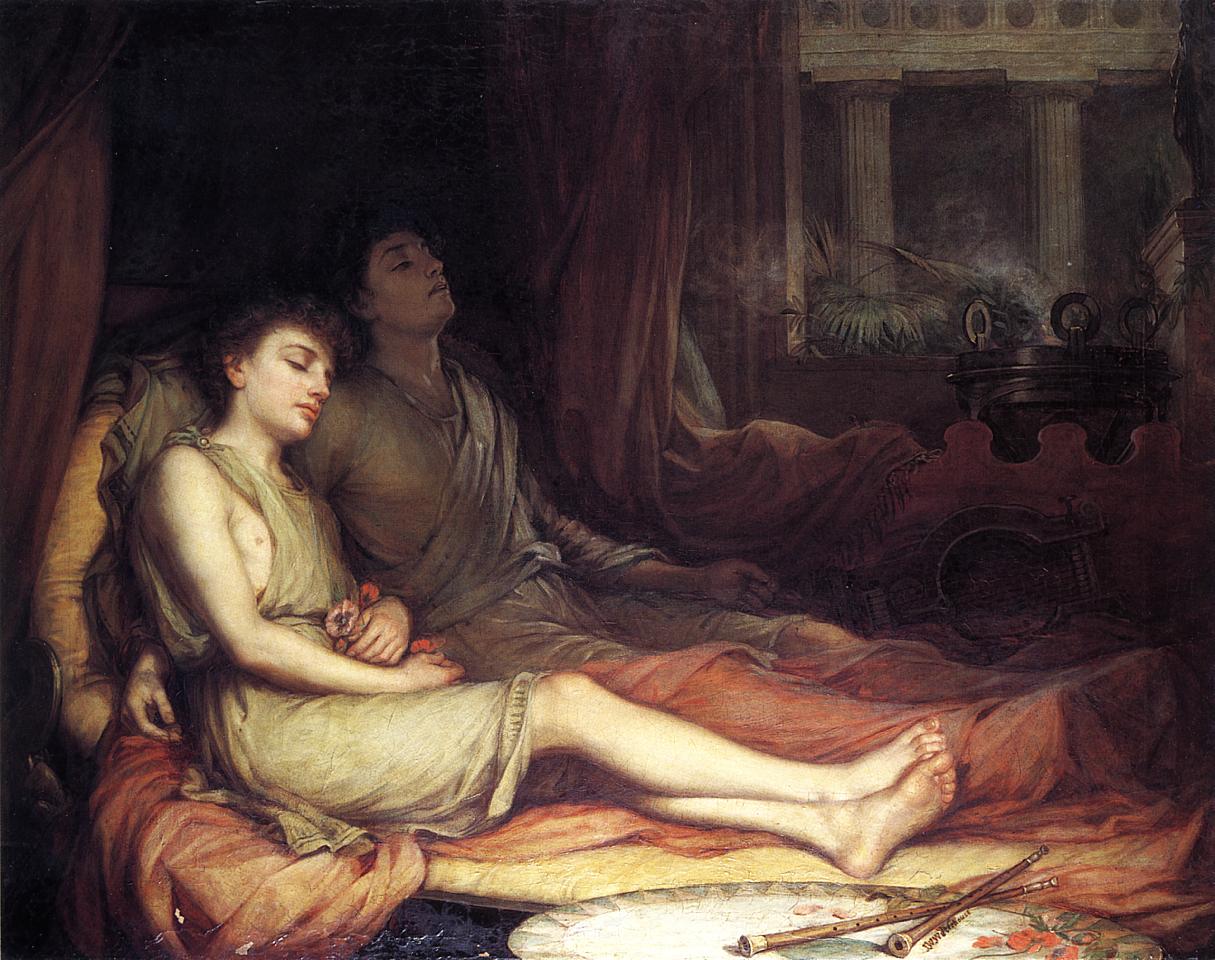
Somnus and Mors, Sleep and His Half-Brother Death by John William Waterhouse
AbodeUnderworld
Genealogy
ChildrenThe Somnia, which included Morpheus, Phobetor, and Phantasos

In Roman mythology, Somnus ("sleep") is the personification of sleep.[1] His Greek counterpart is Hypnos.[2] Somnus resided in the underworld. According to Virgil, Somnus was the brother of Death (Mors),[3] and according to Ovid, Somnus had a 'thousand' sons,[4] the Somnia ('dream shapes'), who appear in dreams 'mimicking many forms'.[5] Ovid named three of the sons of Somnus: Morpheus, who appears in human guise, Icelos / Phobetor, who appears as beasts, and Phantasos, who appears as inanimate objects.[6]

Greek tradition

[edit]

In the Greek tradition, Hypnos (Sleep) was the brother of Thanatos (Death), and the son of Nyx (Night).[7] According to Hesiod, Sleep, along with Death, live in the underworld,[8] while in the Homeric tradition, although "the land of dreams" was located on the road to the underworld, near the great world-encircling river Oceanus, nearby the city of Cimmerians,[9] Sleep himself lived on the island of Lemnos.[10]

Virgil

[edit]

Following the Greek tradition, Virgil makes Sleep and Death brothers, and locates their dwellings next to each other, near the entrance of the underworld:

In the first courts and entrances of Hell
Sorrows and vengeful Cares on couches lie :
There sad Old Age abides, Diseases pale,
And Fear, and Hunger, temptress to all crime;
Want, base and vile, and, two dread shapes to see,
Bondage and Death : then Sleep, Death's next of kin;[11]

Somnus makes a brief appearance in Virgil's Aeneid. Virgil has Somnus cause Palinurus, the helmsman of Aeneas's ship, to fall asleep while steering the ship at night.[12] Somnus, in the guise of Phorbas, a shipmate, appears to Palinurus and offers to take over, so that Palinurus might rest awhile. But Palinurus refused the offer, so Somnus uses a branch, "imbued" with the power of underworld's river Styx, to sprinkle Palinurus with water from the river Lethe, the underworld's river of forgetfulness. Palinurus then falls asleep, and Somnus pushes him overboard.

Ovid

[edit]

Somnus, and his sons the Somnia appear in Ovid's poem Metamorphoses.[13] Ovid, like Virgil before him, followed Hesiod in making Sleep a denizen of the underworld.[14] However, recalling the location of the 'land of dreams' in the Odyssey, Ovid also locates the dwelling of Somnus "near the land of the Cimmerians".[15] Ovid has Somnus live in a cave, describing "the home and chamber of sluggish Sleep"[16] as a place where:

Phoebus [the Sun] can never enter ... with his rising, noontide, or setting rays. Clouds of vapour breathe forth from the earth, and dusky twilight shadows. There no wakeful, crested cock with his loud crowing summons the dawn; no watch-dog breaks the deep silence with his baying, or goose, more watchful than the dog. There is no sound of wild beast or of cattle, of branches rustling in the breeze, no clamorous tongues of men. There mute silence dwells.[17]

In keeping with this theme of "silence", Ovid says that Somnus' house has no doors, "lest some turning hinge should creak".[18]

Like Virgil, Ovid associates Somnus with the underworld's river Lethe, which Ovid has flowing from the bottom of Somnus' cave, and "whose waves, gently murmuring over the gravelly bed, invite to slumber."[19] Near the entrance bloom sleep-inducing poppies and other herbs, which Nox (Night) uses to spread sleep over "the darkened lands."[20] Although Ovid connects Night with Sleep, he makes no mention of Night being Sleep's mother as she is in Hesiod.[21]

In the center of the main chamber, Somnus lies "in languorous repose" on a "downy-soft" black couch, surrounded by his innumerable sons, the "empty dream-shapes [Somnia vana], mimicking many forms, many as ears of grain in harvest-time, as leaves upon the trees, as sands cast on the shore."[22] Ovid names three of these form-mimicking "dream shapes": Morpheus, Icelos/Phobetor, and Phantasos. About Morpheus, Ovid says "no other is more skilled than he in representing the gait, the features, and the speech of men; the clothing also and the accustomed words of each he represents."[23] Another son called Icelos by the gods, but Phobetor by men, "takes the form of beast or bird or the long serpent", and a third son named Phantasos "puts on deceptive shapes of earth, rocks, water, trees, all lifeless things".[24]

In Book 11 of the Metamorphoses, Somnus becomes involved in Ovid's telling of the love story of Ceyx and his wife Alcyone. Ceyx has died in a storm at sea. Juno the queen of the gods, sends her messenger Iris to the sleeping Somnus' cave, to command Somnus to send a dream to Alcyone, in the form of Alcyone's husband Ceyx.[25] Arriving at the cave, Iris brushes aside the many sleeping Somnia blocking her way, and her brightly gleaming clothes wake Somnus from his deep slumber.[26] Iris addresses Somnus as "thou rest of all things, Sleep, mildest of the gods, balm of the soul, who puttest care to flight, soothest our bodies worn with hard ministries, and preparest them for toil again!", then orders Somnus to "Fashion a shape that shall seem true form" to be sent to Alcyone.[27] Iris immediately leaves before she herself is overcome with sleep, and Somnus wakes Morpheus to carry out what Juno has commanded, then goes back to sleep on his couch.[28]

Like other gods associated with sleep, Ovid makes Somnus winged.[29]

Notes

[edit]

References

[edit]
Revisions and contributorsEdit on WikipediaRead on Wikipedia
from Grokipedia
Somnus is the Roman deity personifying , counterpart to the Greek , and son of the primordial goddess (Night) and (Darkness). In , he resides in a shadowy cave in the land of the or the realm of Erebos, surrounded by his sons the Oneiroi—dream spirits including , who shapes human forms in dreams, Ikelos (or ), who appears as beasts, and Phantasos, who takes inanimate shapes. Depicted as a youthful figure with wings on his temples or shoulders, often holding a stalk, horn of , or branch from the river to induce slumber, Somnus symbolizes rest and oblivion, serving as a benevolent force granting respite to mortals and immortals alike. Somnus features prominently in Roman literature, particularly Ovid's (Book 11), where Iris, messenger of Juno, visits his dim cavern to summon a dream vision of the drowned Ceyx for his widow Alcyone; the god, rousing briefly from his eternal repose, dispatches to fulfill the task, leading to the couple's transformation into halcyon birds. Drawing from Greek precedents, Somnus echoes Hypnos's role in Homer's (Book 14), where he aids by lulling to sleep with a promise of marriage to , one of the younger Graces, allowing the goddess to aid the Greeks undetected during the . As twin brother to (Death), Somnus underscores the close mythological bond between sleep and mortality, both emerging from Nyx's lineage without paternal involvement in some accounts, though is named as father in others. His influence extends to , with representations in sculptures and reliefs portraying him alongside symbols of quietude, reflecting his status as a minor yet essential deity in the pantheon.

Identity and Etymology

Name and Meaning

In , Somnus serves as the personified deity of , with his name directly derived from the Latin noun somnus, meaning "." This term originates from Proto-Italic \swepnos, which traces back to the \swep-, signifying "to ." The linguistic evolution reflects a broad Indo-European for slumber, shared across ancient languages. Throughout classical Roman literature, somnus functions dually as a common noun for the state of and as the capitalized proper name for the , establishing Somnus as the standard anthropomorphic representation of this natural phenomenon. This usage underscores the Roman tendency to deify abstract concepts, transforming somnus from a everyday descriptor into a divine identifier by the late Republic and early Empire periods. Distinguishing Somnus from related Latin terms highlights its specificity: while sopor denotes a deeper, more profound or unnatural —often implying or somnus encompasses in its general, restorative sense, making it the preferred term for the deity's . This choice solidified Somnus as the canonical name, aligning closely with the Greek equivalent , both evoking 's essential, non-pathological essence.

Relation to Hypnos

Somnus serves as the direct Roman adaptation of the Greek god , the personification of sleep, embodying the broader process of mythological in which Romans incorporated and Latinized Greek deities during the late Republic and Imperial eras. This equivalence allowed Roman authors to seamlessly integrate Hypnos' attributes into Latin literature, transforming the Greek figure into a native entity while preserving core conceptual elements. Early Roman writers explicitly equated the two through translation and philosophical discourse. In Cicero's (3.44), Somnia (Dreams) are described as progeny of (Night) and , mirroring Greek genealogies from and , with Somnus identified as the Latin counterpart to . Similarly, later poets like in the portray Somnus in a cavernous hall akin to Hypnos' dwelling. While features prominently in Homeric epics as an active divine agent—such as aiding against in the (14.231–356)—Somnus receives distinct emphasis in Roman works, such as Virgil's (5.835 ff.), where he appears as a divine agent inducing , aligning with themes of fate and mortality. This shift highlights Roman adaptations that prioritized moral and epic introspection over the more whimsical, interventionist portrayals in Greek sources. The etymological similarity between "Hypnos" (from Greek hypnos, ) and "Somnus" (from Latin somnus, ) underscores this natural linguistic alignment in the syncretic process.

Mythological Background

Parentage and Family

In , Somnus, the god of sleep, is depicted as the son of , the primordial goddess of night, and , the personification of darkness, drawing from the Hesiodic tradition of the where Nyx bears (Somnus's Greek counterpart) and the Oneiroi without a specified father, though later sources including Roman adaptations pair her with Erebus. Roman authors like (De Natura Deorum 3.17) and Hyginus name Erebus as the father. This lineage positions Somnus among the early chthonic deities emerging from the cosmic void. Somnus shares a twin brotherhood with , the god of death (known as Mors in Roman sources), a relationship emphasized in classical texts where the pair embodies complementary forces: Somnus as the gentle inducer of restful slumber, contrasting Thanatos's inexorable and often grim finality. Classical texts emphasize their twin brotherhood, as seen in Greek sources adapted in Roman , reinforcing their close familial and thematic bond within the Roman pantheon. Somnus is the father of numerous offspring, most notably a thousand sons called the Somnia, or "dream shapes," who serve as personifications of dreams and appear in Ovid's as inhabitants of Somnus's realm. Among these, three prominent sons stand out for their specialized roles in dream-weaving: , who fashions human figures and voices to deliver messages in sleep; (also known as Icelos), who manifests as beasts, birds, and serpents to evoke fearsome visions; and Phantasos, who creates illusions from inanimate objects, waters, and landscapes. This progeny underscores Somnus's dominion over the diverse manifestations of nocturnal reverie in Roman lore.

Residence and Associations

In , Somnus inhabits a secluded cave in the distant land of the , a shadowy realm enveloped in perpetual darkness where sunlight never penetrates. This cavernous dwelling, hewn deep into a mountainside, serves as the sanctuary of sleep, with no doors to bar entry and an atmosphere heavy with fog, clouds, and the soporific scents of poppies and drowsy herbs. A gentle stream of the river emerges from the cave's stony depths, its murmuring waters over loose pebbles inducing forgetfulness and drowsiness, thereby linking Somnus's abode directly to the themes of oblivion central to the . The cave's location positions Somnus in close proximity to Pluto's realm, the Roman underworld, as the flows through and underscores sleep's boundary with death and the afterlife. Within this habitat, Somnus is closely associated with the Oneiroi, the spirits of dreams personified as his thousand sons, who emerge nightly like bats to deliver visions to mortals; chief among them are , who shapes human forms in dreams, Icelos (or ), who manifests beasts and monsters, and Phantasos, who crafts inanimate objects. These dream entities extend Somnus's influence, populating his cave with restless, ever-shifting presences that embody the fluidity of slumber. Somnus frequently acts as an intermediary in divine affairs, dispatched by higher deities to induce sleep as a tool for intervention; for instance, echoing where he (as ) lulls () to slumber at Juno's (Hera's) behest, enabling her schemes among the gods, as adapted in Roman literature. Such roles highlight his non-familial ties within the pantheon, positioning him as a neutral agent who enforces repose even upon immortals. Additionally, Somnus oversees states of eternal sleep, exemplifying sleep's divine utility in preserving beauty and averting mortality.

Role and Attributes

Personification of Sleep

In Roman mythology, Somnus serves as the personification of sleep, embodying a neutral and restorative force that provides respite and renewal, in stark contrast to Mors, the personification of death, whose domain represents irreversible finality. Sleep was associated with healing in Roman culture, particularly through incubation rituals in temples of Asclepius, where patients sought dream-based cures after induced slumber, though Somnus himself received rare dedications for peaceful rest rather than a dedicated cult. This distinction underscores sleep's role as a benevolent counterpart to death, allowing for recovery and continuation of life rather than its end. Somnus's mythological functions center on inducing slumber across both mortals and gods, thereby regulating the natural cycles of day and night to maintain cosmic balance. He disperses soporific influences, such as poppies or waters from the river , to envelop all beings in peaceful repose, ensuring that yields to rest as part of the eternal rhythm governed by his mother, . From his residence in the , Somnus exerts this influence over the living world, lulling even the mightiest deities when needed to facilitate pivotal events or simply to honor the diurnal order. In Roman philosophical thought, particularly within Epicurean traditions, was interpreted as a temporary death-like state that mirrors the ultimate dissolution of the soul and body, yet without evoking fear due to its reversible nature. , in (Book III, lines 919–930), argues that during deep , when the mind and body lie in profound stillness, no sensation of or desire for persists, akin to the non-existence after ; however, 's return to awareness demonstrates that such oblivion holds no terror, as the atomic motions merely pause and resume. This view positions Somnus not as a harbinger of doom, but as a periodic reminder of mortality's tranquility, encouraging acceptance of both and as natural processes devoid of suffering.

Symbols and Powers

In , Somnus was commonly symbolized by wings attached to his temples or shoulders, representing the swift and silent manner in which overtakes both mortals and gods. Additional emblems included lush poppies and drowsy herbs that exude sleep-inducing juices, as well as a horn filled with or a branch dripping water from the River , evoking forgetfulness and repose. These attributes underscored his role in gently but inexorably drawing the world into slumber, often depicted in his subterranean cave where such elements abound. Somnus possessed the power to induce irresistible , capable of overpowering even the most vigilant figures, as seen when he compelled the watchful helmsman to slumber during a at sea in Virgil's . This ability extended to divine realms, mirroring classical accounts where subdued himself through subtle means, such as Lethean vapors or herbal essences. Tied to nocturnal cycles, his influence peaked in darkness, sealing eyes and stilling limbs under night's veil, restoring weary bodies while banishing cares. A key aspect of Somnus' dominion involved dispatching dreams through his progeny, the thousand Somnia, with figures like shaping visions for mortals. Depictions of Somnus varied across texts and art: often as a youthful winged figure embodying gentle arrival, yet in some literary portrayals, such as Ovid's languid, nodding form in eternal repose, he appears as a bearded elder sunk in profound sloth. These variations highlighted his dual —swift harbinger by night, yet timelessly immersed in unending .

Literary Representations

In Virgil's Aeneid

In Virgil's Aeneid, Somnus appears prominently in Book 5 during the Trojans' voyage from to , where he intervenes to fulfill a divine by inducing in , Aeneas's steadfast . Disguised as the deceased Trojan warrior Phorbas, Somnus glides silently from the stars through the night sky, approaching the high stern of Aeneas's flagship amid a deceptively calm sea. Palinurus, ever vigilant and distrustful of the serene conditions, initially resists the god's gentle persuasion to rest, insisting on maintaining his post. Undeterred, Somnus scatters the waters of from a branch of the tree over the helmsman, plunging him into an irresistible slumber before casting him overboard into the waves, shattering part of the rudder in the process. This act ensures the fleet's safe passage to , as foretold by , but at the cost of Palinurus's life, who later washes ashore and meets a brutal end among the locals. Somnus is portrayed as a serene yet inexorable figure emanating from the , embodying quiet authority rather than overt menace, with his winged descent emphasizing his ethereal, dreamlike presence. This depiction contrasts sharply with the relentless trials of Aeneas's journey, where human diligence clashes with divine inevitability; here serves not as mere respite but as a deceptive that exposes vulnerability, transforming a moment of potential rest into tragedy. The god's gentle attendants are implied through the somnolent poppies and Lethean influences that precede his action, underscoring 's dual nature as both a balm for weary mortals and a tool of fate that disrupts even the most pious resolve. In this way, Somnus highlights the epic's exploration of sacrifice, where individual loss—Palinurus's unwavering pietas notwithstanding—propels the collective destiny toward Rome's foundation. Virgil adapts the figure of from the Homeric , particularly echoing the 's episode where aids by lulling to sleep with similar deceptive subtlety, but reorients it to Roman imperial themes of inexorable fate and the burdens of leadership. While Homeric operates in a more whimsical, Olympian context, Virgil's Somnus integrates into the Aeneid's somber narrative of and empire, where divine interventions like this one underscore the cost of Aeneas's mission and the gods' role in shaping history. This transformation elevates Somnus beyond to a symbol of forces that both hinder and enable the hero's path, aligning with Virgil's broader meditation on the interplay between human agency and cosmic order.

In Ovid's Metamorphoses

In Ovid's , Book 11, Somnus appears prominently in the myth of Ceyx and Alcyone, where the goddess Iris visits his subterranean realm to summon a dream messenger revealing Ceyx's death at sea to his grieving wife. This episode underscores Somnus's role as the profound embodiment of sleep, facilitating divine intervention through visionary communication that propels the toward metamorphosis. Somnus's dwelling is vividly portrayed as a cavernous hollow in the Cimmerian mountains, far from sunlight, where stagnant air breeds a perpetual twilight and no birds, beasts, or serpents dare enter. At the entrance, abundant poppies and sedative herbs flourish, their juices harvested by Night to distill slumber over the world, while inside, silent black waters evoke the river , fostering oblivion. The realm teems with paradoxical noise from countless murmuring dreams—Somnus's progeny—clinging to walls, hovering in air, or sprawling on the ground, mimicking waking realities in myriad forms. Amid this, Somnus himself reclines in deepest torpor on an elevated ebony bed draped in shadow, his form ancient and indistinct, with neck merged into head and limbs lost in enveloping drowsiness, symbolizing sleep's overwhelming, transformative . Upon Iris's urgent plea, the barely rousing Somnus dispatches his son , the shaper of human visages in dreams, to assume Ceyx's drowned likeness and appear to Alcyone, thereby bridging mortal sorrow and divine revelation. This act highlights sleep as a liminal space where illusions precipitate change, as Alcyone's dream-vision of her husband's fate catalyzes their mutual into halcyon birds, embodying themes of loss, , and renewal through Somnus's domain. As father to the Oneiroi-like dream deities, Somnus governs this ethereal family of illusions that blur reality and fancy in Ovid's mythic tapestry.

In Other Roman Literature

In Horace's Odes, Somnus appears as a personified benevolent force, invoked to provide restful slumber amid life's simplicities. In Odes 3.1, the poet contrasts the restless pursuits of the powerful with the gentle that graces humble rustic homes, stating that "somnus agrestium lenis virorum non humilis domos fastidit umbrosamque ripam" (the gentle of country men disdains not lowly homes nor shady riverbanks), emphasizing Somnus's impartial favor toward the unassuming life. Similarly, in Odes 3.14, urges a lover to awaken from prolonged , warning "surge, ne longus tibi somnus, unde non times, detur" (rise, lest a long be given you, from which you fear not to return), portraying Somnus as a soothing yet potentially eternal companion to be approached with caution. Lucretius treats sleep in De Rerum Natura through an Epicurean lens, demythologizing as a natural process rather than a divine entity, akin to a temporary atomic dissolution of the . In Book 4, lines 907–961, he describes how arises when the 's vital disperses through the limbs and partially withdraws, stating "principio somnus fit ubi est distracta per artus vis animae et partim eiecta recessit" (first occurs when the 's power is scattered through the limbs and partly ejected has withdrawn), linking this repose to the broader of atoms in motion that explains sensory illusions and bodily rest without intervention. This rational depiction underscores 's role in restoring the body, mirroring as an ultimate, fearless quiescence in Epicurean thought. Somnus features as a motif for respite in the epic poetry of and Valerius Flaccus, often invoked during moments of tension to provide temporary relief in martial s. In 's (Book 10, lines 84–136), the god's shadowy realm is vividly depicted as a place of oppressive lethargy, where Somnus reclines amid perpetual dusk, serving as a to the Theban war's frenzy and allowing warriors brief respite before renewed conflict. Likewise, in Valerius Flaccus's (Book 8, lines 68–78), calls upon Somnus as "fratrique simillime Leto" (most like your brother Letum) to subdue the sleepless dragon guarding the , portraying the god as a merciful ally in her desperate quest, whose intervention halts the beast's vigilance and enables ' escape. These appearances highlight Somnus's utility in epic as a device for pausing heroic action, blending mythological tradition with themes of inevitable rest amid strife.

Depictions and Legacy

Iconography in Art

In , Somnus is commonly portrayed as a reclining in a pose of serene repose, often holding a branch of poppies or a horn filled with to symbolize the inducement of . This motif draws from Hellenistic precedents but adapts to Roman funerary and domestic contexts, emphasizing themes of peaceful rest and transition to the . Occasionally, Somnus appears as a bearded man, reflecting variations in age and authority seen in earlier Greek depictions of , though the ful form predominates in Imperial-era works. Poppies, as emblems of slumber, frequently accompany these figures, underscoring Somnus's gentle, beneficent nature. Such is evident in Pompeian frescoes from the first century CE, where reclining sleeping figures evoke an atmosphere of tranquil detachment, integrated into mythological scenes within villas. On Roman sarcophagi, particularly those from the second and third centuries CE, Somnus appears alongside motifs of eternal sleep, such as in Endymion reliefs where he administers slumber to the mortal , symbolizing hope for the deceased's peaceful . These carvings, often in , feature Somnus with wings emerging from his shoulders or temples, paired with inverted torches or Lethean waters to denote oblivion and rest. Hellenistic influences shaped these representations from the first century BCE onward, with statues depicting in dynamic compositions involving sleeping attendants or the river , as seen in a marble head from showing wings at the temples and tousled hair suggestive of drowsiness. The evolution from Greek red-figure vases—where aids in transporting the dead, as on Athenian lekythoi—to Roman mosaics highlights a shift toward underworld serenity; a prime example is the second-century CE mosaic from a villa in , , portraying reclining on cushions amid floral motifs, the only known floor depiction of the . This progression underscores Roman artists' emphasis on as a comforting presence in visual narratives of mortality.

Cult Practices and Modern Influence

Unlike major Roman deities such as or , Somnus lacked dedicated temples or state-sponsored priesthoods, reflecting his status as a minor rather than a central figure in . Instead, worship was primarily private and informal. These invocations appear in literary sources, such as ' poem Silvae (5.4), where the poet pleads with Somnus for relief from , portraying the god as a gentle responsive to human supplications. Poppies, whose sedative properties aligned with his domain, were symbolically associated with Somnus. Such practices tied into broader Roman customs around sleep, including remedies in medical texts like those of , who discussed sleep disturbances and therapies (e.g., in On the Affected Parts) without direct invocation but within a cultural framework where deities like Somnus symbolized therapeutic rest. While not linked to major festivals like the , which focused on exorcising restless spirits, Somnus featured in quieter, household observances emphasizing renewal through slumber. In modern times, Somnus's legacy endures through linguistic and conceptual influences on science, literature, and . The term "hypnosis" derives directly from , Somnus's Greek counterpart, reflecting the god's association with induced states in 19th-century medical practices. In literature, William Shakespeare's frequent personification of —such as in Macbeth (2.2), where Macbeth laments "Macbeth does murder "—echoes classical motifs of Somnus as a benevolent force, drawing from familiarity with . Psychologically, Sigmund Freud's (1900) extended ancient interests in Somnus's realm by analyzing dreams as gateways to the unconscious, transforming mythological personifications of into tools for therapeutic insight.

References

  1. https://en.wiktionary.org/wiki/somnus
Add your contribution
Related Hubs
User Avatar
No comments yet.