Spectral theory
Spectral theory
Main page

Spectral theory

logo
Community Hub0 subscribers
Read side by side
from Wikipedia

In mathematics, spectral theory is an inclusive term for theories extending the eigenvector and eigenvalue theory of a single square matrix to a much broader theory of the structure of operators in a variety of mathematical spaces.[1] It is a result of studies of linear algebra and the solutions of systems of linear equations and their generalizations.[2] The theory is connected to that of analytic functions because the spectral properties of an operator are related to analytic functions of the spectral parameter.[3]

Mathematical background

[edit]

The name spectral theory was introduced by David Hilbert in his original formulation of Hilbert space theory, which was cast in terms of quadratic forms in infinitely many variables. The original spectral theorem was therefore conceived as a version of the theorem on principal axes of an ellipsoid, in an infinite-dimensional setting. The later discovery in quantum mechanics that spectral theory could explain features of atomic spectra was therefore fortuitous. Hilbert himself was surprised by the unexpected application of this theory, noting that "I developed my theory of infinitely many variables from purely mathematical interests, and even called it 'spectral analysis' without any presentiment that it would later find application to the actual spectrum of physics."[4]

There have been three main ways to formulate spectral theory, each of which find use in different domains. After Hilbert's initial formulation, the later development of abstract Hilbert spaces and the spectral theory of single normal operators on them were well suited to the requirements of physics, exemplified by the work of von Neumann.[5] The further theory built on this to address Banach algebras in general. This development leads to the Gelfand representation, which covers the commutative case, and further into non-commutative harmonic analysis.

The difference can be seen in making the connection with Fourier analysis. The Fourier transform on the real line is in one sense the spectral theory of differentiation as a differential operator. But for that to cover the phenomena one has already to deal with generalized eigenfunctions (for example, by means of a rigged Hilbert space). On the other hand, it is simple to construct a group algebra, the spectrum of which captures the Fourier transform's basic properties, and this is carried out by means of Pontryagin duality.

One can also study the spectral properties of operators on Banach spaces. For example, compact operators on Banach spaces have many spectral properties similar to that of matrices.

Physical background

[edit]

The background in the physics of vibrations has been explained in this way:[6]

Spectral theory is connected with the investigation of localized vibrations of a variety of different objects, from atoms and molecules in chemistry to obstacles in acoustic waveguides. These vibrations have frequencies, and the issue is to decide when such localized vibrations occur, and how to go about computing the frequencies. This is a very complicated problem since every object has not only a fundamental tone but also a complicated series of overtones, which vary radically from one body to another.

Such physical ideas have nothing to do with the mathematical theory on a technical level, but there are examples of indirect involvement (see for example Mark Kac's question Can you hear the shape of a drum?). Hilbert's adoption of the term "spectrum" has been attributed to an 1897 paper of Wilhelm Wirtinger on Hill differential equation (by Jean Dieudonné), and it was taken up by his students during the first decade of the twentieth century, among them Erhard Schmidt and Hermann Weyl. The conceptual basis for Hilbert space was developed from Hilbert's ideas by Erhard Schmidt and Frigyes Riesz.[7][8] It was almost twenty years later, when quantum mechanics was formulated in terms of the Schrödinger equation, that the connection was made to atomic spectra; a connection with the mathematical physics of vibration had been suspected before, as remarked by Henri Poincaré, but rejected for simple quantitative reasons, absent an explanation of the Balmer series.[9] The later discovery in quantum mechanics that spectral theory could explain features of atomic spectra was therefore fortuitous, rather than being an object of Hilbert's spectral theory.

A definition of spectrum

[edit]

Consider a bounded linear transformation T defined everywhere over a general Banach space. We form the transformation:
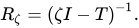
Here I is the identity operator and ζ is a complex number. The inverse of an operator T, that is T−1, is defined by:

If the inverse exists, T is called regular. If it does not exist, T is called singular.

With these definitions, the resolvent set of T is the set of all complex numbers ζ such that Rζ exists and is bounded. This set often is denoted as ρ(T). The spectrum of T is the set of all complex numbers ζ such that Rζ fails to exist or is unbounded. Often the spectrum of T is denoted by σ(T). The function Rζ for all ζ in ρ(T) (that is, wherever Rζ exists as a bounded operator) is called the resolvent of T. The spectrum of T is therefore the complement of the resolvent set of T in the complex plane.[10] Every eigenvalue of T belongs to σ(T), but σ(T) may contain non-eigenvalues.[11]

This definition applies to a Banach space, but of course other types of space exist as well; for example, topological vector spaces include Banach spaces, but can be more general.[12][13] On the other hand, Banach spaces include Hilbert spaces, and it is these spaces that find the greatest application and the richest theoretical results.[14] With suitable restrictions, much can be said about the structure of the spectra of transformations in a Hilbert space. In particular, for self-adjoint operators, the spectrum lies on the real line and (in general) is a spectral combination of a point spectrum of discrete eigenvalues and a continuous spectrum.[15]

Spectral theory briefly

[edit]

In functional analysis and linear algebra the spectral theorem establishes conditions under which an operator can be expressed in simple form as a sum of simpler operators. As a full rigorous presentation is not appropriate for this article, we take an approach that avoids much of the rigor and satisfaction of a formal treatment with the aim of being more comprehensible to a non-specialist.

This topic is easiest to describe by introducing the bra–ket notation of Dirac for operators.[16][17] As an example, a very particular linear operator L might be written as a dyadic product:[18][19]
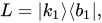
in terms of the "bra" ⟨b1| and the "ket" |k1⟩. A function f is described by a ket as |f ⟩. The function f(x) defined on the coordinates is denoted as

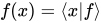
and the magnitude of f by

where the notation (*) denotes a complex conjugate. This inner product choice defines a very specific inner product space, restricting the generality of the arguments that follow.[14]

The effect of L upon a function f is then described as:

expressing the result that the effect of L on f is to produce a new function multiplied by the inner product represented by .

A more general linear operator L might be expressed as:

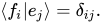
where the are scalars and the are a basis and the a reciprocal basis for the space. The relation between the basis and the reciprocal basis is described, in part, by:

If such a formalism applies, the are eigenvalues of L and the functions are eigenfunctions of L. The eigenvalues are in the spectrum of L.[20]

Some natural questions are: under what circumstances does this formalism work, and for what operators L are expansions in series of other operators like this possible? Can any function f be expressed in terms of the eigenfunctions (are they a Schauder basis) and under what circumstances does a point spectrum or a continuous spectrum arise? How do the formalisms for infinite-dimensional spaces and finite-dimensional spaces differ, or do they differ? Can these ideas be extended to a broader class of spaces? Answering such questions is the realm of spectral theory and requires considerable background in functional analysis and matrix algebra.

Resolution of the identity

[edit]

This section continues in the rough and ready manner of the above section using the bra–ket notation, and glossing over the many important details of a rigorous treatment.[21] A rigorous mathematical treatment may be found in various references.[22] In particular, the dimension n of the space will be finite.

Using the bra–ket notation of the above section, the identity operator may be written as:
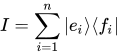
where it is supposed as above that are a basis and the a reciprocal basis for the space satisfying the relation:

This expression of the identity operation is called a representation or a resolution of the identity.[21][22] This formal representation satisfies the basic property of the identity:

valid for every positive integer k.

Applying the resolution of the identity to any function in the space , one obtains:

which is the generalized Fourier expansion of ψ in terms of the basis functions { ei }.[23] Here .

Given some operator equation of the form:

with h in the space, this equation can be solved in the above basis through the formal manipulations:


which converts the operator equation to a matrix equation determining the unknown coefficients cj in terms of the generalized Fourier coefficients of h and the matrix elements of the operator O.


The role of spectral theory arises in establishing the nature and existence of the basis and the reciprocal basis. In particular, the basis might consist of the eigenfunctions of some linear operator L:

with the { λi } the eigenvalues of L from the spectrum of L. Then the resolution of the identity above provides the dyad expansion of L:

Resolvent operator

[edit]

Using spectral theory, the resolvent operator R:

can be evaluated in terms of the eigenfunctions and eigenvalues of L, and the Green's function corresponding to L can be found.

Applying R to some arbitrary function in the space, say ,

This function has poles in the complex λ-plane at each eigenvalue of L. Thus, using the calculus of residues:

where the line integral is over a contour C that includes all the eigenvalues of L.

Suppose our functions are defined over some coordinates {xj}, that is:

Introducing the notation

where δ(x − y) = δ(x1 − y1, x2 − y2, x3 − y3, ...) is the Dirac delta function,[24] we can write
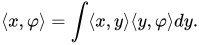
Then:

The function G(x, y; λ) defined by:
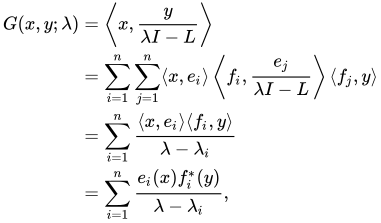
is called the Green's function for operator L, and satisfies:[25]

Operator equations

[edit]

Consider the operator equation:

in terms of coordinates:

A particular case is λ = 0.

The Green's function of the previous section is:

and satisfies:

Using this Green's function property:

Then, multiplying both sides of this equation by h(z) and integrating:

which suggests the solution is:

That is, the function ψ(x) satisfying the operator equation is found if we can find the spectrum of O, and construct G, for example by using:
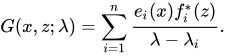
There are many other ways to find G, of course.[26] See the articles on Green's functions and on Fredholm integral equations. It must be kept in mind that the above mathematics is purely formal, and a rigorous treatment involves some pretty sophisticated mathematics, including a good background knowledge of functional analysis, Hilbert spaces, distributions and so forth. Consult these articles and the references for more detail.

Spectral theorem and Rayleigh quotient

[edit]

Optimization problems may be the most useful examples about the combinatorial significance of the eigenvalues and eigenvectors in symmetric matrices, especially for the Rayleigh quotient with respect to a matrix M.

Theorem Let M be a symmetric matrix and let x be the non-zero vector that maximizes the Rayleigh quotient with respect to M. Then, x is an eigenvector of M with eigenvalue equal to the Rayleigh quotient. Moreover, this eigenvalue is the largest eigenvalue of M.

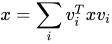
Proof Assume the spectral theorem. Let the eigenvalues of M be . Since the form an orthonormal basis, any vector x can be expressed in this basis as

The way to prove this formula is pretty easy. Namely,

evaluate the Rayleigh quotient with respect to x:

where we used Parseval's identity in the last line. Finally we obtain that
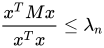
so the Rayleigh quotient is always less than .[27]

See also

[edit]

Notes

[edit]

References

[edit]
[edit]
Revisions and contributorsEdit on WikipediaRead on Wikipedia
from Grokipedia
Spectral theory is a branch of functional analysis in mathematics that generalizes the eigenvalue and eigenvector theory from finite-dimensional vector spaces to linear operators on infinite-dimensional spaces, such as Banach and Hilbert spaces.[1] It focuses on the spectrum of an operator, defined as the set of complex numbers λ\lambda for which the operator AλIA - \lambda I is not invertible, providing a framework to decompose operators and solve associated equations.[2] This theory enables the representation of operators in forms amenable to analysis, such as diagonal or block-diagonal structures, reducing complex problems into manageable invariant subspaces.[3] Central to spectral theory are the classifications of the spectrum: the point spectrum consists of eigenvalues λ\lambda where there exists a non-zero eigenvector uu satisfying Au=λuAu = \lambda u; the continuous spectrum involves approximate eigenvalues without exact eigenvectors; and the residual spectrum covers values where AλIA - \lambda I is injective but not surjective.[2] For self-adjoint operators on Hilbert spaces, the spectral theorem guarantees a unique spectral measure that integrates to reconstruct the operator, allowing it to act as multiplication by a function on a suitable space.[2] This theorem, along with extensions to normal and compact operators, forms the cornerstone for understanding operator behavior and stability.[1] Spectral theory originated in the 19th century with Fourier's work on trigonometric series for solving heat equations and Sturm-Liouville boundary value problems, which implicitly involved spectral decompositions.[4] It advanced through Fredholm's 1900 spectral theorem for integral operators and Hilbert's formulation of infinite-dimensional spaces around 1904–1912, culminating in von Neumann's 1927–1929 extensions to unbounded operators.[4] Applications span quantum mechanics, where operator spectra determine energy eigenvalues and stationary states; differential geometry, as in the analysis of Laplace-Beltrami operators for manifold shapes; and numerical methods for partial differential equations via finite element approximations.[2][3]

Introduction

Overview and scope

Spectral theory is a branch of functional analysis that studies the eigenvalues, eigenvectors, and generalized eigenspaces of linear operators acting on infinite-dimensional spaces, particularly extending the concept of diagonalization from finite-dimensional linear algebra to more complex settings.[5] In this framework, the theory seeks to classify operators by analyzing their spectral properties, allowing for a decomposition of the operator into simpler, often multiplicative, components that facilitate understanding and computation.[6] Unlike finite-dimensional spectral theory, which relies on tools like characteristic polynomials to determine eigenvalues for matrices, spectral theory in infinite dimensions addresses the absence of such finite methods and emphasizes operators—bounded or unbounded—defined on Hilbert spaces.[5] This extension is crucial because many natural operators arising in analysis and physics, such as those in partial differential equations, are unbounded and require careful treatment within the structure of Hilbert spaces to ensure well-defined spectra.[6] A central role of spectral theory lies in its use of spectral measures to decompose operators, enabling the representation of an operator as an integral with respect to these measures, which simplifies the analysis of operator actions on vectors.[5] This decomposition provides a powerful tool for solving problems where direct computation is infeasible. Key motivations include the simplification of differential equations, where spectral decompositions reveal solution behaviors through eigenvalues, and the modeling of quantum observables, where self-adjoint operators correspond to physical quantities like energy.[5] Pioneered by mathematicians such as David Hilbert and Marshall Stone, the theory has become foundational in modern mathematics and physics.[4]

Historical development

The origins of spectral theory lie in the 19th-century study of eigenvalues and eigenvectors for finite matrices. Augustin-Louis Cauchy laid early foundations in 1826 by analyzing quadratic forms in n variables, where he introduced the term "tableau" for the coefficient matrix, proved that real symmetric matrices have real eigenvalues, and demonstrated their diagonalizability over the reals.[7] These results established key algebraic properties that would underpin later generalizations. Leopold Kronecker further advanced the field in the 1850s and 1860s through his work on linear transformations and determinants, providing tools for handling matrix equations that influenced later developments.[7] David Hilbert's contributions from 1906 to 1910 marked a pivotal shift toward infinite-dimensional operators. Motivated by Fredholm's work on integral equations, Hilbert developed spectral decompositions for bounded symmetric integral operators acting on spaces of square-integrable functions, which he formalized as Hilbert spaces. In a series of six papers culminating in his 1910 work, he introduced the concept of the continuous spectrum and the resolvent operator, freeing spectral analysis from strict ties to integral equations and establishing an abstract framework.[8][4] In the 1930s, Marshall Stone generalized Hilbert's results to unbounded self-adjoint operators. Stone's 1932 book, Linear Transformations in Hilbert Space, provided a rigorous spectral theorem integrating measure theory and functional analysis, resolving open questions about unbounded operators and solidifying the role of Hilbert spaces in operator theory.[4] Concurrently, John von Neumann extended spectral theory to normal operators, including the unbounded case, in works from 1929 onward, applying it to quantum mechanics through abstract Hilbert space formulations. Post-World War II, von Neumann's advancements emphasized applications in quantum theory and ergodic theory within functional analysis, influencing computational and physical modeling.[4] Modern extensions in the mid-20th century included Béla Sz.-Nagy's dilation theorem in 1953, which showed that every contraction operator on a Hilbert space dilates to a unitary operator, broadening spectral methods to non-self-adjoint cases and inspiring further developments in operator theory.[9]

Background Concepts

Mathematical foundations

A Hilbert space is a complete inner product space over the real or complex numbers, providing the natural setting for spectral theory due to its geometric structure and convergence properties. Specifically, it is a vector space HH equipped with an inner product ,\langle \cdot, \cdot \rangle that satisfies linearity in the first argument, conjugate symmetry x,y=y,x\langle x, y \rangle = \overline{\langle y, x \rangle}, and positive definiteness x,x0\langle x, x \rangle \geq 0 with equality if and only if x=0x = 0. The induced norm is x=x,x\|x\| = \sqrt{\langle x, x \rangle}, turning HH into a metric space. Completeness means every Cauchy sequence {xn}\{x_n\} (where xmxn0\|x_m - x_n\| \to 0 as m,nm, n \to \infty) converges to some xHx \in H. Orthogonality holds when x,y=0\langle x, y \rangle = 0, enabling decompositions like the orthogonal direct sum H=MMH = M \oplus M^\perp for closed subspaces MM, where M={yH:x,y=0 xM}M^\perp = \{ y \in H : \langle x, y \rangle = 0 \ \forall x \in M \}.[10] Linear operators on a Hilbert space HH map vectors to vectors, defined as T:D(T)HHT: D(T) \subseteq H \to H, with D(T)D(T) as the domain. Bounded operators satisfy D(T)=HD(T) = H and have finite operator norm T=supx1Tx<\|T\| = \sup_{\|x\| \leq 1} \|Tx\| < \infty, implying continuity and uniform boundedness. Unbounded operators, in contrast, are defined on proper subspaces D(T)HD(T) \subsetneq H and lack a uniform bound, often arising in differential equations. The adjoint TT^* of a densely defined operator TT is the unique operator satisfying Tx,y=x,Ty\langle Tx, y \rangle = \langle x, T^* y \rangle for all xD(T)x \in D(T), yD(T)y \in D(T^*), where D(T)={yH:zH Tx,y=x,z xD(T)}D(T^*) = \{ y \in H : \exists z \in H \ \langle Tx, y \rangle = \langle x, z \rangle \ \forall x \in D(T) \}. For bounded TT, TT^* is also bounded with T=T\|T^*\| = \|T\|.[11][12] Self-adjoint operators on HH are those with T=TT = T^* on a common domain, equivalently Tx,y=x,Ty\langle Tx, y \rangle = \langle x, Ty \rangle for all x,yD(T)x, y \in D(T), ensuring real eigenvalues and orthogonal eigenspaces in finite dimensions. Normal operators satisfy TT=TTTT^* = T^*T, encompassing self-adjoint and unitary operators (where TT=IT^* T = I); they preserve the inner product structure, with Tx=Tx\|T x\| = \|T^* x\| for all xx. These operators are crucial for maintaining symmetry and unitarity in infinite-dimensional settings.[11] Basic functional analysis concepts underpin the rigor of operator theory. A subspace DHD \subseteq H is dense if its closure D=H\overline{D} = H, allowing operators defined on DD to approximate actions on all of HH via limits. Closed operators have closed graphs G(T)={(x,Tx):xD(T)}HHG(T) = \{ (x, Tx) : x \in D(T) \} \subseteq H \oplus H, meaning if xnxx_n \to x and TxnyTx_n \to y, then xD(T)x \in D(T) and Tx=yTx = y; this ensures the domain is complete under the graph norm xD(T)=x2+Tx2\|x\|_{D(T)} = \sqrt{\|x\|^2 + \|Tx\|^2}. The complex plane C\mathbb{C} plays a foundational role in resolvents, where points λC\lambda \in \mathbb{C} outside certain regions allow invertible shifts λIT\lambda I - T, facilitating analytic tools for operator behavior.[13]

Physical motivations

Spectral theory emerged as a crucial framework in physics to address problems involving discrete energy levels and oscillatory behaviors, driven by early 20th-century discoveries in radiation and mechanics. Max Planck's introduction of energy quantization in 1900 to resolve the blackbody radiation spectrum implied that physical systems exhibit discrete spectral lines rather than continuous distributions, laying the groundwork for analyzing atomic spectra through eigenvalue decompositions.[14] This quantization concept necessitated mathematical tools to handle the spectra of physical operators, influencing the development of spectral theory in infinite-dimensional spaces. Later, Paul Dirac's formulation in the 1930s further emphasized spectral decompositions by representing quantum observables as self-adjoint operators whose eigenvalues correspond to measurable outcomes, unifying earlier approaches in quantum mechanics. In classical mechanics, spectral theory finds motivation in the study of vibrations and waves, where normal modes represent independent oscillatory patterns that diagonalize the system's dynamics. For instance, the vibration of a string or membrane leads to eigenvalue problems for differential operators, as seen in the separation of variables for wave equations, where eigenvalues determine the frequencies of normal modes.[4] This approach, rooted in 19th-century work on Sturm-Liouville boundary value problems motivated by wave propagation and heat conduction, transforms coupled oscillations into uncoupled ones via spectral analysis, providing a physical interpretation of eigenvalues as resonant frequencies.[15] Quantum mechanics provided a profound physical impetus for spectral theory, particularly through the time-independent Schrödinger equation, which poses a spectral problem for the Hamiltonian operator: $ H \psi = E \psi $, where $ E $ are the energy eigenvalues representing possible measurement outcomes for the system's energy.[16] Here, operators such as position and momentum, representing physical observables, have spectra that dictate the discrete results of quantum measurements, as formalized in the 1920s by Heisenberg and Schrödinger's matrix and wave mechanics.[4] John von Neumann's extensions in 1929 to unbounded operators in Hilbert space were directly inspired by these quantum needs, enabling rigorous spectral decompositions for Hamiltonians in realistic physical models.[4]

Core Definitions

Spectrum of an operator

In functional analysis, the spectrum of a bounded linear operator TT on a complex Banach space XX is defined as the set σ(T)={λC:TλI does not have a bounded inverse in B(X)}\sigma(T) = \{ \lambda \in \mathbb{C} : T - \lambda I \text{ does not have a bounded inverse in } \mathcal{B}(X) \}, where B(X)\mathcal{B}(X) is the algebra of bounded linear operators on XX.[6] This set generalizes the notion of eigenvalues from finite-dimensional linear algebra to infinite-dimensional settings, capturing values of λ\lambda for which TλIT - \lambda I fails to be bijective.[6] The spectrum is always a nonempty compact subset of C\mathbb{C}.[6] The spectrum σ(T)\sigma(T) decomposes into three disjoint subsets: the point spectrum σp(T)\sigma_p(T), the continuous spectrum σc(T)\sigma_c(T), and the residual spectrum σr(T)\sigma_r(T). The point spectrum consists of eigenvalues, i.e., σp(T)={λC:TλI is not injective}\sigma_p(T) = \{ \lambda \in \mathbb{C} : T - \lambda I \text{ is not injective} \}, where the kernel of TλIT - \lambda I contains nonzero vectors.[6] The continuous spectrum includes points where TλIT - \lambda I is injective with dense but not closed range (hence not surjective).[6] The residual spectrum comprises points where TλIT - \lambda I is injective but the range is not dense.[6] These distinctions highlight how invertibility fails in different ways, with the point spectrum reflecting discrete spectral behavior and the others indicating more continuous or defective structures.[6] A classic example illustrating these components is the unilateral right shift operator RR on the Hilbert space 2(N)\ell^2(\mathbb{N}), defined by R(x1,x2,x3,)=(0,x1,x2,)R(x_1, x_2, x_3, \dots) = (0, x_1, x_2, \dots). Here, σ(R)\sigma(R) is the closed unit disk {λC:λ1}\{ \lambda \in \mathbb{C} : |\lambda| \leq 1 \}, with empty point spectrum σp(R)=\sigma_p(R) = \emptyset, residual spectrum σr(R)={λC:λ<1}\sigma_r(R) = \{ \lambda \in \mathbb{C} : |\lambda| < 1 \}, and continuous spectrum σc(R)={λC:λ=1}\sigma_c(R) = \{ \lambda \in \mathbb{C} : |\lambda| = 1 \}.[17] In contrast, the adjoint left shift L=RL = R^*, given by L(x1,x2,x3,)=(x2,x3,)L(x_1, x_2, x_3, \dots) = (x_2, x_3, \dots), has point spectrum σp(L)={λC:λ<1}\sigma_p(L) = \{ \lambda \in \mathbb{C} : |\lambda| < 1 \}, empty residual spectrum, and continuous spectrum on the unit circle, showing how adjoint operators can swap residual and point spectral components.[17] For self-adjoint operators AA on a Hilbert space, the spectrum σ(A)\sigma(A) lies on the real line, i.e., σ(A)R\sigma(A) \subseteq \mathbb{R}, reflecting the operator's symmetry.[18] Moreover, the spectral radius equals the operator norm, so sup{λ:λσ(A)}=A\sup \{ |\lambda| : \lambda \in \sigma(A) \} = \|A\|, bounding the spectrum within [A,A][- \|A\|, \|A\| ].[18] In infinite-dimensional spaces, the geometric multiplicity of an eigenvalue λσp(T)\lambda \in \sigma_p(T) is the dimension of the eigenspace ker(TλI)\ker(T - \lambda I), which can be finite or infinite and measures the "degeneracy" of the eigenvector space.[19] The algebraic multiplicity, generalizing the finite-dimensional case, is the dimension of the generalized eigenspace n=1ker(TλI)n\bigcup_{n=1}^\infty \ker(T - \lambda I)^n, or equivalently the ascent of TλIT - \lambda I (the smallest mm such that ker(TλI)m=ker(TλI)m+k\ker(T - \lambda I)^m = \ker(T - \lambda I)^{m+k} for all k0k \geq 0), which may exceed the geometric multiplicity for non-normal operators.[20] For self-adjoint operators, geometric and algebraic multiplicities coincide for each eigenvalue.[19] The resolvent set ρ(T)=Cσ(T)\rho(T) = \mathbb{C} \setminus \sigma(T) consists of points where TλIT - \lambda I is invertible.[6]

Resolvent operator

The resolvent operator serves as a fundamental analytic tool in spectral theory for investigating the spectrum of a linear operator $ T $ acting on a Banach space. For a complex number $ \lambda $ belonging to the resolvent set $ \rho(T) $, which consists of those $ \lambda $ for which $ T - \lambda I $ is bijective with a bounded inverse, the resolvent is defined by
R(λ,T)=(TλI)1. R(\lambda, T) = (T - \lambda I)^{-1}.
The spectrum $ \sigma(T) $ is precisely the complement of $ \rho(T) $ in the complex plane.[6] This operator-valued function encodes essential information about the operator's behavior, particularly through its singularities at points in $ \sigma(T) $. The resolvent $ R(\lambda, T) $ exhibits strong analytic properties: it is holomorphic as a function from $ \rho(T) $ to the space of bounded operators, meaning it admits a power series expansion around any point in $ \rho(T) $. Specifically, near a point $ \mu \in \rho(T) $,
R(λ,T)=n=0(1)n(λμ)nR(μ,T)n+1, R(\lambda, T) = \sum_{n=0}^{\infty} (-1)^n (\lambda - \mu)^n R(\mu, T)^{n+1},
valid for $ |\lambda - \mu| < |R(\mu, T)|^{-1} $. The singularities of $ R(\lambda, T) $ occur at the points of $ \sigma(T) $, where isolated eigenvalues typically manifest as poles, while continuous spectrum leads to branch points or essential singularities.[21][6] A key relation is the resolvent identity, which connects the resolvents at distinct points in $ \rho(T) $: for $ \lambda, \mu \in \rho(T) $ with $ \lambda \neq \mu $,
R(λ,T)R(μ,T)=(μλ)R(λ,T)R(μ,T). R(\lambda, T) - R(\mu, T) = (\mu - \lambda) R(\lambda, T) R(\mu, T).
This identity, also known as the first Hilbert identity, facilitates computations and proofs involving the resolvent's behavior across the complex plane.[6][22] The resolvent plays a crucial role in establishing the spectral radius formula for $ T $. The spectral radius $ r(T) $ is defined as
r(T)=limnTn1/n=sup{λ:λσ(T)}, r(T) = \lim_{n \to \infty} \|T^n\|^{1/n} = \sup \{ |\lambda| : \lambda \in \sigma(T) \},
and the resolvent set contains the exterior of the disk $ { \lambda : |\lambda| > r(T) } $, where Neumann series expansions converge:
R(λ,T)=1λk=0(Tλ)k,λ>r(T). R(\lambda, T) = -\frac{1}{\lambda} \sum_{k=0}^{\infty} \left( \frac{T}{\lambda} \right)^k, \quad |\lambda| > r(T).
This connection allows bounds on $ r(T) $ via resolvent norms, as $ |R(\lambda, T)| \leq 1 / (|\lambda| - r(T)) $ for large $ |\lambda| $.[21][6]

Key Theoretical Frameworks

Resolution of the identity

In spectral theory, the resolution of the identity provides a measure-theoretic framework for decomposing self-adjoint operators on a Hilbert space, facilitating the construction of functional calculus through integration over the spectrum. For a self-adjoint operator AA acting on a Hilbert space HH, the resolution of the identity is a projection-valued measure EE defined on the Borel σ\sigma-algebra B(R)\mathcal{B}(\mathbb{R}) of the real line, satisfying A=RλdE(λ)A = \int_{\mathbb{R}} \lambda \, dE(\lambda). This integral is understood in the strong operator topology, and the support of EE is contained within the spectrum σ(A)\sigma(A).[23] Key properties of the resolution EE ensure its utility as a spectral measure. For disjoint Borel sets Δ1,Δ2R\Delta_1, \Delta_2 \subseteq \mathbb{R}, the projections satisfy orthogonality: E(Δ1)E(Δ2)=0E(\Delta_1) E(\Delta_2) = 0. Additionally, completeness holds via RdE(λ)=I\int_{\mathbb{R}} dE(\lambda) = I, where II is the identity operator on HH, reflecting the decomposition of the entire space. These properties extend the classical resolution for finite-dimensional diagonalizable matrices to infinite dimensions, enabling the representation of bounded Borel functions ff as operators via f(A)=Rf(λ)dE(λ)f(A) = \int_{\mathbb{R}} f(\lambda) \, dE(\lambda).[23] The construction of the resolution relies on the Riesz representation theorem applied to the commutative C*-algebra generated by AA and the identity. Specifically, the Gelfand transform maps this algebra to continuous functions on its spectrum Δ=σ(A)\Delta = \sigma(A), and the sesquilinear forms x,φ(A)y=Δφ^(t)dμx,y(t)\langle x, \varphi(A) y \rangle = \int_{\Delta} \hat{\varphi}(t) \, d\mu_{x,y}(t) induce complex measures μx,y\mu_{x,y} via Riesz-Markov-Kakutani representation. The projections are then obtained as E(ω)=Φ(χω)E(\omega) = \Phi(\chi_{\omega}) for Borel sets ωΔ\omega \subseteq \Delta, where Φ\Phi is the operator-valued extension and χω\chi_{\omega} is the indicator function, yielding a unique resolution satisfying the integral representation.[24] A canonical example arises with multiplication operators on L2L^2 spaces, which illustrate the resolution explicitly. Consider the self-adjoint multiplication operator MmM_m on L2(R,μ)L^2(\mathbb{R}, \mu), where m:RRm: \mathbb{R} \to \mathbb{R} is a bounded measurable function and μ\mu is a σ\sigma-finite measure. The resolution of the identity is given by the projection-valued measure E(Δ)f=χm1(Δ)fE(\Delta) f = \chi_{m^{-1}(\Delta)} f for Borel sets ΔR\Delta \subseteq \mathbb{R}, where χm1(Δ)\chi_{m^{-1}(\Delta)} is the indicator function of the preimage set. Here, E(Δ)E(\Delta) acts as multiplication by the indicator, satisfying orthogonality for disjoint Δ\Delta and completeness over R\mathbb{R}, with Mm=RλdE(λ)M_m = \int_{\mathbb{R}} \lambda \, dE(\lambda). This setup demonstrates how the spectral measure corresponds directly to level sets of the multiplier function.[24]

Spectral theorem

The spectral theorem provides a canonical decomposition for self-adjoint operators on Hilbert spaces, revealing their underlying spectral structure analogous to diagonalization for matrices. For a bounded self-adjoint operator $ A $ acting on a separable Hilbert space $ H $, the theorem guarantees the existence of a unitary operator $ U: H \to L^2(\sigma(A), \mu) $, where $ \sigma(A) \subset \mathbb{R} $ is the spectrum of $ A $ and $ \mu $ is a positive Borel measure on $ \sigma(A) $, together with the multiplication operator $ M $ defined by $ (M \psi)(\lambda) = \lambda \psi(\lambda) $ for $ \psi \in L^2(\sigma(A), \mu) $, such that $ A = U M U^{-1} $.[25] This representation shows that $ A $ is unitarily equivalent to multiplication by the coordinate function on a suitable $ L^2 $ space, with the measure $ \mu $ uniquely determined by the spectral projections associated to $ A $. The theorem extends to unbounded self-adjoint operators defined on a dense domain, where the decomposition holds with the integral taken over the spectrum in the strong operator topology, ensuring the operator is well-defined on its domain.[25] For normal operators, which commute with their adjoints, the result generalizes via polar decomposition: any bounded normal operator $ N $ admits a polar form $ N = V |N| $, where $ V $ is a partial isometry with initial space the closure of the range of $ |N| $ and $ |N| = \sqrt{N^* N} $ is self-adjoint positive; applying the spectral theorem to $ |N| $ yields a unitary equivalence $ |N| = U M_\phi U^{-1} $ for some positive function $ \phi $, and thus $ N = (U V^) M_{\phi^{1/2}} \cdot M_{\phi^{1/2}} (U V^)^{-1} $, or more directly, $ N $ is unitarily equivalent to multiplication by a complex-valued bounded measurable function on $ L^2(\Omega, \nu) $ for some measure space $ (\Omega, \nu) $. This form captures the full spectral multiplicity, with the spectrum of $ N $ as the essential range of the multiplying function. Proofs of the spectral theorem typically rely on constructing the spectral measure from analytic properties of the operator. In Stone's approach, the resolvent $ R(\zeta) = (A - \zeta I)^{-1} $ for $ \zeta \notin \sigma(A) $ is used to define projections via contour integrals, such as $ E(\Delta) = \frac{1}{2\pi i} \int_{\partial \Delta} (z - A)^{-1} dz $ for Borel sets $ \Delta \subset \mathbb{R} $, where the family $ {E(\Delta)} $ forms a resolution of the identity satisfying $ A = \int \lambda , dE(\lambda) $; the unitary equivalence then follows by mapping to the multiplication representation induced by this measure. An alternative proof leverages the Gelfand-Naimark representation theorem for C*-algebras: the C*-algebra generated by a normal operator $ A $ and the identity is commutative and isomorphic to $ C(\sigma(A)) $, the continuous functions on its spectrum; the theorem embeds this into bounded operators on $ L^2(\sigma(A), \mu) $ via multiplication, yielding the desired unitary equivalence. A key consequence of the spectral theorem is the Borel functional calculus, which defines $ f(A) = \int_{\sigma(A)} f(\lambda) , dE(\lambda) $ for any Borel measurable function $ f: \sigma(A) \to \mathbb{C} $, or equivalently $ f(A) = U M_f U^{-1} $ where $ (M_f \psi)(\lambda) = f(\lambda) \psi(\lambda) $; this extends the continuous functional calculus and preserves the operator norm for bounded $ f $, enabling the construction of functions of operators like exponentials or powers essential in analysis and quantum mechanics. This calculus integrates with the resolution of the identity, where the projections $ E(\Delta) $ serve as the "integrating mechanism" for the spectral measure.

Applications and Methods

Solving operator equations

Spectral theory provides powerful tools for solving operator equations by leveraging the decomposition of operators into their spectral components, transforming complex problems into simpler multiplications or integrals over the spectrum. For self-adjoint operators on Hilbert spaces, the spectral theorem enables the representation of an operator AA as A=σ(A)λdE(λ)A = \int_{\sigma(A)} \lambda \, dE(\lambda), where EE is the spectral resolution of the identity, allowing equations involving AA to be addressed through this integral form.[26] In eigenvalue problems of the form Ax=λxA x = \lambda x, spectral decomposition reduces the equation to a multiplication problem in the spectral basis. Specifically, applying the projection dE(μ)dE(\mu) to both sides yields (μλ)dE(μ)x=0\int (\mu - \lambda) dE(\mu) x = 0, implying that xx lies in the eigenspace corresponding to eigenvalue λ\lambda, where the operator acts as multiplication by λ\lambda on that subspace. This approach diagonalizes the problem, facilitating the identification of eigenvalues as points in the spectrum where the resolvent fails to be invertible and eigenvectors as elements in the corresponding spectral subspaces.[27][28] For the time-dependent Schrödinger equation itψ=Hψi \partial_t \psi = H \psi, where HH is the self-adjoint Hamiltonian operator, the spectral theorem yields the explicit solution ψ(t)=σ(H)eiλtdE(λ)ψ(0)\psi(t) = \int_{\sigma(H)} e^{-i \lambda t} \, dE(\lambda) \psi(0). This integral form evolves the initial state ψ(0)\psi(0) by multiplying each spectral component by the phase factor eiλte^{-i \lambda t}, capturing the unitary time evolution governed by the spectrum of HH. The resolution ensures that the solution preserves the norm and orthogonality of the initial condition's projection onto eigenspaces.[28][29] Inverse problems, such as solving (Aλ)x=y(A - \lambda) x = y for xx when λ\lambda is not in the spectrum of AA, rely on the resolvent operator R(λ)=(AλI)1R(\lambda) = (A - \lambda I)^{-1}, which applies the spectral decomposition to express x=σ(A)(μλ)1dE(μ)yx = \int_{\sigma(A)} (\mu - \lambda)^{-1} \, dE(\mu) y. This integral inverts the shifted operator by scaling each spectral component by the reciprocal distance from λ\lambda, providing a solution valid in the resolvent set. The method extends to perturbed operators, where stability of the solution depends on the spectral gap around λ\lambda.[6][29] A representative example is the quantum harmonic oscillator, governed by the operator H=d2dx2+x2H = -\frac{d^2}{dx^2} + x^2 on L2(R)L^2(\mathbb{R}), whose spectrum consists of discrete eigenvalues λn=2n+1\lambda_n = 2n + 1 for n=0,1,2,n = 0, 1, 2, \dots. The spectral decomposition H=n=0(2n+1)PnH = \sum_{n=0}^\infty (2n + 1) P_n, with projections PnP_n onto Hermite function eigenfunctions, solves the eigenvalue equation Hϕn=λnϕnH \phi_n = \lambda_n \phi_n directly as multiplication in this basis, and extends to time evolution via ψ(t)=n=0ei(2n+1)tϕnψ(0)ϕn\psi(t) = \sum_{n=0}^\infty e^{-i (2n+1) t} \langle \phi_n | \psi(0) \rangle \phi_n. For the heat equation tu=Δu\partial_t u = \Delta u on a bounded domain with appropriate boundary conditions, spectral theory solves it through the decomposition of the Laplacian Δ=σ(Δ)λdE(λ)\Delta = \int_{\sigma(\Delta)} \lambda \, dE(\lambda), yielding u(t)=σ(Δ)eλtdE(λ)u(0)u(t) = \int_{\sigma(\Delta)} e^{\lambda t} \, dE(\lambda) u(0), where the negative eigenvalues λ<0\lambda < 0 ensure decay. Equivalently, applying the Laplace transform in time converts the equation to (λIΔ)u^(λ)=u(0)(\lambda I - \Delta) \hat{u}(\lambda) = u(0), solved via the resolvent as u^(λ)=R(λ)u(0)=σ(Δ)(μλ)1dE(μ)u(0)\hat{u}(\lambda) = -R(\lambda) u(0) = -\int_{\sigma(\Delta)} (\mu - \lambda)^{-1} \, dE(\mu) u(0), with inversion recovering u(t)u(t).[28][6]

Rayleigh quotient and variational principles

The Rayleigh quotient for a self-adjoint operator AA on a Hilbert space is defined as
R(x)=Ax,xx,x R(x) = \frac{\langle A x, x \rangle}{\langle x, x \rangle}
for nonzero xx in the domain of AA.[30] The critical points of this quotient, where its gradient vanishes, correspond to the eigenvalues of AA, with the associated eigenvectors achieving stationary values of R(x)R(x).[30] A fundamental result linking the Rayleigh quotient to the spectrum is the min-max theorem, which characterizes the kk-th largest eigenvalue λk\lambda_k of a self-adjoint operator (or symmetric matrix) as
λk=mindimV=nk+1maxxVx=1R(x), \lambda_k = \min_{\dim V = n-k+1} \max_{\substack{x \in V \\ \|x\|=1}} R(x),
where the minimum is over all subspaces VV of dimension nk+1n-k+1.[31] Equivalently, it can be expressed in max-min form as
λk=maxdimW=kminxWx=1R(x), \lambda_k = \max_{\dim W = k} \min_{\substack{x \in W \\ \|x\|=1}} R(x),
with the maximum over subspaces WW of dimension kk.[31] This variational principle provides bounds on eigenvalues without explicit computation of the spectrum. The Courant-Fischer characterization, a refinement of the min-max theorem, further specifies that the eigenvalues satisfy
λk=maxdimS=kminxSx0Ax,xx,x=mindimT=nk+1maxxTx0Ax,xx,x, \lambda_k = \max_{\dim S = k} \min_{\substack{x \in S \\ x \neq 0}} \frac{\langle A x, x \rangle}{\langle x, x \rangle} = \min_{\dim T = n-k+1} \max_{\substack{x \in T \\ x \neq 0}} \frac{\langle A x, x \rangle}{\langle x, x \rangle},
enabling rigorous error bounds in approximations.[31] In numerical methods, this characterization underpins the Ritz-Galerkin approach, where the eigenvalue problem is projected onto a low-dimensional subspace (e.g., a Krylov subspace) via the Galerkin condition, yielding Ritz values that minimize or maximize the Rayleigh quotient over that subspace for optimal approximation.[32] Specifically, the Ritz pairs satisfy variational properties derived from Courant-Fischer, ensuring that the approximate eigenvalues interlace the true ones and providing bounds like 0λiμi(λiλn)[ζiTki(1+2δi)tanθ(ui,v)]20 \leq \lambda_i - \mu_i \leq (\lambda_i - \lambda_n) [\zeta_i T_{k-i}(1 + 2\delta_i) \tan\theta(u_i, v)]^2, where μi\mu_i are Ritz values.[32] In Sturm-Liouville problems, the Rayleigh quotient facilitates bounding eigenvalues by evaluating it on trial functions satisfying the boundary conditions. For the standard form ddx(p(x)dydx)+q(x)y=λσ(x)y-\frac{d}{dx} \left( p(x) \frac{dy}{dx} \right) + q(x) y = \lambda \sigma(x) y, the quotient is
R(y)=pydydxab+ab[p(dydx)2qy2]dxaby2σdx, R(y) = \frac{ -p y \frac{dy}{dx} \big|_a^b + \int_a^b \left[ p \left( \frac{dy}{dx} \right)^2 - q y^2 \right] dx }{ \int_a^b y^2 \sigma \, dx },
and the smallest eigenvalue is the minimum of R(y)R(y) over admissible yy, with upper bounds obtained by substituting specific trial functions.[33] For instance, in the problem ϕ+λϕ=0\phi'' + \lambda \phi = 0 with ϕ(0)=ϕ(1)=0\phi(0) = \phi(1) = 0, using the trial y(x)=xx2y(x) = x - x^2 yields R(y)=10R(y) = 10, bounding the fundamental eigenvalue λ19.87\lambda_1 \approx 9.87 from above.[33] This variational technique proves positivity of eigenvalues when R(y)>0R(y) > 0 for all trial functions and extends to higher eigenvalues via orthogonal constraints.[33]

References

User Avatar
No comments yet.