


Community hub
Recent from talks
Contribute something
Nothing was collected or created yet.
Spoke
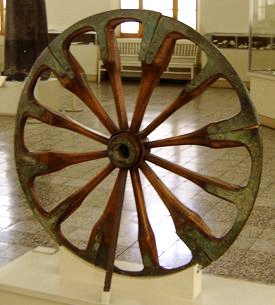
View on WikipediaA spoke is one of some number of rods radiating from the center of a wheel (the hub where the axle connects), connecting the hub with the round traction surface.


The term originally referred to portions of a log that had been riven (split lengthwise) into four or six sections. The radial members of a wagon wheel were made by carving a spoke (from a log) into their finished shape. A spokeshave is a tool originally developed for this purpose. Eventually, the term spoke was more commonly applied to the finished product of the wheelwright's work than to the materials they used.
History
[edit]The spoked wheel was invented to allow the construction of lighter and swifter vehicles. The earliest physical evidence for spoked wheels was found in the Sintashta culture, dating to c. 2000 BCE.[1] Soon after this, horse cultures of the Caucasus region used horse-drawn spoked-wheel war chariots for the greater part of three centuries. They moved deep into the Greek peninsula, where they joined with the existing Mediterranean peoples to give rise, eventually, to classical Greece after the breaking of Minoan dominance and consolidations led by pre-classical Sparta and Athens.
The levantine Hyksos are credited with introducing the spoked wheel, chariot, horse, and bronze weapons to Africa, during their conquest of Lower Egypt, and later establishment of the Fifteenth Dynasty of Egypt, from 1650 to 1550 BC.[2][3]
Neo-Chalcolithic/proto-historic period (1800-1200 BCE)[note 1] paintings in various regions of India such as Chibbar Nulla, Chhatur Bhoj Nath Nulla, Kathotia, etc. depict the usage of chariots with spoked wheels.[7][8]
Celtic chariots introduced an iron rim around the wheel in the 1st millennium BCE. The spoked wheel was in continued use without major modification until the 1870s, when wire wheels and rubber tires were invented.[9]
Construction
[edit]Spokes can be made of wood, metal, or synthetic fiber depending on whether they will be in tension or compression.
Compression spokes
[edit]The original type of spoked wheel with wooden spokes was used for horse-drawn carriages and wagons. In early motor cars, wooden spoked wheels of the artillery type were normally used.
In a simple wooden wheel, a load on the hub causes the wheel rim to flatten slightly against the ground as the lowermost wooden spoke shortens and compresses. The other wooden spokes show no significant change.
Wooden spokes are mounted radially. They are also dished, usually to the outside of the vehicle, to prevent wobbling. Also, the dishing allows the wheel to compensate for expansion of the spokes due to absorbed moisture by dishing more.[10]
Tension spokes
[edit]For use in bicycles, heavy wooden-spoked wheels were replaced by lighter wheels with spokes made of tensioned, adjustable metal wires, called wire wheels. These are also used in wheelchairs, motorcycles, automobiles, and early aircraft.
Types
[edit]Some types of wheels have removable spokes that can be replaced individually if they break or bend. These include bicycle and wheelchair wheels. High quality bicycles with conventional wheels use spokes of stainless steel, while cheaper bicycles may use galvanized (also called "rustless") or chrome plated spokes. While a good quality spoke is capable of supporting about 225 kgf (c. 500 pounds-force or 2,200 newtons) of tension, they are used at a fraction of this load to avoid suffering fatigue failures. Since bicycle and wheelchair wheel spokes are only in tension, flexible and strong materials such as synthetic fibers, are also occasionally used.[11] Metal spokes can also be ovalized or bladed to reduce aerodynamic drag, and butted (double or even triple) to reduce weight while maintaining strength.
A variation on the wire-spoked wheel was Tioga's "Tension Disk", which appeared superficially to be a solid disk but was in fact constructed using the same principles as a normal tension-spoked wheel. Instead of individual wire spokes, a continuous thread of Kevlar (aramid) was used to lace the hub to the rim under high tension. The threads were encased in a translucent disk for protection and some aerodynamic benefit, but this was not a structural component.
| wire gauge | diameter | section area |
|---|---|---|
| 15G | 1.8 mm | 2.54 mm2 |
| 14G | 2.0 mm | 3.14 mm2 |
| 13G | 2.3 mm | 4.15 mm2 |
| 12G | 2.6 mm | 5.31 mm2 |
| 11G | 2.9 mm | 6.61 mm2 |
| 10G | 3.2 mm | 8.04 mm2 |
Tangential lacing
[edit]Wire spokes can be radial to the hub but are more often mounted tangentially to the hub. Tangential spoking allows for the transfer of torque between the rim and the hub. Tangential spokes are thus necessary for the drive wheel, which has torque at the hub from pedalling, and any wheels using hub-mounted brakes such as disk or band brakes, which transfer torque from the rim to the brake in the opposite direction—(via the hub) when braking.
Wheelbuilding
[edit]Constructing a tension-spoked wheel from its constituent parts is called wheelbuilding and requires the correct building procedure for a strong and long-lasting end product. Tensioned spokes are usually attached to the rim or sometimes the hub with a spoke nipple. The other end is commonly peened into a disk or uncommonly bent into a "Z" to keep it from pulling through its hole in the hub. The bent version has the advantage of replacing a broken spoke in a rear bicycle wheel without having to remove the rear gears.
Wire wheels, with their excellent weight-to-strength ratio, soon became popular for light vehicles. For everyday cars, wire wheels were soon replaced by the less expensive metal disc wheel, but wire wheels remained popular for sports cars up to the 1960s. Spoked wheels are still popular on motorcycles and bicycles.
Spoke length
[edit]When building a bicycle wheel, the spokes must have the correct length, otherwise there may not be enough threads engaged, producing a weaker wheel, or they may protrude through the rim and possibly puncture the inner tube.
Calculation
[edit]For bicycle spokes, the spoke length is defined from the flange seat to the thread tip. For spokes with bent ends, the nominal spoke length does not include the width of the spoke at the bent end.
For wheels with crossed spokes (which are the norm), the desired spoke length is

where
- d = distance from the center of hub (along the axis) to flange, for example 30 mm,
- r1 = spoke hole circle radius of the hub, for example 19.5 mm,
- r2 = half of effective Rim Diameter (ERD), or the diameter the ends of the spokes make in a built wheel (see 'Discussion' attached to this article for explanation) of the rim, for example 301 mm,
- r3 = radius of spoke holes in the flange, for example 1.1 mm,
- m = number of spokes to be used for one side of the wheel, for example 36/2=18,
- k = number of crossings per spoke, for example 3 and
- a = 360° k/m, for example 360° ⋅ 3/18 = 60°.
Regarding d: For a symmetric wheel such as a front wheel with no disc brake, this is half the distance between the flanges. For an asymmetric wheel such as a front wheel with disc brake or a rear wheel with chain derailleur, the value of d is different for the left and right sides.
a is the angle between (1) the radius to a nipple hole in the rim to which a spoke is attached, and, (2) the radius to the flange hole holding the spoke. The spoke crosses either 1, 2, or 3 oppositely pointing spokes depending on the lacing design. On the flange, the angle between the radii of adjacent holes is 360°/m (for equally spaced holes). For each spoke crossed, the hub is rotated with reference to the rim one "angle between adjacent flange holes". Thus, multiplying the "angle between adjacent flange holes" by k gives the angle a. For example, a 32 spoke wheel has 16 spokes per side, 360° divided by 16 equals 22.5°. Multiply 22.5° ("angle between adjacent flange holes") by the number of crossings to get the angle a—if 3-crosses, the 32 spoke wheel has an angle a of 67.5°. Regarding r3: The size of the spoke holes in the flange does not matter for the needed spoke length. This term removes the effect of the hole size. Since the holes are usually small (just over 2 mm in diameter), the effect is small and in practice matters little.
For radially spoked wheels (zero crossings), the formula simplifies to the Pythagorean theorem, with spoke length l plus r3 being the slope, r2 minus r1 being the base, and d being the rise:
- ; or solving for the length



Derivation
[edit]The spoke length formula computes the length of the space diagonal of an imaginary rectangular box. Imagine holding a wheel in front of you such that a nipple is at the top. Look at the wheel from along the axis. The spoke through the top hole is now a diagonal of the imaginary box. The box has a depth of d, a height of r2-r1cos(α) and a width of r1sin(a).
Equivalently, the law of cosines may be used to first compute the length of the spoke as projected on the wheel's plane (as illustrated in the diagram), followed by an application of the Pythagorean theorem.
See also
[edit]Notes
[edit]- ^ Neumayer 1800-1200 BCE;[4][5] Celeste Paxton 2300-1000 BCE).[6] See Bradshaw Foundation, The Prehistoric Paintings of the Pachmarhi Hills, for proto-historic/chalocolithic.
References
[edit]- ^ Lindner, Stephan, (2020). "Chariots in the Eurasian Steppe: a Bayesian approach to the emergence of horse-drawn transport in the earlysecond millennium BC", in Antiquity, Vol 94, Issue 374, April 2020, p. 367: "...The 12 calibrated radiocarbon dates belonging to the Sintashta horizon range between 2050 and 1760 cal BC (at 95.4% confidence; Epimakhov & Krause 2013: 137). These dates correlate well with the seven AMS-sampled Sintashta graves in the associated KA-5cemetery, which date to 2040–1730 cal BC (95.4% confidence...)".
- ^ Shaw, Ian, ed. (2000). The Oxford History of Ancient Egypt. Oxford University Press. p. 481. ISBN 0-19-815034-2.
- ^ Bunson, Margaret (2014). Encyclopedia of Ancient Egypt. Infobase Publishing. p. 110. ISBN 978-1-4381-0997-8.
- ^ Neumayer, Erwin. "Chariots in the Chalcolithic Rock Art of Indian" (PDF).
- ^ harappa.com, Chariots in the Chalcolithic Rock Art of India
- ^ Celeste Paxton (2016), in Voices from the past: Researcher explores a mystery across 40 centuries .
- ^ Neumayer, Erwin (28 March 2013). Prehistoric Rock Art of India. ISBN 978-0198060987.
- ^ Neumayer, Erwin. "The Chariot in Indian Rock Art" (PDF). Harrapa.com.
- ^ Herlihy, David (2004). Bicycle: the History. Yale University Press. p. 141. ISBN 0-300-10418-9. Retrieved 2009-09-29.
- ^ "Hansen Wheel and Wagon Shop". 2006. Archived from the original on 2006-08-14. Retrieved 2006-08-22.
- ^ "PBO Spoke Technology". 2006. Archived from the original on 2011-10-30. Retrieved 2011-10-21.
- ^ "Basic spokes". Sapim N.V.
External links
[edit]
- Online spoke length calculator (German), uses slightly different measures than the above formula (in German)
| Frame |  | |
|---|---|---|
| Wheels | ||
| Drivetrain | ||
| Cabling | ||
| Peripherals | ||
Spoke
View on GrokipediaFundamentals
Definition and Function
A spoke is a rod or wire that radiates from the hub to the rim of a wheel, serving as a key structural element that provides integrity and distributes loads across the wheel assembly.[3] This design allows the wheel to withstand various stresses while facilitating efficient rotation. The term "spoke" derives from Old English spāca, denoting a ray or line, reflecting its radial arrangement akin to spokes emanating from a central point.[13] The primary function of a spoke is to transfer radial and tangential forces from the rim to the hub, enabling the wheel to rotate smoothly while preserving its shape under dynamic conditions such as rider weight, ground impacts, and centrifugal forces during motion.[14] Radial forces, primarily vertical loads from weight or impacts, are supported by the collective action of the spokes, which distribute these stresses evenly to prevent deformation. Tangential forces, arising from torque during acceleration or braking, are transmitted through the angled orientation of the spokes, ensuring power delivery without compromising stability.[15] In terms of basic mechanics, spokes operate on principles of tension and compression to maintain wheel equilibrium. Under load, spokes on the lower portion experience reduced tension, while those on top bear increased tension; this balance is achieved through pre-tensioning in many designs, ensuring the spokes remain in tension to resist buckling and absorb vibrations effectively.[16] Spoked wheels find application in bicycles and vehicles, where this mechanism supports efficient load handling and durability.[17]Components of a Spoked Wheel
The hub serves as the central component of a spoked wheel, connecting the wheel to the bicycle frame via an axle and providing the primary anchorage point for the spokes.[18] It features protruding flanges on either side, each containing evenly spaced holes through which the hooked ends of the spokes are inserted and secured.[18] These flanges are positioned at specific distances from the hub's center, with the spoke holes arranged in a circular pattern known as the spoke pitch diameter, typically measuring around 60 mm or more depending on the hub design.[18] The number of holes on each flange, such as 32 or 36, must match the rim's capacity to ensure balanced attachment.[19] The rim forms the outer hoop of the wheel, designed to hold the tire and provide a connection point for the spokes via dedicated holes or reinforced eyelets.[20] These spoke holes are drilled into the rim's sidewall at precise intervals, often at a slight angle to align with the spokes' path from the hub.[20] Many rims incorporate eyelets—small metal inserts, typically made of brass or steel and pressed into the holes—to reinforce the area around the nipple insertion point, distributing stress and preventing rim cracking under load.[20] The rim also includes a valve hole for inflation, positioned to avoid interference with the spoke attachments.[21] Nipples are small, threaded cylindrical connectors that secure the threaded ends of the spokes to the rim, enabling precise adjustment of spoke tension.[21] They feature an internal thread that engages the spoke's end, along with external flats or a square head for turning with a spoke wrench, and are inserted through the rim's holes or eyelets.[22] Typically measuring about 13-14 mm in length, nipples allow for incremental tensioning to maintain wheel trueness and stability.[22] Together, the hub, rim, nipples, and spokes create a prestressed system where the spokes are tensioned to pull the rim toward the hub, forming a rigid, balanced structure capable of withstanding dynamic loads without buckling.[16] This pre-tension, often significantly higher than riding forces, ensures even force distribution across all components, with the nipples anchoring the spokes at the rim to counterbalance the hub's pull.[16] In modern tension-spoked wheels, this integration relies on the spokes remaining in tension under varying conditions to provide lateral and radial stability.[16]Historical Development
Ancient Origins
The earliest evidence of spoked wheels appears in the Sintashta culture of the southern Ural steppes in present-day Russia, dating to approximately 2000 BCE, where archaeological excavations have uncovered imprints and remains of lightweight chariot wheels featuring radial wooden spokes designed for horse-drawn vehicles.[23] These innovations marked a significant advancement over earlier solid wooden wheels, as the spoked design reduced weight while maintaining structural integrity, enabling faster and more agile chariots suited for Bronze Age mobility.[24] By around 2000 BCE, lightweight chariot technology had spread to ancient India, as evidenced by burials in the Sanauli site near Delhi, where three full-sized chariots with solid wheels decorated with copper triangles were unearthed, highlighting their use in elite warrior contexts.[25] Similarly, the Hyksos invaders introduced spoked-wheel chariots to Egypt during the Second Intermediate Period (c. 1650–1550 BCE), revolutionizing local warfare through superior speed and maneuverability compared to traditional solid-wheeled carts.[26] In both regions, the initial designs employed wooden compression spokes—radially arranged and wedged into a central hub and outer rim—to create lightweight vehicles that prioritized velocity over load-bearing capacity.[27] Archaeological findings from the Lchashen cemetery near Lake Sevan in Armenia, dating to the 14th century BCE, provide some of the best-preserved examples of these early spoked wheels, including two-wheeled chariots with up to 28 oak spokes and four-wheeled wagons constructed from joined oak planks, discovered in elite burials during excavations in the 1950s and 1960s.[28] These artifacts, often found disassembled alongside horse remains, demonstrate the advanced woodworking techniques of Bronze Age societies in the South Caucasus, where spokes were bent and joined to form resilient, circular rims.[29] In Bronze Age societies, spoked wheels transformed transportation and warfare by facilitating rapid horse-drawn chariots that enhanced tactical mobility, allowing elites to dominate battlefields and expand trade routes across Eurasia.[30] This technology's adoption in regions from the Eurasian steppes to the Nile Valley underscored its role in social stratification, as chariots became symbols of power reserved for warriors and rulers, thereby accelerating cultural exchanges and military conquests during the second millennium BCE.[31]Industrial and Modern Evolution
The Industrial Revolution catalyzed major advancements in spoke technology, particularly through the development of bicycles in the 19th century. In 1871, James Starley and William Hillman introduced the first wire-spoked wheel using radial spokes tensioned by turnbuckles, marking a shift from rigid wooden or iron constructions to more flexible and lightweight designs.[32] By 1874, Starley patented the tangent-spoke configuration, where spokes crossed at angles to better distribute tension and torque, enabling stronger wheels for high-speed bicycles like the penny-farthing.[33] These innovations, commercialized by Starley's Coventry Machinists Company, laid the foundation for modern bicycle wheels and earned him recognition as a pivotal figure in the industry.[34] Parallel developments in rims and tires complemented spoke evolution during this era. Early 1860s bicycles featured wooden wheels with iron tires for basic durability, but by the late 19th century, steel rims became prevalent, offering superior strength and reduced weight while supporting tensioned wire spokes.[35] In 1888, Scottish inventor John Boyd Dunlop patented the pneumatic tire, which inflated with air for better shock absorption and road grip, requiring spokes capable of handling increased lateral forces.[36] Dunlop's company rapidly scaled production, integrating these tires with steel-rimmed, tangent-spoked wheels to boost bicycle adoption worldwide.[37] The 20th century saw further standardization and material refinements in spoke design. Tangential lacing, initially patented by Starley, became the industry norm by the 1890s and was refined in the 1920s with patterns like 3-cross, which optimized torque transfer for chain-driven safety bicycles and early motorcycles. Following World War II, stainless steel spokes gained widespread adoption starting in the late 1940s, prized for their corrosion resistance and extended lifespan compared to plain steel, especially in post-war consumer bicycles from brands like Raleigh.[38] In the early 21st century, spoke innovations emphasized aerodynamics for performance cycling, with 2000s designs incorporating fewer spokes (e.g., tri-spoke patterns) and integration with deep-rim profiles to minimize wind resistance, as validated by computational fluid dynamics studies showing up to 18% drag reduction versus traditional spoked wheels.[39] This era also witnessed robust market expansion, with the global bicycle industry—encompassing advanced spoke technologies—growing from about $52 billion in 2011 to roughly $66 billion by 2019, fueled by rising demand for recreational and competitive models.[40]Materials
Traditional Materials
Wooden spokes, primarily employed in ancient compression-style wheels for chariots and early vehicles, offered notable flexibility that allowed them to absorb shocks from uneven terrain, making them suitable for rudimentary transportation. However, their organic composition rendered them susceptible to fatigue under repeated loading cycles and degradation from weathering, including moisture absorption leading to warping or rot.[41][42] Early metal spokes, introduced in the mid-19th century for tension-based designs, were typically made from iron or plain carbon steel, providing greater durability than wood but at the cost of increased weight and vulnerability to corrosion, especially in humid or salted environments. These materials marked a shift toward lighter, more efficient wheels, as seen in innovations like Eugene Meyer's 1868 all-metal tension wheel.[34][43] Stainless steel emerged as the dominant material for bicycle spokes by the mid-20th century, with commercial availability noted in 1939 Raleigh catalogs, offering high tensile strength reaching up to 1300 MPa or more in specialized alloys, along with superior corrosion resistance that minimized rust even in adverse conditions. Despite these advantages, stainless steel spokes are denser than later alternatives, contributing to higher overall wheel weight.[44][45][46] Basic steel alloys, particularly in butted configurations, further refined traditional designs by featuring thinner middle sections—often reducing from 2.0 mm at the ends to 1.8 mm in the center—to achieve weight savings of approximately 10-15% per spoke without compromising strength, a practice standardized in high-quality production since the early 20th century.[47][48]Contemporary Materials
Since the 2000s, contemporary materials for wheel spokes have emphasized lightweight construction, enhanced durability, and improved performance metrics, particularly in high-end bicycles, to reduce rotational mass and aerodynamic drag while promoting sustainability through longer-lasting components.[49] These advancements leverage aerospace-derived technologies to achieve superior strength-to-weight ratios compared to traditional metals.[50] Carbon fiber spokes, introduced commercially in the 2010s, represent a pivotal shift toward ultra-lightweight options with approximately 50% less weight than equivalent steel spokes, owing to their exceptional stiffness-to-weight ratio and ability to form aerodynamic profiles.[51] Brands such as ARRIS Composites have pioneered these spokes, developing them with advanced layups in facilities like their Berkeley, California headquarters—commercially launched in June 2025 in collaboration with Specialized for Roval Rapide CLX wheelsets—resulting in award-winning products that enhance explosive power and rigidity for road and gravel applications.[51][52] Similarly, Hunt Bike Wheels and NEXTIE incorporate carbon fiber for its high tensile strength, which supports efficient energy transfer without compromising structural integrity.[53] Titanium spokes, often used in full lengths or integrated into heads for hybrid designs, offer corrosion resistance and high fatigue tolerance, making them ideal for harsh environments despite their premium cost.[54] With a density about 40% lower than stainless steel, titanium provides a favorable strength-to-weight balance, reducing overall wheel mass while maintaining comparable stiffness to thinner steel variants.[55] Manufacturers like Light Bicycle employ titanium in carbon-titanium hybrids, ensuring compatibility with standard hubs and nipples for versatile assembly.[56] Synthetic fiber spokes, exemplified by Berd Spokes introduced in 2018, utilize ultra-high-molecular-weight polyethylene (UHMWPE) such as Dyneema, which boasts 15 times the strength-to-weight ratio of steel and delivers up to 30% weight savings per wheelset.[57] These fibers excel in vibration dampening due to their intrinsic polymer properties, fostering smoother rides and reduced rider fatigue across gravel, road, and mountain biking disciplines.[58] Liquid crystal polymers and similar synthetics further contribute to this category by enhancing impact resistance without adding bulk.[59] Aluminum-carbon hybrids and other composites have gained traction as versatile alternatives, blending metallic durability with fiber reinforcement for optimized performance.[60] Market analyses project a compound annual growth rate (CAGR) of 5.4% for the bicycle spokes market from 2025 to 2032 (as of September 2025), driven by demand for sustainable, high-performance cycling components.[49]Construction Methods
Compression Spokes
Compression spokes, also known as push spokes, consist of rigid rods that extend outward from the hub to the rim, providing structural stability through compressive forces rather than tension.[61] These spokes function as solid columns, transmitting loads from the rim to the hub by resisting buckling under pressure, without any mechanism for tension adjustment.[62] In this design, the spokes bear the weight directly, pushing against the hub and rim to maintain wheel integrity during static or low-dynamic loads.[63] Historically, compression spokes were prevalent in wooden wheels for carriages and early vehicles, dating back to ancient and medieval designs where thick wooden rods supported heavy loads on carts and wagons.[62] This approach carried into the 19th century with industrial-era carriages and the initial bicycles, such as boneshakers, which adapted carriage-style wheels featuring wedged or slotted wooden or early steel spokes secured by iron tires shrunk onto the rim for tightness.[63] The mechanics suited rigid, low-speed applications where spokes acted as compression members to distribute weight evenly, common in transportation before the shift to tension-based systems for lighter vehicles.[61] The primary advantages of compression spokes lie in their straightforward construction, utilizing readily available materials like wood for cost-effective assembly without complex tooling.[63] However, these designs are notably heavy due to the need for thick, robust rods to prevent buckling, and they prove failure-prone under lateral flex or impacts, as the rigid structure lacks resilience to dynamic stresses.[62] In modern contexts, compression spokes see rare application in heavy-duty wagons for agricultural or logging use, as well as in artistic replicas of historical vehicles, where their simplicity preserves traditional aesthetics and functionality.[15] Unlike tension spokes, which allow for tunable preload to handle varied forces, compression designs remain suited primarily to static, high-load scenarios.[61]Tension Spokes
Tension spokes represent the predominant design in modern spoked wheels, consisting of thin steel wires, typically around 1.8 to 2.0 mm in diameter, that are drawn into high tension to connect the hub to the rim.[64] These spokes are pulled taut through threaded ends that engage with adjustable nipples at the rim, creating a preload that counters compressive forces from the wheel's operation.[65] This configuration forms a prestressed structure where the rim is suspended in tension between the hub and spokes, ensuring structural integrity without relying on rigid compression members.[64] Mechanically, tension spokes operate as an elastic system where the preload allows the wheel to respond to dynamic loads by elongating individual spokes, particularly those on the lower side under vertical weight, thereby maintaining rim alignment and distributing forces evenly.[64] Spoke strain under load typically ranges from 300 to 350 microstrain, with elongation enabling the system to absorb impacts without permanent deformation, while the adjustability of nipples permits precise balancing of tension across spokes to prevent wobbling or uneven stress.[64] This prestressing ensures that even under high radial or lateral forces, such as during cornering, the wheel remains stable by modulating tension rather than introducing compression.[65] The advantages of tension spokes include their lightweight construction, which reduces rotational inertia for improved efficiency in high-speed applications like bicycles.[64] They enable efficient force distribution, with pre-tension levels often reaching 800-1200 N per spoke, allowing the wheel to handle repeated loading cycles—up to millions in typical use—while minimizing fatigue failure.[64] Key features enhance this performance: butting creates a variable diameter, thicker at the threaded ends (e.g., 2.3 mm) and thinner in the middle (e.g., 1.8 mm), reducing overall weight by 10-20% compared to straight-gauge spokes while maintaining strength at stress points and increasing elasticity for better shock absorption.[66] Threading at the nipple end facilitates fine-tuned adjustments, ensuring the preload is optimized for the wheel's intended use.[65]Design and Assembly
Spoke Types and Variations
Spokes vary in cross-sectional shape to optimize performance characteristics such as aerodynamics and weight. Round spokes, the traditional design, feature a circular cross-section throughout their length, providing uniform strength and simplicity in manufacturing. In contrast, bladed or aero spokes have a flattened, ovalized profile in the midsection, which reduces wind resistance by presenting a narrower leading edge to airflow; this design can lower drag by up to 5-10% compared to round spokes at speeds above 30 km/h, making them popular in racing applications. For lightweight and stiff carbon wheelsets, bladed spokes such as the Sapim CX-Ray are particularly recommended due to their aerodynamic profile, high stiffness, and reduced weight while maintaining excellent strength.[67][68][69][70] Another key variation lies in the spoke's diameter profile along its length. Straight-gauge spokes maintain a constant diameter from end to end, offering consistent stiffness and ease of use for general-purpose wheels. Butted spokes, however, taper at one or both ends—single-butted at the threaded end, double-butted at both ends, or triple-butted with additional reduction in the middle—allowing for significant weight savings of approximately 30-60 grams per wheelset while preserving or even enhancing strength through cold-forging processes that increase fatigue resistance.[71][70] Spoke attachment styles at the hub also influence assembly and performance. J-bend spokes feature a hooked elbow that wraps around the hub flange, a versatile design compatible with most hubs and enabling various lacing configurations. Straight-pull spokes, by contrast, connect directly to the hub without a bend, often via a threaded or pressed-in head; this configuration simplifies radial lacing by eliminating the elbow flex point, improving alignment efficiency and potentially reducing stress concentrations for lighter, more direct builds.[72][8] Niche variations explore extreme performance needs, such as double-spoke designs that use only two spokes per wheel to achieve superior lateral stiffness and aerodynamic efficiency, as seen in prototype carbon wheels developed for high-speed applications. These configurations prioritize rigidity for specialized uses like track racing, though they remain uncommon due to manufacturing complexity.[73]Lacing Patterns
Lacing patterns determine the arrangement of spokes between the hub flanges and the rim, influencing wheel balance, stiffness, and torque transmission across various vehicle applications. These configurations optimize the distribution of forces, ensuring structural integrity under load while minimizing material use. Radial lacing positions spokes perpendicular to the hub, running straight to the rim without crossings, which simplifies construction and reduces weight but results in lower lateral stiffness compared to crossed patterns.[64] This pattern is suitable for front wheels or non-torque-intensive setups, as it provides adequate radial support with minimal complexity.[12] Cross or tangential lacing, by contrast, involves spokes intersecting each other—typically 2 to 4 times per spoke, with 3-cross as the most common standard—creating a more tangential alignment to the hub for superior torque transfer and enhanced overall stiffness.[64] In a 3-cross pattern, each spoke crosses three others from the same flange, balancing radial and lateral load handling effectively.[12] The 2-cross variant offers slightly higher radial stiffness (about 1.7% more than 3-cross) but is less common due to its reduced tangential efficiency, while 4-cross maximizes resistance to tangential forces at the cost of minor radial flexibility loss.[64] Bicycle wheels often employ asymmetric patterns between the drive-side and non-drive-side of rear hubs to account for torque demands; the drive-side typically uses 2- or 3-cross lacing for optimal power transmission, whereas the non-drive-side may adopt radial or 1-cross to equalize dish and tension.[74] Historically, tangential lacing—emphasizing near-perpendicular spoke angles to the hub for torque—was prevalent in early 20th-century motorcycle wheels, improving drivetrain efficiency in high-power applications.[75] These patterns promote even tension distribution across spokes, reducing wobbling and fatigue under dynamic loads, which contributes to wheel longevity.[64] A 32-spoke setup in a 3-cross configuration has emerged as a durability standard for road and touring bicycles, balancing strength with modern spoke advancements.[76]Wheelbuilding Process
The wheelbuilding process involves methodically assembling a bicycle wheel by connecting the hub to the rim using spokes and nipples, followed by precise tensioning and alignment to ensure structural integrity and performance. This hands-on procedure requires patience and specialized tools to achieve even tension and trueness, typically resulting in a wheel capable of withstanding riding forces while minimizing flex.[19] The process begins with hub preparation, where the hub flanges are inspected for damage and cleanliness, and the appropriate number of spokes—commonly 32 or 36 for standard wheels—is selected based on the hub's hole count. Spokes are then installed according to a chosen lacing pattern, such as the radial or crossed configuration, by inserting one end into the hub flange holes and threading the other end loosely through the rim holes using nipples. Essential tools at this stage include a spoke wrench for initial threading and an ND-1 nipple driver to seat the nipples properly without cross-threading.[19] Once all spokes are threaded—typically with nipples advanced to cover about half the spoke threads—the wheel is stressed by gently squeezing the rim sides together to seat the spokes, followed by initial tensioning. Using a spoke wrench, nipples are turned evenly across all spokes, often starting with the non-drive side and adding extra turns (e.g., two more) to the drive side for rear wheels to account for cassette forces. Tension is measured with a tool like the Park Tool TM-1 tension meter, aiming for typical values of 980 to 1177 Newtons (100 to 120 kgf) depending on the rim's specifications, ensuring no spoke exceeds the manufacturer's limits to prevent deformation.[19][65] Truing follows tensioning and is performed on a truing stand, where the wheel is spun and adjusted for lateral (side-to-side) and radial (up-and-down) alignment by turning individual nipples a quarter-turn at a time. Lateral truing corrects wobbles by tightening spokes on the side toward which the rim deviates, while radial truing addresses hops by similar adjustments. Dishing, or centering the rim relative to the hub's midline, is verified using calipers or a dishing tool to ensure symmetry—critical for rear wheels to align with the drivetrain and for front wheels to center in the fork—typically requiring offsets of 1-2 mm for disc brake hubs.[19][77][78] Common pitfalls include over-tensioning, which can cause nipple stripping or failure by exceeding the brass nipples' tension limit (around 130 kgf or 1275 Newtons maximum), leading to wheel instability or the need for full disassembly. Uneven tensioning early in the process can also result in persistent wobbles, emphasizing the importance of iterative checks with a tension meter.[65][19]Engineering Calculations
Spoke Length Formulas
The primary formula for determining spoke length in bicycle wheel construction applies the law of cosines to the triangular geometry formed by the hub flange hole, the rim nipple seat, and the wheel's centerline. This formula is expressed as: Here, represents the effective spoke length from the hub's J-bend to the end of the threads; is the axial distance between the hub flange and the rim's midline (varying slightly per spoke position due to lacing); is the radius of the hub flange to the center of the spoke hole (typically 20-25 mm for road hubs); is the effective rim radius, calculated as half the effective rim diameter (ERD), which measures the diameter from nipple seat to opposite nipple seat (often 602-610 mm for 700c rims, yielding mm); is the angular offset between the hub spoke hole and the corresponding rim hole, determined by the lacing pattern and spoke count (e.g., for a 3-cross pattern with 36 spokes, ); and accounts for the nipple engagement and thread offset, usually 12 mm. These variables require precise measurements of the hub (flange diameter, spoke hole diameter, center-to-flange distance) and rim (ERD, asymmetry if applicable) to ensure accuracy within 1 mm, as even small errors can prevent proper tensioning. Actual lengths may vary by 2-6 mm between non-drive and drive sides due to hub asymmetry, requiring separate calculations for rear wheels.[18] For butted spokes, which taper in diameter along their length to reduce weight while maintaining strength, the core geometric calculation remains identical to straight-gauge spokes. Wheelbuilders select the appropriate pre-manufactured length based on the calculated , rounded to the nearest millimeter. As an illustrative example, consider a standard 700c clincher rim with an ERD of 605 mm ( mm) paired with a typical road hub featuring mm, mm (drive-side), , and mm in a 3-cross, 36-hole pattern. Substituting these values yields: Numerous online calculators automate these computations using the formula above, incorporating user-input measurements for hub, rim, and pattern specifics to output precise lengths and even generate build sheets. Tools from manufacturers like DT Swiss provide reliable results tailored to their components, aiding professional and amateur wheelbuilders alike.[79]Derivation and Stress Analysis
The derivation of the spoke length formula relies on the three-dimensional geometry between the hub flange and the rim. Consider the hub flange with radius and the rim with effective radius (typically the effective rim diameter divided by 2). The lacing pattern introduces an angular offset , calculated as , where is the number of crosses and is the total number of spokes per wheel. This angle represents the central angle subtended by the spoke path in the plane perpendicular to the axle. Using the law of cosines in this plane yields the projected length of the spoke path: This accounts for the tangential displacement due to crossing.[80] To incorporate the axial dimension, apply the Pythagorean theorem in three dimensions, where is the distance from the hub flange plane to the rim's centerline (positive on the drive side, negative on the non-drive side for rear wheels). The full straight-line distance from the hub hole center to the rim hole is then The effective spoke length is , where is the nipple offset, typically 12 mm. This derivation ensures precise fitting during wheelbuilding, minimizing errors that could lead to loose or overstressed spokes.[80] Stress analysis in spokes focuses on tensile forces under load, as spokes operate primarily in tension. For a radial load applied at the hub (e.g., rider weight), the change in tension in the lower spokes approximates , where is the angle between the spoke and the radial direction (typically 10-15° for standard geometries), and is the number of spokes sharing the load (often for the lower half). The factor of 2 arises from the symmetric unloading of upper spokes and loading of lower ones. This formula assumes a rigid rim and neglects bending, providing a conservative estimate for peak stresses. Total stress combines this dynamic component with static preload , typically 800-1200 N for steel spokes to ensure even load distribution.[81] Preload maintains positive tension across all spokes during unloaded conditions, preventing buckling or rattling under minor vibrations, while dynamic stresses from riding (e.g., potholes) superimpose cyclic variations up to 50% of preload. Safety margins for impacts incorporate factors of 2-3 times expected peak loads, ensuring spokes remain below yield strength (around 1500 MPa for stainless steel). Steel spokes exhibit fatigue limits at approximately 10^6 cycles under alternating stresses of 500-700 MPa, beyond which endurance is effectively infinite for typical riding; this is verified through cyclic loading tests simulating road conditions.[64] For advanced materials like carbon fiber spokes, finite element modeling (FEM) is essential due to their anisotropic properties and lower tensile strength (2000-3000 MPa) compared to steel. FEM simulates stress concentrations at the J-bend and nipple interface under combined tension, torsion, and impact, optimizing fiber orientation to achieve uniform strain distribution and fatigue resistance exceeding 10^5 cycles at 1000 MPa. This approach reveals that carbon spokes require 20-30% higher preload than steel equivalents to mitigate delamination risks under dynamic loads.[82]Innovations and Applications
Advanced Technologies
Recent advancements in spoke technology have focused on hybrid materials that combine the lightweight properties of carbon fiber with the durability of titanium, leading to significant performance gains. Introduced in 2023 by Light Bicycle, the Flyweight carbon-titanium spokes feature a titanium head integrated with a carbon fiber body, enabling wheelsets under 1 kg while maintaining high tensile strength that is 34.2% greater than comparable models.[56] These hybrids offer approximately 22.3% greater lateral stiffness compared to traditional aero spokes like Sapim CX-Rays, enhancing responsiveness and reducing vibration during high-speed rides.[56] By 2025, such developments have continued to evolve, with compatibility across various hubs and rims supporting broader adoption in racing applications. Fabric-based spokes represent another key innovation, utilizing advanced polymer fibers for improved ride quality. Berd Spokes' PolyLight series, made from ultra-high molecular weight polyethylene (UHMWPE) such as Dyneema, provides 200% better vibration damping than steel equivalents, resulting in smoother handling and reduced fatigue on rough terrain.[59] These spokes achieve up to 40% weight reduction while offering 15 times the strength-to-weight ratio of steel, making them particularly suitable for mountain biking where impact resistance and compliance are critical.[59] Refinements in polymer composition and manufacturing, as highlighted in ongoing product iterations through 2023 and beyond, have enhanced their durability and ease of installation without compromising performance.[57] Sustainability efforts in spoke design have increasingly incorporated recyclable composites to address environmental concerns in the cycling industry. Thermoplastic carbon fiber reinforced polymer (CFRTP) spokes, as seen in Specialized's 2025 CLX series developed with Arris Composites, allow for easier recycling at end-of-life compared to traditional thermoset materials, while saving 96.6 grams per wheelset and increasing strength by 20%.[83] These eco-friendly innovations contribute to market growth, with the global bicycle spokes sector projected to expand from US$2.9 billion in 2025 to US$4.2 billion by 2032 at a compound annual growth rate (CAGR) of 5.4%, driven in part by demand for sustainable materials.[49]Uses Across Vehicles
Tension spokes are integral to bicycle wheels, providing the necessary radial tension to maintain structural integrity under pedaling forces and impacts. In road bicycles, configurations typically feature 24 to 28 spokes per wheel, optimizing for reduced weight and aerodynamic efficiency during high-speed riding on paved surfaces.[9] For mountain bikes (MTB), higher spoke counts of 28 to 36 are common, particularly on rear wheels with 32 to 36 spokes, to enhance durability and withstand off-road stresses like rocks and jumps.[9][11] In classic motorcycles and automobiles, wire-spoked wheels remain a hallmark of vintage designs, often laced with 48 to 72 spokes to deliver robust performance and aesthetic appeal. These tension-spoked setups originated in the late 19th century for early cars and motorcycles, evolving from carriage wheels but adapted for higher speeds and loads in models like pre-1950s sports cars and cruisers.[84][85] Modern high-end electric vehicles (EVs), such as 2025 e-bike models from Porsche Design, incorporate full carbon wheelsets to minimize rotational mass and boost range efficiency.[86] Lightweight composite materials have expanded applications in e-bikes. E-bikes, including electric mountain bikes (eMTBs), utilize polymer or carbon fiber reinforced thermoplastic (CFRTP) spokes for superior strength-to-weight ratios, as seen in designs like the BITURBO X 6-spoke carbon wheels that support heavier battery loads while improving handling.[87] This transition from historical wooden-spoked carriage wheels—typically featuring 8 to 12 radial spokes for load-bearing—to modern composites underscores spokes' role in scaling from low-speed transport to electrified mobility.[85] Emerging trends emphasize aerodynamic optimizations and functional enhancements in vehicle applications. Aero or bladed spokes, such as CX-Ray models, reduce drag compared to round equivalents, proving advantageous in bicycle racing and high-performance e-bikes for marginal gains in speed.[88]References
- https://en.wiktionary.org/wiki/spoke
- https://en.wikisource.org/wiki/The_Cycle_Industry/Chapter_1