Hubbry Logo
Demetrius of ThessalonikiDemetrius of ThessalonikiMain
Open search
Demetrius of Thessaloniki
Community hub
Demetrius of Thessaloniki
logo
8 pages, 0 posts
0 subscribers
Be the first to start a discussion here.
Demetrius of Thessaloniki
from Wikipedia

Saint Demetrius (or Demetrios) of Thessalonica (Greek: Ἅγιος Δημήτριος τῆς Θεσσαλονίκης, Hágios Dēmḗtrios tēs Thessaloníkēs[a]), also known as the Holy Great-Martyr Demetrius the Myroblyte (meaning 'the Myrrh-Gusher' or 'Myrrh-Streamer';[b] 3rd century – 306), was a Greek Christian martyr of the early 4th century AD.

Key Information

During the Middle Ages, he came to be revered as one of the most important Orthodox military saints, often paired with Saint George of Lydda.

In the Roman Catholic Church he is most commonly called Demetrius of Sirmium and his memorial is 9 April in the 2004 Roman Martyrology and 8 October in the martyrology of the Extraordinary Form. It is debated whether Demetrius of Thessalonica and Demetrius of Sirmium are the same person.[4]

Life

[edit]
St Demetrius of Salonica, 18th century, Walters Art Museum

The earliest written accounts of his life were compiled in the 9th century, although there are earlier images of him, and the 7th-century Miracles of Saint Demetrius collection. According to these early accounts, Demetrius was born to pious Christian parents in Thessalonica, Macedonia in 270.[5]

According to the hagiographies, Demetrius was a young man of senatorial family who became proconsul of the Thessalonica district. He was run through with spears in around 306 in Thessalonica, during the Christian persecutions under the emperor Galerius,[6] which matches his depiction in the 7th-century mosaics.

Martyrdom of Demetrius of Thessalonica, depicted in the 11th century Menologion of Basil II.

Veneration of sainthood and celebrations

[edit]

Evolution during Byzantine Empire

[edit]

Transfer to Thessaloniki; gaining of military attributes

[edit]

Most historical scholars follow the hypothesis put forward by Bollandist Hippolyte Delehaye (1859–1941), that his veneration was transferred from Sirmium[7] when Thessaloniki replaced it as the main military base in the area in 441/442 AD. His very large church in Thessaloniki, the Hagios Demetrios, dates from the mid-5th century.[8] Thessaloniki remained a centre of his veneration, and he is the patron saint of the city.

After the growth of his veneration as saint, the city of Thessaloniki suffered repeated attacks and sieges from the Slavic peoples who moved into the Balkans, and Demetrius was credited with many miraculous interventions to defend the city. Hence later traditions about Demetrius regard him as a soldier in the Roman army, and he came to be regarded as an important military martyr.[9]

From pagan Demeter to St Demetrios

[edit]

Demetrius was also venerated as patron of agriculture, peasants and shepherds in the Greek countryside during the Middle Ages. According to historian Hans Kloft, he had inherited this role from the pagan goddess Demeter. After the demise of the Eleusinian Mysteries, Demeter's cult, in the 4th century, the Greek rural population had gradually transferred her rites and roles onto the Christian saint Demetrius.[2]

During the Crusades

[edit]

Unsurprisingly, he was extremely popular in the Middle Ages. Disputes between Bohemond I of Antioch and Alexios I Komnenos appear to have resulted in Demetrius being appropriated as patron saint of crusading.[9]

Relics

[edit]
Relics of Saint Demetrius at the Hagios Demetrios Basilica in Thessaloniki

Most scholars still believe that for four centuries after his death, Demetrius had no physical relics, and in their place an unusual empty shrine called the "ciborium" was built inside Hagios Demetrios. What were purported to be his remains subsequently appeared in Thessaloniki, but the local archbishop John, who compiled the first book of the Miracles ca. 610, was publicly dismissive of their authenticity.[10] The relics were assumed to be genuine after they started emitting a liquid and strong-scented myrrh. This gave Demeterius the epithet Myroblyte.[5][c]

Veneration in Orthodox world outside Greece

[edit]
15th-century icon of St Demetrius (Russian State Museum, Saint Petersburg)

Demetrius was a patron saint of the Rurik dynasty from the late 11th century on. Izyaslav I of Kiev (whose Christian name was Dimitry) founded the first East Slavic monastery dedicated to this saint.[citation needed]

In the Russian Orthodox Church, the Saturday before the Feast of Saint Demetrius is a memorial day. Originally, the day was one commemorating the soldiers who fell in the Battle of Kulikovo (1380), under the leadership of Demetrius of the Don, but came to be a day in which all reposed Orthodox Christians were commemorated. This day is known as Demetrius Saturday.[12][13]

The Bulgarian Orthodox Church and the Romanian Orthodox Church revere Demetrius on 26 October (Димитровден [Dimitrovden] in Bulgarian); meanwhile, the Serbian Orthodox Church and Macedonian Orthodox Church (Ohrid) and the Coptic Church have a feast on 8 November (called Митровдан [Mitrovdan] in Serbian and Митровден [Mitrovden] in Macedonian).

Derived personal names

[edit]

The names Dimitar (Bulgarian and Macedonian), Dimitrije (Serbian), Dimitry (Russian), Dimitris (Δημήτρης, Greek), Dumitru/ Dimitrie (Romanian), Mitri (short form of Dimitri in Lebanon) are in common use.

Iconography

[edit]
Byzantine icon of the 10th century: Demetrios as infantryman (Metropolitan Museum of Art)

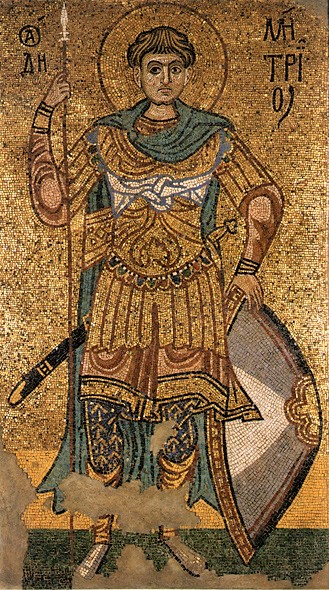
The hagiographic cycles of the Great Martyr Demetrius of Thessaloniki include depictions of scenes from his life and his posthumous miracles.[14] Demetrius was initially depicted in icons and mosaics as a young man in patterned robes with the distinctive tablion of the senatorial class across his chest. Miraculous military interventions were attributed to him during several attacks on Thessaloniki, and he gradually became thought of as a soldier: a Constantinopolitan ivory of the late 10th century shows him as an infantry soldier (Metropolitan Museum of Art). But, an icon of the late 11th century in Saint Catherine's Monastery on Mount Sinai shows him as before, still a civilian. In Byzantine icons he is depicted in military dress, either standing or riding a horse.[15]

Modern Bulgarian icon of Demetrius spearing the gladiator Lyaeus, who is dressed in rather Turkish style (1824).

Another Sinai icon, of the Crusader period and painted by a French artist working in the Holy Land in the second half of the 12th century, shows what then became the most common depiction. Demetrius, bearded, rather older, and on a red horse, rides together with George, unbearded and on a white horse.[16] Both are dressed as cavalrymen. Also, while George is often shown spearing a dragon, Demetrius is depicted spearing the gladiator Lyaeus (Λυαίος Lyaíos; for meaning see here), who according to story was responsible for killing many Christians. Lyaeus is commonly depicted below Demetrius and lying supine, having already been defeated; Lyaeus is traditionally drawn much smaller than Demetrius. In traditional hagiography, Demetrius did not directly kill Lyaeus, but rather through his prayers the gladiator was defeated by Demetrius' disciple, Nestor.[14]

A modern Greek iconographic convention depicts Demetrius with the Great White Tower in the background. The anachronistic White Tower acts as a symbolic depiction of the city of Thessaloniki, despite having been built in the 16th century, centuries after his life, and the exact architecture of the older tower that stood at the same site in earlier times is unknown. Again, iconography often depicts saints holding a church or protecting a city.

According to a hagiographic legend, best known in Russia in the version retold by Dimitry of Rostov (1651–1709), Demetrius appeared in the camp of tsar Kaloyan of Bulgaria during his 1207 siege of Thessaloniki, piercing the king with a lance and so killing him. This scene, known in Russian as Чудо о погибели царя Калояна ("the miracle of the destruction of tsar Kaloyan") became a popular element in the iconography of Demetrius. He is shown on horseback piercing the king with his spear,[17] paralleling the iconography (and often shown alongside) of Saint George and the Dragon.

Feast Days

[edit]

Eastern Orthodoxy

[edit]

Demetrius' feast day is on 26 October, which falls on 8 November [NS, "new style"] for those following the old calendar.[18][19]

There is also a commemoration of the finding of his icon on the island of Syros on May 25.[20]

See also

[edit]

Notes

[edit]

References

[edit]

Sources

[edit]
  • Roth, Paul W. (1993). Soldatenheilige (in German). Graz, Vienna, Cologne: Verlag Styria. ISBN 3-222-12185-0.
  • Kloft, Hans (2010). Mysterienkulte der Antike. Götter, Menschen, Rituale (in German). Munich: C.H. Beck. ISBN 978-3-406-44606-1.
  • Bauer, Franz Alto (2013). Eine Stadt und ihr Patron. Thessaloniki und der Heilige Demetrios [A city and its patron saint. Thessaloniki and St Demetrios]. Regensburg: Schnell & Steiner, ISBN 978-3-7954-2760-3 (monographical study on the veneration of Demetrius with a focus on Thessaloniki).
  • Robin Cormack, Writing in Gold, Byzantine Society and its Icons, George Philip, London, 1985. ISBN 0-540-01085-5
  • Eugenia Russell, St Demetrius of Thessalonica; Cult and Devotion in the Middle Ages, Peter Lang, Oxford, 2010. ISBN 978-3-0343-0181-7
  • James C. Skedros, Saint Demetrios of Thessaloniki: Civic Patron and Divine Protector 4th-7th Centuries CE, Trinity Press International, 1999. Summarized in Harvard Theological Review 89:410 (1996). in JSTOR
  • James C. Skedros, "Response to David Woods" Harvard Theological Review 93:3:235 (July 2000). at JSTOR
  • Kurt Weitzmann in The Icon, 1982, Evans Brothers Ltd, London, ills. pp. 32,51,220 (trans of Le Icone, Montadori 1981), ISBN 0-237-45645-1
  • Woods, David (2000). "Thessalonica's Patron: Saint Demetrius or Emeterius?". Harvard Theological Review. 93 (3): 221–234. doi:10.1017/S001781600002530X. JSTOR 1510028. S2CID 162463136. free copy
  • David Woods, bibliography on St. Demetrius
[edit]
Revisions and contributorsEdit on WikipediaRead on Wikipedia
from Grokipedia
According to hagiographical tradition, Demetrius of (c. 270–306 AD) was an early and venerated primarily in the as the patron of and a protector. Born in to a noble family of secret Christians, he rose to prominence as a Roman commander and proconsul in the under Emperor , but his open profession of faith and efforts to convert pagans led to his arrest and martyrdom by spearing in a prison bathhouse on October 26, 306. Although traditionally regarded as a historical figure, the existence of Demetrius as described is subject to scholarly debate. His body was secretly buried by fellow at the site of his execution, and a church was later constructed over the during the reign of Emperor Constantine (306–337 AD), marking the early growth of his . By the fifth century, his relics were uncovered, and from the seventh century onward, they became renowned for exuding —a fragrant oil believed to have healing properties—earning him the epithet "Myrrh-Streamer" or "Myrrh-Gusher." Demetrius's veneration spread rapidly across the and into Slavic regions, where he was invoked as a defender against invasions, plagues, and sieges, with traditions crediting him for over 1,600 years of miraculous protections for . In and , Demetrius is often depicted as a youthful on horseback, spearing a barbarian foe, symbolizing his role as a heavenly warrior akin to Saint George. His feast day on coincides with historical events like the 1912 liberation of from Ottoman rule, reinforcing his enduring significance in Greek Orthodox tradition as a symbol of faith, courage, and national guardianship.

Early Life and Martyrdom

Historical Background

Thessalonica, a prominent Hellenistic city founded around 315 BC by and named after his wife Thessalonike, sister of , served as the capital of the of Macedonia following its reorganization in 148 BC after the defeat of the Macedonian kingdom. By the late third century AD, it had grown into a vital administrative, commercial, and military hub in the eastern , connected by the trade route and benefiting from its strategic port on the . Under Emperor (r. 284–305), the province was divided into Macedonia Prima (with Thessalonica as capital) and Macedonia Salutaris, underscoring the city's elevated status as a metropolis and colony. Despite its prosperity, Thessalonica's Christian community, which traced its roots to the apostolic visits of St. Paul in the mid-first century, faced intensifying persecution during the Great Persecution initiated by and his co-ruler around 303 AD, as imperial edicts targeted Christian practices and properties. According to hagiographic tradition, Demetrius was born around 270 AD in Thessalonica to a wealthy and distinguished family of Greco-Roman origin, whose members held prominent positions within the provincial administration. His parents were secret who maintained their faith discreetly amid the prevailing pagan Roman culture and sporadic anti-Christian measures, baptizing and raising Demetrius in the tradition within a hidden family . As the only son of a Roman provincial official, Demetrius was nurtured in an environment blending classical education with clandestine religious instruction, fostering his commitment to from an early age. Through his noble lineage and personal merits, Demetrius is said in to have ascended to high office, eventually being appointed as a or high-ranking military in the region by around 305 AD, succeeding his father in a prominent role. In this capacity, he oversaw both civil administration—managing taxation, justice, and infrastructure in the bustling province—and military affairs, including the defense of Macedonia against external threats and the enforcement of imperial policies. His tenure coincided with the height of the Diocletianic persecutions, placing him at the intersection of Roman and the growing tensions within Thessalonica's Christian population.

Martyrdom and Earliest Accounts

According to traditional accounts, Demetrius, described as a Roman proconsul or high-ranking official of Thessalonica and son of a local governor, was martyred around 306 AD during the Diocletianic Persecution, specifically under the co-emperor Maximian Galerius, who had appointed him to enforce anti-Christian measures but grew enraged upon learning of his secret Christian faith. Demetrius openly confessed his Christianity and refused to persecute believers, leading to his arrest while he was preaching in a basement of the Coppersmiths' Portico in Thessalonica. This act of public confession occurred amid the broader imperial edict of 303 AD targeting Christian clergy and scriptures, though Demetrius's execution was a direct response to his defiance and association with the martyrdom of his companion Nestor, a soldier who slew a gladiator champion in the arena after receiving Demetrius's blessing. Following his arrest, Demetrius was imprisoned in the basement of a public bathhouse near the city's furnaces, a site chosen for its isolation and heat to hasten his suffering. There, hagiographic narratives describe him enduring a by sent by the , which he repelled with the , and receiving a vision of an angel affirming his crown of martyrdom. , returning victorious from campaigns against the and , ordered Demetrius's execution by spearing at the imprisonment site, blaming him for inspiring Nestor's rebellious victory in the . Soldiers thrust spears into his body, and his blood was collected by a faithful servant named , who was subsequently martyred as well. The earliest surviving hagiographic sources for Demetrius's martyrdom are the Passio Altera (BHG 497), a Greek text likely composed in Thessalonica during the 6th or , which provides the detailed narrative of his senatorial background, arrest, and spearing. This passion account was known by the , as evidenced by its use in Bishop John of Thessalonica's collection of Miracles of Saint Demetrius (early , during the reign of , 602–610 AD), a two-book compilation focusing on post-martyrdom events but referencing the core passion story. An earlier Syriac horologion translation from the 4th century briefly notes his spearing death in 306 AD, representing one of the oldest textual allusions, though it lacks narrative depth. Immediately after his death, local , fearing Maximian's wrath, secretly buried Demetrius's body at the execution site in the bathhouse during the night. This location quickly became a focal point of , with reports of early miracles drawing pilgrims from Macedonia and . By 412–413 AD, , the eparch of Illyricum, had constructed a over the site, marking the formal inception of organized cultic practices in Thessalonica.

Debates on Historicity

The of Demetrius of Thessaloniki as a specific individual in the early remains a subject of scholarly debate, primarily due to the absence of contemporary records from his purported lifetime. No documents from the (303–313 CE) mention a martyr named Demetrius in , and the earliest textual references to his cult appear in the mid-5th century, such as a letter from Acholius of Thessaloniki around 413 CE alluding to a local saint's veneration without naming him explicitly. The Miracles of Saint Demetrius, a collection of hagiographical accounts, provides the first detailed narratives of his intercessions, with Book I dated to the early and Book II to the late , but these focus on post-martyrdom events rather than biographical details. The full passion narrative (Passio Altera, BHG 497), describing his trial and execution under Emperor , likely emerged in the 6th or , suggesting significant legendary development over time. A key point of contention involves possible conflation between of Thessaloniki and Demetrius of , a martyred around 304 CE in the Roman province of (modern ). Scholars propose that the cult originated in , an important military center, and was transferred to following the relocation of imperial administrative functions there in 441/442 CE under . This theory accounts for inconsistencies in early sources, such as references to basilicas in both cities and the saint's military associations, which align more closely with Sirmium's strategic role. Hippolyte Delehaye and later Michael Vickers argued that the Thessalonian Demetrius may represent an adaptation of the Sirmian martyr's veneration, amplified to suit local needs as became a provincial capital. Archaeological evidence from supports the existence of an early dedicated to but offers no confirmation of his . Excavations beneath the Church of Saint Demetrios have uncovered foundations of a 5th-century , dated via brickstamps to approximately 447–448 CE, indicating organized by the mid-5th century. Inscriptions and fragments from this period invoke Demetrius as a protector, yet they provide no details on his life or martyrdom, focusing instead on his role as civic patron. This material evidence attests to a thriving devotional but underscores the gap between practices and verifiable historical events. Modern scholarship, particularly since the late , often portrays Demetrius as a potentially composite figure, blending elements of a real early with legendary amplifications to embody Thessaloniki's civic identity. James Skedros's analysis posits a historical core—a local Christian executed during persecutions—embellished through to include military and miraculous traits absent in earlier accounts. David Woods has suggested alternative identifications, such as links to other s like Emeterius of , though this remains marginal compared to the Sirmium hypothesis. Post-2011 studies, including reviews of Skedros's work, emphasize that while the cult's antiquity is undisputed, the vita's details likely reflect 5th–7th-century theological and political agendas rather than 4th-century reality, viewing Demetrius as a symbolic construct rather than a strictly historical person.

Development of Veneration

Byzantine Origins and Relic Transfer

The veneration of Demetrius as a martyr began to spread in the early 5th century within the Eastern Roman Empire, with initial evidence of his cult appearing in Thessalonica through accounts of healing miracles attributed to contact with his relics. According to hagiographical traditions preserved in the Miracula Sancti Demetrii (noting scholarly debate on the cult's early location), Praetorian Prefect Leontios of Illyricum was cured of illness at the site of Demetrius's martyrdom in Thessalonica around the early 5th century, prompting him to construct a church there dedicated to the saint. However, scholarly analysis indicates that the primary center of the cult may have initially developed in Sirmium, the provincial capital in Pannonia, before disruptions led to its relocation. According to this theory, the pivotal transfer of Demetrius's relics from Sirmium to Thessalonica occurred around 441–442 AD, driven by the Hunnic invasions under Attila that devastated the Balkans and destroyed Sirmium as a Roman stronghold. This relocation, facilitated by imperial officials amid the chaos of the invasions, brought the saint's bodily remains and associated artifacts—such as blood-stained garments—to Thessalonica, where they were enshrined in a newly established basilica known as Hagios Demetrios. Brickstamps from the basilica's foundations date its initial construction to 447–448 AD, confirming the swift institutionalization of the cult site shortly after the transfer. The move not only preserved the relics but also elevated Demetrius's role as a protector for Thessalonica, a key eastern frontier city facing ongoing threats from barbarian incursions. By the mid-6th century, the had integrated into Thessalonica's civic identity, with the serving as a focal point for communal devotion and defense against invasions, supported by state patronage during the reign of Emperor , with the structure rebuilt and expanded following a fire around 629–634 AD under the oversight of the local and eparch Leo. The collection of miracles known as the Miracula Sancti Demetrii, compiled in the early by Archbishop John of Thessalonica (c. 610–620), records early 5th-century healings and interventions, underscoring the saint's growing reputation for interceding against plagues, sieges, and Slavic raids on the city. These accounts, drawing on oral traditions, highlight Demetrius's transformation from a local to an imperial protector, with his feast day becoming a major civic and observance by the late .

Acquisition of Military Attributes

During the , the of of Thessaloniki underwent a significant transformation, shifting from a focus on his martyrdom to emphasize his attributes as a warrior saint and protector of the city against external threats. This evolution was closely tied to the Avar and Slavic invasions that beset the , particularly the sieges of Thessalonica between 586 and 626 AD, where his intercessions were credited with pivotal victories that preserved the city's independence. The attribution of patronage to Demetrius during this period reflects the broader Byzantine need for divine allies amid recurring assaults on the . Central to this development are the Miracles of Saint Demetrius, a collection of 7th-century homilies compiled by John of Thessalonica (BHG 499–516), which vividly depict the saint as an active defender on horseback, intervening directly to support Byzantine armies. In these accounts, Demetrius appears in martial guise, such as a radiant figure mounted on a white horse, rallying defenders and striking fear into invaders during critical battles. A later anonymous compilation (BHG 516z–523) further reinforces this image by portraying him marching in full military attire alongside soldiers, underscoring his role as a who bolsters morale and turns the tide of conflict. These narratives, drawn from eyewitness testimonies and episcopal records, established Demetrius as a reliable patron for warriors facing existential threats. Demetrius's military persona became intertwined with that of Saint George, forming an early pairing as co-patrons of Byzantine soldiers, with joint invocations appearing in 7th-century hagiographies like the Life of Theodore of Sykeon. This association extended to practical military customs, including the inscription of Demetrius's name on banners and projectiles—such as a miraculous bolt marked "In the name of God and Saint Demetrius" that repelled attackers—and imperial oaths seeking his aid, exemplified by Emperor Justinian II's supplications during campaigns in 688 AD. Specific apparitions during Thessalonica's sieges cemented this reputation; for example, in 586 AD, Avar and Slavic forces fled after witnessing a vision of Demetrius leading a heavenly army, while similar interventions in the 617 and 676–678 sieges involved him manifesting as a on the walls to thwart scaling attempts and boost defender resolve. The transfer of his relics to Thessalonica earlier in the had laid the groundwork for this protective role, enabling localized miracles that evolved into widespread martial veneration. Scholars have identified etymological and attributive connections between Saint Demetrius of Thessaloniki and the ancient Greek goddess , the protector of and . The name "Demetrius" derives directly from , implying a linguistic tie that influenced the saint's veneration as a guardian of the land and harvests in agrarian communities. These connections are theorized in scholarship but remain debated, with varying degrees of influence in different regions. In 6th-7th century hagiographical texts, such as the Miracles of Saint Demetrius, this attributive overlap is evident in descriptions of the saint interceding for bountiful crops and protection against famine, roles traditionally ascribed to Demeter in . The cult of Saint Demetrius also incorporated elements from the Dioscuri (Castor and Pollux), the twin pagan deities associated with cavalry and divine protection, particularly through the saint's portrayal as a mounted warrior safeguarding travelers and soldiers. This is theorized in early 20th-century scholarship examining Christian legends, where Demetrius's equestrian and role as a twin-like patron (often paired with Saint George) mirror the Dioscuri's attributes as rescuers on horseback. Regional inscriptions and accounts from the 6th-7th centuries further suggest this adaptation, blending the saints' protective interventions with pre-Christian motifs of divine horsemen. A key example of transition from pagan festivals to Christian feasts occurred with the Demetria in , originally a Macedonian celebration honoring Demeter's agricultural bounty, which evolved into the October feast of Saint Demetrius by the early Byzantine period. This shift absorbed Demeter's roles as city guardian and fertility symbol into the saint's cult, with the festival combining liturgical observances, processions, and communal feasting that echoed pagan rites while emphasizing Christian themes of martyrdom and divine aid. 6th-7th century texts, including the Encomia and , describe the feast's communal aspects—such as gatherings for protection against invasions—as retaining the civic and protective essence of the earlier Demetria, facilitating the saint's integration as 's primary patron. Evidence of appears prominently in 6th-7th century hagiographic sources, where the blended Christian narratives with pagan elements to appeal to local converts in Macedonia, a region with longstanding sanctuaries like those at and Beroea. For instance, the saint's miracles often invoke themes of earthly abundance and communal safeguarding, paralleling Demeter's , while miracle accounts portray Demetrius warding off threats in ways reminiscent of chthonic deities. The associated with his relics, described in these texts as a fragrant oil emanating from the tomb for healing and consecration, represents a holdover from pagan rites used in Greek fertility and protective ceremonies, repurposed here as a symbol of divine favor and . In Macedonia, where Demeter's cults were deeply entrenched due to the region's fertile plains and agricultural economy, Demetrius's filled a similar niche, with local traditions merging the goddess's blessings into the saint's intercessory powers. Byzantine chroniclers from the onward noted how Thessalonian peasants and shepherds invoked Demetrius for crop success, directly supplanting Demeter's rituals while retaining practices like seasonal processions and offerings. This regional underscores the cult's adaptability, transforming pagan agrarian piety into Christian devotion without fully eradicating underlying folk elements. The military patronage attributed to Saint Demetrius parallels adaptations from pagan warrior traditions, further illustrating the cult's synthetic nature in early Byzantine .

Relics and Miracles

Description of the Relics

The primary relics of Saint Demetrius consist of his bones, and blood-stained garments, all enshrined in a marble located beneath the altar in the of the Basilica of in . According to early hagiographic accounts, the bones were initially buried at the site of his martyrdom in the Roman baths, while the blood was collected on a stole () by his servant , and portions of his military () and stole were preserved as contact relics. These elements were later consolidated in the during the construction of the basilica in the , forming the core of the site. The architectural setting integrates the relics into a multi-layered structure: the 5th-century crypt, excavated from the Roman bath complex where Demetrius was imprisoned and executed, serves as the lower level directly accessing the , while the upper church, rebuilt in the 7th century after an , overlays it as the main worship space. The relics have endured significant historical upheavals, including the Slavic invasions of the 7th century, Ottoman occupation from 1430 to 1912 during which the crypt was filled with earth, and a devastating in 1917 that damaged the but spared the core relic enclosure. Post-fire restorations by 1949 preserved pre-existing elements, such as marble fragments from the original ciborium canopy over the . Hagiographies describe the relics in their incorrupt state, with the saint's body appearing serene and intact upon discovery, surrounded by fragrant mixed with blood-soaked soil in the , emphasizing their enduring sanctity. Partial translations of relics occurred early in the cult's ; for instance, blood-stained garments were transferred to by around 413–423 and encased in a silver there. Later medieval accounts note smaller portions, such as traces of blood and , distributed in portable reliquaries like enkolpia, facilitating veneration beyond Thessaloniki without depleting the primary shrine.

Myrrh-Streaming Phenomenon

The myrrh-streaming phenomenon of Saint Demetrius of Thessaloniki refers to the exudation of a fragrant, oil-like substance from his relics, preserved in the of the of . This miracle is first documented in the seventh-century Miracles of Saint Demetrius, a two-volume hagiographical collection attributed to Archbishop John of Thessaloniki, which recounts the discovery of the flowing from the saint's tomb as a divine attestation of his protective presence over the city during sieges and plagues. In , the symbolizes the saint's enduring sanctity and the transformation of his martyred blood into a life-giving , signifying grace and . It is employed for the faithful, promoting physical and spiritual renewal, and reinforces Demetrius's Mirovlitis (Myrrh-Streamer), emphasizing tactile devotion over mere visual . Post-2013 has analyzed this aspect as part of a broader sensory shift in Byzantine cults, where the myrrh facilitated intimate, material communion with the holy. The has been systematically collected from the , particularly around the saint's feast day on , and distributed to pilgrims and churches worldwide, sustaining a of devotion. During the Ottoman occupation (1430–1912), when the served as a and the was sealed, devotees reportedly accessed and gathered the substance in secret, preserving amid restrictions.

Authenticity and Archaeological Findings

Early skepticism regarding the relics of Saint Demetrius emerged in the early seventh century, as documented in the First Collection of Miracles compiled by Archbishop John of around 610 AD. In Miracle 5 of this collection, John references a letter from his predecessor, , who refused Maurice's request to transfer the relics to , stating that the location of Demetrius's burial in was unknown, with only the Matrona's site identified. noted a similar failed attempt by , where dust stained with the saint's blood was sent instead, highlighting the absence of verifiable physical remains at the time. This account underscores contemporary doubts about the relics' existence and origins within the local church hierarchy. Archaeological investigations at the Church of in have provided indirect evidence supporting the traditional martyrdom site, though without confirming the relics themselves. Excavations in and , along with later work, uncovered the as the eastern section of a Roman bath complex, where tradition holds was imprisoned and executed around 303 AD; findings include early Christian sculptures and architectural layers from the fifth to seventh centuries, indicating the site's continuous use as a center from the late antique period. Further digs revealed a small fifth-century beneath the current structure, potentially built over the presumed grave, with artifacts such as marble revetments and inscriptions linking to early , but no human remains definitively tied to the saint. These discoveries affirm the site's paleo-Christian significance as part of 's UNESCO-listed monuments, yet they rely on circumstantial associations rather than direct relic identification. Scholarly debates persist over whether the relics originate from Thessaloniki or Sirmium (modern Sremska Mitrovica, Serbia), with no conclusive archaeological or scientific resolution. Some analyses of hagiographical texts, such as the Passio Demetrii, suggest the cult began in Sirmium, where a Demetrius—possibly a deacon or proconsul—was martyred, and relics were later translated to Thessaloniki amid fourth-century persecutions and migrations; this is supported by references to shared military attributes and basilica foundations in both locations by figures like Governor Leontius. However, other studies argue for a native Thessalonian origin, citing the basilica's early establishment over the bath site and local miracle collections predating Sirmian influences, though without physical evidence to distinguish the martyrs. As of 2025, no radiocarbon dating, forensic analysis, or DNA testing has been conducted on purported relics—such as bone fragments or myrrh-associated materials in the crypt—to verify age, identity, or provenance, leaving authenticity reliant on historical and stratigraphic interpretation.

Iconography and Artistic Representations

Core Iconographic Motifs

In the core iconographic tradition of Saint Demetrius of Thessaloniki, the saint is most characteristically depicted as a mounted in full Roman armor, dynamically thrusting a into a prostrate figure as Lyaeus, the gladiator from his who symbolizes and pagan opposition to . This pose, emphasizing the saint's role as a triumphant , became standardized in from around the 11th century onward, with the saint often shown in a three-quarter view, his body leaning forward aggressively toward the fallen enemy beneath the horse's hooves. A signature element of this motif is the saint's red horse, evoking themes of martial victory and the blood of martyrdom, paired with his white tunic visible beneath the armor, signifying purity and divine favor. The horse's vibrant red coloring contrasts sharply with the white mount typically assigned to Saint George in paired depictions, reinforcing Demetrius's distinct identity as Thessaloniki's protector. Accompanying these central figures are protective symbols such as a emblazoned with a , held in the saint's left hand to underscore his Christian allegiance, or architectural elements like stylized city walls in the background, alluding to his guardianship over . These motifs collectively portray Demetrius not merely as a historical but as an active celestial warrior, inspired by his patronage of soldiers and the city's defense. The earliest surviving examples of Demetrius's appear in the 6th- or early 7th-century mosaics of the Basilica of in , where he is shown in a more static, enthroned or standing pose with donors, foreshadowing the later militarized form while already emphasizing his protective aura through inscription and setting.

Across Periods

In the period spanning the 6th to 15th centuries, the of Saint Demetrius transitioned from a static portrayal as a youthful in consular robes to a dynamic warrior saint, reflecting the growing emphasis on his role as protector of amid military threats. Early depictions, such as the 7th-century mosaics in the Basilica of , present him as a courtly figure with an and tablion, emphasizing his senatorial status rather than prowess. This evolved in the 11th–12th centuries, post-Iconoclasm, when icons began showing him in military attire with a , , and , as evidenced by the 12th-century miniature from the Monastery of Saint Catherine on , where he appears in bust form ready for combat. By the , during the Palaiologan era, the warrior image was fully entrenched in frescoes and manuscripts, with elaborate details like and ; a key example is the 14th-century Palaiologan in Sassoferrato, , depicting him standing with spear and against a . These changes paralleled broader trends in , where soldier saints like Demetrius gained prominence in defensive narratives, such as spearing invaders in cycles at Dečani Monastery. Post-Byzantine influences under Ottoman rule led to simplifications in , with a focus on essential military motifs amid restricted artistic production, while Western elaborations introduced classical revivals. In the 16th–17th centuries, Cretan school icons, produced in Ottoman territories, retained the mounted or standing warrior but streamlined compositions for portability and devotion, as seen in works by artists like Emmanouil Tzane, who depicted Demetrius in half-length form with and against simplified backgrounds. Meanwhile, in Western art, a 14th-century Byzantine icon of Demetrius was reframed around 1465–1471 as a gift to , incorporating elements like stoichedon Greek inscriptions mimicking ancient styles and a painted wooden box, thus adapting Eastern warrior imagery into humanistic decorative contexts. The 19th–20th-century revivals of Demetrius's iconography in integrated national symbols, portraying him as a liberator in the context of the War of Independence against Ottoman rule. These depictions often amplified his role as a slayer of tyrants, with the symbolizing resistance; a representative 19th-century Greek school icon shows him on horseback piercing a pagan foe, evoking contemporary struggles for . This nationalistic evolution built upon core motifs like the shield and , transforming them into emblems of ethnic identity in church frescoes and portable icons during and after the independence era.

Regional and Modern Variations

In Slavic regions, particularly among Serbs and , iconographic depictions of Saint Demetrius adapted Byzantine prototypes to incorporate local historical and military elements, often showing him on horseback in military dress, spearing the Kaloyan during the 1207 siege of . This motif, emphasizing his role as a protector against invaders, appears in frescoes such as those at the Dečani Monastery (c. 1340s) in , where he is portrayed as a mounted thwarting a Slavic foe, blending hagiographic tradition with regional identity. In Russian iconography, Saint Demetrius is frequently rendered as a patron of the military and homeland defense, sometimes alongside tsars or in compositions evoking Russian valor, as seen in 19th-century icons from the that equip him with spears and shields echoing local armament styles while maintaining his equestrian triumph over enemies. These variations underscore his assimilation into Slavic cultural narratives as a bulwark against external threats. Western European representations of Saint Demetrius remain rare in , largely confined to post-Crusades contexts where he appears as a in full armor, sometimes depicted on horseback spearing a symbolizing Emperor , reflecting his elevated status as a intercessor for Christian warriors during the Latin East campaigns. Influenced by the Fourth Crusade's in 1204, which facilitated the spread of Eastern saints' cults westward, such images—evident in paintings like Tintoretto's 16th-century portrait—portray him with a red mantle denoting martyrdom and a as his attribute, adapting his Byzantine soldierly form to chivalric ideals without widespread liturgical integration. This sparse adoption highlights the selective incorporation of Orthodox military saints into Latin iconographic traditions. In modern Greece, particularly in Thessaloniki, contemporary icons of Saint Demetrius frequently incorporate local landmarks like the White Tower—a 15th-century Ottoman structure repurposed as a city symbol since the 19th century—positioning him against this backdrop to affirm his enduring patronage amid urban revival narratives. These depictions, produced by workshops in northern Greece since the early 20th century, blend traditional hagiographic poses with nationalist motifs, as in mosaic icons at the Church of Hagios Demetrios restored post-1980s. Digital and popular media representations extend this, featuring him in Greek video games, animations, and social media graphics during his October 26 feast day, often as a heroic defender in virtual Thessaloniki settings to engage younger audiences with his legacy. Post-2013 scholarship on Saint Demetrius's has increasingly examined spatial and sensory dimensions of his representations, with Carolyn L. Connor's highlighting how mosaics in Thessaloniki's church model interactive through gaze and proximity, reframing motifs in embodied devotion. Feminist interpretations, drawing on broader , critique the gendered martial ideal in depictions of soldier saints like Demetrius, viewing them as emblematic of patriarchal military sanctity that marginalizes female agency in saintly cults. Postcolonial lenses, applied in examinations of transfers and artistic diffusion, interpret Slavic adaptations—like the Kaloyan-slaying scenes—as sites of cultural negotiation and resistance to Byzantine hegemony, evident in reassessments of Dečani frescoes as hybrid expressions of identity. These approaches prioritize contextual diversity over linear evolution, revealing ongoing interpretive vitality.

Feast Days and Liturgical Celebrations

Eastern Orthodox Observances

In the , the primary feast day of Saint Demetrius of Thessaloniki is celebrated on in the , corresponding to November 8 in the for those communities adhering to the old style. This commemoration centers on the , often followed by solemn processions carrying the saint's relics and icon through the streets of , where his basilica serves as the focal point of . During these observances in , the associated with the saint's relics is collected and distributed to the faithful, symbolizing his enduring miraculous intercession. The day preceding the feast, known as Demetrius Saturday, is designated as a universal memorial for the departed souls, particularly emphasizing prayers for soldiers and warriors who have fallen in battle. This observance includes special and panikhida services, where the Church offers intercessions for the repose of all Orthodox Christians who have passed away, fostering a communal reflection on mortality and eternal life. Liturgical hymns and troparia dedicated to Saint Demetrius highlight his title as the "Myrrh-gusher," portraying him as a champion of whose relics exude healing . The principal in Tone 3 proclaims: "The world has found in you a great champion in time of peril, as you emerged the victor in routing the barbarians. For as you brought to naught the boasts of Lyaeus, you confuted the sophistries of Nestor by the power of the ; and granting crowns of victory to the faithful, you became a good athlete of the ." These chants are sung during , , and festal services, underscoring themes of martyrdom, protection, and flowing from his . Monasteries on , particularly the of Saint Demetrius affiliated with Vatopedi Monastery, mark the feast with annual vigils, Divine Liturgies, and all-night services that draw monks and pilgrims to honor the saint's role as a . These celebrations often incorporate the relics' in blessings, reinforcing the saint's spiritual presence in Athonite tradition.

Celebrations in Other Traditions

In the Roman Catholic Church, Saint Demetrius of Thessaloniki, often referred to as Demetrius of , is commemorated on , marking his martyrdom, and on , associated with the translation of his relics, as recorded in the . His remains limited compared to Eastern traditions, with occasional recognition in liturgical calendars but without widespread feast observances or dedicated roles in the West. Among Oriental Orthodox communities, the Coptic Church honors Saint Demetrius of Thessaloniki on November 8 (corresponding to Baba 29 in the ), focusing on his martyrdom under Emperor . This commemoration includes liturgical readings from the Synaxarium emphasizing his role as a , and regional Coptic icons depict him as a youthful soldier-martyr, often in attire with a , reflecting Byzantine influences adapted to local artistic styles. Similarly, the observes his feast around the same Julian-aligned date in late October or early November, integrating him into the broader synaxarium of saints with prayers for protection against . Medieval survivals of his cult in include veneration in , where he serves as patron of communities like Morigerati in , blending his Byzantine military imagery with local Catholic devotions to soldier-saints during the . In , despite the dominant Eastern Orthodox tradition, historical observances of Dimitrovden on incorporate folk elements, such as blessings and communal feasts, merging his with regional agrarian customs and occasionally syncretizing with pre-Christian figures like the Thracian rider. Modern ecumenical initiatives have fostered shared recognition of Saint Demetrius across Orthodox and Catholic lines, though specific joint liturgies for his feast remain rare.

Associated Commemorative Practices

In , the veneration of Saint Demetrius includes the annual Demetria festival, a tradition dating back to the Byzantine era that combines religious observance with civic and commercial activities, such as fairs and markets where pilgrims trade myrrh-filled amulets and local goods. This event, held around the saint's feast day in , historically drew visitors from across Europe and Asia, fostering economic and cultural exchange while emphasizing the saint's role as protector of the city. Modern iterations continue this blend, incorporating processions, exhibitions, and public celebrations that integrate religious devotion with community gatherings; the 60th edition in 2025 emphasized a return to the city's historic markets. Within Eastern Orthodox tradition, naming children (or variations like Dimitrios) at invokes the saint's intercession for protection against harm, reflecting the broader practice of selecting patron saints to guide and safeguard the individual throughout life. This custom is particularly prevalent in regions with strong ties to , where the name is chosen to emulate the saint's courage and faithfulness, ensuring spiritual from infancy. Historical commemorations honor Saint Demetrius as a patron of soldiers in Slavic Orthodox contexts, including and , where his feast day served as a rallying point for troops invoking his aid in battles against invaders during the medieval period. In the Second Bulgarian Empire, numerous churches and monasteries dedicated to him underscored this role, with soldiers attributing victories to his miraculous interventions, such as repelling assaults on . Similarly, in , Mitrovdan (Saint Demetrius Day) became a significant slava—a and patronal feast—observed by armies to seek divine protection, evolving from Byzantine influences into a national tradition by the 14th century. Pilgrimages to the Church of in remain a central practice, with devotees visiting the —believed to be the site of the saint's martyrdom—to venerate his relics and collect , a phenomenon tied to his title as Myrrh-Streamer. Historically, these journeys involved carrying sealed bottles of as protective talismans, a custom that persists today among Orthodox faithful seeking and blessings. In modern times, the site attracts a blend of religious pilgrims and tourists, bolstered by its World Heritage status as part of 's Paleochristian and Byzantine monuments, with ongoing restorations completed in 1949.

Legacy and Cultural Influence

Patronage Roles

Demetrius of Thessaloniki is primarily revered as the of the city of Thessalonica, where he is believed to have intervened repeatedly to safeguard its inhabitants from external threats and calamities. As the city's protector, he is invoked against invasions by barbarians and plagues, with traditions attributing to him the preservation of Thessalonica from , , and foreign assaults over centuries. His role extends to military patronage, earning him veneration as a guardian of soldiers and warriors, often depicted in icons as a mounted armed with a , symbolizing his aid in battles and defense of the faith. In historical accounts, Demetrius's protective interventions are exemplified during sieges of Thessalonica, such as the Arab raid in 904, where narratives from the period describe apparitions of the and the miraculous flow of from his relics, offering solace and amid the city's capture and sack. Further recorded in hagiographic collections highlight his role in repelling invaders, including and Avars in the 6th and 7th centuries, through visions that bolstered the defenders and averted total destruction. These events underscore his enduring function as a civic and martial defender, with prayers to him seeking deliverance for communities under siege. Beyond military and urban protection, Demetrius serves as a guardian for vulnerable groups, particularly the young and children, invoked for their safety and guidance, as seen in legends where he aids youths facing or , extending his compassionate for the defenseless in Byzantine and post-Byzantine traditions. In rural Greek contexts, his name's etymological proximity to the ancient goddess has linked him to agricultural patronage, with devotees invoking him for bountiful harvests and the protection of shepherds and peasants, especially as his day traditionally marks the close of the farming season. Among specific historical lineages, holds patronage over the dynasty of Kievan Rus', where from the late he was adopted as a heavenly protector by the ruling family, associating his military virtues with Rus' patriotism and victories, such as the in 1380. This role solidified his status as a defender of Orthodox realms against nomadic incursions, blending local Thessalonian devotion with broader Slavic veneration.

Derived Names and Institutions

The of Demetrius of Thessaloniki as a and protector has given rise to various personal names across Orthodox Christian cultures, particularly in regions where his feast day is prominently celebrated. In , the name Dimitrios (Δημήτριος) is a direct derivation, commonly used for males and reflecting the saint's Greek origins; its feminine form, Dimitra, is also widespread. In , the equivalent Dimitar is prevalent, often linked to the saint's day (Dimitrovden) on October 26, and serves as a popular with diminutives like Mita. Similarly, in , (Дмитрий) draws from the same root, honoring the saint as a protector, with its nameday aligning with his feast. Numerous churches and monasteries worldwide bear his name, underscoring his enduring spiritual influence. The most prominent is the Church of in , , built over the site of his martyrdom and recognized as a for its . Other notable examples include the of Saint Demetrius on , , a monastic community affiliated with Vatopedi Monastery dedicated to ascetic life in his honor, and the Divljana Monastery in , a Serbian Orthodox site near Divljana Lake established in the medieval period. In , the Orthodox Monastery of Saint Demetrius near , founded in 1997, exemplifies modern dedications amid forested surroundings. These institutions, exceeding dozens across and beyond, often serve as centers for his liturgical commemoration. In , institutions reflect his patronage as a soldier saint, including educational and commemorative sites. The town of , originally named Civitas Sancti Demetrii in the 13th century, preserves this legacy through its historical and annual observances, evolving into a modern municipal center. While specific orders directly named after him are rare, his influences Serbian traditions, as seen in the Divljana Monastery's role in regional heritage. Schools and academies occasionally invoke his name, though examples are more tied to broader Orthodox education, such as those in commemorating local saints. Toponyms inspired by Demetrius appear in the , particularly in historical Macedonia and surrounding areas. Villages like Dimitrovci in , , derive from the saint's name, reflecting Slavic adaptations (Mitrovica variants). In , sites near Markova Sušica link to monasteries dedicated to him, embedding his legacy in rural . These place names, often from medieval settlements, highlight his role in protecting communities against invasions.

Modern Veneration and Scholarship

Following the liberation of Thessaloniki from Ottoman rule on October 26, 1912—coinciding precisely with Saint Demetrius's feast day—veneration of the saint experienced a significant revival in Greece, intertwining national identity with religious devotion. The Church of Hagios Demetrios, which had served as a mosque for nearly five centuries, was promptly restored to Christian worship that year, symbolizing the city's reclamation and the saint's protective role. Damaged by a major fire in 1917, the church underwent further restoration completed in 1949, preserving key Byzantine mosaics and the crypt associated with the saint's relics. This event elevated October 26 to a local public holiday in Thessaloniki, marked by dual commemorations of the saint and the liberation through processions, doxologies, and cultural events like the annual Demetria festival, which draws pilgrims to collect myrrh from the saint's tomb as protective amulets. In the 20th and 21st centuries, devotion to Saint Demetrius has spread globally through communities, particularly in the and , where numerous parishes bear his name and sustain liturgical traditions. In the US, prominent examples include Saint Demetrios Greek Orthodox Church in Baltimore, (established 1923), and in , Washington (founded 1923), which host annual feast-day celebrations with , divine liturgies, and community festivals reinforcing ethnic and spiritual ties. Similarly, in , churches such as the Greek Orthodox Parish of St. Demetrios in , Victoria (active since the ), and in St. Marys, New South Wales (founded 1970), organize paniyiri festivals and relic veneration on , fostering continuity for immigrant families. This modern veneration extends digitally via , where Orthodox communities share live streams of services, relic expositions, and personal testimonies—such as posts from parishes displaying myrrh-streaming icons or feast-day homilies—enabling global participation beyond physical attendance. Recent scholarship from 2013 to 2025 has deepened understanding of Saint Demetrius's cult through analyses of , , and ecumenical contexts, while sparking debates on historical authenticity. Digital projects, such as the University of Kragujevac's of the saint's hagiographic cycle in the of Peć, have enabled textual and iconographic comparisons, revealing how medieval narratives evolved to emphasize his role as Thessaloniki's protector. Ecumenical dialogues have highlighted his significance, as seen in the 2024 Anglican-Orthodox Joint Doctrinal Commission's meeting at St. Demetrios Church in , which discussed shared patristic legacies including military saints like Demetrius to bridge Eastern and Western traditions. Controversies persist in academic and popular discourse over authenticity; for instance, a 2023 study in Gesta examines sensory elements in the cult, questioning whether physical relics ever existed or if centered on symbolic items like rings and blood-stained garments, amid ongoing debates tracing the saint's origins to rather than . These discussions, echoed in outlets like Greek City Times, underscore the tension between faith-based tradition and historical scrutiny without diminishing the saint's enduring appeal.

References

  1. https://commons.wikimedia.org/wiki/Category:Saint_Demetrius_of_Thessaloniki_churches
Add your contribution
Related Hubs
User Avatar
No comments yet.