Hubbry Logo
Strain (mechanics)Strain (mechanics)Main
Open search
Strain (mechanics)
Community hub
Strain (mechanics)
logo
7 pages, 0 posts
0 subscribers
Be the first to start a discussion here.
Strain (mechanics)
Strain (mechanics)
from Wikipedia
Strain
Other names
Strain tensor
SI unit1
Other units
%
In SI base unitsm/m
Behaviour under
coord transformation
tensor
Dimension

In mechanics, strain is defined as relative deformation, compared to a reference position configuration. Different equivalent choices may be made for the expression of a strain field depending on whether it is defined with respect to the initial or the final configuration of the body and on whether the metric tensor or its dual is considered.

Strain has dimension of a length ratio, with SI base units of meter per meter (m/m). Hence strains are dimensionless and are usually expressed as a decimal fraction or a percentage. Parts-per notation is also used, e.g., parts per million or parts per billion (sometimes called "microstrains" and "nanostrains", respectively), corresponding to μm/m and nm/m.

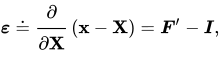
Strain can be formulated as the spatial derivative of displacement: where I is the identity tensor. The displacement of a body may be expressed in the form x = F(X), where X is the reference position of material points of the body; displacement has units of length and does not distinguish between rigid body motions (translations and rotations) and deformations (changes in shape and size) of the body. The spatial derivative of a uniform translation is zero, thus strains measure how much a given displacement differs locally from a rigid-body motion.[1]
A strain is in general a tensor quantity. Physical insight into strains can be gained by observing that a given strain can be decomposed into normal and shear components. The amount of stretch or compression along material line elements or fibers is the normal strain, and the amount of distortion associated with the sliding of plane layers over each other is the shear strain, within a deforming body.[2] This could be applied by elongation, shortening, or volume changes, or angular distortion.[3]

The state of strain at a material point of a continuum body is defined as the totality of all the changes in length of material lines or fibers, the normal strain, which pass through that point and also the totality of all the changes in the angle between pairs of lines initially perpendicular to each other, the shear strain, radiating from this point. However, it is sufficient to know the normal and shear components of strain on a set of three mutually perpendicular directions.

If there is an increase in length of the material line, the normal strain is called tensile strain; otherwise, if there is reduction or compression in the length of the material line, it is called compressive strain.

Strain regimes

[edit]

Depending on the amount of strain, or local deformation, the analysis of deformation is subdivided into three deformation theories:

  • Finite strain theory, also called large strain theory, large deformation theory, deals with deformations in which both rotations and strains are arbitrarily large. In this case, the undeformed and deformed configurations of the continuum are significantly different and a clear distinction has to be made between them. This is commonly the case with elastomers, plastically-deforming materials and other fluids and biological soft tissue.
  • Infinitesimal strain theory, also called small strain theory, small deformation theory, small displacement theory, or small displacement-gradient theory where strains and rotations are both small. In this case, the undeformed and deformed configurations of the body can be assumed identical. The infinitesimal strain theory is used in the analysis of deformations of materials exhibiting elastic behavior, such as materials found in mechanical and civil engineering applications, e.g. concrete and steel.
  • Large-displacement or large-rotation theory, which assumes small strains but large rotations and displacements.

Strain measures

[edit]

In each of these theories the strain is then defined differently. The engineering strain is the most common definition applied to materials used in mechanical and structural engineering, which are subjected to very small deformations. On the other hand, for some materials, e.g., elastomers and polymers, subjected to large deformations, the engineering definition of strain is not applicable, e.g. typical engineering strains greater than 1%;[4] thus other more complex definitions of strain are required, such as stretch, logarithmic strain, Green strain, and Almansi strain.

Engineering strain

[edit]

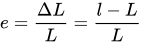
Engineering strain, also known as Cauchy strain, is expressed as the ratio of total deformation to the initial dimension of the material body on which forces are applied. In the case of a material line element or fiber axially loaded, its elongation gives rise to an engineering normal strain or engineering extensional strain e, which equals the relative elongation or the change in length ΔL per unit of the original length L of the line element or fibers (in meters per meter). The normal strain is positive if the material fibers are stretched and negative if they are compressed. Thus, we have , where e is the engineering normal strain, L is the original length of the fiber and l is the final length of the fiber.
The true shear strain is defined as the change in the angle (in radians) between two material line elements initially perpendicular to each other in the undeformed or initial configuration. The engineering shear strain is defined as the tangent of that angle, and is equal to the length of deformation at its maximum divided by the perpendicular length in the plane of force application, which sometimes makes it easier to calculate.

Stretch ratio

[edit]

The stretch ratio or extension ratio (symbol λ) is an alternative measure related to the extensional or normal strain of an axially loaded differential line element. It is defined as the ratio between the final length l and the initial length L of the material line.

The extension ratio λ is related to the engineering strain e by This equation implies that when the normal strain is zero, so that there is no deformation, the stretch ratio is equal to unity.

The stretch ratio is used in the analysis of materials that exhibit large deformations, such as elastomers, which can sustain stretch ratios of 3 or 4 before they fail. On the other hand, traditional engineering materials, such as concrete or steel, fail at much lower stretch ratios.

Logarithmic strain

[edit]

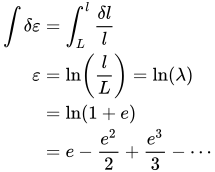
The logarithmic strain ε, also called, true strain or Hencky strain.[5] Considering an incremental strain (Ludwik) the logarithmic strain is obtained by integrating this incremental strain: where e is the engineering strain. The logarithmic strain provides the correct measure of the final strain when deformation takes place in a series of increments, taking into account the influence of the strain path.[2]

Green strain

[edit]

The Green strain is defined as:

Almansi strain

[edit]

The Euler-Almansi strain is defined as

Strain tensor

[edit]

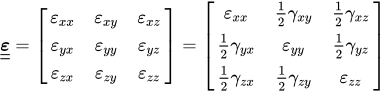
The (infinitesimal) strain tensor (symbol ) is defined in the International System of Quantities (ISQ), more specifically in ISO 80000-4 (Mechanics), as a "tensor quantity representing the deformation of matter caused by stress. Strain tensor is symmetric and has three linear strain and three shear strain (Cartesian) components."[6] ISO 80000-4 further defines linear strain as the "quotient of change in length of an object and its length" and shear strain as the "quotient of parallel displacement of two surfaces of a layer and the thickness of the layer".[6] Thus, strains are classified as either normal or shear. A normal strain is perpendicular to the face of an element, and a shear strain is parallel to it. These definitions are consistent with those of normal stress and shear stress.

The strain tensor can then be expressed in terms of normal and shear components as:
Geometric setting

[edit]
Two-dimensional geometric deformation of an infinitesimal material element

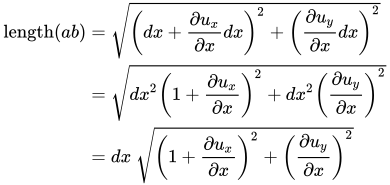
Consider a two-dimensional, infinitesimal, rectangular material element with dimensions dx × dy, which, after deformation, takes the form of a rhombus. The deformation is described by the displacement field u. From the geometry of the adjacent figure we have and For very small displacement gradients the squares of the derivative of and are negligible and we have

Normal strain

[edit]

For an isotropic material that obeys Hooke's law, a normal stress will cause a normal strain. Normal strains produce dilations.

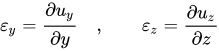
The normal strain in the x-direction of the rectangular element is defined by Similarly, the normal strain in the y- and z-directions becomes

Shear strain

[edit]
Shear strain
Common symbols
γ or ε
SI unit1, or radian
Derivations from
other quantities
γ = τ/G

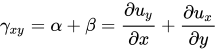
The engineering shear strain (γxy) is defined as the change in angle between lines AC and AB. Therefore,

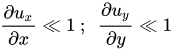
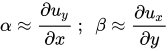
From the geometry of the figure, we have For small displacement gradients we have For small rotations, i.e. α and β are ≪ 1 we have tan αα, tan ββ. Therefore, thus By interchanging x and y and ux and uy, it can be shown that γxy = γyx.

Similarly, for the yz- and xz-planes, we have

Volume strain

[edit]

The volumetric strain, also called bulk strain, is the relative variation of the volume, as arising from dilation or compression; it is the first strain invariant or trace of the tensor: Actually, if we consider a cube with an edge length a, it is a quasi-cube after the deformation (the variations of the angles do not change the volume) with the dimensions and V0 = a3, thus as we consider small deformations, therefore the formula.


Real variation of volume (top) and the approximated one (bottom): the green drawing shows the estimated volume and the orange drawing the neglected volume

In case of pure shear, we can see that there is no change of the volume.

Metric tensor

[edit]

A strain field associated with a displacement is defined, at any point, by the change in length of the tangent vectors representing the speeds of arbitrarily parametrized curves passing through that point. A basic geometric result, due to Fréchet, von Neumann and Jordan, states that, if the lengths of the tangent vectors fulfil the axioms of a norm and the parallelogram law, then the length of a vector is the square root of the value of the quadratic form associated, by the polarization formula, with a positive definite bilinear map called the metric tensor.

See also

[edit]

References

[edit]
Revisions and contributorsEdit on WikipediaRead on Wikipedia
from Grokipedia
In mechanics, strain is a dimensionless measure of the deformation experienced by a material in response to applied stress, quantifying the relative displacement of points within the body. It is fundamentally defined for normal strain as the ratio of the change in length to the original length, often denoted by the Greek letter ε (epsilon), where ε = ΔL / L₀. This quantity is unitless and typically expressed as a percentage for practical interpretation, capturing both elongation and contraction under tensile or compressive loads. Strain manifests in various forms depending on the direction and nature of the deformation, with normal strain describing changes in length along a principal axis—positive for tensile stretching and negative for compressive shortening—while shear strain, denoted by γ (gamma), measures angular distortion due to forces parallel to a surface. In , the full strain state is represented by the strain tensor, a second-order tensor that includes both normal and shear components derived from the displacement field, such as ε_{ij} = (1/2)(∂u_i/∂x_j + ∂u_j/∂x_i) in three dimensions. For small deformations, engineering strain (ε = (l - l₀)/l₀) is commonly used, though alternatives like logarithmic strain (ε = ln(l/l₀)) apply for larger strains in nonlinear analyses. The relationship between strain and stress is central to material behavior, governed by constitutive laws such as for elastic materials, where stress σ is proportional to strain via the modulus of elasticity E (σ = Eε) in uniaxial loading. Strain analysis is essential in for predicting failure, designing components like beams and bridges, and interpreting experimental data from tensile tests, where stress-strain curves reveal properties like yield strength and . Measurement techniques, including strain gauges and digital image correlation, enable direct quantification of strain fields in both laboratory and field applications.

Introduction to Strain

Definition and Basic Concepts

In , strain serves as the geometric measure of local deformation within a body, quantifying the relative displacement between neighboring points in the continuum. This deformation arises from applied forces that alter the positions of particles, leading to changes in the body's geometry without inherently involving the material's constitutive response. Unlike displacement, which describes absolute shifts in position, or stress, which represents internal force distribution per unit area and depends on properties, strain focuses solely on kinematic aspects such as alterations in , , or volume. A foundational illustration occurs in one dimension, where strain ϵ\epsilon is defined as the ratio of the relative displacement δu\delta u between two points to the original infinitesimal length element dxdx separating them: ϵ=δudx.\epsilon = \frac{\delta u}{dx}. This expression captures the local stretching or compression along a line, motivated by the need to describe how displacements vary spatially within the material. Strain is inherently dimensionless, expressed as a pure (e.g., meters per meter) or often in percentage form for practical reporting, emphasizing its role as a normalized measure independent of scale. The conceptual origins of strain trace to the , particularly Leonhard Euler's foundational work on continuum deformation, where he introduced the tensor of rate of deformation in 1769 to describe fluid motion and criteria. This early framework laid the groundwork for modern strain theory by distinguishing deformable continua from rigid motions. In the infinitesimal strain regime, such measures approximate deformations for small relative displacements, aligning with assumptions.

Historical Development

The concept of strain in mechanics emerged in the early 19th century as part of the foundational work in , with playing a pivotal role. In the , Cauchy introduced the fundamental relations between stress and strain, laying the groundwork for describing material deformation through tensorial quantities; he formalized the infinitesimal strain tensor in publications from and , establishing it as a symmetric measure derived from displacement gradients for small deformations. This framework shifted the analysis from one-dimensional extensions to multidimensional deformations, enabling the study of elastic responses in solids. Building on Cauchy's contributions, Adhémar Jean Claude Barré de Saint-Venant advanced the theory in the 1860s by developing the compatibility conditions for strain. In 1860, Saint-Venant proposed a complete set of equations ensuring that a given strain field could be integrated to yield a continuous displacement field, addressing the need for consistency in three-dimensional elasticity problems. These conditions, now known as Saint-Venant's compatibility equations, were crucial for solving boundary value problems in and solidified the transition from scalar to tensorial representations of strain. The late 19th century saw further formalization of the strain tensor in three dimensions through Augustus Edward Hough Love's seminal 1892 treatise, A Treatise on the Mathematical Theory of Elasticity. Love's work systematically presented the strain tensor as a key component of the mathematical of elasticity, integrating it with stress analysis and providing a comprehensive basis for isotropic and anisotropic materials under small strains. This text marked a maturation of strain from formulations to a structured field, influencing subsequent engineering applications. Developments in gained momentum in the and , driven by the need to describe large deformations in materials like rubber and metals. Heinrich Hencky introduced the logarithmic strain measure in , offering a rotationally invariant tensor suitable for finite deformations. These efforts extended Cauchy's linear approximations to nonlinear regimes, with strain serving as a linearization for small displacements. Post-1950s advancements in nonlinear mechanics, particularly through Clifford Truesdell's systematic exposition in The Non-Linear Field Theories of Mechanics (1965), refined finite strain measures by integrating rigorous axiomatic principles and tensor calculus, partly inspired by the coordinate-invariant formulations from . This era emphasized hyperelasticity and path-independent measures, enhancing applications in and . Modern standardization culminated in ISO 80000-4 (2006, revised 2019 with 2025 amendment), which defines strain quantities as dimensionless ratios, confirming their unitless nature across scalar and tensor forms.

Deformation Kinematics

Displacement and Deformation Gradient

In continuum mechanics, the displacement field u\mathbf{u} describes how material points of a body move from their positions in a reference configuration to positions in a deformed configuration. A material point at position X\mathbf{X} in the reference configuration occupies position x=χ(X,t)\mathbf{x} = \boldsymbol{\chi}(\mathbf{X}, t) in the deformed configuration at time tt, where χ\boldsymbol{\chi} is the deformation mapping function. The displacement is thus defined as the vector u(X,t)=x(X,t)X\mathbf{u}(\mathbf{X}, t) = \mathbf{x}(\mathbf{X}, t) - \mathbf{X}, which maps each reference point to its change in position under deformation. The deformation gradient tensor F\mathbf{F} quantifies the local kinematics of this mapping and is derived from the partial derivatives of the current position coordinates with respect to the reference coordinates. In rectangular Cartesian coordinates, F\mathbf{F} has components FiJ=xiXJF_{iJ} = \frac{\partial x_i}{\partial X_J}, representing the of the deformation mapping χ\boldsymbol{\chi}. This tensor relates to the displacement field through F=I+Xu\mathbf{F} = \mathbf{I} + \nabla_{\mathbf{X}} \mathbf{u}, where I\mathbf{I} is the second-order identity tensor and Xu\nabla_{\mathbf{X}} \mathbf{u} is the displacement tensor with components uiXJ\frac{\partial u_i}{\partial X_J}. The derivation assumes a coordinate transformation where the bases in reference and deformed configurations are aligned, allowing the matrix of partial derivatives to approximate the linear transformation of infinitesimal vectors near a point. Key properties of F\mathbf{F} include its polar decomposition, which isolates the rotational and stretching components of the deformation. Specifically, F=RU\mathbf{F} = \mathbf{R} \mathbf{U}, where R\mathbf{R} is a proper orthogonal tensor satisfying RTR=I\mathbf{R}^T \mathbf{R} = \mathbf{I} and detR=1\det \mathbf{R} = 1 (describing rigid ), and U\mathbf{U} is the symmetric positive-definite right stretch tensor capturing pure deformation. This , unique for detF>0\det \mathbf{F} > 0, was established as a fundamental tool in nonlinear . Additionally, the J=detFJ = \det \mathbf{F} measures the local volume change, with dv=JdVdv = J \, dV relating deformed dvdv to reference dVdV, and J>0J > 0 ensuring the mapping is locally invertible and orientation-preserving. Geometrically, F\mathbf{F} describes the local linear transformation induced by the deformation at a material point, mapping an line element dX\mathrm{d}\mathbf{X} in the reference configuration to dx=FdX\mathrm{d}\mathbf{x} = \mathbf{F} \, \mathrm{d}\mathbf{X} in the deformed configuration. This relation captures how nearby fibers are stretched, sheared, and rotated, providing the kinematic basis for subsequent strain measures in finite deformation .

Strain Regimes: Infinitesimal vs. Finite

In , strain regimes are classified into and finite based on the magnitude of deformations encountered in materials. The strain regime applies when the displacement gradient satisfies u1\|\nabla \mathbf{u}\| \ll 1, allowing higher-order terms in the deformation description to be neglected for simplification. This assumption holds for elastic materials under small loads, such as metals experiencing strains below 0.2%, where the linear elastic response dominates without significant geometric changes. In such cases, the reference and deformed configurations are nearly indistinguishable, enabling the use of linearized for analysis. The finite strain regime, in contrast, addresses large deformations where rotations and stretches are substantial, requiring nonlinear measures to capture the full . This approach is essential for materials like rubber, which can undergo strains exceeding 5% up to several hundred percent, or biological tissues that exhibit hyperelastic behavior under significant loading. Finite strain formulations account for the distinction between reference and current configurations, incorporating effects like large rotations that would otherwise lead to inaccuracies in simpler models. Criteria for selecting a strain regime depend on the magnitude of the displacement gradient and the resulting changes in , with infinitesimal theory suiting scenarios where deformations do not alter the overall shape appreciably. For instance, beam bending in structural metals typically falls within the infinitesimal regime, as strains remain small and rotations minimal. Conversely, processes like metal forming involve large plastic strains and geometric nonlinearity, necessitating finite strain to accurately predict material behavior. The transition between regimes can be understood through linearization error analysis, where the infinitesimal strain measure represents the first-order Taylor expansion of finite strain quantities. Neglecting higher-order terms introduces errors that are quadratic in the displacement , becoming negligible only when u1\|\nabla \mathbf{u}\| \ll 1, but growing rapidly for larger values. This approximation underpins scalar measures like strain in small deformation contexts, providing a bridge to more complex finite descriptions.

Scalar Strain Measures

Engineering Strain

Engineering strain, also known as nominal or conventional strain, is a fundamental scalar measure of uniaxial deformation defined as the relative change in with respect to the original configuration: εeng=LL0L0=ΔLL0,\varepsilon_\text{eng} = \frac{L - L_0}{L_0} = \frac{\Delta L}{L_0}, where L0L_0 is the original of the element and LL is its after deformation. This measure quantifies the average elongation or contraction along a specific direction, making it particularly suitable for describing simple tensile or compressive loading in one dimension. In one-dimensional , engineering strain arises from the displacement field u(x)u(x) along the length, where the local strain is the u/x\partial u / \partial x. For a uniform deformation, it simplifies to the value over the original length: εeng=1L00L0uxdx=u(L0)u(0)L0.\varepsilon_\text{eng} = \frac{1}{L_0} \int_0^{L_0} \frac{\partial u}{\partial x} \, dx = \frac{u(L_0) - u(0)}{L_0}. This integral form accounts for the total relative displacement, providing a straightforward that aligns with experimental measurements using fixed gauge lengths. The primary advantages of engineering strain lie in its simplicity and intuitiveness, especially within the infinitesimal strain regime where deformations are small (typically less than 5%). It facilitates direct calculations from observable changes in dimensions without requiring knowledge of the current geometry, and it is the standard measure employed in protocols, such as ASTM E8 for metallic materials, which specifies gauge lengths like 4 times the specimen diameter to compute elongation. This approach ensures reproducibility and comparability across tests, supporting material characterization in engineering design. However, engineering strain has notable limitations when applied to large deformations. It is not additive under sequential loading; the total strain from multiple deformation steps does not equal the sum of individual engineering strains, leading to inconsistencies in path-dependent processes like multistage forming. For instance, a 50% extension followed by a 20% extension on the deformed state yields a total engineering strain of 80% relative to the original, but summing the individual values (50% + 20%) underestimates the outcome. This non-additivity arises because the reference length remains fixed at L0L_0, ignoring geometric changes during deformation. A practical example illustrates its use in the elastic regime: for a steel wire under tensile loading, the engineering strain reaches approximately 0.002 (0.2%) at the elastic limit, beyond which permanent deformation begins, as determined from stress-strain curves in standard tensile tests. For small values like this, engineering strain closely approximates other measures, such as logarithmic strain, providing a reliable indicator of elastic behavior.

Logarithmic Strain

Logarithmic strain, also known as true strain or natural strain, is a measure of deformation defined for uniaxial loading as the natural logarithm of the ratio of the current length LL to the original length L0L_0: εlog=ln(L/L0)\varepsilon_{\log} = \ln(L / L_0). This definition arises from integrating the incremental strain over the deformation path, expressed as εlog=L0LdLL\varepsilon_{\log} = \int_{L_0}^{L} \frac{dL}{L}. The concept was first introduced by Paul Ludwik in 1909 as an "effective specific strain" based on the integral form, and later named "natural strain" by Arpad Nadai in 1937; Heinrich Hencky extended it to three dimensions in 1928. A key property of logarithmic strain is its additivity for sequential uniaxial deformations, making it path-independent in one dimension, as the total strain is the sum of incremental strains regardless of the order of application. For small deformations where the engineering strain ε\eng1\varepsilon_{\eng} \ll 1, logarithmic strain approximates the engineering strain: εlogε\eng\varepsilon_{\log} \approx \varepsilon_{\eng}, since ln(1+x)x\ln(1 + x) \approx x for small xx. This equivalence ensures continuity with while providing accuracy for large strains. Logarithmic strain is particularly suited to finite strain regimes in materials processing, such as metal and , where deformations exceed 100% and engineering strain becomes misleading due to its reference to the initial configuration. In , for instance, the effective strain is calculated as εlog=ln(R)\varepsilon_{\log} = \ln(R), where RR is the extrusion ratio (initial cross-sectional area over final area), enabling precise modeling of and . This measure facilitates additive accumulation of strain in multi-pass operations, improving predictions of microstructural evolution and material properties. In multi-axial extensions, logarithmic strain applies to principal directions as εi=ln(λi)\varepsilon_i = \ln(\lambda_i), where λi\lambda_i are the principal stretches, forming the basis of the Hencky strain tensor in for large deformations. An illustrative example is cumulative strain in a rolling mill, where sequential passes yield total logarithmic strain εlog=ln(1+ε\eng,j)\varepsilon_{\log} = \sum \ln(1 + \varepsilon_{\eng,j}) for each pass jj, equivalent to ln(L\final/L0)\ln(L_{\final} / L_0), which captures the overall reduction without overestimating due to intermediate references.

Tensorial Strain Measures

Green-Lagrange Strain

The Green-Lagrange strain tensor, denoted as E\mathbf{E}, is a finite strain measure defined in the reference configuration, making it suitable for analyzing large deformations in Lagrangian descriptions of . It quantifies the change in squared lengths of line elements relative to their original configuration, capturing both stretching and shearing effects nonlinearly. The tensor is mathematically expressed as E=12(CI),\mathbf{E} = \frac{1}{2} (\mathbf{C} - \mathbf{I}), where C=FTF\mathbf{C} = \mathbf{F}^T \mathbf{F} is the right Cauchy-Green deformation tensor, F\mathbf{F} is the tensor relating reference to current positions, and I\mathbf{I} is the identity tensor. This formulation arises from the metric change in the reference frame, ensuring E\mathbf{E} vanishes for rigid body motions. In component form, using the displacement field u(X)\mathbf{u}(\mathbf{X}) where X\mathbf{X} denotes reference coordinates, the elements are Eij=12(uiXj+ujXi+ukXiukXj),E_{ij} = \frac{1}{2} \left( \frac{\partial u_i}{\partial X_j} + \frac{\partial u_j}{\partial X_i} + \frac{\partial u_k}{\partial X_i} \frac{\partial u_k}{\partial X_j} \right), with summation over repeated indices kk. This expansion includes linear displacement gradient terms plus quadratic nonlinear contributions, distinguishing it from strain measures. Key properties of E\mathbf{E} include its (Eij=EjiE_{ij} = E_{ji}), inherited from C\mathbf{C}, and objectivity, meaning it remains invariant under superimposed rotations, as the deformation gradient's rotational part cancels out. Additionally, E\mathbf{E} is quadratic in the principal stretches, providing a natural measure for fiber deformations in finite strain contexts. In applications, the Green-Lagrange strain tensor is central to modeling nonlinear elasticity and hyperelastic materials, such as rubber, where potentials are expressed in terms of E\mathbf{E} or its invariants. For instance, in Mooney-Rivlin hyperelastic models, the function depends on the first two invariants of C\mathbf{C}, enabling simulations of large deformations in total Lagrangian finite element formulations. A representative example is uniaxial tension along the 1-direction, where the stretch ratio λ=L/L0\lambda = L/L_0 (current to reference length) yields the normal component E11=12(λ21)E_{11} = \frac{1}{2} (\lambda^2 - 1), while off-diagonal components vanish assuming uniform extension. This illustrates how E\mathbf{E} nonlinearly amplifies stretching beyond engineering strain λ1\lambda - 1.

Euler-Almansi Strain

The Euler-Almansi strain tensor provides a measure of finite deformation relative to the current (deformed) configuration, offering an Eulerian description suitable for spatial analyses. It is defined mathematically as e=12(Ib1),\mathbf{e} = \frac{1}{2} \left( \mathbf{I} - \mathbf{b}^{-1} \right), where I\mathbf{I} is the identity tensor and b=FFT\mathbf{b} = \mathbf{F} \mathbf{F}^T denotes the left Cauchy-Green deformation tensor, with F\mathbf{F} being the deformation gradient tensor. This formulation arises from the push-forward of the Green-Lagrange strain tensor to the spatial frame, emphasizing distortions in the instantaneous geometry. In component notation within a Cartesian basis aligned with the deformed state, the Euler-Almansi tensor is expressed as eij=12(δijk(F1)ki(F1)kj),e_{ij} = \frac{1}{2} \left( \delta_{ij} - \sum_{k} ( \mathbf{F}^{-1} )_{k i} ( \mathbf{F}^{-1} )_{k j} \right), where δij\delta_{ij} is the Kronecker delta and (F1)ki=Xk/xi( \mathbf{F}^{-1} )_{k i} = \partial X_k / \partial x_i represents components of the inverse deformation gradient, linking reference coordinates X\mathbf{X} to current coordinates x\mathbf{x}. The resulting e\mathbf{e} is a symmetric second-order tensor whose eigenvalues correspond to (1/2)(1λi2)(1/2)(1 - \lambda_i^{-2}), with λi\lambda_i the principal stretches and principal directions in the spatial frame. This strain measure effectively captures local changes in lengths and angles based on the prevailing deformed geometry, distinguishing it from material descriptions tied to the state. It proves advantageous in scenarios involving fluid-like material flows, where ongoing reconfiguration dominates, or in updated Lagrangian simulation methods that periodically reset the to the current configuration for . In dynamic settings, the Euler-Almansi tensor connects to the velocity gradient via spatial descriptions of deformation rates, facilitating in evolving flows without explicit time differentiation in its static form. A representative example occurs in simple shear, where the deformation maps (X1,X2)(x1=X1+γX2,x2=X2)(X_1, X_2) \to (x_1 = X_1 + \gamma X_2, x_2 = X_2) with shear parameter γ\gamma. Here, the deformation gradient is F=(1γ01)\mathbf{F} = \begin{pmatrix} 1 & \gamma \\ 0 & 1 \end{pmatrix}, yielding b=(1+γ2γγ1)\mathbf{b} = \begin{pmatrix} 1 + \gamma^2 & \gamma \\ \gamma & 1 \end{pmatrix} and b1=(1γγ1+γ2)\mathbf{b}^{-1} = \begin{pmatrix} 1 & -\gamma \\ -\gamma & 1 + \gamma^2 \end{pmatrix}. The nonzero components of e\mathbf{e} are then the shear term e12=e21=γ/2e_{12} = e_{21} = \gamma/2 and the normal term e22=γ2/2e_{22} = -\gamma^2/2, illustrating how finite shear induces contraction perpendicular to the shear direction while the shear component remains linear in γ\gamma.

Other Measures: Volumetric and Deviatoric

In continuum mechanics, volumetric strain quantifies the relative change in volume of a material element due to deformation. For infinitesimal strains, it is defined as ϵv=VV0V0\epsilon_v = \frac{V - V_0}{V_0}, where VV is the deformed volume and V0V_0 is the reference volume, which approximates the trace of the infinitesimal strain tensor ϵvtr(ϵ)\epsilon_v \approx \mathrm{tr}(\epsilon). In the finite strain regime, volumetric strain is more precisely expressed as ϵv=ln(J)\epsilon_v = \ln(J), where J=detFJ = \det \mathbf{F} is the Jacobian determinant of the deformation gradient F\mathbf{F}, capturing the multiplicative volume change J=V/V0J = V / V_0. Deviatoric strain isolates the distortion component of deformation by removing the volumetric contribution, defined for the infinitesimal strain tensor as ϵdev=ϵ13tr(ϵ)I\boldsymbol{\epsilon}_\mathrm{dev} = \boldsymbol{\epsilon} - \frac{1}{3} \mathrm{tr}(\boldsymbol{\epsilon}) \mathbf{I}, where I\mathbf{I} is the identity tensor; this measures shape change without dilation, as tr(ϵdev)=0\mathrm{tr}(\boldsymbol{\epsilon}_\mathrm{dev}) = 0. The total strain tensor decomposes additively into volumetric and deviatoric parts: ϵ=ϵvol+ϵdev\boldsymbol{\epsilon} = \boldsymbol{\epsilon}_\mathrm{vol} + \boldsymbol{\epsilon}_\mathrm{dev}, with the volumetric part ϵvol=13tr(ϵ)I\boldsymbol{\epsilon}_\mathrm{vol} = \frac{1}{3} \mathrm{tr}(\boldsymbol{\epsilon}) \mathbf{I}; the first invariant I1=tr(ϵ)I_1 = \mathrm{tr}(\boldsymbol{\epsilon}) directly relates to change. This decomposition is essential in applications involving incompressible materials, where ϵv=0\epsilon_v = 0 (or J=1J = 1), such as rubber, allowing pure deviatoric deformation without volume alteration under nearly hydrostatic loading. In geomechanics, separating hydrostatic (volumetric) and deviatoric stresses aids in modeling and rock behavior, where hydrostatic components drive compaction and deviatoric ones induce shear failure. For example, in uniaxial tension along the longitudinal direction with strain ϵlong\epsilon_\mathrm{long}, the lateral strains are ϵlat=νϵlong\epsilon_\mathrm{lat} = -\nu \epsilon_\mathrm{long} due to ν\nu, yielding volumetric strain ϵv=ϵlong(12ν)\epsilon_v = \epsilon_\mathrm{long} (1 - 2\nu); for ν=0.5\nu = 0.5, ϵv=0\epsilon_v = 0, illustrating incompressibility.

Strain Tensor

Derivation and Geometric Interpretation

In , the deformation of a continuum is described by the displacement field u(x)\mathbf{u}(\mathbf{x}), where x\mathbf{x} is the position vector in the configuration. To derive the strain tensor, consider two neighboring points in the body: a base point at x\mathbf{x} and another at x+dx\mathbf{x} + d\mathbf{x}. The displacement at the neighboring point can be approximated using a first-order Taylor expansion for small displacements: du=udxd\mathbf{u} = \nabla \mathbf{u} \cdot d\mathbf{x}, where u\nabla \mathbf{u} is the displacement gradient tensor with components uixj\frac{\partial u_i}{\partial x_j}. The displacement gradient u\nabla \mathbf{u} can be decomposed into a symmetric part, representing pure deformation (strain), and an antisymmetric part, representing rigid rotation. The infinitesimal strain tensor ϵ\boldsymbol{\epsilon} is thus the symmetric part: ϵ=12(u+(u)T),\boldsymbol{\epsilon} = \frac{1}{2} \left( \nabla \mathbf{u} + (\nabla \mathbf{u})^T \right), with components ϵij=12(uixj+ujxi)\epsilon_{ij} = \frac{1}{2} \left( \frac{\partial u_i}{\partial x_j} + \frac{\partial u_j}{\partial x_i} \right). The antisymmetric rotation tensor is ω=12(u(u)T)\boldsymbol{\omega} = \frac{1}{2} \left( \nabla \mathbf{u} - (\nabla \mathbf{u})^T \right). This decomposition holds under the assumption of linear geometry, where higher-order terms in the Taylor expansion (e.g., quadratic in u|\nabla \mathbf{u}|) are neglected due to small displacement gradients. Geometrically, the components of ϵ\boldsymbol{\epsilon} quantify the deformation of infinitesimal line elements dxd\mathbf{x}. The normal strain ϵii\epsilon_{ii} (no sum) along a line element represents the average relative elongation: for a fiber originally of length dsds, the deformed length is ds(1+ϵii)ds(1 + \epsilon_{ii}), corresponding to a fractional change in length ϵii=duidxi\epsilon_{ii} = \frac{du_i}{dx_i}. The shear strain ϵij\epsilon_{ij} (for iji \neq j) measures half the change in the right angle between two originally orthogonal line elements along the ii and jj directions, capturing the distortion without rotation. Small rotations from ω\boldsymbol{\omega} are neglected in this linear approximation, as they do not contribute to permanent deformation. For the strain field ϵ\boldsymbol{\epsilon} to correspond to a single-valued, continuous displacement field u\mathbf{u}, it must satisfy the Saint-Venant compatibility equations, which are six partial differential equations ensuring integrability of the displacement gradients. As an example, consider 2D plane strain in a thin plate deformed in the xx-yy plane. The normal strain ϵxx=ux\epsilon_{xx} = \frac{\partial u}{\partial x} describes the extension of material fibers aligned along the xx-direction: a fiber of original length Δx\Delta x stretches to Δx+Δux\Delta x + \Delta u_x, yielding a relative extension ϵxx\epsilon_{xx}. This visualizes how ϵ\boldsymbol{\epsilon} tracks local stretching without rigid body motion.

Normal and Shear Components

The normal components of the infinitesimal strain tensor, denoted as ϵii\epsilon_{ii} (with no summation over ii), represent the extension or compression along the principal coordinate directions. Specifically, ϵxx=uxx\epsilon_{xx} = \frac{\partial u_x}{\partial x}, ϵyy=uyy\epsilon_{yy} = \frac{\partial u_y}{\partial y}, and ϵzz=uzz\epsilon_{zz} = \frac{\partial u_z}{\partial z}, where uiu_i is the displacement component in the ii-direction and xix_i is the position coordinate. These terms quantify the in length of infinitesimal line elements aligned with the xx-, yy-, or zz-fibers, such that a positive value indicates elongation and a negative value indicates compression. The off-diagonal shear components, ϵij\epsilon_{ij} for iji \neq j, capture the distortion arising from changes in the angles between originally perpendicular line elements. Defined as ϵij=12(uixj+ujxi)\epsilon_{ij} = \frac{1}{2} \left( \frac{\partial u_i}{\partial x_j} + \frac{\partial u_j}{\partial x_i} \right), these elements are symmetric (ϵij=ϵji\epsilon_{ij} = \epsilon_{ji}) and represent half the total angular deviation from 90 degrees between the affected axes. For instance, ϵxy\epsilon_{xy} describes the shearing action in the xyxy-plane. In contexts, such as analysis, the shear strain is often expressed using the engineering convention γij=2ϵij\gamma_{ij} = 2 \epsilon_{ij}, where γij\gamma_{ij} denotes the full change in the between the line elements. This convention aligns the tensorial shear with the observable geometric distortion, facilitating practical computations in elasticity problems. Geometrically, normal strains manifest as uniform stretching or shortening along a direction, preserving cross-sections to that axis, while shear strains produce a parallelogram-like of rectangular elements, altering their without changing to . A representative example is simple shear flow, where a layer slides tangentially, yielding ϵxy=12γ\epsilon_{xy} = \frac{1}{2} \gamma with γ\gamma as the engineering shear angle; here, the tensor component accounts for the symmetric averaging of the displacement gradients.

Strain Analysis in Materials

Principal Strains and Invariants

In the analysis of the strain tensor ε\boldsymbol{\varepsilon}, principal strains represent the maximum and minimum normal strains at a point, occurring along directions where shear strain vanishes. These principal strains ε1\varepsilon_1, ε2\varepsilon_2, and ε3\varepsilon_3 (with ε1ε2ε3\varepsilon_1 \geq \varepsilon_2 \geq \varepsilon_3) are the eigenvalues of ε\boldsymbol{\varepsilon}, obtained by solving the characteristic equation det(ελI)=0\det(\boldsymbol{\varepsilon} - \lambda \mathbf{I}) = 0, where λ\lambda denotes the eigenvalues and I\mathbf{I} is the identity tensor. The corresponding eigenvectors define the principal directions, which are mutually orthogonal and align the tensor in a basis free of off-diagonal shear components. The invariants of the strain tensor provide scalar measures that remain unchanged under coordinate transformations, summarizing the tensor's overall behavior. The first invariant I1=tr(ε)=εkk=ε1+ε2+ε3I_1 = \operatorname{tr}(\boldsymbol{\varepsilon}) = \varepsilon_{kk} = \varepsilon_1 + \varepsilon_2 + \varepsilon_3 quantifies the , relating directly to relative change ΔV/VI1\Delta V / V \approx I_1. The second invariant is I2=12[(tr(ε))2tr(ε2)]I_2 = \frac{1}{2} \left[ (\operatorname{tr}(\boldsymbol{\varepsilon}))^2 - \operatorname{tr}(\boldsymbol{\varepsilon}^2) \right], capturing interactions between principal strains, while the third invariant I3=det(ε)I_3 = \det(\boldsymbol{\varepsilon}) reflects the tensor's , linked to the product ε1ε2ε3\varepsilon_1 \varepsilon_2 \varepsilon_3. Under a Q\mathbf{Q}, the tensor transforms as ε=QεQT\boldsymbol{\varepsilon}' = \mathbf{Q} \boldsymbol{\varepsilon} \mathbf{Q}^T, preserving all invariants such that I1=I1I_1' = I_1, I2=I2I_2' = I_2, and I3=I3I_3' = I_3. These concepts find practical use in material failure assessment and visualization. In brittle materials, failure often occurs when the maximum principal strain ε1\varepsilon_1 exceeds a critical threshold, as per the maximum principal strain criterion, which assumes fracture initiates perpendicular to the direction of largest extension. For two-dimensional strain states, provides a graphical tool to determine principal strains and maximum shear strain from known components, plotting normal strain versus half the engineering shear strain (γ/2) to reveal the principal strains at the circle's intersections with the horizontal axis. As an illustrative example, consider a biaxial strain state with normal strains εx\varepsilon_x and εy\varepsilon_y, and engineering shear strain γxy\gamma_{xy}. The in-plane principal strains are found by solving the quadratic characteristic equation λ2(εx+εy)λ+(εxεy(γxy/2)2)=0,\lambda^2 - (\varepsilon_x + \varepsilon_y) \lambda + (\varepsilon_x \varepsilon_y - (\gamma_{xy}/2)^2) = 0, yielding ε1,2=εx+εy2±(εxεy2)2+(γxy2)2\varepsilon_{1,2} = \frac{\varepsilon_x + \varepsilon_y}{2} \pm \sqrt{ \left( \frac{\varepsilon_x - \varepsilon_y}{2} \right)^2 + \left( \frac{\gamma_{xy}}{2} \right)^2 }
Add your contribution
Related Hubs
User Avatar
No comments yet.