


Structural geology
View on Wikipedia | This article needs additional citations for verification. (October 2008) |

Structural geology is the study of the three-dimensional distribution of rock units with respect to their deformational histories. The primary goal of structural geology is to use measurements of present-day rock geometries to uncover information about the history of deformation (strain) in the rocks, and ultimately, to understand the stress field that resulted in the observed strain and geometries. This understanding of the dynamics of the stress field can be linked to important events in the geologic past; a common goal is to understand the structural evolution of a particular area with respect to regionally widespread patterns of rock deformation (e.g., mountain building, rifting) due to plate tectonics.
Use and importance
[edit]The study of geologic structures has been of prime importance in economic geology, both petroleum geology and mining geology.[1] Folded and faulted rock strata commonly form traps that accumulate and concentrate fluids such as petroleum and natural gas. Similarly, faulted and structurally complex areas are notable as permeable zones for hydrothermal fluids, resulting in concentrated areas of base and precious metal ore deposits. Veins of minerals containing various metals commonly occupy faults and fractures in structurally complex areas. These structurally fractured and faulted zones often occur in association with intrusive igneous rocks. They often also occur around geologic reef complexes and collapse features such as ancient sinkholes. Deposits of gold, silver, copper, lead, zinc, and other metals, are commonly located in structurally complex areas.
Structural geology is a critical part of engineering geology, which is concerned with the physical and mechanical properties of natural rocks. Structural fabrics and defects such as faults, folds, foliations and joints are internal weaknesses of rocks which may affect the stability of human engineered structures such as dams, road cuts, open pit mines and underground mines or road tunnels.
Geotechnical risk, including earthquake risk can only be investigated by inspecting a combination of structural geology and geomorphology.[2] In addition, areas of karst landscapes which reside atop caverns, potential sinkholes, or other collapse features are of particular importance for these scientists. In addition, areas of steep slopes are potential collapse or landslide hazards.
Environmental geologists and hydrogeologists need to apply the tenets of structural geology to understand how geologic sites impact (or are impacted by) groundwater flow and penetration. For instance, a hydrogeologist may need to determine if seepage of toxic substances from waste dumps is occurring in a residential area or if salty water is seeping into an aquifer.
Plate tectonics is a theory developed during the 1960s which describes the movement of continents by way of the separation and collision of crustal plates. It is in a sense structural geology on a planet scale, and is used throughout structural geology as a framework to analyze and understand global, regional, and local scale features.[3]
Methods
[edit]Structural geologists use a variety of methods to (first) measure rock geometries, (second) reconstruct their deformational histories, and (third) estimate the stress field that resulted in that deformation.
Geometries
[edit]Primary data sets for structural geology are collected in the field. Structural geologists measure a variety of planar features (bedding planes, foliation planes, fold axial planes, fault planes, and joints), and linear features (stretching lineations, in which minerals are ductilely extended; fold axes; and intersection lineations, the trace of a planar feature on another planar surface).

Measurement conventions
[edit]The inclination of a planar structure in geology is measured by strike and dip. The strike is the line of intersection between the planar feature and a horizontal plane, taken according to the right hand convention, and the dip is the magnitude of the inclination, below horizontal, at right angles to strike. For example; striking 25 degrees East of North, dipping 45 degrees Southeast, recorded as N25E,45SE.
Alternatively, dip and dip direction may be used as this is absolute. Dip direction is measured in 360 degrees, generally clockwise from North. For example, a dip of 45 degrees towards 115 degrees azimuth, recorded as 45/115. Note that this is the same as above.
The term hade is occasionally used and is the deviation of a plane from vertical i.e. (90°-dip).
Fold axis plunge is measured in dip and dip direction (strictly, plunge and azimuth of plunge). The orientation of a fold axial plane is measured in strike and dip or dip and dip direction.
Lineations are measured in terms of dip and dip direction, if possible. Often lineations occur expressed on a planar surface and can be difficult to measure directly. In this case, the lineation may be measured from the horizontal as a rake or pitch upon the surface.
Rake is measured by placing a protractor flat on the planar surface, with the flat edge horizontal and measuring the angle of the lineation clockwise from horizontal. The orientation of the lineation can then be calculated from the rake and strike-dip information of the plane it was measured from, using a stereographic projection.
If a fault has lineations formed by movement on the plane, e.g.; slickensides, this is recorded as a lineation, with a rake, and annotated as to the indication of throw on the fault.
Generally it is easier to record strike and dip information of planar structures in dip/dip direction format as this will match all the other structural information you may be recording about folds, lineations, etc., although there is an advantage to using different formats that discriminate between planar and linear data.
Plane, fabric, fold and deformation conventions
[edit]The convention for analysing structural geology is to identify the planar structures, often called planar fabrics because this implies a textural formation, the linear structures and, from analysis of these, unravel deformations.
Planar structures are named according to their order of formation, with original sedimentary layering the lowest at S0. Often it is impossible to identify S0 in highly deformed rocks, so numbering may be started at an arbitrary number or given a letter (SA, for instance). In cases where there is a bedding-plane foliation caused by burial metamorphism or diagenesis this may be enumerated as S0a.
If there are folds, these are numbered as F1, F2, etc. Generally the axial plane foliation or cleavage of a fold is created during folding, and the number convention should match. For example, an F2 fold should have an S2 axial foliation.
Deformations are numbered according to their order of formation with the letter D denoting a deformation event. For example, D1, D2, D3. Folds and foliations, because they are formed by deformation events, should correlate with these events. For example, an F2 fold, with an S2 axial plane foliation would be the result of a D2 deformation.
Metamorphic events may span multiple deformations. Sometimes it is useful to identify them similarly to the structural features for which they are responsible, e.g.; M2. This may be possible by observing porphyroblast formation in cleavages of known deformation age, by identifying metamorphic mineral assemblages created by different events, or via geochronology.
Intersection lineations in rocks, as they are the product of the intersection of two planar structures, are named according to the two planar structures from which they are formed. For instance, the intersection lineation of a S1 cleavage and bedding is the L1-0 intersection lineation (also known as the cleavage-bedding lineation).
Stretching lineations may be difficult to quantify, especially in highly stretched ductile rocks where minimal foliation information is preserved. Where possible, when correlated with deformations (as few are formed in folds, and many are not strictly associated with planar foliations), they may be identified similar to planar surfaces and folds, e.g.; L1, L2. For convenience some geologists prefer to annotate them with a subscript S, for example Ls1 to differentiate them from intersection lineations, though this is generally redundant.
Stereographic projections
[edit]
Stereographic projection is a method for analyzing the nature and orientation of deformation stresses, lithological units and penetrative fabrics wherein linear and planar features (structural strike and dip readings, typically taken using a compass clinometer) passing through an imagined sphere are plotted on a two-dimensional grid projection, facilitating more holistic analysis of a set of measurements. Stereonet[4] developed by Richard W. Allmendinger is widely used in the structural geology community.
Rock macro-structures
[edit]On a large scale, structural geology is the study of the three-dimensional interaction and relationships of stratigraphic units within terranes of rock or geological regions.
This branch of structural geology deals mainly with the orientation, deformation and relationships of stratigraphy (bedding), which may have been faulted, folded or given a foliation by some tectonic event. This is mainly a geometric science, from which cross sections and three-dimensional block models of rocks, regions, terranes and parts of the Earth's crust can be generated.
Study of regional structure is important in understanding orogeny, plate tectonics and more specifically in the oil, gas and mineral exploration industries as structures such as faults, folds and unconformities are primary controls on ore mineralisation and oil traps.
Modern regional structure is being investigated using seismic tomography and seismic reflection in three dimensions, providing unrivaled images of the Earth's interior, its faults and the deep crust. Further information from geophysics such as gravity and airborne magnetics can provide information on the nature of rocks imaged to be in the deep crust.
Rock microstructures
[edit]Rock microstructure or texture of rocks is studied by structural geologists on a small scale to provide detailed information mainly about metamorphic rocks and some features of sedimentary rocks, most often if they have been folded.
Textural study involves measurement and characterisation of foliations, crenulations, metamorphic minerals, and timing relationships between these structural features and mineralogical features.
Usually this involves collection of hand specimens, which may be cut to provide petrographic thin sections which are analysed under a petrographic microscope.
Kinematics
[edit]Geologists use rock geometry measurements to understand the history of strain in rocks. Strain can take the form of brittle faulting and ductile folding and shearing. Brittle deformation takes place in the shallow crust, and ductile deformation takes place in the deeper crust, where temperatures and pressures are higher.
Stress fields
[edit]By understanding the constitutive relationships between stress and strain in rocks, geologists can translate the observed patterns of rock deformation into a stress field during the geologic past. The following list of features are typically used to determine stress fields from deformational structures.
- In perfectly brittle rocks, faulting occurs at 30° to the greatest compressional stress according to Byerlee's Law.
- The greatest compressive stress is normal to fold axial planes.
Modeling
[edit]For economic geology such as petroleum and mineral development, as well as research, modeling of structural geology is becoming increasingly important. 2D and 3D models of structural systems such as anticlines, synclines, fold and thrust belts, and other features can help better understand the evolution of a structure through time. Without modeling or interpretation of the subsurface, geologists are limited to their knowledge of the surface geological mapping. If only reliant on the surface geology, major economic potential could be missed by overlooking the structural and tectonic history of the area.
Characterization of the mechanical properties of rock
[edit]The mechanical properties of rock play a vital role in the structures that form during deformation deep below the earth's crust. The conditions in which a rock is present will result in different structures that geologists observe above ground in the field. The field of structural geology tries to relate the formations that humans see to the changes the rock went through to get to that final structure. Knowing the conditions of deformation that lead to such structures can illuminate the history of the deformation of the rock.
Temperature and pressure play a huge role in the deformation of rock. At the conditions under the earth's crust of extreme high temperature and pressure, rocks are ductile. They can bend, fold or break. Other vital conditions that contribute to the formation of structure of rock under the earth are the stress and strain fields.
Stress-strain curve
[edit]Stress is a pressure, defined as a directional force over area. When a rock is subjected to stresses, it changes shape. When the stress is released, the rock may or may not return to its original shape. That change in shape is quantified by strain, the change in length over the original length of the material in one dimension. Stress induces strain which ultimately results in a changed structure.
Elastic deformation refers to a reversible deformation. In other words, when stress on the rock is released, the rock returns to its original shape. Reversible, linear, elasticity involves the stretching, compressing, or distortion of atomic bonds. Because there is no breaking of bonds, the material springs back when the force is released. This type of deformation is modeled using a linear relationship between stress and strain, i.e. a Hookean relationship.

Where σ denotes stress, denotes strain, and E is the elastic modulus, which is material dependent. The elastic modulus is, in effect, a measure of the strength of atomic bonds.

Plastic deformation refers to non-reversible deformation. The relationship between stress and strain for permanent deformation is nonlinear. Stress has caused permanent change of shape in the material by involving the breaking of bonds.
One mechanism of plastic deformation is the movement of dislocations by an applied stress. Because rocks are essentially aggregates of minerals, we can think of them as poly-crystalline materials. Dislocations are a type of crystallographic defect which consists of an extra or missing half plane of atoms in the periodic array of atoms that make up a crystal lattice. Dislocations are present in all real crystallographic materials.
Hardness
[edit]Hardness is difficult to quantify. It is a measure of resistance to deformation, specifically permanent deformation. There is precedent for hardness as a surface quality, a measure of the abrasiveness or surface-scratching resistance of a material. If the material being tested, however, is uniform in composition and structure, then the surface of the material is only a few atomic layers thick, and measurements are of the bulk material. Thus, simple surface measurements yield information about the bulk properties. Ways to measure hardness include:
Indentation hardness is used often in metallurgy and materials science and can be thought of as resistance to penetration by an indenter.
Toughness
[edit]Toughness can be described best by a material's resistance to cracking. During plastic deformation, a material absorbs energy until fracture occurs. The area under the stress-strain curve is the work required to fracture the material. The toughness modulus is defined as:
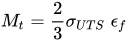
Where is the ultimate tensile strength, and is the strain at failure. The modulus is the maximum amount of energy per unit volume a material can absorb without fracturing. From the equation for modulus, for large toughness, high strength and high ductility are needed. These two properties are usually mutually exclusive. Brittle materials have low toughness because low plastic deformation decreases the strain (low ductility). Ways to measure toughness include: Page impact machine and Charpy impact test.


Resilience
[edit]Resilience is a measure of the elastic energy absorbed of a material under stress. In other words, the external work performed on a material during deformation. The area under the elastic portion of the stress-strain curve is the strain energy absorbed per unit volume. The resilience modulus is defined as:
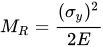
where is the yield strength of the material and E is the elastic modulus of the material. To increase resilience, one needs increased elastic yield strength and decreased modulus of elasticity.

See also
[edit]
References
[edit]- ^ Russell, William L (1955). "1. Introduction". Structural Geology for Petroleum Geologists. New York: McGraw-Hill. p. 1.
- ^ "Plate tectonics and people". USGS.
- ^ Livaccari, Richard F.; Burke, Kevin; Scedilengör, A. M. C. (1981). "Was the Laramide orogeny related to subduction of an oceanic plateau?". Nature. 289 (5795): 276–278. Bibcode:1981Natur.289..276L. doi:10.1038/289276a0. S2CID 27153755.
- ^ "Stereonet". Rick Allmendinger's Stuff. Retrieved 2022-12-23.
Further reading
[edit]- M. King Hubbert (1972). Structural Geology. Hafner Publishing Company.
- G.H. Davis and S.J. Reynolds (1996). The structural geology of rocks and regions (2nd ed.). Wiley. ISBN 0-471-52621-5.
- C.W. Passchier and R.A.J. Trouw (1998). Microtectonics. Berlin: Springer. ISBN 3-540-58713-6.
- B.A. van der Pluijm and S. Marshak (2004). Earth Structure - An Introduction to Structural Geology and Tectonics (2nd ed.). New York: W. W. Norton. p. 656. ISBN 0-393-92467-X.
- D.U Deere and R.P. Miller (1966). Engineering Classification and Index Properties for Intact Rock. Technical Report No AFWL-TR-65-116 Air Force Weapons Laboratory.

| Overviews | |
|---|---|
| History of geology | |
| Composition and structure | |
| Historical geology | |
| Dynamic Earth | |
| Water | |
| Geodesy | |
| Geophysics | |
| Applications | |
| Occupations | |


| International | |
|---|---|
| National | |

Structural geology
View on GrokipediaIntroduction and Fundamentals
Definition and Scope
Structural geology is the branch of geology that examines the deformation of rocks in the Earth's crust, focusing on the three-dimensional architecture of rock bodies and the processes that shape them. This discipline investigates how rocks respond to forces, recording evidence of tectonic activity through various deformational features. At its core, structural geology seeks to understand the geometry, kinematics, and dynamics of these deformations, providing insights into the mechanical behavior of the lithosphere.[4][5][6] The scope of structural geology encompasses both brittle and ductile deformation mechanisms, including faulting, folding, and the development of fabrics such as cleavage and foliation. These processes operate across a wide range of scales, from microscopic crystal-scale changes to regional mountain belts, and are analyzed to reconstruct the deformational history of rock masses. Key concepts include the distinction between primary structures—those formed during sedimentation or igneous crystallization, like bedding or lava flow alignments—and secondary structures, which result from post-formational deformation, such as folds and faults. Applications extend to plate tectonics, where structural data inform models of crustal movement and orogeny; resource exploration, aiding in the location of hydrocarbons and minerals; and engineering, assessing rock stability for infrastructure projects.[4][7][3][8] Structural geology differs from sedimentology, which primarily studies depositional environments and primary sedimentary structures without emphasizing deformational overprints, and from geophysics, which relies on indirect methods like seismic imaging to model subsurface architecture rather than direct analysis of rock deformation fabrics. Concepts like stress and strain provide foundational context for these investigations but are explored in greater detail within deformation processes.[9][10]Historical Development
The foundations of structural geology trace back to the Renaissance, where Leonardo da Vinci provided some of the earliest visual documentation of geological structures through his detailed sketches of folded strata in the Italian Apennines, capturing the curvature and layering of deformed rocks around 1500 AD.[11] In the 18th century, James Hutton advanced the field by introducing uniformitarianism in his 1785 paper and 1795 book Theory of the Earth, positing that present-day geological processes, including slow deformation, explained ancient rock structures without invoking catastrophic events.[12] This contrasted with Abraham Werner's neptunism, which dominated early 19th-century thought and attributed stratified rocks to precipitation from a universal ocean, sparking debates that refined understandings of sedimentary and structural origins.[13] The 19th century saw significant advances in linking stratigraphy to deformation, exemplified by William Smith's 1815 geological map of England and Wales, which depicted the distribution of sequential rock layers across regions, enabling correlations despite deformation in the strata.[14] Concurrently, fault classification emerged as geologists like Charles Lyell in his 1830-1833 Principles of Geology categorized dip-slip faults as normal or reverse based on displacement sense and geometry, and noted early examples of lateral (now termed strike-slip) faults through field observations in Europe and North America.[15] The 20th century marked transformative milestones, beginning with experimental rock mechanics pioneered by David Griggs in the 1930s, whose high-pressure apparatus simulated crustal deformation, demonstrating plastic flow and fracture mechanisms in rocks under tectonic stress.[16] The 1960s plate tectonics revolution, catalyzed by Harry Hess's 1962 hypothesis of seafloor spreading, integrated structural geology with global tectonics, explaining large-scale folds, faults, and orogenic belts as products of plate motions. Influential figures like Ernst Cloos in the 1940s advanced kinematic methods through his analyses of shear zones and lineations in the Appalachians, emphasizing movement indicators to reconstruct deformation histories.[17] John Ramsay's 1967 book Folding and Fracturing of Rocks formalized geometric analysis, introducing quantitative techniques for fold shapes and strain patterns that became foundational tools.[18] In the post-1980s modern era, structural geology evolved through integration with geophysics and computing, enabling 3D modeling of subsurface structures via seismic reflection data and numerical simulations of deformation processes.[18] The 28th International Geological Congress in 1989 highlighted this shift, with symposia on structural analysis in tectonic settings that bridged field observations with geophysical imaging to interpret complex orogenic systems.[19] In the 21st century, the field has further advanced with geospatial technologies such as LiDAR for high-resolution mapping and machine learning for interpreting complex deformation patterns from seismic and remote sensing data, enhancing applications in tectonics and resource exploration as of 2025.[18]Deformation Processes
Stress and Strain Basics
In structural geology, stress is defined as the force per unit area acting on a rock body, quantified in units of Pascals (Pa), where 1 Pa equals 1 Newton per square meter (N/m²).[20] This concept arises from the distribution of internal forces within a deforming continuum, essential for analyzing how rocks respond to tectonic forces.[21] Stress is categorized into normal stress (denoted σ), which acts perpendicular to a surface and can be compressive (positive, pushing the surface inward) or tensile (negative, pulling it outward), and shear stress (denoted τ), which acts parallel to the surface and promotes sliding or distortion.[20][22] In geological settings, normal stress dominates in compressional regimes like mountain belts, while shear stress is prominent along faults.[23] Principal stresses are the maximum and minimum normal stresses (σ₁, σ₂, σ₃, where σ₁ > σ₂ > σ₃) acting on orthogonal planes where shear stress vanishes; these represent the eigenvalues of the stress tensor and define the axes of no shear in a 3D stress state.[20] For a two-dimensional stress state, Mohr's circle graphically represents the transformation of stress components on different planes, with the circle's center at (σ₁ + σ₃)/2 and radius (σ₁ - σ₃)/2, allowing calculation of normal and shear stresses at any orientation.[24] This tool, originally developed by Otto Mohr in the late 19th century, is widely used in structural geology to predict fracture orientations under biaxial loading.[25] Strain measures the relative deformation of a rock, quantifying changes in length, area, or volume due to applied stress, and is dimensionless as a ratio of deformed to original dimensions.[23] Elastic strain is reversible, where the rock recovers its original shape upon stress removal, occurring below the elastic limit, whereas plastic strain is permanent, resulting in ductile flow or irreversible distortion common in deep crustal deformation.[23] In structural geology, where deformations can be large, finite strain theory accounts for nonlinear effects beyond infinitesimal approximations; the Green-Lagrange strain tensor E, a measure of finite deformation, is defined as E = (1/2)(C - I), where C is the right Cauchy-Green deformation tensor and I is the identity tensor.[26] The relationship between stress and strain in elastic regimes follows Hooke's law, expressed uniaxially as σ = E ε, where E is Young's modulus (typically 10¹⁰ to 10¹¹ Pa for crustal rocks), relating stress σ to elastic strain ε.[27] This linear proportionality holds for small strains but breaks down at higher levels, transitioning to plastic or other behaviors. Many rocks exhibit viscoelasticity, combining elastic recovery with time-dependent viscous flow, where strain rate depends on both stress magnitude and duration, as seen in creep experiments on crustal materials.[27] Principal strains are the eigenvalues of the strain tensor, representing maximum and minimum extensions along orthogonal directions with no associated shear. The octahedral shear stress, a invariant measure derived from principal stresses, quantifies the distortional component as τ_oct = (1/3) √[(σ₁ - σ₂)² + (σ₂ - σ₃)² + (σ₃ - σ₁)²], influencing yield criteria in rock failure.[28]Deformation Mechanisms
Deformation mechanisms in structural geology describe the physical processes through which rocks respond to applied stress, transitioning between brittle, ductile, and intermediate behaviors depending on temperature, pressure, confining stress, strain rate, and rock composition. These mechanisms operate across scales, from microscopic lattice defects to kilometer-scale structures, and are influenced by the presence of fluids and material anisotropy. Brittle deformation dominates at low temperatures and high strain rates, leading to fracture propagation, while ductile mechanisms prevail under higher temperatures and slower rates, enabling continuous flow without macroscopic failure. Transitional processes bridge these regimes, often involving combined fracturing and solution effects. The choice of mechanism is also modulated by regional stress fields, which dictate the orientation and intensity of deformation.[29] Brittle deformation primarily involves fracturing and faulting, where rocks fail by the initiation and propagation of cracks under tensile or shear stress. This occurs when interatomic bonds break abruptly, resulting in localized displacement along faults or joints. A foundational model for this process is the Griffith criterion, which predicts the critical stress for fracture initiation in brittle materials containing pre-existing flaws. The criterion states that the fracture stress is given by , where is the Young's modulus, is the surface energy required to create new crack surfaces, and is the half-length of the initial crack. This equation highlights how longer cracks or lower surface energy reduce the stress needed for failure, explaining the lower strength of flawed rocks compared to ideal crystals. In geological settings, such as shallow crustal faulting, this mechanism accommodates rapid strain release during earthquakes.[30] Ductile deformation, in contrast, allows rocks to flow continuously without fracturing, primarily through crystal plasticity and diffusion creep at elevated temperatures. Crystal plasticity involves the movement of dislocations—linear defects in the crystal lattice—that enable permanent shape change via glide and climb. Dislocation glide occurs when dislocations slip along specific crystallographic planes under shear stress, producing intracrystalline strain; this is the dominant strain-producing process at moderate temperatures. Climb, facilitated by atomic diffusion, allows dislocations to move out of their glide planes by absorbing or emitting vacancies, enabling recovery and further deformation around obstacles like other dislocations. These processes lead to work hardening initially but soften through dynamic recrystallization at high strains. Diffusion creep, a volume-preserving mechanism, operates at lower stresses and finer grain sizes, where atoms diffuse through the lattice to accommodate stress differences between grains. A key equation for Nabarro-Herring creep, a lattice diffusion variant, is , where is the strain rate, is a geometric constant, is the volume diffusion coefficient, is the atomic volume, is the differential stress, is the grain size, is Boltzmann's constant, and is temperature; this shows inverse dependence on grain size squared, emphasizing the role of fine-grained rocks like mylonites. Examples include folding in quartz-rich layers during regional metamorphism.[31][32] Transitional behaviors emerge at intermediate conditions, where rocks exhibit semi-brittle responses combining elements of brittle and ductile flow. Cataclastic flow involves distributed fracturing and grain-size reduction without discrete faulting, producing cataclastic rocks like protomylonites and cataclasites through mechanical granulation and milling under high confining pressures. This mechanism is prominent in porous sandstones, where pore collapse and grain crushing lead to compaction and flow-like deformation. Pressure-solution, another transitional process, facilitates ductile behavior at lower temperatures by dissolving material at high-stress grain contacts and redepositing it at low-stress sites via diffusive mass transfer through an intervening fluid film. This results in structures like stylolites in carbonates and sutured grain boundaries in sandstones, with deformation rates controlled by solubility differences and diffusion paths. The transition between mechanisms is governed by temperature, pressure, and strain rate, often following an Arrhenius relation for thermally activated processes: , where is a pre-exponential factor, is the activation energy, is the gas constant, and is absolute temperature; higher temperatures and slower rates favor ductile over brittle paths by enhancing diffusion and reducing fracture propensity. For instance, in subduction zones, pressure-solution dominates in fluid-rich, anisotropic foliated rocks at depths of 10-20 km.[33][34][35] Deformation mechanisms exhibit scale dependence, with microscopic processes aggregating to macroscopic structures, modulated by fluids and rock anisotropy. At the microscale, dislocations and diffusion control crystal response, while at the mesoscale (grain aggregates), cataclasis or solution leads to fabrics like mylonitic foliation; macroscopically, this manifests as folds or shear zones spanning kilometers. Fluids lower effective stress via pore pressure, promoting pressure-solution by enhancing solubility and diffusion, as seen in vein formation during deformation. Anisotropy, from pre-existing bedding or foliation, directs crack propagation or glide planes, influencing mechanism selection—for example, layered shales favor cataclastic flow parallel to bedding under differential stress. These interactions ensure that local mechanisms contribute to large-scale tectonic structures without loss of coherence.[36][37]Field Observation and Measurement
Measurement Conventions
In structural geology, orientation conventions standardize the recording of planar and linear features to ensure consistency across datasets. For planes, such as bedding or faults, the strike is measured as the compass bearing of the horizontal line on the plane, typically expressed in azimuth degrees from 0° to 360° (north as 0°), while the dip is the acute angle of maximum inclination from the horizontal, with its direction following the right-hand rule—where the strike is to the left and the dip direction to the right when facing the dip direction.[38][39] Alternatively, the quadrant system denotes strike as bearings like N45°E, dividing the compass into four quadrants for brevity in field notes.[40] For linear features, such as fold axes or lineations, the trend is the horizontal projection's azimuth, and the plunge is the angle below the horizontal in the vertical plane containing the line, also using azimuth or quadrant notation.[41][42] Fabric measurements quantify the orientation and distribution of deformational elements like S-planes and L-lines. S-planes, including foliation and cleavage, are recorded using strike and dip conventions, with additional notes on spacing—the perpendicular distance between parallel planes—and intensity, often scaled qualitatively from sparse (widely spaced, weak alignment) to pervasive (closely spaced, strong parallelism).[43] L-lines, such as stretching lineations or mineral alignments, are measured by trend and plunge, sometimes relative to the containing S-plane.[44] The bedding-cleavage intersection (BCI) method identifies a prominent L-lineation formed by the intersection of bedding (S0) and cleavage (S1) planes, measured as a linear trend and plunge to infer fabric development without direct kinematic analysis.[45][46] Fold conventions describe the geometry of anticlines and synclines through key elements. The axial plane (or surface) bisects the fold and contains the hinge line—the line of maximum curvature connecting points of equal dip on opposite limbs—while limb attitudes are recorded as the strike and dip of the folded layers.[47] Interlimb angles classify fold tightness: gentle (>120°), open (70°–120°), tight (30°–70°), or isoclinal (<30°), measured as the angle between adjacent limbs.[48] Folds are further categorized by attitude: upright (axial plane near-vertical), inclined (axial plane dipping moderately), or overturned (one limb inverted, dipping beyond vertical).[49] Error considerations in field measurements address instrument and geological biases. Compass corrections account for magnetic declination—the angular difference between magnetic north and true north—adjusted locally using updated charts or GPS-derived values to ensure accurate bearings.[50] Structural corrections restore orientations to a pre-deformational reference, such as untilting bedding planes by rotating about the strike axis to horizontal, applied to associated features like lineations.[51][52] Modern surveys integrate GPS for precise positioning, reducing locational errors in rugged terrain by providing real-time coordinates tied to measured orientations.[53] Traditional and emerging tools facilitate these measurements. The Brunton compass, a clinometer-equipped magnetic compass, remains essential for direct strike, dip, trend, and plunge readings in the field due to its portability and accuracy within 1° for angles.[54] GPS devices enable georeferencing of stations, supporting vector-based mapping.[55] Post-2010s advancements include drone-based photogrammetry, which captures high-resolution imagery for structure-from-motion modeling, allowing remote measurement of inaccessible outcrops with sub-centimeter precision for orientations and spacing. As of 2025, artificial intelligence and machine learning are increasingly integrated for automated analysis of fabrics and orientations from these models.[56][57][58] Measured data are often visualized using stereographic projections to assess patterns and consistency.[41]Structural Features and Fabrics
Structural features in geology encompass a range of macro- and micro-scale elements formed through deformation processes, providing insights into the tectonic history of rock masses. These features include folds, faults, joints, and veins at the macro-scale, which are observable in outcrops and larger geological maps, as well as fabrics and microstructures that reveal finer details of strain accommodation. Identification of these elements relies on field observations of geometry, orientation, and associated mineral alignments, often supplemented by thin-section analysis. Folds represent undulations in rock layers resulting from compressional or shear stresses, with common types including anticlines, synclines, and isoclinal folds. An anticline is an upward-arching fold where older rocks occupy the core, formed by shortening that causes layers to buckle convex-upward. Synclines, conversely, are downward-arching folds with younger rocks in the core, developing under similar compressional regimes but concave-upward. Isoclinal folds feature parallel or near-parallel limbs, often tight and overturned, indicative of intense ductile deformation in deeper crustal levels. These folds are identified by tracing bedding or foliation across limbs and measuring axial planes in the field. Faults are planar discontinuities along which significant displacement occurs, classified by slip direction into normal, reverse, and strike-slip types. Normal faults form under extensional stress, where the hanging wall moves downward relative to the footwall, typically dipping at about 60° and common in rift zones. Reverse faults, including thrusts, develop in compressional settings, with the hanging wall displacing upward along a lower-angle plane (around 30° dip), as seen in mountain belts. Strike-slip faults involve horizontal motion parallel to the fault strike, with near-vertical dips; they are right-lateral (dextral) or left-lateral (sinistral) based on relative block movement, prevalent along transform boundaries. Identification involves recognizing offset markers like beds or veins and determining slip sense via slickensides or kinematic indicators. Joints are tensile fractures without discernible displacement, forming perpendicular to the minimum principal stress due to tectonic loading, cooling, or unloading. They occur in sets with consistent orientations, such as conjugate (30-60° angles) or orthogonal systems, and are identified by their planar surfaces, spacing, and features like plumose markings radiating from initiation points. Veins are mineral-filled fractures, often quartz or calcite, resulting from fluid infiltration into dilated joints under elevated pore pressure; tension veins show fiber growth tracking extension directions. These are distinguished from joints by their sealed, crystalline infill and en échelon arrays in shear zones. Planar fabrics, or foliations, are pervasive parallel alignments of minerals or compositional layers, prominent in metamorphic rocks. Schistosity is a medium- to coarse-grained foliation (grains >1 mm) defined by aligned platy minerals like mica, formed through rotation, dissolution, and growth during deformation at higher metamorphic grades. Gneissic banding involves alternating light (quartz-feldspar) and dark (mafic) layers from recrystallization, creating a coarse, lenticular fabric in high-grade terrains. These are identified in schists and gneisses from orogenic belts, such as the Appalachian or Himalayan metamorphic terrains, where they parallel deformational fronts. Linear fabrics, or lineations, are elongate alignments within rocks, often superimposed on planar fabrics. Stretching lineations arise from ductile extension, manifesting as elongated pebbles, quartz fibers, or mineral aggregates parallel to the maximum strain direction, common in deformed conglomerates from shear zones. Intersection lineations form at the crossover of two foliation planes, such as bedding and cleavage, and are measured directly or via stereographic projection. In metamorphic terrains like the Scottish Highlands, these lineations trend along tectonic transport paths, aiding in reconstructing deformation kinematics. Microstructures are fine-scale features visible in thin sections, revealing deformation mechanisms at the grain level. Pressure shadows (or strain shadows) are tapered zones of mineral overgrowth adjacent to rigid porphyroclasts, composed of quartz, mica, or carbonates precipitated during deformation, indicating low strain around competent grains. Sigma clasts (σ-clasts) are asymmetric porphyroclasts with wing-like tails extending parallel to the foliation, formed in mylonitic shear zones from rotation and recrystallization of minerals like feldspar. Porphyroclasts are large, relic crystals exceeding the matrix grain size, often with mantled rims from dynamic processes. Thin-section analysis of dynamic recrystallization shows subgrain formation and grain boundary migration in quartz or plagioclase, evidencing dislocation creep in ductile regimes. Deformation fabrics in shear zones include S-C structures, mylonites, and cataclasites, which record localized strain. S-C fabrics consist of schistosity (S-planes) oblique to shear surfaces (C-planes), forming in semiductile conditions through grain-size reduction and foliation development, as simulated in halite experiments mimicking natural mylonites. Mylonites are fine-grained, foliated rocks from intense ductile shearing, with porphyroclasts in a recrystallized matrix, typically in greenschist to amphibolite facies. Cataclasites result from brittle fragmentation, producing angular grains cemented by pressure shadows or veins, often overprinting mylonites in fault cores. These fabrics transition from ductile to brittle with decreasing temperature and pressure. Pseudotachylytes, glassy vein-like rocks formed by frictional melting during seismic slip, serve as key indicators of ancient earthquakes in structural geology. Post-2000 research has constrained their formation depths to 2.4-6.0 km using thermochronology, such as 40Ar/39Ar dating in the Sierra Nevada, revealing complete stress drops (21-51 MPa) in melt patches and heterogeneous coseismic slip.[59] These features, often injected along faults, provide direct evidence of seismic rupture in exhumed terrains like the Woodroffe Thrust.[60]Analytical Techniques
Geometric Analysis
Geometric analysis in structural geology involves the quantitative description of the orientations, shapes, and spatial relationships among deformational features such as folds, faults, and fractures, typically using graphical and statistical methods derived from measured orientations. These techniques process field data, such as strike and dip measurements, to visualize and interpret three-dimensional structures on two-dimensional representations, enabling geologists to identify patterns like fold axes or fracture sets without direct numerical simulation. Central to this approach is the use of stereographic projections, which map spherical data onto a plane while preserving key geometric properties, allowing for the analysis of intersections, rotations, and concentrations of structural elements.[61] Stereographic projections are fundamental tools for representing orientation data, with two primary types employed in structural geology: the equal-area Schmidt net and the equal-angle Wulff net. The Schmidt net, based on the Lambert azimuthal projection, preserves the area of projected features, making it ideal for contouring pole densities to assess preferred orientations in large datasets, such as bedding planes or fault poles; it projects points from the lower hemisphere onto a horizontal plane tangent to the sphere's equator. In contrast, the Wulff net uses stereographic projection to preserve angles between lines, which is useful for measuring apparent dips or angular relationships but distorts areas, and is less common in structural applications compared to the Schmidt net. On these nets, planes are plotted as great circles (equatorial lines representing the intersection of the plane with the reference sphere) or small circles (for poles to planes), facilitating the identification of structural intersections; for example, the pole to a bedding plane is the point where a line perpendicular to the bedding intersects the sphere.[62][61] A specialized application of stereonets is the β-diagram, used to determine fold axes in regions of cylindrical or near-cylindrical folding by plotting great circles for multiple bedding attitudes; the resulting concentration of poles to these great circles defines the β-axis, which approximates the fold axis orientation as the great circle girdle's pole. This method is particularly effective for dispersed data where individual hinges are not exposed, though it assumes cylindrical geometry and can introduce errors in conical or irregular folds. For instance, in folded terrains, β-diagrams reveal axis plunges by the density maximum on the net, providing a geometric estimate without kinematic assumptions.[63][64] Fold geometry analysis quantifies the shape and attitude of folds through metrics of tightness, symmetry, and cylindrical versus conical form. Cylindrical folds feature straight, parallel hinge lines that generate consistent cross-sectional profiles perpendicular to the axis, whereas conical folds have hinge lines converging to a vertex, resulting in varying interlimb angles and often appearing as small circles on stereonets due to the tapering geometry. Tightness is assessed by interlimb angle or wavelength-to-amplitude ratios, with classes ranging from gentle (interlimb >120°) to isoclinal (<10°); symmetry is evaluated via limb dip differences, where symmetric folds have equal dips on both sides of the axial plane. A key tool for these metrics is the use of dip isogons, lines joining points of equal dip on adjacent folded layers, as defined in Ramsay's classification: Class 1 folds show converging isogons indicating thickening toward hinges, Class 2 parallel isogons for constant thickness (similar folds), and Class 3 diverging isogons for thinning toward hinges, providing insights into strain distribution during folding.[65][66] Fault and fracture analysis employs geometric statistics to characterize networks, focusing on orientation clustering via rose diagrams and spatial patterns through spacing and length distributions. Rose diagrams circularly plot orientation frequencies as radial bars or sectors, revealing preferred strike directions in fracture sets; for example, bimodal roses indicate orthogonal joint systems, with bin widths typically 10-30° to balance resolution and sample size. Spacing statistics, often log-normal or power-law distributed, quantify fracture density as mean distance between parallel fractures, influenced by mechanical layer thickness; in layered rocks, spacing scales with bed thickness, with closer fractures in stiffer layers due to stress shadows. Length distributions follow power laws in natural systems, where longer fractures control connectivity, analyzed via cumulative frequency plots to estimate fractal dimensions for permeability modeling. These metrics, derived from scanline surveys, highlight heterogeneity, such as clustered spacings in tensile regimes.[67][68] Strain geometry reconstructs the finite strain ellipsoid from deformed markers, using Flinn's graphical method to classify shape via the parameter $ k $, which quantifies deviation from plane strain. The ellipsoid's principal stretches $ \lambda_1 \geq \lambda_2 \geq \lambda_3 $ (with $ \lambda_i > 0 $) define $ k = \frac{R_{xy} - 1}{R_{yz} - 1} $, where $ R_{xy} = \sqrt{\lambda_1 / \lambda_2} $ and $ R_{yz} = \sqrt{\lambda_2 / \lambda_3} $. This is plotted on a Flinn diagram with logarithmic axes: x-axis $ R_{xy} $, y-axis $ R_{yz} $; $ k = 0 $ yields oblate (pancake) shapes, $ k = 1 $ plane strain, and $ k \to \infty $ prolate (cigar) shapes, assuming incompressibility for volume $ \lambda_1 \lambda_2 \lambda_3 = 1 $. This method graphically determines strain type from measured ratios of deformed ellipses or objects, such as ooids, providing a visual tool for comparing natural strains to theoretical paths without full tensor inversion.[69][70] Modern geometric analysis increasingly relies on open-source software for efficient data handling and visualization, with Stereonet (versions 9 and later, updated post-2015) offering robust stereographic plotting, contouring, and statistical tools for Windows, Mac, and Linux platforms. This program supports Schmidt and Wulff projections, β- and π-diagrams, rose diagrams, and strain ellipsoid plotting via Flinn diagrams, integrating field data import from GPS-enabled devices for real-time analysis. Its algorithms, based on vector mathematics, ensure accurate great/small circle generation and density calculations, making it a standard for processing large datasets in both academic and industry settings.[71]Kinematic Indicators
Kinematic indicators are geological structures that reveal the direction and sense of tectonic movement during deformation, primarily through asymmetries developed in shear zones and fault systems. These features arise from non-coaxial flow, where rotational components dominate, allowing geologists to infer the kinematics of deformation from field observations. Common indicators include asymmetrical fabrics and fault steps, which provide direct evidence of shear sense, while vorticity analysis quantifies the relative contributions of rotational and irrotational deformation components. Recent advancements include machine learning algorithms for automated detection of kinematic indicators from images and UAV-based 3D models integrated with stereonets for precise shear sense analysis.[72][73] Shear sense criteria encompass a range of asymmetrical fabrics that form in ductile shear zones, such as σ-clasts and mica fish. Sigma-clasts, or porphyroclasts with sigmoidal shapes due to pressure shadows, indicate the sense of shear by the direction of tail asymmetry relative to the foliation; for instance, in a dextral shear zone, the tails curve clockwise from the clast. Mica fish, elongated mica grains with asymmetric pressure shadows or tails, similarly reveal shear sense based on their orientation perpendicular to the shear plane, often appearing as "fish-shaped" structures aligned with the mylonitic foliation. In brittle regimes, steps in faults serve as kinematic indicators: positive steps (relief facing the hanging wall) suggest reverse or normal movement, while the offset direction distinguishes dextral from sinistral strike-slip motion. These criteria must be oriented using geometric analysis to ensure accurate interpretation of movement direction.[74] Vorticity analysis quantifies the kinematics of deformation by distinguishing between simple shear (pure rotation) and pure shear (irrotational stretching), using the kinematic vorticity number $ W_k $, defined as the ratio of the rotational component $ W $ to the irrotational component $ A $ of the velocity gradient tensor: $ W_k = \frac{W}{A} $. Values of $ W_k = 1 $ indicate pure simple shear, while $ W_k = 0 $ represents pure shear; intermediate values reflect general shear with both components. This number is derived from microstructures like rotated rigid objects or oblique foliations in mylonites, enabling reconstruction of flow parameters in transpressional or transtensional settings. Seminal work established stable positions of rigid porphyroclasts to estimate $ W_k $, highlighting deviations from simple shear in most natural zones. Progressive deformation markers track the evolution of strain paths during ongoing deformation, providing insights into finite strain accumulation. Rotated porphyroclasts, such as δ-type objects with asymmetric tails, record incremental rotation during non-coaxial flow, allowing estimation of strain paths from their angular deviation relative to the principal strain directions. Vein asymmetry, where mineral fibers or syntaxial veins curve in response to shear, indicates the sense and progression of movement, often forming S- or Z-shaped patterns in shear zones. These markers collectively define the finite strain path, from initial to final deformation states, aiding in the interpretation of polyphase histories without assuming discrete events.[74] Reconstruction methods integrate kinematic indicators to model deformation history, notably through balancing cross-sections, which restore deformed strata to their undeformed state while conserving bed lengths and areas. This technique estimates shortening or extension amounts by ensuring geometric compatibility between observed and restored sections, as in fold-thrust belts where fault-bend folds are retrodeformed sequentially. Basic 3D kinematic modeling extends this by incorporating out-of-plane movements, using software to balance volumes across multiple sections for comprehensive tectonic reconstructions. Pioneering applications demonstrated the validity of such sections through conservation principles, providing quantitative kinematic budgets.[75] Recent advancements in LiDAR-based kinematic mapping, leveraging high-resolution digital elevation models (DEMs), enhance the detection and analysis of subtle indicators like fault scarps and lineaments in vegetated or inaccessible terrains. Airborne LiDAR at 1 m resolution reveals microrelief features associated with shear sense, such as offset markers on faults, enabling precise 3D mapping of deformation direction and sense that surpasses traditional field methods. For example, in tectonically active areas like Taiwan, LiDAR has identified fault dips and gravitational slope deformations, correlating them with kinematic indicators exposed in excavations to refine movement interpretations.[76]Stress and Rheology
Stress Fields
Paleostress analysis in structural geology involves reconstructing past stress orientations and relative magnitudes from geological structures, primarily fault-slip data, to understand tectonic histories. This is achieved through inversion methods that solve for the reduced stress tensor, which defines the orientations of the principal stress axes (σ1, σ2, σ3) and the shape ratio (R = (σ2 - σ3)/(σ1 - σ3)). A seminal approach is the method developed by Etchecopar et al. (1981), which uses numerical optimization to find the best-fit stress tensor by minimizing the misfit between observed slip directions and those predicted by the stress field on fault planes.[77] This technique assumes frictional sliding on pre-existing faults and has been widely applied to homogeneous fault populations, enabling the identification of principal stress axes with uncertainties typically below 10-20 degrees. Multiple inverse methods exist to handle heterogeneous datasets, where fault slips record multiple deformation phases; for instance, the Gauss method iteratively separates stress tensors by maximizing data compatibility and has been implemented in software like T-TECTO for efficient analysis of both homogeneous and polyphase fault-slip data. Kinematic indicators, such as slickenlines, serve as key inputs for these inversions by providing slip senses.[78] Anderson's theory of faulting provides a foundational framework for interpreting fault orientations in relation to stress fields, positing that faults form as conjugate pairs at optimal angles to the principal stresses under the influence of gravity. In Andersonian stress regimes, the maximum principal stress (σ1) is vertical for normal faulting in extensional settings, leading to high-angle conjugate faults dipping at approximately 60 degrees; conversely, horizontal σ1 produces low-angle thrust faults in contraction, and strike-slip faults arise when σ1 and σ3 are horizontal. This theory distinguishes dynamic analyses, which focus on stress orientations driving slip on existing faults, from genetic analyses, which address fault initiation and evolution, highlighting how non-Andersonian conditions (e.g., tilted σ1 due to mechanical layering) can produce rotated fault arrays.[79] Estimating stress magnitudes from structural data complements orientation analyses by integrating fault displacements with rock strength criteria. Displacements along faults can be used to infer differential stresses via relationships involving fault length and throw, often calibrated against laboratory-derived rock strengths; for example, in frictional regimes, the shear stress (τ) on faults is governed by Byerlee's law, where τ ≈ μ σ_n for normal stresses (σ_n) up to 200 MPa, with friction coefficients μ ranging from 0.6 to 0.85 depending on fault rock composition and conditions. This criterion assumes velocity-independent sliding and has been validated across diverse crustal settings, allowing magnitude estimates where σ1 - σ3 ≈ 3-5 times the overburden stress in seismogenic zones. Regional stress fields are mapped globally through compilations like the World Stress Map (WSM) project, initiated in 1986 to aggregate orientations from diverse indicators including faults, with database releases updated in the 2020s incorporating over 100,000 data points (100,842 in the 2025 release, more than double the previous count and including high-quality data from over 3,000 additional boreholes) for enhanced resolution.[80] Contemporary stresses are increasingly derived from GPS measurements of crustal strain rates, which reveal plate boundary forces and intraplate variations; for instance, GPS data in tectonically active regions like the Mediterranean show maximum horizontal compressive stresses aligned with convergence directions at rates of 1-10 nanostrain per year. Integration of paleostress inversions with earthquake focal mechanisms has advanced since the 2010s through synergies with InSAR, enabling joint analyses that constrain both historical and present-day stress changes; post-2010 InSAR datasets, with sub-centimeter precision, have refined focal mechanism inversions by providing surface deformation constraints during seismic sequences, as seen in studies of the San Andreas fault system.Rock Mechanical Properties
Rock mechanical properties describe how rocks respond to applied stresses, encompassing parameters such as elasticity, strength, hardness, toughness, and resilience, which are essential for understanding deformation and failure in geological contexts. These properties vary widely depending on rock type, composition, microstructure, and environmental conditions like temperature and pressure. For instance, igneous rocks like granite typically exhibit higher compressive strengths than sedimentary rocks like sandstone, influencing their behavior during tectonic processes.[81] Measurements of these properties are obtained through standardized laboratory and in-situ tests, providing quantitative data for engineering and geological applications.[82] The stress-strain curve illustrates a rock's mechanical response under load, typically featuring an initial linear elastic region followed by yielding, plastic deformation, and ultimate failure. In the elastic phase, Young's modulus , defined as the slope of the stress-strain curve (), quantifies stiffness, with values ranging from 10-100 GPa for common rocks like limestone and granite. Poisson's ratio , the negative ratio of transverse to axial strain (), typically falls between 0.1 and 0.3 for rocks, indicating lateral expansion under compression. The yield point marks the onset of permanent deformation, while ultimate strength represents the peak stress before failure, often 50-300 MPa in uniaxial tests. Triaxial testing protocols, involving confining pressures up to several hundred MPa, simulate in-situ conditions and reveal higher strengths due to suppressed fracturing, with protocols standardized by organizations like the International Society for Rock Mechanics.[83][84][82] Hardness measures a rock's resistance to localized plastic deformation, commonly assessed via the Mohs scale, a qualitative ordinal system from 1 (talc) to 10 (diamond) based on scratch resistance among standard minerals. For example, calcite ranks 3 on the Mohs scale, while quartz ranks 7. The Vickers method provides a quantitative measure through microindentation, calculating hardness as $ HV = 1.854 \frac{P}{d^2} $, where is the applied load in kgf and is the average diagonal length of the indentation in mm; typical values for rock-forming minerals include 163 HV for fluorite (Mohs 4) and 1070 HV for quartz (Mohs 7). These tests highlight variations among minerals, with feldspars around 500-600 HV, aiding in rock classification and predicting abrasion resistance.[85][86] Fracture toughness quantifies a rock's resistance to crack propagation, critical for brittle failure analysis. In linear elastic fracture mechanics (LEFM), mode I fracture toughness is given by $ K = \sigma \sqrt{\pi a} $, where is applied stress and is crack length, with values for rocks typically 0.5-5 MPa, such as 1.2 MPa for sandstone. For nonlinear behaviors involving plastic zones or microcracking, R-curves plot fracture resistance against crack extension, showing rising toughness due to mechanisms like crack bridging, as observed in granites where resistance increases from 2 to 4 MPa over initial crack growth. These parameters help distinguish brittle rocks, which fail suddenly, from more ductile ones.[87][88][89] Resilience refers to a rock's ability to store and release elastic energy, calculated as the area under the stress-strain curve up to the yield point ($ \int_0^{\varepsilon_y} \sigma , d\varepsilon $), often 0.1-1 MJ/m³ for crustal rocks, representing recoverable energy before permanent deformation. Ductility is characterized by extensive plastic deformation prior to failure, contrasting with brittleness, where minimal plasticity leads to sudden fracture; brittleness indices, such as the ratio of compressive to tensile strength (typically 8-25 for brittle rocks like basalt), or energy-based metrics like the dissipation ratio, quantify this behavior. For example, ductile rocks like salt absorb more energy through creep, while brittle ones like coal release it rapidly. These properties influence deformation styles, with high resilience promoting elastic rebound in seismic events.[90][91][92] Standard testing methods include uniaxial compression for direct measurement of compressive strength and elastic parameters, applying axial load until failure, and the Brazilian tensile test for indirect tensile strength, diametrically compressing cylindrical samples to induce splitting, yielding values 5-15% of compressive strength. Laboratory tests often overestimate strengths compared to in-situ conditions due to scale effects and lack of natural fractures, addressed by borehole logging techniques like sonic velocity measurements, which infer moduli from wave speeds (e.g., ). Anisotropy, prevalent in foliated or bedded rocks, causes directional variations, with strengths up to 50% higher parallel to bedding in sandstones, requiring oriented sampling. Post-2015 advancements in nanoscale testing using atomic force microscopy (AFM) enable resolution down to 50 nm, mapping local moduli and hardness in shales via nanoindentation, revealing heterogeneities like organic matter softening effects not captured by bulk methods.[93][94][81]| Mineral | Mohs Scale | Vickers Hardness (HV, approximate) |
|---|---|---|
| Talc | 1 | 14 |
| Gypsum | 2 | 62 |
| Calcite | 3 | 152 |
| Fluorite | 4 | 204 |
| Apatite | 5 | 554 |
| Feldspar | 6 | 701 |
| Quartz | 7 | 1244 |
| Topaz | 8 | 1795 |
| Corundum | 9 | 2000 |
| Diamond | 10 | 11700 |