



Community hub
Recent from talks
Contribute something
Nothing was collected or created yet.
Operational amplifier applications
View on Wikipedia
This article illustrates some typical operational amplifier applications. Operational amplifiers are optimised for use with negative feedback, and this article discusses only negative-feedback applications. When positive feedback is required, a comparator is usually more appropriate. See Comparator applications for further information.
Practical considerations
[edit]


In this article, a simplified schematic notation is used that ignores details such as device selection and power supply connections. Non-ideal properties (such as those shown in Fig. 1) are ignored.
Operational amplifiers parameter requirements
[edit]In order for a particular device to be used in an application, it must satisfy certain requirements. The operational amplifier must
- have large open-loop signal gain (voltage gain of 200,000 is obtained in early integrated circuit exemplars), and
- have input impedance large with respect to values present in the feedback network.
With these requirements satisfied, one can use the method of virtual ground to quickly and intuitively grasp the behavior of the op-amp circuits.
Component specification
[edit]Resistors used in practical solid-state op-amp circuits are typically in the kΩ range. Resistors much greater than 1 MΩ cause excessive thermal noise and make the circuit operation susceptible to significant errors due to bias or leakage currents.
Input bias currents and input offset
[edit]Practical operational amplifiers draw a small current from each of their inputs due to bias requirements (in the case of bipolar junction transistor-based inputs) or leakage (in the case of MOSFET-based inputs).
These currents flow through the resistances connected to the inputs and produce small voltage drops across those resistances. Appropriate design of the feedback network can alleviate problems associated with input bias currents and common-mode gain, as explained below. The heuristic rule is to ensure that the impedance "looking out" of each input terminal is identical.
To the extent that the input bias currents do not match, there will be an effective input offset voltage present, which can lead to problems in circuit performance. Many commercial op-amp offerings provide a method for tuning the operational amplifier to balance the inputs (e.g., "offset null" or "balance" pins that can interact with an external voltage source attached to a potentiometer). Alternatively, a tunable external voltage can be added to one of the inputs in order to balance out the offset effect. In cases where a design calls for one input to be short-circuited to ground, that short circuit can be replaced with a variable resistance that can be tuned to mitigate the offset problem.
Operational amplifiers using MOSFET-based input stages have input leakage currents that will be, in many designs, negligible.
Power supply effects
[edit]Although power supplies are not indicated in the (simplified) operational amplifier designs below, they are nonetheless present and can be critical in operational amplifier circuit design.
Supply noise
[edit]Power supply imperfections (e.g., power signal ripple, non-zero source impedance) may lead to noticeable deviations from ideal operational amplifier behavior. For example, operational amplifiers have a specified power supply rejection ratio that indicates how well the output can reject signals that appear on the power supply inputs. Power supply inputs are often noisy in large designs because the power supply is used by nearly every component in the design, and inductance effects prevent current from being instantaneously delivered to every component at once. As a consequence, when a component requires large injections of current (e.g., a digital component that is frequently switching from one state to another), nearby components can experience sagging at their connection to the power supply. This problem can be mitigated with appropriate use of bypass capacitors connected across each power supply pin and ground. When bursts of current are required by a component, the component can bypass the power supply by receiving the current directly from the nearby capacitor (which is then slowly recharged by the power supply).
Using power supply currents in the signal path
[edit]Additionally, current drawn into the operational amplifier from the power supply can be used as inputs to external circuitry that augment the capabilities of the operational amplifier. For example, an operational amplifier may not be fit for a particular high-gain application because its output would be required to generate signals outside of the safe range generated by the amplifier. In this case, an external push–pull amplifier can be controlled by the current into and out of the operational amplifier. Thus, the operational amplifier may itself operate within its factory specified bounds while still allowing the negative feedback path to include a large output signal well outside of those bounds.[1]
Amplifiers
[edit]The first example is the differential amplifier, from which many of the other applications can be derived, including the inverting, non-inverting, and summing amplifier, the voltage follower, integrator, differentiator, and gyrator.
Differential amplifier (difference amplifier)
[edit]
Amplifies the difference in voltage between its inputs.
- The name "differential amplifier" must not be confused with the "differentiator", which is also shown on this page.
- The "instrumentation amplifier", which is also shown on this page, is a modification of the differential amplifier that also provides high input impedance.
The circuit shown computes the difference of two voltages, multiplied by some gain factor. The output voltage

Or, expressed as a function of the common-mode input Vcom and difference input Vdif:

the output voltage is

In order for this circuit to produce a signal proportional to the voltage difference of the input terminals, the coefficient of the Vcom term (the common-mode gain) must be zero, or

With this constraint[nb 1] in place, the common-mode rejection ratio of this circuit is infinitely large, and the output

where the simple expression Rf / R1 represents the closed-loop gain of the differential amplifier.
The special case when the closed-loop gain is unity is a differential follower, with

Inverting amplifier
[edit]
An inverting amplifier is a special case of the differential amplifier in which that circuit's non-inverting input V2 is grounded, and inverting input V1 is identified with Vin above. The closed-loop gain is Rf / Rin, hence
- .
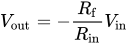
The simplified circuit above is like the differential amplifier in the limit of R2 and Rg very small. In this case, though, the circuit will be susceptible to input bias current drift because of the mismatch between Rf and Rin.
To intuitively see the gain equation above, calculate the current in Rin:

then recall that this same current must be passing through Rf, therefore (because V− = V+ = 0):
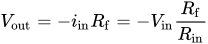
A mechanical analogy is a seesaw, with the V− node (between Rin and Rf) as the fulcrum, at ground potential. Vin is at a length Rin from the fulcrum; Vout is at a length Rf. When Vin descends "below ground", the output Vout rises proportionately to balance the seesaw, and vice versa.[2]
As the negative input of the op-amp acts as a virtual ground, the input impedance of this circuit is equal to Rin.
Non-inverting amplifier
[edit]
A non-inverting amplifier is a special case of the differential amplifier in which that circuit's inverting input V1 is grounded, and non-inverting input V2 is identified with Vin above, with R1 ≫ R2. Referring to the circuit immediately above,
- .
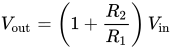
To intuitively see this gain equation, use the virtual ground technique to calculate the current in resistor R1:

then recall that this same current must be passing through R2, therefore:

Unlike the inverting amplifier, a non-inverting amplifier cannot have a gain of less than 1.
A mechanical analogy is a class-2 lever, with one terminal of R1 as the fulcrum, at ground potential. Vin is at a length R1 from the fulcrum; Vout is at a length R2 further along. When Vin ascends "above ground", the output Vout rises proportionately with the lever.
The input impedance of the simplified non-inverting amplifier is high:

where Zdif is the op-amp's input impedance to differential signals, and AOL is the open-loop voltage gain of the op-amp (which varies with frequency), and B is the feedback factor (the fraction of the output signal that returns to the input).[3][4] In the case of the ideal op-amp, with AOL infinite and Zdif infinite, the input impedance is also infinite. In this case, though, the circuit will be susceptible to input bias current drift because of the mismatch between the impedances driving the V+ and V− op-amp inputs.
The feedback loop similarly decreases the output impedance:
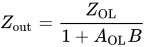
where Zout is the output impedance with feedback, and ZOL is the open-loop output impedance.[4]
Voltage follower (unity buffer amplifier)
[edit]
Used as a buffer amplifier to eliminate loading effects (e.g., connecting a device with a high source impedance to a device with a low input impedance).
- (realistically, the differential input impedance of the op-amp itself (1 MΩ to 1 TΩ), multiplied by the open-loop gain of the op-amp)


Due to the strong (i.e., unity gain) feedback and certain non-ideal characteristics of real operational amplifiers, this feedback system is prone to have poor stability margins. Consequently, the system may be unstable when connected to sufficiently capacitive loads. In these cases, a lag compensation network (e.g., connecting the load to the voltage follower through a resistor) can be used to restore stability. The manufacturer data sheet for the operational amplifier may provide guidance for the selection of components in external compensation networks. Alternatively, another operational amplifier can be chosen that has more appropriate internal compensation.
The input and output impedance are affected by the feedback loop in the same way as the non-inverting amplifier, with B=1.[3][4]
Summing amplifier
[edit]
A summing amplifier produces the negative of the sum of several (weighted) voltages:

- When , and independent



- When


- Input impedance of the nth input is ( is a virtual ground)


Instrumentation amplifier
[edit]
Combines very high input impedance, high common-mode rejection, low DC offset, and other properties used in making very accurate, low-noise measurements
- Is made by adding a non-inverting buffer to each input of the differential amplifier to increase the input impedance.
Oscillators
[edit]Wien bridge oscillator
[edit]
Produces a very low distortion sine wave. Uses negative temperature compensation in the form of a light bulb or diode.
Filters
[edit]Operational amplifiers can be used in construction of active filters, providing high-pass, low-pass, band-pass, reject and delay functions. The high input impedance and gain of an op-amp allow straightforward calculation of element values, allowing accurate implementation of any desired filter topology with little concern for the loading effects of stages in the filter or of subsequent stages. However, the frequencies at which active filters can be implemented is limited; when the behavior of the amplifiers departs significantly from the ideal behavior assumed in elementary design of the filters, filter performance is degraded.
Comparator
[edit]
An operational amplifier can, if necessary, be forced to act as a comparator. The smallest difference between the input voltages will be amplified enormously, causing the output to swing to nearly the supply voltage. However, it is usually better to use a dedicated comparator for this purpose, as its output has a higher slew rate and can reach either power supply rail. Some op-amps have clamping diodes on the input that prevent use as a comparator.[5]
Integration and differentiation
[edit]Inverting integrator
[edit]The integrator is mostly used in analog computers, analog-to-digital converters and wave-shaping circuits. A simple version is:

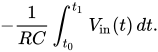
Assuming ideal elements, it integrates the input signal (multiplied by ) over a time interval from t0 to t1, yielding an output voltage at time t = t1 of:


where Vout(t0) is the capacitor's initial voltage at time t = t0. In other words, the circuit's output voltage changes over the time interval by an amount proportional to the time integral of the input voltage:
This circuit can be viewed as an active low-pass electronic filter with a single pole at DC (i.e., where ).

Its practicality is limited by a significant problem: unless the capacitor is periodically discharged, the output voltage will eventually drift outside of the operational amplifier's operating range. This can be due to any combination of:
- a non-zero DC component in the input Vin,
- a non-zero opamp input bias current,
- a non-zero opamp input offset voltage.[6]
The following slightly more complex circuit can ameliorate the second two problems, and in some cases, the first as well, but has a limited bandwidth of integration:

Here, the feedback resistor Rf provides a discharge path for capacitor Cf. The series resistor Rn at the non-inverting input alleviates input bias current and common-mode problems, provided it is set to the parallel resistance of Ri || Rf:

Op amp integrator § Practical circuit explains the output drift adds a small finite DC error voltage:

Because the circuit is a first-order low-pass filter with a flat response up to its cutoff frequency , it only functions as an integrator for frequencies significantly higher than that cutoff.

Inverting differentiator
[edit]
Assuming ideal elements, this circuit differentiates the signal (multiplied by ) over time:

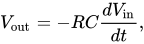
where and are functions of time.


The transfer function of the inverting differentiator has a single zero in the origin (i.e., where angular frequency ). The high-pass characteristics of a differentiating amplifier can lead to stability challenges when the circuit is used in an analog servo loop (e.g., in a PID controller with a significant derivative gain). In particular, as a root locus analysis would show, increasing feedback gain will drive a closed-loop pole toward marginal stability at the DC zero introduced by the differentiator.
Synthetic elements
[edit]Inductance gyrator
[edit]
Simulates an inductor (i.e., provides inductance without the use of a possibly costly inductor). The circuit exploits the fact that the current flowing through a capacitor behaves through time as the voltage across an inductor. The capacitor used in this circuit is geometrically smaller than the inductor it simulates, and its capacitance is less subject to changes in value due to environmental changes. Applications where this circuit may be superior to a physical inductor are simulating a variable inductance or simulating a very large inductance.
This circuit is of limited use in applications relying on the back EMF property of an inductor, as this effect will be limited in a gyrator circuit to the voltage supplies of the op-amp.
Negative impedance converter (NIC)
[edit]
Creates a resistor having a negative value for any signal generator.
In this case, the ratio between the input voltage and the input current (thus the input resistance) is given by

In general, the components , , and need not be resistors; they can be any component that can be described with an impedance.


Non-linear
[edit] |
Precision rectifier
[edit]
The voltage drop VF across the forward-biased diode in the circuit of a passive rectifier is undesired. In this active version, the problem is solved by connecting the diode in the negative feedback loop. The op-amp compares the output voltage across the load with the input voltage and increases its own output voltage with the value of VF. As a result, the voltage drop VF is compensated, and the circuit behaves very nearly as an ideal (super) diode with VF = 0 V.
The circuit has speed limitations at high frequency because of the slow negative feedback and due to the low slew rate of many non-ideal op-amps.
Exponential output
[edit]
The Shockley diode equation gives the current–voltage relationship for an ideal semiconductor diode:

where is the saturation current, is the forward voltage across the diode, and is the thermal voltage (approximately 26 mV at room temperature). When the diode's current is approximately proportional to an exponential function:


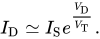
The opamp's inverting input is virtually grounded and ideally draws no current. Thus, the output voltage will be:

The output voltage is thus approximately an exponential function of the input voltage :

This implementation does not consider temperature stability and other non-ideal effects.
Logarithmic output
[edit]Since the logarithm is the inverse function of exponentiation, the exponential output circuit described above can be rearranged by swapping the diode into the feedback path of the opamp to form a log amplifier:

Since the opamp's inverting input is virtually grounded and ideally draws no current, and the current flowing from the source through the resistor and diode is:

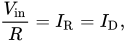
where is the current through the diode, which as described earlier is approximately:

Solving for gives an approximately logarithmic relationship between the input voltage and the output voltage :

This implementation does not consider temperature stability and other non-ideal effects.
Piecewise linear output
[edit]Piecewise linear functions can approximate non-linear functions as a series of connected line segments. Gain compression circuits (like sine or square root) use diodes or transistors to switch between line segments with slopes determined by resistive voltage divider networks. Expansion circuits may be built using a compression circuit as feedback of an opamp.[7]
Temperature-compensated compression
[edit]
The schematic shown for a "temperature-compensated three-segment compression function"[8][9] produces a gain compression transfer function where each subsequent line segment reduces the steepness of the transfer function. For small signals, transistors Q2 and Q3 produce very little base current, and so the circuit's gain is determined just by the feedback resistance of R2 divided by the input resistance of R1. Once the output voltage exceeds around 2 V (whose exact voltage depends on R3 and R4 and the -15 V supply), then Q3 saturates, so the circuit's feedback resistance is determined by R4 in parallel with R2, reducing the gain. As the output voltage increases more, Q2 will saturate, so the circuit's gain is again reduced by the additional inclusion of R6 into the parallel feedback resistance. Temperature-compensation transistors Q4 and Q1 cancel out the temperature-dependent p–n junction base-emitter forward voltage drop of Q3 and Q2. Additional linear segments can be added using additional copies of the resistor-transistor-resistor chains (like the chain R5, Q2, R6 or the chain R3, Q3, R4 but with different values) in a similar manner to further compress the input. This circuit's compression function only works for negative inputs. Diode D1 forces the output to zero if a positive input is applied.
Other applications
[edit]See also
[edit]Notes
[edit]- ^ If you think of the left-hand side of the relation as the closed-loop gain of the inverting input, and the right-hand side as the gain of the non-inverting input, then matching these two quantities provides an output insensitive to the common-mode voltage of and .


References
[edit]- ^ Paul Horowitz and Winfield Hill, The Art of Electronics. 2nd ed. Cambridge University Press, Cambridge, 1989 ISBN 0-521-37095-7
- ^ Basic Electronics Theory, Delton T. Horn, 4th ed. McGraw-Hill Professional, 1994, p. 342–343.
- ^ a b "Benefits of Negative Feedback". HyperPhysics. Retrieved 2018-05-07.
- ^ a b c Simpson, Robert E. (1987). "7.2 Negative Voltage Feedback". Introductory electronics for scientists and engineers (2nd ed.). Boston: Allyn and Bacon. p. 291. ISBN 0205083773. OCLC 13821010.
input impedance of an amplifier without negative feedback is increased by adding negative feedback. .. .. output impedance .. is decreased ..
- ^ "Op Amps used as Comparators—is it okay? - the Signal - Archives - TI E2E support forums".
- ^ "AN1177 Op-Amp Precision Design: DC Errors" (PDF). Microchip. 2 January 2008. Archived (PDF) from the original on 2019-07-09. Retrieved 26 December 2012.
- ^ Kuhn, Kenneth A. (2004-03-24). "Piecewise Linear Circuits" (PDF).
- ^ "AN-4 Monolithic Op Amp—the Universal Linear Component" (PDF). Texas Instruments. April 1968.
- ^ "National Semiconductor Application Note 31" (PDF). September 2002.


Further reading
[edit]External links
[edit]
- "Single supply op-amp circuit collection" (PDF). (163 KiB)
- "Op-amp circuit collection" (PDF). (2980 KiB)
- "A Collection of Amp Applications" (PDF). (1.06 MiB) – Analog Devices Application note
- "Basic OpAmp Applications" (PDF). (173 KiB)
- "Handbook of operational amplifier applications" (PDF). (2.00 MiB) – Texas Instruments Application note
- Low Side Current Sensing Using Operational Amplifiers Archived 2009-04-08 at the Wayback Machine
- "Log/anti-log generators, cube generator, multiply/divide amp" (PDF). Archived from the original (PDF) on 2008-05-09. (165 KiB)
- Logarithmically variable gain from a linear variable component
- Impedance and admittance transformations using operational amplifiers by D. H. Sheingold
- High Speed Amplifier Techniques very practical and readable – with photos and real waveforms
- Properly terminating an unused op-amp
Operational amplifier applications
View on GrokipediaPractical Considerations
Op-Amp Parameter Requirements
Selecting an operational amplifier (op-amp) for a specific application requires careful consideration of its key electrical parameters to ensure the circuit meets performance requirements such as accuracy, speed, and stability. These parameters, specified in datasheets, define the device's capabilities and limitations under various conditions.[3] The open-loop gain (), also known as the differential voltage gain, is the ratio of the output voltage to the differential input voltage with the output open-circuited, typically ranging from to (100 dB to 120 dB) at DC for general-purpose op-amps. This high gain enables precise closed-loop configurations but decreases with frequency, influencing overall circuit accuracy by minimizing gain errors in feedback applications.[3][4] The gain-bandwidth product (GBW) represents the product of the open-loop gain and the frequency at which it equals unity, serving as a measure of the op-amp's bandwidth limitation; for example, the classic μA741 offers a GBW of 1 MHz. A higher GBW is essential for high-frequency amplifiers to maintain desired closed-loop bandwidth without excessive gain reduction.[3][4] Slew rate (SR) quantifies the maximum rate of change of the output voltage in response to a step input, typically 0.5 V/μs for general-purpose op-amps like the μA741, limiting the amplifier's ability to handle large, fast signals without distortion. Applications involving rapid transients, such as audio or video processing, demand higher SR values to preserve signal integrity.[3][4] Input offset voltage () is the differential input voltage required to make the output zero, ideally less than 1 mV for precision devices, as it directly affects DC accuracy in non-inverting or integrator circuits. Low is critical for precision DC amplification, where even small offsets can propagate to significant output errors.[3] Common-mode rejection ratio (CMRR) measures the op-amp's ability to reject signals common to both inputs relative to differential signals, typically exceeding 80 dB, ensuring that common-mode noise, such as from power lines, does not corrupt the desired differential signal. High CMRR is vital in differential amplifiers for instrumentation where noise rejection is paramount.[3] Power supply rejection ratio (PSRR) indicates the suppression of supply voltage variations at the output, usually greater than 80 dB, maintaining output stability despite fluctuations in the power supply. This parameter is particularly important in environments with noisy power sources, like battery-powered or industrial systems.[3] Matching these parameters to the application involves selecting devices with high GBW and SR for high-frequency or fast-response needs, such as in active filters or data acquisition, while prioritizing low and high CMRR for precision, low-frequency tasks like sensor interfaces. For instance, a high-speed video amplifier might require a GBW above 100 MHz, whereas a DC precision scale would favor below 10 μV.[3] Trade-offs are inherent in op-amp selection; for example, rail-to-rail input/output op-amps, which allow signals to approach the supply rails closely, often incur higher quiescent current and slightly reduced precision compared to standard op-amps, increasing cost for applications needing full dynamic range on low supplies, such as portable devices.[5] Historically, the μA741, introduced in 1968 by Fairchild Semiconductor, set benchmarks with around , SR of 0.5 V/μs, and up to 6 mV, establishing the general-purpose op-amp standard but limited by modest bandwidth and noise. Modern low-noise JFET-input op-amps, such as the OPA827 with 22 MHz GBW and 28 V/μs SR, evolved from these foundations to offer superior noise performance (e.g., 4 nV/√Hz) and higher speed for demanding audio and instrumentation uses, reflecting advances in fabrication and design since the 1990s.[6][4][7][8]Input Bias and Offset Management
Input bias current, denoted as , represents the average DC current required to operate the input transistors of an operational amplifier, flowing into both the noninverting () and inverting () terminals. In bipolar junction transistor (BJT)-based op-amps, typically ranges from 1 nA to 100 nA, stemming from base currents in the differential input stage. Field-effect transistor (FET)-input op-amps, by contrast, exhibit much lower values, often below 1 pA, due to the high input impedance of FETs. The input offset current, , measures the mismatch between these currents and can introduce differential errors even in balanced circuits. A key error mechanism arises when flows through source resistances, producing an input voltage offset , which is particularly problematic in high-impedance, DC-coupled applications where even modest resistances amplify the effect. Input offset voltage, , originates from inherent asymmetries in the op-amp's input stage, such as mismatches in transistor threshold voltages, emitter areas, or collector resistors in BJT pairs, or gate-source capacitances in FET designs. These mismatches manifest as a fixed differential voltage at the inputs needed to drive the output to zero, with typical magnitudes from 10 µV in precision BJT amplifiers to 1 mV or more in untrimmed CMOS types. To measure , the op-amp is configured in a high-gain unity-feedback setup, where the output voltage is amplified by the noise gain (e.g., 1001) and then divided back to yield . Nulling techniques employ external potentiometers connected across the op-amp's dedicated offset adjustment pins, injecting a corrective voltage or current to trim to near zero at ambient conditions; however, this adjustment can introduce additional temperature coefficient drift, often 3–5 µV/°C per mV of nulling range. Mismatched external components, such as feedback resistors differing by 1%, can further contribute to effective via resistor tolerance errors proportional to . Compensation for input bias currents focuses on balancing the voltage drops across the inputs to minimize differential offsets. A standard method involves inserting a resistor in the noninverting input path equal to the parallel combination of the source and feedback resistances, , ensuring that produces equal common-mode drops rather than differential errors; this approach is most effective when is low relative to . For ultralow-current applications, such as electrometer circuits, guarding techniques drive a surrounding conductor or printed circuit trace to the input common-mode potential, shunting board leakage currents (often 10–100 pA) away from the sensitive inputs and reducing effective by orders of magnitude. Bootstrapping complements this by feeding a portion of the output signal back to the input stage's bias elements or shielding, effectively lowering the impedance seen by parasitic capacitances and stabilizing against common-mode voltage variations. Consider a non-inverting amplifier with gain set by feedback resistor and ground resistor . The total output offset voltage combines contributions from both errors: Here, is amplified by the noise gain, while at the inverting input flows through to produce a direct drop, assuming a compensated configuration where the noninverting path resistor balances the effect; for a gain of 10 with kΩ, kΩ, a 10 nA and 50 µV yield approximately 500 µV output offset, underscoring the need for low- op-amps in precision setups.Power Supply Effects
Operational amplifiers require careful consideration of power supply configurations to ensure reliable performance. Dual power supplies, typically denoted as ±V, provide a symmetric voltage around ground, facilitating straightforward signal referencing and minimizing the need for additional biasing in AC-coupled applications. In contrast, single-supply operation uses a positive voltage (e.g., +V to ground), which is advantageous for battery-powered or low-voltage systems but demands proper DC biasing of the input and output signals to keep them within the common-mode range. The total supply voltage remains comparable between configurations, often up to 30 V for many devices, but single-supply designs must account for the absence of a negative rail.[9][10][11] Headroom limitations further influence supply selection, as the output voltage swing of standard op-amps is typically restricted to within 1.5 V to 3 V of the supply rails under nominal loads, preventing saturation and distortion. For instance, bipolar input op-amps often exhibit about 2 V of headroom from each rail, limiting the maximum output excursion in a ±15 V dual supply to roughly ±13 V. Rail-to-rail output variants reduce this to under 100 mV but may compromise other parameters like noise. These constraints are critical in applications requiring full-scale signals, where insufficient headroom can clip waveforms or degrade linearity.[12][13][14] Power supply noise significantly impacts op-amp performance, particularly through reduced power supply rejection ratio (PSRR) at higher frequencies, where rejection can drop from over 100 dB at DC to below 40 dB above 1 MHz, allowing ripple to couple into the output. Effective filtering involves placing bypass capacitors close to the supply pins: a 0.1 μF ceramic capacitor for high-frequency decoupling combined with a 10 μF electrolytic for low-frequency stability minimizes inductive paths and suppresses noise. Bypassing and decoupling techniques are essential in layouts to prevent ripple from coupling into sensitive signal paths via parasitic inductances or capacitive crosstalk, which can otherwise introduce unwanted oscillations or feedthrough.[15][16][17] Supply currents must also be managed, with quiescent current (I_Q) typically ranging from 1 mA to 10 mA per amplifier in standard precision devices, influencing power budgeting in current-source applications where op-amps serve as control elements. Sensing I_Q via a low-value shunt resistor in the supply path allows monitoring for thermal or fault conditions without disrupting the signal chain. In audio applications, inadequate decoupling exacerbates distortion, as supply ripple modulates the output stage, potentially increasing total harmonic distortion (THD) by orders of magnitude; proper techniques can maintain THD below 0.0001% at 1 kHz. Avoiding direct routing of supply lines near signal traces further prevents ripple injection, preserving signal integrity.[18][19][20][21]Component Selection and Specifications
Selecting appropriate external components is crucial for achieving desired performance in operational amplifier (op-amp) circuits, as these elements directly influence stability, noise, precision, and bandwidth. Resistors and capacitors in the feedback and signal paths must be chosen based on tolerance, temperature stability, and other specifications to minimize errors and ensure reliable operation across environmental conditions.[22] Resistors in op-amp circuits, particularly those in feedback networks, require careful selection to maintain precision. For precision applications, resistors with 1% tolerance or better are recommended to limit gain errors, while higher tolerances like 5% or 10% may suffice for non-critical uses.[22] Temperature coefficients should be low, typically 50 ppm/°C or less for precision designs, to avoid gain drift over temperature variations; metal film resistors are preferred for this characteristic.[23] Power ratings must exceed the expected dissipation, calculated as , to prevent overheating and nonlinearity, with a safety margin of at least 2x recommended.[22] High resistor values exceeding 1 MΩ should be avoided in input and feedback paths, as they amplify thermal noise and input bias current errors, increasing overall circuit noise density.[24][25] Capacitors used in op-amp circuits, such as those for compensation or filtering, also demand specific types to ensure stability and performance. Ceramic capacitors with NP0 (C0G) dielectric are ideal for feedback and timing applications due to their low temperature and voltage coefficients, providing stable capacitance over a wide range without introducing distortion or phase shifts. For larger capacitance values required in low-frequency filters or integrators, electrolytic capacitors (aluminum or tantalum) are suitable, but their polarity must be observed to avoid damage from reverse bias, and they exhibit higher leakage currents.[16] In active filters, the equivalent series resistance (ESR) of electrolytic capacitors can affect the Q-factor and roll-off characteristics; low-ESR types are preferred to maintain sharp frequency responses, especially at low temperatures where ESR may increase by 4-6 times.[26] Designing the feedback network involves optimizing for stability, particularly in high-speed applications. A phase margin greater than 45° is essential to prevent oscillations and ensure adequate settling time; this can be verified through Bode plot analysis of the loop gain.[27] Capacitive loading at the output or inverting input should be minimized by keeping traces short and using isolation resistors if necessary, as stray capacitance reduces phase margin and can cause instability.[28] For high-speed op-amps, impedance matching in the feedback path—often using lower-value resistors or transmission line considerations—helps preserve signal integrity and bandwidth by reducing reflections and mismatches.[29] Resistor tolerances directly impact gain accuracy in amplifier configurations. For an inverting amplifier with gain , the relative gain error is approximately , assuming uncorrelated errors; thus, using matched 1% resistors limits the worst-case error to about 2%.[22] Component-driven bandwidth may also be constrained by the op-amp's slew rate, requiring verification in precision designs.[30]Basic Amplifier Configurations
Inverting Amplifier
The inverting amplifier configuration uses an operational amplifier with negative feedback to produce an output signal that is an inverted and amplified version of the input signal. The circuit consists of an input resistor connected from the signal source to the inverting input terminal, a feedback resistor connected between the output and the inverting input, and the non-inverting input grounded. Due to the high open-loop gain of the op-amp, the inverting input operates at a virtual ground potential, where the voltage is approximately zero, ensuring that the input current flows entirely through and without drawing current into the op-amp inputs.[31] Under ideal conditions, the op-amp has infinite input impedance, zero output impedance, and infinite open-loop gain, leading to the virtual ground assumption. Applying Kirchhoff's current law at the inverting input node, the current through equals the current through : Solving for the output voltage yields the gain formula: where the negative sign indicates 180-degree phase inversion. This closed-loop gain can be adjusted by selecting appropriate resistor values, typically with ranging from 1 to 100 for stability.[31] In non-ideal scenarios, the finite open-loop gain (e.g., 10^5 to 10^6 for typical op-amps like the OP177) introduces a small error in the closed-loop gain. The actual output voltage becomes: For high , the error is negligible (e.g., less than 0.1% for and ), but it increases at higher gains. Additionally, the frequency response is limited by the gain-bandwidth product (GBW), a constant for voltage-feedback op-amps (typically 1-10 MHz). The 3-dB bandwidth is approximately , beyond which the gain rolls off at 20 dB/decade, restricting high-frequency operation for large .[32] A key limitation is the noise gain, defined as , which equals the non-inverting gain and determines the amplification of op-amp input-referred noise and offset voltages, potentially degrading signal-to-noise ratio in low-level applications. This noise gain also influences stability, as phase margin decreases with higher values.[32] The inverting amplifier finds applications in audio signal processing, such as low-pass filtered amplification for bass enhancement, where it provides controlled gain and inversion without introducing significant distortion. In sensor interfacing, it scales small output voltages from devices like temperature sensors (e.g., translating -5 V to -1 V inputs to 3.3 V to 0.05 V outputs) while maintaining accuracy through precise resistor ratios.[33][34]Non-Inverting Amplifier
The non-inverting amplifier is a fundamental operational amplifier configuration where the input signal is applied directly to the non-inverting (+) terminal, while negative feedback is applied to the inverting (-) terminal via a resistive voltage divider. The divider consists of the feedback resistor connected between the output and the inverting input, and the gain-setting resistor connected from the inverting input to ground. The closed-loop voltage gain is determined by the ratio of these resistors and is expressed as This setup ensures that the output signal remains in phase with the input, providing non-inverted amplification.[35] A primary advantage of this configuration is its exceptionally high input impedance, which minimizes loading effects on the source and is particularly beneficial for signals from high-impedance transducers. The input impedance is approximately equal to the op-amp's own input impedance, often in the gigaohm range, but more precisely approximated as , where is the feedback factor, is the open-loop gain, and is the op-amp's differential input resistance; this bootstrapping effect via feedback further enhances the effective impedance.[35][36] Additionally, the non-inverting topology exhibits low output offset contributions from the feedback network, as there is no series input resistor to amplify input bias currents, reducing overall DC errors compared to inverting configurations. The output voltage, accounting for the op-amp's input offset voltage , is given by This equation highlights how the offset is amplified by the noise gain, which equals the closed-loop gain in this setup.[35] The closed-loop bandwidth of the non-inverting amplifier is limited by the op-amp's gain-bandwidth product (GBW) and decreases inversely with gain, expressed as ; for example, with a GBW of 3 MHz and , the bandwidth is approximately 300 kHz. Stability is maintained through the feedback factor , which sets the loop gain ; for unity-gain-stable op-amps, the configuration remains stable across typical gains greater than 1, though high-value resistors may require compensation capacitors to preserve phase margin.[35] Common applications include voltage boosting in signal processing chains, where modest gains (e.g., 2–100) are needed without phase inversion, and interfacing with transducers like piezoelectric sensors or strain gauges, whose high output impedances (often MΩ) are preserved by the circuit's input characteristics.[35]Voltage Follower
The voltage follower, also known as a unity-gain buffer, is an operational amplifier configuration where the output is directly connected to the inverting input, and the input signal is applied to the non-inverting input. This setup results in a closed-loop gain of exactly 1, such that the output voltage equals the input voltage for an ideal op-amp.[1][32] In this arrangement, the op-amp operates with 100% negative feedback, maximizing its bandwidth to approximately the gain-bandwidth product (GBW), where the -3 dB frequency . This configuration leverages the op-amp's high open-loop gain to achieve precise signal replication without amplification.[32] A primary benefit of the voltage follower is its impedance transformation capabilities, providing a very high input impedance—typically on the order of the open-loop gain times the differential input resistance, often exceeding 1 MΩ—and a very low output impedance, approximately the op-amp's output resistance divided by , which can be less than 1 Ω. This makes it ideal for impedance matching, preventing loading of sensitive signal sources while enabling the output to drive low-impedance loads effectively. Additionally, the unity-gain setup introduces minimal phase shift across the frequency range, preserving signal integrity in applications requiring faithful waveform reproduction.[1][32] Common applications include buffering signals for analog-to-digital converters (ADCs), where the high input impedance isolates the ADC from the source, and driving coaxial cables to minimize signal distortion over long distances. However, stability can be compromised when driving capacitive loads, such as those in ADC inputs or cables, potentially causing peaking or oscillation due to phase shift in the feedback loop; this is often mitigated by inserting a small isolation resistor (e.g., 20–50 Ω) in series with the output. For scenarios demanding higher output current to drive low-impedance loads, current-boosting techniques—such as using op-amps with integrated high-current outputs or external Darlington transistor pairs—extend the configuration's utility without altering the unity gain.[1][32] In non-ideal conditions, the output voltage includes an offset error, given by , where is the input offset voltage, typically ranging from 1 μV to 5 mV depending on the op-amp type. This error can be minimized through selection of low-offset devices or external trimming circuits, ensuring the buffer maintains accuracy in precision applications.[1][32]Differential Amplifier
The single op-amp differential amplifier configuration amplifies the voltage difference between two inputs while rejecting common-mode voltages present on both inputs simultaneously. This circuit uses four resistors: input resistors connected to the inverting and non-inverting terminals of the op-amp, respectively, a feedback resistor from the output to the inverting input, and a resistor from the non-inverting input to ground. The differential gain is .[37][38] The output voltage is expressed as where and are the voltages at the inverting and non-inverting inputs. When a common-mode voltage is applied to both inputs with perfectly matched resistors, the common-mode gain is approximately 0, as the voltages at the op-amp inputs remain equal due to the balanced resistor ratios. With perfectly matched resistors, the CMRR approaches the op-amp's intrinsic CMRR. For matched resistors, the circuit's common-mode rejection is enhanced by the op-amp's inherent rejection capability.[37][39][38] To maintain high CMRR in practice, resistor balancing techniques such as laser trimming during manufacturing or selecting precision external resistor networks with tight matching (e.g., 0.01% tolerance) are essential. This setup finds application in bridge sensors, such as strain gauges or pressure transducers, where the small differential output from an unbalanced Wheatstone bridge is amplified amid potentially large common-mode offsets from excitation voltages or environmental noise.[37][40][41] Resistor mismatch due to manufacturing tolerances degrades CMRR by introducing a residual common-mode gain. In the unbalanced case, with absolute tolerance (fractional mismatch), the approximate CMRR is ; for example, with 0.1% tolerance () and unity gain, CMRR ≈ 250 (48 dB). Techniques like adding a balancing resistor to the non-inverting input can mitigate input bias current effects on CMRR, as detailed in input bias and offset management.[37][38]Summing Amplifier
The summing amplifier, also known as a summer or adder, is an operational amplifier (op-amp) circuit that combines multiple input voltages into a single output representing their weighted sum, typically in an inverting configuration. This setup extends the basic inverting amplifier by connecting several input signals through individual resistors to the inverting input terminal, with a shared feedback resistor linking the output back to that same point. The non-inverting input is grounded, creating a virtual ground at the inverting input due to the op-amp's high open-loop gain and negative feedback, which forces the differential input voltage to near zero.[42][43] In the standard inverting summing configuration, the output voltage is given by the formula: where is the feedback resistor, through are the input resistors for each voltage through , and the negative sign indicates inversion. If all input resistors are equal (e.g., ), the formula simplifies to , providing equal weighting for the summed signals. The virtual ground at the summing junction ensures that input currents add linearly without mutual loading, as each input current is and the output drives the feedback current to balance the sum.[42][2][43] The noise gain of the circuit, defined as where is the parallel combination of all input resistors, increases as more inputs are added because decreases. This higher noise gain reduces the closed-loop bandwidth, approximately given by the op-amp's gain-bandwidth product divided by the noise gain, potentially limiting high-frequency performance in multi-input designs.[42][43] Common applications include audio mixers, where multiple microphone or instrument signals are combined with adjustable gains via resistor ratios, and digital-to-analog converters (DACs), particularly weighted-resistor types that sum currents from binary-weighted sources to produce an analog output voltage. A non-inverting variant can be realized using a differential amplifier configuration, where multiple signals are summed at the non-inverting input through resistors, while the inverting input receives a reference or grounded path via a resistor network, preserving signal polarity.[42][44][32] Error sources in summing amplifiers primarily arise from input bias currents, which flow through the input resistors and create voltage drops at the virtual ground, leading to offset errors in the output. This effect is exacerbated if input resistors are unequal or high in value, as the voltage offset for each input becomes ; for bipolar op-amps with bias currents in the nanoamp range, a 100 kΩ resistor can produce offsets of tens of microvolts. Mitigation involves selecting low-bias-current op-amps (e.g., CMOS types) or adding a compensating resistor equal to the parallel combination of input and feedback resistors at the non-inverting input.[42][43][2]Advanced Linear Circuits
Instrumentation Amplifier
The three-op-amp instrumentation amplifier is a precision circuit topology that combines two input buffer stages with a differential amplifier stage to amplify small differential signals while rejecting common-mode noise. The input stage employs two operational amplifiers configured as non-inverting buffers, interconnected via a gain-setting resistor and feedback resistors on each buffer, which ensures high and matched input impedances. The output stage is a conventional differential amplifier with input resistors and feedback resistor , converting the buffered differential signal to a single-ended output. This structure allows the gain to be precisely adjusted by varying only , typically yielding a differential voltage gain .[45][46][47] The differential gain arises from the input stage amplification of the voltage difference across . For a differential input , the current through is , which flows equally into the non-inverting inputs of the buffers via their respective resistors, producing an output difference of at the buffer outputs. This differential voltage is then amplified by the output stage gain , resulting in the total gain expression above. Common-mode rejection occurs because a common-mode voltage applied to both inputs appears equally at the buffer outputs (with unity gain), and the differential output stage inherently subtracts these equal signals, yielding zero output for pure common mode; the overall CMRR is enhanced by the precise matching of the input stage resistors, often exceeding 100 dB.[45][46][47] This topology offers significant advantages over simpler configurations, including a common-mode rejection ratio (CMRR) typically greater than 100 dB (up to 120 dB in precision designs) due to the balanced input buffering and resistor symmetry, which minimizes mismatch-induced errors. Input impedance is exceptionally high, exceeding , as the buffer stages isolate the signal source from loading effects. In modern integrated circuits based on this design, the common-mode input range often extends to the power supply rails, enabling operation in low-voltage environments. Compared to a single op-amp differential amplifier, the three-op-amp version achieves superior performance through the shared , which allows gain adjustment without compromising resistor balance or CMRR, as variations in affect both input paths equally.[46][45] Instrumentation amplifiers find critical applications in environments requiring accurate measurement of low-level differential signals amid high common-mode interference, such as Wheatstone bridge circuits with strain gauges for detecting mechanical strain in force or pressure sensors. In medical diagnostics, they are essential for amplifying bioelectric potentials in electrocardiogram (ECG) systems, where they enhance signal fidelity while suppressing 50/60 Hz power-line noise.[46][45]Integrators
The operational amplifier integrator is a fundamental circuit configuration that performs time-domain integration of an input signal, producing an output voltage proportional to the accumulated value of the input over time. This inverting integrator setup, which builds on the basic inverting amplifier by replacing the feedback resistor with a capacitor, is essential in analog computing and control systems where signal accumulation is required.[42] In the ideal circuit, the input signal connects through an input resistor to the inverting terminal of the op-amp, while a capacitor provides feedback from the output to the inverting input, with the non-inverting input grounded. Assuming an ideal op-amp with infinite gain and input impedance, the output voltage is given by which represents the negative integral of the input voltage, scaled by the time constant . In the frequency domain, the transfer function is , confirming its role as an integrator.[48][42][49] The frequency response of the ideal integrator behaves as a low-pass filter with a cutoff frequency , where the gain rolls off at -20 dB per decade above this point and the DC gain is theoretically infinite. This characteristic makes it suitable for accumulating low-frequency signals while attenuating higher frequencies, though practical implementations limit the DC gain to prevent saturation.[42][48] Key applications include analog PID controllers, where the integrator provides the integral term to eliminate steady-state errors in feedback systems, and triangle wave generation, often by integrating a square wave to produce linear ramps that form the waveform. To address output drift, a reset switch can discharge the capacitor periodically.[42][50][51] Non-ideal effects, such as input offset voltage and bias current, cause a ramp-like drift in the output over time, potentially leading to saturation. This is mitigated by adding a high-value resistor in parallel with the feedback capacitor, which limits the low-frequency gain and stabilizes the circuit without significantly affecting integration performance at higher frequencies.[42]Differentiators
The inverting differentiator circuit uses an operational amplifier in a feedback configuration where a capacitor is connected in series with the input signal to the inverting terminal, and a feedback resistor connects the output to the inverting input, with the non-inverting input grounded.[1][52] This setup produces an output voltage proportional to the time derivative of the input, given by the equation .[1][49] In the frequency domain, the transfer function is , resulting in a magnitude that increases linearly with frequency, providing a high-pass characteristic with a 20 dB/decade gain slope.[52][49] This frequency response emphasizes high-frequency changes in the input signal but introduces instability at high frequencies, as the op-amp's open-loop gain eventually rolls off, leading to phase shifts that can cause oscillations.[1] More critically, the circuit amplifies high-frequency noise present in the input or from the op-amp itself, often by orders of magnitude, since noise components behave like rapid signal changes and are differentiated accordingly.[1][52] The rate of closure between the noise gain and the op-amp's open-loop response is approximately 40 dB/decade in the basic configuration, exacerbating instability and making the ideal differentiator impractical for most real-world uses without modifications.[1] To address these issues, a resistor is typically added in series with the input capacitor , forming a low-pass filter at the input with cutoff frequency , which limits the bandwidth and prevents excessive noise amplification at very high frequencies.[1][52] Additionally, a small feedback capacitor is placed in parallel with , introducing a zero in the transfer function and rolling off the gain at , typically set to about 3.5 times the maximum differentiation frequency for stability while preserving the desired response.[1][52] These modifications ensure the noise gain intersects the op-amp's open-loop gain within its stable region, often requiring the gain-bandwidth product (GBP) to satisfy .[52] Offset voltages can be managed using standard feedback techniques, such as adding a compensating resistor, to minimize DC errors in the differentiated output.[1] Differentiator circuits find applications in signal processing tasks that require emphasizing transients, such as wave shaping where a square wave input produces impulse-like outputs for edge detection, or converting sine waves to cosine waves for phase analysis.[52] In control systems, they implement the derivative term of PID controllers to anticipate rapid changes, though noise sensitivity limits their use in real-time applications without additional filtering.[1] For instance, slope detection in biomedical signals, like pacemaker timing, employs differentiators to identify sharp transitions in voltage waveforms.[53] Despite these uses, the inherent noise amplification and potential for saturation during high-slew-rate events restrict their deployment in noisy environments or precision real-time control without robust practical enhancements.[52]Active Filters
Low-Pass Filters
Low-pass filters implemented with operational amplifiers (op-amps) attenuate high-frequency components while passing low-frequency signals, providing active filtering with adjustable gain and high input impedance. These circuits enhance passive RC filters by buffering the output to prevent loading effects and allowing higher-order responses without inductors.[54] A first-order low-pass filter uses a passive RC network followed by a non-inverting op-amp configuration, typically as a unity-gain voltage follower. The circuit consists of a resistor in series with the input and a capacitor to ground at the op-amp's non-inverting input, with the output fed back directly to the inverting input. The cutoff frequency is given by , where the gain rolls off at -20 dB/decade above . This topology has a quality factor , corresponding to a damping ratio of 1, resulting in a maximally flat response without peaking.[54][55] For sharper roll-off, second-order low-pass filters employ the Sallen-Key topology, introduced in 1955, which uses a single op-amp with two resistors and two capacitors in a positive-feedback configuration. In the unity-gain version, the op-amp acts as a buffer with the output connected directly to the inverting input, and the RC network forms the feedback path. The transfer function is , where is the natural frequency and determines the filter's peaking and selectivity. The cutoff frequency is , with for gain . Unity gain () with equal components yields ; higher requires component ratios greater than 1 (e.g., ). It exhibits low component sensitivity, typically less than 1 in magnitude for variations in or .[56][54] Design equations for specific responses normalize component values for a given . For a Butterworth response, which provides maximally flat passband magnitude, set ; this requires unequal capacitors with equal resistors, e.g., , , , yielding . Chebyshev responses offer steeper roll-off at the expense of passband ripple; for a 3-dB ripple, and a scaling factor , requiring adjusted ratios like for equal resistors to achieve the pole locations. These designs assume ideal op-amps, but real devices introduce non-idealities such as finite gain-bandwidth product (GBW), causing excess phase shift and reduced at frequencies approaching GBW/10. For example, a 1-MHz GBW op-amp in a 10-kHz filter may shift the phase by an additional 5-10 degrees, necessitating compensation via higher GBW selection or added RC snubbers.[54] Op-amp-based low-pass filters find applications in anti-aliasing for analog-to-digital converters, where they attenuate frequencies above the Nyquist rate to prevent spectral folding; a second-order Sallen-Key with at 0.4-0.5 times the sampling frequency is common. In audio systems, they reduce high-frequency noise and interference, smoothing signals in amplifiers or DAC outputs to improve signal-to-noise ratio without affecting the audible band up to 20 kHz.[54]High-Pass Filters
High-pass filters implemented with operational amplifiers are active circuits designed to attenuate frequencies below a specified cutoff while allowing higher frequencies to pass with minimal distortion, offering advantages such as impedance buffering and gain adjustment over passive counterparts. These filters are essential in signal processing where low-frequency noise or DC components must be suppressed without significantly affecting the desired signal bandwidth.[57] A fundamental configuration is the first-order inverting high-pass filter, where a capacitor is placed in series with the input signal to the inverting terminal of the op-amp, and a resistor provides feedback from the output to the inverting input. This setup forms a high-pass response with a -20 dB/decade roll-off below the cutoff frequency, calculated as , with as the feedback resistor and as the series capacitor; the low-frequency gain approaches zero, effectively blocking DC.[57] The inverting nature inverts the output phase, and the op-amp's high input impedance ensures the capacitor's charging is not loaded by the source.[58] For sharper transitions, second-order high-pass filters employ the Sallen-Key topology, featuring two capacitors in the feedback path and two resistors, with the op-amp configured non-inverting. The transfer function is given by where is the cutoff angular frequency and determines the filter's selectivity and potential peaking. In this design, is gain-dependent; for equal resistor and capacitor values, with as the passband gain set by feedback resistors, allowing higher (sharper roll-off) at gains approaching 3, though values exceeding this risk instability.[58] The cutoff frequency is , providing a -40 dB/decade roll-off.[59] First- and second-order high-pass filters approximate the behavior of a differentiator at frequencies well below the cutoff, where the output is proportional to the input's rate of change, effectively acting as an ideal high-pass with infinite roll-off at DC; however, practical limitations like op-amp bandwidth prevent perfect differentiation. To ensure a flat magnitude response in the passband, components are tuned by selecting matched capacitors (e.g., 1% tolerance NPO types) and resistors (metal film, hundreds to thousands of ohms), with gain adjusted to minimize peaking for Butterworth or Bessel responses.[60][58] These filters find applications in DC blocking to eliminate offset voltages in high-gain amplifiers, preventing output saturation in single-supply systems. In audio processing, they facilitate treble boost in equalizers by selectively amplifying high frequencies, as seen in op-amp-based Baxandall circuits that provide up to 20 dB adjustable boost above break frequencies around 10 kHz.[60][61]Band-Pass and Band-Stop Filters
Operational amplifiers enable the implementation of band-pass and band-stop filters that selectively process signals within or outside specific frequency bands, building on basic low- and high-pass filter principles to achieve targeted frequency response characteristics.[60] The multiple-feedback (MFB) topology is a popular second-order configuration for active band-pass filters, utilizing one op-amp with two capacitors and three resistors to provide a resonant passband. In this circuit, the center frequency is determined by where and are resistors in the feedback path, and and are the integrating and differentiating capacitors, respectively.[62] The quality factor , which defines the filter's selectivity and bandwidth as , is determined by the resistor and capacitor ratios according to standard design equations. This topology offers high gain at resonance and is suitable for moderate values up to approximately 20, though it requires careful component selection to minimize sensitivity to op-amp non-idealities like finite gain-bandwidth product.[62][60] For band-stop (notch) filters, the twin-T topology provides a simple passive network augmented by an op-amp buffer or amplifier to enhance performance and impedance matching. The circuit consists of two T-shaped RC networks—one capacitive and one resistive—connected to the op-amp input, with the notch frequency calculated as assuming equal resistor values and capacitor values in the symmetric configuration.[63] The op-amp introduces positive feedback to boost the quality factor , enabling deeper notches; can be adjusted via the feedback gain , where higher (narrower stopband) is achieved by setting non-inverting gain approaching 2, potentially yielding infinite for ideal rejection at .[63] This buffered design improves the passive twin-T's inherent low of 0.25, achieving rejection depths of 40 dB or more with proper tuning.[60] These filters find essential applications in signal conditioning, such as band-pass circuits for radio frequency tuning to isolate desired channels in receivers operating from 1.5 MHz to 30 MHz.[64] Band-stop filters, particularly twin-T notches, are widely employed for interference rejection, including attenuation of 50 Hz or 60 Hz power-line hum in audio, instrumentation, and sensor systems to preserve signal integrity.[60][65] Higher-order band-pass and band-stop responses are realized by cascading multiple second-order MFB or twin-T sections, transforming low-pass prototypes via frequency mirroring to approximate ideal brick-wall characteristics with steeper roll-offs.[60] However, such designs exhibit sensitivity to component mismatches, where tolerances in resistors (e.g., ±1%) or capacitors (100–200 ppm/°C drift) can shift and degrade , particularly in high- stages, necessitating precision components and potential trimming for accurate overall filter performance.[60]Oscillators
Wien Bridge Oscillator
The Wien bridge oscillator is an electronic oscillator circuit that generates low-distortion sinusoidal signals using an operational amplifier (op-amp) configured as a non-inverting amplifier combined with a frequency-selective RC bridge network for positive feedback. This configuration provides a phase shift of 0° at the oscillation frequency, enabling sustained oscillation while minimizing harmonic distortion compared to other RC-based oscillators. The circuit is valued for its simplicity, requiring only a single op-amp, and its ability to produce stable audio-frequency sine waves with total harmonic distortion typically below 0.5%.[66][67] In the standard op-amp Wien bridge circuit, the op-amp operates in non-inverting mode with a gain set by feedback resistors and , where the gain must equal 3 to meet the oscillation condition when the bridge feedback factor . The bridge consists of a series RC network (resistor in series with capacitor ) from the op-amp output to the non-inverting input, paralleled by another RC network (resistor in parallel with capacitor ) to ground, forming a bandpass filter that passes the oscillation frequency . At , the bridge introduces exactly 0° phase shift, satisfying the Barkhausen criterion for oscillation: the loop gain with a total phase shift of 0° (or 360°). Without stabilization, the circuit may fail to oscillate reliably or produce excessive distortion due to slight gain variations.[66][68] To ensure reliable startup and amplitude stability, a nonlinear element such as an incandescent lamp or back-to-back diodes is incorporated in the negative feedback path of the amplifier. Initially, the lamp operates at low resistance (cold state), providing gain greater than 3 to initiate oscillations; as amplitude builds, the lamp heats up, increasing its resistance and reducing gain toward 3, implementing automatic gain control (AGC) that limits distortion to less than 0.1%. Diode-based AGC achieves similar results with distortion below 0.2% by softly clipping the signal, avoiding the thermal inertia of lamps while maintaining low harmonic content. This stabilization is critical for practical operation, as excess gain can lead to quasi-square wave output with higher distortion levels.[66][68] Wien bridge oscillators are widely used in audio signal generators and test equipment due to their low distortion and ease of frequency tuning via variable resistors or capacitors. Historically, the circuit gained prominence with the Hewlett-Packard HP 200A audio oscillator, introduced in 1939 as the company's first product, which employed a Wien bridge design with a light bulb for stabilization and achieved distortion below 0.5% across a 35 Hz to 35 kHz range; this device was notably used in the production of Walt Disney's Fantasia for audio testing.[66][67]Phase-Shift Oscillator
The RC phase-shift oscillator is a sine wave generator that employs an inverting operational amplifier with a feedback network consisting of three cascaded RC sections arranged in a ladder configuration. This setup provides a total phase shift of 180° from the network—60° per section at the resonant frequency—combined with the inherent 180° inversion from the amplifier to produce the 360° loop phase shift necessary for positive feedback and sustained oscillation. The circuit is valued for its simplicity and use of only resistive and capacitive components, making it suitable as a basic sinusoidal source without inductors.[66][69] The oscillation frequency is determined by the RC time constants and given by where and are the identical resistance and capacitance values in each section. For the Barkhausen criterion to be met ( with 0° or 360° phase shift), the feedback network's attenuation factor must be compensated by the amplifier's gain , since at . This gain is typically set using feedback resistors in the inverting configuration, ensuring the loop gain reaches unity while the amplifier's nonlinearity eventually stabilizes the amplitude.[70][69] Output distortion, often manifesting as harmonic content in the sine wave, primarily results from the operational amplifier's nonlinearity, which causes soft clipping as the signal amplitude grows until the effective gain drops to exactly compensate for . Additional distortion can arise from approximations in the calculation, which assume negligible loading on the RC sections and ideal component matching, leading to slight deviations in the actual attenuation. To mitigate loading effects and reduce distortion, variants incorporate unity-gain op-amp buffers between each RC section, preserving the phase shift while improving waveform purity.[66][71] This oscillator finds applications in generating low-frequency test signals, particularly in the audio range (up to several kilohertz), for calibration, audio equipment testing, and simple function generation where high precision is not required. However, its frequency stability is limited, with exhibiting sensitivity to temperature changes due to the thermal drift in resistor and capacitor values, often resulting in shifts of several percent over typical operating ranges without compensation.[66][72]Comparators
Basic Comparator Circuits
In basic comparator circuits, operational amplifiers are configured in open-loop mode without negative feedback, enabling them to compare the voltages at their non-inverting (V+) and inverting (V-) inputs and produce a binary output based on the comparison. This setup leverages the op-amp's high open-loop gain, typically on the order of 10^5 to 10^6, to amplify even small differential input voltages, driving the output into saturation.[73][74] The output voltage V_out saturates to either the positive saturation level +V_sat (close to the positive supply rail, e.g., +13.5 V for ±15 V supplies) when V+ > V-, or to the negative saturation level -V_sat (close to the negative supply rail) when V+ < V-. This behavior can be expressed as: The saturation levels depend on the op-amp's supply voltages and internal design, with typical values reaching within 1.5 V of the rails for common devices like the 741 op-amp. The transition speed is influenced by the overdrive voltage V_od (the magnitude of |V+ - V-|) and the op-amp's slew rate SR, with an approximate response time given by t_response ≈ V_od / SR; for instance, a 741 op-amp with SR = 0.5 V/μs may take tens of microseconds for small overdrives.[74][75][73] A primary application is zero-crossing detection, where the inverting input is connected to ground (or a fixed reference) and the non-inverting input receives the signal; the output switches to a square wave each time the input crosses the reference, useful for converting sinusoidal signals to digital pulses in timing circuits. Window comparators, which detect if an input signal lies within upper and lower voltage bounds, employ two op-amps—one for each threshold—with diodes at the outputs to perform logical OR or AND functions, producing a high output only when the input is inside the window (e.g., thresholds set via resistor dividers as V_upper = +V_sat \cdot R_2 / (R_1 + R_2)). Stable voltage references for these thresholds are established using Zener diodes, which maintain a constant breakdown voltage (e.g., 5.1 V), or simple resistor dividers from the supply, such as V_ref = V_supply \cdot R_2 / (R_1 + R_2) for precise levels like 2.5 V from a 5 V supply.[74][76][73] Despite their simplicity, basic op-amp comparators have notable limitations, including slow recovery from saturation—often 20–50 μs or more due to internal compensation capacitors and charge storage, which delays response to subsequent input changes. The absence of built-in noise rejection can lead to erratic switching near thresholds, and general-purpose op-amps exhibit input offset voltages (1–5 mV) that degrade precision. Compared to dedicated comparator ICs like the LM311, which achieve response times under 200 ns with optimized input stages and no compensation capacitors, op-amps are less suitable for high-speed or noisy environments, though they offer versatility when linear amplification is also needed in a system.[75][73][74]Schmitt Trigger Circuits
Schmitt trigger circuits utilize operational amplifiers configured as comparators with positive feedback to introduce hysteresis, which eliminates noise-induced chatter and ensures clean switching transitions in applications involving noisy or slowly varying inputs. This feedback mechanism creates two distinct switching thresholds: an upper threshold (V_UT) for the output transitioning from low to high, and a lower threshold (V_LT) for the transition from high to low. The hysteresis width, defined as ΔV = V_UT - V_LT, provides a deadband where the output state remains unchanged despite small input fluctuations, enhancing reliability over basic open-loop comparators.[77] In the inverting Schmitt trigger configuration, the input signal is applied to the inverting input, while the non-inverting input receives the reference voltage V_ref through resistor R2, with positive feedback from the output via resistor R1 to the non-inverting input. The upper threshold is given byand the lower threshold by
where V_OH and V_OL are the op-amp's positive and negative saturation voltages, respectively. The hysteresis is then
For the non-inverting configuration, the input is applied to the non-inverting input, with feedback arranged such that
and
yielding
These thresholds center around V_ref, adjustable by the resistor ratio.[77] The transfer characteristic of a Schmitt trigger features a hysteresis loop in the output voltage versus input voltage plot: as the input increases, the output remains low until V_UT, then snaps high; as the input decreases, the output stays high until V_LT, then snaps low, forming a rectangular loop whose width is ΔV. This behavior contrasts with linear transitions in non-hysteresis comparators and ensures stable operation. The loop's shape and size depend on the feedback resistor values, with larger R1 relative to R2 increasing hysteresis for greater noise immunity.[48] Schmitt triggers find key applications in signal conditioning, such as debouncing mechanical switches by ignoring transient bounces within the hysteresis band, producing a single clean transition per switch actuation. They also generate square waves from sinusoidal or triangular inputs in oscillator circuits, where the op-amp switches repeatedly between saturation levels to produce a periodic digital output. The hysteresis width is adjustable via the feedback resistor R_f (typically R1), allowing tailoring to specific noise environments or signal amplitudes.[78][48] Additionally, Schmitt trigger circuits relate closely to relaxation oscillators; by incorporating an RC timing network between the output and input, the circuit self-oscillates as the capacitor charges and discharges between V_UT and V_LT, generating relaxation waveforms used in timing and signal generation.[79]